Catalyze Workshop:
driving inclusive networks and actions.
Information
- Organized by: ‘Quererla es crearla’ and Dept. Theory and History of Education, Social Pedagogy and M.I.D.E.
- Date: October 25 and 26, 2024, from 9:30 AM to 8:30 PM.
- Location: Bofill Foundation Social Hub. Girona St., 34, interior. 08010 – Barcelona.
- Collaborate: Bofill Foundation
- Information: https://creemoseducacioninclusiva.com/workshopcataliza/.
- Online participation and registration: https://tinyurl.com/23sxls8c
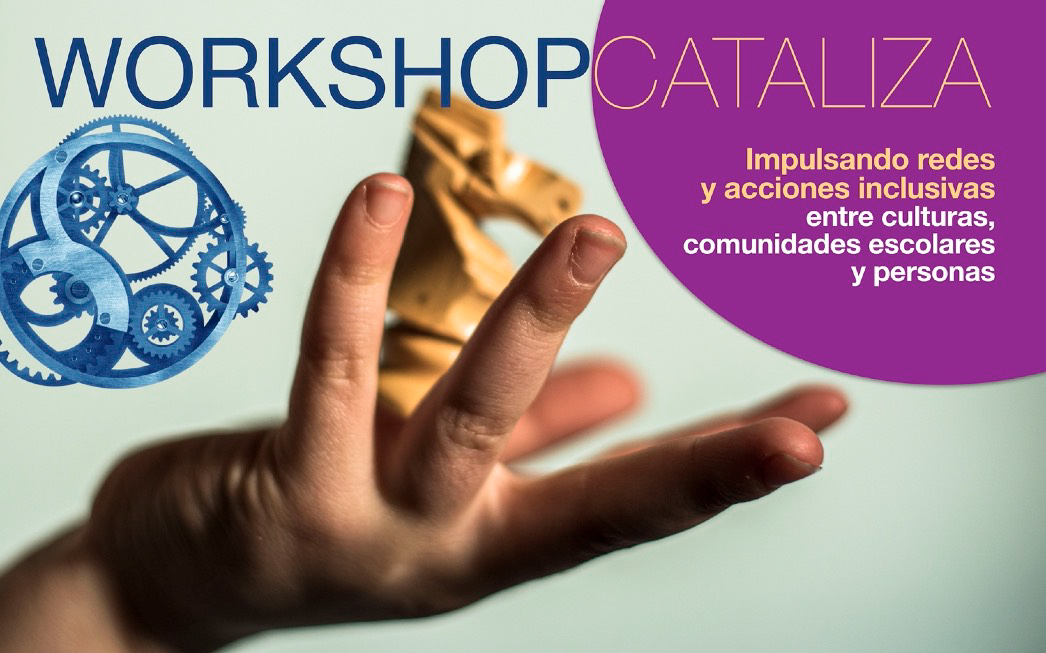
- Photograph by Paula Verde(a child’s hand holds a wooden chess piece).
- Organized by: Inclusive Education. Quererla es crearla; University of Malaga.
International meeting between professionals, families, students and other community agents to articulate and catalyze the movement for inclusive education and the emergence of more humane schools.
SUMMARY: The Catalyze Workshop is an international meeting between families, students, professionals, and other community stakeholders to drive the movement for inclusive education and the construction of more humane schools. The objective is to continue the participatory, organized, and systematic work that Quererla es Crearla has been developing for more than six years and to promote the construction of an International Network of schools for inclusion and equity, aimed at facilitating and accelerating the process of transformation of our educational systems to make them more inclusive.
The basis: thinking and building globally to act locally in the creation of a social movement for inclusive education.
Thinking and building globally to create inclusive schools locally
Where we come from, where we are going
In February 2018 we celebrate the main precedent of this meeting at the University of Malaga. The WorkshopOrienta was a working meeting that aimed to establish egalitarian communication between school professionals and families with enrolled children, with the idea of evaluating the experience of guidance in schools in the Spanish State, which must be inclusive. To this end, an intensive day of assemblies, presentations, and workshops was convened for people involved in inclusive education, which would conclude with strategic lines for continuing to work towards the necessary transformation of schools. That work was the seed for many actions developed over the following years by different people and groups.
That Workshop was not conceived as an event where some attend as listeners and others present. It was a collaborative work meeting, where we intensely dialogued to analyze the school reality and guidance in particular, and to generate strategic lines to continue advancing. Furthermore, non-attendees generated the context of the in-person meeting itself by creating videos in which they showed pain and joy in relation to school guidance, and participated through Twitter in the work sessions. The sessions were extraordinary, and from then on, many of the participants got moving.
Two years after the WorkshopOrienta, betweenMay and June 2020,while we were suffering the strict lockdown due to the COVID-19 pandemic, we took the opportunity to carry out a series of Conversations about (inclusive) school which were shared on social media. These conversations were intended to be a space to publicly reflect on the reality we are experiencing in our schools and to project the school we desire.
The sessions were recorded and disseminated through social media, while also being used for pedagogical research purposes. More than 200 people from different nationalities registered for the conversations, which is why the meetings were operationally divided by groups: first only families, then students, professionals, management teams, researchers, and policymakers at the Congress of Deputies. Despite holding meetings by groups, the idea was for all registered participants to attend the other debates, and the rest of the public was invited to follow and comment on them on social media. The listening exercise proved fundamental to the entire process.
We became aware of our collective identity with each story and each experience that was shared. At the same time, the idea that our biological condition is not the problem, but the “excuse” for maintaining a system that thrives on segregation, began to take shape.Estela WorkshopOrienta, 2018
As a result of all this, the recorded sessions from those days remain for reflection and analysis, and are already being used with tens of thousands of views. On the other hand, from these meetings, a document for legislative debate was born, both at the national and regional levels. In other words, a guide for the construction of public policies. The text, available for free download, is titled “Analysis and Proposals for a New Education Law” (Octaedro, 2020).
“In this way, many students were left behind very naturally, and it even seemed kind to recommend someone to look for other places with more resources and so on. Breaking that dynamic that has to do with beliefs, as you have mentioned, responding to the dilemma by stepping out of self-absorption has been the most important path, the most important challenge for me. Starting to look at ourselves from a different perspective.”CristóbalSchool Principal, Conversations, 2020.
Two years later, in October 2022, the WorkshopCrearla: Building collectively to promote the inclusive school, was organized in Madrid. The WorkshopCrearla was a meeting between families, students, and professionals where we shared a diagnosis of the school reality in relation to inclusion, collectively built over 4 years. From that starting point, the aim was to generate a dialogue that would allow us to continue working in a coordinated manner in the following years based on a series of strategic lines. During that meeting, each participant committed to the transformation of the education system. This meeting was broadcast live by PeerTube thanks to the support of xrcb.cat. The workshop served to design strategic lines to promote the real and effective development of the inclusive school, as well as to organize a great Participatory Action Research to promote inclusion in the school system. The following then emerged.
Decalogue of proposals
- 1. Build a steering group for each Autonomous Community, with members from different groups: professionals, students, families, politics, associations, and universities.
- 2. Carry out extensive dissemination work for the documentary.
- 3. Share the economic study of segregated and inclusive schooling.
- 4. Squeeze the web, experimenting with the guides and materials.
- 5. Create workshops and training sessions.
- 6. Improve the accessibility of the web.
- 7. Create a network of counselors throughout the State.
- 8. Weave networks by sharing stories.
- 9. Create a defined argumentation with three points: argument, reasoning, and evidence.
- 10. Committing as teachers to the educational community.
(Infographic from WorkshopCrearla)
“Despite the misinformation and fear, which is what we face every day, we have the obligation to believe in our children, to empower them, to make them brave individuals capable of making decisions and to be free.” AssemblyWorkshopCrearla, 2022
Starting work by territories
Although until then the meetings had been organized every two years and for the entire territory of the state, since then, and as a result of this approach, other more local but equally interesting meetings have been developed.
In March 2022, the Federation of AMPAs of Cádiz (FEDAPA Cádiz) opened a very interesting door by inviting members of different collectives from Quererla es Crearla, to participate in the Congress ‘Inclusion and good practices’which was held at the University of Cadiz. Particularly memorable was the participation of families and the student group, whose round table is now availablehere. That step would be irreversible for the movement.
In January 2023, something similar happened in Grado (Asturias), with members of the different collectives of Quererla es Crearla participating in the II Conference on Guidance for the 21st Century, in which the group of students once again shone particularly, this time represented by Martín and Indira. The conference provided a space for deep reflection and the building of collective will.
In October 2023, the Federation of AMPAS of Mallorca (FAPA Mallorca), with the collaboration of Quererla es Crearla among other entities, organized in Menorca the Balearic Days for Inclusion, where experts and activists met to debate and share experiences on inclusion in different areas: educational, community, and labor. Quererla es Crearla and FAPA Mallorca worked together in the preparation of this meeting, which highlighted the analysis of the situation of inclusive education in the adverse political context we are experiencing for the development of the right to education.
In June 2024, the Federation ‘Together for Inclusion’ of Paraguay prepared a Virtual meeting between students from Asunción and the collective “Students for Inclusion”, with which a new path of collaboration between collectives and openness towards international contexts began. This meeting would be preparatory for a major event in Paraguay.
Finally, in July 2024 we also collaborate in the organization of the “AMPA as accelerators of inclusive education” Conference, which have been held in Arcos de la Frontera under the auspices of FEDAPA Cádiz.
In addition to all these meetings, Quererla es Crearla has also been present at two Conferences with a less prominent, but also noteworthy role: in March 2024, the International Congress Universities and Inclusive Education (San Sebastián), and in April 2024 the Journeys of the Spanish Confederation of Associations of Parents and Mothers of Students (CEAPA) on the transition to secondary school for students labeled as having SEN (Pamplona).
“We meet again to talk and devise strategies together to continue building inclusion and empathy in classrooms, with families, teachers, administrators, government, youth, civil society, medical professionals, and social services. Join us! Only TOGETHER can we face the challenges.” ION MovementION Congress, Asunción.
Internationalization of the movement
In early July 2024 the ION Congress, a great participatory event in which Quererla es Crearla had an important space, particularly the participation of representatives from the collective “Students for Inclusion”. This event was preceded by intense participatory work initiated the previous year from the previous edition of the congress. In one year, there has been gigantic progress. This year, moreover, the event was followed by the ION Tour through different cities in the interior of the country. The experience has constituted a milestone in both movements, which are joining forces to advance the inclusive education agenda.
On the other hand, Quererla es Crearla has initiated an International Network of Schools for Inclusion and Equity, aimed at facilitating and accelerating the process of transforming our education systems to make them more inclusive. The network is composed of approximately 170 schools from 10 countries: Mexico, Costa Rica, Spain, Colombia, Peru, Chile, Brazil, Paraguay, Uruguay, and Argentina.
The WorkshopCataliza, to be held in Barcelona on October 25 and 26, 2024, aims to take on this challenge, mobilizing the International Network to advance in the task of developing more inclusive school institutions, offering learning opportunities and a social network that supports all students without exception. This implies building more welcoming and creative school communities that value differences and grow systematically from them. In this way, educational environments reduce segregation, and improve the quality of the learning they generate and the social relationships they foster, which means growing in democracy and social justice.
“So many people have looked at my disability and not seen me as ‘Ariel,’ and I’m not talking about the name, but about the young man who graduated, got diplomas, found a job, and started a communication services business without any help, on his own, with a white cane in the streets. Enough looking at the blind man! It’s time to see Ariel.”Ariel RuizION Movement, Villarica, Paraguay.
“Some people consider me a dreamer. I am a dreamer. But not a mad dreamer. Some people consider me an idealist, a dangerous idealist. I don’t think so. I believe in hope… Hope starts from what we call human nature.”Paulo Freirehttps://tinyurl.com/24kdl3w7.
Working towards the construction of a dream
Both the 2018 Workshop and the Conversations about the (inclusive) school in 2020 have constituted participatory diagnoses to understand the reality. They are narratives constructed through the dialogue of a large group of people for the transformation of collective ideologies and the construction of strategic objectives. From them, a series of works were derived that responded to what was discovered in these two major moments of collective creation.
These are proposals that aim to channel new ways of facing the explored reality. In other words, to create new paths through different forms of participation, which lead to an expansion of the participants’ experience, and to the production of useful guides and materials for building inclusion. Among all of them, the following works stand out:
- The first is a Participatory Action Research developed at the CEIP “La Parra” of Almáchar (Málaga), an experience that is serving to train other schools nationally and internationally through the Network of Schools for Inclusion and Equity, and from which a guide on its own school improvement process emerges. The second is a
- The second is aWorking Group on Inclusive Psychopedagogical Assessment, with more than 3 years of recorded periodic meetings, made up of about 50 guidance counselors from all over the country who are building a new proposal for alternative psychopedagogical assessment, as a key piece in the construction of the inclusive school.
- The third is a “Students for Inclusion Working Group. For more than 2 years, periodic meetings have been recorded with students from all over the country. Together they have built a guide for students themselves to promote inclusion in their schools.
- The fourth is a Activist Families Working Group for Inclusive Education, has built the awareness campaign for inclusive education “Quererla es crearla”. The campaign is composed of several videos, among which the one that gives it its name (“https://youtu.be/ze1K3X5-NTY“) and the website of Quererla es Crearla, which brings together all the previous work, as well as a selection of legal texts to defend inclusive education and scientific texts that underpin it. Furthermore, this collective has developed the Guide “How to Disagree”.
- Finally, all this work culminates in the Documentary “Inclusive Education. To want it is to create it”, directed by filmmaker Cecilia Barriga, which premiered on October 21, 2022 (one day before the Create Workshop), at the Reina Sofía National Museum of Art. , directed by filmmaker Cecilia Barriga, which premiered on October 21, 2022 (one day before the Create Workshop), at the Reina Sofía National Museum of Art.
This methodological architecture, developed to promote inclusive education in the Educational Policy Agenda, has been built on the personal stories from many participantswho have generously shared their experiences in school. These stories serve as a roadmap or a map, helping us to recognize the terrain and know which steps we should and should not take, in light of previous experiences. And it is this construction – work with specific schools that are moving forward, and a social movement that supports them – that we are now sharing withfamilies, students, and professionals from other Latin American countries, with the hope that together we can make schools move, learn from each other, and ensure that no child or young person is deprived of their fundamental right to education.
A few brushstrokes about the research in which the Workshop is framed
The research project ““Emerging narratives for the construction of inclusive schools” (Ministry of Science and Innovation, PID2022-140193OB-I00), within which the WorkshopCataliza, it is a continuation of another that began in 2018, called “Emerging Narratives on Inclusive Schooling from the Social Model of Disability. Resistance, Resilience, and Social Change”. The project is based on two premises:
- The activism of persons with disabilities and their support network contributes to the formation of identities that promote educational inclusion and social change.
- Mutual support and resistance networks foster resilience processes that benefit persons with disabilities.
Since its inception, the project has generated numerous resources and a growing movement for inclusive education, under the slogan Inclusive education. To want it is to create it, which highlights that the involvement of all citizens is necessary to make this collective desire a reality. Hence the importance of continuing to develop research and development processes based on the basic moral principle of considering that all human beings are equal in dignity and rights, regardless of differences in gender, abilities, beliefs, social status, sexual orientation, or any other characteristic. Based on these ideas, the research project addresses the difficulties faced by education systems worldwide in responding to many of the social, technological, and cultural transformations occurring both inside and outside educational centers.
The research has aimed to rescue stories of activism from families, students, and professionals who are resolutely fighting to make school a place where all children find recognition through presence, learning, participation, and success in the pre-primary and compulsory stages. It documents and analyzes the experiences of those striving to ensure the fulfillment of Article 24 of the Convention on the Rights of Persons with Disabilities, ratified by Spain (UN, 2006). However, the research goes far beyond these descriptive and legal terms.
The research work developed so far in Spain has demonstrated its capacity to position itself at the forefront of knowledge, as well as to contribute to the development of schools in our country, but also beyond our borders, particularly in Latin America. In this regard, finding ways to include social groups that are excluded or in situations of high vulnerability – particularly people in poverty, students identified by disability, indigenous students, and students from rural populations – in education systems is a fundamental challenge for all Latin American countries.
These contradictions, which despite the achievements, are incorporated into the project of making schools more inclusive, also take place in the omnipresence of legal reason over ethical reason (Skliar, 2008). There is no doubt that its consideration as a human right constitutes one of those fundamental levers for the change we need. But there is also no doubt that not everything is solved by stating it. New discourses and practices are needed that question the hegemonic narratives of schools that overshadow others that could offer new possibilities for the construction of identities that overcome current forms of relationship and meaning-making (Adami, 2014; Calderón-Almendros & Calderón-Almendros, 2016; Calderón-Almendros & Ruiz-Román, 2016), allowing for more robust resistance and strengthening possibilities for personal and collective resilience based on the recognition of our humanity: we can rebuild ourselves through education.
Based on the premises mentioned and the progress made in these six years of research,the motivation for the current project and theWorkshopCataliza is to continue in the generation of pedagogical knowledge and construction.
“What kind of world do we want? Is it a world in which we can comfortably rationalize the exclusion and segregation of different groups of people? What is the nature of justice and democracy? Does this not apply to people we consider to have SEN?” Roger Slee (2011:73) University of South Australia.
The Catalyze Workshop
Purpose
To generate an international meeting between families, students, and professionals that begins with a diagnosis of the school reality in relation to inclusion, collectively built over the last 6 years of research. Starting from there – as well as from other diagnoses generated in Latin American countries – the aim is to develop an egalitarian dialogue in which strategic lines emerge for continued participatory, organized, and systematic work over the next 2 years. This is not a conventional conference or course. It is a meeting aimed at facilitating and accelerating the transformation process of our education systems to make them more inclusive, both in Spain and in Latin America.
Objectives
- To facilitate and accelerate the process of transformation of educational policies, cultures, and practices in schools in Spain and Latin America, guiding them towards inclusion and equity through participatory methodologies.
- To establish a space for the development of the International Network of Schools for Inclusion and Equity.
- To know and understand the educational conceptions, experiences, and professional practices involved in school inclusion processes.
- To learn from the knowledge of students, families, and professionals, encouraging all members of the educational community to share their school experiences and proposals for improvement.
- To identify, develop, and share the collaboration mechanisms used in different educational centers.
Methodological bases
The WorkshopCataliza it will be part of the research, as will the previous participatory meetings held within this project. It will function as Participatory Action Research (PAR), which aims to nest multiple more local PAR processes. Action-focused participatory methodologies facilitate the construction and development of common projects to transform reality, critically examining power and privilege according to Brydon-Miller & Maguire (2009), generating collaborative relationships as a framework for more effective practices.
Spivak (2006) reflects on the difficulty of the subaltern subject to express themselves and be heard. A difficulty that lies in the absence of spaces that accommodate these voices that have historically been silenced. Participatory methodologies also enable new forms of discursive production, unexplored channels through which to channel new discourses and the generation of processes of listening, transformation of practices, and questioning of power. Because for subordinate groups, the act of writing (in the broadest sense of the word) is an act of rebellion against imposed silence. Writing publicly is a political act. Therefore, the construction of narratives is a subversive and, in itself, transformative act.
This is intended to be an international participatory workshop, bringing together the experience of schooling for boys and girls and school inequality, and involving families, professionals, and students. A working meeting that aims for egalitarian communication among these groups in order to evaluate the schooling experience in schools in Spain and Latin America, which must be inclusive. This work will conclude with strategic lines for coordinated action in different territories to achieve the necessary transformation of schools. This meeting provides a framework for the development of the rest of the research and will seek to mobilize an international group of activists to generate action proposals, with a special emphasis on promoting the student collective for inclusion.
Working dynamic
How the meeting is structured
The WorkshopCataliza will consist of two intensive working days. The morning sessions will be for participants from Spain, given the time differences; the afternoon sessions will be for the international workshop. The first day will focus on supporting the network of schools; the second, on structuring the social movement. Regardless of this plan, all participants will be able to attend any session. The days will be distributed as follows (GTM Madrid):
Friday, October 25, 2024
Morning
08:30-09:00 h. Doors open and accreditation.
09:00-09:30 h. Presentation of the day and work proposal.
09:30-10:30 h. Plenary Assembly. The Network of Schools for inclusion and equity in Spain at the center.
10:30-11:30 AM. Round table: Guiding the school towards inclusion. Stop looking in the wrong place.
11:30 AM – 12:00 PM. Break. Coffee in the Courtyard.
12:00-1:30 PM. Simultaneous workshops: Towards a change of focus in schools
1:45-2:15 PM. Plenary Assembly. Sharing of workshop outcomes.
2:15-3:45 PM. Lunch.
Afternoon
3:45-4:45 PM. Presentation of the International Workshop. Where we come from, where we are going.
4:45-5:45 PM. Plenary Assembly. What is happening in our schools?
5:45-6:15 PM. Break.
6:15-7:45 PM. Simultaneous workshops: Moving forward from schools.
8:00-8:30 PM. Plenary Assembly. Sharing workshop outcomes.
Saturday, October 26, 2024
Tomorrow
08:30-09:00 AM. Doors open.
09:00-10:00 AM. Presentation and Plenary Assembly. Sharing analysis, concerns, and work for the transformation of the system.
10:00-11:00 AM. Round table: Families and students share what they have learned.
11:00-11:30 AM. Break. Coffee in the Courtyard.
11:30 AM – 1:30 PM. Simultaneous workshops: Learning, movement development, and influence
1:45 PM – 2:15 PM. Plenary Assembly. Sharing of workshop outcomes and decision-making.
2:15 PM – 3:45 PM. Lunch.
Afternoon
15:45-16:45 h. Presentation and Plenary Assembly. Analysis and challenges for an International Social Movement.
16:45-17:45 h. Round table: Contributions from families and students.
5:45-6:15 p.m. Break.
6:15-7:45 p.m. Simultaneous workshops: Putting inclusive education on the social agenda.
8:00-8:30 p.m. Plenary Assembly. Sharing workshop outcomes and building proposals.
Online participation
It is expected that many people, despite their interest in participating in this meeting, will not be able to be in Barcelona in person. Particularly for all those participating from Latin America, we may ask them for some tasks beforehand to include their perspectives. On the other hand, the plenary sessions will be streamed live so that interested people, both within and outside our borders, can follow them. The hashtag #WorkshopCataliza will be used on the X social network so that people following the debates and the assembly work can participate live.
- Basic information: www.creemoseducacioninclusiva.com/workshopcataliza.
- Online registration and participation: https://decidimoseducacioninclusiva.uma.es/conferences/workshopcataliza
- Location: Bofill Foundation Social Hub. C/ de Girona, 34, L’Eixample, 08010. Barcelona.
- Contact: info@creemoseducacioninclusiva.com
- Organizers: Quererla es crearla. University of Malaga.
- Collaborates: Fundació Bofill. Education to change everything.
Bibliographical references
- Barton, L. (2005). Emancipatory research and disabled people: some observations and questions. Educational Review, 57, 317-327.https://doi.org/10.1080/00131910500149325
- Kemmis, S. (2006). Participatory Action Research and the public sphere. Educational Action Research, 14 (4), 459-476.https://doi.org/10.1080/09650790600975593
- Moriña, A. (2017). Investigar con Historias de Vida. Narcea, Madrid.
- UN (2006). Convention on the Rights of Persons with Disabilities. New York, NY: UN.https://bit.ly/2X6oZGC
- Parrilla, Á. (2009). What if research on inclusion were not inclusive? Reflections from a biographical-narrative research. Revista de Educación, 349, 101-117.https://bit.ly/3Irzlad
- Rojas, S. (2008). The “voice” of people with intellectual disabilities in educational research: rethinking research practices. Revista de Educación, 345, 377-398.https://bit.ly/3NRxQTO
- Spivak, G.C. (2006). Can Subaltern Speak? In C. Nelson & I. Grossberg (Eds.), Marxism and the Interpretation of Culture (271-316). London: Macmillan.
- Wolgemuth, J. & Donoghue, R. (2006). Toward an inquiry of discomfort: Guiding transformation in “emancipatory” narrative research. Qualitative Inquiry, 12(5), 1012-1021. https://doi.org/10.1177/1077800406288629
Latest project productions
- CALDERÓN ALMENDROS, I. & RASCÓN GÓMEZ, M.T. (2022). Weaving struggles for the right to education: collective and personal narratives for inclusion from the social model of disability. Pedagogía Social. Revista Interuniversitaria, 41, 43-54.
- SOLDEVILA-PÉREZ, J.; CALDERÓN-ALMENDROS, I. & ECHEITA, G. (2024). My (school) life is expendable: radicalizing a discourse against the miseries of the school system. In J. Collet, M. Naranjo & J. Soldevila (Ed), Global Inclusive Education (pp. 41-62). Octaedro.
- JURADO, B. AND CALDERÓN ALMENDROS, I. (2024). Violations of the right to education that occur daily in our schools. And nothing happens. AOSMA, Journal of Educational Guidance, 33, 118-127.
- CALDERÓN ALMENDROS, I. & RASCÓN GÓMEZ, M.T. (Coords.) (2024). The role of the university in building inclusive education systems. Difficulties, proposals, and challenges. Octaedro.
- ALONSO BRIALES, M. & VILA MERINO, E. (2019). Thinking collectively about a better school. Continuing professional development and inclusive education. Aula de Secundaria, 33, 18-22.
- CALDERÓN ALMENDROS, I. & RASCÓN GÓMEZ, M.T. (2021). Rhetorics, possibilities, and torn childhoods. On inclusive education in the LOMLOE. Cuadernos de Pedagogía, 526, 74-80.
- CALDERÓN ALMENDROS, I. & RASCÓN GÓMEZ, M.T. (Coords.)(2020). Analysis and proposals for a new Education Law. Citizen conversations about inclusive schools. Octaedro, Barcelona.
- VILA MERINO, E., RASCÓN-GÓMEZ, M.T. & CALDERÓN-ALMENDROS, I. (2024). Disability, stigma, and suffering in schools. Emerging narratives for the right to inclusive education. Educación XX1, 27(1), 353-371.https://doi.org/10.5944/educxx1.36753
- CALDERÓN ALMENDROS, I.; RASCÓN GÓMEZ, M.T. & ALONSO BRIALES, M. (2020). Researching to build inclusive education. In Vila, E. and Grana, I. (Coords.), Educational research and social change (pp. 189-209). Octaedro, Barcelona.
- CALDERÓN-ALMENDROS, I.; AINSCOW, M.; BERSANELLI, S. & MOLINA, P. (2020). Educational inclusion and equity in Latin America: an analysis of the challenges. Prospects: Comparative Journal of Curriculum, Learning, and Assessment, 49(3), 169-186.
- CALDERÓN ALMENDROS, I.; MORENO PARRA, J. & MOJTAR MENDIETA, L. (2023). School inequality and discrimination based on ability during confinement. Family experiences in participatory research processes. Revista Complutense de Educación, 34(4), 945-954.
- COLLECTIVE ‘STUDENTS FOR INCLUSION’, CALDERÓN, I.; MOJTAR, L. & CABELLO, F. (2021). How to make your school inclusive. Ministry of Education and Vocational Training, Madrid.
- HERRERA FERNÁNDEZ, M.M., MATÉS LLAMAS, C., FARZANEH PEÑA, D. & BARRADO FERNÁNDEZ, S. (2021). Moving towards inclusion through participatory action research in an educational community. Revista Latinoamericana de Educación Inclusiva, 15(2), 135-153.
- MARTÍNEZ MARTÍN, M.; CALDERÓN ALMENDROS, I. and VILLAMOR MANERO, P. (2019). The role of practice in the training of education professionals. In Vera Vila, J. (Coord.), Training to transform. Social change and educational professions (pp. 133-156). GEU Editorial, Granada.
- MOJTAR-MENDIETA, L. & CALDERÓN-ALMENDROS, I. (2022). Silenced voices leading school changes. Enabling Education Review, 10, 28-29.
- MORENO PARRA, J.J. (2021) Inclusive Education: From the State to the Public. Devenir. 40, 67-90.
- MORENO PARRA, J.J., MOJTAR MENDIETA, L., GONZÁLEZ MILEA, A. (2020). Inclusive education in the time of COVID-19. Aula de Secundaria, 38, 18-22.
- RASCÓN GÓMEZ, M.T. AND CABELLO FERNÁNDEZ-DELGADO, F. (2019). Audiovisual narratives about resilience and education from an edu-communicative approach. Innovación Educativa, 19 (80), 77-92.
- RASCÓN GÓMEZ, M.T. and CALDERÓN ALMENDROS, I. (2019). Challenges of inclusive education in secondary education. Aula de Secundaria, 33, 12-17.
- UNESCO-OIE (2022). Reaching all students: a UNESCO-OIE toolkit to support inclusion and equity in education. International Bureau of Education of UNESCO, Geneva.
- ALONSO, M.; RASCÓN, M.T.; CALDERÓN, I. & EDUCATIONAL COMMUNITY OF CEIP ‘LA PARRA’ (2023). How to do Participatory Action Research. Ministry of Education and Vocational Training.
- CALDERÓN-ALMENDROS, I. & ECHEITA, G. (2022). Inclusive Education as a human right. Oxford Research Encyclopedia of Education.
- CALDERÓN-ALMENDROS, I.; MORENO-PARRA, J. & VILA-MERINO, E. (2022). Education, power, and segregation. The psychoeducational report as an obstacle to inclusive education. International Journal of Inclusive education.
- COLECTIVO RADIKALES DESADAPTADAS (2024). How to dissent. A Guide (or companion). Octaedro.
- CALDERÓN ALMENDROS, I. & MORENO-PARRA, J. (Coords.)(In press). Towards an alternative psychoeducational assessment. Octaedro.