Crearla Workshop: Collectively Building to Drive Inclusive Schools
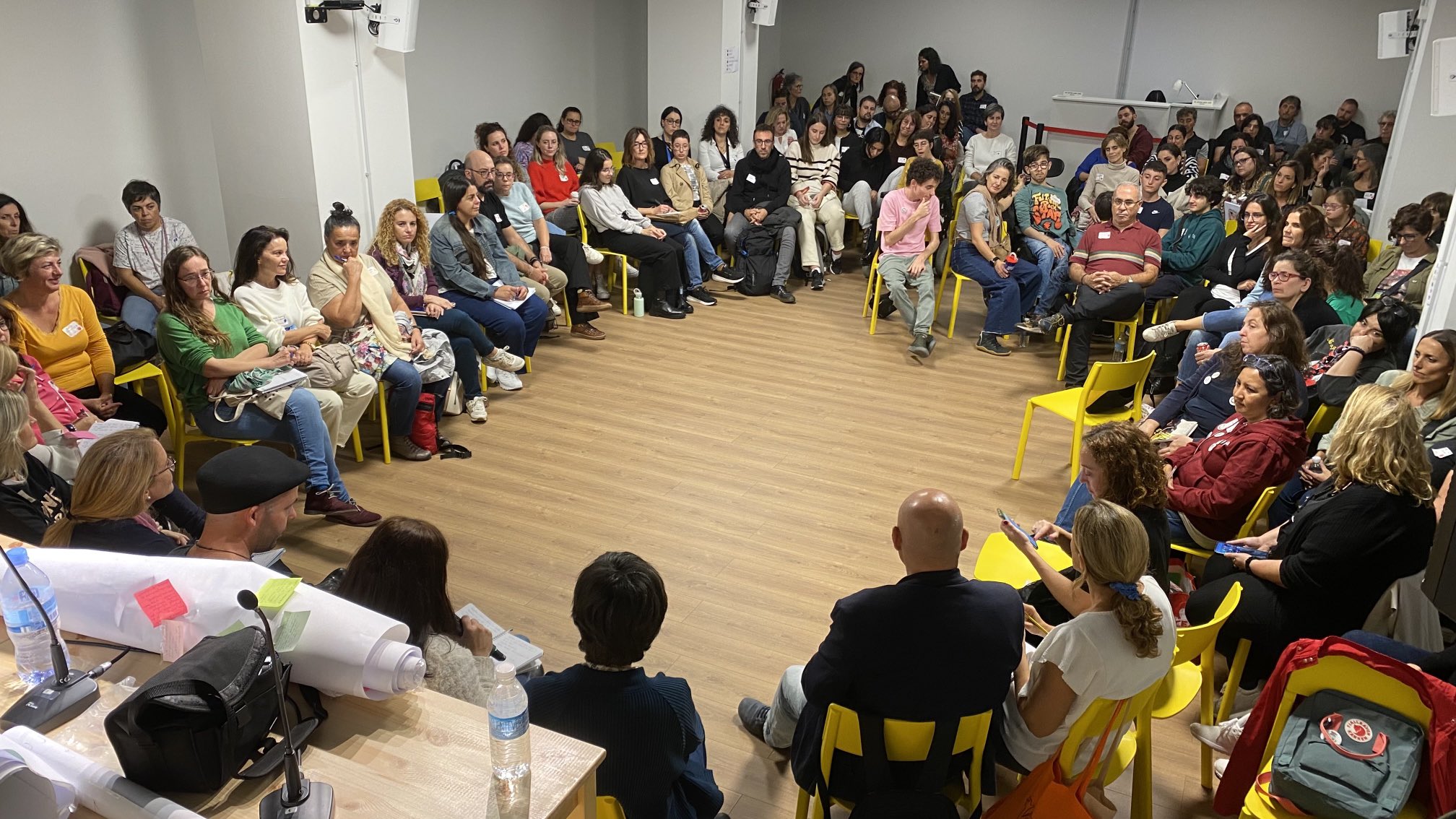
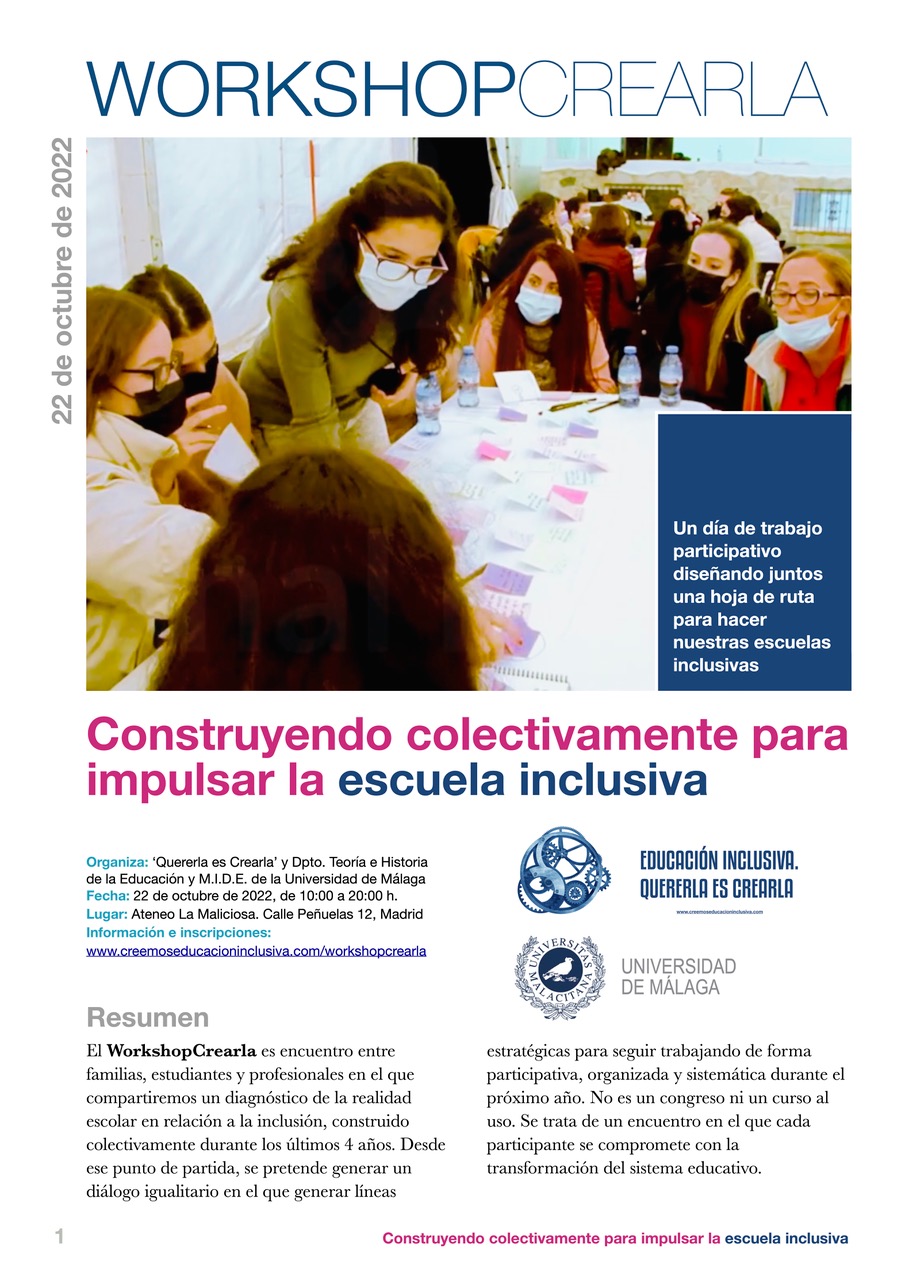
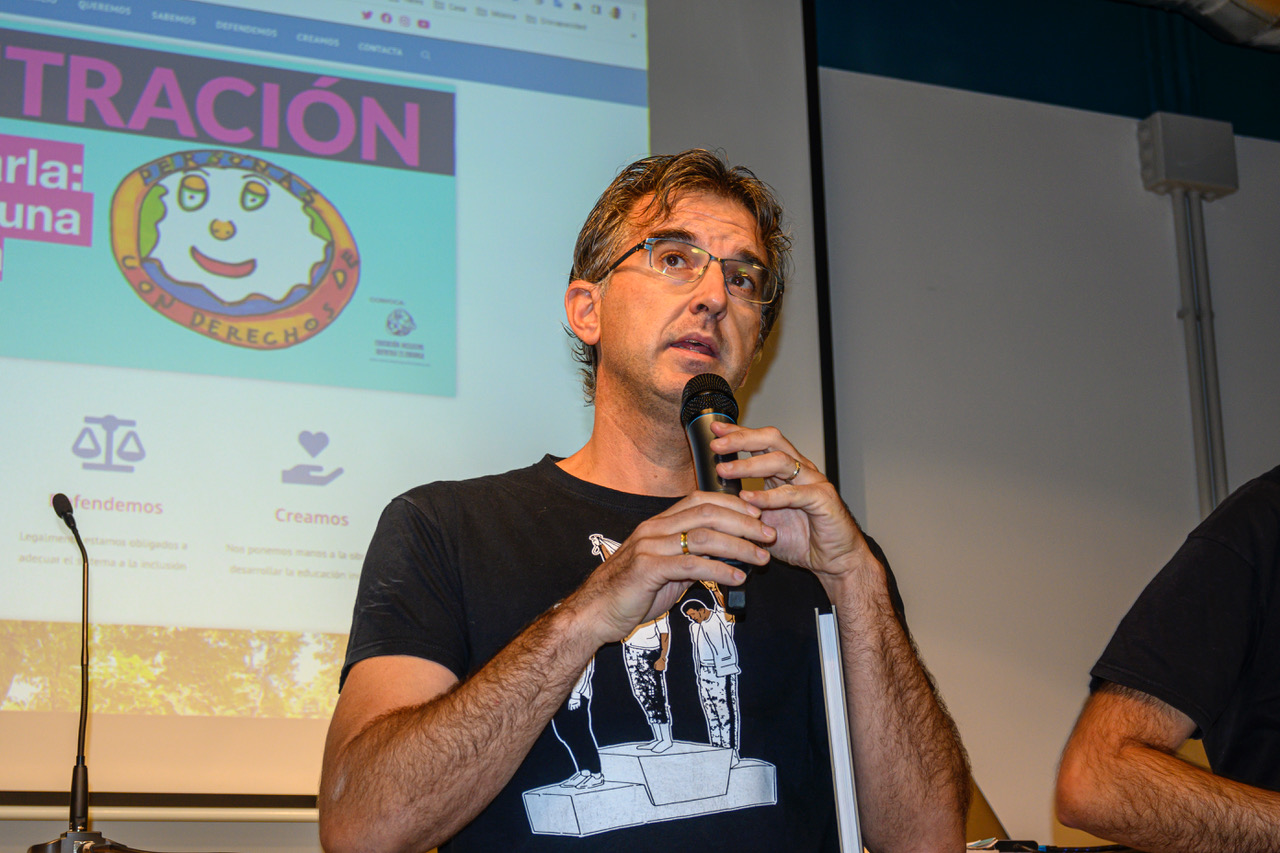
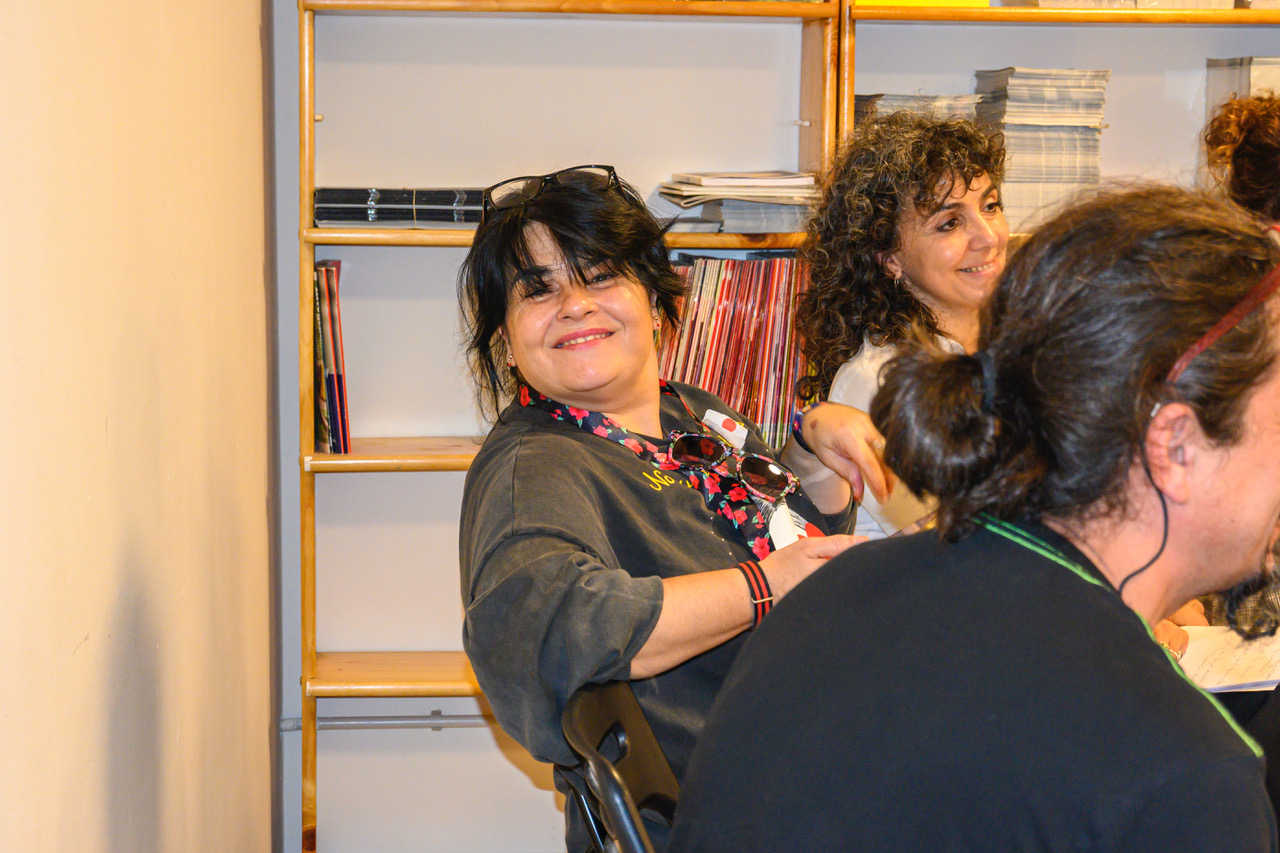
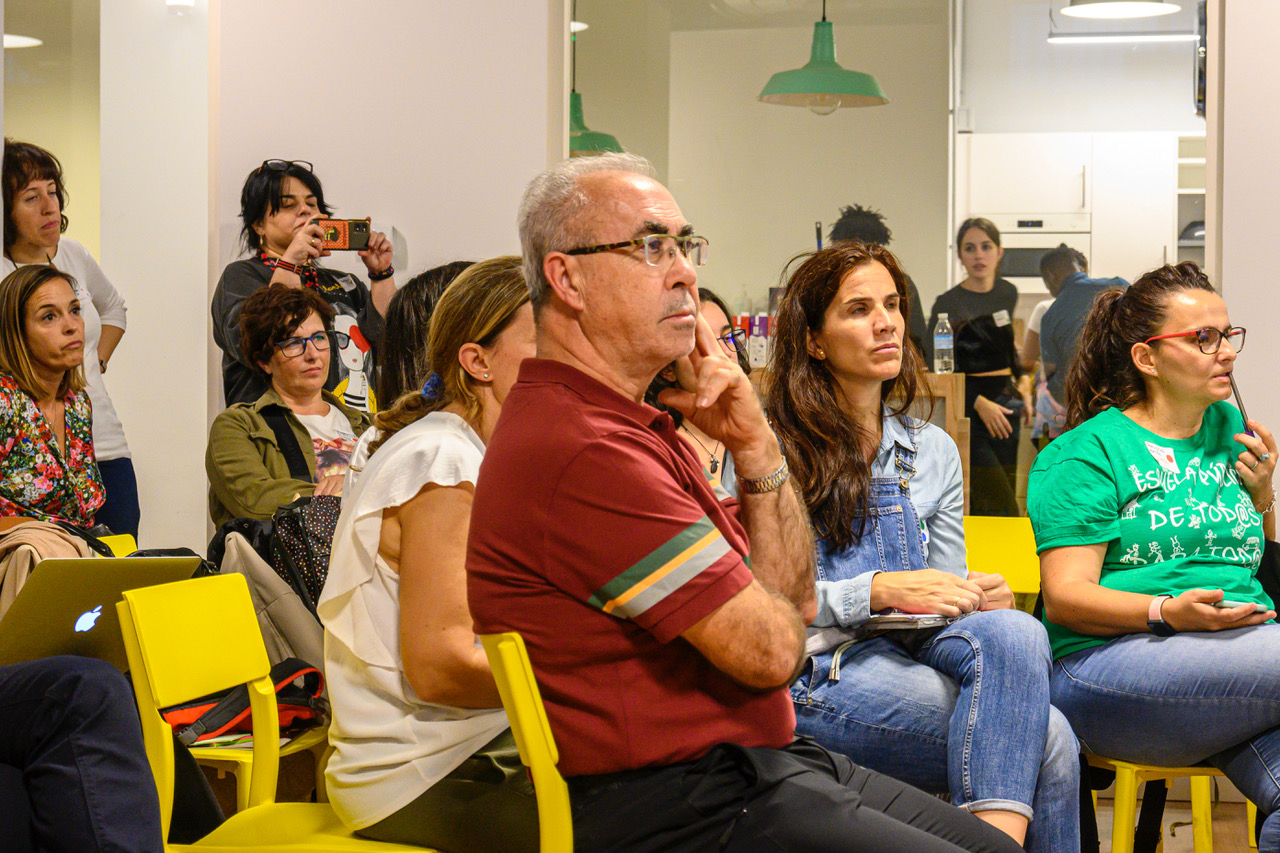
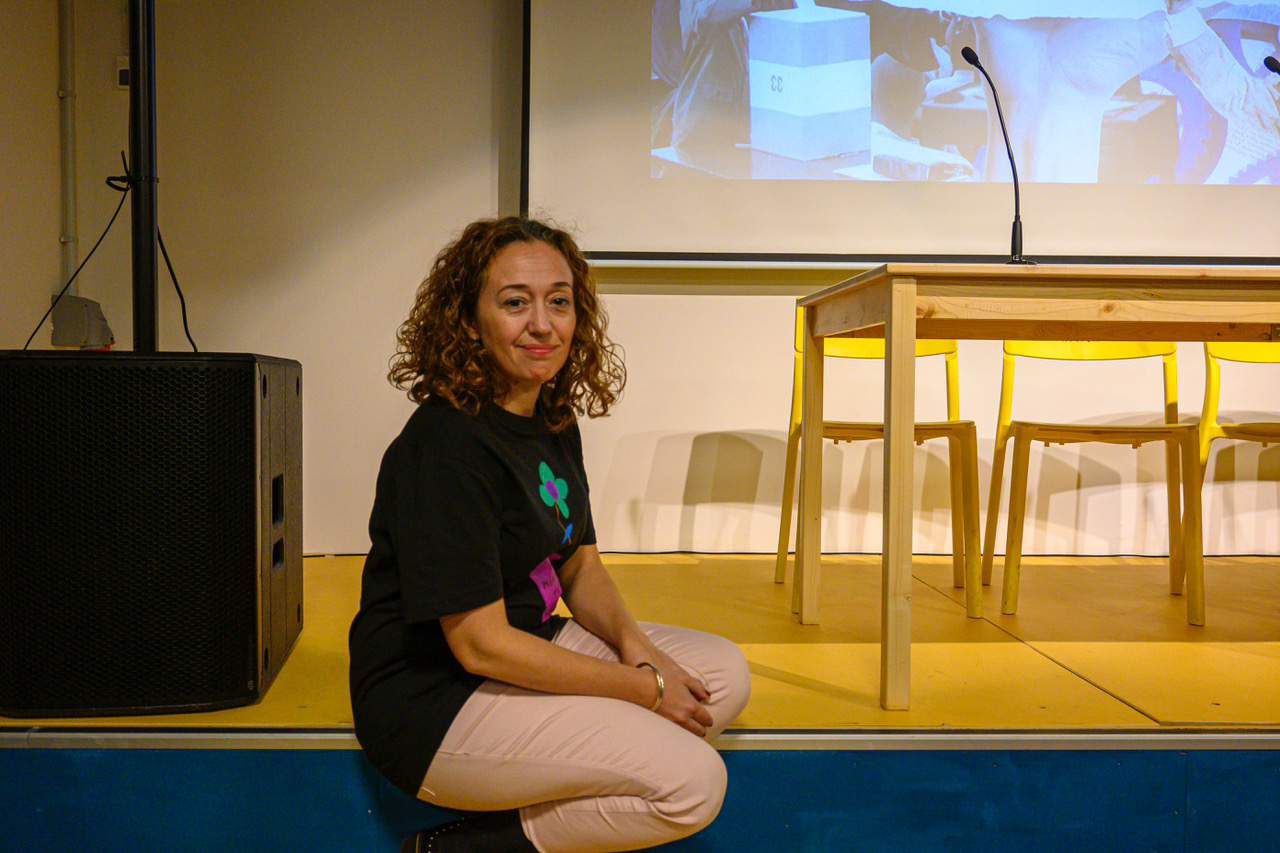
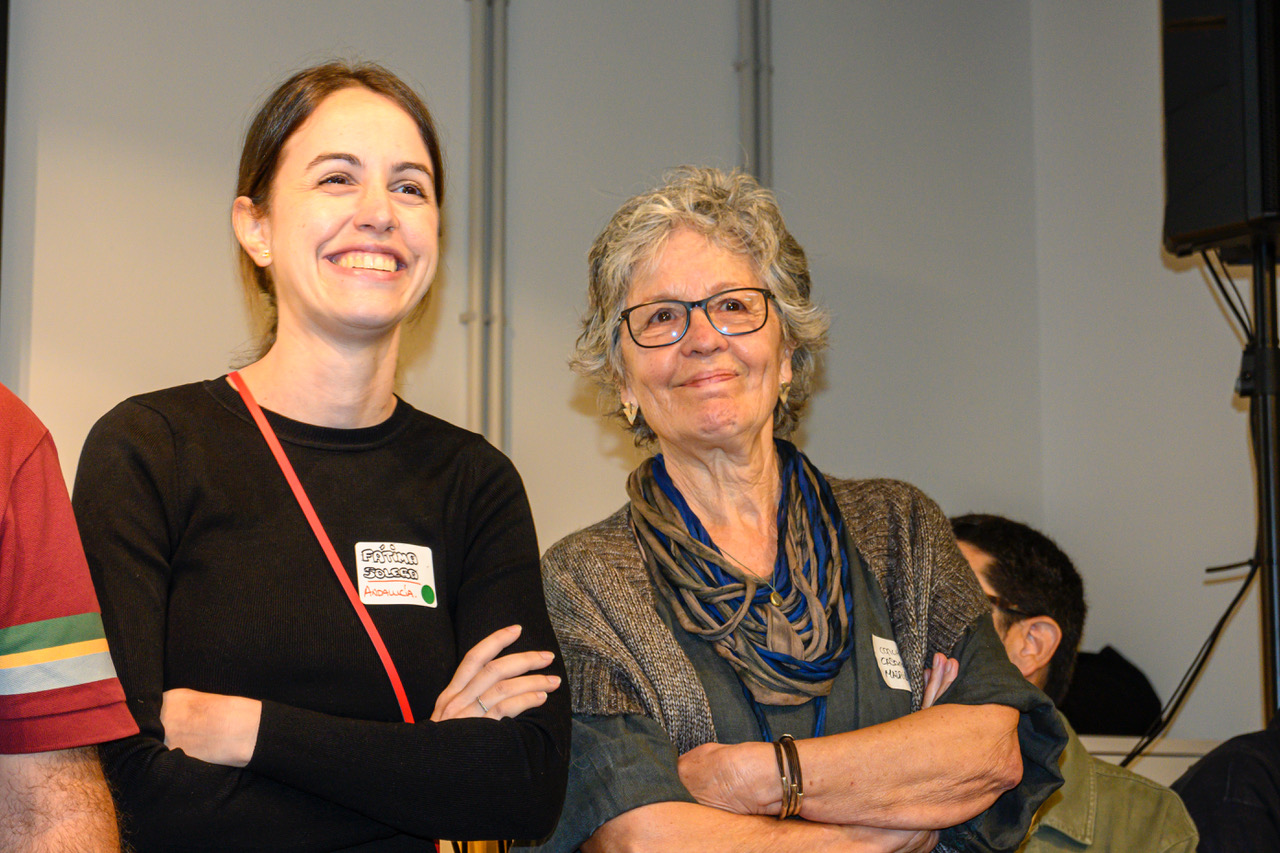
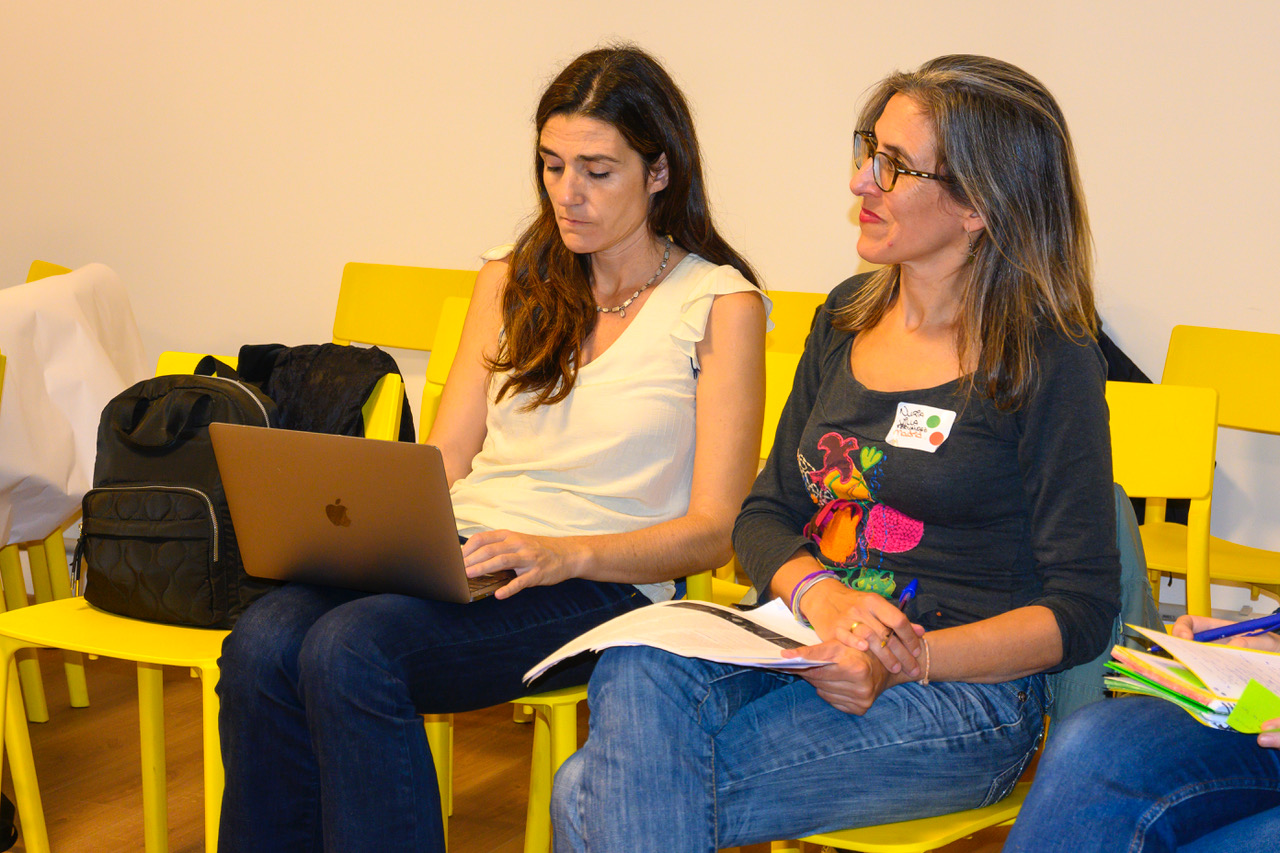
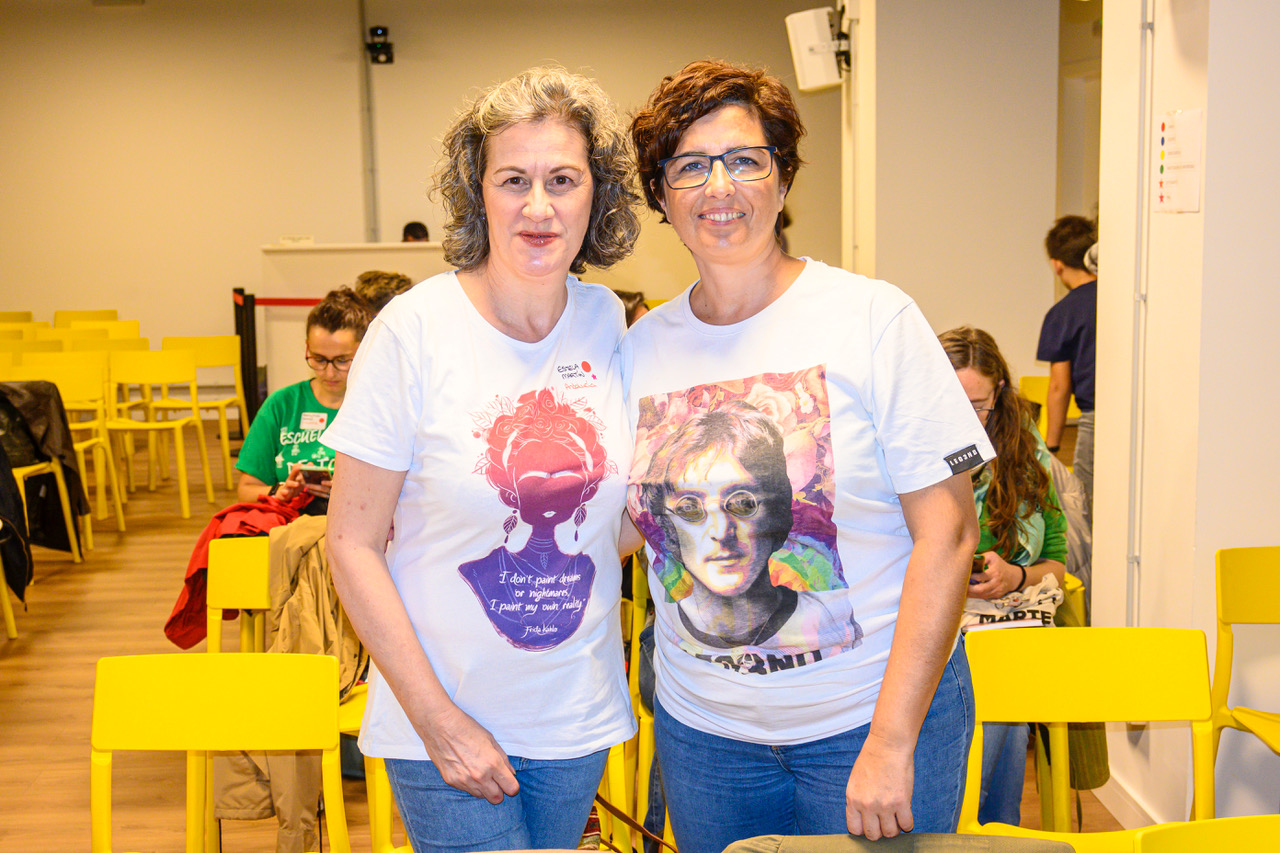
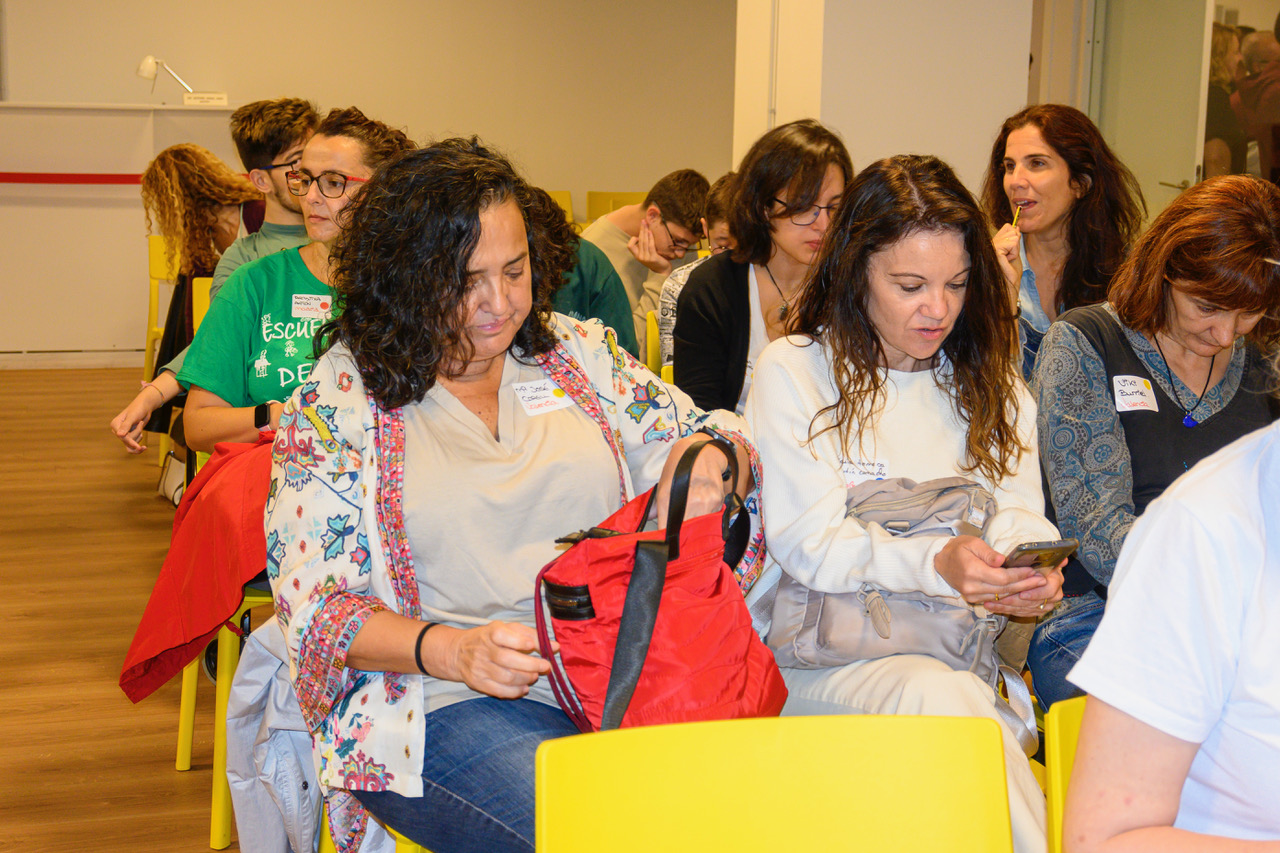
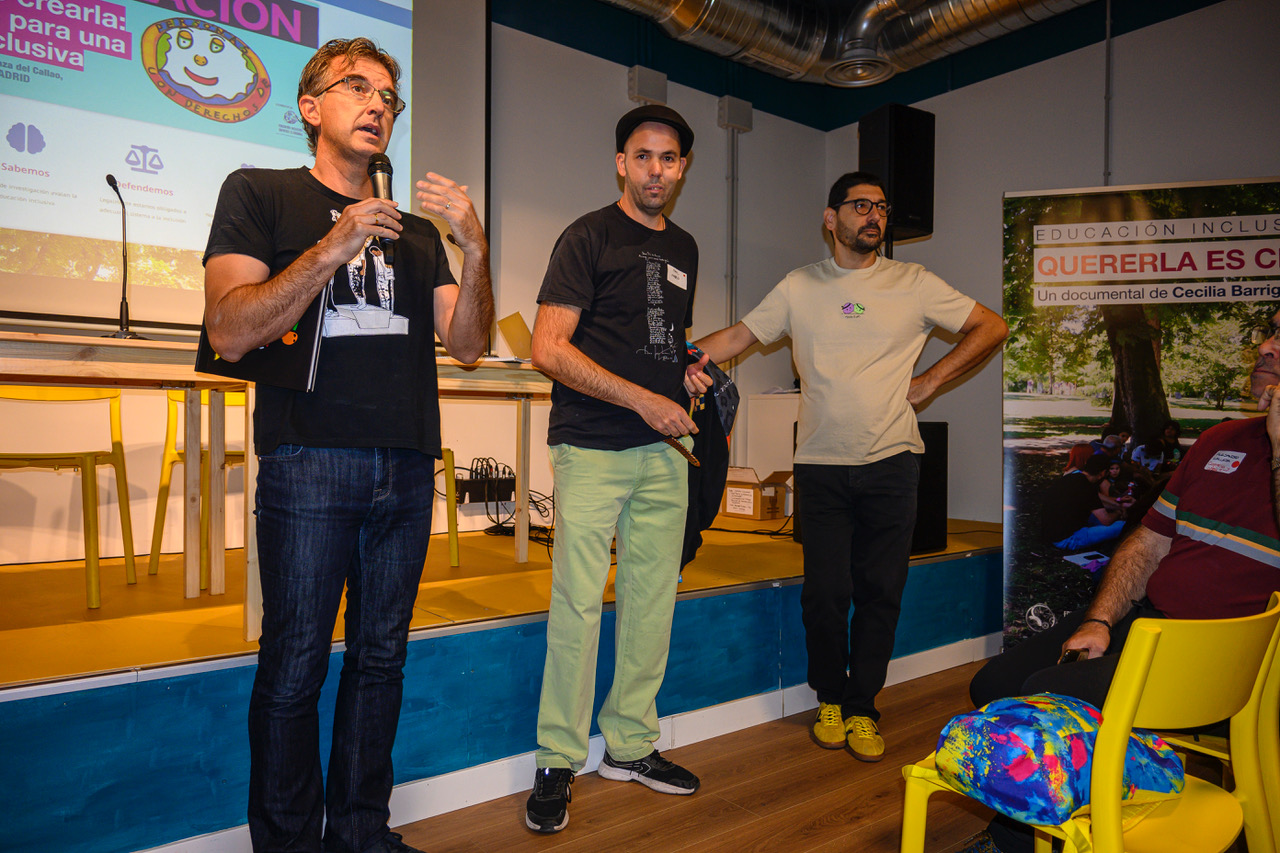
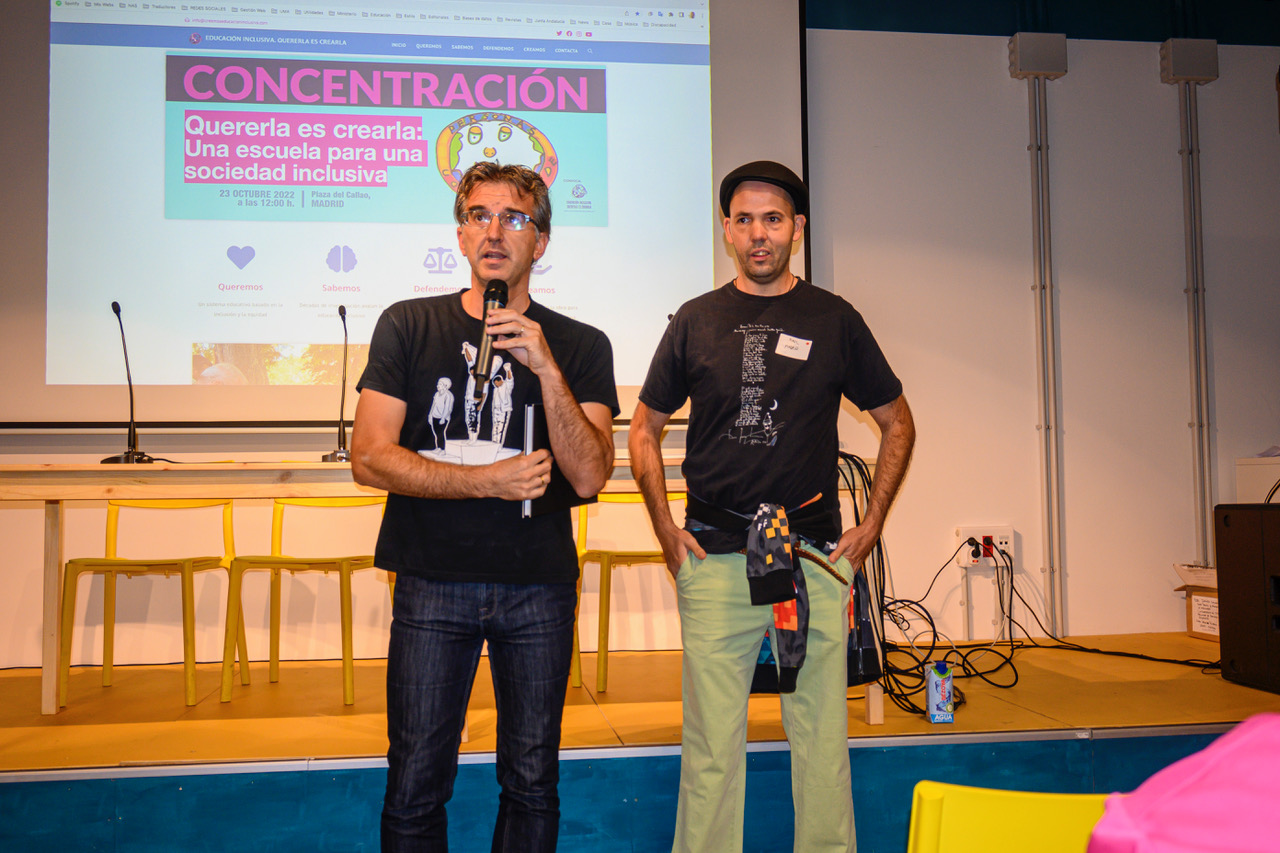
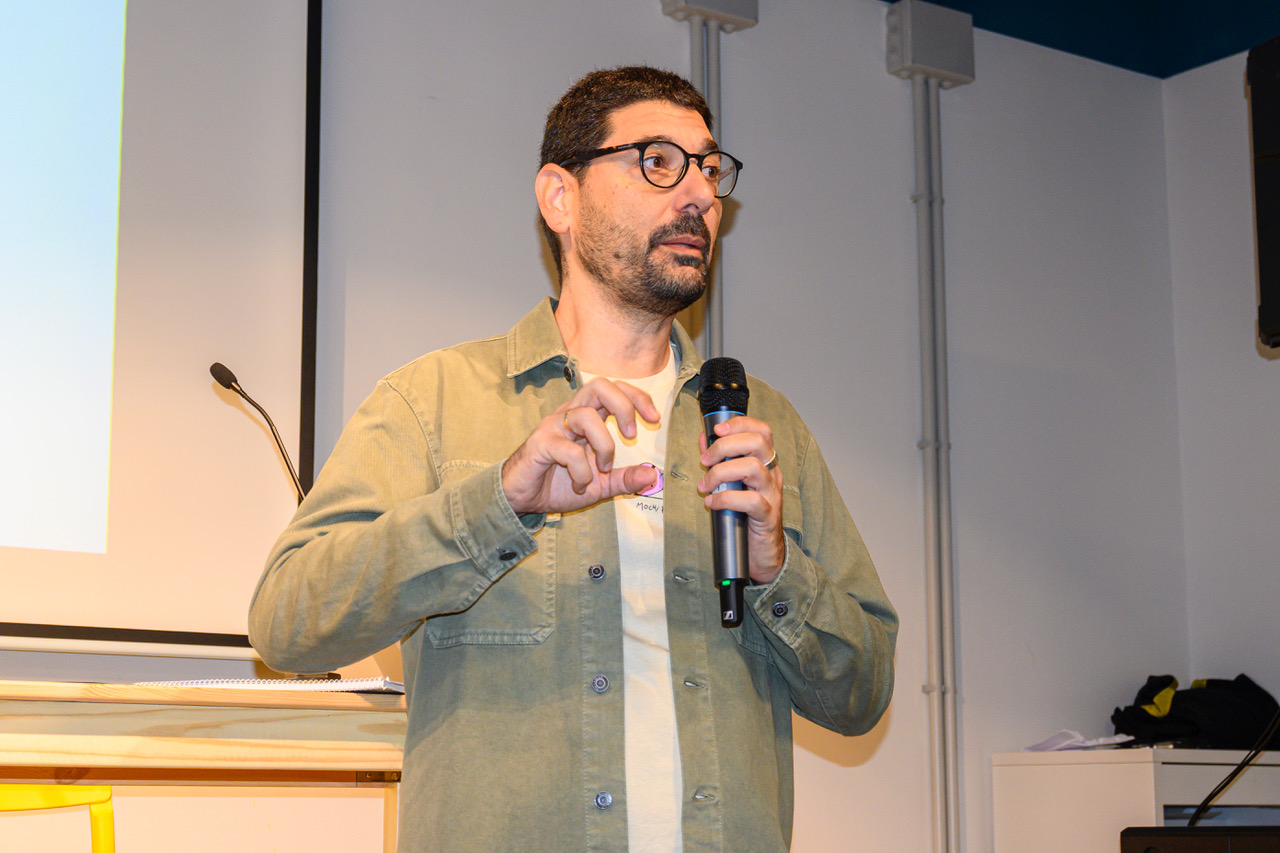
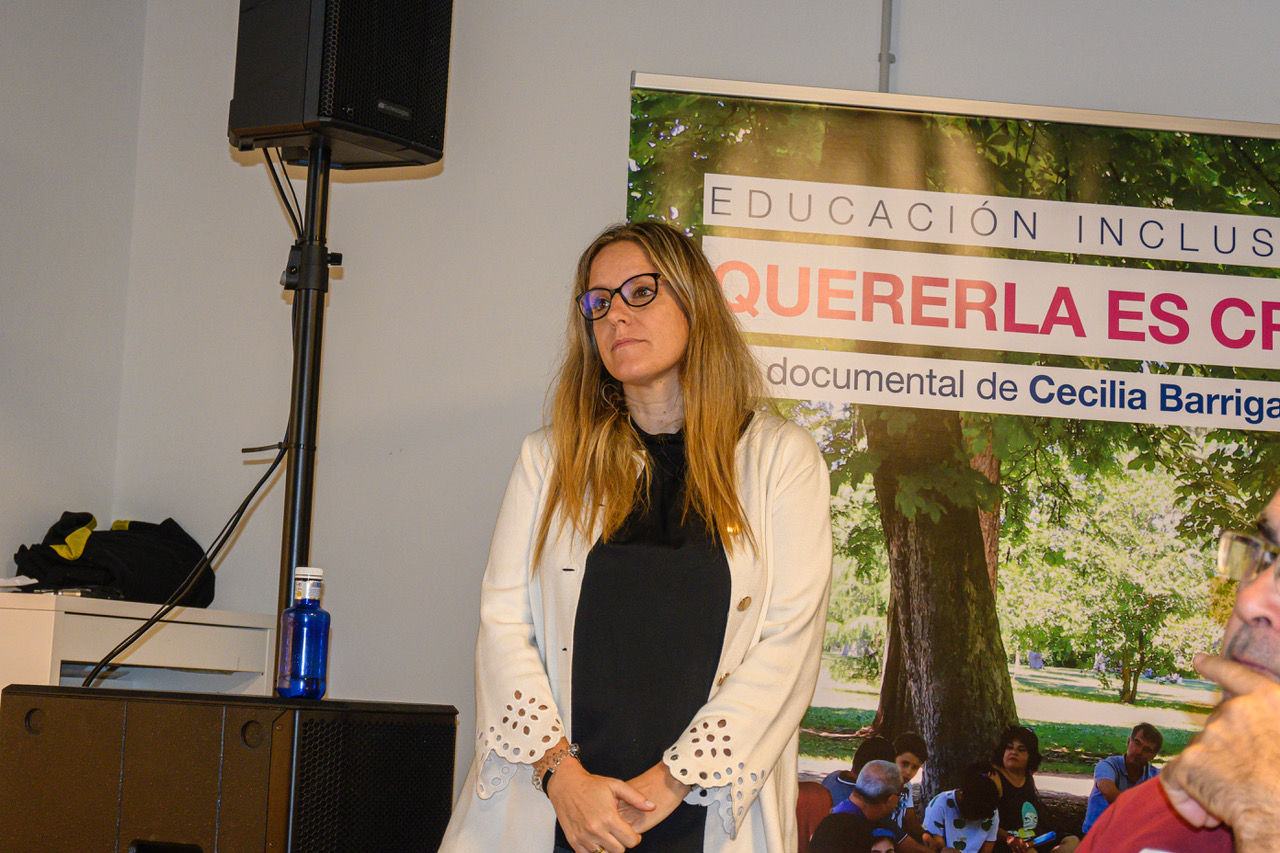
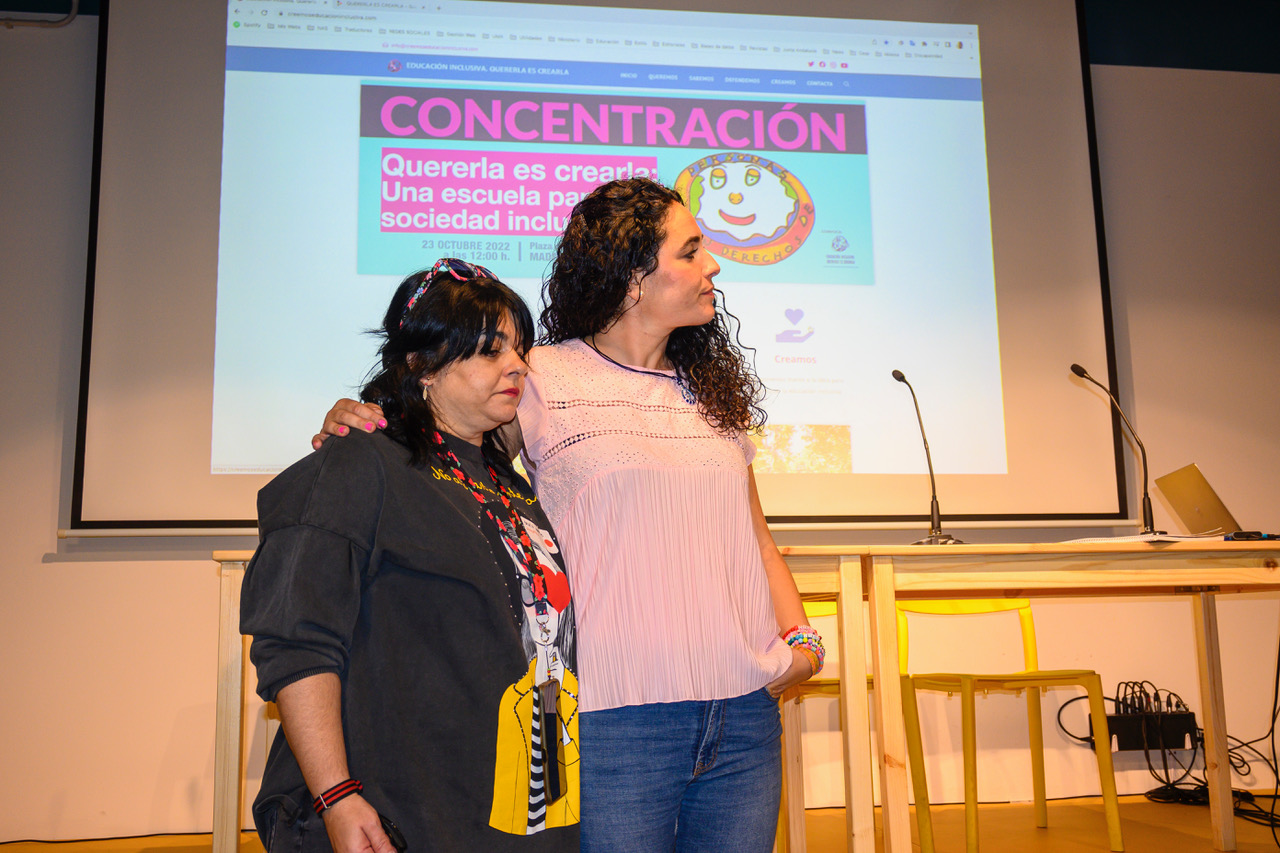
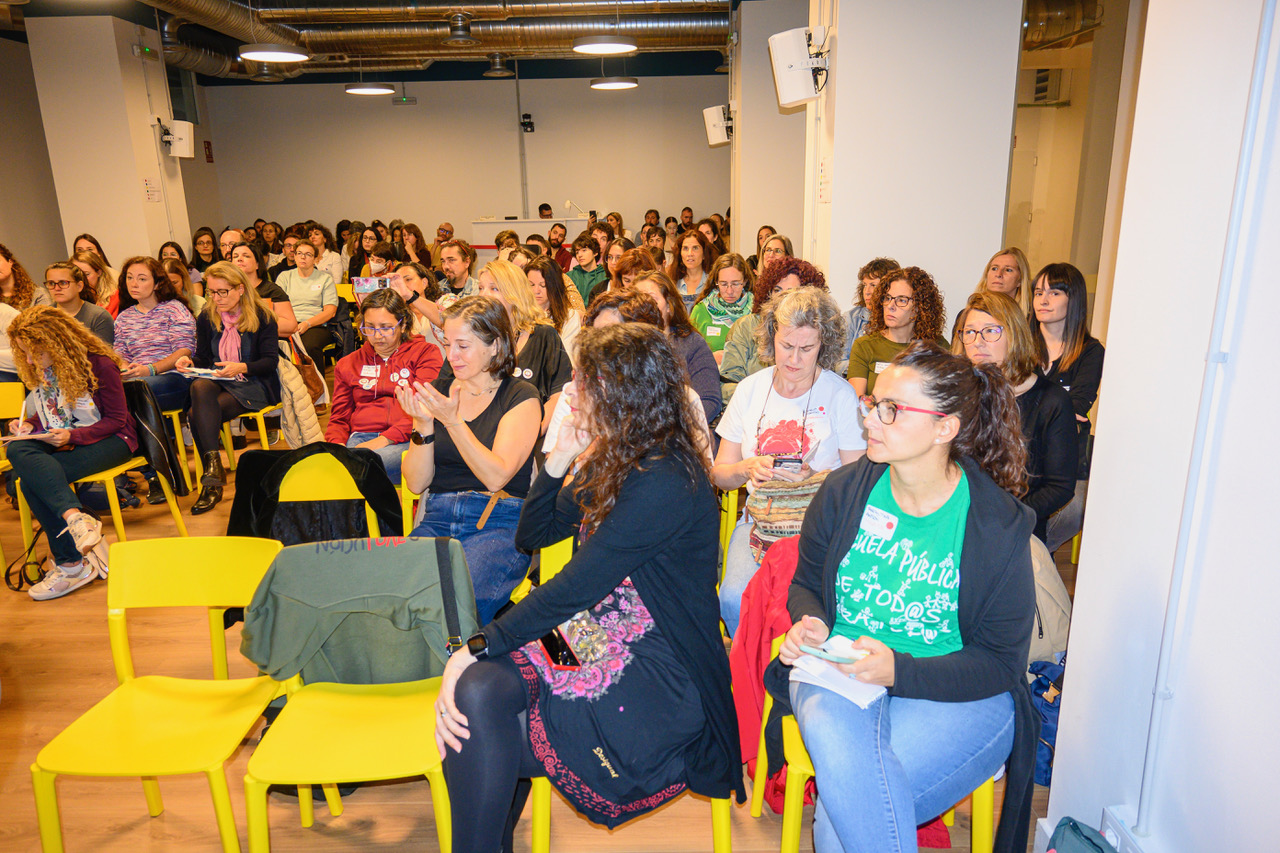
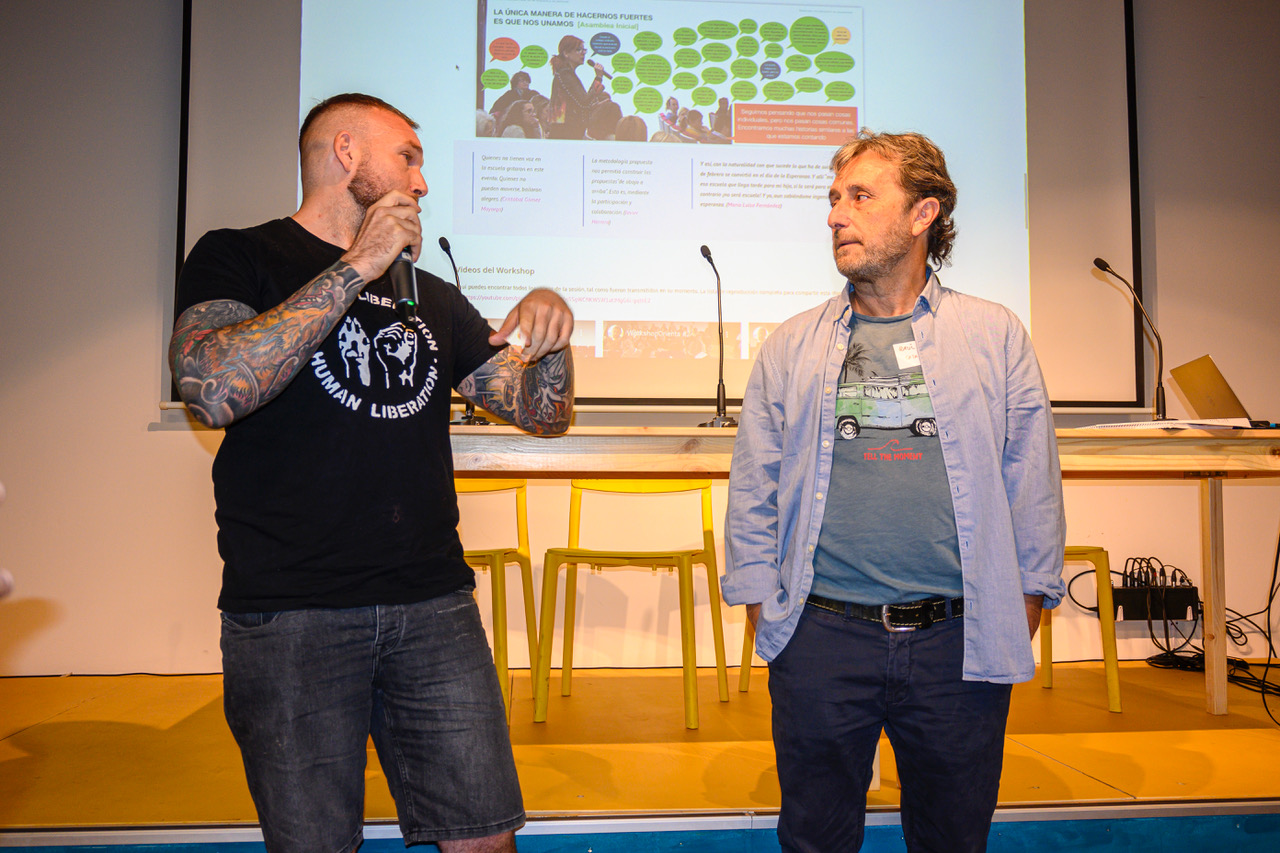
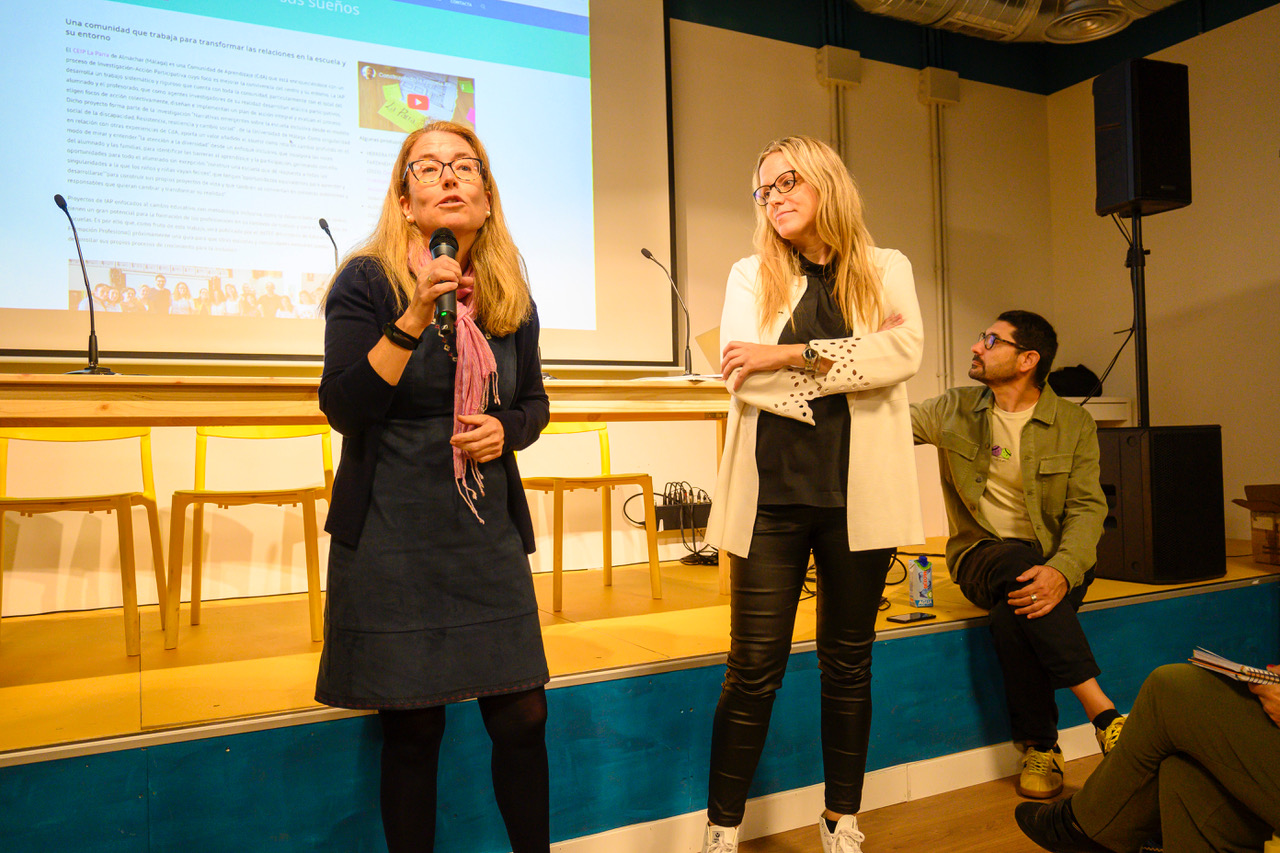
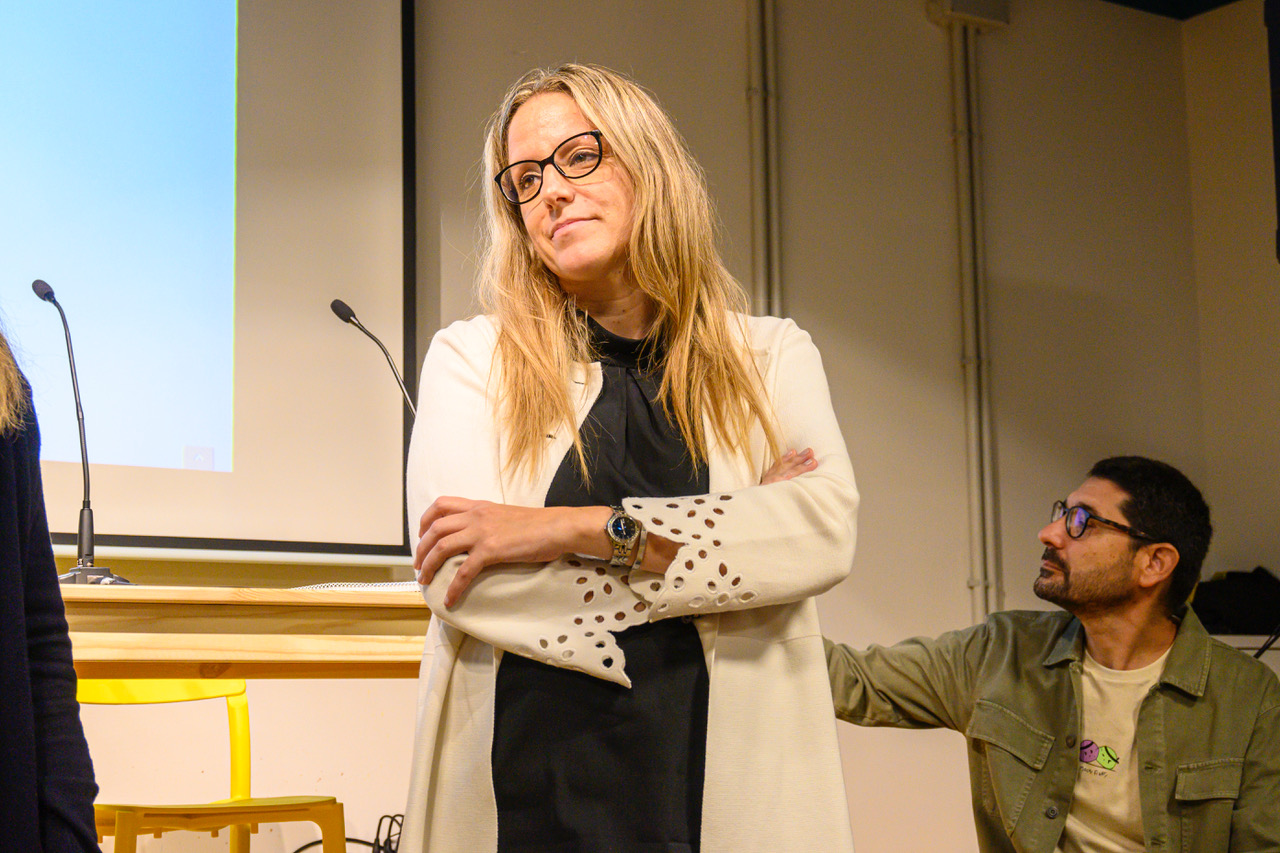
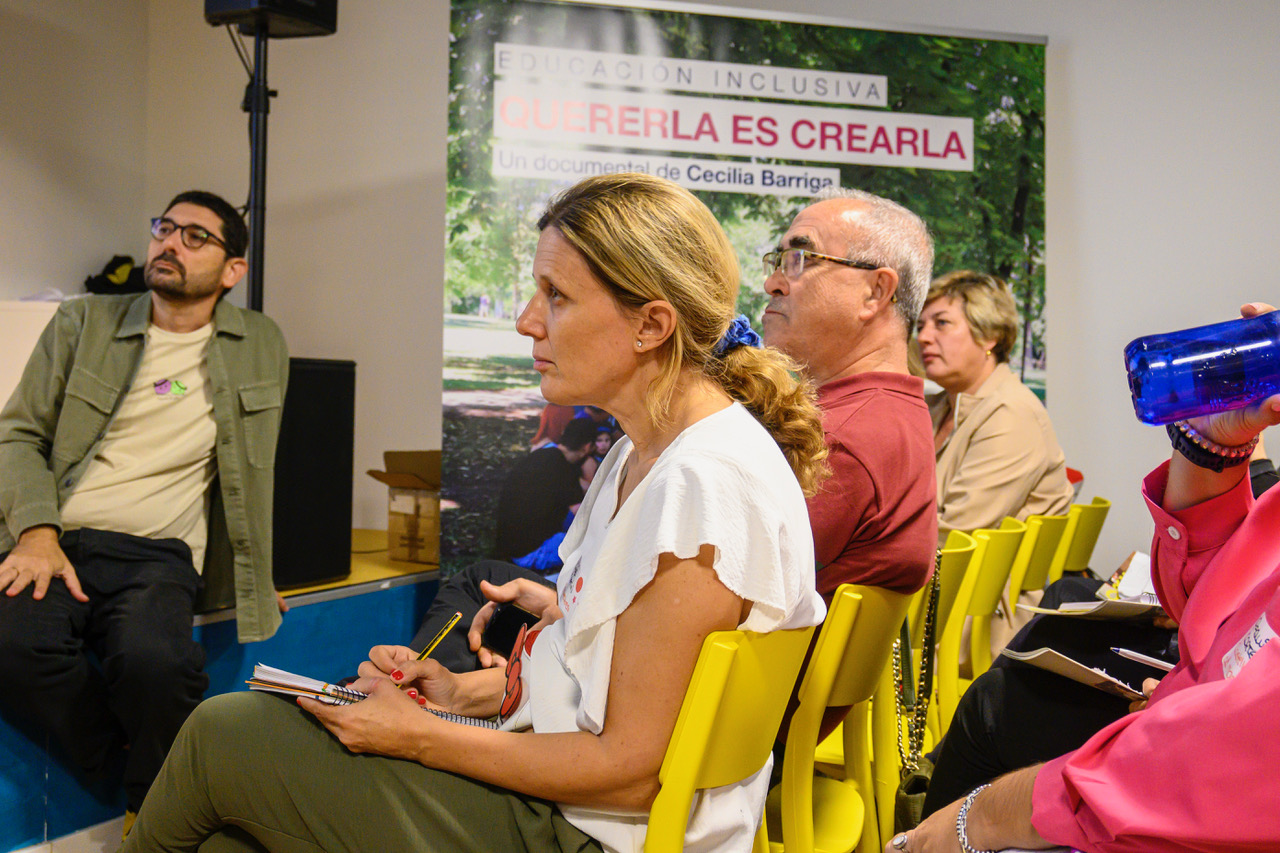
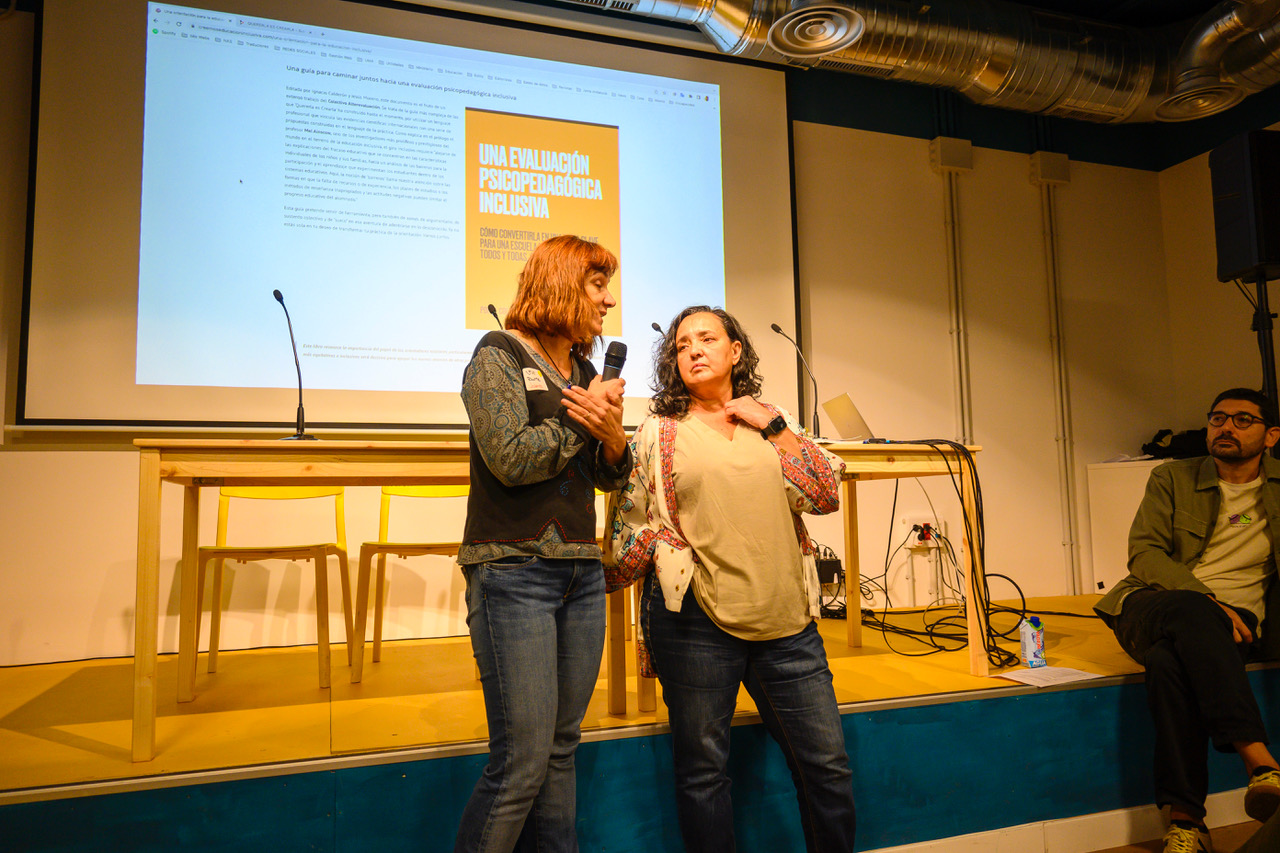
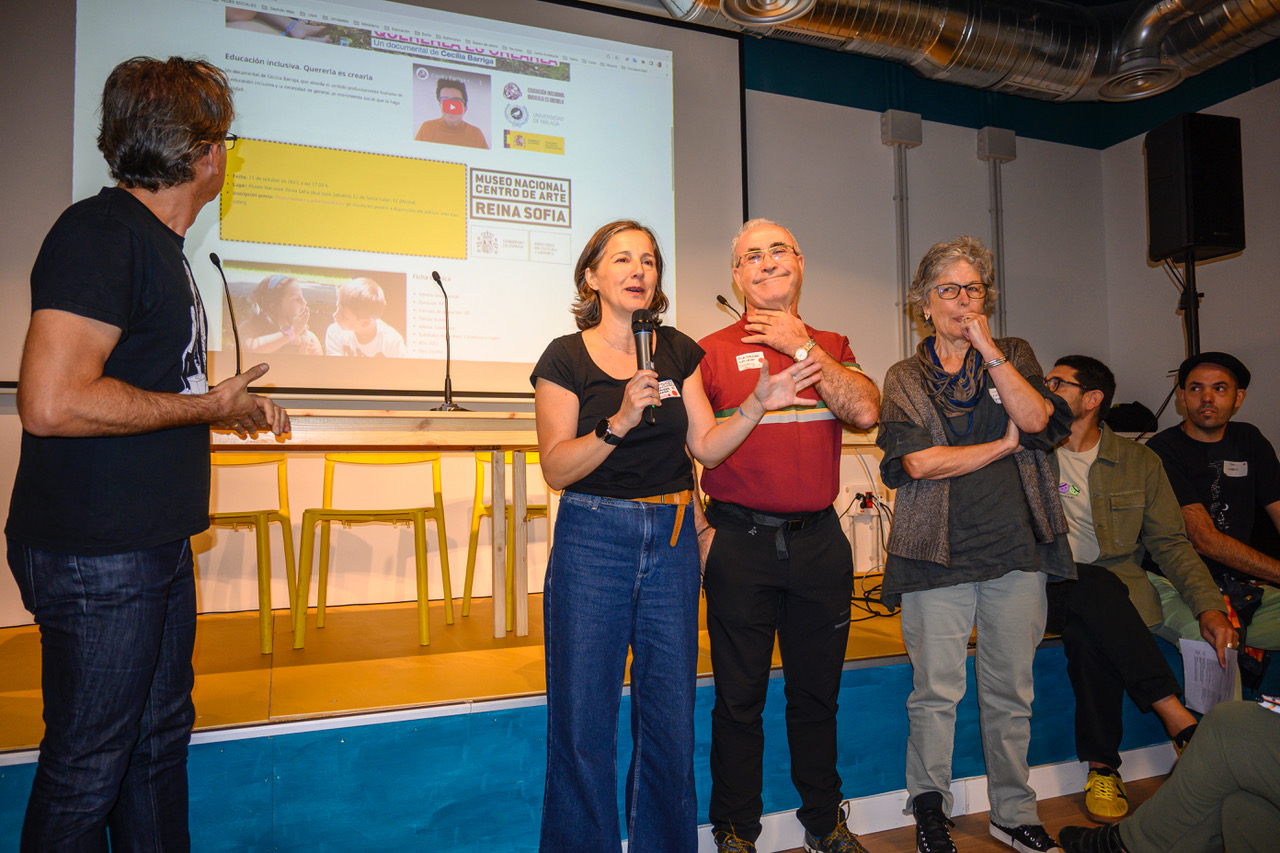
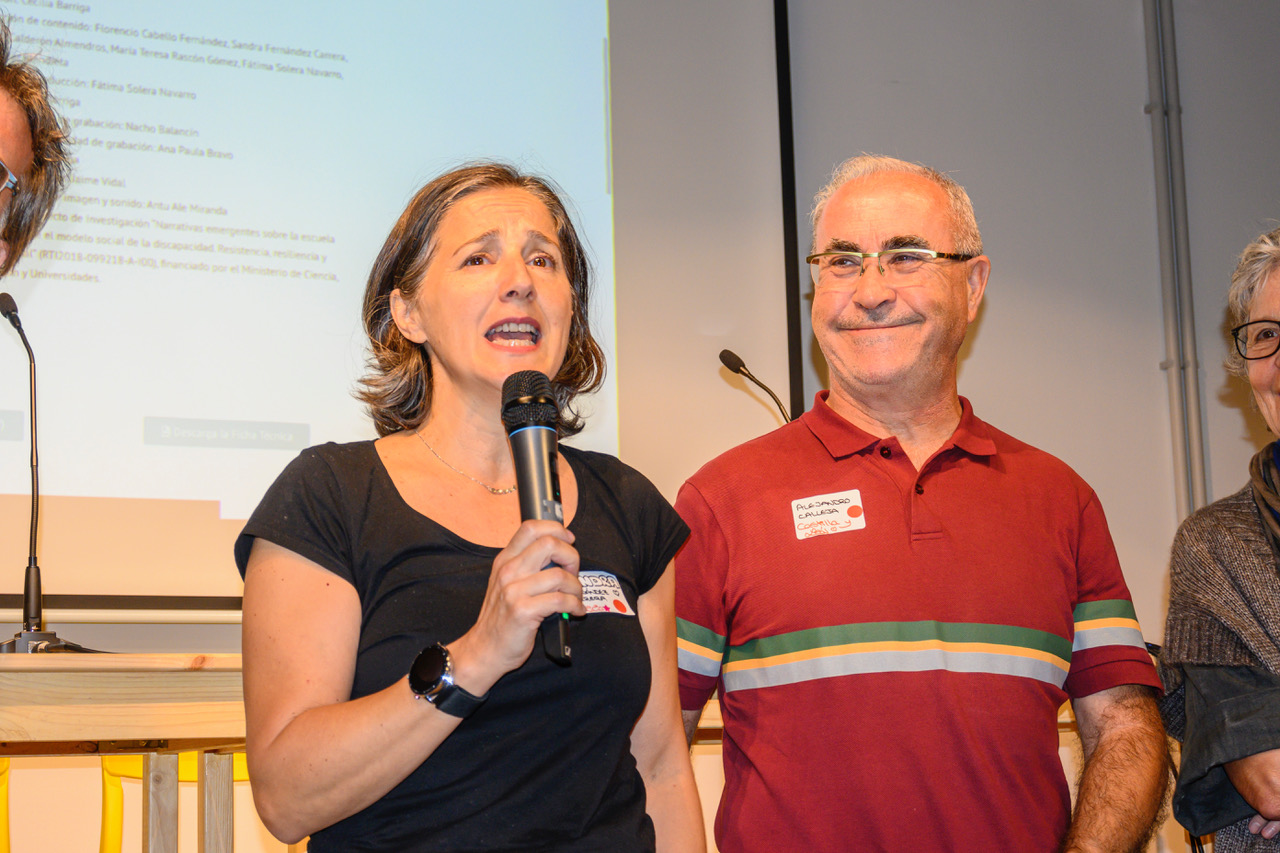
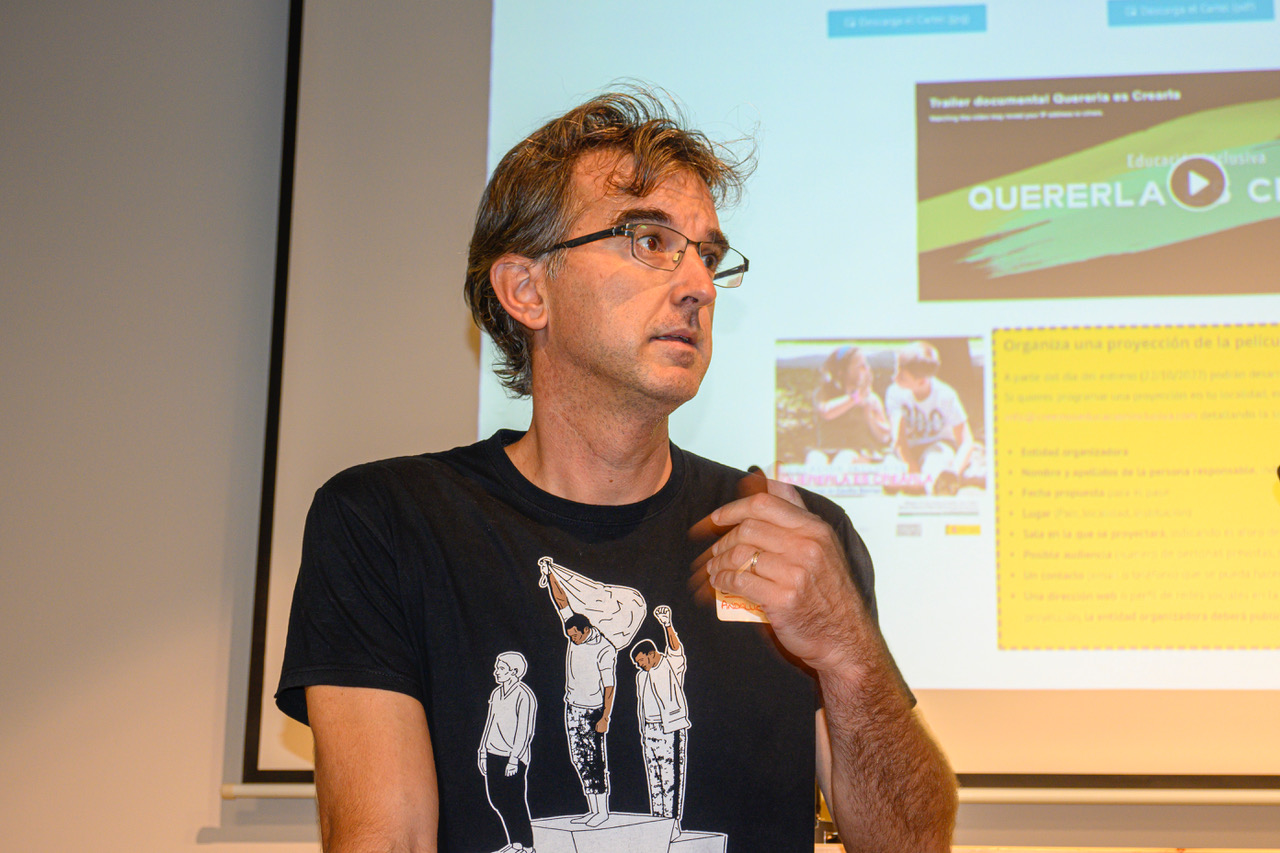
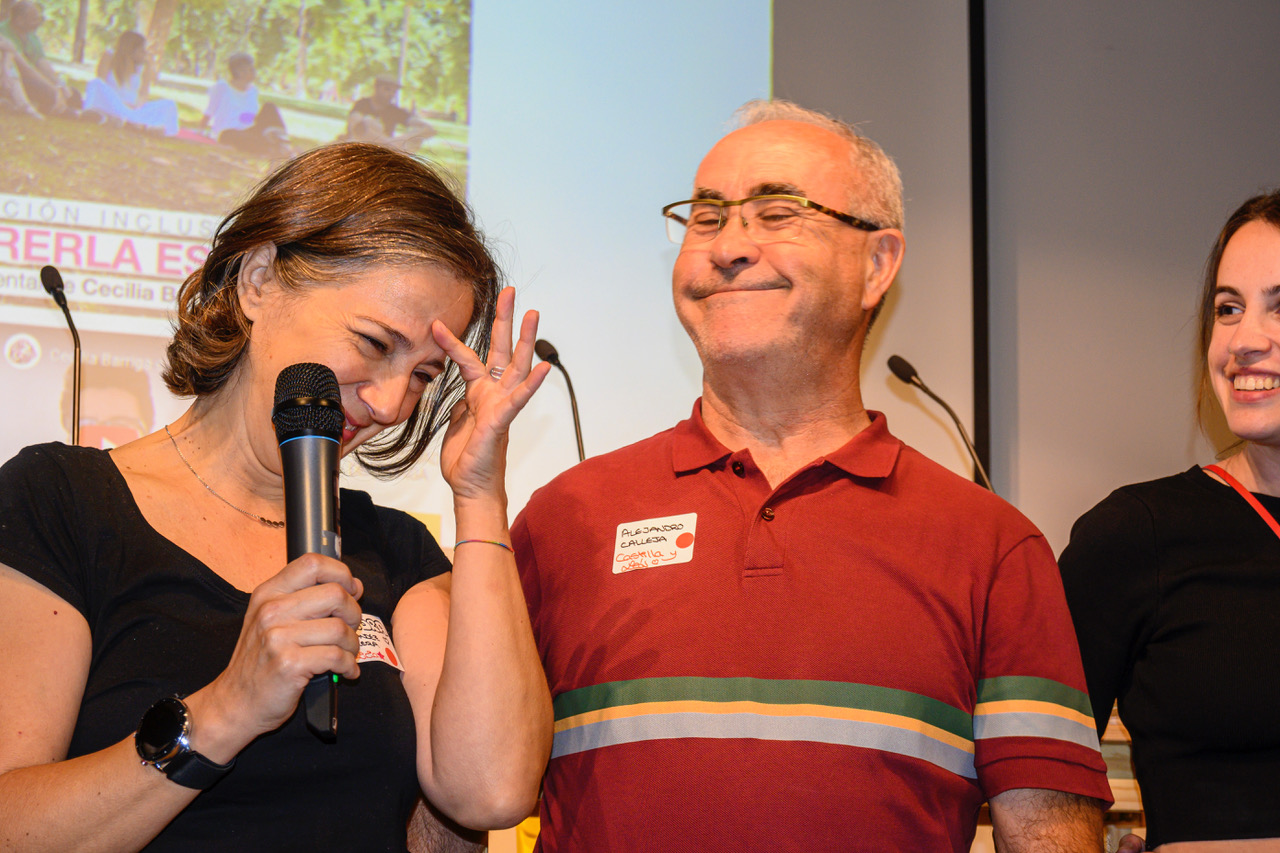
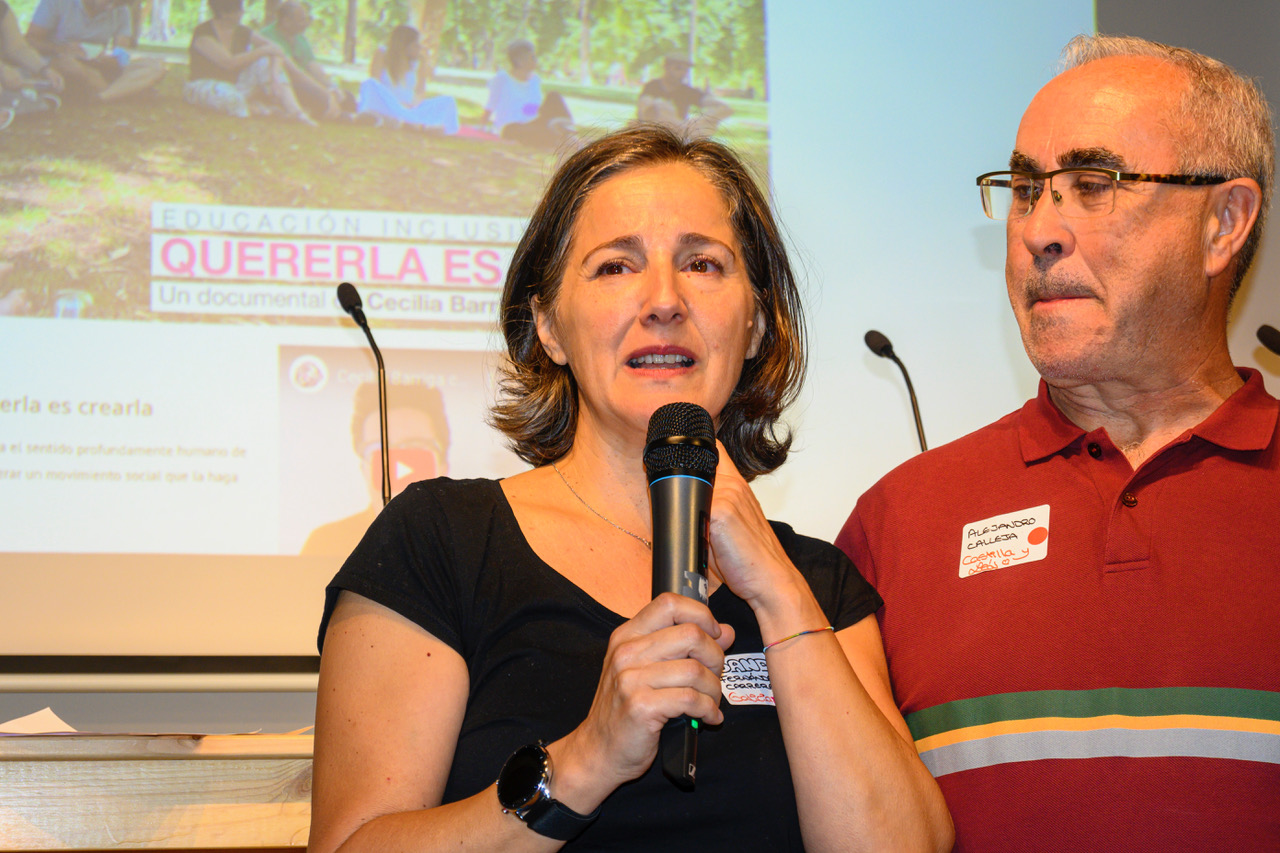
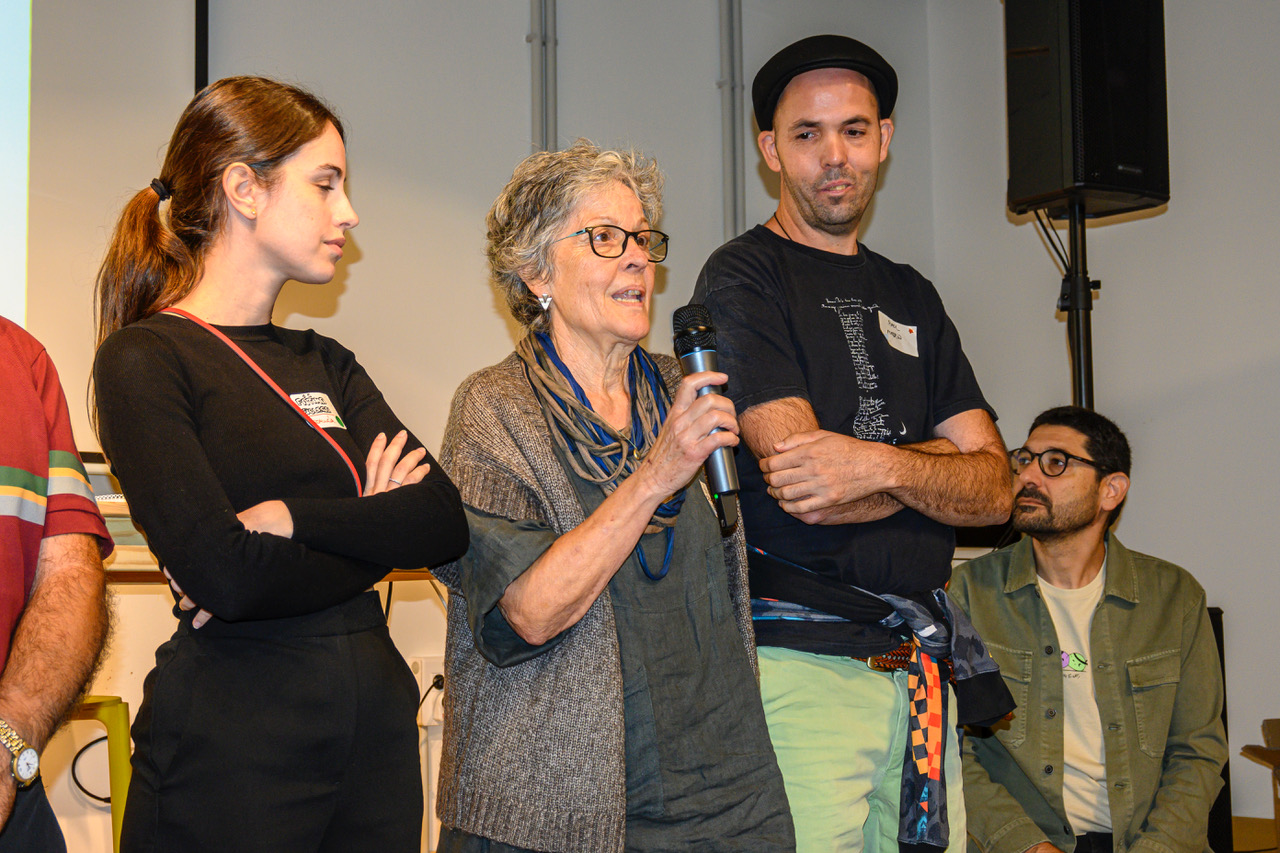
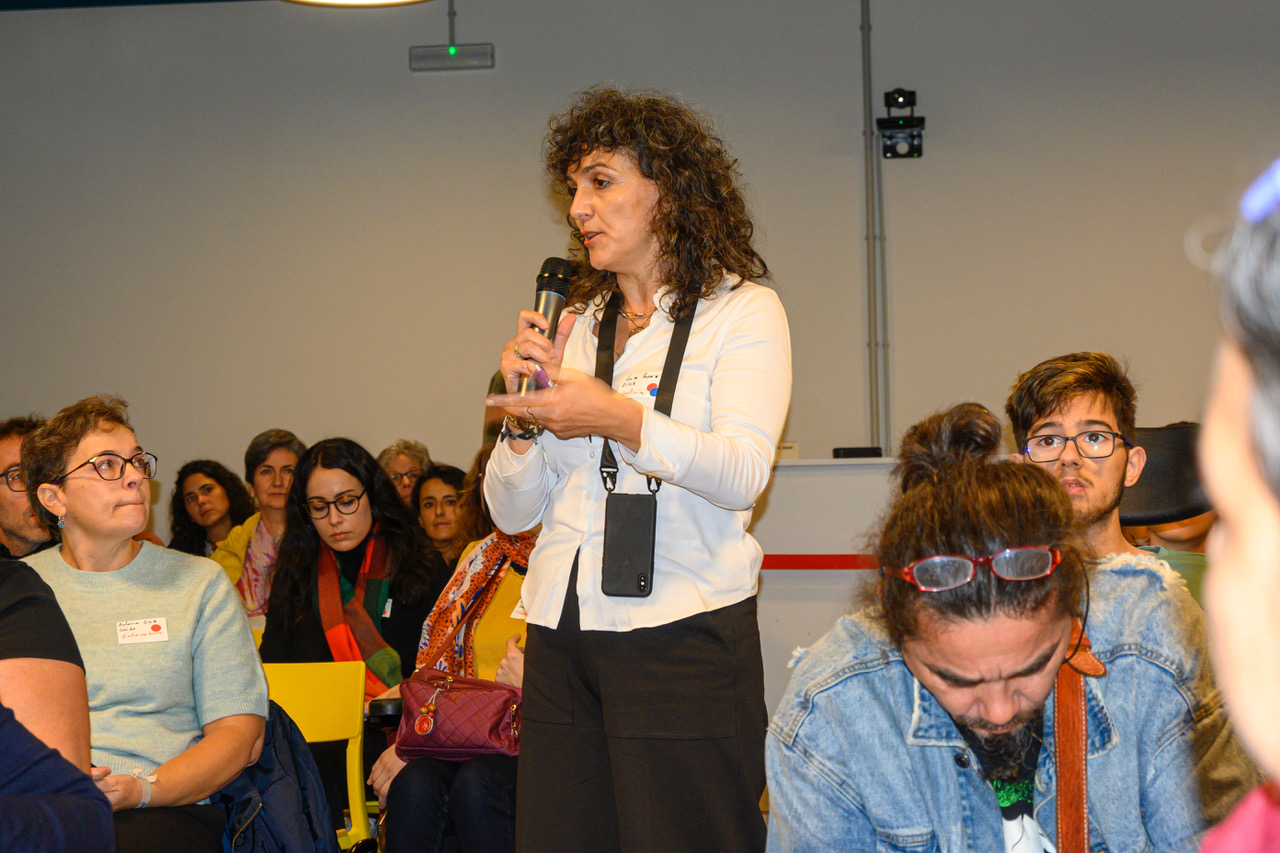
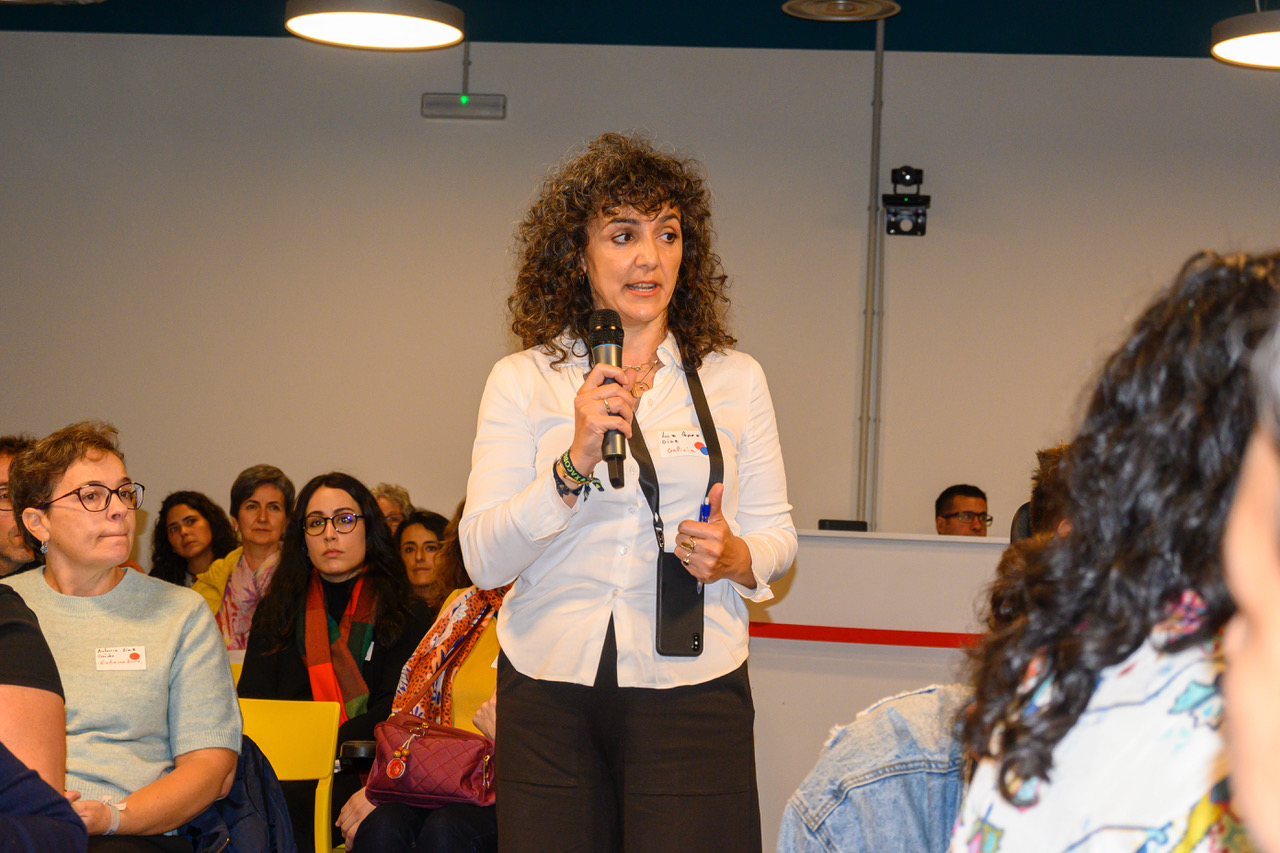
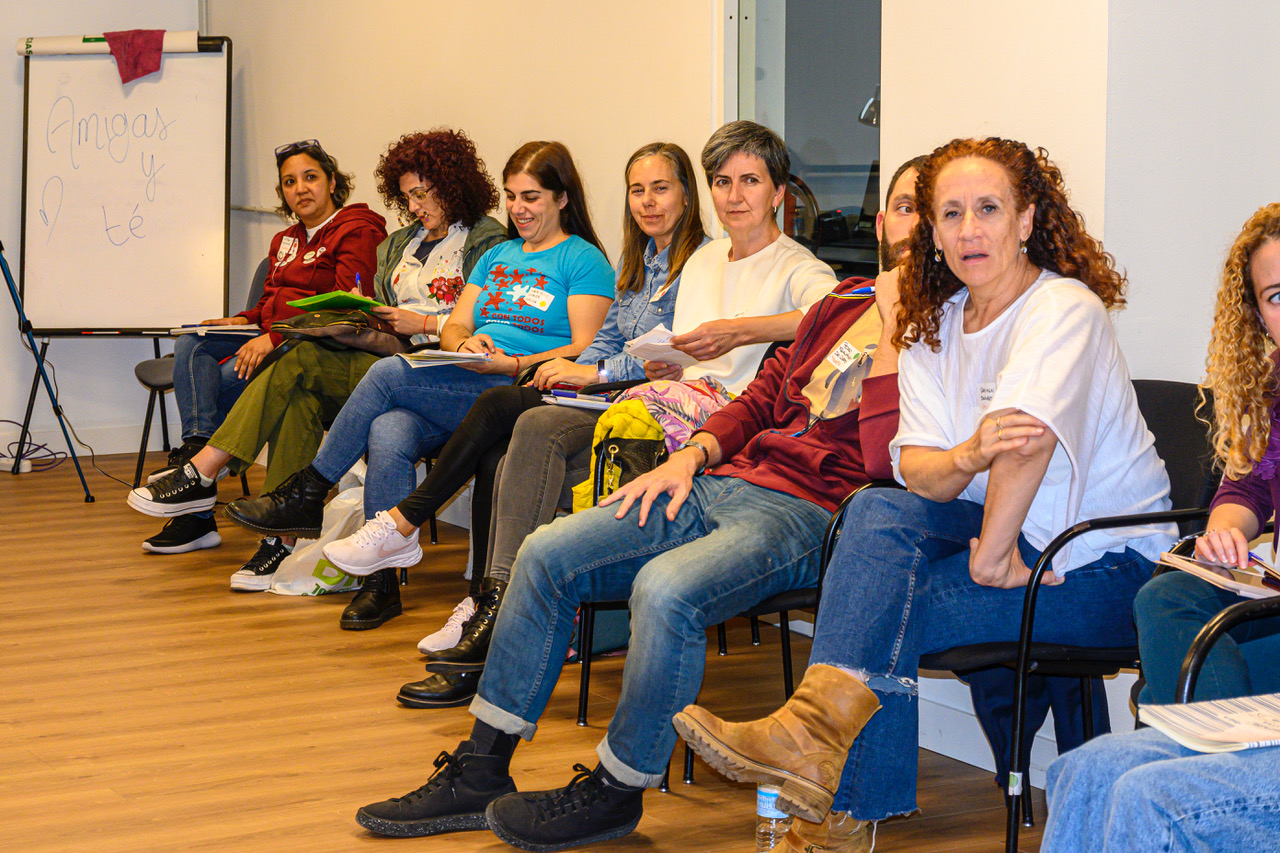
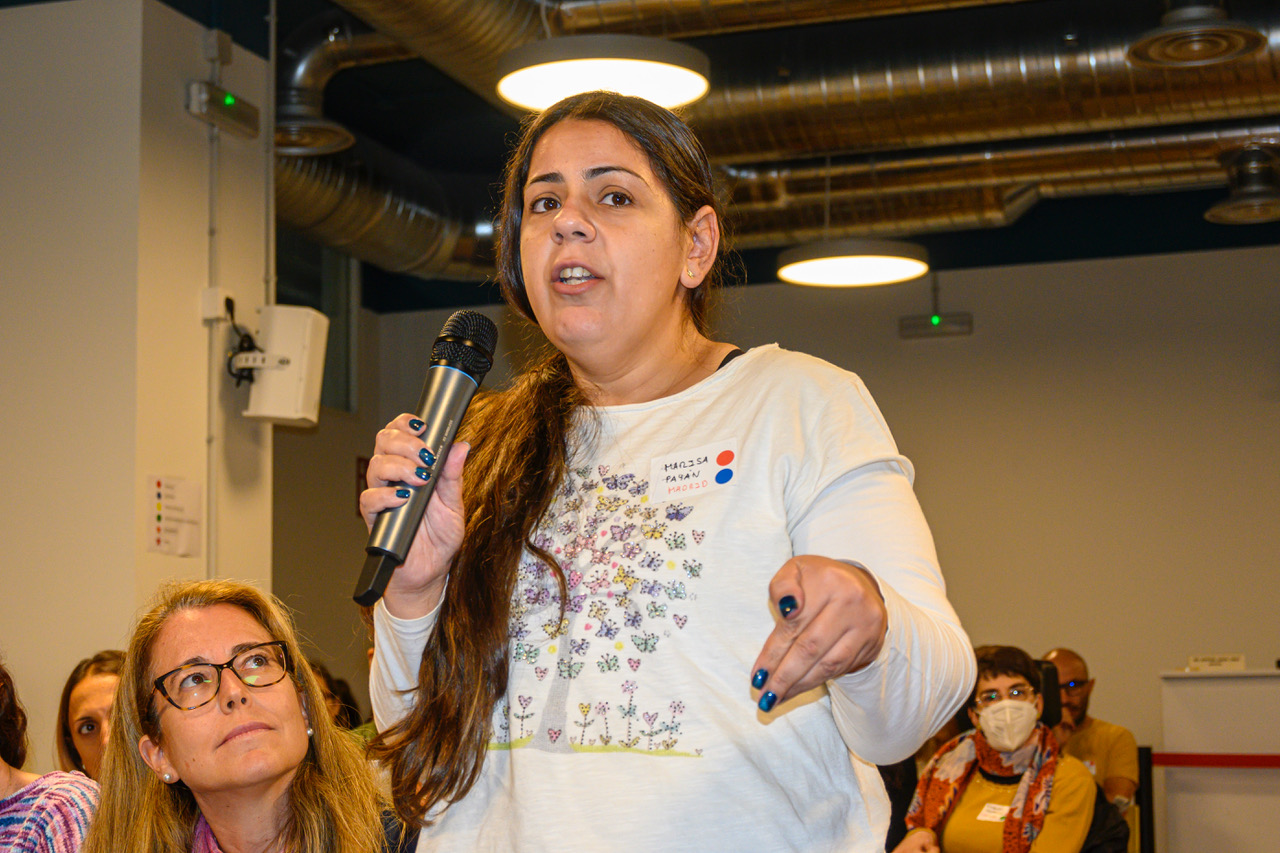
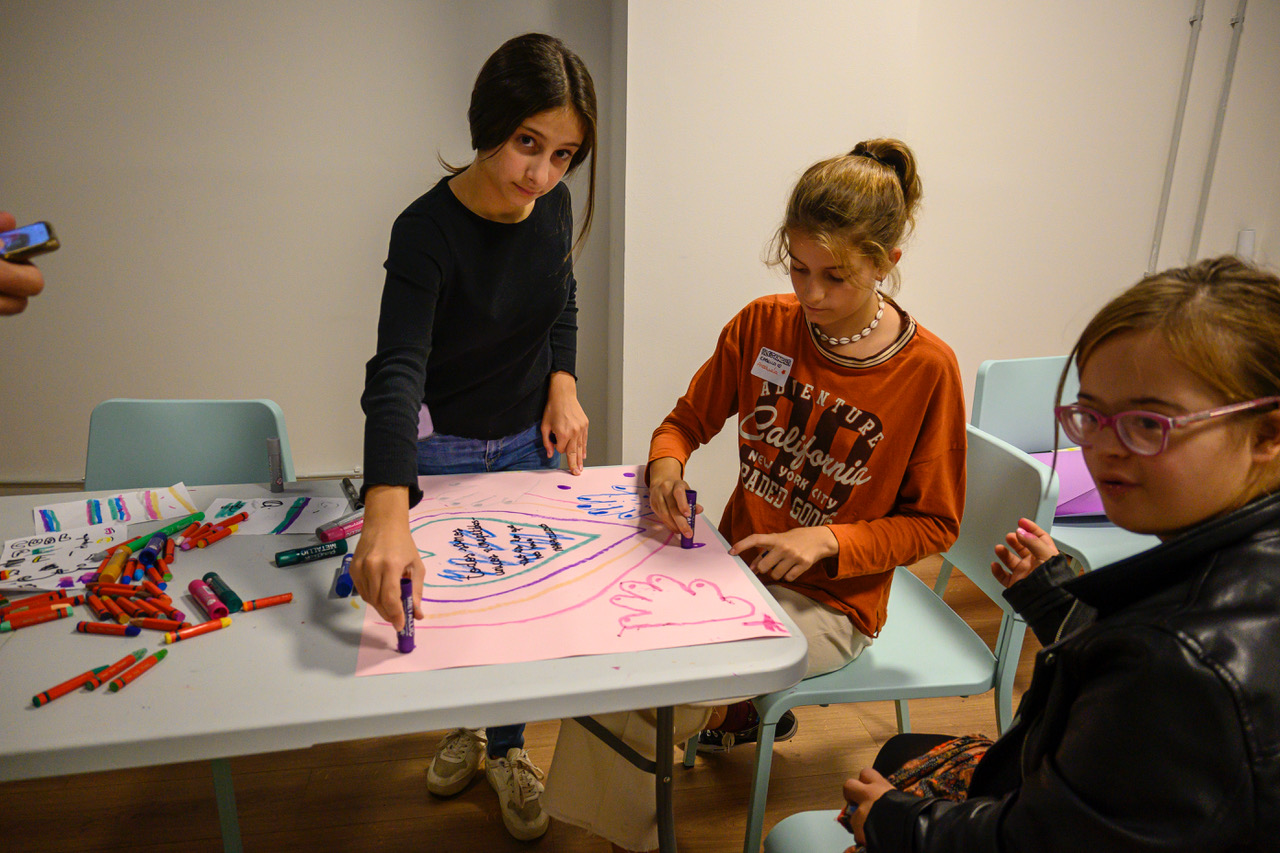
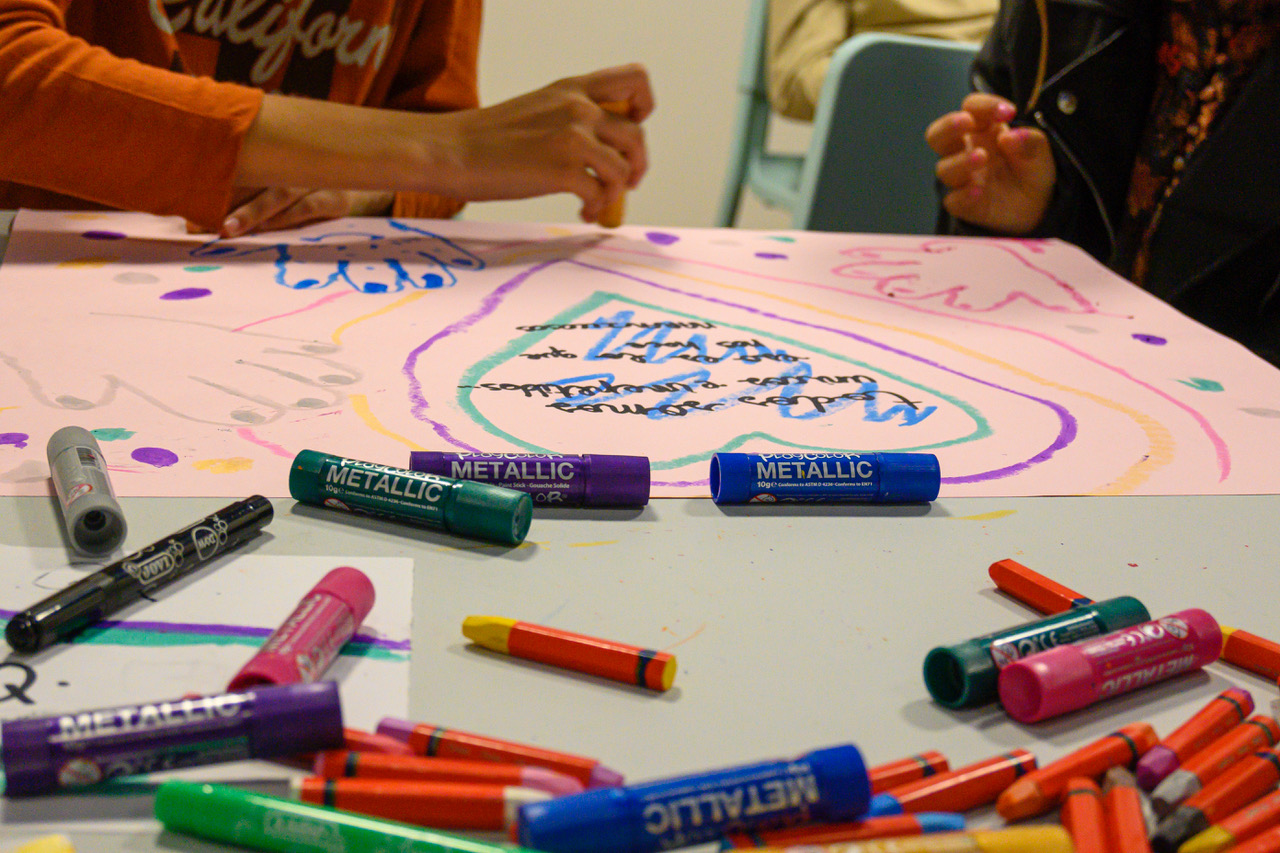
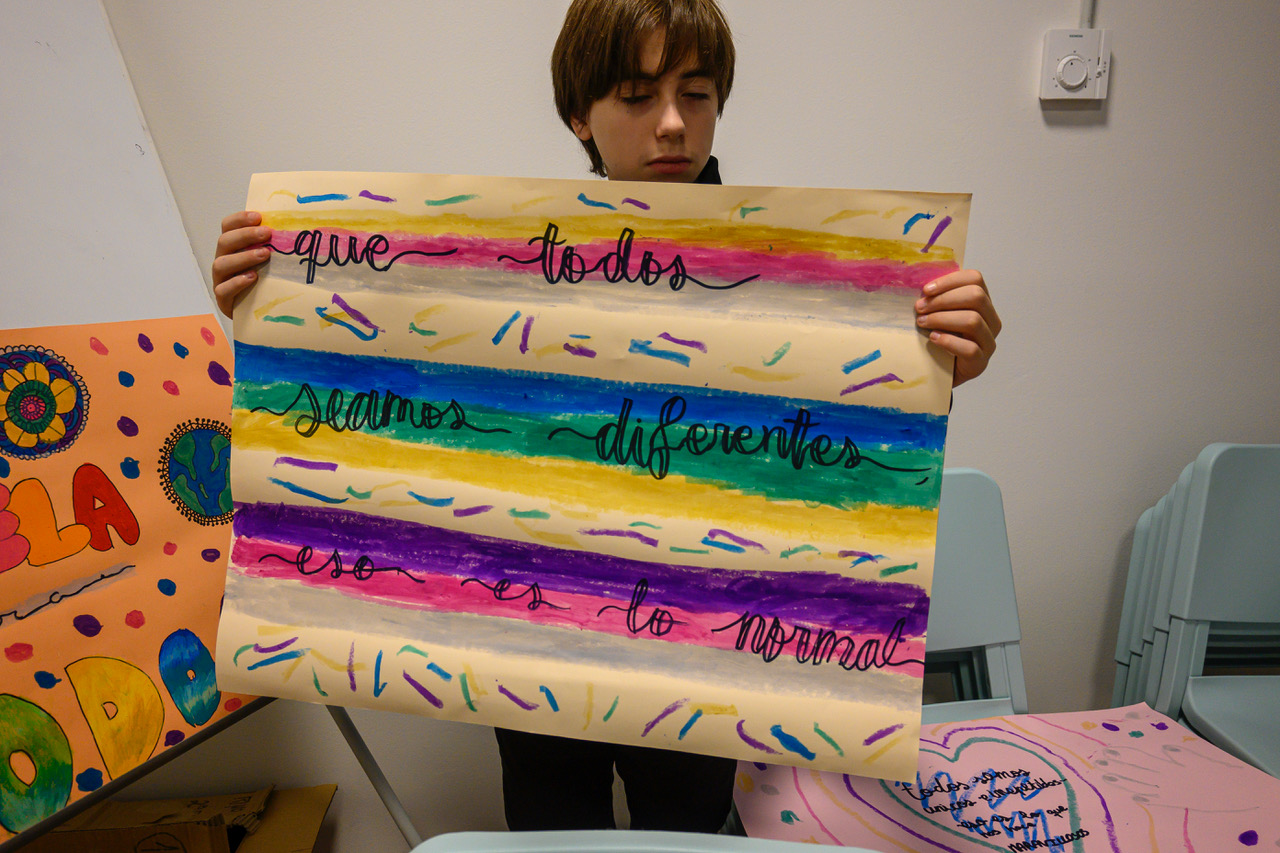
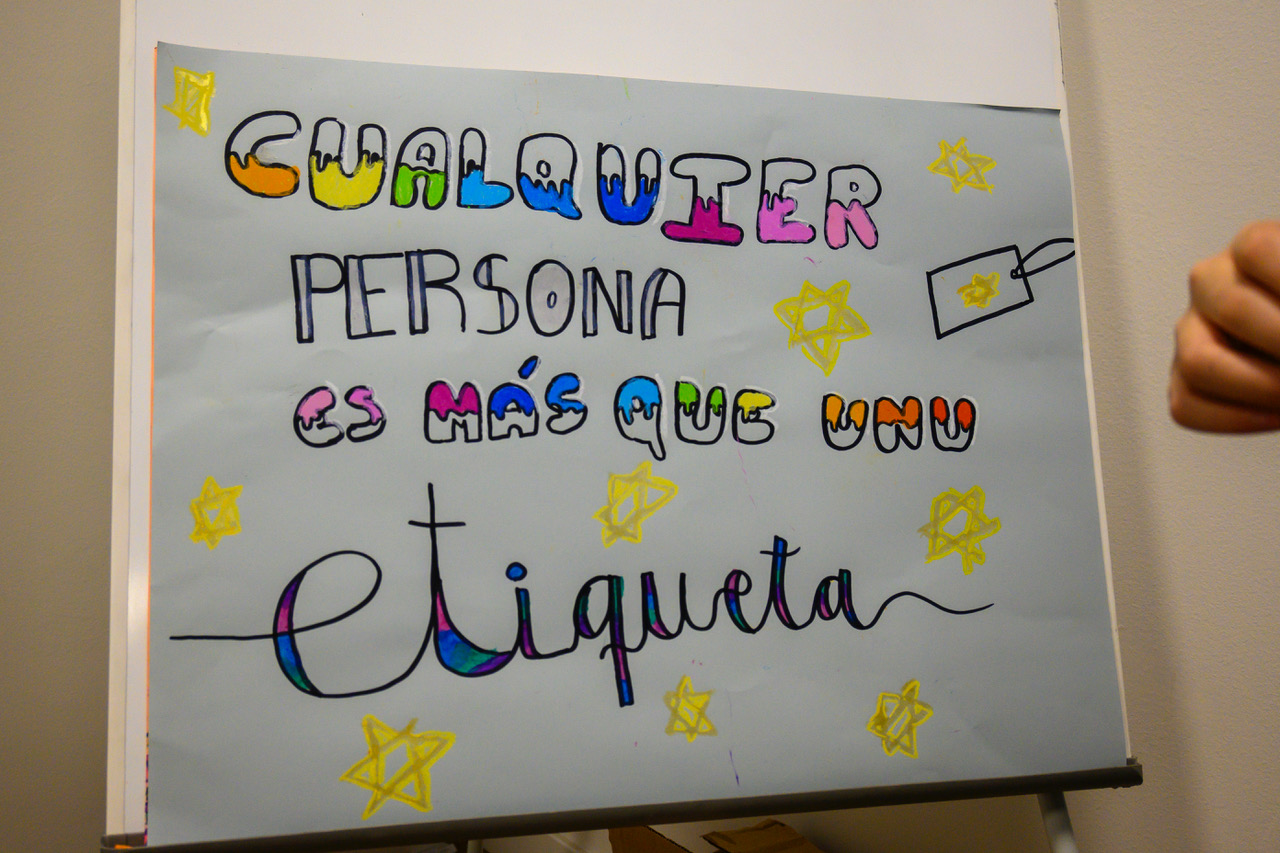
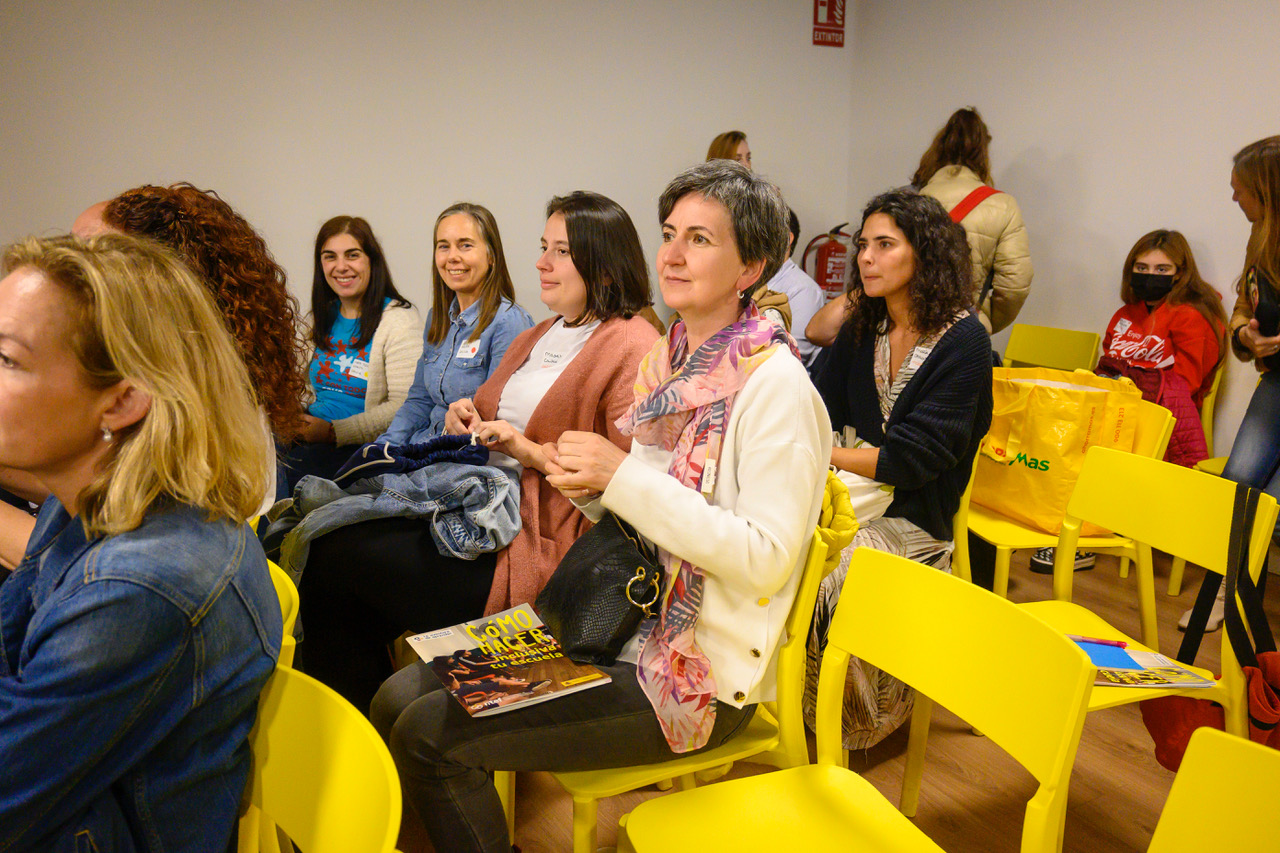
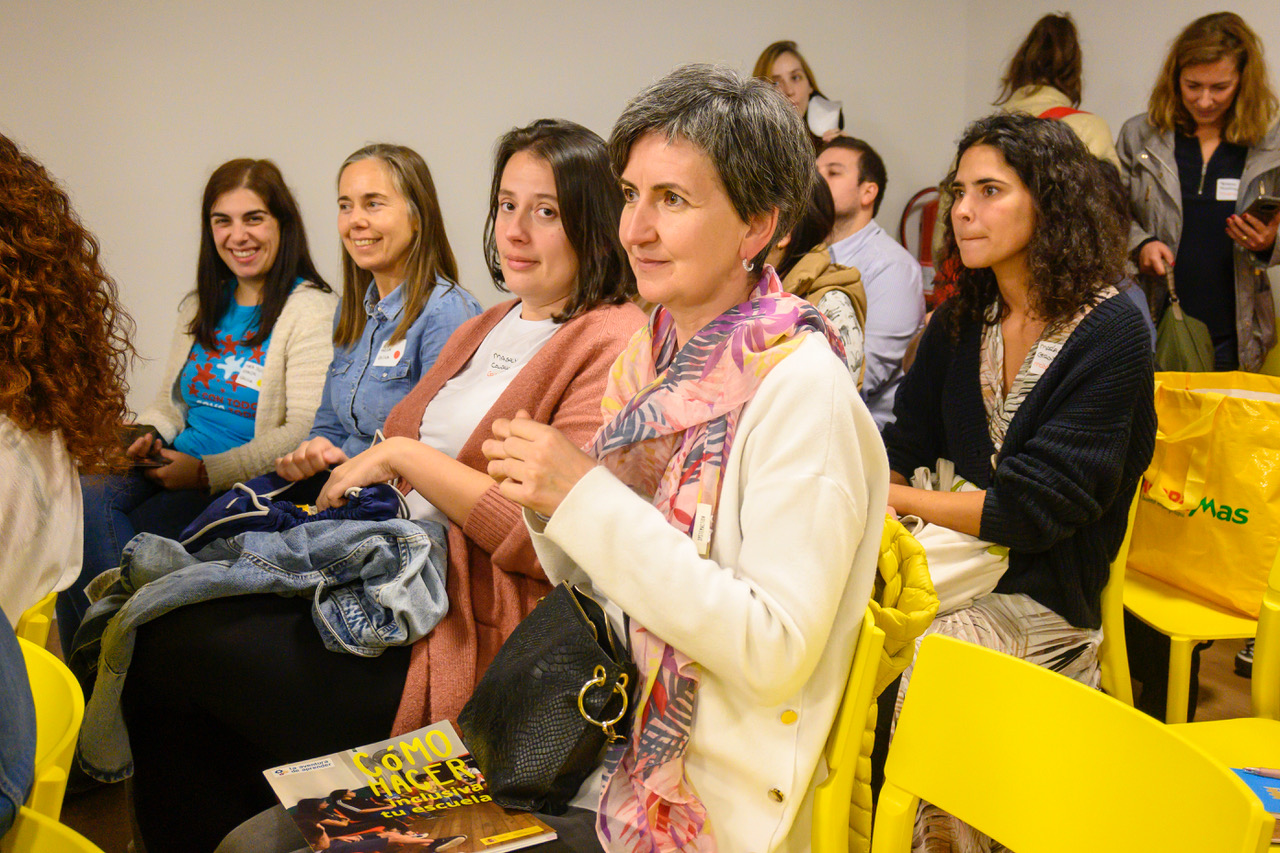
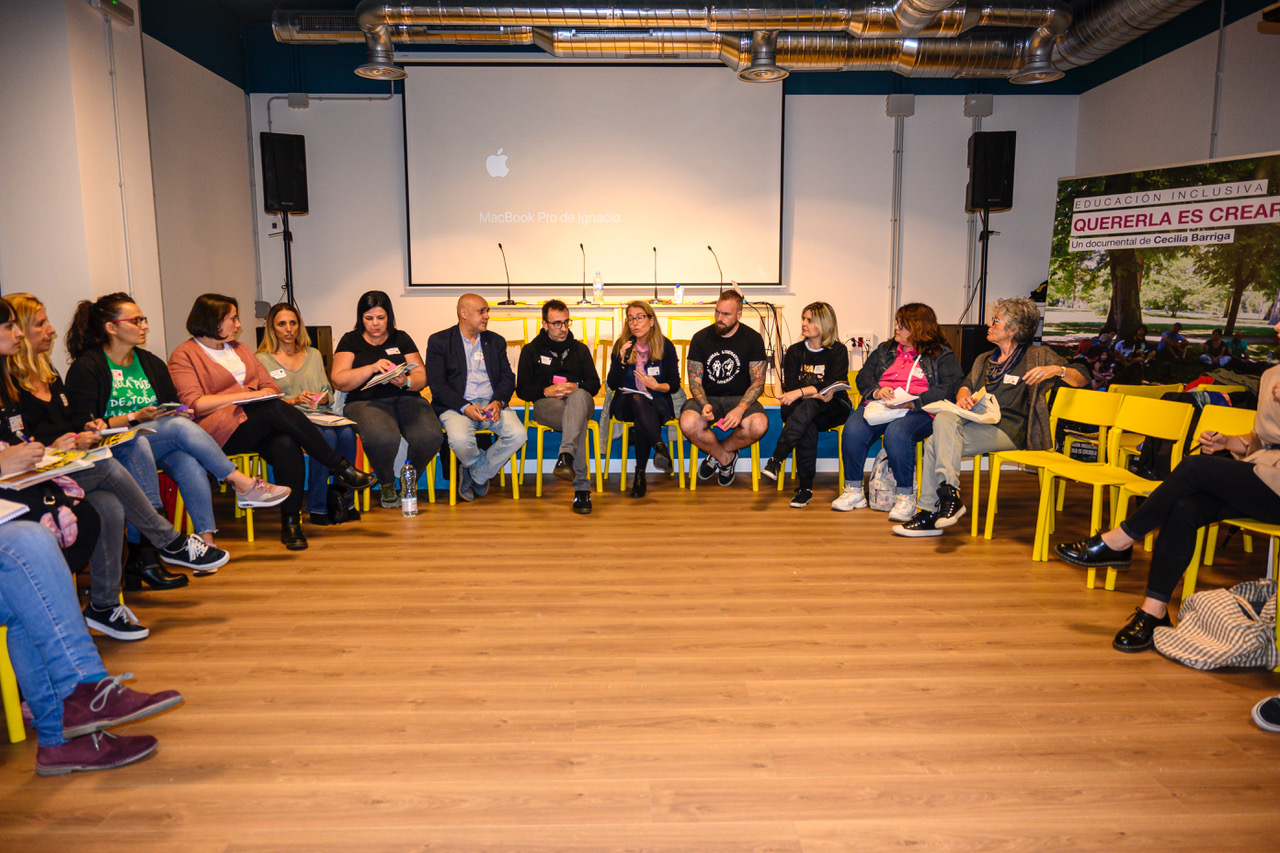
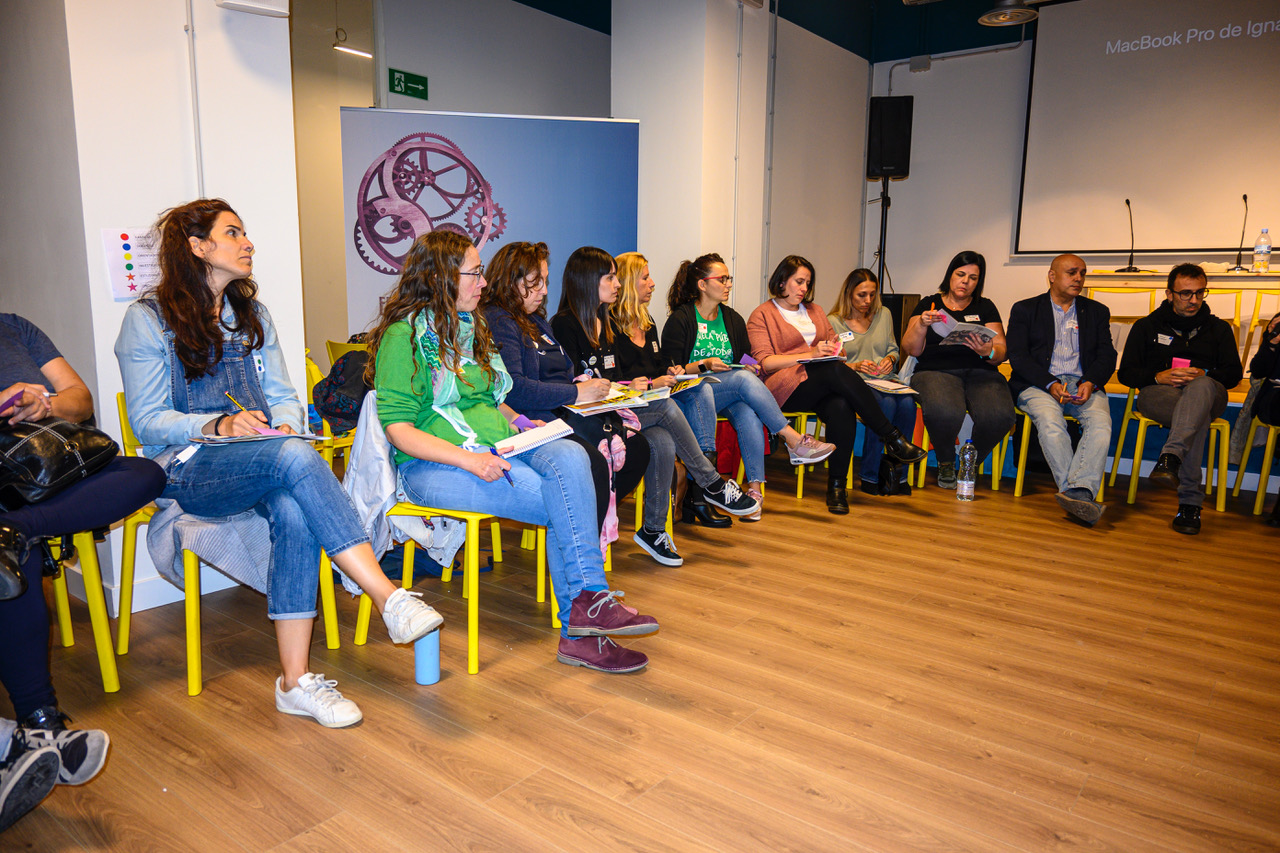
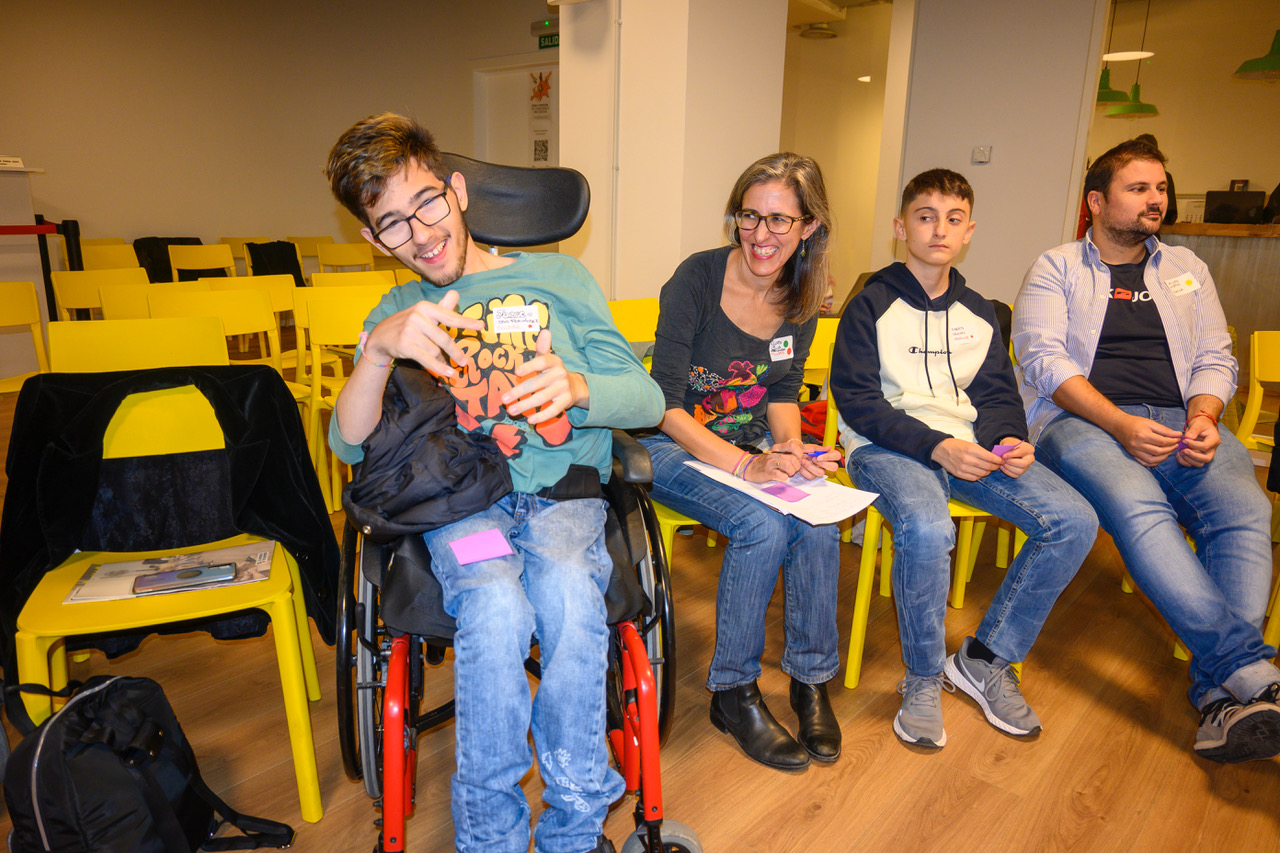
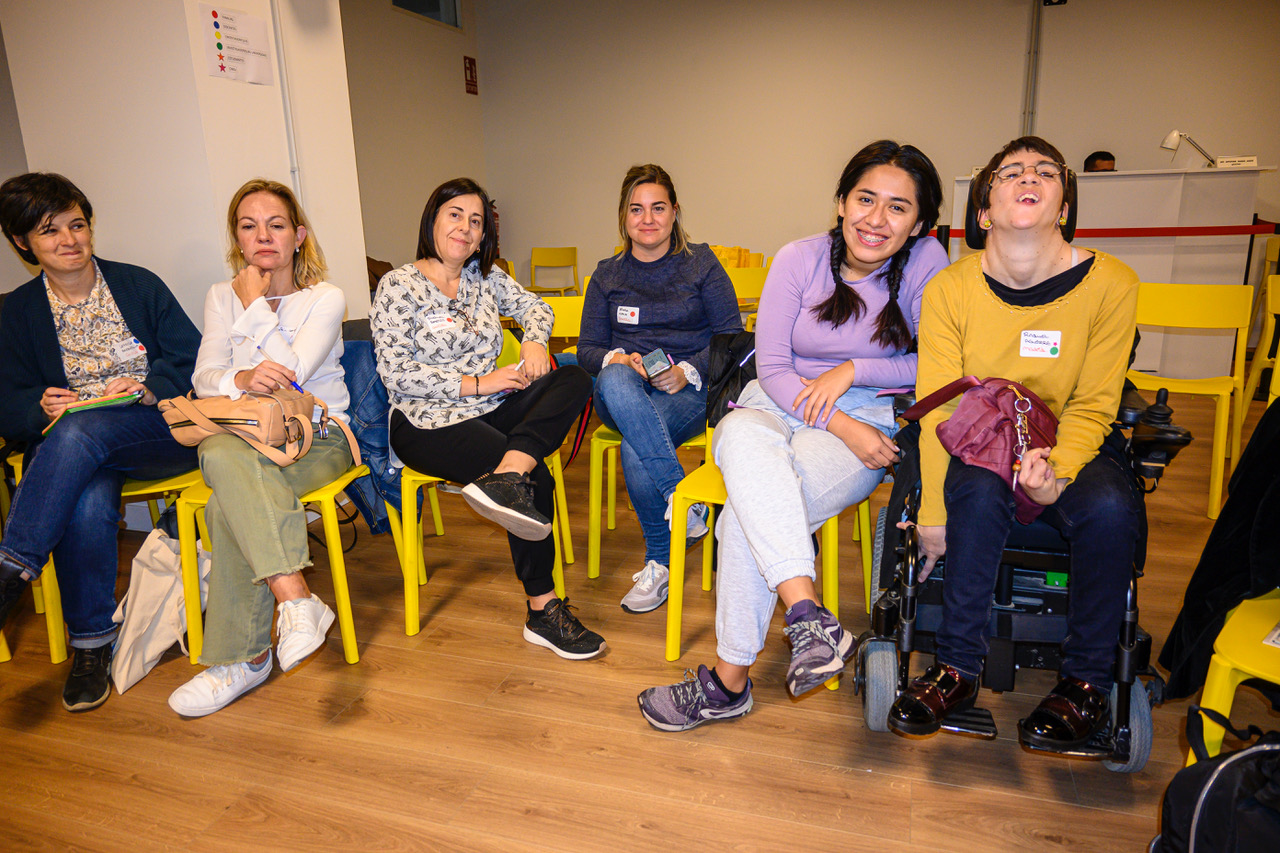
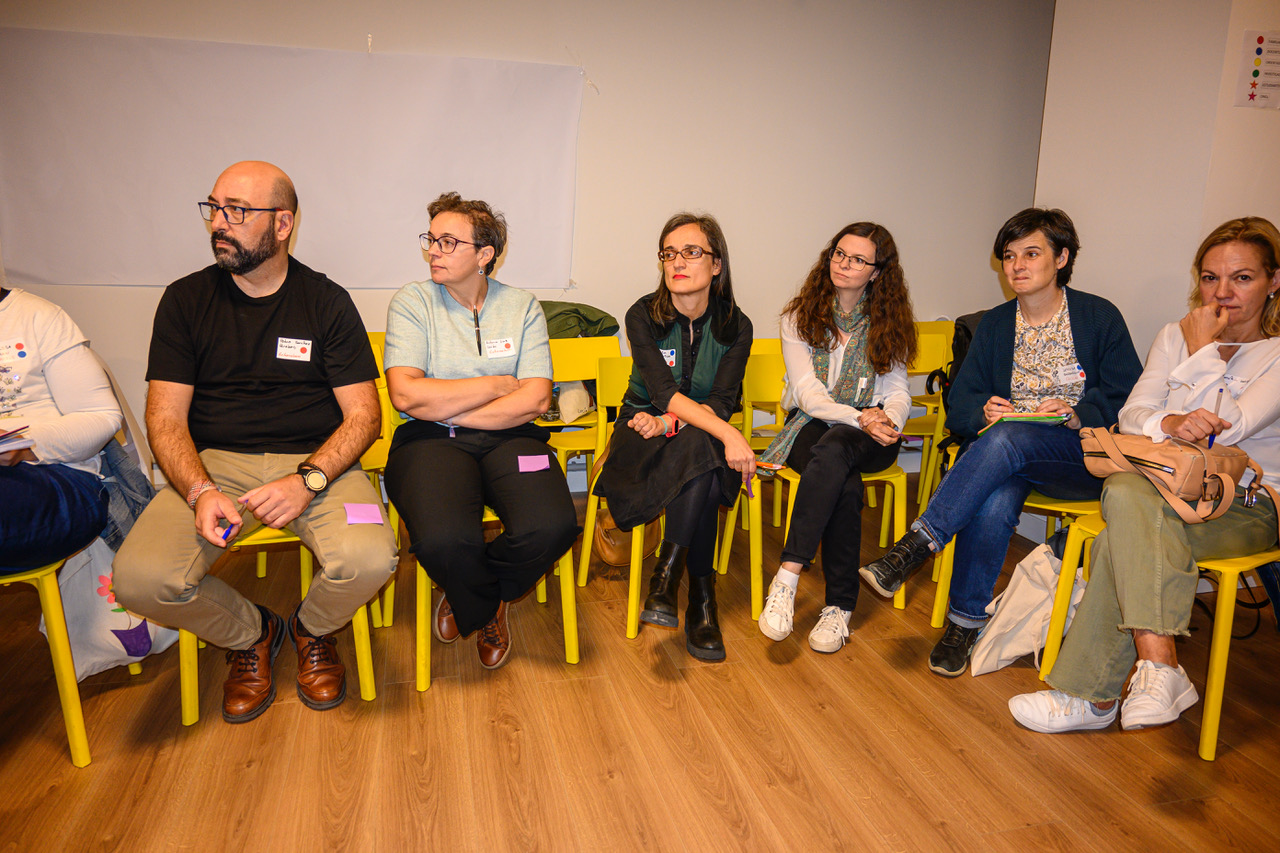
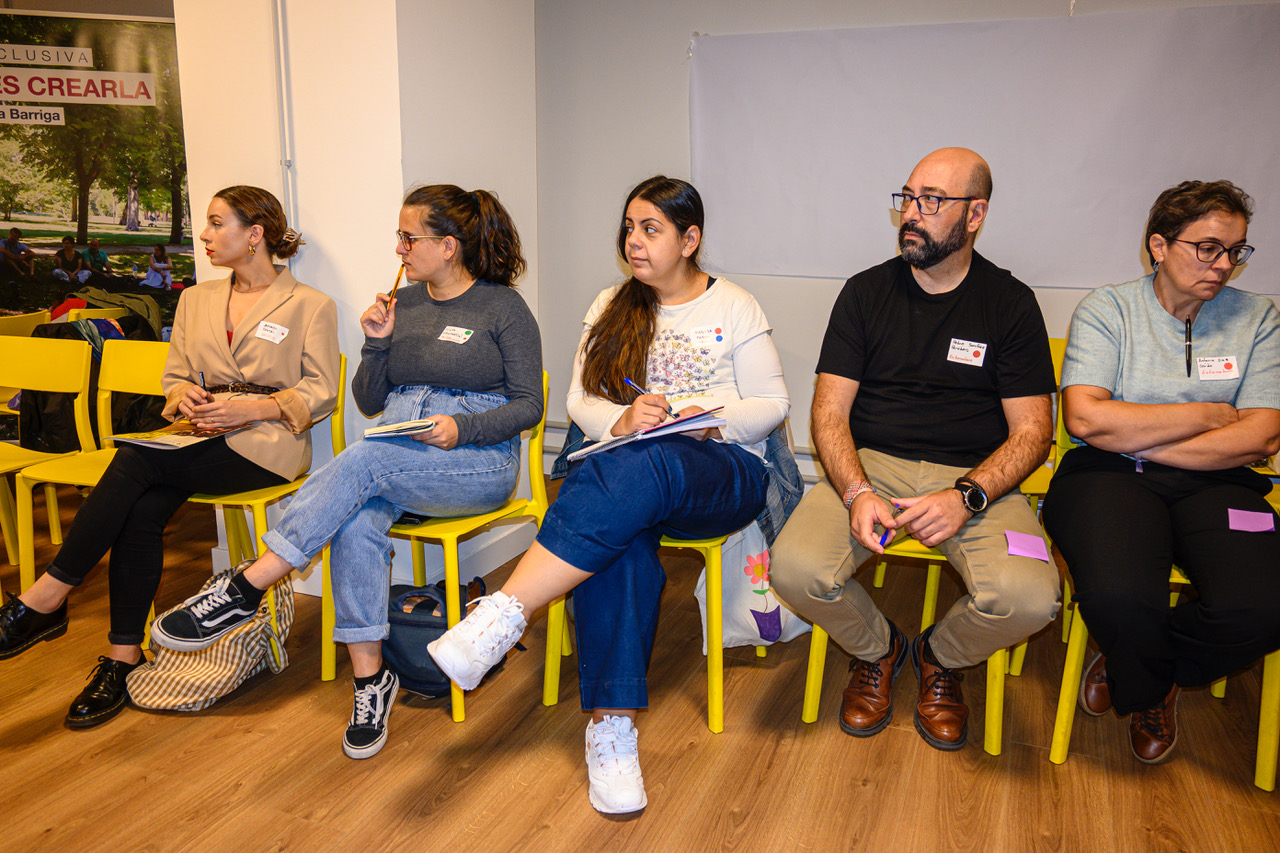
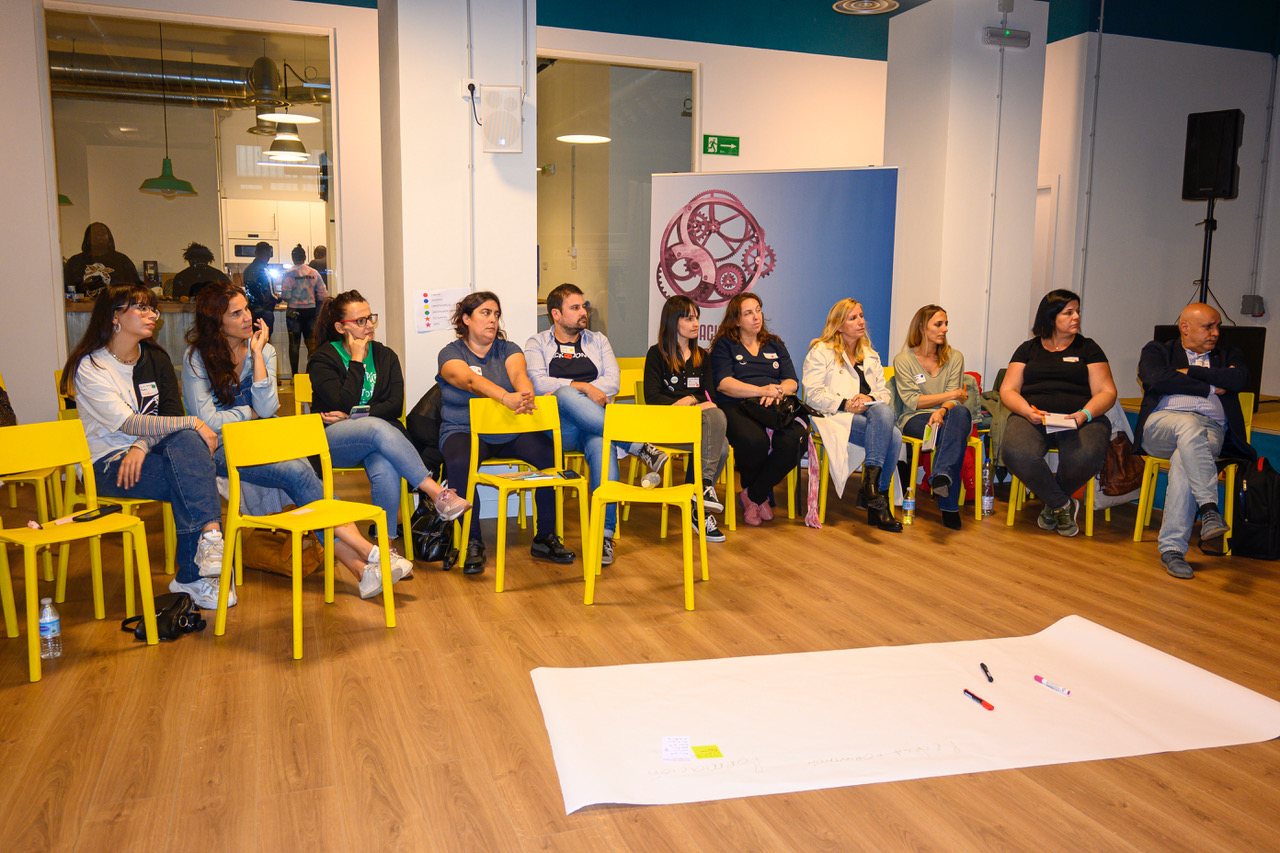
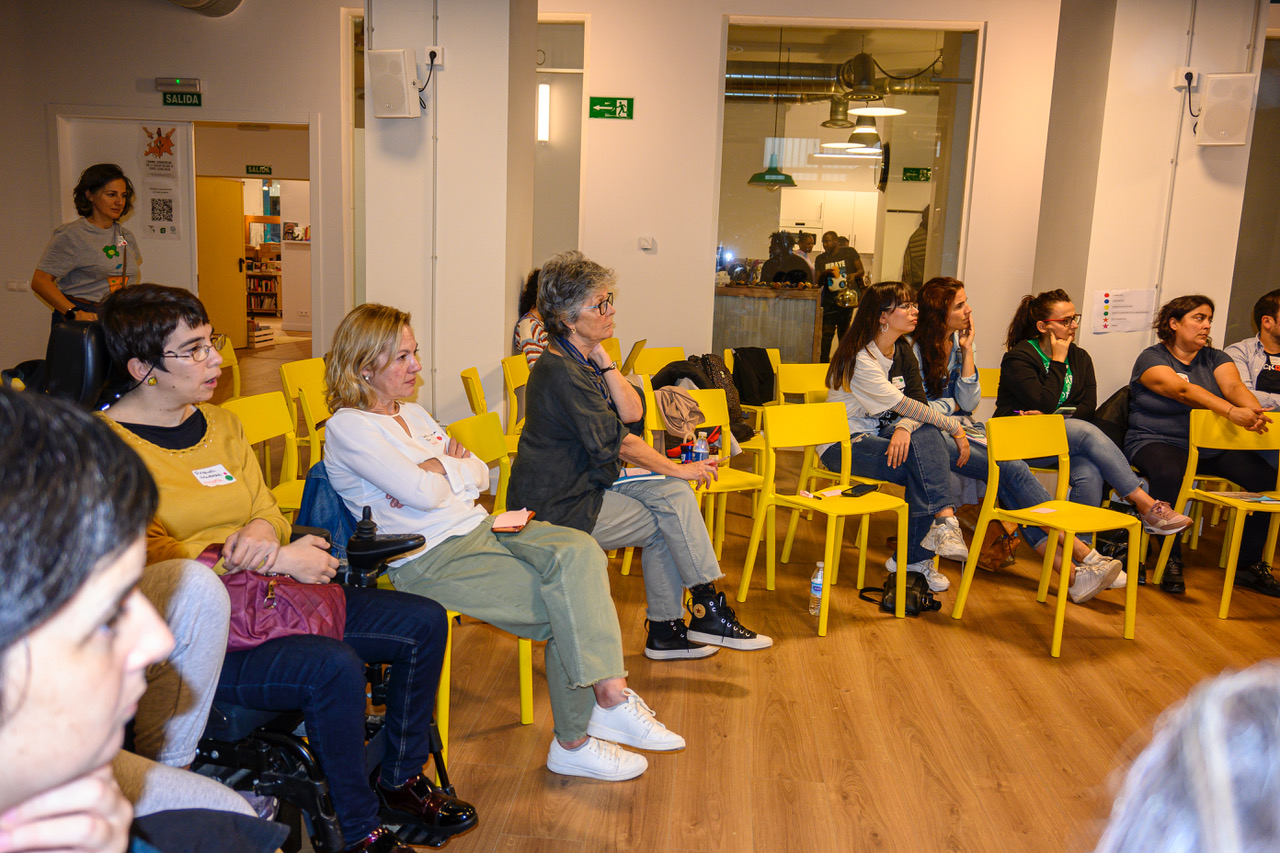
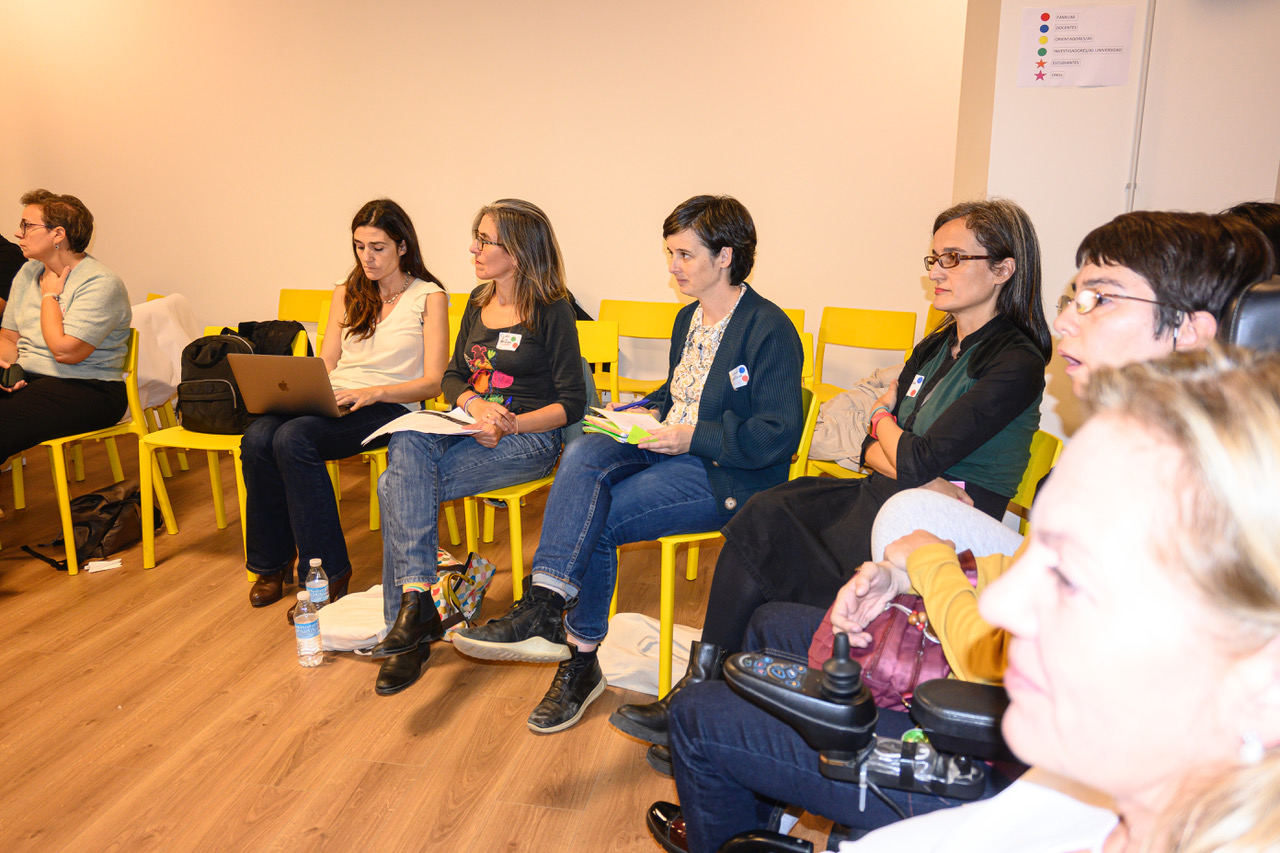
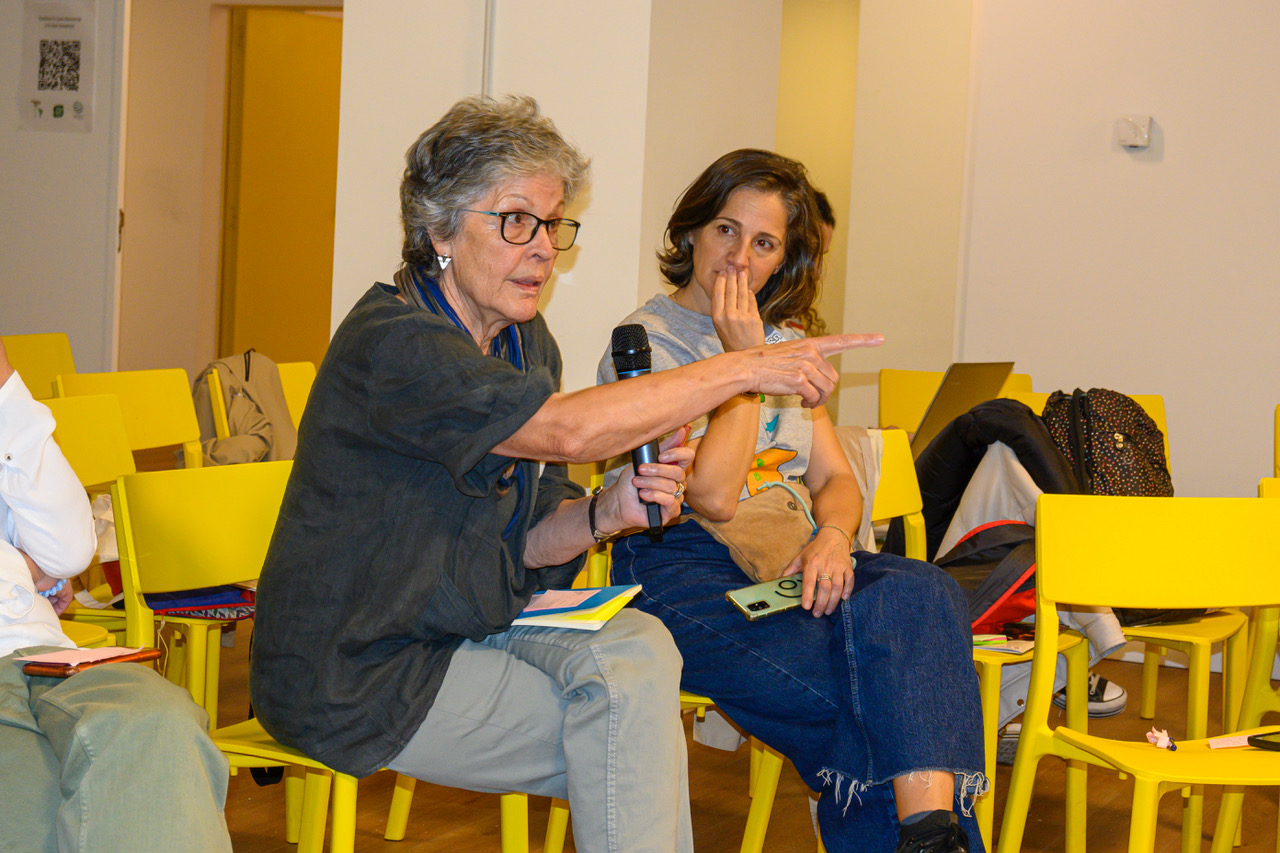
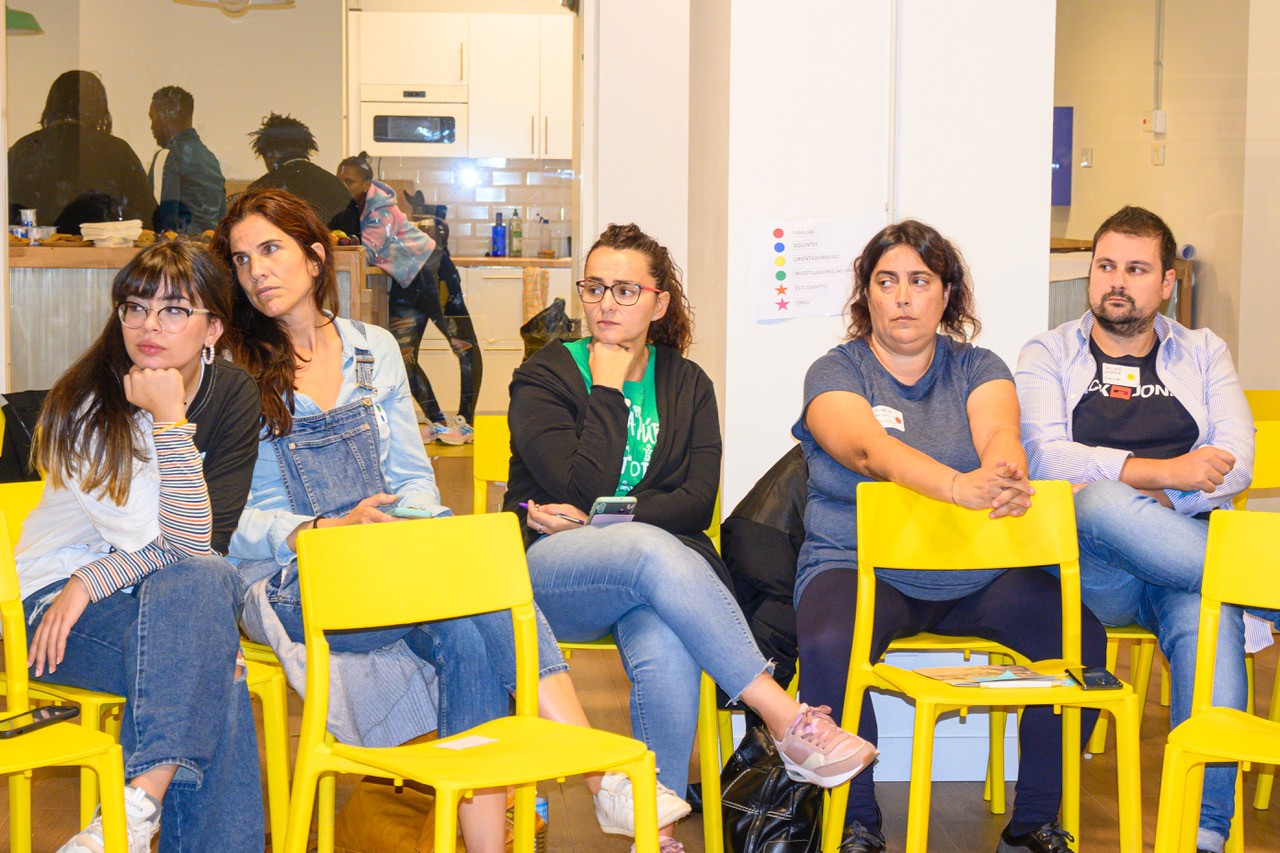
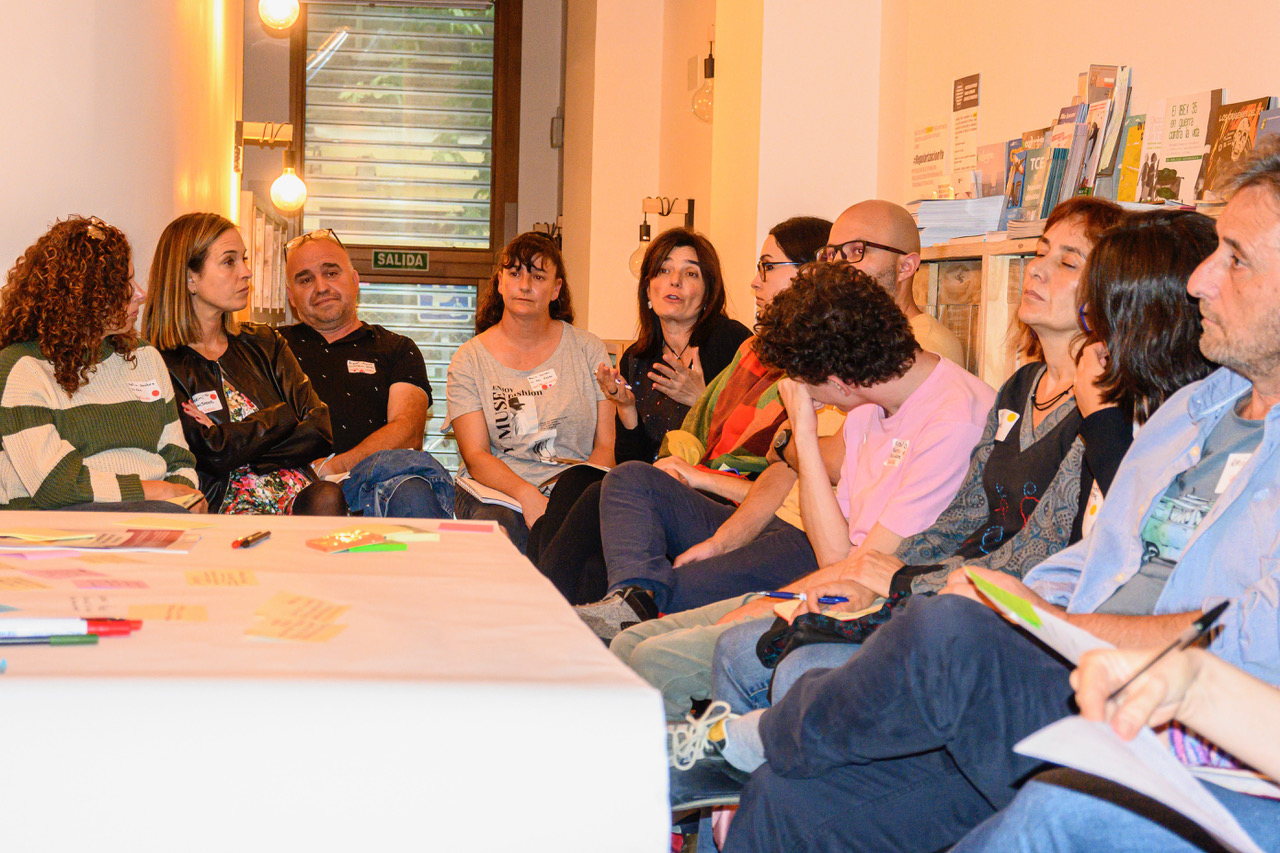
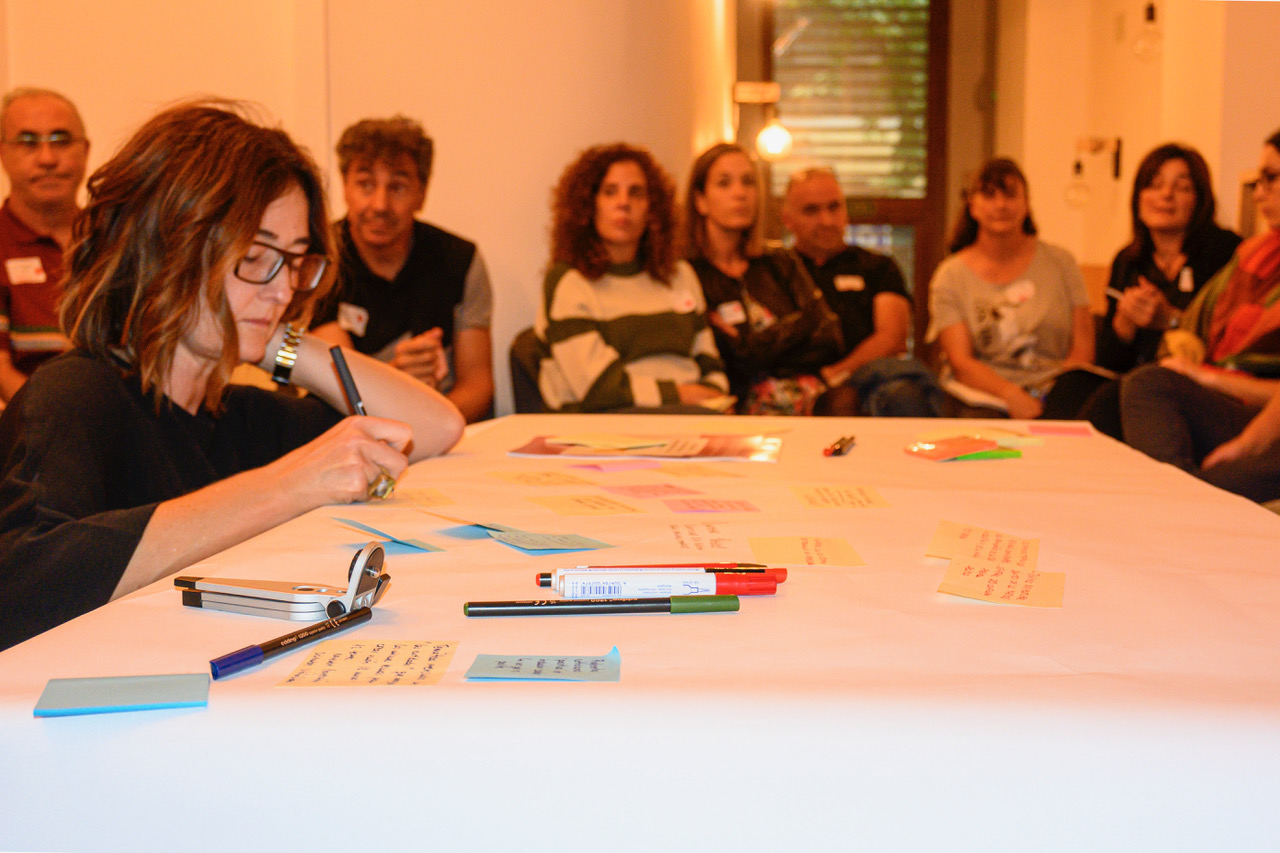
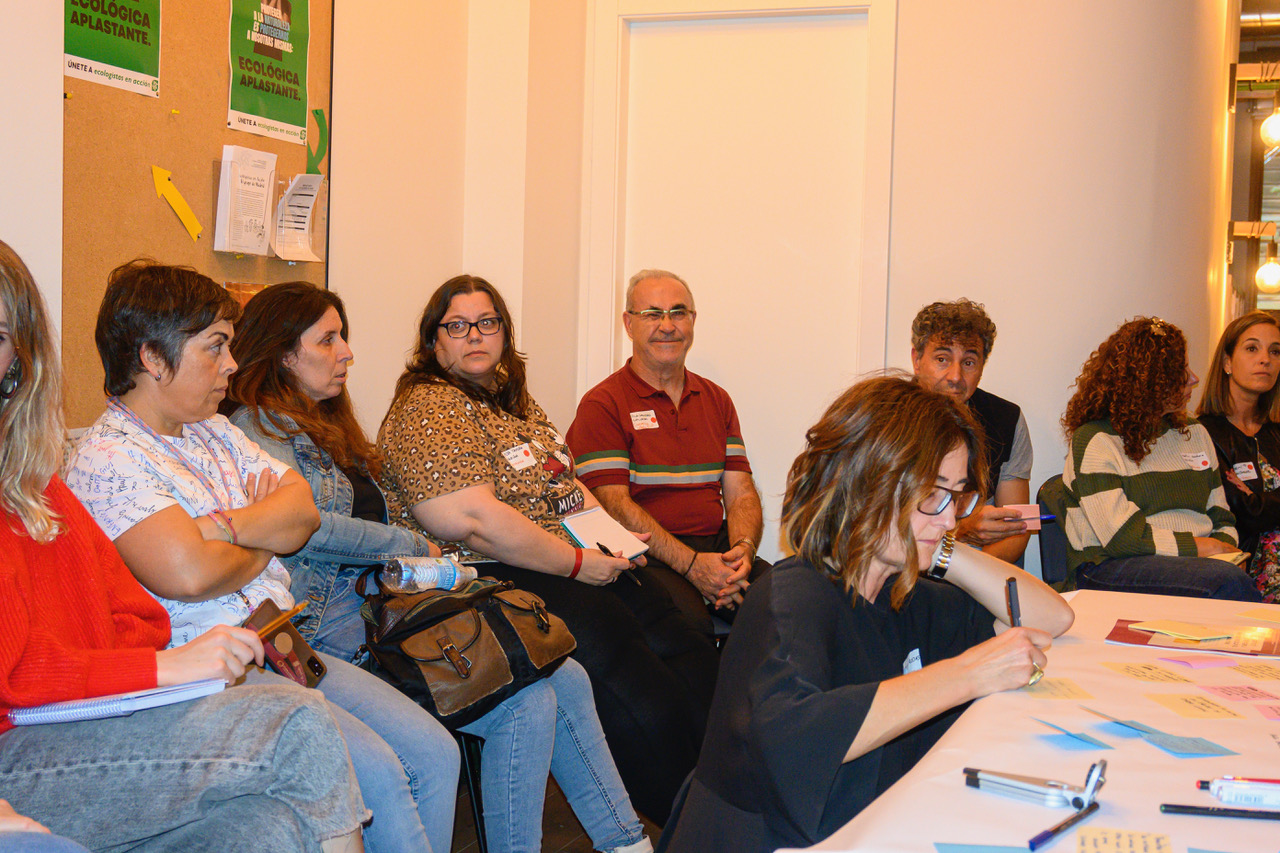
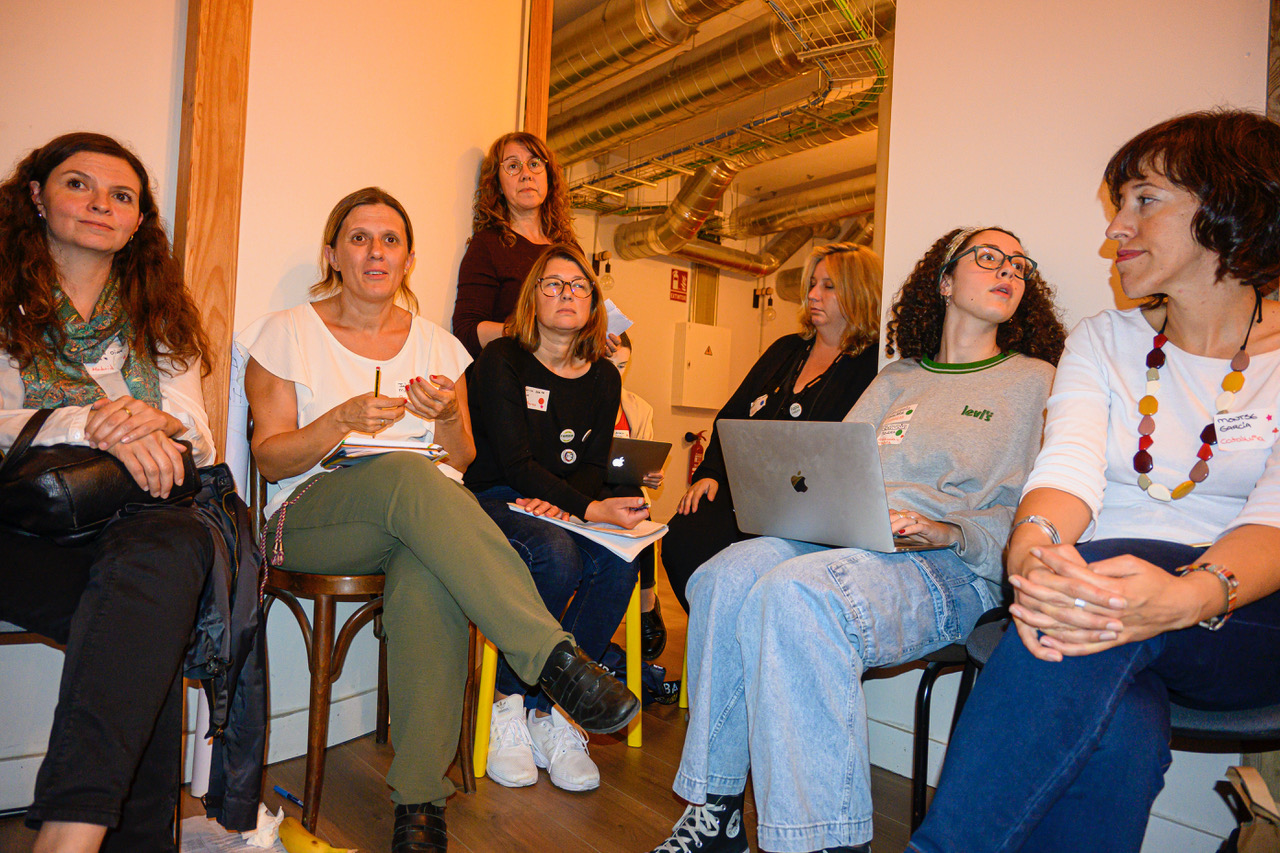
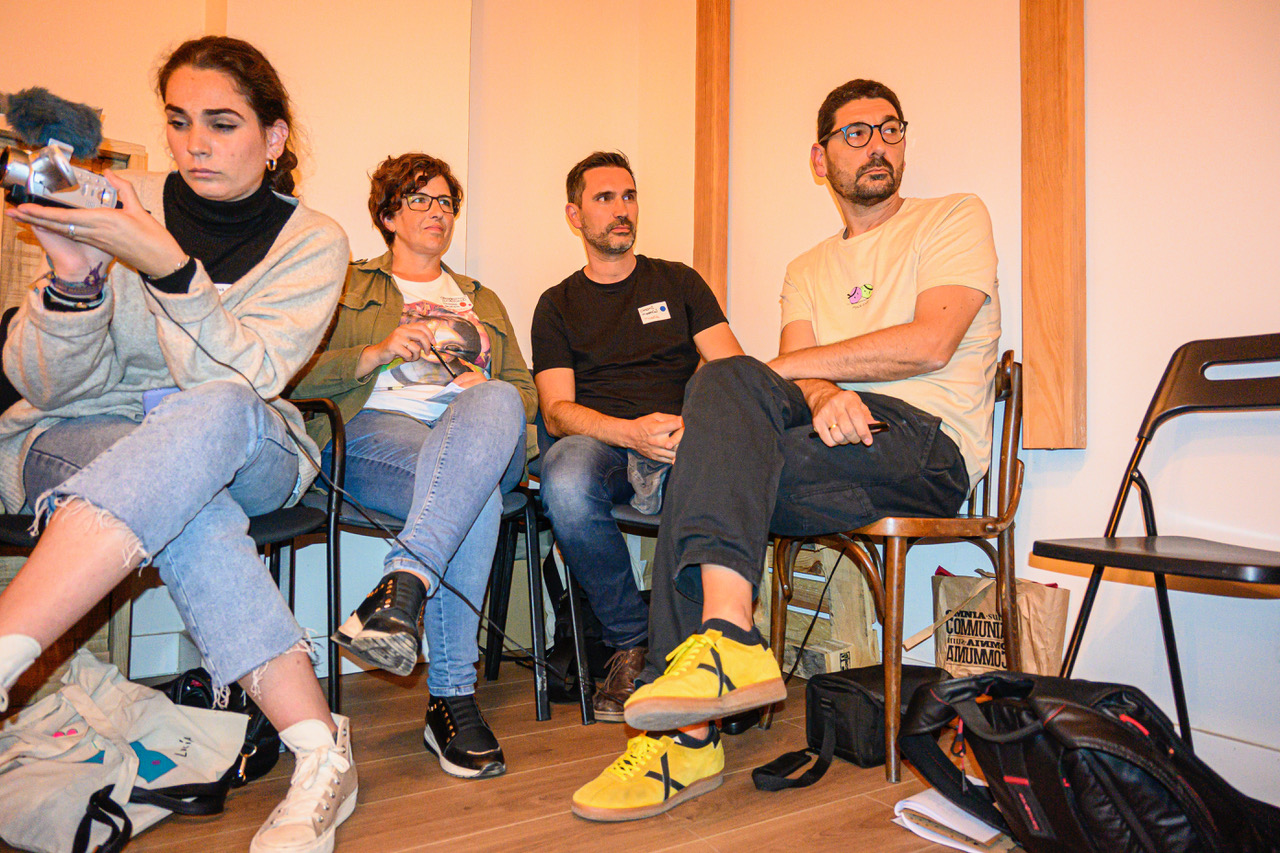
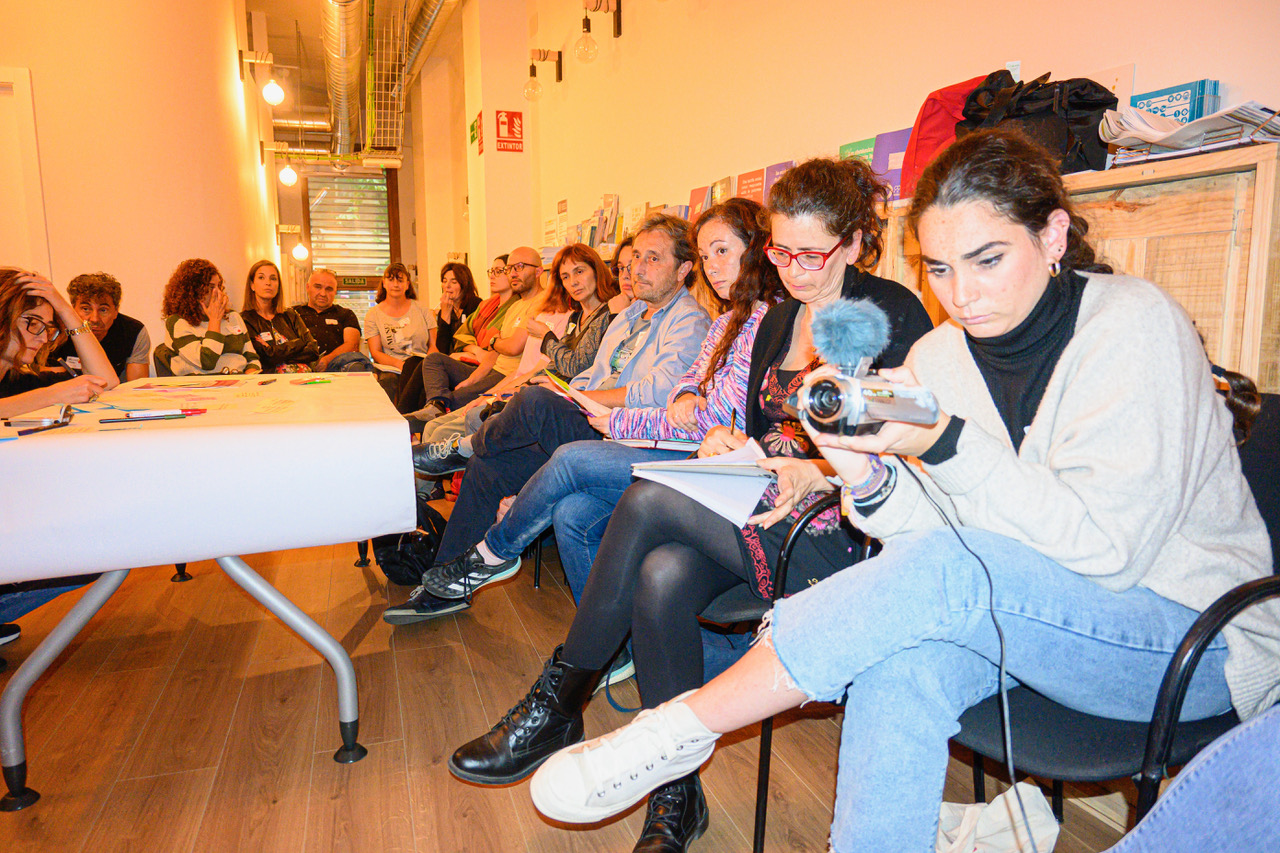
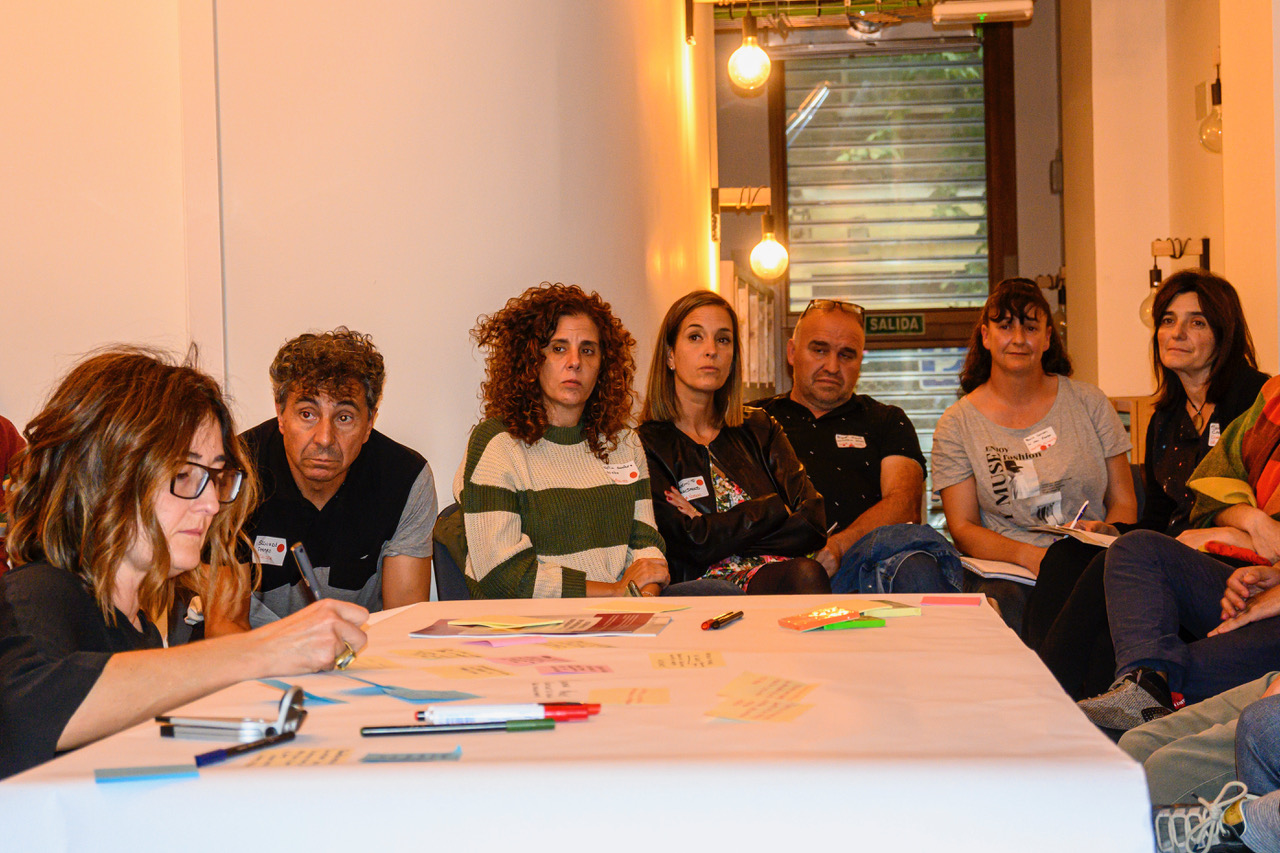
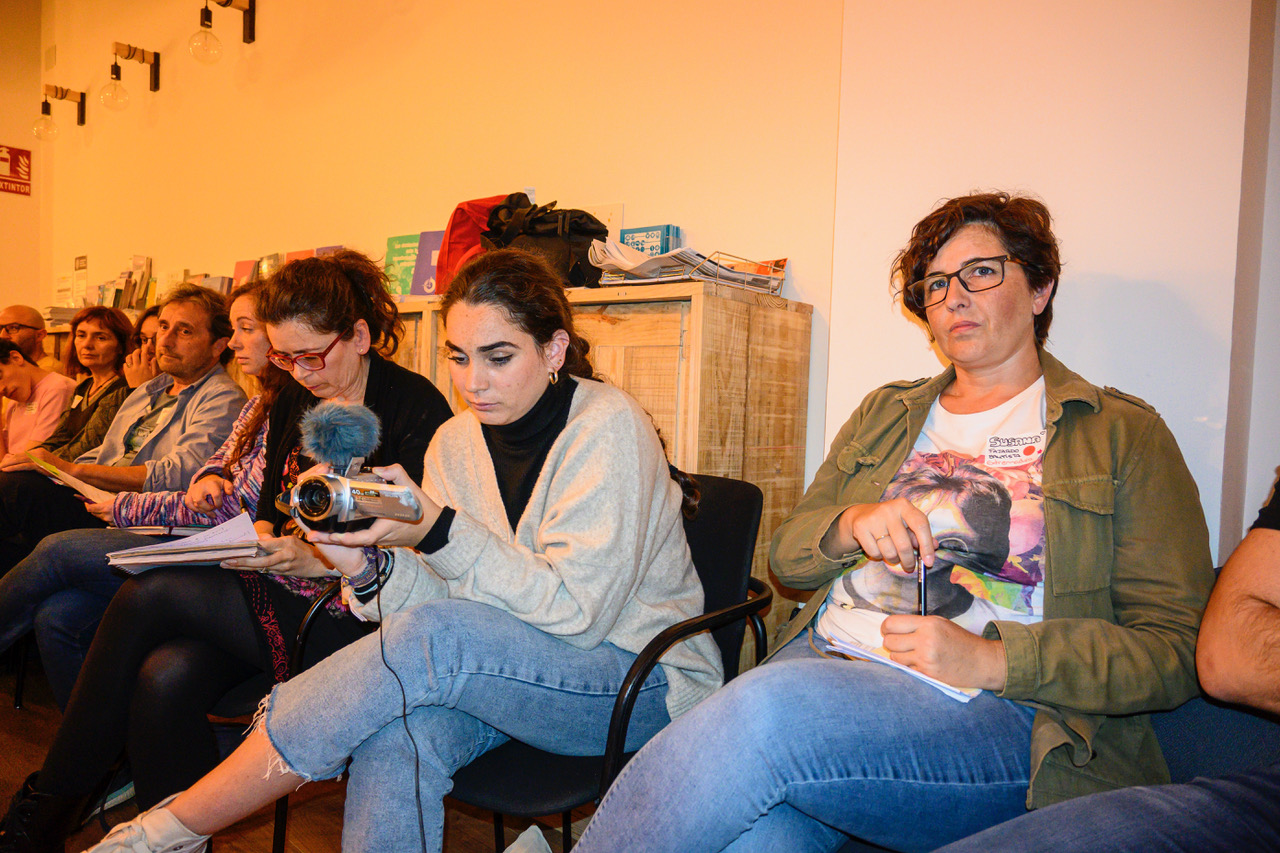
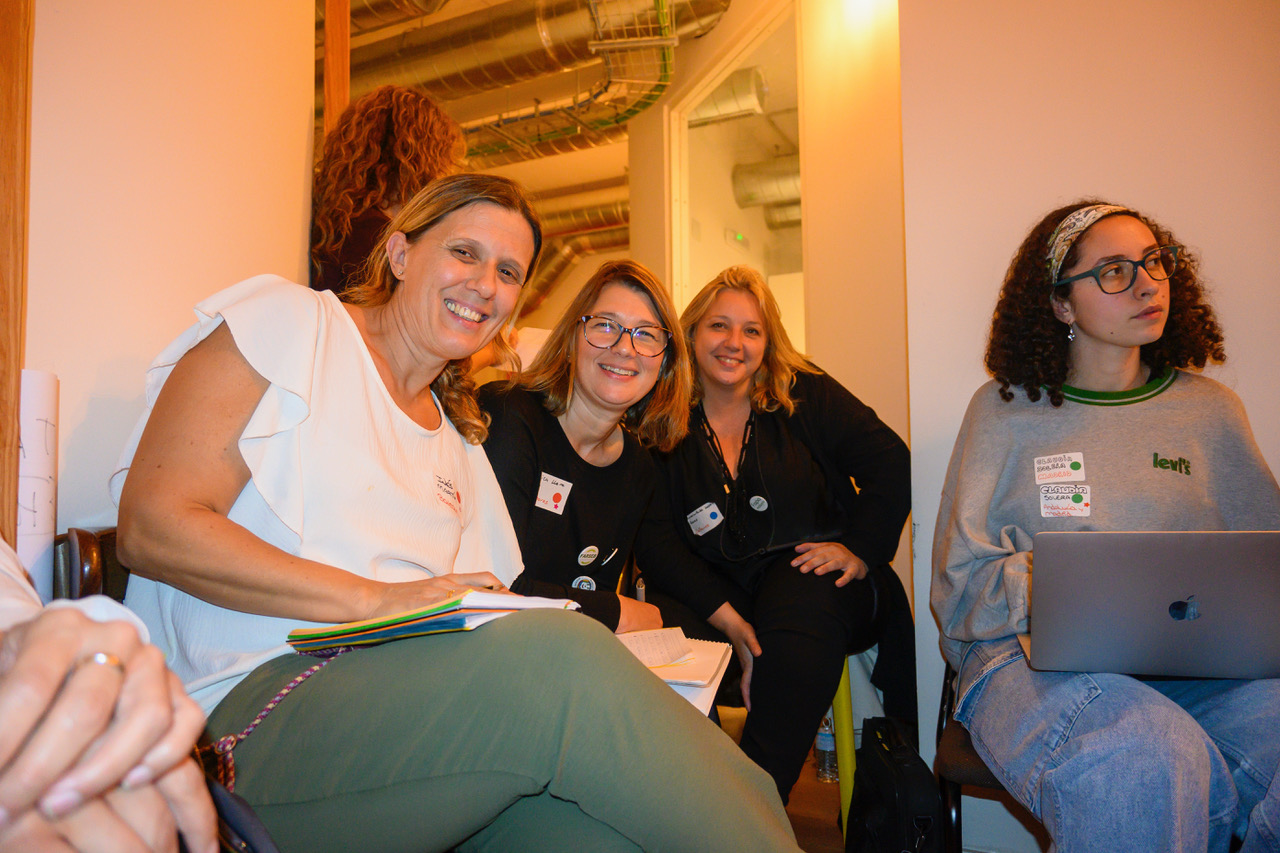
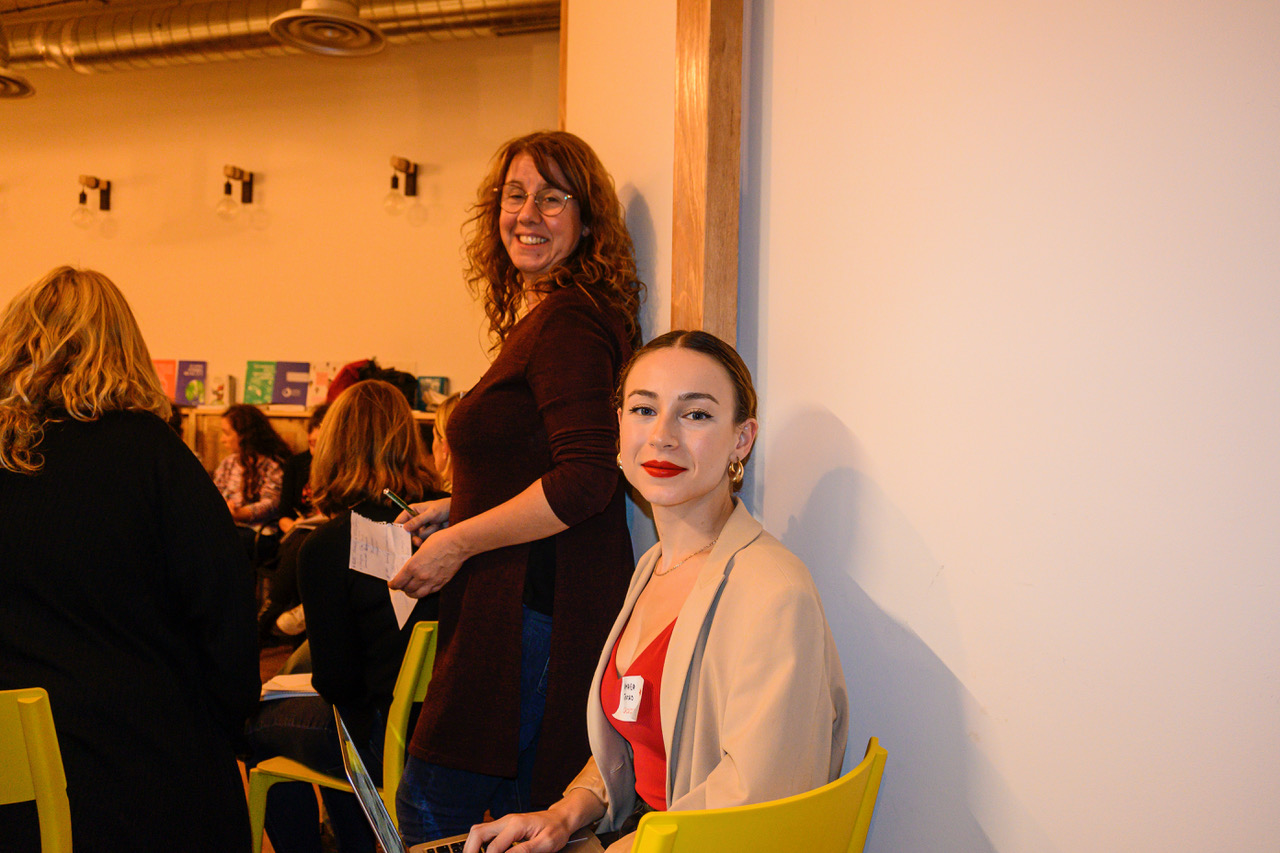
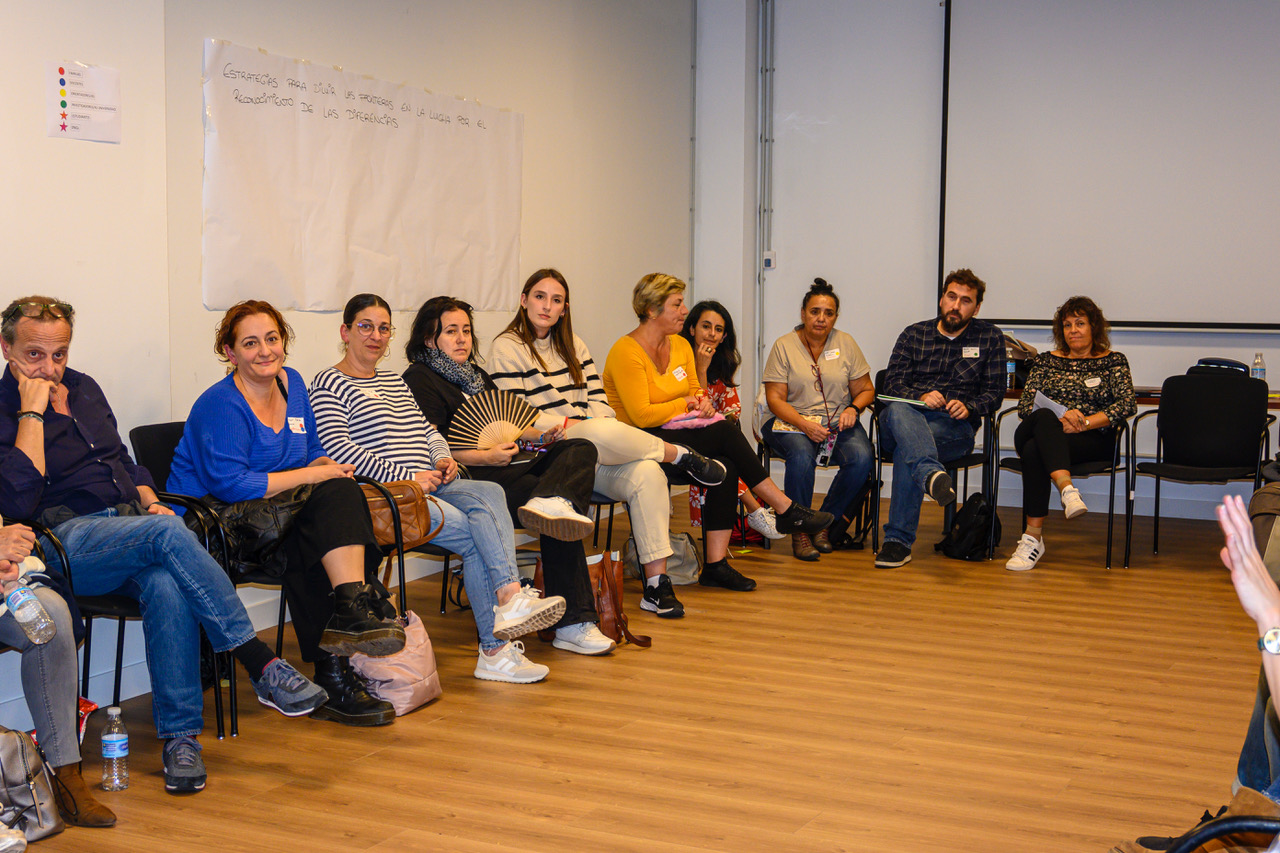
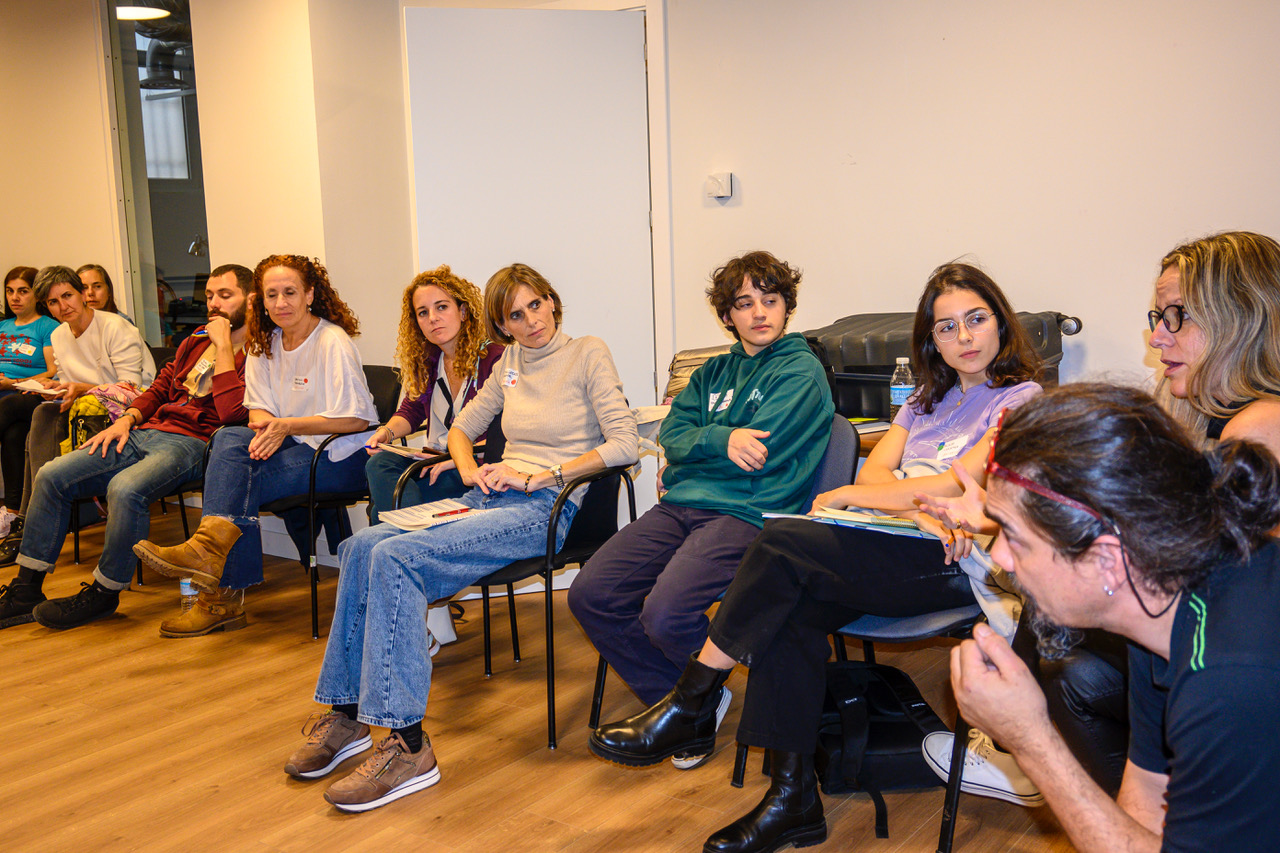
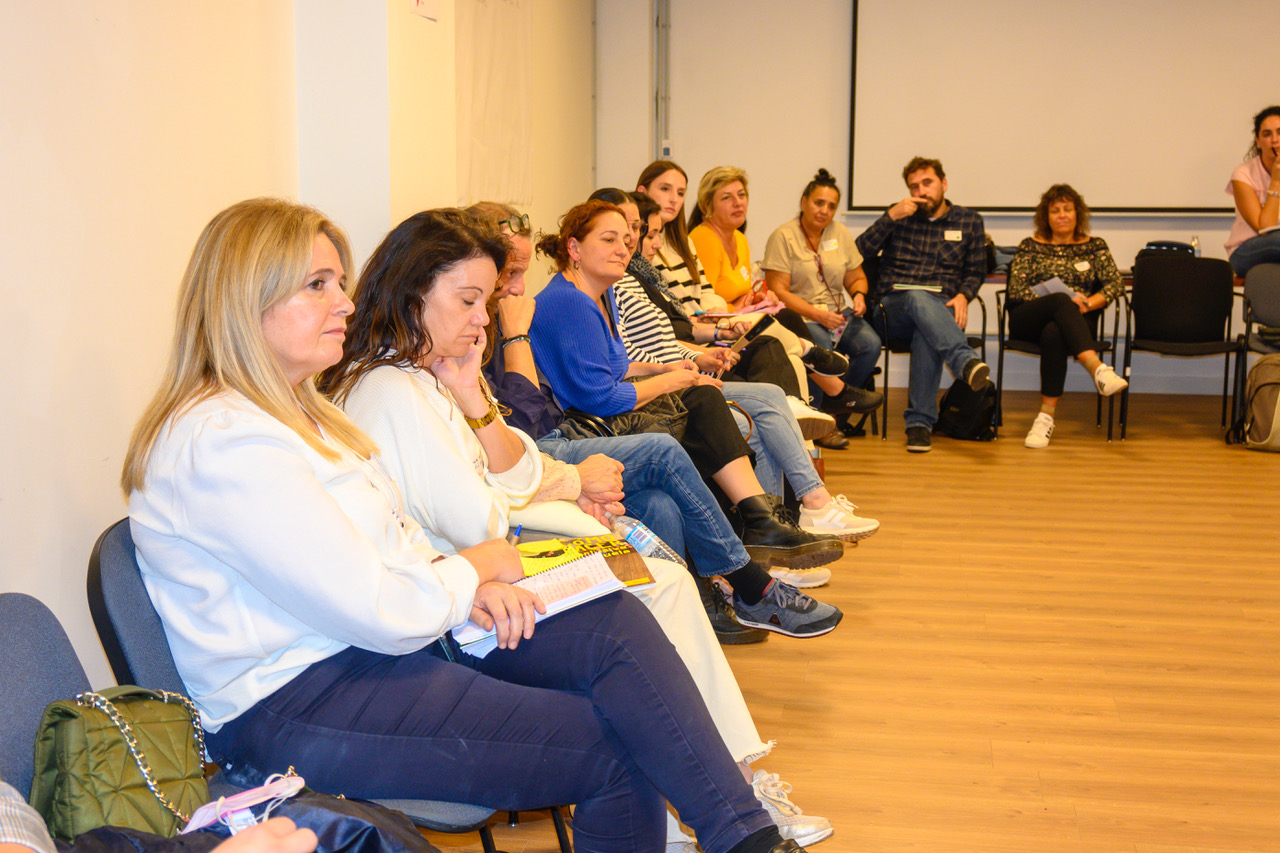
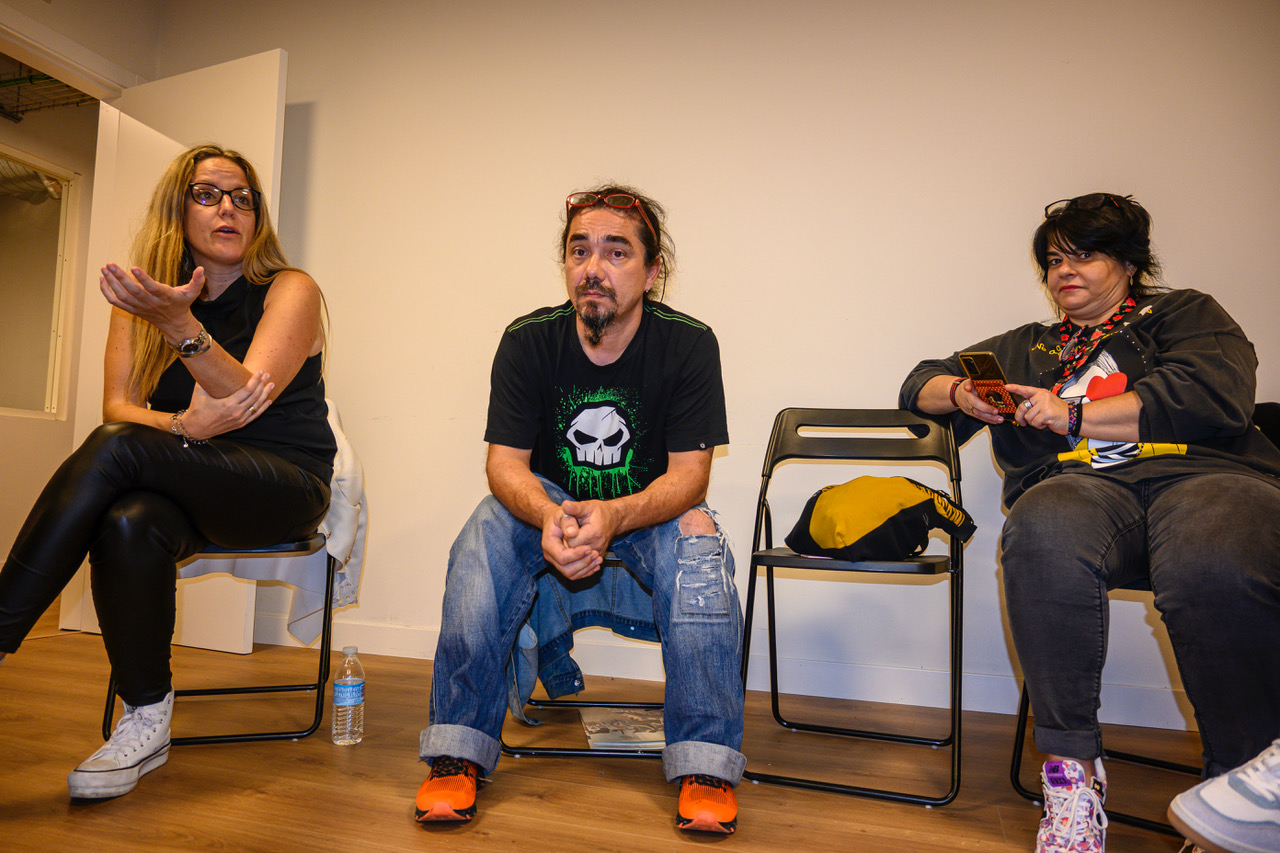
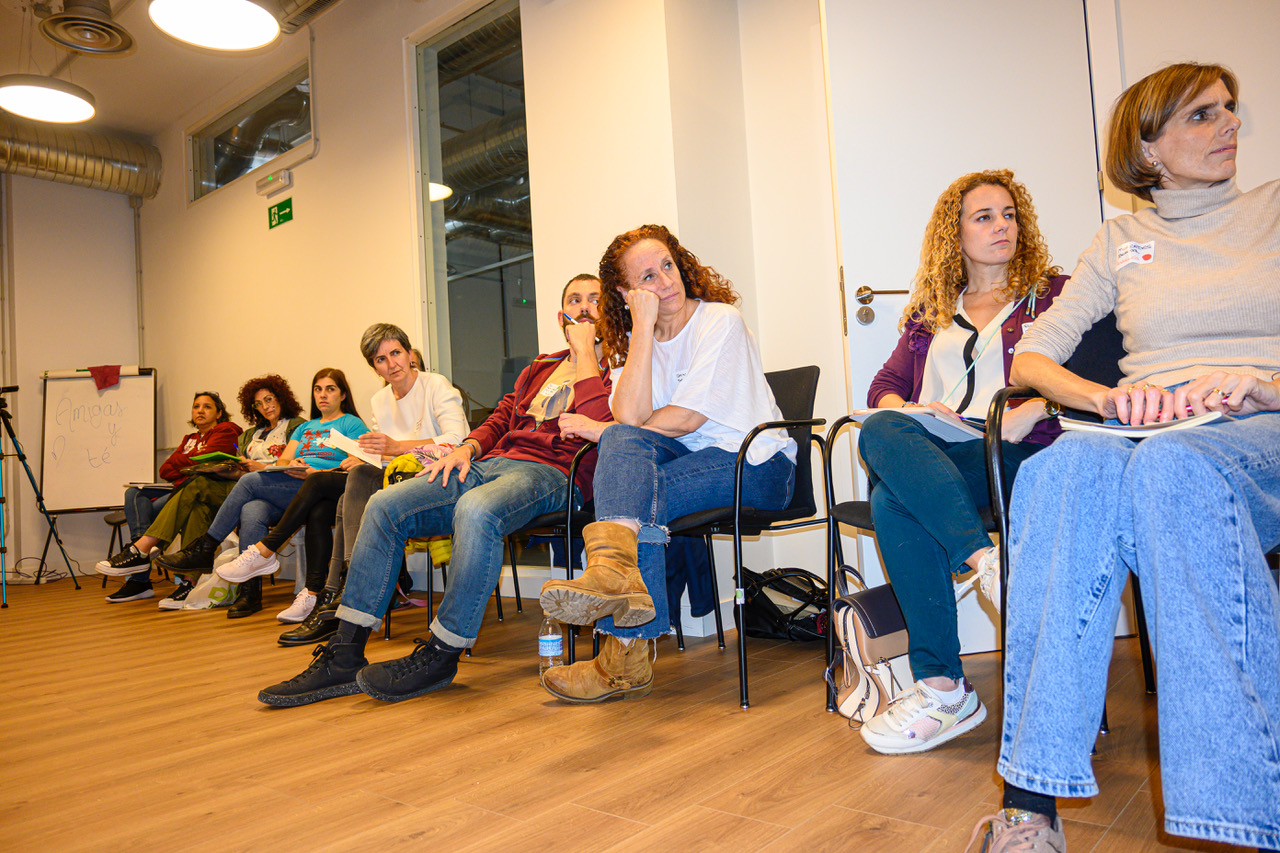
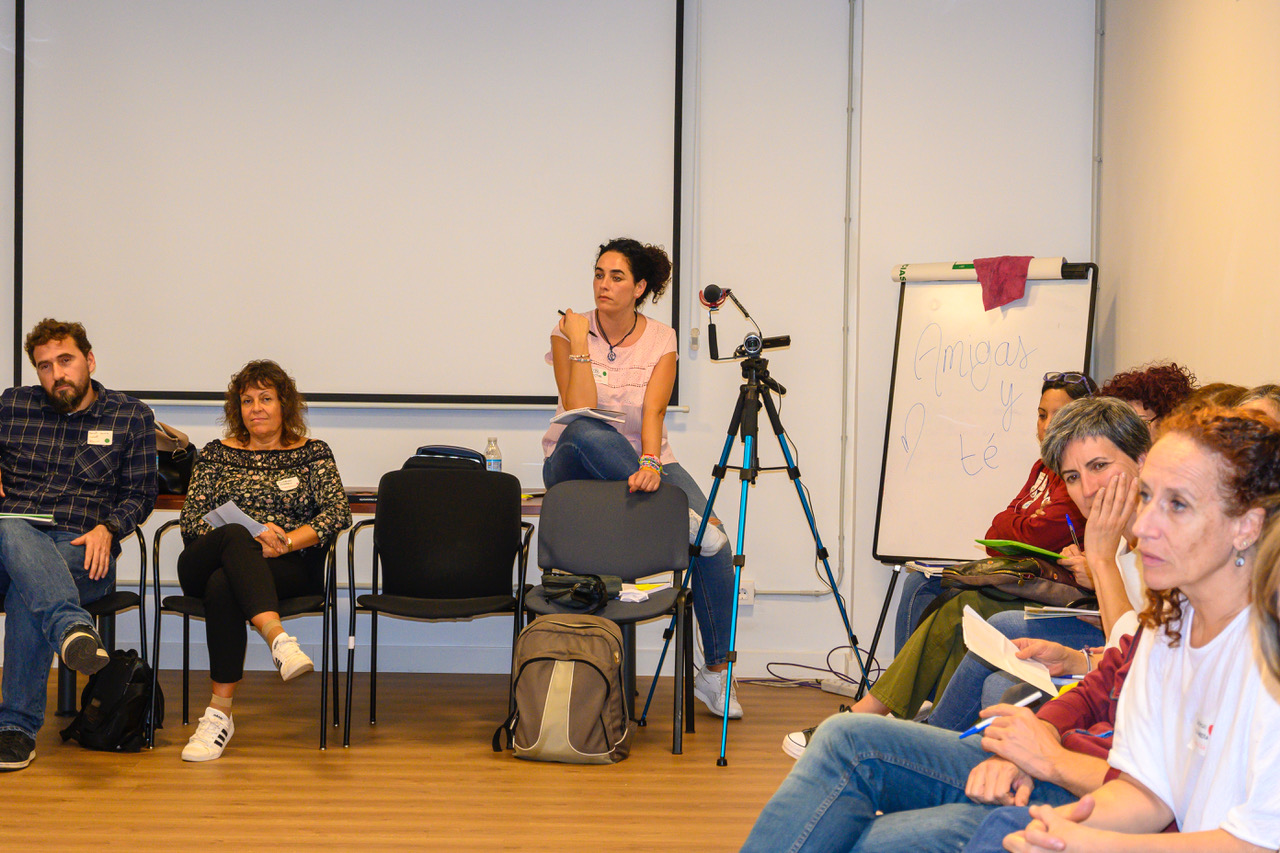
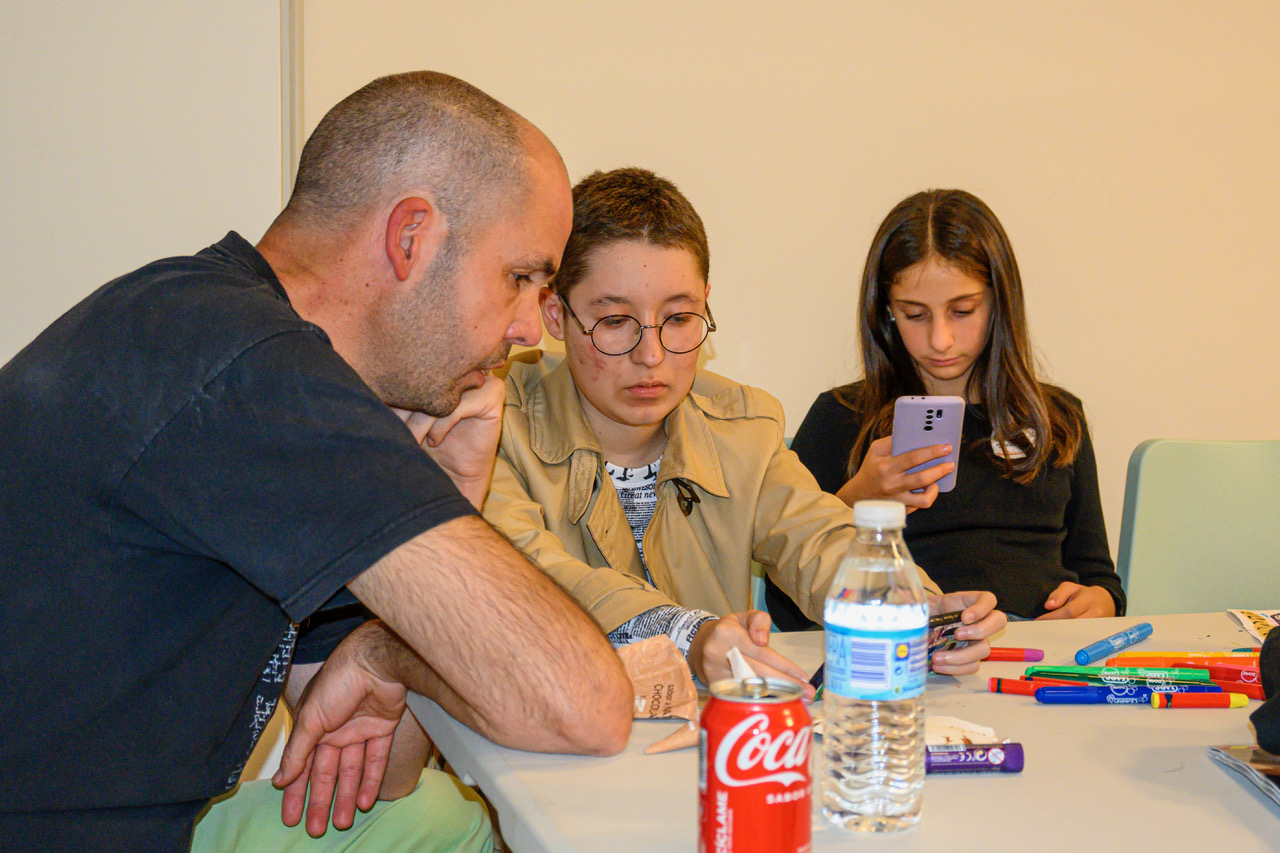
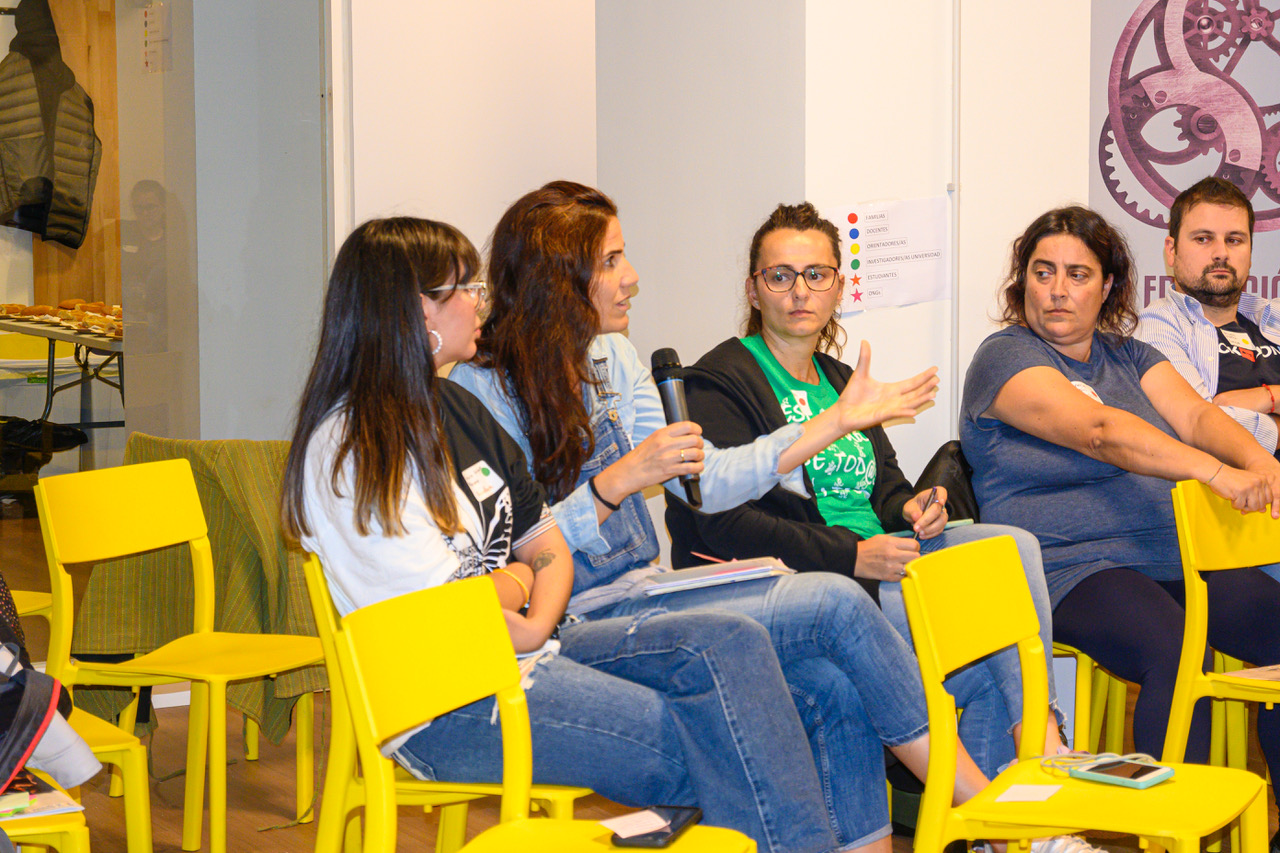
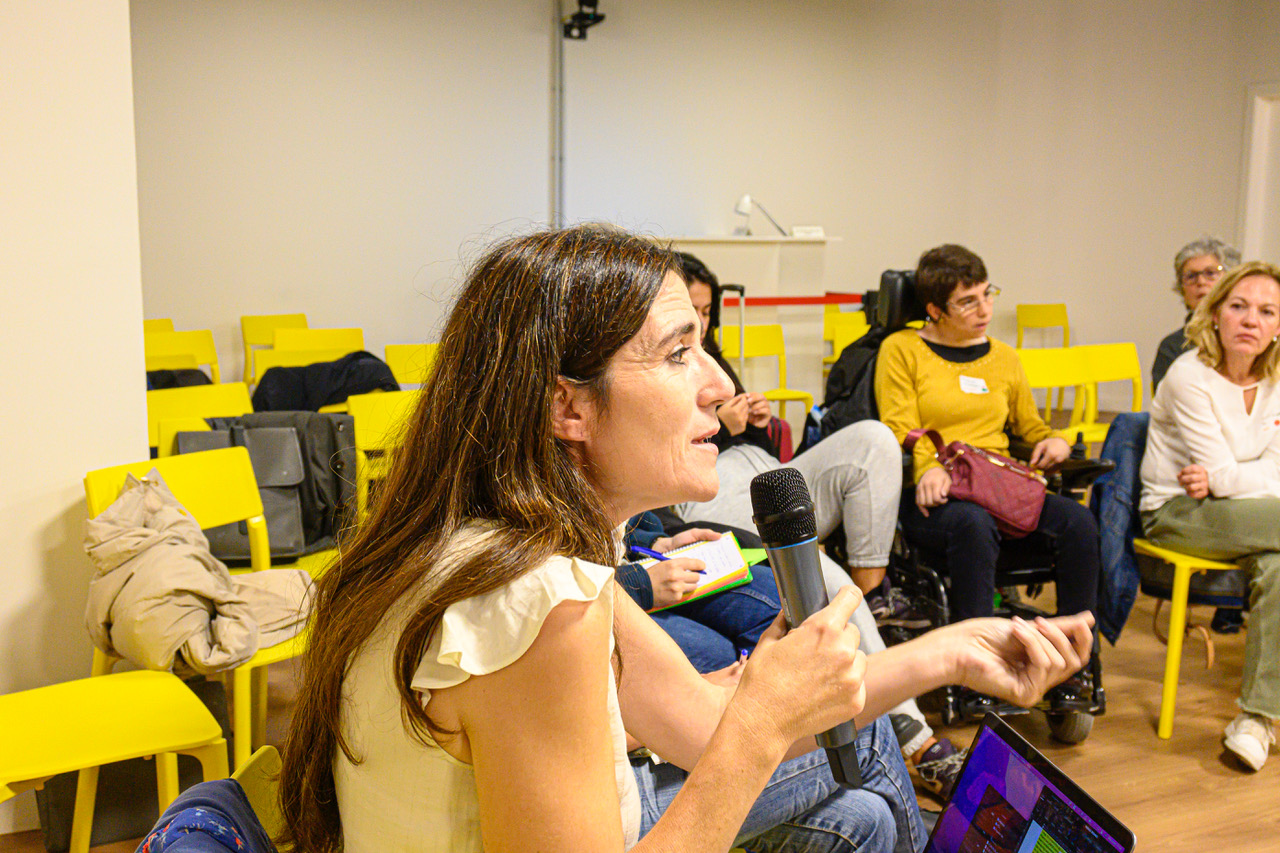
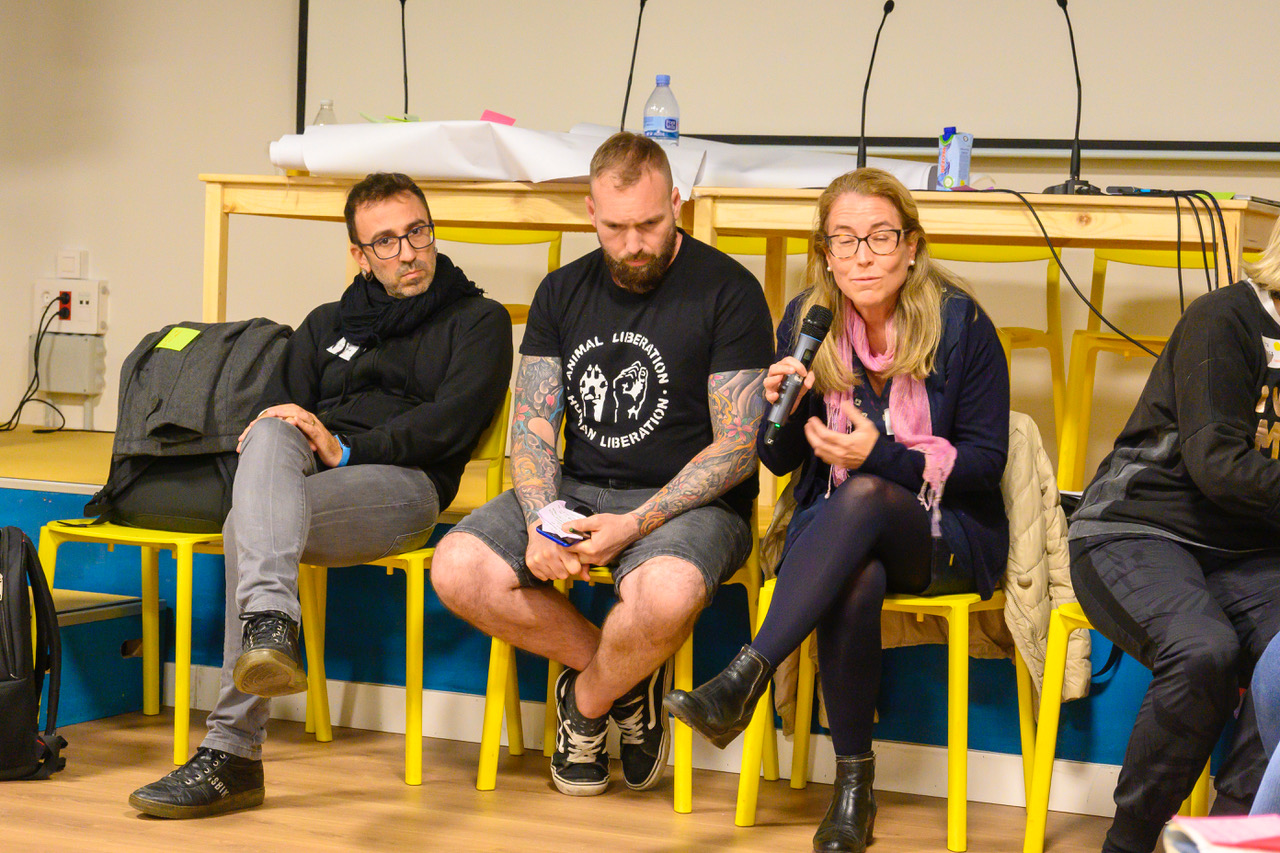
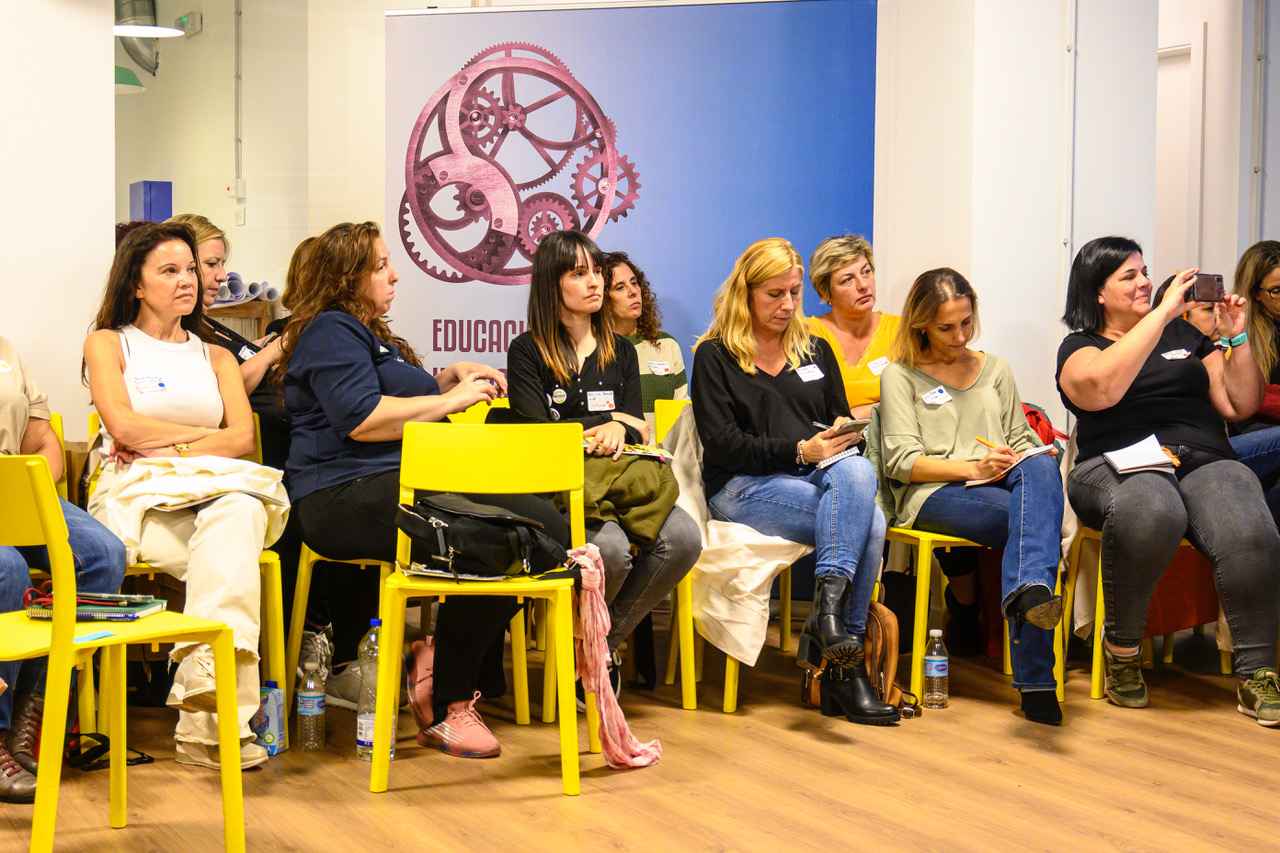
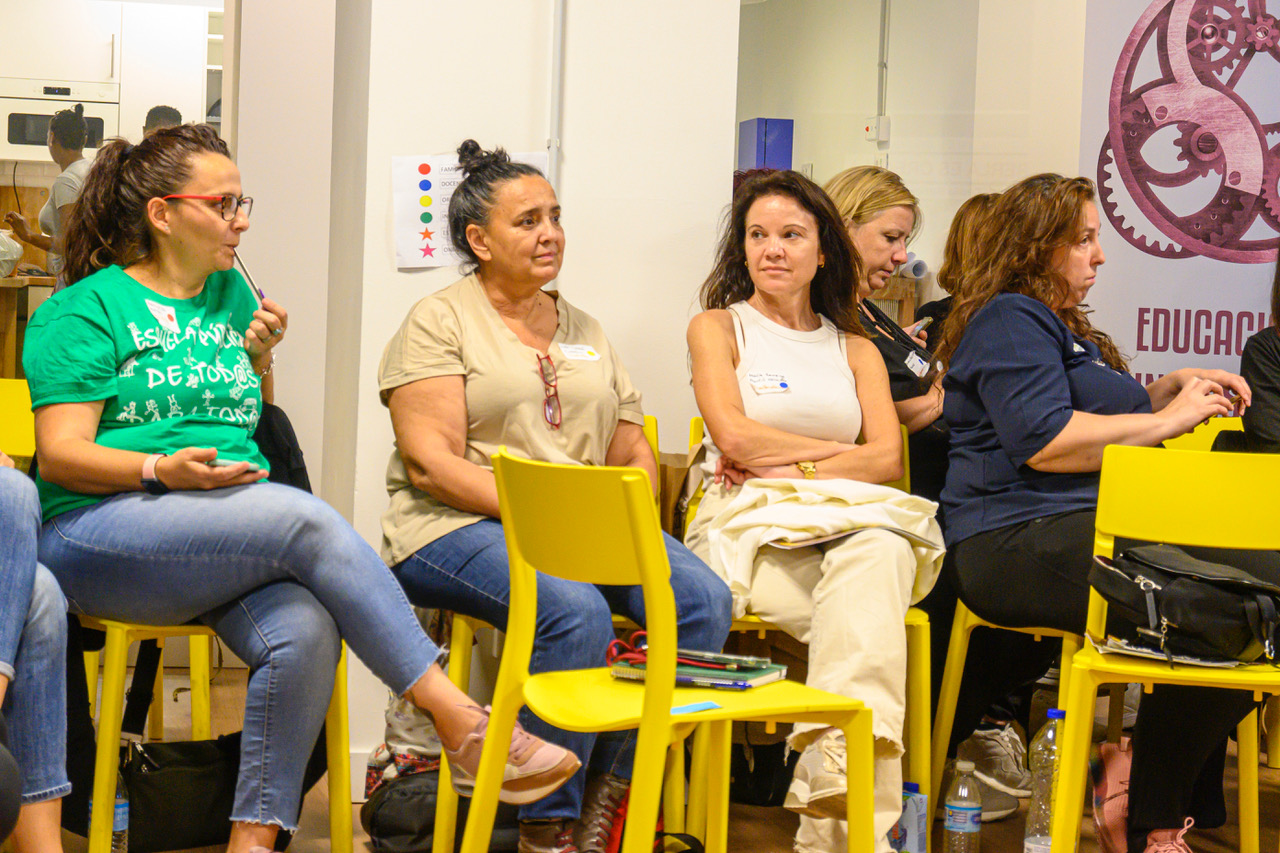
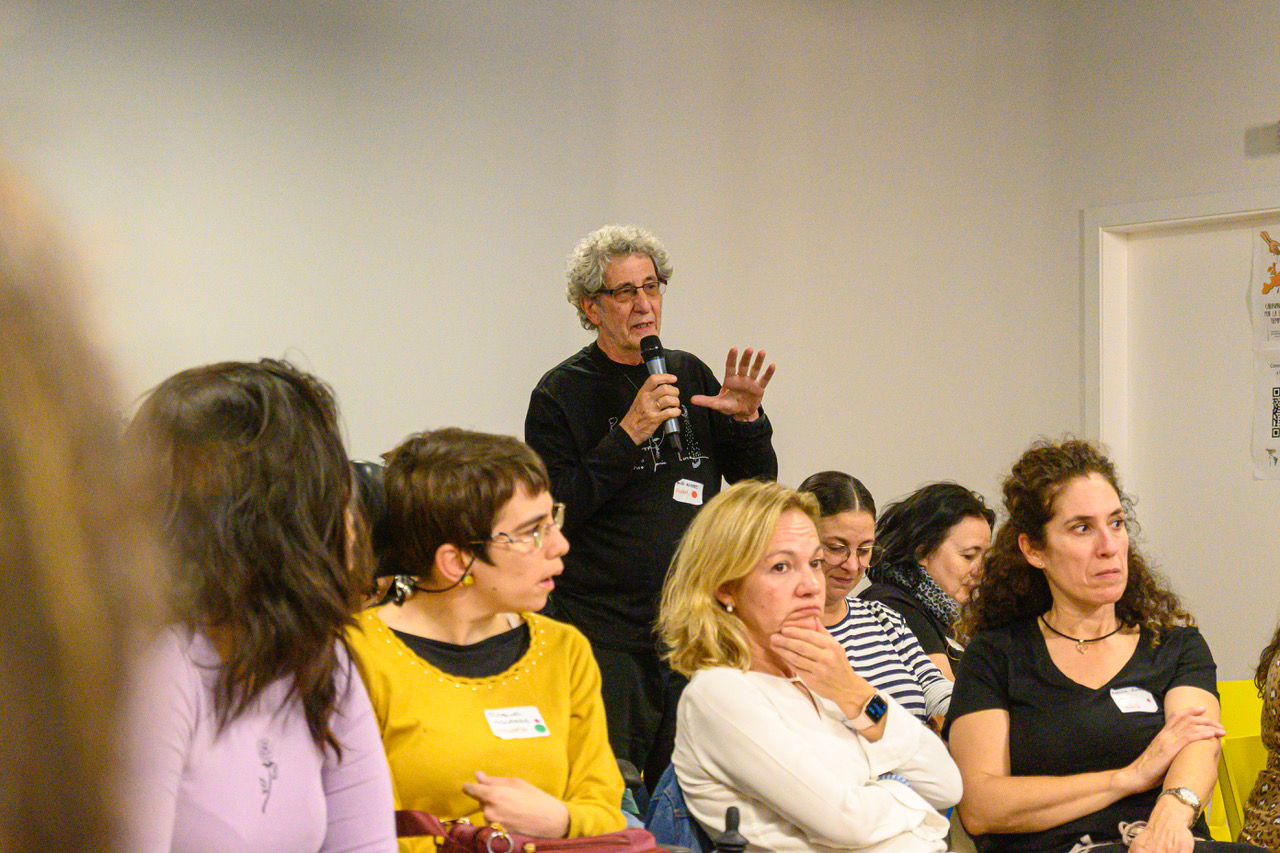
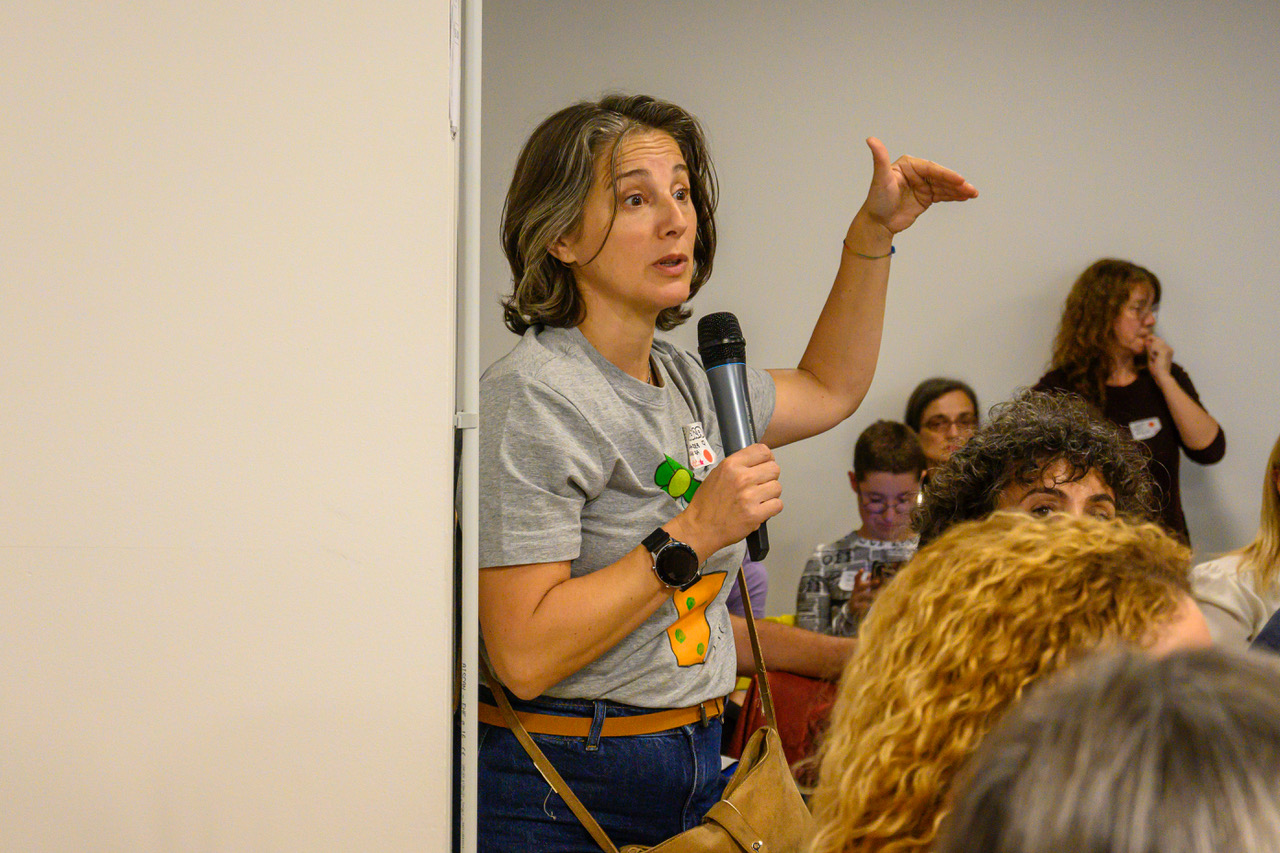
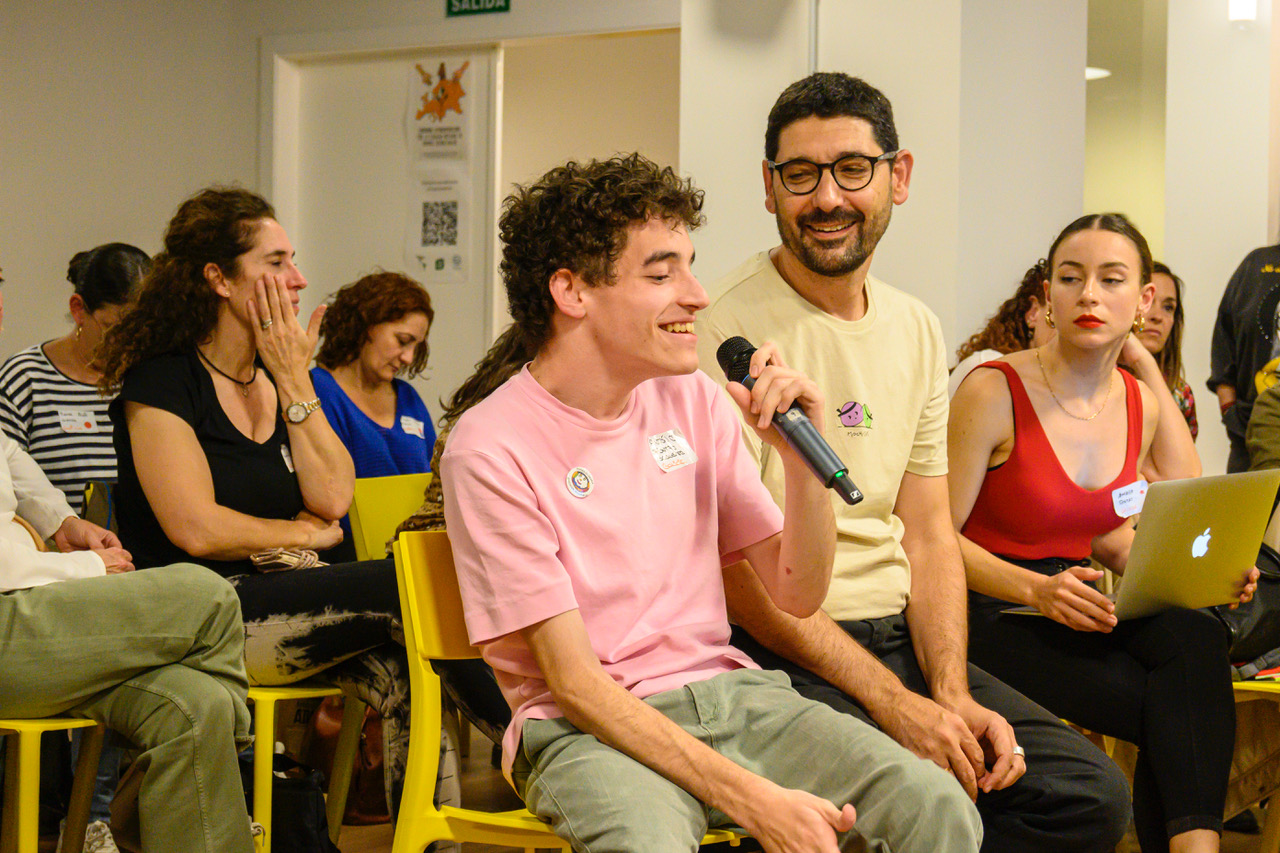
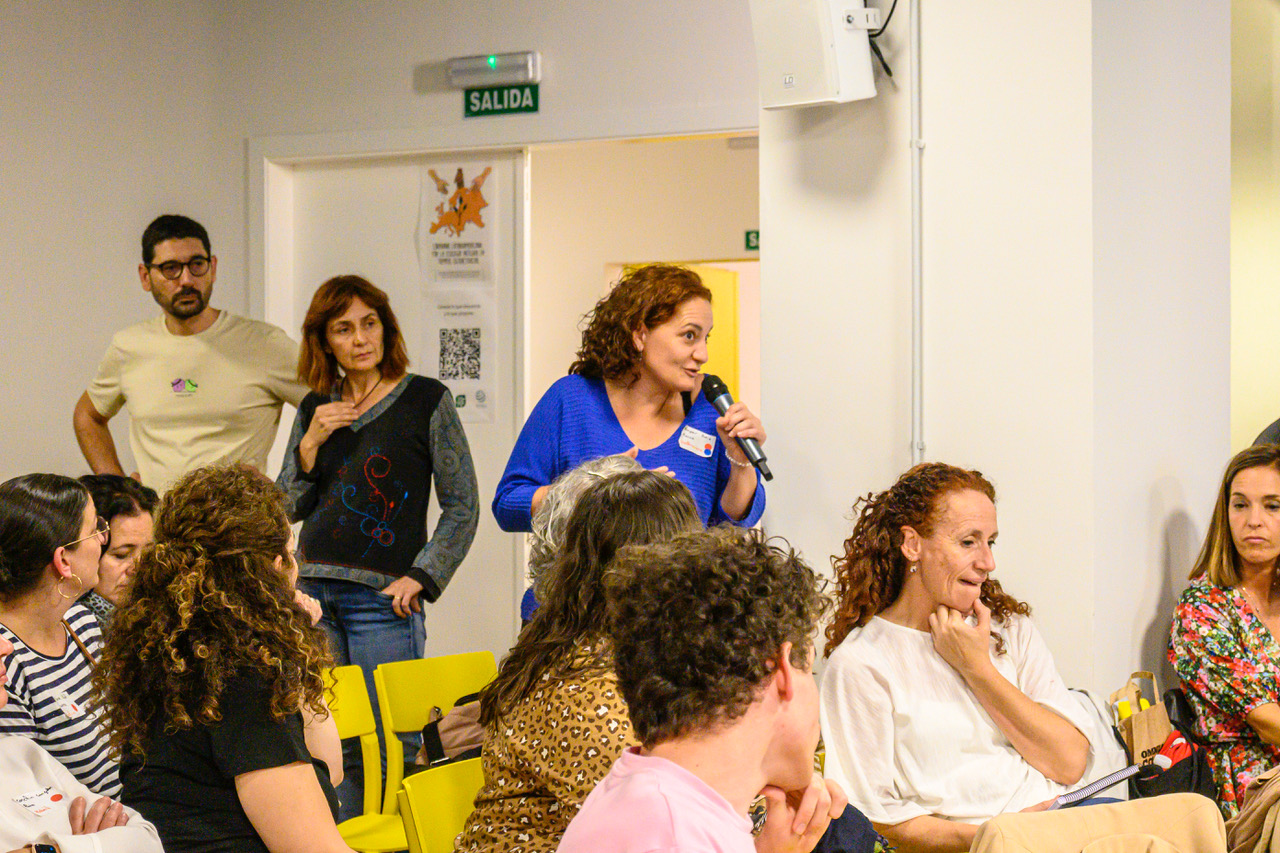
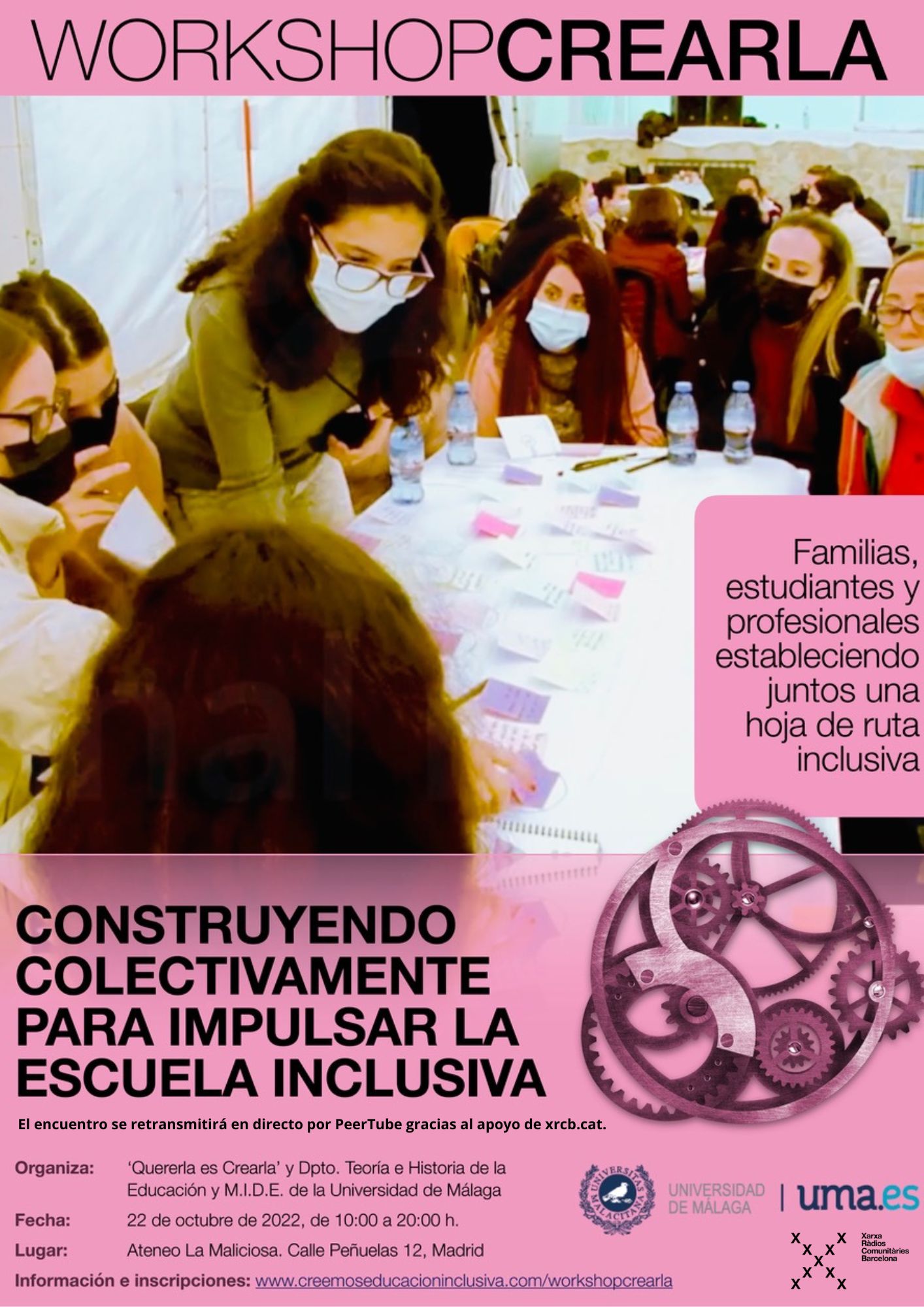
The WorkshopCrearla was a meeting between families, students, and professionals held on October 22, 2022, in Madrid, where we shared a diagnosis of the school reality regarding inclusion, collectively built over 4 years.
From this starting point, the aim was to generate an egalitarian dialogue to build strategic lines for continuing to work in a participatory, organized, and systematic way during the following year. It was not a conventional conference or course. It was a meeting where each participant committed to the transformation of the education system.
The event was broadcast live on PeerTube thanks to the support of xrcb.cat




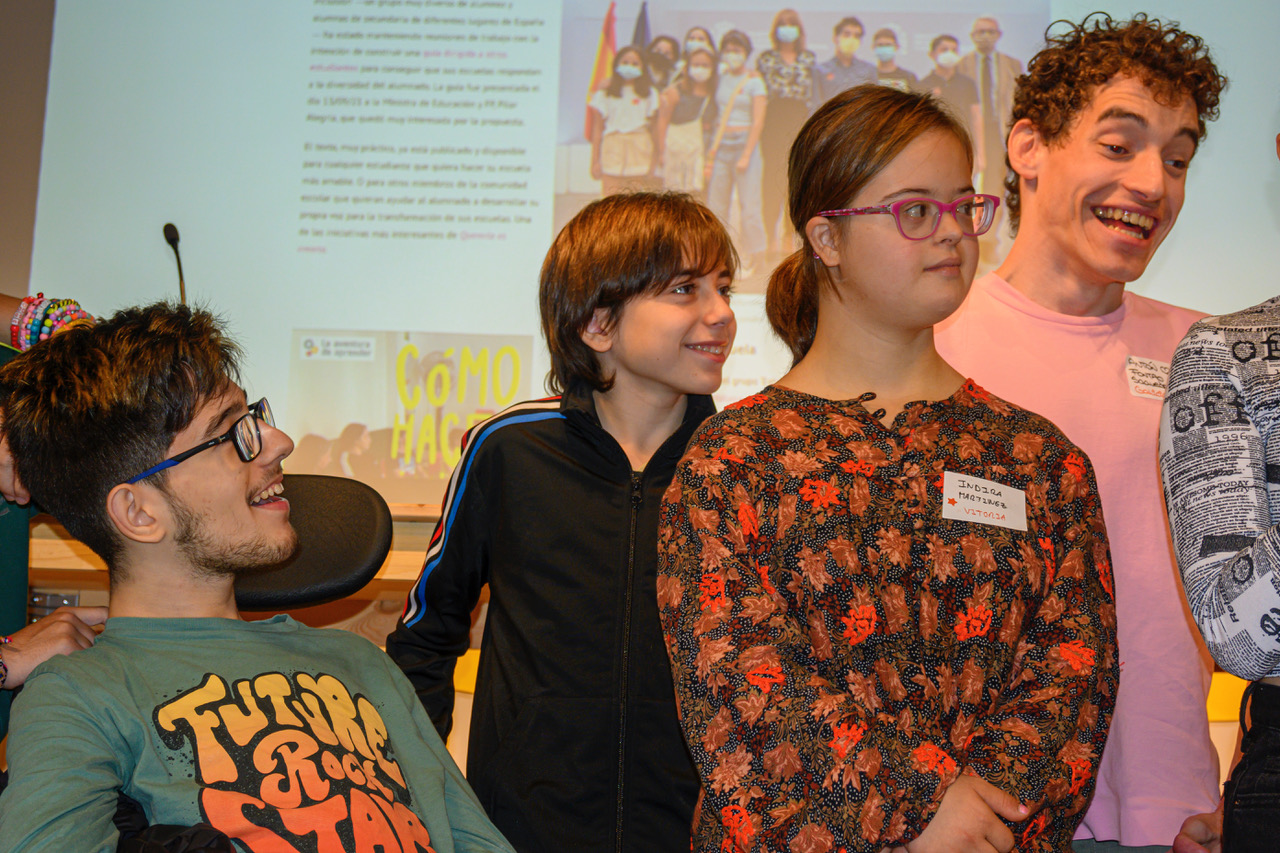
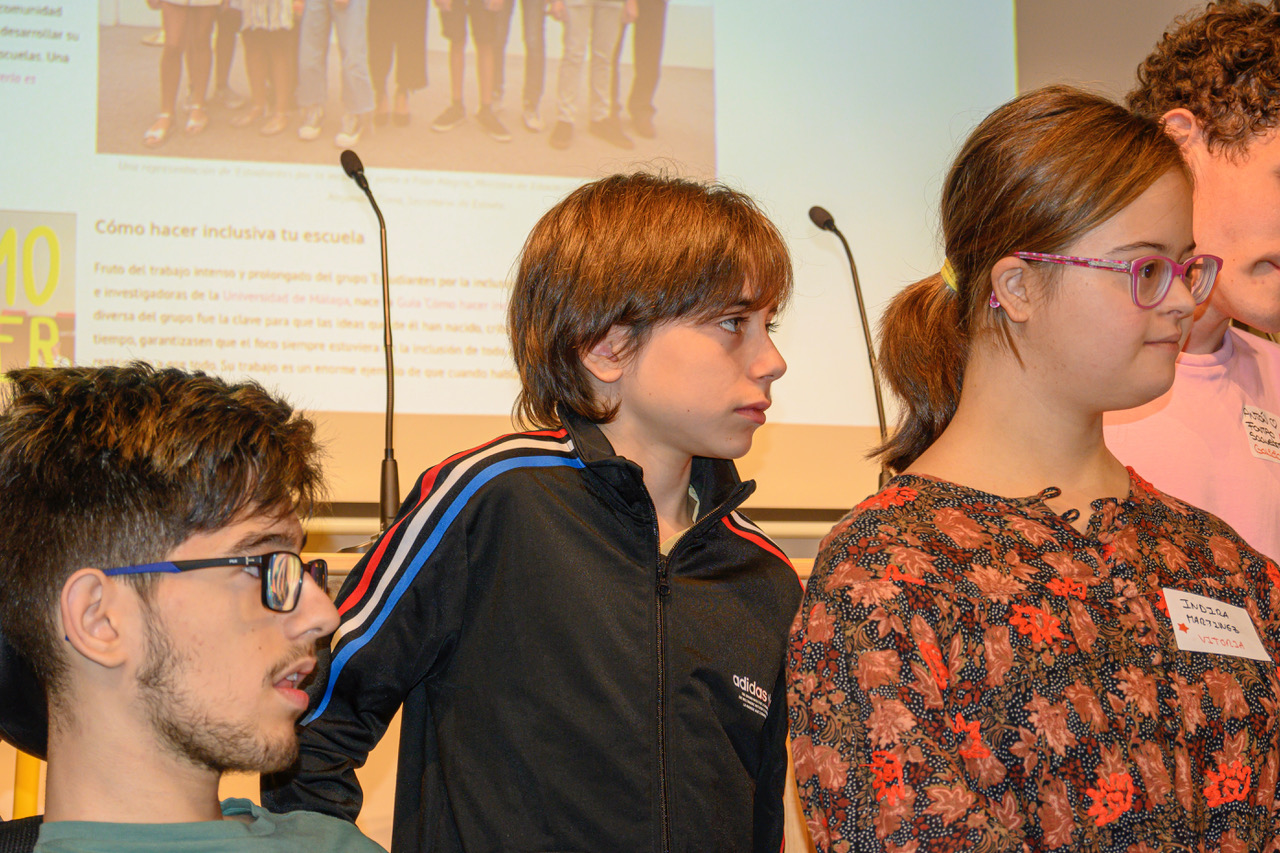
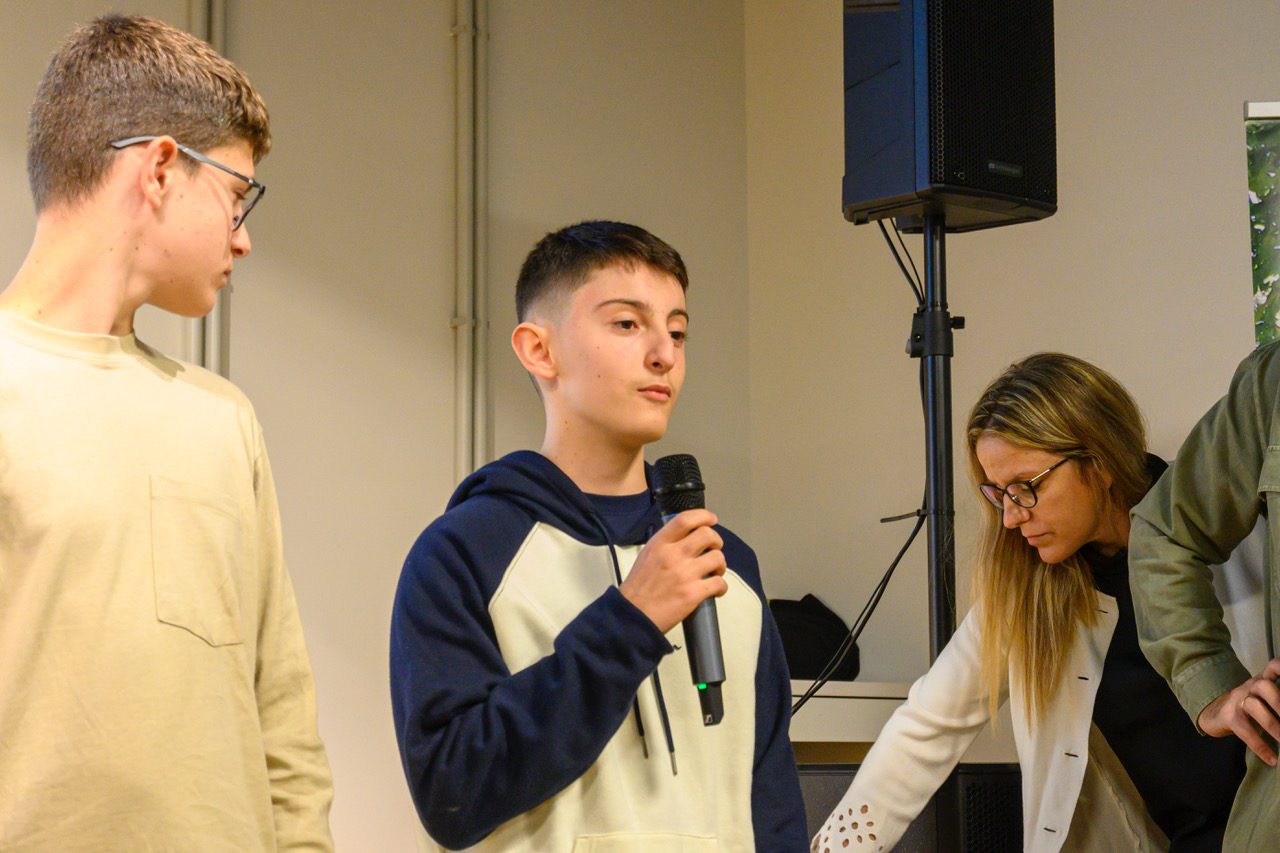
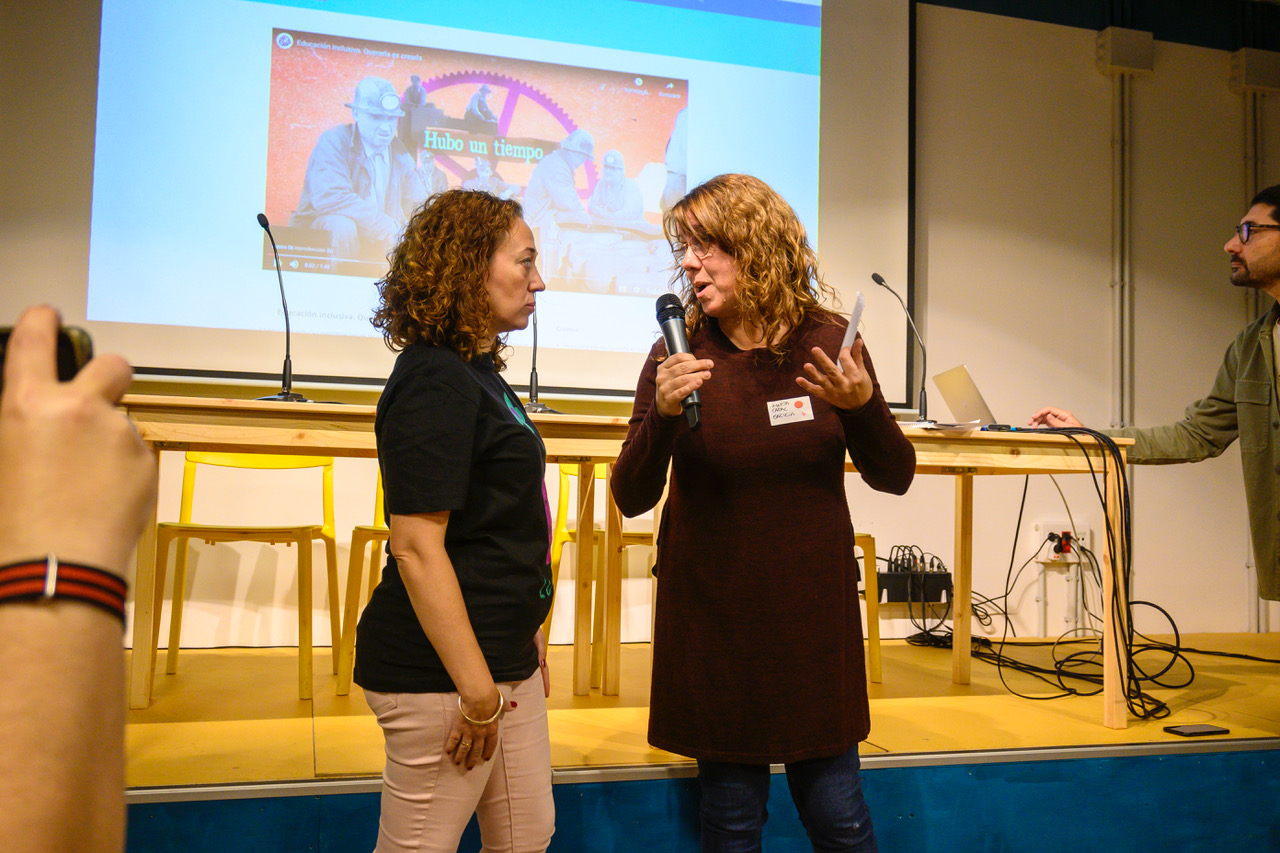




















Purpose of the Meeting
The Workshop started from the research “Emerging narratives about inclusive schools…” (RTI2018-099218-A-I00) which we developed at the University of Malaga with funding from the Ministry of Science, Innovation and Universities, as were the previous participatory meetings held in prior years.
It started from Booth’s perspective (1998) when he puts forward the “excluded voice thesis”: this research methodology allows us to reach the perspectives and experiences of oppressed groups who would not be able to make their voices heard with other methodological proposals.
In other words, the research seeks to question and even break the power relations that dominate research practices.
What we aimed for with the Workshop
Aware of the value of what we have been building, this meeting started from the idea that students, teachers, families, and academics can learn from each other, collaborate in developing new proposals, and together develop new possibilities for action. Therefore, we aimed to:- Promote the construction of collaboration and activism networks for inclusion.
- Disseminate a participatory evaluation of the state of school inclusion, based on experience.
- Provide a space for expressing desires, concerns, doubts, and proposals.
- Re-establish the necessary trust between professionals, students, and families, through people committed to the democratization of schools.
- Design strategic lines to promote the real and effective development of the inclusive school.
- Organize a large Participatory Action Research to promote inclusion in the state school system
Inclusive education is not something technical, but a committed form of activism with a humanizing project for the school, in which guidance work becomes research at the service of the democratization of the center, making visible the violence that is normalized in schools, and recognizing the value and legitimacy of the knowledge of the entire community
Agreements developed in the Workshop
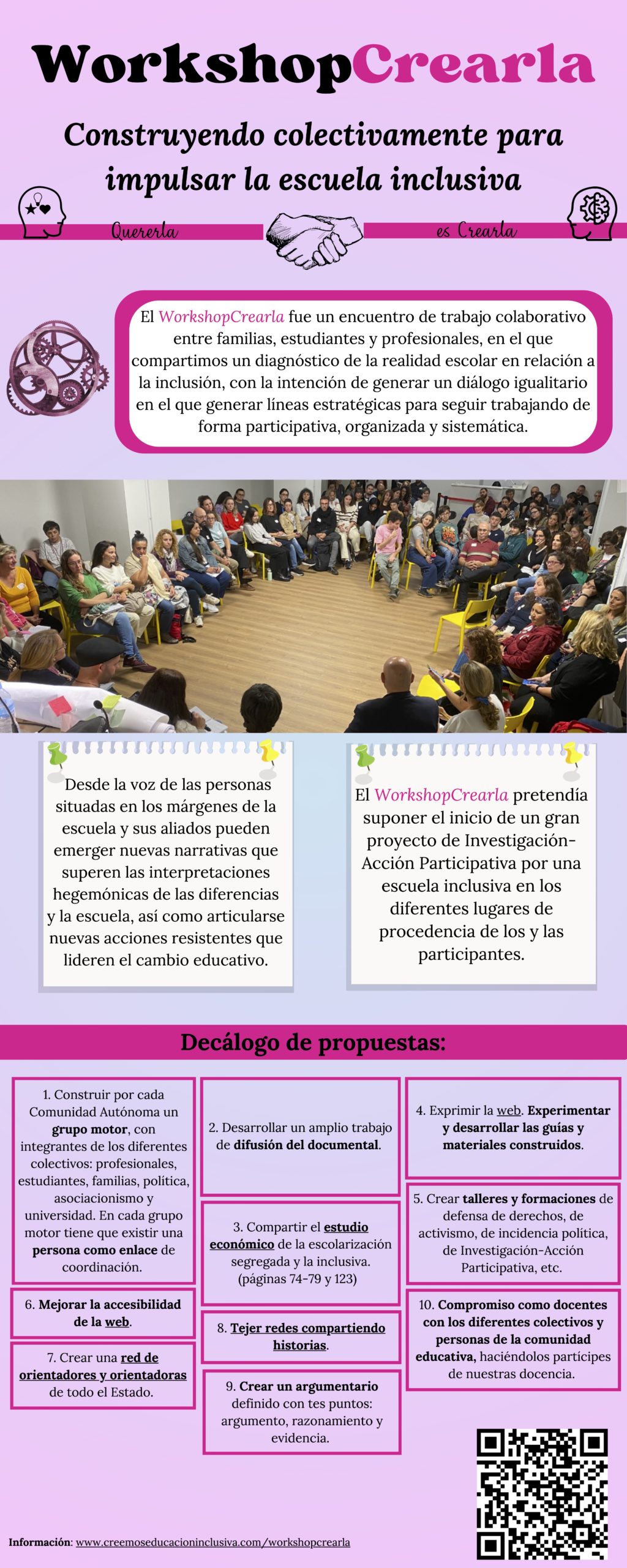
From all the proposals developed in the three workshops, during the final assembly the following was agreed upon:DECALOGUE OF PROPOSALS:
- During the month of November, eachAutonomous Community or territory will form a steering groupwhich should include the different groups of the educational community within it: professionals, students, families, politics, associations, and the university.Each steering group will appoint a liaison personfor coordination with the promoter group and the rest of the groups from other territories.
- Desplegar un amplio trabajo de difusión del documental en todas las instituciones posibles, tratando de implicar a ayuntamientos y entidades, más allá de las propias. Se trata de implicar a la comunidad para generar debate público sobre la necesidad de la educación inclusiva, intentando hacer proyecciones en lugares emblemáticos. Toda esa información será publicada aquí. Para ello se diseñarán guiones que ayuden a generar debate tras el visionado del documental. Este guión será distribuido en un kit que se facilitará a cada entidad o persona que solicite hacer una proyección.
- Poner el economic study on segregated and inclusive schooling available in the ‘We Defend’ section of the website, specifically the book “The Impact of the International Convention, CRPD, on Spanish Educational Legislation”, pages 74-79, and page 123.
- “Immerse ourselves” in the website, with the idea of making the most of the work developed in recent years, working in the same direction and speaking the same language. The aim is to leverage them, trying toexperiment and develop the guides and materials built.
- Create workshops and training sessionsfor rights defense, activism, political advocacy, Participatory Action Research, etc. These workshops, which will initially be centralized so that all territories can access them as basic tools, will be developed online.
- Improve the design and materials of the websiteto make them more accessible. This task will be coordinated by Sonia López.
- Create a network of counselorsfrom all over the State, generating online meetings. To do this, an email address will need to be set up.
- Weaving networks by sharing stories. Belén Jurado makes “Lucía’s Room” available to continue creating and sharing.
- Create a defined argumentation with three fundamental points: argument, reasoning, and evidence. Working on argumentation with a positive and negative view to identify, argue, and debate. The topics that would be needed from the different territories to complete this tool will be uploaded to QeC. On the other hand, the creation of argumentation must be agile to respond to current events.
- Commit as teachers with the different groups and people in the educational community, making them participants in our teaching.
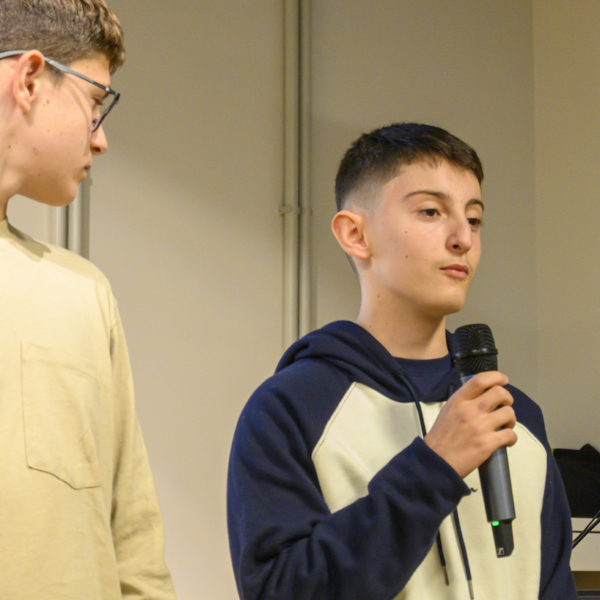
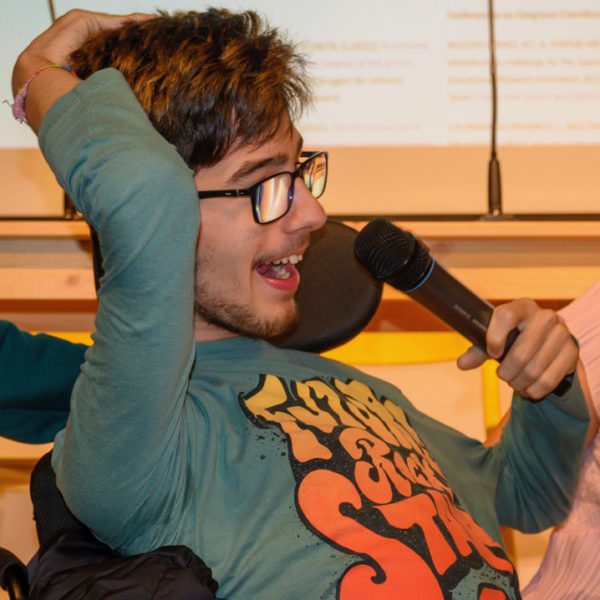
We have gradually involved all the students and their peers in coming together. And everyone being together. But we started a bit late. If we had started earlier, we would have already changed a lot of things. But little by little, that is being achieved.
Amanda. Secondary student at CEIP La Parra, Almáchar
Our group finished the guide work with a celebration: that of having learned to know each other, to support each other, and to believe that we are capable of much more than we had imagined.
Guide “How to make your school inclusive”Students for Inclusion
Videos from the Workshop
Teresa Rascón:—
In this first assembly, we are going to have the different initiatives that have been carried out throughout this process explained to us. The students will talk about the experience we have had at La Parra, the different resources that have been created, etc. The idea, at this first stage, will be to present to you a little bit about what we have done so far and where we need to go.
I'll hand you over to Nacho.
Nacho Calderón:—
As Tere said, it's about showing that we are not starting from scratch. Those who were at the premiere of the documentary yesterday could see that we are not starting from scratch. That is to say, that things have already been done, that we are building on previous work. Now, what we will do is present what we have been doing over the last five years.
The first thing we had planned is a tour of the website where all the projects, all the work we have been doing over the last five years, are hosted. We have divided the website into sections: 'We want', 'We know', 'We defend', and then 'We create'. 'We create' is divided into major blocks. Now, Luz Belén and I are going to tell you about one of the ideas of this project, which we have called 'Weaving lives'. What we intend to show, referring to something Lulux said some time ago, is 'how can it be that what happened to me with my son many years ago is still happening to so many mothers and fathers with their own children today'.
I can say the same with my brother's experience; it is still happening. Today, then, what we have aimed to do is precisely to say that we are not starting from nothing, there is a creative foundation made up of the lives that have been woven together. Luz and Belén have participated in this 'weaving lives' project, as have many other people whom we will now introduce, and they can briefly share their experience.
Luz Mojtar:—
Bueno, yo soy más breve todavía porque quiero que hable Belén. De lo que comentaba Nacho de «Hilando Vidas», podéis ver que estamos haciendo un montón de historias de vida, relatos de vidas, gracias a mucha gente que pone a nuestra disposición una vida supervaliosa que queremos compartir, saber y conocer las realidades de muchas personas. En este caso, yo estoy muy implicada con la de Sandra. Personalmente, me emociono por estar aquí, en frente de ella. Aprovecho este momento personal para darle las gracias porque me ha abierto las puertas de su casa, de su vida y de su familia, y estoy aprendiendo mucho gracias a ella, a Belén y también a todo el mundo. Creo que para mí, esta es una de las cosas más valiosas que estamos haciendo, porque con la con las voces de las familias del alumnado estamos aprendiendo un montón.
Belén, cuenta cómo te has sentido. (Dirigiéndose a la audiencia) La de ella ya está terminada, la mía está en proceso.
Belén Jurado:—
Bueno, para mí ha sido difícil remover y sacar todos los años que hemos vivido. Pero creo que es muy importante visibilizar y que todo esto sirve para muchos de nosotros y para los que vendrán es complicado, pero creo que debemos hacerlo. Ha sido muy emocionante verlo. Para mí ha sido muy muy difícil porque a las madres no nos gustaría estar haciendo estas cosas. Nos gustaría estar cuidando de nuestros hijos de otra manera, pero en realidad no
nos queda otra, así que gracias a ellos estamos haciendo ese trabajo tan bueno, que creo que merece la pena ver.
Nacho Calderón:—
Son un suelo para nosotros y nosotras porque nos cuentan otras historias. Hay historias de estudiantes. Ahí están las historias de vida de Inar, Belén, Corina, Sandra, María, y José. Hay de profesionales, de madres…, bueno, son historias de vida que nos puedan ayudar. Hay relatos breves que nos han contado estudiantes, o que nos han contado madres activistas profesionales, que nos pueden servir como base para seguir pensando, porque no solo es leerlas, sino compartirlas.
Bueno, muchas gracias, Belén. El siguiente bloque de contenido es el de «Estudiantes por la inclusión». Que venga toda esa peña para acá.
(The 'Students for Inclusion' group is about to introduce themselves).
(Applause)
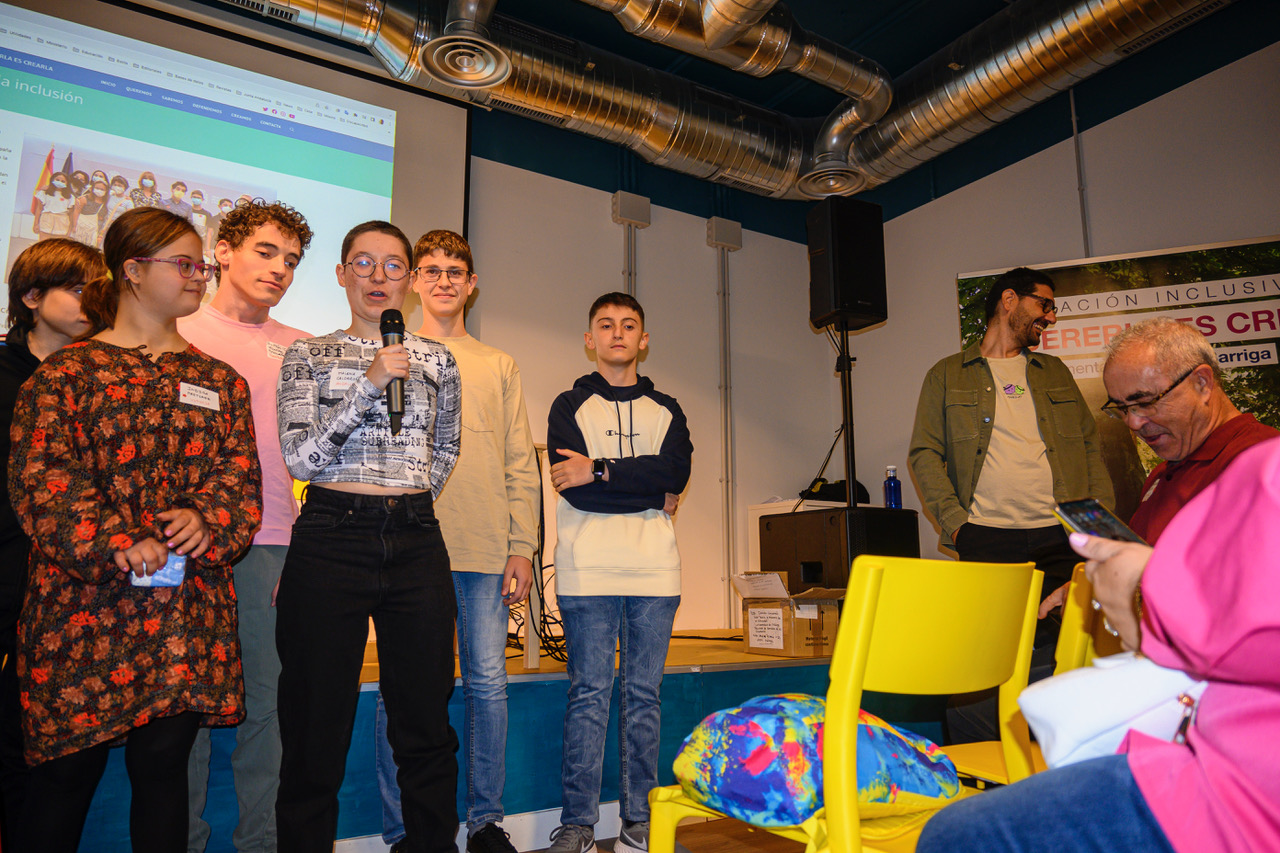
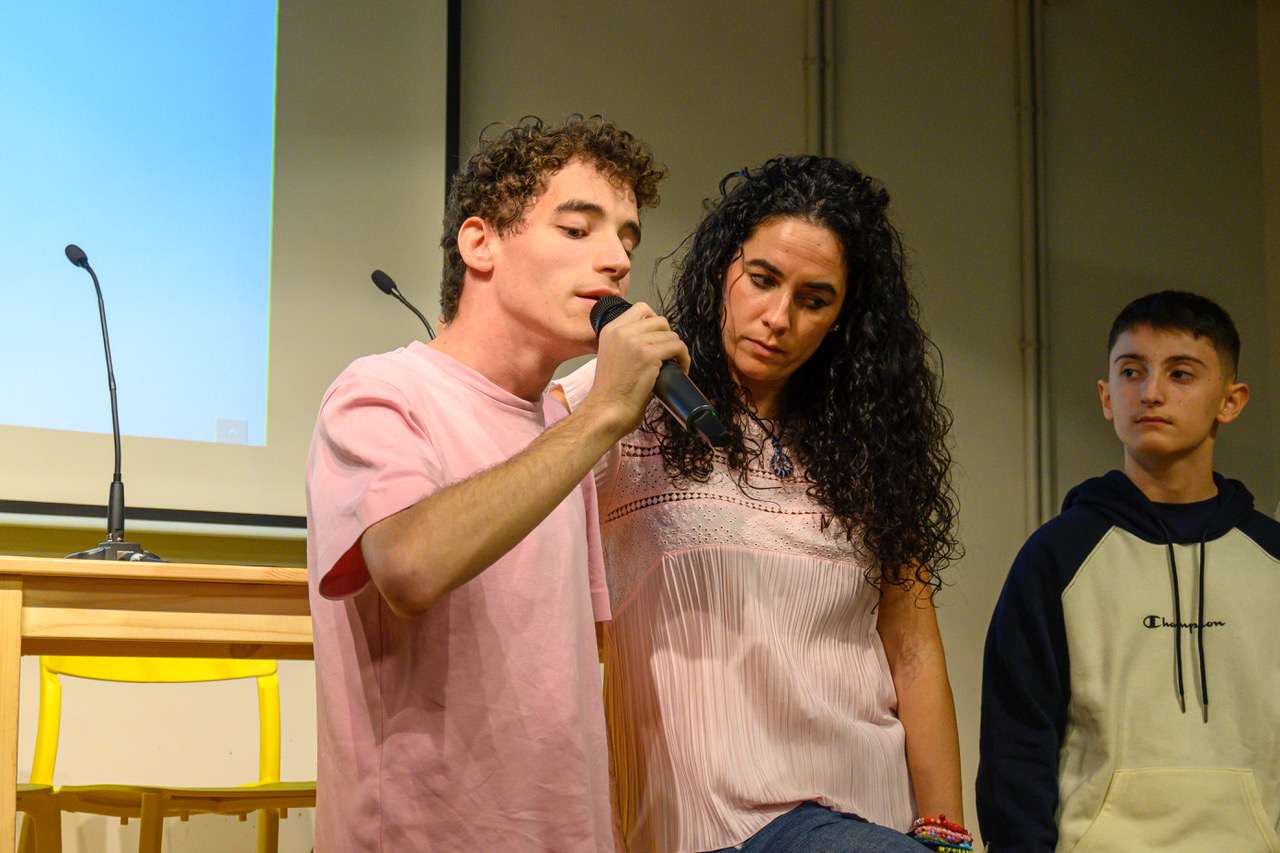
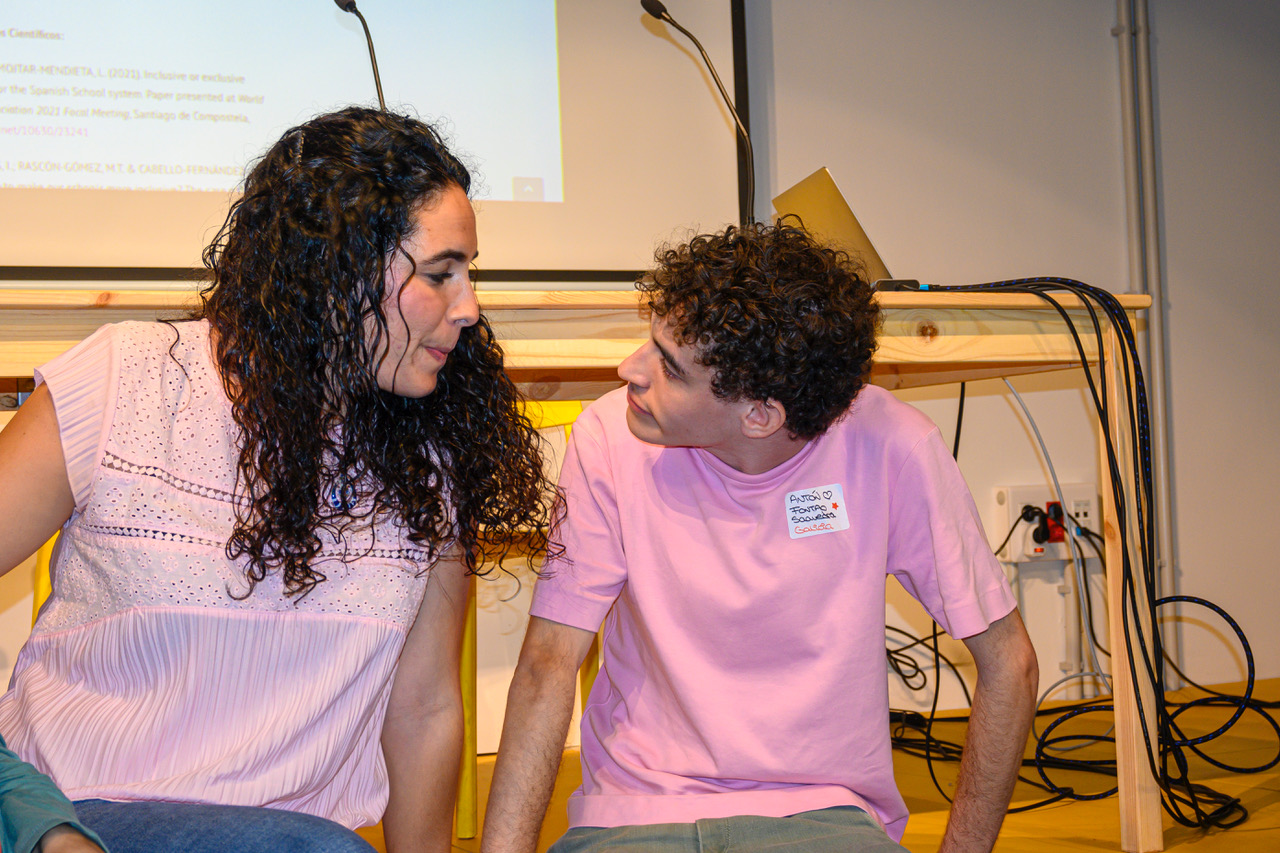
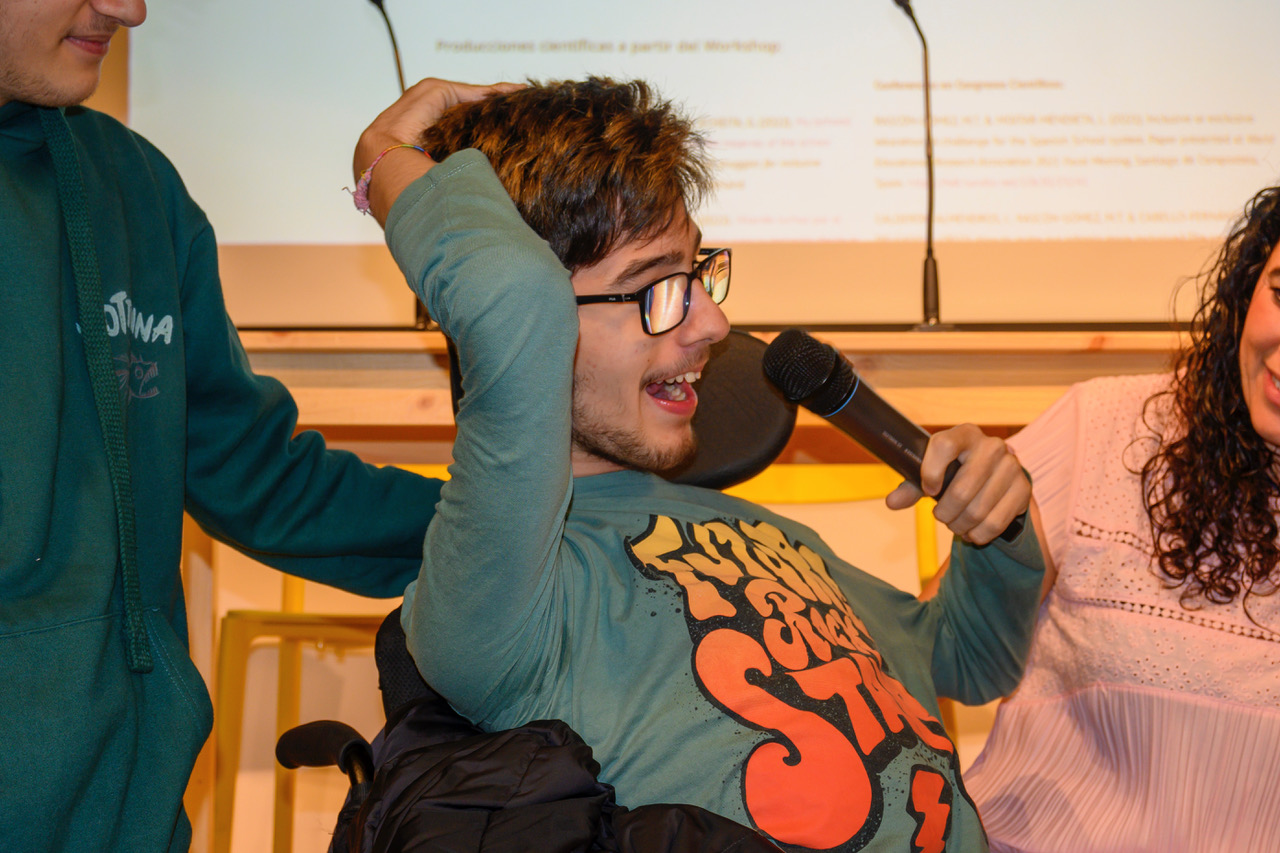
Nacho Calderón:— Come on, folks, with courage. Who's going to start? Malena. This group of students has been doing one of the most valuable blocks of work we've developed over the last few years. Now they're going to tell you a little bit about how we did it. It's going to be very brief.
Malena Calderón:—
Hello everyone, I'm Malena Calderón. We're going to explain how we made the guide. We didn't know each other at all, I only knew one person, Antón, and obviously my brother, but I didn't know the others. I met Antón on Instagram because he sent me a request three times and I didn't accept it, until I asked my father who he was and he told me he was a really good kid, that I should accept it. So, of course, we started.
My father asked us if we wanted to participate with my brother in a project for inclusion. I said yes, and my brother did too. And that was it, then we started getting to know each other at the first meeting, and that was it (laughter).
(The audience laughs) (Applause)
Martín Zabaleta:—
I am Martín Zabaleta Verde and I am going to talk about our meetings. They were on Thursdays. They proposed a topic related to school experiences and situations, and we debated from a personal point of view or that of someone close, and, well, all opinions were important. We listened to each other, and it was a very beautiful experience. I got to meet very, very nice, very charming people.
(Applause)
Alberto Sánchez:— Well, I am Alberto Sánchez, I come from Seville, and I am going to talk about how we felt in the meetings. Well, at first it was a bit strange, because we barely knew each other and it was a bit embarrassing, right? But then we got to know each other, and we had more meetings, and since we were all united by something, we created a very strong bond, and in the end, we are here and we are all very good friends.
(Applause)
Darío Calderón:—
Hi, I'm Darío Calderón and I'm going to talk about how we extracted the important things we saw in the meetings to put them in the guide. The first thing we did was record the meetings. We gathered all the meetings and extracted the most important things to be able to put them in the guide afterwards, and that's it.
(Applause)
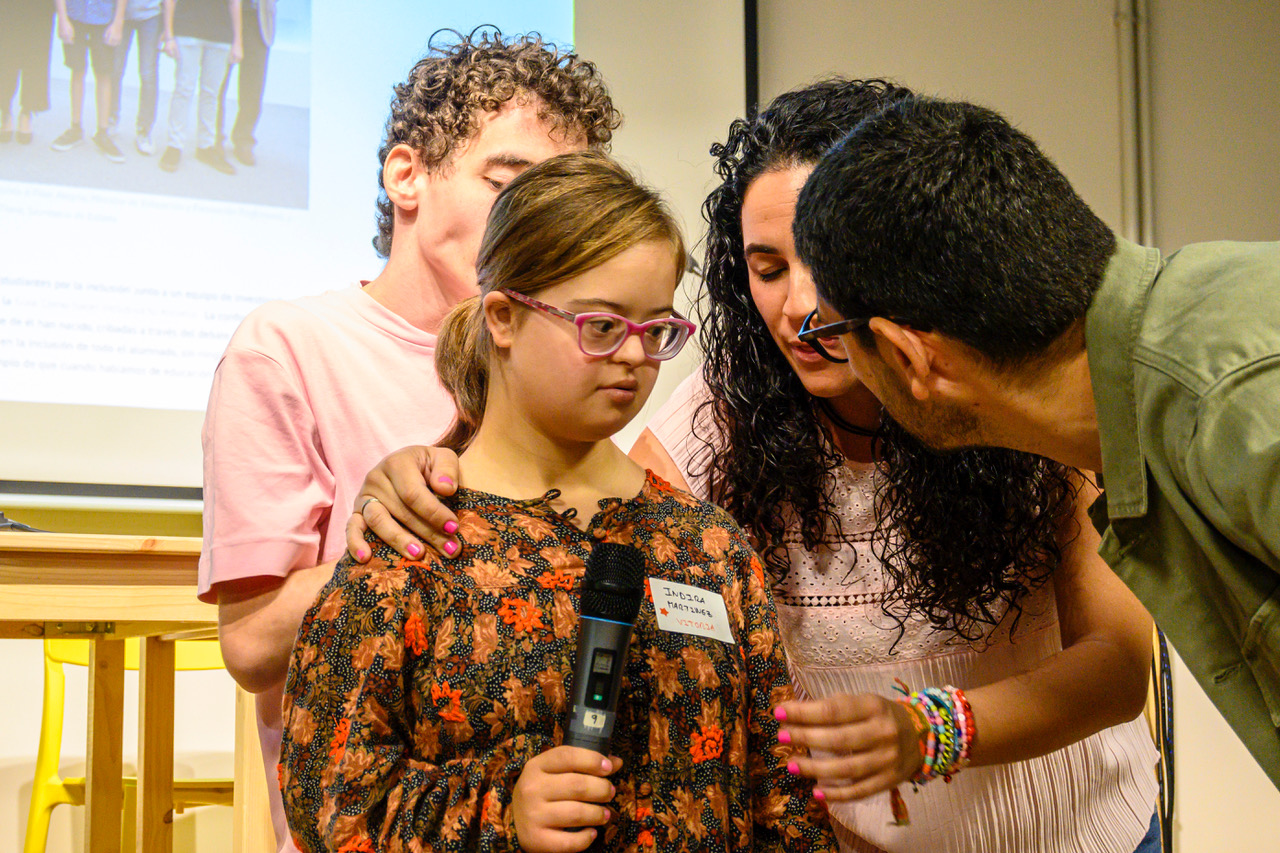
(Indira prepares to speak. Nacho and Luz talk to her beforehand and ask her what she is going to talk about.)
(Applause)
Luz Motjar:—
They are handing out the guide you created over there, but the work didn't stop there; you've done much more, right, Indira?
Indira Martínez:—
Yes.
Luz Motjar:—
For example, the ONCE national competition invited you to give talks to teachers and counselors, right? Tell us a bit about that.
(Indira nods)
Luz Motjar:—
She says you used to talk online, people would ask you questions... and she was talking about someone, who were you talking about?
(Indira breathes and prepares to speak)
Indira Martínez:—
I was very fond of Aniceto, who was the best teacher in the world, but my mother has always come first.
(Indira blows a kiss to her mother)
Indira Martínez:—
And that's why, that's why I'm so grateful to my mother for everything she's helped me with, truly a lot.
(Indira blows another kiss to her mother)
(Applause)
Nacho Calderón:—
What did you say, do you remember? What did you do there or how did you feel there?
Indira Martínez:—
Well, I felt good because I know they were, well, I know they were going to listen to me, so good.
Luz Motjar:—
Indira was being listened to, she was giving classes to the teachers, right?
Indira Martínez:—
Yes.
Luz Motjar:—
I was showing them what we had to do, that we had to be like Aniceto, right?
Indira Martínez:—
Yes.
(Applause)
Luz Motjar:—
And besides going to contests and training, we've done more things, right?
Antón Fontao:—
Hello, my name is Antón Fontao and I think, well, on behalf of the whole group, I think we are mainly here because, obviously, to improve the school, but also because we don't want any child to experience what we experienced. Something I can't stand is that it's between them, because last year we told the tutor that a teacher wasn't behaving well and, without knowing anything, it was... that they behave well, and that they face the consequences. For example, my sister, I don't know if I can say it, but my sister, she has a wonderful teacher, but it's just that, as happened to my kindergarten teacher, the teachers made her life impossible because... she wanted to do things right. And, well, we want a more inclusive school.
Leo Osa:—
Well, Jorge and I are going to talk about what's on the screen. It was a day when we were invited to FEDAPA, to a conference that was full of guidance counselors and, well, other people. The teachers were talking about their proposals for an inclusive school and we each got to talk about several topics. We talked about the guide, but also about personal experiences. Jorge will tell you all about it. Well, thanks to the meeting at the conference, we were able to present the guide in front of a lot of adults and professionals. And thanks to all those people who understood us. We hope the guide has more impact than it did initially.
(Applause)
Luz Motjar:—
Well, then, that's it, we'll say goodbye, and the guide that has been distributed to you is the work we have done together. The guide is actually a participatory action research process in which students take the lead because, in the end, they are the ones who spend the most time in schools. We don't understand much how they are the ones who often speak the least. We hope you like the guide and that we can put it into practice in many places to change schools.
(Applause)
Nacho Calderón:—
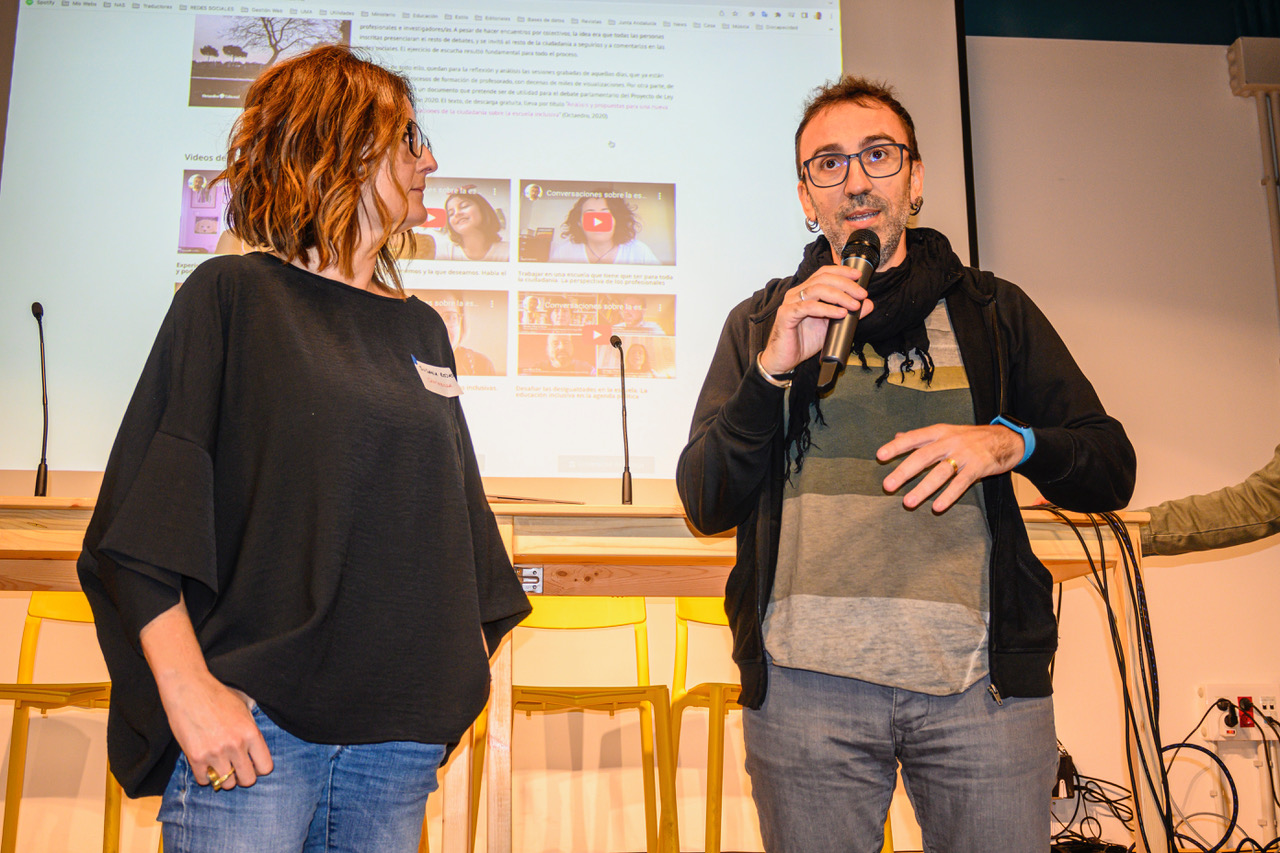
Susana Roja and Jesús Soldevila are coming now, and they are going to tell us something about one of the meetings. Let's see if I'm not mistaken, yes, about the conversations to guide policies.
Susana Roja:—
Good morning, everyone. It is a real pleasure for us to be here today and to be able to share this space with many
of you. We were tasked with talking about one of the actions that was developed and that, probably, many of you here already know, because you were there. Others were not.
Our role was to share with you and also to invite you to visit that space.
Jesús Soldevila:—
It was a space where something that seemed impossible happened, wasn't it? Bringing many people together to talk, no. It happened during the pandemic, when we were confined to our homes. It's beautiful that it happened at that moment, because it was a time when, once again, humanity showed its good and bad sides, right? As Mr. Nacho Calderón explained to us, one day during the first wave of COVID, the survival of some people was prioritized over others, sending the message to the whole world that some lives are worth more and some are worth less. So it was beautiful that in that space where lives were being sacrificed, there was also the good side of humanity, and work like this was done, and space was given to the voices of different people to talk about the school we want, about the social future we want too.
Every week, people from different groups met. Families participated, students of all levels, families who have children from early childhood education to those who are now trying to open an opportunity in the working world, to live and organize their lives like any other young person. We met researchers and teachers. Also politicians. They were open spaces for debate where fundamental questions about what is happening in schools were raised. In those discussions, there were moments when we were all moved, in the broadest sense of the word 'moved'.
We were able to see yesterday in the documentary, truly difficult situations that many children and young people are experiencing in schools, that their families are experiencing, and obviously, it affected us. And while we would love to say
that we wish all of that wouldn't happen, the truth is that it also serves to mobilize us. I believe that, without a doubt, it pushes us to want to change all that is happening.
And something else very important in those meetings is that we talked about schools, the schools we live in and know, the schools we want. And that seemed very important to us, because there are many forums where inclusion is discussed, and diagnoses and children with this or that condition are discussed, and we didn't talk about that here. In all those events, what was discussed was the curriculum, the organization, the support, the relationships or the lack thereof. Opportunities were discussed, and therefore, we were talking about contexts and not about what some people seem to want to make us believe: that inclusion is about talking about what happens to some people. And no, it has to do with other issues.
Jesús Soldevila:—
We were discussing with Susana that it would be important to start talking only about 'school', without any additions or adjectives, understanding that school is already for everyone, and that's it. In this sense, we also emphasize the fact that it was important to give voice to those silenced voices, to those voices often trampled upon, and that people could speak without the pressures that the system and the fear it often imposes. This was a space precisely for people to express their ideas about how they wanted this 'school, plain and simple' to be. To say that all those conversations and everything that emerged from them shaped a working document that you have there now, and which should also have served for the approval of the new law. Well, we who are here know that many of those demands have not yet taken shape, but that working document is there and it is truly a very interesting document for continued reflection. I believe that many of the issues raised there will continue to be addressed throughout today.
En él se hacían propuestas muy concretas y claras, como que desaparezcan los dictámenes de escolarización, que la asignación de recursos no se haga en función de los diagnósticos, por ejemplo, o que se mejore, o que la inclusión educativa sea una formación transversal en la formación del profesorado y no algo que tiene que ver solo con lo que se hace en algunas asignaturas y en algunas especialidades. Realmente son muchísimas las propuestas que ahí se recogen y que nos van a ayudar no solo a repensar las políticas en cada una de las comunidades autónomas, sino también a imaginar cómo juntos podríamos seguir avanzando. Y en ese sentido, solo para acabar, en las conversaciones algo que también ocurría es que creo que hay muchas personas que estamos alineadas con lo que aquí está ocurriendo; algunos son docentes, otros son orientadores, otros somos investigadores, y estamos con las familias y con los estudiantes que estáis aquí. Por tanto, esas alianzas que se fueron creando son las que tenemos que seguir fortaleciéndose. Y eso es lo que un poco coincidíamos en esta idea final, que era que no estamos solas, soles ni solos, que cada vez somos más, que esto ya no hay quien lo pare y que, usando la letra de Ketama que nos reíamos, «que no estamos locos, que sabemos lo que queremos»: crearla.
(Aplausos)
Nacho Calderón:—
Muchas gracias, Jesús, muchas gracias, Susana. Ellos son
profesores de la Universidad de Cantabria y de la Universidad de Vic. Sobre esto último que han dicho de cómo fortalecemos nuestros vínculos y creamos redes valiosas, yo creo que hay un ejemplo en este trabajo de cómo se pueden construir redes valiosas que pueden mover políticas. Esto quizás no sirvió tanto para generar la LOMLOE, pero en cada comunidad autónoma se hacen políticas
educativas y este mismo instrumento puede servir para ordenar políticas
educativas dentro de cada comunidad o de cada territorio.
Muy bien. El siguiente espacio es para Susana Fajardo, Carmen Moreno y Sonia
(Applause)
Nacho Calderón:—
Good morning, everyone. It's wonderful to see this full auditorium. Well, we've been tasked with following up on what Jesús and Susana just said. We want to create it, and for that, there are very specific sections on the website where all the information has been structured, and where the three of us want to focus, as part of a collective, a choral effort we've been undertaking for a very long time. Each of us, within our capabilities, has contributed what we could at each moment: our lives, which are valuable in themselves, and that's why we want inclusive education as the only change and the only possible school to build an inclusive society afterwards. Undoubtedly, that is the only path. We also want real changes. A structure that is a systemic change, not accessory changes for a specific person at a given moment, but changes that will last over time.
And not unchangeable structures to which we have to adapt again, but rather we must move towards inclusive education with the perspective that it is a transformation process that will last forever. We know that, undoubtedly, change will only be possible if we make demands, if we are a sufficient social mass, but we also know that all great social processes started with very few people. Even the people within the collective itself often didn't believe in those social changes. We know these are paths that take time, but we must exercise and be capable of establishing these networks in the territories and of structuring them to build and expand that social mass.
We also know that change is possible, and it's possible because we see it, we
feel it, we experience it. We see teachers in schools who undertake transformation processes, who change the lives of girls and boys, of students all over Spain. Therefore, it is possible, and we must move towards it. We defend what should not need defending, which is an inalienable right of our sons and daughters, of the students themselves. We parents cannot act as violators of the right, but as defenders of it, understanding that it does not belong to us. Furthermore, this right is endorsed by legal texts, international and national, from the Convention on the Rights of Persons with Disabilities, through the Constitution or the rights of the child.
We argue that inclusive education is not just for the traditionally excluded students, for the traditionally labeled students, but that it improves the lives of everyone. Therefore, as a summary, we want a profound transformation of the current education system. This must begin now, because we know it is the only path we can take, taking firm steps towards a more just society. We thus defend our right and our obligation to initiate this change, all of us as actors in this change, from the different positions we hold in society, from the individual to the collective.
Nacho Calderón:—
Thank you very much. This is, again, collective work; there is no single piece of work being presented individually. Marta and Paula are coming up now, and they will present a project.
Marta Casal:—
Hello, I'm Marta and my colleague is Paula. We're going to talk a little bit about a couple of videos. The name ‘Quererla es Crearla’ is part of this. They are very short.
(The trailer for ‘Quererla es Crearla’ is shown. Transcript available at this link.)
(Applause after the screening)
Marta Casal:—
We are very short on time. You are now watching another video, by the amazing artist Leo Osa, who is also part of the "Students for Inclusion" group.
(Applause)
Marta Casal:—
Leo Osa is sitting there, (laughter) next to the mother who gave birth to him. The video arose from something that united all of us in the families' group, a common feeling: the loneliness of our children at school. I think it was such a strong feeling that we thought one of the messages we had to send was this, and an appeal to everyone involved in the school, the entire educational community. This is happening, and we cannot tolerate it or normalize it as it is being done.
"Quererla es crearla" (To want it is to create it), a name that, in the end, is a slogan, was also a name created collectively, through brainstorming in a collaborative document, until the pieces fell into place. There was a very clear idea: enough talking about inclusive education, inclusive education, as if it were something we encountered on the street when we went out, when in fact it doesn't exist. So, we had to make visible a slogan that contained the denunciation and also the capacity and the desire to do it, "Quererla es crearla".
we want it, but it doesn't exist. So, we have to create it. And then, the video emerged about a year and a half ago, more or less, last summer. Floren encouraged us a bit and helped us to see ourselves from the outside, as well as the families' discourse. She started showing us some videos…
Paula Verde:—
Well, there was a wonderful one, which she showed us, which was the germ of this video, of course. We wanted something transversal that would break through and show what things have been achieved, what we are going to achieve, and it was a bit of this idea that we were working on, as Marta says.
Marta Casal:—
Yes, the video gave us some inspiration and encouraged us to make our own first video for the message of ‘Quererla es crearla’. I think there were some key ideas: the connection of inclusive education with the fight for human rights. We wanted to insert ourselves into that whole history of which many of us feel a part. We want these movements to feel challenged by the need to undertake this fight because, as Concha said yesterday, she never felt welcomed or supported in other collective groups or movements. To be part of everything we talked about yesterday, to be part of all these fights for the advancement of the rights of all people. So, we wanted to make that appeal and focus on the fact that today this is happening and there is enormous tolerance for the violation of rights. We saw it again yesterday, an impressive tolerance.
Manu Viqueira is the creator, the producer, an audiovisual artist from A Coruña and a friend who captured very well what we wanted to do. We also developed the script as a collaborative document among everyone, and this is what you will see.
Paula Verde:—
Well, I wanted Marta to speak because she has an impressive ability to speak, although I usually talk a lot. I wanted to say that behind all this there are no personal agendas. We want everyone to identify with ‘Quererla es crearla’, that's why we don't want names or representatives, we want someone who sees this to say “I am ‘Quererla es Crearla’”. For this reason, we are here, I imagine. I have nothing more to say.
Marta Casal:—
Simply, that you watch the video Leo made about student solidarity calmly. I believe both videos are very useful tools in schools; I have used them with secondary school students and they work very well.
Nacho Calderón:—
The activity we are now having on social media while we listen and share what is happening is a way of giving strength to all of this. Jesús and Raúl continue with the Orienta workshop, which is the antecedent of today's workshop. It was where we debuted and learned to do something we hadn't done until that moment.
I would also say that each of the sections on the website has its production, but then there is another at the end. You will see that, in addition to everything that has been produced, there is scientific production related to it, to give consistency to what people are doing.
Raúl R. López:—
I don't know when it started, but we found ourselves at the workshop. We found professionals and families mainly, some children too. For me, it was a very enriching encounter. What I really liked about that workshop is that there was a moment for complaining and plenty of time not to dwell on the complaint, but to start building from the beginning. I remember Susana put it very well: 'This is all well and good, but on Monday, what are we each going to do?' And there was a Monday, and a Tuesday, and a Wednesday, and it was very interesting.
Jesús Moreno:—
For those who weren't there, it was an encounter that I actually experienced or understood a bit as a catalyst, because there was already strength and people's intention to meet. And it served as a meeting point, also as a starting shot for many things. All the things that have happened, I think, have a bit to do with the workshop, really. And what Nacho said earlier, I was thinking and saying: 'We're already friends.' No, I believe that because, in reality, we are already friends, we were already friends, and we haven't just become friends. Beyond a naive idea of friendship, there's the idea of friends who are combatants.
And what Raúl spoke about a bit, although there's little time, it seems important to us that there are many people here who were at the workshop and that, instead of us telling our stories, we pass the microphone to two or three people and let them say what it meant to them. It certainly served me personally, and I'll start, because I was, and Nacho knew it, running on half power at the time, but it helped me to get hooked and to put my thesis aside and actually start it.
Who wants to say what the workshop meant?
María José G.:—
Well, I don't know, for me it was very emotional to be able to meet at that moment. 4 years ago, I imagine each of us, but I'm speaking personally for myself, was at a different point, and for me it was a shot of energy, an emotion that overwhelmed me at the time. Those of you who were there know that I couldn't speak, and if I could have hidden under a rock, I would have. The affection I also received overwhelmed me. And of course, at that moment, the commissions that were created, I as a pedagogue.
Raúl R. López:—
Yes, three commissions were formed: one on the school, another on all legal matters, and another on pedagogical evaluation. As a result, what struck me most was that we had a common goal, but many different perspectives on how to get there, a whole process. It's what Jesús says: 'We have become friends from different points of view.' It has been a process that was not only friendly but also very loving, because the good intentions were evident. Even among those of us who were most mistaken, there was a transformation, a learning process, very difficult, because we had to unlearn, and in unlearning. Everything important that I was became nothing, and I had to start from scratch. Equalizing ourselves under a common line.
There was a meeting in Yecla and, subsequently, 'AlterEvaluation' will be discussed.
Jesús Moreno:—
I simply want to highlight the value that meeting had and that, I believe, we want this one to have. What the colleagues were saying before is crucial: it wasn't celebrated at the University of Málaga per se, I don't feel it as belonging to the University of Málaga, in reality, I feel it as belonging to the people, and what was built was, in reality, a group of approximately 100 people from different parts of Spain who were working and researching together. It was a kind of initial diagnosis to see what we can do.
Nacho Calderón:—
Thank you both very much. Now, Carmen Saavedra and Leticia are coming.
(Applause)
Leticia Barbadillo:—
Well, it has fallen to us to present and convince you, if you weren't already convinced, to embrace 'troublemaking,' to defend all the work of dissent. If you are here, we assume you have already taken that step. Alejandro summarizes it very well in the phrase: 'What need did the state have to turn me into an activist?' I suppose that, in one role or another, whether as families or professionals, our experiences have turned us into dissidents, into resisters, and history proves us right.
Carmen Saavedra:— It proves us right in that there have been many struggles, many oppressed groups who, even if they are not in an ideal situation, we know they are oppressed groups and their situation must change. And how have they done it? By dissenting. So, we have to dissent, and we dissent from the very first moment when you have a parent-teacher conference and they tell you they don't accept your child, and you believe it for a long time. Some people die believing that, but I don't know why some people, because we know other people, say: 'But what are you telling me?', 'How can you say you don't accept my child?', 'How can I not accept my child?', 'What mother wouldn't accept her child?'.
What we don't accept is that they don't have the right to education, to learn. What human being cannot learn? Not everyone will be able to learn the same thing or reach the same place as they theorize they have to reach, but obviously everyone can learn and everyone has the right to be with everyone. Although consensus is highly valued, whenever a law is passed unanimously, it seems wonderful to us, and I, until we created this guide to dissent, had not considered how necessary it is to dissent. And the majority is not always right.
The most important thing of all is when the person in a position of privilege starts to dissent. That's when the change comes. I always talk about John Doar, who was a white lawyer and was fundamental. Whenever the struggle for civil rights of African Americans in the 50s and 60s is discussed, people talk about Martin Luther King, about Rosa Parks. But how important are people like John Doar who legislate, who at the moment the first African American student went to university, it was with the police and John Doar by his side. That's when the change begins, when those in that position of privilege, who are part of the oppression, also get involved...
And, there are so many people here, so many people who are dissenting and doing so, not like me, because I have been touched by the people I love most in life. And there are so many people here, school professionals, who are surely suffering just as much or more than us, those of us who are at home. You suffer all the time, and the moment we start having those allies, it means it has already begun. So, let's keep dissenting.
Leticia Barbadilla:—
We have organized this entire process of dissent into a guide that we still don't know how it will see the light of day, because, as we are dissidents, we have done something else. We, especially as families, while trying to involve all sectors, would have liked to have this guide because it is a very tough path and you generally experience a lot of loneliness. So, also to help build the networks for which we are here today, because we know that resistance can be very hard and frustrating.
I take from that guide what I like most, which are those elements of resistance that can be very small and everyday, that are very exhausting and that we often feel do not translate into anything, that we are fighting and fighting and hitting our heads against a wall, and we just burn out and it doesn't bear fruit. There is a wonderful story that Sonia recommended to me, called "100 Seeds That Flew," which tells the story of a tree that sheds its seeds, and ten go into the river, another ten are carried away by the wind and end up on a rock. At one point in the story, it seems that none will manage to reproduce that tree because they all ended up where they shouldn't have. Some are eaten by a bird that takes them elsewhere, and in the end, without being able to establish a linear relationship that they came from that tree, fruits do emerge from that dissent, sometimes larger, sometimes smaller, but it is always worth continuing to resist and to do so accompanied so as not to die in the attempt.
(Applause)
Nacho Calderón:—
Mariana and Tere are now going to present an experience.
Mariana Alonso:—
Hello, good morning. I'm Mariana.
Teresa Rascón:—
I'm Tere.
Mariana Alonso:—
Well, the truth is that we are delighted to be here in this privileged space to think and create together. Our experience is simple but very interesting, and it really arose from the question: what can any of us here in this room do? How can we transform? And I think that's the question that's on all of our minds.
And well, those teachers who started asking themselves how to do it, how to transform, were exactly like you, sitting in a workshop in 2018, but they didn't stop there. They returned to their educational center, which is located in a small town in Málaga called Almáchar. This center is CEIP La Parra, which some of you know, and it's a small town. You have to get there, in short, an odyssey, right. And well, they started thinking, after that workshop, how can we make our school more inclusive? And there, the first thing they did, this group of teachers, was to request training. Imagine that; we always have to be in a continuous process of training, of learning. They requested institutional training from the teacher training center and, from there, they also asked for collaboration from the research group of the Narra Inclusión project.
And well, the experience, what can I say, spectacular, it can't be defined any other way. How did they start? They were a learning community and, therefore, they decided to hold a diagnostic day linked to that process called "Dreaming Again," which is part of learning communities. And there, the entire community, just like we are here, representatives of students, teachers, families, administrative and service staff, management teams, social agents, associations, the whole town, participated in that day. It seemed spectacular to me, we even took a bus from the faculty. I mean, I said, we're all going to end up there.
And we asked ourselves four questions, around which we worked on flip charts like the ones we've brought today, more or less: What is the school we have like? How is teaching and learning done in the school? What are the relationships like with your classmates, with the teachers? And, finally, what is the school of our dreams like? And from those four questions, you can imagine, many contributions emerged, and everything was summarized in a focus that concerned us: improving coexistence in the school and in the surrounding environment.
Well, from there, we started. The students, teachers, families, and the entire educational community became researchers of their own environment, of their own reality, and we began to design a participatory action research. That was the focus: the students. They collected information, observed, conducted interviews. Within the family, interviewing each other... And, finally, an action plan was designed so that it would truly have an impact, could transform, could change.
The action plan addressed three main concerns: relationships on social networks, how to transform and improve work methodologies, and how to make recess a more educational space. These were the proposals that were put into practice, and for each of these proposals, we could talk about many of the initiatives in which the entire community participated. We closed the first cycle of participatory action research with an evaluation process, a photo booth where students, anonymously, went and shared their thoughts, a SWOT analysis, assemblies in all classes, collecting suggestions, contributions, and, finally, a beautiful day where it was celebrated, because these research projects ultimately have a moment of celebration, and they shared all the achievements, the difficulties, of course, and created networks with other educational centers that want to join.
That was held on December 1st in the small town of Almarcha, and it was called the "Jornada Axaquía Inclusiva" (Inclusive Axaquía Day), also a beautiful day, of which you have... Well, I'll hand over to Tere, so I don't ramble on any longer. Thank you very much.
(Applause)
Teresa Rascón:—
Well, I don't know if it happens to you, but when I listen to Mariana, and that captivating voice, I find it hard to keep talking, honestly.
Well, what I wanted to say is that I believe there's a premise that has been discussed a lot yesterday and today, and that is that none of us like unchosen loneliness. Students who are excluded don't like it, families don't like it, but logically, neither do teachers who want to transform things and don't find the necessary support in their school. I'm talking about teachers, counselors, and other educational professionals.
From this experience that Mariana mentioned, another guide emerges to support those education professionals, those educational communities that want to carry out participatory action research in their school to initiate change. This guide, which has just been released, is available on the website. All these resources are on the website, in the "Creemos" section.
Well, as I was saying, none of us like that unchosen loneliness, and that's why those of us who are here, and those who we hope will join us throughout this process, have wanted to create a series of resources to also support those processes you want to carry out in your schools, but sometimes you can't find the support, you can't find the resources. The idea is that you have that battery of resources on the page and can access all of them, as my colleagues explained very well this morning.
Additionally, there's another resource developed by students, because we are university professors, but we believe that the university should be at the service of those who it should serve, which are those educational communities. They need to go out into the world. So, we all came up with the idea of creating video tutorials created by students so that, well, they also support those action research processes within the school. They are very basic videos, 2-minute tutorials, in fact. Some of the protagonists are here, and well, they explain how to conduct an interview, how to create political impact, how to initiate a participatory action research process, etc. All of that, as I said, is available for those of you who want to use it.
That was one of our premises, that all resources should be open access, because the idea is that they don't stay here, but rather that this grows and we truly make our schools those inclusive schools that I believe we all want. Thank you very much.
Nacho Calderón:—
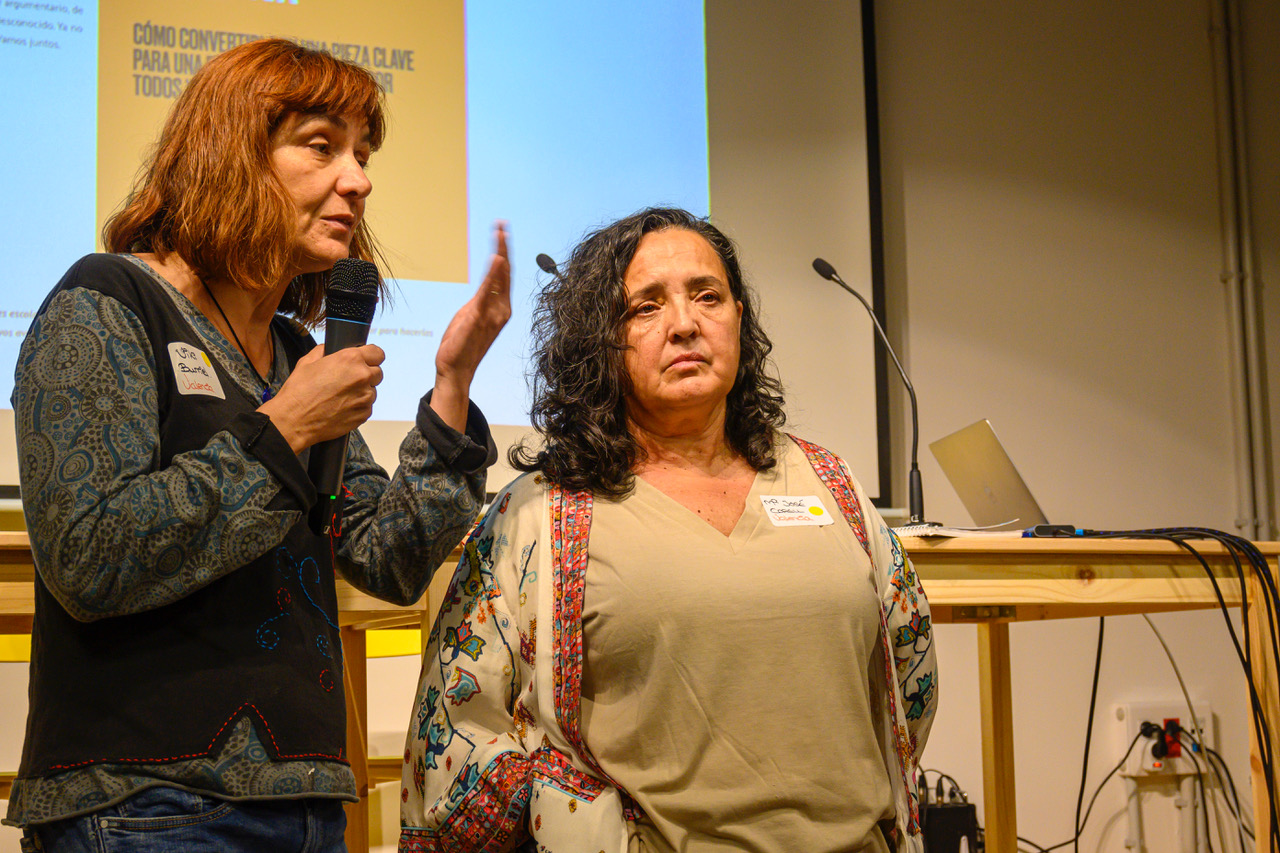
Thank you. Well, now María José and Viki are coming to talk to us about how to provide guidance for inclusive education and about the collective «AlterEvaluación».
María José G.:—
Hello again, well, we are participating in a collective of guidance counselors that we call «AlterEvaluación». The idea arose from the 'Orienta' workshop in 2018, from one of the sessions on psychopedagogical assessment. A commission emerged in which we worked for some time and it has gone through various processes. Right now, we have been in a group for a couple of years; we started with about 50 guidance counselors who sometimes join and leave.
The idea is that we consider psychopedagogical assessment to be a major obstacle right now, as it is currently framed for inclusive education. The idea, then, is how to put those ideas into practice if we come from so many ingrained habits of labeling, exclusion, and justifying resources.
Viki Burriel:—
That was the idea, as María José says. From psychopedagogical assessment, and therefore the guidance counselor collective, we thought about how to help make schools more inclusive in those days, compared to the current situation where there is a categorizing and discriminatory trend and that, in part, the guidance counselor collective is instrumentalized for that. Therefore, it is necessary to turn that situation around and put ourselves at the service of building collective improvement and transformation processes in schools.
So what we said was: how can we transform an individual, labeling psychopedagogical assessment, which proposes supposed supports that, in the end, are sometimes the biggest barrier some students have to being one more in school? How can we transform that? We said, well, into a participatory action research process that has a democratic aspect. That is, I don't do this assessment against the family or without telling the family anything, against the students or without consulting the students, but rather the family, the students, and the teaching staff will be the protagonists and main participants.
And how can we make this a collective process and, therefore, a truly transformative process? That is, that it is not a one-off measure, but a process of reflection, thought, and transformation to try to achieve the school we want.
So that's what we're working on.
María José G.:—
The guide "To create your dreams," from CEIP La Parra, is also about to be released and, shortly, will be available to help other guidance counselors who want to join in.
And just as someone said: it doesn't belong to anyone, it belongs to all the guidance counselors who want to join, to the families who adopt it and can take it to their schools, to anyone. Finally, we professionals have to be brave, we have to be brave, and for that, we have also built this, to have a network. To have a foundation from which to be brave. Like the mother who asked us guidance counselors for support. It doesn't matter if we didn't know how or what to do or where to start, together we will figure out how to do it. Well, thank you very much.
(Applause)
Nacho Calderón:—
Thank you. One of the most beautiful things is that each of these projects that you are seeing here have crossed paths, have been crossing paths, and some have fed into others. Alejandro, Sandra, Concha, Floren, and Fátima are coming now to finalize all of this.
(Applause)
Sandra Fernández:—
(Laughing) As you can see, they send us here to work a lot. I haven't stopped crying since I arrived, I'm very tearful, and my son always tells me: "Mom, don't cry," but it's incredible. It's one thing to have been part of the process of all this work and another thing to see it materialized. It's as if...
Audience:—
(Laughing) That's a lie!
(Laughter)
Sandra Fernández:—
(Laughing) How can it not be true…!
I'm going to tell you a bit about the journey, how all this madness began. The 'Radicales Desadaptadas' group is mainly mothers, one father, and a teacher, Nacho. We've spent years in a Messenger group talking every day, and there we pour out everything that happens to us, the good and the bad. We laugh, we cry together, we give each other advice, we get really fired up. We are daring, brave people, and some of us are a bit out there. We take the plunge and here we are, presenting a documentary in front of the minister.
From all those reflections, one day we added this guy here to my right, Floren, and a woman who's around here, Fátima. Floren said: 'And why don't we make a film?' When he learned about the Calleja family's case, he said: 'We're going to make a film about this.' How? Because we used to meet online every Friday, and we'd get really wild there. Then this one (Floren) comes along and says: 'I have a friend who's a film director, and this needs to be documented.' And then, how? Excuse me, and that's how the process began.
We started thinking together about what we wanted to show in that documentary, the struggle of so many families, in so many different ways of fighting and pushing the system to say what we're here to do today: this needs to change, this cannot go on like this. You have to allow me the indulgence that, of all the things we are most proud of, it's that our sons and daughters have joined us and have given their voice, which is what we have to respect. We are presented as activists, as we said before, but what need do we have? Also, we've left an incredible legacy for our sons and daughters, we must always keep fighting.
And I don't want to go back to a microphone, I want you to do it.
Fátima Solera:—
I can talk more about what the documentary creation process has been like. Cecilia was talking about it yesterday, about how she stepped down from that pedestal, from the ego a director might have, and the bravery she had to step down from it and let others speak too, give an opinion. When we have very little training in documentary filmmaking, if we stand next to them.
So, that collective work, not just recording it, but transcribing it. Honestly, without Paula, without Sandra, and without Carmen, I couldn't have done those subtitles because they helped me so much. I mean, I don't think any professional team would have worked so well, so quickly, and so effectively to bring this to completion. So, the documentary work isn't just collective in terms of the visuals, but there's also been a great deal of work behind the scenes by the group. So, thank you so much, girls, and of course, thank you so much to Cecilia for agreeing to this, truly.
Alejandro Calleja:—
Well, indeed, this was born or is nothing more than a network of trust, really, the Radical group, the Quererla es Crearla group. The embryo was surely the 2018 workshop. Although we already knew each other virtually and had a relationship, meeting, having direct contact, is one of the things I have always most appreciated in these encounters, because in the end, de-virtualizing, we don't think so, but it's a plus. I love contact with people, direct contact, the trust you build because, otherwise, this project would have been impossible. In the end, in the documentary, we have all exposed ourselves a little; I have exposed myself like never before. It was difficult, but, honestly, I did it very willingly because I was very comfortable, I felt free to do it, and it is indeed a way to be able to do it.
The origin of saying: 'Come on, let's move forward,' the fault lies with Floren, who said: 'Damn, with our story and the United Nations committee's ruling, how could we not do it?' So, that's what spurred it on. I asked the family for permission, in quotes, and permission granted. And then, we all moved forward, because, well, it's a beautiful and exciting project. Cecilia has done an incredible job, and we have all contributed our best. In the end, in this work, all of us who are here and all of you who are there are represented. That's why we continue.
Floren Cabello:—
To finish, the documentary is to be shared with you or by writing to the group. The idea is that you take it to your town, to your Cultural Center, to your social center, to your small class, and that we have debates everywhere. In other words, the documentary is the documentation of a movement so that the movement can grow. So, nothing ends here; it is assumed that, just like the victory of the Calleja family, we wanted to tell it with the origin of a movement, which takes us one step further in courage, in audacity, in making a documentary. What's next is for you to go with us, either on your own, or with some in-person or virtual intervention from one of the protagonists, take the documentary, make it your own, and carry these debates to all places. So that's the task that remains for you now.
Concha Casasnovas:—
The only thing we wanted to convey to you, from our family, is that our story has been one of solitude. Raúl has reached where he has reached, you will see it in the video, thanks to us believing in him, we have fought, but at that time we were alone. Today you are with us. (Concha gets emotional and her voice breaks).
(Applause)
Floren Cabello:—
Good morning. We're going to start now, as we're running late. We greet everyone connected remotely. You already know you can participate and intervene.
So, just a couple of logistical notes. It would take too long to explain the process of the venue that hosts us today, but I invite you to get to know this social space in Madrid. Traficantes de Sueños, the publishing house-bookstore, is right next door. The Fundación de los Comunes, in which we participate in Málaga, and Ecologistas en Acción. It's a privilege to have a space like this, where they support movements like ours. I hope that, from today on, you feel it as your own, that you feel it as another home.
Regarding logistics, you've already seen that this is the main hall for plenary sessions. Next to it, in the morning, we'll have the training room, where some of you waited for registration. There's a space for people coming with children, with glass partitions for supervision. And, in the afternoon, in the Ecologistas area, we also have rooms for workshops and banner making. The restroom is as you exit, to the left. Lunch is from 2 PM. Lastly, (showing the book "La cabeza del Rinoceronte" by Raúl Aguirre) the Traficantes de Sueños bookstore is over there. You'll find Raúl Aguirre's book there.
(Raúl greets the audience)
(Applause)
Floren Cabello:—
I insist, thanks to Traficantes, Fundación de los Comunes, and Ecologistas. You are in our hearts.
(Applause)
Nacho Calderón:—
The streaming is working, but it would be good if the event wasn't just in-person, but also virtual. How can we achieve that? The way is for everyone here to be tweeting and participating on social media. If you have a Twitter account, you can use #WorkshopCrearla and comment whatever you want.
First, we should share the streaming link. This can be done right now, so anyone can participate in the assemblies. Those of you who have Twitter, we need to push hard. All with the same hashtag, throughout the morning and the day. With Instagram, the same. The point is that we have a strong presence on social media and that, from home, people are participating.
Second, the most important thing. Welcome, everyone. It's a pleasure to be here today. We've gotten this far, as my aunt used to say: '...but we've made it.' I love the family-like atmosphere of this gathering. It's not like other types of events; it's more like a group of friends getting together to think about what we're going to do. When we were planning this whole day, what we had in mind was: what could we do together between now and a year from now, when we meet again in a year and tell each other about the progress we've made? What could we achieve beyond what I do in my neighborhood, or in my school, or what anyone does in their family?
So, what we've planned is for today's session to be the starting point of a process called 'Participatory Action Research,' at a national level. What does that mean? That all the people here, and those who will participate throughout this year, become researchers of their own realities. And they build action proposals. Today, we'll design it so it lasts until next year. That's why we need a lot of participation. We'll try to organize it as best we can. Please forgive us for what we don't do well, and for what we do well... you can also tell us about that.
(Laughter)
Nacho Calderón:—
Flores thanked the Ateneo and everyone who is making this possible. For the physical and virtual space. I want to thank the entire organization, which is made up of people from the university, the "Radicales Desadaptadas" group, the "Estudiantes por la inclusión" group, "AlterEvaluación", La Parra… In short, many people who have worked to make this possible today. And I won't ramble on, Tere. I've talked about what we have prepared with this session for the future, and Tere will talk about where we come from.
Teresa Rascón:—
In this first assembly, we will have the different initiatives that have been carried out throughout this process explained to us. Students will talk about the experience we have had at La Parra, the different resources that have been created, etc. The idea, at this initial stage, will be to give you a brief overview of what we have done so far and where we need to go.
I'll hand you over to Nacho.
Nacho Calderón:—
As Tere said, the aim is to show that we are not starting from scratch. Those who were at the documentary premiere yesterday could see that we are not starting from scratch. That is to say, that things have already been done, that we come from previous work. Now, what we will do is present what we have been doing over the last five years.
The first thing we had planned is a tour of the website where all the projects, all the work we have been doing over the last five years, are hosted. We have divided the website into what "We Want", "We Know", "We Defend", and then, "We Create". "We Create" is divided into major blocks. Now, Luz Belén and I are going to tell you about one of the ideas that this project has, which we have called "Weaving Lives". What we intend to show, referring to something Lulux said some time ago, is "how is it possible that what happened to me with my son many years ago, is still happening to so many mothers and fathers with their own children today".
I can say the same about my brother's experience; it is still happening. Today, then, what has been intended is precisely to say that we are not starting from nothing, there is a creative foundation made up of the lives that have been woven together. Luz and Belén have participated in this "Weaving Lives" project, as have many other people whom we will introduce now, and they can briefly share their experience.
Luz Mojtar:—
Bueno, yo soy más breve todavía porque quiero que hable Belén. De lo que comentaba Nacho de «Hilando Vidas», podéis ver que estamos haciendo un montón de historias de vida, relatos de vidas, gracias a mucha gente que pone a nuestra disposición una vida supervaliosa que queremos compartir, saber y conocer las realidades de muchas personas. En este caso, yo estoy muy implicada con la de Sandra. Personalmente, me emociono por estar aquí, en frente de ella. Aprovecho este momento personal para darle las gracias porque me ha abierto las puertas de su casa, de su vida y de su familia, y estoy aprendiendo mucho gracias a ella, a Belén y también a todo el mundo. Creo que para mí, esta es una de las cosas más valiosas que estamos haciendo, porque con la con las voces de las familias del alumnado estamos aprendiendo un montón.
Belén, cuenta cómo te has sentido. (Dirigiéndose a la audiencia) La de ella ya está terminada, la mía está en proceso.
Belén Jurado:—
Bueno, para mí ha sido difícil remover y sacar todos los años que hemos vivido. Pero creo que es muy importante visibilizar y que todo esto sirve para muchos de nosotros y para los que vendrán es complicado, pero creo que debemos hacerlo. Ha sido muy emocionante verlo. Para mí ha sido muy muy difícil porque a las madres no nos gustaría estar haciendo estas cosas. Nos gustaría estar cuidando de nuestros hijos de otra manera, pero en realidad no
nos queda otra, así que gracias a ellos estamos haciendo ese trabajo tan bueno, que creo que merece la pena ver.
Nacho Calderón:—
Son un suelo para nosotros y nosotras porque nos cuentan otras historias. Hay historias de estudiantes. Ahí están las historias de vida de Inar, Belén, Corina, Sandra, María, y José. Hay de profesionales, de madres…, bueno, son historias de vida que nos puedan ayudar. Hay relatos breves que nos han contado estudiantes, o que nos han contado madres activistas profesionales, que nos pueden servir como base para seguir pensando, porque no solo es leerlas, sino compartirlas.
Well, thank you very much, Belén. The next content block is "Students for Inclusion." Let all those folks come over here.
(The "Students for Inclusion" group gets ready to introduce themselves).
(Applause)
Nacho Calderón:— Come on, folks, with courage. Who's going to start? Malena. This group of students has been doing one of the most valuable blocks of work we've developed over the past few years. Now they're going to tell you a little bit about how we did it. It's all going to be very brief.
Malena Calderón:—
Hello everyone, I'm Malena Calderón. We're going to explain how we made the guide. We didn't know each other at all; I only knew one person, Antón, and obviously my brother, but I didn't know the others. I met Antón on Instagram because he sent me a request three times, and I didn't accept it, until I asked my father who he was, and he told me he was a really good kid and that I should accept it. So, of course, we started.
My father asked us if we wanted to participate with my brother in a project for inclusion. I said yes, and my brother did too. And that was it; we started getting to know each other at the first meeting, and that was that (laughs).
(The audience laughs) (Applause)
Martín Zabaleta:—
I am Martín Zabaleta Verde and I am going to talk about our meetings. They were on Thursdays. They proposed a topic related to experiences and situations at school, and we debated from a personal point of view or that of someone close, and, well, all opinions were important. We listened to each other, and it was a very beautiful experience. I got to meet very, very nice, very charming people.
(Applause)
Alberto Sánchez:— Well, I am Alberto Sánchez, I come from Seville, and I am going to talk about how we felt in the meetings. Well, at first it was a bit strange, because we barely knew each other and it was a bit embarrassing, right? But then we got to know each other, and we had more meetings, and since we were all united by something, we created a very strong bond, and in the end, we are here and we are all very good friends.
(Applause)
Darío Calderón:—
Hello, I am Darío Calderón, and I am going to talk about how we extracted the important things we saw in the meetings to put them into the guide. The first thing we did was record the meetings. We gathered all the meetings and extracted the most important points to then be able to include them in the guide, and that's it.
(Applause)
(Indira prepares to speak. Nacho and Luz talk to her beforehand and ask her what she is going to talk about.)
(Applause)
Luz Motjar:—
They are handing out the guide they have created for you, but the work hasn't stopped there; they have done much more, haven't they, Indira?
Indira Martínez:—
Yes.
Luz Motjar:—
For example, they have been invited by the ONCE national competition to give talks to teachers and counselors, right? Tell us a little about that.
(Indira nods)
Luz Motjar:—
She says you used to talk online, they would ask you questions... and she would talk about someone, who were you talking about?
(Indira takes a breath and prepares to speak)
Indira Martínez:—
The one I was very fond of was Aniceto, who was the best teacher in the world, but the first one has always been my mother.
(Indira blows a kiss to her mother)
Indira Martínez:—
And that is why I am very grateful to my mother for all that she has helped me with, a whole lot.
(Indira blows another kiss to her mother)
(Applause)
Nacho Calderón:—
What did you say, do you remember? What did you do there or how did you feel there?
Indira Martínez:—
Well, I felt good because I knew they were going to listen to me, so good.
Luz Motjar:—
Indira was being listened to, she was giving classes to the teachers, right?
Indira Martínez:—
Yes.
Luz Motjar:—
She was teaching them what needed to be done, that we had to be like Aniceto, right?
Indira Martínez:—
Yes.
(Applause)
Luz Motjar:—
And, apart from going to contests and training, we've done other things, haven't we?
Antón Fontao:—
Hello, my name is Antón Fontao and I believe that, well, on behalf of the whole group, I think we are mainly here because, obviously, to improve the school, but also because we don't want any child to experience what we experienced ourselves […]. One thing I can't stand is that it's among them, because last year we told the tutor that a teacher wasn't behaving well and, without knowing anything, it was… that they behave well, and that they face the consequences. For example, my sister, I don't know if I can say this, but my sister, she has a wonderful teacher, but it's just that, like what happened to my kindergarten teacher, the teachers made her life impossible because… she wanted to do things right. And, well, well, we want a more inclusive school.
Leo Osa:—
Well, Jorge and I are going to talk about what's on the screen. It was a day when we were invited to FEDAPA, to a congress that was full of guidance counselors and, well, other people. The teachers were talking about their proposals for an inclusive school and we were each able to talk about several topics. We talked about the guide, but also about personal experiences. Jorge is going to tell you all about it. Well, thanks to the meeting at the congress, we were able to present the guide in front of a lot of adults and professionals. And thanks to all those people who understood us. We hope the guide will have more impact than it did initially.
(Applause)
Luz Motjar:—
Bueno, pues, nada, nos despedimos y que la guía que os han repartido es el trabajo que hemos hecho juntos y juntas. La guía en realidad es un proceso de participación-acción participativa en el que el alumnado toma el protagonismo porque, al final, son los que más tiempo pasan en las escuelas. No entendemos mucho cómo son los que muchas veces menos hablan. Esperamos que os guste la guía y que la podamos poner en práctica en un montón de sitios para cambiar las escuelas.
(Aplausos)
Nacho Calderón:—
Vienen ahora Susana Roja y Jesús Soldevila, que nos van a contar algo sobre uno de los encuentros. A ver si no me estoy equivocando, sí, sobre las conversaciones para orientar políticas.
Susana Roja:—
Buenos días a todos y a todas. Para nosotros es un auténtico placer estar hoy aquí y poder compartir este espacio con muchos
de vosotros. Nosotros teníamos el encargo de contar una de las acciones que se desarrolló y que, probablemente, muchos de los que estáis aquí, ya conocéis, porque estuvisteis. Otros no.
Nuestra función era compartir con vosotros y también invitaros a que visitéis ese espacio.
Jesús Soldevila:—
It was a space where something that seemed impossible was achieved, wasn't it? Bringing many people together to talk, no. It happened during the pandemic, when we were confined to our homes. It's wonderful that it occurred at that moment, because it was a time when, once again, humanity showed its good and bad sides, right? As Mr. Nacho Calderón explained to us, one day during the first wave of COVID, the survival of some people was prioritized over others, sending a message to the entire world that some lives are worth more and some are worth less. So, it was wonderful that in that space where lives were being sacrificed, there was also the good side of humanity, and work like this was done, and space was given to the voices of different people to talk about the school we want, the social future we want as well.
Every week, people from different groups met. Families participated, students from all levels, families with children from early childhood education up to those now trying to forge an opportunity in the working world, to live and organize their lives like any other young person. We met researchers and teachers. Politicians too. They were open spaces for debate where fundamental questions about what is happening in schools were raised. During these sessions, there were moments when we were all moved, in the broadest sense of the word 'moved'.
We were able to see yesterday in the documentary, truly difficult situations that many children and young people are experiencing in schools, that their families are experiencing, and obviously, it stirred us. And while we would love to say
that we wish all of that wouldn't happen, the truth is that it also serves to mobilize us. I believe that, without a doubt, it pushes us to want to change everything that is happening.
And something else very important in those meetings is that we talked about schools, the schools we live in and know, the schools we want. And that seemed very important to us, because there are many forums where inclusion is discussed, and diagnoses and children with this or that condition are discussed, and we didn't talk about that here. In all those events, what was discussed was the curriculum, organization, support, relationships, or lack thereof. Opportunities were discussed, and therefore, we talked about contexts and not about what some people want to make us believe: that inclusion is about talking about what happens to some people. No, it has to do with other issues.
Jesús Soldevila:—
We were discussing with Susana that it would be important to start talking only about 'school,' without any qualifiers or adjectives, understanding that school is already for everyone, and that's it. In this sense, we also emphasize the fact that it was important to give voice to those silenced voices, to those voices often trampled upon, and that people could speak without the pressures that the system and the fear it often imposes. This was a space precisely for people to express their ideas about what they wanted this 'school, plain and simple' to be like. I'll say that all those conversations and everything that emerged from them shaped a working document that you have now, and which should also have served for the approval of the new law. Well, those of us who are here know that many of those demands have not yet taken shape, but that working document is there and it is truly a very interesting document for continued reflection. I believe that many of the issues raised there will continue to be addressed throughout today.
En él se hacían propuestas muy concretas y claras, como que desaparezcan los dictámenes de escolarización, que la asignación de recursos no se haga en función de los diagnósticos, por ejemplo, o que se mejore, o que la inclusión educativa sea una formación transversal en la formación del profesorado y no algo que tiene que ver solo con lo que se hace en algunas asignaturas y en algunas especialidades. Realmente son muchísimas las propuestas que ahí se recogen y que nos van a ayudar no solo a repensar las políticas en cada una de las comunidades autónomas, sino también a imaginar cómo juntos podríamos seguir avanzando. Y en ese sentido, solo para acabar, en las conversaciones algo que también ocurría es que creo que hay muchas personas que estamos alineadas con lo que aquí está ocurriendo; algunos son docentes, otros son orientadores, otros somos investigadores, y estamos con las familias y con los estudiantes que estáis aquí. Por tanto, esas alianzas que se fueron creando son las que tenemos que seguir fortaleciéndose. Y eso es lo que un poco coincidíamos en esta idea final, que era que no estamos solas, soles ni solos, que cada vez somos más, que esto ya no hay quien lo pare y que, usando la letra de Ketama que nos reíamos, «que no estamos locos, que sabemos lo que queremos»: crearla.
(Aplausos)
Nacho Calderón:—
Muchas gracias, Jesús, muchas gracias, Susana. Ellos son
profesores de la Universidad de Cantabria y de la Universidad de Vic. Sobre esto último que han dicho de cómo fortalecemos nuestros vínculos y creamos redes valiosas, yo creo que hay un ejemplo en este trabajo de cómo se pueden construir redes valiosas que pueden mover políticas. Esto quizás no sirvió tanto para generar la LOMLOE, pero en cada comunidad autónoma se hacen políticas
educativas y este mismo instrumento puede servir para ordenar políticas
educativas dentro de cada comunidad o de cada territorio.
Muy bien. El siguiente espacio es para Susana Fajardo, Carmen Moreno y Sonia
(Applause)
Nacho Calderón:—
Good morning, everyone. It's wonderful to see this full auditorium. Well, we've been tasked with following up on what Jesús and Susana just said. We want to create it, and for that, there are very specific sections on the website where all the information has been structured, and where the three of us want to focus, as part of a collective, a choral effort we've been undertaking for a very long time. Each of us, within our capabilities, has contributed what we could at each moment: our lives, which are valuable in themselves, and that's why we want inclusive education as the only change and the only possible school to build an inclusive society afterwards. Undoubtedly, that is the only path. We also want real changes. A structure that is a systemic change, not accessory changes for a specific person at a given moment, but changes that will last over time.
And not unchangeable structures to which we have to adapt again, but rather we must move towards inclusive education with the perspective that it is a transformation process that will last forever. We know that, undoubtedly, change will only be possible if we make demands, if we are a sufficient social mass, but we also know that all great social processes started with very few people. Even the people within the collective itself often didn't believe in those social changes. We know these are paths that take time, but we must exercise and be capable of establishing these networks in the territories and of structuring them to build and expand that social mass.
We also know that change is possible, and it's possible because we see it, we
feel it, we experience it. We see teachers in schools who undertake transformation processes, who change the lives of girls and boys, of students all over Spain. Therefore, it is possible, and we must move towards it. We defend what should not need defending, which is an inalienable right of our sons and daughters, of the students themselves. We parents cannot act as violators of the right, but as defenders of it, understanding that it does not belong to us. Furthermore, this right is endorsed by legal texts, international and national, from the Convention on the Rights of Persons with Disabilities, through the Constitution or the rights of the child.
We argue that inclusive education is not just for the traditionally excluded students, for the traditionally labeled students, but that it improves the lives of everyone. Therefore, as a summary, we want a profound transformation of the current education system. This must begin now, because we know it is the only path we can take, taking firm steps towards a more just society. We thus defend our right and our obligation to initiate this change, all of us as actors in this change, from the different positions we hold in society, from the individual to the collective.
Nacho Calderón:—
Thank you very much. This is, again, collective work; there is no single piece of work being presented individually. Marta and Paula are coming up now, and they will present a project.
Marta Casal:—
Hello, I'm Marta and my colleague is Paula. We're going to talk a little bit about a couple of videos. The name ‘Quererla es Crearla’ is part of this. They are very short.
(The trailer for ‘Quererla es Crearla’ is shown. Transcript available at this link.)
(Applause after the screening)
Marta Casal:—
We are very short on time. You are now watching another video, by the amazing artist Leo Osa, who is also part of the "Students for Inclusion" group.
(Applause)
Marta Casal:—
Leo Osa is sitting there, (laughter) next to the mother who gave birth to him. The video arose from something that united all of us in the families' group, a common feeling: the loneliness of our children at school. I think it was such a strong feeling that we thought one of the messages we had to send was this, and an appeal to everyone involved in the school, the entire educational community. This is happening, and we cannot tolerate it or normalize it as it is being done.
"Quererla es crearla" (To want it is to create it), a name that, in the end, is a slogan, was also a name created collectively, through brainstorming in a collaborative document, until the pieces fell into place. There was a very clear idea: enough talking about inclusive education, inclusive education, as if it were something we encountered on the street when we went out, when in fact it doesn't exist. So, we had to make visible a slogan that contained the denunciation and also the capacity and the desire to do it, "Quererla es crearla".
we want it, but it doesn't exist. So, we have to create it. And then, the video emerged about a year and a half ago, more or less, last summer. Floren encouraged us a bit and helped us to see ourselves from the outside, as well as the families' discourse. She started showing us some videos…
Paula Verde:—
Well, there was a wonderful one, which she showed us, which was the germ of this video, of course. We wanted something transversal that would break through and show what things have been achieved, what we are going to achieve, and it was a bit of this idea that we were working on, as Marta says.
Marta Casal:—
Yes, the video gave us some inspiration and encouraged us to make our own first video for the message of ‘Quererla es crearla’. I think there were some key ideas: the connection of inclusive education with the fight for human rights. We wanted to insert ourselves into that whole history of which many of us feel a part. We want these movements to feel challenged by the need to undertake this fight because, as Concha said yesterday, she never felt welcomed or supported in other collective groups or movements. To be part of everything we talked about yesterday, to be part of all these fights for the advancement of the rights of all people. So, we wanted to make that appeal and focus on the fact that today this is happening and there is enormous tolerance for the violation of rights. We saw it again yesterday, an impressive tolerance.
Manu Viqueira is the creator, the producer, an audiovisual artist from A Coruña and a friend who captured very well what we wanted to do. We also developed the script as a collaborative document among everyone, and this is what you will see.
Paula Verde:—
Well, I wanted Marta to speak because she has an impressive ability to speak, although I usually talk a lot. I wanted to say that behind all this there are no personal agendas. We want everyone to identify with ‘Quererla es crearla’, that's why we don't want names or representatives, we want someone who sees this to say “I am ‘Quererla es Crearla’”. For this reason, we are here, I imagine. I have nothing more to say.
Marta Casal:—
Simply, that you watch the video Leo made about student solidarity calmly. I believe both videos are very useful tools in schools; I have used them with secondary school students and they work very well.
Nacho Calderón:—
The activity we are now having on social media while we listen and share what is happening is a way of giving strength to all of this. Jesús and Raúl continue with the Orienta workshop, which is the antecedent of today's workshop. It was where we debuted and learned to do something we hadn't done until that moment.
I would also say that each of the sections on the website has its production, but then there is another at the end. You will see that, in addition to everything that has been produced, there is scientific production related to it, to give consistency to what people are doing.
Raúl R. López:—
I don't know when it started, but we found ourselves at the workshop. We found professionals and families mainly, some children too. For me, it was a very enriching encounter. What I really liked about that workshop is that there was a moment for complaining and plenty of time not to dwell on the complaint, but to start building from the beginning. I remember Susana put it very well: 'This is all well and good, but on Monday, what are we each going to do?' And there was a Monday, and a Tuesday, and a Wednesday, and it was very interesting.
Jesús Moreno:—
For those who weren't there, it was an encounter that I actually experienced or understood a bit as a catalyst, because there was already strength and the intention of people to meet. And it served as a meeting point, also as a starting shot for many things. All the things that have happened, I think, have a bit to do with the workshop, really. And what Nacho said earlier, I was thinking and saying, 'We're already friends.' No, I believe that because, in reality, we are already friends, we were already friends, and we haven't just become friends. Beyond a naive idea of friendship, there's the idea of friends who are combatants.
And what Raúl spoke to us about a bit, although there's little time, it seems important to us that there are many people here who were at the workshop and that, instead of us telling our stories, we pass the microphone to two or three people and let them say what it meant to them. It certainly served me personally, and I'll start, because I was, and Nacho knew it, running on half power at the time, but it helped me to get hooked and to put my thesis aside and actually start it.
Who wants to say what the workshop meant?
María José G.:—
Well, I don't know, for me it was very emotional to be able to meet at that moment. 4 years ago, I imagine each of us, but I'm speaking personally for myself, was at a different point, and for me it was a shot of energy, an emotion that overwhelmed me at the time. Those of you who were there know that I couldn't speak, and if I could have disappeared, I would have. The affection I also received overwhelmed me. And of course, at that moment, the commissions that were created, I as a pedagogue.
Raúl R. López:—
Yes, three commissions were formed: one on the school, another on all legal matters, and another on pedagogical evaluation. As a result, what struck me most was that we had a common goal, but many different perspectives on how to get there, a whole process. It's what Jesús says: 'We have become friends from different points of view.' It has been a process that was not only friendly but also very loving, because the good intentions were evident. Even among those of us who were most mistaken, there was a transformation, a learning process, very difficult, because we had to unlearn, and in unlearning. Everything important that I was became nothing, and I had to start from scratch. Equalizing ourselves under a common line.
There was a meeting in Yecla and, subsequently, 'AlterEvaluation' will be discussed.
Jesús Moreno:—
I simply want to highlight the value that meeting had and that, I believe, we want this one to have. What the colleagues were saying before is crucial: it wasn't celebrated at the University of Málaga per se, I don't feel it as belonging to the University of Málaga, in reality, I feel it as belonging to the people, and what was built was, in reality, a group of approximately 100 people from different parts of Spain who were working and researching together. It was a kind of initial diagnosis to see what we can do.
Nacho Calderón:—
Thank you both very much. Now, Carmen Saavedra and Leticia are coming.
(Applause)
Leticia Barbadillo:—
Well, it has fallen to us to present and convince you, if you weren't already convinced, to embrace 'troublemaking,' to defend all the work of dissent. If you are here, we assume you have already taken that step. Alejandro summarizes it very well in the phrase: 'What need did the state have to turn me into an activist?' I suppose that, in one role or another, whether as families or professionals, our experiences have turned us into dissidents, into resisters, and history proves us right.
Carmen Saavedra:— It proves us right in that there have been many struggles, many oppressed groups who, even if they are not in an ideal situation, we know they are oppressed groups and their situation must change. And how have they done it? By dissenting. So, we have to dissent, and we dissent from the very first moment when you have a parent-teacher conference and they tell you they don't accept your child, and you believe it for a long time. Some people die believing that, but I don't know why some people, because we know other people, say: 'But what are you telling me?', 'How can you say you don't accept my child?', 'How can I not accept my child?', 'What mother wouldn't accept her child?'.
What we don't accept is that they don't have the right to education, to learn. What human being cannot learn? Not everyone will be able to learn the same thing or reach the same place as they theorize they have to reach, but obviously everyone can learn and everyone has the right to be with everyone. Although consensus is highly valued, whenever a law is passed unanimously, it seems wonderful to us, and I, until we created this guide to dissent, had not considered how necessary it is to dissent. And the majority is not always right.
The most important thing of all is when the person in a position of privilege starts to dissent. That's when the change comes. I always talk about John Doar, who was a white lawyer and was fundamental. Whenever the struggle for civil rights of African Americans in the 50s and 60s is discussed, people talk about Martin Luther King, about Rosa Parks. But how important are people like John Doar who legislate, who at the moment the first African American student went to university, it was with the police and John Doar by his side. That's when the change begins, when those in that position of privilege, who are part of the oppression, also get involved...
And, there are so many people here, so many people who are dissenting and doing so, not like me, because I have been touched by the people I love most in life. And there are so many people here, school professionals, who are surely suffering just as much or more than us, those of us who are at home. You suffer all the time, and the moment we start having those allies, it means it has already begun. So, let's keep dissenting.
Leticia Barbadilla:—
We have organized this entire process of dissent into a guide that we still don't know how it will see the light of day, because, as we are dissidents, we have done something else. We, especially as families, while trying to involve all sectors, would have liked to have this guide because it is a very tough path and you generally experience a lot of loneliness. So, also to help build the networks for which we are here today, because we know that resistance can be very hard and frustrating.
I take from that guide what I like most, which are those elements of resistance that can be very small and everyday, that are very exhausting and that we often feel do not translate into anything, that we are fighting and fighting and hitting our heads against a wall, and we just burn out and it doesn't bear fruit. There is a wonderful story that Sonia recommended to me, called "100 Seeds That Flew," which tells the story of a tree that sheds its seeds, and ten go into the river, another ten are carried away by the wind and end up on a rock. At one point in the story, it seems that none will manage to reproduce that tree because they all ended up where they shouldn't have. Some are eaten by a bird that takes them elsewhere, and in the end, without being able to establish a linear relationship that they came from that tree, fruits do emerge from that dissent, sometimes larger, sometimes smaller, but it is always worth continuing to resist and to do so accompanied so as not to die in the attempt.
(Applause)
Nacho Calderón:—
Mariana and Tere are now going to present an experience.
Mariana Alonso:—
Hello, good morning. I'm Mariana.
Teresa Rascón:—
I'm Tere.
Mariana Alonso:—
Well, the truth is that we are delighted to be here in this privileged space to think and create together. Our experience is simple but very interesting, and it really arose from the question: what can any of us here in this room do? How can we transform? And I think that's the question that's on all of our minds.
And well, those teachers who started asking themselves how to do it, how to transform, were exactly like you, sitting in a workshop in 2018, but they didn't stop there. They returned to their educational center, which is located in a small town in Málaga called Almáchar. This center is CEIP La Parra, which some of you know, and it's a small town. You have to get there, in short, an odyssey, right. And well, they started thinking, after that workshop, how can we make our school more inclusive? And there, the first thing they did, this group of teachers, was to request training. Imagine that; we always have to be in a continuous process of training, of learning. They requested institutional training from the teacher training center and, from there, they also asked for collaboration from the research group of the Narra Inclusión project.
And well, the experience, what can I say, spectacular, it can't be defined any other way. How did they start? They were a learning community and, therefore, they decided to hold a diagnostic day linked to that process called "Dreaming Again," which is part of learning communities. And there, the entire community, just like we are here, representatives of students, teachers, families, administrative and service staff, management teams, social agents, associations, the whole town, participated in that day. It seemed spectacular to me, we even took a bus from the faculty. I mean, I said, we're all going to end up there.
And we asked ourselves four questions, around which we worked on flip charts like the ones we've brought today, more or less: What is the school we have like? How is teaching and learning done in the school? What are the relationships like with your classmates, with the teachers? And, finally, what is the school of our dreams like? And from those four questions, you can imagine, many contributions emerged, and everything was summarized in a focus that concerned us: improving coexistence in the school and in the surrounding environment.
Well, from there, we started. The students, teachers, families, and the entire educational community became researchers of their own environment, of their own reality, and we began to design a participatory action research. That was the focus: the students. They collected information, observed, conducted interviews. Within the family, interviewing each other... And, finally, an action plan was designed so that it would truly have an impact, could transform, could change.
The action plan addressed three main concerns: relationships on social networks, how to transform and improve work methodologies, and how to make recess a more educational space. These were the proposals that were put into practice, and for each of these proposals, we could talk about many of the initiatives in which the entire community participated. We closed the first cycle of participatory action research with an evaluation process, a photo booth where students, anonymously, went and shared their thoughts, a SWOT analysis, assemblies in all classes, collecting suggestions, contributions, and, finally, a beautiful day where it was celebrated, because these research projects ultimately have a moment of celebration, and they shared all the achievements, the difficulties, of course, and created networks with other educational centers that want to join.
That was held on December 1st in the small town of Almarcha, and it was called the "Jornada Axaquía Inclusiva" (Inclusive Axaquía Day), also a beautiful day, of which you have... Well, I'll hand over to Tere, so I don't ramble on any longer. Thank you very much.
(Applause)
Teresa Rascón:—
Well, I don't know if it happens to you, but when I listen to Mariana, and that captivating voice, I find it hard to keep talking, honestly.
Well, what I wanted to say is that I believe there's a premise that has been discussed a lot yesterday and today, and that is that none of us like unchosen loneliness. Students who are excluded don't like it, families don't like it, but logically, neither do teachers who want to transform things and don't find the necessary support in their school. I'm talking about teachers, counselors, and other educational professionals.
From this experience that Mariana mentioned, another guide emerges to support those education professionals, those educational communities that want to carry out participatory action research in their school to initiate change. This guide, which has just been released, is available on the website. All these resources are on the website, in the "Creemos" section.
Well, as I was saying, none of us like that unchosen loneliness, and that's why those of us who are here, and those who we hope will join us throughout this process, have wanted to create a series of resources to also support those processes you want to carry out in your schools, but sometimes you can't find the support, you can't find the resources. The idea is that you have that battery of resources on the page and can access all of them, as my colleagues explained very well this morning.
Additionally, there's another resource developed by students, because we are university professors, but we believe that the university should be at the service of those who it should serve, which are those educational communities. They need to go out into the world. So, we all came up with the idea of creating video tutorials created by students so that, well, they also support those action research processes within the school. They are very basic videos, 2-minute tutorials, in fact. Some of the protagonists are here, and well, they explain how to conduct an interview, how to create political impact, how to initiate a participatory action research process, etc. All of that, as I said, is available for those of you who want to use it.
That was one of our premises, that all resources should be open access, because the idea is that they don't stay here, but rather that this grows and we truly make our schools those inclusive schools that I believe we all want. Thank you very much.
Nacho Calderón:—
Thank you. Well, now María José and Viki are coming to talk to us about how to provide guidance for inclusive education and about the collective «AlterEvaluación».
María José G.:—
Hello again, well, we are participating in a collective of guidance counselors that we call «AlterEvaluación». The idea arose from the 'Orienta' workshop in 2018, from one of the sessions on psychopedagogical assessment. A commission emerged in which we worked for some time and it has gone through various processes. Right now, we have been in a group for a couple of years; we started with about 50 guidance counselors who sometimes join and leave.
The idea is that we consider psychopedagogical assessment to be a major obstacle right now, as it is currently framed for inclusive education. The idea, then, is how to put those ideas into practice if we come from so many ingrained habits of labeling, exclusion, and justifying resources.
Viki Burriel:—
That was the idea, as María José says. From psychopedagogical assessment, and therefore the guidance counselor collective, we thought about how to help make schools more inclusive in those days, compared to the current situation where there is a categorizing and discriminatory trend and that, in part, the guidance counselor collective is instrumentalized for that. Therefore, it is necessary to turn that situation around and put ourselves at the service of building collective improvement and transformation processes in schools.
So what we said was: how can we transform an individual, labeling psychopedagogical assessment, which proposes supposed supports that, in the end, are sometimes the biggest barrier some students have to being one more in school? How can we transform that? We said, well, into a participatory action research process that has a democratic aspect. That is, I don't do this assessment against the family or without telling the family anything, against the students or without consulting the students, but rather the family, the students, and the teaching staff will be the protagonists and main participants.
And how can we make this a collective process and, therefore, a truly transformative process? That is, that it is not a one-off measure, but a process of reflection, thought, and transformation to try to achieve the school we want.
So that's what we're working on.
María José G.:—
The guide "To create your dreams," from CEIP La Parra, is also about to be released and, shortly, will be available to help other guidance counselors who want to join in.
And just as someone said: it doesn't belong to anyone, it belongs to all the guidance counselors who want to join, to the families who adopt it and can take it to their schools, to anyone. Finally, we professionals have to be brave, we have to be brave, and for that, we have also built this, to have a network. To have a foundation from which to be brave. Like the mother who asked us guidance counselors for support. It doesn't matter if we didn't know how or what to do or where to start, together we will figure out how to do it. Well, thank you very much.
(Applause)
Nacho Calderón:—
Thank you. One of the most beautiful things is that each of these projects that you are seeing here have crossed paths, have been crossing paths, and some have fed into others. Alejandro, Sandra, Concha, Floren, and Fátima are coming now to wrap everything up.
(Applause)
Sandra Fernández:—
(Laughing) As you can see, they send us here to work a lot. I haven't stopped crying since I arrived, I'm very sensitive, and my son always tells me: "Mom, don't cry," but it's incredible. It's one thing to have been part of the process of all this work and another thing to see it materialized. It's as if...
Audience:—
(Laughing) That's a lie!
(Laughter)
Sandra Fernández:—
(Laughing) How can it not be true…!
I'm going to tell you a bit about the journey, how all this madness began. The 'Radicales Desadaptadas' group is mainly mothers, one father, and a teacher, Nacho. We've spent years in a Messenger group talking every day, and there we pour out everything that happens to us, the good and the bad. We laugh, we cry together, we give each other advice, we get really fired up. We are daring, brave people, and some of us are a bit out there. We take the plunge and here we are, presenting a documentary in front of the minister.
From all those reflections, one day we added this guy here to my right, Floren, and a woman who's around here, Fátima. Floren said: 'And why don't we make a film?' When he learned about the Calleja family's case, he said: 'We're going to make a film about this.' How? Because we used to meet online every Friday, and we'd get really wild there. Then this one (Floren) comes along and says: 'I have a friend who's a film director, and this needs to be documented.' And then, how? Excuse me, and that's how the process began.
We started thinking together about what we wanted to show in that documentary, the struggle of so many families, in so many different ways of fighting and pushing the system to say what we're here to do today: this needs to change, this cannot go on like this. You have to allow me the indulgence that, of all the things we are most proud of, it's that our sons and daughters have joined us and have given their voice, which is what we have to respect. We are presented as activists, as we said before, but what need do we have? Also, we've left an incredible legacy for our sons and daughters, we must always keep fighting.
And I don't want to go back to a microphone, I want you to do it.
Fátima Solera:—
I can talk more about what the documentary creation process has been like. Cecilia was talking about it yesterday, about how she stepped down from that pedestal, from the ego a director might have, and the bravery she had to step down from it and let others speak too, give an opinion. When we have very little training in documentary filmmaking, if we stand next to them.
So, that collective work, not just recording it, but transcribing it. Honestly, without Paula, without Sandra, and without Carmen, I couldn't have done those subtitles because they helped me so much. I mean, I don't think any professional team would have worked so well, so quickly, and so effectively to bring this to completion. So, the documentary work isn't just collective in terms of the visuals, but there's also been a great deal of work behind the scenes by the group. So, thank you so much, girls, and of course, thank you so much to Cecilia for agreeing to this, truly.
Alejandro Calleja:—
Well, indeed, this was born or is nothing more than a network of trust, really, the Radical group, the Quererla es Crearla group. The embryo was surely the 2018 workshop. Although we already knew each other virtually and had a relationship, meeting, having direct contact, is one of the things I have always most appreciated in these encounters, because in the end, de-virtualizing, we don't think so, but it's a plus. I love contact with people, direct contact, the trust you build because, otherwise, this project would have been impossible. In the end, in the documentary, we have all exposed ourselves a little; I have exposed myself like never before. It was difficult, but, honestly, I did it very willingly because I was very comfortable, I felt free to do it, and it is indeed a way to be able to do it.
The origin of saying: 'Come on, let's move forward,' the fault lies with Floren, who said: 'Damn, with our story and the United Nations committee's ruling, how could we not do it?' So, that's what spurred it on. I asked the family for permission, in quotes, and permission granted. And then, we all moved forward, because, well, it's a beautiful and exciting project. Cecilia has done an incredible job, and we have all contributed our best. In the end, in this work, all of us who are here and all of you who are there are represented. That's why we continue.
Floren Cabello:—
To finish, the documentary is to be shared with you or by writing to the group. The idea is that you take it to your town, to your Cultural Center, to your social center, to your small class, and that we have debates everywhere. In other words, the documentary is the documentation of a movement so that the movement can grow. So, nothing ends here; it is assumed that, just like the victory of the Calleja family, we wanted to tell it with the origin of a movement, which takes us one step further in courage, in audacity, in making a documentary. What's next is for you to go with us, either on your own, or with some in-person or virtual intervention from one of the protagonists, take the documentary, make it your own, and carry these debates to all places. So that's the task that remains for you now.
Concha Casasnovas:—
The only thing we wanted to convey to you, from our family, is that our story has been one of solitude. Raúl has reached where he has reached, you will see it in the video, thanks to us believing in him, we have fought, but at that time we were alone. Today you are with us. (Concha gets emotional and her voice breaks).
(Applause)
Audio description [AD]:
The trailer for the documentary ‘Quererla es Crearla’ is shown. Access the transcript at this link: trailer.
https://creemoseducacioninclusiva.com/creamos/documentar-un-movimiento/
Nacho Calderón:—
We have now finished the summary of what we have been doing for the past five years. Now is the time to hold assemblies. Everything that has been discussed so far are tools that have been made available to everyone. We end the documentary with what Concha said, that she didn't think it was right to dream for our son or daughter. Therefore, the question with which we want to start this assembly is: how do we create the conditions for people to take ownership of their dreams? This is the energizing question we take from Concha. How can we make it so that people can take ownership of their dreams in schools?
You have the floor. When someone wants to speak, they must stand up and move closer to the center so that the streaming can record them. Well, who will begin? Who will start? We have very little time.
Participant 1:—
Well, I liked many things about the documentary, but what I liked most was Antón's question: "How can we plan to take over the Ministry of Education?" Do you remember?
(laughter) (applause)
And so that's what we did yesterday. The takeover of the Ministry of Education started yesterday, and I think we are planning it. We'll start there.
(Applause)
Nacho Calderón:—
Very good. Any more comments?
Participant 2 (Paula Verde):—
I think one of the keys is to be present. How can we start not to dream for them? That they are present. Our step, as I said in the video, and many times on social media. If we withdraw, if we don't make it transform, it's no use. There's a lot of literature left, and then, they aren't there. So, we have to fight for them to be there and be brave. All of us, families. They, in the end, are the ones who suffer and endure it in the worst-case scenario. But if they aren't there, we don't transform anything.
Nacho Calderón:—
Very good.
Participant 3 (Raúl Aguirre):— First, to dream, that they hear us, that we have a voice, that we must fight for a dignified and independent life and that we can be heard with this voice.
(applause)
Nacho Calderón:—
Very good, very good.
Participant 4:—
I wanted to say, first of all, that I totally agree with what Paula says. It is fundamental that we are present, but above all that they are present, in my case, my daughter. I believe we have the obligation, as families, despite the misinformation and fear, which is what we face every day of our lives: a lot of fear and a lot of misinformation. We have the obligation to believe in our children, to empower them, to make them brave individuals capable of making decisions and with the freedom to decide what they want to do and where they want to be. But when they are still unable to decide for themselves, like any other child, we must be the ones to take the reins.
And that, the only way is to believe in them, to value them. Families are the main drivers of the value we give to our children as people in this society. Therefore, I believe it is fundamental to empower them and value them greatly so that they can be present and have the freedom and capacity to decide in their lives.
(Applause)
Participant 5:—
I want an education and social system that gives me my son back, because I had three differently-abled children and the Administration stole one of them from me. They returned him to me labeled, with less value and fewer rights. When that son finished high school, a journalist asked him: What do you think was the secret to your success? I want no student in the world to answer what my son answered. He said the secret to his success was to resist. That is not fair. That is not fair.
(Applause)
Participant 6:—
Hello. Well, I just want to say that to resist, networks are necessary. And to resist, all and each one of us here, and those who are watching us, are necessary. So, I believe the great value, and I know it has been said, is the creation of all these networks that will support us when we are about to fall. Because we are going to fall, we know that. And our sons, our daughters, our students, our learners, and our daily lives will fall. Therefore, we need to weave these human networks without losing our humanity.
(Applause)
There is no school without emotion, there is no education. And please, let's keep that in mind, because I cannot be with my daughter all the time. I don't want to be with my daughter all the time. I shouldn't be with my daughter all the time. We need to know what's out there. As is also said in the documentary, there are educating cities and communities where all of us learn from everyone. And that can only be built with networks that multiply. Thank you.
(Applause)
Participant 7:—
I think it's important for society to see us, to see our children, not just see them. When the problem doesn't affect them, they aren't experiencing what's happening. So, I think it's super important that they see, that they empathize and feel what we feel. Because they are people, they are people and they have the right to be and to exist. Therefore, it's a job we have to do as a society together. This has to be like that drop of oil that creates a tide. We should break through all those barriers, all those paths we are constantly forced to navigate, so they see that it's possible. And the proof of this, I always say, is my son; with a lot of effort, he's at university, he's made it to university. It's possible, with a lot of effort, but it shouldn't be like that, it shouldn't be a struggle. Everyone has the right to be here. Everyone has the right to exist, and society must change. Let's start there.
(Applause)
Participant 8:—
Hello. Following up on what you said earlier about your three children, I wanted to say something I've always said. I've experienced it. I have two children, one with a disability and one without. When you have a child without a disability, you decide, from when they are small, where they will study, which school you will take them to; you decide everything with them as soon as they are able. But with your child with a disability, as soon as they get the label, everyone starts to give their opinion. Everyone, whether they are qualified or not, starts to give their opinion on what they should do, where they should study, how they should do it, where they should go, their entire life path. From the most expert to the last person who passes by or meets you on the street, even the neighbor across the way. And everyone, moreover, feels entitled to tell you what you have to do. So, there shouldn't be that difference. I mean, parents are equally competent to educate and make decisions about our children, and we have the same rights over our children with disabilities as we do over those without. That's what I wanted to say. Thank you.
(Applause)
Participant 9 (Jesús Calleja):—
After a long time, what I'm increasingly clear about is that empowered families generate empowered children. If our children don't see us as parents who fight, resist, and also suffer, if they see us suffer, they won't be empowered either. They won't be resilient. That's why it's so important for families to have... Because, in the end, others will hardly fix this for us. The Educational Administration and educational policies will take as long as they take. But our children, if they see us empowered, will become empowered. And the seed of transformation, both for the Administration and for educational policy, will be ours. It really depends on us. If we wait for politicians or the Administration to change, we're in for a long and difficult road. So, let's get our act together and move forward.
(Applause)
Participant 10:—
Good morning. Thank you to all of you who have been part of making today's workshop, yesterday's, and tomorrow's happen. I knew what it was about, but right now I'm very emotional and many things are coming to my mind. I'm the mother of two young children with disabilities and, in the end, like everything, when it affects you closely, you find strength. There are better days, there are worse days. And it's wonderful to see professionals, families, and students here. 'Quererla es crearla' (Wanting it is creating it), and I see that yes, it is. It's possible! And don't be afraid. We have to make noise. Tomorrow I hope to see you all and many more people, because what isn't talked about isn't known. So, we have to be brave and say what happens to us. And say it. And if we don't have the strength, the next day go back and knock on doors and ask. Because our children have rights. Let's never forget that. Thank you all for being here.
(Applause)
Participant 10:—
Hello. I wasn't going to do this, but I want... I understand that everyone's pain is their own, but this isn't something for each individual; this is something for everyone. You already know me through 'Belén's Room.' They kicked me out. I wasn't allowed in; I suffered school bullying and I was condemned. I didn't fit into any watertight compartment. And like me, so many children and adolescents who don't fit into any compartment, who don't fit into any protocol. But it can happen to any of us, and that's what outsiders need to understand: this is something for everyone, that inclusion is something for everyone. I, because of everything I've experienced, wouldn't be here today. Inclusion saved my life. If I hadn't known about inclusion at 20, which was when I discovered it, I wouldn't be here; I wouldn't be anywhere. So, people need to understand that this is for everyone, that it can happen to any of us, and that we all fight here, together, because this is something that benefits us profoundly.
(Applause)
Participant 11:—
It's hard to dream of something if you're not allowed to, right? Or it's hard to dream if you're institutionalized or if you're segregated. It's very hard to dream if you don't have rights or if you're not seen, if you're invisible. I want to share here today the testimony of a friend who is no longer with us, but who has always been here and continues to be. She was institutionalized for 15 years of her life and lived a life with immense dignity. Not when she was institutionalized, but by claiming that empowerment for many women, in this case, who also have the added layers of being women and having a diversity. She broke through ceilings and glass ceilings, glass walls. She used to say: 'I don't just have walls, I also have ceilings, and like me, so many people.' That woman and friend is Soledad Arnau Ripollès, and the motto she always told us was: 'Nothing about us without us.' So, she captured that motto in her doctoral thesis, which for her was a dream. There are other people who have written a thesis, and I think to myself: 'Well, perhaps a thesis isn't the most beautiful thing in my life,' although mine was on labor inclusion for people with intellectual diversity in 2003.
But she wrote her thesis: 'Critical Studies of and from Functional Diversity.' I recommend you look up Soledad Arnau Ripollès. She is a person who has moved many communities with this 'Nothing about us without us' and with the Independent and Diverse Life Forum. Remembering also many other people who are no longer with us. And, perhaps, yes, it is also time to say that my mother dreamed of four daughters, each one diverse, different, and she also helped us in that process of dreaming ourselves. That is, that accompaniment that Paula mentioned, that way of letting us dream is very important, even though, sometimes, as mothers, it's so difficult because maternalism or paternalism comes out. Empowering our children and giving them freedom. And to give an example with my son, although I might be getting too sidetracked with the topic of COVID and confinement, there's a phrase that deeply impacted me. I asked him: 'Miguel, are you scared of the little bug?' And he says: 'No, I'm scared of not hugging my friends.'
(Applause)
Nacho Calderón:—
One more word, because we have to take a break. In fact, we've eaten into the break by fifteen minutes. One more word.
Participant 12:—
Hello, thank you all for being here. I wanted to stop talking about inclusion. How revolutionary, right? I wanted to talk about working with abilities and not dwelling on disabilities. I think that would help everyone.
(Applause)
Nacho Calderón:—
Now there's a 15-minute break to rest. Those who haven't registered, please do so now during this time, and afterwards, we'll begin with the workshops. Okay? Well, let's take a break.
Audio description [AD]:—
All in-person participants are gathered in a room. Nacho addresses them.
Nacho Calderón:—
We have prepared the session around three major workshops that bring together what you have shared with us through your registrations, when you were asked what topics you thought needed to be addressed now to transform reality. We have grouped them into three major workshops. The first workshop will take place here, in this room. This will be the largest workshop due to space. All workshops must include all members of the educational community. That is, you now have a color on your registrations. The colors are in the columns. Red represents families, blue represents teachers, yellow represents counselors, green represents university researchers, orange represents students, and pink represents NGOs. Pink.
We will try to make groupings based on people's interests, but we should also have flexibility so that if many families have gone to one place or many teachers have gone to another, some voluntarily move to another workshop.
The first workshop is titled: 'Schools as spaces for coexistence and learning.' The second workshop will take place in the back room and is titled 'Valuing Differences.' And the third workshop, which will be held in a room parallel to this one, is titled 'Participation and activism to transform the system.' Let's say the three workshops have three main ideas. One refers to how to transform school practices. Another refers to how to transform cultures. And finally, another refers to how to carry out political advocacy. These are the three workshops. The first, practices; the second, culture; and the third, political advocacy.
We said that now, what we are going to do is have those with the round sticker raise their hands and distribute themselves directly. Let's see, how many are there? How many red ones are there, since you are the most numerous? You should distribute yourselves, go to the different rooms, depending on your interest. We have mentioned school practices, culture, and politics. Let's form heterogeneous groups, so there are representatives from all collectives. You can go to the different locations. If someone stays here, they stay here. This is the first group: school practices.
We do the same for teachers and counselors. Let's distribute ourselves now and see if it's balanced or very unbalanced. Quickly, because there will be a joint session later.
Audio description [AD]:
On screen, the group of families, sitting in circles. Each person in the group has post-its and pens to take notes as they discuss.
Amalia Alonso:—
We have divided the workshops into two parts. On one hand, there is an initial question that we will all ask, which would be the following: Are schools spaces for participation and learning? That is a question we propose in the workshop for you to reflect on the post-it. Write it on the post-it. If anyone needs a marker, pen, etc., just ask. Then, we will pass the post-its around, so that we can later place them on the flip chart on the wall. We will place it in the middle and then we will all fill in that flip chart with the contributions.
Participant 1:—
You are asking the question, but referring to inclusion, right?
Amalia Alonso:—
Of course, of course. Yes, in reality, when we talk about inclusion, the question has to do with, as you rightly said in the Assembly, with being present, with that presence. With what learning is, that all boys and girls can learn and develop all their competencies, and with participation. So, really, we can also ask the question thinking about: Are schools a space or are there barriers to that presence, participation, and learning? If you want to see it that way.
Jesús Moreno:—
No solo de colectivos que histórica o normalmente se llaman «con necesidad de educaciones especiales». Es decir, la pregunta es: ¿Son las escuelas espacios de participación y aprendizaje?
Amalia Alonso:—
Exacto. Y la segunda, que se puede colocar en otro post-it, y si os parece, serían ideas o estrategias para que lo sean. ¿Qué ideas, qué estrategias se nos ocurren para que lo sean? ¿Vale? Entonces, ¿os parece que dejemos cinco, seis, siete minutillos para que podáis pensar, rellenar y, después, abrimos la puesta en común? ¿Compartimos?
Jesús Moreno:—
Primero sería solo la parte, digamos, diagnóstica. Ahora mismo no pensemos en la estrategia, sino en: ¿Son las escuelas?, ¿vale? Eso es lo que vamos a hacer ahora. Y después, a la una y cuarto, hacemos la segunda parte.
Amalia Alonso:—
Vale, gracias. Exacto, vamos a hacer así. Bueno, pues si os parece, dejamos el tiempo para pensar las dos preguntas juntas, despacio, en silencio, que cada uno pueda tener su espacio, su tiempo. Escribimos y luego dejamos el tiempo restante, porque es que va unido, ¿no, Paula? Lo que tú dices. Está dividido, pero ya el tiempo…
Does everyone have a post-it? We'll pass around more post-its.
Audio description [AD]:
The group reflects and writes their ideas on post-its for fifteen minutes.
Jesús Moreno:—
What do you think, I'm asking you too, as part of the facilitators, if we get up in an orderly fashion, and while we put up the post-it, if you want, you can read it? This is a proposal, I'm not saying what needs to be done. And, from there, we can discuss it, if we want, a little. That is, we explain ourselves a little and if someone wants to add something. I would ask, and this is also a proposal, that we don't confront what someone else has said, but rather add to what someone else says. And also, when we're putting them up, because at first there will only be one post-it, let's think a little about how we group them. And that way we can participate more. I don't know if you want to add anything.
Amalia Alonso:—
One little thing, does anyone volunteer to be the secretary spokesperson for the subsequent assembly? After lunch, we have a very brief assembly, where the main points from each workshop will be shared. Who's up for it? It can be one or two people. Or three. Or three, it can be two or three people. Leticia. Does anyone else want to help Leticia? Marisa and Leticia. Okay, great. Wow, what amazing colleagues we have, incredible.
Jesús Moreno:—
If someone wants to speak, I'll give them the mic and they can comment. Who wants to start?
Audio description [AD]:—
One after another, people in the group stand up and, after each intervention, stick their post-it note on the flip chart in the center of the circle.
Jesús Moreno:—
Tell us what you wrote. Then, you pass the mic directly to the next person.
Participant 2:—
Okay. Well, I wrote that they are not, because they are rigid spaces, self-directed by the teacher, who sets the pace without considering the heterogeneity of the students. Should I put it there?
Participant 3:—
Hello. I believe it is difficult to talk about a school that allows participation and learning in the classroom when, from minute one, we hand the student a report that segregates them, in a way. And it also provides adaptations. Now we know they have changed the name, I don't know what they call them now, significant curricular adaptations, which also condition the future. They already, in a way, mark a trajectory that does not take into account the student's abilities and that, in a way, incapacitates them when they are not truly justified, with poor psycho-pedagogical evaluations.
Participant 4:—
I have written that, in theory, they are. They are spaces where these aspects should be learned and experienced to allow social change and transformation. Because I think that school, if it were truly as it should be, is an engine of change.
Participant 5:—
Hello, I have also written that they are, but what is questionable is how learning and participation happen.
Participant 6:—
I have written that I believe they are, but not for all students, nor is it always the same. I have two children, and it's different when you don't offer them the same opportunities. But I have also been able to see how, when they are offered by a teacher who does exist, then it is the same. I have experienced it that way, and for my son, when he is given the necessary tools, he is doing it. He is only seven years old, and I am seeing the difference when he is with one teacher or another. So, I believe they are, they can be.
Participant 7:—
For me, it's along the same lines. Currently no, because I think it depends a lot on the perspective of the adult in those spaces, who teaches those learnings, to see if they are designed and conceived with all the students who belong to and make up that classroom in mind, or only the majority.
Participant 8:—
Well, as a Galician, it depends. It depends on the professionals who make it up, because they are subject to their will and criteria, both in the student's learning and in family participation.
Participant 9:—
I've written the same as her, although I'm not Galician, but it's the same. I wrote that it depends on the educational center and, above all, on the teacher you get. So, I'll put it here with her.
Participant 10:—
Well, I didn't write 'it depends,' but I wrote 'no,' from the point of view that it depends on the center and the decisions of a few. Not the entire educational community is part of it, nor architecturally, nor cognitively accessible. So it's a 'depends.'
Participant 11:—
I thought yes, because in my high school I am allowed to participate in the activities that the teachers assign. And although many schools do not share this feeling, or rather, this statement, I believe that all schools should be like this and understand their students.
Participant 12:—
Very good. I'll say mine and then paste both. Well, I'm always the optimist. For me, well, I'm not sticking to my experience, but they are spaces that meet all the requirements. So, it's a yes, even if it's not always met, obviously. I'm going to say it's a yes because they meet the requirements to be so. Spaces for participation and diversity. Two yeses.
Participant 13:—
Well, at first I also said... First I stated no, and then I said: 'Look, I'm going to be a bit like... I'm going to think that if the school is participatory and collaborative and works on coexistence, then yes, it happens.' And then in this case, it happens if there is active listening, if there is dialogue, if there is respect, coexistence. These are very obvious things. If there are shared tutoring sessions, if it goes beyond the classroom, if there is a playground, a cafeteria, a participatory environment, if students' and staff's personal needs are met, if it is a school open to the context, to the diversity found within it. And if not, I say no, if this is not the case.
Participant 14:—
Well, I'll take over now because I'm going along the lines she mentioned. I think most are not. As Paula says, yes, they all meet the requirements to be so, but my experience has been that my son was in a school that wasn't, and now we've found a school that is. So, I've had both experiences, and I say that most are not. Why? Because to see it, I think there has to be the rule of the three 'P's' that I call it. It's not my idea, I got it from somewhere, but I always emphasize it. There has to be presence, because if there's no presence in the classroom, there can't be participation. And if there's no participation, there's no progress. So, for it to be an area for student participation and learning, I think these three things must be met: presence, participation, and progress.
Participant 15:—
It fell to me. Well, I'm in line with no, and furthermore, with admiration. Based on my closest experience. I am a professional, I am a counselor, and in my close context, the school is a hierarchical space where teachers unilaterally decide who, when, and how participation and learning happen.
Participante 16:—
I have said no, because there are always those camouflaged barriers that exclude the most vulnerable students, limiting their participation in the classroom when the content is reduced for them from early childhood education and, specifically, with significant curricular adaptations.
Participante 17:—
I'm going with no, I'm sorry. I saw it as a student, I still see it at university, and I see it as a professional. Schools are spaces for learning, they are not spaces for learning, they are spaces for teaching, because they tend to forget the most important factor, which is the student, the one who learns. And there can be no space for participation and learning if the student is not properly considered and seen as a whole being, with emotions, with abilities, and with their own voice.
Participante 18:—
I would say no, but I can't say no, because I have seen that sometimes, when the conditions are right, when there is a will, it is possible. Only sometimes, only some, and only in very specific, few, and wonderful classes or schools. Concha, you were there, weren't you?
Participante 19:—
Well, I'm not very up-to-date on the current situation. I have grandchildren who are in school, but they are grandchildren who don't have difficulties. So, they fully participate in everything. But in my opinion, neither theoretically nor practically does the voice of the students, of all students, count. So, I think it's a resounding 'no'.
Participant 20:—
For me, a categorical 'they are not' came out, and I was left feeling sad. And what surprises me most is how much silence there is among them in the classrooms. I walk by the classrooms and the silence is absolute; you don't learn like that. There's the teacher's voice, but too much silence, little communication.
Participant 21:—
Nothing, I'm on the same page. I think they are not spaces for participation at all, and for anyone. As Concha said, they are fully hierarchical spaces, where the voice of the students and learners has no place; there is no effective participation. And they are only spaces for learning for a very specific type of student, so no.
Participant 22:—
Well, when I started, I did have that illusion and that desire as a counselor to create those spaces, but it's true that nowadays I have many doubts about whether they really are. I see them as transmitters of content. There is different... student body, in which we transmit information. So, in the middle, as a Galician, which I am.
Participant 23:—
I stated that they should be, but that they are not, and that it often depends on the willingness of the teaching staff or the people working with them.
Participant 24:—
I stated that in general they are not, although my experience is positive. It started out negative because my son was rejected by the first school I had in mind. Well, it was a rejection... of those kinds... But now my experience is positive. I believe that if you want to, you can, as the colleague said. And yes, there are some professionals who want to, and they should be supported and encouraged.
Participants 25 and 26:—
Participant 25, accompanied by Participant 26, intervenes. At the end, Participant 26 conveys her words to the group.
"To promote participation, a variety of professional profiles are needed. It is necessary to listen to students and not judge them by their appearance, because everyone has capabilities. So, in the middle."
Participant 27:—
Well, I've also leaned towards the negative side. Let's see, I think we continue to prioritize individual learning. Participation happens very little in schools. It's true that there are some cases, some centers, but we continue with grades, with content, as some colleagues have said. Learning, yes, but not for everyone, which means that at the moment someone doesn't learn or participate, I consider that a system cannot be considered educational or participatory if someone is excluded from the system, and we continue to focus on deficits rather than on students' competencies or capabilities. So, I've leaned towards the negative side.
Participant 28:—
Well, I'm still in the negative too. My experience is a bit as a student, as a researcher who has just started, and also as a professional, because I work in a school, not as a teacher, but providing support to students with needs. And my perspective is no, unfortunately. And I think that in a space where not everyone can learn and not everyone can participate, it cannot be called a space for learning and participation. So, that's a bit where I stand.
Participant 29:—
As a journalist, I answered yes, because objectively you have to learn to pass the course and to what you're there for. And you also have to participate; there are even some mandatory participation points, but the way it's done is completely incorrect. So, it's a yes, but a negative one. And I think the problem stems from rigidity, which leads to discrimination and cuts short the development potential of each student.
Participant 30:—
Hello. I understand that they should be places for learning, not just about curricular content, but about learning appropriate behaviors, socialization, and how to be in the world and how to live a normal life. So, they are places for learning if they are allowed to be in the mainstream classroom. If you separate them, you have to be there first to learn. Many of the children who are there, even if they are not taught, learn on their own, they learn much more than we think. Just by being there, just by being there. And then, if universal design for learning is implemented, which is now mandatory by law, but still depends on others' willingness, then they would learn much more. Regarding participation, for the most part, for children with disabilities, no. Participation is left as if it were the child's responsibility to make it happen. 'They don't participate.' Maybe they don't participate because they don't have the support to participate, because they don't have the means to express themselves, or because they are embarrassed; for multiple reasons, thinking they will be laughed at.
Perhaps, then, participation needs to be supported. I believe support is fundamental there. We need to implement active support strategies to foster the participation of these children, and it's not that 'they don't want to work' or 'they don't want to participate.' I think they arrive in the classroom already with the Pygmalion effect. That is, they already arrive with an evaluation in place, and expectations are very low from the moment they enter the classroom. So, it depends a lot on the teacher's perspective. Furthermore, in an evaluation process, they perceive whether the person expects something from them or not. If you are conveying to them that they don't know, that they can't, and so on, they think it's not worth the effort and why should they demonstrate anything, even if they actually know it. It depends a lot on our attitudes. But if they are there, if they are allowed to be there, even if we did nothing, they learn. And everyone learns, from the most competent to the least competent.
Participant 31:—
Hello, thank you for participating. Currently, no, schools are not centers of inclusion. Perhaps they are centers of integration. The difference is obvious. That is, it's one thing for a child to be in a school and another thing for them to be integrated, actively participating in the school. I sometimes think that teachers don't have that difference very clear, and I think it's part of the problem. There is indeed a teaching effort. That is, they have the effort. We see it every day. What they don't have are the means.
Currently, the law is causing us to have this inclusion, turning it simply into integration, without providing educational centers with sufficient means for this inclusion to be effective. So that the teacher, in a difficult situation, cannot give the required attention to this group of children, including children with special needs. And that is the problem, basically, and that's why I say no, that even though they want to and work for it, they lack many means to achieve it. Therefore, it is something that is being attempted, that we are actually working to achieve, but currently, for me, it is a resounding no.
Participant 31:—
I believe that resources are important, but above all, will is important. No matter how many resources there are, if they don't believe in it, if they continue to think that this is like a favor, a utopia that the child cannot avoid, no matter how many resources they have, it will not be possible. That is, it depends on the will. If you have few resources, but you have the will, you seek help from parents, or whatever. You find a way, somehow. If you have many resources, but you think it's impossible, that it's a fad and so on, it doesn't matter what you have. Resources are necessary, but they are not the most important thing. The most important thing is the will.
Participant 32 (Jesús Soldevila):—
Well, I thought that, in reality, we have been a bit deceived, in the sense that a school is not inclusive because everyone enters through the same door, but because of what happens inside, which is what must be taken into account. And, therefore, even being an optimist and a fighter until I die, it's just no. They continue to be spaces of submission, of exclusion, of segregation, of classification, due to their purpose. In the end, the school was invented at the time for this, and the legacy is still alive and continues to perform these functions. And until we break with that, we are not going to move forward.
And a place for learning? What kind of learning? That is, you pointed out (addressing another participant) 'content is learned' and so on, but what is learned is what is necessary for life. Because in reality, as I was saying, the school is sold to the market, and if you are productive, you are valuable and you can be there, and if you are not productive, you are not valuable and you cannot be there. And the type of content is linked to the market, that you learn above all to be a good worker, and that's it. And if you cannot be a good worker, then you are not useful for the school or for society. With which I say, a no. But we will continue fighting for a yes.
Jesús Moreno:—
No voy a repetir lo que ha dicho él, estoy totalmente de acuerdo. ¿Qué tipo de aprendizaje, qué tipo de sociedad buscamos? Pero lo mío también es un no. ¿Y participación? ¿Qué tipo de participación? Realmente, participación para mí sería, y esto ya un poco dentro de lo segundo, que lo que estudiamos también lo decidamos nosotras y nosotros, desde que tenemos tres años. Me parece bien que las normas del centro también las decidamos nosotras y nosotras, que no sea el profesor una figura de autoritarismo, de autoridad, y que la escuela sea de todo y todas, más allá de la discapacidad o no discapacidad, de la etnia o no etnia. O sea, es que no es participativa para nadie. En realidad, la escuela es profundamente autoritaria. Entonces, yo me vengo aquí (espacio del ‘No’ en el papelógrafo). Lo pongo aquí porque no puedo ir más lejos.
Amalia Alonso:—
Ya que estamos por aquí, me animo. Bueno, la verdad es que una pregunta compleja. Yo he puesto «en proceso». Trabajo desde hace mucho tiempo, casi más de 20 años, en formación permanente del profesorado. No solo en formación inicial, sino lo que sería, una vez que ya están trabajando, profesionales que quieren seguir en periodo de formación. Y creo que los procesos de exclusión-inclusión están estrechamente ligados, de forma que yo como docente he cometido muchas veces errores y he dejado fuera en mi aula algún alumno o alumna.
Y, luego, me he ido y he empezado a deconstruir o a desaprender, intentando hacer mejor mi aula, más inclusiva. Y me he ido a hablar con Nacho y le he dicho: «fíjate, cómo no he visto esta realidad». Entonces, creo que todos somos escuelas, que todos en algún momento excluimos e incluimos. Y creo que una de las cosas que más estoy aprendiendo en el proyecto en el que estoy participando, lo he apuntado aquí, es que necesitamos cambiar la mirada y que necesitamos, lo que habéis dicho todos y todas, visibilizar. Pero, quizás, de las cosas más bonitas, para mí, en del documental, es que hay un momento en el que Cecilia ha reflejado cuando los niños, muchos están aquí, se asoman al balcón del Ministerio. Y yo pensaba: «qué momento, si ellos fueran los que gobernaran, si fueran el Gabinete de Educación».
Pues esa es la escuela con la que sueño, donde el cambio viene de la mirada y de las voces de los niños y las niñas. Creo que sois los protagonistas. Si os tenemos como protagonistas, todo cambiará. Ya está.
Participante 33:—
Bueno, yo, desde mi punto de vista, como estudiante que soy, actualmente diría que sí, que todo el mundo participa en clase y los profesores te ayudan, aunque no es siempre. Eso también hay que admitirlo. Pero esto fue peor cuando era más pequeña, porque los profesores se lo tomaban todo a broma, y cuando pedías ayuda, ellos no hacían nada para solucionar estas cosas. Pero actualmente, mi instituto sí cumple las cosas. Y claro, todos nos ayudamos entre todos, no solo los profesores, sino que también los alumnos. Y nadie, en mi caso, no excluimos. Y bueno, tengo una compañera autista que está en clase, en clases presenciales, y llevo dos años con ella. Nunca en la vida ha sido expulsada de la clase.
Participante 34:—
I think most cases are not, as they don't encourage us to participate. Only those who know participate. And rather than acquiring learning, we learn to memorize and compete with each other. And if you don't reach that, you have to fall behind and lose the right to participate and learn.
Audio description [AD]:
The group reflects on the second question and writes down their answers on post-its.
Jesús Moreno:—
To continue, to deepen, to advance further into what works. Why is school a place for learning and coexistence, that is, for participation? Why does it do it?
Participant 13:—
I especially liked what Alberto said, really. It moved me a lot because, even if you're with the optimism of saying 'what kind of school do we want, we dream, let's daydream, we're building it together,' he said about the education system: 'they teach us to compete and they teach us 'don't copy me'.' It struck me. The first time I heard my son in primary school say 'no, don't copy me,' I told him: 'Miguel, you never say that.' Because 'don't copy me' has a lot behind it. They are teaching us, as Alberto said, to compete, not to collaborate or coexist, to judge ourselves from a very young age if we don't give the correct answer, to crush ourselves, because we see how others are also crushed.
And of course, seeing it like this, the issue of coexistence is very linked to school bullying, which is just the tip of the iceberg, but there are many realities in that daily struggle. Seeing school, which should be a 'wow, great,' turn into a place where on Monday the headaches, stomachaches, the discomfort of saying: 'I don't want to be here,' that's very heavy. That shouldn't happen to any child, to any person. And if there is any professional who facilitates this, they'd better do something else, not education. So, what he said about 'teaching to compete' really got to me. What a powerful and great phrase!, because they teach us to see the person next to us as competition, like in the game of musical chairs, which was supposed to be a collaborative game. It fell apart for me once. We had to make it cooperative, and it was a challenge to change the mentality of removing chairs without removing people.
Suddenly, something comes to my mind. But how can the game not follow the rules of the game? We've also talked about rules of coexistence. Are those rules of coexistence built from the ground up? I'm going to change the paper.
(laughter)
Clearly not, either. I tried to give a positive vision and say: 'What school do I dream of?' 'And my school?' Of course it's participatory, of course it's collaborative, because it's mine, with you, with the other, with the other... I don't know, I really liked what Alberto said. They teach us to compete and memorize. And it's true, they teach us that and they should teach us so that you could live together and participate.
(Participant 13 changes her answer on the flip chart.)
Participants 26:—
I'm with her too, what Alberto said has moved me. That part and then he said something like, there are students to whom he transfers like more participation than others, or there are times when you even lose that opportunity to participate.
I think that many times I have experienced in my high school, a type of education of reward and punishment. And I think it's like what Alberto said, like it's reproduced in all classrooms and it's almost like a way of teaching, well, like prison, practically. If you behave well, you have access to the good things I can offer you as a teacher, and if you misbehave or don't meet my minimum standard, you no longer have that possibility. And another thing.
Participants 25:—
(Participant 26 conveys her words for the group.) "There are many ways to participate. If a person has difficulty speaking, for example, there are many ways to participate. You don't always have to speak; you can participate in various ways."
Participant 30:—
I, I don't know your name, I really liked what she said. Yes, Mariana. About the documentary on children's voices. I include myself, first and foremost. We've been talking for a long time about family participation, about giving families a voice, but I think the real key is to give children a voice. So, it's crucial: the children. This comes from the Convention on the Rights of the Child, which states that the child must decide on matters affecting them. Children have no say in psycho-educational assessments. No one asks them where they want to study, in which school, how they want to decide. And this is also in our law. The child must decide if the matter being decided affects the child, administratively and on all levels. And there's also the recent law on the protection of children and adolescents, because if you change their school, it could be a form of violence against the child.
So, I believe it's they who should have a voice. I have a 13-year-old son who is very intelligent, but he doesn't have oral language; he communicates with a communication device. I don't rule out that he might speak one day, but right now, with the embarrassment he feels about being so different, he speaks less. Like when I speak English with my accent, I feel embarrassed and don't speak. So, with the communication device, every time we've gone to the doctor... This year I told him: 'You have to say it there, because they will listen to you. I can argue, say whatever you want, but they will listen to you. They might doubt what I say, but they will listen to you.' And he has started to do it. He has started to say what he wants with his communication device, with voice output, where he wants to be, which school he wants to go to, what's happening to him at school. So, I think it's important to give them more and more voice, whether they are 14, nine, or eight years old, just like children without disabilities at the same age.
They must be heard, according to the law, exactly like children without disabilities, by providing them with the communication mechanisms they have. And I believe the future is them, and it involves giving them a voice, because until now, no one has asked them anything. No psycho-educational assessment includes what the child thinks, what they want to study, where they want to go. None at all. So, what the child wants seems important to me. I mean, it seems fundamental to me, and I think the future has to go in that direction. Families, yes, but the most important thing is them, yes.
Participant 3:—
Regarding psycho-educational assessments, I believe we are still very rooted in that clinical or behaviorist perspective, which is not helpful at all. I think we need to start changing, moving towards what you've discussed, that change of perspective, that change in our conceptions, and opt for a more humanistic, more collaborative approach in psycho-educational assessments. We need to consider the child more, the family, and the entire context that involves the student presenting needs. The situation was so bad when my son started school that I decided to study pedagogy. I'm in my second year, and I see hope, I see that we can change things, but we also need to enter the university. We need to train those future pedagogues, those future teachers, from that inclusive perspective.
I was discussing it earlier with my colleague. Either we make subjects that are currently optional, which work on or teach about students with needs, mandatory, or it will be complicated to change. It will be a journey… It won't happen overnight; it will be long, it will take us years. But I see the kids, I'm almost like the mother to many of them, and I see them eager, very aware. I think we have the key there, in the universities. We need to empower them too.
Participant 20:—
It's just that my voice doesn't come out. I started working as a counselor last year, on February 3rd. And in the zone grouping, everyone was arguing about taking the tests. And sometimes it's easier than we think, because they ask me: "Don't you ask for any?" and I would answer: "No." "And how do you do it?" "By asking what they need." For example, if a girl had tremors, what do you need? And that's it. It's asking what you need. And it's so obvious and so easy, and it seems it's not always the case.
Participant 11:—
At first, I wrote that school is good for me, because if a teacher does activities with all the classmates, in the end, you are giving them the opportunity to interact with other people and, at the same time, they are discovering that student's capabilities. Of course.
Participant 35:—
Well, it would be quick because I had it written down. Well, the ideas for elaboration, what I've written is that it should be through active participation, enhancing everyone's capabilities, from a community perspective, giving everyone the same tools and opportunities, through visual documents, pictograms… For this, I believe teacher training and involvement are essential through a change in perspective.
Participant 4:—
Okay, let me explain. I was in yes, but in the theoretical yes. That is, it's no, for me, totally no, and even more so if we're talking about it in a generalized way. Then there are specific cases. But it's true that the school has all the elements to be so and that these children live that participatory reality to be able, later, when they are adults, to change that society.
So, as strategies, I work in a school and I need a policy and rules that back me up to be able to do it. And I believe that, at least in the Valencian Community, everything can be improved, but I have it. The problem is that it is violated, repeatedly. On many occasions, sometimes not. But above all, I need that: there to be a person who isn't doing it and I can tell them, 'Excuse me, you are not doing it and the law says you have to do it. It's not that you want to or not.' Attitude is important, but if you don't have it, I'm sorry, you're out. I need systematic plans and practices in my center that tell me: 'You have to do this. It's not that you want to do it. It's that today it's time, you have this space to participate, for this.' And then, I need to evaluate it. See if I'm really doing it or not to improve it. 'Look, it hasn't worked for us, let's do more things.'
Participant 31:—
I wanted to comment that, as we know, the school is not democratic, although it is participatory. We can participate not only as individuals and not carry our fight individually, which we often fall into that error or rely on a few parents. We have to participate with the AMPAs of the schools, make them understand the situation. I think we all know that many parents don't really know what the problem is. And many parents see us and our children as a problem. A problem in their children's progress, and they point to our families and our children as part of their children's lack of progress, which is a mistake, of course, but they don't know it. We have to participate with the AMPAs.
We also have to try to get involved in the school councils, which is a participatory body where we can express our opinions, speak up, and exert more influence from within, from a position. Within a school council of each school. It is very important. And above all, always, always, maintain composure and seek reasoning. Sometimes, when something happens and we get heated, I think it has happened to all of us due to situations of social injustice, and in the end, it turns against us.
We have to seek support from the rest of the parents. That is the most fundamental and most important thing.
Participant 33:—
Well, to progress in this, we should practice accepting everyone and also have talks or even classes about acceptance. Not discriminating against others and learning to collaborate with others. In Performing Arts, my high school major, we have to learn to collaborate, even if we don't like a certain person. You have to learn to do it, also to coexist and work with those people. For our work, we need to help each other, because what I'm studying is collective work, and if one falls, we all fall.
(Applause)
Participant 34:—
To improve the school, we need to be aware of each student's limits. And if necessary, for example, send an email and say: 'Such and such things were done today.' That is, inform them and include them in the class even if they are not present.
In truth, there are means. Today, there is a lot of technology to help someone who needs it. For example, if they are not lacking, but not keeping up with the pace, there is a lot of material and many ways to teach so that we all learn.
(Applause)
Participant 14:—
I believe that teachers who want to make a change and have that shift in perspective should involve other teachers in doing the same. For example, the management team of a school, both guidance counselors and the principal, have a lot of influence over teachers. I will take you back again to my bad experience and my good experience. The school where my son is now is a learning community. We are in contact with families, the management team, and teachers. It wasn't like that at the other school. If I told the guidance counselor: 'Look, this teacher is not including my son in the classroom,' they would say: 'Well, she knows how to do her job.'
No, because at the school we are at now, in fact, I see that he is participating. We have been assigned a student teacher who didn't have much knowledge and asked me, as a mother, as the person who knows my son best, for advice on strategies for working with him. So, I think the change is, as a colleague said earlier, when you have the will, a lot can be done. And if there is one or two teachers who have the will and the rest don't, I think you should make that shift in perspective contagious to the rest of the teachers.
Mariana Alonso:—
After lunch, we will have an assembly to share the conclusions with our wonderful secretaries Marisa and Leticia. And then, we will have workshop time again to continue. Okay? Come on, shall we go to lunch?
Audio description [AD]: The participants from the three workshops gather and sit in a circle to begin the assembly, forming a single group.
Ignacio Calderón:— We are going to have a short assembly. Come on, keep coming in. There are more chairs over here if anyone wants to come in. Well, let's finish taking our seats.
(Murmurs)
Ignacio Calderón:— Okay, the next session is short, only half an hour to share what we've done in the different workshops. In each of the workshops, someone was designated to be the spokesperson for that workshop. And well, now is the time for those spokespeople to come, tell us what happened in each of those workshops, and let's discuss it a bit to continue working. Workshop 1, come on.
Participant 1:— Our diagnostic question was whether schools were spaces for participation and learning. And there were three groups of responses: the emphatic "no"s, because my experience tells me that's not the case or the school isn't designed to be a space for participation; then there were the conditional "yes"s and the aspirational "yes"s. The conditional "yes"s were "it can be when a series of circumstances occur" or "it can be because, although it's not my general experience, I have had some moments where I experienced school like this or I have known schools that truly are." And the aspirational "yes"s, "it has to be; it isn't, but it has to be." That would be more or less the diagnosis. I think there was more agreement on the "no," but we don't want to dwell on the "no." Then, in the second part, the more proactive one, we ran very short on time and couldn't contribute all we would have liked. So, from what we've gathered, there was a part more focused on the need for a change of perspective, which has already been discussed here. On the need to recognize the richness of diversity, a part more on the necessary cultural transformation, and also structural and political transformation.
Someone commented that, fortunately, in their regulatory framework, at least in the Valencian Community, there were certain legal texts to minimally hold onto to do certain things. And well, that idea of "we need a regulatory framework that doesn't let people off the hook for doing this." Also, proposals related to teachers. Regarding teachers, on the one hand, always with the need for initial and ongoing training, with a transformation of that training.
A very interesting intervention that spoke about the richness of us, experts through our experience as trainers of trainers, that need to have space in training settings for our experience to be valuable. And another that also relates to teachers, the need for teachers to be diverse, that it's impossible to build a school open to diversity when the power structure is entirely homogeneous, when there's no longer even a possibility of recognizing diverse students in the teaching staff. And then, we've grouped a final set of more concrete proposals, more about strategies and practices, which in many cases have to do with UDL, with the implementation of techniques specifically for welcoming diversity and providing and building learning that isn't just curricular learning, but co-learning. Learning understood in a broader sense, through small practices. More or less.
(Applause)
Participant 2:Raúl and I. Do you want to start, Raúl?
Raúl Aguirre:You.
Participante 2:— Vale. En el segundo taller, se nos planteó la pregunta de si valoramos todas las diferencias por igual o si solo las que nos afectan directamente. Estábamos bastante de acuerdo en que no valoramos todas las diferencias por igual. Valoramos las que sufrimos y las que conocemos. Y que las diferencias están bastante jerarquizadas, se les da más importancia a unas que a otras. Se hablaba de la rentabilidad de las diferencias. Se nos pidió proponer estrategias para cambiar esto. Han salido muchas. La primera pasa por visibilizar y conocer todas las diferencias y sentirlas como propias, porque todos podemos tener. Todos y todas, en algún momento, podemos formar parte de cualquier colectivo diferente al que se le excluye por ser diferente. La información para empatizar: hablamos mucho de la empatía, de la importancia de la empatía para echar el miedo fuera. Más estrategias. Ah, hay que estar para visibilizar, hay que estar en los sitios. Hablaba aquí una mamá de las AMPA, de los consejos escolares, de las asociaciones, de la política. Para visibilizar, hay que estar, y para dar a conocer, hay que estar.
También se habló de la necesidad de la convivencia y de la creación de espacios comunes en los que poner de manifiesto todas estas diferencias. Todo lo que podemos aportar y hacer desde nuestra posición, posición que siempre va a ser de privilegio, como apuntaba Leo. Nos ha gustado mucho esa parte. Más estrategias. Escuchar; la importancia de escuchar más y hablar menos. La importancia de dar un paso atrás, ver cuál es nuestra posición y, a partir de ahí, entender que estamos en una posición de poder y que tenemos que utilizar nuestro poder para empezar a transformar más. A cambiar el foco, modificar la escala de valores, entendiendo el contexto neoliberal y capitalista en el que nos estamos moviendo hoy en día. Deconstruirnos, aliarnos, sentir las diferencias, todas las diferencias como ‘lo nuestro’. Unir el activismo a la legislación, porque sin legislación no vamos a conseguir nada. La importancia del lenguaje y de trabajar desde la primera infancia. Necesitamos medios y hay que facilitar esos medios desde cualquier entidad, cualquier administración, para poder acceder la accesibilidad y establecer vínculos, crear redes como las que estamos creando hoy aquí, por ejemplo.
No sé si me he olvidado de algo. Seguramente sí. ¿Tú qué crees, Raúl?
Raúl Aguirre:— Creo que no.
(Risas)
Participante 2:— And that's it.
(Applause)
Nacho Calderón:—Before César speaks, I wanted to mention that, again, it's important that we are on social media. It's important that, during the workshops and the assembly, we are tweeting things so that it's not just those of us who are here, but that we involve other people. Come on, César, if you want, sit here.
Participant 3:—Political advocacy. Two questions have been posed to us, one of which was: are there changes? And the other, how to mobilize? Four blocks emerged from the first question: one, in which 'nothing changes'; another, in which 'there are changes'; another, which is a bridge, 'those things that are being done, but which will be seen in the near future'. The second question is: how does immobility occur? Within all these four blocks, we start from the basis that ideas have emerged. We start from the basis that politicians kept changing seats, the people in charge; that there is immobility and that laws are not respected, or that laws are being created that are slow and do not respect those rights and the movement. Then, there was the part about people who did see those small changes and told us about things that had happened years ago, which were like small breaches and which had to serve as launchpads to change everything.
And then, later, in the bridge, there are all these things that are happening now, like 'Quererla es crearla', which are doing all this work and believe in the students. The students have made us participants in the fact that these small changes will occur and will be seen in the future. And then, how does immobility occur? By doing nothing about it. I don't know if I missed anything. If you want, Alejandro and the people who were here, give me a hand. You can all participate.
Then, on the second question, how to mobilize?, the three blocks I told you about have emerged. Those people who don't know how to do it or who have already tried and don't know how to continue. Those who say that we must continue to do so by seeing through social networks, through the collaboration of all civil society, through federations and confederations, through entities, that is, working as a social movement where we involve everyone. And then, talking about how to generate these resistances, how to break these resistances, how we do it. Then they said to make reasonable adjustments, that there should be participation processes. We cannot think that we alone are the solution, but that all of civil society must be involved.
Let's go, in short, that if politicians, in my opinion, do nothing, let's make them do something. That's it, if I'm missing anything, thank you.
Ignacio Calderón:—Well, quick round before returning to the workshops. Anyone want to comment? We're going to continue working on how to make it happen. So, there's a round now.
Participant 3—(Addressing the group) Look, we all need to participate, please. We're saying we need to create a civil and social movement, please participate.
Participant 4:—Hello. Well, we're from Menorca, from the Balearic Islands, and we want to launch a proposal for next year to continue with these work meetings. We are people who are here, from Mallorca, Menorca, Ibiza, and our proposal is to hold these meetings once a year on each island. Next year, 2023, in October. You are all invited to come to the first one, but the proposal, the other part of the proposal, is that this be repeated in each community. I think it's super necessary because, in a way, we are all working in each community more individually, perhaps, and all of this needs to be transferred and shared. So, we will go to all the communities where you want to do something.
Ignacio Calderón:—More ideas.
Participant 5:—I wanted to say that we have to think about ideas for interventions, for doing things. I think one thing we should be clear about is what we call each thing, that is, to be clear about the names we give them. I study pedagogy and this year, in a subject, they used an expression that I really like: 'pedagogical garrulity.' An expression they use to describe aligning yourself with ideas and calling concepts by different names. For example, we engage in pedagogical garrulity when we call integration inclusion. So, to move forward, let's stop engaging in pedagogical garrulity. Let's be clear about the concepts, and then we can move forward better.
Ignacio Calderón:—Come on, more words.
Participant 6:—Hello. I, being quite technocratic when it comes to organizing, was thinking about... I'm not saying this based on my experience in accessibility and so on, I think it's important. I'm from the 'next action' plan, setting short, medium, and long-term goals. Saying, 'Well, here, those of us who are here today, both personally and as entities and so on, can commit to this, and we can meet periodically to also follow up.' Saying, 'Well, where are we?' Because otherwise, it will be like Groundhog Day, you know? We'll be going through the same thing a year from now. So, I think it would be great if today, from these meetings, very concrete proposals could emerge, and say, well, what things are state or regional competencies or I don't know what. And how do we channel them. Very directly, but keeping in mind these actions, both personal and collective, because otherwise it's hard to ground it and build a network, right? Also, who can we ally with. It came up earlier, what's our situation with professional associations? And with other forms of education in general?
Ignacio Calderón:— Thank you.
Participant 7, (Jesús Calleja):— Well, taking advantage, effectively, of next year, I think it's very important because it's an election year for regional, municipal, and national elections. In political advocacy, each of us in our own territory, we could certainly bother them, be a bit of a thorn in their side. And to the politician in charge and the administration in charge, well, stir things up, unsettle them a little, say things clearly, call things by their name. What is a crime is a crime, unless they prove otherwise. What is not being done well is not being done well, what is being done well, is being done well, that's fine too. But well, next year I think we have room to start organizing something, to stir things up a bit. In the end, what bothers politicians and administrations is the light, that things are brought to light, that crimes are seen and reported. That bothers them a lot and politicians handle it very poorly.
(Applause)
Ignacio Calderón:— I'd say a few things about what's been commented on now… Antón? Go ahead.
Participant 8 (Antón Fontao):— I don't know how it will be, but I think tomorrow's demonstration should be held every year.
(Applause)
Ignacio Calderón:—Well, two ideas emerge from this: one related to how the work is articulated geographically, and another regarding its frequency. Now, Antón was talking about concentration, or rather, about a demonstration that isn't just a one-off event but is periodic. Similarly, earlier, the workshop in the islands was mentioned. The idea is that the work we do should be articulated in each of the territories. We have people here from Extremadura, Andalusia, Galicia, from many places, and each of us will go back to our own territory, and there, something needs to be set up. We need to think throughout the afternoon about how to set up that 'something,' so that a driving group is generated in each territory. The driving group isn't the main group; the driving group is the one that mobilizes. It's the group that, in a way, stimulates other people, works with the rest of the people, and doesn't become the main focus in that territory. Do I make myself clear?
In the same way that in everything we've seen here so far, there was no single protagonist, or rather, there were many protagonists. The question is how we should work in the territory. For example, how participatory meetings can be held in each territory. It would be great if something like the workshop that can be done there could also be done in Extremadura. So, who could push that forward? Well, the driving group that is formed when we return to each of our territories would start doing it. One idea.
Another idea is, how can we ensure that these territorial efforts aren't isolated and that this doesn't turn into separation or division again? How could we do it? There will need to be a network that integrates all the territories, a national one, which will also have to have its own logic. We've seen that there are tools we've been creating over the last few years. We'll have to use those tools, or surely, other tools will emerge, but they must be tools that strategically lead us to some solutions. Come on.
Participant 9 (Paula Verde):—'Quererla es crearla,' subdivision 'I don't know what,' or 'Quererlas es crearla' and the community's lyrics. No, no, I'm joking. I was, as always, making a joke about everything. Look, regarding what Nacho said, let's not forget what Floren told us about the documentary. As far as possible, [intentemos buscar huecos para proyectar y generar debate]. I have great support from Foanpas, which is represented here by many people who come from Vigo. Chus is one of the educators, and they always find us opportunities to screen it and generate debate. Opening it up to other people, to other people who couldn't travel here. As an idea, the documentary is an excellent tool to initiate many things. So, the documentary is available and needs to be screened to start that change and generate, I mean, we start from that first idea that Floren left in the documentary.
Ignacio Calderón:—Sure, the interesting thing is that it's not being made public for strategic reasons. Perhaps we'll present it at festivals, as it can be a way to promote the documentary itself, and if it's already public, it might not be eligible for festivals. So, what you can do, and it's on the website, is request that screenings be organized in different territories. Do you want to have a screening at your school? Well, look, I've prepared for the screening to take place on such-and-such a day, in the school's auditorium, or whatever. You request it, we'll send you the link, and you'll have the documentary without any problems, but it won't be publicly available. And we should think about this, because the documentary is a great tool related to the work you've been doing in that room on cultural transformation. Not just the documentary, but also generating a debate afterwards based on the documentary. What do people think, what resonated most with them, where are we stuck?
Well, any more ideas. Last idea.
Participant 10:— Hello. I wanted to comment that it would also be important to think about the students of today who are suffering, to provide many tools so that it's not just a long-term utopia, but that families benefit from it starting today. What they are going through is happening now, and exclusion is still very present.
Ignacio Calderón:— What you're suggesting is that we also think about the present. Very well. Well, if you agree, we'll end the assembly here and then we'll get back to the workshops. It makes sense for those who started working this morning to continue. If someone says, 'No, I can contribute more elsewhere,' well, that's fine, you can switch, but if you can continue in that workshop, then continue, because you've already been following the debates.
Well, may it be productive. We're focusing on transformation, on what do we do? Okay?
Audio description [AD]: People head to the classrooms assigned for each workshop. On screen, the group of families is seated in circles, with post-its and pens to take notes during the dialogue.
Amalia Alonso:—Let's see, can you hear me? Yes, you can hear me. I don't know about your group, but we had a hard time stopping talking because we came up with some spectacular lines of action. So, do you think we should share them and then decide?
Participant 1:—I wrote very quickly because I feel very small here. As someone said, I commit to supporting, to making visible the families that come to me. And as a mother, I commit to something that I also think is important: educating in diversity. I believe that's where we need to start, from the bottom up. And since they are very simple, I haven't added anything else.
Jesús Moreno:—The commitments are perfect, we will accept them at the end. Now, we can go beyond commitment.
Participant 2:—Following my colleague, listening to the students and families from our federation, from both. So, that's what we would commit to. And something further would be to center the learning process on the students, that they be the center of all of it, that the students be the center of learning and not the content, but the students. And from there, generate knowledge, participation, learning, everything we want. But always from the students. What I would do is always listen to the student about their needs, and from there. Generate knowledge. What does that student need from that school? And, from there, we generate the content, procedures, whatever we want, but from listening to the student. From the concrete, then we can go further. We are family counselors, we are educators, and we advise AMPAs, families who come to our federation with different issues. It is for those who are teachers or counselors in a school.
(Laughter)
Participant 3:Look, I am in a school, and when you proposed the question, I was telling them what I thought: what can I do this coming Monday, or what could we do? And, then, I realized I hadn't had the chance to properly look at all the material on the 'Quererla es crearla' page. And it's perfect for me to do a training course or propose a training course to my faculty with all that material, because I see that there is very interesting material there that can be used and, in the end, raise awareness. I think it can raise awareness a lot, because in my school, that's what happens to me. I mean, I have resources, we were talking about it, we have everything, and yet, it's still very difficult. The resource is there, we have it, we have everything we need, but still, it's difficult.
And, then, our colleague added that it's not just for the faculty, but for families too. To reach, in some way, to raise awareness with families about all this, because you also find families who don't understand it. And so, that's the proposal I've had.
Participant 4:Yes, with your permission, I'll clarify it a bit. Well, I joined an AMPA at a special education center, precisely because of the deficiencies I saw when I moved from Granada to Melilla. I found that we were coming from a special education center that, at least, had a good service, good attention to the children, to a center where practically nothing was done, it was a parking lot for children. Of course, I found that lamentable. I got involved in the AMPA, from the AMPA, I got involved in the Federation, from the Federation, I got involved in CEAPA.
I am now a national director of CEAPA and general coordinator of inclusion and special needs. I volunteered because I see the deficiency. As I've progressed, well, imagine. I know tremendous and terrible cases that I prefer not to explain here, they are too sad, it's very hard. One of the main problems I have, and that I experience not only in Melilla, but everywhere, is that the parents of neurotypical children don't really understand the situation, they are not aware of how important inclusion is and how good it is for their children to grow up in an environment where people with different abilities are treated equally. It's very important.
So, the proposal I make, very concretely, is that each of us, through the tutoring or the direction of our center, arrange a meeting with the other parents, because the children in your school or the parents themselves cannot say that their children are doing poorly because of that child or that family. I have encountered and experienced complaints, lawsuits against families to have children with special needs removed from the center to a special education center, when I believe we all agree that, when that happens, the child ceases to have any academic opportunity. They will be well treated, they will be well cared for, but what education is about is educating them and trying to give them some kind of academic possibility, and that is what we fight for.
So, I consider it important that we address tutors, principals, and arrange a meeting with the parents in our child's grade to make them understand the situation and that it will be the complete opposite. It will be very positive for them, for us, for our children. And we will not find ourselves in unpleasant situations where, precisely, the people who should help us do not help us, not because they are bad people, but because they do not understand what is happening and they consider or come to believe that something terrible is really happening, which is that their children are doing poorly because there is a "retarded" child in their class. You know they call them that. I don't know if I've managed to explain myself. I think it's very important that we do that. Okay.
Participant 5:—I'll take the floor now because, regarding what he just said, at my son's previous school, I did that. I met with the families of my son's entire class from the age of three, because he spent all three years of preschool with the same group. I met with them mainly because one day at the park my son Sergio was going to go down the slide, and of course, he was still wearing a diaper, and then, of course, a little girl told me: "My mom says that Sergio is a baby because he still wears a diaper and doesn't know how to talk." So, of course, I thought: "If that girl says that and it's been said at home, it's probably been said in other homes too." So, I wanted, as he says, to educate the families a bit about how they should respond to their children when they ask them: "Why doesn't Sergio talk? Why does Sergio wear a diaper or is in my class if he's a baby?" I did it with my son's preschool class, and at this school, with the pandemic, I haven't had the opportunity to do it, but my idea is that on March 21st, International Down Syndrome Day, we do something at the school, not just at the classroom level, but for the entire center, to also provide some training.
My idea is to make an explanatory video about what Down syndrome is. In my case, for example, I'm going to do it this way because my son has Down syndrome, but also to make families aware of the particularities a child with needs might have and that this doesn't mean their children will fall behind more than they would have if that child weren't in the class or school, in general. So, I'll take the opportunity, if you wish, to explain the course of action. I've gone a bit beyond the educational center. I've gone to the delegations; for example, in my delegation, which is Guadalajara, we see that every time a mother shows up, we're 'the crazy mom,' and they don't take us seriously because 'your child is an isolated case not included in the center, but they are the minority.' I don't think that's true. What I've thought of is to propose screening the documentary 'Quererla es crearla' not in an educational center, but at the Guadalajara delegation, which teachers, families, students, and teachers in training can attend. They can watch the screening, and from there, the delegation can commit to ensuring that the different centers carry out three actions.
First, not allowing students to be taken out of the classroom for support, thus ensuring their presence. I'm following the same line as before: presence, participation, and progress. So, there would be presence, but it would be genuinely monitored that the student isn't taken out, because, for example, it doesn't happen in my son's school, but I do know other schools in Guadalajara that do take them out for support. So, the delegation should take this into account and not allow students to leave the classroom. In fact, in Castilla-La Mancha, there's a royal decree with an article stating that all children's support will be provided within the classroom. The schools that are doing otherwise are ultimately breaking that law. So, the delegation must ensure that this law is complied with.
The second action I would propose to the delegation would be to bring training in collaborative learning, UDL, and inclusion to the various educational centers in the community of Guadalajara. Bringing it to the different centers, because if training is offered at the delegation or elsewhere, teachers may or may not attend. No, it should be done during school hours, and all teachers should be present. It wouldn't be an obligation to say, 'Go to the delegation, we're holding training,' because many teachers won't attend, but it wouldn't be an issue if the training is brought to the center. I believe that's where teachers will be and will receive the training, yes or yes. So, there would be participation, because we're talking about training in UDL and collaborative learning. Everyone could participate then.
And then, the third action I would propose to the delegation after this would be to convey to the orientation and inspection teams the idea that they need to monitor and ensure that students with special educational needs are also progressing in their learning. Often, exams and evaluations are given to the rest of the children, but the child with needs is excluded from those evaluations. They should have an evaluation that aligns with their curriculum, aligns with their learning level, but they should have an evaluation so they can see if that student is truly progressing. So, that's where progress would be. We need to monitor if it's truly understood. And how do you monitor or truly see it? By seeing if the student is progressing or not. If the student isn't progressing, then perhaps the participation we want to see isn't happening. So, that's all.
Thank you.
Jesús Moreno:— What I wanted to say is that I would like, I don't know what you two and the others think, for us to systematize it collectively. I mean, if we start to see links, commonalities, that we don't wait to hear everything, but rather "this has to do with what I said and this directly challenges me." What I want to say fits right in with what you just said, and let's weave that course of action, beyond us as university professionals doing the analysis as experts, which is bullshit, sorry, I didn't say bullshit, that we all do it together. I don't know what you think.
Participant 6 (Paula Verde):—From what I'm asking later, of the very positive things this morning, is that in this group I get the impression that everyone has spoken. It's very important that we manage to get everyone to say something in time, because in the end, if some voice isn't heard, we might miss something. So, I think this morning's session was very positive, and we're going to try.
Participant 7:—Look, we've tried to keep in mind what we can do, but not what we can do individually, but rather to try to make proposals that seem viable from the 'Quererla es crearla' space. From where we are, as external and not very legitimized agents, but who can promote things. So, many ideas have come up, really, so I'm going to get a little lost.
First, that people with diversity who are already in higher education or who are professionals, become the teachers who train groups, who go to educational centers and universities to train other education professionals. That the training be centered on people with diversity as protagonists, that it be that firsthand experience that trains others. Then, what other ideas have come up? Well, since many families, we've had no choice but to generate our own support materials, more with UDL guidance, more adapted to the needs we find at home, to try to make academic follow-up more or less viable. Since those materials already exist, organize them in a repository, both accessible to other families and accessible to professionals who tell us: "I don't know how to do it." Well, at least I can provide you with this material, which has already been generated for specific needs and is an effort we are wasting by doing it individually.
Then there's an idea that has to do with infiltrating teacher training networks. We need our entire experience and all our knowledge, which is very valuable, to be perceived as legitimate by the teaching staff. When we speak as families, they always treat us like crazy, hysterical people, "What are you going to know?" But in reality, we have accumulated a lot of tools and experiences, things that, perhaps, are not generally useful, but can be useful in specific cases. So, to get them to listen to us, let's say we look for that space in the Teacher Training Centers, so that schools and teachers don't receive it as the perspective of families, but rather receive it from a structure that is valid for them and, moreover, offers them rewards. And even if they are not directly interested in the topic, they get points. Put that knowledge, which is already in a place, so that it has some interest for them.
Along the same lines, we need a network of counselors who are in cahoots with families. It's about the same thing. When we say: 'Look, this works because I know it works because I'm doing it this way,' they don't listen to us. So, territorially, having guidance professionals who deliver our same message, so that it comes from a place they will listen to. It seems interesting to us to articulate this network of agents, also a bit infiltrated. A need that we don't know how can be met, but that we don't consider unfeasible either, is to have a legislative support tool for self-defense. That is, families constantly face situations where we know the law is on our side, and yet, we fail to make it effective due to a sheer lack of legal knowledge on how to claim it, where to claim it, or with what procedure to make it valid.
So, having people who know how it's done, and also, in their territory, which is not the same in Galicia as in Madrid, as the networks are not the same. To seek, I don't know how, a way to have legal advice so we can defend ourselves from the violence exerted against our children. And along the same lines, the idea of seeking alliances with juvenile prosecutor's offices emerged. That is, we have to accept that what is done to our children in many cases is mistreatment, and therefore, the prosecutor's office must take responsibility for accusing of this mistreatment and penalizing it. To seek ways to have that alliance, because we know that these are also very hostile spaces. To seek that space. And finally, due to the cases in our group, it has been materially revealed to us that art is an inclusive space in itself, meaning it has no barriers by its very nature. To see how more artistic spaces are created in educational centers, because they are inherently laboratories of inclusion, naturally, and they are spaces where it can be perceived that inclusion is not a utopia.
So, it also has to do with seeking agents willing to do these types of residencies. Well, it's not that concretely defined, but it's a path that I think can be explored. We believe it can be explored, yes. Everything.
Jesús Moreno:—To add a bit, and linking the group, I don't know if you know that in the project we are already putting into play, and that's why it's so valuable, the voices of ordinary people in the university. For example, in our classes we think, I don't know what the rest of you think, that to educate ourselves as educators, we cannot educate ourselves from cold theories, not that theory is bad, but we have to educate ourselves from the valid, painful, resistant, and valuable experiences of families. So, it's important that families and counselors are there. Then, this is for weaving networks, so it's great. And regarding the network of counselors, the counselor group is precisely working on an 'Alter-evaluation' and on how to generate guidance networks at the service of families and not at the service of a commodified school that seeks the reification of students. So, it's great.
I've put two sticky notes there, in training. If there are more sticky notes in training, both ongoing and initial, they can go directly there, straight away. I've put the 'networks' sticky note in the middle because I think it's something that will also be present. And I've put it in networks with a guiding line, because guidance networks are especially important, perhaps for you to have that support. Then, I also want to let you know, and perhaps I shouldn't say it, that Nacho, Luz, and I are working on a small article that seems trivial, because often they are at the service of our resumes and the university's, but it's precisely a systematic review of how scientific literature, for many years now, says that we all learn more and better together. Not the person with a label, no, all of us together. None have been accepted yet, but it's in process. In it, we try to demystify that special education is what responds to needs. To build on what you were saying.
Shall we continue?
Participant 8 (Concha Casasnovas):—I would like to build on the two comments you made regarding families. I would like to expand on it further. I mean, I think we need to work with the municipality, with the neighborhood, and involve the school with the community of neighbors and the community of neighbors with the school. I think what he said is fundamental. That is, if we don't work with the parents of those we consider 'normal' children, what we are doing will be useless. It's true that they are constant obstacles, who also go out into the neighborhood, into the municipality, and end up stigmatizing. So, I think the school cannot be an abstraction, a center that is up there, where the cool people who know a lot are, and the rest have their own culture, their own stigmas, their own stories. I think we need to do community work there, and we will have to count on who. What you did at La Parra, I mean, I think La Parra is key for that. So, everyone gets together, and grandparents, children, and people from the supermarket work on math by buying figs in the village. But you cannot separate what really, as you rightly say, will lead to labeling in school, because parents will say: 'My child isn't progressing because this one has some issue'.
I mean, I think what we all have to learn together is that we all learn from each other. And that doesn't just happen in school.
Participant 9:—Yes, regarding learning communities, I wish they could be extended more, but well, in the end, that's the direction we're heading. Well, what we wanted to comment on, it's a bit about what you've also commented on: the need to bring in the reality of the students themselves, how students have experienced it. Because, in the end, they are the ones who will be able to tell you 'Hey, I've missed this, I've had these problems', 'how I imagine the ideal school'. And give them that opportunity to speak, and let them be the ones who teach future teachers, future educators. I imagined it last year too, because it was an assignment I had to do for university. I had to do a project to pass this, but I focused it on inclusion and I said to myself, 'Wow, why not have a conference at the university where a documentary is presented, and after that documentary, have a panel discussion where there are no experts, but families, students, those who have experienced this firsthand'. And give them a voice, and let them explain themselves and somehow train others. It would be wonderful. In fact, we've been discussing it, I think we're going to look into bringing the documentary you presented to the faculty, coordinate the Balearic campuses, present it, and have that debate afterwards.
This will open doors for us and then, little by little, we can bombard them with all this material you have here, which is wonderful. I think the first thing I'll do on Sunday when I get home is the Inclusive Psychopedagogical Evaluation Guide. I'm going to give it to my children's school counselor. I think that's the first thing I'll do. "Here, you have some homework." And I don't think I'm missing anything.
Participant 10:—Yes, it's one thing to bring the reality of the schools. I don't work in an educational center, I work in an association, an entity, but to bring our reality to the university and for the university to be able to carry out research projects for our daily lives.
Participant 11:—Yes, for the university that trains teachers, new teachers, to be the ones who truly introduce inclusion, along with that line of research. Not as an optional subject, which is what was happening to them, but as a mandatory one. Because I believe that every time we go to an administration, and in fact, a new law has been put in place stating that we must be inclusive, teachers in the Balearic Islands have rebelled and said they don't have the tools. So, if teachers at the university are teaching, imparting knowledge to new teachers, they should be the ones to instruct them. That is, from the university, it must be done in conjunction with that research, that research team. That they are given those tools, but not as electives, as is happening in the Balearic Islands, but as a mandatory subject.
Participant 9:—Just to clarify, very quickly. So, that proposal comes from saying, of course, I'm being given a theory, right? Of what the direction of current pedagogy should be, but of course, it's very far from reality and from what's happening. So, in the end, I'm the one who always has to make a fuss in class, you can't imagine. To say, "Yes, the theory is very nice, but this is what I'm encountering, and they didn't tell me about it, I'm living it with my son." One thing is what should be and another is what is. So, that's what we're saying, that we should transfer it to universities so that they are realistic about what actually exists.
Participant 10:—Yes, because what happens is that the Administration trains teachers, but, perhaps, there are courses that are only limited to those who want to go. I believe that if we want to create an inclusive society, it should not only be for those who want to go, but for everyone if we want to change this concept of real, effective inclusion, and not just a law that might last two years and then they remove it because there were no tools. There's something else that I've forgotten and I don't know, I'll leave it to you.
Jesús Moreno:—As I said, I will apply the rule I have proposed of not contradicting anything, but I will say, I don't contradict, but I do say. I think that, in reality, the only way to heal ourselves is not for us from the university to teach, because that's what we are doing, what we have been doing for a long time, it's for you to teach us. Therefore, it's useless for us to teach because we are doing it wrong. It's evident that we are doing it wrong and, furthermore, inclusion is not optional. The inclusion course, the one that should be about inclusion, is a core subject in the first year of almost all degrees, in primary, in early childhood education, and in pedagogy, but it's a piece of junk because we don't know what inclusion is at the university, as we continue from a deficit, individualistic clinical model, at the service of the market, and we will continue like this because we are the university. So, you need to come and say: 'No, it's not this, it's that, and I live this, and I suffer like this.' And we truly think about the group, about the smallest part of Málaga, and I don't know what you think about the fact that the only way you can educate us is through suffering and by us suffering with you. Because if we don't suffer with you, nothing changes.
Participant 11:—Well, it seems that things are repeating themselves. On a personal level, I am a university professor, I also spent 10 years in face-to-face teaching, and now I have been teaching online for almost eight years. I teach subjects very closely related to inclusion. Inclusion is something I believe in, diversity too. And in 2006, we organized a conference at the Faculty of Education of the Complutense University, in which 300 students participated. We left it open; we also gave credits for free choice, which was an incentive. But I liked the atmosphere that was generated, because we also made the space accessible. We introduced the concept of functional diversity, which also changes how you name people, it implies social change. And people said, 'What is this functional diversity?' I'm talking about functional diversity from 2006. And in this struggle, there are many families, professionals, and people who advocate for this change of perspective, which is necessary to achieve this transformation. And what I liked most is that, at a certain point, there are no students with any mental health issues, and then, suddenly, three raise their hands. At that time, each faculty had a coordinator in the area of diversity, and I was the coordinator. There was an average of 35 students studying Social Education, Pedagogy, some Teaching degrees, or Psychopedagogy at the faculty.
There were about 35 students, more or less, on average in the Faculty of Education. And two students raised their hands: 'We have a mental health issue, if you want to ask us any questions.' In other words, an atmosphere was created like being in a family, very pleasant. This was in 2006, a lot of water has passed under the bridge, and it continues to rain, millions of things are still being done. The entire inclusive education project is wonderful, which, as Nacho said, has also drawn from the entire Independent Living forum, from all the proposals of 'Nothing about us without us' from the field of diversity itself, from the university. Therefore, what we have said from the beginning is important, that change of vision that each one of us makes in our classes, since the first video came out, since the first minute. That all this material and resource is taken to the classroom as it has been, taken to the entire community and that our students who are going to be future teachers, pedagogues, have all these materials that contribute to them and that they themselves also create.
So, well, my proposal is like this. It seems that we have been hearing the same thing for a long time and it is very nice to say: 'Come on, let's make it concrete, what would I do?' There has always been that need and importance for this training to be real and reach those who will later be in the classroom. But of course, we see everything we are discussing from the family perspective, that it is not an easy path, that we are there, but then you say: 'My goodness, something that is so obvious, that all of us, everyone, are part of' and that then, in the end, there are so many injustices, which is what makes your blood boil. I don't know, I wanted to say that yes, it is true that training is done, that it is necessary to continue doing it and that it is necessary to change that vision of seeing the person, because sometimes no matter how much a man or a woman is worth, they are not worth more than being a person, and we forget that. And we have to remember it in the worlds we live in, so fast-paced.
— Participant 12Moreover, excuse me, I felt addressed because I have gone to the university to give talks and so on, but what I wanted to comment, above all, is that, okay, I have gone to give talks to future teachers about diversity and literature, I have a background in literature, but I believe that none of the families here would lose anything by trying to create that network with the university in our locality or our autonomous community by offering that contact. We are 'x' families, we have this life experience, we want to share it with your students because we don't need to be experts in literature or experts in whatever, we need to share our life experience, which is indeed a specialty in itself. So, moreover, in my case it's not about me, but because what I shared was my experience, not just my knowledge. And it was the most valued part of the entire course for the students. So, this transforms the students. Maybe it doesn't give them the tools to work with in their day-to-day lives, but it does transform their perspectives. So, I wanted to encourage anyone who can to try to find that connection with the nearest university.
You don't have to be, I don't know, whatever, a specialist in literature and diversity, a specialist in mathematics. No, you are family, you know it firsthand, you've lived it. Excuse me, people are asking to speak over there.
— Participant 13I am a student of Social Education at the University of Huelva and, continuing with the topic you were discussing earlier, I think what teachers need is to normalize diversity. They have it denaturalized. I am also the sister of a child with a rare genetic condition. So, since I was little, I have learned to have that inclusive perspective. And of course, seeing the contempt of others towards people with diversity makes me feel sorry for those people, very sorry. I believe that what I have learned to have that perspective is based on my experiences, because I have known what my brother is like; he can get angry, he can have whatever emotions he wants, but that's what makes him unique. And why, being unique, does he not have the same rights as other people?
So, what we had thought was to normalize this diversity through awareness-raising experiences in universities. And what I would like to do within my university would be to screen this documentary and, after watching it, debate and hold workshops.
Participant 14:—After all, if we are here, it's because we have the spark lit, meaning, we don't need to be convinced. But when someone said earlier that the first thing they would do on Monday is to give them the guide, well, maybe that person will take it and put it in a drawer because they are not with the same emotion you have. So, we thought that what you are saying is very important, that it has to be the families and individuals themselves who have their voice, but we, perhaps also, that is to say, to turn it around to say how we can try to convey that experience. Arantxa shared with us that she, at 20 years old, experienced how... (addressing Arantxa, next to her) If you want, let's do a tandem here, right? To keep adding.
Participant 15 (Arantxa):—Yes, well, I was telling them about an awareness-raising experience I had, which has shaped who I am now. Maybe it was destiny, I don't know. And of course, it's that, giving a guide is difficult. It's hard to pick up 20 pages and find a moment to read it, which is great when you're already on your way to get support and say: 'Look, this is true,' but what we need is that, awareness-raising. Through awareness-raising experiences, we talked about escape rooms, but for the teachers themselves, of course, the families themselves, the students, well, it's a bit of everything.
Participant 14:—And, then, from there, when you are already sensitized, start talking and start sharing different experiences that had worked for us when we accompanied a faculty to carry out, let's say, more inclusive practices. Recognizing also the first point, how we systematically segregate, how we are from the theory, thinking that our focus is on doing it, but really not. That is, recognizing what we do daily. So, from there, before trying to understand what roadmap we will follow. Experience, welcoming and listening to experiences. We, in a very humble way, carried out practices where there was an objective, and groups were generated where we also set different levels of support so that people would feel that frustration. It is not comparable to the pain of a mother, a sister, a father, but it is a bit of that level of helplessness of saying, how is it that at a given moment you miss access to learning, no matter how present you are? That's the point.
So, from there, we thought about those dynamics we had carried out. Earlier, we started listing elements that helped us understand cognitive, visual, and sensory accessibility, and so on, on how to turn it around. And if we are talking about that repository, sharing it so that, in the end, one can say: 'Well, this and this worked for me,' because we also talked about how sometimes they become a double-edged sword and don't serve to stigmatize even more. But, well, that repository, in the end, could be shared. It seemed like a very powerful action to us: raising awareness. And then, after visualizing everything we could do from the documentary, supporting each other. Arantxa was at the screening yesterday, but we missed the whole visualization and the debate about what you all felt, but maybe she commits to coming to my neighborhood, and I to hers. Being a support when we share it with families, with the whole community. That is also where all the people belonging to the neighborhood should be included; being there to liven up, liven up the comments and redirect.
Lucía also spoke about bringing it to that university, and perhaps we, from the online side, can also support it. Telling her, 'You are not alone presenting the documentary; we are here for you,' also as logistical support. And then, also towards concrete actions. Perhaps this is more personal, but for me, inclusion begins in early intervention, in how the family is welcomed and how concrete actions are also translated from early childhood education.
So, well, towards that presence and that participation and that learning. Being able to share concrete tools within that repository that are already aimed at that, which perhaps we don't always handle, but there are very useful tools for working with teachers. I, specifically, handle those from early childhood education, but also to mark a different point in that conversation with the family, to gather their concerns. And the same to do with the classroom: what are your concerns in the classroom? And, there, it is also identified what might be happening, but not because the child has autism or cerebral palsy, but rather to look at what the limitations are for participating, for being involved, for having social relationships. I think this is what we also need to stop doing in that repository: segmenting.
Jesús Moreno:—Time is what we have, and it seems so interesting, so much wisdom that you have, and there's nothing there (points to the cardboard on the floor). I mean, what's not there stays only with us. So, we are doing a selfish act, because I am having a great time, I am very comfortable, and learning a lot, but we cannot share it with the rest. What I propose is that I give you the mic now, but that we start thinking about where we are going to put our little paper. Here, I've left space because I. Whoever writes it, there are 7 min left.
Participant 15:—It relates to what was said about neurotypical children, that the families of neurotypical children don't get involved, don't understand. In other words, if we turn this into something for one group and not the other, it's normal that they don't get involved, because you can't get involved in or understand something that doesn't concern you. So, one line we talked about was abandoning the idea of watertight compartments and making this something for everyone. The school must serve all the students it accommodates. Breaking away from the "them and us" mentality. We also talked about, and you've all mentioned it, specific training for the management team, mandatory, not just for teachers, as was said. The management team holds the key to what happens in their educational center. Getting into university, you've all said that. Also, using external resources to advise the university, the schools, or everyone. Proposing new teacher training, and also working with families, which is very important. Empowering families, informing them, providing strategies, and accompanying them. Do you want to add anything else?
Participant 16:—Well, I want to add going beyond training, to supervise the entire faculty, where somehow evidence is given to the professional who disrespects, who acts, the word escapes me, who may even use violence or disrespect towards a child, and to empower or give more strength to the professional who is doing it well. It's a supervision that goes far beyond training.
Participant 17:—Well, briefly, I wanted to share this with you. I arrived late because I'm traveling. I'm speaking from my experience, from what has helped me the most. Everything that has been said is evident, but there's still an inability to reach. What I've noticed in my journey as a mother is that, at the beginning, the barrier or the distance I felt with the teaching team I wanted to ally with was growing. The more I pointed out to them what they weren't doing and what they weren't managing to do and their failures, the further away they felt from me and the worse it got.
And suddenly, looking for solutions where there are none, I was at a talk with Gerardo Echeita and he told me something: "Ruth, maybe what I'm about to tell you won't make you feel good, but have you considered that maybe you are, without realizing it, putting up more barriers to your daughter's inclusion?" Then, I started to think: "I'm telling them everything they're not doing, exactly what I'm asking them not to do to my daughter." And from then on, I made a tremendous effort, and I continue to do so. It's very, very difficult for me, every time I meet with them, to regulate myself, not to point out the flaw, to acknowledge everything they are doing, but at the same time, to say how I want things to go. It's extremely costly, it's a constant level of regulation. However, I believe there are many teachers who want to do things well, I'd say most of them, but they don't know how and they're terrified. And then, I notice that when you find that common ground, something starts to move. It's still all very precarious.
But if we don't start there, I think that no matter how much we go to a management team and tell them: "It's just that if you do mandatory training, it won't matter, it won't help you." Something will help, I think they are levels. So I think there's an institutional level, a macro level, a training level, but then there's the micro level of relationships and how to help families and teachers establish those levels of collaboration.
Teresa Rascón:—Well, listening to you, and somewhat in line with what we've discussed, for me, the experience at La Parra has been an incredible learning opportunity, precisely because, well, because we've lived together, we've met each other, because I believe that inclusion has more to do with, as I'm learning, with knowing each other, loving each other, accepting each other as we are. And, well, there will always be challenges, problems, conflicts in a school. This is my experience in training. But if we go together, things change. For example, La Parra, which surprised me a lot, and also my colleagues Nacho and Tere, is that they give voice first to the students, then to the families.
At first, all the teaching staff spoke, and hardly any families or students attended, and the faculty itself, as if nothing was happening, right? Well, no, the families and students have to be involved. And for some time now, in meetings, we first listen to what the students say, because they are our great teachers, they are the ones who are clearest about what needs to be done and who see things, who solve them in a much simpler way. Of course, we listen and learn from the families. And we, from the university, are not going to give any lectures or courses.
That is, not a lecture at a specific moment, which I think is important, but a process of experiencing, of living together, of getting to know each other, of loving each other, of appreciating each other. That's it, we are on the path to inclusion, I believe, because it is also very dangerous. 50% of the schools change the following year, which means we have to keep getting to know each other, learning, and living together. And then, I do commit to continuing in that direction, that is, the idea is that it doesn't stay at La Parra. We are going to form networks with other schools, so that the school becomes the point from which that work emerges from all sectors of the community, as Concha said, with the people.
Even, I would add something else, like learning by doing a service to the community, what we talked about regarding service-learning. I think if two more schools join next year, fantastic, if three or four join the following year... that's how we can create networks. I think it's spectacular learning as a person, regardless of where the voice comes from.
Jesús Moreno:—I want to say something, but let's see how I can say it. Inclusion is not something absolute, it's a process. It's true, but for me, for example, and I'm going to speak from the 'I', this requires an effort, because I learn a lot, but at the same time, I lack a lot of humility. And I say it like this because, when I listen and even read things, things get stirred up in me, because we are not all in the same places. And I would like to point something out. We all want the same thing, which is the best for everyone, everyone, and everyone, but I think it's important that we also be and think that this is a political issue, above all, it's not a matter of being good or bad. It's a political issue and, also, a paradigmatic one. I want to use a very ugly word that we use at the university: 'ontological'. That is, how we understand reality, how we position ourselves in relation to it. And perhaps we need to review ourselves, because when we say, unintentionally, that they have diversity, I don't have diversity, they are the ones with functional diversity. If they are the ones, maybe they are still the disabled people. It's something that's more. Or if we think from the paradigm of normality, for example, without intending to be neurotypical, neurotypical is normality. Then, in reality, we are legitimizing discourses that go against us.
It is not a criticism of us. For me, everyone here has tremendous value and we are in the same boat, but let's think, because sometimes we want to go in one direction, but we use the tools of the enemy and the languages of the enemy, and they colonize our discourse, and in the end, everyone is inclusive. I was at a conference a month ago. The teachers' perceptions of inclusion were that everyone is inclusive, but resources are lacking. Bullshit, we are inclusive. I mean, in this workshop I have heard people say several times that their family members are people, as they would say in 2006 and 1982, and they will say in 2032, because we must remember that they are people because we are in the paradigm of normality. And well, I won't go on, but let's often think that language shapes reality and where we are, beyond concrete practices.
Thank you very much.
(Applause)
Audio description [AD]:The workshop concludes, and the people in the group begin to get up and chat animatedly. Then, the rest of the groups join them. Under the projection, at the central table, sit Jesús Moreno, Teresa Racón, Ignacio Calderón, and Luz Mojtar. In front, the entire group prepares to share opinions. They have removed the poster board from the previous workshop. The three spokespersons from each workshop take seats in adjacent chairs, facing the group.
Ignacio Calderón:—Well, let's continue. We had actually planned two assemblies, but we've combined them because we've run over time. The first was to share our findings, which we'll do now, on what was discussed in the workshops, where we've arrived with each of the workshops, and from there, make decisions to see what the strategy we'll follow over the next year will entail. Now, the spokespersons for each workshop should present what was decided there from workshop number 1. Come on.
Spokesperson 1 (Leti):—Hello. Well, I'm going to try to get you to quiet down by talking, but I don't know if I'll succeed (laughter). I'm an early childhood teacher and I'm going to try to give some brief insights because many strategies have come up. Many of them have to do with the role that families and students play in the training of teachers and trainers. We've dedicated a lot of time to that. So, first of all, make the most of the material that already exists as a catalyst for these awareness-raising processes, because it's material that already exists and, let's say, comes from a slightly more legitimate place than that of families or students, even though it's our voices, it's like it has more authority. So, we have to take advantage of that material in all the spaces possible. Also, work a lot on what has to do with the community at different levels. That is, strengthen school-neighborhood, neighborhood-school networks and, also, act as inclusive agents, ourselves, with our context. That is, train not only teachers, but also the families of our children's classmates and our sons' and daughters' classmates. Bring the reality of students into teacher training, taking advantage of this material we mentioned and also offering ourselves. That is, feeling like valid agents to go to the nearest Faculty of Education and say, 'I have a life experience that I believe is very valuable and that you should take into account'.
So, I and my group offer ourselves as educational agents that you can use in the training of trainers. Also take advantage of the resources that we families, in many cases, and in other cases, other agents, such as associations and purely educational materials, already generate. There are many of us who adapt materials for our children, with a more inclusive approach, more accessible, with a UDL approach, and these are underutilized resources that exist, we use them for our children and there they stay. So, create a kind of repository that could be available to other families as well as to those teachers who tell us they don't know how to do it and that we have already paved the way for how to do it. An available repository. And also, with awareness-raising experiences, create that repository of things that have worked to create that receptivity, which is the first step before moving forward. There must be a need to make the change. Collect and make available those awareness-raising experiences.
Then, there's a more guerrilla-style approach, which has to do with infiltrating teacher training networks. Not in a sneaky way, but to ensure that our discourse, which is very valuable, is present in spaces legitimized by teachers and that they are willing to listen to it. So, seek alliances with teacher training networks to be able to place the experiences of students and families. And also, in a guidance network that is already being formed. Take advantage of these authoritative voices to transfer experiences and practices that already exist to the center, and that we are not the hysterical mothers coming to impose our utopian vision of education.
Y, luego, tiene que ver con la autodefensa y con los derechos, buscar redes de apoyo legal en las comunidades. Es decir, en muchos casos nuestras demandas no prosperan porque no sabemos cursarlas por los cauces adecuados. Intentar formar esa estrategia. Asumiendo que lo que se está haciendo en muchos casos es maltrato, ver cómo llegamos a las fiscalías de menores y que estas estén predispuestas a escucharnos. Y por último, unas últimas cosas que tienen que ver con experiencias como el arte como espacio inclusivo, naturalmente inclusivo. Ver formas también de que el arte tenga más espacio en las escuelas para que sea una experimentación, una vivenciación de experiencias inclusivas de éxito. Cuando las cosas se hacen en entornos más flexibles y creativos, funcionan, porque sabemos que funcionan. Entonces, proporcionar esas experiencias de éxito y demostrar que es posible buscar alianzas en el arte. Y aparte de supervisar las prácticas.
Dos últimas aportaciones que nos parecen esenciales, aunque son igual más abstractas, y tienen que ver con no hacer a los centros lo que nosotros no queremos que les hagan a nuestros hijos. Que muchas veces estamos muy en la posición de «es que no hacéis esto, es que no hacéis esto, es que no hacéis esto». Cuando nos quejamos de las reuniones en las que nos dicen: «Es que tu hijo no hace esto, es que tu hijo no hace esto, es que tu hijo no hace esto». Entonces, buscar la forma de ser nosotros, aunque no nos toque, los generadores de un espacio de verdadero encuentro y de verdadera escucha, por mucho que nos duela y muy difícil que sea porque está el mundo en guerra con nosotros. Generar esa convivencia para que sea, a partir de la confianza, donde pueda surgir la colaboración.
(Aplausos)
Portavoza 2:— Me falta Raúl aquí (señala una silla a su lado). Raúl, acompáñame. Y mientras Raúl viene, voy a decir que los del taller 1 nos han copiado un poco a los del 2.
(Risas)
Audiodescripción [AD]: Raúl Aguirre se acerca y toma asiento a su lado.
Spokesperson 2:— My head is already a bit saturated. If I leave something out or say something, please correct me and expand on it. We have debated a lot and agree on some things and strategies with what Leti has proposed. We continue to insist on creating networks and sharing what each of us is already doing in our own space and from our own position with others. There is a colleague who spoke about having legislation-based documents, which she will share with all of us. I don't know where she is now. She will share them with us, but keeping in mind that each community has its own legislation. Then, another strategy was to also share experiences, as Leti said. There are things that are already being done, that we don't have to invent anything. So, sharing and giving voice to those experiences, collaborating not only among ourselves, but involving other entities such as universities, bar associations, other organizations, NGOs, and various other entities that can contribute.
Also, a very interesting strategy, which we would need to figure out how to implement, is to create an observatory for educational negligence. A colleague looked up the definition of negligence and, well, I think we came up with about 20, just like that, off the top of our heads, each of us. So, the observatory would be a good idea. Insisting on coexistence, because it is the guarantee of a change in perspective, supporting each other in our claims and supporting each other physically, uniting sisterhood and pressure, which implies a family going accompanied to an office, for example. Investing our time in claims, even though it is tedious and, at times, doesn't achieve anything.
Another very interesting aspect is involving local administrations. We already know they don't have competencies in Education, but inclusion must be intersectional, it must permeate us and go beyond the school. So, perhaps, by starting at the local level, we can expand. Then, we continue talking about giving voice to students, creating student councils, student commissions, working on their participation; fostering, encouraging, and creating spaces where they feel free to express themselves. And we talk about contagion, we have to seek to spread it, seek allies among teachers, among families. Here, parent-teacher associations (AMPAs) would also come in, because there are some that work for inclusion, some of them.
Insisting on training and information to empower both families and teachers. And looking for the positive and moving towards the positive, starting from the positive. We know that the negative is there and often wins over the positive, but we have to find the crack through which the little grass will begin to grow in the wall. And well, I don't know if I've left anything out. School networks. You spoke of guidance networks, we talk about school networks, about sharing good experiences. Well, a bit of what we are discussing here, what we already know and what we need to roll up our sleeves for and each one of us start working in our own area and from our own little corner. And from there, keep adding. Is everything okay? Did I say it right? (Addressing Raúl)
Raúl Aguirre:— Yes.
(Applause)
Spokesperson 2:— Thank you.
Spokesperson 3:— Well, it's my turn to talk about the strategies we've discussed. There's also been debate regarding political advocacy, and we've identified four fundamental blocks. The first is to build networks of trust with both the media and politicians. The second is to utilize the material that has already been created, the different guides, documents that can serve us, the screening of the documentary, and to get students involved in schools, families through the AMPAs, guidance counselors, and teachers. The third block is to raise awareness with citizens, create spaces with other movements and associations, but it's very important to identify which association, which professional bodies, which unions, which political parties, which universities, which training centers. And the fourth, which we've considered transversal, is to create a defined strategy. Having a defined strategy, developing a set of arguments to convey the same message. And that set of arguments must have three fundamental points: an argument, reasoning, and evidence.
We also need to consider two perspectives, both positive and negative. Why negative? Because we need to identify it in order to argue and to refute that negative perspective. The three fundamental points are having an argument, reasoning, and evidence. And to finish, I want to say that I couldn't be happier, that I'm delighted to be here, and really, you've made me very happy.
(Applause)
Nacho Calderón:— Well, the three spokespersons. As you have your notes, perhaps, if you move to the table now and speak with Jesús and Luz, you can review the notes they've taken in case there's anything you want to emphasize. Okay, now we'll open a debate to try to ground all of this or some of these lines; we don't have to do them all. We need to set a direction. The idea is to do work that lasts for a year and is done by territories, and that all these territories are also connected to each other. So, the first task we had planned in our group, which was about political advocacy, but ultimately everything is political advocacy, is that practices in schools are political. How we build culture is also political, and of course, when we talk about the broader structure. So, we had thought that a first task could be the construction of steering groups in each territory. So, now I'm going to Málaga and I say: 'Okay, and who do I start by working with?'
In the chest, we have the places of origin, because it's possible that two people have come from the same place and don't know it. Perhaps now would be the time to take note of those people. But beyond those who have come now, it will be about identifying what other people and allies can serve us to build these steering groups. I mentioned it earlier in the other group. The steering group is not the main group, it's not the most important group; it is an important group, but it's not *the* most important one, okay? It's important because it has to mobilize other people, and therefore, steering groups must be diverse. They should include students, teachers, other school agents, university researchers, people from associations, or neighbors from the area, okay? The point is to think that the first task is to build a steering group in a short timeframe, for example, one month, so that all these steering groups are constituted and we can start getting the wheels turning.
Well, that's a first proposal. And among the things I've heard around, there was the idea of involving other people, and we would need to think about finding allies. Allies means that just anyone won't do. Perhaps those people who are not suitable right now will be in the future, but for this moment, it's important to form good alliances, to build the alliances that we understand align with what we've been designing so far. And one more thing, apart from all this that has been discussed, one of the things that was even mentioned was using the material we have. I'll remind you again, we have a guide on how to do participatory action research in schools, that is, a guide for schools and educational communities. We have a guide on how to dissent, which has its steps. We have a guide on how students can get to work to make their school more inclusive, with students as protagonists. And we have a guide on psychopedagogical assessment. All of this, within that one-month timeframe, I believe we will have it all. If it's not beautifully published, maybe it won't be pretty, okay? But we will be able to count on them. We have the psychopedagogical assessment guide, that is, how we can conduct psychopedagogical assessment from an inclusive approach. And finally, we have a guide on how to do political advocacy, which we designed for the LOMLOE, but which is valid for communities.
So, all of that forms a puzzle that rests on a pivot, which is participation, and I think it makes a lot of sense and we can use it. Well, I'll be quiet now. And now, a round of proposals to see how we land all this, or what we land to reach agreements on what we are going to do.
Participant 1:—I propose that, from each community, at least those of us who are here, a person, so to speak, a representative of the community, emerges, who can keep the rest of the people in that community informed and who can also create that communication network among everyone.
Ignacio Calderón:—I don't think we need to do it here today.
(The group speaks at the same time) (Laughter)
Ignacio Calderón:— In reality, the participatory proposal is not about representativeness, but about participation. So, there is no one here representing other people. Here there have been students who, in a personal capacity, started talking, and we recognized those voices as valuable, but they were not representing anyone. So, we will do the same in the proposals we put forward, but by autonomous community. Come on, let's continue. More ideas. I'm giving away a mic. More ideas.
Participant 2:— Thinking about what we also discussed in workshop three, perhaps through that link, coordinate the dissemination of the documentary in all possible places, institutions, educational centers, in a coordinated way so that everyone knows where it is being shown. Since the documentary has just premiered and it was proposed to show it and start promoting it now, perhaps I wouldn't know how to do it, right? But through the link or the steering group if it is created soon.
Ignacio Calderón:— I don't think the steering groups need much time either. I think if we set a deadline of one month, it's more than a reasonable timeframe, and it gives us time to prepare it. And beyond that, we can make proposals to 'Quererla es crearla', for example, if someone wants to organize a screening in a city council. It would certainly be interesting, afterwards, for the steering groups to say, 'Well, a strategic line will be to screen the documentary in our city council'; that's a strategic line. Or we will try to get it into schools, that's another. We could decide that a little later, that is, propose that screenings be held in some emblematic places. (Addressing participant 5). Was that what you were referring to?
Participant 3:— And the debate guide.
Ignacio Calderón:— Ah, yes. The discussion guide was a proposal that came up in our group, if you'd like to explain it.
Participant 4:— Well, we had discussed that if the documentary is screened, to get the most out of it in terms of inclusion, we should have a presentation or a discussion guide so that it's not just watching it, turning around, and going home. If we have a guide with some phases, it always helps to ensure it has real visibility and that people take away a message of inclusion.
Ignacio Calderón:— Very good. Any other ideas?
Participant 5:— Who is going to write the guide?
Ignacio Calderón:— Well, I think it's not difficult. We, or the steering group that has been involved in the documentary, can create a script, I believe, to facilitate a debate that anyone can lead. I think it will be a useful tool. Very well, any other ideas.
Participant 6:— Regarding the tasks that have emerged as more cross-cutting, like the argumentation framework, I see how the territorial groups work, and I'm not sure if, from there, we then select people to carry out these more collective tasks or if a group is formed for, for example, that specific activity. We were talking about the argumentation framework because we saw that we needed it.
Ignacio Calderón:— Yes, the argumentation framework is something that came up in the political advocacy workshop. It raised the need to create an argumentation framework, because even though we think we think the same about inclusion, we don't think the same. We need to be clear about that. We don't think the same, and that's okay. We don't think the same, and furthermore, the people who join won't think the same either; that's okay, but we need to have some established lines. So, those established lines should generate argumentation frameworks that are simple, that we can share and say, 'well, this is about topics that are particularly heated or current.' For example, the issue of closing special education centers will be asked about in all communities. So, we can create an argumentation framework about that. It needs to be something simple. Carla was explaining very well earlier how to do it simply, and we have all the work that has been developed below, which is deeply developed and supports what we can say in a few words. I think those of us who have been acting as the steering group here should also take on that now.
Any other ideas. Although perhaps we could suggest topics for which we think it's important to create argumentation frameworks. Some will be emergent, because tomorrow a news story comes out about something, and it becomes a topic for an argumentation framework, but others are permanent. The one about special education centers is a permanent topic. There are other topics, for example, psycho-pedagogical assessments. The other day, I had an interview, and a journalist who interviewed me about inclusive education asked me about curricular adaptations. Well, let's create an argumentation framework. More ideas.
Participant 7 (José Luis Aguirre):— For me, what I would like to propose, for when we debate with schools or with people and families who are keen on special schools, is to conduct an economic study of what special education really costs and how that could be redirected to mainstream schools, to a single school system. A written and argued study, 'It costs 6 million for this and that.' And if they exceed that, to inclusive education, because they always say: 'no, no, it's just that...'. And in fact, most failures in mainstream schools, well, all of them have been due to lack of resources. So the economic aspect is very important. And families cling to this issue a lot. So, let's do a study, let's see if we can manage to make it not so, even by zone.
Participant 8:— Two concrete things that had come up, one that I thought of after a long debate. On the one hand, there's the issue of rights defense workshops, how they are put into practice, meaning, not just with a guide, but with in-person rights defense workshops. And then, I was thinking about something else that colleagues, I think from Ecologistas en Acción, mentioned to me: activism workshops. For example, in the workshop we were in, there were several of us, and it was like, 'well, maybe we also need to learn tools for political advocacy strategies.' Therefore, in the same way that, perhaps, we hold rights defense workshops, on how we resolve this step by step, beyond having the guide, which sometimes is also difficult to understand, we can hold activism workshops. Exactly. For example, how to interact with the administration.
Ignacio Calderón:— The thing is, we would have to think, beyond the ideas we are developing, about how to take on doing them. For example, if you have the capacity to form a group that does that workshop online, for instance, for everyone and all territories, then that's a win for us.
Participant 8:— In fact, I think we have some recorded, I'll check later and see if we can recover them. And I'm speaking now, not as Monse, but as Ecom. The difficulty I perhaps see, or rather, is that in the general framework we might have it very clear, but then, sometimes, each autonomous community has specific regulations, a specific way of operating, and this is where we might get lost. I mean, in Catalonia, but I think it would also be interesting to break them down by each autonomous community because, perhaps, it also has specific regulations or a specific way of operating, I don't know.
Ignacio Calderón:— Ahora mismo, corremos un peligro, yo lo veo, ¿vale? Corremos el peligro de ahogarnos en demasiadas cosas. Entonces, creo que lo importante que es tratar de simplificar y saber que siempre hay profundidad, o sea, hacer algo simple que después siempre se puede profundizar. Y, después, tenemos que pensar también que ahora mismo estamos diseñando lo general; por supuesto, después se desarrolla en cada sitio. La idea de hacer formaciones creo que debería recorrer las diferentes herramientas que tenemos. Por ejemplo, la guía «Cómo hacer investigación-acción participativa». Si vamos a hacer investigación-acción participativa en los diferentes territorios, más allá de tener la guía, deberíamos poder hacer un encuentro online o varios encuentros online en los que se piensen juntos cómo hacerlo, que se planteen las dudas. Ahora, ¿qué es lo que hacemos nosotros? Bueno, pues lo que podríamos plantear es esto o aquello, de modo que no se quede la gente sola, sino que hagamos grupo de apoyo. Bueno, más ideas.
Participante 9:— Sobre el tema de la accesibilidad, yo quería proponer que en todas las producciones que salgan de este grupo y las que ya hay, se creen varios formatos. Por ejemplo, un vídeo en lengua de signos o en lectura fácil, para que realmente pueda llegar a todo el mundo, porque al final hay un formato que es estándar y si utilizamos diferentes formas de representarlo, llegaremos a más gente.
Participante 10 (Raúl Calleja):— Sí, mira, quería puntualizar lo de hacer el estudio económico argumentando sobre lo que supone tener abiertas las escuelas especiales. Ese estudio ya existe. Existe, yo tengo la información. Es un estudio que, además, desmantela todo el argumentario de la escuela especial, porque son carísimas, carísimas. Y la prueba es que es más del 60 % de los centros especiales son privados. Hay un estudio a nivel nacional muy bueno, y a nivel internacional también, sobre cómo se pierde producto interior bruto al tener a las personas en los centros de educación especial y no tenerlas participando en la vida social.
Ignacio Calderón:— De hecho, a mí me duele decirlo, porque una de las ideas que plantea la propia Unesco es que las escuelas inclusivas son más eficaces y económicamente más rentables. Pero hay que tener cuidado al decirlo, porque te pueden dar la vuelta a la tortilla.
Participante 11:— It has to do with what my colleague, Montse, was saying, and with something someone mentioned in the morning: what do we do about what's happening today with certain children, with this boy, with this girl? Raúl said: 'I offer to provide training for counselors or a support group.' I think online, I don't know how, without drowning, which also worries me, but having these self-defense workshops. If we families don't know, or if teachers feel alone in their school, we need to share strategies beyond those materials. This morning I was with Conchi who said: 'Well, this battle, from here up to the fourth year of ESO that I'm teaching,' and I said, 'Well, whatever I can learn.' So, it's something we've also talked about for the boys and girls, right? Self-defense workshops. Supporting that idea a bit. I don't know how we can do it. Maybe a first pilot workshop with someone who has done something. Try one for students, another for families. We have the experience of feminist self-defense workshops. How can we bring that here? I don't know, I love that, sharing those day-to-day strategies, like walking down the street and someone saying, 'Where are you going?, and your mom?', and so on, and how to respond. Maybe share if it's already being done.
Participant 2:—Let's see, two things. One related to what's being discussed. I propose, and I'm getting into a tricky situation, that the AMPA federations each organize these training sessions in their province, in their community, because we talk about how each community has different regulations, so let's make them adapted. That each AMPA federation can adapt them to the community. There it is, my colleague is going to kill me. And then, we talk about sharing good experiences, school networks, counseling networks. So, I propose creating a collaborative document where we can present these good experiences and which schools are working well, to then create a database that can be published and that everyone can access and see what is being done.
Ignacio Calderón:—I propose, along the lines of what you're suggesting, that by next year, in each territory, a school be chosen, and that school implement one of the proposals we've made, document it on video, and at the end of next year, we'll make a documentary with those videos from within the school. I say it's along those lines and I think it could be useful, like CEIP La Parra or like the student guide, or I don't know, other experiences out there. We say that schools are exclusionary, yes, but there are also schools that are doing things that work, and maybe they're not doing everything perfectly. La Parra isn't either, I mean, I don't know a school that is perfect because it's impossible, but they are on the path. So, what we need to do is gather what some people, schools that can serve others, are doing on the path. More ideas.
Teresa Rascón:—Well, picking up on the idea you mentioned about making the material more accessible. We, the people who create this material, are all of us, but it's true that, often, to materialize it, there are fewer of us. So, I would like to propose from here, because I heard a colleague this morning tell Nacho: 'I think you should translate that documentary into another language, I offer to do it because I work in this.' So, in that sense, if there's another person who works in this, who can make any of the materials more accessible, who offers that service through the 'Quererla es crearla' page. We would be very grateful, because the further this message reaches, the more people we will reach and that change of culture will occur. That, on the one hand, is to say, let everyone contribute what they can contribute, and say it, okay? And we'll take advantage of it.
And, on the other hand, it aligns somewhat with what María Jesús and Marta have mentioned. For example, in the workshop I attended, which was workshop number 2, ‘Families for Inclusion,’ an association shared something they were doing in Castilla-La Mancha. Basically, they had created an association where they were posting, or were going to post, for instance, the rights that families have in that autonomous community, because we know that legislation varies from one community to another. The rights and instruments available to families, which we often don't know about. Email templates. Their idea is to post it and only have to modify everything related to legislation, all the steps that are taken, and to share the struggles that families go through, so that newcomers have everything ready. They'll even have email templates. This is being done in Castilla-La Mancha. They also told me that another association has partnered with them, in Aragon, and there are surely many initiatives in this regard in other autonomous communities.
Well, this would be my proposal: to create an information network, for example, regarding the legislative sphere or to expand it to others. To create that network. If someone has contact with these entities or works in them, it would also be good for them to share the work of that entity and their autonomous community there. Let's see if we can put them in contact and start weaving these networks.
Participant 12:—Nothing, it's just a quick note to materialize some of the ideas that came up. The point about allies, which in theory each autonomous community should seek out, where are we going to upload that information, because it would be optimal to operationalize a shared database so that, when a documentary is presented or a press release is issued, we can send it to all those collaborating agents in the territory.
Ignacio Calderón:—I would say that we need to think here about what we are going to do as a network, and then, it will be done in the territories. Each territory will have to specify its own.
Participant 13 (Paula Verde):—Building on what you were saying, Nacho, for next year, those videos of practices, related to what Chus was talking about, also positive ones, it reminds me of the responses when Leo's proposal was launched, about loneliness, to make specific videos of practices and things that were being done positively so that there wouldn't be loneliness in the playgrounds. I, for example, had a positive experience, specifically, and the center could share it as such. Now [Héctor] is no longer at that center, but beyond that. Perhaps they are small, specific experiences, which don't need to be a 'La Parra' movement, but concrete things that spread positivity, because there was a lot of talk about spreading positivity. What we did came to mind, and we asked for those videos, right?
Ignacio Calderón:— In our workshop, we also talked about trying not to always show the negative, but also to show the positive. Well, more ideas. We have less than half an hour left and we need to wrap up. (Pointing to the projection on the wall) That's a list that's huge, so that can't be done. Now we have to think strategically about what we're going to do.
(Laughter)
Participant 14:— Good morning, good afternoon… I don't even know what time it is anymore.
(Laughter)
Participant 14:— Well, if you notice, I think you've noticed. Practically, all the options and everything that has been proposed from each of the workshops coincide on many things that those of us who were already in the Málaga Workshop proposed. They are coming out here, today, four years later. So, if we can land this a little more and focus, I would say that next year we will all be doing work in our respective territories. Let's make it very easy, let's align ourselves with everything that has already been done. There's a lot to do in a year, we're not going to have time to generate a lot of videos again, that's not the task. The task is to do advocacy today with what has already been done. I understand that if all of us here, and there are more than a hundred of us, commit to finding a place to broadcast the documentary, it's something grounded, it's easy, and each person does it in their own place, of course, and those who can, in two. And we will have already screened the documentary 400 times. If we commit to getting in touch with Teacher Training, because this has to start from there, in many cases, some people will achieve something, others won't, and there's a lot of information there to start from.
Imagine a screening in each of the Teacher Training centers, and also in a city council. I don't think it's an unattainable goal; in one year we could aim to ensure the accessibility of materials, which I consider a fundamental objective. If we already have all the material and information, tomorrow we will demonstrate with a manifesto to which we have adhered and about which we all agree, those of us who are here. That already gives us work for a year. Of course, we have work for a year because we tend to get scattered and we need to specify the work of the driving groups. But, look, four years ago, Nacho, don't be alarmed.
Ignacio Calderón:—Look, we need to pick up on lines, but I also think we shouldn't get stuck on one of the tools. One of the tools, any of them, it doesn't matter. Imagine that in a community they say: 'in a school we have managed to get a guide used.' A guide, isn't it interesting that a video comes out of that experimentation? Isn't that possible? The center itself generates it, and then it's sent to the national level. And, there, something collective is generated like: 'this is happening in Extremadura, this is happening in Galicia, this is happening in Andalusia...' In other words, something emerges from what we've done. Very good. More ideas, more ideas. But to be specific.
Participant 15:—Hello. Perhaps, I don't know what you think, but if we think from here, not in a year, but in two months, the first of the actions has already been mentioned: that during the first month, the driving groups in each community are identified. It might be that in the second month. Once those driving groups have been identified, each driving group has identified which schools, which counselors, or which politicians they are going to talk to. Having that ready, for example, in the second month, that mapping of actors, might be feasible and it's one of the initial and main things that need to be done, knowing who to talk to in order to then know what the ideas are. And during this second month, for example, the University of Malaga also has connections with other academic centers in other parts of Spain. So, not only looking at what exists in our territory, because people who live in other territories also know or have connections with other institutions. So, starting to create that map in the second month, for example, and in the third month already knowing who we are going to talk to. For example, we had a list of 50, and we are going to talk to five. Taking those steps in this specific field. Perhaps, other things can be done in parallel, but perhaps giving it that order can be important. I don't know.
Participant 16:—Look, it's occurring to me that, since we are all saying that the main thing we should do is project the video in each autonomous community, what occurs to me is, why don't we, under the name Quererla es crearla, organize an inclusion day in each autonomous community and, at that inclusion day, we can both project the video and create an assembly or a colloquium after projecting the video. We can also present, as Nacho said, the positive experiences from each school. I think that at that inclusion day, we can do everything we are proposing. And under the name Quererla es crearla, we could create a calendar and say, 'On such a date, we will do it in this community.' Obviously, we may not be able to be at every inclusion day, but the driving group from that community that is at the inclusion day can be. I think that if it's an inclusion day where professionals and families are also present, we could also share our negative or positive experiences. So, I think that at an inclusion day, everything we are proposing can be done.
Participant 17:—Perhaps, I would put a calendar and a date, maybe, I would say: 'by next month, we all commit to bringing the documentary' and then, see if that follow-up has been done and if that objective has been met in all communities and what impact it has had. I think that would be the proposal, in the short term, so that it is fulfilled and carried out. Maybe in another month, maybe another idea could be to go to schools.
Ignacio Calderón:—I think we have to leave here with the idea that, first, what we have decided, we can do it. That is the first thing, it has to be doable. So, the idea of showing the documentary, the idea of forming working groups, we know we can do it. Okay? And now let's think, what else do we decide will also be done?
Jesús Moreno:—I'm going to try to be practical. I think that, here, there were people with blue badges, who are teachers, educators, and so on. I want to think, from my position, as a university professor, that I commit to this semester, in my class, some people present here being actors in my class, right? To show the documentary. So, in my class, I know Nacho will do it, I know Luz will do it. What I ask of the other teachers is that we all commit to doing it, or all of us who can in that way. So, if there are 10 of us, then 10 are enough. And if we can also talk to other teachers about what we are doing and so on. Think about school teachers and parents what you can do. I commit to this and I think it can be interesting for us to carry it out.
(Applause)
Participant 18:—I couldn't see the documentary yesterday, but I found out that the minister came, right? So, my proposal is that, if we managed to bring the Minister of Education, if there are people who can influence our communities to get the documentary to the Minister of Education, I don't know. In fact, Alejandro was mentioning it, the elections are next year, and we can invite political parties, I don't know, to have an event with all these key players who move the pieces in the game, strategically speaking, and show them this documentary. If the minister could come, I think, maybe, from our autonomous community, those key people in Education or, maybe, in political parties, strategically, but get it to them.
Participant 19:— Hello, good afternoon. I think everything we're discussing is great, but I believe we might be getting too global, as was said in the old 2021 agenda. Think globally, act locally. Before seeing the documentary, I was already writing an email because I felt the need to say, 'Hey, I talk about this in my town hall, I don't know how to organize it,' talk to the AMPAs. Even now, I've gotten an idea with the teacher training center in my province, which would be, 'Hey, I'd like to do this in my own town, because that's really where I see I can act.' At the regional level, it seems a bit too broad to me, because if I advertise, for example, yes, it will be done in Andalusia, Seville; however, the teachers I want to see the documentary are my son's teachers, the families who live there and don't go there. Now, if we do it in a place closer to everyone... maybe you know what I mean. So, at least I commit to trying it in my town hall and I will try to contact the AMPAs of Rota, see what they say and how we can organize it locally. If you see that it really has to be done by communities, then, as she said, the conferences at the community level seem more significant, right?
Ignacio Calderón:— (Addresses several participants) You should talk about your experience in teacher training.
Participant 20:— We, in addition to representing the Federation of Cádiz, represent the Andalusian Confederation of AMPAs, which means we have direct contact with the regional education departments, with the teacher training centers, and we can extend everything that is agreed upon. And, of course, we can reach more places, and in fact, we offer ourselves and commit to it. You already know, last year we had the experience in Cádiz, where for the first time, according to you, and I'm glad it was for the first time, the opportunity was offered to have a panel of only students, a panel of families, where all the experiences of each group were shared, and it was, truly, one of the most moving experiences we've had as a federation and as families. We hope to repeat it. We've already said it, you are invited, summoned, to Cádiz, again. We'll refine all this as we go, but I tell you that the AMPAs of Andalusia are at your disposal because we are represented here, right now. Of course, with everyone's agreement and how we want and decide to do it, establishing the guidelines.
Participant 21:— I'm going to convey and share that, personally, I'm feeling overwhelmed by the issue of coordination, because I believe it can very easily happen that many individual efforts, without being coordinated, might step on each other's toes, be misunderstood, and be duplicated.
Ignacio Calderón:— I would propose that, of all that has come out, we bold a few lines. First, organize screenings of the documentary. That seems obvious. And to generate guides for a person as a liaison and the construction of working groups. Yes, that comes up. It's not difficult. I'm looking at Susana so she doesn't scold me.
(Laughter)
Ignacio Calderón:— The screening will be requested by each territory. That is to say, it won't happen if you don't call and ask the city council if they will let you have the room on a certain day. Yes. Tell me, Raúl…, are you leaving? Goodbye.
(Everyone says goodbye to Raúl Aguirre with applause)
Ignacio Calderón:— I was saying that, this someone who does it doesn't have to be anyone representative of anything. I go to my city council and ask them to let me have a room to show a screening. If they say yes, I send an email to ‘Quererla es crearlas’, and I've organized it. And then, I have to publicize it. Okay. That's another thing. For that, there's the issue of the guides.
Okay, (points to a proposal on screen) the economic aspect, out. Or, if anything, what can be done is to include that economic study. Let's include the economic study that has already been done on the Quererla es crearla website, in the ‘We Know’ section. Okay? If anyone wants to use it for whatever, they have the document there. Okay, come on, more things. Something that can be done. Come on, I'll ask Susana so she doesn't scold me. Susana, what can be done?
Participant 22 (Susana):—(Inaudible), at least we are not going to commit. And to the argumentation. The argumentation. I think there is something more important and that is that all the people who are here speak the same language and know what we are talking about. And for that, you have to immerse yourself in the website. That is the main thing. That is the main thing, and everything else pivots on that. And I think that would be the most important thing, to immerse ourselves in the website, the projections, in the creation of groups, to be coordinated in what is done in each territory, share information, and that each one can go as far as they can. There are people who are doing a lot of things. If we really aligned ourselves with the website, we would be talking about the same thing in all territories. That's quite something.
(Applause)
Participant 23:—Now I'll come with the agenda, they already know me, because here we have to schedule meetings, because otherwise, nobody comes to the meetings. So, what she was saying about her fear of coordination, of not stepping on each other's toes… I think a year from now is too long. We have to meet sooner, schedule the first month, the second month, but also recount the difficulties we have had in trying to do these things. And for that, we need to meet beforehand. And if I set a date, I mean, I'll take care of setting the date.
(Applause)
Participant 24:—To me, the issue she mentioned about material accessibility seems fundamental, because we are constantly speaking for them, with them, and we cannot be the first ones to work or intend to work and show accessibility and inclusion with material that is not accessible. (Addressing Susana) I don't know, Susana, if the accessibility office of Extremadura can help us with this task. I'm asking. Shall we negotiate it, right? We'll negotiate it, we'll negotiate it.
Ignacio Calderón:—It's what we're saying: if these are state-level issues, someone has to take responsibility or someone is.
Participant 25:—I offer to do it, but someone has to lend me a hand, for God's sake. Okay, thank you, Carmen. Regarding what kind of help. We need to meet initially and see what we can do. I was thinking about easy reading, I was thinking about sign language. I have experience in easy reading. So, well, we can see what we can contribute.
Ignacio Calderón:—I would also say that regarding what was said about languages, it's a matter of someone raising their hand and saying: 'I can get this document translated into English,' for example, right? Then send the proposal to ‘Quererla es crearla’.
Participant 26:—Well, I don't know if I'm going to change the subject a bit because I really liked the idea of us immersing ourselves in the website. And it's true that I know the website, but I haven't immersed myself in it. I don't know if there's a forum section or something similar on the website so we can get in touch. I, for example, am an education professional as well, besides being a mom, and sometimes I encounter many difficulties in my day-to-day life to implement certain activities or strategies. And, perhaps, it would be good to have a forum where we speak the same language, because I can ask questions online, but who knows who will answer me. But if we have a Quererla es Crear forum, where everyone speaks the same language as me, or at least should, I can make certain inquiries about how to solve this issue. For example, the topic of evaluation really overwhelms me. People who know me know this; it's a topic that worries me a lot. So, I can go into the forum and ask my question, and counselors or other professionals or educators like me can tell me: 'Look, I know that legislation is different from one community to another, but I've solved it this way,' 'I do this,' and I can then adapt to my legislation what is being done elsewhere.
Participant 27:—Raúl and I were talking about how the network of counselors is something very specific and that we should work on it, have it, commit to it. It would be interesting to expand it, so if you know any counselors who can join, we can set up an email.
Ignacio Calderón:—Note down there that an email will be set up for the team of counselors to support other counselors. And a network will be generated there.
Participant 28:—But I don't see it in the form of a forum, but in an online face-to-face format.
Ignacio Calderón:—I think the same. Proposing online meetings where doubts are resolved, things are explained, and so on. I think if the teaching staff wants something similar, they should generate that too. But that requires experience, I think. Setting up forums, first, technically, has an implication, and then, they have to be fed. Many times, forums, if they are not well fed and well monitored, in the end, they become a lot of work...
Participant 29:—I have 'Lucía's Room', as you know. We held talks and some interviews. I offer, through my channel, to share experiences from families, as there are quite a few, or if you want to join forces and hold talks or discuss something. There are also talks about psycho-educational reports. There are many things there that can be used, I think.
Ignacio Calderón:—Let's try to conclude, not open more fields, but narrow down, we are underlining what we decided.
Participant 30:—I wanted to say, regarding assessment, that psycho-educational assessment is a very traumatic stage that we have all gone through. A stress for children and families. So, besides asking them and allowing students to participate, I think it was mentioned in our workshop on psycho-educational assessment, the child's opinion is not taken into account at any time. Nor are they asked. What also cannot be is that they hand this over to you, they have spoken with you, they might completely change what you have said, the information you have given them, and you have to accept it and cannot refute it in any way.
Ignacio Calderón:—It's in the guide.
Participant 30:—Is it in the guide? Okay, okay, okay. And what about rectifying inaccurate data from the agency, I mean, from the data protection officer and all that, is that also included? At least, on the back cover in Madrid it says: 'You can exercise your right to object, rectify, or delete data, etc., by contacting the assigned data protection officer, in this case, from the Community of Madrid, and if not, the Data Protection Agency.' Because sometimes they put false information and you can't do anything about it. So, one way is through that, through data protection.
Participant 31:—I wanted to ask Susana, I don't want to miss out on the part about positive experiences. Because I truly believe that educational communities need to feel and see what can be done. And, so, I don't know how we could organize something operational. Because it's true that Nacho, while you were talking about recording within schools, it seems wonderful to me, but what I've encountered is that, in general, at least here, in the Community of Madrid, there's tremendous rigidity when it comes to any camera entering.
Ignacio Calderón:—The easiest thing is for each working group to find an ally or alliance at the university. Then, you can propose, 'Hey, look, a pilot experience with this guide in such-and-such a school.' Of course, you look for the school you think might be most aligned, the pilot experience is done, and at the end, it's recorded. It's actually not difficult and it's not an added task. It's using a guide and documenting it. Let's see, for example, right now I'm working with a guide in Almería and it started last week; by the end of the year, we'll have a video and we'll send it to UNESCO. Can that be done? Of course, it can be done, no problem with that. And I think it's a powerful material, and if we make it inter-territorial, it can be very powerful.
Well, set a date for the next meeting, which will be online, okay? End of November. By the last day of November, the working groups in each territory must be in place. Understood?
(People talking at the same time)
Participant 32 (Antón Fontao):— I'm super excited. Nobody knows what yesterday, today, and tomorrow mean to me. I have so much to thank so many people for that I don't, because tomorrow we have to go to the demonstration. I know there will be an inclusive education, and that.
(Applause)
Ignacio Calderón:— Is there any agreement that is not in bold that should be, or are we done? Are we done, yes? Well, wait, wait, wait, it's there.
Participant 22 (Susana):— Tomorrow we have a rally, I imagine everyone will go. A manifesto needs to be read, and we would like people to volunteer to read a paragraph each, representing families, students, professionals, all communities, and even all languages. Sonia, do you dare to do a paragraph in sign language? (Laughter) Maybe tomorrow there will be someone from the deaf community, maybe we can get them to come up. It would be very nice if it were the other way around, with the interpreter translating it into spoken language. Then, there will be testimonies. Well, that's so there's some substance, not just shouting.
Ignacio Calderón:—It has been planned that the first half hour will be silent, and during the second half hour, we will share short testimonials of about 1 minute each. So, we invite you all to bring your own testimony, if you wish, you can read it and share it. Keep them brief, though. I think it will be important and valuable, not only to read the manifesto but also to hear people's testimonies. Perhaps, we could also make space in these testimonies for optimism, for the good things that have happened to us when we have enjoyed school, how we have experienced inclusive education even in this exclusionary school. So, let's think a bit about what we can share tomorrow and let everyone get involved in sharing something, so that the microphone is never idle.
Luz Mojtar:—We will bold Jesus's proposal, which Nacho and I will implement, as will Tere and Floren. So, are more teachers signing up to mark this, right? We'll mark it. Okay, okay.
Ignacio Calderón:—Well, are we ready? What a pleasure, what a marvel, and we'll see you tomorrow! Congratulations, well done. Thank you!
(Everyone applauds and thanks.)
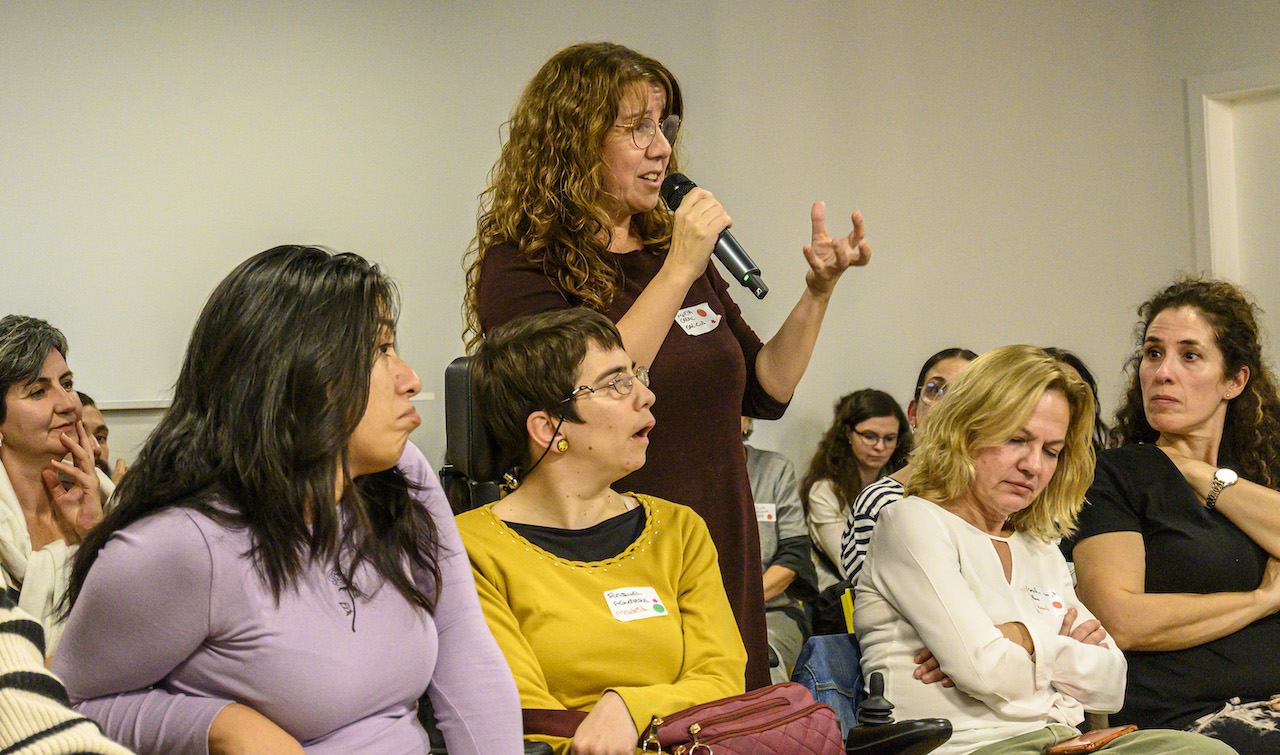
Assuming inclusive education as a human right with all its implications means recognizing the intrinsic value of the person in the school context, which resituates them in the world. In a world with a history, in which we have not occupied equivalent positions. Only by questioning the boundaries that delimit us, and that divide struggles and dreams, will we be able to build a radical inclusive pedagogy, which is also based on our leading role in history.
Calderón and Echeita (Forthcoming)University of Málaga and Autonomous University of Madrid
Organized by
Where, when, and how it was developed
- Date: October 22, 2022, from 10:00 AM to 8:00 PM.
- Location: Ateneo La Maliciosa. Calle Peñuelas 12, Madrid

Scientific productions from the workshop
Some scientific publications
- CALDERÓN-ALMENDROS, I. & RASCÓN-GÓMEZ, M.T. (2022). Weaving struggles for the right to education: Collective and personal narratives for inclusion from the social model of disability . Pedagogía Social. Revista Interuniversitaria , 41, 43-54.
- CALDERÓN-ALMENDROS, I. (2023). Researching with communities to promote inclusive education . Lead the Change Series , 140, 2-4.
- CALDERÓN ALMENDROS, I. (2024). To tread on the right to (inclusive) education or to fight to achieve it . Fòrum. Journal of Educational Organization and Management , 63, 5-10.
Conference presentations at scientific congresses
- CALDERÓN-ALMENDROS, I. (2022).Involving communities in the promotion of inclusive school cultures . 1st International Conference on Education and Training – Thinking education in transition times, Lisbon, Portugal.
- CALDERÓN-ALMENDROS, I.; RASCÓN-GÓMEZ, M.T. & MOJTAR-MENDIETA, L. (2022).Intersectionality, emerging narratives, and inclusive education in Spain. Paper presented at theAmerican Educational Research Association Annual Meeting 2022 (AERA). San Diego, USA.
- CALDERÓN-ALMENDROS, I.; RASCÓN-GÓMEZ, M.T. & MOJTAR-MENDIETA, L. (2022).New Discourses for a Necessary Transformation: Intersectionality, emerging narratives, and inclusive education in Spain.Paper presented at theAmerican Educational Research Association Research Meeting 2022 (AERA), San Diego.