Entradilla del programa TESIS, Canal Sur.
[Música de fondo]
Audiodescripción [AD]: Un grupo diverso de personas entra al campus de la Universidad de Málaga, rodeado de zonas verdes. Se sientan en un banco circular de piedra y comienzan a charlar de forma animada. Primeros planos capturan las expresiones emocionadas y el entusiasmo en sus interacciones.
Audiodescripción [AD]: Teresa Racón habla a cámara en una zona verde.
Teresa Racón:— Quererla es crearla es un movimiento que tiene un poco sus inicios a partir de un
workshop which was held here, at the University of Malaga. It brought together people from all over Spain – teachers, students, education professionals, counselors – and from there, we began to identify a series of needs that it seemed the school had. Transformations that were necessary to make it more inclusive.
Audio description [AD]: Several people enter the Faculty of Education Sciences building in Malaga.
Label: Educating in equality.
[Música]
Audio description [AD]: The faculty lobby is shown, followed by Ignacio Calderón speaking to the camera in a green area.
Label: Ignacio Calderón, profesor de la Facultad de Ciencias de la Educación de la UMA e integrante de 'Quererla es Crearla'.
Ignacio Calderón:— Emerge desde varios lugares. Por una parte, desde lo social, desde el activismo de muchas personas que vienen desarrollando trabajo desde hace mucho tiempo, pero también desde la universidad, por el deseo de transformar fundamentalmente cómo atienden las escuelas a toda la población.
Audiodescripción [AD]: Un grupo de jóvenes de diversas edades conversan en un entorno natural. Se van incorporando personas.
Rótulo: El proyecto 'Quererla es Crearla' de la Universidad de Málaga trabaja en pro de un sistema educativo basado en la equidad y la inclusión.
Ignacio Calderón (v.o.):—So, in a way, there is a union between people's desires to transform those schools and the work being done at the university to support those people in developing discourses, building new practices, transforming policies, and so on.
Audio description [AD]: Diana Farzaneh speaks to the camera in a classroom at CEIP La Parra.
Caption: Diana Farzaneh, Inclusive Pedagogy teacher at CEIP La Parra.
Diana Farzaneh:—Students who are in a situation of exclusion are the most vulnerable students, because they do not fit within that normative framework that we understand as 'normal,' such as students who have a sexual orientation different from the majority, students who present cognitive peculiarities, physical peculiarities, peculiarities in their way of communicating…
For us, differences are not a problem, they are not a difficulty. We want girls and boys who are people who value differences as something wonderful and necessary, and not as a problem if someone feels differently from me. If someone thinks, moves, or speaks differently from me.
Audio description [AD]: The group of participating people embrace and laugh as the camera focuses on each of them.
Audio description [AD]: Carmen Moreno speaks to the camera in a green area.
Caption: Carmen Moreno, member of 'Quererla es crearla'.
Carmen Moreno:—'Quererla es crearla' is a project that, above all, we believe is the foundation for an inclusive school. The main seed is for the entire educational community and society to understand and recognize the right to inclusive education. We have to change our perspective and culture.
Audio description [AD]: The group enters a classroom at CEIP La Parra and sits down. The documentary
Quererla es Crearla.
Title card: The group works on advising and training educational centers so they can implement a more egalitarian model in classrooms.
Audio description [AD]: Carmen Matés speaks to the camera in a classroom at CEIP La Parra.
Title card: Carmen Matés, director of CEIP La Parra.
Carmen Matés:—We find ourselves in the need that, in order to work on inclusion, we needed to invite someone external who could help us. So, we called the University, we spoke with Nacho Calderón, and he came to give us some training for the teaching staff on how we could work in that inclusive school.
At first, we understand that inclusive education seems like magic, right? You do a training, and it seems like you've got it. And you realize, from the moment you start, that it's the opposite. That it's a world in which you have to keep working, day by day, and that when it comes to addressing any conflict, which is natural in educational centers, the question is how we are going to address it, apart from learning. There, we already have the need for how we can do it, right?
Audio description [AD]: Diana Farzaneh speaks to the camera in a classroom at CEIP La Parra.
Diana Farzaneh:—The structure we currently have in the education system does not allow us to build inclusion from the beginning, because the curriculum implies a difference. The curriculum, as it is currently organized, most of the teaching staff uses textbooks, for example. Well, that already poses a huge barrier for all girls and boys, not just for a more specific group, but also for the rest who understand that knowledge comes packaged in a book, that what that publisher marks is what needs to be known and the rest is not of interest. For example, that is contrary to cultural values, right?
In our school, there are girls and boys from different cultures, and yet, the textbooks only talk about a very specific culture. Theirs are made invisible. If we understood that this is the curriculum, then we would be making invisible and devaluing their culture, the one they bring. The knowledge that the girls and boys bring.
Audio description [AD]: Carmen Matés speaks to the camera in a classroom at CEIP La Parra.
Carmen Matés:— It is very difficult to provide a... mass education, isn't it? The same for everyone. Well, it's easy to provide it, but it's not easy for it to reach all students because everyone learns differently, everyone has different emotions, and everyone comes with a different kind of baggage.
Therefore, responding to each student is where the teacher's demand comes in. That we need this training, this help, this constant reflection that we teachers are not always accustomed to, that we need to learn by listening to others.
Audio description [AD]: The documentary Quererla es crearla is shown in the classroom of CEIP La Parra. Opening scene: Collage. A child smiles over a large fuchsia gear. In the foreground, an old typewriter with a text that reads "but we wanted love." On the left side, a document titled "Convention on the Rights of the Child (11.20.1989)."
Audio description [AD]: Next, images alluding to slavery and the anti-racist struggle follow. Among them, the faces of Martin Luther King, Nelson Mandela, Rosa Parks, a Black woman voting, and protesters appear.
Narrator (v.o.):— There was a time when the color of some human beings made them the property of others, a time when the law discriminated against and segregated them. But we wanted freedom.
[Música]
Audio description [AD]: Scenes of students participating in the recording of the documentary.
Label 1. Making the institution participate.
Label 2. It helps to avoid prejudices and favors dialogue between generations and groups.
Label 3: Students from the Faculty of Education Sciences have contributed to the project with a YouTube channel to offer didactic content.
Label 4: Teresa Rascón, professor of Educational Sciences at UMA and member of
Quererla es Crearla.
Teresa Rascón (v.o.):— The participation of students from the university here in these tutorial videos has been very participatory from the beginning. Furthermore, it was work that I consider very enriching for them because they had a period in which they had to prepare the scripts. The tutors reviewed them, and from there, they had to learn them, record them...
In other words, I believe that for them, at least the evaluation they made of that process was very positive. And the fact of seeing that the product developed here, within the university, does not stay within these four walls, but rather goes out and will truly be useful, for training, for example...
Audio description [AD]: Teresa Rascón speaks to the camera in a green area.
Teresa Rascón (v.o.):—For example, we are using it for teacher training courses. It is even available on the university website. In other words, any educational center that wants to can go to the page
www.creemoseducacioninclusiva.com and there they have all the resources we have been creating uploaded.
Audio description [AD]: Teresa Rascón and Ignacio Calderón show materials and resources from Quererla es Crearla to the participating group in a classroom at CEIP La Parra.
Ignacio Calderón (v.o.):— A lot of creative narratives have emerged from reality about how people can transform reality, the reality that is hurting them or that can be greatly improved. Well, the guides that have been made emerge from that.
Audio description [AD]: Ignacio Calderón speaks to the camera in a green area.
Ignacio Calderón:— Various guides have been created: a guide for building public policies; a guide created by students for other students, so that they themselves can build their own schools. In other words, they don't have to wait for the teaching staff to do it, but rather they get to work building these inclusive schools.
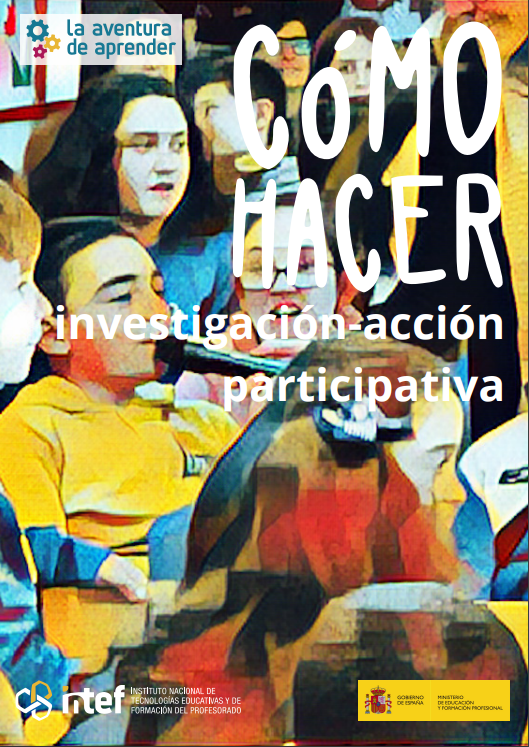
Audio description [AD]: Three young people leaf through a magazine titled
How to Make School Inclusive, from
The Adventure of Learning.
Ignacio Calderón:—There is a guide created by families on how to dissent in schools; a guide for counselors on how to build counseling practices that align with inclusion and human rights.
Audio description [AD]: Ignacio Calderón speaks to the camera in a green area.
Ignacio Calderón:—And, finally, there is another one so that schools themselves can build participatory action research processes, which is the other major methodology we have used.
Audio description [AD]: Official meeting between the Minister of Education, Pilar Alegría, and the Secretary of State for Education, Alejandro Tiana, and two young people, seated in front of them. One of the young people addresses them.
Young person:—… they tried to expel him from school. And we have a friend, named Rubén, who they did kick out of school.
Audio description [AD]: In an outdoor space, two young people dance in the background and a third young person, in a wheelchair, remains near a table in the foreground. Next, a young person with a backpack walks through a plaza with restaurant tables.
Caption: The documentary
Quererla es crearla, directed by Cecilia Barriga and which had the participation of the collective, was screened at the Reina Sofía Museum in Madrid.
Audio description [AD]: Ignacio Calderón speaks to the camera in a green area.
Ignacio Calderón:— The documentary 'Quererla es crearla' is directed by Cecilia Barriga, a Chilean filmmaker with a long career, and it emerges from a story: the story of Rubén Calleja and his family in the fight for his right to inclusive education, which had been violated and which was recently recognized by the UN as a violation by the Spanish State of a fundamental human right of a child.
Audio description [AD]: Antón Fontao, in a scene from the documentary, speaking to the camera next to another person.
Ignacio Calderón:— Starting from there, from that story, the documentary acts as a mirror of the entire research process initiated, which has a biographical part in Rubén's story, but also in the stories of other families who talk about what has happened to them in schools, what isn't working…
Audio description [AD]: Raúl Aguirre in front of a young woman communicating with gestures. Next, Indira next to an adult and a young person who are paying attention and smiling. Behind Indira, in a natural setting, a young woman blows soap bubbles next to an adult who appears to be smiling.
Audio description [AD]: Three young people sitting on a stone bench. All three are looking at the camera. Malena Calderón, a participant in the documentary Quererla es crearla, is sitting in the center. To her left is Alberto Sánchez, also a participant.
Malena Calderón:— Recording this documentary has been quite good, because we have made many friends in Spain, we have been able to talk to the Minister of Education to fix things in schools, or at least try.
Audio description [AD]: Four young participants in the documentary conversing animatedly. Among them are Rubén Calleja, Antón Fontao, and Malena Calderón. The setting is an outdoor space with stone walls. Next, two young people sitting on natural ground. One of them is painting or reading on a tablet. The other seems to be playing with the dirt.
Malena Calderón:— We have conveyed to them that everyone needs to be included in schools and that many children feel excluded because they are not in mainstream classes.
Alberto Sánchez:— It has been a great experience because it has given me quite a few things, including knowing that, even though it may seem like you are alone, you are not, because there are people going through the same thing as you. And, well, it has served me to support and be supported by the people who have participated in this.
Audio description [AD]: The group participating in the CEIP La Parra training meets in a circle in a natural environment or park. They converse and exchange ideas.
Alberto Sánchez:— With the documentary, what we want to ask is that everyone must be included, without dividing them by knowledge, abilities, or anything else. That the minds and hearts of teachers and students, etc., be opened. Everyone, really.
Audio description [AD]: The group enters the school and walks through its natural spaces to head to the classroom. Behind them, a blue bus.
[Música]
Audio description [AD]: Carmen Moreno speaks to the camera.
Carmen Moreno:— All the work that is being developed in 'Quererla es crearla', such as the documentary or the different guides and tools that have been created, is an open window to society so that those who feel identified or want to start working in their schools for an inclusive school, have materials available. They can transform those schools.
Audio description [AD]: Several people from the group stop and explore a natural environment with cacti.
Audio description [AD]: Teresa Rascón speaks to the camera in a green area.
Teresa Rascón (voice-over):— We continue to encounter certain resistances within the school institution that prevent certain actions from being shared, and from remaining within the scope of a classroom or a teacher. That a student's success is not in the hands of one teacher, but is the responsibility of the entire school.
Audio description [AD]: Teresa Rascón speaks with one of the members of Quererla es crearla.
Audio description [AD]: Four members talk to each other in a natural environment with cacti.
Audio description [AD]: Malena Calderón speaks with another member in a natural setting.
Audio description [AD]: Ignacio Calderón speaks with a young member in a natural setting.
Audio description [AD]: Diana Farzaneh speaks with a member in a natural setting.
Teresa Rascón (v.o.):— We need more social awareness. We have worked with families who already had an activist background, and we need to raise awareness in other areas of society that do not have this background.
Audio description [AD]: Diana Farzaneh speaks to the camera in a classroom at CEIP La Parra.
Diana Farzaneh:—We need to build a community where people need each other, help each other, love each other… as they are. And it can't be done by just one group; we all have to be together: teachers, students, associations, the city council must be involved. It's something we all have to do, fundamentally by believing that it's possible. Here, utopia… We need to reclaim utopias. We need to believe it's possible in this catastrophic world, where it seems there's nothing left to do. The world is being destroyed, it's self-destructing, and we can't do anything.
Audio description [AD]: Raúl Aguirre takes photos in a natural setting. He looks at the camera.
Audio description [AD]:A group of young people lean out of a balcony, observing the surroundings and the cars driving by. Among them is Antón Fontao.
Diana Farzaneh:— Necesitamos recuperar la conciencia de que es posible, porque nosotras somos las que construimos la realidad que tenemos, y podemos mejorarla. Y quererla es crearla.
[Música]
Audiodescripción [AD]: El grupo de personas integrantes de Quererla es Crearla comparten risas, complicidad y abrazos en un entorno abierto.
Créditos:
Guion de Juanjo Zayas.
Montaje de José Antonio Galiano
Imagen de Macarena Texeira.