Carmen Ocaña - C.O.:Good morning and thank you very much for allowing us to appear here today to, under the auspices of the SOLCOM association, defend the rights to a dignified education with equity for all students with functional diversity.
I would like to start by saying that everything has changed in Spain since the committee's 2018 report, but this is not the reality. We cannot even say that the reality is the same; it is even worse than what the committee encountered during its visit to Spain in 2017.
After that report was issued, there was a pause for a while during which hopeful families waited for solutions; however, nothing happened, and this was like granting a free pass for the bad practices up to that point to become consolidated.
The reality is that children, from a very early age, sometimes 3 or 4 years old, continue to be referred to Special Education centers. The law allows for this, instead of focusing on the entire environment that hinders the learning, presence, and participation of these students. The system already decides, as if it were a magician's crystal ball, that the student is not suitable to benefit from school.
This is the textual argument, and it is made to seem that the decision for this exclusion rests with the student, not with the lack of opportunities that the school is unable to offer. Students whose parents decide to fight survive barely within the system. We are talking about the early stages of children, when they act like sponges, when they mimic and understand absolutely everything. If, when children are so young, we teach them that those who are different must be separated, we are creating new generations that will obviously grow up with inoculated discrimination. School environments are hostile, aggressive. Students who manage to continue in mainstream schools suffer all kinds of harassment, discrimination, abandonment, and rejection. Protocols are not activated to defend and protect them; however, they are activated against them. Neither the school administration nor the management teams are involved in the education of these students. When some professionals, and there are some, and we cannot overlook them, get involved with these children, the students progress, but we cannot allow education to depend on the will of a teacher or on the luck of finding that teacher. Education is not a lottery that you win or lose.
Special education classrooms still exist. They are ghettos, antechambers to exclusion, where students are separated from their reference group. In all laws and regulations, there is a clause that allows for support outside the classroom. In exceptional cases, and this exceptionality becomes the usual practice, students are kept out of their reference classroom, away from the curriculum that they cannot share with the rest of the students. However, and curiously, these students are considered, according to statistics, as students in inclusion. Being outside the classroom is not inclusion.
Reasonable adjustments are made after an illegal psycho-pedagogical report is carried out, in which, in many cases, the professional is forced to provide the student's clinical data, because otherwise, resources are denied. This clinical data should be especially protected because it belongs to a minor and, in many cases, to a diagnosis. However, it constitutes the basis for the administration to label these students.
Resources continue to be allocated to the centers, which is why these diagnoses are used. They are not allocated, as they should be, in the open; this type of report, which later conditions school placement decisions, should not disappear.
Another important issue is curricular adaptations, which in many cases form the basis for adjustments. If a student manages to reach the end of secondary school, passing the adaptations that are supposed to guarantee the accessibility of their curriculum, they do not graduate. And they do not graduate because the system does not adapt content or learning. The system diminishes and steals that continuity. It devalues the curriculum; however, at the end of the stage, it demands the acquisition of competencies from the entire curriculum that has not been included in their learning.
How can someone learn something that has not been taught to them? How can someone be examined on content that has not been included in their adaptations? Adaptations are the system's great trap to continue perpetuating exclusion. There are lawsuits currently being fought based on reports that state, verbatim, "they pass their subjects with curricular adaptation, but for this reason, they do not graduate."
If the student has fought against segregating dictates since childhood, if they have endured incorrect adaptations, if they have suffered rejection and neglect, and in the end, they still do not graduate and continue with some form of training that enables them a place in society, we are only casting students into absolute invisibility.
Another pending issue is accessibility. 13 years have passed since the Royal Decree that established the minimum accessibility requirements in
centers. It is true that there has been some progress in physical and architectural accessibility, but there has been none in cognitive, sensory, or digital accessibility. There has been no progress; in many cases, there are neither the spaces nor the materials, not even, for example, in the evaluation tests.
There are no such accessible options for the student. Furthermore, in many of those psycho-pedagogical evaluations that involve the use of diagnostic tests, such as, for example, the psychometric assessment of intelligence, they are carried out without having taken accessibility measures for the students being evaluated. All these circumstances are considerably aggravated in rural areas, where students sometimes have to travel 60 and 100 km from their environment to have access to support.
All of this that we are describing can be verified in the documentation we have provided: psycho-pedagogical reports that continue to consider that the barriers are not systemic, but rather due to the difficulties and deficits attributed to the students. Court rulings where one can read statements like the recurring "has not achieved the objectives as a consequence of their personal situation." Reports from professionals requesting resources and training to be able to do their job. Unsubstantiated testimonies from families, very important ones, where they speak of harassment, violence, institutional abuse. First-person testimonies from students who say, "Every day I woke up with the hope that when I arrived at school, the teachers would accept me."
We cannot overlook that, in these years, we have also suffered the global COVID crisis, and that has also left us behind. The school made a titanic effort, but only for the so-called normalized students. Students with functional diversity were abandoned, they did not receive instructions, they did not receive classes; moreover, in some autonomous communities, specific regulations were issued for the completion of that course. Regulations that determined that promotion would be the general rule. Well, this circumstance also did not affect students with functional diversity.
This is, broadly speaking, the situation in Spain. A government and a political class that does not bet on inclusion. Educational inspectorates that justify certain exclusionary practices. Families who are misinformed, neglected, abandoned, and, in many cases, accused of abandonment when they try to protect their children. Many students who are being left behind, mistreated by the system, judged at all times and scrutinized by a system and a society that prefers to look the other way and not seek mechanisms of defense, protection, and, above all, inclusion. And all of this is done, most of the time, for the best interests of the minor, which curiously always coincides with what the administration says. The best interests of the minor are never what the parents ask for, nor even what the student asks for, but what the administration determines and establishes.
I would continue speaking for hours, and reality would always surpass my words.
I conclude by saying that the State has fulfilled absolutely nothing of what was requested by the Committee. The lack of protection for students with diversity is total, exclusion is manifest and deliberate, and the commitment to change is only on paper.
There are no political measures to guarantee this change, nor has it been contemplated in the budgets. We cannot and must not allow the institutional mistreatment that these students and their families are suffering. We cannot and must not allow even one more student to be discriminated against and segregated due to their functional diversity. A student segregated from school is an adult at risk of social exclusion.
Thank you very much.
Nuria Aparicio - N.A:
— Bueno, pues, a raíz de las declaraciones de mi compañera, está clarísimo que las recomendaciones del informe del comité del 2018 no se han cumplido y además observamos con preocupación importantes retrocesos. Todo ello, se puede ver, por ejemplo, con el aumento alarmante del alumnado escolarizado en educación especial.
En la primera década, tras la ratificación de la convención, la segregación creció hasta casi duplicar el número de unidades segregadas dentro de los centros ordinarios. En 10 años, las aulas específicas de nueva creación mostraron un incremento del 188 %. Informes publicados por fuentes oficiales del ministerio, donde se refleja como algo natural la segregación escolar justificada de estos niños, dicen que en los últimos 10 años el número de estudiantes con discapacidad escolarizados en centros de educación especial, lejos de disminuir, ha aumentado en un 20,8 %.
Asimismo, la escolarización también en este último año ha aumentado en un 42 %. No lo podemos permitir en España. En estos años, desde la publicación del informe del comité, se ha producido un cambio normativo muy importante en materia de educación escolar. Se ha promulgado una nueva Ley Orgánica de Educación en sustitución de la anterior que estuvo vigente hasta el 2020.
En su preámbulo, esta ley establece una serie de principios intentando dar
una transformación al sistema educativo español, sin embargo, se ha visto que ha mantenido y no ha derogado el artículo 74.1, donde dice que la escolarización de este alumnado en unidades o en centros de educación especial solo se llevará a cabo cuando sus necesidades no puedan ser atendidas en centros ordinarios. Es decir, no se ha eliminado la excepción de la educación especial y tampoco el dictamen de escolarización que determina la segregación educativa. Sin que los alumnos con discapacidad puedan opinar al respecto e, incluso muchas veces, en contra de su voluntad y la de sus padres.
La Ley de Educación debería de haber establecido de una forma mucho más contundente y más rotunda una cláusula explícita contra el rechazo en la que se prohíba la denegación de la admisión de este tipo de alumnado y se garantice la continuidad de la educación. Estos avances supuestos también se ven reflejados en la disposición adicional cuarta de esta ley, donde dice que se desarrollará un plan en 10 años donde los centros ordinarios cuenten con los recursos para poder dar atención a este alumnado con discapacidad. Sin embargo, se continuará prestando el apoyo a los centros de educación especial con el objetivo de que esto se desempeñen una función de centros de referencia y apoyo.
Esta prestación de apoyo a los centros de educación especial no se ha contemplado como algo transitorio que prevea un cambio porque se han 10 años. Ya han pasado 3 y 12 desde que se ratificó la Convención, forma parte ya de nuestro sistema jurídico y la segregación aumenta. Con ello, este papel de supuesto apoyo a los centros de educación especial sigue y, sin embargo,
nadie sabe nada de este proceso sobre que haya concretado cómo va a ser esa
transición. Qué presupuestos concretos irán destinados a ello; qué recursos humanos, técnicos y financieros, etcétera.
La situación en cuanto a la regulación de la normativa aprobada desde el 2017 en las comunidades autónomas en España es lo misma. Sí que han actualizado sus decretos, sí que es cierto que algunas han avanzado, pero todos siguen dejando una puerta abierta a la escolarización en aulas específicas y centros de Educación Especial. Lo más preocupante, actualmente, en España es una ley de la Comunidad de Madrid llamada ley «Maestra de Libertad de Lección Educativa», que interpreta y restringe el derecho a una educación inclusiva, diciendo que el único compromiso que tiene la administración es garantizar un puesto escolar a los alumnos con discapacidad en la educación básica, no necesariamente inclusiva. Por ello, regula, por un lado, la escolarización inclusiva y, por otro, la escolarización. En diversas modalidades inclusivas incluye, como ya hemos dicho, centros de Educación Especial, modalidad de aulas específicas, etcétera.
Cabe ratificar la preocupante situación de la violación sistémica del derecho a una educación exclusiva. Esta permanece y se perpetúa esta segregación. Especialmente los niños y niñas con discapacidades intelectuales,
psicosociales y múltiples. Además, se confunde al titular sujeto de la educación inclusiva, que es el niño por encima de todo. Él es el titular del derecho, sin embargo, últimamente también con mucha preocupación, hemos visto a asociaciones, plataformas, congresos nacionales, etcétera, defendiendo el derecho de los padres a la educación especial. Se han abierto nuevos centros
de educación especial, todo últimamente bajo el título inclusivo. Formaciones
políticas que hacen eco de que, cuando lleguen al gobierno, van a cambiar la ley de Educación, reforzando la educación inclusiva. Partidos políticos que han interpuesto recursos de inconstitucionalidad contra la ley
actual.
Estas leyes y recursos han sido derogados, pero con preocupantes contestaciones del Tribunal Constitucional, diciendo que estos recursos se desestiman porque los padres siguen pudiendo elegir las dos modalidades de educación inclusiva o educación en centros especiales. Es decir, vuelve a consagrar la dualidad de la educación y lo que es más grave, esta sentencia vuelve a hablar de principios, no de que la educación sea un derecho fundamental. Existen numerosas sentencias como la del tribunal Supremo, donde un alumno aprueba sus materias conforme a su adaptación curricular significativa y, sin embargo, por este motivo no se titula.
Pero la más grave es la de esta sentencia, donde, de nuevo, vuelve a considerar el derecho fundamental a la inclusión educativa como un principio. Hay otras sentencias también muy significativas, como la del Tribunal Superior de Justicia de Castilla y León, donde dice que se ha vulnerado el derecho...
… Bueno, hay numerosas sentencias donde se ve que tanto la ley como la práctica como los propios organismos judiciales van en contra de la educación inclusiva. No nos podemos permitir que estos organismos judiciales sigan sin tener en cuenta las interpretaciones que hace el Comité y odien lo que dice la Convención.
Tengo una serie de peticiones al Comité, no sé si da tiempo ahora o las dejo para el final, pero bueno, voy a decir alguna: es urgente que se regule el valor vinculante de los dictámenes del Comité. Es urgente que se adapte la normativa y el sistema educativo a la convención, que se eliminen el artículo 74 y el 18 de determinadas leyes. Que se eliminen los dictámenes de escolarización y las modalidades de escolarización excluyente. Que el plan que se dice de 10 años comience en un proceso de adecuación de políticas, culturas y prácticas. Que hagan efectivo por fin la educación inclusiva. Que haya órganos que permitan la participación de las familias y que no se las someta a una ligita de 12 años o 13 para conseguir una sentencia favorable que, además, ni al final se ejecuta. Que haya una resolución efectiva, por fin, de las titulaciones de estos alumnos. Que se creen protocolos efectivos contra el acoso, los actos vejatorios y los discriminatorios.
Que, por favor, se examinen peticiones o quejas individuales por el Comité, aun no habiéndose agotado los mecanismos internos y que, en definitiva, se mantenga abierta la investigación al Estado español con nuevos mecanismos de presión.
Si ello fuera posible. Y por favor, que no pasen 10 años desde la última
investigación. Que lleven un control y sean mucho más permanentes. Es decir, cada año o dos años, pero por favor que se tenga en cuenta. Que se vigile más al Estado español.
Muchas gracias
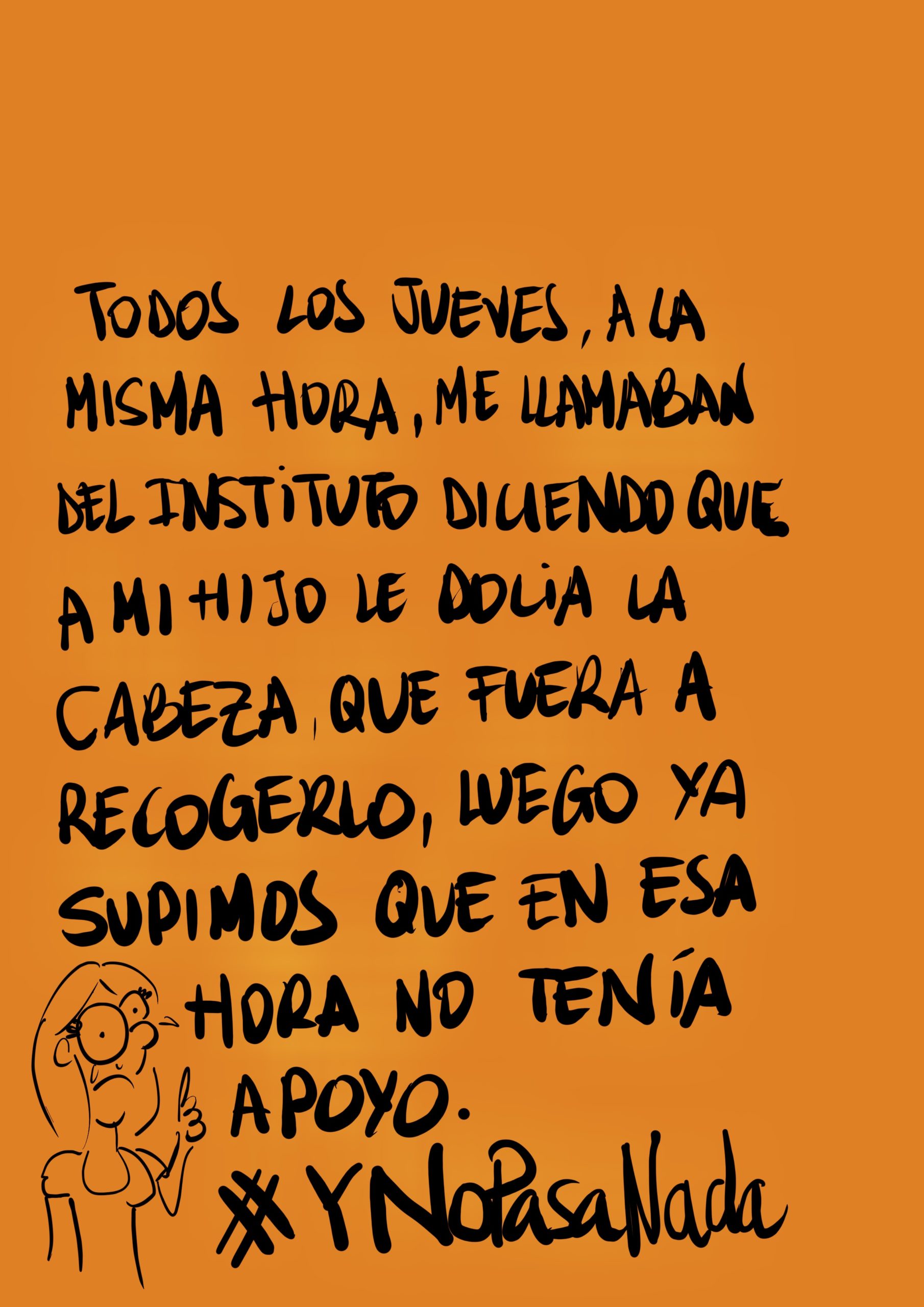
Audio description [AD]:Projections of testimonies follow one another on the central screen. Ángela narrates.
Nerea:— I want to ask you to stop this once and for all. Someone has to say enough is enough, don't let more time be wasted, because while we take it step by step, many people suffer and it marks us for life.
Cristina, Raúl's sister:— The harm that is done when not only actions count, but also ignoring.
José Antonio, Samuel's father:— After the decision that the child stays at home because the administration does not protect him, they start the absenteeism protocol; it seems like you are the villain of the story when you are only trying to protect him.
Mariola, Dani's mother:— A few years ago, I saw my son's future as gray, now I see it as black. The convention is not taken into account, there is no progress. In terms of rights, we are returning to the medical model, to macro-residences, to exclusion.
Raquel, Carmen's mother:— Everyone is capable of learning, but if you want your child to have educational opportunities, you have to pay for them outside of school hours.
María del Carmen, Clara's mother:— What should never be tolerated is for a diagnosis not to be used to help a person, and for them to decide your future and the support each person needs.
José Manuel, Raúl's brother:— A child who can speak can go home and say 'so-and-so hit me or this teacher treated me badly,' but my brother could only cry every time we took him to school.
José Antonio, father of Samuel:— They have given us a choice, we have been tied hand and foot by the Administration's stubbornness. The idea that we can choose is a lie. They don't care, they are not their children.
Carolina, aunt of Guillermo:— My nephew, who is 6 years old and has no effective oral communication, left school without anyone noticing. Something very serious could have happened, and yet, these types of things do not result in any kind of sanction or disciplinary action for anyone.
Manuel, father of Raúl:— Please, let the Administration offer a real education, let them stop with trivialities and ghettos where they are mistreating children like mine.
Mari Carmen, mother of Nerea:— She never received reasonable adjustments or methodological adaptations. We have been told that legislation was one thing and reality was another. We have been attacked and ignored by the Administration, we feel helpless.
Raquel, mother of Carmen:— They decided that she had to go to a special education center, yes or yes. She is no longer a nuisance in the mainstream classroom. This is her place.
Cristina, Raúl's sister:— They always emphasized what she would never be able to do and didn't try to find ways to enhance what she *could* do. They looked at him, but they didn't see him; they didn't see his potential.
Laura, Yuri's mother:— We were the ones who found the resources for the diagnosis and for addressing our son's schooling.
Raquel, mother of Carmen:— The special school is an approach with a therapeutic focus where academic aspects are not worked on. When I finish work and my daughter finishes school, her academic training begins.
Mari Carmen, mother of Nerea:— We feel powerless for not fighting for our rights. How long are we going to tolerate this? We need to find a way to put an end to it. We need the Committee to understand us, to lend us a hand.
María José, mother of Raúl:— Now I realize I have to apologize to my son for everything we didn't see. He cried when I told him he had to go to school. Later we found out he spent hours lying on the floor; that's where they left him.
Laura, mother of Yuri:— It was requested that a lower student-teacher ratio be considered for my son, as his medical reports advised. The Inspector's words were, "The law is one thing, and reality is another."
The convention states that they have the right to receive training throughout their lives, but after age 21, there's nothing. There are no options.
Carmen, mother of Manuel:— My son was thrown to the floor and handcuffed because of his lack of communication; he couldn't explain himself, and they didn't let him either 3 years ago, and he hasn't been able to study since due to the trauma.
Laura, madre de Yuri:— Mi hijo llegó a decirle a un amigo que solo pensaba en suicidarse. Yo estaba en la habituación de al lado y lo escuché.
Amalia Gamio:— Gracias, Señora Presidenta. En nombre de mi colega Rosa Idalia Aldana y el mío, para el seguimiento de la investigación, doy la más cordial bienvenida a las dos representantes de una organización española de personas con discapacidad y al representante del CERMI.
Sus profundas investigaciones y múltiples documentos han sido de enorme utilidad para nosotras, efectivamente no se han cumplido las indicaciones del comité de hechas en 2018. Personalmente, me asombra la reacción del Estado parte a la investigación, se sienten enormemente ofendidos porque se diga que discriminan a los estudiantes con capacidad y que se empleen términos como segregación y violación de derechos, pero aquí no encontramos mejores términos para referirse a todo lo que el Comité pudo observar durante la visita y con los amplios informes que hemos recibido de ustedes y escuchado en este día.
Se asombran de que digamos que persiste el modelo médico. Cómo se le llama que se siga otorgando al alumno las dificultades para la inclusión y no al entorno que no ofrece las ayudas individualizadas requeridas. Dicen también que criticamos las sentencias porque tenemos diferencias de opinión, pero no se trata de diferencias de opinión, sino de que ellos no enfocan los casos como derechos humanos, sino como principios.
Pues bien, preocupa muchísimo que la Ley Orgánica 3/2020 siga mencionando que existen todavía centros de educación especial en los que los alumnos podrán, preferentemente, ir a escuelas de educación regular, pero que esos centros seguirán recibiendo financiamiento y no se habla de temporalidad.
Yo quisiera preguntar a los colegas, a los amigos, a los representantes de la sociedad civil si ustedes saben si existen planes para establecer el correspondiente plan de acción educativa para esa nueva ley 2020 sobre educación, si existe ya algo para atacar esa profunda ideologización del tema en partidos políticos y legisladores. Es decir, si hay acciones y posicionamientos de la sociedad civil en contra de regular eso. Es muy pero muy preocupante.
Qué está haciendo esta organización de personas con discapacidad para sensibilizar a esa sociedad civil que sigue apostando por la educación especial y que se alía, por decirlo de alguna manera, con partidos políticos y legisladores para sostener esta idea. Tengo que decir que estoy contenta con haber visto la reforma al artículo 49 de la Constitución que se apega muchísimo a la Convención sobre los Derechos de las Personas con Discapacidad. Cambia su lenguaje, cambia su enfoque, habla de muchas cosas de la convención, pero mi pregunta es: cómo se reflejará esto el plan educativo. Qué beneficios traerá esta importante y correcta modificación de la ley 49 de la Constitución hacia la educación.
Con esto termino y me gustaría dar la palabra a algunos de los colegas si quieren hacer preguntas.
Rosa Idalia Aldana:— Thank you very much, Madam President. I am pleased to have read such comprehensive and detailed reports. Regarding data, I am very grateful to the civil society organizations that contributed to this research. Like my colleague, I am concerned about some issues, such as, for example, what happens to students affected by the lack of certification. Will you have data on how many students with disabilities actually manage to reach higher education if they do not obtain a degree due to accommodations or any other type of support they receive during their education?
Another important question that catches my attention is about Article 27 of the Spanish Constitution, which is very specific that parents are the ones who decide on their children's education. My question is based on the testimonies and everything you presented. You were very clear, the parents are not deciding anything in the end. That is, are they also not exercising that right as parents established by that article of the Constitution? Is there any intention by civil society, the movement, or legislators to modify this article of the Constitution? Because in reality, it is not being applied. Could you elaborate on the part where administrations also foresee that possibility? In Article 75,
according to the modification made, it does foresee the possibility that educational administrations can also incorporate Spanish Sign Language offerings in schools.
Do you have any information you can provide us on how many sign language interpreters have been incorporated using this modification of Article 75? It is truly an offering that is opened with much appeal and much dissemination so that Spanish Sign Language interpreters can apply, to be integrated into the educational sector.
I think I will leave it here and also give the floor to my colleagues.
Vivian de Torrijos:— Thank you very much, Madam President. I want to congratulate the SOLCOM association for sharing this morning the frustrations that children in Spain experience in finding true inclusive education. It strikes us powerfully, as our colleague comments, that Spain has always been seen as one of the States Parties we aspire to reach. But I have a question.
Spain is composed of different communities. We have Madrid, Valencia, Andalusia, etc., and they also operate with different characteristics. My question is: within these different communities or generalitats, is there any where the difference is made, where things are being done well? Where can we look as a reflection of our true Convention. Is there any of them that is salvageable for the educational inclusion that the entire country aspires to?
N.A:— Hello, regarding the law's 10-year plan to strengthen mainstream and inclusive education, SOLCOM is not aware of any such plan. Perhaps it's still a draft. Certainly, there are no specific budget allocations, neither from the central government nor from the autonomous communities, to improve inclusion. There are some notable budgetary actions, such as the launch of several calls for a program called ‘For Guidance, Advancement, and Educational Enrichment,’ promoted by the Ministry of Education in the area of inclusive education. However, due to its focused and partial nature, the funding for these programs remains insufficient.
It's true that it has been quite substantial, but they are focused on schools with special vulnerability due to social reasons, yet they do not specifically address the reality and needs of children with functional diversity. Its greatest weakness, moreover, is that it does not aim for structural transformation, which is what is needed, but rather for punctual improvements in some specific schools, which are nonetheless commendable, but do not lead to structural transformation.
On the other hand, the government recently also announced a budget of about 500 million euros, but in the end, it's to reinforce mathematics and language areas, and also in classes after school hours. And as far as SOLCOM knows, it's about reducing student numbers, but for math and language classes.
This is regarding the 10-year plan. As for the data we were asked for more explanation on, 'What happened after the Convention?', in the decade following the Convention's approval, it seems the Spanish State did not commit to eliminating parallel and segregated systems. In the 2009-2010 school year, there were 476 special education centers and 9,993 specific classrooms in mainstream schools in our country. It's important to emphasize this about specific classrooms because, often, it's difficult to obtain this data from ministry statistics.
As has been stated, Spain has delegated the competence of education to the autonomous communities, and each autonomous community regulates it somewhat differently, not always maintaining the spirit of the state law. Therefore, the data provided from each community are different, and it's quite complicated to obtain statistics of all kinds. But, in summary, we can say there were 1,800 specific classrooms in mainstream schools. In 10 years, 5 fewer Special Education centers, which means a 1% reduction. And there were 872 newly created specific classrooms, showing an increase, as I pointed out earlier, of 188%. For its part, the difference in the percentage of enrollment compared to the total number of students in non-university general education is an increase of 0.6%, from 0.4% in the 2009-2010 school year to 0.46% in the 2019-2020 school year, which shows that segregation grew in the first decade after the Convention's ratification, doubling the number of segregated units.
We have also seen from the data I have provided subsequently that this segregation continues to exist in 2024. I don't know if you need more data, or more specific data.
[Música]
[Música]
C.O.:— Students are managing to graduate, for example, in adult education centers, and it's interesting because the approach is the same, the students' circumstances are the same, they are simply studying in a center where they are not being labeled. In mainstream schools, they haven't been able to graduate, and outside of them, in adult education centers, they are graduating. The most worrying aspect of not graduating is that it is based precisely on those adaptations that are supposed to be the way to adapt the curriculum for students. If a student's content is correctly adapted, that student will be able to respond to that curriculum later, but if what is being done is devaluing that curriculum, which is normally what happens, they will never be able to fully respond to the curriculum and will never be able to obtain the competencies. Therefore, not graduating is a consequence of these poor adaptations that are being made.
Regarding what was asked about sign language, for example, this entire communication system is not being implemented in schools. We are seeing cases where, lately, there are many children who use communication devices, and schools are prohibiting their use. Families requesting the use of these communication devices are contacting the inspectorates, and in some cases, the answer is, 'whatever the school decides.' The school decides not to use communication devices, and the child is left unable to communicate. This refers to the use, for example, of sign language, meaning that there is no willingness to provide the necessary resources to the students in most cases.
I don't know if we have anything else to comment on regarding what was also asked about the autonomous communities. If there is any differentiation between communities in the regulations being promoted, almost all of them in their preambles speak of inclusion, almost all of them in their articles speak of special educational needs, but then we find that students are allowed to have adjustments outside the classroom and things like that, meaning there is still no clear awareness of what inclusion is and no clear concept of what inclusion in school is. Often, the options and the problem do not arise from a lack of resources; often, it is about willingness. Inclusion must be created by all of us, matured and built by all of us, by the teaching staff, by the families, by the students, and if we do not achieve joint work among all these elements that form part of education, we will never be able to talk about inclusion.
N.A:— It is true that we are aware that the autonomous communities of Barcelona and Valencia have created general directorates for inclusion within their departments to increase inclusion levels in education; however, on the other hand, and curiously, the autonomous communities of Catalonia and even Valencia are at the forefront in statistics as the communities with the highest number of Special Education centers, up to 20%. So it is contradictory; I don't know if they will improve in the future with these general directorates.
C.O.:— What other questions did we have…? I don't know if we have answered everything. If anything remains pending or if you need more specific data on any of the information you have requested, we will be happy to provide it within 24 hours.
Thank you, Madam President.