Quererla es crearla
Quererla es crearla is a citizens’ movement that brings together international scientific evidence with research and citizen activism. This has led to the participatory construction of campaigns, school experiences and a network of schools for inclusion, guides and tutorials, national workshops and international conferences, actions for political advocacy, school work materials, citizen mobilizations, biographies and life stories, top-level international scientific publications, the emergence of working groups and collectives such as Students for Inclusion, etc. The movement generated has been narrated in the documentary“Inclusive Education. Quererla es crearla”, and has received several National and International Awards.
As a social movement,Quererla es crearla brings together different people and collectives who unite around a consistent and robust common ideology, the result of systematic collective analysis. It is not an exclusive group, but rather aims to bring together many people who suffer in schools, or who want to make them more welcoming for all children without exception. This includes all groups, with special attention to those most affected in the school system, due to social class, nationality, ethnicity, abilities, sexual orientation, gender, health, etc.
This website offers an overview of what has been achieved so far, serving as a starting point for everyone joining the movement, both in Spain and Latin America.
A participatory research project for the achievement of the right to education
Quererla es Crearlais a social movement of people that has been scientifically supported and facilitated through the R&D&I (Research, Development, and Innovation) Projects “Emerging narratives about inclusive schools from the social model of disability. Resistance, resilience, and social change” (RTI2018-099218-A-I00) and “Emerging narratives for the construction of inclusive schools” (PID2022-140193OB-I00), developed at the University of Malaga and funded by the Ministry of Science, Innovation and Universities, and the University of Malaga.
This research project is based on three premises:
- The activism of persons with disabilities and their environment promotes educational inclusion and social change;
- The knowledge derived from the Social Model of Disability allows us to question and improve schools;
- Mutual support and resistance networks foster resilience processes.
Based on these ideas, stories of activism from families, students, and professionals who are fighting to make school a place where all children find recognition through presence, learning, participation, and success in the pre-compulsory and compulsory stages have been recovered. The aim is to document and analyze the experiences of families, students, and professionals who are fighting to ensure that Article 24 of theConvención de los Derechos de las Personas con Discapacidad, ratificado por España. Esto cobra especial relevancia tras el informe hecho público en junio de 2018 por el Comité sobre los Derechos de las Personas con Discapacidad de la ONU, en el que se manifiesta que en España se viola grave y sistemáticamente el derecho a la educación de los niños y niñas con discapacidad. Sin embargo, el movimiento y la investigación que lo acompaña han ido mucho más allá de estos términos jurídicos.
Hemos documentado nuevas narrativas sobre discapacidad e inclusión educativa que se originan en este colectivo con el fin de reconocer su valor y difundirlas; hemos profundizado en las concepciones educativas, experiencias y prácticas profesionales implicados en los procesos de inclusión escolar; hemos ayudado a comprender los mecanismos de colaboración que utilizan estos colectivos; y por último, hemos creado recursos que visibilizan y alimentan nuevas concepciones sobre la diversidad funcional y que articulan propuestas para promover la inclusión educativa.
Para lograr estos objetivos, el estudio ha partido de una metodología “ad hoc”, que combina varios procesos de Investigación Acción Participativa (IAP), capable of speaking uncomfortable truths, with the biographical and narrative methodology. Participatory action-oriented methodologies facilitate the construction and development of common projects to transform reality, critically examining power and privilege, and generating collaborative relationships as a framework for more effective practices. On the other hand, the biographical and narrative methodology allows for an understanding of personal experiences under conditions of oppression and exclusion.
For its development, various methodological approaches have been used: the creation of numerous micro-life stories and autobiographical accounts, the construction of in-depth life stories of activists, students, and professionals committed to inclusion, and a documentary analysis of current legislation on equity and inclusion in schools. Furthermore, various Participatory Action Research processes have been developed to promote transformations. The reports have been produced in two formats: text and audiovisual.
The research has aimed at understanding, but also at giving expression to individuals and groups whose constructions are often not legitimized. Therefore, the research itself is a tool for social change. Additionally, the narratives and analyses have served as catalysts for action-oriented proposals, making struggles for this social change more effective. Finally, the design and facilitation of participatory research processes have been fundamental to the movement’s strength.
Beyond Research
However, the social movement generated has gone beyond research. People have been organizing around shared desires, knowledge rigorously built by science alongside the everyday knowledge of everyone, and instituted but not yet achieved rights. The social movement began at a moment of collective connection through the pain caused by negative experiences in schools. But also through the joy of positive ones, and the hope generated by sharing the project of social and educational change: what is impossible individually gains meaning and possibility in the collective. From there, life and struggle stories began to be woven, upon which other people could build: thus, the journey begins to be less lonely, and emerges from the pit of the private. Personal stories—which connect with the work and experience of so many people in the past—are shared, occupying space in public debate and reaching the highest political decision-making forums: a regional parliament, the Congress of Deputies, the United Nations headquarters… The alliance between academia and civil society allows for the construction of empowerment processes in which the words of a vulnerable mother, for example, are put into dialogue with those who make decisions about that vulnerability. Or science and art, knowledge and emotion, come together to build forms of activism that occupy parks and institutions: we can be moved as we learn to see life, people, and school from different perspectives, questioning our judgmental gazes.
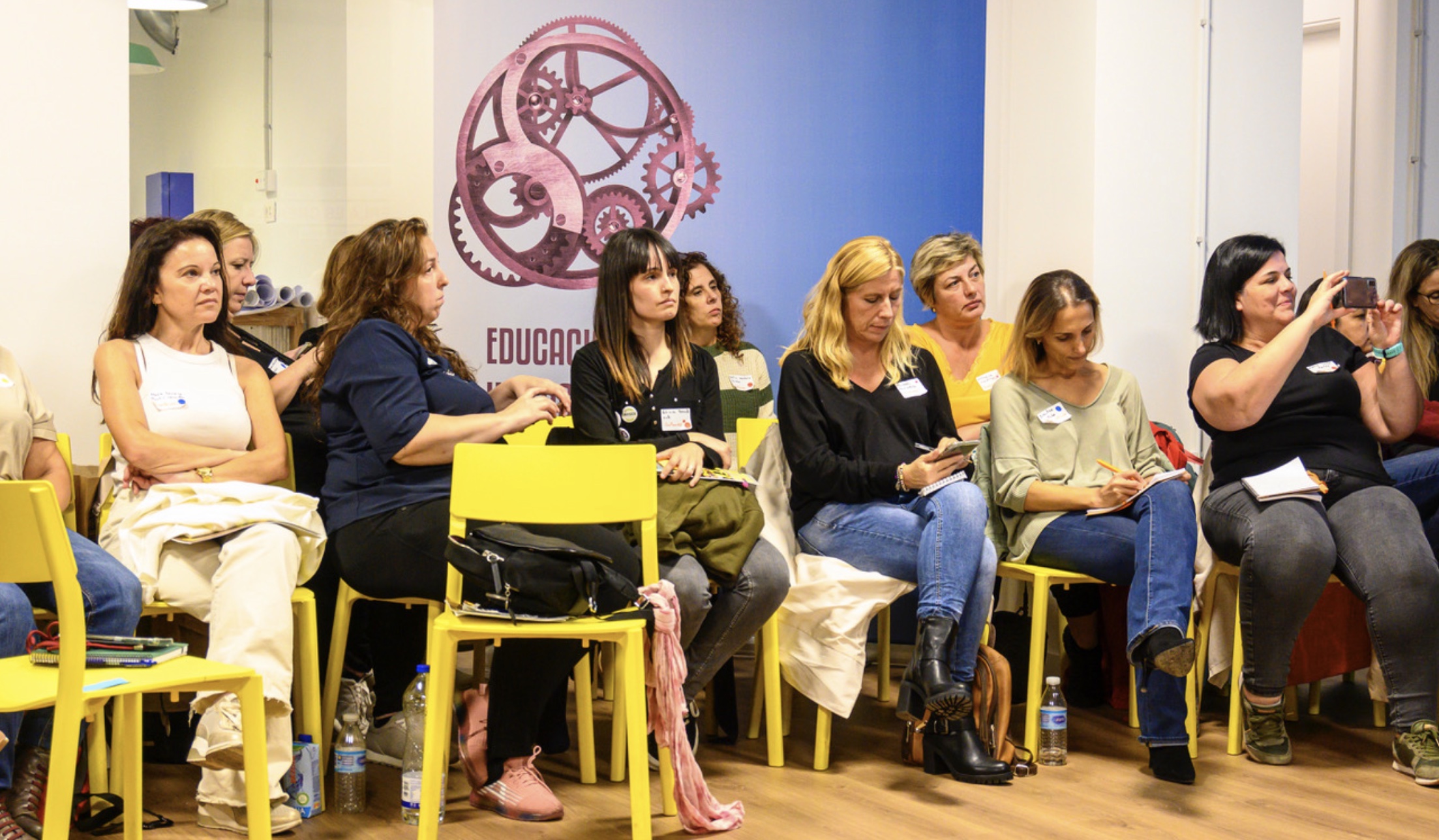
Four participatory diagnosis and collective construction moments have taken place since the beginning, and have guided all the work generated: a workshop in Malaga in 2018, from which the question of school segregation emerged; online conversations about (inclusive) school in 2020, during the COVID pandemic lockdown, which reached Parliament to guide political decisions; a new workshop to create the school we desire, in Madrid in 2022, where the next steps were articulated based on what had been collectively built previously; and a new participatory meeting in Barcelona in 2024, which marked the beginning of the movement’s internationalization.
Among these constructions, some emerging groups and their respective productions stand out:
- A group of professionals who are creating a new way of understanding school guidance, now truly focused on human rights.
- A school that decides to journey from its reality to dreams of an inclusive community, and shares its process with other schools that wish to do the same. It is possible here and now, and experience proves it. Based on their experience, an entire network of schools for inclusion has emerged.
- A group of mothers who make it clear that when there is inequality, it is necessary to dissent, and they create a tool to facilitate the path of dissent in schools that want to generate change in reality.
- And a group of secondary school students who do not wait for adults to take the step, because they know that inclusive education also depends on them, and they create a proposal aimed at students, while also embarking on initial and ongoing teacher training processes, and political dialogue. All of this has earned them an International Youth Educational Research Award.
As a culmination, the generated movement has been documented through a film, which is stirring and uniting ideas, emotions, knowledge, and wills in Spain and beyond our borders, putting inclusive education on people’s lips, and making it possible to talk about what remains tacitly forbidden in many places. And people emerge from the pit of loneliness, sadness, and shame. And they come out to dissent and defend the beauty of diversity, and to collectively show that there are miseries in schools that cannot be maintained. And it is made public in the media, in film screenings, in photographic exhibitions, and also in prestigious scientific publications of the highest international level.
Thus, there remains a journey full of hope: the one that goes from where we are, which still does not respect the human right to education for many children, to that inclusive school that promises a society where everyone matters. The one that is created in the process of dreaming it and rolling up our sleeves to make it a reality.To want it, then, is to create it.