Inclusive education is a right recognized in our laws for years. On this page, you will find the steps to file a complaint if you believe the right to education is being violated. Also, a brief selection of fundamental legal texts. Using these laws can help us change reality.
Steps to file a complaint for alleged violation of the right to education
Alejandro Calleja, Rubén’s father, has unfortunately had to develop extensive knowledge of the available procedures to respond to an alleged violation of the right to education. His fight in his son’s case now aims to light the way for those who find themselves in the same situation as his family.
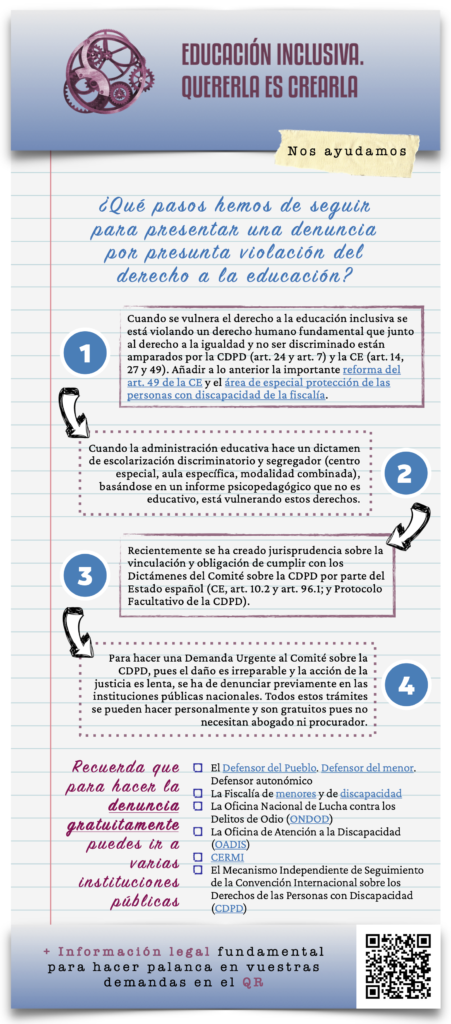
This infographic summarizes in a very concise and graphic way the steps to follow to file a complaint for free. If you click on the image or the button below, you can download it in PDF, which keeps all the active links to expand the information.
Step 1
The violation of the right to inclusive education is the violation of a human right. This right is protected by:
- The Convention on the Rights of Persons with Disabilities in articles 24 and 7.
- The Spanish Constitution in articles 14, 27 and49.
- The area of special protection for persons with disabilities of thePublic Prosecutor’s Office.
Step 2
If the educational administration issues a discriminatory and segregating schooling report, based on an inadequate psycho-pedagogical report, it violates the right to inclusive education. Discriminatory reports include assignment to a special center, a specific classroom, or combined modalities.
Step 3
In 2020, a legal norm was created that obliges the Spanish State to comply with the Committee’s Opinions on the Convention on the Rights of Persons with Disabilities. This obligation is supported by articles 10.2 and 96.1 of the Spanish Constitution, and by the Optional Protocol to the Convention.
Step 4
To file an urgent complaint with the Committee on the Rights of Persons with Disabilities, you must first file a complaint with national public institutions. The harm from violating your rights can be irreparable because justice is slow to act. You can carry out these procedures personally. They are free of charge and do not require a lawyer or legal representative.
Important
To file the complaint, you can go to these public institutions:
- The Ombudsman.
- The Children’s Ombudsman.
- The regional Ombudsman.
- The Prosecutor’s Office for minors and disability.
- The National Office for the Fight against Hate Crimes (ONDOD).
- The Office for Attention to Disability (OADIS).
- CERMI.
- The independent monitoring mechanism of the International Convention on the Rights of Persons with Disabilities (CRPD).
International Texts
Convention against Discrimination in Education
Convention on the Rights of the Child
- Access the Convention, available in PDF, online and in easy-to-read format (PDF).
Salamanca Statement and Framework for Action on Special Needs Education
Instrument of Ratification of the Convention on the Rights of Persons with Disabilities, done at New York on December 13, 2006
Thematic study on the right of persons with disabilities to education for Human Rights
General comment number 4 (2016) on the Right to Inclusive Education
- Access the document, available in Doc, PDF and online.
Transforming our world: The 2030 Agenda for Sustainable Development
Report of the inquiry relating to Spain under article 6 of the Optional Protocol
- Access the report, available in Docx.
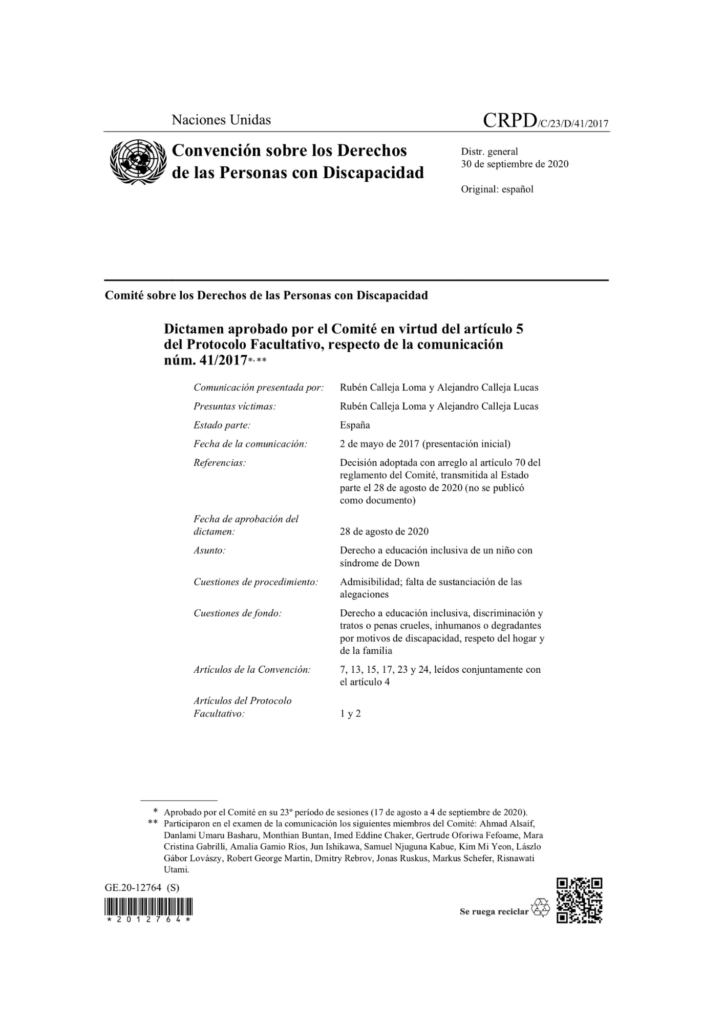
Opinion adopted by the Committee under article 5 of the Optional Protocol, in accordance with article 7 (2) of the Optional Protocol
- Access the document, available in Doc, PDF and online.
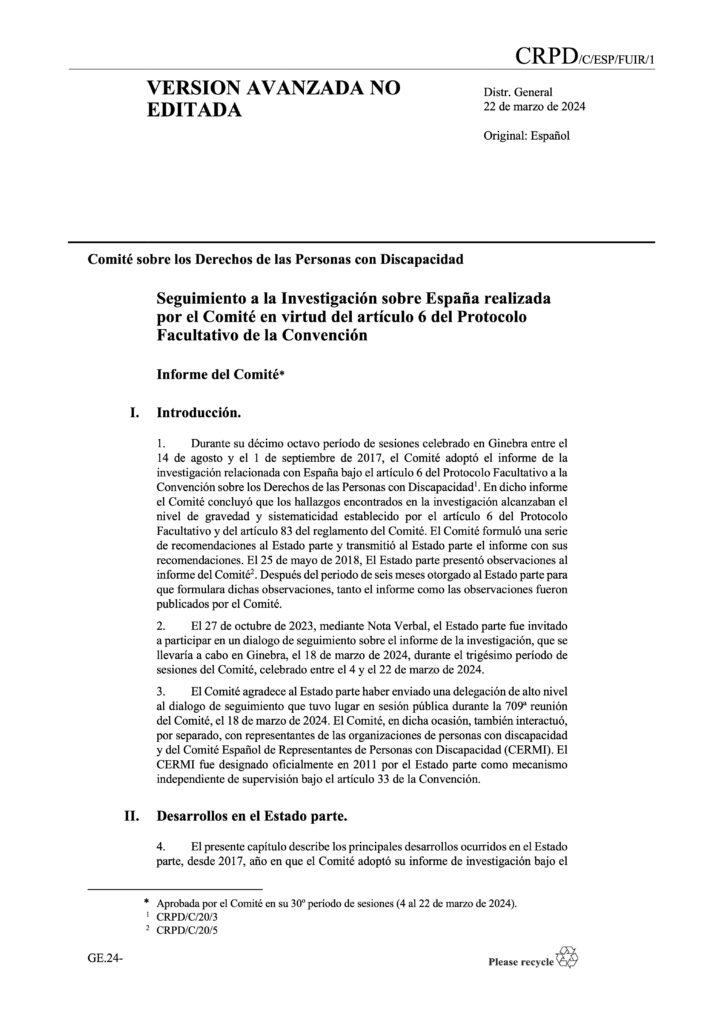
Follow-up to the Inquiry on Spain carried out by the Committee under article 6 of the Optional Protocol to the Convention
- Access the report, available in Docx.
Spanish legislation (state) on inclusive education
Spanish Constitution
- Access the Constitution, available PDF, online and in easy-to-read version (PDF).
Organic Law 8/1985, of July 3, regulating the Right to Education (LODE)
Organic Law 2/2006, of May 3, on Education (LOE)
Title II, “Equity in education”. Article 74 conflicts with higher-ranking legislation.
“This law leaves open the possibility of a dual schooling model; inclusive or segregating. It tries to make us believe that segregation is beneficial, that society can be compartmentalized and that coexistence is neither possible nor necessary. This message is sent to the educational community without giving it the opportunity to be confronted.”
Royal Legislative Decree 1/2013, of November 29, approving the Consolidated Text of the General Law on the rights of persons with disabilities and their social inclusion
Article 18.3 conflicts with legislation of a higher rank.
“Compendium of rights and duties that recognize my son as a full citizen, except for receiving his education in common environments, which, in practice, means lifelong segregation.”
Organic Law 3/2020, of December 29, modifying Organic Law 2/2006, of May 3, on Education (LOMLOE)
Judgment number 1597/2023, of the Contentious-Administrative Chamber, Fourth Section, of the Supreme Court
Landmark ruling by the Supreme Court, which upholds the Calleja family’s appeal against the National High Court’s ruling that did not comply with the Committee on the Rights of Persons with Disabilities’ opinion. This establishes jurisprudence regarding the binding nature of the Committee’s opinions.
To learn more
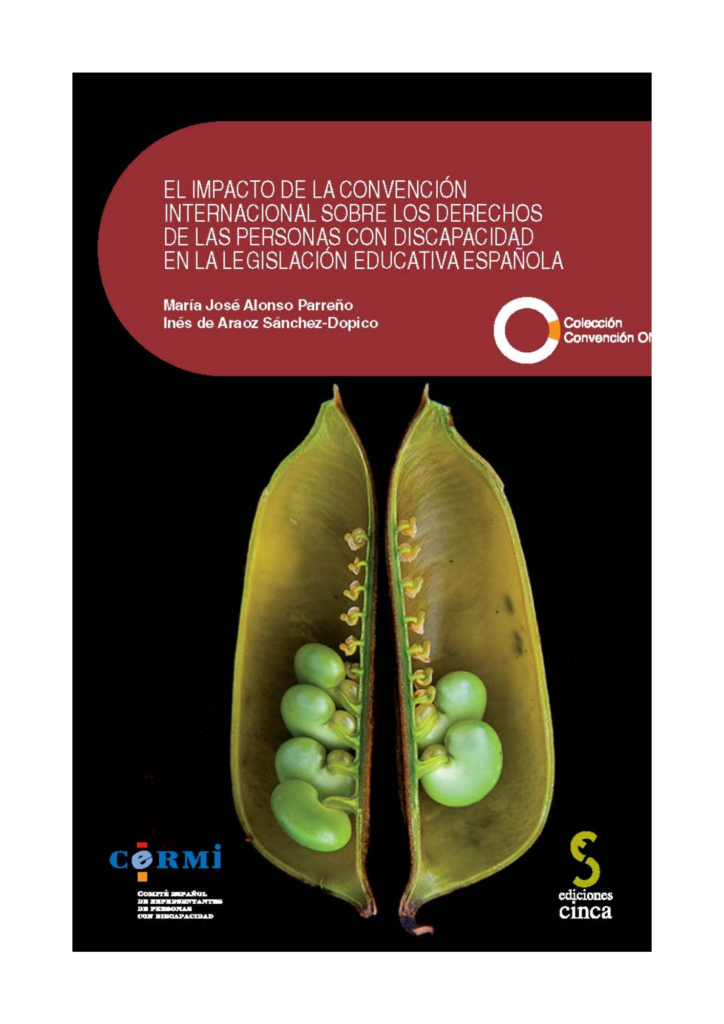
The impact of the International Convention on the Rights of Persons with Disabilities on Spanish educational legislation
M. J. Alonso and I. de Araoz
- Access the document, available PDF.