#WorkshopCataliza: Fostering inclusive networks and actions across cultures, school communities, and individuals
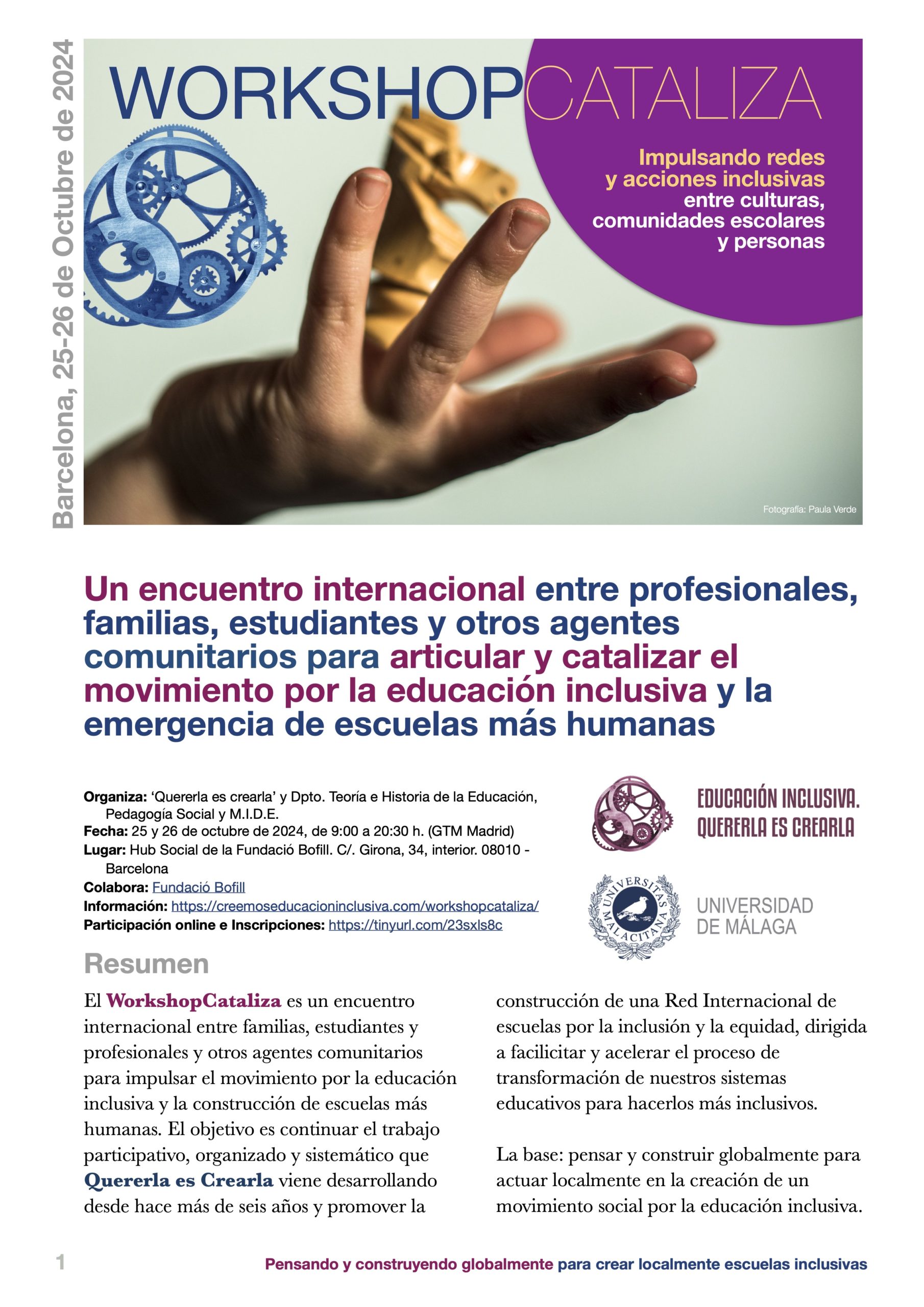
The Catalyze Workshop was an international meeting of families, students, professionals, and other community stakeholders to advance the movement for inclusive education and the creation of more humane schools. The objective was to continue the participatory, organized, and systematic work that Quererla es Crearla has been developing for over six years and to promote the establishment of an International Network of schools for inclusion and equity, aimed at facilitating and accelerating the transformation process of our educational systems to make them more inclusive.
The basis: think and build globally to act locally in creating a social movement for inclusive education.
Everything that happened at the Workshop
All the information from the two Conferences, including videos and minutes, can be found by entering in their program. During the workshop, there was a great deal of coordination and systematization, so that the results of each session were published in real time. Detailed information can be found at the following links, although we are developing the video editing process for the second day, as well as the full transcripts of the sessions:
Day 1: The Network of Schools
Audio description [AD]:The workshop "Cataliza" begins at the Barcelona Social Hub. Teresa Rascón, Mónica Nadal, and Ignacio Calderón are seated facing the attendees. Behind them, two large screens display the posters designed for the event.
TERESA RASCÓN:—Good morning, everyone. It is a pleasure to be here with you for this new workshop, which is a continuation of the previous three. The third one was held in Malaga in 2018. And now we are on the fourth. Malaga, Madrid, Menorca, and now it's Barcelona's turn. So, I am absolutely delighted to be here with you. We hope this will be a very fruitful meeting and, above all, that we will learn and set things in motion that will help us transform others. This is the difference between the meeting we aim to have today and, perhaps, another format, like a conference or a course. No, this is a working meeting.
We are here to think about our practices and about what is happening in schools that leads to many children still being excluded, segregated, and discriminated against. This is a meeting to think about and transform the school, society. So that these children feel not only their presence but also their participation in those classrooms and in society, in general.
Today, we have a very broad representation of families. I see many familiar families of students and professionals here, so we are delighted.
I would also like to thank Hup Social and Fundació Bofill for lending us this space, which is very welcoming. Thank you very much. Thanks also to the technical team because we have set up quite a fuss here. We hope everything works as it should. Throughout the day, you will see that we have tried to maintain this coherence with inclusive education and society, not only in the workshop but in all processes. The cooperative of street vendors here in Barcelona will be providing the catering, and I am sure they have prepared something very delicious for us.
I hope you enjoy it very much. We are here with great enthusiasm from the University of Malaga and the Foundation. Thank you all very much for coming.
MÓNICA NADAL:—Good morning. I wanted to thank you for the work you do and for offering us the opportunity to host you today. I wanted to welcome you and explain, very quickly, who we are, what we do, and why we are happy you have come to Barcelona. That you asked us if we could host you here. Very quickly, we understood that this was our contribution to the work you are doing.
Hub Social is an initiative of the Bofill Foundation, born with the idea of bringing together social entities, knowledge, and the defense of social rights with an innovative approach.
We believe that we must innovate because we need to truly break traditional frameworks and think of new ways to promote social change. The Foundation is over 50 years old and has always sought knowledge for social improvement. This conviction has evolved over time with specific emphases. Right now, we are focused on education. Education as a lever for social transformation. We start from the premise that knowledge must serve social change. That's why we do a lot of analytical work on policy proposals. We talk to politicians. We try to convince institutional actors of the need to transform educational policies so that they are truly inclusive and serve social and collective improvement.
Then, we also profoundly believe that knowledge, to be robust and meaningful, must combine different perspectives, as well as the voices of protagonists and the experience of experts. The experience of people on the ground and the analysis of experts. From this combination, proposals are much more solid and much more legitimate.
Finally, we believe that knowledge must serve to strengthen civil society, because great policies and approaches can be made, and we have seen this, but for them to truly resonate and transform, they need a strong basis of legitimacy that many people believe in, defend, fight for, and demand when it is not met. While it is true that, in the end, public authorities have the duty to guarantee and create the frameworks for things to happen. That is, we cannot only build from the ground up; someone has the responsibility. And that is what public administrations are for, to ensure that rights are met and that appropriate policies are in place. However, at the same time, if there isn't a base that defends and claims [estas políticas], any proposal can be neutralized. The school has the capacity to neutralize any political proposal, however good it may be. That is, the school has the capacity, not the teachers, poor things.
All structures and institutions tend to neutralize anything that questions the status quo. And, therefore, only those policies end up transforming reality when there are people who truly understand them, believe in them, and know what they are for, defending them in their daily lives. And for all of this, the work you do is necessary.
Pepe Menéndez told me: 'You have to talk to Nacho Calderón one day and learn about the work they are doing from the University of Málaga.' And what impressed me most was precisely the radical nature of the project, which involves linking knowledge with protagonists. The project's connection with the promotion of social activism, in the sense that rights are fought for and conquered every day. And they are made possible every day.
Done.
Currently, we are seeing a reactionary wave. What we understood, by default, as a shared project of what school should be and could become, is beginning to erode. There are voices that are directly questioning whether school should have that function. These are extremely dangerous discourses, because, faced with difficulties, no one denies that implementing social transformation projects is difficult. Faced with difficulties, instead of fighting and refining policies further or betting more strongly, they say: 'This doesn't work. Let's dismantle it all. Let's destroy it all and return to a selective school model. Let everyone fend for themselves.' And for us, that is the entry of fascism. Distrust in the public is a discourse in which everyone must fend for themselves and that there can be no collective project because it always fails. We must fight against this, and hence the alliance between knowledge and practice.
Leadership is vital. I wish there were many more projects led, or at least promoted, by universities, which have the capacity to do so, with the depth that you are doing it. Therefore, we are delighted to welcome you and I hope it will be fruitful. That you make it to tomorrow night alive, because you have a program that is death. I don't know how you're going to do it, but, in any case, I hope you are well here, that you feel welcome, that you enjoy yourselves and return home energized to continue with the work you are doing.
Thank you very much.
NACHO CALDERÓN:—Thank you very much, Mónica. The first thing we want to do is thank the Bofill Foundation for the opportunity to be here today, in the center of Barcelona. Enjoying a space like this, beautiful, and with so many people. For us, it is an honor and a pleasure to be here. Thank you very much for the opportunity.
Then, welcome, everyone. Everyone. I believe there is something wonderful about this project and it is that, when one speaks of 'project,' one is not speaking so much of a research project as of a vital, social project, built by people, with distributed leadership. I am seeing many faces that are currently exercising that leadership in the movement in which the university has played and plays a role that we believe is useful for it to happen. Favoring or facilitating, perhaps, a space and methodologies that help people to build what they want.
So, welcome, everyone. I don't know if we'll make it out alive, especially considering that we're starting late; that is, disastrously. We've done the math and said: 'This has to be good.' Well, nothing... calculations are for scribbling. Well, we hope not, and please keep in mind that we are amateurs. We are trying to learn as we go and we try to do our best. But we make many mistakes.
Well, I also want to thank the entire movement. Every person who has worked on the project during all this time, which began in 2018 and has been running for 6 years now. We have had four major gatherings. This is the fourth. Each of those gatherings had its own meaning and a global meaning. Thanks to everyone who has made it possible for us to advance from 2018 to the present.
I also want to thank all the people who have facilitated or will facilitate this gathering. To all the promoters. This year, there is something new: many people from Latin America are joining. It is an honor for us to be able to work in this international context. All those people, just like those of you here, do it altruistically. No one gains more than what we manage to produce, and what we are going to produce is knowledge, relationships, and emotions. All this that we are building here is what we will take with us tomorrow. Tired, but it's what we'll take. People come from Ares, from the Canary Islands, from Zaragoza, or Andalusia, making a personal, economic, time, and effort investment, which I think is the great value of what we are building. Thank you and congratulations.
I also want to welcome those who are starting on the path of 'Quererla es crearla'. There are people participating in a gathering like this for the first time. I want to welcome them on behalf of all of you. Know that this is everyone's space. We are willing to improve and transform it until it suits everyone.
As both Mónica and Tere mentioned, this is not a conference, it is a space for social construction. Today and tomorrow, a series of assemblies, round tables, and workshops await us. These are the three main formats we will use. The assemblies will be for all of us to participate, both in person and virtually. And the round tables will refine the debates initiated in the assemblies.
This year we have two main focuses. One has to do with schools, with what happens within them. In the morning, schools, here, in the Spanish State. And in the afternoon, in the Ibero-American context. Tomorrow, we will dedicate the focus to thinking about the social movement here, in Spain, and the social movement that is beginning in Latin America.
I only have a few words about the rules. We will be very strict with time, even though we started late. We ask you to be understanding. Initially, in the assembly, we will have very brief interventions, of 2 minutes. We ask you to stick to that time and try to keep your interventions to 2 minutes. Think about what you want to share, what is the important thing you have to share in the assembly? And try to fit it all into those 2 minutes. This way, the maximum number of people will be able to participate.
This is a space necessarily built on respect. That is, it is essential that we respect everyone's experiences. By respecting everyone's experiences, what remains for us is to discuss interpretations. And discussing interpretations is not discussing your experience, but its interpretation.
We are trying to improve all experiences: those of families, students, teachers, and professionals. All those interpretations must be improvable, and that necessarily requires contrast. Let's not be afraid of conflict; conflict is part of our nature. Conflict is necessary for inclusive education; it will only happen if there is conflict. But conflict is not fighting, but contrast, the push of some ideas against others. In that dialectic, it becomes something better.
Again, let's try to stick to the focus of each moment and let's try for everyone to participate. Let's not leave here without everyone having participated. That's all.
Thank you very much for coming. Welcome, everyone. Let the "hunger games" begin.
Audiodescripción [AD]: Asamblea del workshop «Cataliza» en el Hub Social de Barcelona. Ignacio Calderón toma el micro y se dirige a las personas asistentes.
NACHO CALDERÓN - N.C.:— La primera asamblea es una asamblea dedicada a lo que voy a leer. Se titula: «Red de Escuelas por la Inclusión y la Equidad de España». En el centro, nuestra idea para este día es acompañar a la Red de Escuelas que se ha iniciado en ‘Quererla es crearla’ hace muy poquito. Llevamos muy poquitas reuniones, con lo cual la red de escuela está básicamente empezando. No nos hemos puesto todavía a trabajar, de hecho. Este mes es el primer mes de trabajo dentro de cada una de esas escuelas; algunas de ellas están aquí, otras están online, conectadas.
Pero sabemos que aquí hay representación de escuelas de la red de diferentes lugares del Estado, y también hay escuelas de otras redes que pueden participar contando parte de su experiencia. La finalidad de esta asamblea es hacer una primera valoración sobre el estado de la educación inclusiva, aquí, en España, a la luz de las experiencias que volquéis, así como conocer el sentir de las personas participantes al respecto. Es decir, se trata de pensar qué está ocurriendo dentro de las escuelas. Cuáles son los problemas y las preocupaciones que vivimos en ellas. Cuáles son las fortalezas, los logros y vuestra experiencia.
Comenzamos la asamblea y ¡ánimo! ¿Quién rompe el hielo?
PARTICIPANTE 1 - INMA:— Hola, yo soy Inma. Mi experiencia en la enseñanza obligatoria con mi hijo ha sido muy lorquiana y medieval. Nadie se ha hecho cargo de atenderlo ni protegerlo. Es un niño que tiene dos enfermedades raras, congénitas, crónicas, graves y discapacitantes. Esto me llevó a plantearme muchas cuestiones. Por ejemplo, ¿para qué sirve la acción tutorial?, ¿para qué sirve el proyecto del centro?, ¿para qué sirve el equipo directivo o la inspección educativa?
I have come to the conclusion that they are useless because the system protects neither the minor nor their family environment. Therefore, a system that does not accept any opinion from outside itself and listens to no one is undermining interpersonal relationships and, at the same time, weakening itself in its intrapersonal capacity. I have come to the conclusion that, for me, the educational system in the school of life is suspended.
N.C.:—Thank you, Inma. Any other thoughts?
PARTICIPANT 2 - BELÉN:—Hello, good morning. I'm Belén. Our experience in the education system has been that Lucía has been confined to an ASD classroom for 13 years. Lucía is 16 years old and will finish next year. It was supposed to be the best for her, but she hasn't left it. She hasn't gone on any excursions. Many times, she didn't even leave the school cafeteria. It has been a total disaster. I would also like to address the issue of ASD classrooms, specific classrooms in Madrid. ASD classrooms are very common, and I believe they are completely discriminatory.
I'll share more later.
N.C.:—Very well, thank you very much, Belén. Any other ideas? We would like to start having participation from all sectors of the school community. Professionals and students. This space should prioritize speaking, especially from professionals, so you can share what is happening in schools. How you are experiencing it. What your experiences are.
PARTICIPANT 3 - ABRAHAM:—Hello, good morning. I'm Abraham and I'm a primary school teacher in Catalonia. The first two testimonies scare me. I'm grateful to hear them, and scared. It reminds me of how we started in our school, separating the children. Taking them out of their natural space, their group of classmates. We started to wonder how this reality could be changed and the problem that changing realities entails. It's very difficult in the sense that, before changing any reality, you have to change the person's thinking about what you want to change. That involved us.
We've been trying to do it for 20 years. Now, in our school, no one considers removing a child from the group, but it's true that along the way there have been, to put it clearly, victims and those who have been harmed. It's also true that when we started, there was no rule or legislation to support us. At least, here in Catalonia, there is. This doesn't mean it's respected, as Inma said, especially if those who have to apply the rule don't believe in it or don't bring it to fruition. Obviously, this is more complex. However, just by considering it, we are already starting.
I was very eager to meet Belén because of her #YNoPasaNada initiative. The fact that we consider this, and that you, as a teacher, have a mother with that initiative, makes you consider many things. Surely, they are not the answers we are looking for. But we consider them. Unfortunately, these answers are very, very slow.
N.C.:—Thank you very much, Abraham. For those who don't know what [la iniciativa] #YNoPasaNada is, it's one of the campaigns launched by Belén Jurado. (Addressing Belén) Belén, how did you start the initiative?
PARTICIPANT 2 (B.J.):—People were reporting discriminatory educational practices that were not seen or were hidden in the education system. So, I started with some of my own, and many people followed me with the hashtag #Nothing happens.Many were collected, which can be seen on Instagram and on the blog of 'Quererla sí es crearla'.
N.C.:—The hashtag #Nothing happensimplies all those discriminatory practices that 'happen, but nothing happens'. Very good, thank you very much. More ideas. What disciplined people with timing, I'm impressed!
(Laughter)
PARTICIPANT 4 - ADRIANA:—Hello, based on my experience at my son's school and what I see when talking to other schools, I simply want to comment that my perception is that we start, perhaps, from a mistaken idea of inclusive education in schools. At least, my experience is that it seems 'inclusion' means accessing a mainstream school. But of course, from there, what?
Linking a bit with what you are discussing, it's not simply about entering a center that has a sign saying 'mainstream', but what happens from there? What practices do we put on the table or how do we evaluate? This is where I see we start to get lost. At least, in my experience. That is, we have presence clear, but from there, what? How do they participate or how do we evaluate? How do we make them progress? It's the mistaken concept of 'inclusive education'. It's clear that no one says they want to exclude, but what concept do we have of inclusive education?
N.C.:—Very good, thank you very much, Adriana.
PARTICIPANT 5 - EMPAR:—Hello, I'm Empar, a mother and a teacher. (Addressing Nacho) As you are also asking for a teacher's perspective, and in relation to what Adriana just said, I would like to say that there is also the mistaken concept of what disability is. Along with what Adriana just said about the concept of inclusive education, I also believe that, sometimes, within the system and even society, the problem is 'what is disability'. People with disabilities are people with full rights, they should achieve the same as people without disabilities. I believe this error is deeply ingrained in professionals, which leads to the establishment and continuation of dynamics that are not inclusive, that do not attend to the right of all people.
N.C.:—Very good, thank you very much. (Addressing Empar) Listening to you, I would ask you: what are those dynamics?
PARTICIPANT 5 - EMPAR:—The dynamics involve having a student with a disability performing below their actual capabilities. The perspective from which we work with students with disabilities is not the same as with students without disabilities. We set the ceiling lower than it should be. From there, everything that it encompasses and functions poorly. Everything related to planning, assessment, and the daily work in the classroom. All of that is no longer working as it should.
N.C.:—Very good, thank you very much. Any other ideas?
PARTICIPANT 6 - PAULA:—Hello, I'm Paula. Following our recent experience in compulsory secondary education, at the institute, I wanted to share a reflection for us all to consider. And I would like it to be discussed at some point. It has a lot to do with this t-shirt I'm wearing: resources.
I start from the premise that resources are necessary. It's the way for all of us to understand each other and be united: teaching teams, management, and families. But to what extent are resources a means or a tool for inclusion, or are they an excuse for exclusion? Because I am sadly encountering the latter. Sometimes we don't want resources because we prefer the students not to be in our center. So, after the experience of having advocated, actively and passively, for resources for the center, I am experiencing enormous disappointment.
That's all.
N.C.:—Okay. Please, when we talk about something that we know, but others perhaps don't, let's explain it for everyone.
PARTICIPANT 7 - CARMEN:—Hello, I'm Carmen and family. I would like to point out that the educational practice carried out in schools affects both students and families. We feel that we are not part of that educational community, as it is not planned taking our children into account. So, that is a pain that I think should also be considered.
N.C.:—Very good, thank you very much, any other ideas? Come on, professionals, share your concerns or wishes.
PARTICIPANT 8 - JUANI:—Hello, I'm Juani and I come from Valdepeñas. I'm a colleague of your brother, Nacho, a counselor and a mother. (SOBS) I'm very emotional, I'm sorry.
(Applause)
PARTICIPANT 8 - JUANI:—As a counselor, I question many things. As a mother, I get very frustrated. The Administration requires us to follow a series of content criteria. They tell us: “put this child in the [programa] Delfos,” but children are not a program. If a child with special and specific educational needs is associated with a need for early childhood curricular competence while in high school, we cannot spend 13 years tracing lines and maintaining an early childhood curriculum just because the program says so. Or because the program prevents us from setting a curricular competence level adapted to their real needs.
That is a handicap we have in schools and high schools. So, as a counselor, I feel frustrated when my colleagues and I have to create those programs, and when I face the same problem with my daughter. The Administration needs to understand that inclusive education means adapting all materials and the Administration itself to the students' needs, not to a program or a set of criteria.
Regarding resources, it's the same as what Paula was saying: “I don't have resources.” Yes, but what good are resources for a series of covered needs if those resources are not developed in a curricular way, according to the student's needs? We have nothing, then. Furthermore, we see a change, unfortunately, between primary and secondary school. It seems that in Primary, regular things can be done, but in secondary, they cannot. Why? Why can't we work with children in secondary school the way we do in primary? “This child is no longer in Special Education Secondary.” No, excuse me. By providing special education, you don't want them. And what cannot happen is that parents are afraid, as if they will be harassed in high school, and that you use that fear to send children to special education.
No, excuse me, like everyone else. Everyone has different interests and equal needs. Therefore, we cannot use fear. Professionals have it too. And we have to admit it: we are afraid. As a professional, even though I am a mother, I often don't know the appropriate educational response. And I ask, I move around, because those fears must be controlled in some way.
Thank you very much.
N.C.:—Thank you very much. More ideas.
PARTICIPANT 9 - KARIM:—Hello, I am a mother and an educator too. My daughter has already gone through the education system, she is working. And what worries me is that I keep hearing the same things I heard 30 years ago. I feel like we are getting stuck in a culture that doesn't know how to ask for help, that shouldn't be afraid because... let's not talk about fear..., that moves very fast and doesn't focus on processes. A culture that doesn't know how to listen and sees difference as a problem. I believe we need to start discussing these issues.
N.C.:—Very good, Karim.
(Applause)
PARTICIPANT 10:—Hello, I am (unintelligible) and I also have a son who has gone through the entire educational system. Up to university. He was successful until he got there. At university, he faced many difficulties, so he did not continue. There is no university inclusion.
I want to talk about that loneliness that mothers and students with disabilities feel from within educational centers, from the education system itself. That loneliness that no one understands, [y por la que nos acusan] of us becoming crazy, hysterical, misunderstood mothers, and that no one makes it evident. Until you find a person who sees that humanity in you. And promotes that humanity in you. I want to leave that mark too so that it is visible.
N.C.:—Thank you very much.
(Applause)
N.C.:—David is there taking a look at the chat in case there is any intervention that wants to come in. (Nacho looks at a laptop) There are people here from Dance Centers for Inclusion, from Catalonia. From our network, there are people from CEIP Cavite-Isla del Hierro, from CEIP Manuel Llano, from Colegio Maristas CCV (Centro Cultural Vallisoletano), from IES José Conde García, from CEIP Luis Vives, from Escola de la Vila, from CEIP Alcázar y Serrano, from CEIP Andrés de Ribera, from CEIP Príncipe de Asturias…
Come on, these professionals have to come out… I don't know if I haven't said it already…
(Laughter)
PARTICIPANT 11 - PAU:—Hello, I'm Pau, and I'm a technician in the Education department, in the Directorate General for Inclusive Education. We coordinate the "Centros en Danza por la Inclusión" (Schools Dancing for Inclusion) project. For those who don't know it, it's a project that was launched thanks to the material provided by Nacho.
I was listening to you, and one of the things that becomes clear is the necessary collaboration between the Administration, families, and educational centers. In this regard, I would like Bea, Inclusive Education facilitator, Segundo and Montse, from the management team of l'Institut d'Escola, and Miguel Martí, from Lliçà, to join me in this presentation. One of the things that makes us most proud is being able to triangulate educational intervention.
We hear a lot about the negative vision, obviously based on experience, but there's also a call for optimism, I think. For example, in the work Bea is doing as a facilitator in creating synergies with city councils and institutions, especially to change this vision of disability. The educational center, on its own, will have a very difficult time socially. A lot is being asked of educational centers and the Administration, but it has to be an involvement that pulls everyone along. And in that sense, I appreciate the work of Bea and Segundo.
That's what "Centros en Danza por Inclusión" is all about. We are 207 centers that are now starting to talk about inclusion within the center. Each one from their starting point. Obviously, not all centers are at the same level, but they are centers that have already jumped into the pool and have very cool experiences, like the work with families on November 8th. Thanks to the intervention of one of the families, the colleagues from l'Institut Escola are premiering a short film.
That's why I truly call for optimism because it's worth it. Now Bea will speak to you, it couldn't be any other way…
N.C.:—(IRONICALLY) You're not forcing anyone either, are you, Pau? I notice you're not forcing anyone either.
PARTICIPANT 11 - PAU:—We talk almost every day, we are almost family.
PARTICIPANT 12 - BEA:—Hello, good morning everyone. I'll explain a little about where our project comes from. I'm Bea Alonso. I've been a teacher since 2003. I have the privilege of being part of the inclusive education facilitation team, a new role within the Department of Education of Catalonia. There are 37 of us professionals across Catalonia, distributed among different territorial services. I'm here with my colleagues Sergi and Joana, who do the same job as me, and Olga Vilamala.
We have the privilege of developing the "Centros en Danza por la Inclusión" (Schools Dancing for Inclusion) project. Pau is the coordinator for Central Services. And we have the privilege of visiting different centers in the territory to present the project to them and encourage them to join. L'Institut Escola Miquel Martí i Pol, from a municipality called Lliçà d'Amunt, also participates. They are top-notch professionals, 100% committed. They are doing incredible work.
I was listening to these interventions, and honestly, there's a sense of negativity in the air. I'm very sorry that we are in this situation right now. Therefore, we would like to contribute our small part, to bring a bit of optimism, because it can be done. We are starting little by little. As my colleague Sergi always says, there's no magic wand. Little by little, step by step; it's a very long road ahead of us, but we are on it. The important thing is that we are here.
In the "Centros en Danza" project, professionals, families, students, and the Administration work as a team. I think it's fundamental because the students' voices must be heard, what they feel and think. To count on them as flag-bearers for transforming schools into inclusive educational centers.
As I was telling my colleagues in the car: we are starting now, little by little. It's about creating an educational environment where there is trust and cooperation. Where every student is valued and we can bring out their excellence. And from here, little by little, little by little.
Come on, lots of encouragement, we're on it and it's not easy, but it's a matter of effort and teamwork. I'll hand over to my colleagues.
PARTICIPANT 13 - SEGUNDO:—Hello, I'm the director of the Instituto Escuela. When I took on the project of directing, one of the things I set out to do to improve the center was social cohesion. Within social cohesion, inclusion. Beyond educational results, I wanted to improve our center in terms of inclusion, and we joined the "Centros en Danza por la Inclusión" initiative. We are very happy; everyone from early childhood education to 4th year of ESO has been involved. We are carrying out activities to improve this issue. We hear many interventions from families, and our hearts are moved. Right now, we have a student with a tracheotomy, a rare disease. She is in our educational center, and we are very happy to have her. We are professionals, we don't have a magic wand, as Bea said… I get emotional too… Let's go for it!
(Applause)
PARTICIPANT 14 - MONTSE:—Hello, I'm Montse, head of studies at this Instituto Escuela. An Instituto Escuela that has students from I3 to ESO. Four teachers from this center have come, but any of us could have come because it's a project that spans from early childhood education, as the director mentioned, to 4th year of ESO. Furthermore, we keep in mind that we can't do anything without families and that this project extends to the entire educational community to move forward together. Activities? We have group dynamics because, for us, inclusion means all students, and everyone must participate in group dynamics, cohesion dynamics.
And well, what Segundo was saying. For example, the student we have in I3. We are a pilot school here in Catalonia, and we've put in all the resources. Among colleagues, we've made every effort so she can be at school with us. Her dad is in the classroom with her every hour, and of course, we also get emotional about being able to have this situation, collaborating with this family. Jessica is here. She's one of the teachers who started this project and can tell us about an experience. We have Eli, who is the Special Education teacher, from Therapeutic Pedagogy, and she can also explain a bit.
PARTICIPANT 15 - JESSICA:—Good morning, I'm Jessica and I'm a 6th-grade tutor. Last year we made a very beautiful short film, which we will present on Friday at our educational center. What really matters to us is reflecting on this topic. At our center, we take the whole issue of inclusion very seriously. It's a center where, I believe, we do things very well. We are one big family and, together, we fight for our students.
We have the student they were talking about, and we have other children with other types of difficulties, both social and physical or psychological, and they have a place in our center. I am the mother of an I3 class student and I am truly excited that my daughter can live and share her school environment with girls like Tanit.
PARTICIPANT 16:—(Addressing Montse) Haven't they provided you with the resource of a nurse? I think the appropriate solution would be a nurse because for the family to be... we also have lives. I don't think it's the solution. The solution is a school nurse.
PARTICIPANT 17 (off-camera):—(Responding to Participant 16.) For now, it's an option.
PARTICIPANT 16:—Yes, yes. I'm not saying otherwise. I think they are looking for options and it's a very valid option, but I think the appropriate one would be to have a school nurse. For the Administration to provide that resource.
N.C.:—We will finish with the presentations and then continue with the debate because the entire time will be dedicated to debate.
PARTICIPANT 14 - MONTSE:—Well, we are just starting. We are indeed requesting all resources and we acknowledge that we are developing an action plan with families, which we are beginning to implement.
N.C.:—Excellent. Thank you very much for sharing your experience. We will continue; there were several people who wanted to speak.
PARTICIPANT 18:—Well, since Nacho has thrown down the gauntlet… I am a mother. I have a child with a disability. I also work in education, and that's where the difference lies. I come from Mallorca, from the Saudade School, a recent school, although the project has been in operation for 10 years. Well, 10 years since we started thinking that we absolutely had to open a school; 17 years working in a more therapeutic field. We were also involved in the school environment, but we saw the number of difficulties and diagnoses that were arriving. My sister, who worked in early childhood education, and I, who worked in secondary education, would say to each other: 'What has happened over all these years?' Because I would read reports from early childhood education and observe that the children were exactly as they had been described in early childhood education. Many things were stirred up within us.
As a result of all the work, including therapeutic work, we decided what Olga Casanova, I don't know if you know her, says in one of her books something like we should close all schools, spend a year thinking, and then reopen them all. And, really, luckily, we had the family and financial means to cope with many aspects. We stopped, we left the school where we were because we didn't fit in at all, and we decided to create the project that is now up and running. It's the second official year, as we've been going for five, the first three in other places. Now, we are officially accredited. It is an inclusive school and the Ministry's order states that we are 'an atypical center (inclusion)'.
(Nacho approaches the participant.)
PARTICIPANT 18:—(COMEDIC) You scare me, Nacho…
(Laughter)
N.C.:—(COMEDIC) It's to bother you a bit and interrupt you…
PARTICIPANT 18:—Okay, I'm going. [… somos un centro atípico (inclusión)], that gives us freedom. We are based on five pillars. The work methodology is completely different from a mainstream school. We go on excursions on Fridays, as Belén mentioned. If not all students can participate in the excursion, it doesn't happen. Of course, it has to be adapted to all circumstances. We have people with different needs: severe emotional issues, disabilities, difficulties.
What are we observing? That teacher training is fundamental, the personal work of each one, because of everything that affects us. Support is fundamental to cover all those needs; small classrooms with few resources. I agree with what Paula says, it's not a matter of resources. For us, the team that works horizontally is fundamental, and inclusive communities open to the community. We are in a town. Thank you very much.
N.C.:—Thank you. Come on, more speakers, please. Let's try to stick to two minutes. We have 10 minutes left for the assembly. It would be interesting for everything that needs to be said in these 10 minutes to come out.
PARTICIPANT 19 - CARMEN:—Hello, my name is Carmen and I wanted to thank the testimony from Centros en Danza por la Inclusión. I wish it weren't the exception, but the norm. I also want to apologize in advance. In these meetings, I always have the feeling that the teachers who come are precisely the ones who don't need to be here. You have to endure and hear all our pain and all our experiences. So, just so you know: we know. But well, it's your turn.
Believe it or not, we are not negative, it's just that our life experience would have led us to jump off a bridge years ago. We have enough energy to be here and continue this activism to end these situations we have lived through. And about 'step by step, little by little,' I understand that too. The suffragettes were where they were a long time ago, but our children have a life. For ours, it has already passed. They are no longer on time. We need to speed things up so that, at least, the children who started school this year receive it. I would be satisfied with that, with all the pain and all our terrible life experiences, discrimination, violation of rights, loneliness, isolation, and everything negative a human being can experience in their life.
So, step by step, little by little, yes, but not so slowly, please.
(Applause)
DAVID GONZÁLEZ GÁNDARA - D.G.:—Hello, I'm David and I'm recording the comments of the people connecting online. After some technical difficulties, we've finally managed to collect them.
We have María Panadero, from CEIP Alcázar y Serrano, Caudete (Albacete). María says: "Just today, we presented a song coinciding with the center's 50th anniversary, following the Schools for Inclusion project, and we would like to share it with the other participating centers." Well, you'll have to play it later to hear the song created by a children's choir of 6th-grade students, from the 24-25 school year. A version by Mario Milán, who says: "In this world, at times so disoriented, they are essential." Let's raise our hands to accompany them. Let's raise our hands so that everyone has a place, without exception. It's the only thing that will ensure us a kind future."
(Applause)
N.C.:—Very good. Perhaps you could send us the video if it's already produced, and we could share it on social media.
PARTICIPANT 20 - MARISOL:—Hello, I'm Marisol Moreno, I come from Bogotá, Colombia, Latin America. Thank you, Nacho. Thank you all. I want to share with you that this is a universal feeling and that the time has come for this to stop. As was said before, we have been talking about the same thing for 30 years, about similar stories. The train has already left for some, it cannot be changed little by little. The time is now. And count on Latin America. I believe that united, we can move and transform this reality for a better education system, not just for students with disabilities. They are the ones who will lead the transformation of a better education system.
The time is now, Nacho. That's why we came, to see how we can unite to generate a tide and a universal movement.
(Applause)
N.C.:—Thank you very much.
PARTICIPANT 21 - VANESSA:—Hello, good morning. I'm Vanessa, a mother and a teacher here in Barcelona. I don't share the enthusiasm of the representatives of inclusiva, I'm sorry, nor of the Escolas en Danza project, which we haven't wanted to join, but we do join the Escuelas en Red project that you have shared.
I feel frustration. As a teacher, I have not felt accompanied by the Consorci d'Educació or by the Administration at any time. In the end, I feel much more accompanied by the families, who are the ones with whom I share day by day. I also share what Carmen said about loneliness, frustration, and that when you talk to the Consorci, the response is disastrous. This is totally personal.
When I learned about the project, for me it was something, as Marisol said, totally international. I mean, beyond the Administration that accompanies us. It's everyone's business.
N.C.:—My question would be: what is it that you miss when you say "I feel alone?" I think that answer could help us continue thinking as teachers.
PARTICIPANT 21 - MARISOL:—Because in the end, when you have doubts or don't understand... we have a Decree of Law that accompanies us... it stays between the family and the teacher. I think there should be a network of teachers to ask and who would listen to us. For example, now, in our school, they set up a specific classroom, which here is called SIEI, and we were never asked. Of course, I understand where all this comes from, but I miss encounters like this (referring to the workshop), organized by the Consorci where you can say what you think. Fear has also been discussed here...
I don't have that feeling, no. The Director of Inclusion herself came to our center and the experience was not pleasant. That is, we left even more frustrated from that meeting. I, at least, have the feeling that not everything can be said as a teacher. Then, you go as a family member and, sometimes, the answer is different too. Not always, mine doesn't do that. So, what I would need more is the feeling that it's everyone's thing, that encounters like these could also be organized by the Consorci or whatever.
N.C.:—Well, I think here a possibility is raised to continue advancing on how we can support each other and not feel alone.
PARTICIPANT 22 - CRISTINA:—Hello, good morning everyone. My name is Cristina and I am a counselor at a secondary school in the Balearic Islands, specifically in Menorca. I am here with three colleagues: a head of studies and two teachers, who have also been heads of studies and project promoters at the educational center where I work. It is a complex and very large center, with vocational training, baccalaureate, and secondary education.
It is very difficult for me to decide in two minutes whether to talk about projects, needs, barriers, or concerns. I wouldn't know where to start. What I am clear about is that there has been an evolution in the Balearic Islands over the last 30 years. That, on the one hand.
On the other hand, I also believe that we have evolved as an educational center. In the center, we have a School Educational Project (PEC) that clearly reflects the idea of inclusion, and we have been working for four years through initiatives like yours, and others, with the aim of detecting and eliminating barriers to inclusion in the center. We have sought the participation of the entire educational community to achieve this. Now, we are focusing more on the students. At other times, we have focused more on families and teachers, even on the non-teaching staff of the center.
What I can say is that, perhaps, one of the fundamental barriers we encounter is communication. I believe that the difficulty in understanding each other and in finding adequate communication strategies among the different members of the educational community is one of the keys for everything that is being done to be valued. And for the school, at the same time, to be able to realize, in a way, what the families have conveyed here, up to now.
N.C.:—Very good, thank you very much.
(Applause)
PARTICIPANT 22 - SHEILA:—Hello, my name is Sheila, I come from Vigo. I am fortunate to participate in a Federation of AMPAS (Parents' Associations) where we have a Specific Educational Support Needs (SEN) Commission. Also, I am fortunate to have great professionals who live and fight for this and help me. I realize that, every week, cases appear. Every week. I understand you perfectly, because I am also a mother of a child with SEN. I listen to the cases of the families we try to help, often we try to help them as best we can, letting them know they are not alone; sometimes, what you feel is a sense of loneliness within. You notice it and try to help, but it's difficult.
I understand the teachers, for example, because at a certain point they are not given the resources and they try to fight. There comes a point when you give up. You let it go and that's when phrases like 'better for special education' and these kinds of things appear. This is what we try to do, to make them understand that this is not the case. We are in a phase right now of fighting so that politicians understand that resources are needed, that these children have to be where they belong. That their place is to belong to a mainstream classroom. That they are children like everyone else and that they have to participate.
It is difficult for us, as it is for everyone, to get resources, but we are not going to stop. However, I am fortunate to have a wonderful Specific Educational Support Needs (SEN) Commission. The parents who are here, like me, will never be alone, never.
(Applause)
N.C.:—No more words are accepted. You know we will be talking until tomorrow night. Don't try to take it all in now.
PARTICIPANT 23 - ALICIA:—Hello, good morning. My name is Alicia, I am a primary school counselor and I come with my colleagues Esther and Blanca. We are from Colegio Maristas.
The subsidized private school also commits to inclusion. At the core of our ideology is supporting vulnerable children. 200 years ago, this group had certain characteristics, and now, I don't know if you agree, all our children and adolescents are vulnerable for some reason. We believe in a school for everyone, not just for persons with disabilities, although we understand they are the most excluded. For them, we must focus and look beyond.
Being here is a tribute to those children and families who made us reflect and change. It is a tribute to Miguel and Sergio, from our school, and to their families. We share a context of success. Reaching this point is due to the support and the construction of this school by everyone. Leadership teams and counseling departments must play that leadership role in schools. We believe in it, but we also believe that we have to identify those catalysts for change in our schools.
We have taken personal and professional risks to get here. I take the risk. I don't like to speak without knowing: at least, the Administration of Castilla y León is exclusionary. And if you want arguments, I would be delighted to be called if they are listening.
And I share a concern, which I'm sure is a general concern: how to sustain this inclusive culture? How to sustain these inclusive practices in our schools? Joining the comment made earlier by a mother, I am in a hurry because the children are in a hurry. We haven't been doing this for many years. Yes, little by little, it is built more solidly, but many children have already been left behind along the way.
N.C.:—Thank you very much, Alicia. María, and José Ramón will close.
PARTICIPANT 24 - MARÍA:—Hello. I am going to explain what I see as negative about the evolution. I do see plans, programs, and cultures that are changing and are very inclusive, but I don't see them in the real practice of the classrooms. Due to my work, I enter many classrooms in different centers and I still see the same practices from many years ago. Practices in which students with disabilities have no place and in which many other children, without apparent difficulties, also do not.
Many times I wonder who this class is designed for, what children are learning in it. Yes, there may be two or three, but the vast majority survive an education system in which children with disabilities do not fit, and neither do many others. We have a very poor quality education with very nice and inclusive plans and programs. However, the reality is not that. I, at least, and I enter many classrooms, do not see it. Or I see it in a specific activity, on a specific day, but in the day-to-day I still see the education I received 40 years ago.
PARTICIPANT 25:—(Takes the mic from María, who is sitting next to her): Well, I'll take the floor.
N.C.:—(IRONY) She's a word thief, a second thief…
(Laughter)
PARTICIPANT 25:—I completely agree with Vanessa. Policies are changing, apparently, but in reality the lowest-ranking norms being applied are in all the regional education departments, they are not contravening organic and higher-ranking laws. In the end, I think only the names of the general directorates, projects, and programs are changing. I completely agree with Vanessa: we are not accompanied at all. And that's it.
N.C.:—Very good, thank you.
(Applause)
PARTICIPANT 26 - JOSÉ RAMÓN:Hello, I'm José Ramón Lago, I work as a professor at the University of Vic, I'm not a professor: I work. Following up on what the colleague raised, I would propose that this meeting, in the end, try to provide two key answers. Two clear answers to two questions that were raised six or seven years ago in Catalonia and which have received many different answers over the years.
The first was posed to me by a professional from the United Kingdom when he came and told me, 6 years ago: "You have a very clear and good inclusion law. I'm very happy." And I said: "I doubt it." About 6 months ago, those of us who followed the figures already knew what would happen: how could it be that we had an inclusion law and in the last five years the number of children in special education centers had increased? Both in the regions of Catalonia and in Spain.
The second is something that came up about a month and a half ago. I was with 70 centers that have Intensive Support for Inclusive Schooling (SIEI). I asked them what SIEI was. I believe that of the 70, about 50 told me that SIEI was the USEE (Special Education Support Units).
The questions are two. First, do we agree that special education centers must be closed NOW!?
(Some attendees respond yes)
PARTICIPANT 26 - JOSÉ RAMÓN:—Let's not answer them now.
N.C.:—(Addressing the attendees.) Don't answer it yet.
PARTICIPANT 26 - JOSÉ RAMÓN:—The second is linked to the first. I would ask that we start talking about processes to be able to close special education centers. I know it can't be done in all of Catalonia or all of Spain, but let's try to make certain regions and environments able to do it. There is a region in Catalonia called Solsona. For a long time, fortunately, it did not have a Special Education Center (CEE) and some children were able to stay there.
The last question is: how do we ensure that within classrooms and centers that have SIEI classrooms, it is not a SIEI classroom?
N.C.:—That question links to the one Belén started with at the beginning. There is only the word of one person who wrote in the chat left. With her, we will close.
D.G.:—Well, first, apologies to the people who commented online because they had indeed put the link to the video of the song; I just saw it. We have another comment from Carmen Matés, from CEIP La Parra…, who just wanted to say hello.
(Laughter)
D.G.:—And, then, we have another from Diana Farzaneh, from CEIP La Parra, who says: “It is necessary for the teachers’ perspective to change. We cannot keep focusing on the students. Inclusion only exists in the present if it is given and students feel connected. Teachers with very traditional, exclusionary practices continue to arrive at the centers.”
And another colleague from the same center says: "We need Special Education centers to be reconverted into the resource centers they should have been for a long time by decree. At least, in the Valencian Community."
N.C.:—Alright, thank you all very much for this fantastic opening assembly. We've kicked off. Now we have a round table. Let's continue.
(Applause)
Audio description [AD]:Raúl Aguirre approaches Nacho. Nacho asks him if he wants him to comment on his book, "The Rhinoceros's Head." Raúl nods.
N.C.:—(Addressing the participants.) While the round table members are arriving, I'd like to mention two things regarding the organization. The first is that I haven't had the chance to thank the Spanish Sign Language interpreters for their work. Thank you very much. Second, I want to announce that Raúl has copies of "The Rhinoceros's Head" here that he is selling. I want him to present them, as it is his work.
Raúl Aguirre - R.A.:—It is… The Head of the… Rhinoceros. It is an art book. And it is av… available for all… of you who want to… buy… it. And if there are none… you can ask me for it, as it can be sh… shipped by ma… mail.
(Applause)
N.C.:—Great. Get in touch with Raúl. Thank you.
(Music)
[Música]
Audiodescripción [AD]: Mesa redonda del workshop «Cataliza» en el Hub Social de Barcelona. En una mesa redonda, varias personas están sentadas frente a un grupo de asistentes. Entre ellas, Marta Casal, Jesús Soldevila, Marisensi Muñoz, Raúl R. López, David G. Gándara, María José Gómez y Vicky Burriel. Marta toma el micrófono.
MARTA CASAL - M.C.:— Damos paso a la primera mesa redonda. Nosotros somos el Colectivo Alterevaluación. Pertenecemos a ‘Quererla es crearla’. Estamos muy emocionados y nerviosos porque tenemos mucha responsabilidad y esperamos hacerlo bien. A mí, me ha tocado hacer el papel de moderadora. Nos presentaremos conforme vayamos interviniendo. Voy a dar paso a la primera compañera.
MARÍA JOSÉ GÓMEZ - MJ.G.:— Buenos días, me llamo María José y es un placer estar aquí con todos vosotros, compartiendo estos días que esperemos que sean fructíferos. Me han encomendado el marrón de abrir la mesa y la verdad es que, escuchando vuestras intervenciones, me dan ganas de cambiar bastante parte de lo que he preparado, aunque no va muy desencaminado. Voy a empezar leyendo una parte pequeña, porque si la leo voy, a ser más escueta que si la cuento.
«Mírame a este niño». Como orientadores, esta es una frase típica que repetimos muchas veces y que nos han dicho miles de veces. Os voy a contar una historia sobre esta frase. Pongamos que el niño se llamaba Abel y tenía 8 años.
Cuando le conocí, el niño era la diana donde se focalizan todos los problemas de su centro educativo. Su familia sufrió lo que no está escrito. Muchísimo maltrato. Y mi intervención no sirvió absolutamente de nada. Conmigo no querían contar. Mi intervención y mi forma de enfocarlo no les interesaban. Me ningunearon, devaluaron y fue inútil cualquier intento de poner cordura: era inhumano.
What happened in the end? Well, the child, his mother, and I left the center. I told the mother they had to leave, that they couldn't continue. The child was given a place in the same center where I had been given mine. The old center was the only one in that town, and he moved to where I had been given a place, in another town.
The child arrived in September with school phobia. He didn't even want to enter school. I understood him perfectly: I felt the same way. What happened at the new center? Nothing special, teachers were coordinating. His tutor was respectful of children, eager to improve as a teacher and as a person. I would venture to say that what happened at that new center is that everything is done in the plural, no one says 'let's get rid of this child'.
The issue of resources has come up here. The center where he was was a classroom with 10 students and 14 people a week for reinforcement. The tutor was never alone. What I mean by this is that it's not a matter of resources. Yes, they are needed, no one will deny it, but resources are not the solution to what we are talking about.
Within a couple of months, the child told his mother: 'Mom, I'm happy at this school. They love me.' He was 8 years old. The two centers are barely 5 km apart. How can it be that a child doesn't fit in one center and does in another? A center with more complexity, a larger number of students, and fewer personal resources.
Sometimes, when I've told this or another story, something that has come up here catches my attention: what's wrong with that child? What does he have, what's his diagnosis? The diagnosis doesn't matter. The child's characteristics don't matter. We have to stop focusing on what's happening or not happening with the child. We have to change the environment. It has also come up, I think Diana said it in the chat, that the perspective needed to change. Yes, the perspective needs to change. We often hear that 'the child has barriers.' The child doesn't have barriers, the girl doesn't have barriers. The barriers are in the environment and in the relationship created between a person with certain characteristics and an environment that is not created or designed for them. I'm not even talking about adapted anymore.
Therefore, it cannot be that we continue with the same question about deficit or disability: it doesn't exist. Special educational needs is the terminology used in educational legislation, but we should ban the idea that anyone has educational needs or is a NEAE. That type of terminology is the convention.
I've gone off track now...
In short, what it's all about is moving from the individual model we're used to, to the social model. In our work as counselors, that was a point we wanted to work on. And it was very difficult for us to break away from that individual perspective. Later, my colleagues will explain the model we propose and how we created it.
It has also come up here that you don't need to have a recognized disability to be suffering in school. We have seen many students and families in thousands of situations of institutional mistreatment that school inflicts on a large part of the student body because it doesn't consider children's needs. We cannot keep doing the same thing. We cannot avoid considering how to change. The easiest thing is to get rid of the child; it's easier to have the family against you, without considering: 'What am I doing?' 'What can I change to make this better?'
Some voices from guidance counselors have emerged. We bear a large part of the responsibility because, traditionally, what we have done is segregate students. We have been instrumentalized for this and have accepted it by sending students out of the classroom to a TEA (Autism Spectrum Disorder) classroom, as it has been called, or to a special education center. The UN already told us guidance counselors in a 2017 report that enough is enough with the reports we are producing. Therefore, we must move to the social model, a model that is, I believe, misunderstood.
The entire educational community must unite, families, students, and professionals, to make this change that, as has been said before, is too slow because we have been hearing 'little by little' for many years. Enough is enough; no more students should suffer in school.
Well, I'll hand over to another of the topics that has come up and that José Ramón Lago was asking about: How to close Special Education Centers? My colleague Marta will tell you a bit about how they are doing it.
MARTA SÁNCHEZ - M.S.:—Hello, my name is Marta, and I serve as the director of a Special Education Center in Almansa, in the province of Albacete, Castilla-La Mancha. For those of you across the pond, I'll tell you that the center belongs to the Asprona association, a provincial association that has three Special Education Centers in three different towns. We are state-subsidized centers with the Ministry of Education and initiated, 10 years ago, a transformation process as a necessary exercise in internal coherence.
We are an entity that works for the inclusion of persons with disabilities and supports families in those processes, so the issue of Special Education Centers was a natural next step. In this transformation process, we acknowledge and identify ourselves as segregating centers, a step that I consider essential and that all centers should take. The change in perspective and outlook primarily involves realizing what one is. What one is doing: segregating.
From there, we began to work with many difficulties, which I will not go into, but also with a lot of support. There are other centers we have discovered nationwide, and I want to name the Joan Mesquida Center in Manacor, Balearic Islands. This center is doing excellent work despite having everything against it. It is working along the same lines as us, trying to build that transformation which involves the transfer of resources. Something as simple as the resources that are now in the Special Education School moving to the mainstream school. I see it as simple, and I believe we are doing it in a simple way.
When you tell this in other forums or with colleagues who are in Special Education Centers, with your permission I add the addendum of ‘public ones’, I’m sorry because it’s my experience, it seems like a huge task to them. ‘What you are doing is impossible, we cannot do it.’ Everything is a barrier to carrying out this work. Well, we are doing it. We don’t know if well or badly. Our indicators are what families tell us and what the bodies of our students tell us, who are the ones who tell us where they want to be. We perceive the difference when they are within the four walls of our center. We can generate a safe space where the student is recognized and feels good. A space where they don’t find what they might sometimes find in mainstream school: aggression, violence, and rejection. Their bodies and their gaze are not the same when they are in mainstream classrooms.
We are accompanying students with great support needs. Colleagues from Catalonia have mentioned that, in their center, they have one student. We also accompany these types of students. We do not have preschool or primary school students enrolled in the center. The students who remain in secondary education are all in combined schooling. That is, they spend a few days in the mainstream center and others with us. Then, the rest who remain are in the post-compulsory stage.
Yes, inclusive education can be done. It’s not easy, but we are an example that a way can be found. It is essential that the family, the school, and the students go together. It is a transformation of educational communities; it cannot be done with only one leg of the table. All are needed. It is a collaborative process, in which building together starts from realizing who we are and what we are doing. I believe this is the essential question we all need to ask ourselves in school.
SUSANA PÉREZ - S.P.:—Good morning. I’m a little nervous, to be honest. I’m Susana and I come from the social movement, from a very small association in Ferrol that was founded 30 years ago, back in 1994, coinciding with the Salamanca Statement. At that time, I was still in high school. 10 years later, I was a teacher and psychopedagogue.
Back then, this association [Teima Down Ferrol] hired me to defend the right to inclusive education. My role in the association is to accompany inclusion processes, or at least that’s what I like to think, because in reality, what I do is stumble upon a lot of barriers. The barriers that families, students, teachers, and other education professionals encounter. Barriers that end up expelling students, who experience a segregated system firsthand. We have a system that allows one to be apart from society.
For me, the most impactful part of my work has to do with listening to those voices firsthand. I’ve been working here for 20 years, and I believe that what has kept me tied to this association is precisely those firsthand accounts. Hearing them tell you how they are insulted or how they have been pushed down the stairs. That every day they are given coloring pages and no one bothers to teach them. That they are yelled at and treated as if they were little children. That they are bullied and are always watched in case anything happens to them. That no one will miss them if they leave their school.
Estos relatos se llegan a interiorizar y a legitimar, considerando que sus derechos no cuentan. Entendiendo que el mundo para ellos funciona de otra manera, que no es lo mismo del otro lado. También escuchamos a los profes cuando nos dicen: «¿Cómo voy a enseñarle matemática si no sabe hablar», «Para aprender a escribir, primero tendrá que aprender a hablar», «No sabe relacionarse con los compañeros, tiene que ir al aula de educación especial» o «La adaptación curricular la tiene que trabajar en la clase de apoyo, yo no soy especialista en pedagogía terapéutica, tendrá que ir al Centro de Educación Especial, donde están los especialistas.» Podría seguir enumerando cientos de relatos como estos.
De alguna manera, mi trabajo consiste en escucharlos y remover esas barreras que están impidiendo que puedan permanecer en el sistema ordinario y no tengan que ser expulsados. En tratar de desmontar verdades que parecen incuestionables. Y fortalecer a la familia, abrazarla, escucharla y recordarle que sus hijos tienen unos derechos. Escuchar las voces de esos estudiantes que, de alguna manera, consideran que no importan. Hay que recordarles que sí importan y que, además, tienen que ser ellos mismos también los que reivindiquen sus derechos. Tenemos que aprender a escuchar y no morir en el intento por todas esas situaciones que se viven en la escuela. Escuchar a los profes y saber cómo remover y hacer que las escuelas dejen de ser lugares de sufrimiento, porque al final lo son. Y lo son para todos.
Se me acaba el tiempo. Quería aprovechar para reivindicar, desde aquí, el papel de las asociaciones, porque muchas de ellas nacieron para dar respuesta a ese modelo rehabilitador. Antes, las personas con discapacidad no tenían recursos, no podían estar. Simplemente, no estaban, y de alguna manera muchas asociaciones nacen para dar respuesta a esto. Creo que también hay que evolucionar y, efectivamente, tal como decía María José, tenemos que dar ese salto al modelo social y entender que el papel de las entidades puede ser importante en ese cambio de mirada.
Como profesional de una entidad, siento también ese rechazo que sienten las personas etiquetadas. Al final, yo también vengo de una asociación donde, en realidad, mi categoría profesional no es considerada igual que la de cualquier otro profesional. Yo también estoy etiquetada. Y en esta búsqueda y en esta sensación de sentirme etiquetada, me encontré con todas estas personas con las que, poco a poco, se fue creando una red. A día de hoy, a veces, cuando tengo una reunión en un cole, puedo llamar a Paula, que es una mamá, y le digo: «Me voy a enfrentar a una situación y no sé qué es lo que va a pasar, quiero que me cuentes. Quiero escucharte.» O, de repente, puedo llamar a María José porque creo que ella me puede ayudar. O necesito escuchar a Raúl o a Carmen porque me está pasando algo y creo que sus voces pueden ser importantes. Para mí, es muy importante la red que se está creando, este grupo.
Gracias. Juntos somos más fuertes, gracias.
MARISENSI MUÑOZ: - M.M.:— Yo voy a leer un poquito porque así sé lo que voy a tardar. Soy Marisensi y empezaré hablando un poquito de mi trayectoria en este colectivo. Participé en el primer workshop de Málaga con muchas y
muchos de vosotros. Asistí como familia y, por aquel entonces, me encontraba en un proceso de búsqueda de otra escuela para mi hijo y mi hija. Unos años antes, había conocido a Marta y a otras familias en Almansa, de donde yo soy; andaban buscando lo mismo. En Málaga, fuimos conscientes del sufrimiento de muchas familias que habían vivido procesos de exclusión y de segregación de sus hijos e hijas. Poco después, como orientadora, me encontré formando parte del grupo Alterevaluación, que hoy está aquí.
First, I had to commit to those red lines we started with, born within this group. Then, I had to recover my spirit as an educational activist. Although I knew it was too late for my son and me, as you have mentioned, I had to be consistent with everything I had learned in that search process.
My journey as an interim teacher allowed me to get to know different schools. At first, it was very hard and difficult for me to see, from within the school, that what I suspected from the outside could sometimes be even worse than I imagined. Although I needed my time to complain, I had to get out of there, I had to be proactive and align what I felt with what I thought and did.
In that process, I also realized that this mistreatment of children and adolescents by schools is almost always systematic and unconscious; we don't realize it. That's why I think what we discussed here this morning is important. It is necessary to review usual practices. We need to initiate research processes to question many of the perpetuated and accepted actions. Without these review processes, the school is doomed to maintain them without even being aware that they are exclusionary, segregating, or harmful.
For example, we can talk about adaptation periods in early childhood education, which, if you think about it, is outrageous. We try to adapt 3-year-old boys and girls to a space that is totally hostile to them, without reflection. If we reflected, we should talk about welcome periods, for example, in which the school adapts to the children. The center should be the students. The spaces and practices are what should adapt to the children. The school should always be respectful and welcoming towards everyone. This is just one example that occurred to me suddenly, but we should continue reviewing lists, as was mentioned this morning. And, for this, the attitude of listening within our collective is fundamental. We have to listen to the entire educational community.
I will tell you, from my experience as a counselor, a specific situation very similar to those already told. But this time, I'm talking about a secondary school where a colleague approaches me in the hallway to talk about a student. I listen to him and sense that, behind this request for help, lies the belief that this student should not be in the school. That 'this' is not his place. However, I welcome this request for help from the teacher's need, because it is the teacher who cannot or does not know how to act. The child or adolescent is as they are. Therefore, it is the school that doesn't know how to do it. So, I have to listen and empathize with the teacher.
I initiate a process of participatory listening to build a response from a collaborative model, not as an expert. I am not an expert. I listen to that teacher, I understand where his distress comes from. However, I make it very clear from the outset that 'this' is the boy's place, in his classroom, with his peers. I do not allow for the possibility that he might think there is another place for him. Next, I gather information about the boy's context. I need to listen to the family, to know their reality. I realize that there is a lot of suffering behind the family, accustomed to being told about the problems their son has. The relief I sense is immense when we change accountability for listening and interest, for getting to know the boy. The family's eyes change in the listening process; listening is extended to the boy himself, to the teaching staff. Together, we discover and understand many situations and how they can be changed. We take opinions into account, and many close-by ideas and measures emerge from this.
Learning for all is profound. In the process, there are moments of disagreement, of course, but since it's a collaborative model, the loneliness isn't so great. Not for the teacher, nor for the counselor, the family, or the students. And most importantly: for the child.
In the process, there are also magical moments. For example, shortly after, I meet the teacher again. In the same hallway. I ask him the same question, but his answer is completely different. Some time ago, the answer would have been: 'Very bad. You see, the child did a handstand in class today...' However, his answer was: 'Very good, actually, great. The child did a handstand in class.' That is to say, the child is still the same, still doing a handstand in class. What has changed is the teacher's attitude.
That is the beginning and the end: orienting the school towards inclusion, ceasing to look in the wrong direction. Thank you.
(Applause)
VICKY BURRIEL - V.B.:—Hello, I'm Vicky Burriel, and I'm also a counselor in this collective where we've concluded that we must transform all those psycho-pedagogical evaluations they ask us for on children to create reports that, in reality, serve no purpose other than labeling. We should try to transform these procedures into participatory action research processes. A national network of schools has been created to try to advance in inclusion and equity, carrying out participatory action research in each center.
A collective of students has created a guide for conducting participatory action research in schools. This guide has been published by the Ministry of Education. Additionally, there is another guide published on how to conduct this type of research in a school. Something that was carried out at CEIP La Parra, in Malaga. They are not present, but they are participating online. (Addressing CEIP) Please, we invite you to comment on something; we want to hear from you.
That's why we are on this path. Participatory action research involves opening processes where mechanisms are put in place that facilitate dialogue and active listening. Through these mechanisms, people investigate what is happening in their environment, in this case, the school. Everyone investigates. It's not the counselor's job. We start from that conviction: when people look, they understand, and the unjust situations that occur in school and society emerge. We are in a very unjust, violent, and competitive society. When we listen, empathy appears, and together we seek solutions. Something that hadn't happened before because the situation hadn't been created.
Quiero poneros un ejemplo, rápido, porque queda poquito tiempo. Es sobre un niño cualquiera de 9 años, con discapacidad, de un centro cualquiera. Los servicios sociales llevan un seguimiento de su familia porque parece que hay un poquito de desprotección.
Su tutora me dice: «Uf, este niño, muy mal, muy mal. No está haciendo nada y, además, se pasa el 60 % fuera del aula. Claro, como yo al principio le decía que cuando molestara se saliera un poquito y, luego, entrara, ahora es él el que me dice que quiere estar fuera casi todo el tiempo. Además, sus compañeros no le quieren tampoco, es muy punxa (molesto). Huele mal y viene muy sucio. Es muy disruptivo, se está pasando. Ya le he puesto dos partes. Si ponemos el tercero, habrá que ir aplicando el reglamento de régimen interno…», entre paréntesis, porque no lo dijo, «… y eso es la expulsión. Su madre ha tirado ya la toalla, no puede con él.»
Le respondo que voy a llamar a la madre. Llamo a la madre y le digo que la tutora está muy preocupada, ¿que qué pasa? «Me ha dicho que no puedes con tu hijo. Cuéntame qué pasa.» Todo esto por teléfono, eh. Y por teléfono, la madre me dice: «La verdad es que no puedo con él. Antes de ayer, a las 9 de la mañana, nos estábamos viniendo para clase y el niño me dice que mire lo que lleva en el bolsillo. Llevaba unas tijeras porque, si se metían con él, eso es lo que se encontrarían. Yo no supe qué decirle, me quedé helada. No sé qué hacer. Lleva todo el curso pasado y lo que llevamos de este que no le han invitado a ningún cumpleaños. Bueno, un niño le invitó a uno y, al día siguiente, vino y me dijo que lo había desinvitado porque le caía mal a su madre. ¿Cómo puede caerle mal un niño de 9 años?» Después me contó que el niño venía triste, que le llamaban gordo, asqueroso. Le decían que olía mal y le preguntaban si iba a celebrar su cumpleaños en un contenedor. Eso y más cosas. Pongo esto encima de la mesa.
Mel Ainscow dice que «avanzar en inclusión es técnicamente muy sencillo». Es decir, todo aquello que tenemos que hacer. La inclusión no es ‘las personas con discapacidad’. No, la inclusión es que la escuela sea más respetuosa, acogedora y flexible. Que tenga más calidad para todo el mundo. Para mí, eso es la inclusión. Entonces, ¿qué pasa cuando nos enfrentamos a este tema? En esa escuela hay docentes que están a tope para transformar las cosas, por la inclusión. Esta docente, en particular, no, pero los hay. Podemos abordar esta situación, por ejemplo, diciéndole a la docente: «No, la solución con este niño no es que lo expulses. Venga, va.» Tras eso, la tutora u otra persona empática puede decirle al grupito de alumnos: «No lo podéis decir eso a ese niño. Muy mal. No hagáis eso, jolines, que os estáis pasando un montón. Eso ya roza el acoso escolar. ¿Cómo te lo tomarías tú si te lo dijeran a ti?» ¿Sabéis lo que va a pasar si hacemos eso? Seguramente, esos alumnos no vuelvan a decir nada. Pero, seguramente, tampoco le vuelvan a dirigir la palabra y, desde luego, no le invitarán a ningún cumpleaños. No lo van a invitar ni a él ni a otros niños, a lo que no invitan a los cumpleaños en esas aulas. Y lo sé porque ha llegado a mis oídos.
En los «procesos de investigación-acción participativa» se rompe esa dinámica y se pone a la comunidad a buscar qué problemas hay, para que salgan en una asamblea como esta, por ejemplo, o en otras formas de participación. Y que la gente los pueda escuchar. Y que, entonces, pueda haber procesos de empatía, donde una madre pueda participar y decir: «Jolín, cómo me he pasado yo al desinvitar a un niño» o «Jolín, cómo nos hemos pasado por no pensar en este niño». En estos procesos de escucha, de mirada colectividad, se puede dar esa transformación más rápida y mejor.
Por eso, nosotros estamos tirando por ahí.
(Applause)
RAÚL R. LÓPEZ - RR.L.:—In these participatory action research processes, there is also the 'diagnosis' phase, but it is not based on asking if the child is 'capable of', in their abilities or their body. From there, we can move from 'learning difficulties' to 'teaching difficulties', to whether that teacher is 'capable of'. But we are also focusing on capabilities, from the social model, by asking ourselves: Do you consider that the design of this environment is adequate for this child? And for this teacher? Are transformations needed in that environment?
Malaguzzi spoke of the 'third teacher'. The third teacher, involved in the teaching-learning processes, is the relationship with the adult, with the students, and with the environment. I want to show you a part of that design phase in what is 'environmental assessment'. Environmental assessment means changing the gaze, even stopping looking with your eyes and looking with your chest. That is, when we enter to observe a classroom where we have been given permission to observe it, environmental assessment means: What do I feel? What impact does it have on me? Because that is what is there. The rest is intellectualization and we get sidetracked. Do I feel overwhelmed? Is it the overwhelm the teacher feels? Is it the overwhelm the students feel? Students, no. A side note. This morning, Jesús and I were talking, and he tells me: 'We can't talk about that [de alumnado] because in Colombia it is very clear that ‘alumnado’ comes from Latin and means ‘lack of light’. As if they had no light and needed to be illuminated. They do have light, and very bright light. They are the ones to listen to so they can illuminate us. Ask them: What are you feeling in this classroom? What would you like your classroom to be like?
In our observation, in what we perceive, is where we can see unhealthy spaces, spaces that make one sick. How can we transform them into healthy spaces, spaces that heal? From there, we could talk about spatial disorders, right? That is, disorders with a deficit of nature or incompatible with life, like dead classrooms. There are classrooms where there is no life and where there is no space for life. Life is movement. And in those classrooms, there is no space for movement. Life is joy, and there is also no space for joy or emotions. There is no space for many children. Some teachers say: 'It's the classroom I found...' or 'It's the school I found...'.
Participatory action research processes involve changes. It's not what you found, it's the classroom you want to create or the one you accept. They used to say that asylums are not a space, but a criterion of who is crazy and who is not. Classrooms are also not just a space; they are also a criterion. When we design a classroom, we already know who will have a place in it, which children will not be able to develop in that classroom. Therefore, focusing on that design is important, because with it, before the school year begins, we are saying who will fail and who will succeed.
There are other forms of education. For example, farm schools are successful. Kids fail in educational centers, in certain very traditional and closed classrooms. We have a role, also as counselors, and that is to open up those traditional classrooms and transform them into open spaces that adapt to the needs of each course. To avoid exceeding my time, we can talk about classrooms and playgrounds. There is a whole open debate: is the playground for free use or for directed activities? Perhaps, putting activities, more and more activities, is also not the solution. Once again, directing activities and more activities. Another debate, also regarding playgrounds, is: playgrounds and breaks with a fixed schedule or should their use depend on rest, on what the teacher perceives? There are schools that do not have a playground schedule; it is the teachers who decide when to rest and when to return.
In other words, many things are being done differently, opening up new spaces for all types of students.
DAVID G. GÁNDARA - D.G.:—Hello, I'm David and for the past few years I've been working as a school counselor in a small school in the middle of the mountains, literally. The place is called Terra de Montes, which I recommend you visit, and the town is called Forcarei. (Addressing the members of the Alterevaluación group) I started collaborating with these people by developing a proposal. A proposal for one of the biggest hurdles in inclusive education, which is psychoeducational assessment.
I'm going to tell you an example of how I went from feeling that what I was doing day-to-day was a long way from the group, and that I saw it as a bit unrealistic. And you might ask me: 'So, what were you doing there?' Well, here you go…
(Laughter)
Just the other day, we were asked to explain our proposal at a meeting of the Colectivo Dime, of which a couple of people are present here. The Colectivo Dime is a group of teachers who, among other objectives, also advocate for educational inclusion. While preparing the explanation, I started thinking about my own past examples that could fit well here. So, I've brought you one…
This example starts as always: 'You have to look at [un alumno, alumna]'. However, this time there was a difference. Sometimes, the teacher tells you, but this time I found out that the family had already started pulling strings to get something done that I'll mention later. This could be a real or fictional example, but I'm not going to say which to protect the data.
(Laughter)
Okay, I'll continue. [En Alterevaluación] we have an integrated process to turn around those demands that don't come in the form of a diagnosis; to start looking at the context, as my colleagues have already said. This new point of view isn't easy for teachers, families, or us. It's very difficult for us to change our mindset. In our case, even when talking about it. The brain keeps defaulting to the usual. It was about doing a joint analysis as Alterevaluación proposes, but in this situation, I spoke with people separately. Asynchronously, which is all the rage now. I'll explain later why I did it that way, as these were the things that made me think I didn't fit with the model. We must include the voices of the students. And the students loved the proposals that were being put on the table.
On this last aspect, I want to pause for a second because something we've talked about a lot is that our proposal is like painting a picture within a frame that we define, where you can paint in many different ways. And this is very important. We don't propose a step-by-step recipe, but a framework within which to paint.
So, I said to myself: 'This time, I couldn't form the group, but before riding a bike, you need training wheels.' With some people, at first, you can make mistakes, or not, but I prefer to go like this, little by little. So I started negotiating… (LAUGHING) Wow, time flies…!
(Laughter)
I managed to shift the conversation from talking about ADHD, protocols, guidelines, consequences, conflict, and difficulties in problem-solving, to thinking about what we can do. And what we could do was very simple. As you can see, all this vocabulary, like 'ADHD', 'behavioral problems,' and so on, was reframed. We decided to create cooperative groups where we would solve unplugged computational thinking problems, which is trendy. That is, we used chess pieces and small cards to solve some problems, but it sounds better if you say 'computational thinking,' (SARCASTICALLY) especially when the inspector asks you.
(Laughter)
This is where we had to fit everything in well. We presented them with: 'Now you can be the boss for 5 minutes,' 'No, now she's the boss,' 'You continue,' and that's how the classroom was being rebuilt to be a welcoming place for everyone, learning that there are rules to respect. I'm almost done now. It worked very well. The students were delighted with that activity, of course. You take away their books, and they're playing with chess pieces, but it was important. The first intervention had been a disaster, but I took notes. In the second one, I was pleased.
Another very important aspect of participatory action research is cycles. The bad thing was that, even though everyone agreed it had gone well, it wasn't continued. I think it's because it's not in the book, in the summary.
I don't know how you see the example I've told you about, before talking about the guide, because it hasn't been published yet. When you see the guide, you'll be able to judge whether this example fits well or not. I took some shortcuts… but my message was to tell you my personal anecdote and show how I feel I applied the model we talked about. Then my colleagues tell me if it's true or not…
These examples are more akin to what can actually happen in classrooms than if we only spoke about theory. Thank you for listening.
(Applause)
M.C.:—(Addressing Nacho) Is there time for questions or interventions?
ORGANIZER 1:—(Addressing Marta) First of all, one of the interventions was for you, precisely, in gratitude. It's from colleague María Panadero, one of the schools whose reference center you are. María wanted to thank you for the work you do and how you help, support, and manage to reinforce all the path they are developing in favor of inclusion.
Then, we have another intervention from Charu, who shares her experience with changing schools for her son's enrollment. After changing several times, she managed to feel part of the school. She explains that one of the possible explanations is the fact that, upon arriving at the new school, she prepared a talk with her therapist from the association to introduce herself to her new classmates. And with that talk and preparation, she was well received, also by her classmates. She has managed to feel part of the school.
Charu also tells us that they didn't know how to make her feel like one of them in the previous school, and now, they have done so by openly sharing her abilities and difficulties with the rest of her classmates. Thus, she has managed to feel like one of them in the educational community where she is now.
These are the interventions for now.
M.C.:— Thank you.
N.C.:— Thank you. There are several hands raised here.
PARTICIPANT 1 - MARTA:— Hello, I'm Marta. Thank you for letting me participate. I want to congratulate the colleague who spoke about playgrounds. I thought it was a great idea. After all the interventions, I'm trying to put my thoughts in order. I am a trainer. I train people in inclusive education. I am also a Special Education teacher, although I don't practice.
I think, lately, we complain in all areas of life. And I think enough is enough, because the trains are running late. We complain, but we don't look for a solution. The teachers I meet in training sessions consider filing a complaint and ask me for a solution. They give me an example: they have a student with ASD who starts screaming, that they can't do anything, that they don't have support, etc. Always complaints, but they don't try to find a solution, but rather for someone to give them a tool to solve the problem. I think that, with a little reading about inclusive education, they could also look for tools. We complain, but we don't look for a solution.
I will participate more later. I've forgotten everything I wanted to say. Thank you.
(Applause)
N.C.:—Besides the readings, I would say that some ideas that go further have been mentioned today. I don't remember if it was Vicky who commented: “I have a network of people who help me solve the problem. I don't feel alone.” It's not that you read a book, which is supposedly what you have to do, but that there are other people you can tell your story to and they will give youfeedback.
JESÚS SOLDEVILA - J.S.:—Can I say something? I think that, precisely, methodologies, tools, and resources are requested, which is what matters least. In reality, it's a matter of conscience, culture, political commitment, and relationships. We always go towards the tools, and they matter the least. It can be done in many different ways, being respectful of human rights and sensitive to others, understanding that there is a human being in front of you. We forget this and think that everything is methodology, when, in reality, it matters the least.
PARTICIPANT 2 - JUANI:—Marta, I was struck by something you said. You defined yourselves as a 'segregating center.' In my town, the teachers at the Special Education Center wear t-shirts that say: 'We are an inclusive school.' And in the discussions we have in orientation sessions, the counselor tells us they are an inclusive school. To which I reply that they are not an inclusive school. (Addressing Marta) As counselors, your work has been phenomenal. But what do we do, for example, when the Special Education Center doesn't want to advise the institute or doesn't want an inclusive opinion, pressuring and threatening families so that the children don't go to the institute? What can we do? What does the Administration do? Inspection?
I am a counselor like you, so I ask you: what do we do as counselors when a Special Education Center says that the child should not go to the institute, but to a Special Education Center, and the institute's counselor asks for advice on how to work with the child at the institute? And they don't want to advise, among other things, because they won't send professionals from the Special Education center to the institute. They refuse, they don't believe it. They understand that their positions will be eliminated and they prioritize their personal interest in securing a position at the institute over the student's interest. It's the difference between public and subsidized schools.
Someone has to stop this! Either we parents, as associations, stop it by exerting pressure, because they pay more attention to us when we are parents. As a colleague said, it seems that a teacher cannot say certain things clearly because, if you say certain things, they tell you: 'Hey, shhh, you are part of the Administration.' Okay, but I'm speaking as a mother now. When I go to a meeting with Inspection, it's very funny because I say: 'No, I'm not Juani, the counselor, now I'm the mother.' But it shouldn't be like that. The criticism has to be constructive. I have to be able to speak as an equal. I shouldn't be afraid of an inspector calling me out or opening a file on me. Besides, if they can't open a file on me, because I'm a civil servant, then we should use that to tell them: 'You are not going to open a file on me. I am going to report what you are doing. You have an obligation, and I have another.'
N.C.:—Of course, what cannot happen is that we think that, for example, Marta has more freedom than a public official. A public official has more freedom of action. It is true that the public official is subject to a very complex and heavy machinery. But I have more freedom as a public official. I teach as I want, and besides, I have an obligation. What cannot happen is to think that being public is the problem.
Just as Marta has mentioned the benefits that working at Asprona has brought her, I also mention the benefits that working at a public university has for me. In the panel discussion, there are several people working in the public sector. The public sector has the vast majority of human diversity in schools. The biggest problem or obstacle is the fear we've talked about. Fear in families, students, teachers, and counselors.
RR.L.:—Hello, I introduced myself earlier. I'm Raúl, and I live in the Ebro Delta. I'm a counselor with the Alterevaluación collective. After an counselor finished telling me about her daughter's experiences, crying, she said to me: 'I'm afraid to report all this at the school because my daughter might pay for it later.' To which I replied: 'I understand. As a father, I've also experienced that fear. Of course, you're not obligated to risk it as a mother. However, you are a counselor and a civil servant. Don't tell me you're afraid, because you're not risking anything more than your conscience. That's where you should speak as that mother who cannot speak at the school where your daughter is.'
We have to lose our fears, and fears can only be lost when you don't feel alone and when you have someone to share them with. This group has power because we talk about our fears, our falls, and our emotions. And we give each other emotional support, more than intellectual. I believe that professional networks of personal support, heart to heart, are necessary, because that is where the strength to change is found.
MJ.G.:—It's important that we know that nothing will happen to us, that most of us have faced pressure. When you see the suffering of the most vulnerable link, you stand your ground because your conscience won't let you do otherwise. You can't do anything else. You go through a hard time, but in the end, we sign the ruling. Networks are fundamental. Raúl and I met in 2016. He was working as an advisor in Huelva and told me via social media: 'You are not alone.' You are not alone. I've repeated those three words to myself since 2016 because, for me, they were incredibly important. I was alone. In my guidance team, there were 30 professionals, and I was alone. I suffered workplace harassment, and the Inspectorate pressured me to change. But I said, 'No, I'm not changing.' I bothered Alejandro and Nacho. I asked them what I could do and how, but you resist and disobey the orders you are given because they are unjust. And the only thing you can do is disobey them. Follow your conscience. Otherwise, you are disrespecting yourself too.
So, I encourage you to disobey what we consider unjust. To stand firm and defend what is justice and right.
PARTICIPANT 4 - MÓNICA:—Hi, I'm Mónica, and I'm from the Balearic Islands. It's been mentioned that we're doing things well in the Balearic Islands, but it's been a bit due to immense loneliness. We are trying to overcome fear by uniting families and teachers. I'm very proud because I have half the faculty from my children's high school here, and I think that's very important.
I'd like to ask Marta a question, who spoke about a center in the Balearic Islands, specifically Mallorca. It started as a resource center for training, but it suffered a setback with the new administration of the Conselleria d'Educació in the Balearic Islands. They want to prevent the 14 centers it serves from losing that resource and have their students return to their schools. Here, I want to make a point: it's crucial that the Federation of Families supports these centers. As of today, the center has overcome the setback. We, the federations of the Balearic Islands, have supported it. All the AMPAs from the schools these centers serve have taken to the streets, and the town councils have requested the resource for their towns. We have the strength, which I find very important and worth noting. We have the strength. We have to unite; fear can be overcome.
That said, Marta, I have a question for you. Following their success in legally approving, through a decree, that they can continue to go to schools to serve them, we now have the case where it's contemplated that any Special Education Center in the Balearic Islands has the possibility of being a resource center. They've opened that door, but I'll tell you how that opening is being used, although I assume you already know. These centers are not acting as resource centers.
So, please, can you explain what a resource center is and what it is not? Forgive me for the length. I only came for one question.
M.C.:—I think the essential thing is not that the Administration gives you the title or the label of 'Resource Center'. If there isn't an internal transformation in that center, nor the previous process that we have gone through, for example, the center can become a space for recruiting new students. What you are experiencing in the Balearic Islands with this decree that has just been issued, we also experienced in Castilla-La Mancha with the School Support Services (SAE). The same thing happens to us, right, Juani?
In other words, Special Education Centers that have this service, supposedly to advise mainstream centers and prevent students from ending up segregated, can become spaces for recruiting new students. In the Special Education Centers of Castilla-La Mancha, we have a process called 'tutoring process' to prevent precisely this. In practice, if there is no attention paid to it, it ends up becoming the opposite. That is why the indices of segregated students from Special Education Schools are increasing. Catalonia has CEEPSIR and objective data are showing an increase in segregated students. In other words, CEEPSIR are also not working, generally speaking, of course. (Addressing several attendees) I know that some centers are fighting and working to ensure this is not the case, but, in general, we run that risk.
N.C.:—Let's take a break, have some coffee, and then we'll continue working. The idea is to continue with the workshops. In the workshops, we will all contribute to analysis and proposals. I know time is short, but we have two days to keep talking. Thank you very much to the panel and to those who have participated.
(Applause)
(Music)
Audio description [AD]:Workshop "Resources, tools for inclusion or excuses for exclusion?", from the "Catalyze" workshop at the Barcelona Social Hub. José Ramón Lago acts as moderator on-site. Luz Mojtar acts as note-taker. Teresa Rascón manages the display of content on screen. Nieves Millán acts as virtual moderator.
On the main screen, an illustration of a tree is displayed, where the proposals and interventions of the participants will be placed. The trunk symbolizes the causes. The branches and the trunk symbolize the symptoms. At the end of this transcript, the result is transcribed.
JOSÉ RAMÓN LAGO - JR.L.:—We will have 10 minutes to form teams of four. We pose the following question: Are resources tools for inclusion or excuses for exclusion? Resources include classrooms, teachers, and sometimes, materials. I suppose I was placed here because of the intervention I made earlier. The idea is that, when we talk about whether resources are a tool for inclusion or exclusion, we discuss basic causal elements and symptomatic elements.
For example, what happens in a center that is seen as a resource, let's say, a specific classroom? A symptom is how teachers divide the time they spend in the background. This is symptomatic. The cause is that nobody wants to go.
So, let's dedicate 10 minutes to thinking about whether resources are for inclusion or exclusion, how it manifests, and what causes it. And if any proposal emerges on how we can achieve some of this, we will discuss it later.
We will have a first round where we will say our names and where we come from to introduce ourselves a bit. Let's begin.
GROUP 1 - ANA:—In my group, we have two ideas. The first idea is that resources are not for the child; they are always for the center. The second is that we call anything a resource that makes inclusion possible. That is to say, it doesn't just focus on the person who needs support but is for everyone, without ever losing sight that it must enable inclusion and coexistence among students. That is vital. It's a cause.
And, secondly, only visible resources, those that can be quantified, are counted. Normally, we are used to saying: 'This center has a PT, an AL, an assistant, a shadow teacher, an adapted chair, etc.' But we consider it fundamental that, in this assessment of the resources needed in the center, all those that are not visible are included. Starting with the emotional quality that permeates the classroom. That is to say, how that class group is supported from an emotional point of view, because the best resource of all is understanding that the class has to work for everyone, that they have to know each other. For example, what their deficiencies are, where they come from, what they need, what their paces and spaces are, etc. So: invisible resources to make them visible.
JR.L.:—Thank you very much.
(Applause)
GROUP 2 - INDIRA:—Resources, yes, but for what and how. That's the first thing. First, if they are individual resources, they are a barrier because they should be for the whole class, in general. Because if they are hovering over you, infantilizing or watching you, they are marking you and excluding you.
Two, before having the resources, the perspective, the attitude is very important, because if that doesn't exist, the resources can be exclusionary. Lack of interest or apathy is seen when a student with a disability is not given the opportunity. For example, in my case, before, I saw the special classroom as just another resource, when it is not a resource. It is not a resource because it only serves to separate and discriminate us from others. So, it is not a resource.
What would be a good resource is for us all to be together, learning together as a team. Clearly, that is a good resource.
(Applause)
JR.L.:—Very good, thank you very much, Indira.
GROUP 3 - SONIA:—In our group there was a comparison, because I come from Paraguay and the rest are from here, from Spain. So, we have two totally different situations. What came out is that in Spain, resources are an excuse for exclusion. Although there are resources, a minimum of resources is needed to properly support students with disabilities. They don't want to lose these minimums, they want to improve them. Therefore, many times, it is an excuse from the Administration, which pressures teachers to exclude and for the student to go to a special school, in most cases.
And in Paraguay, it's the complete opposite. In Paraguay, we have directly zero resources in public schools, a bit more in private ones. In public schools, there are zero resources, neither financial nor human, nor professional. So, schools are forced to include. They have no excuse, and there are no special schools either. In 2018, all special schools in our country were closed. What exists is a link to mainstream schools, but without a transition, without training or capacity building.
So, really, the lack of resources is essential today, but you can't exclude because there's nowhere to exclude them to. Exclusion happens within the classroom. Children are left like little plants, without achievements or participation. And teachers, because they lack resources, have to use a great deal of their creativity to include them. We are at the mercy of the teacher's mood, interest, and attitude. The entire burden falls on the teacher.
JR.L.:—Thank you very much.
(Applause)
GROUP 4 - RAFAELA:—Indira, you are absolutely right, because here the focus is also on the school as a whole. If the school has good management, resources will be organized much better. There will be coordination, spaces will be organized, teacher schedules, student schedules so that we can coordinate, so that we can share this help and do things to improve. If the school has resources, but is not well-managed, they won't really be useful; the resources will be the excuse.
How can we move forward? We come back to the same point: students do not belong to one specific department, we already know which one, nor to one tutor. Students belong to the entire school. Students must also have the freedom to move and interact, not be a shadow.
JR.L.:— (Referring to the graph) Tere, the center's inclusive vision must be at the core. This is then reflected in how things are distributed, how support is allocated, how children are considered at certain times, etc. And one example she gave is that the shadow teacher changes; they are no longer a shadow teacher, they are something else.
GROUP 5 - MARINA:—Much of what you've said has come up. If we are here, it's because we agree on many things. So, the first thing we've stated is precisely the focus on all students, not just students with special educational needs. On all students, because otherwise, you won't be able to organize, or work, or the methodology will not be adequate for the whole class. So, in the end, that will be an excuse for exclusion.
Another thing we've included is methodology. When we talk about resources, you've pointed it out very well: many centers have many more resources than others and are not inclusive at all, and others have many fewer and are very inclusive. With what you have, you always do what you can. Support is not for you, it's for the child, but not for one, but for the whole class. This is universal design for learning. If we can't, what we do is modify the methodology to do it differently.
And this is the story. In other words, it's about hacking resources so we can give them a new spin, improve them, and ensure all students and families can access them, as they are also part of the community and not a resource for exclusion. For example: 'I have a field trip and your mother, Fulanito, has to come because otherwise, I can't.' No, offer it to all families, and then, a draw is held. If you want families to come, let them all come, not just the families of students with special educational needs.
(A participant asks something.)
GROUP 5 - MARINA:—We propose here that there is a 'desire to participate,' but not just in field trips, but in more aspects of the educational community. So, if you want families to come so they can enjoy that specific field trip, yes, but not to accompany the child, but as participants, as a community.
GROUP 6 - MERCEDES:—Following up on what you’ve said, when we talk about inclusion, resources are just one part of it. We also need to focus on our own small sphere of action. What can we do? Resources are necessary and should be for inclusion, not for unfortunately exclusionary educational practices. For example, resources like Special Educational Needs support (PT), are being used to focus on the child, as if the child needs to be “fixed” in an individualized way. We are overlooking that it’s a resource that should be for everyone, from which everyone can benefit.
One of the reasons this is lacking is the low awareness and insufficient training about what inclusion is, among teaching staff, and how that influences whether resources are exclusionary or inclusive. This includes coordination among teaching staff, which was also mentioned earlier, regarding shared teaching, the need to plan together with specialists. Specialists shouldn’t be for some and not for others; it should be a resource for the entire school and the whole classroom.
And to finish, as Paula said earlier, sometimes it’s important not to provide those resources because when we have them, we run out of excuses. And that’s when we have to roll up our sleeves and say, “Okay, now what do we do?” So, this fear of the new, of not knowing how we’re going to work, is what allows excuses to persist. And that’s it. Thank you very much.
(Applause)
GROUP 7 - MARTA:—Well, it’s difficult to add anything more, but we’ll try. We believe that one of the most important things is attitude. That is, within the same school, with the same resources, there are teachers who have it very clear and who are welcoming, making all children feel comfortable. And there are teachers who are exclusionary and who want to use resources in an exclusionary way. Therefore, pedagogical leadership is very important for this; the management team must have it very clear, and the school’s organization must support making this possible.
And then, what do we mean when we talk about inclusion?, which is not integration. This shift in focus to the context, the change we, the teaching staff, need to make, to reflect on our educational practices. And think: “Well, this isn’t working, what can we do? How can we improve? What do we change?” We need to change the context. But this idea hasn’t yet taken hold, or we are in the process.
(Applause)
GROUP 8 - YOLANDA:—Hello, in my group there are three of us; two work in the Administration and one is a mother: we got along wonderfully.
(Laughter)
So, the idea that the most important thing is the perspective, the beliefs, etc., came up in all the groups. In ours, too. But we would add that, of course, we say that the resource always depends on how we use it. Depending on that use, it will be inclusive or not. And it doesn't just depend on how we use it, because in the term "use" we are questioning not only how educational centers and teachers themselves use it. How we design this resource and how we allocate it, which concerns us in Administration a bit more, so a bit of self-criticism.
And to add something, a topic that also came up before: fears, insecurities, etc. The mother told us: "How can a resource that, in principle, was going to be wonderful, unintentionally question certain evaluative educational practices at the center and we no longer want it?" Why do some centers reject resources out of fear of being filled with children with needs, out of fear that it will lower the level or prestige? All of this is a matter, again, of beliefs, of fears and insecurities. And I think that's it.
(Applause)
GROUP 9 - HILDA:—Well, as you just said, it's very difficult to add anything more, but well, I'll try. Regarding resources, taking as a starting point what the first team said, that they are not for the child, but for everyone, we have come to the reflection that, moreover, we are all resources. That is, families are also important and we have a lot of information that we can contribute to the center, to the teachers, and that with good communication and a good communication channel between the center and families, we could make inclusion a reality.
The other idea is that we believe that resources can be exclusionary; we can have a resource that, in the end, becomes a space for individual support. That is, I'll give an example to try to explain it. In early childhood, they tell me: 'I am a single teacher with 25 students and I can't be with your child, I need support.' In primary school, in the first and second cycles, they tell me: 'Support is available, for the hours they have and so on. Your child will work when the Special Education teacher (PT) is here.' Primary school ends, they move on to secondary school, and they tell me: 'Your child doesn't work if there isn't someone next to them.' Therefore, what are we creating? What are we using resources for? With what perspective? Are we including them or excluding them? Yes, and that's the concept.
(Applause)
VIRTUAL MODERATOR - NIEVES MILLÁN:—Hello, I have gathered the fundamental ideas. The debate began by discussing how the lack of resources is always an excuse for not providing better support for students with specific needs. This has led us to the idea that, I believe, all groups have mentioned, is that the need truly arises from the fact that resources should be oriented towards everyone, and that universal design for learning has the potential to make this possible.
GROUP 10 - VICKY:—In our group, things have been raised that you have already mentioned. Regarding resources, we think that when we talk about resources, it's not just the Special Education teacher (PT) or the AL… No, resources are many things and not just material, but also immaterial things. Then, here we have Rubén, the ultimate synthesizer. In the documentary, it was already seen that he was the one who made the best synthesis. And he has done the same thing again, he said, 'If you want, you get further [lejos] than you get if you have it.' And I think it's something that synthesizes what many of you have said.
Here, the example of Guatemala was also given, very similar to the example of Paraguay. There were no resources, not even roofs on the schools, the teachers were vocational training technicians with very little training, but what there was was a very human school. And that was the key. And then, it was also said that when there are people in the classroom who are a resource for inclusion, the problem is that they are poorly conceived and used. The person who is there, the first thing they must have, as you have already said, is the right perspective. Then, a commitment and to perceive themselves as a resource for inclusion, not for something else.
(Applause)
GROUP 11 - ABRAHAM:—Hello, I'm Abraham. In our group, we've discussed and commented on many of the things you've already mentioned. Clearly, perspective is important, especially in how we use resources. As Vicky commented, seeing oneself as a resource for inclusion is crucial, but beyond seeing oneself that way, one must act, and your use must be for inclusion. Because when we stand next to a child, we become the focus on that child, as Indira mentioned earlier, much better than I am doing now.
Then, we also talked about resources. I think it was a group here that said we need to make all resources visible, but we haven't talked about a very specific one that we should never be without, and that is that students themselves are the first resource we have. Therefore, when we organize the classroom so that students are a resource, we facilitate inclusion and group cohesion.
On the other hand, when we also organize the resources for shared teaching, as a colleague mentioned, for it to be truly active shared teaching that addresses the diversity of all students, it must involve modifying classroom methodologies. Therefore, we are gradually moving towards ways of doing things that are surely much more inclusive. The goal, in the end, must be to remove the resource, because I don't want anyone to always want someone by their side telling them what to do.
(Applause)
GROUP 12 - BLANCA:—Well, the first idea has been repeated in all groups: resources are essential, but only a change in perspective makes it possible for inclusion to be present and for an inclusive culture to be created. Resources alone are not enough. An open context and culture, one that welcomes and cares, optimizes resources better and enhances them.
A second idea we have analyzed is the lack of training, with two examples. Initial training, given the few credits allocated to the training of future tutors. Also, when resources and training are provided, they are not always optimized within the schools and remain there; sometimes they are lost. The cause we identified is that they are not expected, that their presence is not taken for granted. This would be the cause we have analyzed.
Lastly, the power of liberalism, which places a high value on technological and material resources over human resources.
(Applause)
JR.L.:—Are we all here, yes? Is no one missing? Now, based on what is presented here (points to the tree diagram), let's have individual interventions, clarifications, comments.
PAULA:—To the person who mentioned training: it's true that often many teachers don't sign up for training. I'm not accusing anyone. But then, there are also these kinds of events (referring to the workshop), which are training, where, in the end, the same people always attend. I don't know. One thing we said in the group was that it has been mandatory, at least in Castilla-La Mancha, to complete the B1 in digitalization, but it has not been mandatory to undertake training in inclusion.
(Applause)
PALOMA:— Following up on what my colleague was saying about the need to implement the B1 digitalization training, I'm going to give a concrete example of my daughter. My youngest daughter needs a communication device to speak, which is a human right. Although it was very difficult, I managed to get the [sobre cómo usar un comunicador] training provided to teachers, but it's training for a very small group.
And we were discussing this earlier: my daughter, like all children, has to learn to read in a specific grade. However, in that grade, training on literacy through Augmentative and Alternative Communication (AAC) doesn't start until... March! And I ask myself: how are you going to teach the girl to read until March? Yes, there's a lot of training in digitalization, but literacy training, which is essential to guarantee a human right, is not mandatory. I depend on the willingness of... Get your act together!
Every time they tell me, and it happens often, 'The system is...', I reply, 'Then you break it from within.'
(Applause)
NOELIA:—(Addressing Paloma) What you said about communication devices and the lack of teacher training is very interesting, but I wanted to take this a step further because we're always talking about resources being general, but we always focus on the teacher's responsibility to learn and on the administrations to teach us. However, we don't focus on the students. In our center, we not only train all the teaching staff in communication devices, but we also train the students so they can communicate with our children. They are the ones who will actually teach them to read and write; they are their classmates.
I'd like to reflect a bit on 'Speech-Language Pathologists and Special Education Teachers are not the resources, the resources are other things.' Why don't we also train those children? Why aren't we also concerned about not being the burden and the cause of that resource deficit? Why aren't we concerned about not being the sole burden and cause of that resource deficit? Why don't we strive to ensure that this inclusive education also involves family communities, as we mentioned earlier, by opening up that school a bit more and seeking to share those resources more widely? Thank you.
(Applause)
BELÉN:—As I've told you before, my daughter is in a special education classroom for autism spectrum disorder (ASD) and spends all day in that classroom. It turns out that, first thing in the morning, there are resources because she leaves the ASD classroom. That is, first thing in the morning there are resources, second and third period, there are not, but fourth period there are. In reality, there are the same resources all the time. What fails is the will of the professional who is on duty at that time. They are the ones who decide if my daughter leaves the ASD classroom or stays in it. So…
SESA:—I apologize in advance. I believe that school is a reflection of society and society is a reflection of school. Why don't we start asking ourselves individually how we can be useful? What can we do by collaborating among ourselves? Thank you.
(Applause)
JR.L.:—I'll pick up on what Sesa just said. Let's see who has an intervention to propose measures so that resources are used inclusively.
PALOMA:—I will try to answer Noelia and Belén. It turns out that my little one's class is very, very rich in diversity. She has a classmate with high abilities who is a whiz with technology. Last year, this classmate's mom and I asked the counselor and the PT [Therapeutic Pedagogue] for this child to be my daughter's communication partner, for him to be the expert modeler. The counselor's response was that we cannot give a child of that age, 6 years old, that responsibility. His mom and I were together, and it's understood that our children are at different levels, but neither of us believes that one is above the other; rather, they are at the same level. One has certain characteristics and needs, and the other has different ones, but they could form a great team. I have requested that my school promote communication augmentation and alternatives. I have training in it, but despite telling them we can do what we are asking, they don't think it's a good idea. Thank you.
JR.L.:—I am going to make a statement. It struck me greatly that, until Abraham spoke in the eighth intervention, students were not brought up as a resource. And, from the moment Abraham spoke and opened the floodgates, in the last five interventions, students have started to appear as resources. I don't know if you realize what has happened.
It appears in a sentence in the text that Indira is reading. This topic is interesting, and since I can also speak a little, I believe that inclusion would gain a lot if we could make all children, not just those with many abilities, all of them, feel responsible for the inclusion of all children in the classroom.
(Applause)
SONIA:—I would also like to emphasize that, when we talk about inclusion, we don't only focus on the pedagogical aspect, because in Paraguay, it often happens that children with disabilities do not achieve social participation. That is, they don't achieve that sense of belonging to the group they are part of. I believe that this social and human resource that is emerging is even more important than the pedagogical one.
JR.L.:—So, if you allow me, I was going to make a statement. I was waiting for Nacho, but since Nacho isn't here to explain it, I'll explain it. In a master's final project, in a master's in inclusive education that Nacho and I were taking, a mother who was a counselor mentioned that she had a daughter who had experienced a lot of exclusion since she started school. This girl, who is now an adolescent of about 15 or 16 years old, had a biographical interview. One of the questions they asked her was in what situation she felt most excluded. And she replied: 'When I go to birthday parties, and the only mother who has to be watching is mine.'
(Participants express dismay.)
MARINA:—Hello, I'm from Zaragoza and Noelia's colleague, as well as being the director of an early childhood and primary education center. (Addressing José Ramón) Regarding what you said earlier about how to organize resources and students as a resource, I just want to say that it's not the only center that does this. Many centers do it, even if it doesn't seem like it. We, I as the center's director and my colleagues, establish a structure in which all sectors of the educational community participate, and not only feel present, but also that their actions and decisions are successful. We have a children's council, which includes representation from students with special educational needs and students without, or without any label, who need to be empowered and are very involved. For us, this children's council is just as important as the school council or the teaching staff meeting. It's exactly the same. I know many centers do this, and that's why I mention it, to give a little hope too. To work in community, we need to listen to the students.
JR.L.:—...who, in addition to being from the center, is from the classroom.
PARTICIPANT 1:—In my town, there is a children and youth council that belongs to the city council and to the National Network of Schools that work on all of this, although I can't remember the exact name of that network right now. A representative from each school and the institute participates in this council. My daughter is a member of this council. It's not because my sister-in-law is the education technician, that has nothing to do with it; in fact, her own class group chose her, along with another girl. She doesn't speak. She understands, but she is not able to express herself. We are in a constant fight with the communicators, but she is there and participates in all the activities. Look at this coincidence, in the activities where they go on an excursion [con el consejo], she doesn't need any ATE (Educational Technical Assistant) and there are no conflicts. When she has to go with the school or the institute, let's see if the parents show up or the AT appears.
(Applause)
JR.L.:—Thank you very much. Let's let in the colleagues who are outside to see if they have any proposals for us.
ONLINE MODERATOR - NIEVES:—Hello again. Not much has been discussed here. A colleague has proposed working groups by area, but the idea hasn't been developed much further. We were paying attention to the debate in the room. The colleague who shared the proposal writes to us in the chat that she is an Educational Technical Assistant (ATE).
JR.L.:—Thank you. I want the last few seconds for myself.
PARTICIPANT 2:—A proposal that we have discussed here (referring to your group) is to start by analyzing all the available resources in the center, including spaces, time, organization, and human resources, as well as the visible and invisible resources that have already been mentioned. This, regarding the center. And, from here, we can start working. This is a proposal.
SESA:—We talk about resources, but let's also talk about a policy with a brave commitment to provide financial resources, with an open budget. And, thus, that everything that has been discussed is feasible and that schools are schools, without the little title 'inclusive'.
CARMEN:—Hello. I believe that, in addition, the school must open itself to the world, to the family, and do as we are doing today: talk, listen to each other, and make proposals for improvement. And for all of us to listen to each other, including the professionals, who have a lot to say. That we manage to listen to each other and coordinate.
JL.R.:—I will only speak for 15 seconds. There are people in this room who know me well and know that when we started working as a team, I got a brutal scolding. And they are absolutely right, because it has happened in several places. Tomorrow I will also coordinate another workshop, but it will be much more inclusive than today. I would like to have a father or mother, a professional, someone from the administration, someone from Lleida and someone from Galicia on the same team, because heterogeneous teams contribute much more to everyone. Today I didn't feel very calm about whether I could do it or not, but I asked and they confirmed that I can. So tomorrow I will do it this way. Okay, agreed? Thank you.
(Aplausos)
Audiodescripción [AD]: El árbol mostrado en pantalla, queda de la siguiente manera.
Raíces (de izquierda a derecha) - Causa del problema o problemas.
- La falta de recursos es una excusa de la Administración, que presiona al docente. Cuando no hay recursos, esa excusa no se emplea.
- Los recursos no son para el niño, son para todos.
- Mirada inclusiva del centro.
- ¿Cómo diseñamos el recurso? Ese es el problema.
- All resources must be present, including non-visible ones, such as times, spaces, etc.
- The focus must be on all students.
- Fears are a problem.
- The most important thing is the perspective, the beliefs.
- Resources should not be used to separate, but to learn together.
Trunk - Identified problem or problems.
Branches (from left to right) - Consequence of the problem or problems.
- More commitment is needed.
- Lack of initial teacher training in inclusion. And when there is training, it is poorly organized and managed.
- Resources are necessary, but they are not the only thing. Specialists should be a resource for the school and the classroom.
- Students and families are resources, let's not forget it.
- Importance of teacher and school leadership.
- When there are people in the classroom who are resources, the problem is that they are misused and poorly planned.
- Therapy teachers (PT) and learning support teachers (AL) are resources.
- Digital resources are prioritized over human ones.
- Resources are sometimes available, but there is a lack of will among professionals.
- The inclusive perspective has to do with how resources are distributed.
- In the same school and with the same resources, there are inclusive teachers and others who exclude.
- Hack the resources so they serve everyone, including families.
- We are all resources (families, students, professionals). There must be a good communication channel.
- Resources are sometimes lost within the school.
- Focus above all on more inclusive methodologies.
- UDL can be a good resource because it is intended for everyone.
- We also need to train all students because they live with diversity.
Trunk (left to right) - Proposals
- More inclusive training.
- All children and professionals must feel responsible for everyone.
- Prioritize human resources over material ones.
- Facilitate the participation of all members of the educational community.
- Create diverse student councils.
- Analyze all school resources, visible and invisible (time, spaces, etc.)
- Acquire a political commitment that provides an open budget so that schools can be inclusive.
- The school must open itself to listen to the entire community.
- Create a resource bank to support inclusion, and promote UDL.
Audio description [AD]:Online workshop "Little by little, but not too much," part of the "Catalyze" workshop at the Barcelona Social Hub. Amalia Alonso acts as moderator.
Audio description [AD]:On screen, the virtual workshop.
SPOKESPERSON - ÁNGELA SÁNCHEZ - A.S.:—Hello. In the in-person workshop, they are discussing the problems of inclusive education, in the sense that we are moving forward, but little by little. So, we need to gather some ideas about these problems to advance inclusive education, because it seems like it will never arrive. So, what are the barriers? Why is true inclusive education not achieved in schools?
PARTICIPANT 1 - MARÍA:—I am the mother of a teenager with Down syndrome and I also worked as a secondary school teacher, although it was only for a year because I decided to change professions recently. So, from my experience, I see many barriers.
SPOKESPERSON 1 - A.S.:—What are the reasons why we are not progressing?
PARTICIPANT 1 - MARÍA:—I believe the main barrier is the way children with intellectual disabilities are still viewed. There is still a mindset that focuses on their limitations, thinking they won't be able to learn more. And, therefore, it's not worth making certain efforts because they won't learn more. As long as this approach exists, things will not change.
(TAKES NOTE)The perspective on disability.
PARTICIPANT 1 - MARÍA:—Exactly.
PORTAVOZ - A.S.:— Además, la poca confianza, ¿verdad?
PARTICIPANTE 1 - MARÍA:— Sí, las expectativas que los profesores tienen sobre estos alumnos son muy bajas, lo que implica que no haya, realmente, una apuesta por ellos. Estos alumnos pasan por la escuela porque tienen que estar en ella, pero no con un objetivo claro. Por lo menos, con el resto de alumnos hay una evaluación y un currículum más claros. Con los alumnos con discapacidad, las adaptaciones curriculares y su evaluación son ambiguas. Es más, a veces, no se les evalúa, y no pasa nada, por lo que el alumno termina su etapa educativa sin aprender lo necesario. Y no pasa nada.
PORTAVOZ - A.S.:— Sí, creo que también estás hablando de la falta de implicación. Se garantiza el acceso, pero no se centra en el éxito que estos alumnos pueden tener.
PARTICIPANTE 1 - MARÍA:— Eso es. Nos basta con que simplemente estén ahí, pero lo que hagan o el progreso que tengan no le importa a nadie, excepto a las familias, claro. Yo creo que esa es la barrera principal. Mientras esa imagen no cambie, es muy difícil cambiar el resto.
SPOKESPERSON - A.S.:—(TAKES NOTE) Curriculum and closed lesson plans. Esther adds in the chat: lack of resources and teachers who prioritize content over individuality. Esther, when you say this, are you referring to attention to diversity?
MODERATOR 1 - AMALIA ALONSO - A.A.:—(Shares a tree graphic) Can you tell me if the screen is being shared?
SPOKESPERSON - A.S.:—Yes.
MODERATOR 1 - A.A.:—Now we are going to share our discussion, and I think we will do it in a rather original way. The dynamic we have planned is to complete these points on the tree in this workshop and then take it to the assembly. Look, Marina will help us with the trunk. On the trunk, we will place the fundamental problem, which in our case we will call 'Little by little, but not too much,' which is the essential problem we are working on in this workshop.
Luego, pondremos los problemas fundamentales en la raíz, que son los que causan los problemas que aparecerán en la copa del árbol, a los que llamamos sintomáticos, lo que se ve. Aunque, realmente, los problemas causantes están en la raíz. Vamos a comentar y dar también tiempo a Marina para que pueda ir completando.
MODERADOR 2:— Una cuestión operativa: estábamos planteando que aprovechemos un poco más la dinámica de este taller y nos saltemos el horario previsto. Podríamos comer un poco más tarde y extenderlo hasta las 2. Sé que ya habéis vuelto de los agrupamientos. En los otros talleres están ampliando los agrupamientos 10 minutos más, ¿queréis que también ampliemos? Podríamos dar un poco más de tiempo al pequeño grupo que tenemos y avisar a la gente de los cambios.
PORTAVOZ - A.S.:— Vale. Creo que Esther se ha ido. Isabel, cuando quieras.
PARTICIPANTE 2 - ISABEL:— Hola, ¿Isabel soy yo, verdad? Ando un poco desorientada, no sabía qué tenía que hacer después del descanso y acabo de aterrizar.
PORTAVOZ - A.S.:—Don't worry.
PARTICIPANT 2 - ISABEL:—I'm reading here in the chat, people who have mentioned barriers they saw to inclusion. I think in many cases it's a lack of awareness about the situations faced by people with more disabilities or what we often call 'difficulties'. We also need to speak with a different language, right? Many times, people, because they haven't lived through it or experienced it, don't get an idea. Deep down, I think it's a lack of empathy. I see my reality day by day and I'm wondering if it's also ignorance.
SPOKESPERSON - A.S.:—(TAKES NOTE) Ignorance.
PARTICIPANT 2 - ISABEL:—Basically, for me, the problem with inclusion is a lack of empathy and awareness regarding the rights of these people who are not being truly included.
SPOKESPERSON - A.S.:—Yes, it aligns a bit with what María was saying earlier about the perspective on disability, the expectations. We also talked about the lack of involvement, the curriculum and closed programming; teachers who prioritize content over individuality; the lack of personal resources, and the lack of support from the administration.
PARTICIPANT 2 - ISABEL:—We should also add the fears, the fears of change and not knowing. I also perceive in teachers a feeling that they don't know how to manage a classroom when they have students with a situation they can't control, and since it has traditionally always been understood that this was for the support teacher or a specialist, we haven't quite assimilated that inclusion means I have to make a change and almost a transformation in my way of conceiving classes and my way of educating students.
So, there we have the fear of change, or of revealing that I don't know how to do it, my ignorance. So it's easier to pass the buck and say that, with a lack of resources, it can't be done.
SPOKESPERSON - A.S.:—(NODS) As a basis, what main barriers do you identify and which ones derive from those main ones? So, what basic barriers or difficulties are there, from which the others arise?
PARTICIPANT 1 - MARÍA:—I, as I was saying before, believe that the root barrier is mentality and perspective. Once that changes, the lack of teacher training is also an important barrier. But if the teacher has a change in perspective and understands that a student with a disability or high abilities is also a student to whom they must respond to their needs, they will seek a way to train themselves or find resources. But if they don't identify the root or don't have it clear, they won't even see the other barriers.
In my opinion, I think that would be the root of the tree.
SPOKESPERSON - A.S.:—Isabel, would you like to tell us the main problem you identify?
PARTICIPANT 2 - ISABEL:—As a basis, I think what I said was quite connected. I don't see it as a basis, but yes, the lack of sensitivity towards this is significant. There is a social discourse that, hand in hand with what happens in schools, means we don't foster real equality nor keep in mind the fundamental rights of everyone. I think that's the origin, and then it leads to the schools. And also, I don't know if I should say it as a human pattern, the fear of change and of leaving our comfort zone. Many people experience fear of the revolution that inclusive education entails. For me, that is indeed in the tree, meaning, it's the human being and how society is.
SPOKESPERSON - A.S.:—So, for you, those two things are like the roots of that tree. Noted. Esther, would you like to speak?
PARTICIPANT 3 - ESTHER:— (Interferences) I agree with María that they are still very archaic forms.
SPOKESPERSON - A.S.:—Okay, noted. Are there any branches stemming from these problems, Esther? For example, María also spoke about the lack of training as a derived problem, part of the treetop.
PARTICIPANT 1 - MARÍA:—I would add, because I believe it does constitute a barrier, the lack of information sharing and teamwork within the same center, and even within the same department. I think teachers often work somewhat individually. Even more so, sharing good practices and materials, even between centers, is crucial. I believe there are very positive experiences that sometimes remain only within the knowledge of one teacher, one department, or one center, and are not extended to other areas. I think it's a barrier and would certainly be easy to eliminate.
SPOKESPERSON - A.S.:—Yes, like building community and sharing, even discomforts, because that's also how it's built, even if there isn't an immediate answer.
PARTICIPANT 1 - MARÍA:—Sure, sharing everything: good experiences, above all, but also bad ones to learn from. Another aspect regarding building communities is that families are not included in the educational community. As a family, I notice that my opinion is rarely asked for, and when I give it, it is not always heard. I think that would be very important too.
SPOKESPERSON - A.S.:—Okay. I'm taking notes.
PARTICIPANT 2 - ISABEL:—Ángela, are you also taking notes from the chat? Because I wrote "the fear of the different and not knowing how to relate to them".
SPOKESPERSON - A.S.:—Okay, I'm on it.
MODERATOR 1 - A.A.:—Hello, Ángela, sorry to interrupt. Two more minutes and we'll do the debrief. We're alternating in-person and virtual interventions.
SPOKESPERSON - A.S.:—Any other questions I can note down now?
(Participants from other workshops speak inaudibly. MODERATOR 2 gives operational instructions to coordinate the three workshops and establish communication between them.)
Audio description [AD]:On screen, the in-person workshop.
MODERATOR 1 - A.A.:—So, we're going to share the tree I told you about earlier. This tree we mentioned. Let's start, Marina, if you like. I love keeping the phrases of interesting people, like all of you here, so we'll start with one that Carmen said. Carmen said, 'step by step, but not too much.' I have many other phrases noted down because they seem important to me and allow you to reflect, keep learning, and, above all, because they stem from experiences. As Nacho said at the beginning, this is not a conference, but a space for participatory analysis. We're going to include in the trunk what Carmen has titled this workshop, which is 'little by little, but not too much.'
In fact, I'll give the floor back to you, Carmen, so that, since you gave the workshop its title, you can once again comment on the importance of "little by little, but not too much."
(Applause)
PARTICIPANT 4 - CARMEN:—I don't have much more to add; I think anyone can understand a little. It was a kind of response to what a professional had said, who saw us as very negative. Honestly, I don't think it's just negativity, but rather a description of reality, sadly. I understand that things can't be built overnight, and this isn't going to change that quickly either. But it drives me crazy, because when my son was in early childhood education, I thought that by the time he reached secondary school, things would have changed. And it turns out that my son has already gone through primary, secondary, tried vocational training, and I see that reality, I don't know if I'm negative, is that it's worse than when my son started.
I was just commenting in our breakout group that when I started looking for a school for Antón, I, a product of my society, was a deeply ableist person. I thought my son's place was, as I had always seen, where people with disabilities went. I never had a classmate referred to by their disability, never. I thought my son had to go to a school where children like him went.
At that time, both the early intervention therapist and Educational Inspection... we went to a special education center in our town. I used to say to my husband: how lucky we are that there's a center in our town, we don't have to go far! But everyone told us: "At least, try mainstream early childhood education." And I was terrified. And look at me now. That same center now has early childhood students. How can I not say we are worse off? It's scientific.
And well, we have to accelerate the process because, thanks to other mothers, because it's almost always mothers, my son is here today. 50 years ago, a person like my son would have been inconceivable to be in a space like this, and I have to thank all those who came before me for that. So, I think those of us who are here now are here for those who are coming, even if our children won't make it, as Tere said. But we have to accelerate it. I think now of a 3-year-old child, and my heart breaks thinking that they will have the same educational and life journey as my son.
Well, that's all.
(Applause)
MODERATOR 1 - A.A.:—Thank you very much. We are now giving the floor to share those problems and we will try to manage the time, giving two minutes to each person. Who would like to speak?
PARTICIPANT 5 - RAÚL AGUIRRE:—I will. I'm going to respond to what Carmen was saying and what we were discussing about schools and a bit about Antón, which we were talking about earlier. That without the supports that exist, we are not capable of being here today. I don't see myself as capable of going grocery shopping, reading, going horseback riding, or engaging in leisure activities, which increasingly need to be more inclusive and where we need to be heard more, given a voice and rights; they cannot clip our wings.
(Applause)
MODERATOR 1 - A.A.:—Let's transform those problems. We have the treetop, what is visible, and we have the roots. I believe Raúl has highlighted the importance of the lack of support; without support, we cannot move forward. Do you think we should identify this as a root problem? Support, the need for support, and another issue he mentioned has also emerged: being heard. Listening more, giving voice.
PARTICIPANT 5 - RAÚL AGUIRRE:— Yes.
MODERATOR 1 - A.A.:— Where do we place that problem, in the crown or in the root?
PARTICIPANT 6:— Giving voice is in the crown, it's a solution. Not having a voice is the problem, giving voice is the solution.
MODERATOR 1 - A.A.:— Okay, they are all problems. So, the problem of not having a voice, meaning, lack of listening or not being heard, do we place it as fundamental or as a symptom?
PARTICIPANT 7 - ALEJANDRO:— Main cause because in the end we are talking about the three pillars: families, professionals, and students. The students are the most important, but they don't exist; they are there, but they seem invisible. They don't exist, they aren't heard. People with diversity are not only not heard, but often they aren't even present, they are set aside, they aren't even given that possibility. Now, if they don't start speaking, if they aren't started to be listened to, then we are in big trouble.
Another root issue for me is the issue of families, the "little by little, but not too much." That is, the other pillar is families, because this step will not be taken by professionals, nor by the Administration, nor by educational policy; not in the short or medium term. This problem, which we already have, either we families slam our fist on the table, as we humbly did, and move forward with all the consequences, or else, there's nothing to be done here. In the short and medium term, we are not doing well.
MODERATOR 1 - A.A.:—Families as commitment or lack of commitment.
PARTICIPANT 7 - ALEJANDRO:—Today, as a driving force for change, we must be empowered families who have to slam our fist on the table because the rest of the system lacks that synergy. That is, there are professionals and educational centers, but the system is rotten from the root in its vast majority. So, the vast majority of everything that flourishes, in the end, must be the family who, through their rights, defends their children's rights, their dignity. This is what the Administration, the system, and educational policy should be doing, but they don't always do it that way. Thank you.
PARTICIPANT 8 - JESÚS:—In reality, the family experiences the urgency, so the only thing that truly matters is the urgency to say "enough, let's move towards transformation in the family." Why? Because we professionals and the Administration don't know how to move towards small changes or changes that seem comfortable for us or our environment. With the best intentions, we try to make small reforms to gradually transform something that has been done for 30 years and isn't transforming because, in the end, reform or a reformist attitude is a great ally of the system. Transformation doesn't happen with small changes; it happens by going to the root, seeking substantial transformations. I mean, a change that doesn't bother a management team or the Administration, that change is likely going nowhere. We need to transform the way we relate to each other, the way we understand space, time, the place we occupy, the way we understand power, above all. Who holds power in the classrooms? Who decides on the curriculum? All those things are not small changes. So, we think small changes are the cause of "little by little," but no.
MODERATOR 1 - A.A.:—Alejandro, would you agree if we talk about continuous reforms, because we are experiencing them, that don't get to the root of the system? We've framed it that way. The professional experiences continuous reforms. We put a question mark next to innovation, whether it's a problem or not.
PARTICIPANT 9:—First, I understood what innovation means. Then, I doubt the families' commitment so much, because the family has to undertake all the struggles. We place a burden on them, and then it's a constant fight. All the changes that were made were as a result of families' struggles. At some point, society will have to lift that burden. We have enough with life when we come home tired from work, let alone getting into a war that, in the end, occupies your whole life. Also, your rest time. The war should be fought by the professionals, who live off it. That's what we have to move and fight for.
MODERATOR 1 - A.A.:—I'm giving the floor. Do you think that, in addition to the family's commitment, we can also include professionals, as the colleague mentioned? Let's go.
PARTICIPANT 10:—I think the problem with future professionals is that, when it comes to training, it's still very outdated. For example, at my university, they still offer a Master's in Special Education. So, if we are training new professionals with theories from 50 years ago, it's normal that we can't move forward.
MODERATOR 1 - A.A.:—Training, we identify this as the root problem.
IN UNISON:—Yes, fundamental.
PARTICIPANT 11 - RAÚL:—And internships are done in exclusionary centers. So, the inertia continues, and they are evaluated based on how they have also participated in exclusionary processes. Apart from the struggle of families, who have to be there because they suffer it daily and this doesn't end with age or schooling, professionals must take the power we have been given. Specifically, counselors have all the power in the world.
No one has ever told me: 'No, you can't dictate a mainstream classroom in a mainstream school.' They can question it, but they don't change me, and I don't click on 'Special Education Center,' I don't click on 'special classroom.' I say: 'In their classroom.' When they ask me: 'But how is this…'. I reply: 'Ah, a need arises. Are you asking me how? Shall we move on to the 'how'?' But that's absolute: if the counselor doesn't segregate, segregation is very difficult. Personally, they might have problems, on a personal level. If they are alone, possibly, they won't be able to withstand group pressure. If their reference group isn't exclusionary groups, but other professionals who are with them and supporting them emotionally, they will feel much stronger.
Furthermore, we have the strength of the entire law. We know that no type of complaint against us will prosper. On the contrary, that's why they will never move, they will tell us in words. Faced with any suggestion from Inspection, I used to say: 'How interesting, I would like to do everything you consider appropriate along the lines you consider, but as I have so many tasks, could you please send it to me in writing?' It never arrived in writing, they never called me back again.
Verbally, do all the foolish things your colleagues ask you to do; in writing, nothing, because they know it goes against the law. Therefore, with the law on my side and the key to decide whether to segregate or not, the problem is merely personal and a matter of awareness.
MODERATOR 1 - A.A.:—How can we define that problem of the power that guidance holds?
PARTICIPANT 11 - RAÚL:—I don't see it as a problem; I see it as a solution: to exercise the power that the guidance counselor has not to segregate, not to go against the law.
MODERATOR 1 - A.A.:—We can put 'exercising the power of guidance'.
PARTICIPANT 11 - RAÚL:—The basis is fear and loneliness.
MODERATOR 1 - A.A.:—"Fear and loneliness," we can put that at the base.
PARTICIPANT 11 - RAÚL:—Isolation, because the punishment is leaving you alone. But you find that there are many 'lonely ones,' many teachers who are not comfortable with that. That's another power of the teacher. If I believe that I can be with all types of students, the tutor doesn't have to segregate and doesn't ask for segregation. Some tutors tell you: "Take five children out of my class," and others tell you: "No, I'm fine, but I have many difficulties, it's a challenge for me."
MODERATOR 1 - A.A.:—Who wants to speak now, because it's not very clear to me that innovation is a problem? I think with the issue of continuous reforms, it has become clearer.
PARTICIPANT 8 - JESÚS:—It would be more than innovation, small changes.
MODERATOR 1 - A.A.:—Exactly, instead of innovation we can put 'small changes'. In the end, what they do is cosmetic without profound change. Words that haven't come up, who wants to jump in?
PARTICIPANT 12 - MARISOL:—We had some very important conversations among everyone and identified several elements. One, the problem was being centered on the student, and that's why the solution was also flawed. If you analyze incorrectly, the solution will also be incorrect. Also, the teacher was blamed, and the intervention was flawed. So, we thought the solution should encompass the entire structure of the system and involve the entire educational community. For example, in large centers with 1300 members plus their 1300 families, we had a whole group to generate change, because it is those 1300 who exclude, bully, and reject.
Furthermore, we discussed how training was also misdirected, focusing on the idea that the problem lies with the student. It was unknown that inclusive education is a result of the entire society: transportation, nutrition, citizenship, everything. Society was demanding changes and transformations from the education system that the education system was not following, falling far behind. Everything has changed: banking, technology, cities, food, except the education system, which is exclusionary.
I don't remember what else we said... Oh, another important thing was that leadership should not be exercised by a bureaucratic or administrative profile, although someone has to do it and it is necessary, but by someone passionate who believes in the system and understands that they must lead all the actors. A human profile is required to advance transformations and drive social changes.
Audio description [AD]:Online workshop "Relationships break without listening", part of the "Catalyze" workshop at the Barcelona Social Hub. Cecilia Azorín acts as moderator.
VIRTUAL MODERATOR - CECILIA AZORÍN - C.A.:—Good afternoon. Welcome to workshop number two, which will be very dynamic. The theme we have been assigned is: "Relationships break without listening". I find it very interesting and I think good things can come out of it.
I am Cecilia Azorín and I will be the moderator of this workshop. I come from the University of Murcia, where I am a researcher in the field of Inclusive Education. I am also very interested in everything related to support networks and the collaboration necessary for inclusion to be possible. So I'm glad I got this workshop.
I am going to introduce you to the colleagues who will help us with the organization of the workshop. In this session, we have Luz, who will be our secretary, taking notes of the testimonies and everything she deems important. The organization of this workshop is very interesting and visual. From the organization, we have been asked to create an idea tree. That is, a brainstorming session that will be represented in a tree, managed by Áurea, our trusted person. It will look awesome.
I'll explain a bit about what I've been told. We will use this structure to identify problems related to our theme and place them at the root of the tree. At the top, the canopy, we will discuss the effects of these problems. In the trunk, we will discuss how these problems affect us, following a problem-cause-effect logic to shape the ideas that emerge. We will project all this on the screen for better visualization.
PARTICIPANT 1—I understood it differently. I thought the trunk represented the problem. The root represents its origin, and the crown, its consequences.
VIRTUAL MODERATOR - C.A.:—That's true, I stand corrected. The problems are in the trunk, the causes in the root, and the effects in the crown. You're right, it's the nerves…
(Laughter)
VIRTUAL MODERATOR - C.A.:—The dynamic will be as follows: you will divide into groups of four, although one group will have five; no problem. For 10 minutes, you will think about the most pressing problems for inclusive education, related to this lack of active listening. Afterwards, we will share the ideas in a brainstorming session, which we will transfer to the tree on the screen.
It will be a live creation process. Let's see how the experiment works. Once the debate is open, I will give you the floor to speak for a couple of minutes about your discourse. Luz has given me this hourglass. Each turn I give it is one minute, which will make it very visual and easy to follow. We will try to meet the deadlines, but we will be flexible so you don't feel overwhelmed. In the end, the important thing is the debate we are going to establish.
So, if you agree, let's begin. We will take 10 minutes, and at 1:10 we will return to continue.
(After the 10 minutes allocated, they resume the activity.)
GROUP 1 - SONIA - S.L.:—(Addressing the people in her group) I will give each of you a turn, a couple of minutes each.
GROUP 1 - MARINA:—The first thing that comes to mind seems very obvious. Indeed, there is an issue of attitude or perspective that is difficult to change, as was said in the general meeting.
I have been an educational counselor for 25 years, and the processes to help others ask themselves questions that can provoke a change in perspective seem very complicated. Although it depends on the skills each person has, it is crucial to know what questions to ask. This is the focus of change. How to look at teachers? How to look at those who are furthest from inclusion? How to approach them to guide them in changing to a more inclusive perspective and a more inclusive response?
I'll give you the floor. If anything else occurs to me during your contributions, I'll let you know.
GROUP 1 - SONIA:—Great, I'm timing so we don't go too far over time. I'll give each of you a couple of minutes, and then we'll review.
GROUP 1 - ROSA.:—Hello, I'm also an educational counselor and I work part-time at a school. What I'm seeing is that situations aren't known, that people start to treat and include better when children get to know each other, listen, experience, and share common experiences. Inclusion is totally necessary because it involves all sectors of the population; we are all part of this society. Conflicts usually arise from misunderstandings or because people don't know each other and sometimes even think they are dealing with someone different. That's why we all have to work together, from teachers to parents, and in the best way we can.
COORDINATOR:—Sonia, excuse me for interrupting. From the room, we are planning to extend the workshop until 2 p.m. instead of 1:30 p.m. to make the most of it. I'm saying this in case you want to take your time.
GROUP 1 - SONIA:—Okay, Rosa, please continue.
GROUP 1 - ROSA.:—As I was saying, conflicts, lack of knowledge, and prejudice are barriers. The first thing we need to do is get people who aren't listening to start hearing and listening. Also, we need to work on empathy in all groups, because it can happen to any of us.
GROUP 1 - SONIA:—So, the idea is to convey that part of the conflicts arise because we don't listen to each other, and that we need to involve the little ones in this listening process. In the end, they also need to know about the situations we experience.
GROUP 1 - ROSA.:—To know and participate.
GROUP 1 - SONIA.:—Noted.
GROUP 1 - CRISTINA:—I am the mother of a child with needs who is at school. What I encounter, above all, is a defensive attitude when talking to teachers. I never know how to approach them because I don't want to make enemies; what I want is to have an understanding. But I feel their defensive attitude, which makes me carry this burden of 'here we go again'. So, I don't know how to choose my words. This is the struggle with the school.
Then, they sell me everything as if it were perfect, so I don't feel there's any humility in their work. I wish they would say, for example, 'I don't know' or 'How can we do it?' Many times I want to convey to them that I don't know either, but we can figure out how to do it. However, there's no 'let's work together on this'.
In the case of other families, like those who don't have children with special educational needs, I often find a paternalistic attitude. They tell me: 'Yes, the same thing happens to me'; but no, it doesn't happen the same way. When I say I don't understand what's going on, they tell me they aren't told things either. They treat my son with a lot of condescension. And that's when I try to tell them that I don't want him treated with condescension; I want him treated equally, within the differences that each person has. At that moment, on the one hand, I tell myself that my son is being cared for, but I want him to be given the same opportunities.
From there, how do we break away from the complaining or get out of it so that families aren't always seen as complainers? That also weighs us down. We want to build, not carry more burdens. What about limited resources, overcrowded classrooms... We need to break free from all that a bit.
GROUP 1 - SONIA:—You're keeping to the time, girls. How wonderful! Cristina, let me see if I've grasped everything you've shared. You spoke about the defensive attitude that families sometimes encounter from teachers when you go to schools. Also, that there's a lack of critical attitude from teachers, that they don't ask themselves what they're doing wrong or what can be improved.
And from the families, I'm picking up on Rosa's point about children's participation and the need for information from families. So, in some families, the situation of those with special needs, whatever they may be, doesn't seem to be well understood. Did I understand correctly, Cristina?
GROUP 1 - CRISTINA:—Yes, that's more or less it. When I express my needs, because my little one has more language now, but last year he barely had any, and I say that I don't understand what they do or don't do at school, sometimes, others downplay it by saying: 'They don't tell me either.' But it's not the same, because you have much more information than I can have from the outside. And if I want to understand something, it's taken as if I were trying to control things.
I don't know. On the one hand, they don't understand the reality. And it's true, if this were built by everyone, realities could be better understood. And then, the way they are sometimes treated is condescending, instead of treating them as just another person. I don't know if I'm explaining myself well.
GROUP 1 - S.L.:— Perfectly. Cristina. Thank you very much.
GROUP 1 - CHARU.:—Hello, I'm Charu. I can compare what I experienced in the past with what I'm experiencing now. In summary, when there is a real educational community in which everyone — teachers, parents, and students — contributes their part, [todo va bien]. For example, a child has to be happy, that's the first thing. Education is a right, although it is also an obligation. The right to be happy takes precedence over everything else. For someone to tell me: 'I see it fine,' when a mother sees that something is not right... that communication... From the outside, parents always see the protective shield that teachers have, but we also see when there is unity.
I had to experience both sides. Right now, I see a school where the teaching staff collaborates for the student's well-being. I don't know if 'collaborates' is the right word, but anyway. On the second day of class, the counselor proposed holding an informational talk where my son, with his therapist from the association we are part of, could explain who he is, what neurodiversity is, and, as he said, how they can help him when he needs something. He is just one of them; if he wants to play, he plays, he plays with the rest. And he boasts about having friends; he is overwhelmed by what he never had.
Before, he was a burden to the teaching staff, they used to say: 'Oh, I hope this child doesn't get assigned to me, because otherwise, the parents will kill us.' I remember a classmate telling me: 'Look after Luis for me, I'm going to grab a coffee.' That generated a series of issues that, in the end, led the previous school to see my son as someone who needed something special. I talk to former colleagues and they tell me: 'Of course, Luis needed special education.'
But now, in another mainstream school, he doesn't need anything special, just friends. It's his peers who wait for him when he enters. So, resources are good, but you have to know how to use them. Communication between families and teaching staff is fundamental. There's no greater secret than that.
GROUP 1 - S.L.:—Thank you, Charu. I have to cut you off, sorry.
GROUP 1 - CHARU.:—I'm sorry.
GROUP 1 - S.L.:—Don't worry, Charu. Let me see if I've understood correctly. You've experienced both situations and seen the difference. When teachers collaborate with families, things work. When they don't, they don't. That's the general idea, right?
GROUP 1 - CHARU.:—Exactly, guaranteed happiness.
GROUP 1 - S.L.:—Great. Is there anyone else who wants to speak? I gave the floor to someone, but I don't know if they are online. So, the idea is for me to relay what you've told me to the larger group. Therefore, I'm going to do a recap, okay?
VIRTUAL MODERATOR - C.A.:—If you agree, let's project the tree diagram. Colleagues [del grupo 1], can you see it?
(The members of group 1 nod)
VIRTUAL MODERATOR - C.A.:—If you agree, since you are further away, you can start since you are online to feel closer. Please, tell us about the problems you have identified.
GROUP 1 - SONIA:—I'll tell you a little about the contributions my colleagues have made. Marina, who is a counselor, told us that part of the problem is the issue of changing our perspective.
VIRTUAL MODERATOR - C.A.:—Changing our perspective.
GROUP 1 - S.L.:—Exactly. And also what questions to ask ourselves, because sometimes we feel a bit lost about what to ask to make this change of perspective.
Rosa, also a counselor, told us that conflicts often arise from misunderstandings, from this lack of communication and the low participation of the children in these processes. It is necessary for them to participate.
VIRTUAL MODERATOR - C.A.:—Lack of communication.
GROUP 1 - SONIA:—Cristina, who is a mother, mentioned that she encounters a defensive attitude when she tries to open lines of communication. She runs into walls, like a lack of understanding of what we can change and that lack of openness to what families contribute, who are labeled as problematic or opposed to the school, when that's not the case. She also said it's complicated to build bridges with other families, who sometimes have paternalistic and overprotective attitudes.
VIRTUAL MODERATOR - C.A.:—Lack of communication.
GROUP 1 - SONIA:—Charu's contribution is that she has seen both sides of the same coin. On one hand, she has seen that when communication is lacking, things don't work. And, on the other hand, she has witnessed that when there is communication, things really work and progress. Charu spoke of the "teacher's shield," a barrier that prevents this necessary communication. It's a problem that exists and can be changed, but...
VIRTUAL MODERATOR - C.A.:—Very good. (Addressing another group) I'm going to repeat what Sonia has commented, and what I've also noted. Perhaps it will be useful to you too. In the virtual group, they highlighted the need for a change in perspective as one of the main problems. It was also mentioned how misunderstandings, which are often a consequence of lack of communication, act as walls when we are defensive, making the process of opening up to families to establish lines of communication difficult. This is a fourth identified problem, also linked to the paternalistic attitudes you mentioned. And the last identified problem is the "shield" that, at times, teachers put up as a barrier, limiting that relationship and communication that could be more flexible.
Great, we have a start here. I haven't been mindful of the time... I must be the worst moderator in the world.
(Laughter)
VIRTUAL MODERATOR - C.A.:—Do you want to comment on the causes and effects to close this first group and then move on to the discussion of proposals?
(The group tells her they have only prepared the first part of the workshop)
VIRTUAL MODERATOR - C.A.:—Okay. If you wish, think about this a little longer. We'll mute your microphones. We'll continue with group 2.
GROUP 2 - SPOKESPERSON:— Lo primero que se ha tratado en el grupo ha sido la falta de espacios y tiempos de calidad para hablar y escuchar. A partir de ahí, han empezado a salir algunas opiniones sobre esa falta de espacio y tiempo. Se ha dicho, si lo he entendido bien, que las creencias limitantes influyen en esa falta de tiempo y espacio. Tal vez, no es que falten espacios y tiempos, sino que no creemos en ellos o no somos capaces de crearlos. De ahí, ha salido el concepto de «derechos laborales», que puede ser la causa de esa falta de tiempo. En mi opinión, esto tiene mucho que ver con el sistema capitalista en el que vivimos y las corrientes neoliberales de las que vive la escuela, lo que fomenta que exista ese problema.
En cuanto a problemas de escucha, foco y miradas egoístas. A veces, no entendemos al otro porque no tenemos el mismo concepto sobre lo que estamos hablando. Por ejemplo, sobre inclusión o escuelas inclusivas. Puede que yo tenga una idea y otro tenga otra; si no ponemos en claro qué es para cada uno la inclusión, surgirán barreras.
En relación con las relaciones educativas, no se da importancia a la vulnerabilidad ni a saber que todos y todas somos vulnerables. Tampoco se le da espacio al no saber. Es decir, si yo no sé algo, no pasa nada. En las relaciones educativas, se dice mucho: «Esta familia o estos padres no saben nada», creyendo que hay una jerarquía de quienes saben más que otros.
MODERADORA VIRTUAL - C.A.:— Muchas gracias. Discúlpame, no me gusta interrumpir ni estoy cómoda en este papel, pero hay que ejecutarlo por falta de tiempo. Vamos a limitar a dos o tres problemas por grupo para no irnos de madre y poder completar el árbol como procede para que quede bonito y uniforme. Doy paso al siguiente grupo para continuar.
GRUPO 3 - PORTAVOZ:— Lo que hemos hablado se resumiría en que la escuela, en principio, está basada en una estructura de poder. Desde ahí, se alimentan esas jerarquías y estados de necesidad de cada uno de los integrantes de la escuela. En esa estructura de poder, el alumnado y las familias quedan debajo, mientras que el profesorado, los directivos y las instituciones están arriba. El pez grande se come al chico. La escuela no acepta nada que venga de fuera, y se dinamita a ella misma porque no se evalúa. Es decir, la escuela genera un propio conflicto en este estado de no escucha. Es un sistema lorquiano, en el que yo ejerzo el poder como Bernarda Alba, con mis propias limitaciones.
Luego, hemos hablado de un corporativismo excesivo entre… esto lo añado yo… la casta del profesorado (RÍE). El profesorado habla muchas veces desde una situación privilegiada; alejado de la realidad económica y social de muchas familias. Por eso hablo de la ‘casta del profesorado’. También hay prácticas que no se revisan. Por ejemplo, no se escucha a las familias, se las violenta y se las juzga culpables, pero cuando buscamos culpables, perdemos todos. También hemos hablado del ego institucional: si no se escucha, no se investiga.
And, finally, regarding listening to students, adultism feeds the power structure. We think that we, as adults, are right; we don't see the boy or girl as full rights holders. We think they are people in formation as people, but we don't see them as such. So, everything revolves around that adult-centric view that doesn't listen to what the child wants or has to say. We believe that adults are right.
VIRTUAL MODERATOR - C.A.:—Thank you very much, let's move on to the next one.
GROUP 4 - SPOKESPERSON - MALENA:—Hello, I'm Malena. We've come to the conclusion that one of the problems is that people don't know how to listen. If there's a lack of listening or attention isn't paid to the other person, there will be no communication. We also said that, normally, this is usually the fault of the teachers. Well, also the students, uh, but especially the teachers who just want to do their job, even if it's poorly done, and earn money. It shouldn't just be about money, but that the teacher does it because they really want to teach and enjoy teaching.
We also talked about self-exclusion. It happens to me a lot that, because of bullying, I self-exclude. For example, last Wednesday I was in a group and I just limited myself to listening to my classmates. I don't like to speak or contribute ideas, I'm being honest, and my classmates started talking and I stayed quiet. No one asked me if I agreed with what they were saying. In the end, the teacher asked me: "What did you contribute to this?" And I said: "I didn't contribute anything because I didn't know what to say." That was self-exclusion, which also happens because each of us has our own thoughts and, to be contrary, we don't want to give in.
VIRTUAL MODERATOR - C.A.:—Thank you, Malena. Let's move on to the next group. Please, two or three ideas to synthesize.
SPOKESPERSON FOR GROUP 5:—I think everything has been discussed. We have identified four problems: the first, the lack of listening. Families feel they are not heard enough or are poorly heard by professionals, who also show a lack of empathy. Another problem along the same lines is that families believe their opinion doesn't count within the educational community or the school. The third problem relates to language; not everyone starts from the same concepts and language, and as a consequence, we find it difficult to understand each other. Finally, we have discussed communication failures related to the communication structure: teacher training, spaces, times, moments, communication methods, interview objectives, etc. These are the four aspects.
VIRTUAL MODERATOR - C.A.:—Thank you very much for the summary.
(Laughter)
VIRTUAL MODERATOR - C.A.:—We are developing this core structure shown on the screen. You can see it's turning out well. Some aspects are repeated. Our colleague is making an effort to synthesize some elements, such as the lack of respect when not listened to or the lack of empathy.
SPOKESPERSON FOR GROUP:—I think we have forgotten the lack of listening not only to families, but also to the boys and girls.
VIRTUAL MODERATOR - C.A.:—We are including this important point, which has been commented on but not highlighted. It is time to meet again to think about the causes and effects of the identified problems, and to go a step further. That is, to think about proposals to change these realities. This is a more extensive task, so we will allow 12 minutes. Good luck.
GROUP 1 - SONIA:—Rosa, do you want to start?
GROUP 1 - ROSA:—We are in a transformative process at our school. We are part of the International School for Inclusion ‘Quererla es crearla’. We are CEIP Alcázar y Serrano. Today we are celebrating our 50th anniversary and we have created a song. This afternoon, for example, we cannot participate because we will be hosting people here. We are a school with many students with specific educational support needs (ANEAE) and we are beginning to change our perspective on some practices, forming groups that participate so that we are all part of this educational community.
The students will have their delegate council to group together in a more specific way; we are working on it. The first time I met with the community services teacher (PSC) and the counselor was on October 10th, so we have various difficulties and many open fronts. We also have a new management team.
The guidance counselors in schools also do a lot. Above all, their attitude and that they 'want to'. The participation of families is important. They can do it through family associations. This weekend, for example, PSC and I were at a fair for inclusion in Albacete, where an association of mothers and fathers was created. It is important that parents associate, participate actively, and be a real turning point. They have a voice and a vote.
GROUP 1 - SONIA:Okay, Rosa. Let me see if I've understood your proposal correctly. You're talking about forming participatory groups and motivating family participation through the AMPA (Parents' Association), right?
GROUP 1 - ROSA:Yes, through the AMPA and other associations. Parents often feel alone. In a way, what we're proposing is to create a kind of educational community. That's what we truly desire. In Castilla-La Mancha, we guidance counselors meet at least quarterly, although in reality, we meet every month and a half or two months. In these meetings, we discuss what we can do. We are also fortunate to have Marta Casal, who spoke with you this morning. Therefore, it's important that we all move forward together.
GROUP 1 - SONIA:Okay, Rosa. So, in addition to what we've already said, I'll add the need for more frequent professional meetings. Great, thank you, Rosa.
GROUP 1 - MARINA:I believe there are major demands, which are the well-known ones, such as initial training and working a lot on communication. As Rosa has pointed out, all of this involves a change in attitude, which has already been discussed in the general assembly. There are big things that do not depend on us, so we must continue to insist. For example, on good initial training for teachers, ongoing training, that focuses more on communicative and inclusive aspects, and less on technological and language aspects, at least in the Community of Madrid.
We must insist on having more real spaces for reflection in educational centers, although that also depends on us. It's not just about having more resources or spaces, but about using them well. In the talk they gave this morning, that change of perspective has already been discussed. I insist, what questions should we ask ourselves and how can we, as agents of change within the school, mobilize? How to mobilize in daily life, which is the most real transformation? How do we carry out all these processes? From where should we provide support? How to be empathetic with others, whether it's a teacher or the family? We need to insist on the 'hows'.
GROUP 1 - SONIA:—Okay, Marina. So, the proposals I'm gathering would be: initial and continuous teacher training, not so focused on technological aspects, but on communication. Then, identify what those questions are that help mobilize and understand how to carry out that process. Is that right?
GROUP 1 - MARINA:—Yes, it's a group responsibility. The responsibility of the Administration and the individual one. How to make that change? For example, Rosa has told us about what they have done. The difficulty and the power of transformation lie in those 'hows'.
GROUP 1 - SONIA:—So, the proposal would be to know how to identify those 'hows'. Noted. Thank you very much, Marina. Charu? It will have to be very quick because in three minutes we join the central workshop.
GROUP 1 - CHARU:—I believe it is important to have spaces where we are heard and where it is recognized that our motherhood is different, something they should understand. If we have communication channels, they should be through representatives. For example, I no longer go to the AMPA (Parent-Teacher Association), I go to someone who represents us, because in the end, you end up reporting to the Inspectorate and you never know if that report actually gets through. We need a communication channel where they see that we genuinely contribute and are not trying to be a nuisance. That's all I can say.
GROUP 1 - SONIA:—Charu, so, what we need are spaces where families are heard and those individual experiences you have are respected. And then, a representative in those communication channels, right? Thank you very much.
GROUP 1 - CHARU:—Yes, a coordinator for families.
GROUP 1 - SONIA:—Maricarmen, very quickly, please.
GROUP 1 - MARICARMEN:— I just wanted to say that I'm from Castilla-La Mancha and, more or less, what I think you've already said. I arrived a bit late because of work. We need to be heard and, above all, to be able to share those spaces where the social welfare, health, and education network is discussed, where they meet to talk about our children. Families want to be part of that network.
VIRTUAL MODERATOR - C.A.:— Hello.
GROUP 1 - SONIA:— Thank you, Maricarmen, and sorry [por el tiempo].
VIRTUAL MODERATOR - C.A.:— Well, we're going to leave the last interventions to our virtual colleagues, if that's okay with you. Now we're going to reconstruct the problems we were talking about earlier and place them in the tree. If you look, we've already identified the problems and done a quick synthesis as best we could. Now we move on to the roots, which represent the causes. We'll mark the effects in black, which are currently in green in the treetop, to differentiate them from the problems in the trunk. Come on, I'll pass you the microphone. If it's okay with you, I'll say a word and then give you the floor. What is the cause of the lack of space and time? One cause could be the hidden curriculum.
PERSON 1:— The capitalist system, as we said before. I don't know if it's cause or effect, but we have to unite to do something common because, in the end, someone is always looking for a culprit, right? In the end, it's everyone's responsibility.
PERSON 2:— I'm lost now, are we on the solutions?
VIRTUAL MODERATOR - C.A.:— No, we are on the causes and effects of the problems we mentioned at the beginning. We have to establish those roots first. Then, the visible part in the canopy above. For example, what do you think causes the lack of empathy towards inclusion that you mentioned? What can cause that selfish perspective? Human selfishness itself?
PERSON 3:— I believe that, precisely, we understand difference as a problem. It's the most important cause. We learned that difference is a problem, and we take all cultural measures to avoid listening.
VIRTUAL MODERATOR - C.A.:—Anything else?
PERSON 4:—The group also discussed that one cause could be not listening to oneself, not respecting one's own emotions or the emotions of others because you have something else in mind and you have to fulfill it. You have everything planned, instead of attending to real life, to what is happening at this moment.
VIRTUAL MODERATOR - C.A.:—Okay, and what are the proposals you are making in your group?
PERSON 5:—It occurs to me, as they said in the main hall: daring to disobey orders and listen to our conscience. I think that's a proposal: daring to listen to ourselves, to pay attention to what our soul tells us more than our reason.
AMALIA ALONSO - A.A.:—Well, if you agree, let's start with sharing the work done in the workshops: 'Little by little, but not so much,' 'Resources, tools for inclusion or an excuse for exclusion?', and 'Without listening, relationships break.'
Audio description [AD]:The tree-shaped graph developed in the 'Little by little, but not so much' workshop is shown on screen.
As moderator and spokesperson for the first workshop, which Carmen has named, we have shared different problems at the base or root. We talked about the lack of political commitment, the isolation and loneliness affecting professionals and families, and how society views disability. We also discussed how children are not considered, they are invisible; the lack of societal values, not just in the education system; and the lack of interest in education.
Another root problem is that education is not considered a fundamental human right. The lack of listening to children, the importance of that listening, and the continued blaming of students or teachers were highlighted. Also, the economic interests behind this entire exclusionary system. A system with a profound crisis that should be reflected upon and debated, as you have rightly commented.
The lack of empathy, not knowing the other person, and the need for accompaniment and necessary support were also mentioned. Small changes are a root problem because, sometimes, they lead to nothing. What we need is a true revolution or transformation of the education system. Centralization and hierarchy have also been mentioned. Centralization, hierarchy, and the training of future education professionals were also highlighted problems. We even discussed how training practices continue to be carried out in exclusionary centers, thus perpetuating the same model.
As you can see, in the canopy, we placed the symptomatic problems. For example, the continuous reforms that only serve to mask the system with regulations and laws, but which are mere bureaucracy and do not produce profound change in education.
Finally, we offer some proposals. We started by discussing the importance of family commitment, as they are leading the change. Next, many professionals in the workshop highlighted their responsibility as professionals, and therefore, it is a shared responsibility. We have discussed the power of guidance in educational centers and how, starting with families, little by little, the professionals who join can lead.
In the end, they are steps, and the fourth is the educational community which, as we said before, can transform and avoid the fragmentation of "I'm going alone" to "I'm going as an educational community," through participatory action research, etc. In short, having a human profile capable of leading social transformations.
That's all, this is the tree we worked on in the workshop "Little by little, but not so much." Thank you very much.
(Applause)
Now, let's move on to the second workshop. Its moderator is José Ramón.
Audio description [AD]:The tree-shaped graph developed in the workshop "Resources, tools for inclusion or excuses for exclusion?" is displayed on the screen.
A.A.:—Notice that all the workshop titles have emerged from verbatim phrases that were shared and that we found particularly significant.
JOSÉ R. LAGO - JR.L.:—In the analysis we carried out, what almost always happened was that we identified some problems or potentialities in the roots and, afterwards, we saw what was happening in the school (in the canopy). Finally, in the center are the proposals we make.
I'm going to start with the base. How are resources used, in an inclusive or non-inclusive way? The first thing we found is that the lack of resources is an excuse used by the Administration to pressure teachers. When there are no resources, that excuse is not used. A debate arose in the workshop about what resources are. Then, the idea emerged that all resources must be counted, even the non-visible ones. From there, we started talking about resources like time, spaces, etc., and how those resources were used in a certain way. Ideas emerged such as: 'The gaze must be placed on all students,' 'Fears are a problem for using resources,' 'The most important thing is the gaze, the beliefs.' 'Resources,' because it often happens, 'should not be used to separate, but to learn together.'
And a very relevant idea, from an inclusive point of view, is that resources are not just for the child, they are for everyone, which is linked to the inclusive gaze of the school. So, what were we evidencing? That resources are sometimes in the schools, but there is a lack of will among professionals to use them in an inclusive way. Another thing we have identified is that in the same school, with the same resources in all classrooms, there are teachers who make inclusive use of resources and others make exclusionary use. Also, that resources get lost in the school, it is not known where they are, and they are wasted.
Then, from there, some ideas emerged about how resources could be used better. From Málaga, they pointed out that Universal Design for Learning (UDL) can be a good resource because it is intended for everyone. The idea also emerged that we are all resources: families, students, professionals; therefore, there must be good communication. The idea also emerged that we must train all students, because they coexist in diversity.
I'm going to explain something that happened in our workshop and that I shared with you. Resources kept coming up until Abraham said that we should also consider whether students are a key resource for inclusion. Many resources may be lacking, but without them, it is impossible. What happened in our workshop is that, from there, a whole cascade of interventions began about how we understand that students can be a key element for inclusion. Perhaps it is not the most fortunate thing to say that students are a resource, but it was expressed that way. And then, some of the proposals that emerged were that there should be more initial training for teachers in inclusion because, as someone said in an intervention, 'Last year all schools had training in digital competence, but it doesn't occur to anyone that all schools should have mandatory training in inclusive education.' That was one of the last interventions.
Among some of the proposals that emerged were more inclusive training. That all children and professionals should feel responsible for caring for human resources as essential material, facilitating the participation of all members of the educational community. Create diverse student councils within schools and, I proposed, also within classrooms. An analysis of all school resources should be carried out, and there should be political commitment that provides an open budget so that schools can be more inclusive. I think that summarizes a bit of what we have discussed.
(Applause)
A.A.:—Thank you very much, José Ramón. We only have the third workshop left. Whenever you're ready, Cecilia.
Audio description [AD]:A tree-shaped graphic created in the workshop "Without listening, relationships break down" is shown on screen.
CECILIA AZORÍN. - C.A.:—Good afternoon, everyone. We are going to talk about the third workshop, titled "Without listening, relationships break down." I will mainly focus on the discussion we had about the main problems. Then, on the solutions or proposals that the colleagues in the room have put forward.
First of all, a major problem is the hierarchy of power. Often, the management or teaching team holds that power and views families and students as secondary, perhaps not giving them the empowerment they should have. Both groups, families and students, report problems of violence, where their time, feelings, or needs are not respected. This stems from a lack of empathy and listening, another topic we discussed in the workshop. Therefore, we need a school that is open to the community, families, the neighborhood, and the surrounding environment in general. Families feel that their voices are not heard, which is linked to communication. Families also lack sufficient mechanisms to participate in the classroom, both inside and outside of it.
We also discussed that practices are often not reviewed, that there are many prejudices. We start from very selfish viewpoints, and the language isn't the same either. Sometimes, what we understand in some contexts as ‘inclusion’ isn't inclusion; it's integration. Logically, a significant problem is discomfort, because we are often detached from reality, including the reality of families.
We talked about how teachers use their position of power as a shield to protect themselves, and how they should open up more, including emotionally. We discussed the capitalist system and how its structure hinders effective participation and communication. The root of all this involves many issues: the scarcity of bridges and mechanisms, mistrust among different groups, labeling, etc. Ultimately, the foundation of our system needs a cultural shift towards developing more collaborative cultures. We have deeply ingrained structures, and it's difficult to break away from the way we've worked for decades.
Another fundamental problem is that vulnerability is not accepted or is perceived as something negative, when in reality, we are all vulnerable. We are not perfect; we all have our own issues, needs, feelings, and there's nothing wrong with showing them and seeking ways to help each other. This relates to the human aspect, which I will discuss later in the proposals. Another problem is that diversity is not seen as a positive value that enriches us, but quite the opposite. Hence, that continuous effect on how we address its response. At this point, we've discussed bullying and the school harassment faced in these spaces.
Regarding the proposals, we've talked about the need to dare to disobey and question the status quo, as discussed this morning. Sometimes, our hearts tell us not to follow certain orders. In that sense, it's necessary to listen with the heart. Sometimes, it means setting aside reason to follow our own conscience. Also, an opening to families with more participation mechanisms has been proposed, which is one of the main problems. Likewise, respect for differences. For example, Malena told us about the need to respect others' thoughts, to be interested in other people's thoughts and tastes to establish connections among us. That is vital. Something we don't like at first can become a relationship that enriches us and with which we connect.
We also discussed the importance of listening to the voices of families and students, including their demands, interests, and needs. That is, listening to and confronting the reality we are experiencing. This relates to the humanization plan: a more human school that welcomes everyone. A school open to its community, which considers the need for collaborative networks and support, and recognizes the connections generated in these meetings.
And also, the need for new professional profiles that are more dynamic and integrative. It is essential to build trust among the different stakeholders because, without trust among us, we will hardly achieve anything. This also implies a commitment. Finally, initiating a change towards more collaborative cultures that foster a sense of belonging within the educational center itself. This is something that literature and research address very well, but practice does not. Therefore, it's important that all groups and stakeholders involved feel a sense of belonging to their school. This would be the final conclusion. Thank you very much.
(Applause)
A.A.:—Thank you very much, Cecilia. To conclude this sharing of the work we have all done, we will close with some key ideas.
From the first workshop, "Little by little, but not so much," which Carmen named, the idea could be the commitment that families and professionals join, and the power of guidance. In short, the commitment of the entire community is fundamental for transformation.
From the second workshop, "Resources, tools for inclusion or excuses for exclusion," we could take away the idea that we are all important resources for inclusion, especially the students, leading this process.
From the third, "Without listening, relationships break," we could take away the importance of listening to our hearts, summarizing all that your workshop has also contributed.
Since there was no time to develop proposals, Nacho and Tere suggest that we think about concrete proposals to continue our work this afternoon and tomorrow. With this, we conclude the morning, dedicated to the International Network of Schools for Inclusion and Equity in Spain. We will continue after lunch. Anything else to say?
Thank you very much. Remember that the posters behind you have QR codes that allow access to the minutes of everything that happened this morning.
Congratulations on all the work.
Audio description [AD]:International Assembly "Where we come from, where we are going", part of the "Catalyze" workshop at the Barcelona Social Hub. Nacho Calderón acts as moderator.
NACHO CALDERÓN - N.C.:—We are going to start the afternoon session and the morning session in Latin America. Welcome to those connecting now from Latin America. We apologize for the accumulated delay from this morning; we will try to organize ourselves better tomorrow. The start was a bit chaotic, but we hope to do a little better tomorrow.
We welcome all the people from Latin America who are joining us online. For us, it is a pleasure and an honor to have your presence and participation. The "Quererla es crearla" movement began its journey in Latin America, although it has been underway in Spain for some time. We believe that, without being burdensome, sharing what we have been doing in Spain in recent years to promote inclusive education would be a good way to start this first step towards its internationalization, thinking about schools in Latin America.
To do this, we thought of involving a group of people with experience and participation in "Quererla es crearla" to help us illustrate what we have been doing. One of the people in the organization that drives things, Fátima Herrera, told me: "You're crazy, it's impossible for all those people to speak in this time." But, indeed, I am a little crazy and I believe that, with very brief interventions, we can explain what "Quererla es crearla" is. So I will pass the microphone to many people to help us tell this story.
Welcome. We hope you find the entire session interesting. We will begin by introducing this movement a little: what we have done so far, what we have felt, and what we have learned in the process.
Marta, if you agree, please stand up, and we will pass the microphone around. Marta, you start.
PARTICIPANT 1 - MARTA:—For me, “Quererla es Crearla” was a balm in the midst of a sea of loneliness. It meant finding people who not only thought, like me, that inclusive education was the only possible way, but who also based it on scientific evidence. It’s not just what someone feels, but a scientific background that is demonstrating that inclusive education is the only possible education.
For me, it meant realizing that I was an activist. Now I am one with full awareness and I am very proud. It served to strengthen my commitment to the work I was doing and has helped me to continue with it. I have found wonderful people and I still believe that the effort is worthwhile, despite all the difficulties and barriers you encounter along the way.
N.C.:—Alejandro, are you here? I’m looking for people all over the room. Alejandro…
PARTICIPANT 2 - ALEJANDRO:—Hello, good afternoon. I am Alejandro Calleja, Rubén Calleja’s father. For me, “Quererla es crearla” is the accumulation of many experiences, people, friends, and feelings. It’s knowing that you are accompanied on this arduous and difficult path. It’s realizing, together, that inclusive education is a fundamental human right. It is not a right of the Administration or of parents, it is a right of our children.
Furthermore, we know that we have legal support, in addition to reason. We have the Convention on the Rights of Persons with Disabilities, the Convention on the Rights of the Child, and then the Spanish Constitution. What happens is that our own countries do not even comply with their own Constitution, violating and infringing upon our children’s right to inclusive education.
In this battle we are, we continue, and we will continue. It is a long and hard battle, but it is worth it. I encourage you to keep pushing in that direction.
N.C.:—Thank you very much. (IRONY) You can applaud if you want, it's not forbidden.
(Applause)
PARTICIPANT 3 - Mª JOSÉ:—Good afternoon, good morning. My name is María José, I am a counselor and I am also part of "Quererla es crearla".
I believe this movement arises from suffering. We have seen a lot of suffering in students and families, but that suffering has served as a lever to try to change what is happening.
There was a moment when I thought that my own suffering, seeing that of the people I worked with, lacked legitimacy. But I understood that yes, we have to recognize that suffering exists in school. Many people suffer. And far from being a pessimistic or defeatist message, the enthusiasm and hope of seeing that more and more people are working here, shows that we are not here out of pessimism or to complain, but to reflect a reality in order to try to change it. Thank you.
(Applause)
PARTICIPANT 4 - MARISENSI:—Good afternoon, my name is Marisensi. I am a school counselor and I participated for the first time in the great meeting in Malaga as a mother, looking for a different school for my daughter and my son.
Despite it being a space where the suffering of many families was evident, for me it was a place where I felt I was not alone and that I was not crazy. As my t-shirt says, "[no estamos locas,] we know what we want". In Malaga, I felt it was possible to generate common spaces with the entire educational community.
In the following major meetings, in Madrid, Menorca, and now in Barcelona, I have participated as a counselor. Each time, the need to listen to families and students is reaffirmed, generating participatory and collaborative listening because, as we say, "Quererla es crearla" (To want it is to create it). Thank you.
(Applause)
N.C.:—Furthermore, the meetings are increasing. Marisensi has spoken of four major meetings, but there have been others. Cesa, your turn.
PARTICIPANT 5 - CESA:—For me, going to Madrid meant a more personal contact with "Quererla es crearla," continuing to weave a network and build bridges. It also meant the creation of a space from above, from the Administration, which is sometimes greatly needed, not just from below, the TaPSEI, Catalonia's participation table for an inclusive school (Taula de Participació per un Sistema Educatiu Inclusiu).
In May, a major meeting was held where Nacho Calderón attended and, through the documentary "Quererla es crearla," an impressive effort began to be woven that, little by little, will become visible. It is the change that evolves, and with it, my feelings have also changed. Finally, I can speak of a positive emotional afterglow, and I wouldn't trade that for anything.
(Applause)
PARTICIPANT 6 - PATRI:—Hello, my name is Patri and I come from Mallorca. We also left Madrid with such a positive emotional afterglow that we couldn't wait two years to see each other again here, so we decided to move it up. We presented the documentary in Mallorca and, as if that weren't enough, we said, "Let's also see each other in Menorca!", and in February we met there.
For me, it's about reconnecting with that family that isn't given to you by blood, but that you choose. It's seeing faces again with whom you know you share something so strong and filling yourself with energy. So, thank you all.
(Applause)
PARTICIPANT 7 - MERCEDES:— Hello, good afternoon. I'm Mercedes. For me, one of the most revealing encounters was the one we had in Cádiz. For the first time, at a conference on education, there was a panel full of students. We know that in education, the student should be the center, the protagonist, but that is not always the case. Especially when we talk about children with disabilities, who are often ignored and silenced, and about whom decisions are made.
It was impactful to hear those firsthand testimonies and understand how school and our education system had made them feel. And who better than them to teach us another path, another way of understanding education? An education in which all of us must be present, not just present, but participating. And to participate, the important thing is that each person's essence is respected and they are allowed to be.
It was a very impactful moment for me, and I'm grateful it was thanks to 'Quererla es crearla'. As I say, I believe it was the first time there was a student panel, when it should be the norm in education to include them because they are the protagonists.
(Applause)
PARTICIPANT 8 - MARTÍN:— Hello, I'm Martín, one of the members of 'Students for Inclusion'. I want to talk about the meeting we had in Grado, Asturias, about one or two years ago, where I was accompanied by Indira, another member of 'Students for Inclusion'. My mother and the rest of my family also came.
At that meeting, I expressed my perspective on the education system, defending my brother's values. I felt loved, respected, and heard by the teachers and specialists present. From here, I thank you all for coming that day.
(Applause)
PARTICIPANT 9 - SUSANA:—Hello, I'm Susana and I come from Teima in Ferrol, a very small association that was founded to defend the rights of persons with disabilities. For me, 'Quererla es Crearla' was encountering a language that was like my own, where I didn't have to justify myself, argue, or explain. It was finding other voices and situations similar to what I was experiencing, which weren't so strange.
I went to Malaga, and later to Menorca, where we talked about policies and the importance of integrating into them to make politics from the inside out. Then, we met in San Sebastian. Now, I have the meeting of families, students, and professionals.
This year, our organization turns 30 years old, and we are celebrating participatory workshops where the idea is to talk about the past, present, and future of the rights of persons with disabilities, and about the steps we need to take from now on.
(Applause)
N.C.:— The meetings have been increasing organically; people were asking for them, they wanted them. One meeting would end, and then people elsewhere would say, 'We'll organize the next one.'
PARTICIPANT 10 - MALENA:—Hello, I'm Malena and I'm here to talk about the meeting we had in Paraguay. I was there with Antón and my father to explain our work on "Quererla es Crearla", the guide we developed and the many meetings we had.
For me, it meant finding a new family, because not only were we invited to Paraguay to share our experiences, but we also made very good friends and had a great time.
(Applause)
PARTICIPANT 11 - ANTÓN:—Hello, I'm going to talk about the trip we took to Chicago last year. We basically went to present and share our project, which we've been working on all this time. In Chicago, we presented and showed our work to other groups of students and other people.
It was very interesting and great; that's how I experienced it. People who, without knowing me, suddenly became interested in our project. Until now, I wonder why there are people in this world who don't know me, but they value me and I feel like I can contribute something to them. It's something that doesn't happen to me with other people. I love that!
(Applause)
PARTICIPANT 12 - CONCHA:—Hello, I'm Concha Casasnovas. As you can see from my hair and my appearance, I'm older than many here, but my feelings, my needs, and above all, the support I've needed throughout my life are the same as those of most of the mothers present. The difference is that I lived this in solitude for many years. That's why, for me, "Quererla es crearla" was a whole universe.
I want to tell you that Raúl, whom you will probably see later, has had a serious illness since birth, or rather, a few years after he was born. For a long time, doctors told us that he had to go to an institution because, according to them, he would ruin our family life.
Forgive me, I'm very nervous. (Referring to her companions) I had a beer (WITH AFFECTION) with these witches to calm myself down, and this is how I am...
(Laughter)
PARTICIPANT 12 - CONCHA:—Neither his father nor I ever believed the doctors. We fought against medicine, school, and all possible social spaces so that he could fulfill his life's desire: to be the person he wanted to be. And, in fact, he achieved it.
It took many years, because he didn't control his illness until he was 20, and for a long time he has carried the consequences of that illness, but that has only made him a more and more wonderful person. (SOBBING) I want to tell you that this loneliness I've felt throughout my life has only been overcome with "Quererla es crearla".
Audio description [AD]:Antón approaches Concha. They hug.
PARTICIPANT 12 - CONCHA:—Thank you, Antón! Well, I've told you everything. Thank you very much and keep up the good work. I truly believe we are changing the future with the support of “Quererla es crearla,” also in Latin America. Thank you.
(Applause)
PARTICIPANT 13 - BELÉN:—Hello, I'm Belén Jurado and I come from Madrid. I'm a mother of two and I started to notice the discrimination towards Lucía in first grade, when she was only 6 years old. I began to realize everything that was happening. As I've said on several occasions before, they would leave her in the ASD classroom for days, years, and entire school terms until now, when she is 16 years old.
At first, it was a shock because I didn't know exactly what was happening. I have to say I didn't understand. But I started reading a lot from other mothers, like Carmen Saavedra, and Nacho. And that helped me a lot to do what I had to do: claim Lucía's rights.
Then they tell us that mothers are crazy, and perhaps many think we like to post our life stories on social media. No, we would like to be doing other things, like enjoying Lucía, who is wonderful, or enjoying my son, who is wonderful. But we have no other choice, because it's the only way to achieve anything.
In "Quererla es crearla" there are many life stories in a section called "Weaving Lives". It includes our story, Lucía's, Concha's, and many others. I recommend you take a look. And that's all, because I get nervous.
(Applause)
N.C.:—It's your turn, Indira.
(Applause)
N.C.:—(Addressing Indira) Here are the applause, come on.
PARTICIPANT 14 - INDIRA:— (Addressing Malena, sitting next to her) Okay, but I need your hand, I get nervous.
Audio description [AD]: Indira and Malena get up, holding hands.
(Applause)
PARTICIPANT 14 - INDIRA:— (BREATHING HEAVILY) I don't know what's happening to me, I'm super nervous.
N.C.:— (Addressing Indira) (IN A LOW VOICE) You know how to do it so well. Take your time. You've been talking about some places you've been, right?
Audiodescripción [AD]: Raúl se acerca a Indira y la anima.
(Aplausos)
N.C.:— (Dirigiéndose a Indira) (EN VOZ BAJA) Tómate tu tiempo. Habéis estado hablando de algunos sitios en los que habéis estado vosotras, ¿verdad?
PARTICIPANTE 13 - INDIRA:— Con la ministra.
N.C.:—(Speaking to Indira) (IN A LOW VOICE) What happened with the minister?
PARTICIPANT 13 - INDIRA:—It was super exciting. That said, with quite a bit of nervousness, but with energy and hand in hand with my little sister, Malena.
Audio description [AD]:Indira hugs Malena. The attending group gets emotional.
(Applause)
PARTICIPANT 14 - INDIRA:—Malena, and I say this from the heart, is wonderful and she supported me a lot. Well, actually, everyone supported me. The whole group, which is wonderful, supported me.
N.C.:— (Dirigiéndose a Indira) Y tú, ¿dónde has estado? Cuéntame. ¿Dónde has tenido influencia política?
Audiodescripción [AD]: Malena se inclina y susurra algo al oído de Indira.
PARTICIPANTE 14 - INDIRA:— Cuando estuve en la ONU. También fue emocionante.
N.C.:— (Dirigiéndose a Indira) ¿Y qué hiciste en la ONU?
PARTICIPANT 14 - INDIRA:—Malena and I had to talk.
N.C.:— (Addressing Indira) And how did you feel?
PARTICIPANT 14 - INDIRA:—Well, a little nervous at first. That said, once again with Malena's magic touch.
(Laughter)
N.C.:—(Addressing Indira) You told me before that there were good feelings and bad feelings.
PARTICIPANT 14 - INDIRA:— Yes.
N.C.:— (Addressing Indira) Explain it. First, the bad part.
PARTICIPANT 14 - INDIRA:— Yes, yes. For example, when I was with my mom talking to some politicians, the bad part was that they told me: “Very good, very good, how brave” and I don't know what, but they didn't stop for a minute to tell me that I'm doing a good job and that, because of that, they are going to listen to my voice, something I doubt. But well, I don't know if everything I told them really sank into their hearts. That discussion was so tense…!
N.C.:— (Addressing Indira) And what was the positive emotion?
PARTICIPANT 14 - INDIRA:—At least, they allowed me to be there. That's the only good part I have. I saw from the very first moment, because I'm very selective, that they were nice people, of course, but the truth is they weren't very nice to me.
(Laughter)
N.C.:—(Addressing Indira) (SMILES KNOWINGLY) But you're the best, Indira…!
Audio description [AD]:Indira and Malena hug.
(Applause and cheers)
PARTICIPANT 15 - DARÍO:—Hello, I'm Darío Calderón and I'm part of the 'Students for Inclusion' group. I want to talk about my experience receiving the City of Málaga Award for Education.
(Applause)
PARTICIPANT 15 - DARÍO:—This award was given to my sister and me. At the time, we were quite excited to receive it, but it wasn't until I got home that I truly realized the magnitude of what we had achieved: promoting our ideas about the education everyone deserves and about an inclusive learning model.
I felt very grateful to have been chosen to receive that award. I realized that what we are doing is not trivial, but something that is truly generating changes within the education system of our country.
N.C.:—And, furthermore, today is Darío and Alejandro's birthday!
Audiodescripción [AD]: El grupo aplaude y comienza a cantar al unísono.
🎶 ¡Cumpleaños feliz, cumpleaños feliz,
te deseamos todos, cumpleaños feliz! 🎶
Audiodescripción [AD]: Alejandro y Darío se abrazan.
PARTICIPANTE 16 - CARMEN:— Hola, yo me llamo Carmen, y ojalá todos los días de mi vida pudiera tener la misma sensación que tengo cada vez que tenemos encuentros como este. A veces, la vida te hace preguntarte si todo esto compensa… y puede que sí, no lo sé.
Lo que he aprendido, fundamentalmente, de este movimiento y de la gente que he ido conociendo en «Quererla es crearla» es que, cada vez que hemos logrado un pequeño avance, o incluso cuando no, al menos nos ha servido para sentirnos un poco mejor con nosotros mismos, sabiendo que estamos aportando algo.
This is what Concha just said, what Indira does every day with her life, what Antón and Raúl do: dissent. Because that is what Concha did. They told her that her son was going to ruin her family's life, but she dissented and said: "I do not agree."
As a collective, we have developed a guide that gathers all those experiences and dissents that can serve other families. I don't know if it will be enough to move forward immediately, although I am sure it will be, at least in the long term. But, above all, it is to feel that we are defending the dignity of our sons and daughters, of our students.
N.C.:—Mónica, it's your turn.
PARTICIPANT 17 - MÓNICA:—I think it's clear that families have a lot to contribute. It's important that we complain, yes, but also that we build.
In my case, I was very clear that I had to focus all my effort and the potential I could contribute, both as a person and as a family, in the school. But how to do it? The path I found was to get involved with the AMPA (Parents' Association).
It is important to open a door from where to act, using the mechanisms that the Administration has to focus our proposals. What we are doing here, this meeting, we have to channel it through a channel that really compensates us.
Following my experience in the AMPA, I discovered that there was a very big open door here and that we could do many things. If we unite, we can achieve much more. The AMPA is not just for organizing parties or supporting school projects; it can also be used to support those people whom the school is not supporting or who feel very alone. I believe the AMPA can also take on that role.
Based on this idea, I thought about the need for a guide. Just as the 'Students for Inclusion' group has theirs, and the counselors have theirs, families also need one. I spoke with Nacho, we discussed the idea, and it seemed like a good proposal, so now we are working on it.
It is important that you understand that you can join an AMPA and then a federation, because there are channels to channel our proposals and the potential we have as families.
This guide will talk about that: about how to build the school we want from the AMPA. It will be practical so we can build together, but the essential thing is that, first, we have to join an AMPA and a federation of families to go further.
Basically, that's what I wanted to share.
(Applause)
N.C.:—Thank you very much.
PARTICIPANT 18 - PALOMA:—Hello, I'm Paloma and I've been following the "Quererla es crearla" movement for a while. You have been my guide, and the students have taught me to leave behind the fear that was paralyzing me.
The board of directors of the Federation of AMPA of Cádiz, the association of mothers and fathers of the students, was undergoing a change. Talking with Nacho and other people, I told myself: "I'm going to take the plunge." I decided to take the step and get involved with a clear purpose: that no family feels alone, because loneliness is the most terrifying thing.
My idea is that in all educational centers there should be a group of 'Families for Inclusion', so that this is not left solely in the hands of the mothers or fathers of children who are singled out for their disability within schools. We want this to spread and drive the necessary political change, because "education is politics," even if some say it isn't.
That's why we have to unite so that no family feels alone. That this becomes almost an obligation. That we are not always "the crazy mothers," but that we manage to make all mothers and fathers become "crazy mothers and crazy fathers" for inclusive education.
(Applause)
N.C.:—Thank you.
PARTICIPANT 19 - ALBERTO:—Hello, good afternoon. I'm Alberto, one of the students from the 'Students for Inclusion' group, and today I want to talk a bit about how students can lead change in education.
(Applause)
For me, accepting that students can lead change has been a process that I've carried out from the inside out. The first vital step to being able to do so was having a good quality of life, and I achieved that thanks to my doctors, who diagnosed my illnesses, did what needed to be done, and gave me the appropriate treatments. Thanks to them, today I can be here and participate in all of this. Because if I weren't healthy, I couldn't be where I am now.
The world is already calling for change. To evolve and not remain stagnant. As Pau Donés says in a quote I really like because, from my point of view, he's very right: "Living is urgent." That's why I value the school I'm in today so much, because it respects me, listens to me, values me, allows me to develop socially, and be who I am.
That's why I think being here today, at this workshop, is very important for everyone. Because together we are building the future. A future that we want, in which we can all be well and participate.
(Applause)
N.C.:— Thank you.
PARTICIPANT 20 - LUZ:— Hello, I'm Luz, one of the fortunate ones to accompany this group of students. It's very difficult for me to speak after Alberto and everyone else, because I'm very emotional. And that's how I live my day-to-day life with these people: emotional.
Mónica was telling families that they have the possibility to join the AMPAs, to be together, to create networks. I want to address the professionals: teachers, counselors… You have the possibility to accompany your students.
And don't be afraid. Earlier, my colleagues spoke about fear, but in the end, they themselves make everything much easier. Because all they need is for us to be by their side, as Nacho and I have been, and to put them at the center. It's not about giving them a voice or giving them anything, because they already have it. It's simply about providing them with support and accompanying them.
Thank you very much.
(Applause)
PARTICIPANT 21 - VICKY:—Hi, I'm Vicky, I'm a school counselor. In Latin America, I suppose the equivalent would be a school psychologist or something similar. I came to counseling at the age of 30, after having dedicated the first part of my life to political and social activism.
Since I started in counseling, I had something very clear that I had integrated into my life: that the place we are as humanity is the result of the struggle of those who came before us. I have always believed in the capacity and strength of people when they organize to achieve something, in trusting people.
So I came to counseling with that mentality, with an approach that was quite against the grain, outside of everything. I highly valued democracy within the school, respect for people, for boys and girls, not classifying or labeling, questioning injustices in the school environment.
But I remember that when I joined the group of counselors from 'Quererla es crearla', I suggested that listening is fundamental for a counselor. Listening. And then, in a meeting, someone questioned me: 'And why do only you listen in school?' And I was shocked. They told me: 'Why doesn't the tutor listen with you too? Why don't you teach listening? Why don't we work on listening?' And, at that moment, I understood that I was mistaken.
The change in the counseling model that we propose seeks to transform counseling into processes of social change. That is what is really complicated when we talk about advancing inclusion, getting people to say: 'Come on, let's have the will to change'.
From my point of view, that is the change in the counseling model.
(Applause)
PARTICIPANT 22 - RAÚL R.:—Hello, I'm Raúl and I'm a counselor… Wait, I'll start again. Hello, I'm Raúl. I'm a student and, when I was little, I went with my father to Germany. I didn't know the language, and when I returned to Spain, I was two years behind in school.
Well, I'll start again. I'm Raúl, father of a daughter and a son who, for me, are very powerful, both personally and for school. I'll continue. I'm a counselor and, after all I've experienced and felt needed to change, now I have the opportunity to transform it.
In ‘AlterEvaluación’ I have found a group of professionals who work from collective creation and emotional listening. I believe that was exactly what I needed and what we need.
And now I see that I increasingly feel part of a much larger family than I thought.
(Applause)
N.C.:—Carmen Matés and Diana, are you online? If you are, get ready to comment on something. And, also, Juliana, from Mexico, and Víctor Salinas.
PARTICIPANT 23 - MARIANA:—Hello, I'm Mariana and I'm also part of the magnificent team at the University of Malaga (UMA), with whom I learn every day. The truth is I'm quite excited after hearing so many testimonials.
Now I suppose Carmen and Diana will comment on the experience of La Parra, a very small school in a rural area of Malaga, in Almáchar. I believe that great things always start small, and at La Parra, something small began that has been growing.
We started working by supporting this center. Professionally, I have spent over twenty years supporting different educational centers, and for me, it was a huge opportunity because I had never worked with the entire educational community nor had I had the experience of listening, first and foremost, to the students. Being in a center where the children were the first and the most important. It wasn't like that at first. It took us time to invite them; it seemed difficult, but then they became the most important voices. And then, the families. I believe that is the correct order in a center, breaking the hierarchy.
To this day, I feel enormously fortunate because Nacho and Tere, the principal researchers, have counted on me to collaborate in the coordination of this network we are creating. From something small, a network of centers and schools that want to work for inclusion and equity has emerged.
In April of this year, a call was made through a Google Forms survey, you know, we're very modern with technology, and more than 150 schools from Spain and Latin America responded, interested in working to make inclusive education a reality.
Some, due to lack of time, will not be able to continue this year, but perhaps later on. The important thing is that we are already advancing in this work to bring participatory action research to these communities and work with the entire educational community.
We haven't been doing this for long, but we are continuing to move forward, and that's what's important. So, thank you very much, it's a pleasure, as always.
(Applause)
N.C.:—Mariana has already spoken about the La Parra school and other schools in Latin America. I have had the good fortune to work with Professor Mel Ainscow and with teams from different schools that, through action research, try to improve their practices. Many of them are in Latin America and some are part of this network.
I would have liked Víctor Salinas to comment a little on his experience in his school. In particular, in San Luis Potosí, Mexico, there is a group of schools that is advancing in their own practices, and I believe that is another of the great achievements we have accomplished. These are changes that start little by little, as Mariana said, but that, over time, take root.
Belén, whenever you want.
(Applause)
PARTICIPANT 12 - BELÉN:—Here I am again, determined to make visible the educational practices that no one wants to talk about. Yes, I'm a little crazy, as they say. Many things happen in schools, and yet, nothing ever happens. I'm sure you know many stories where nothing ever happened.
That's why I've dedicated myself to running campaigns. The first was "Excuses," hence the t-shirts you see around here. Always with the participation of others, never alone. I like to make visible, above all, the testimonies of mothers, although also of professionals. On YouTube, there are talks where many mothers share their experiences. Also, mothers who are professionals, like Ana Murcia and others.
The last campaign I launched was "And nothing happens," because in our experience, really, nothing has ever happened. Next year, Lucía will leave with one hand in front and one behind, just as she entered: without a diploma and with nothing. And when she leaves, she will go out into the world without anything happening.
I tried to run the campaign on social media with the hashtag #YNoPasaNada, making visible all those discriminatory educational practices that no one talks about. I was lucky that many people followed me, and we have managed to collect many experiences that you can see with that hashtag. Also on the "Quererla es crearla" website, there is a piece we wrote where we collected some of them.
I think something has to happen now. We can't go on like this, with nothing happening.
(Applause)
PARTICIPANT 24 - RAÚL:Well, then... I am... Raúl. I am a person with a disability and... and I have come here to try to ch-change the rules of schools. I-I-I am also here because we have to defend e-e-e-each person's rights. A-a-a-and we cannot a-a-a-allow them to take them away from us.
They have to listen to us. Let them give us a voice... D-d-d-don't take away our d-d-d-dreams. E-e-enough of so many pro-o-o-omises! Let there be... actions. And don't... clip... our wings.
(Applause)
Audio description [AD]:Raúl and Malena hug.
PARTICIPANT 25 - PAULA:—Hello, I'm Paula Verde. In addition to my activism with the rest of my colleagues here, with families and professionals I've met over time, I'm deeply committed to ensuring that not only people's rights are respected, but also their dignity, their abilities, and all that they have to contribute are recognized.
I'm talking about my son, specifically, and all people who function differently from the statistical majority. That's why, through photography and art, we are trying, just like Raúl, to promote initiatives such as photographic exhibitions and collaborations with Nacho, for example, through the book 'Reconocer la diversidad' (Recognizing Diversity).
There's also the photography you see on the poster. Nacho has always been a person with an incredible ability to infect us with his vision that everyone can contribute.
My small contribution has been to share my most personal side, to open my heart, and with my photographs, to try to change the perspective towards a more dignified one for people labeled by their disability.
(Applause)
N.C.:—Raúl hasn't mentioned it, but he also collaborates with his art. His drawings are part of the publications of "Quererla es crearla".
PARTICIPANT 26 - FÁTIMA:—Good afternoon, everyone. I'm here to talk about something that perhaps some of you already know, others have collaborated on, appear in, have already seen, or want to see. I'm referring to the documentary "Quererla es crearla", which premiered two years ago at the Reina Sofía Museum.
This documentary did two things: on the one hand, it documented something that was already being done, and on the other, it facilitated new encounters. We came from a lot of work through screens, and it served as an excuse to put faces to names. It was like a process in progress that, as many of you already know, later motivated screenings all over the world.
(Addressing Nacho) May I say it? (Nacho nods) The documentary is open to everyone. You no longer need to ask our permission to organize screenings. You can organize them whenever you want.
(Applause)
PARTICIPANT 6 - PATRI:—(Patri, Indira, and Malena are standing together) Not content with organizing events, we also make time to appear in the media. As Chelo mentioned while we were eating, we need to evangelize, spread the word, and educate.
Personally, I take advantage of any opportunity that comes my way, whether on radio or television. I don't even know how I did it, but I ended up on a TV set live. Ultimately, it's about talking about what isn't being talked about. Because if people don't know about it, they don't understand it.
So, that's what it's all about: communicating, explaining, talking, and making this reality known, which isn't always pretty.
(Applause)
PARTICIPANT 6 - PATRI:— (Addressing Indira and Malena) Do you two want to say anything?
(Applause)
N.C.:— Indira, for example, has been one of the people who has appeared most in the media for "Quererla es crearla." Over the past year, Indira was in the press almost every day. How was that, Indira? What was that experience like? Don't you want to say anything?
PARTICIPANT 10 - MALENA:— (Encouraging Indira) Yes, come on!
N.C.:— How did you feel when you saw yourself, for example, in the interviews?
PARTICIPANT 14 - INDIRA:— Good, yes, quite confident with what I was doing.
Audio description [AD]: Nacho smiles.
(Applause and cheers)
PARTICIPANT 27 - MARINA:—I'm Marina, for those who don't know me. I manage the social media for "Quererla es crearla" and, following up on what Patri said, if you don't communicate and aren't present externally, people won't know about you.
That's what we try to do through social media. You can send all the suggestions you want, because the idea is to reach a little further than what the university, which is a lot, normally reaches. That's all from me.
(Applause)
N.C.:— Marina has done an amazing job!
PARTICIPANT 28 - DANI:—Hello, good day. My name is Daniel García, Dani. I'm a pedagogue and currently a professor at the Faculty of Education in Zaragoza.
As a pedagogue, the educational issue has always interested me. "Quererla es crearla" was the answer to a search I had been developing for a long time within the field of education. This search has to do with how to move beyond the educational models we had been trained in, about which we had a lot of criticism, but we lacked the initiative to take action.
Furthermore, it was important that this action not only originated from academia but was also rooted in practice and took into account the feelings, emotions, and experiences of the true protagonists of educational processes. In this sense, it has provided me with the opportunity to connect with wonderful people who, to this day, are invaluable collaborators in the training of future teachers.
Thank you very much.
(Applause)
PARTICIPANT 29 - DAVID:Hello, I'm David, and I'm a counselor. I'm going to talk a bit more about what my colleague Daniel started and explain what we've been doing within the "Quererla es crearla" framework.
We call this "committed science" because, unlike traditional science in inclusion and diversity, which focuses on measuring intelligence or educational outcomes with numbers, committed science is directed towards change processes. Primarily, through action research and storytelling, which have already been discussed.
What does this mean for those of us who work in counseling? For us, it's a total change, it's something completely different. We go from working alone, as mentioned before, to discovering what people like Nacho, Gerardo Echeita, Mel Ainscow, among others, have written. Now, in addition, we have everything that "Quererla es crearla" has generated.
We already have some doctoral theses, like Jesús's, and many articles, like those about the experience at La Parra. When a counselor needs to speak with the Inspectorate or whoever, and can present these scientific works and published theses, it makes a difference.
(Applause)
N.C.:—We'll close with you.
PARTICIPANT 30 - PALOMA:—Hello, my name is Paloma and here with me is Sonia. Nacho asked us to tell you about the ION movement. We are from Paraguay, and this movement was born within the framework of a congress that we have been organizing from the federation "Juntos por la Inclusión" (Together for Inclusion) for three years now.
The first congress was very focused on what the experts say and on the educational community attending to listen. From the beginning, we knew we wanted teachers and professionals not to feel so alone, so the idea was to show what was being done in inclusive education in Paraguay. However, we were still working with the model of "there are people who know, there are people who listen".
In the second congress, thanks to Nacho and Fabio, who is also connected from Paraguay with a group, we adopted a more community-based approach. We started to give voice to the educational community, to the different stakeholders. We held conversations, which we called "circles of trust", where each sector met and expressed their concerns, pains, and joys.
The second congress concluded with a manifesto that brought together all those concerns, which led to more people joining to work and make the change we had been seeing as necessary in the country a reality. This is the ION movement.
We meet once a month. It's a totally diverse group, with parents, professionals, teachers, students with and without disabilities, grandparents… It's very varied. And, above all, it's generating projects that we put into action through the federation.
Now, Sonia will answer the second question: what does this movement mean?
PARTICIPANT 31 - SONIA:First, we are deeply grateful to Nacho, because he was the one who sowed the little seed in Paraguay, the seed of listening to the voices of different sectors. And not just listening, but acting through the federation as an action platform. We understand that this is a "little by little" process, but we still jump into the pool. We set very big challenges for ourselves, trying to do something ambitious.
Nacho knows our challenges, but we believe that inclusive education cannot wait another day. There are people who are already in processes, others who are just starting, and some who are finishing their studies. From the federation and, above all, from the ION platform, we try to be a family, as Malena said. As Patri said, it's the family we choose.
And, well, we are deeply grateful to Nacho, Malena, and Antón, who came to Paraguay this year. Thanks to the inspiration of the group 'Quererla es crearla' and 'Students for Inclusion,' many students joined.
What the ION movement and the federation mean is enormous. It's a commitment that goes beyond being a mom. I have a daughter with Williams syndrome, Eva, and three other children. But ION goes beyond my commitment as a mom, my concern, and my desire for my daughter to grow up in a healthy and safe environment. There are many more people with us.
ION means a safe space, a family, a place where everyone feels free from prejudice and strange looks, where everyone feels supported and can express themselves. And this creation of networks challenges us, because we believe that networks are what give us strength and inspire us. We don't feel alone.
The other key point is advocacy. We are a nexus platform between society and government. We are a non-profit organization, but we are reaching the Ministries of Education, Health, and Culture effectively.
One of our challenges is to reach society, all those people who do not have a direct relationship with a person with disabilities. We want to reach others through awareness and, above all, through commitment.
As was said this morning, inclusive education is for everyone and by everyone. It must reach everyone. Thanks to Nacho, Malena, and Antón for this invitation.
(Applause)
N.C.:—We have done a great round with everyone. I believe that what has been demonstrated here is the learning process of a group that has grown over time and in which all of us have advanced. In reality, talking about inclusive education is talking about how communities can learn, and I think this is a great example of that.
We have finished with this session… and now another one is coming. We'll give you three minutes to rest. Thank you very much.
Audio description [AD]:International Assembly "What's happening in our schools?", part of the "Catalyze" workshop at the Barcelona Social Hub. Nacho Calderón acts as moderator.
MODERATOR - NACHO CALDERÓN - N.C.:—Let's begin. We continue with the plenary assembly titled "What's happening in our schools?". When we talk about 'our schools', we are referring to schools in Latin America. So those of us who are here in Spain will learn what happens in them, and those who have the floor are the people from Latin America who are accompanying us via video call.
Special greetings to María Patricia, to the Federation 'Juntos por la Inclusión' from Paraguay, and to Mexico. Go ahead.
Audio description [AD]: Nacho hands the microphone to Hilda, who is sitting in front of the attendees.
MODERATOR - HILDA CARMONA - H.C.:—Hello, good afternoon and good morning to Latin America. My name is Hilda Carmona, and I currently live in Spain, although I am from Mexico and have been here for 20 years. You might notice my accent (LAUGHTER).
As Nacho has introduced us, in this workshop we will try to seek everyone's collaboration, especially from those who are following us live. So, let's start this debate and try to do an analysis.
To those following us via streaming, I ask you to use the raise hand emoji in the chat so that we know you want to contribute or collaborate. After this great introduction to the "Quererla es crearla" movement, let's look at a great comparison of what schools in Latin America are experiencing.
I'm going to ask a question to see if we can have live participation or here in the room. Are our colleagues from Paraguay here? They are eating... Well, I'm going to ask a question about the current difficulties and possibilities for achieving inclusive education in your Latin American countries. Does anyone want to participate? The colleague from Colombia.
— PARTICIPANT 1:Hello everyone. As we were saying, in Latin America, very similar things happen to us because exclusion, isolation, and loneliness are universal. An important variable is the progress in the normative part. Indeed, most of our countries have very specific policies related to diversity and disability. However, it is a matter of society, of resistance, the need for teacher training, and how some families get trapped in the diagnosis. The issue of diagnosis in our countries is a very complex topic: many want to have it, but never achieve it. And, when they have it, absolutely nothing happens.
I just want to make an introduction because I prefer us to talk about all the countries. I encourage all my colleagues to, country by country, share our anguishes, solitudes, fears, and anxieties, but also our progress. Of course, as societies, we are growing. I believe a key element was the Convention on the Rights of Persons with Disabilities. If it hadn't been for it, I don't think we would be where we are, although we still have a long way to go.
I give you the floor, Hilda, so that all countries can participate.
— MODERATOR - H.C.:—Patricia, you have the floor (virtual).
PARTICIPANT 2 - PATRICIA:—Hello, can you hear me?
IN UNISON:—Yes.
PARTICIPANT 2 - PATRICIA:—Can you see me?
IN UNISON:—No.
PARTICIPANT 2 - PATRICIA:—I don't know where I am (LAUGHTER), I can't find myself! I silenced myself and then I took myself out. It doesn't matter if you don't see me! You're not missing anything! (LAUGHTER) I'm going to speak without being seen.
In Argentina, we are living a terrible reality due to the political moment we are going through. But generally, since we started talking about integration and inclusion years ago, what I see from my activism, advocacy, and struggle is that families have regressed. Society has regressed. Our children are not better off in school, not just included in school, but the school we have doesn't serve anyone, not even the diverse, not anyone, and much less special education.
Another problem we have is the struggle with what I would call the ‘commerce of pain’. Private special education schools manipulate parents because they need to keep living off the commerce of pain. Special education schools, public or regular, want to maintain their curriculum and only adapt when they have no other choice, pretending to be an inclusive teacher or shadow teacher, whatever you want to call it, and they provide support, but only once a week or even less. Another thing that happens, which didn't happen many years ago, which is why I call it an involution, is trying to include a child in a two-year-old class, a two-year-old class, with an inclusive teacher. My daughter, who is now 41 years old, never attended any class with an inclusive teacher at that age; it was called ‘Peer tutoring’ at the time, and certainly not in a two-year-old class. We didn't even know what an inclusive teacher was! What they ask for is madness.
Worst of all, when they enter school, families don't know what to ask for, because society doesn't want them. Families see the diagnosis, not the child, generally. They don't read or are prepared because they want others to solve it for them. When they enter school and accept without stating what they expect, if they have money, they might have an interdisciplinary team, but it depends on the team they get, and so their needs are met. The rights of the child and the rights brought by the Convention are useless to us, because no one complies with them. And if you force compliance, because you have money and file a legal injunction, the child ends up being accepted into the school. I wouldn't leave any child or my child in a school because they are holding them hostage, just to comply with the injunction.
I don't want to take up more time and I'll let others speak, but sadly, I believe we have gone backward here. Way backward.
MODERATOR - H.C.:—Thank you, Patricia, for your contribution.
(Applause)
MODERATOR - H.C.:—Little by little we are seeing these realities, and I believe that considering the differences between schools in Latin America and those we have here in Spain will help us a lot to reflect. And, above all, to try to create that support network, whether for professionals or families, as the colleagues from Paraguay were mentioning a moment ago.
I don't know if anyone else would like to speak. I see Mercedes has raised her hand, and Rebeca will be next. Go ahead, Mercedes.
PARTICIPANT 3 - MERCEDES:—It's lovely to be here, thank you very much for the invitation. I'm from Uruguay, and I'll tell you a bit about how the situation is in the country. From a regulatory point of view, much progress has been made. In Uruguay, the National Public Education Administration regulates education, not the Ministry of Education. This administration generated all the regulations and policies that, with the impetus of civil society, were approved.
However, when it comes to being in school, we are still experiencing the same discrimination as before. Perhaps it's now harder for them to say "no, you can't be here," but they do say, "you can come to school, but you have to spend two days in the mainstream school and three days in the special school." In this shared and segregated schooling, which is not part of inclusive education, the child ends up without a sense of belonging to an institution or a group.
Furthermore, it often happens that the student's presence is ‘accepted,’ but participation and progress are not real. That role falls heavily on the family, who must push hard for rights and, many times, be the only support system or ‘reasonable accommodation.’ I have three children, and my youngest daughter, who has Down syndrome, has been able to complete all her schooling and is now in university, in her fourth year. I dedicated my professional life to inclusive education, even though I am an architect, but I also wonder: how many families can afford that luxury? I was fortunate enough to be able to do it, and I love education. But most families cannot do this. It cannot solely depend on the will or strength of a family.
Furthermore, due to having a disability, sometimes you are required to have an attendant, a person to accompany you, which can infringe upon your autonomy as a person and, moreover, represents a cost that the family must bear. There are many things that, at the system level, have not truly been transformed.
I will leave my intervention here to save time. There are more hands raised.
(Applause)
MODERATOR - H.C.:—Thank you, Mercedes. Go ahead, Rebeca, we're listening.
PARTICIPANT 4 - REBECA:—Hello, my name is Rebeca Estéfano, from Venezuela. We have a representative group of teachers here. In addition to being a teacher, I also have a motor disability. What we have seen and noticed in our country is that, although there has been an ‘advance’ in state policies regarding attention, the Convention, and laws, in practice we still have a ways to go, as Mercedes was saying. Most of us here are university professors or have worked in inclusive education. What catches our attention and what teachers always tell us is: «I did not study Special Education.» However, a large number of schools have called for attention: «We need you to train us, give us the talk. Explain to us what it is or how I do it, because the number of students with some condition in regular classrooms increases every day.»
When we have gone to give talks, some teachers have told us: “That is very difficult to do.” “How do I attend to a student on the autism spectrum, with attention deficit or cognitive disability, if I have many other students in the classroom?” Here, in Venezuela, as in the rest of Latin America, students in regular classrooms are approximately 40. This is their concern, but we have seen that interest in some schools that, to know how to do it, have told us: “If you know, teach us.”
The other point that has been raised with us is that many families tell us: “That doesn’t catch on.” “How are they going to include a child with some condition?” This is what has caught our attention powerfully. Generally, we would not only have to work with teachers, but also with families who do not experience this process, as Mercedes or I, who have a disability, might. These are two situations that are important to address. Then, here, within the political conceptualization of the special, the terms ‘integration’ or ‘inclusion’ are still used as if they were the same. We have worked on it a bit and, right now, they are reviewing the conceptualization again. It has been a well-traveled and discussed path.
In general, the schools that have asked us for support and training have been private schools. If we want to access public schools to give these trainings, it is a whole procedure. They review what you are going to present, what terms you are going to use, the permit, etc. This is the situation our country is experiencing in terms of inclusive education. I don't know if any of my colleagues are around. After the order of speaking, I would like to add something.
(Applause)
MODERATOR - H.C.:—Thank you, Rebeca. We still had Gabriela pending, who raised her hand.
PARTICIPANT 5 - GABRIELA:—Good afternoon, it's ten to one here. I am the director of a primary school here in Chile. The possibilities are probably not many, but there are policies, laws, and programs that have been established since approximately 2015 in Chile. This is associated with resources and professionals that, unfortunately, are not sufficient in schools. There is a lot of commitment from the teams, although there is no supervision or inspection from the Ministry for this inclusion to truly happen. When it is the law, we must receive all students equally, regardless of their condition or need, but it does not happen in all schools.
Unfortunately, the barriers are greater. Primarily, there are difficulties on the part of adults, who still have a perspective that transmits wrong messages to children about accepting diversity. The curriculum still limits us greatly regarding how much we can free ourselves from this burden that is imposed on us year after year. It is difficult to achieve collaborative work between teachers and professionals so that diversity in education and the strategies addressed in classes are implemented correctly.
There is a lack of time that prevents spaces for reflection and awareness-raising from being generated to foster tolerance and empathy. Also, schools and educational leaders lack the autonomy to make decisions regarding the educational approach that each establishment should adopt, based on the community's needs. That is why this participatory action research practice makes a lot of sense to me, because I believe that from there arises the basis of how we should focus our educational process with students, based on their needs.
Another concern is the integration of students who graduate from our schools, whether into secondary education institutions, the job market, or society in general. We have an educational perspective on diversity that we have worked on so that everyone feels included and can progress, but our perspective is different from that of the education system as it is currently structured in Chile. This worries us because our students once again encounter this system that is structured and has more barriers than opportunities for them. If we do not have a generalized vision of the education system regarding how we should implement this inclusive education transversally in all centers, from early childhood to higher education, it will be difficult for our children to continue their studies feeling like they are part of this society.
I believe we want to include, but we are still figuring out how to do it. That is my perspective, thank you.
MODERATOR - H.C.:— Thank you, Gabriela. We give the floor to Belén.
PARTICIPANT 6 - BELÉN:— Good morning. I am speaking from Argentina. I am a coordinator in a civil society human rights organization that works for inclusive education with a focus on persons with disabilities. I am also part of the Regional Network for Inclusive Education. Mercedes, Gis, and several people from the network are also here. Complementing what Patricia was just saying about the situation in Argentina, as it is a federal system, each province has its own system. Beyond having a national regulation, there are many pending issues, as Patricia mentioned, and there are even systems that seem to have regressed.
There are some interesting cases to look at, for example, the province of La Pampa, which you may have heard of, where a segregated education system no longer exists, and all students are attending the same schools. This also shows that, with the same law, it depends a lot on political will whether progress can be seen or not. And then, it also depends a lot on the public-private system, which is also something that fragments the system a lot. In some districts, for example Buenos Aires, where I live, there are many students who go to private schools. In these schools, greater barriers to inclusion were observed under the view that 'the school is private and has a kind of right of admission or can implement education as they wish.' This is not the case, because the state has a control role that it must exercise. We see that many private schools, still with this idea of the right of admission, reject students with disabilities upon entry.
And also, something that Patricia was also mentioning. We have a system that is quite problematic because support for inclusive education often comes funded by the health sector. So, there is a rather strange issue there that should not be the case. We observe with concern, as Patricia said, that we are receiving more and more inquiries and concern from families because they have a daughter or son with a disability or, even, with some learning difficulties. The school insists on requiring them to have a support teacher, a shadow teacher, who does not respond to how support should be. And they do not allow them to attend school without this person or they reduce their school day if they cannot be there all day.
We observe with concern a design of support from the medical model that does not favor the development of an inclusive system. Also, the multiplicity of diagnoses worries us. There are increasingly more diagnoses linked, for example, to autism, which is welcome in terms of providing attention and giving the necessary tools, but, at the same time, it alerts us that hand in hand with the medical diagnosis comes the requirement, without fail, of a shadow teacher as a condition for being in school, and that is quite problematic.
(Applause)
PARTICIPANT 7 - LILIANA:—Hello, how are you? I'm Liliana, from Peru, and I'm part of the network for the right to inclusive education. My son would be 35 years old now; he passed away five years ago. I continue to work on the issue of inclusive education because I believe it is the fundamental right to be able to exercise other rights. In Peru, many regulations have been enacted, some of them even before the Convention. In 2003, a general law of education was passed, and we have made much progress in regulations. However, in practice, it is not being as effective as one would wish and as it could be if there were political will. I would say that the big problem is the absence of political will to grant, for example, a budget and to have a plan that is sustainable and can be scaled up. We do not want pilot plans that have a very limited scale. That is what is happening right now.
The Ministry of Education, from which the funds for the pilot plan come, is certainly not enough to support schools and teachers from outside, the regional and local Education departments, and from the schools themselves. In private schools, things move along, more or less, in line with what the colleagues have been expressing, with many difficulties, especially regarding attitudinal barriers. They are schools that call themselves 'inclusive' simply because they receive children with disabilities, but they do not have a truly inclusive culture or practice.
I don't know who mentioned that there has been a setback, I don't know if I would call it a setback, but certainly special schools are not good in my country. Therefore, they are not missed, but regular schools also do not provide the quality of education that would be expected. And right now, we are fighting to include a budget. It seems that it has been achieved, but it is a minimal budget that does not even cover 10% of the schools that require it. The other problem is that there is a large number of students. We estimate that there must be around 280,000 persons with disabilities of school age, of whom not even 100,000 are in the regular and special education system. This means that there are more than 100,000 children and adolescents who are at home and do not receive any type of education.
I don't know if there is anyone from Peru who would like to complement what I am saying, but there is a lot of frustration. Just like in Argentina, it is not comparable, but there is a very difficult political situation.
MODERATOR - H.C.:—Liliana, can you hear me?
PARTICIPANT 7 - LILIANA:—Yes.
MODERATOR - H.C.:—I would appreciate it if you could start wrapping up and pass the floor to one more person who has requested it.
PARTICIPANT 7 - LILIANA:— Yes. I would like to conclude by saying that this generation of families, like mine and like previous ones, have been on the front lines of the battle, and now I feel that families are waiting to be given things. I believe we must regain that combative and fighting attitude for our rights, because they will not be given to us.
(Applause)
MODERATOR - H.C.:— Thank you, Liliana. I'm told there are people from Mexico or Paraguay who would like to contribute something. Juliana, are you there?
PARTICIPANT 8 - JULIANA:— Good morning. I greet you from San Luis Potosí, a state in Mexico. I will be brief because I understand we are wrapping up. We are working on a program that has federal resources; it is the Strengthening of Special Education Services program. Although its specific purpose is for this public resource to provide training and equipment for special education services, for two years now, we have been working on a diploma course on the topic of inclusion. It has definitely not been an easy task. However, we have been able to work with teachers who are in regular education, who work in regular classrooms with students with disabilities and gifted students.
This has allowed us, through this participatory action research diploma, to generate strategies that make inclusive education possible for us. The truth is that we are moving forward step by step. There have been great experiences through interviews conducted with girls and boys, and above all, the most important thing is that the teachers in the classroom, the regular teacher, the basic education teacher as we call them around here, have generated more awareness and are more sensitive to the needs of all students. This work has been arduous. They are constantly training and preparing themselves, and we are seeing how, little by little, the context in schools is changing to generate opportunities for everyone.
Tell them, colleagues, that it is possible to take small but firm steps. We are growing and learning together thanks to Dr. Ignacio, who has introduced us to this path and with whom we continue to work. I send you a hug from here.
MODERATOR - H.C.:—Juliana, from the project you are carrying out, could you share with us one of the major barriers or problems you encountered when you started working on inclusion in your region?
PARTICIPANT 9 - JULIANA:—First, obviously, the disposition of the teachers, of the teaching staff, because teachers are afraid of being questioned, of us questioning their practices. Starting with these tools of inquiry, of conducting interviews, of understanding how girls and boys feel in schools, can cause them some anguish. They feel their practices are questioned. However, by participating in the research activities themselves, they realize that they too, at times, suffer discrimination or exclusionary practices. This allowed us to remove this barrier and move forward.
MODERATOR - H.C.:—Thank you very much, Juliana.
(Applause)
MODERATOR - H.C.:—Let's hear from Lis, a colleague from Paraguay.
PARTICIPANT 10 - LIS:—Hello everyone. My name is Lis, and we are here from the platform. In fact, we gathered here in Paraguay to follow the entire streaming.
Audio description [AD]:The people accompanying Lis greet the camera, smiling. The attendees in the room applaud.
PARTICIPANT 10 - LIS:—I am a person with a visual impairment. We are all gathered and very attentive. Everything we are hearing is very enriching. In fact, listening to you, we have reached an agreement and a conclusion: everything you are commenting on, in some way, I believe we also experience it in Paraguay in relation to attitudinal barriers. Above all, the discrimination against persons with disabilities that still exists within the social environment.
Regarding the educational field in Paraguay, we have an education law that obliges educational institutions to include persons with disabilities within the system. Talking a little here, what we see happening in our country is that, when we are children, as persons with disabilities, we are included in schools, somehow mandated by law. But as we grow, it's like we are left behind. Often it's not just architectural barriers, there are also all the barriers related to the curriculum, pedagogy, and a lot of technical help or support that we probably don't have.
It's like we grow up, reach adolescence, and probably many of us only reach that level of schooling. We reach sixth or seventh grade, at 12 or 13 years old, and that's as far as we get. But often we get there without even having acquired significant learning. We are enrolled, but that doesn't mean we have learned to read or write. Generally, this happens most to people with intellectual disabilities. They are at an advanced level, but they haven't learned.
That's what happens with inclusive education in our country. Many people are left behind, and somehow, inclusive education is only around the law, which obliges institutions. Often, what also happens is that we might have teachers who are super willing to collaborate with inclusion in institutions. In fact, from my own experience, I had teachers who were super interested in helping me design adapted curricula for my needs as a visually impaired person. However, it happens that, often, the system itself is all structured, and it doesn't allow you to get out of that box the curricular system is in.
It doesn't allow the teacher to generate learning from different perspectives, but rather they have to adhere to the curriculum and what is already written. They cannot deviate from that system. This also happens a lot in inclusive education: the teacher may have the predisposition and openness, but the system is not collaborating with that process so that the person can truly learn and not just be sitting in class as another number.
What is sought is that learning occurs in different environments, taking advantage of learning opportunities not only inside the classroom but outside the classroom, during recess, in more cultural or recreational activity spaces. These are also learning spaces. Learning can also be generated from them, especially for persons with disabilities, because it's not a more rigid system, but something freer. That's all for now.
(Applause)
MODERATOR - H.C.:—Thank you very much, Lis. We now give the floor to Pedro, from Brazil. Pedro, are you there?
PARTICIPANT 11 - PEDRO:—Good afternoon, how are you? I'm going to speak in Spanish, but I have difficulty. Please forgive me for murdering your language. I speak from Brazil, I am an academic and the father of a daughter with a disability, with Down syndrome. I am not going to repeat everything my colleagues who preceded me said because it seems to me that the diagnosis is global. There are advances in the normative part, but in practice our children continue to be foreign bodies in school.
It seems to me that everything that is done is in good faith. For example, changing and adapting the curriculum, creating situations with assistants to accompany our children, but I ask myself: is it possible to include them in school without totally changing the management style, the curricularization style, the school's structure? That is my first question, and I wanted to pose it to you as well.
The second question is very clear and specific, but I think I should share it too: is it possible to change all of this in some way without doing what we do here in this network, in ‘Quererla es crearla’? That is, listening to people with disabilities, with diversity, creating even without creating another way of knowing things or training teachers.
For me, these are two questions for which I have no answer, but I think it is important to discuss them because it does not seem to me that the way of knowing that has been constructed in school, always for the other and not with the other, seems to me to be a way that still suffocates the people who are included, as the colleague who preceded me, Lis, who spoke from a lived experience within the school, commented.
These are issues I would like to raise. I will finish here, thanking you. Thank you.
MODERATOR - H.C.:—Thank you, Pedro. I think, if I'm not mistaken, the workshops that follow are focused on what all the people from Latin America have contributed. We'll take a little time to reflect on the experiences and then work again in the workshops. Thank you all (LAUGHTER).
(Applause)
MODERATOR - N.C.:—Thank you very much, Hilda. Thank you, Marta, Marisensi, Tere, and Marina for your work. Thank you to the interpreters. We are going to take a coffee break and will be back in 15 minutes.
Audiodescripción [AD]: Asamblea Internacional «Puesta en común de talleres y propuestas», parte del workshop «Cataliza» en el Hub Social de Barcelona. Karim actúa de moderadora.
PORTAVOZ 1 - MARISOL:— (Señala la diapositiva del árbol que se muestra en pantalla) Nuestro tema es «de las leyes a las aulas».
En nuestro grupo tuvimos una discusión muy acalorada. Estuvimos discutiendo puntos muy profundos y nos dimos cuenta de que, en la raíz, y a pesar de los 70 años de la Declaración Universal de los Derechos Humanos y de la Convención sobre los Derechos de las Personas con Discapacidad, el capacitismo atraviesa todas las acciones de la sociedad.
No hay una verdadera conexión entre la política y la práctica. La política tiene unas lógicas de juego que no se reflejan en la cotidianeidad de las aulas. Existe una carencia de un movimiento social profundo, totalitario, no solo de los «evangelizados», porque muchas veces nos encontramos en espacios donde los evangelizados hablamos entre nosotros mismos, pero no salimos de ahí. Necesitamos un movimiento mundial por una sociedad humana unida. Es por eso que «Quererla es crearla» es fundamental, porque de eso se trata.
El papel fundamental de los medios de comunicación también es clave. Nos han vendido y siguen manteniendo imaginarios erróneos, creando estereotipos donde hay buenos y malos, perfectos e imperfectos, lo que mueve a toda la sociedad, que sigue engañada. Esto me recuerda la historia del emperador: la sociedad sigue creyendo que hay personas «típicas» y otras «no típicas», cuando en realidad lo que existe es la diversidad humana.
Además, hay intereses económicos, por supuesto. Mientras la banca, la industria y la tecnología se transforman rápidamente, la escuela no. ¿Por qué? Existen intereses por perpetuar este sistema, con consumidores permanentes. Encontramos algo muy preocupante: las políticas y normativas están diseñadas para agotar a las familias. Una familia solo está en relación con el sistema educativo por unos 10, 12 o 15 años, y en ese tiempo ni siquiera logran resolverse los juicios ni las órdenes cautelares. Entonces, la familia se agota, pero el sistema gana.
A symptom of this is the lack of knowledge about the rights and duties of all students. There is a need to create a network of lawyers specialized in legalizing educational rights. In other countries, there are highly specialized areas. However, in the Ibero-American region, there is a significant gap. We need professionals who understand the system and how to beat it before they get exhausted.
Furthermore, we see a difference between the oral and written history of policies and regulations. The education system fears lawyers and written documents. We confirm this. Therefore, we must use this. Everything must be done in writing and with the involvement of lawyers.
Laws have evolved only in terminology, but the Administration does not facilitate their application in schools. We want to make a public denunciation: the education system is the biggest violator of human rights and the one that most fails to comply with what the regulations state. When a principal wants to do things right, the main barriers are put in place by educational authorities, with bureaucracy and endless paperwork. If they decide to do nothing, no one says anything. So, it depends on their will.
We propose collective actions, appealing to pro bono lawyers within the 'Quererla es crearla' strategy. We will seek out the most recognized law firms in each country to support us. They are obligated to dedicate a certain number of pro bono hours to causes that will give them prestige. We need to appeal to these firms, through campaigns, so that we all become one. We need to learn the language of the system to overcome it, because this system is not concerned with the right to education, but with administrative matters. We are entangled in educational service, in its provision, which is merely the external facade, but not in the deep debates. For example, what does the Ibero-American educational community expect from an education system? Do young people know their rights?
The difficulty, as we mentioned, is that Ibero-American societies are unaware of educational rights and how to demand them. The administration is often the worst enemy of our education systems, as it knows that families get exhausted and there is enormous difficulty in defending these rights.
In summary, we propose that 'Quererla es crearla' incorporate an advocacy component with specialized lawyers and popular actions to declare the current situation of the right to education in Latin America and Spain unconstitutional.
Thank you.
(Applause)
MEDIATOR - KARIM:—When I listened to Marisol, I thought of: 'the body.' The importance of moving forward, of doing all this, with our bodies. I believe we have spent many years with our bodies turned backward, letting them do whatever they want with us. The invitation is 'let's move forward, let's go for it, with strength.'
SPOKESPERSON 2 - SONIA:—(Points to the tree slide shown on screen) It was our turn to talk about school structures, based on the state of schools in Latin America. Lis, from Paraguay, had mentioned that thanks to a teacher who allowed her to break free from that structural rigidity a bit, she managed to complete her education. However, we also talked about the many persons with disabilities who do not manage to finish their studies due to the system's rigidity.
Pedro, from Brazil, posed an important question: Can schools be changed without changing their structures? In the group, some people answered yes, others no, but those who answered 'yes' then added a 'but not.' Therefore, the conclusion was no. It is not possible to transform education without changing political, hierarchical, and institutional structures, but above all, mental and cultural structures. These latter two are the most important, reflecting what happens in educational structures.
Part of the group, in addition to the system's rigidity, also discussed how publishing houses play a significant role in this problem. Often, they are the ones who decide what content is taught and how learning is measured, as if it were a kind of 'one-size-fits-all' approach that does not consider the diversity of students. In conclusion, we are not only subject to the political and institutional structure but also to the commercial system of publishing houses.
As symptoms, schools are not inclusive.
As proposals, on one hand, José Ramón talked about starting to change a small group of teachers. And from there, to radiate outwards. We shouldn't think that everything must be changed at once, because the structure is very large; instead, start with a small group.
On the other hand, another interesting proposal was to build and strengthen this network, which is already international. And through it, we can exert pressure and achieve changes in those mental, cultural, and institutional structures.
Thank you.
(Applause)
SPOKESPERSON 3 - RAÚL R.:—Workshop 3, “Trapped by Labels.” Beyond the tree, I am going to read what they have said, especially because one group was made up of Indira, Marcos, and Judit, and I find it very interesting to present the answers they have given from their perspective. This forces me to read all the groups to visualize it better.
Indira, Marcos, and Judit have told us that these labels go beyond school; they also receive them on the street, and not just them, but others too. The reason for these labels is because “they don’t want to know the person,” “to make fun of others with their friends,” “to laugh at the person,” “because they want to kick you out, exclude you, or discriminate against you because they don’t see you like them,” “because they think they are superior to you.”
(Silence)
I fell silent because it’s not just about repeating what they said, but about feeling their pain.
Continuing. "Because it doesn't give them a good feeling or they'll get bored with the person," "they don't feel comfortable talking to the person, they might say something they don't like; for example, telling them they have rights or things as they are," "because they told me I have to be 'with my own kind,' as if I were stupid or didn't understand anything."
The virtual group contributed the following: "Because that person is different and needs different things," "we can change 'labeling' to 'getting to know'," "knowing why we are sharing the space." "Encounters with diversity are important, especially for growing together." "I am like this, you are like this, and they are like this, but we can share together."
Regarding the adult groups: "Labels don't exist, they are a construct that humans don't need." (Addressing the attendees) Did I understand correctly or is it the other way around? "Labels only serve to classify and to not see the person behind them." "From the moment you put on the label, you will always see the label before the person."
Another key idea that emerged in the workshop is: "Labels exist because they are a business. Without them, you don't get financial aid." In other words, there are economic interests behind it.
Another group pointed out: "We're talking about labels related to schools. In other contexts, they can be good. For example, with chickpeas." "Children don't go to school for medical treatment, they go to the hospital for that." "Children go to school in the first years of life, where their personality is formed and built based on how they are seen and how they are treated." This will be ingrained in the personality of that child.
Continuing. "Opinions and test batteries at school: zero." "The label conditions how the person in front of you sees you." "We need to promote a change in the teacher's perspective." "Simply, getting to know each other and understanding it as a sense of belonging in the classroom..." (MISUNDERSTANDING) Well... sometimes, I took notes as best I could. (LAUGHTER) "It seems that a diagnosis is the ideal pill for the teacher, but it doesn't work that way because each of us needs different things, and only the diagnosis. That doesn't work."
The following statement caused Indira to jump. They said virtually: "I don't like labels, but 50-50. You can't go beyond the labels, that's why I don't like it. No one moves if there isn't a diagnosis, and with the label, they could identify the student and help them more." Indira responded: "No diagnosis is needed for a person not to have to be there. The diagnosis should be used for good. This child has to be here because they are part of the group. If the diagnosis is going to be used to exclude them, then no."
(Applause)
I'm going to take a leap, to the solutions provided by Indira, Marcos, and Judit's group. 'Don't teach the diagnosis in a school; let them know you as you are. But let them know you first, not the diagnosis.'
In this regard, the adult group has asked: 'What would happen if the family refused to provide the diagnosis to the school?' The counselor wouldn't be able to click, etc.
I'll continue with the youth group: 'Don't depend on the person you're with.' 'I had a label, they called me 'baby.' I would fall asleep and they would sing me lullabies, but it was because I was bored in class, which were in Basque and English.' 'Tell teachers that we are all the same and that we are all different: we don't need labels.' 'Many students have told us that we are not good enough for school, and that hurts more if they tell you when you're a child.' 'They told me I had to be with 'my people,' as if I wasn't already with my people, because my people are everyone and not just those with Down syndrome.'
(Applause)
MODERATOR - KARIM:All the information from today's work is available on the platform for you to review calmly. It's important to live it, experience it, and internalize it. See you tomorrow. Thank you for coming.
(Applause)
Day 2: The Social Movement
AUDIO DESCRIPTION [AD]:International Assembly "Round table: Families and students share what they have learned", part of the "Catalyze" workshop at the Barcelona Social Hub. Nacho Calderón and Martín Zabaleta act as moderators.
Facing the attendees, a round table made up of the 'Students for Inclusion' group and various families.
MARTÍN ZABALETA - M. Z.:—Hello, good morning. We are gathered here, both students and family members, all united by the same cause. This table will address some questions, such as what we have done well and what we haven't, what problems we face, and what has emerged in the last two years. We also ask ourselves what we need now that we didn't need two years ago and how this progress can serve us.
From my perspective, I believe we have made significant progress. We need to look back and see the small steps we have taken and how we have grown during this time. But not only that, we still have a lot to achieve, because even though achievements have been recognized and awarded, I, for example, cannot be on the bus with my brother and give him a hug, or be with him during recess and play basketball. That option is not allowed for me, and in fact, they don't even want him at the center where he is. So, on that front, I think we still have a long way to go and many obstacles ahead.
(Applause)
M. Z.:—Now, who wants to speak?
ALBERTO SÁNCHEZ - A. S.:—Well, what I wanted to comment on was a bit about how I realized the importance of the social movement. Since I was a child, I had a problem at school and I didn't quite understand why my mother went to talk. I don't really know with whom, whether with my teachers or the counselors. I also didn't understand why she had to go talk or what she talked about. But later, when I joined this group of students for inclusion, I started to understand a little why she went and how important it was.
Within this group, I grew personally, because before I didn't speak up and I didn't know the importance of my message and that I was the one who had to convey it, not so much my mother. Because, in the end, when my mother conveys it and goes to talk at school, in the end, it's like my mother is crazy, and when I say it, then she's not so crazy anymore, because it's no longer 'oh, my son is having a really hard time,' but rather I myself say and convey the problem that exists. Why weren't they doing it right?
So, I didn't really know how to do that. And Indira was in this group. So, I always pay a lot of attention to her and that's how I've grown.
(Laughter)
(Applause)
A. S.:—I grew up with it because I didn't know how to get my message across or how to make it heard. However, I always saw her going to talk to the principals, to her teachers, without any problem. She would stand there, deliver the message, and they had to listen. So, since I also wanted to be heard, I learned to do it just like Indira. I also arrived, stood my ground, delivered the message, and they had to listen to me. That's why I'm so proud and I think about the importance of this social movement.
(Applause)
ALEJANDRO CALLEJA - A. C.:—Good morning. It's the message I always or almost always tend to deliver: the real situation of inclusive education in this country, as you all know, is, with few exceptions, dire for professionals and centers alike. The situation, as the United Nations committee states, is terrible because in Spain and Catalonia, the right to inclusive education for all children is gravely and systematically violated. Not just for our children, for everyone, because it is everyone's right, their right, and it's not just any right like parents might have to choose schooling; it is their fundamental human right. I always want to emphasize this. We are talking about rights. A right that is constantly violated, protected by our Constitution and by International Human Rights Conventions, both the Convention on the Rights of the Child and the Convention on the Rights of Persons with Disabilities.
The analysis, looking at the short and medium term, shows the situation is not going to change. We need to be clear about this, especially us families. Neither the Administration nor educational policy, which is used as a political football between politicians, are going to change. We have the law we have, and it was modified not long ago, but in the end, it's a bad law. Why? Inclusion is a principle, and it will not be a right as long as the loophole of Article 74.1 exists, which allows for reports and opinions on schooling in special classes and special centers. This is something we need to look into.
From the movement, I want to make a proposal: how can we take this to the Constitutional Court? Article 74.1 is clearly unconstitutional, as stated by the Committee and the Constitution itself. So, there's no doubt about that. For the Court to review and annul this article, we would need to gather 50 senators, 50 deputies, or the Ombudsman. I don't know where we should exert pressure. I know that SOLCOM has had a meeting with the Ombudsman, but I think it falls short. We need to demand fewer favors and more rights. We are not here for favors. Indeed, 'nothing is happening' (referring to Belén Jurado's campaign), but things are happening, and a lot is happening.
(Applause)
DARÍO CALDERÓN - D. C.:—I am Darío Calderón, a member of the 'Students for Inclusion' group, like many of you here. I'm here to talk about my experience with this group. What I'm about to say now, I say almost every time I speak at panels or meetings, but it's what I take away from this group. What it has done within me has been to make me a better person. We live in a society where not everyone believes we all have the same rights; instead, they think rights differ depending on social class or other conditions people cannot change.
The group has also enabled me to justify my thoughts, not from my own experience, but from the experiences that others have shared with me, both inside and outside of schools. I cannot speak from my own perspective about bad situations that have happened to me, but I can speak about them and about those who I know have had a very difficult time.
(Applause)
RAÚL AGUIRRE - R. A.:—My name is Raúl. I believe we have started to take very small steps, and there is still a lot of work to do. Let's see if we can change schools so that there are no segregated schools and there are more inclusive schools and equal rights and support, which there needs to be more of. We also need more personal assistants, pictograms for the blind to see, sign language interpreters, and more art.
(Applause)
NOEMÍ PRECIADO - N. P.:—Hello, I'm Noemí, and I see that the movement has grown, that we have made ourselves much more visible. We are becoming more empowered, but I miss the families in the movement, and I don't know how to get them involved. I also miss the young people, who think this doesn't concern them, but it does. I see that need, and also, another point: I believe we need to address the discouragement of families. Many don't join because they have given up, as they encounter wall after wall.
(Applause)
BELÉN JURADO - B. J.:—I'm Belén, you already know me. For me, the 'Quererla es crearla' movement has been very, very important. I'm a nursing assistant, and when Lucía started school, I had no idea about educational laws, nor did I know what was happening or what I should do. That's why feeling accompanied by them has been very, very significant. Furthermore, I've learned a great deal to face the very difficult realities Lucía has experienced.
I've learned so much from the kids. In Cádiz, they were wonderful. You can see it on YouTube. Above all, what I've learned from the mothers and the Radical Group has been not to be alone. When something bad happened to me, or I came home crying from the middle school or the school, I would immediately write and get a response. They have always been there. They are a huge support. They are wonderful. And even though Lucía doesn't have language, she's going to show you a flower she just drew. I think it has a lot of meaning. You all know what Lucía's flower means, which was added to Nacho's book and which we distributed to a lot of schools and institutes, and which many families also read. The book is "Education, Handicap and Inclusion." And all the flowers that are throughout Spain and in many places outside of Spain are also for all of you.
(Applause)
CONCHA CASASNOVAS - C. C.:—Yesterday I already told you what this movement meant to me, but I wanted to tell you that it has also greatly strengthened Raúl, even though he hasn't said it, it has also given him a boost. I do notice that our town is transforming, and Raúl is transforming it. And I'm sorry, but I can't go on without crying.
(Applause)
C. C.:—That's why I was talking about citizenship earlier, because I believe it's them who have to be in the movement. Without them, we cannot transform the school, we cannot transform the school, society, or healthcare, which Raúl also deals with. You can't imagine the movement with the family doctor, with the neurologist, with the X-ray staff. Until now, everyone turned to his father or me, who accompany him, but Raúl has decided that he won't. He wants them to look at him, because he is the one who is sick. If he doesn't understand what they are telling him, they should explain it to him. His father and I have had to make an effort, because also, from that ableism we talk about, we have stayed on the sidelines, at the market, at the store, when he goes shopping, when he goes with Sacha, his personal assistant, and he has to go at his pace, not at the pace of the queue of people waiting to pay or those who want to see a product. When shopping, he can easily take an hour and a half, which is an hour and a half that serves him and serves the entire community of the municipality.
At some point, I suppose what Raúl does with the Tullidos Collective, that's what they call themselves, and the performances they do demanding changes, will come out. All this is born from the support of ‘Quererla Crearla’. It is born from all of us, from the network we have been able to form. I want to convey hope, a lot of it, because this is changing.
(Applause)
PAULA VERDE - P. V.:—Hello, I'm Paula and some of you know me too. I also spoke yesterday. I come from Vigo and I also have a project to raise awareness about autism in a positive way for a long time. I don't like talking much about myself, so there are a lot of things I don't get involved in. Everyone told their story. I have a personal story that I won't talk about as much. I prefer to summarize my commitments with ‘Quererla es Crearla’.
Last year I remember we went to Menorca. It was the second time I had been there, in fact. Mónica Yera is one of the wonderful people who brought me to this movement. Last year, thanks to the Radical Group and Mónica Yera, I made a very important decision: to sign the "no" to special education for my son. I wanted to share that with you. It was a decision that was not part of my discourse. One of the commitments we made in Menorca was to do political advocacy. I don't have a political bone in my body and I don't need to get into more trouble, but I do believe that, seeing Susana Fajardo, for example, who is not here today, it is very important for me to have people like her in politics. That's what makes it change. We don't need to get into politics, to be there, we need ministers like Susana Fajardo. I mean, she's not a minister, but I want her to be a minister. She is doing wonderful work on accessibility and education in the city of Mérida.
There is a guide from ‘Quererla es crearla’ on political advocacy, which was not mentioned yesterday, made for the LOMLOE proposals through the Federation of AMPAs. There is a colleague here who comes from FOANPAS, where I have been working since Héctor was two years old. I brought the proposal from there. The commitment I made was to summarize that guide. I'm bringing it here, I'm not going to read it at all, but so you can see that it's true. I'm leaving it here because it can serve as inspiration for anyone.
We made a short summary of it and the idea was to present it before the election campaigns began in order to influence the electoral programs. Someone involved in politics told us that this is where decisions are made about what can later be approved or not. So, we made this summary. And we presented it. I think it was a bit late for the elections in Galicia, but I'll tell you something: it was useless. In my opinion, maybe we were a little too late. This year, following my refusal last year to have my son enrolled in special education, the school year began with a rather defeatist outlook from the institute. "The child is part of the school, but we don't have the resources."
I understood this, which is why the issue was raised at the time as a call for us to do something. As a result, I and other families exposed ourselves and appeared in the media. You tell your woes and they use the most pitiful photo they can find. I don't know, it was all like a conspiracy. I never try to evoke pity, but I told myself: "if it serves any purpose, we'll go along with it." It was useless. The news in the press had an incredible impact, I really didn't expect it. It was reported as if Héctor had been expelled because there were no resources, and that wasn't the case. The school year was starting, but they were really telling me: "If there are no resources, your son will be like furniture." They didn't tell me he was at risk, but everything pointed to that.
Besides appearing in the press and the news spreading widely, I was called by the radio. You keep exposing yourself. At the same time, other families were already making demands in their schools or contexts. Greatly supported by Belén, from the group Radicales, who organizes the campaigns, the possibility arose to start a video with my young son, where we used the slogan "Less favors and more rights," "Menos favores e máis dereitos," in Galician. Many people who are here joined this movement or campaign, whatever we want to call it. People sent me videos and photos. "Madre chunga" told me yesterday that she hadn't had time. This is the name she uses on social media, be careful. I loved putting a face to it. You have to meet her, she deserves recognition for being here. Many people sent me videos and David, who is another whiz and professional, collected them all on the "Quererla es crearla" page, where the radio interviews, the hashtag, and so on, are available.
People made it their own and began to demand, supported by the AMPA and the federation, this same message, from this campaign or others. The collective of principals was also a bit fed up; they joined and took to the streets. There was a huge demonstration in Vigo, truly. It was becoming a reference point. In it, we saw how opposition political parties, whoever they may be, joined in. Political advocacy was beginning. How should we do it? By knocking on doors or by taking to the streets? This is my summary. It's good for political forces to incorporate our proposals, whether out of interest or whatever. In the end, what we achieve is to change things from the bottom up.
(Applause)
CARMEN SAAVEDRA - C. S.:—Hello, good morning. Well, as I tend to get sidetracked and am the opposite of concise, I'm going to take the advice of Commander Che Calderón (LAUGHTER) here, who told us to think about where we come from and where we are going. Where do we come from? We come from loneliness. Today I see this and I say to myself: "loneliness is becoming less and less lonely." We come from the "firing squad," as I call it. For example, the gym teacher failing your son who entered the classroom dragging himself, and that's not a figure of speech, it's literal. Dragging himself, crawling, who has seen himself get up to use a walker and has seen him walk, go up and down stairs. And he fails him. You ask for an appointment with him and there you have the 'firing squad.' The gym teacher, the tutor, the counselor, the head of studies, the PT... and the special education support team.
I see that there are a lot of professional colleagues here, like those facing a firing squad. So, we're heading in that direction too. It gives me goosebumps because, as I always say, 'My son hurts me.' What hurts more in this life than a child? However, for your students to hurt you... it gives me goosebumps. We've been called 'crazy,' told we're wrong. How can you want the same for your son as for your daughter? And not just for your daughter, but for what I've had. We've been called crazy, and indeed, we are crazy, fortunately, because it's the crazy ones who have changed the world.
I think the main priority is to put this on the political agenda, or whatever you call it, because we see that in political parties, there's so much polarization... Polarization means two poles, not opposites. On this issue, everyone thinks, feels, and acts the same, from the far-right to the far-left, including those in the middle. They are all permeated. We've made progress in other areas, like feminism. We know what's right and what's wrong, even if some people know what's right and do what's wrong. On this issue, they think and look askance, and they think it's right.
I've been very activist, without knowing it, because I grew up in the 80s. We didn't talk about human rights then, but about human lives. It's the only one we have, and for me, it's very important. Since I was 15 or 16, I've been involved in political issues, and it's always the same people at the same events. And you say to yourself, 'What a shame there aren't more,' but those people aren't at the events related to my son's human rights because they think it's a biological issue. They don't think sexism is biological, that it has to do with having a uterus, a vagina, or a female gender identity. They know it's a cultural construct, but disability, no. They think it's a family issue, a personal one, bad luck. And, therefore, they think: 'What's it to the rest of us, right? What can we do if it's a matter of...?' It's terrible.
So, how do we transfer this, how do we overcome it? How is it that no one thinks poverty is a matter of bad luck? Those same people think that this violation of rights, the oppression that ableism signifies, is a matter of bad luck. I truly believe it's important to get there, and I don't know how we're going to do it. But we have to, just like women did when they decided they wouldn't settle for what they were given. Just like people with a different sexual orientation or assigned gender identity did, when they said it wasn't a matter of what reality dictated.
Sometimes, Antón gets desperate. I'm not surprised, because I get desperate, and I don't live it. Not long ago, he came to the conclusion that one must resign oneself. It's very sad, isn't it? And I told him: 'Look, Antón, it's impossible that, in the time you have left, this will change. I don't know how you have to do it, what armor you're going to find so that how they look at you and value you doesn't affect you, but you have to find it because it's like in 1942 a trans woman or a gay man trying to convince their community that they are not less human or degenerates. They won't convince them, no matter how many reasons they give. That person won't live to see the change, but thanks to what those people did, the boys and girls today are living a dignified life. Or, at least, that's what the theory tells us. What is socially and politically well-regarded, even though we know there's still homophobic and sexist violence, but today we're at a different point.'
No, the sad thing is that we're not even starting. Well, I'll shut up because conciseness and dispersion have gotten the better of me again.
(Applause)
INDIRA MARTÍNEZ - I.M.:—(EXHALES) Well, at first it's a bit embarrassing, but well, I'm getting there.
(Laughter)
I. M.:—Well, this whole group has always worked united, together. We have always supported each other, which is what should be taken as an example in school, that's important, you know, camaraderie. I've always said it: the school should be organized like this group, this collective. Look, for example, the step of the guide, which I already did, the one about finding a diverse group; one of them is this one. But well, there can also be another group in the school because, as long as we don't take example from what we are all doing, we will never achieve a just change that is equitable, with camaraderie and everything in general. (EXHALES)
AUDIO DESCRIPTION [AD]:Indira brings her face close to the hand of Malena Calderón, who is sitting next to her, and then brings it to her heart.
(Applause)
M. Z.:— From here, one last remark, saying that neither mothers nor fathers nor families deserve the suffering they are going through. Not because they have a child with difficulties at school, but because of the treatment they receive there directly. Thank you very much for attending today as well as yesterday.
(Applause)
MODERATOR - N. C.:— (Someone alerts them that there is time left for the presentation.) Oh! There's still time for discussion! This is great! I've cut you short. Since we're (always) so short on time, I say: 'Is it over or not?' So there's a little more time for exchange. If anyone at the table wants to say something and anyone from the audience wants to ask…
PARTICIPANT 1 - NEREA:—Hi, I'm Nerea, and I'd like to offer a bit of a university perspective. I'm still a student and finished my degree in Pedagogy a few months ago. I felt that, until about two years ago, I was living in the bubble that the current education system turns us into machines. It wasn't until I did my internships that I met Susana. With her, I opened my eyes and could see a bit of what… (SHE BREAKS DOWN IN TEARS). Sorry. Well, I saw a bit of what was happening.
Once I started seeing this reality, I tried to contribute from the university from my perspective in research, assignments, or wherever I was given a voice, but I always encountered barriers to expressing what I feel. For example, we have a subject called Special Education… its name says it all. I did a project with a family on a topic that I thought was very beautiful and powerful to bring to the university, offering a different perspective. But they didn't reply when I submitted this proposal.
I had a Family Pedagogy class, where we worked on school-family relationships, and where the family was presented as people who didn't want to participate. When I also brought the proposal of a family who had to fend for themselves, they told me that it couldn't be worked on because it was 'inclusion'; it wasn't family pedagogy, and therefore, it wasn't related. To finish, I focused my final project analyzing a supposedly inclusive institution that sought labor inclusion, and based on that work, I carried out a critique demystifying the reality. The conclusion reached by the people who corrected my work was, textually, that I write many nice phrases, but they are useless.
So, it seems to me an example that, from birth, critical thinking is not being fostered, nor are values that are already taken for granted being worked on. In schools, in primary, in secondary education, teamwork is taught, but at university, it's taken for granted and doesn't exist.
(Applause)
PARTICIPANT 2 - MARTA:—What a presentation… That’s how inclusive education is at the university.
Everything you’ve discussed has resonated deeply with me, but one thing you said, Alberto, particularly struck a chord. You mentioned learning from Indira how to stand up to her high school principal and teachers. She would go there and speak her mind, forcing them to listen. And that you needed to do the same, and you learned how. Later, Indira said that what this group has shared is camaraderie, and that’s what schools need. We’ve been asking ourselves what this is all about. I believe it’s about us needing to drive social transformation. About wanting a school for children, not for productivity. That’s what it’s about, the change we want to make. In this spirit of going and making ourselves heard, there’s an issue that seems very important to me. Schools in Spain still don’t know that the UN has just called Spain out. It’s not common knowledge.
We need to stand up like Indira and make them listen. I’m going to explain a situation. Before coming here, I had a meeting with an inspector, supposedly one of the most inclusion-friendly inspectors in the province of Valencia, along with heads of studies, guidance counselors, and other staff. The inspector started spouting nonsense. So, I told her: “Look, what you’re saying, about moving children from early childhood education to a special classroom… the UN has just stated that Spain is not complying with this.” I explained the situation. The inspector’s jaw dropped in complete surprise; she had no idea. The previous week, while discussing this topic with the territorial coordinator for guidance counselors in my area, who had just started, she told me: “Oh, send me the information because I don’t know about it.” My colleagues, about 100 guidance counselors in the area, didn’t know either.
What’s happening? I think this is an important objective because people need to be aware of the issue. While looking for ways to raise awareness, I encountered a problem. When I thought, “I’ll start a campaign among my colleagues, the guidance counselors, in my school,” I searched for SOLCOM and couldn’t find a simple way to get the message across, in an impactful way, like you all know how to do with campaigns here. So, I believe this is an urgent objective. I remember listening to the rapporteur: “Spain has 6 months to respond,” from the publication of the resolution. We are in that moment, so let’s go. It’s a necessity. For example, I need it at my center. I need it not to be me explaining it, but something I can direct to the media and say, “Look, this is happening.” At my center, I need it to be able to counter placement proposals. And like me, many others.
(Applause)
PARTICIPANT 3:—What Marta is saying is very interesting. I was telling her that in the decree of inclusion of Castilla-La Mancha, in the preamble, it refers to this, to the declaration, but when I spoke with the inspector to tell her that this had to be done, and that it was violating my daughter's rights, she told me that it was not binding. And I said to her: 'But if it's in the preamble, binding or not binding!'
(Laughter)
PARTICIPANT 3:—I really like what you said, Alejandro. I would make a proposal. I don't know how to frame it well, because I'm very scattered. But it's true that, talking this weekend and yesterday with Belén, we have many demands for which we need legal advice. So, I don't know how this collective can channel this need for demands or pressure on institutions. That is to say, that there could be a group that channels the needs and is responsible for making a demand or complaint. I offer myself personally, I have contacts at the national and political level. I offer myself personally to try to ensure that these demands or proposals reach my people. (HUMOR) I'm not from Vox, okay?
(Laughter)
PARTICIPANT 3:—Right now I have them in Congress. So, I don't know what's going to happen, I can't guarantee it either, but I can pass on those demands so that they can be raised or discussed in Congress. I would propose a team that really collects, in a situation of defenselessness, as you said, how can we know if it should be declared unconstitutional and taken to Congress. I offer myself and I believe that it should be done. And then, independently of this, there is also a need. I have turned to Laura Badía, I don't know if you know her. I have filed a complaint with a lawyer because, luckily, I can afford it financially. But there are people who would need many Laura Badías and they don't have the money to pay. I don't know how this collective can create support mechanisms in the face of defenselessness or need. I'm putting it out there, I think it would be a need to see if we can respond to it from here.
(Applause)
A. C.:— Thank you. Indeed, that's what we were discussing. 50 deputies, 50 senators, or the Ombudsman are the three options to try to modify by unconstitutionality the article of the LOE that refers to reports and opinions. What you are discussing: ignorance is not a motivation to shirk responsibility; it does not relieve you of the obligation to comply with the law. The law and fundamental rights are clear. It's not a matter of 'you don't know them,' 'you didn't know,' it's that you are obligated. The Administration, the State, is obligated, and one of the conclusions reached with the opinions and reports, particularly regarding Rubén, is that it should be made known and public; that it is binding and mandatory for the State, no matter what.
We shouldn't have to be the ones, families, who unfortunately have to do this, escalating from the bottom up with immense difficulties, but rather the State should do it motu proprio because the Convention and the Optional Protocol have been approved and ratified; they are internal law. They are the ones who have to enforce the law. If the State doesn't comply with the law, what is it demanding of me? That I segregate and discriminate against my son. Please, this is where we families must stand, fighting and resisting. We are the first line of defense against this barbarity, and we have to get our act together, yes or yes, no matter the cost. We would do it again, even through this experience, because Rubén shows us: it is worth defending his right. By defending his right, we are all defending ourselves as a society. Professionals often shield themselves by saying: 'they pay more attention to you parents than to us.' That distance cannot exist.
We must also commit ourselves, because if you don't commit, in the end, you are on the side of the oppressor.
(Applause)
C. C.:— One moment, I just wanted to respond because yesterday, precisely in the workshop we had, it was one of the topics we discussed, and one of the requests that came out of it was for 'Quererla es crearla' to assume, in some way, support for this group. In addition to that, we debated extensively that while individual action is very important, without collective action, we get nowhere. So, that is another of the citizens' movements that I believe the colleague conveyed to us very well.
In the Balearic Islands, they are also including this whole issue within the family debate and the rights of all people, because it has been a citizens' movement, not just a movement of persons with disabilities. So, that is one of the topics that, personally, I am very interested in seeing come out of this. I believe we have to find the key to get our neighbors to support us. Raúl says, and I really like it when he says it, that he has support, which is his personal assistant, but then he has natural supports. Those natural supports are what we all need.
PARTICIPANT 4 - SUSANA:—Hi, I'm Susana. We come from an association in Ibiza and we basically work for this. I wanted to talk about the issue of fear, the fear that Paula talks about. It's my fear, it's her fear, it's everyone's fear, every time we move up an educational level, for example, or change teachers. This fear needs to be shifted. In Ibiza, we've seen how empowering families, making them aware of their children's rights, works. I'm talking about families still because our children are young, okay, we haven't reached the point yet where they can defend their own rights because they are young, but it will come and they will defend them.
We have to shift this fear to another sphere, let's not keep it ourselves, let them have it. They already fear us, I say it literally, we are intimidating. We go to the pool and take our daughter, who has reduced mobility, and there's no stretcher. I look at them and they fear me because yes, they fear me. They know that tomorrow I'll go to the press and it hurts them deeply, but it hurts me more to take my daughter to the pool and have her unable to swim because there's no stretcher. So, let's shift this fear to a roof other than ours and empower ourselves, that's the way.
B. J.:—That's why it's so important not to stay silent and to always make things visible until
we are very intimidating.
PARTICIPANT 5:—I wanted to add to Concha's point. Yesterday we were discussing that we could do an international collective action with Latin American countries that would have three elements. First, ask major law firms in the countries to donate pro bono time for an important international litigation. It doesn't matter what happens, because the process is the most valuable thing. Second, that it be accompanied by ‘Quererla es crearla’ with the whole communication strategy. And third, that you accompany it, 30 years of the Salamanca Declaration, almost more than 15 years of the Convention. Therefore, the states are failing to comply and we want cases like Quim's. I don't know if Estela is here today… They didn't come because they are, surely, recording an episode of the television series they are participating in.
Quim is 29 years old, and we have cases like Quim's in all the countries where the Convention was held, ratified, and the inclusive education policy was implemented, and the first to fail were the States. Something very serious is happening. The time a family remains with an institution is approximately 12 to 17 years. After 17 years, families get exhausted, they weren't given the degree, and the case was lost. We need to recover all those cases in Spain, list them, and say, 'Look what happened, we have it all documented.' States and education systems are the first ones failing the right to education. So, Nacho, let 'Quererla es Crearla' have a component of legal advocacy and activism with major law firms.
(Applause)
PARTICIPANT 6 - MARINA:—Hello, I'm Marina, I'm from Zaragoza and I'm a primary school teacher. Period. I'm here, and I know there are other teachers here, but I haven't heard from them. Special education teachers (PT) and speech and language therapists (AL) are teachers, but excuse me, are there more teachers here who are not PT or AL teachers? (RELIEVED) Good, good. First, we are few, but we have a lot of strength. I'm from Aragon, that's enough.
I am the director of my school, but I wasn't like this before. I used to say, 'I can't, I can't manage, I don't know how to do it, I don't know what to do,' with everything. Outside, it's others' fault, not mine. This involves an internal process. We are constantly talking about changing our perspective, and it's something you can't change in others. But you can facilitate it. You can access those places to modify it; it depends on you. My colleague Noelia, she's a PT, everywhere. My school is an Early Childhood and Primary Education center. I'm amazed by the secondary school colleagues who fight for this; if I find it difficult, it must be brutal for them.
How many women are here? It also has a very important gender component. How many of us are teachers? How many directors are there in Aragon? The proportion is brutal; there are many more men in those positions, and who are we talking here? Aside from that, what I wanted to tell you is that in Aragon, what I keep hearing from families is that they have no way to get through. There's no way to get them to listen, to make it transform into something. I have to stand up to the students to get them to listen to me. But what are we talking about? Their right, so their voice is the most important thing. Everything in school has to revolve around them. We said at the laws panel: 'The system is like this.' No, it's like this because it doesn't work; we encounter one barrier after another. We also encounter them, one after another, and another, and another. You leave your teaching role and move into management, but you keep encountering barriers. So, you tell yourself, 'Well, now I'll get into inspection to stir things up too.' In the end, you try through any loophole.
We have created a website called 'Coles por la inclusión en Aragón' (Schools for Inclusion in Aragon), in which Coral Elizondo and Mari Luz Fernández Blazquez from the Autonomous University are participating. We are talking about people from the Special Education Center who self-qualified as illicit. We are organized. We are few, but we are brave. So, it would be very helpful if all these things were disseminated by 'Quererla es Crearla,' because in Aragon the other day the minister came to announce that they were providing us with a canteen with an on-site kitchen. And I had to say to the Director General of Planning: 'Hey, Luis, (SHOWS HIS OPEN HAND) you guys just made this up.' He replied: 'It was with the previous government.' And I had to answer: 'No, it was with you.' 'No, no, I'll clarify.' I haven't heard back yet.
You are not alone, neither the students nor the families. In my immediate environment and circle, I don't know anyone with a functional diversity or have experienced any traumatic situation, but I don't need to in order to defend the rights of citizens. That's it.
(Applause)
PARTICIPANT 7:—Hello. I just wanted to add one thing to the topic. I think it's crucial that you come together and conduct a collective legal critique. But I also think it's very important to disseminate all the models that work. Many times, we go to centers where they tell us: 'You can do it, but we can't.' So, tell me how you do it.'
We are disseminating that it can be done, that our students… We are a preferred school enrollment center for students with ASD. That's our label. In our center, we don't have an ASD classroom, nor do our students ever find themselves in a different situation. What we try to do is for the teaching staff to understand that there is diversity in the classrooms and to implement adjusted measures for everyone, so that my student with ASD, the student with late enrollment, and that child who struggles with attachment feel comfortable in class. That's what we try to do.
We don't achieve it with all the teaching staff; it's not a reality, but we fight for it. What we try to do in our small circle is to teach the schools near us that it can be done, and you can do that too. We need to give a voice to the centers that can, for those who think they can't. Many teachers are afraid and say: 'I don't know how to do this; I don't have the training; I don't have the resources.' In our case, the training we have is what we can get in our free time. We also don't have resources; we are two people in the center. But you don't need that much either. That's why I think it's very important that you, who know centers and are in places that work, promote it.
That's it. Thank you very much.
(Applause)
PARTICIPANT 8:—I want to comment on something as a federation. It has been mentioned that this type of information should reach the schools, it should be known. The AMPAs (Parents' Associations) are also a means to reach the schools. I believe that from our side, as federations, we could provide that information to families, to the AMPAs, because if the AMPAs know, they will fight from within to ensure the school is aware. This is how federations can provide that information and try to spread it. Whatever you wish to contribute, we can share that information so it reaches more people. I think that is the only contribution we can make, our small contribution, but you can count on it.
(Applause)
P. V.:—I was going to answer the girls from Ibiza here... The thing is, the Balearic Islands are amazing, that's why we went to Menorca.
(Laughter)
P. V.:—When I'm a big fan of someone, it shows. I can't help it (LAUGHTER).
(ADDRESSING PARTICIPANT 7) Before answering the girls from Ibiza, I'd like to answer you. I'm someone who heard throughout primary school: "You've been very lucky." Something I've always told Nacho and my "radicals." And I used to say: "Well, luck, luck... and hard work, too." We have a very good situation because we live in a rural area, and there was no other choice but to include him as one of the group. And I've always shared all those experiences positively. There are some videos out there about the playgrounds, how they were made. I consider it a positive contagion. I tried to do the same in high school, but I encountered barriers. The first year was wonderful, and the second was disastrous due to a change in direction that I noticed.
What happens? I find myself now that, at this moment, sometimes, they also don't want us to share positive experiences for fear of becoming a focal point. This also exists. They don't want us to say that this center does things well, lest we all move there.
And regarding you all, after excusing themselves with 'resources,' they sent an endorsement, the program we have in Galicia for communication with the Xunta, asking families to write to the Inspectorate; we did it. I did it personally, my son's classmates did too, and then more people started doing it, the federation, etc. I believe that "Less favors, more rights" had a lot to do with it, and the resources were recovered because they had been taken away from the center, something the center didn't imagine. So, the fear is now on the other side; they have it. They know that when someone speaks up, something happens. So, I can speak up, or anyone else can, with a different effect. In this case, we got the resources back. So much so that my son had an ATE assigned to him, and there was a change. Perhaps they did it with the best intentions. I'll accept it and understand it that way, because I'm generally very trusting, a well-meaning Galician.
In reality, they called me and said: "Look, from now on the child will share it because they didn't give us another ATE." And I said: "Great, my son has enough autonomy not to need this resource so much." Perhaps they wanted to present it as something negative, or not, but I thought that if the person wasn't overloaded, their functions weren't exceeded, my son was attended to, and the other person or children were too, then great. So much so that I saw a photo of the library, which is one of the most wonderful things the center has, where he goes with his friend. That is to say, his own classmates, as we were discussing yesterday, are taking care of that part that, perhaps, the ATE doesn't cover now.
It's true that I've put the fear on the other side, but even so, constantly enduring being told that with 28 they can't and that your son is unbearable for an entire school year…
(Applause)
MODERATOR - N. C.:—Let's see, some ideas that I don't know if they can help to continue the work going forward. I'm referring to the rest of the morning and afternoon.
The analyses we do must be situated. This is not something done by an outsider; it's something we do ourselves, not the University of Malaga, nor the group of counselors. It's something we take on. I am doing an analysis, and that analysis is something that calls to me. We should always think in these terms. And I am going to bring back, like Vicky, Alberto's words. What does Alberto say? "I focus on Indira."
From ‘Quererla es crearla’ and from everything that has happened during this time, there are things we have done better and worse. The best have been those of the student group. So, just as Alberto focuses on Indira, we should focus on the student group and say: 'How can we replicate?' Because that's what Alberto did: 'I see Indira. I can't do what Indira does. I see that it works for Indira, I can try it.' So, the rest of the groups and people, let's look at these people and ask ourselves: 'What can we learn from this experience?' It is an experience that has exceeded expectations, and it's not that they are superheroes. Well, a little bit, but they are a group of students who, without pretension, started working and have been generating opportunities.
The question is: How many opportunities are the rest of us generating? How could we generate them? Perhaps, in the workshops, we could think a little about this. It's not something that falls from the sky, as Paula was saying earlier. No, it's hard-earned luck. The question now is: How hard are the rest of us working at it?
— PARTICIPANT 9Following up on the two girls from Zaragoza, their faces after their presentation said it all. The university student said it all, and without words, because what we do speaks louder than what we say.
Also, following up on the camaraderie and what Nacho said about how they look out for each other in the group. I want to share that in kindergarten everything was going very well until their last year, when, coincidentally, the classroom was placed next to the Principal's office. At that moment, she tells me: 'I can't keep doing it because I'm next to the Principal's office' and also 'My colleague told me, how are you doing this.' I'm saying this for the group of professionals. It's a shame that many times what you have is 'mobbing,' I would call it that, and you don't talk about it. You talk about some yes, some no. We also need a change from within. If we have to talk about envy, as we have talked about fear, let's talk about it. But you don't talk about envy in a professional context, you don't think about it, you don't reflect on it. I tell you from my own professional experience that if you do well, you have everyone around you, or your colleague at the same level, thinking: 'Let's see how I can do it so that she doesn't keep shining.'
— PARTICIPANT 7Excuse me?
— PARTICIPANT 9 Yes, yes. I'll leave it there because it's not my place. There's a bit of everything.
PARTICIPANT 7:— I have some hang-ups, I've been in primary for a few years. If you're doing it and I'm not, you're proving that I'm not doing it, therefore, they're going to tell me I'm not doing it well and they're going to force me to work. It's not envy, it's laziness and fear.
PARTICIPANT 9:— Comfort zone.
PARTICIPANT 7:— There's a lot of fear and, forgive me, but I also want to say that there are many people you empower a little and they give a lot because they didn't know. Many times we are very hard on ourselves. We teachers are very hard on ourselves. Forgive me for butting in, but this stuff makes my blood boil because those of us here are teachers by vocation. I mean, it's Ikigai. This is my life, I'm very clear about that. And like me, there are many people.
So, when you're at this point, you also have to look at the other person with understanding. You're doing it wrong. Yes, I can also improve. But why are they doing it wrong? I'm not going to tell them (ANGRILY): "You're doing it wrong because blah, blah, blah, and we're not going to help you." Let's help them. You can't make them go from 0 to 100 in a moment. Processes and changes are very slow. That's why I'm in management, because I'm very strategic. You say, "Come on, a little bit here, another little bit from here..." At least there's presence, they're inside, little by little, little by little.
PARTICIPANT 9:—I keep reaffirming: 'May things go well for you, but not better than for me,' and that's it.
B. J.:—Hello. I also wanted to address them. They mentioned they have a preferred school with an ASD unit, but that the ASD unit practically doesn't exist.
PARTICIPANT 6 - MARINA:—It's a split class for English. We've left it as a split for English; it works better that way.
B. J.:—So, the children are in the classroom, in their class, with their peers and hardly ever leave.
PARTICIPANT 6 - MARINA:—In other words, they never leave the classroom. Well, they leave… they leave for recess, they leave for the bathroom, they leave for excursions, they leave where they need to leave, with everyone else.
B. J.:—And do they go on excursions?
PARTICIPANT 6 - MARINA:—To all of them. And the families, well, the families… if families are supposed to go, the families go. Yes.
B. J.:—And earlier you mentioned that some teachers were afraid, they didn't want to. From my position as a mother, what happens with those teachers?
PARTICIPANT 6 - MARINA:—Let me tell you two things that I find very interesting. Our school is open to families. Families are our external evaluation, they are very present. The first thing we do when we receive families is to give them their rights in writing: their rights to choose how they communicate with their children, whether they use bimodal communication or whatever they want; their right not to go on excursions because their child does not need an assistant. Resources are provided by the school, and if there are no resources, no one goes on an excursion. So, we leave all those things in writing. When we are not there, or when another professional is involved in that class, families know what their rights are because they have them in writing, signed by the administration. So there is no problem. Who is going to get into that mess?
B. J.:—If there is a teacher who is teaching this course, for example, who is a bit reluctant to have that child with ASD in their mainstream classroom, what does the Administration do?
PARTICIPANT 6 - MARINA:—School Educational Project, mandatory. In our school, there is a law, the first law.
B. J.:—So, they practically have to be forced.
PARTICIPANT 6 - MARINA:—It doesn't happen, because doing it the hard way… That's why I was telling you about also talking about positive role models… I'll stop now. We'll talk later if you want.
B. J.:—Thank you.
MODERATOR - N.C.:—There will be more time to continue developing ideas later, in the workshops and all that. They should also be present in the workshops. Among the topics that have been raised here this morning, one that is just beginning must be kept in mind: a network of schools. That is an important point. Another is an action also proposed from Menorca, which has to do with working with AMPAs and AMPA federations. This creates a new logic.
And that's it, that's all. That's the end of the round table. Now, a short break until the next activity, which are the workshops. Come on, you can get up and stretch your legs a bit.
AUDIO DESCRIPTION [AD]: "Focus on Indira" central workshop, part of the activity "Learning, movement development and influence". "Catalyze" Workshop, Barcelona Social Hub. Nacho Calderón acts as moderator.
AUDIO DESCRIPTION [AD]:Online workshop "Calling on doors or social movement?", part of the "Catalyze" workshop at the Barcelona Social Hub. Teresa acts as moderator.
(Inaudible voices of participants speaking are heard, while Amalia Alonso, the moderator, takes notes.)
On the participant panel, Nuria López, Sonia López, Txaru, and Relatora remain muted. María Panadero Bañón actively participates. In the chat, the following messages are read:
"Nuria López (Mallorca): Invest efforts in support networks with regular contracts, even if it's a monthly email, a Telegram group to share..."
"Txaru: That proposal is important. In many municipalities where I live, there are Municipal Councils for Children and Youth. I commented on the fact of what representation the disability collective had. Do we label them within as something separate or do we include them, but give them a voice?"
"María Panadero: I propose again the lyrics of the song by Alcázar and Serrano as a Network proposal. It has been composed thinking about all this."
VOICE 1:—We believe that progress can be collective now because there are already experiences and networks. And regarding personal progress, it must be transferred to a social space; we cannot remain at the individual level.
VOICE 2:—Well, I read among the weaknesses we listed… the student's voice is not heard.
VOICE 3:—The microphone is having problems. What we are discussing is like a repository; it is already linked on the website.
VOICE 4:—What we were discussing. How to address the loneliness of families? A very important issue is to go to meetings with the Administration and go accompanied by a professional or a speech therapist. Demand in meetings to be accompanied. The Administration is represented by two or three counselors; they corner you and you don't know where they're coming from. They harass you from all sides. Go with the parents or go with one of the two, because it's a family matter…, but no, both have to come. It's a very common tactic in the Administration; they only ask for parents in meetings. (RHETORICAL) What are you telling me?
So, we must always demand it in all meetings, because words are carried away by the wind. Outrageous things are said that remain there. Then, it's one word against another.
VOICE 5:—Marisol said yesterday how important it was, not to record secretly as we often do, but to say: "Just so you know, I am recording." And for it to be on record. Among other things, they probably won't dare to tell certain stories, but if they do, it will be on record.
We just said that we had forgotten about art. Art, just like merchandising, is an incredible contribution to communication, at a neighborhood level…
(Inaudible voices)
TERESA RASCÓN (T. R.) - MODERATOR:—Thank you very much. Sonia, are you there to tell us about some of your proposals?
SONIA LÓPEZ (S. L.):—Yes, although it's true that practically all the proposals we've discussed have already been mentioned, but I'll comment on them anyway.
First, the topic of disseminating the projects that are already underway, personal experiences, good practices, and a bit of the idea of that repository for consultation. Then, create support networks, building on the steering groups that are already in place; give them more momentum and visibility, leveraging social media to boost them.
And we also discussed the topic of systematizing the group meetings a bit, the frequency. Someone in charge of sending a monthly email so that everything is systematized. And then, the part about empowering students and, as you said before, ensuring their voices are heard on those student listening platforms, that they participate.
María mentioned the idea of using the Alcázar song. She shared the link in the chat to promote it and to show a bit of the work being done.
(T. R.) - MODERATOR:—Thank you very much, Sonia. I think some of the proposals Sonia has put forward, like the network one, could be incorporated into the 'opportunities' section. Creating and leveraging social media. Although we're not using them too badly, are we? We've already seen all the dissemination that Belén's campaign has had.
Or how we manage them when everything about the UN happened, the student guide. Now we're with Paula's campaign, and many others that are collected there. That is to say, we are making use of them.
So, it's a strength and an opportunity that we have there, we must continue to exploit it because we know it's a channel that reaches everyone directly. Social media right now is a fundamental means of communication.
Well, we'll leave it here. We've met the time, religiously! I thank you very much for your participation.
I believe it has been an exciting morning. I think that is also a strength that we must leverage because it has to do with commitment and with those emotions. It is a strength to feel like a group, a support.
We must also demand representation from these professionals and ensure good practices, as we are seeing, because it is an incentive and a strength. What we have to do is spread the word, spread the word, spread the word, and continue on this path.
Thank you all very much. We return to the assembly. I'll stop sharing. See you.
AUDIO DESCRIPTION [AD]: Online workshop "Knocking on doors or a citizens' movement?", part of the "Catalyze" workshop in the Barcelona Social Hub. Teresa Rascón acts as moderator.
AUDIO DESCRIPTION [AD]:Inaudible voices of participants can be heard while Teresa Rascón, the moderator, takes note of what they are presenting.
TERESA RASCÓN - (T. R.) - MODERATOR:—Hello, I'm Teresa and I'll be moderating the workshop. The workshop is titled: "Knocking on doors or a citizens' movement?" In other words, are we knocking on doors one by one, or are we directing it towards that collectivism? That social movement we were proposing.
Well, today's dynamic differs from yesterday's. Today we've set up a framework. Mariana will share it now so you can see how we've designed it. And what we'll do at first is divide into small groups, just like we did yesterday, of about four people. In these groups, we'll discuss this question: "Knocking on doors or a citizens' movement?"
We'll discuss, above all, the weaknesses, strengths, threats, and opportunities. Let's forget the rest for now. Let's discuss a bit in these small groups around these four quadrants. We have ten minutes, as there's no more time, and we'll return to the assembly to present the idea and try to explain our idea. Mariana will upload it next on an iPhone.
Una vez hayamos terminado con esa dinámica, volvemos a utilizar la misma dinámica, pero para trabajar los cuadros azules que tenemos por ahí. La idea es que de aquí salgan propuestas para ese movimiento sobre. Trabajaremos cómo corregir esas debilidades, mantener esas fortalezas, afrontar esas amenazas y aprovechar esas oportunidades. Haremos dos veces la misma dinámica.
Vamos a comenzar por los cuadros amarillos y nos dividimos en grupos pequeñitos. Unas 4 personas, más o menos. Como somos poquitas personas, 6 es suficiente para un grupo perfecto.
Empezamos, si os parece. Os dejamos 10 minutos para discutir en grupo sobre las debilidades. Todos centrados en la segunda pestaña. «¿Llamando a puertas o movimiento social?» Voy a poner el título aquí.
AUDIODESCRIPCIÓN [AD]: El micrófono central queda abierto; se escuchan conversaciones ininteligibles de todos los grupos sobre el tema planteado. La participante Sonia López solicita cerrar el micrófono. Poco después, la imagen se congela durante media hora. En pantalla aparecen Nuria López, Sonia López y Cristina Alfaro. La reunión se reactiva, esta vez con María Panadero Bañón en la vista principal.
T. R. - MODERADORA:— Paula, apunta que los niños son una gran oportunidad de cambio.
VOZ 1:—I'm going to tell an anecdote about a 12-year-old boy. In one class, he's used to going with a classmate. For whatever reason, he's been lucky because they haven't changed him between classes. In the cycles, they change them and mess them around. This boy has been lucky and is super adapted, he knows perfectly how it works. At a moment of class change, during the transition from cycle 3 to 4, the noises start, the sound and so on. There were new children who had never encountered him before, and they bothered him or he yelled at them.
I tell it because one day the principal said to me: “Have you seen this boy?” “Has he always been there?” I had to laugh. She got up, went to the table where the boy had his materials, and took the headphones he sometimes used to escape, without asking anything. Of course, the class continued, I kept talking… (Inaudible)
(Applause and cheers)
… It's an example that he [su hijo] has internalized it because he's been with it since he was 6 years old. Look how simple. She gave him back the headphones and said, “If it bothers you, you won't hear it with these, don't worry.”
T. R. - MODERATOR:—Let's connect with the virtual groups, but first, I don't know if there's anything left here regarding strengths or anything to point out. Opportunities, strengths?
VOICE 2:—Regarding strengths, we've talked about the networks that already exist, which is a great strength. And have we talked about opportunities?
UNISON VOICES:— Yes.
VOICE 2:— Since I don't see it on the screen and I have a bright memory, sorry. These are the opportunities. Just as we say that it is a weakness that there is so much information on social media, technology on social media is something that can help us a lot to disseminate and unite. Other networks would not exist without the internet. For example, people who are connected via the internet.
Then, the events that already exist, like this one, are also opportunities given the group cohesion that exists in them. Without these events, almost nothing would happen. And, finally, the campaigns, which we already know how they work.
T. R. - MODERATOR:— The last two words, very quickly so that those who are virtual also have time.
VOICE 3:— Una de las cosas que comentamos y que en otras compañeras coincidieron son las buenas prácticas realizadas en los colegios. Que no debemos tener miedo; si un colegio lo está haciendo bien, potenciar y difundir, lo que ese colegio está haciendo bien. Si un colegio puede, otro colegio también puede hacerlo, como decían las compañeras de Zaragoza. «No tenemos recursos, pero es el cambio de mirada.»
VOZ 4:— En oportunidades apuntamos también ‘la convivencia’. Contar con las asociaciones de vecinos, con la sociedad completa. La convivencia es una oportunidad. No contar solo con las asociaciones o las federaciones. Al final, quien educa no solo es el colegio, es todo el mundo, la sociedad en general. Es una coeducación al completo. Todo el mundo coeduca, constantemente.
T. R. - MODERADORA:— (DIRIGIÉNDOSE AL GRUPO VIRTUAL) Sonia, ¿qué habéis sacado ahí?
SONIA LÓPEZ - S. L.:— Sí, un poco lo que hemos comentado antes. Añadiríamos el compromiso que tenemos con el movimiento como fortaleza, no sé si lo habéis puesto. Y luego, María ha hecho propuestas, pero no sé si esto lo dejamos para después.
T. R. - MODERADORA:—The proposals, yes, we will leave them for a moment.
SONIA LÓPEZ - S. L.:—May I make a personal contribution? As moderator. I'll tell you. Returning to the topic of the workshop, about knocking on the door of a citizens' movement, for me it is a weakness to see it as one thing or the other. They have to go hand in hand and not understand them as opposing terms.
T. R. - MODERATOR:—Great. We'll note it down, Sonia. Thank you. Is there anything else? Any comments from colleagues? So, let's start with the work.
VOICE 3:—I don't think it was mentioned yet that a strength is the diversity of the group.
T. R. - MODERATOR:—Now, let's dedicate those ten minutes to thinking about proposals. As we said, action proposals must emerge from here. Proposals related to weaknesses.
How do we correct those weaknesses? Regarding strengths, how do we maintain them? How do we ensure they are not lost? Regarding threats, how do we face them and how do we leverage the opportunities we have? Let's think for ten minutes about these issues and, at the very least, come up with one proposal.
AUDIO DESCRIPTION [AD]:The participants in the virtual group exchange ideas.
S. L.:—Hello, ladies. We need to identify proposals within these weaknesses, strengths, threats, and opportunities. What comes to mind? Try to make them concrete so we can.
AUDIO DESCRIPTION [AD]:Message in the chat from María Panadero's group. 'We have to eliminate the terms ‘disability’ or ‘severe behavioral disorders’. We could request that the term Special Educational Needs be associated with any student in general. I would put it under: ‘How to correct threats that are outside our control, such as legislation’'.
S. L.:—Does anyone else want to contribute concrete proposals? Txaru, Nuria, Carmen, any proposals you'd like us to include? Concrete contributions?
AUDIO DESCRIPTION [AD]:Message in María Panadero's group chat. "Important: that both aspects of the workshop's name are carried out simultaneously, as you said, Sonia."
AUDIO DESCRIPTION [AD]:The central microphone is opened. Inaudible voices are heard in conversation.
S. L.:—I did want to bring back a bit of what Nacho said in the plenary assembly: what brings us together? That is to say, what could we do within these threats and weaknesses to firmly establish some things?
AUDIO DESCRIPTION [AD]:Message in María Panadero's chat. "Create a SubNetwork of teachers who want to transform the system from their classrooms. It would focus on developing potentials and strengths."
S. L.:—Txaru, do you have any suggestions?
TXARU:—The issue I see is, sometimes, how do we do these things? It's very easy to say that teachers should collaborate, but if they don't... Someone said something I liked: we should highlight and talk about the schools where things are done well. In the end, everyone has to figure things out for themselves. Fighting, fighting, fighting is all well and good, but when you fight against the same wall, there comes a point where you ask yourself if this struggle is worth it. Do I take this struggle elsewhere where they will listen to me?
Then there's the fact that, sometimes, we have to change schools. And that's another story, because it messes up your life. You're in one place and you have to move to another. The power of associationism is important. Solutions...?
[El resto de videos y transcripciones serán publicados próximamente]
Day 1: The School Network
- Workshop Presentation and Work Proposal
- AP. The Network of Schools for Inclusion and Equity in Spain
- Round table: Guiding the school towards inclusion.
- Simultaneous workshops: Towards a change of approach in schools
- Plenary Assembly. Sharing of workshop outcomes
- International Workshop. Where we come from, where we are going
- Plenary Assembly. What’s happening in our schools?
- Simultaneous workshops: Moving forward from schools
- Plenary Assembly. Sharing of workshop outcomes
Day 2: The Social Movement
- AP. Analysis, concerns, and work for transformation
- Roundtable: Families and students share what they have learned
- Workshops: Learning, movement development, and influence
- AP. Sharing workshop outcomes and decision-making
- AP. Analysis and challenges for an International Social Movement
- Roundtable: Contributions from families and students
- Workshops: Putting inclusive education on the social agenda
- AP. Sharing workshop outcomes and building proposals
Purpose of the meeting
Generate an international meeting between families, students, and professionals that begins with a diagnosis of the school reality in relation to inclusion, collectively built over the last 6 years of research.
Starting from there – as well as from other diagnoses generated in Latin American countries – the aim is to develop an egalitarian dialogue in which strategic lines emerge for continuing to work in a participatory, organized, and systematic manner over the next 2 years.
This is not a conventional conference or course.It is a meeting aimed at facilitating and accelerating the process of transforming our education systems to make them more inclusive, both in Spain and in Latin America.
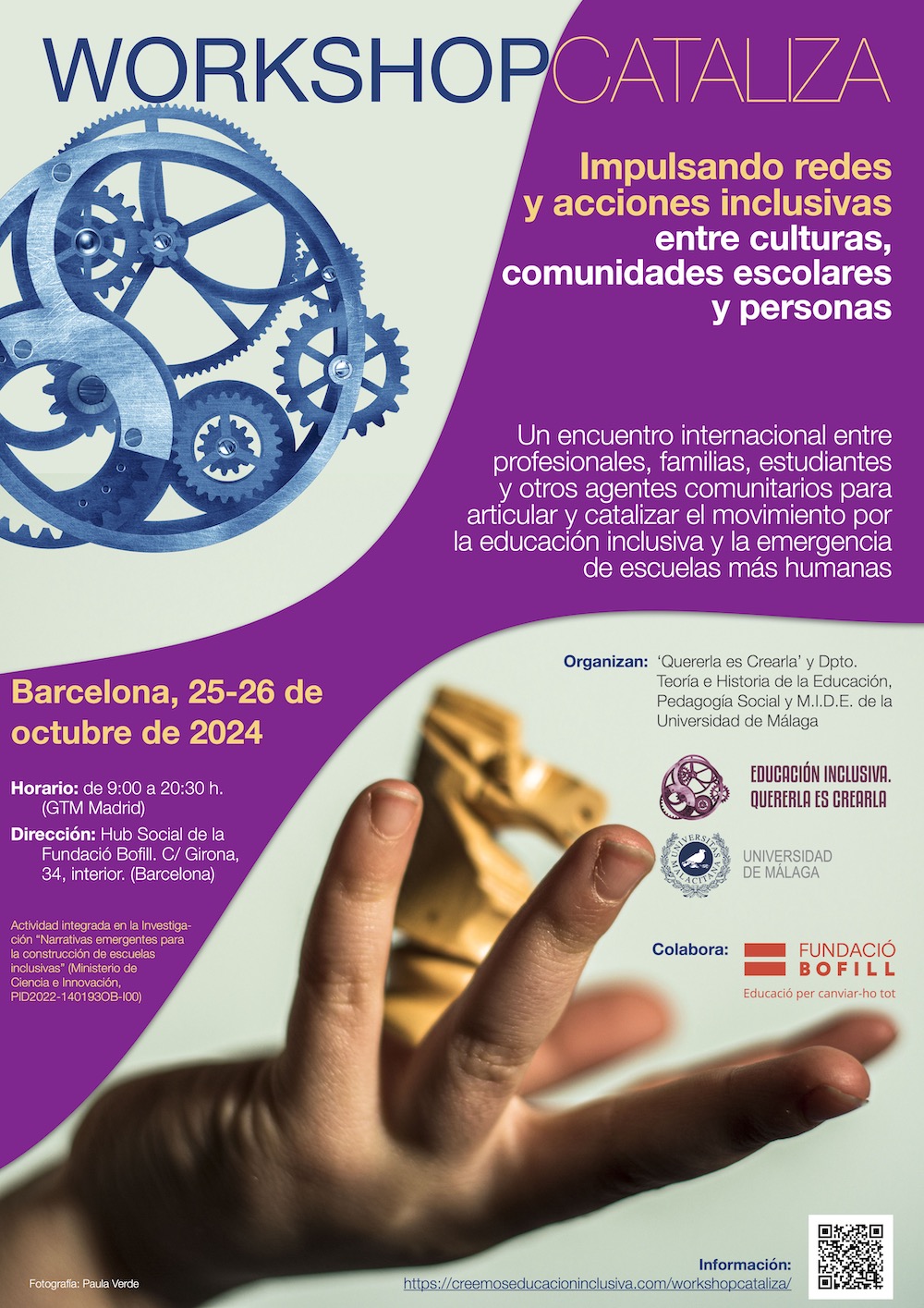
Ver esta publicación en InstagramUna publicación compartida de Quererla es crearla (@quererla_es_crearla)
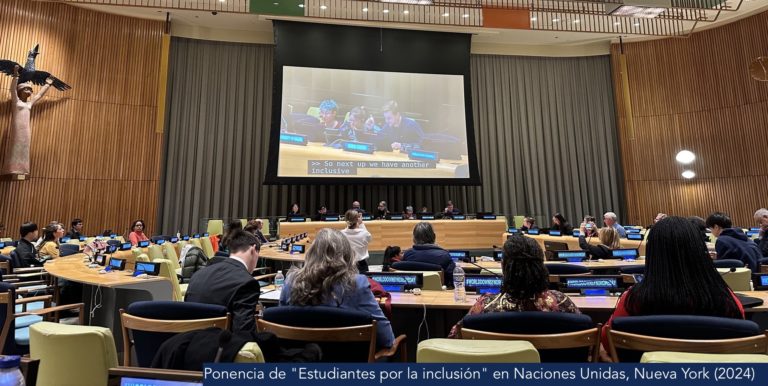
Indeed, that separation that she herself experienced firsthand during her school years and that she now narrates, is what drives her to try to change things. ‘I was in class, but it seemed like I wasn’t; that’s why I was the minus one. I don’t want any of them to feel like a minus one, just one more,’ explains the young activist.
Indira Martínez de llarduya: “Inclusive education is a very important right that should not have to be fought for”. (Noticias de Álava)
What we aimed for with the #WorkshopCataliza
Aware of the value of what we have been building, as well as the singularly important moment we are going through, this meeting had two main objectives: on the one hand, to accompany the International Network of Schools for Inclusion and Equity in its first steps to advance the transformation of their realities; on the other hand, to continue developing the social movement for inclusive education in Spain and Latin America.
The fundamental objectives are:
- To facilitate and accelerate the process of transforming educational policies, cultures, and practices in schools in Spain and Latin America, orienting them towards inclusion and equity through participatory methodologies.
- To constitute a space for the development of the International Network of Schools for Inclusion and Equity.
- To understand and learn about the educational conceptions, experiences, and professional practices involved in school inclusion processes.
- To learn from the knowledge of students, families, and professionals, encouraging all members of the educational community to share their school experiences and proposals for improvement.
- Identify, develop, and share the collaboration mechanisms used in different educational centers.
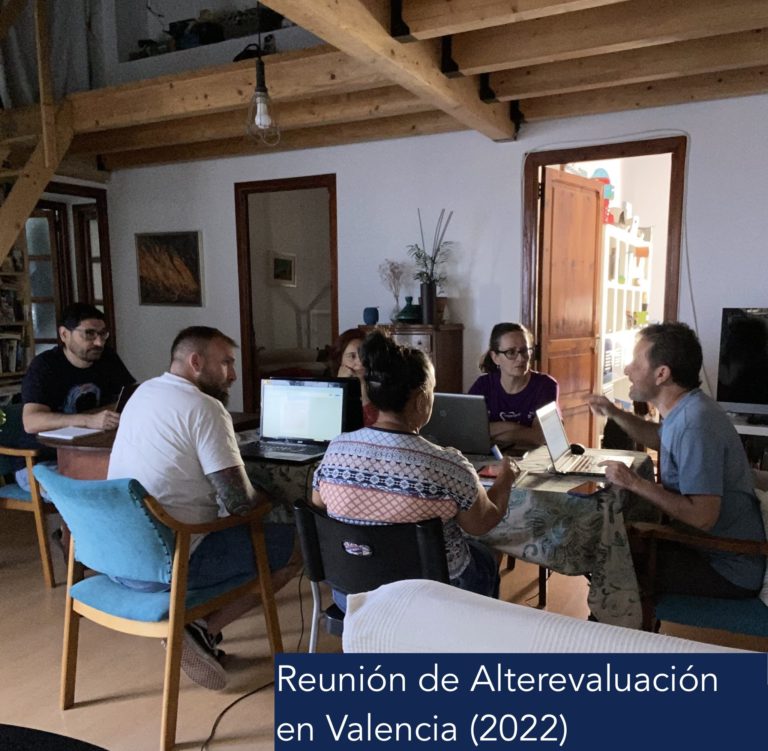
Transformation doesn’t happen through a single channel: teachers alone, nor the management team, nor the students, nor the families can achieve it. It must be the sum of everyone that transforms the school.
Guide “A Psychopedagogical Assessment for Inclusion”(Alterevaluación Collective
Collaborate
Organize
Where, when, and how the workshop took place
- Date:October 25 and 26, 2024
- Location:Bofill Foundation Social Hub. Carrer de Girona, 34, L’Eixample, Barcelona.
-
Registration (in-person and virtual) and online participation (from 9/5/24):
https://decidimoseducacioninclusiva.uma.es/conferences/workshopcataliza
We do not come from nowhere
Since the research that underpins ‘Quererla es Crearla’ began, we have been developing participatory events that have helped us to guide the work in a coordinated and collectively oriented manner: in 2018, it was in Malaga; in 2020, it was online; in 2022, we met in Madrid. This new meeting, which will be held in Barcelona in 2024, therefore, does not come from nowhere, but from the continuous, systematic, and ethically oriented work of many people.
Below we share two documents that can help us get oriented:
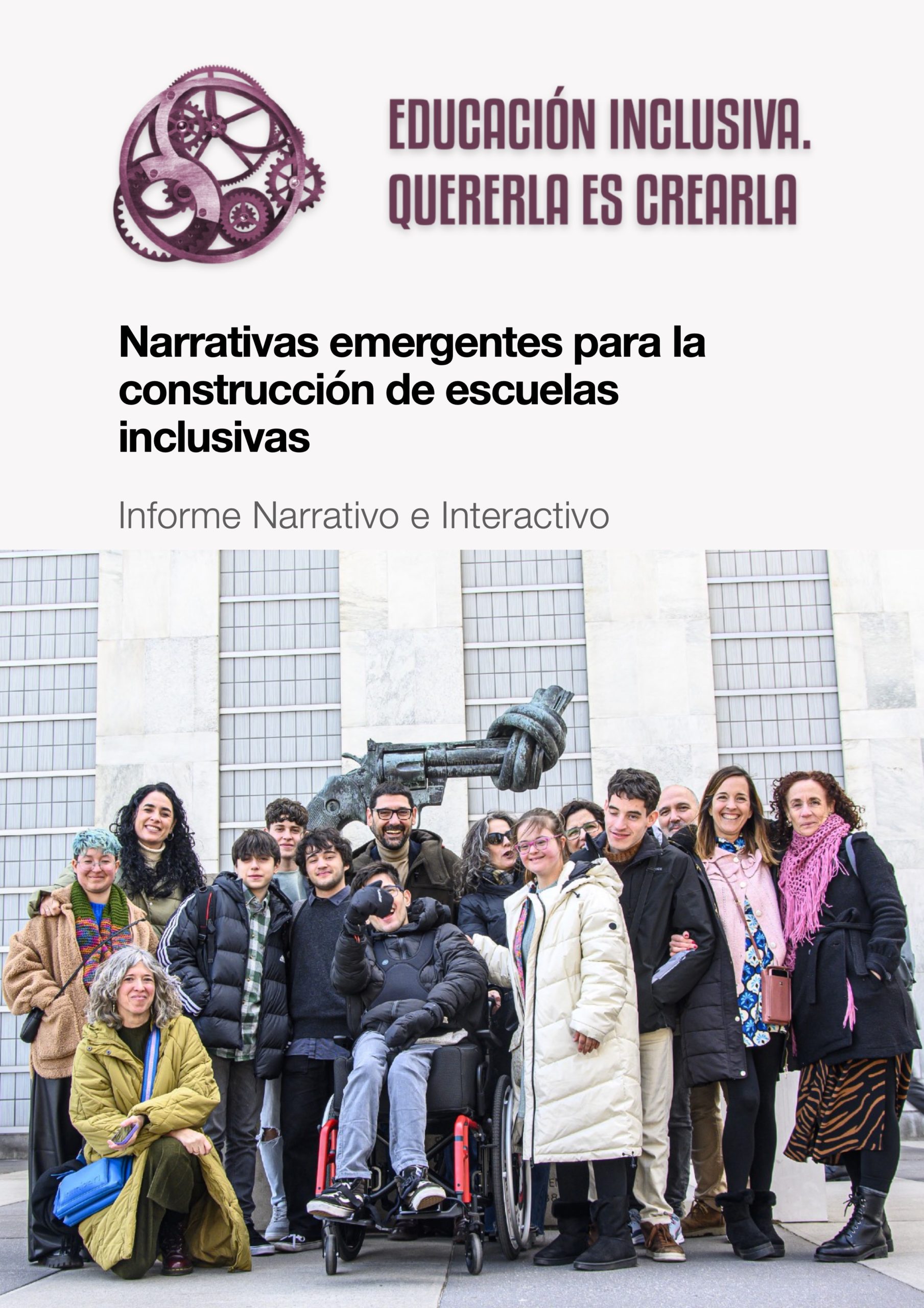
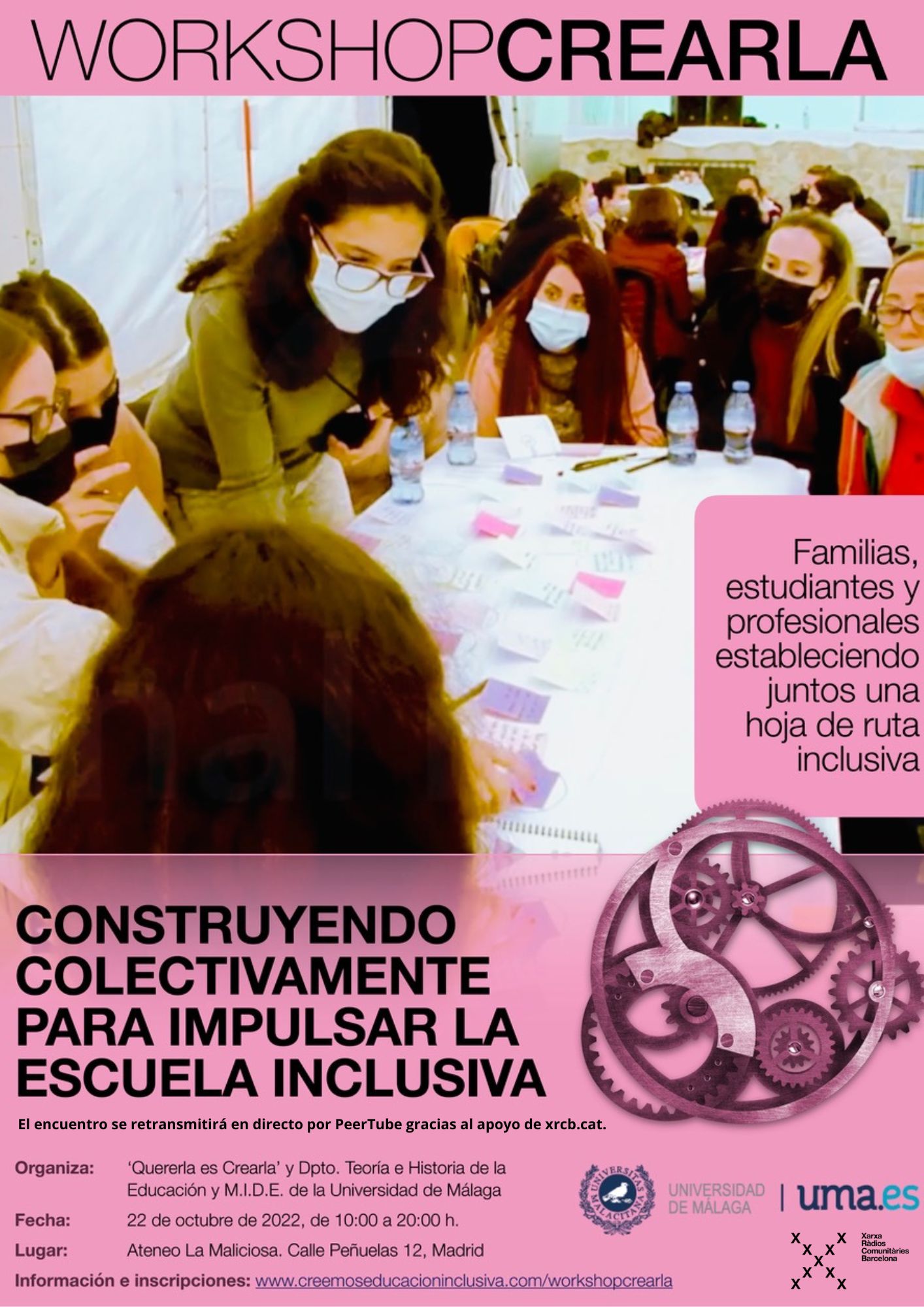
The education system has a mold, and we all have to pass through this mold. And that mold has some ideas behind it, which we have believed until now, and that is that we all learn the same thing, exactly the same thing, that we do it in the same way and in the same time. And that – here comes a spoiler – is impossible. It cannot be done.
If we start from the premise that no two people are the same, that we are all different, it is surreal to think that within a classroom we will all do the same thing, learn the same thing…
Patricia
(IB3 Interview)
Latin America Call
In the weeks leading up to the Workshop Cataliza, we opened a space for students, families, and professionals from Latin America to share, through short videos, real experiences lived in relation to school. Joys and sorrows with names and surnames, which are an essential part of the meeting.
- Access the video testimonials.
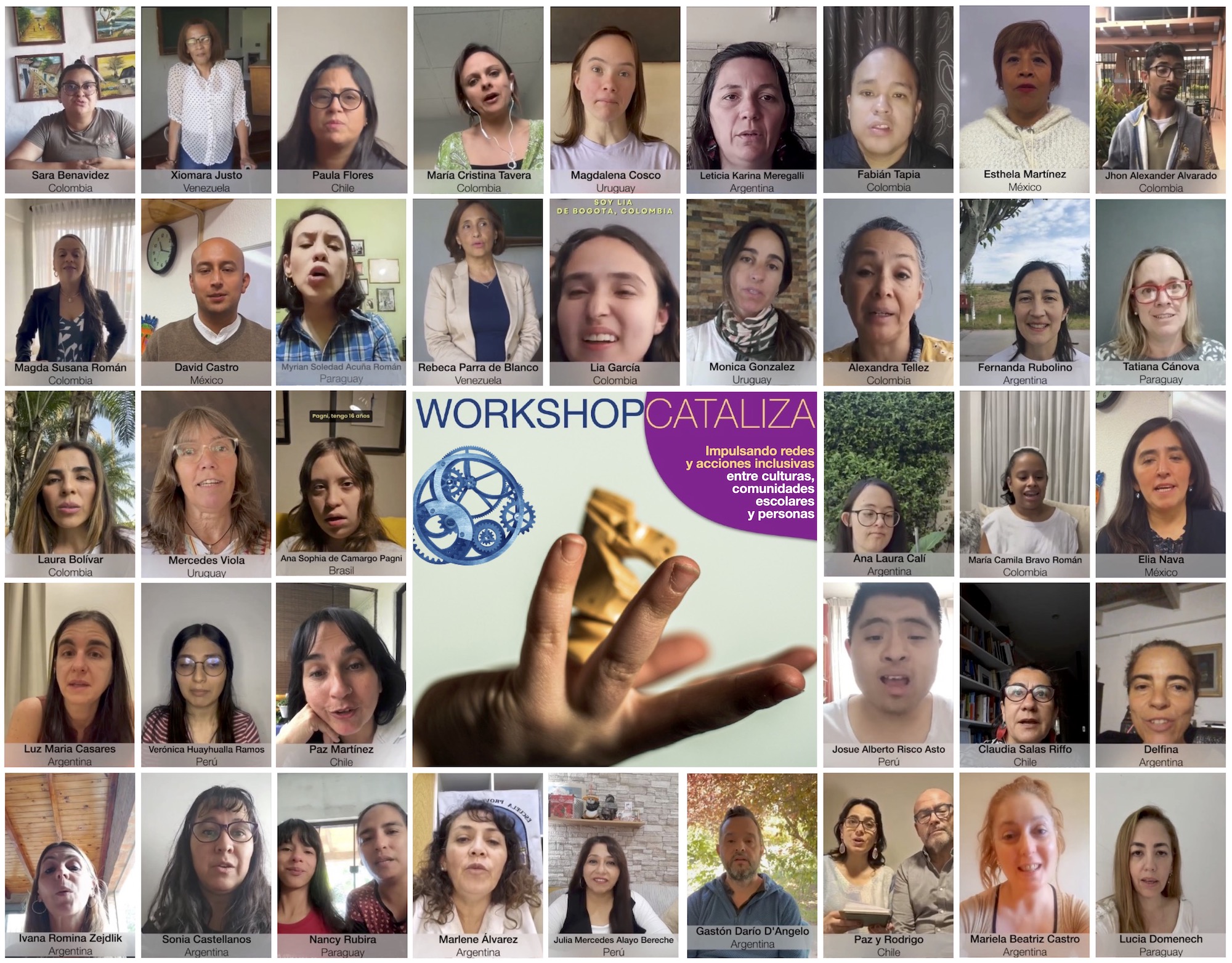
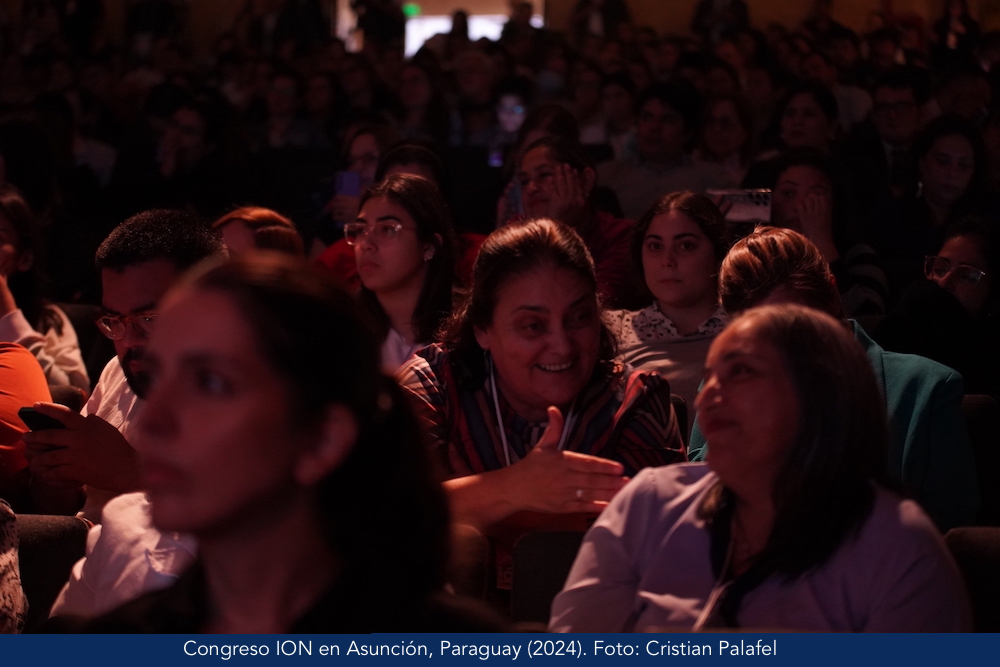
When we carried out participatory action research (PAR) in class, I felt very insecure and a little scared, as I didn’t know how everything would unfold and if it would really work. What I liked most is that this methodology involves everyone and all voices are heard equally, and that through it, great changes can be achieved and those solutions that benefit the entire community can be found. By putting it into practice at school, I was able to better understand the importance of being heard and of listening to others.
Rosa. Student of the Bachelor’s Degree in Early Childhood Education, after starting a youth participatory action research project in a school.
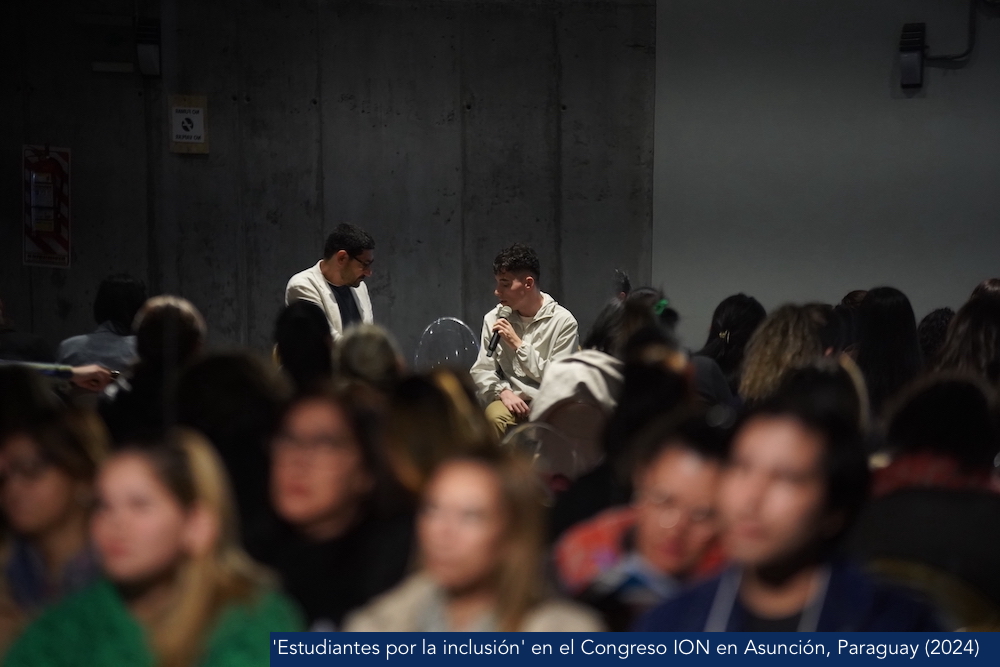
For so long, “minorities” of all kinds were excluded from any representation that now any inclusion seems forced
#AndNothingHappens