WorkshopOrient: New perspectives in school guidance, for childhood and against segregation
Summary: A working meeting that aims for egalitarian communication between two groups (school professionals and families with enrolled children), with the objective of carrying out a preliminary evaluation of the experience of guidance in schools in the Spanish state, which must be inclusive. To this end, an intensive day of assemblies, presentations, and workshops was convened for people involved in inclusive education, which will conclude with strategic lines for continuing to work towards the necessary transformation of schools.
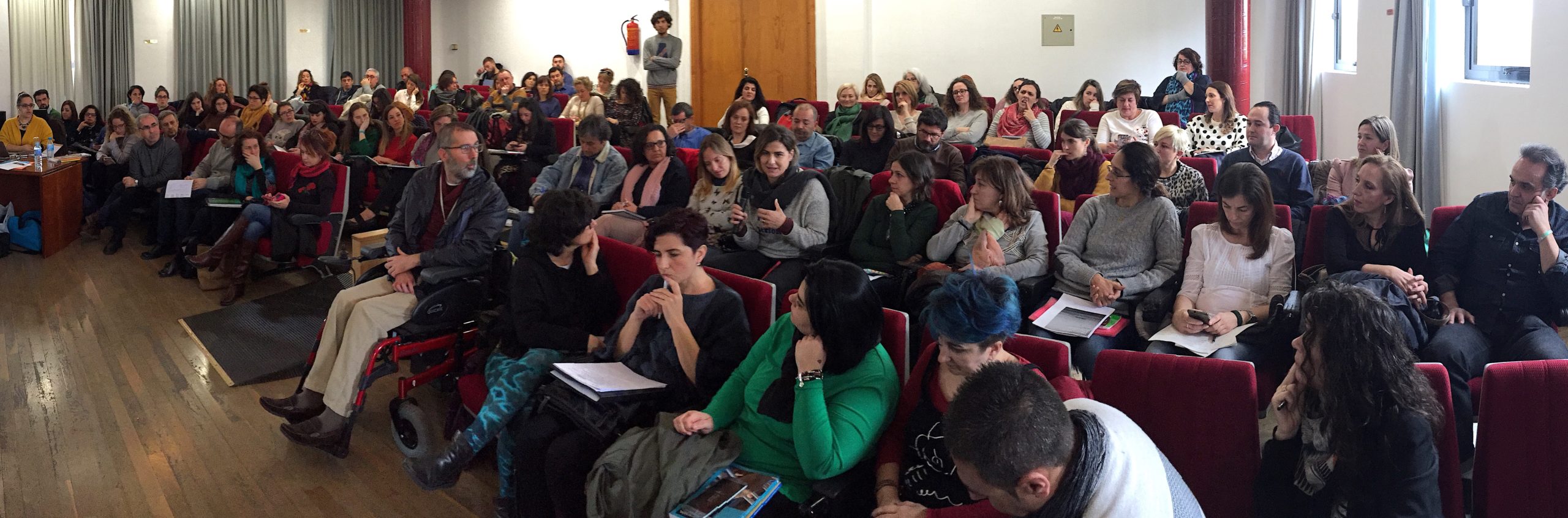
The WorkshopOrienta was a working meeting held at the University of Malaga on February 24, 2018, with the aim of establishing egalitarian communication between two groups (school professionals and families with enrolled children), and the objective of carrying out a preliminary evaluation of the experience of guidance in schools in the Spanish state, which must be inclusive. To this end, an intensive day of assemblies, presentations, and workshops was convened for people involved in inclusive education, which would conclude with strategic lines for continuing to work towards the necessary transformation of schools. In fact, this work has been the seed of many actions developed over the following years by different people and groups.
The Workshop was not a course or a conference. It was not conceived as an event where some attend as listeners and others present. The WorkshopOrienta was a collaborative working meeting, in which it was a face-to-face meeting, but there was also a fundamental role played by those who could not participate physically. The meeting would be divided into plenary sessions (assemblies) and group workshops in which the lines generated in the assemblies would be developed. The plenary sessions were broadcast live via streaming, so everyone who wished could follow what happened in them, except in the workshops. The meeting even became a trending topic on Twitter thanks to all this participation.
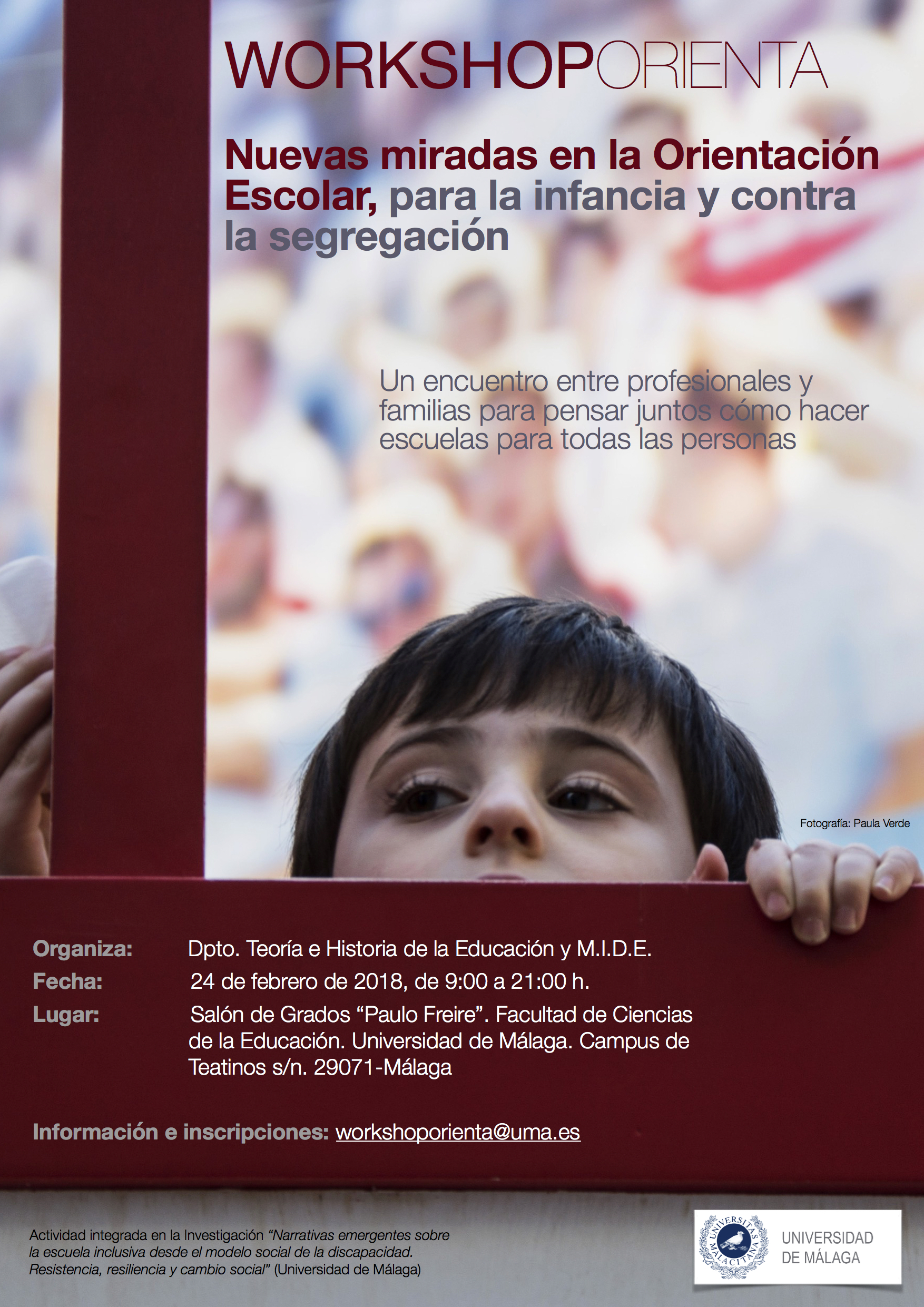
But there was something else. During the weeks leading up to the meeting, following an open call, videos of about 3 minutes were generated and published, in which the participants outlined their schooling experiences, and recounted a pain and a joy associated with it, describing the role played by Guidance. We wanted the pain and joy, which have names and surnames, to have a space in the meeting, because we need to know what students, families, and professionals experience in schools.
In this way, those not attending generated the context for the face-to-face meeting itself, and participated via Twitter in the work sessions. The sessions were extraordinary.
(Song plays Center , by Pedro Pastor)
Audio description [AD]: Opening credits. Dedicated to all those people who wish to change the world. For an inclusive school.
The camera focuses on the gaze of several young people, followed by a shot from inside a car on the highway, heading towards Malaga.
Voice 1 (v.o.):— People will come from many places: families, counselors, people who have things to say, who have lived and felt the consequences of school on their own skin.
Audiodescripción [AD]: Vista posterior de una persona de cabello largo y castaño que se dirige hacia la entrada de la Facultad de Ciencias de la Educación en la Universidad de Málaga. Al entrar, la cámara se detiene en el vestíbulo, donde hay algunas personas.
Voz 1 (v.o.):— Pero, ¿y qué puedo hacer yo allí?
Audiodescripción [AD]: La secuencia comienza en un aula o sala vacía de la universidad, con una mesa central y sillas para las personas asistentes. La sala se llena, rápidamente, de personas que asisten al workshop, muchas de ellas tomando asiento.
En primer plano, Nacho Calderón se prepara, organizando sus papeles en una mesa. A su lado, una persona adulta parece observarlo. La escena alterna con tomas de los asistentes interactuando entre sí.
A continuación, se muestra un primer plano de un juego de letras de colores sobre un fondo blanco. Las letras se van reordenando para formar las palabras ‘Juego', 'Emoción', 'Unidos', 'Constancia', 'Arte', 'Mirada', 'Ser', 'Personas' y 'Un mismo lenguaje'. Finalmente, las letras se juntan formando un corazón.
The sequence continues with a series of quick scenes illustrating the following keywords from the background song, visible on screen: 'Following you', 'Freedom', 'Power', 'Open the doors', 'Invite', 'The most animal humanity', 'Open mind', 'Skin ready', 'Wings set'.
Among the scenes:
- Close-up of markers on a table covered with white paper.
- Young people playing with balloons and words.
- Expressive close-ups of young people making faces.
- A girl with a pink balloon.
- The word 'together' formed by wooden letters of various colors.
- Shots of young people running, showing chalk, playing hopscotch, sharing hugs and smiles.
- A drawing made with marker of figures holding hands.
- A field of daisies.
- An adult with a young person on their back.
- View from below of a young person jumping down stairs.
- Close-up of a young woman resting her head on a dog.
- Young people sitting with balloons and snacks, painting or writing inclusion messages.
- The words 'all' formed by multi-colored wooden letters.
- The sky, clear with light clouds.
- Close-up of someone forming the phrase "Inclusive School" with paper letters.
The sequence ends with a fast rewind visual effect, showing all scenes in reverse, ending with the people giving their testimonies.
(Soft piano melody)
Person 1:—The school counselor called me to tell me that, of course, the ideal thing would be for him to repeat the following year because "these children"… A mythical phrase if ever there was one. I think I'll put it on my tombstone: "Here lies the mother of one of these children." (Sarcastic tone).
Person 2:—I always believed that a label, which is what they give our children, was meant to help them progress as much as possible, but now I've discovered that it's not true; the label is meant to stagnate and separate them.
Person 3:—I do not allow it, I do not allow it anymore, that their constancy, work, and effort are questioned and devalued.
Person 4:—I would beg the Guidance Services to let us be professionals in what we are, which is being parents to these children.
Person 5:—That is the difference: attitude. The means are important, but attitude is much more so.
Person 6:—What has happened for those children who saw no difference between themselves and their classmate with a disability, what has happened for them to ignore them and not feel they are part of their world?
(Soft piano music)
Audio description [AD]:—Testimonials from workshop attendees are interspersed with close-ups of young people facing the camera, to whom labels are being stuck, such as 'Incapable'.
Person 7:—Because my son didn't exist. He wasn't Nico. He was a label they needed to attach for an administrative process.
Person 8:—The constant complaint has always been: 'Your son is not capable of…'
Person 9:—Guidance, education, in general, are improvable. Each one from their own area.
Audio description [AD]: The camera pans through the empty corridors of the faculty.
Person 10 (Nacho Calderón - N.C.):— I believe that, this morning, one of the things that was discussed is that the AMPAs, for example, we have neglected them. And it's true: we have neglected them.
Person 11:— Inclusive Education, which is a right, I say this as a lawyer, as those of us who come from across the street [la Facultad de Derecho], is a right, but it is a right that is not being fulfilled. That is not being fulfilled.
Person 10 (N.C.):— It is already broadcasting live.
(Music)
Audio Description [AD]: Snippets of moments that occurred during the workshop.
Person 12:—We, and the Administration, the professionals, have the obligation to ensure that this right is fulfilled.
Person 13:—To change the perspective from seeing incapable people, people with labels, handicaps, difficulties… to simply seeing people.
Person 14:—The use of language would need to change.
Person 15:—I don't think so, sorry, because of my work in diagnosis on paper. I believe in daily work in the classroom, done well.
Person 16:—So, the only way to become strong is for us to unite and for the information to reach all parents.
Person 17:—What are you going to do starting Monday, counselors and teachers? That's what I want to hear here today. Because I'm no longer clear about what I have to do.
Audio description [AD]:Close-ups of young people facing the camera, with labels stuck to different parts of their faces with words like 'Clumsy', 'ADHD', 'Incapable', 'Blind'. Then, these labels are removed, torn, crumpled, or thrown to the ground with a smile (subjective appreciation).
On a white background, a series of colored labels with the texts 'No labeling', 'Inclusion', 'Power', 'Information for all', 'Strong AMPA', 'Capacities', 'New perspectives', 'Humanize', 'Unity', 'Justice', 'No prejudice', 'Invite', 'Rights', 'Cooperate'.
Again, fragments of moments that occurred during the workshop.
Voice 1 (v.o.):—I could give my opinion, I could learn, I could be there, help, show myself free to express my emotions… I have been able to do so many things. Being a teacher, a parent, a lawyer, a pedagogue, a person. Education is a place for everyone, and everyone can contribute.
('Centro', by Pablo Pastor)
Audio description [AD]:On a black screen, the text "The work begins…".
Below are fragments of moments and interventions from the workshop. Then, the same car that was shown at the beginning reappears.
Voice 1 (v.o.):— Now we have a path ahead to continue advancing. To keep building and achieving social change. Where school is for everyone and for all. Where all languages, perspectives, and hearts have a place. An inclusive school.
Audio description [AD]:Fragments of moments and interventions from the workshop. Below, screenshots of workshop mentions in various media, including blogs, Twitter, and Instagram.
Final credits. One language. Direction: Ignacio Calderón, Lucía María Parody, María Trujillo. Script: Esther Polo. Production: Miguel Moreno, Yolanda Ortega. Camera: Joaquín Barba, Eva Blancbois. Main theme: Pedro Pastor, Center . Music used. Beautiful background, Lightning Traveler, Royalty Free Music (Bensound), Creative Minds.
Participants: Silvia Abolafia, Silvia Aguilar, Andrea Alfaro, Ana Angulo, Juan Carlos Aquino, Sandra Arjona, Joaquín Barba, Rosario Barea, María Dolores Berenguer, Eva Blancbois, Jorge Bueno, Ignacio Calderón, Alejandro Calleja, Irene Carranza, Hermelinda Casaña, Marian Chasco, María José G. Corell, Sonia Díaz, Beatriz Domene, Esther Domínguez, Susana Fajardo, Diana Farzaneh, Ana Gallardo, Loida García, Macarena García, M. Francisca García, Miriam Valle Garcia, Olga Gave, Maite Gavilán, Cristóbal Gómez, Arasy González, Natividad González, Alicia Gracia, Rafaela Guardiola, Antonio Guerrero, Catalina Herrero, María Elena Jiménez, Belén Jurado, Inmaculada Laguna, Concepción Lis, Lucia Loma, María Luz López, María Victoria López, Marina López, Raúl R. López, María Victoria Lupiáñez, María Cristina Marcos, Antonio Alberto Márquez, Estela Martín, Isabel Martínez, Sonia Mateos, Carmen Mates, Mirela Maximet, Carmen Máximo, José Luis Melero, Karina Milici, Alba Milla, Mirian Miranda, María Teresa Mora, Carmen Morales, Carmen Moreno, María José Moreno, Miguel Moreno, Ascensión Muñoz, Inmaculada Concepción Orozco, Yolanda Ortega, Aleida Orviz, Lucía María Parody, Belén Pascual, Mariano Pastor, Fran Pereña, Águeda Pérez, Susana Pérez, Pedro Piña, Esther Polo, Almudena Prats, Noemí Preciado, Cristina Puyo, Virginia Ramos, María Teresa Rascón, Marta Recarte, Ana Robles, Cristina Robles, Juan Carlos Rodríguez, María José Romero, Rocío Rosas, Paloma Ruiz, Rocío Salcedo, Marta Sánchez, Pedro Sánchez, María Eva Santiago, Miguel Serrano, Ana María Solsona, María Trujillo, Francisco Claudio Urbano, Fernanda Valdés, Aleix Vicente, Juan Antonio Vicente, Manuel Villalobos, Isabel Yagüe, Ainhoa Yáñez, Carmen Zunilda.
That anger was an emotional and tense anger, but at the same time it was a calm and relaxed call for change, without intending to offend, without a violent spirit.
We were becoming aware as a collective with each story and each experience that was shared. At the same time, the idea was taking shape that our biological condition is not the problem, but rather the “excuse” to maintain a system that feeds on segregation.
Pain and joy have names and surnames
This set of testimonials was the initial driver for the workshop. It consists of a series of short videos that outline real stories, with lived emotions, and the role that School Guidance has played in them. This set of audiovisual resources shows that this pain and joy in schools have names and surnames. From these emotions, valuable reflections and actions are born.
[Para visualizar los videos, haz clic en las imágenes]
Hola, mi nombre es Paula y soy mamá de tres niños. Los tres acuden a un colegio ordinario y uno de ellos ocupa una plaza de necesidades específicas de apoyo educativo. El que la ocupa se llama Héctor y tiene un diagnóstico de trastorno del espectro autista. Tardó muchísimo en hablar, y, a día de hoy, todavía le cuesta mucho. Cada vez dice más palabras, pero le cuesta. Sin embargo, está en 2° de Primaria con sus apoyos.
Un apoyo fundamental para nosotros es la cuidadora. Es casi el engranaje fundamental para que Héctor esté en la escuela ordinaria. Pero a nivel académico, por ejemplo, Héctor difiere poco de sus compañeros: sabe leer, sabe sumar, sabe escribir, escribe sus propias historias… Entonces, yo soy consciente de todas las cosas positivas. Incluso Héctor acude, por fuera, a actividades de música, a ludoteca, y todos son capaces de ver las cualidades positivas, y a veces desde los equipos de orientación, yo lo que noto es que lo que intentan transmitirnos es todo lo que ellos no son capaces de hacer, más que lo que son capaces de hacer.
Y yo pienso que habría que potenciar o dar herramientas para superar todos esos hándicaps que tienen, más que contarnos lo que nosotros ya sabemos: que no puede hacer esto, que no puede hacer aquello… Y mucho menos ya, de decirnos: «No son capaces de…» Si él a estas alturas ha hecho todo lo que ha hecho es porque se puede hacer. Y porque tiene un mérito enorme. Entonces, ha contado con dos tutoras extraordinarias. Siempre estamos dependiendo de la calidad profesional que le toque, en cualquier centro y cualquier niño.
En nuestro caso, la suerte ha estado de nuestra parte y no sabemos cómo va a ser el futuro ni nuestro día a día. Lo que tengo muy claro es que no hay ningún centro que no sea ordinario en donde Héctor pueda aprender más de lo que está aprendiendo. Lo que sí que sería una pena sería que le quitasen la posibilidad de estar con lo que es hoy algo fundamental para nosotros, que es el grupo de referencia: esa clase que es un ejemplo de convivencia, que nos da lecciones todos los días, y que es un poco lo que a mí me da energía cada día.
Hello everyone. My name is Susana Ortigoso García and I am a clinical psychologist in a Mental Health Unit that depends on the Virgen de la Victoria University Hospital in Malaga. My relationship with Educational Guidance is determined by the number of children – increasingly more – who come to mental health teams with complaints or problems arising in the educational environment. Often, these are children who already come with a psychopedagogical assessment, where all the difficulties that child presents at a psychopedagogical level are measured.
The fundamental problem is that, I believe, in response to the era we are living in, where all issues are being focused on the brain, on organic matters, neurotransmitters, etc. People already come with the certainty of what is happening to them, and that certainty is expressed through diagnostic acronyms. Acronyms such as ADHD, ASD, Oppositional Defiant Disorder, etc. The fundamental concern arises because these are diagnoses that say nothing about what is happening to that child, they say nothing about their suffering. They do say a lot about how bothersome these children can be to adults, including parents, teachers, and fundamentally, adults.
These are diagnostic acronyms that do not take into account the influence of this era, the influence of adult crises, the difficulties that exist in the educational environment, in the system, and in the schools themselves. They are diagnostic labels that are applied based on symptom lists, and where differences end up being pathologized. It is true that in recent years I have been able to speak with guidance counselors; we are currently having periodic meetings, not as often as we would surely like, but with some educational guidance counselors. And yes, it is true that when we start talking about case by case, and about what is happening to that child, we can make sense of the difficulties they present, and other paths become possible.
And well, fundamentally, that's it. The idea of this meeting to be held at the University of Malaga seems fantastic to me; for years I have dreamed of a large-scale meeting between Mental Health and Education, and well, here is my small contribution.
Hi, I'm María Luisa, Ángel's mother. My son was born in the 80s and could only attend mainstream school during his early childhood years. Recently, I received a letter from an educational advisor, Macarena, whose reflection moved and comforted me, perhaps because I always dreamed of it and, above all, because it represents hope for other mothers.
This year I changed my educational role from Secondary to Primary school advisor. Even in February, I'm still in a state of 'reality shock' with many situations that have impressed me and continue to do so. From the moment children start at three years old, they do so with a rupture of attachment: from crying to a space based on absurd and inflexible rules. They are asked for things they are not prepared or mature for, and they are already entering a hostile environment that does not fit their needs and interests. They need to move, discover, investigate...
And that's how this space they call school begins to take shape, where children's needs are met less and less each day, people are dehumanized, and everything is commercialized. And so we continue, with practices based on inequality, marking differences as something negative, singling out children who don't fit the norm, and with a continuous demand to label children and get them out of class. Homogeneity continues to prevail.
And it goes on and on. With a commercialized Administration, focused on numbers and economics, not on providing adequate resources for each situation. And a rigid computer system, with pigeonholed assessments, closed categories, straitjacketed typologies, and schooling modalities that, out of the four available, three are segregating and exclusionary.
And I encounter closed-mindedness driven by fear. It's very difficult to leave comfort zones. And desperate families because their children receive a quality education. Guidance is understood as a diagnostic tool, and this requires an Administration that does not offer the necessary means and resources.
And in all this maelstrom, I can't stop asking myself: who am I to issue judgments and opinions? How can I foster more inclusive and human spaces and times? How can I modify belief systems to embrace the idea that anyone 'can'? And I find myself in continuous contradictions with what is expected of me, with what I should do, and with what I would really like to do. And so I navigate this sea of contradictions, searching for new islands on which to reinvent ourselves...
Hello, I'm María Luisa, Ángel's mother. My son was born in the 1980s, and his educational experience in mainstream school was limited to early childhood. I won't talk about the pain it caused me to accept that school didn't adapt to my son's needs. Instead, I want to share an anecdote that illustrates the naturalness with which children learn to live with differences.
My son would have been 5 years old and his friend 3; it was his birthday. He asked his mother how he should give Ángel his candy, whether wrapped or unwrapped. Considering that at that age children already have certain manipulative skills, his question must have surprised his mother. When she entered the classroom with her son and saw Ángel, she realized the situation. When she left, she told me, a little surprised, what had just happened. What happened was nothing more than one of the many miracles that occur daily in schools: children who learn to live together to be together, who get to know each other and want to, who help each other and act naturally, and when they have a need, they ask for help.
I think this is an opportunity we cannot miss, neither parents nor educators, to teach values that are only learned through practice. Because solidarity, empathy, understanding, even that tenderness that we often lose with childhood, are fundamental for people, for children, to build themselves as complete human beings.
And when a child is excluded from the classroom, not only is a tremendous injustice committed against them by depriving them of a fundamental right, but the rest of the children are also deprived of the possibility of enriching themselves with diversity and of building themselves completely. Because we are only complete beings when we relate to people. To all people. Thank you, and a hug.
Hi, how are you? I'm Iris, and I'm the mother of a 10-year-old boy with physical and intellectual functional diversity. His name is Manuel. He's here. We've always been committed to inclusive education, but right now Manuel is in a mainstream school but in special education classrooms. Therefore, he is pursuing Special Education, even though he is in a mainstream school environment.
The biggest difficulty I still perceive is having to choose between the effectiveness of my son's schooling, the teaching and learning that the school can offer Manuel, and choosing between his personal care, his respect as an individual. Why do we have to choose? We often have to choose, because it's presented to us, I ask myself this every day. I have this personal question. I don't try to project this responsibility onto others. I also question myself: why do I have to choose between the effectiveness of him learning things, of him being able to develop effectively, in terms of studies, results… and the part about respecting his way of being? The importance of the relationships he can build at school, the importance of being heard, of him being able to participate, or not, simply respect for being there…
How can we build something where both things are important? Because I believe they are important. Respect for his slowness, for seeing how he expresses himself, how he learns to communicate, how he builds himself as a being. But it's also important… time passes and he gets older, and he demands to learn things, and he demands… How can we reach that balance? How can we combine these two important needs to offer all the kids? How can we offer these two things, without having to, when we choose one, forget the other?
Lots of kisses to everyone! Bye
I am Noelia, Manu's mom, he is 9 years old and has Down syndrome. My experience with guidance... well, I've never had any positive experience. My first contact with a guidance team was when Manuel started school, just after turning three, and only a month later the school counselor called me to say that, of course, the ideal thing would be for him to repeat the following year because "these children" started at 4 years old. "These children," a mythical phrase if ever there was one. I think I'll put it on my tombstone: "Here lies the mother of one of these children." So, of course, since mine had started at 3, he needed to repeat three years, because it was better for him, to reinforce concepts... But of course, since it wasn't legal, the ideal would be for him to be enrolled in 4-year-old class, but he would go with the 3-year-old class. I told her no. That my son, if they deemed it appropriate for him to repeat, he could repeat, but since it wasn't legal, he would move to the 4-year-old class because I had decided he would start at 3 years old. Then she told me: Well, you do as you please. You decide, but be clear that when he turns 5, he will repeat. The age of 5 arrived, the guidance team changed, and the new guidance team deemed that he could move on to 1st grade.
In 3rd grade, we encountered a tutor who didn't... Well, for this we would need the runtime of "Gone with the Wind" to talk about the tutor in question. I spent more time in the counselor's office than at home. And every time I went, at the beginning of the school year, it was all good words, I was right about everything: indeed, that person was not suitable for my son, she treated him improperly, she treated him like just another piece of furniture in the classroom... My son was exhibiting disruptive behaviors that he had never shown before at five years old because this person was not treating him adequately nor integrating him properly into the classroom. From one day to the next, I don't know what happened, the guidance team told me: "Look, what we were discussing about it being this person... No, it's your son. Clearly, 'it's your son' because your son, when he arrives in the morning, hugs and greets that person."
Then, a point came when the situation was unsustainable. My son was being bullied by several classmates, making fun of him... "Of course, of course, of course, yes, yes, yes, you're right, you're right, you're right," but no one did anything. Therefore, I decided to change schools.
We are delighted right now. It's a shame we had to leave the school, but my son is a completely different person right now. All I have to say to the counselors, to all the people who hold a part of our children's lives in their hands, is please, do not label them. With that label, they are already judged, prejudged, a series of obstacles are placed in their way, which is not right! Because my son, for having Down syndrome, does not have to start school at 4 years old if I have decided he starts at 3. And because my son has Down syndrome, a person does not have to tell me (as I was told on one occasion): "If your son continues with his disruptive behaviors, we will have to consider moving him to Special or Combined Education." That is not right! Because there were classmates of his who behaved inappropriately towards him, but since they didn't have the label, it was never considered that they should leave mainstream schooling. That is all I ask as a mother.
Hello, my name is Mari Carmen. I'm from Ciudad Real and I'm a teacher. My participation in the congress is to share the experience I have as a mother of a boy. I'm going to start from the fact that our children are often labeled, and with that label, the achievements and limitations they have are justified. I see that the moment our children have a certain label, we justify that our children don't progress or achieve what other children can achieve or accomplish.
The pain I see as a mother is the lack of coordination and information that, from the schools and especially in Secondary education, is offered to families. It's a continuous struggle, and they don't give us clear and concise information so that we can participate and become involved.
And well, we're not going to end on a negative note. We're going to end with joy, and for me, that joy is my son. It's him, it's the fight that helps me to fight, to keep going, and it's not feeling alone. On this path, I see every day that we are not alone, and that's what I want to end with on a positive note.
Gloria:—
Hi, good morning. I'm Gloria Chacón and this is my young daughter Sara, who is 9 years old and goes to… What grade are you in?
Sara:—
4th grade.
Gloria:—
4th grade of primary school. My experience at the school is that… I mean, I read that it's better for her not to leave the classroom, that she should even go into the PT [Therapeutic Pedagogy support], inside, with support, but really, if the teacher doesn't want to, I… I can't do anything. It's very difficult. So I prefer her to leave, because if the teacher, the tutor, doesn't consider her a student, considers her something separate, who spends the day coloring and writing the same page a thousand times, then I really prefer her to leave for those two hours, because Sara is a girl, (addressing Sara) right?, who knows how to read, what else do you know? You know how to write, you do addition with carrying… (Sara shakes her head).
What I see is that when the teacher considers her a student, she is very happy and it motivates her to learn. Because, for example, the music teacher, she is learning the flute…
Sara:—
With Alicia.
Gloria:—
With Alicia. The English teacher prepares material for her and she is learning a lot of English… So she feels like any other student, and when they treat her as separate, she gets bored. And I don't like her spending the whole morning doing nothing. The school's guidance is also not really… She makes the schedule, and if you go to ask for something, I really feel like a bothersome mother, when I'm asking for things that should be addressed, but no, I don't feel attended to at all, nor does my daughter Sara, of course. (Sara makes the gesture of finishing) Am I done talking now? (Laughter)
Thank you very much, and hopefully, the generations being trained now will see all of this differently and know that when a teacher treats your child with dignity and considers them a student, you are eternally grateful. The child learns much more, is more motivated. But when a teacher sets them aside, it really causes a lot of suffering for the student and the family.
Thank you very much. Shall we say goodbye, Sara?
Sara:—
Goodbye.
Our story is still very short, as we are just starting out with the school year. My name is Carmen, my daughter is three years old and her name is Enma. She started school last September. The search for a school was very overwhelming. Enma, in daycare, had a spot as a child with special educational needs, and when she moved to school, it had to be in a school with a TEA classroom [Trastornos del Espectro Autista], because she needed it. Given these circumstances, our options for choosing a school near home were minimal. The schools that had a TEA classroom relatively close by had all their classrooms full, and it was a very distressing few months because I went to a lot of open days looking for a school, and there were no options. What we liked didn't have space, and... In the end, the possibility arose to enroll Enma in a school near home that was opening a TEA classroom for the first time this year. So, it was a school that had no training of any kind, neither the teaching staff nor the professionals... Everything is very much on the fly.
My daughter has evolved well; she's going through a bit of a rough patch right now, but it's true that it's a bit distressing to rely on professionals and see that... Well, that the school isn't just the TEA classroom; the school is much more. The school is the teacher in the reference classroom, who needs to be trained in autism, obviously, and she wasn't. The cafeteria staff... It's a bit of everything. And raising awareness, the awareness-raising efforts for families... Because it hasn't been easy either.
And well... My daughter started... My daughter doesn't speak; she's preverbal for now, but she's starting to say a few words now. Honestly, as a mother, it's very hard to trust that she's okay for the seven hours she spends at school and that she's understood. And it's a lot of work when, from the beginning, there's so much instability, everything is so new, and no one knows where things are heading. No matter how much they tell you they have it under control, that the TEA classrooms are very well managed, and that the professionals there are running things well... The truth is, it's very complicated.
I don't know what the future holds for us. I already hear other mothers talking about other options, but it's true that in our case, the first step was very difficult, very complicated, and now Enma will be in Early Childhood Education, and I don't even want to think about the transition to Primary School yet. For now, we're content with how things are and we'll see how they go. Thank you.
Hello, I am Rosa María Conca Pérez, from Ontinyent, from the Vall d’Albaida region, in Valencia. Well, I want to thank you for this Education workshop, which I find very important. I wanted to comment on the topic of non-compulsory education. Currently, I am pursuing a Higher Vocational Training Cycle in Promotion of Gender Equality here in my city and… Well, I need generalized support. I need help in my daily life, to go to the restroom, etc. I use an electric wheelchair to get around and, when I started the cycle, I explained my situation, that I needed support to go to the restroom.
The head of studies and the administration told me they would look into it, that they thought there was some help… But, well, they didn't tell me anything else the first year. The second year, when I enrolled, I told the director that we should write something because, you see, a year had passed and nothing. I even drafted the letter myself, and I don't know if she sent it as is or what, but anyway. The response when I asked her, because she hadn't told me anything, was that they had been told that, since it was non-compulsory education, how could I possibly ask that? And that was it. I have been studying and I am completing the cycle, this last year, thanks to my classmates, who help me every day to go to the restroom, and thanks to the teachers, because they have been a great help. They have given me their full support, they have been there with me, conveying my situation in evaluations and meetings. They gave me leeway if I was tired, etc.
And well, I want to emphasize that there is very conscious teaching staff with a lot of willingness, who do want to change things. But, well, the situation of non-compulsory education for people with functional diversity and with the need for generalized support is very bad. It's no wonder that education is so low in the functional diversity sector. Because we don't have any support or any help. If compulsory education is already bad, then the support for everything else is practically nil.
And that's it. To all the teachers, male and female, and professors, male and female, who are out there, guidance counselors, all the education collective who are out there, keep fighting for inclusion, let's coordinate more, let's organize more, and this needs to be made much more visible and be a very united force so that this ends and it becomes real inclusion. A hug to all.
I am Isabel, Lorea's mother. Lorea is 12 years old and at four and a half months she had encephalitis. Her clearest diagnosis is a very small cerebral palsy that affects her most at school, in her access to knowledge, since she has a blind quadrant on the right side, and access to knowledge through reading is very difficult for her. In addition, she has a visual-manual disconnection and her school experience was fabulous until academics and concepts began to carry a lot of weight.
She is an open and communicative girl, and was very well received by her classmates. When academics began to gain importance, at five years old she repeated a grade. And I, always supported by external stimulation where they told me she was a girl who could do it, and that at school they often confused things, and sometimes when they don't know very well what to do, they immediately tell you she can't. All the time I insisted that she could, until this moment, when I am considering that she repeat 6th grade, because what they offer me for Secondary school is a global ACI.
I do not accept a global ACI, since I, who know her closely, know that she can. It is true that, perhaps, she will not complete Secondary school in four years, but she can do it in more time and it deeply angers me that from the beginning they tell her: 'I am not going to grade you, I am not going to demand anything from you, I am not even going to evaluate you, and what you do, despite your effort and that I admit you learn, will not be useful to me.' And so I am willing to go to war next year, since this year what leaves me most at ease is that she repeats 6th grade and… we'll see after that. Thank you!
Hello, my name is Elia Sevilla. I am an Early Childhood Education teacher and psychopedagogue, and I have worked in Spain and Argentina. In Argentina as an inclusive education teacher and in Spain as a PT and psychopedagogue privately, guiding children with learning difficulties and special educational needs.
I wanted to share my experience in schools, highlighting above all the importance of the teacher, the tutor, the reference teacher, or the specialists in working with children. The most important thing, and when they felt best, was when they were included in activities, when activities were carried out in which they could participate and the way to do it was sought. There were really teachers who achieved this very well, whatever the child's difficulty. And others where he was your student and they didn't take care of him, and you had to teach the class for him. It could be in the classroom or outside, but it was really you who designed everything and without collaborating with the reference teacher.
In this regard, I believe it is important for teachers to feel that all students are equal and for the specialist to be seen as a support or help from a colleague with whom to share the work within the classroom. A good guidance experience has been when, as an external counselor, I have been able to reach many schools and institutes where I have spoken with very involved counselors who were looking to do many things for the children I was working with privately. And when I wanted to get in touch with the school, because I like to work in a coordinated way with the school, with the family, with the child... I have been able to access many schools very easily, and others not so much.
And very approachable and involved counselors, who sought many strategies within their centers, and other counselors whom I could not even access, because the intervention of external professionals was not contemplated. The intervention, the coordination with an external professional who was attending a student from their center. I also wanted to mention that I am now at the UNICAP Foundation and we are working to create a school that includes all children and makes that dream a reality.
Thank you.
Hello, I'm Ramón, Eudald's father. Eudald is 6 years old. I'm going to tell you a bit about our story. Our first contact with School Guidance was at the Early Intervention Center. When Eudald was three, before he started school, they told us that the best thing for him would be to repeat nursery and wait a year for a newly built Special Education school that was being constructed in Reus. We refused, and finally, we enrolled him in a single-stream school here in Reus. We liked the school. Besides, one of its mottos is 'inclusive school.' It convinced us, and we started.
In P3 (3-year-old preschool), things were great. His teacher was very involved and encouraged us to take off his diaper, and it worked. Potty training was successful within two months, and we were very happy. But in P4 (4-year-old preschool), the problems started a bit because they began separating him for certain hours. They said that since they only had two Special Education teachers at the center, they couldn't cover the needs of all students with special educational needs. So, they were separating them in a classroom, apart from the mainstream classroom, to cover their needs. We thought that was terrible. We are still in every meeting, verifying that he receives resources in the mainstream classroom, with his classmates, with his reference teacher, and as we believe it should be.
And well, they always tell us it's a matter of resources, that there aren't enough resources... And we think that resources are very important, but also... Well, the center's attitude should include a structural plan that favors inclusion, and if all teachers worked as a team, supporting each other, many of the students' needs would surely be met. And then, of course, if resources are needed, we are the first to fight with them to seek those resources from the administration. But the attitude and a structural plan to promote Inclusive Education are vital, we believe.
And well, that's it. This is our experience. We would have liked to be there with you, but it wasn't possible. Too much distance, not enough time... But anyway, a hug to everyone, and thank you for all that you do.
Hello, my name is Isabel. I am Mar's mother, and she is now 18 years old. On January 6, 2017, Mar told me she was leaving school, that she didn't want to continue. I asked her: Why? Because the truth is, I saw she was very determined, and she said they wouldn't miss her, and she wouldn't miss them either, referring to both classmates and teachers, as well as the educational community.
Even so, we waited a few days to confirm that her decision was firm, and well, it was. To this day, she still hasn't changed her mind. So we had to fill out a form to withdraw her and explain the reasons. The reasons we explained are that... Attributing her demotivation and desire to quit to the school environment, we were ending many years of struggle at school. Because we can't call it anything other than a struggle. When we left there, we went to celebrate, in fact.
And the truth is, since she left school, Mar is much happier. Even so, we are clear that the time she spent in school, simply by being there, she learned many things. Therefore, I want to thank all of you who are here and have been here, in the fight so that one day the rights to education will truly be rights.
Thank you all very much for this initiative.
Hello, my name is Lina and I'm speaking from Alicante. Aritz is four and a half years old and has Down syndrome. Our experience, in terms of guidance, has been negative in all cases, even encountering traumatic and very difficult situations. The first was the assessment where they make the report. Aritz had just come from a very tough medical test that leaves you very dazed, and so we informed them. Apart from that, well, the report came out. They call us to sign it if we agree or not and explain everything. They tell us he barely passes, as if they were doing us a favor, and we ask if we can't have him start in the three-year-old classroom at age four, and they tell us no. We tell them that there are people in Valencia, Madrid, and other places who have done it, and they tell us no. Why? Because no. That's it. And that's the end of it.
The second is at the school where we are because the teacher can't handle Aritz. Aritz, everyone gets along with him, he's a super sociable guy, and she complains every day that he doesn't pay attention to her. So, the resources are supposed to be yours, you have the experience... It's your problem now. They set up a trap for us where they all decide that... two and a half months after starting, he has to go to a special classroom. We have to face this situation by saying that... Well, that we don't agree. With a lot of calm, a lot of tranquility, and that we know the reasons why they want to do it, which are logistical and economic. They have interests they think we don't know about, but we do. We have to go with the association, the student ombudsman... Well, the next step was to go to the press.
And well, then managing everything from the registry, leaving a record... Seeing how we reacted, they were very surprised. And well, Aritz got sick that whole year, he felt the stress... He didn't feel accepted. His classmates were great, but the teacher and the school weren't good. It's explained too briefly and it's not enough time, but I wish they could go through just one month of what our children go through... Some are miraculously alive. I won't allow it. I won't allow it anymore, that their constancy, their work, their effort is questioned and devalued. No. Because I believe that, then, we should value all the children who enter school. All of them. Many would have to go to a special classroom.
So, the next thing we fear, and that we are very scared about, and that we are a bit like this... For next year, when the assessment that leads to Primary school happens. And we see it. We see how they are framing it to send him to a special classroom. Even, well... Now I don't know. We don't know how we'll do it... We'll see. Let's see what happens.
Hello, I'm Blanca, from Zaragoza. I have three children. The eldest, Pedro, is 12 years old, and for about 11 years now, Pedro has become a piece of paper. For the educational institution, it's an Autism Spectrum Disorder. For Psychiatry, he's diagnosed with a complex mixed disorder for which we still haven't found a name. The day Pedro became a piece of paper changed our lives. Not before.
At 5 years old, I signed a paper agreeing for him to repeat a grade to avoid Special Education, because I thought that's what was best for him. We avoided it, he's in a mainstream school, he passed through the grades, but when he reached fourth grade of Primary, at the beginning of the school year, they told me Pedro would have to repeat the grade. I've spent many years looking for a series of simple supports, making myself available, offering a lot of solutions that are never accepted by the Guidance Service because I'm not a specialist. Putting a lined notebook instead of a squared one, or a tablet that isn't used in class because it might cause envy among classmates, doesn't seem like difficult things to achieve.
What is very difficult to achieve is that Pedro, the day we told him he had to repeat the grade, said that his heart had darkened and that the light would never shine again. I would love to say that my son is a happy child today, but he isn't. Repeating the grade meant a total change and a rupture with his classmates, with his routines, with what he knew. Finally, those small supports are starting to arrive, from the tutors, not from the Guidance Service.
I would beg the Guidance Services to let us be professionals in what we are, which is being parents to these children. I don't doubt the work of a Guidance Service, but I don't want the Guidance Service to doubt my role as a mother, nor to prevent me from exercising it. I truly hope that this opportunity will lead us all to a common ground and that there will be no more children who say that today, their life is just a problem, with more problems than others, or who believe they are a problem for everyone else.
Thank you very much.
When Antón was in Early Childhood Education, his mobility was very limited and he couldn't go up and down stairs. So, he had to use the elevator at certain times when he had to go outside the classroom. His Early Childhood teacher, moreover, who is the person from whom I have learned everything about education, wanted to avoid a very common, widespread, and completely normalized image in our schools: seeing the majority of the class, on one side, with the teacher, and the student or students with disabilities on the other, with the educational technical assistant, with the caregiver. And she wanted to make everyone aware that no child in her class should think that she was the teacher for all the children except Antón, or that Antón had other adults responsible for him.
To achieve this, she always made sure that whenever Antón had no other choice but to go somewhere different from the majority, he was always accompanied by other children. The elevator was one of those places. And since it also became a privilege and Daniela's class was the most democratic place on Earth, everything is regulated by rules. Without rules that make us all equal and that we all follow equally, social justice does not exist. Since accompanying Antón to the elevator became a privilege and not an obligation, and everyone wanted to accompany him every day, shifts were established. One day, they got confused: normally 4 classmates went with him, and that day 5 appeared at the elevator door.
She told them: "Only 4 of you can go and there are 5 of you. I'll leave you here for a while to discuss, to think about it, and to decide who has to stay out and go by the stairs." So, well, she left them talking and, after a while, she went to see what the verdict had been. And the spokesperson for the group told her: "We've already talked about it and we've decided that the one who can't go in the elevator is Antón because he goes every day." When she told me, I felt like crying. She said that, moreover, Antón, cool as you please, standing there, with a face like: "Well, they're right." This elevator anecdote is wonderful and tells us so much.
What I wonder is: What has happened in these 6 or 7 years, not only in our schools: in our schools, in our homes, in our parks, in our streets? What has happened for those children who saw no difference between themselves and their classmate with a disability, what has happened for them to ignore him 7 years later and not feel that he is part of their world? I am quite sure that children are born without prejudice, and my question is: What could we do to not change that lack of prejudice with which all children are born, and for the children from the elevator story not to change over time?
Hello, my name is María Luisa and I am a teacher, in addition to pursuing my degree in pedagogy. My experience with school counseling is bittersweet. In my case, when difficulties began to arise in high school, the school counseling department encouraged me to drop out of high school because, perhaps, it was too difficult for me or I simply wasn't cut out for studying. Currently, I have a Vocational Training Certificate… I completed high school, I am a social integration specialist, and I am pursuing my degree in pedagogy. Her, that she wasn't good enough. However, in my brother's case, they took care to identify the needs that were arising and provide an effective response that, along with his great effort, is enabling him to be on the verge of finishing high school.
The main problem I see, and the big difference between one case and the other, is that many professionals think they are more effective if they leave problems at the door, when what truly makes a professional is their human quality. As a future pedagogue, who will possibly work in the field of School Counseling, I believe it is necessary, from now on, to remove old, outdated paradigms, techniques, and methodologies from our training that only serve to point fingers, label, create handicaps, and discriminate.
In counseling work and in any work related to the socio-educational field, it is necessary to completely remove our expectations of the person in front of us, with whom we are dealing. When carrying out this work, we must see that in front of us is a person with a capital 'P', a person who has needs to be met, and not do what is often done, which is to take the easy way out… Let's not take the easy way out, which is to only see a label that we have to classify and with which we can establish categories.
We enrolled Silvia at 3 years old and she was at this school until she was 5, meaning three academic years. In the first and second year, things went quite well at that school because she was well integrated with her classmates and we didn't have any problems. But in the 5-year-old class, we got a teacher who saw her as a problem. So, we realized that staying there, in that class, was ultimately a waste of time, and we discovered that the management team of that school, which until then we thought was committed to inclusion, wasn't as inclusive as we believed. In fact, they told us that Silvia should be in Special Education and couldn't be in Inclusion.
So, we decided to change her school. To do this, we requested a report from the guidance counselor, the Guidance Team, to allow for a grade deferral at the next school, so the child could remain in the 5-year-old class. We had a lot of trouble with that report because the counselor wasn't doing their job. I remember we signed our decision to change schools in January. Well, from January until the three months they had to prepare the report, nothing but delays, nothing but evasiveness... They also told me yes, they agreed to prepare the report for staying in one place, and then suddenly they went back on their word, saying no, that Silvia had to stay at that center.
Against our will, because we were absolutely clear that we wanted to change her, and everything was a problem. I had to go talk to educational inspection, to the head of the EOE, to put a little pressure on them and tell them to do their job, because it depended on them whether we could get a place at the new school or not. Because otherwise, we would be left without a place. We went through two months of extreme stress, because we saw that Silvia was going to be left without a new school, and the option of staying at the previous school wasn't viable, because we were absolutely clear that she couldn't be there. The professionals weren't committed to including her, at least not in the 5-year-old class.
Our experience at the new school is very good because from the very first moment they welcomed Silvia with open arms. It's a school with an inclusive ethos, unlike the other one. And because of that, they believe Silvia brings a lot to the class, in addition to benefiting from being with children without difficulties, she also contributes a lot to the class. In fact, they've told us this since the first day: that they were very happy to have her. That they were committed to her and would do everything possible to support her in whatever she needs, which is what it's all about. Because Silvia has the right to an education like any other child.
Hello everyone. My name is Sandra and I am the mother of three children. One of them has cerebral palsy. His name is Jorge and he is currently in 6th grade of Primary Education. He repeated 4th grade, which means he has been at the same school for 10 years, the same school his siblings attended and where all his friends are. His time in Early Childhood Education was wonderful. He had an exceptional teacher, and the welcome he received from the other children was also extraordinary.
The difficulties began when he moved to Primary Education and Jorge had to start meeting the same objectives as the other children. And that's when they started telling us that we had to accept that Jorge had a disability. That we should accept it. And that we shouldn't expect him to meet the same objectives as the other children. Regarding the Guidance Department, their contact with us was very limited. In these 10 years, 4 different guidance counselors have come and gone, and only one of them truly wanted to get to know Jorge in depth and receive all the information from the external professionals who were attending him. She gathered them at the school and tried to coordinate the work with all of them. The other two guidance counselors who came later, well... they never came to a meeting. I'm lying, they came to a tutoring meeting, and the current guidance counselor only called me by phone to tell me that the subsidy call had been released.
It has been a difficult period. Especially for us, as we did not want Jorge to be aware of the differences we had with his teachers. We haven't changed Jorge's school, as many people encouraged us to do, because it's not right to uproot him from his social environment. The work was ours. Trying to coordinate with his teachers, trying to ensure Jorge continued to progress... And all of this boils down to Jorge having had a different tutor almost every year. The last one to walk through the door. He has had the same tutor for two years, and last year, in the second term, his tutor told us that they believed Jorge had reached his limit, his ceiling. That from that point downwards, Jorge moved very well, obviously, but he wasn't capable of surpassing it. So I asked him if Jorge really wasn't capable of surpassing it, or if they weren't capable of helping him to surpass it. He was a bit taken aback and admitted that, despite being close to retirement, he was willing to receive help from external professionals who worked with Jorge.
Those were very kind words that remained just kind words. A big hug to everyone.
Good morning. I am Maricarmen, Clara's mother, she is 16 years old. I am going to try to summarize all our joys and also our pains, from Early Childhood Education up to the 2nd year of ESO, which is what she is currently studying. My first pain was when an educational advisor at the early childhood center said she preferred a child in a wheelchair but intelligent. I replied that I preferred my daughter to be happy. Except for this, the entire early childhood stage was very good, we enjoyed it a lot, both in terms of the child's experiences and mine as a mother, and with very good collaboration from the management and guidance team and teachers, we were happy.
But in the 1st year of Primary school, things took a turn, and it became a daily pain to hear the teacher say: "I have 24 children and Clara." Every day, I spoke with the educational advisor, already desperate. She told me that she only made recommendations and that if the teacher did not want to implement them, she could do nothing. So, I couldn't take it anymore, and we transferred to another center, recommended by the Inspectorate, and had another three very happy years. But everything changed again when the management and guidance team had to leave the center; the guidance team due to legal reasons, and the management team due to changes in voting.
And well, for two years, the girl was not evaluated, and in the 6th year of Primary school, the educational advisor, who knows nothing about her, calls me, and the teachers, who also don't know her because they are new that year, and they tell me there is a change of schooling, that they recommend me to Special Education. To which I refuse and say no; of course not. The fight begins, talking to doctors, talking to centers, and there is another change, and I get a very good center where the professional team is wonderful, and the educational advisor assesses Clara properly and sees that she can study ESO, Secondary education, which is what we are currently doing.
Well, we continue to remove pebbles from our path, because there are many, we are going to build a castle with them. And fighting, and nothing, always moving forward. I will leave you with just one reflection: I always believed that a label, which is what they put on our children, was to help them advance as much as possible, but now I have discovered that it is not. That the label is to make them stagnate and set them aside. That is my experience. If there is no daily and continuous struggle on the part of parents, our children are condemned to end up in Special Education. And it is a very great pain.
Thank you very much to this project and to these conferences.
Hello, I'm Rocío Sotillos, mother of Mateo, who just turned 12, and Carolina, who is 10. I wanted to share a bit of our experience because it's really the opposite of most experiences we hear about. And we feel fortunate for it, but it's a shame to think that it depends on luck whether your child receives better or worse attention in a school.
Mateo started with a school placement ruling for a CYL classroom, which are the specific classrooms in mainstream schools, and at that time, well, the inspector said it was lucky that he got a spot because there were few and high demand, and that all his needs would be met there. And they sent him to a school with a newly created classroom, and in which... Well, I don't think they knew how to organize themselves very well yet. But in early childhood education, he barely set foot in his mainstream classroom. The first year, he only went down to it for an hour a week during the last two months of the school year. Until then, no. Of course, on field trips, etc., he didn't participate with the reference classroom.
Since we didn't like that school placement idea for our son, we looked for another center, other options, and we changed schools. In this case, it's a subsidized mainstream school, a teaching cooperative, and the change happened in the 1st grade of Primary. And the difference, so you can get an idea, is that a week after the school year started, the PT (physical therapist) came to talk to me. She, of course, didn't know Mateo yet, nor the tutor... because they hadn't had the material time, to tell me that the school had two camping trips a year: one at the beginning of the school year and another at the end, and that the camping trip would be in three weeks. And I, obviously, expected her to say: 'Maybe it's not advisable for Mateo to come, because we don't know him or...'. Well, anyway, what you normally expect, which unfortunately is what they've accustomed you to. And she came and told me: 'We have the camping trip, and of course, Mateo is coming.' And she didn't ask me, she stated it. Taking for granted that Mateo was going, just like all his other classmates.
That's the difference: the attitude. The resources are important, but the attitude is much more so. The way of looking at the person, at the child, at who they are, and their characteristics and not their label, is fundamental. That they change grade, cycle, and have a new tutor, and you normally worry about who it will be, if they will understand your son's way of being, and the tutor comes to tell you: 'How lucky! I was so looking forward to having this class because Mateo is in it...!'. It's things like that that truly keep us going and let us know that it's possible.
I want to congratulate you on the initiative. I believe that this way of connecting families and professionals is the only way to make everything work and create a future, and if possible, a much better present for our children's schooling. A hug.
Access the playlist.
Echoes of a Mobilizing Encounter
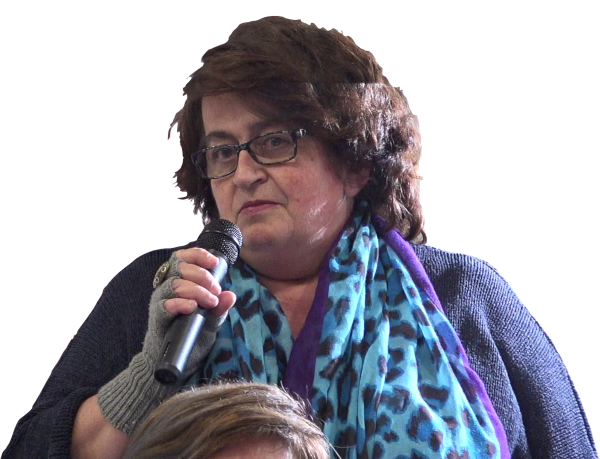
The Workshop “New Perspectives in School Guidance, for Childhood and Against Segregation” did not leave us indifferent. Those of us who participated experienced it as a very mobilizing encounter. Proof of this was the response on the network, as well as the texts that have been published on different websites and blogs. We collect some of these echoes below:
- Rethinking the role (not only) of Guidance to make inclusion possible, by Pablo Gutiérrez de Álamo
- WorkshopOrienta in Malaga: The Outburst of the Silenced, by Antonio Márquez
- For four little corners for nothing!, by Cristóbal Gómez Mayorga
- The dreamed journey…, by Alejandro Calleja
- Naivety and Hope , by María Luisa Fernández
- Reflection on the WorkshopOrienta in Malaga , by Estela Martín
- New Perspectives in School Guidance, for Children and Against Segregation , by Ignacio Calderón
- WorkshopOrienta. Building Inclusion from the Ground Up by Javier Herrera
- The vastness of the sea by Belén Jurado
- The group provides warmth, the group is necessary by Maite Gavilán
The #WorkshopOrienta was a meeting between professionals and families held in 2018 at the University of Malaga to think together about how to create schools for all people. Since then, we have been organizing ourselves to weave networks that make the right to inclusive education effective. A commitment to the democratization of schools.

Those without a voice in school shouted at this event. Those who cannot move, danced joyfully.
And so, with the naturalness with which what must happen, happens, February 24th became the day of Hope. And there they “told me” that the school that is late for my son will be on time for others, or otherwise it will not be a school! And I, even knowing myself to be naive, have hope.
The proposed methodology allowed us to build proposals “from the bottom up”. That is, through participation and collaboration.
Workshop Videos
Here you can find all the videos from the session, as they were broadcast at the time.
Audiodescripción [AD]: Un grupo de participantes conversa mientras toma asiento en la sala, preparándose para comenzar el workshop. Ignacio Calderón toma el micro y se dirige al grupo.
Ignacio Calderón - I.C.:— Buenos días a todos y todas, bienvenidos y bienvenidas a la Universidad de Málaga y bienvenidos a este encuentro que hemos hecho con mucho cariño y que, ahora, vivimos con mucha ansiedad.
Bueno, estaba pensando que, primero, habría que hacer una presentación de esta jornada, que es cualquier cosa menos lo que normalmente entendemos como jornada. Las jornadas normalmente son entendidas como un lugar donde hay un experto que habla y el resto escucha y, en este caso, nos hemos reunido para concebirnos a todos y a todas como expertos de la realidad que vivimos, y como constructores de conocimiento a partir de esa realidad que hemos vivido y estamos viviendo.
Hablábamos hace un ratito Raúl, María José, Silvia y yo, los que hemos liado todo esto, que habría que presentar esta jornada desde donde nace. Nace hace mes y medio, dos meses como máximo, cuando María José, orientadora de Valencia, muestra en Facebook su malestar por su profesión, porque está viviendo su profesión, que es la orientación, desde un lugar que a ella no le gusta. María José sufre, y entonces, al expresarlo, ella dice, quizás de una manera casi ingenua: ¿por qué no nos reunimos? ¿Por qué no nos encontramos?
Y a esa pregunta, que no sé si era del todo consciente, responde mucha gente. Se trata de algo, de un encuentro que se gesta ahora, pero es un encuentro que ya estaba ocurriendo previamente en la red, poco a poco. Bueno, cuando le responden a María José, responden principalmente familias, y entonces, eso desborda lo que María José planteaba, y cuando hablamos del tema, yo le digo, quizá, se pueda hacer un encuentro menos habitual, un encuentro presencial en Málaga. Y después pensamos que tuviera la posibilidad virtual, porque la gente empezó a pedir que fuera virtual.
Decía que se desborda el inicio de pensar que fueran solo los profesionales en esa conversación, en ese encuentro. Se desborda el hecho de que sean familias que se encuentran con profesionales en un espacio, y al final acaba siendo lo que hoy hemos montado, y que tendrá sentido en la medida que todos le demos sentido. Poco a poco, conforme se va gestando el encuentro, se van poniendo expectativas. Una idea que tuvimos fue crear vídeos. Crear videos ha dado mucho de sí. Cuando empezamos a crear esos vídeos, fue llegando mucha gente a preguntarnos e invitarnos a continuar. En ese proceso, hay personas que no pueden venir y que, más allá o no de enviar un vídeo con su experiencia, personas como Concha Casasnovas, que dice: «Se me ocurre, Nacho, que esto debería tener una música». Y cuando dice que se le ocurre que esto tenga una música, piensa en concreto en un músico, y nos ponemos a preguntarle a ese músico si nos cede el derecho de uso de una canción y de eso quedó esto.
Self-description [AD]:— Facing the attendees, the wall serves as a screen where the song ‘Centro’ by Luis and Pedro Pastor is projected, accompanied by images created by Paula Verde. The images include photographic portraits of different young people.
🎵 Behind you, the future runs
to see if you want
to let yourself be scratched by its brushes.
Behind you, following you, freedom
to see if you can
open some doors for it, release the nets.
Behind you, the full moon dances,
its fiery dance
invites you to raise your voice of snow.
Behind you, the most animal humanity
is calling you:
to forget what you have learned,
to start feeling,
that it makes no sense
to live like this.
Open mind, ready skin,
wings spread, mind alert.
Heart open, open to the world
in all its splendor your deep being.
You must have:
Open mind, wings spread
and if possible,
skin ready, mind alert.
Behind me, slowly simmering, is being born
a song from the center of your center. 🎵
I.C.:— I wanted to thank Pedro Pastor, especially, for having lent us that music, but also Paula Verde for the work she does with the images that help so much to reflect on those realities. We have gathered to think about reality from another perspective. Also to Olga Lalín, Carmen Saavedra, Concha Casasnovas, and all the people who are not here today, and who truly are here.
Today's session, getting to the most operational part, has a radically participatory meaning. The idea is to build knowledge from our experiences. We are going to start building that knowledge from the videos that have been shared, by people who are not here now, and that is how they are present. In those experiences that they have shared in those videos, I imagine there are many people who feel understood in what they have lived through, and it will also be interesting, after the work you have done connecting those videos you have seen with your personal experiences, to see what emerges.
We are going to divide the session into plenary assemblies and workshops. The initial plenary assembly, which begins now, is about talking about what happens in those videos and about your experience as education professionals, from schools, as families of enrolled children, and for us to think about the problems, the issues we encounter, the pains we find in those schools, and the joys, so that throughout the day we don't just focus on the problems, but that those problems serve to think about some solutions.
Today's session is a lot of work. Some people scold me because it's a very intensive session, but I was thinking, "How can we have a short session when there are people coming from Asturias, Galicia, Valencia, León, Extremadura, coming from so many places? How can we have a short session with people who have made such an effort?"
I invite you all to participate. It is important that all voices are heard, those of the professionals, family members, and other professionals who are not counselors, and that we talk amongst ourselves to build new things, that we don't follow the paths already laid out, which the videos denounce as unsatisfactory.
In this first assembly, we will try to identify some of the fundamental ideas that will help organize the workshops. The workshops have not been developed yet; we don't know what topics we will cover in them. We plan to have three or four workshops based on the topics that emerge from the assembly; we will try to address the most important ones later, in small groups, during the workshops. There will be a team of students from the faculty, some are collaboration scholarship holders, others are master's students in Education and Social Change, and we will try to systematize what we create in this session.
The idea we had planned is that the three videos we have selected, perhaps because they encompass others, will be screened, and from there, we will start and talk. I don't know if Raúl or María José want to comment on anything, right? Then we will watch the videos and begin.
Audio description [AD] In front of the attendees, three testimonials are projected on the wall.
Testimonial 1 - María Luisa Fernández (voice-over):— Hello, I'm María Luisa, Ángel's mother. My son was born in the eighties, and he could only attend mainstream school during early childhood education.
I have received a letter from a counselor, Macarena García, and her reflection has moved me, perhaps because I always dreamed of it, and especially because it offers hope to other mothers.
"This year, I have changed my educational path from Secondary to Primary school counselor. Even in February, I am still in a state of reality shock, with many situations that have impressed me and continue to do so.
From the moment children start at three years old, they do so after a rupture of attachment, from crying to a space based on absurd and inflexible rules. You demand aspects from them for which they are not prepared or mature, and they are already entering a hostile environment that does not fit their needs and interests. They need movement, discovery, investigation…
And that is how this space they call school begins to be forged, where every day less attention is paid to children's needs, people are dehumanized, and everything is commodified. And so we continue, with practices based on inequality, on marking difference as something negative, on singling out children who do not fit the norm, and a continuous demand to label children and have them leave class. Thus, homogeneity continues to be rewarded, and it goes on and on.
With a commodified administration, focused on numbers and economics, not on adequately covering each situation with resources. And a rigid computer system, with pigeonholed diagnoses, closed categories, straitjacketed typologies, and schooling modalities that, out of four options, three are segregating and exclusionary. And I am confronted with mindsets blocked by fear; it is very difficult to leave comfort zones. And desperate families seeking quality education for their children.
Counseling is understood as a diagnostic tool, and this requires an Administration that does not offer the necessary means and resources. And in this whole maelstrom, I can't stop asking myself: who am I to issue diagnoses and judgments? How can I foster more inclusive and humane spaces and times? How can I modify belief systems to bet on the idea that anyone can? And I find myself in continuous contradictions with what is expected of me, with what I should do, and with what I would really like to do. And so I navigate this sea of contradictions, looking for new islands on which to reinvent ourselves..."
Testimony 2 - Carmen Saavedra:— When Antón was in early childhood education, his mobility was very limited, and he could not go up and down stairs. So, he had to use the elevator at certain times when he had to move outside the classroom.
His early childhood teacher, moreover, who is the person from whom I have learned everything about education, wanted to avoid a very assumed, widespread, normalized image in our schools, which is seeing the majority of the class, on one hand, with the tutor, and the students with disabilities on the other, with the educational technical assistant, with the caregiver. And she wanted to make it clear that no child in her class thought that she was the tutor of all the children except Antón, or that Antón had other adults who were responsible for him.
So, to do this, she prevented that, every time Antón, because there was no other choice, had to go somewhere different from the majority, he was always accompanied by other children. The elevator was one of those places, and it also became a privilege, and Daniela's class... is the most democratic place on Earth; everything is regulated by rules. Without rules that make us all equal and that we all follow equally, there is no social justice. Since accompanying Antón to the elevator became a privilege and not an obligation, and everyone wanted to accompany him every day, they established shifts. One day they got confused: normally four classmates went with him, and that day five appeared at the elevator door. What she told them was, "Only four of you can go, and there are five of you. I'll leave you there for a little while to deliberate, to think about it, and decide who has to stay out and go by the stairs." So, she left them talking, and after a while, she went to see what the verdict had been. The group's spokesperson told her: "We've already talked about it and decided that the one who can't go in the elevator is Antón because he goes every day."
When she told me, I felt like crying. She also said that Antón was there, perfectly fine, next to them with a face that said, "Well, they're right." This elevator anecdote is wonderful and tells so many things... What I wonder is: what has happened in these 6 or 7 years, not only in our schools but also in our homes, parks, and streets? What has happened for those children who saw no difference between themselves and their classmate with disabilities, what has happened for them to ignore him 7 years later and not feel that he is part of their world? I am quite clear that children are born without prejudice, and my approach is:
What could we do to not change that lack of prejudice with which all children are born? I am convinced of it, and that the children from the elevator do not change over time.
Testimony 3 - Paula Verde:—Hello, my name is Paula, and I am the mother of three children. All three attend a mainstream school, and one of them occupies a place for specific educational support needs. The one who occupies that place is called Héctor, and he has a diagnosis of autism spectrum disorder. He took a very long time to speak, and to this day, he still struggles a lot. Every day he says more words, but it's difficult for him. However, he is in second grade, with his support. His fundamental support for us is the caregiver; she is almost the fundamental gear for Héctor to be in a mainstream school. Academically, Héctor differs little from his classmates; he knows how to read, write, add, and writes his own stories. So, I am aware of all the positive things, and Héctor even attends music activities and the play center outside of school. Everyone is able to see the positive qualities, and sometimes, from the orientation teams, what I notice is that what they try to convey to us is everything they are not capable of doing, rather than what they are capable of doing. I think we should empower or provide tools to overcome all those handicaps they have, rather than telling us what we already know, "that they can't do this, that they can't do that..." And much less telling us that "they are not capable of," because if Héctor has done all that he has done at this point, it is because it can be done, and because it is an enormous achievement.
So, he has had two extraordinary tutors. We are always dependent on the reality of the professional you get and the center. In our case, luck has been on our side; we don't know what the future or our day-to-day will be like. But what I am very clear about is that there is no center that is not a mainstream school where Héctor can learn more than he is learning. What would be a shame would be if they took away his possibility of being with what is fundamental for us today, which is his reference group, that class that is an example of coexistence, that teaches us lessons every day, and that is a bit of what gives me energy every day.
I.C.:—Two little things before we begin. I have just shared the link forstreamingonline. If you share it, people can access the video of this moment.
The session opens, and we begin to listen to words, to comment on what we have experienced while watching those videos, about our opinion on the current situation of guidance, about our experiences... I wanted to say one thing, and that is that we have to be very disciplined, especially disciplined with time. There are many of us and we have very little time. We have to be disciplined and understand that our contributions must be very brief, two minutes at the start, two minutes maximum.
Audio description [AD]: The people in the attending group take turns speaking, picking up the microphone and talking in turn.The people in the attending group take turns speaking, picking up the microphone and talking in turn.
Carmen Morales:— Hello, good morning, my name is Carmen Morales. My son is already 23 years old. To summarize, my impression is that the guidance from the schools, the teams, the EOE (Educational Guidance Teams), the support teachers, the tutors, has always been "Your son is not capable of...". When he started preschool, the teacher (whom I didn't really like), well, you empathize or you don't empathize with people, that's a reality, then you can be a good professional or not, empathy is fundamental for me. I arrived one day in class, the child was three years old, he had cerebral palsy, at four years old he could walk, but not before, and the teacher told me: "Your son, Carmen, just hates the pencil." And I, who have a strong personality, told her: "Laura, I'm at my job from eight to three." Look what Carmen Morales, who is also a special education teacher, told her. They could have told me: "Look Carmen, we've thought, why don't you do it at home...?", but not tell me that the child hates the pencil... At school, there are professionals who should be guiding me on what I should do at home.
Also, he took a long time to learn to read and write. I went to complain because in three years they had tried eight different reading methods, so, well, any learning takes a lot of work. Anyone who gets their driver's license, if you change the car, they won't learn. How do you expect a child to learn with eight reading and writing methods?
(Applause)
Alejandro Calleja:— Hello, good morning, I'm Alejandro Calleja, Rubén's father. As we said, yesterday marked three years since the conference on inclusive education and the right to reality. So, we are more or less in the same place. Sometimes, it seems like we're going backward, but I think we've delved quite deeply; the fact that we are here, that professionals and families are all interested. What I want is to leave this conference with a positive proposal for professionals and especially for families, to know that there are tools, to know that we have instruments to uphold the right and dignity of our children. From our seven years of experience in this struggle, that's what we've come to contribute. I believe that together it will be a wonderful conference. Thank you.
(Applause)
Antonio Guerrero:— Hello, good morning. My name is Antonio Guerrero. I am president of the early attention platform of Andalusia. From Huelva to Almería, what we have seen is a reality, and I agree with the message. We are seeing day by day that it is possible to keep children in the appropriate modality. We are seeing, day by day, that it is possible; by working hard, pushing hard, sometimes even going to the juvenile prosecutor's office, fighting for the children's rights. The best interests of the child are above all else. I adhere to that message that all families must hold onto today. It's not that we think it might be possible, but that it already is possible. My phone number, ours, is on the early attention website. Anything you need, please, get in touch with us. What we are trying to do is bring together the entire collective from all over Andalusia, so that we are one voice. Last week in Málaga, they closed a conference for psychologists to give workshops to families to get to know the first families; there was a guest who was going to provide me with the eighty-five associations for disability in Málaga, and I said I don't want eighty-five addresses, I want just one, I want us all united. The administration is interested in dyslexia, on one hand, Down on another, ALS on another. Diversity makes us all equal in diversity; the message is that it's not that it's not possible, it's that it already is possible. Thank you.
(Applause)
Paco Serrano:—Hello, my name is Paco Serrano. I am an early childhood education teacher, a pedagogue, and the father of a three-year-old boy who is currently starting in the guidance service. I am addressing one of the colleagues who has already spoken. I would like to invite all of you, colleagues, members of the educational community, whether we are parents, teachers, guidance counselors, to use the most positive tone possible today, because those of us who are here know that things were worse a while ago, that this has improved over time, and we know that what we have right now, today, is improvable. Education, guidance in general, is improvable, each in their own area, from their own point of view. Therefore, I would truly like not to leave this Workshop tonight at nine o'clock feeling emotionally devastated; I would not like that. I did not come here for that. I would like us all to leave here with a lot of energy and with all the threads that each of us can pull in our own way, with all the threads well tied, and as the colleague said, that from those threads we make a single rope so that all of us go forward together from today, and starting today. I hope that happens.
(Applause)
Ana Solsona:—Hello, I'm Ana Solsona. I'm Aleix's mother, who is here with us, and he's 21 years old. In two minutes, it's very difficult to cover the journey that all of us parents have had, with 21 years, imagine. I agree that we have come here to try to get something positive out of it, and I am with Héctor's mother, Paula Verde, who says that from the mainstream setting we have to move forward. Despite the difficulties our children may have, we have to try to have them there with all the support they need, even if it's hard, we have to fight from there because from exclusion, in the end, you find nothingness. I suppose throughout the day we will gather more things and extract positive outcomes. Thank you.
(Applause)
Virginia:— Hola, buenos días, me llamo Virginia. Yo tengo un niño que tiene 13 años. De todo lo que habéis dicho, y aunque esté en la parte de educación, es inevitable colocarnos unos en un lugar y otros en otro, aunque tengamos que avanzar juntos. Yo creo que todos los padres, hemos sufrido de alguna manera muchas cosas que nos han pasado durante todo el proceso en el que avanzan nuestros hijos. Inevitablemente, tenemos que ir a la par, pero tenemos una parte muy sufrida que no vamos a poder evitar.
Me emociono porque esta semana he recibido yo la evaluación psicopedagógica de mi hijo. Me parece muy importante lo que han dicho antes, ellos se aprovechan y tal cual lo digo, de las diferencias que tenemos en pensar si mi hijo es más discapaz o no, y la administración hace uso de nuestras diferencias, porque en nosotros mismos pasa mucho tiempo hasta que aprendemos a tener una mirada diferente hacia los que son más discapaces que los nuestros, ya que ellos nos enseñan a tener esa mirada. Es la manera de empoderarnos y creer que no somos muy diferentes de los que son normales, es la realidad.
Otra parte que me parece fundamental es que los que estamos aquí estamos muy a favor de la inclusión, pero, hay muchos padres que desconocen todo esto que sucede, porque siguen creyendo que la parte de la administración y los docentes no le van a decir una cosa muy diferente, es decir, no van a pensar de alguna manera que los están engañando. Y, perdonarme, yo el sábado tuve una comida familiar en la que estaban mi cuñada y mi sobrina, que tiene una dislexia, tiene 15 años, tiene que hacer las cosas muy espaciales, y ella me contaba que la profesora de lengua le había dicho que no podía dar sus exámenes. Y yo le dije: «Sara, la ley te permite que tú pidas una copia del examen y te lo lleves a casa». Hay mucha gente que no sabe ni los derechos que tenemos, ni lo que nos están contando, entonces, la única manera de hacernos fuertes es que nos unamos y que la información llegue a todos los padres, porque si no somos una pequeña parte en un grupo de gente que no conoce las cosas, y eso les vale a todos los demás para hacernos más pequeños.
The psycho-pedagogical report for my son, which I received this Thursday, is curious and striking that they forgot to include the phrase from his doctor stating he has autonomy for basic daily life activities, from 2018, from this January, but they didn't forget to include a report from 2016 where the person who sent it says he needs help getting dressed. Forgive me, but that's not forgotten if it's not for a purpose, and that's a reality that happened to me three days ago, so let's open our eyes, this is the reality.
(Applause)
Mónica:— Hello, good morning. My name is Mónica, I'm Nico's mom, an 8-year-old boy. We have 4 years of school life, I could tell you many things. Regarding the orientation approach, I must say something that surprised me a lot. When he finished early childhood education in modality B, a mainstream classroom with support, there's a change to primary school where, almost as a general rule, they end up in special education classrooms. I remember that, after the assessment done by the counselor, she told me: «Since Nico doesn't have a clear diagnosis yet, I don't know what to put for him». And I told her that it wasn't very important, meaning, what is the assessment for? I understand that what you're looking for is the correct educational response for my son, and she told me «No, but I have to pigeonhole him somewhere, I'm forced to put something in the computer, and what do I put?». And I told her that he has medical reports from professionals, yours, and in the end, she ended up calling the autism specific team of the delegation, and after fifteen minutes, she ended up classifying him there to be able to tick a box and for my son to have a label. I looked at her and told her that she wasn't doing that to provide the correct educational response to my son's needs; it seemed so surprising to me because at that moment I realized that my son wasn't human, meaning, it dehumanized him. What mattered was to give him a name to put him in a special education classroom, Pluri or TEA, in a special education classroom, here or there, but not because he needed it, but because she needed to give him, she was forced to put a label on my son. That's what hurt me the most because my son didn't exist. He wasn't Nico, he was a label they needed to put for an administrative procedure, without ever looking for what my son needed.
(Applause)
Diana Farzaneh:— Good morning, I'm Diana Farzaneh. I'm a teacher. What interests me most about all of this is that I see how families and some professionals, unfortunately, not all of us yet, have a very different perspective towards people with any kind of handicap. What interests me most is that I believe the key lies in education professionals, whether they are counselors or anyone working with children in schools, changing their perspective, from seeing incapable people, people with labels, handicaps, difficulties, to simply seeing people. I believe that what we should focus on, especially education professionals, is changing our perspective, because from there we can begin to work and change the society we live in, which is also necessary, starting from school. School is the engine of change. Thank you.
(Applause)
Ana:— Hello everyone, I'm Ana, mother of a six-year-old girl named Luna. I want to briefly share my very positive experience regarding guidance. Thanks to the counselor at the center where my daughter was last year. My daughter was in the five-year-old class last year, and she needed a diagnosis to move on to primary school. My daughter was enrolled at Las Flores, a school here in Málaga that has three specific classrooms. At the beginning of the school year, until October, everything was great, just like the first three years of Luna's life. Starting in October, negative reports about my daughter's abilities began to arrive, and my daughter remained the same; nothing had changed about her at all. What happened? The counselor called me and personally told me: “Ana, don't tell anyone, but I want to meet with you.” So, we met somewhat behind closed doors, because it was very difficult to understand, for the counselor to speak directly with the girl's mother, and she told me: “There's an administrative problem at this center. Next year, they're closing a specific classroom because they won't have enough students, and of course, to bring in someone from outside with a more complex reality, it's preferable for Luna, who doesn't cause any problems, who is a cheerful girl with no behavioral issues, to move to modality C, just like that.” So, she was forced to create a lot of negative reports about my daughter. She refused outright, of course, because she visits Luna in class and doesn't see any kind of problem. What's more, she requested that, please, she be allowed to remain in the third year of early childhood education one more time so she could mature and so on… In the end, thanks to the counselor at this center, Luna remains in modality B. Of course, I took my daughter out of that educational center where her abilities were no longer seen, and where everyone had started to see Luna as something completely different. I moved her to a school where there are no specific classrooms at all, at Nuestra Señora de Gracia school, where Luna is currently, integrated, included, wonderfully, with all her support and with a wonderful monitor, a great social worker who helps her day-to-day, and I am very happy. I just wanted to say that.
(Applause)
Maite:— Hello, my name is Maite, I'm the mother of a 12-year-old boy who has autism and is in a specific classroom. I'm not going to talk about my life, I'll just tell you that the role of the counselor in my life has been very negative, because the counselor is detached from reality, lives in another world. The child doesn't have to approach the school; it's the school that needs to approach families and the child. So, when you use your heart, you're going to use your intelligence, because when a behavioral problem arises, you won't see a behavioral problem; you'll look for the 'why,' not like one person told me: “She did this just because.” When we use our heart, we will see not a child with a diagnosis, but a person, and we will want to help them. Therefore, I hope that from this meeting, it emerges that the heart is fundamental, offering a hand to parents is fundamental for this to continue. Well, the specific classroom needs to change a bit, and for that, the unity of everyone is necessary, because otherwise, the administration will tell us there's no money. That's all, thank you.
(Applause)
Esther Gómez:— Hello everyone, and welcome. My name is Esther and I'm a student at the University of Málaga. We're looking at Twitter and the streaming , and we are seeing the comments people are making about what we are discussing here today, so to give them a voice and for everyone to hear them and participate in this Workshop, we are going to read some of the comments:
Paula says that information must reach all families and that there is a lot of misinformation from the administration.
Laura has commented that we accompany, as parents of children on the autism spectrum, our children with functional diversity in the school environment, and asks how we can generate communication channels for this challenge of inclusion.
Carmen Ocaña comments that there are many familiar faces in this Workshop, a lot of pain and suffering in each story, a lot of helplessness. That we are together fighting for a dignified education in equality.
Francisco Urbano tells us that in exclusion, you find nothingness, referring to previous comments.
Javier Herrera:— Hello, good afternoon, I am Javier Herrera. Forgive me if I get emotional, but my emotions are on the surface. I feel this way because I believe and feel that something is changing, from the moment we can sit together and talk about this and generate change in society. I am the president of the Petales España association. I just want to say that for me, this meeting represents a (unintelligible) not only because of the concrete tools we will have, the ideas that Álvaro and Antonio mentioned, but because it is all another tool to incorporate the rights-based perspective as a tool.
On the other hand, there is the awareness of society as a whole, meaning that if we don't convince every single parent, every single person our children live with, we will never achieve that goal. It's a task we must undertake, and we can only do it positively. I am convinced that good tools for this will emerge here, and well, thank you all.
(Applause)
Rocío:—Hello, my name is Rocío, and I'd like to shed some light. I am the sister of a wonderful woman who turns 44 this Sunday. She had hypoxia at birth and has different abilities. When this happened so long ago, my parents had to move from our village. The best they could find was a fee-paying school so my sister could sit at the front next to the teacher. Today, I am an occupational therapist, working as an integration assistant in classrooms for children diagnosed with ASD. What I find is that, often, teachers want to help, they really do, but they tell me: 'Look, I just don't know how to do it.' So, [hay que] creating a resource so that these teachers who are truly involved can have training resources, because they really want to. In the end, we face the problems that many of you parents have spoken about: we have to wait for there to be a heart behind the professional. Regardless of whether the role is that of a counselor or a teacher, we hope there is a heart behind them that empathizes with what you want.
I don't know if I've missed anything. Simply, regarding administration and paperwork, so to speak, the use of language should be changed. It's just a matter of swapping some words for others; there are words that cause a lot of harm. A parent who receives a diagnosis, the worst thing they can do is go online, because your world falls apart. Searching for that word, what it means, it's all negative. Language must be attended to in detail. Thank you.
(Applause)
Carmen Máximo:—Hello, I'm Carmen, I'm a support teacher. I wanted to tell you that I am a secondary school support teacher and I haven't had any pedagogical training. I'm telling you this because I've been listening to all the testimonies, and I wanted to make two points that I can elaborate on later in the groups we'll be working in. I know that most of you families are in Primary school, but when you get to Secondary school, we teachers have the pedagogical training we received in a master's degree, even if we are technicians, and even that wasn't always required. I've been assigned to the guidance department for 15 years as a support teacher in the science and technology field for students with hearing impairments, but I work hand-in-hand with counselors and other colleagues, PTIs and other support teachers. I wanted to highlight two things in particular.
The first, I completely agree with what has been said about labels, because if assessment makes sense, it is to provide an educational response; otherwise, it makes no sense. Second, there are many guidance counselors here, and I work with a guidance counselor in my center: there are two thousand students, and guidance counselors must have that pedagogical training. It is true, and I appeal to humanizing practices and for people to have a heart, but when we don't find that heart, there are rights, and then I understand that the information, as my colleagues say, is fundamental. First, things are requested, explained, presented to us, and we ask for attention, but we are not, how can I put it… begging for anything. When we go to a guidance department, and we find a professional, what we must find is a human response, and if it is not given, it must be demanded, because by demanding it for our children, and other children in other schools and from other teachers, they will be attended to, because regarding training, pedagogical direction, and there are many guidance counselors here, the orientation department leads it, and of course, the pedagogical direction of the center, because you have to take into account that the response for your children does not depend solely on the PT or the guidance counselor, but on the involvement that center has in that inclusion, and therefore, for me, the issue of guidance, families, and demanding rights when we are not heard is fundamental. Thank you very much.
(Applause)
Beatriz Domene:— Hello, I'm Bea, Beatriz, mother of a child with Williams syndrome. I am also an early childhood education teacher, and my husband is a physical education teacher at the center where my son attends. So, I have many roles, let's say. I identify with many of the things you were saying. I wanted to pick up on what Rocío said about it depending on the tutors. The other day, for example, I was in a technical team meeting with the guidance counselor at my center, and I asked her. When giving guidelines to my son's teachers, I thought she somehow supervised what was being done. Then, she told me: «Yes, but if the tutors don't want to or aren't willing…». So, who is responsible for ensuring my son's right and all other children's right to a dignified education is met? On the other hand, pedagogical direction must also ensure that, but it turns out that the pedagogical direction, which in this case, for example, are our friends, say the same thing: «If the tutor isn't willing…». So, we are left helpless. We, for example, in our tutoring sessions, manage to get almost the entire teaching team involved because we are at the center, but what about the other children whose parents don't have that access? Even so, of course, we are better off than a few decades ago.
(Applause)
Belén Jurado:— Buenas, yo soy Belén Jurado, madre de Lucía, una niña con autismo de 10 años. Tengo también un hermano con esquizofrenia que, en su día, con 20 años, fue expulsado de su colegio directamente. Le dijeron: «No puedes estar aquí», y se acabó, no hubo ninguna oportunidad más. Sí que es verdad que las cosas han ido cambiando, no creo que mucho, pero han ido cambiando. Nuestra experiencia no ha sido nada buena, quizás ha sido más no con los orientadores, sino con los profesores-tutores. Es lo que decís, no saben hacerlo. Yo creo que, primero, habría que mirar a la persona antes que mirar a la etiqueta, y eso no se hace nunca. Entonces, ponen etiquetas, una, otra, otra… Mi experiencia fue que Lucía durante tres años estuvo en un aula TEA y no entró al aula ordinaria apenas unos minutos. Se da de baja esta profesora y llega otra que parece que sí quería que entrase, y Lucía entró. A mí lo que me dijo eso es que, según el profesor que estuviese, tendría derecho a una educación. Yo no digo que las aulas TEA sean inclusivas porque no lo creo, pero bueno, según el profesor que tuviese en ese momento, mi hija podía o no podía. Durante los meses que esa chica estuvo de baja, Lucía demostró que sí podía estar allí, mostró que estaba bien y mostró que podía hacer sus tareas igual que cualquier niño. Cuando la otra profesora volvió, se acabó todo de nuevo. Mi experiencia es que, según el tutor, según el criterio del tutor, Lucía tiene una educación digna, de calidad o no.
(Aplausos)
Lola Berenguer:— Hola, soy Lola y maestra de educación primaria, tengo una hija con parálisis cerebral y nació en los 80. Todo mi empeño desde un principio es que ella estuviera en un centro ordinario, en modalidad B, y luché, bueno, luchamos mi marido y yo, porque en ese tiempo no se entendía muy bien aquello y ella estaba estupendamente bien. Infantil fue una etapa fantástica, pasó a primaria y empezó a convertirse en una carga dentro del aula y nosotros nos rendimos en quinto. Cuando llegó a sexto de primaria, nos rendimos. Ella siempre había estado conmigo en el colegio donde yo he estado trabajando. Nos rendimos, me decepcioné mucho cuando ya la vi en las circunstancias en las que estaba, en el aula, haciendo plastilina con una mano. Me ofrecieron meterla en un aula específica o llevárnosla a un colegio de educación especial. Ahora está en un cole de educación especial, muy bien atendida, muy contenta. Mi lucha sigue con ella para su integración social, ya lleva muchos años dentro del aula, y ella es muy observadora. Veo que dentro de los colegios no tenemos las posibilidades que deberíamos de tener, que sí que hay gente que a lo mejor no sabe o no se interesa, pero que sí que hay gente, maestros, que tienen mucha mano, pero no hay recursos. Yo siempre he comentado con aquellos compañeros que estaban interesados que me parece que el problema no está en que realmente nosotros queramos o queramos, es que no nos ofrecen, y ahora hablo como maestra, la oportunidad de tener recursos para todo lo que queramos hacer.
El trimestre pasado trajeron a un niño con una problemática social muy complicada. Nos lo metieron en segundo con una compañera admirable. Era un niño que se escapaba de clase y había que correr tras él, por los pasillos, para poder encontrarlo. No sabíamos dónde estaba. Todo el equipo, la PT, la logopeda, después de dar servicio a todo el cole, tenían que atender a este chico. Nosotros pedíamos que, por favor, nos trajeran un monitor para que pudiera ser atendido. ¿Sabéis cómo ha terminado la historia? El niño se ha ido del cole, le han cambiado de modalidad de educación, ahora está en un aula de integración en otro colegio del pueblo, y ya está, así han quitado del medio al problema, porque no se llama niño, se llama problema. Gracias.
(Aplausos)
Audio description [AD]: The interventions of the workshop attendees continue.
Estela Martín:— Good morning, my name is Estela, I am Víctor's mother. He is 19 years old and is in a special classroom at the institute, but as a child, not as a 19-year-old person, with the interests of a 19-year-old. Even if he doesn't read, doesn't write, or can't speak, his interests are those of a 19-year-old boy, we can't forget that. He likes the institute because he likes being with people, he is very sociable, everyone in Alhaurín knows him, even the police in Alhaurín. My son won't be more protected in any other center. Our children have to be out on the street, their neighbors have to know them, that's for starters.
My son, since second or third grade of primary school, has not brought any medical report. It was the neurologist himself who gave me the key: medical diagnoses are private, and therefore, they don't have to go to the center if you don't want them to; they cannot demand the diagnosis. The school's diagnosis must be pedagogical, not clinical. From that moment on, when they told me: "Hey, you haven't brought the report back," I would say that I would bring it tomorrow, and I've been doing that for at least 10 years. "I'll bring it tomorrow..." They haven't asked me for it anymore, and besides, Víctor hasn't needed to see the neurologist anymore.
As long as we keep talking about capacity and continue to see school as a way to get to work, which is what it is for now, but that's not the case, the system must be for developing us as people.
(Applause)
Isabel:— Hello, my name is Isabel, I am very excited and right now very nervous too, so if I don't explain myself well in these two minutes, it's because of that. I am the mother of two children. I am also a school counselor. It pains me, as part of the institution, to see your pain, because the school pains me and I believe in the institution... forgive me, I'm getting emotional. I believe in children, I believe in the childhood of all children and not just the children that you feel and that cause you pain. I don't feel that the school is for any child, not even for (inaudible). I don't feel that there is that respect among the sectors that form that community which is not a community, it's not in common; that are families and teachers if you want to do things differently. I want to do things differently. Sometimes I don't even know what to do (inaudible).
(Applause)
Audio description [AD]: The interventions of the workshop attendees continue.
Susana Pérez:— Hello, I'm Susana, I'm from Galicia. As you may have noticed, I hope I don't leave here with a label. It's a great effort to be here today, logically, it's proving quite tough, honestly. I'm an early childhood education teacher, I'm a psychopedagogue, I don't work in a school, I come from an association for people with Down syndrome and intellectual disability, which is in Ferrol. It's a small association, although it used to be smaller. I work in the education area. I've been with the association for 14 years, which means I have a lot of stories of pain behind me. All the stories I've heard throughout this morning are stories I've been hearing all these years.
I believe many things need to change. I'll hold onto the part that, in the end, it's true that it depends on people's willingness. I've seen how things went wrong during the school year, and the following year with the same teacher, and in the same center, things went great, so I'm left with the idea that it's possible. We need to focus on what's working, what's not working so we stop doing it, because I also believe, and I find it very sad, that there's a Convention on the Rights of Persons with Intellectual Disabilities. How can it be that at this stage of the 21st century we are exposed to people's willingness, meaning, that someone can have the right to a dignified and quality education, depending on whether someone wants to or not?
On the other hand, I want to say that it's necessary to change and start integrating the definition of intellectual disability given by the Convention on the Rights of Persons with Intellectual Disabilities, which states that disability arises in relation to the environment. Therefore, we need to shift the focus from individuals and start looking at the barriers in the environment to be able to adapt and participate on equal terms and equal opportunities. I also took away that I heard the term 'special classrooms' many times today, which makes my hair stand on end, because I don't believe there should be special classrooms for anyone. We should all have the right to be in the same classrooms, all together, because when that's not the case, we are separating them and taking away the opportunity for other people to get to know them and learn to live with them, and to understand them. And then, we get out there, and of course, the world encounters people with intellectual disabilities on the street and doesn't know how to relate to them, what their needs are, what support they need, or anything at all. So, while they're not there, they don't count, which is why I encourage you to keep fighting, because they need and must be where the rest of the world is.
I think there are teachers who have the right to choose whether to teach a child or not. I find that tremendous because children don't have the right to choose whether they like a teacher or not. I think we should always remember the issue of rights, that they are there. We have to stand by them, that's what they're for.
(Applause)
Mirela:— Hello, I'm Mirela, I'm from Ibiza and I'm not going to talk about my son at all, because listening to you, my son's case is super light. I am a founding member of an association on the island, its acronym is APIES, Pitiusas Association for Educational and Social Inclusion. In it, we do precisely this, inform parents about the rights they have, the rights their children have, and one of the things that few parents know is that there are orientation teams outside of the educational sphere, for example, associations that can advise them on the path they need to take for their child to finish school. Two years ago, a special school arrived on the island for the first time. Until now, we were the only place without a special school, but with the arrival of this special school, support in mainstream schools was also cut, hence APIES emerged, and thanks to Nacho, who came to our presentation, he broadened our knowledge and opened our eyes a little more, because we always had a little, but well distributed, and now there is nothing. Regarding the children, for the simple fact that they have a label from orientation, we are told: 'There is a special school.' And that is not the case, we have the right as parents to make mistakes, to take our children to the school we want, to give them an education, and they have the right and the obligation to provide the resources and support so that each one has a quality education, and under the right conditions.
Susana Pérez:— I'm grabbing the microphone again, because I forgot to say something. I want to organize a meeting like this, but in Galicia, I've said it!
(Laughter)
Carmen Morales:— I'm going to repeat myself, because first I spoke as a mother and now I want to speak as president of SOLCOM. We are a national association that defends the rights of people with functional diversity. You can't imagine the number of cases we receive regarding education with changes in exams. There is a national trend in all autonomous communities of children who were in mainstream classrooms and are now moving to special education classrooms; it's a real scandal, it goes against the International Convention on the Rights of Persons with Disabilities. From SOLCOM, we want to invite you all to, in your respective locations, your associations, meet with your peers, find a good lawyer, and file a complaint, because the right to education is a constitutional right. Sometimes, people try to talk to the school first, and sometimes the school reasons because the professionals are human beings, the counselors are human beings, and they have the same capacity to make mistakes as we do. And sometimes, well, by bringing them to reflection, they change. There are occasions when the only option they give is to refer the child to a special education center. And there are people who accept it because they like it and that must be respected. Of course, but my opinion must also be respected. I don't want my son to be in a special education center. When the teams, the delegation, and everyone else become stubborn, the only recourse is to file a complaint in court. And there are already favorable rulings in Spain, which can be used for our children's cases. Mine was reported last year for another issue: he was expelled from education for being 21 years old and having a disability. You can also use it; it's on the SOLCOM website, we usually post the rulings. Education is a right and you have to fight when it's not recognized. Our children are born with a backpack of no rights, and we have to carry it throughout our lives, that's a reality. So, we invite you not only to argue with the counselors, who are often caught between a rock and a hard place, but to file a complaint. You can visit SOLCOM and consult us, and we can guide you. Thank you.
(Applause)
Susana Fajardo:— Good morning everyone, I'm Susana Fajardo. I had written three pages about my experience with the education system and guidance in particular, but I would like to highlight two things and share an experience. First, the issue of sensitivity and having heart. You can have sensitivity or not have sensitivity, but you have to do your job, which is to attend to all children, and then if you want to put your heart into it or not because it comes naturally or not, then welcome if you do it with heart, but it's your job and you can't stop doing it.
Then I want to draw attention to an issue that seems very important to me: we don't have a sense of belonging to a group, no one wants to be the parent of the child who can't read or write, and we keep thinking that individual things happen to us, and we come here and realize that all experiences have common points. We won't get anywhere as long as we don't feel that we belong to a group and that we belong to this group of mothers and fathers of children who can't read or write at thirteen, at 14, at 15, at 21, and at 50, and that we all have to fight for everyone's rights.
My latest experience with guidance, the second to last, was when Víctor finished sixth grade last year. Throughout sixth grade, the psycho-pedagogical report was being prepared; he was already in a combined program in fourth grade. In Extremadura, there is an option for combined schooling, which is attending the mainstream school a few days a week and the special education center on other days. When he was in fourth grade, due to a tutor with whom we couldn't do anything, we accepted the combined program and then we saw the reality of special education. We compared it with the reality of the mainstream educational center, we met a wonderful tutor. It wasn't that my son had behavioral problems, it was that behavioral problems were being provoked. During that report, we went to meetings with that counselor, to present a series of reasons why our son should not leave the combined program, he should not leave it because he belonged to the group, there was a sense of belonging not only from my son but also from the others, because there were behavioral improvements, when he was in the mainstream center he behaved worse in the special education center, for many reasons. The only reasons they gave us were repeating the grade or going to a special education center, which we refused, and after a lot of effort, he is now in high school.
I want to draw attention to two things. First, the whole series of reasons the counselor gave us to tell us that Víctor should not continue in high school were systemic problems, problems of their system, of the school's organization, of the student-teacher ratio, of teacher training. They were placing the problems of their system on our son's shoulders. Second, when we presented a whole series of arguments, she said why should she be convinced by us, instead of us being convinced by her?, because she was the professional and we were just his parents. She didn't understand that we could have an opinion and that she had to respect our opinion, because she was the professional. Then, when the moment came and the arguments purely affecting our son changed, we started talking about exclusion, we started talking about cutting off our son's social bond, when we started talking about discrimination, she even told us that she didn't want to consider all that because she wanted to sleep soundly. Many don't consider that this is necessary because rights are being violated; they continue to defend the system and do their job to defend the system.
(Applause)
Esther Polo (Master's student):— Hello again, on the stream, a girl named Marta Recarte Domingo has shared a story and I'm going to read it so we can all hear it:
"I am a secondary school counselor, and at my institute, we have two children whose needs often lead to exclusion. The teachers said it was impossible for them to be here; they seemed scared and incapable, but little by little, they are learning. Now they are fully included. The special education teacher works within the classes with them, and their classmates are enriching themselves from the diversity, acquiring very valuable values of solidarity and respect. We still need to change teacher training, change the type of segregating bureaucracy and resources, but even so, more can be done than what is being done; we just need to want to do it."
(Applause)
Cristóbal Gómez Mayorga:—Hello, I'm a special education teacher. I've been doing it for four or five years, but I have twenty-something years in early childhood education. I just wanted to state one thing: 80% of my work now isn't with the children with difficulties, because I don't see problems. The one who needs to learn letters is learning them; the one who is at another level can do other things. 80% of my work is talking with the staff, but it's not just a matter of knowledge; it's a matter of school culture, of textbooks, of everyone only knowing how to follow the same level, homogeneity, and all these kinds of things. So, it's a change of attitude. You have to be in the hallways with a good vibe. Sometimes you feel like doing a lot, convincing them of what they know, but: 'You don't realize they know... look what they've done to me.' They don't see the capabilities; that's work. We special education teachers have the university from a certain perspective, not learning to work with children with difficulties, but learning to work with teachers, with administrations, with counselors, with everyone, because we are a force that can make things happen. Thank you.
Participant 1:—Hello. Simply put, I'm realizing that here, parents either avoid it or don't address it, and professionals do too. Why do we reject children and send them to a special classroom or a special education school?
One is behavior. We look at behavior in a very dehumanized way because we always think the child brings the behavior, and we never think about what we provoke in that behavior. So, fundamentally, teachers and counselors are opposed. Many of the problems are created by us, by not respecting their decisions, because the child, even if they don't speak, knows what they want and has interests; it's another thing to investigate, to put on the glasses. It's fundamental that we put on the glasses, but no longer just from the heart, but in the most professional way. We create many of the behaviors ourselves, and then we do have a problem because we don't know how to work with it and we blame the parent. It's my burden, of course, because he's my son, my life, my heart, but it's your responsibility and you have to do it. Because later these children are like clay; we are shaping them, and they will be adults, and who will include them? Nobody. Behavior is one of the fundamental things; we shouldn't be ashamed. If I ask, even I have behavioral problems, but nobody analyzes me. I can be at a traffic light and say 'damn it...', but nobody will do a record of me. We are going to analyze behavior seriously, by taking records, not by saying: 'I think.' So, let's see what the child's problem is and help them, because this child will be an adult, and then, for them, there is nothing, and we have no right to do that.
(Applause)
José and Isabel Yagüe:— Hello, good morning, I'm José and Isabel. We are parents of a six-year-old girl and we come from Valencia. Our story, like that of many of you here, is about fighting with Health, with Education, every day, without having any knowledge. Well, we have always gone with the articles, with the rights, perhaps that is what has made us respected in certain places.
Then, when we arrived at the school and they wore us down, a psychologist told us that we had to go to special education. So, we visited them all and realized what special education centers are like. And you say: 'I don't want that.' But there is no other alternative. We stated in the report that we disagreed, based on the rights of the United Nations, the articles, and all that. Finally, someone listened to us, and we found a counselor, named Ana, who opened up our lives to another school. And we went from a school where my daughter was a problem, couldn't go on excursions, to school when she didn't have an educator or when they called us not to bring her, to a school where there is no problem. That is to say, when we arrived there, they told us: 'There are many children here and there is no problem, we have no problem, we don't even notice.' The difference is that there are no educators or PTs there, they are on the business card, but all the professionals do everything, and in the end, it all works out. What I would like is for us to multiply from here, for each province to identify those schools that know how to do it well, and that are not here, and to write that guide of steps to follow for this to happen. If it's possible in one school, why not in another? I would like that White Paper to be written that we can find to set up a non-profit association, so let's do it for inclusive education. A book where the rights are, where the steps to follow are, that serves teachers, and serves families. Well, and I think that is my goal here today. Thank you.
(Applause)
Olga Gave:— Well, let's see the nerves and emotions. I'm Olga Gave, mom of three little ones, and I say that for me, each one of them functions in a different way, although my eldest son had to try special education, because he was already, how to put it, already stimulated to where we were going, they told me he would go to a special school, that he would go by bus, and that he would eat there. That already sounded like 'what's going on?' But well, I didn't know, it was my first child, I had no idea. We went along with it. The psychologist told us it would be the best place. I still have the paper for special school, mainstream school, or combined, but the best place was special. Three years of struggle. You saw me and I felt that when those children got off the bus, leaving my child there... I don't know, my stomach hurt, I saw that this was not what I wanted. Then, out of curiosity, by moving and searching on the internet, I found a wonderful person, who is here and is called María José.
María José had a statement that said: 'Who was she, who were the counselors to decide if this child goes to special and this one to mainstream?' Then, things started to change for me. I wrote to her. We fought. I have taken Jaume out of the special school, he is in a mainstream school. And I wanted to contribute many things, but it's like we've taken away everything he has, because for me, my son has nothing, he functions differently, so we've taken things away. By being in the special school, I think it pigeonholed him into not being in our world, into being apart. Then, there, in the mainstream school, since Jaume already came from the special school, there was already a precedent: who would this child be? And when they started to see him: 'Oh, how nice, it's not that bad.' I don't know, we created things, and well, now we are very happy, and I wanted to thank María José for that.
(Applause)
Virginia:— Hello, excuse me, but I'm going to repeat myself. (Addressing Cristóbal Gómez) You said that you dedicate almost 80% of your time to talking, to teaching professors, and I think that's fundamental. But I must say that my son has been in a school from first to sixth grade. I changed him in January, and in that school, I haven't heard a single disqualifying phrase. With the teachers, he could achieve this or that, they encouraged him, but after starting the psycho-pedagogical evaluation, I found that the special education teacher told me: 'When he gets older, it's going to get worse.' I found that the secretary told me, 'He'll be good for screwing a bolt in a specific place.' Phrases I hadn't heard in six years, and I'm hearing them now, now, after the psycho-pedagogical evaluation.
Then, another thing that I think is very important is when you talk to the inspectors or the guidance counselors. Now it turns out that when a parent has a child with special educational needs and dedicates themselves like any other parent to helping their child progress, you're not doing it right, meaning parents don't know, we can't compare ourselves to being a teacher; parents should be parents, not teachers. So, the school or the State doesn't provide support, but if you as a parent help your child, what the hell, you're also doing it wrong. So, I don't quite understand it. At breakfast, I was talking with a mother who told me a fundamental phrase: 'It's no use for us parents to complain about the institutions, it's no use for us parents to complain about the teachers, the tutors; if we parents don't push forward and unite, they are an army that has been very well built over many years.' In favor of this working as they expect it to work. It's like that because, whether you like it or not, and I'm going to say it, and I don't know if there's anyone from Madrid and it might harm me. In Madrid, one of the most important foundations is the Carmen Pardo Valcarce foundation, which has now changed its name for a very simple reason. The woman who runs that association is named Carmen Casafranca. That woman is one of those indicted in the 'Tarjetas Black' scandal of the Community of Madrid; she is a partner of people who were in the party. This is set up in a certain way so that education, as a father said earlier, leads our children to a series of workshops that then benefit a certain group of people. And that's a reality, and it is exactly like that, it's not something I'm making up; anyone can read it.
When my son was in preschool, he had epileptic seizures (he's now discharged). I took him to an institution in Madrid that depended on Health and was called the Dionisia Plaza Institute. They've closed it. That school that supported children received blank checks from Health; 3,000 euros they paid for my son, and it didn't work. They were guided to have workshops take place. And let's not fool ourselves, this is set up in a certain way for things to reach a certain point. That's why, at 21 years old, they can't continue studying, so they go to a series of places. And what I say about an army... the guidance counselors love you, but when the guidance counselor comes in, they no longer look at you; you find that a teacher comes to talk to you because you submit a written statement, and you find that all those who were very friendly with you, stop being so; you're no longer the mother who has been there for six years, whose school you attended; you're now the one who's causing trouble and going to create a problem in the system. Excuse me.
(Applause)
Fernanda Valdés:— Hello, well, I'm Fernanda Valdés. I come from Cáceres and I'm Zoe's mom, because she's more famous than me. In Cáceres, I've actually felt a bit alone since Zoe was born, because it was like my problem, but I discovered Facebook and a lot of wonderful people who I feel are like my own family. When we met here, it was like: 'Wow, how are you Alejandro, María José, or Belén?' And that's fantastic because you feel like you're not crazy, just like when I met Nacho, it was like, 'Well, thank goodness you exist.'
Zoe is five years old now, or six, yes, she's five years old now, we're in the third year of early childhood education. Now we have the transition to primary school, but it scares me a lot. I studied early childhood education and I know what the transition to Primary school means with five hours sitting in a chair. Zoe is a free spirit and I don't yet know very well what decision to make. What I wanted to say, because almost everything has already been said here, about the problems, the things we have to face and all that, some of which I've already had to face, and that fighting and arguing, even if they call me crazy or whatever. From my profession, I'm a musician, a storyteller, I try to talk or tell stories about differences, about how different we all are and how wonderful that is, and children understand it perfectly. Then, you have to work on the parents, that's more complicated, but children understand it perfectly from childhood. And I, from the beginning, it's true that in the school we're in, it's small, Cáceres isn't big either, so I have a place and Zoe has a place and she's just one of the group so far. I don't know what will happen in the future, and I'm not afraid because I trust. So, I think we need to change our perspectives a lot and childhood is very important for changing those perspectives, because that childhood will later become adulthood, and that's my small but significant contribution, the way we look at our children is what others see how we see them and that also makes them see them differently and that is very powerful, changing perspectives is very important.
(Applause)
Belén Jurado:—I want to repeat, because some people know it, but some people don't. A year ago, when everything was very bad, very bad, I started a chain with Nacho Calderón's book 'Education, Handicap and Inclusion' and with a flower from my daughter. It went through the school and through many people. I encourage you to take it to schools, to take it to institutions and have it there, because this book is very important, truly. And another thing I wanted to mention before I forget, is the 'Madres' project, which I don't know if you know about. Visit it, because there are many stories from moms and many people there who talk about what is being said here today. Thank you.
(Applause)
Antonio Guerrero:—Hello, I'm going to repeat some important things. One is this lady who spoke without the microphone. I've always said that you should never judge an opponent by their size, but by their capacity for resistance. For example, the three hundred at the Battle of Thermopylae, who didn't stop until their people got out. And we've also said from the beginning, since we were born as a collective, as a movement, that if we learn to accept diversity as something normal, we don't need to talk about inclusion but about coexistence, but that has to be learned from the cradle, not from when you get to school, because you're already three years old. Before that, we've possibly already taught them that this one is lame, this one is one-eyed, this one is blonde and beautiful, and that they are also 'victims of'.
And why do I say this? Because earlier we said that teachers don't know. On February 6th, we went to the Faculty of Education Sciences at the University of Seville, from the early intervention platform with our members, to teach future teachers what they will encounter. Two speakers who have won the Reina Sofía award, meaning top-tier professionals, attended. Mothers, fathers, and school principals were there and said: 'This is what you will find in the classrooms.' They saw children with Down syndrome, children with butterfly skin, children with cerebral palsy, and with fourteen thousand rare diseases that are almost impossible to pronounce.
But we also said, and returning to the previous point, returning to the children, why don't we involve children in interacting with other children, and not separate them from each other? This comes from families saying their children were alone during recess and no one accompanied them. So, we came up with the idea of involving children from older grades to play with and be protagonists alongside the younger ones. Today, the newspaper La Razón is publishing our project; we are distributing 'protector' ID cards. For example, an 8-year-old child takes care of, accompanies, protects, and teaches children who are alone during recess. And today, it's in the press. As this woman said (points), don't think it's possible; it already is possible. The cards are already being given out, and mayors and councilors are calling me: 'Antonio, I'm going to implement this in all schools.' I also spoke with the director of educational planning. There are officials from the ministry here, and he told me: 'Upload the project to the good practices portal, we will analyze it, and if it's correct, we will make it mandatory in all schools.' So, what a beautiful way! An 8, 9, or 10-year-old child feels responsible for a 3, 4, or 5-year-old child. We are giving him an extra role and also a reason for his family to feel proud. Above all, the child who is different is accompanied, included, protected, and taught to play. Play has been play since the dawn of humanity, since play was invented, and children truly learn by interacting with their peers. Let's make it happen, it's here. Thank you very much.
(Applause)
Fran Pereña:—Thank you, good morning. Give me two minutes, when the one who is going to speak is a lawyer. I wanted to introduce myself; perhaps I am the only one who doesn't have much connection with education from that point of view, but from the point of view of law. I saw you have the faculty right across the street, so we are not far, and I believe that together we can all help this move forward.
These women and I, including this little one, belong to this group. We come from Madrid. My colleague will present the Carlos Cano school shortly, and as a lawyer, I want to bring to everyone's attention a legislative initiative from the city councils, from 42 city councils in Madrid, which is currently in the Madrid Assembly. It is an initiative towards inclusive education. Inclusive education is a right, I tell you as a lawyer coming from across the street; it is a right, but it is not being fulfilled. Regarding this legislative initiative, she spoke earlier about armies, and we speak of an army of ants. I wasn't in that army at first; they started about two years ago, and those two years have led to the fact that on March 1st, there will be a consideration in the Madrid Assembly, and this legislative initiative of the city councils (ILA) is now called Bill 17/17. They are already considering it. It is a project of an army of ants, but it is a very ambitious project, and as that army of ants says, because it is very modest, but I don't think so, 'from modesty, we aim to achieve what we are all here striving for.'
Let me speak about the right to inclusive education. It is regulated in all legislation, but putting it into practice is another matter. It is in practice where that army, which she mentioned, puts all possible obstacles in our way. From a legislative point of view, the aim is to establish a basis, a rule that we must comply with; however, as of now, it is not being complied with. I don't know if you are aware of a recent ruling by the Supreme Court, our highest court. For legal specialists concerned with these issues, it is very clear and will create jurisprudence. That is to say, it is something that judges and courts will have to consider, and it will complicate things for that army that tries to do things wrong. However, my focus is purely legal; we also need people outside this field. You, from the grassroots, have to fight to change this situation. While laws are applied and approved, and political parties assess whether they are beneficial to the electorate, after the Madrid assembly, they must reflect. We have come this far, it is a great step, and together we can achieve it. In the meantime, humble people like me are here to fight in the courts, which in the end are ruling in our favor. The problem is that to reach this point, to the internal war of each one, you add the battle of the courts, the rulings, and the time, all of which must be very fast. 'They want to take my child away,' well, there are ten days to act. It is an enormous burden for you, the parents facing this problem, and for education workers, without needing to delve into this corrosive world that is law. But here we are, representing an ILA (legislative initiative of the town councils) which I have the honor of representing today. There are five million people in Madrid, because there are 42 town councils. What began as a small dream of getting support from 3 town councils, which the ILA establishes, has become a reality. So, here I am to help in any way I can. Thank you very much.
(Applause)
Participant 2:—I wanted to comment on something that I believe is fundamental for teachers. I would like to invite you... as teachers, we must have two fundamental things. One, absolute commitment in our work, commitment to social justice, to educational equity. Second, have a bit or a lot of rebelliousness. I believe that we have to rebel against this system that is oppressive, segregating, and that it is our responsibility to change it, so we cannot be mere instruments of the system, but rather we are here to transform it and therefore transform the society in which we live. Thank you.
(Applause)
Rosario Barea:—Hello, good day, we are the parents of two children, but one of them has a functional diversity. We were predestined. I studied psychology here at the University of Malaga and had the good fortune to meet Carmen Linares while taking the Early Intervention subject. That's why I say we were predestined, because years later we had a wonderful child, our first child, Pedro, with functional diversity. Then I went to Carmen Linares, and everything was wonderful with Carmen Linares, but what happened? That early intervention was already grating, falling apart. The early intervention center we took him to for the first time was not what Carmen Linares told us, and we said: what is this? Early intervention wasn't happening there. Then Carmen told us: 'Until you find a center where early intervention is done as it should be done, don't stop.' And so we continued fighting until we found a center where things were done correctly.
When we started with the topic of education, we are from a very small town in Cádiz, where there is only one school. We went to the school's EOE (Educational Guidance Team), someone very familiar to us and my husband. He told us from the outset that he took it for granted that the child would not be there, because he assumed we would take him 15 kilometers away, to Ubrique, the nearest larger town. I told him that the child was not from Ubrique, that the child was from Villanueva del Rosario, which is where we are from. Given the obstacles we already had, why should we take our child to another school? He told the educational guidance team and the educational guidance team. They always told us they would vouch for our son not being in the town's school. The town's school is more or less as Antonio has described, and I thought it was ideal. They are single-teacher classrooms, the older ones help the younger ones, but what happens? Since my son is a nuisance and the EOE doesn't want him there, no teacher wants Pedro to be there. It's a daily struggle, but even so, we are almost famous in the Cádiz delegation, and Pedro is there.
Participant 3:—Yesterday, watching the videos, I realized that many of them said that the Early Childhood Education stage was wonderful, that there were no problems. So, what I ask myself is what happens in Early Childhood Education that is lost obligatorily in Primary Education, or, in other words, couldn't we analyze the Early Childhood Education stage and see what can be maintained in Primary Education so that there isn't that change, that break? Why does standardization, homogenization, and unification prevail in Primary Education, and why is there so much fear of losing control of what the child learns? As if evaluating children on different objectives guarantees that children are truly acquiring those learnings, when the only thing it indicates is that, at the moment of evaluation, the boy or girl is capable of remembering what they were asked, but I don't think long-term learning really happens there, at least not in the context of those evaluations. Therefore, I believe we should lose the fear of Primary Education resembling, continuing to resemble, Early Childhood Education. I would like that to be analyzed at some point: what is the difference between one stage and another? Thank you.
(Applause)
Antonio Márquez:—Well, I'm Antonio Márquez. Those of you who know me know that my story, my fight, goes in a different direction, as has been mentioned here a little. There are many teachers who need tools, who want to know how to do it. The work of raising awareness and fighting that all of us here have done is starting to have an effect. And now, we need to take a step further: provide strategies to all those teachers who are demanding it. Yes, we are aware of this, but how do we do it? In this regard, I want to give you a positive outlook because there are many initiatives that are already working, especially on social media. There is a fairly large group of almost a hundred guidance counselors who are on Telegram; we move on Twitter, with the hashtag #orientachat, working groups are being formed to analyze inclusion situations, analyze psychopedagogical situations, how we can change them, so training is being provided in many schools, as they want to join this inclusive education movement. For example, at the Almería teacher training center, they are carrying out a very large initiative led by Manolo Ávila, and I myself am providing training to 28 schools in Andalusia, 28 schools that have made achieving inclusive education in two years a priority line. Two weeks ago, I managed to bring together 100 educational innovation teachers in Motril, arguably the most cutting-edge in Andalusia, who are driving the transformation in schools that is so in demand, not only in inclusion but also in innovative didactic proposals, all to talk about inclusion and for educational innovation to go hand in hand with inclusion because it is fundamental.
So, I also want us to focus our attention on that group of teachers, who are the ones I am convinced can bring about this change, the teachers, not the special education teachers or the guidance counselors, the teacher is definitely with the student, and focus on that teacher because there are quite a few changes, changes are happening and I feel good, happy, because things are being achieved. Thank you.
(Applause)
Participant 4:For parents who are seeing that the system isn't working for them, they go to court and nothing happens. There comes a point when you're so fed up that you go to court, no problem, SOLCOM is there. There are people who will support you, and that's what bothers the Administration the most. That is, we go to court, we have to go after them, and hey, I'm very sorry for the guidance counselors, for whoever, but parents are the ones who have to step up, and mothers too, that's what we're here for, not the system. The system, we already know how it is and what's there, so you go to court, you file a complaint, and that's it. And nothing more, that's what I'm telling you.
(Applause)
Rocío Salcedo:Good afternoon, my name is Rocío, I am a psychopedagogue and a PT by vocation, and well, after watching the videos yesterday from all the parents, I would like to express my recognition because you have sacrificed yourselves for years to improve the quality of life of your children and, above all, you have dedicated yourselves body and soul to bringing them forward. However, it is undeniable that this work is little recognized socially, and on many occasions you continue to fight against different adversities, such as uncommitted administrations and a society that is not very sensitive and accessible. I believe and think that the progress of a child with functional diversity in Primary School depends a lot on the PT and the tutor within the classroom. Because of my work, I do not believe in diagnoses on paper; I believe in good daily work in the classroom, because students evolve so much and every day they show us that perhaps they need a little more time, but that in the end they are capable if teachers implement the resources available to the students. I believe and think that teachers, in general, need more specialized training, especially classroom tutors, and of course they need more empathy and to put themselves in your shoes, the families'. There is so much left to do in the educational field, perhaps to eliminate all diagnostic labels and to think, as a mother rightly said, about a more pedagogical diagnosis than a clinical one. There is also a lot left to do, because in many centers, that inclusion in the mainstream classroom is still not happening, that educational support within the mainstream classroom, but outside the classroom, in the PT room. I would also like to advocate for the need to modify the language that does so much harm. In short, there are many of us teachers who believe in inclusion, but we believe in real and effective inclusion. Thank you very much.
(Applause)
Paco Serrano:— Well, I repeat, but more briefly than before. I have a small note in response to what the colleague was saying earlier: what happens in the transition from Early Childhood to Primary School, or in the transition from Primary to Secondary School? I trained as a teacher in this very faculty. I studied Early Childhood Education here and then Pedagogy, and one day a professor from here spoke to us about the concept of education, in its raw form, and spoke to us about the difference between education, training, and literacy. Then I left here and started working, and I started working in Early Childhood Education and not in all cases, and I wouldn't want to generalize because there are many very valuable colleagues working and doing a truly excellent job in Early Childhood Education, but it is true that many times I have found that Early Childhood Education is not Early Childhood Education, it is early literacy, and in Primary it is more so. In Primary School, education becomes literacy because it is reduced to teaching reading, writing, rivers, kings, geography; the subjects stagnate and they forget what really matters, what we say. I'm not talking about matters of the heart or voluntariness. Compulsory Secondary Education is not training; it is said that Education has the final, ultimate purpose of the integral development of people, physical, psychological, moral, and civic development, in all aspects. So, if the law that we teachers and educators currently have in our hands tells us that this is the objective, then why on earth is this purpose ignored and what should be integral education transformed into mere academic or vocational training? Training should remain at the University, that's what it's for. Thank you.
(Applause)
Alejandro Calleja:— Well, I believe what we families need to be clear about from the beginning, which I think is why we've come, is to have a clear personal awareness that we want to defend our children's right. Their right as legal subjects that they are. We, the administration and the professionals, have the obligation to ensure that this right is fulfilled. And, indeed, education must be education for life, so that the person can be as autonomous and independent as possible. Afterwards, each one will go where they need to go. The important thing is to have that awareness, to create group awareness, family awareness, as is beginning to be created in different autonomous communities. And, indeed, to demand; if we have to go to court, we go, with the support of professionals. There are clinical psychologists, counselors who can support us, lawyers who can help us. We don't even need to go to court anymore to defend our children's right to inclusive education; there is the International Convention on the Rights of Persons with Disabilities, which Spain ratified ten years ago this May. And I'll just give you one tip, I'll explain it better later. Just by filling out a questionnaire and sending the school placement report to the combined center or the special center, no courts are needed, the human rights commission intervenes directly, because there is already a violation of Article 7 and Article 24 of the Convention, and it is effective, real, and free.
(Applause)
Raúl López:—Today, I'm Raúl. The only thing I was clear about when I started working was that I didn't want to work in special education, and that's why I'm here today, because I also didn't want to work with the Roma community, or with immigrants, or with marginalized sectors, or with segregated family sectors. What I've always wanted to work with, and have worked with, is the suffering of children in classrooms, I don't know if they are normal or not normal, different or not, but there is a lot of suffering. A suffering that comes from boring classes, which are passive and lead to segregation, versus interesting classes, which are participatory and, curiously, where there is never a problem for inclusion. So, the work is to transform the toxic systems that are producing so much suffering.
(Applause)
Ainhoa Yáñez:—Hello, good morning everyone. I'm Ainhoa. As we said before, we represent ILA inclusiva, and also a school in Madrid, Carlos Cano, where we are not going to give you any magic recipe because the magic recipe doesn't exist. I'm very soft-spoken, but I wanted to tell you that it's possible. As a teacher, it killed me when the colleague spoke about us being an army. I never want to belong to that army. It exhausts me that the guilds don't stop talking about resources and resources, 'the children here are not well, they have to go somewhere else where there are more resources.' I am totally convinced that resources are necessary, the PT and AL [support staff] do essential work, that the counselors do their job, but the resource is infinite, and if there is a resource that has a potential that cannot be measured, it is you, the families. So, I think that if families enter the school, invade the schools, if you were everywhere, that would also be the resource.
We are in a school where we don't have textbooks to adapt to the students, because not all of them can use the same textbook, and because we don't like a child with a curricular adaptation having a different book from the rest of the class. We are in a school where the Early Years corners extend up to third grade of Primary. We are in a school where there is cooperative learning in fourth, fifth, and sixth grade. But, above all, for me the most important thing is that we are in a school where families work with us. On Mondays, during teaching hours, families are in the school, in committees, they work with us on everything, they make decisions, they propose whatever they need to propose, they criticize, they encourage, and there is a strong Parents' Association that drives things forward. I think you need to get involved in schools, stop being so patient. Your patience breaks my heart; you have the right to be in school, you have the right to say: 'We are here and we matter.' The school exists because the children are there, and if the children weren't there, we teachers would be nothing, so please, get involved in schools, defend that right to family participation, and go for it all. And if you want anything, we are here.
Ignacio Calderón:—Well, thank you all very much. I'm sorry, but we are short on time and we have to be very strict about this. We now have a break scheduled. We'll return here afterwards to go to the workshops. It's half an hour, the cafeteria is open, that's the way to do it. Thank you very much.
Audio description [AD]: After the break, the attendees return and take their seats. Ignacio Calderón addresses them.
Ignacio Calderón:—Well, after the short break, we'll start the workshops. From everything that has been discussed, we have managed to agree on three workshops. A first workshop titled: "What happens in schools where some children don't fit?" This workshop aims to take a global look at the school, that is, what happens in those schools where some children don't fit. We are not talking about all schools, we are talking about those schools where some children don't fit, okay? Participation, culture, organization, and methodology will be worked on here. We will examine what happens, why it happens, and how exclusion occurs.
A second workshop, which deals with responding to something that has been a common theme in the videos sent and also in today's debate: psychopedagogical assessment. This workshop is titled: "Psychopedagogical Assessment Under Scrutiny: What are reports for?" This second workshop aims to analyze and focus our analysis on this problem, okay? We are talking about problems right now, not solutions. We need to analyze these problems thoroughly. What happens in schools that leads to the exclusion of some children? What is happening with psychopedagogical assessment right now?
And the third workshop deals with something that also came up in the debate, and we've titled it: "Legal Barriers." We need to problematize the legal barriers that currently exist or that we perceive to exist in schools, alright? What legally prevents this? We put "legally" in quotation marks. What regulations? What is happening that leads to us being told, for example, "legally, they cannot be here"?
So, those are the three workshops we have proposed. I believe they encompass the sentiment of everything that has been discussed so far. If there is anything you feel doesn't fit here, now is the time to bring it up.
Belén Jurado:—I would also propose, not now, in the workshops, non-curricular adaptations.
Ignacio Calderón:—It's well proposed, we'll have to think about it. I would propose it as part of that section on psychopedagogical assessment under examination. We'll complete it and include it. "Psychopedagogical assessment and curricular adaptations under examination", for example, what do you think?
Well, we have to divide ourselves, meaning that if there's a workshop that's very attractive and 90 people would like to be in it, that can't happen, so we'll have to divide ourselves.
The first one is "What happens in schools where some children don't fit?" It's a global analysis of the school as an institution, as an exclusionary institution, because right now we're talking about the problems. Afterwards, we'll talk about solutions in the second workshop, but for now, let's think about the problems. What happens in schools for this to occur?
Does everyone have it clear? The third panel is "Legal barriers", meaning, focusing on what is proposed from the schools, what is legal, you have discussed this in several interventions. Right now, we have to think only about the problem, about the legal aspect as a problem.
If you agree, let's put three sheets of paper here, we'll sign up for the workshops. Everyone chooses the workshop they want; we won't spend much time in the workshops. You'll go into a workshop and dedicate your brain to thinking about that topic.
This afternoon the workshops will be dedicated to thinking about solutions, in response to those problems. Why does it happen, how does it happen, and for what purpose does it happen? Workshop two, 0.16, workshop three, classroom 0.15.
Audio description [AD]: Attendees approach the table to register for the workshop of their choice. Then, each person heads to their assigned workshop and room.
Participants who have chosen Workshop 1, "What Happens in Schools Where Some Children Don't Fit?", remain seated in the main room.
Cristóbal Gómez:— The idea is to focus on the first workshop: "What Happens in Schools Where Some Children Don't Fit?" It is assumed that school is for everyone; there are schools where everyone fits. There are early childhood classrooms, as we discussed earlier, where they fit. Then, there are other places where they don't fit. So, let's specify only the problems, the difficulties, the systemic causes of all the elements of the school that make someone not fit, okay?
We raise our hands, state the idea, pass a post-it, and it's summarized in a few words to put it there (he points to a wall with a large white poster board hanging on it).
Ignacio Calderón — I would say it would be better to pass out post-its now and have them ready while we are talking.
Cristóbal Gómez:— If it can be in uppercase and systemic, with a short word or phrase, the better, although later when explaining them we can elaborate a little more. Elements that hinder the inclusion of some children in some schools.
Audio description [AD]:Cristóbal hands the microphone to the attendees, who will respond in turns. After speaking, each person will place their post-it on the cardstock.
María José— Hello, I'm María José, I'm the mother of a boy with Down syndrome. The problems I've encountered are that my son is in first grade, and the problem his teacher told us this year, no, last year, was that she had to meet certain objectives. Therefore, she couldn't dedicate the time Luis needed because she had to meet those objectives with the other children. Reading and writing objectives.
Pedro Piña:—Hello, good day, I'm Pedro, father of a child with problems too. The main problem we encountered when enrolling Pedro in school is that I come from a very small town in the province of Cádiz, with four hundred inhabitants, and the school has a total of thirty students, thirty students for four teachers. Pedro, to this day, through our struggle, has had his PT. He has her twice a week, in addition to his tutor, his English teacher, etc. Our first problem was when we met with the EOE and they told us there was no money, that there were practically no resources. Since we come from a small town, they had to centralize all the children in the region of Sierra de Cádiz in a school where there were more resources. Apart from fighting hard for Pedro to be there, when we met with the EOE, the main problem I see in the school is the EOE. Then, an orientation team that doesn't agree, you get to understand them, but from above they tell you there's none and there's none, and that's it, it was the only obstacle they put in our way. When we really started talking to them, we told them: 'If you understand what I want and what I need, what's the problem? Is it economic?' And they would tell us yes, that the administration didn't supply enough teachers, or enough resources.
Ignacio Calderón:— Es importante que cada intervención que hagamos se materialice, o que cada idea que trabajemos se materialice en un post-it que vaya al papel continuo.
Arasy González:— Hola, mi nombre es Arasy. Soy alumna de la facultad desde hace unos cuantos años y seguiré siéndolo, espero. Yo veo que uno de los factores que condicionan que la escuela se materialice como espacio donde no hay cabida para niños y niñas es cierto déficit en la formación del profesorado durante el periodo de formación inicial. Normalmente, hay muy poco espacio donde se pueda pensar en otro tipo de escuela, entonces, cuando la formación sigue siendo reproductora en la facultad, sigue siendo transmisiva, sigue siendo inerte y estéril. Lo que se tiende a hacer es reproducir ese modelo hegemónico y no hay cambio, y las personas que llegan y salen de su carrera y llegan a un aula, terminan reproduciendo lo que hay en ese lugar y lo que vienen trayendo heredado de la cultura y la sociedad.
Audiodescripción [AD]: La cámara sale del aula donde se lleva a cabo el primer taller y se dirige hacia el aula donde se realiza el segundo: «La evaluación psicopedagógica, a examen». Atraviesa un pasillo acristalado de la facultad, pasa por un patio y camina por un hall vacío.
Susana Fajardo:— Ha desvirtuado todo el trabajo que han hecho las personas que pensaron ese proceso, se ha desvirtuado el proceso y la utilidad tanto de la evaluación psicopedagógica como de la concreción curricular.
Esther Polo:— Pues si quieres, aquí tenemos post-it y puedes escribirlo más o menos, y lo pegamos. Si queréis, seguimos con las aportaciones; si alguien quiere comentar algo, lo que queráis decir.
José Luis Melero:—Good morning. I have a daughter with Down syndrome. We are trying to fight for this. Based on what I've seen online, on Facebook with Nacho Calderón and Alejandro Calleja, I am fighting for my daughter's inclusive education. The issue of psycho-educational reports, I see it as something clinical. The administration has tremendous power there, and as long as our children are seen as sick, I believe the issue will be difficult to change for the better, because of course, when you read one of those reports, your world falls apart. It's all negative, there's nothing positive about your child. When I read Nacho Calderón's articles or yours, for example, (inaudible).
María José Cornell:The same happens to me. In the team, there are over thirty of us, and only two of us from the team are here; everyone else sees it differently.
José Luis Melero:—They are different perspectives.
María José Cornell:In the afternoon, when we look at the solutions, or see the directions to take... One of the things is that these are not just opinions. There will be a workshop focusing on the law, the legal aspect. Other types of arguments are what we can offer you, as a parent, or me as a counselor, when I'm on the team and you say something that isn't in line with what they say.
Raúl López:— I'll say something, because I see people writing. I propose that we only write the main idea on the post-its, for example, 'evaluation problem,' 'clinical model,' or 'only point out the negative.' That is to say, 'main ideas.' So that the different main ideas are visible. And then, we group them.
Participant 1:— I belong to the Spanish Federation of Rare Diseases (FEDER). In rare diseases, we also have conflicts with classification, because obviously we don't consider them sick, but of course, in clinical terms, it's often necessary to classify to provide a clinical response. What I do see from my point of view is that no psycho-educational assessment should be done, because no child who doesn't have difficulties undergoes a psycho-educational assessment. What is considerable is to prepare a report that not only takes into account the needs but also assesses all of that child's capabilities. It is also important in rare diseases to consider healthcare needs, but we must not confuse it and take it to a clinical level, because there are many children who have a healthcare need at school, for example, a catheter change, and they need the presence of a healthcare professional, they need that resource for the child to be in the classroom. Therefore, I think the most important thing is to prepare a report of their needs, but also to reflect all the capabilities they have, which is not usually done. We always focus on the needs and difficulties, without highlighting those capabilities they possess.
Carmen Mates:— Well, I'm Carmen Mates, director of a school. We are a learning community and we ensure inclusion in the school as one of the pillars of learning communities. It's true that psycho-educational assessment for labeling students doesn't make much sense, but schools also find themselves obligated, because if there isn't an assessment of students with needs, they reduce our staff. It's great to have two or three teachers in the classroom, but when there are no assessed students with a psycho-educational report, those resources start to disappear, so something is wrong. I don't know if it's the regulation or the method. It's true that there's a lot to do in the conception of schools, a lot to work on, and that we need to change our perspective towards students, but those types of assessments are necessary, or at least, not by separating them, but by providing them with solutions within the classroom.
José Luis Melero:— I think the complete opposite, excuse me.
Participant 7: —I think what would be important is to know the reality we encounter in schools. What can be done so that schools can have resources without needing to negatively label students? We have that difficulty; we need teachers to work with. How do we do it? That would be an important point to work on, I don't know if within the system we have, because the system is totally wrong. There shouldn't be a census or labels to address the educational needs that all students have.
Mirela:— It happens because the psychoeducational reports are too standard. In the association, for example, we receive them from parents, and when you read them, they seem like a driving test: A, B, A, B, C. They are too 'standard'.
Esther Polo:— Let's try to ensure all these ideas we're discussing here are reflected on the post-its. As we get them, we'll stand up and stick them on, because we'll need to organize them later. So, to speed up the process, apart from all the interventions.
Antonio Márquez:— I wanted to make a point in relation to what you're saying, and focus it a bit on the more technical aspect of psychoeducational assessment. I believe that psychoeducational assessment is being associated with being the cause of labeling, and it's rather the report that generates the labeling. As you've rightly said, psychoeducational assessment has been distorted, and it has been distorted because among the functions assigned to psychoeducational assessment are defining special educational needs and, on the other hand, analyzing the context in which the student operates, to modify that context so the student can participate. What has happened? That we have completely forgotten the context part, and it's not paid attention to, and it's the most important part, because it doesn't force the child to change, but it forces the school to change and the classroom to change.
Furthermore, the term "special educational needs" has been distorted. I don't know if you've noticed that we access any manual, report, etc., and special educational needs are presented as problems, and it's not a problem. What we need to look at is the need the child has to alleviate that problem, what they need. And if I confront this with what should be changed in the school, the psycho-educational report would have a use. And that is fundamental, it's not something I say, the regulations say so. The regulations, when they define psycho-educational assessment, state that it must be based on both elements, it must be based on the analysis of the child, but, above all, based on the analysis of the context, and it is the norm and it is violated, like so many things that are violated and not done. I believe this is important, that it is something that could be useful and isn't.
Participant 7:—And don't you think that to work on those needs, we have to do it from the student's strengths, from their strong points? Don't you think that's something that should be part of the assessment? How am I going to address those needs if I don't know what I'm going to rely on? This is also something I haven't seen in an assessment.
Susana Fajardo:—They aren't made for that, they are made to exclude.
Raúl López:—I see a problem with psycho-educational assessments. A fundamental one is that they force us to apply a label that corresponds to a medical model. When I've asked the college of psychologists if I could apply any of these categories, they told me no, not because it's not clinical, but because I'm not the one who should. I'm going against legal regulations to apply a label. When I spoke with the delegation, they told me: "No, you state that this boy or girl has symptoms compatible with such a label." In the solutions part, I'd say that I don't necessarily have to know what something is compatible with, because maybe I'm not a psychologist, I'm a pedagogue, and if I'm a psycho-pedagogue, I don't have to know about the latest clinical labeling inventions.
Mirela:—In the Balearic Islands, we saw a report from the psychiatrist that, initially, does not provide a psychoeducational report. Based on the psychiatrist's report, they then proceed to create a psychoeducational report.
Raúl López:—Of course, what they told me was: ‘Stop it until you have the health report,’ but if I stop it without the health report, he is not entitled to scholarships, he is not entitled to resources.
And another issue related to resources. Sometimes I have been criticized for how I made that ruling, stating that this classroom, not the child, but this classroom, needs a second support teacher, or needs a communication teacher, or needs a social educator, since none exist at the school. I am not evaluating the school's resources, but rather what needs this classroom has, regardless of whether they exist or not. That does not interest me, but there is a strong tendency to think that if there is no Special Education Teacher (PT), do not request one. If there is no social educator, do not request a social educator. If there is no specific classroom, do not request a specific classroom, which I would never do, but I have encountered situations where they say, ‘Since we have a specific classroom, assign a child who needs a specific classroom, because otherwise the specific classroom will disappear.’ In other words, they are looking for children for the resources, not resources for the children.
Susana Fajardo:—They tell you that to your face, sitting calmly in their office, the provincial delegate. What about the resources? What about the children? The children where the resources are, not the resources where the children are, and they say it so casually.
Participant 1:—And the thing is, since there is nothing established here in Andalusia, in my son's case, I had to take him to a school that was not his assigned zone; it was where the resource was located. And of course, there is one Special Education Teacher (PT) for 30 students, which means, obviously, that attention is not provided within the classroom, in groups, and in that manner.
Susana Fajardo:— And another thing we must take into account, and it's a bit what I was mentioning. Children who receive support because they need it and do not have a formal assessment, are not counted within the ratio.
Participant 1:— No, they are not counted.
Carmen Mates:— One of the requirements for a child to be evaluated is that they must have a failed subject. If there is no failed subject, there is no evaluation.
Susana Fajardo:— But if you detect that there is a difficulty, you provide support, but they do not have the formal assessment because they have not failed a subject and need support, and they are not counted in the ratio. Therefore, there is always that imbalance.
Carmen Mates: —We understand ‘difficulty’ when it is suspended, when the difficulty is there, whether they are suspended or not. Ability and difficulty do not have to go together; one can have a difficulty and have great abilities. So, they have to fail the child, because with the evaluation we have, there are some resources…
Rocío Salcedo:— I wanted to say that we see the psychoeducational report as a closed tool. I have read reports that have not been modified in years, so if the child evolves, that psychoeducational report must also evolve, it must adapt to the child's reality. I have read reports that are not modified; however, the curricular adaptations that we PTs make, we adapt them quarterly. I wanted this difference to be recorded.
María José Moreno:— I wanted to say that the basic problem I see in psychoeducational evaluation is, mainly, that it has been adapted to the education system. Those of us who are here cannot change the education system and have little to do, except in the small island of our school. I am the mother of two children. One of them is diagnosed with ASD, and I have had to look for which school is inclusive, which I find totally unfair. But apart from that, what I have suffered with the psychoeducational evaluation, in the first case, is that it was done so that my son would leave the subsidized school, because my son bothered the rest of the students and that school did not have the resources to support my son. It may have a heated pool, it may have many things, but it did not have the resources to support my son. So, the psychoeducational report was made as a kind of bandage, to be able to exclude my son.
Then, I encountered the second case, in which a proper psychoeducational evaluation was done, perfect, taking into account all aspects of the child, family, and therapeutic ones, but, once it was done, there was no coordination with the subsequent PTs who have come, nor with the subsequent tutor teachers, which is something else we haven't talked about. Children in primary school do not have a tutor; my son has had up to 11 teachers, but if there is no coordination between the counselor or the counseling team that did the evaluation, between the subsequent PTs who come and go, the subsequent teachers, the subsequent heads of studies, the subsequent speech therapists, then it is useless. For example, the ACIS, it is February and I still haven't received it. That is to say, when my son starts in September, it is not known what he is going to learn, I know what he is going to learn.
Esther Polo:— We have to start wrapping up the comments because we are going to move on to analyzing the post-its. If anyone wants to say something, please keep it very brief.
Olga Gavé:—I put down what the power of the counselor is to change things, what I mean is. I had previously commented on my son's case when he moved to special education. We had to request a second evaluation. In the special education setting, the counselor said no, that my son could not benefit from a mainstream school. Then we went to another team, and, surprise, they told me they would evaluate with their heart, and that's why my son is in a mainstream school, because his score indicated a special education classroom, but, since I have two other children and we wanted family balance, my son is in a mainstream school. Why do some change and others don't?
Audio description [AD]:The camera leaves the classroom where the second workshop is taking place and moves to another, where the third workshop titled: "Legal Barriers" is taking place.
Fran Pereña:—That's the problem with Law, having reason, knowing how to justify it, and being proven right.
Alejandro Calleja:—Here I used to say: the school placement ruling as a social death sentence. The ruling is legally a sentence, and the consequence is social death.
Carmen Morales:—The system endorses laws that should have been repealed. If Spain had done a thorough cleanup… What was done here six or seven years ago, which seemed to convince many people, is that a group was formed that proposed changes, they took a law and out of all the articles that violated the Convention, they only changed two. A good agreement was reached, but the law is not being enforced, because the education laws that remain in force violate the fundamental rights of all our male and female students.
Alejandro Calleja:—The problem is that with the elementary law, two phrases were added that sounded very nice, which included inclusion, but in the end it was the same: there are four school placement models, and only one is inclusive. As long as there isn't a single model or school placement group, we have the problem and we have illegality.
Fran Pereña:—The rule is clear, the rule exists. Since 2008, Spain has approved this, it is above everything, but, as she says, all the laws that can be maintained and those that are emerging continue to violate it. One thing is the existence of rules, and what is happening now goes against the law. And the problem is that you have to go to court so that a judge, with the arbitrariness you mentioned, so that the judge or the arbitrariness of going to justice, declares what is already established, which should be executive, that is, it says this here and it must be complied with.
Carmen Morales:—If, out of this whole group, a great platform were to emerge, one that somehow had an impressive social echo, do you know what the government and the autonomous communities do? They create a new law that takes them three or four years to draft, they pass it, they don't budget for it, they don't create the regulations, and our children remain in the same place, because how many changes have there been already.
Alejandro Calleja:—The best way to combat that, and I'm increasingly clear about it after this whole journey. In March or April, all the psychopedagogical reports arrive, so that in September they are seconded by the special education ones. If, instead of one family in an autonomous community refusing to take their child, it were ten families in Andalusia, fifteen in Extremadura, then the big problem the administration would have would be that.
Carmen Morales:—But special education schools should not have existed here in Spain for ten years.
Sabina:—We have twenty minutes left, and if you agree, let's review the ideas that have come up. 40 ideas have emerged.
(Reads) 'Lack of knowledge of the law in the educational field and lack of proof that a teacher is writing lies'.
Fran Pereña:—It is the presumption of truthfulness and legality.
Virginia:—How do you prove a teacher is writing lies? It's their word against yours.
Sabina Habegger:—If you'd like, I invite you to come a little closer, unless you have very good eyesight. The idea is to see if the groupings we've made are more or less pertinent. I'll read you the ones we've already organized:
The school placement ruling as a social death sentence
How to prove these lies?
Psychopedagogical reports.
Measures towards students.
Labels.
The law works within a clinical model.
The special educational needs model.
Do you think what I've read aligns with a similar idea?
Javier Herrera:—I believe there's a clear one, which is about the model of the structure, or the model itself. That is, how the categories come, how the structure is ordered. It's clear that some things are in common, but there's one, I don't remember which one, that isn't.
Irene Carranza:— There are educational regulations that have a clinical, psychopedagogical model as their basis, so a counselor who wants to do inclusive work has a hard time because they have to go against the regulation.
Javier Herrera :— It’s ‘the regulation as a barrier’.
Sabina Habegger:— Well, that was the title of the workshop, wasn't it?
Irene Carranza:— The educational regulation that governs your work goes against inclusion.
Fran Pereña:—The rigid character, we could call it.
Irene Carranza:—The rigid and clinical character.
Sabina Habegger:—An exclusionary clinical model within the legislative framework; we have to give a name to the category.
Irene Carranza:—The Administration has created a labeling artifact that only guarantees that right if I am on the phone. 'Labeled' and 'not labeled' are a labeling clinical paradigm, to guarantee a right to someone who already has it.
Alberto Márquez:— Clinical model with the force of law.
Javier Herrera:— The clinical basis is what underpins the psycho-educational report. If you remove the clinical basis…
Alejandro Calleja:— We must banish the clinical model.
Sabina Habegger:— But what does all this represent, what are we talking about, what ideas are we putting forward?
Irene Carranza:—That the education law supports what group 2 is working on, which is a psycho-pedagogical evaluation and certain reports, and the law responds to that.
Sabina Habegger:—The law responds to a clinical model.
Alejandro Calleja: I think it's the other way around. The law promotes that those reports and those assessments are possible. If there wasn't a law that supports different schooling models, the reports wouldn't exist.
Javier Herrera:—Not because of the law that is initiated, but because of the existing regulations.
Ana Solsona:—The educational model is based on academics, and education is much more than academics.
Sabina Habegger:—We are in the phase where we have to try to summarize or bring all of this together. When we go to the large group, there are more than forty opinions here, meaning we have to group them into large blocks.
Irene Carranza:— Regulations based on clinical models.
Participant 1:—Models based on pathologies.
Ana Solsona:Also, academic demands.
Virginia:Forgive me, I don't know if it falls within what we discussed or not, but, for example, in the legal part, can a counselor clinically assess a child? I'm asking.
Irene Carranza:—They cannot, but if they follow the LOMCE, they must, because they have to justify it.
Virginia:—But that would be illegal, because a non-medical professional cannot.
Irene Carranza:—The LOMCE is illegal. You identify needs and they have to be associated with categories.
Alejandro Calleja:—I think the counselor may or may not.
Sabina Habegger:Let's focus, I'll read this one here: 'Lack of information, lack of clarity in the rules, lack of knowledge of rights.'
How do we group it?
Virginia:—I believe that is something that is created on purpose. That misinformation from the educational administration is generated on purpose so that parents have indecision.
Javier Herrera:—Unclear and contradictory regulations.
Sabina:Unclear and contradictory regulations, noted.
I'll read you the blocks of ideas: 'slow bureaucracy, lack of effective mechanisms; review in the administrative phase, defenselessness, lack of empowerment of families, lack of mechanisms to demand accountability and presumption of truthfulness'.
Alberto Márquez:—Defenselessness.
Sabina Habegger:—Helplessness, what else?
Carmen Máximo:—Legal helplessness.
Carmen Morales:Helplessness of children with diversity.
Alberto Márquez:I would say more, the helplessness of people.
Fran Pereña:— Helplessness consists of having a right, that a norm grants you that right, and that you cannot exercise that right, that is a position of helplessness. I have this right and I cannot exercise it, or I have this right and I have to go to court for that court to uphold a right that I already have. That is a problem.
Sabina Habegger:— Child abandonment, can we put that under helplessness? [El menor] is excluded.
Carmen Morales:— In all that history, the entire traditional legal framework is not taken into account, where the best interests of the child are not respected. The best interests of the child can never be segregation, which is what is achieved through the rulings.
Sabina Habegger:— There was one here about the ‘spirit of the law and instructions’, do you think it could go with the first one we were analyzing?
Fran Pereña:—Yes, because in the end, it's what she was saying. The instructions override the law. That is, the instruction, which is at the bottom, is what I work with day-to-day, and I forget about everything I have up here: it's the day-to-day of your work.
Sabina Habegger:—Here we talk about other things: added personal burnout; economic, health, and psychological costs; lack of budgetary transparency, which I don't know if it belongs here; economic barriers, stable criteria; resource allocation; concern about money; judicial costs, and social damages.
Fran Pereña:—Costs.
Sabina Habegger:—Costs? Should I leave it like that?
Javier Herrera:Added costs of advocacy.
Carmen Morales:—Costs. You cannot imagine the cost it is at the family level, at the social level, at the psychological level, both for your child and for you, economically.
Sabina Habegger:—So, should I put added costs for advocacy?
Carmen Morales:No, for me it's a whole. I cannot separate the cost of my son losing seven kilos from the cost of me almost having a depression; I cannot separate it. The economic cost, since I was able to pay it, is the least of it, but how many people have not been able to face the economic cost.
Alejandro Calleja:— Ultimately, this is what this whole process aims for: the destruction of the family unit.
Audio description [AD]: The participating group gathers in the main room after the workshops. Ignacio Calderón addresses them.
Ignacio Calderón:This short half-hour assembly is to bring everyone up to speed on what happened in the workshops we weren't in. So, the spokespersons for each workshop will come up here and tell us a bit about the conclusions they reached and the discussions that arose in each of the workshops.
Alejandro Calleja:—Hello, good afternoon. In workshop 3, we've been comparing the legislative aspect, where we come from and where we are. This afternoon, we will delve into where we want to go, where we are going. So, there was a cascade, a brainstorm. I haven't counted them, but there were about forty-something initiatives that we've summarized into eight.
The first, somewhat as a headline, is "unclear and contradictory regulations." They generate confusion among professionals and families themselves. The lack of knowledge is tremendous. And, furthermore, contradictory in the sense that they don't truly align with legislation. The legislation is illegal because, if discrimination, rejection, abandonment, mistreatment, segregation, exclusion, and the civil-social death sentence of students are permitted, it is illegal according to the Convention and human rights, of course, and, evidently, we are still dealing with it.
These are regulations based on the clinical model. The regulations rely on labeling, as we've already discussed. In the end, the student is labeled, and the families are labeled too; we are all labeled.
Then, "helplessness," logically the family, when this tsunami hits them. They are already coming from a very strong emotional tsunami, and when these problems hit you out of the blue, you are totally helpless. You don't expect the blow, and such a tsunami hits you that surviving is almost impossible. "Resilience," which I learned from Nacho. After this whole process, believing yourself a survivor is truly a tremendous merit, given all you have to go through and suffer: your own lack of understanding, that of others, even of your immediate circle, which is why personal, family, and community support is so important. We will see this later.
Then, the legal aspect generates many fears due to the issue of "costs." The issue of threats, logically. You are always between a rock and a hard place. If you confront the Administration, the established power, the norm, then they threaten you with social services, they threaten you with reporting you, they threaten you with breaking up the family, they threaten you because you are a bad parent and "how can you do that for your child." So, fear and threats, logically, greatly affect families and it is an abuse of power. Actually, we are in "legality over illegality."
The absence of actions for discrimination is a bit what I was commenting on in the workshop, it's a bit about access. Families, besides being honest, have to appear to be so, because professionals, even if they are not honest, can afford not to appear honest and nothing happens. I have experienced that personally. But families have to be honest and appear to be so. When battles that can be proven are won, some responsibility, there must be something.
The "lack of budgetary transparency" in controlling educational criticisms. The usual song and dance: there's no money, there are not enough resources. What are you telling me, if the World Bank report from the OECD says that special education is very expensive, in costs and results? Look, you're saying there are no resources? The resources you are using for segregated education, for mainstream education, you'll see there are resources for everyone. Besides, we will be creating students, people, with rights, dignity, autonomy, and independence. It will be, over a lifetime, much cheaper than telling a student at 21: "Here, take this kick and get out." And where do we go from here? Without any official study, without any official qualification, all this for what? We have to invest and we have to spend, let's be clear about things.
The problem for the Administration will not be the associations. The problem for the Administration could be families, independent families who unite, and when September arrives, instead of one "crazy" family, 20 or 30 families gather here in Andalusia at the Ministry of Education, because our children are not going to go to segregated centers.
And then, well, "the absence of both families and professionals" of the norms, of the laws, of the right. I think it's a somewhat deceptive ignorance, because it's possible that the Administration, between quotes, is not interested in us knowing that we have rights. And for them to tell you that your child has to go to a certain center and you tell them: "The child's right is not that." Likewise, the Administration is not interested in telling you: "These are your rights and this is the Convention."
And that's all we've seen so far. Thank you. And of course, something better will arrive this afternoon.
(Applause)
Arasy González:— Well, multiple ideas emerged from our debate, which we tried to group into different large categories. After releasing these mini-ideas and grouping them, we tried to find, among everyone, an origin for the school's problems, and we realized that everything is actually interconnected and that we could start explaining the diagram from anywhere, although I feel more confident starting from the left.
We understand that there is an education law. An education law that, broadly speaking, is quite inclusive, but something happens in the concretization of that law, something happens that makes the school become segregating, so, what happens? We find that there is a very specific organizational structure of the school, as some colleagues said. The school is focused not on forming active, independent, and democratic citizens, but on forming workers, which translates into an educational project without a mission and without a vision. Taking into account that the educational purpose of the school is to train these workers, it is totally focused on productivity, on academicism, it is a closed school, a rigid school, a one-size-fits-all t-shirt, where certain people enter and the majority are excluded in one or more aspects.
All of this translates into adopting and assuming a specific methodology, which also includes very closed, very specific lesson plans, focused solely on obedience, on student submission, on control, on order, and on having a student model that has to fit into that specific methodology. One of the examples we gave before finishing is that the school is seen as a cubicle where boys and girls are separated from their peers. So, it is normal for the teacher's role to translate into responding to small problems. Children with disabilities are not seen as a problem, which is a problem that, in the end, must be dealt with.
Well, that methodology inevitably leads to a type of evaluation, which is more of a grade than an assessment, that has to do with an alphanumeric data point, with a number that implies segregation, implies separation and a hierarchy, where one is more than another and there are standards that must be met. What colleagues said is that we need an evaluation for social justice, evaluation instead of grading, and that what the school pursues, taking into account the principles we talked about, is academic excellence rather than inclusion or generating competent citizens.
Well, all of this is seen and concretized in a very particular educational culture and practice, in which the teacher lacks attitude, willingness, motivation, and does not leave their comfort zone. This last sticky note, we added it at the end, and it is that we notice that there is a lack of social cohesion in the school. Without that sense of social fabric, everyone understands that the problems are their own, and that each person has to take care of them.
Another point that is closely related to school culture and practice is teacher training. The training for teaching staff, which we discussed earlier, has a high deficit related to the exclusionary society we are immersed in.
The ones who pay the price are the families. Taking into account that in a closed, inert environment that excludes other participating agents, the family is the one that suffers the consequences. This translates into families being part of a mechanism, a hierarchy, in which teachers come first, with the status of experts; then, there are the lucky parents; and finally, there are the boys and girls.
(Applause)
Leonor:—Well, our group was the second workshop, psychopedagogical assessment. We also did a brainstorming session regarding psychopedagogical assessment, what it's for, and put it under scrutiny. In this regard, we grouped all the post-its and then grouped them by assigning a category to each of those groups of post-its. The categories were those listed on the paper: labels, cooperation, and the functions and limitations of adaptations. In the group, we addressed all the issues that my colleague just raised. Psychopedagogical assessment is part of the processes and actions we carry out in schools, and we guidance counselors, who organize them, are involved and are part of all those circumstances my colleague has described.
What did we highlight, focusing mainly on the problems? I felt like contributing proposals and solutions that are also in our minds, and positive experiences, which there are also. Focusing on the problems, we cannot ignore that the clinical, segregating, and exclusionary model is very present in psychopedagogical assessment right now. Some guidance counselors have the same feeling as families, needing to be very technical, with rigor in terms of diagnostic categories; to assign a resource that closely matches that label. This is very present, and it's an effort that we guidance counselors must make to remember for each of our actions why we assess, with what purpose we assess, and as I said in the group earlier, we must not forget that we work for and by the students, and in that work, we are here to benefit them and help them based on the needs they present.
It was also mentioned that the reports were very standardized, that one report was a photocopy of another. In these reports, the context is forgotten, it is decontextualized, the child is viewed as sick.
Psychopedagogical assessment has gone from being a process to being something prescriptive, to assign a resource, they would say: 'Let's assign children to use this resource,' instead of the other way around, having needs and seeing what resource we can offer those students. The process and the usefulness of psychopedagogical assessment have thus been distorted.
We talk about cooperation because it also seemed noteworthy to us that in these psychopedagogical assessments, the solitary figure of the guidance counselor, alone, determined as a technician or clinician what the need, or disability, or diagnosis, that label was. In many cases, the opinion of families, or the observations of the tutor, who also does their own assessment and knows the students, are not taken into account. The assessments focus on that moment when you administer tests, decontextualized and without cooperation among the stakeholders involved.
I don't know if I'm missing anything else. I told my colleagues to help me out, I don't know if anyone from the group wants to comment.
Susana Fajardo:— We had discussed the issue of cooperation, how unfair it seems that, after doing work that should, in principle, be positive and necessary, such as assessing a child's needs so that those needs are met in the educational environment, we find that it is then up to the teacher to decide whether or not to pay attention, and whether or not to implement the proposal.
Another thing we had discussed regarding adaptations and limitations is that the system itself is corrupted by labeling students. What we achieve is that if we have distorted the very process that was supposed to be that assessment, and we only carry it out to produce a report that will likely be exclusionary, because otherwise, the child probably won't even be assessed, we are corrupting the system, and the report and the assessment are becoming defenders of the system's own corruption. So, instead of being a tool to meet needs, it is becoming a tool for segregation, and one that the entire administration relies on to decide which child gets in and which child doesn't.
So, obviously, another thing to keep very much in mind is that it is impossible, with the current ratio of guidance counselors, for this process to be carried out as it was intended. Just as ACIS (curricular adaptations) were not intended to segregate, but to ensure that students acquired certain objectives, now, if the ACIS means that your child has a two-year deficit, they are a clear candidate to have the door open, as it has been almost since they entered, to leave the mainstream education system. So, everything is very involved and very connected. The psycho-educational study is necessary if we are going to use it to meet needs, but if we are looking for a report, the report is what is dispensable, it is not necessary at all. If we are going to use psycho-educational assessment to segregate a child, the psycho-educational study will also be dispensable.
(Applause)
Ignacio Calderón :— I would add, just to point out one thing, regarding our workshop on the school as a whole, that what you are discussing in your workshop has to do with something that perhaps we have not addressed sufficiently, which is levels, the leveled school, the idea that a child at a certain age must be in this grade, but if they do not meet certain requirements, they do not have to be in that grade, or they do not have to be in that center or in that classroom. We will have to think about what is happening there for us to have understood that the school is above any child.
Alejandro Calleja:— Regarding exams and reports, we also address this in the legal aspect. Legally, we saw the need for a report. There must be a report to assess that each child has different needs, requires different support, and this must be evaluated. What we consider totally illegal and dispensable is the school placement ruling, because a ruling is legally a sentence. In the case of our children, it is a social death sentence; there cannot be a yes or no option, it has to be yes, period.
(Applause)
Leonor:—I would like to say something that I mentioned earlier in the group. Another thing I take into account, and I think it's important to name or mention, is that in that feeling we have of being technical, of being rigorous, of adjusting and being very precise in our work regarding needs and resources, and being very exact in the case we are evaluating. I believe we cannot forget subjectivity, just as we educators work in education and have a significant subjective component when we are working. However, this subjectivity should not imply a lack of rigor or that we are not doing our job well. Furthermore, I believe it is essential as long as it benefits the children and is focused on what they need and their well-being. I think that part, which is the heart we talked about, can never be missing, and it certainly contributes to doing a good job.
(Applause)
Inma (student):—I wanted to add that, in my group, we discussed the importance given to what is being evaluated. If we evaluate rigid rules like 'arriving to class, sitting down, and being quiet,' and if that is considered correct, supposedly correct, because if a child doesn't do it, and it already requires an evaluation, what are we really evaluating?
(Applause)
Irene Carranza:—I wanted to say that the psycho-pedagogical report is also a warning, in the sense that it identifies special educational needs. We analyze that the regulations themselves are based on a clinical model, part of the LOE (Organic Law of Education), and that the guarantee of certain aids and resources is based on this labeling. That is what I see as perverting the whole issue. So, I think the report also adheres to this clinical model, because it seems to be the guide to guarantee a right that the child already has. The label is not necessary; it's a double-edged sword.
Then, we also analyze that everything behind this in the school (referring to the workshop 1 poster). The regulations are also based on this whole model: how students are graded, how they are assessed, how the curriculum is designed, what the school's organizational regulations are. All these issues, which belong to how the entire educational institution is legislated, also respond to a segregating model, and it is at the root of all mechanisms of exclusion. In the end, guidance is just another pillar of all these segregating structures, by design.
(Applause)
Participant 6:—I think that, among the problems found in this area, one of them is the form of assessment. A team is assessing the children. When I went for my son's assessment, there was a team of people who didn't know him at all, who had never been with him. They hadn't even spent half an afternoon with him, and they were evaluating a child at a specific moment from which not much can be drawn. It's ten minutes, fifteen minutes, or half an hour, and that gives you no information. You are sentencing a child with incomplete information. So, I think the problem is that it has to be assessed differently. We'll look at the options later. Assessment needs to change; it shouldn't be done in that environment which is unknown to the child. They arrive at a place they don't know, where they are being scrutinized.
(Applause)
Raúl López:—To build on what has already been said, when conducting psychoeducational assessments, it depends heavily on the system we are in and how we understand education. In one of the schools I worked with last year, in an inclusive school, I received requests for psychoeducational assessments for 2% of the student body; if there were 100 students, that's 2, and they were for obtaining resources and scholarships. In segregating schools, the supposed need for psychoeducational assessments was 20% per classroom.
Depending on the system, it is selected what type of student is susceptible to being evaluated or not. I mentioned that, in a farm school, the most susceptible to being evaluated would be the shyest, those who don't dare to ride a horse, those who don't get their hands into bread dough, but the one who is very extroverted and has a very high kinetic-expressive ability is one of the best and most admired. However, in school, it is the disruptive and problematic ones who require strategies to get them to sit still and be quiet; this is where the school's behavioral modification responses come in, because we want them to adapt to a system, instead of the system adapting to the different types of personalities we have.
(Applause)
Virginia:—I want to speak based on what that mother said, when a child they don't know is evaluated. A note. In my son's evaluation, they considered it a problem because he really likes Disney and Pixar, and he's thirteen years old. Instead of discussing what he likes about Disney and Pixar, it was mentioned twice in the evaluation; they didn't bother to understand that my thirteen-year-old son doesn't just like Disney and Pixar, he knows who founded Pixar, that Disney bought Marvel, or who the producers of each movie are. They just thought he was younger because he likes Disney and Pixar, but they didn't bother to get to know him. He tried to tell the evaluator what interested him, and for her, it's a problem that my son knows the producers, the musicals, what one and the other do. He starts writing scripts, which for him is a passion, for her it's a major disability.
Ignacio Calderón:—Often, it seems that it has nothing to do with knowing the person, but rather the opposite.
Susana Fajardo:—Two little things I had forgotten and I think are important. The issue of evaluation, of coordination. It was mentioned before that the psycho-pedagogical report was not just the work of the counselor, but of the tutor with the families, etc., but as my colleague mentioned, there is often not enough time for these meetings to happen. It is very difficult to reach an agreement, teachers have more and more paperwork, and therefore what is truly important is being set aside: that the child does not progress due to a lot of administrative paperwork.
Another thing we have also discussed and which I think is important is that, often, students without a label are not counted for resources, so students who currently do not have a label are forced, in a way, to find a problem so that they can obtain a resource.
Ignacio Calderón:—Thank you all very much. I think in all of them you can see something, or perhaps it's just me who has a bit of a strange eye. It is clear that something that is a social process, which is what has been discussed here since nine in the morning. The problems are social, but in the three areas we have worked in, in the three workshops, what we have come to understand is how the school has the means to turn them into individual problems; these social problems become personal.
Let's take a break, we're going back to the workshops. We're going to continue working, now on how we can respond to these workshops. There are two workshops where we need to continue working to organize all these issues and we will continue thinking about what solutions we can offer to the problems we have generated in each of these workshops, okay? After that, we'll meet again, we have an hour and a half to think about possible solutions in those workshops. Come on.
Audio description [AD]:—The participating group stays in the main room for a while, chatting and exchanging opinions. Afterwards, they disperse to the different assigned classrooms to continue with the selected workshops. Meanwhile, the camera remains in the main room, focusing on the participants of the first workshop titled "What happens in the school where some children don't fit? Solutions".
— Cristóbal Gómez:"If we are going to put all these ideas into a tree, we have to structure it. It seemed that the essence was the organizational structure, which perhaps we can place in the trunk.
The idea we have is to provide solutions, but three types of solutions. We already have the problem. Global solutions for everyone don't work; let's focus on the solutions that are within our reach, what each of us – counselors, families, teachers, and others – can do, what is within our hands. Then, we will look for others that we can influence, and set aside those that are not within our hands, because there are realities to accept or live with in contradiction. In this case, there are ways to participate, either politically or through voting. When we propose a solution, let's see if we think about it from these three areas: those that are within our hands, those we can influence and how, and those that are a bit beyond us.
Ignacio Calderón:—Regarding the problems we have been working on this morning, we need to give them another thought. The idea we propose is that to visualize these problems, we have made a very simple design that serves to understand which problems are fundamental and which are symptomatic.
These problems we have seen are related. There are problems that cause other problems, and we can place them at the root of the tree; there are problems that are more symptomatic, meaning they are caused by others, but do not cause other problems themselves; and finally, there are other problems that, more or less, have a balance between what they cause and what causes them, do I make myself clear or not?
That is, if we can say that one problem causes another, we indicate it with an arrow. Now we can think: those that receive the most arrows are the symptomatic ones, those from which more arrows come out are the Gordian knots, the important ones. So, if we are capable of attacking these nodes down here (the roots of the tree), as Cristóbal said, having the capacity to work on that, it is important to attack these because they cause other problems.
So, let's get to that task now. First, to think about those problems we have been discussing, which are the fundamental ones and which are the symptomatic ones, and then, to think about what solutions we find for each of those problems.
Estela Martín:—I see education more as a cog within the economic and political system. We are educated to work, to be productive; therefore, for me, that is the root of the problem.
Cristóbal Gómez:—That is the ultimate conclusion we had to reach. Perhaps we should look for solutions elsewhere, although, perhaps, that change must be made at the deep root that also needs to be addressed, and which has a political, ideological, external to the school, social reason. We must never lose sight of it, because otherwise we are talking about technical issues.
Ignacio Calderón:—I would say it is from outside the school, but also from within the school, because as a teacher, every time I am working with my students as if they were workers, I am doing it, I am building, I am inventing, even if it is a mandate that comes from outside.
There are many ways to be teachers in schools too, and it is still the same school with the same mandate.
Estela Martín:—There are democratic schools and schools that are not. Also, there are teachers who use school to create critical thinking, and there are those who use it for submission.
Participant 1:— From the teacher's point of view, I ask myself: what can I do? When a teacher's methodology is focused on getting students to reach the top of a mountain, then, those students start walking and many fall by the wayside, they can't climb it, only a certain number of students reach that summit. So, there must be a change in attitude on the part of the teacher, and that change can be a change in methodology. Since there is a lot of competitiveness in the classroom in the end, it's about being the first to arrive individually. If we change that, and the topic of cooperative work, which is so obvious, is very much in vogue, but, to really carry it out, and realize that their role changes, and that those students who have fallen behind should not be timed, not only by the teacher, but by their own classmates, and make their classmates, who are only focused on climbing the mountain, stop for a moment and say: “This is teamwork, and we all have to climb together, in the end we will all take a little longer, some will reach the top, and others will get this far, but we will ensure that all these boys and girls give their best.” In a way, it's about changing the methodology, changing that way of thinking, which, although it seems very obvious, is not being implemented in the classroom.
Participant 2:— I think the basis is in the concept of education that she was talking about, a concept of education where the roles, in a traditional school, are very different from an inclusive school. The teacher's role changes completely when you give the child full access to their capabilities, and the child's role also changes. So, I think one of the problems I would point out is the concept of education and the established roles. That's the basis, because it has a solution. The solution is to work on initial training, work through methodology, work on it with families.
Ignacio Calderón:— I would say that, to pinpoint the problem that has no solution, the problem is the problem, then we think about the solution, but, right now, let's pinpoint it.
Participant 3:— Initially, the problem was discussed by saying that there was no true educational community. I am somewhat in favor of an educational community without hierarchy, without the teaching staff, families, and students being at the top, but rather that we can all learn from each other. In terms of the counselor's perspective, thinking that one can also learn from parents' perspectives. We should not start from the premise that the counselor knows everything because they have been trained. The individuality of each child will be able to contribute a lot to the family. So, it's a bit about that, that it is a true educational community, we can all contribute by adding.
Ignacio Calderón:— So, is the problem, and is the solution? Because you are providing both.
Participant 3:— The solution is to change our perspective, both for the teacher who can learn from the reality of parents, not just that they are in possession of the truth, and, on the other hand, for parents to be able to change their perspective towards the teacher, from judging whether they are doing it well or badly. To change everyone's perspective, so that it is a true educational community, where we all contribute, and then to consider the child.
Audio description [AD]: The camera leaves the classroom and tours the faculty facilities until it reaches the classroom where the second workshop is taking place. Meanwhile, the group continues to dialogue in the room.
Participant 4:— So, the control of the context, of the circumstances in which the child finds themselves, is in the hands of the counselor or the teacher.
Participant 5:—But if it is not formally regulated, we go back to the same old thing: do I do it or not? I can have my classroom, and he can come and tell me: ‘You have to set up the classroom like this, because you have this child with characteristics that might be better if they are organized in groups instead of individually’ or ‘The two chatterboxes who are best friends, put them at opposite ends of the room.’ And what do they do all day? Get up? I’ll put them together, let them talk their fill, I don’t want them flitting around the classroom. So this is not mandatory.
Raúl López:—I said I would do it, I can do it. Another thing is whether I am heard or not.
Esther Polo:—There may be two aspects. The legal aspect, which would be positive, in which we cannot infer, and another, the aspect in which we can infer, although not personally control, which would be the intermediate color.
Raúl López—: That’s where my proposals came from.
Participant 8:— As guidance counselors, we can also make proposals to the delegation to change this, so that the opinions and evaluations change. I believe it is also our obligation as guidance counselors.
Antonio Márquez :— I wanted to connect with what you are discussing, and I think one more point is missing, which is the concept of barriers to participation. When the guidance counselor, together with the teacher —and this changes the perspective—, considers that the teacher is the one who ultimately has the power to decide in the classroom, if both value the context, not only of corners or spaces but also the didactic and methodological context, as well as the proposals generated in the classroom, such as classroom plans, activities, and groupings, and we confront that with the needs not only of one student, but of all students in the classroom, then, based on that union, we think about the concept of barriers to participation. What we have to do from the psychoeducational report, according to the classroom proposal that exists with this teacher and this group of students, is to consider that this and this proposal that you are presenting exclude this and this student, so we propose this and this alternative. That, I believe, is the key to psychoeducational reports: offering alternative systems to break down barriers to participation.
Participant 4:— From what you said, about whether it happens in a classroom or not, I think the psychoeducational evaluation would not be done there, simply because it occurs in a specific situation, and a psychoeducational evaluation is a slow and careful process so that it is not just repeated in one situation, do you understand me?
Antonio Márquez: —But I'm not talking; it's the same, it's the same process. It's about, when you're in an initial evaluation, at the beginning, let's agree with all the teachers, and let everyone put their work proposals on the table, and let's also see which students those proposals are aimed at. And let the psychoeducational evaluation report truly serve as guidance for that teacher with whom, together with him, I will work; it's not something just for me as a guidance counselor, but rather we both see that the didactic proposal they have for the course might leave certain students out, and we propose alternatives. In other words, if I am a teacher who has this system, and I really like using this stimulus and so on, I might be leaving out a student who misses this stimulus, so offer them an alternative. I'm not saying your alternative isn't useful, but rather that you propose a double option so that students have the opportunity to choose, then we will be breaking down many barriers to participation. This, moreover, is in the Index for Inclusion; it's what we are trying to do, change the perspective, to focus not on needs but on seeking barriers to participation. I believe both are necessary because, if I don't know the student's needs, I can't know the barriers I will encounter in my classroom either, so I have to confront both.
Participant 4:— That is orange then.
Antonio Márquez: Of course, that's why I said it needs to be changed in color, because I absolutely need the teacher's participation.
Participant 4:— Information and inclusion originate from the teacher, even if the law specifies it. If, in the end, the teacher doesn't want to, they won't implement inclusion in the classroom.
Raúl López:— The problem, or lack thereof, will be entirely different depending on how the context is organized. If I want them to read in silence for an hour, I already know which children will have problems.
Participant 9:—I, there, don't see that the problem is psychopedagogical evaluations. I think what matters, there, is that the teacher knows their students, simply. Not evaluating everyone, and at all times or anything like that.
Finding out about the child's family situation, but without a diagnostic criterion or anything like that, just in a human way.
Susana Fajardo:—That tutors worry about the students
Participant 9:—Without looking for 'this one is missing this or that or needs this or that'.
Susana Fajardo:—There, we return to voluntariness, what we call empathy or having the desire, having that feeling that makes me want all my students to progress.
Participant 4:—That's part of the training. I'm in my second year of a Pedagogy degree, and that part is touched upon very little.
Leonor:—It happens to me, and forgive me for extrapolating too much to the personal, to my own experience. In all that you are bringing up or reflecting on, it happens to me that, in my own experience, when I've had the worst times or under the greatest pressure, I've suffered it more from teachers than from families. I've always felt closer to families, even much more drastic from the teacher than from the Administration, because the Administration is the norm, it constrains us sometimes because it's sometimes interpretable, and depending on how you interpret it, it has many loopholes, but I think it gives us room to offer solutions and offer beautiful things to students, and that it allows us to bring all these ideas forward. What is true is that there are wonderful teachers, but there are teachers who expect that specific role from the counselor. What they seek is to initiate the entire protocol, fill out all the documentation, which in my province are five or six documents, all with a deadline, and once it's filled out, for the counselor to see it. They expect that, and that when you see it, you give them the resolutions and the magic wand. That's where the powerlessness lies. I can't do anything alone; I need us to sit down, to truly form a working team to detect what we need, or how we value this process, or how we benefit the entire context and all the children, and what is happening that we cannot or feel unable to support this student. So, you sometimes encounter those barriers and many other pressures, and it's a matter of resisting and conveying that model to them a bit. Defending the other stance, returning reports with a different vision, defining the context more.
There, we also get into time limitations, and sometimes I also think that counselors are forced to train more, or we are forced in practice to adapt to everyone with whom we ultimately interact at school, because otherwise, you don't "adapt" for communication and a good relationship. When you clash with a teacher who is showing you something you don't agree with and you believe the way forward is different, you want to turn around and say: "I can't do anything with this person." To avoid this, you need to have a series of tools to adapt.
Raúl López:—The word "adapt" scares me a lot when it means giving up rights.
Leonor:— When I say 'adapt,' I mean knowing how to turn around what that teacher does when they won't budge. How to turn it around and come back another day, and get the conversation going again. Adapt in that sense, to finally be able to understand each other.
Participant 7:— I'd like to insist on something I think is very important. I keep insisting, as we've discussed before, that in schools we are not clinicians; we are teachers, counselors, not clinicians. Our job when doing an assessment is not to issue a report and diagnose; that is a task that, if necessary, should be done by another professional. The school's role is to determine the students' needs, how we can meet them, and to foster learning and, therefore, development, in each and every person at the school. Therefore, our job is not to diagnose; the exam is not necessary, nor is making a diagnosis. If we need to know how to modify contexts so that learning and, therefore, development can occur within them, that should be our job. The word 'diagnosis'... it's not our job.
Esther Polo:— I think we're getting a little off-topic again, so let's try to get back and focus on solutions.
Participant 7:— The important thing in the solution is the context.
Esther Polo:— Whatever comes up, even if we are talking in a fluid way, let's jot it down, especially to keep track of it and visualize it all, so that we can all see it. Anyway, she (pointing to her colleague) is writing down all the ideas that come up.
Susana Fajardo:— I think my colleague has said one of the key words that we can all agree on, families, specialists, and teachers alike: resist. It's about resisting invitations, resisting the teacher who doesn't want to, resisting the ruling, resisting and strengthening yourself, transmitting your message, because it's no use keeping it to ourselves.
Leonor:— Because it's no use, I've had the experience. It cost me my health, and it cost me a 3-month leave, which I didn't want, because I said: 'I can't take leave because the work will pile up and when I come back, what am I going to do?' The doctor told me: 'Girl, you're in your third trimester, forget about it and rest.' So, it cost me my health. I, intelligently, don't want it to cost me my health again. I've had to learn how to face all these pressures, all these challenges. It's very difficult not to let it cost you your health and still be effective in your job. That's why I say I empathize a lot with families, I've always empathized with them. It's not because I've had certain circumstances, it's because in my work with children, I put myself in the parents' shoes. Now I'm a mother, I have two young children, and the situations we deal with at school affect me even more. So, I consider it fundamental. Subjectivity is there to benefit the children in all cases, and when we don't benefit the children, we are applying a subjectivity that is very questionable and that we don't want to question, and we want to base ourselves on the ruling, and on the technical and rigorous.
Susana Fajardo:— But here we do have to find solutions, since we are a mixed group of families, I, in a way, don't have to... Beyond saying that what you are doing is not benefiting my son, I can't say that to a teacher. We, as a family, have solutions to improve or stop, and there are two, they are legal, because it won't depend on us whether a ruling is made or an ACIS is applied.
Leonor:— I believe that families need to be much more involved in the process, just as we lack coordination, time, space, and meetings from the context. There is no space, so we do it by approaching them in the classroom in the hallway, during recess, in spare moments, and we do it as best we can. We families need to be included in the process. We have a starting interview and a final interview, to provide feedback on that information, stipulated in the protocol. It depends a lot on how you conduct that interview, what attitude and predisposition you show, how you will attend to those families, whether you act as a technician who reads reports, 'this is what it is, I'm reading you the sentence and so on,' and the parents sign or not, or if you establish a dialogue with the family from the beginning. And I think those two prescriptive meetings are insufficient, and that throughout the process, if I am evaluating and seeing things, I should provide information as we evaluate. The problem is that this implies a much slower and more collaborative evaluation process; we always have time constraints. Evaluation needs to be a slow process, and we're rushing, and if you don't do it, 'this child is referred in the first trimester,' and June arrives, and you haven't seen them. We always have that limitation.
Rosario Barea:— I think that with the resources we have today, it doesn't have to be an in-person meeting; it could be via email, via telephone, there's Skype. They say 'there are two meetings and they are prescriptive,' but if there's willingness, in a little while, if you're leaving the child's school, don't rush to get in the car, I'm not going to do anything to you, an interview to provide feedback can happen at any time, and it doesn't have to be a trimester later when it no longer makes sense to meet, because sometimes feedback and reinforcement should be given gradually, not when the trimester has already passed.
Audio description [AD]: The camera leaves the classroom of the second workshop and moves through the faculty facilities until it reaches the classroom where the third workshop, 'Legal Barriers,' is taking place.
Alejandro Calleja:— I wanted to conclude by emphasizing the importance of associations. Lately, an association of parents seeking inclusive education has emerged, and this needs to spread and make the path more complex.
Ana Solsona:— And what good is it if you don't address the legal aspects?
Alejandro Calleja : Regarding the legal aspects, we'll see there's a strong step, which is what I want to analyze next. Empowering families through a network is fundamental. There are professionals, we need to communicate, talk, that's what we're here for. When you start to empower yourself and say you have rights, they tell you they're going to send you to social services. Families need to know. Based on our experience, we have a report from the State Attorney General's Office, which states that a family cannot be sued by the Administration for defending their children's right to inclusive education, something so obvious, but it happened to us.
J. Antonio Vicente:— They threatened us too.
Alejandro Calleja:— We were indicted and prosecuted.
Ana Solsona:—They even demand money from you.
Alejandro Calleja:Yes, it was a four-thousand-euro bail, and even with the possibility of losing parental custody. The Administration cannot threaten you for defending our children's human right to inclusive education.
Ana Solsona:—Let's be practical, what happens if I experience a violation of rights, what do the associations do? When a specific person has a problem, someone should support that person to the death, with enthusiasm. We associations haven't done that until now.
Alejandro Calleja:One of the preliminary solutions is that, as soon as you have a ruling for combined or special schooling, you can immediately send a form, scanning that ruling, to the United Nations committee, denouncing a violation of articles 7 and 22, because that's the reality.
Ana Solsona:— And is that so?
Alejandro Calleja: Yes, I had a meeting with the Committee with Carmen, last year, and we've been in contact since then.
Virginia:— And where is that committee located?
Alejandro Calleja: It's in Geneva. You send them an email and they respond quickly. It's very effective because the reprimands don't come from the bottom up, as they usually do, but from the top of the Administration. The communication through the committee is against the Spanish government.
(Everyone speaks at once)
Carmen Máximo:— I understand families perfectly when they spoke of teachers as if they were the opposing side. My proposal is that the fight must be collective, involving the entire educational community. Therefore, spaces like this should be used to create networks and share the information we are working on. I work in an educational center; that information can be put on the guidance website. We cannot separate families, teachers, and students; we are not factions, we are not in conflict. All of us who defend inclusion are among the teaching staff, the students, and among the families; we are not one or the other.
Ana Solsona:— But I ask myself, who takes a stand?
Carmen Máximo:— Some people do take a stand.
(Everyone speaks at once)
Carmen Máximo:— What I mean is that, even though it may seem like there are no professionals pushing for change, there are committed people who want a change within the paradigm. And if it's not visible, what isn't seen doesn't exist. My proposal is that this space serve to create a network of contacts that expands, and that information like what Alejandro is providing, and which I had no idea about, can be shared. And that the professionals and people within the education system can give families who come to us that information. I always have hope, and I don't think the system can be changed; it has to be changed.
Fran (student) :— It relates to the previous proposal about associationism.
Carmen Máximo: But that movement is more political, because life is political, it's a structure we talk about that sustains all of this. That real system dominates relationships, and therefore, we have to politicize ourselves as subjects to realize that we are part of that channel, and many people see this through their own experience or the experience of people close to them.
Irene Carranza: I propose compensatory measures for groups of families that do not have an association or the means to know their rights, not only at an informational level, but also to act more effectively with certain groups who have their rights violated and have fewer resources.
Another proposal I make is an increase in the budget. That would be out of control, but an increase in the education budget and resources that would allow the inclusion of all students in mainstream schools.
Since this is out of control, another more accessible option is to reach a basic allocation, even if it is very basic, in all schools, and that it does not depend on the number of students with certain labels, but rather on a series of other factors that are not so individual. For example, the context in which the school is located. A basic allocation not dependent on children's labels.
Another proposal, although with the basic allocation it would no longer be necessary, would be to eliminate the reports, if there were a basic allocation and measures in mainstream settings that allowed for attention, reports would not be necessary, because if there were an educational assistant in all schools, a report would not be needed to take you to the school where there is an assistant.
Virginia— Forgive me, but what you are saying seems almost utopian to me.
Sabina Habegger:Out of control, right?
Irene Carranza : Budgets are out of control, but basic funding can be influenced.
J. Antonio Vicente:— Excuse me, but the initial premise is that a budget increase is needed, we don't stop to think that perhaps the budget is being misused.
(They all speak at once)
Sabina Habegger:— Optimize resources.
Irene Carranza:— It's not so much about optimizing as prioritizing. Where do I place it, in bilingual sections, which are proven to segregate, or in specialized resources, which are proven to help inclusion?
(everyone speaks at once)
Irene Carranza:—A new psycho-pedagogical evaluation standard, through that basic provision. There could be a new standard. In Asturias, last year, enrollment in specialized centers could not be done without family authorization. Write it into a standard, into an operational guideline for guidance.
Audio description [AD]:The camera leaves the classroom where the workshop is taking place and tours the faculty facilities until it reaches the classroom for the first workshop.
Arasy González:—… The teacher, if they don't become aware during their initial or ongoing training period, or at some point, is not performing their teaching function well. He or she is enacting a specific policy in the very way they are present in the classroom. How are they present, how do they relate to the children, how do they manage time? They are a political being who makes policy. Politics is not separate from the educational center.
Therefore, if they do not become aware of that function or role, if they do not see themselves embodied as political agents, the teacher's ethics are inherent, they cannot be separated, they are not an add-on, and then the leg is hobbling. I don't think it's a lack of attitude, nor that they lack values or solidarity, no, because that must be present as a substantial part of what a teacher is. If that's not there, it means the teacher is missing a leg, they are hobbling.
(Everyone speaks at once)
Ainhoa Yáñez:I, responding a bit to you, return to the previous topic of working with the collective, whatever the school may be. You said something very important…
Audio description [AD]: After the workshops, the participating group gathers in the main room and begins to chat animatedly. Ignacio Calderón takes the floor and addresses the group. Meanwhile, the camera visually pans over the symbolic tree created during the workshops, from the roots to the leaves, highlighting the group's interventions and the post-its attached.
Ignacio Calderón:— Okay, now we'll do a very quick, very systematic sharing of what we worked on in the workshops. And then, the final assembly. It will be 5 or 10 minutes, maximum, and then we'll have coffee.
Alejandro Calleja:— We're going to touch on the legal tree section, which we prepared based on what we were discussing this morning.
Regarding what depends on us, we've talked about the empowerment of families. About how we families have to unite, unify, and be committed to what we're doing, which is defending our children's right and dignity. This should include innovation and communication, which is fundamental, and a platform should be created.
Also, to participate more in the school; to understand and communicate, create networks; join forces with experts, lawyers, educational psychologists, clinical psychologists.
Participant:—All of that costs money.
Alejandro Calleja:—We can start creating the network. In León, we have SOLCOM, and it costs nothing. Alternatives can always be created. Committed people, and well, what I am very clear about is that claiming a right should not mean families fear facing a reality you want to correct. That's why what I mentioned is so important: the role of the Committee on the Rights of Persons with Disabilities.
I've left a post-it. I'll pass on the information later about where to download the form to make a claim to the Committee, attaching the schooling report. The schooling report, administratively, is equivalent to a court ruling. You can claim it to the committee, and since it implies a clear loss of the minor's rights, you can invoke Article 7, 'The equality of boys and girls,' and Article 24, 'The right to inclusive education.' By making this claim, it will be admitted for processing and will go through the Government of Spain, the Ministry of Education with the regional department, and through the Provincial Directorate. The problem for the administration is that the process goes from top to bottom, not like we usually do complaints to inspection or the tutor, where it doesn't advance and gets blocked; this way, the procedure is more effective. Furthermore, the committee only evaluates whether the Convention is met or not, so it will demand that Spain, as a signatory country to the Convention, apply this agreement. This is very important and completely free: you just have to send an email with the form and, if possible, attach a psychological report favorable to the inclusive model, which can solve the problem quite a bit.
Regarding possible solutions, we have logically discussed teacher training. Also, about establishing and building new educational models; actions beyond volunteering; platforms; political movement; basic inclusive training; having reference contacts.
Furthermore, about the struggle of the entire educational community, so that there are no factions, which is ideal. Compensatory measures for certain groups. Changing the subject of competitive examinations, the method of teacher access, the syllabus... Authorization from families for schooling, which is now recorded, but sometimes doesn't matter. We should never reach this dilemma, just as the counselor should never reach the dilemma of issuing an inadequate report, but there should never be a ruling, and the ruling is yes or yes.
A question Antonio Márquez asked me this morning, and it's a question that's asked very often: 'the student has multiple disabilities,' but if that student can be in the classroom for ten minutes, then they are in the classroom for ten minutes. That is their right; what is not their right is to be kept apart all morning.
Afterwards we talked about the flexible organization of the school; the system of access to the teaching profession and basic resources. Distribution of resources, which is what we were discussing: inclusive education is much cheaper than special education; however, like everything, the norm has to change. The system has to be changed completely, from the root, from top to bottom, yes or yes.
Increase in budget, which would be ideal, or at least that the existing budget should not be dedicated to special education, but rather that the same resources should be dedicated to mainstream education, which will be cheaper and more effective. It is also proven.
Create a single educational model among the administrative regions, so that there are not seventeen administrative models of education, because the right is the same everywhere, the best thing to do is to implement inclusive education decrees everywhere.
Personally, on the subject of the archive, on the judicial subject, regarding the advice you may need, I have the information, I can provide it privately. We can share and communicate that. Anything you need on this subject is at your disposal. I think it's interesting. This way, we will give the Administration a good jolt. We found out months ago, we met with the Committee a year ago, which gave Spain an evaluation: a disaster, we are awaiting the evaluation of the Committee on the Rights of Persons with Disabilities, and I think, knowing me, Nacho and many others who participate, it will be quite tricky. Moreover, if we all, every time there is a problem, turn to the Committee, all of that will empower us a lot and we will move forward a lot.
Arasy González:—We try to organize our jumble of systemic problems in school into this tree, locating them in root, trunk, and branch. Starting from the most general problems, which lead to more specific problems, which are concretized into much more concrete problems.
The most general problems are, for example, teacher training, fragmentation in disciplines, traditional methodology, the concept of education that teachers have. Also, fear of the unknown, lack of political will, which has to do with what we were talking about regarding teachers as political agents in school, grading, grading, and lack of cohesion.
All of the above has the consequence that the school focuses on teaching processes, rather than learning processes, which translates into all attention being centered on specific standards, on acquiring a series of contents, and does not take into account who is being taught.
Finally, the result of this type of teaching translates into a lack of resources. There is an educational hierarchy of what families, teachers, and students are. With this hierarchy, teachers are the experts and families have nothing to contribute. Families are not informed, there is no communication or feedback.
For all these types of problems, we proposed a series of solutions, from the closest to the furthest.
The pink post-its are the close solutions, those that are in our hands as teachers or as families, and they are, for example: valuing difference; sharing experiences; changing our perspective on difference, carrying out awareness-raising tasks, creating spaces for coexistence, working as a team in schools, with families, etc., individual contributions of people's experiences, and enhancing the child's qualities at school.
In other types of solutions, which deal with a level a little further from ours, but of which we are also agents of influence, they are, for example: seeking alternatives to the textbook, generating a shared feeling of inclusion, a joint feeling, fostering communication, participation, the democratic sense, providing the child with personalized attention, opting in the classroom for a more flexible methodology, taking the step from grading to assessment.
An example we saw for carrying out all these types of initiatives is, for example, adopting the model of learning communities, which emerged as an example of this.
And other types of changes, at a macro level, to which we do not have so much access, but which would be necessary for change, to change the roots, would be, for example: questioning educational practices, eliminating specific classrooms, that is very important, making a radical change in initial training, making permanent education mandatory, and creating another type of culture.
Thank you.
Susana Fajardo:— We, at the root, have established the conception of the system, the system itself, the limitations and adaptations. In the trunk, cooperation and decontextualization. And at the top, in the branches, we have placed the labels.
We have been discussing that it would be necessary and urgent to evaluate children by their names and surnames, not through their diagnosis. That the clinical report should not be the first thing you receive, followed by everything else. Perhaps the report should be the last thing to read, or perhaps it shouldn't be read at all.
If we know our students' needs, if we know their environment, perhaps we don't need an expert opinion, because we ourselves might need collaboration to propose solutions, but we will be part of it. We don't need the figure of a counselor to come and propose to us, and tell us what we have to do. We will be an important part of the orientation process. And that's how it should be.
Not only should families be included in the evaluation process, but tutors and the entire educational community should be included. It's about stopping the specific evaluation of children to start evaluating the context, the shortcomings of the classroom, the shortcomings of the school. And as a tutor, evaluate the methodology I am using, do some self-criticism, and see if the methodology I am applying works for all students or if I am leaving people out. That should be the true evaluation.
Teacher training to equip us in addressing diversity in the classrooms. It is clear that we need to know about autism. It is clear that we will need to know about dyslexia, which some claimed we caused. We will need to know about everything, but we need to know how to include, and that is what we are forgetting, and that is what teacher training is forgetting, training for inclusion. On how to design tasks so that all my students can perform them. How do I organize my class, if the material I have is suitable for everyone?
Human being. Human being and consider the person in front of us as human, which is already asking a lot. Take into consideration external reports for all students. We discard very important information if we only rely on medical reports. Not only information from families, but also from associations and people who work with them, who can provide us with much more.
Create democratic classrooms where differences are necessary and natural. Classmates should be natural supports; we all learn from differences. Experience diversity as something naturalized. It is impossible to experience diversity as something naturalized if we continue to exclude them, if we continue to push them out. If you have never grown up, or shared a classroom, life, or space with a person with a disability, you will not know how to treat a person with a disability. The first time we saw a Black person it was: 'Wow, a Black person.'
Virginia: "When I went to Paris for the first time, in '82, I sat on the metro and started counting how many Black people there were, because there were hardly any Black people in Spain. I said: 'My goodness'.
Susana Fajardo:We have to learn. A moment ago, they said: 'We have to feel included.' No, we have to feel excluded, which is what they won't be able to do.
Do not conduct decontextualized assessments, taking the child out of the classroom. I believe it is fundamental to take the child out of the classroom and say, 'With the five blocks, build me a tower, and now build me a train.' 'But what is this woman saying? I don't know her at all; my mother told me not to talk to strangers.' We are asking them to answer what we are asking them, and we don't know if they are understanding it, and furthermore, it will mean that those 10 or 15 minutes spent with the person will determine whether the assessment is one way or another.
Resist, we must resist, we have to resist, and we also have to denounce, not only do we have to denounce, but we also have to be critical, and we have to disobey, stand up and ask ourselves how far we can go and not be afraid. A moment ago, we were having a conversation where we said: 'It has happened to me that they told me, 'A child like your son, in high school, that has never been seen before.'' But what is the worst that can happen to me, that I have to take him away? If you're going to kick him out anyway. The fact is, if he does poorly in three months, I'll take him away, but he's doing well, to the horror of many people. Let's consider that fear limits us, and if it limits us, we are limiting them.
The psycho-pedagogical report should focus on eliminating barriers to participation. The goal is for the child to be able to participate and learn, obviously. Focus on the barriers for children without difficulties, but by eliminating the barriers in the context. Conduct joint assessments coordinated with families. Change the labels, create globalizing labels. Decide ourselves who to assess and who not to.
Enforce the regulations, which are inclusive, actively involving the inspection services. That our opinions be respected, because no one can rob us of the right to decide about our children. That is fundamental for us as families; if I don't agree, I will not consent. Family and proactive participation. Coordination among all professionals. Systemic intervention.
Promoters of methodological change. You teachers are the ones who have to promote methodological change; you should not create more obstacles. Promote methodological alternatives. Diagnostic labels can only be issued by health professionals; you cannot issue diagnostic labels, nor use them to define anyone.
Audio description [AD]: After the workshops, participants gather in the main hall for a plenary assembly, where they engage in lively conversations and participate in the development of analyses, communication, and action planning. The camera focuses on Ignacio Calderón, who is typing on his laptop with the assistance of someone spelling for him. It then moves around the room, asking members of the attending group about their experience during the Workshop.
Ignacio Calderón takes the floor and addresses the group.
Ignacio Calderón:— While we were having coffee, the spokespeople stayed to talk and reached some conclusions, which are the main lines of focus that appear there. What we are going to do in the next hour is work on these lines of focus and try to be as concrete as possible about what each of us can do from our own position to continue working in this direction. This debate needs to be concrete; we need to make this entire work session concrete. Finally, we will have 10 minutes for closing.
If you like, I'll read. In workshop 1, on exclusionary schools, three lines are proposed:
- Regarding training, a change of perspective.
- Value diversity, frame it positively.
- Generate flexible methodologies, support flexible methodologies
The key points of workshop 2 on psycho-educational assessment are:
- Reports should be context-centered, person-centered, identifying barriers to participation. We cannot continue with clinical diagnoses.
- Consolidate a critical network that does not get dragged along.
- Resist, not by settling for the minimum, resist the maximum. Talking about inclusion is talking about social revolution, it's thinking that we can build a better society. To achieve this, it is necessary to add support, it has to do with generating networks. Add support (unions, universities, lawyers, politicians...). That is to say, we have to rely on other people who can generate that.
The key points of workshop 3, from Right to Reality, are:
- Independent families' movement. That is, families who do not depend on resources. We can create whatever platforms we want, but independent families' movements are not controlled by the administration. These families' movements are the ones that cause the most fear, because they are the ones that can drive the most change. They cannot be manipulated.
- Seek professional support that makes the reality visible, both in exclusion and inclusion.
- Urgent demand for the rights of persons with disabilities. This is a PUM proposal, very interesting because it is very direct.
- We cannot fall into criminalizing families. That is to say, families are in the same boat, even if we don't think alike; what we are doing is defending the right to education.
The floor is open, the floor is yours.
Ángel:—A little thing, a little doubt I have. Regarding no more clinical diagnoses, can the orientation specialist's diagnosis be translated into a clinical diagnosis?
Ignacio Calderón:—Ángel, they are clinical diagnoses. That is to say, the diagnoses currently made in schools, the psycho-educational assessments, are clinical diagnoses. The psycho-educational assessment. That is to say, you have ASD or Down syndrome or cerebral palsy, and from there it is derived that you have a schooling determination of one type or another. But if we think about psycho-educational assessment and do not adapt the teaching-learning process to this concrete reality, it is something very different. One thing is the clinical diagnosis and another is the assessment of the educational process; it is moving from the personal to the conceptual.
Ángel:—So, the clinical diagnosis is not given by a psychologist in healthcare?
Ignacio Calderón:—In schools, it's given by a psychologist, a pedagogue, a counselor…
Ángel:Can the counselor give...?
Ignacio Calderón:It's not that they can, it's that they do.
Susana Fajardo:—In workshop 1, what surprises me is that all the lines of force that have emerged are, above all, focused on teachers. That is to say, we families also have to make it our problem, too. We are victims of the exclusionary school, but, many times, you also find yourself trapped in it until you realize that you have to do something. I just wanted to point that out. I think that line should be put there.
Audio description [AD]: The plenary assembly continues.
Susana Fajardo:— In workshop 1, I am surprised that all the lines of force that have emerged are, above all, focused on teachers. That is to say, we families also have to make it our problem, too. We are victims of the exclusionary school, but, many times, you also find yourself trapped in it until you realize that you have to do something. I just wanted to point that out. I think that line should be included there.
Paco Serrano: A clarifying question due to lack of knowledge. Is a clinical diagnosis, by definition, exclusionary?
Ignacio Calderón:— In school, yes. Saying that you have cerebral palsy or whatever disorder you have does not help me or the teacher to develop new responses. New responses are generated when I understand. And here is the example of the social model of disability. The social model of disability is understanding disability as a relationship, not as a person's condition. Therefore, if we talk about the pedagogy of education, what we should talk about is the relationship, and the relationship is what is not questioned. The clinical diagnosis says: "This one is to blame, look at him." And in education, what we have to do is see that this relationship is flawed. How can we transform it? That is the task.
Participant 7:— We've talked about this in the workshop, we were talking about not closing the diagnosis on the handicap or the difficulty that the person has (because the person is who they are), but rather focusing on how to modify that context so that person can learn exactly the same as others, and can develop to their maximum potential just like the rest. So, the diagnosis made in schools is not a clinical diagnosis, in the sense that a doctor doesn't make it, but being a diagnosis, it has that character. That is, I give you a label that will cause other teachers to see that label before seeing the person. They don't see the person or their strengths. We think that assessment should focus on how to modify the context, what strengths do you have to focus on them. Through them you will be able to learn, not from your difficulties, that's clear. If we focus on difficulties, we get stuck there, in incapacity.
Antonio talked about how we need to focus on barriers to participation. That is, we teachers, the guidance team, sit down and say: 'I have my classroom, I have 25 students. Each student with their peculiarities, their ways of communicating, thinking, feeling. This is the classroom, this will be the methodology. We are going to work this way to assess what barriers we will encounter to participation.' With this type of methodology, with this broad context, it is pointed out which students are left out and cannot participate. We have to think about how to modify that to include all students. That's where the issue of context assessment comes in.
Raúl López:— The thing is, regarding this type of report on context needs, what kind of resources does that tutor need to describe the diversity of their classroom? Currently, at least in Andalusia, we are not allowed to write it. The software doesn't allow you to indicate that, but rather refers you to a clinical model where you can only indicate certain student problems. Since you are not a clinician, they don't force you to make that diagnosis, but if they tell you: 'indicate that they have such symptoms, compatible with this disorder,' they are already forcing you, sometimes for the first time and without any doctor having made any diagnosis, to indicate a possible diagnosis that, even if you are not saying it, they are forcing you to use a model based on the clinical. Therefore, what is supposed to be transformed is that characteristic of that student, and not transforming the context, because that student, who is also different, is alongside others who are different (high abilities, more need for movement or not, shyness or not). And with all this variety, teachers need support, resources, and guidance. You have to do it in the hallways, because formally the model is still too clinical.
Ignacio Calderón:— I was just going to say that we've been talking about guidance all day, and no pathology has been mentioned, it hasn't been necessary. What we've been talking about is purely social, the social model, all the time.
Leonor:— I wanted to comment in relation to what you were saying that it is true that we have a system, which is Séneca, where the psycho-educational reports and the opinions are registered. It is true that the opinion, perhaps, is the most technical, most clinical document, the one that creates these resources, these modalities, and that, perhaps, we can all agree could be eliminated and is not necessary. But regarding the psycho-educational report, talking about clinical diagnoses and their nature, I think that in some way it gives us, the counselors, room, as it is in Séneca, to fill it out according to the way or approach each one has.
There is the school and academic context, the family context, these are open sections where you develop and describe, to the extent that each person carries out their work. You can describe that situation, if you want and if we want, and if we set out to do a more contextualized evaluation, it also has a place in that school context section. Of course, there are also sections for the students' developmental progress, where we talk about cognitive development, communication and language development, all areas of development, learning styles... What happens? That it is in our hands the nature given to that document, how we develop those sections and how much time we invest in searching.
Ignacio Calderón:—You talk about finding the formula in the tool itself.
Leonor:—Of course, the report in its sections. Not the opinion, the opinion in Séneca forces you to select tabs, which in most cases do not reflect who the student is. But the psycho-educational report has open sections, perhaps there should be other sections and some should be eliminated, but if the school and academic context and the family context are there, and they are all to be filled in.
Ignacio Calderón:—It occurs to me that you are talking about the Andalusian context and I see the Valencian context, which is shaking its head, because perhaps the tool is different. It occurs to me that in each context we could create, to visualize, an example, and that other counselors say: 'Well, look, I could do it like this too if I wanted to.' That's why it would be a good tool.
Leonor:— We were talking in our group that one of the solutions is for the family to be part of the process, but not only in the two mandatory meetings we have, those in which we inform about the start of the evaluation and the content of the report, but in the process where I am trying to get to know who this student is. That information you can give me, which is so valuable, just as the information from the tutors is useful to you. I cannot conceive of the counselor determining who they are and how they develop on their own. You have to rely on the information provided by the tutor, who spends many more hours with them, and the families. All of this must be included in the report.
Virginia:— Excuse me, it is also mandatory, how many times you meet with the tutor or, rather than mandatory, how many times you meet with the parents. You said it is mandatory to meet with parents twice, but with the rest of the agents, how many times you meet with the tutor is mandatory.
Raúl López:— No, it is mandatory with the educational team.
Virginia: How many times?
Raúl López:— As many times as necessary, and for three months general measures must be approved.
Virginia : So, every time it's necessary you can meet with the educational team, but with parents it's mandatory twice, which already says a lot. I had already been told this when they had already started it and when they gave it to me, and it is mandatory that they meet with parents twice and with the other stakeholders as many times as necessary. I am asking you a question that I don't know about what she said. I was only called twice, and much of the information I provided appears biased in the report, which is why it struck me that with parents it is only mandatory to meet twice.
Besides, it's what she just said about the sections. The label at the end is just a place where an 'X' is put; moreover, in the parents' section, there isn't even an 'X', there are only signatures. The only thing parents do is meet twice and sign.
And in the part she mentioned about the context, it's not that it's only biased when the 'X' is put, it's that in every part she talks about, you can see that the information is biased, and it's taken to a certain point to arrive at that 'X', focused on the difficulty. That's why what she says is so important. Even if the counselor is later forced to put an 'X' because the system requires it, without the part where the counselor can write, subjectively, what they see in that child, it would be very different.
Ignacio Calderón:— Just because you put an 'X' doesn't make it objective, and writing it out is subjective
Virginia:—It's just that she used the word subjective before, because what she's saying is because of the perspective she has, and forgive me, because that's the debate, not all counselors have that perspective.
Ignacio Calderón:—We have to continue, and look at proposals.
Irene Carranza:—One proposal is basic allocation, because the system is corrupted, because measures and resources are associated with certain labels. So, until we break that corruption, I think it's going to be difficult, because we have to guarantee attention without labels.
Ignacio Calderón:—That idea is important, we have to break the relationship between resource allocation and categorization or labeling, we have to break that.
Irene Carranza:— The ministry, scholarships, and the percentage of places that are preferred for admission… there are a lot of things that have been perverted.
Alejandro Calleja:— Regarding the report, it's clear that it goes to Séneca or the corresponding program, but who forces the counselor to document that section? When Rubén's placement report for a special school arrived, the head of the guidance team refused to sign it. He said: 'You sign it, because the report you've written and the recommendation make me laugh.' And another official had to sign it by order of the provincial director, but the head of guidance refused. No one is denying the counselor because, moreover, it's such an illegal document that with it, you can go to the Committee on the Rights of Persons with Disabilities to state that the child's right is being denied.
Raúl López:— One question about this. A label does not mandate a report; any label, however severe, does not mandate a report. If you have managed, through guidance, through the work of the educational team, for that student to be adequately supported and to be developing appropriately, there is no need for a change in modality. They remain in modality A, they can move from early childhood to primary school with modality A. If in primary school it continues to be inclusive education, with open, universal proposals, there will be no need for different treatment because they are evolving favorably, and they can go to secondary school with modality A, whatever their supposed problem may be. It's only when certain tutors, when certain educational teams, think that they can't do anything. That's when they say: 'It's not my responsibility, it's someone else's, modality B, C, or D.'
For me, it's always modality with support, because we all need support at certain times. We have all needed support in our lives, and we are not a different type of person. When a school, according to its ideology, believes it cannot provide adequate support, it invents the need for other types of schools and a report, but there is no label that forces any counselor into another type of schooling modality. Resources must be generated so that the student receives adequate support. In a conference, Nacho said it. It's not ADHD, whether ADHD exists or not, or a child who needs to move. That child needs to be allowed to move because they have a need to move. And a response must be provided, because otherwise, it's false that this child can be one of the group. If they are responding to that need for movement, and the child and their classmates are benefiting from schooling, there is no need to send them to any special school.
Susana Pérez — Regarding resources, I wanted to say that in Galicia we have a decree on attention to diversity, and yes, resources are associated with people who have the label. That's at the legal level. It's true that you, within the center, can decide how to manage that resource.
On the other hand, I wanted to contribute another line of strength: classroom programming, which I don't think takes into account the reality in the classroom at all. That is to say, there are classroom programs that this year, and the next, and the next, and the next, are always the same. If I don't consider what I have in my classroom in my classroom programming, nor the needs I have, the barriers I have to eliminate, the materials I have to use, the assessment... then I am wasting an opportunity.
Ainhoa Yáñez:—I wanted to include this in workshop 2, but I'm not sure. We are constantly talking about reports, psychopedagogical reports, diagnoses, and sometimes, since I've been working in this field, I wonder where the word 'to guide' fits in, right? I've never understood it. When you read the functions of a guidance counselor, and there are many of you here, your basic function is to guide, so...
Audio description [AD]: The plenary assembly continues.
Susana Fajardo:— I haven't heard anyone tell me what you are going to do starting Monday, the counselors and teachers, because I already know what I have to do. Honestly, what we need is an answer, and it's no longer acceptable to stand aside. That is to say, 'We are going to put forward proposals so that the opinions change,' 'We are going to get involved with the families in our community who are fighting for inclusive education, and we are going to get involved with them.' That is to say, what is going to happen when we leave through that door? On Monday, what are we going to do? That's why we've come.
Ignacio Calderón :— I was going to say, along the lines of what was being discussed, that this morning in the first assembly the need to create materials for those who don't know how to do it was raised, right? So, along these lines, regarding psychopedagogical evaluations, they must be generated. I believe a good proposal could be to generate materials so that the counselor who feels bad doing their job, or who doesn't know how to do their job differently, sees an alternative: 'I can do my job in another way because there are people who do it.' This is a task for which someone must say (raises hand): 'I'll take care of it.'
Participant:— Let's form a group, those of us who want to, a working group.
Ignacio Calderón:— It's a proposal. That's a proposal. Another one, regarding this same issue. There are initiatives in different parts of Spain that are currently creating decrees on psychopedagogical evaluation. So, those initiatives that in some places are tending to be inclusive, will probably face the difficulty of the Administration saying 'well, no,' or not so much. Therefore, a support network for these inclusive proposals, or a network to be attentive so that these new decrees that are elevated are truly inclusive, meaning, for example, that clinical diagnoses are not allowed again. It's something we need to be mindful of. It's another proposal I'm putting forward.
Javier Herrera:— I believe a fundamental line is for families to unite in some way, whether it's as Antonio and his colleagues have done, through the early intervention platform, or by creating platforms by autonomous communities or nationally, where we reinforce each other and give ourselves that weight and those work tools, to be able to report, have documentation organized, and provide direct support to families. I think that's fundamental. Furthermore, I believe tools should be created, not only to help guidance counselors do their job well or do it differently, but even to not do it. That is to say, sometimes they have room within the system to practice disobedience, within certain margins. Thank you.
Antonio Guerrero: I know what I'm going to do on Monday, which is why I've barely spoken. I am an independent life movement. Our website has a reach of four million, so I'm going to tell everyone to send their demands: we're going to overwhelm the Committee on the Rights of the Child. That's as an independent movement. Furthermore, we don't have fees, or subsidies, or anything, so we are incorruptible, and with a reach of 4 million. Now, what do we need? I told the parents not to sign the report saying 'I disagree.' I tell them not to sign, because if you don't sign, you can say you didn't understand. So I tell them 'don't sign.' Now, we need the other part, which is you teachers, whom I've been bothering, to put it plainly, for almost two and a half years, and I hear a lot of silence. So, on Monday, I know what I'm going to do.
Carmen Máximo:— Well, I wanted to comment that we had discussed earlier, in the group we were in, that we don't believe it's a fight for families; it's a fight for the educational community, a fight for inclusive schools. More than that, a fight for all children, because inclusive schools include all of us. Therefore, I understand that families are worn out, that they want to associate, that they want to create platforms, but those platforms must be for all sectors, for the educational community, for the students, so they can be representative, so they can have a voice, and also for the teaching staff. Moreover, in the proposals made for networks, it's very important from the perspective that information is power. In any school, if there's a teacher who has that information and encounters a parent who doesn't know what to do, which also happens, and they have resources, because the movement is for all children, for those children who have involved parents, and for those children whose parents, due to lack of training, don't even know how to access it, then we have to tell them.
So, I know you are very burnt out professionally, because you have been fighting against a barrier, but I have a lot of hope and I know many people within the education system, and we think another school is necessary. Many times, they don't find a space like this to be able to reach their center again and learn about the information we have shared here. So, when the information is in the centers and there is committed staff, when a family arrives, whether they are fighters or not, they will be given it. It is a social issue, not an individual issue, and inclusive education is everyone's school, the whole community's school. Therefore, all the work we do should be for all children, and for all families, even if it is us at this moment who have to get started.
Participant 7:—I am clear about what I am going to do on Monday, because it is what I do every day: continue on the same path. What I do encourage is teachers, both male and female, counselors, both male and female, that if someone is interested in really working on this, I am available to anyone who wants to change things and do something, but, really, count on me. Whoever wants to, let's get in touch. And let's create materials, things that can truly change things. I am willing to do anything.
Ignacio Calderón:—I think it's a great plan, to start creating some materials that are not the usual ones, something different.
Carmen Morales—My son is 23 years old, and to be honest, I have to thank many professionals who have worked with my son, with incredible decency and ethics. Just as I have had the worst, with incredible indecency! For example, they told Alejandro that the problem was his mother, and well, I am truly happy to find this space for reflection here. I suffered this morning because I still see that, if my son has been beaten down for twenty years, there are families who are living the same situation as me, and truly, it is devastating. A person there greeted me and hugged me, crying. Besides my own experiences, I also take with me the experiences of many families who come to SOLCOM, and it really reaches a point where you start to break down. Until recently, I was saying "I can't go on," because you see so much bad people.
I was saying that there are three types of people: those who are born with human rights incorporated, innate, that come as standard; those who come like cars, with the space to incorporate them; and those you will never convince. These people are bad people, and you have to live with them. What should be done? Take advantage of those who come with human rights as standard and influence those who have the space to incorporate them. So, we are two groups against one. I have been thrilled to be here, both with professionals and with families, because when my son was little, the only thing I knew was the independent living forum, and it was a bunch of very crazy people, coming from an independent living movement that was born in the fifties. The mothers and fathers who are here today are truly lucky, because there are more people involved in doing things right with our sons and daughters, with their mistakes, because they are not perfect, we have a lot of flaws and virtues.
Well, I'll be there on Monday. I'm already like a motorbike, my engine had a few little hiccups, it seems I relate everything to cars... I thank you all, Nacho, I'm really enthusiastic.
Esther Gómez:—Well, once again we're going to try to give voice to everything that's said on Twitter and social media to make a little mix and tell you a bit about what they're saying from outside about the meeting. Marisa, for example, is asking us to evaluate children by name and surname, focusing on needs and not on diagnosis. That we evaluate the context and methodology to see if anyone is being left out.
Mariluz Sanz also tells us that justice should be free, or offer help to many families and entities, in that way the non-compliance with the law would be denounced more, fighting for the right to inclusive education, which is very costly monetarily and, in the end, psychologically we end up giving up.
They also tell us that a first step for a psychopedagogical diagnosis not to be labeling is to make an objective diagnosis of the needs that exist.
They are also talking to us about Nacho's excellent idea, and that this helps us to continue improving in daily training, and to move away from the old method that also exists at the University, which is also part of the proposal.
Alejandro Calleja:—In case of any doubts that may arise, because we will leave and there will be people who want to contact us and so on, the meeting point is with Nacho. Any problem or doubt, through Nacho. Personally, I have no problem facilitating materials, as far as possible, just as they are requested from SOLCOM, of course, of which I am also a member. It's good to know that we have that support. We must support each other and we must move forward. We have to move forward, because we can and it's real, and that's what families have to do. Any questions through Nacho or personally, we'll be there.
Javier Herrera:—There is a part that I think is very important: changing society's perspective in some way. I believe we should find a way to do that. We can all change it in our small circles, and all of us here who are involved should be able to unite and change the perspective on a larger scale. In a way, I think it's possible. If we unite and create powerful unified resources, we could also run powerful campaigns.
Ignacio Calderón:—I think we need to articulate things that are simple, but profound. That is, simple in that they are quick, that people can see them quickly, how reality is structured today, something that is quick, but has a lot of depth underneath. So, whatever we do, let it be simple, quick, but profound. So, these networks, how do we articulate them so that this happens?
Pedro Piña:—I've never seen it, I don't know if that's possible. A notice board in a school that is visible to parents, with information about the students and the school, and to be able to post it there. It's a simple thing, but often, you have contact with parents from the same class, but not with parents from other grades.
Ignacio Calderón:—I think that this morning, one of the things that was discussed is that we have neglected Parent-Teacher Associations (AMPAs), for example. And it's true, we have neglected them, and they are governing bodies. There are great examples in Madrid. What they do is strengthen that community, and right now, the truth is that we have abandoned them. I have a horrible experience from being on a school council, which I share here with a colleague. A horrible experience: feeling nothing. I thought to myself a while ago: 'Okay, I'm being ignored, I'm always contributing, but it doesn't lead anywhere. It only leads somewhere when we become a community and form a strong AMPA, one that doesn't serve the usual people.'
Susana Fajardo:— I want to say something from experience. You don't even need a strong AMPA, because what you need is to create networks from the AMPA, from the image of the AMPA, because the AMPA allows you to communicate with other schools, with other AMPAs, as equals. It may be that you don't have much backing, or that you have a very small school, but it allows you to have contacts, to create a network of contacts. We, for example, have an AMPA forum, a WhatsApp group where information flows. There's a talk and everyone knows there's a talk. Someone posts an article, and that article is disseminated. It arose as an initiative of the city council, but it has served a lot to give a lot of visibility. The school I represented nobody knew existed in my city, and we made a name for ourselves. Besides, behind it, even though it was a small school and there were few parents, we made a lot of noise.
An AMPA that is not so strong, but to make ourselves noticed. In the end, what we will have to do is make ourselves noticed.
Javier Herrera:— We should take over the AMPAs, take over the school councils and the coexistence commissions. We have to take a position and from there create networks and make a nuisance of ourselves.
Alejandro Calleja:— The problem is that school councils have been devalued a lot, families in school councils have less influence than they used to. It's the same old story: you call the provincial director, because if you say it, they'll pay more attention. We're in the same old situation, that's fine, but we need to empower ourselves much more.
Susana Fajardo:— I believe the time for taking sides has passed. Until now, everyone has taken sides, and only those who were interested fought for it. But a moment is coming, as we are seeing how we are functioning, how we are weaving networks, how families are uniting, how initiatives like ILA in Madrid are being presented, or Antonio with early intervention. Or, modestly, us in Extremadura. When you present a proposal, you reveal yourself if you take sides, and that's what we have to force. We have to force people to not be able to take sides on this, with initiatives and proposals that no one can say no to. Then, reach a consensus and say: 'These are the four things that no one can say no to,' and start pushing, start creating networks, start seeking support, and start including parent associations, unions. What teacher wouldn't want a lower student-teacher ratio? The one who doesn't want it is the politician who will have to pay for it, you know what I mean.
Javier Herrera:No, no, we are the ones who pay for it, not the politicians.
Susana Fajardo:Well, yes, I mean it disrupts their budgets. So, what we have to force is that no one can take sides on this, that if you take sides on this, it's because you are openly against it, and you look terrible.
Raúl López:— Along these lines, I want to highlight something that came up in the workshop on psychopedagogical evaluations. Well, I'm a friend of lost causes, and here, paradoxically, I find that this cause is the legal one, and it's the one that aligns with the legal system, and those who are anti-system are the ones opposing it. So, from an educational guidance perspective, I think we should fully embrace legality and demand that the inspection services take a stance based on legality.
Ignacio Calderón:—Here's something interesting. I think, perhaps, we could seek academic support to carry out this struggle between counselors, with the Inspectorate. Then we can look for a support network of academics who are willing to transform this proposal. This has to be initiated by the counselor and ask for support from the academic (raises hand). Let's go to the Inspectorate and say: 'Look, hey, this is illegal'.
Javier Herrera: —Theinspectorates are few, but there are sensitive ones.
Ignacio Calderón: —Here we are focusing on the illegal, but it's not just the illegal, it's the anti-pedagogical; it has a logic too, things are done for a reason.
Esther Gómez: —As a group —and when I say group, I mean Lucía, who is over there, Miguel, Eva, Rocío, who is also over there, Yoli, and myself—, our proposal is to try to give shape to all this that is being created here today. To try to disseminate it so that it reaches further and doesn't stay within a single experience, and that it can cross the borders of the people who are watching and communicating with us, reaching the world. And to continue fighting for just causes and continue giving our all.
Susana Fajardo: —This is the last time I will speak, I promise. What I wanted was to make available the manifesto we have prepared, which can serve as a working document or for what we were discussing, to say, 'This is how it is, and no one can stand aside'.
Ainhoa Yáñez:—On behalf of Cris, Fran, Violeta, and myself, I wanted to say that we are in Madrid, and for those who want to know about ILA, how it started and how it is now reaching the plenary session, we are available. That's why we came. We came from Madrid to tell you that we are at your disposal and that, furthermore, Carlos Cano is open on March 5th. 42 students from the University of Granada will be coming to spend the day. It is always open to families, to students doing internships, and to anyone who wants to take a stroll through Fuenlabrada, which, although it's not very beautiful, is there. We will continue on Monday, with the motto that 'To educate a child, the whole tribe is needed, and that's what we will continue to do'. That's all, thank you.
Carmen Máximo:—A proposal that a colleague reminded me of, and that we made in the working group, was to create a platform for families and professionals, where we could connect and exchange information to get it to schools and to those who need it. The proposal is to take contacts, create a platform where we have guidance professionals, teachers, educators, students, and families. I offer myself to be the link, and at a certain point, to be able to create that space. So that all the parents, teachers, and guidance counselors who are here today, each in their own educational center, can be in that space and share information so that it can be disseminated to all the centers represented here.
Ignacio Calderón:—We would have to think about whether what we are going to decide is to create a platform. I find it interesting that all the diversity here today continues intact and improved. I mean, there are some wonderful associations here, there are wonderful movements, and that has to continue functioning. Now, what we are doing here is something transversal, which should continue, but I don't know if I would call it a platform or what, but yes, it's true that something is being created here, other networks.
Javier Herrera— Let's give it a name, and above all, a resource.
Virginia:—For example, the capacity you've had today, as a team, to bring us together separately, and for us to contribute ideas and group them, and with the initiative Esther mentioned, it occurs to me that you, who are students, right?...
Ignacio Calderón:—...but they are good students...
(laughter)
Virginia:—...it seems that perhaps this capacity they've had to unite us and direct it in some way by you, Nacho, I think we should take advantage of it. They are the future teachers, they are somewhat responsible for sowing this little seed.
Ignacio Calderón:— They have already said they are going to do something about all this; we can't place everything on them, but they are going to do something.
Carmen Máximo:— I commit to actively participating if it gets started. If we are talking about a platform for teachers, students, counselors, and families, I understand that I have to be with them and that a combination will be needed. And that they will contribute many things to us, and we, after years of being in the centers and knowing the relationships, the structures, the centers, etc., can also contribute, although I, too, if you wish, work with you, accompanying.
Irene Carranza:— We come from Asturias; you will also be welcome if you need us. We come from the Ministry of Education; I don't know if it's the only Ministry of Education represented here today. They promoted our presence here today, and they paid for our trip. That is noteworthy; that is good. I have been working there for many years, and on Monday, I will continue the work that, since last year, we have been initiating in this struggle. We have an orientation strategy, for example, for which we are fighting, which involves orientation professionals, PT, AL, community, and educational orientation. All these specialties reflecting, because I believe that in the system, if you don't think, your work will tend towards exclusion. If you let the machinery run, you will tend to create that role of an instrument for exclusion. So, I believe we should never stop thinking and questioning our mistakes.
Last year, we reflected on psycho-educational assessment. Specifically, we discussed all these diagnoses. The strategy concluded, Nacho, thank you; it was a pleasure to have you there; it was inspiring. And this year, we are reflecting on our professional role, on the part we play in advisory centers. More than half of the professionals are trying to move forward in this direction.
We have a draft decree on equity, which includes the basic resources I mentioned earlier; it enhances tutorial action by recognizing its value, strengthening it, not just stating in the preamble that it is very important, but with levers for change: it seeks to promote ordinary measures at the school and organizational level, and at the classroom level. Since last year, the zero-rejection clause has appeared in writing in the instructions for specialized guidance services: if a family does not authorize enrollment in a special education center, the student is not enrolled. The enrollment conditions have worked this way since the previous academic year.
We have also brought training to the Inspection service, as you mentioned: Manuel Ávila from Valencia, Echeita, and Tony Booth with management teams.
And well, to continue in that direction. I also take with me all the emotions, all the knowledge…
(laughter)
We must value not only guidance professionals; it is everyone's responsibility.
Ignacio Calderón:—This has been like pulling a thread, because María José pulled a thread, we have pulled that thread, but schools are not just guidance counselors, nor is society just the school. Anyway…
Irene Carranza:— Thank you for organizing something like this. I am committed to networking, always with support, we can't do it alone. We individuals have our responsibility, but we must seek networks, support. I have always thought that, spaces for reflection and debate, for sharing. I always commit to that in my life and in my work, and it has worked out well for me. Thank you.
Participant 8:— Well, I have something very brief to say. I am a mother of 15 years. They have always told me about being participants in the educational community, and for 15 years I have never felt part of it. This is the first time I see families and teachers represented, and well, thank you. And a very easy and simple project that can be carried out is the parents in the classroom project. They are very beautiful and very enriching. There are many things to do, and fathers and mothers can do many things in the classroom. So, many small things done in small places by small people can change the world. Thank you.
Raúl López:— You have talked about networking, and I find it very interesting, but I feel the need for personal contact. Therefore, I would advocate for these types of meetings to be repeated.
Ignacio Calderón:— I have to say, responding to that, that yesterday I was presented with the possibility of emulating something like this in Madrid, and perhaps it could be an opportunity, perhaps, I don't know.
Ana Robles:— I wanted to thank you all for being here today. For me, it has been a super enriching experience. It is true that networking is very important. I usually work a lot on my own, but because I don't stop much to think about all the strength I need, I don't have that courage. That's what Nacho is for, who is a delight and has that ability to make extensible what, a priori, is complicated.
So, I dedicate myself a bit to my area. You are talking about what you are going to do on Monday. On Monday, I'm going to do something very beautiful, I'll tell you what it consists of. Until now, the project I mentioned, "History for All," I have done it autonomously and alone, with children with and without diversity in the museum of Malaga, but now I have been given an opportunity, since a university extension course has been held for young students with intellectual diversity, and they have a module on dramatizing heritage that I teach them. So, I have asked for that student body to participate actively in the project. That is to say, I will not be alone as a teacher, now I will have those kids I am training, with intellectual diversity, working with me, as a team of fully capable people. And we will have people with diversity upstairs, giving workshops, and downstairs, receiving, a group of people working, simply. It's a mini action that I think is worth publicizing, so that everyone understands that it can be done. I will post it on social media, I will try to give it the publicity I can, but above all I will send it to Nacho, because I think it's a mini example that can be super interesting. To see that it can be done in school and in real life too, because school ends, it's a cycle of human life, but what about those adolescents who finish that school cycle, who are often prevented from participating in high schools and, of course, they don't even reach university? So, I think it's an important job opportunity, because we are all wonderful beings and we contribute fantastic things, thank you.
Javier Herrera:—As an effective way to systematize contacts and as a proposal, I suggest we create a Facebook group and call it, for example, "Movement for Inclusive Education." And we all join the group. To start, we already have the contacts, we already know who we are, and we can start making proposals, creating documents, and from there, the matter can be organized. I'm saying this as a proposal for Monday, or for tomorrow.
Ignacio Calderón:—Do you agree with that?
Virginia:—I would like to thank María José, who is here and who has participated so much in this day as well. Personally, I am very grateful to you because you put up with me a lot on Messenger and help me move forward with many things that sometimes require support. Thank you.
Señora de Gracia School Teacher:— Hello, I am also very happy to be here today. We have learned a lot in this conference as well. I am part of the Nuestra Señora de Gracia School, which is a very inclusive school, and I encourage all of you who wish to, all parents and educators, to visit it. We have open house days on Tuesday, the 6th, from 10 AM to 12 PM, and on Friday, March 9th, from 4:30 PM to 6:30 PM. We are above all a school for social inclusion, but we are also open to diversity. We have Luna there with us. We are also an educational community where parents and students have a place to participate. We have an alumni school, anyone who wants to can participate. Outsiders who want to come and give workshops, the doors are open, we are an open-door school. We work on projects, from early childhood education up to sixth grade, which is what we have, and we are an open-door school for anyone who wants to come, teach, and learn.
(Applause)
Ana María Solsona:— Well, I'm speaking again, it's happening to me like Susana. What can I do as a mother, what can we do as parents starting Monday and from today? First, continue to give visibility to Aleix, in any environment, he can be anywhere, with his characteristics like anyone else.
I still miss what she emphasized earlier: school-level guidance.
Another very important thing. I also want to thank María José, and Nacho too, but especially María José who is behind the scenes and is the one who made me change my perspective. We were about to fall off a cliff when Aleix, at 21 years old, had nothing. They were going to send us to a special school, oops, to a special school, no, Aleix was going to be sent to a day center at 21 years old, when he is still learning so much. He has a lot of potential and, like anyone else, he has the right to an education.
Earlier, talking with Belén, I wanted to say something that might be useful to many parents: there is second chance education, where you don't need to have passed the ESO (Compulsory Secondary Education), and one of the requirements is not having passed the ESO. Aleix, with precautionary measures, we have had to go to court. He has been out of school from September until January 17th, when he started now, and it is working, with many concerns still, but it is working. They are sending us ahead with Spanish and math classes via email, and we adapt them, because they haven't provided us with the resources. That's where we are, he is included in the group, there is no playground where he is not with the group. All of this is part of the teacher's effort, because we were lucky enough to have a teacher who, without having any prior knowledge, dedicated himself to it. And then, we have had external support. Without someone to support you, you cannot move forward. We need that support, whoever it may be, and I hope there will be more and more support, and people who truly get involved in their daily problems. Thank you.
(Applause)
Olga Gave:—As a mother, on Monday I will continue fighting and continue trying to change many people, changing the words that people don't realize when they talk about my son, and continuing to teach anyone who doesn't get tired. What I would like to know is how we can reach so many, so many parents who don't see it like I do, for example. I had it clear, I fight for my son and I intend to keep fighting, but there are other parents who don't see it. It's not that they don't want to, it's that they don't see it or they are misled. How can we, from here, also reach those parents to help them? Because there are very many, and so, if they come to our side, we will be more. Try to do that somehow.
Susana Pérez:—Here's the Galician woman, again. As I said, I come from an association in Galicia, and I am also part of a network. We are seven other associations for Down syndrome and intellectual disability in Galicia and, in turn, we are part of another network that covers all of Spain. Therefore, what I will do on Monday is share this experience with a lot of people. Create that network where we can all be, share positive experiences, materials, models, psychoeducational assessments… I think it will help us a lot. And I will repeat it, I want a second experience like this, but in Galicia.
(Applause)
Ignacio Calderón:—Carmen Saavedra sent me a comment. Yesterday I asked her for a cheerful phrase to start the session, and she was feeling a bit down and told me: 'It's not coming to me, Nacho.' And I wanted to thank her for sending me a message, and she told me that she would like to thank the work that was done today with the photograph of her son's elevator, there you have it.
Paco Serrano:— Rápido, otra invitación. Me gustaría invitaros a reflexionar todo esto siempre desde la amabilidad, desde la amabilidad que, en muchos casos, vosotros o vuestros hijos o hijas, quizás, no hayáis encontrado. Desde la amabilidad y la firmeza tenéis. Yo soy maestro de Infantil, tenéis que exigirnos excelencia, tenéis que exigirnos profesionalidad, desde la amabilidad, desde el cariño, si es posible. Quiero decir, un maestro o una escuela no inclusiva es un lujo que no podemos permitirnos. Un solo maestro o una sola maestra que no esté dispuesto a ser lo que debe ser un educador o educadora, con todas las letras, con ese concepto de educación que yo decía hace unas horas, es una persona que debe estar dispuesta a cambiar o no merece estar en el sistema educativo. Así que exigid con amabilidad, pero exigid excelencia educativa y profesional siempre, siempre. Y ya está.
(Aplausos)
Silvia Abolafia:— Nosotras hemos estado recogiendo todas las propuestas que han ido saliendo. Las diez que hemos considerado más importantes, porque son las que realmente todos podemos hacer y están en nuestro radio de acción, son:
Generar el material para que los orientadores puedan sortear la exclusión, o para aquellos orientadores que no saben muy bien cómo trabajar en las evaluaciones. Unirse para hacer valer los derechos; es decir, denunciar las prácticas excluyentes al Comité de los Derechos de las Personas con Discapacidad, que creo que es algo que muchísimos van a hacer.
Crear plataformas en las que tengan voz todos sectores: alumnos, familias, profesores, orientadores, psicólogos, etc., que también es algo que vamos a hacerlo sí o sí. Que haya profesionales en todas las escuelas que dispongan de formación necesaria para informar a todas las familias. Tomar la posición, tomar las AMPA, tomar las comisiones de convivencia, los consejos escolares, poder participar verdaderamente.
Forzar el que las personas no se puedan poner de lado ante las propuestas que estemos realizando. Que nadie pueda decir que no a las propuestas. Crear una plataforma entre familias y profesionales para intercambiar la información que se vaya generando. Bueno, esto se repite un poco. Reflexionar como comunidad, como estamos haciendo ahora, para no regresar hacia las prácticas exclusivas. Buscar apoyo académico para hacer esta lucha presente ante la inspección educativa.
And, finally, and what I think we're going to do next, is create a page on social media where all of you who are present here can have your voice heard.
And these are the ten proposals that have been key.
Ignacio Calderón:—I, already… my goodness, what a day and what a night…
(laughter)
Ignacio Calderón:—I want to thank everyone for the effort it took for so many people to travel here, to say: 'I'm going to spend money, I'm going to dedicate my effort to coming here, to meet, to have a meeting that is nothing, it's about meeting.' I think María José said: 'Why don't we meet?, why don't we unite?' Well, that's what this has been, uniting, meeting. Many of us have met. We have met in our speeches, and also physically. We have hugged. I congratulate you on the work. Today there has been so much intelligence here; this was a brain functioning, many people thinking, many experts thinking about a concrete reality in which they are experts.
I want to thank María José for giving me the space for this to happen, for having worked with me so wonderfully. I want to thank Raúl, I want to thank Silvia, I want to thank Sabina, I want to thank all the students who have come here today and whom I thought: 'If they hadn't been here, what would have become of this?, what would have happened?' I would have gone crazy. I congratulate all of you, and I thank you enormously for having given this gift today.
(Applause)
Ignacio Calderón:—I started this session with its soundtrack. The first thing that will be uploaded to Facebook, obviously, is its soundtrack.
Self-description [AD]:—On the screen, the song 'Centro' by Luis and Pedro Pastor is being projected, accompanied by images created by Paula Verde. The images include photographic portraits of different young people.
🎵 Behind you, the future runs
to see if you want
to let yourself be scratched by its brushes.
Behind you, following you, freedom
let's see if you can
open some doors for it, release the nets.
Behind you, the full moon dances,
its fiery dance
invites you to raise your voice of snow.
Behind you, the most animalistic humanity
is calling you:
that you forget what you have learned,
that you begin to feel,
that it makes no sense
to live like this.
Open mind, ready skin,
wings set, mind alert.
Heart open, open to the world
in all its splendor your deep being.
We must have:
An open mind, wings spread
and if possible,
skin ready, mind alert.
Behind me, slowly burning, is being born
a song from the center of your center. 🎵
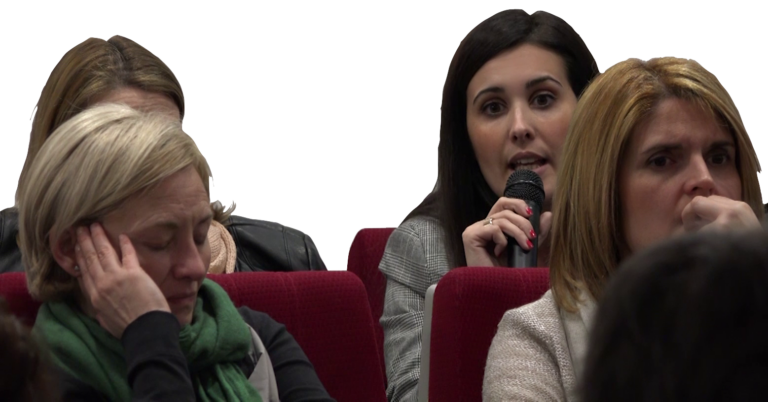
Decalogue for change
- Generate material that facilitates guidance teams focusing their work on non-segregating practices.
- Facilitate unity to assert rights: report exclusionary practices to the Committee on the Rights of Persons with Disabilities.
- Establish a Platform where all involved sectors have a voice to force transformations in mainstream schools: students, families, teachers, guidance teams, lawyers…
- Facilitate participation procedures for families and volunteers in educational centers.
- Take a stand: get involved in Parent-Teacher Associations (AMPAs), Coexistence Committees, and School Councils.
- Force the educational community to take a stand; no one can remain on the sidelines.
- Reflect as a community, to avoid reverting to exclusionary practices.
- Creation on social media of a page where everyone can have their voice heard.
- Seek academic support to make this fight present before educational inspection.
- Generate materials and links to real inclusive experiences.
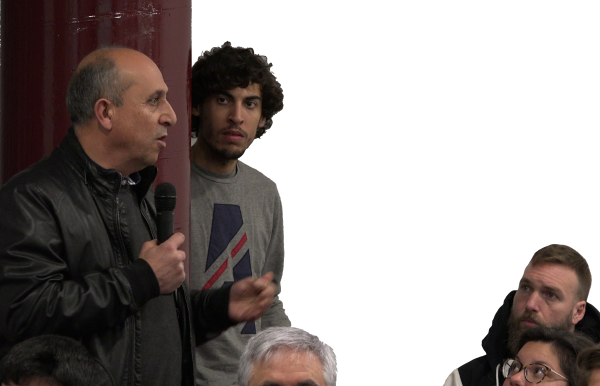
Scientific productions from the Workshop
Publications
- CALDERÓN-ALMENDROS, I. (2018). Deprived of human rights. Disability & Society, 33(10), 1666-1671.
- CALDERÓN-ALMENDROS, I.; MORENO-PARRA, J. & VILA-MERINO, E. (2022). Education, power, and segregation. The psychoeducational report as an obstacle to inclusive education. International Journal of Inclusive Education.
- CALDERÓN-ALMENDROS, I. & RASCÓN-GÓMEZ, M.T. (2022). Weaving struggles for the right to education: Collective and personal narratives for inclusion from the social model of disability. Social Pedagogy. Interuniversity Review, 41, 43-54.
- MORENO PARRA, J.; FERNÁNDEZ TORRES, P. & CORTÉS GONZÁLEZ, P. (2022). Intelligence in the initial training of guidance counselors. Student perspectives. Journal of Education, 398, 87-110.
- CALDERÓN ALMENDROS, I.; MORENO PARRA, J. & MOJTAR MENDIETA, L. (2023). School inequality and discrimination based on ability during confinement. Family experiences in participatory research processes. Complutense Journal of Education, 34(4), 945-954.
Conference presentations at scientific congresses
- CALDERÓN-ALMENDROS, I.; MORENO-PARRA, J.J. & VILA-MERINO, E. (2021). Education, power and segregation. Psychoeducational evaluation as an obstacle to Inclusive Education. Paper presented at World Educational Research Association 2021 Focal Meeting, Santiago de Compostela, Spain. https://hdl.handle.net/10630/22679
- ALONSO-BRIALES, M., DE OÑA-COTS, J.M. & VEGA-DÍAZ, C. (2021). Lifelong learning for inclusive education. Paper presented at World Educational Research Association 2021 Focal Meeting, Santiago de Compostela, Spain.
- RASCÓN-GÓMEZ, M.T. & MOJTAR-MENDIETA, L. (2021). Inclusive or exclusive education? A challenge for the Spanish School system. Paper presented at World Educational Research Association 2021 Focal Meeting, Santiago de Compostela, Spain. https://hdl.handle.net/10630/23241
- CALDERÓN-ALMENDROS, I.; RASCÓN-GÓMEZ, M.T. & CABELLO-FERNÁNDEZ-DELGADO, F. (2021). How to make our schools more inclusive? The case of Spain. Paper presented at Comparative Education Society of Asia (CESA) 12th Biennial Conference. Kathmandu, Nepal.
- CALDERÓN-ALMENDROS, I. (2022). Involving communities in the promotion of inclusive school cultures. 1st International Conference on Education and Training – Thinking education in transition times, Lisbon, Portugal. https://www.icet2022.pt/en/content/abstracts/abstract-book/abstract-book.html