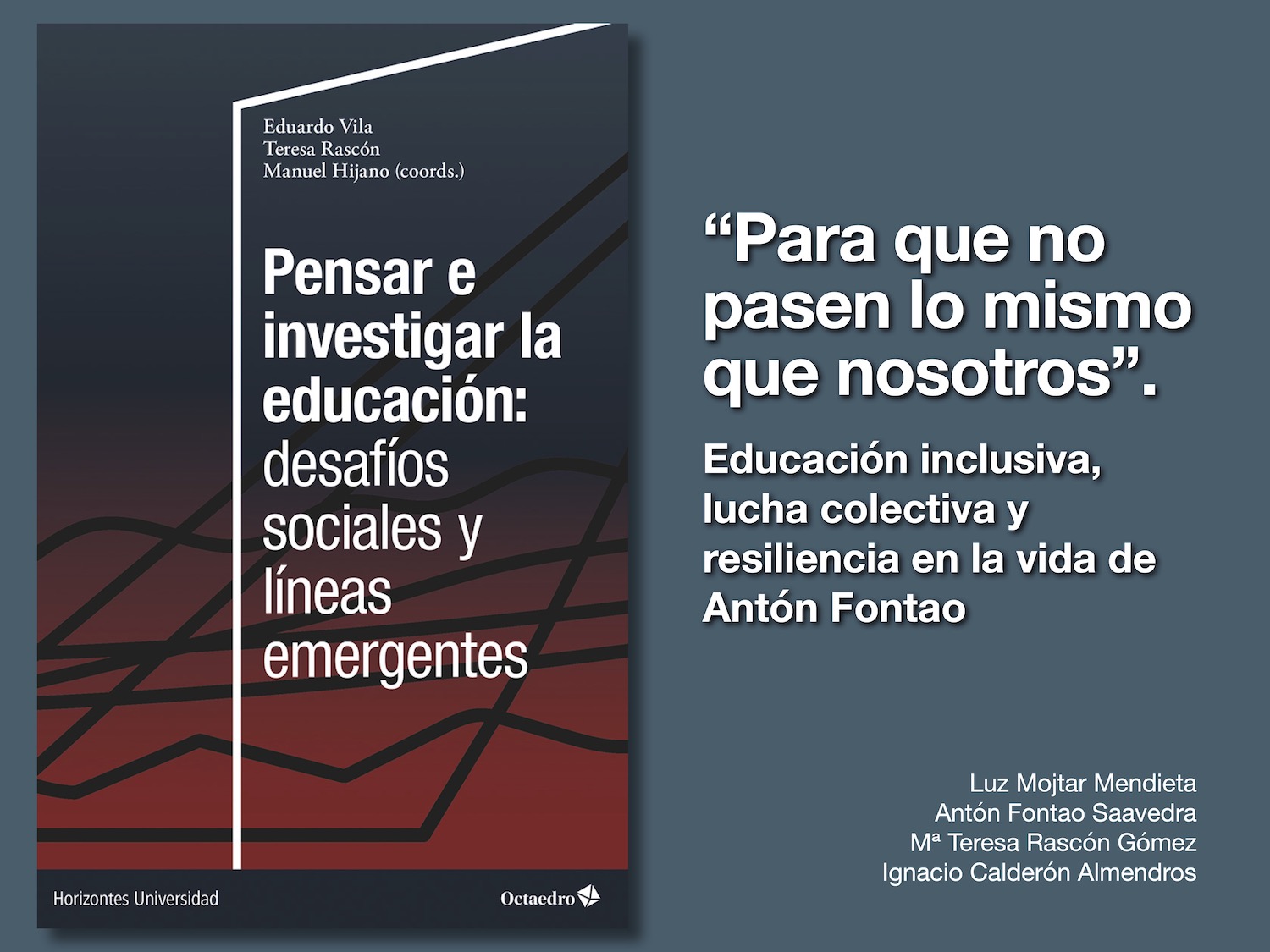
How to cite the chapter:Mojtar Mendieta, L.; Fontao Saavedra, A.; Rascón Gómez, M.T. and Calderón Almendros, I. (2024). “So that they don’t go through the same thing as us”. Inclusive education, collective struggle, and resilience in the life of Antón Fontao. In E. Vila, M.T. Rascón and M. Hijano (Coords.),Thinking and researching education: social challenges and emerging lines(pp. 49-68). Octaedro.http://doi.org/10.36006/09639-0
Authors:
- Luz Mojtar Mendieta
- Antón Fontao Saavedra
- Mª Teresa Rascón Gómez
- Ignacio Calderón Almendros
1. Inclusive education and the construction of identities
The inclusive school is a project that concerns all students without exception. It is a matter of social justice and equity, for which it aims to offer an adequate response to diversity in all dimensions of the human being: cultural, social, cognitive, gender, physical, etc. (Ainscow et al., 2013). In turn, it is a recognized human right, and international scientific evidence has already documented its academic and social value for all students (Cologon, 2022). However, it remains a fundamental right that is violated and a transformation that is pending worldwide (UNESCO, 2020). This means that even today, in our country, there are many children and young people who suffer serious institutional obstacles to enjoy school as their own, to be part of it, enjoying, learning, and participating, being welcomed into a community that sustains, cares for, and values differences.
In the endeavor to shed some light on this necessary transformation, in this chapter we will accompany Antón Fontao, a secondary school student, through some of his experiences in his school journey. His accounts place us before an educational system that is hostile to some people who deviate from the statistical norm. This journey will allow us to delve into two main ideas and the relationship between them, personified in Antón’s story: resistance and resilience. We will understand resistance as a political impulse that, focused on social justice, aims to balance social imbalances, and this movement eventually turns into resilience (Van Hove et al., 2012), so that resistant communities nurture resilient identities within themselves.
According to Susinos and Parrilla (2008), resistance theories recognize, beyond the impact of social structures on individuals, the capacity of individuals to resist dominant discourses. In other words, we are not passive objects of the reality that happens to us, but rather we interact with it, adapting to it or resisting and transforming it (Ruiz-Román, Calderón-Almendros, and Torres Moya, 2011). This second action, resistance, when experienced in company, becomes more powerful, lasting, and effective.
In the following pages, we will delve into the collective power of resistance, and we will do so through a group of students that Antón became a part of. Through this, we will attempt to illustrate how communal resistance movements allow those who suffer exclusion in school to overcome the bruises of psychological wounds (Cyrulnik, 2002).
2. Methodology
The research we address in these pages is part of a broader project that, under the title “Emergent Narratives for the Construction of Inclusive Schools” (PID2022-140193OB-I00), aims to develop the situated, creative, and complex constructions that ordinary people create in their own contexts to understand reality and carry out the transformations that allow for the defense of the right to inclusive education. To this end, a combination of qualitative methodologies has been used, which seek, on the one hand, to understand the phenomenon of school exclusion and inclusive education, and on the other, to commit to the development of changes in schools and society to overcome initial inequalities.
These methodologies are biographical and narrative research (Bolívar, 2002) and participatory action research (Ander-Egg, 2003) with different collectives. PAR is understood as “a process by which members of an oppressed group or community collect and analyze information, and act on their problems with the purpose of finding solutions and promoting political and social transformations” (Selener, 1997, p. 17). In particular, the story we present here has combined the biographical research of Antón Fontao, a 19-year-old young man, with a youth participatory action research process (Cammarota, 2017) in which the protagonist has been involved from 2020 to the present. Both methodologies shed light on the lived reality of the person, but they are also tools for developing transformations. The most evident are the vital transformations, which go hand in hand with biographical analyses that bring awareness to the processes experienced firsthand. In this sense, focusing on one’s own life has the potential to transform subjectivity. For their part, participatory research processes allow people, in this case young people, to be involved in building resistance to counteract oppressive schooling that reproduces inequalities (Cammarota, 2017). This entire methodological framework is based on the idea that valuable, rigorous, and useful knowledge can be built from the voice of the students (Fielding, 2012). The experiences of young people and the way they internalize and question them allow us to understand the contexts of oppression and exclusion in which they develop (Bertaux, 1981), with an emphasis on the processes of identity construction. This knowledge is the starting point for undertaking transformative and resilient processes. Therefore, narrative methodologies facilitate social and personal transformations, which in this case are used with the aim of understanding complex realities from the point of view of the people who live them, in order to contribute to emancipatory processes (Barton, 2009; Calderón, 2014; Parrilla, 2010).
The life story on which this chapter focuses “allows us to know the social positions that people occupy throughout their lives and, in parallel, the changing definitions of themselves and their world. It could be defined as the narration of a person’s life experience” (Taylor and Bogdan, 1986, p. 174). It helps us to locate and unravel the barriers and forms of oppression that the protagonist, along with other students, experiences in schools, to provoke a context of knowledge construction among them in which to face them and promote their overcoming. To this end, the focus of attention is placed on the creation of a support network for its power to generate resistance (Giroux, 1983) and resilience (Cyrulnik, 2002), acting at the personal, relational, or structural levels for the construction of change.
Antón’s journey through school, as well as his narration and problematization, leads to his participation in “Students for Inclusion,” a youth participatory action research group for the right to education, which redefines Antón’s role in the education system and in society, turning him into an agent of social and educational transformation.
All of this demonstrates how research becomes a form of activism here that legitimizes discourses, facilitates resistance, builds networks of mutual support, and enables empowerment processes for subaltern groups. Therefore, far from being simply a job developed by academics, it draws on the knowledge, perspectives, and experiences of students, who become researchers of their own stories. This approach places them in a position of power to reconstruct their realities by understanding them better and becoming part of a resistance group that shares a common language. In this sense, research becomes a means to drive social change.
3. Processes of exclusion and inequality in schools
The concept of exclusion is closely linked to that of inequality. A multidimensional term that not only refers to income level but to everything that affects a person’s social participation and the enjoyment of their basic rights. Given the difficulty in addressing this multidimensional character of inequality in these pages, we will focus on what seems to have the greatest impact on social exclusion: social isolation (VIII Foessa Report on Exclusion and Social Development in Spain, 2018).
Separating or marginalizing a person from their closest groups due to their appearance, way of being, thinking, or acting, generally leads to feelings of loneliness, discomfort, and stress. School can become a context of social isolation for boys and girls belonging to vulnerable groups. Whether due to gender, ethnicity, place of origin, abilities, income level, or sexual identity, the truth is that many boys and girls are perceived by the majority of adults and their “equals” as “different.” Despite having more in common than what separates us, there are reasons of different dimensions that support this view. On one hand, there are cognitive reasons, fundamentally a lack of knowledge about differences. This lack of knowledge is covered up by stereotypes, which prevent understanding. On the other hand, there are emotional reasons, mainly the fear of the unknown, but also the fear of challenging social orders that limit our desire to know others. Finally, there are volitional reasons, as will also comes into play, held back by the previously mentioned reasons. All of this contributes to invisibility, which completes the circle and reinforces the power of the norm. This process of rejection ultimately causes social and educational death for those who suffer it. This is how Antón, the protagonist of this story, expresses it:
“The word ‘subnormal’ is used in all the institutes. It’s always very present. The other day, a teacher asked us to do a short dialogue and some students went out to perform it (I would have liked to go out too, but I couldn’t) and on several occasions the word ‘subnormal’, ‘mentally retarded’ and other offensive slurs came up. I was a bit shocked, to be honest, because I thought he was a cool and fun teacher, but how could he not say anything to them? The word ‘subnormal’ hurts me, I wish it would disappear” (Antón Fontao, Personal Facebook post)
The use of the word “subnormal” remains very common among young people, as evidenced by the testimony presented, and it carries an enormous ideological charge: it is ableism publicly embraced without shame, because it is a common trope. It is used to mock another person, implying they are beneath the rest, with contempt and humiliation. The pain expressed by Antón is largely associated with this word being used to label people who, like him, are defined by their disability. Thus, this insult that his classmates throw at each other carries the stigma he suffers. It is a humiliation to which he is continually subjected, with the consent of the teachers.
It is this stigma that pursues him as he experiences prolonged social isolation from his classmates and teachers. Unwanted loneliness, social isolation, has been a significant part of his school experience.
“In school, no one should ever be or feel alone, because life is hard enough as it is.” (Antón Fontao, Personal Facebook Post)
For Antón, opportunities to interact with his peers have always been very limited, due to a social context that dictates interaction logic based on the social organization of normality, or that in any case does not sufficiently challenge existing inequalities in the social and educational system.
“Teachers should choose the work groups because otherwise, I always end up alone.” (Antón Fontao, Personal Facebook Post)
The free choice of groups is a way of assuming social imbalances in school activities, meaning it is a form of social reproduction. Although many students see this as normal and appropriate, it reinforces the social positions and privileges of those who are already well-positioned within the classroom’s social system. For Antón, this choice is unfair, and the moment it occurs is distressing. All of this leads to a feeling of being out of place.
“At the institute, I feel very alone; I spend my breaks alone. It’s true that during some breaks, I was with a group from my class in another section, but I think I was in the way. Naturally, because that group might have wanted to talk about their own things, and I was in the middle… I felt like, you know in series when they say ‘with the special collaboration of…’? That’s how I feel, like a guest artist. Which is fine, you know? I know perfectly well that having a group since Primary school, it’s not easy for someone else to join their lifelong group, but I want them to feel me and for me to feel like I’m part of it, which isn’t easy, and I understand they don’t do it, but that’s what I would like. It’s been a long time, exactly since Primary school, that I haven’t felt this way. There’s a small group in my class that I thought would be easier to join and build friendships with, but not even that.” (Antón Fontao, Personal Facebook Post)
School is the second socializing agent after the family. It is one of the fundamental places where we have the opportunity to meet people outside our immediate environment. It therefore has great importance for people’s socialization, but also for emotional development, self-concept, and self-esteem. We are built in society, so the context in which we operate plays a fundamental role in shaping subjectivity and one’s place in the world. Starting from this idea, how is the identity of a person who is denied the opportunity to interact with others formed? How does someone who is continually rejected in social relationships see themselves?
The evidence cited so far shows how rejection and isolation occur within what Doyle (1977) calls the structure of academic tasks. There is a feeling of loneliness rooted in class activities, which, when unregulated, become part of the system of oppression experienced by vulnerable individuals. This isolation extends to the structure of social relationships, even beyond the classroom. These are therefore processes of isolation that permeate school activities, both those organized by the curriculum and those aimed at play and socialization, and in the different settings where school life takes place.
Recess is the break from academic activity and the time the school leaves for students’ leisure and relationships. When in that space and time there is no one to share it with, and the silence and loneliness are repeated day after day without rest, recess takes on a new meaning. While most students eagerly await the sound of the siren indicating that it is time for recess, Antón receives it with reluctance and pain. He only goes out to the yard because he is forced to, as it is a constant reminder of the loneliness to which he is subjected. Deregulation, which is mostly understood as “free time,” means oppression for other people. And the school, as an institution, allows this inequality to happen: free time for some can be torture for others. Evidence of this is the words with which Antón writes, on his social media, part of his story through Antonio Vega’s song,“The Place of My Recess”.
“The siren sounds, it’s recess time, I don’t like it, I’d rather stay in class writing on my laptop, but they make us go out. Once there, I go to my usual spot, I stay there alone watching kids play basketball, some are from my class and some from the other. I also see a group of friends who were in my class last year talking. Last year I tried approaching them some days, trying to overcome my intense shyness. They never spoke to me, just ‘hello’ when I came and ‘goodbye’ when the bell rang, and only two out of many there did that. This year, it’s more of the same, except that at the beginning I talked a bit with those two people, then only one of them spoke to me, and then not even her. Another recess, I’m alone, another, another, alone.” (Antón Fontao, Personal Facebook Post)
Continuous isolation erodes self-concept and self-esteem, as we are built in the gaze of others. Even in those gazes that do not occur. Shame is a subjectivization of those gazes, which make one feel strange and intrusive. It is a construction that develops over time, through prolonged processes of exposure to incisive situations.
Antón has not always been alone. Both his mother and he fondly remember the wonderful work done by his kindergarten teacher with a group of which all the students felt a part, including Antón. For the family, those years were the best in their relationship with school; Antón was happy, and so he entered Primary school, accompanied, loved, and valued. Unfortunately, and despite many efforts to maintain that well-being, time passed, and something in those children changed, causing Antón deep pain.
“There is a person I invited to my house many times, my parents have taken them in the car many times, I have protected them from several instances of disrespect, and many other things. That’s why it blows my mind that they ignore me like this, as if they had forgotten everything. I know they’re in a different place now, but it makes me angry because in first grade of primary school we were super friends, until we went down to the playground on the first day of middle school and they immediately left and left me alone without me knowing anyone. They started to care less and less about me, more and more. I did a lot for that person, but apparently, they forgot. I will never forget that, I can hide it, but I will never forget it.” (Antón Fontao, Personal Facebook Post)
This has been the pattern of Antón’s years in Compulsory Secondary Education. But also at the end of those years, he began to meet a group of students with whom he would share a common project: promoting inclusive education. And those other students, from different backgrounds than his own, began to provide companionship during his loneliness…
“I’m sick of being alone, I’m too tired of no one accompanying me during recess in these first three years of middle school and of all the groups rejecting me. Sometimes I think how cool it would be if Carlota, Érika, Leo, Jorge, and Malena were here, but it makes me laugh because Malena is many kilometers away, on the other side of Spain.” (Antón Fontao, Personal Facebook Post)
4. From victims of a system to political actors: collective resistance
We haven’t mentioned it until now, but a large part of what happens to Antón is justified by Joubert Syndrome. Historically, disability has been considered a deficit of the subject, possessing non-normative characteristics and a non-normative body. Anything that deviates from the canons of normality is considered a defect, an illness, and therefore requires a cure provided by doctors, psychologists, and other specialists linked to the health sciences.
Resistance to this medical model of disability led to the emergence of the disability rights movement in the 1960s, during the peak of other struggles led by oppressed groups (feminists, the LGTBI community, people of African descent, etc.) based on the principles of freedom, equality, and human dignity (Palacios and Romañach, 2006). This movement consolidated to give rise to the Social Model two decades later, a new paradigm in the very conception of disability. For this new approach, the problem is not located in the individual, but in the environmental barriers. It is the physical and social barriers to participation that create disabling environments.
This is a good example of how collective resistance has contributed throughout history to challenging and transforming hegemonic cultural norms and values, promoting social change and the construction of increasingly diverse and inclusive societies, advancing equity and social justice. And it makes a lot of sense: a social practice cannot be transformed in the individual sphere. Confining Antón’s problem, which we have outlined in these pages, to the syndrome he carries is foolish. Rejection or exclusion are social realities that Antón suffers, and which are justified by disability. However, we are talking here about disability as an unbalanced form of relationship, and there is no individual clinical treatment that can solve that. Just as the problem was never with homosexual people, for example, even though they were treated as ill; the problem, evidently, has always been in the conception and practices of heterosexual people, who hold hegemony. Nor was the problem ever with women’s bodies, but with machista oppression. Nor with the skin color of certain people, but with racism.
It has been these collectives that, at different moments in history, were capable of recognizing their situations outside the socially shared epistemological framework, thus developing a social and political movement that expands rights. That is what Antón would find in a group of students who, as we anticipated, began to meet with the simple idea of building a guide to make schools more inclusive based on their own experiences. That group transcended the limits of a specific oppression (for example, disability, understood as a relationship), because it was made up of enormous internal diversity: of social class, abilities, ethnicity, nationality, race, health status, sexual orientation, gender, rural/urban environment, academic performance, etc. A human group was formed that had the opportunity to share experiences and, with it, to recognize themselves in others.
For Antón, the protagonist of this story, coming into contact with this group of boys and girls was like a breath of fresh air in the desert he was living through. Among the members, some were more oppressed by schools and others were more privileged in them, but all of them were able to build a critique of a school that, according to their own elaborations, does not sufficiently respect childhood and youth. Then, participating in this process meant no longer being alone, discovering that his thoughts and feelings were shared by other boys and girls, it meant enormous support and joy for him. But there was also a healing element in all that diversity: that what was considered normal became diluted, and with it, the possibility of being strange disappeared.
“When I met EXI (Students for Inclusion) I was having a terrible time at high school, I spent breaks alone, and meeting them online was like having support during that difficult stage for me. Knowing that we were all having a hard time at school, each for their own reason, comforted me; by listening to them, I empathized a lot and felt increasingly connected to them, and having something in common and knowing they existed made me a little stronger when I had to endure that loneliness that suffocated me so much at school.” (Antón Fontao, Personal Facebook Post)
A loneliness that “suffocates” is eradicated by accompaniment, not necessarily physical, that oxygenates. This was the beginning of a profound personal transformation process. Throughout this process, he transitioned from sadness and pain to joy and pleasure; from loneliness to companionship; or from exclusion to coexistence and understanding. Antón went from being an “invisible” person at his school to becoming an essential person for the group’s work to move forward. His experience and knowledge were not only validated by other students but also by university researchers. The guide they developed was published (Calderón, Mojtar, Cabello, and Students for Inclusion, 2021) and presented by them to the Minister of Education; they starred in a documentary (Barriga, 2022) and were featured in press and television reports. They then began to be requested by educational professionals from all over the country to provide training.
“I think about everything we did, and I would tell all those people from the past right now that they were wrong, that look, we, a great group we have, have reached the Ministry of Education and have been with a whole Minister in a room, we advocate for problems we suffer in school, we went to her office and some even follow us on social media, while the people from the previous year did not have such an experience, I would tell them that we are also fighting for them, because, just like us, they are victims.” (Antón Fontao, Personal Facebook Post)
In Antón’s words, one of the great changes experienced is distilled: the shift from shame—that of walking with your head down, speaking very softly and with little articulation, trying not to be seen to avoid feeling rejection again—to pride. A pride rooted in a production, a work, but it is a work that distills the very thing that caused his friend to gradually abandon him. What should have been hidden had now been publicly revealed. Explicitly published. And advertised. His experiences—the ones that embarrassed him—are going to the press, radio, and television. And this is done with a clear purpose: to improve the school for all students, because they have discovered that this diverse group is a mirror of all their classmates, and therefore, there is a whole liberation to be generated in schools. Hence, the moment of presenting their experiences and proposals to the Minister—the highest representative of the school system in the country—in the majestic building of the Ministry of Education, was loaded with great symbolism and meaning, as well as great responsibility:
“I freaked out thinking about the meeting with the “Minister, because we entered there as if it were the most normal thing in the world (not counting the nerves we had due to so much responsibility). I was sitting next to the Minister. I didn’t realize it until several days later. At first, what the Minister said was nothing more than words, words, and words, like any other politician, but throughout the meeting, we touched her heart more and more, because all humans have one.” (Antón Fontao, Personal Facebook Post)
Antón says that he has been with the highest representative of our country’s educational system, something that is an indescribable source of pride for him and has undoubtedly contributed to his empowerment. But far from being satisfied with just that achievement, he becomes emotional highlighting the value that being part of a group of people who respect, value, and love each other has had and continues to have in his life. The years of loneliness are behind him, replaced by the happiness brought about by the support and companionship of friends who fight together for a better world for everyone.
“When I went to Madrid and met ‘Students for Inclusion’Inclusion”, it filled me with so much happiness… I felt great. I lived those days with adrenaline, intensity, and happiness. There I felt pure fire with my whole group of “Students for Inclusion”. The day we met with the minister of education, we were outside for a while, in front of the ministry, with immense responsibility on our shoulders. I, with the nerves I had, was almost at the point of needing defibrillators to revive me, and I mean that almost literally. Inside, we told the minister all our experiences; Malena cried, Indira cried, Zulaica cried, Alberto cried, and I almost cried too. […] I want you to know how emotional what we experienced inside was. […] We fight for an inclusive school, not just for those of us with disabilities, but because, believe it or not, everyone else is also struggling in school.” (Antón Fontao, Personal Facebook Post)
Both Antón and his group now assert themselves with strength, feeling part of a youth movement fighting so that no one in schools has to go through a ordeal similar to what many of the group’s boys and girls have experienced.
“Being able to express ourselves in front of the Minister has been very important to me. Each of us has been working for some time to build an inclusive school, and we are still working on it, meeting virtually, but being able to meet in person at last filled us completely with happiness. An inclusive school is what we want and what we fight for, so that going to school or high school isn’t like going to jail, as it seemed to me this year, for example.” (Antón Fontao, Personal Facebook Post)
It is a genuinely political movement, of activism and of claiming their own agency, even after being treated as objects for years in their schools. It is the power of the group that allows for the generation of political literacy processes, in which students, even the most vulnerable, can assume leadership within the oppressive systems in which they live, and appropriate the spaces where their opinions have been ignored. When this happens, young people become agents of change, capable of challenging cultures, policies, and practices, in search of a more just society. A movement that can act as support and guidance for other young people who find in Antón and his friends the shared language of a large-scale collective resistance. In some screenings of the documentary in high schools and universities, attendees recognize, among other virtues, the courage in the “Students for Inclusion”.
Schools are privileged places to develop processes like the one described, in which the value of diversity and the voice of students are the raw material for building new forms of relationships and new epistemologies. In which they are involved in activities and spaces where they can express their opinions, reconstruct their experiences through dialogue, and contribute to decision-making. In this way, they can experience their capacity to generate significant changes that respond to their needs and those of others, transforming their actions, adopting a leading role in history, and challenging the structural conditions of their experiences. Because it is there that the obstacles that prevent schools from being places of hope for all students without exception are located.
5. Activism, Resilience, and the Healing Power of Education
Up to this point, we have seen that the focus of action has always been clear: if Antón’s problem is not personal, addressing it must target the conditions that sustain discrimination. The same would happen with other oppressions that intersect within the group and in schools: the solution lies in political action for sociocultural transformation.
It is in this collective sphere where people work and fight together to bring about social and educational change, that personal empowerment is born. There is a Vygotskian foundation in the process followed. The group of students generates dialogical learning in which they position themselves as producers of knowledge at the highest level. Not in vain, they were going to present a guide to the Ministry of Education. And it is in the internalization of the cultural products generated, in the exchange, that personal development occurs. Thus, collective struggle is a breeding ground for personal growth, committed to social change and full of hope, because the group can achieve what individually seems impossible. So, when students begin to become aware of the oppression to which they have been subjected by the school and society, and come into contact with other boys and girls who are excluded and segregated from it for having different characteristics; they see themselves reflected in others and decide to unite to change that reality. At that moment, when they perceive that their voices and actions begin to have repercussions in their closest environments and in others further away, that is when personal and collective empowerment emerges. It moves from an identity of adaptation, in which Antón and his friends conceived themselves as objects of the conditions to which they were subjected, to project-based collective identities: when, based on the cultural materials they have been generating, they “construct a new identity that redefines their position in society and, in doing so, seek the transformation of the entire social structure” (Castells, 1998, p. 30). This has a strong impact on the personal level. It is what Ruiz-Román, Calderón-Almendros & Torres-Moya (2011) call “interpretive identity,” by giving the person a greater capacity to decipher what is happening in their contexts and to project themselves relatively autonomously based on the new reading they make of reality. This greater mastery of school logic offers more security to the person, who allows themselves to conceive of themselves as activists, as someone who rebels against the reality that oppresses them and who works for change.
“The work we are doing in this group is because we don’t want anyone else to go through the same thing we went through. So that those boys and girls in the future who will be in educational centers do not suffer what we have suffered. That seems very important to me and that’s why I’m here, because I don’t want anyone to go through that.”(Antón Fontao, Personal Facebook Post)
Antón recently turned 19, and his strong commitment to improving schools remains intact. The seed of all the change he has experienced is the promotion of change in schools as altruistic work. And by doing so, he has been able to feel proud of being the person with a disability that he is. In fact, on several occasions, he has made it explicit on his social media that thanks to having Joubert syndrome, he is in this fight that he does not want to abandon. Furthermore, for a few years now, he has been happy because he has managed to make true friends. Something he also associates with the same reason.
“The truth is that I wouldn’t trade having Joubert for anything. I had great experiences, like this one, and met a lot of fantastic people, like these. It might sound masochistic, but I’m grateful I had such a hard time in high school. What is true is that I couldn’t have been luckier having a functional diversity. With me, you can skip that famous question of ‘And when did you accept your disability?’, because honestly, I’ll tell you I’ve never accepted it; it’s part of me like having blue eyes. I don’t know if you understand what I mean.” (Antón Fontao, Personal Facebook Post)
An pride that doesn’t just stop there; activism runs through Antón’s veins, and proof of this is his social media, where day by day he shares his commitment to the human rights of all people through reflections, protests, or solutions, among other things.
“I want students and teachers to read this post. Values shouldn’t be just a one-hour class a week. Neither should tutoring, let alone a mere twenty minutes. In Values class, we should talk about inclusion and how not to feel alone at school, and I would gladly accept going to give a talk about that, for two hours, if I have that permission, with a fellow student from ‘Students for Inclusion’.”Inclusion”. At my high school especially. And that all the teachers were present. What am I saying, in class, in the auditorium. In the case of my high school “La Senra”. I’m delighted. I would love for you to share it, especially the Parent-Teacher Associations of the schools I attended: As Mariñas and Mondego”. (Antón Fontao, Personal Facebook Post)
It’s an act of bravery. A young man who has long defined himself as a shy person, who now doesn’t hesitate to call out the people who have made him or others suffer. And it has been collective work that has given him the strength to do so. Along with his classmates from “Students for Inclusion”, has managed to have a place for their voice, and for it to be valued and respected. The knowledge of students is being legitimized in the media, at scientific congresses, and in teacher training centers.
“The other day, three people from “Students for Inclusion” had an online meeting with counselors, and I forgot to mention that everyone who works in a high school defends themselves. Last year I had a math teacher, who was our tutor, who in tutoring sessions, every time we told him something about the social studies teacher, he always defended her. So please, counselors present the other day, and in general, all high school workers… LET THEM DEFEND THEMSELVES OR LET YOURSELVES BE DEFENDED.” (Antón Fontao, Personal Facebook Post)
His latest work has been the creation of a script for a short film about violence in schools, produced as a group of experts for the Generalitat de Catalunya.
“Honestly, I couldn’t be happier with my life. It doesn’t even compare to the bad times. I don’t know if what awaits me will be good, which is something I want more than anything in the world. I want to be very happy. I am happy now too. I want my disability not to influence my future. That is, when it comes to auditions, holding a baby (mine or someone else’s) for example, etc. First, I have to achieve what I want to have. I couldn’t be happier with the people I know. Such wonderful people. I suppose people who aren’t worth it will drift away from me, and when I’m older, the opposite will happen.” (Antón Fontao, Personal Facebook Post)
6. Conclusions
The story outlined here, starring Antón Fontao with reflections on his school experiences, accounts for the complex and flawed socialization processes that some people, overshadowed by different stigmas, in this case disability, undergo. These are processes of oppression in which the entire school community exerts pressure for the person to adapt to the mold of prejudice, thereby causing great suffering. The example of Antón’s recess experience as torture shows the pain many people experience in schools while the word inclusion is dragged along and distorted to serve the interests of a school system obsessed with homogeneity and competitiveness.
The story told in these pages has the peculiarity of showing how a profoundly educational process —the one the protagonist experiences within the collective “Students for Inclusion”— can transform part of that pain into something new. This dialogical process, in which very different people come together to build a tool committed to changing schools, has meant an interpretative turn for Antón, while also constituting a new social context in which to rebuild his identity. Of course, the harm done by the school will always be irreparable. However, political resistance has meant political literacy, a relaunch of personal agency, and the development of transformative collective action. All of this has contributed significantly to healing part of the experienced harm. And it has happened thanks to an enormous educational process, in which the person learns significantly from a collective presided over by differences, and teaches what has been learned to people who occupy the position that inflicted so much harm on them.
7. Bibliography
Ainscow, M., Dyson, A., Goldrick, S., & West, M. (2013). Promoting equity in education.Journal of Educational Research, 11(3), 44-56.
Ander-Egg, E. (2003). Rethinking participatory action research. Lumen Humanitas.
Barriga, C. (Dir.). (2022).Inclusive education. Quererla es crearla.Ministry of Science, Innovation and Universities.
Barton, L. (2009). Disability studies and the search for inclusivity. Observations.Journal of Education, 349, 37-52.
Bertaux, D. (1981). Biography and Society. Sage.
Bolívar, A. (2002). “¿De nobis ipsis silemus?”: Epistemology of biographical-narrative research in education. Electronic Journal of Educational Research, Ensenada, 4Electrónica de Investigación Educativa, Ensenada, 4(1), 1-26.
Calderón Almendros, I. (2014). Education and hope on the borders of disability. Cinca.
Calderón, I., Mojtar, L., Cabello, F., & ‘Students for Inclusion’ Collective (2021).How to Make Your School Inclusive. Ministry of Education and Vocational Training.
Cammarota, J. (2017). Youth Participatory Action Research: A Pedagogy of Transformational Resistance for Critical Youth Studies. Journal for Critical Education Policy Studies, 15(2), 188-213.
Cologon, K. (2022). Is inclusive education really for everyone? Family stories of children and young people labelled with ‘severe and multiple’ or ‘profound’ ‘disabilities’. Research Papers in Education, 37, 395-417. https://doi.org/10.1080/02671522.2020.1849372
Cyrulnik, B. (2002). Ugly Ducklings. Resilience: An unhappy childhood does not determine life. Gedisa.
Doyle, W. (1977). Learning the classroom environment: an ecological analysis. Journal of Teacher Education, 28(6), 51-55. https://doi.org/10.1177/002248717702800616
Fielding, M. (2012). Beyond Student Voice: Patterns of Partnership and the Demands of Deep Democracy. Journal of Education, 359, 45-65.
Giroux, H. (1983). Theories of reproduction and resistance in the new sociology of education: A critical analysis. Harvard Education Review, 53(3), 257-293. https://doi.org/10.17763/haer.53.3.a67x4u33g7682734
Palacios, A. and Romañach, J. (2006).Functional diversity: bioethics and human rights as a tool to achieve full dignity in functional diversity. Diversitas/AIES.
Parrilla, A. (2010). Ethics for inclusive research. Revista de Educación Inclusiva, 3(1), 165-174.
Ruiz Román, C., Calderón Almendros, I. and Torres Moya, F.J. (2011). Building identity on the margins of globalization: education, participation, and learning.Culture and Education, 23(4), 589-599. https://doi.org/10.1174/113564011798392398
Selener, D. (1997).Participatory action research and social change. Cornell University Participatory Action Research Network.
Susinos, T. and Parrilla, A. (2008). Giving voice in inclusive research. Debates on inclusion and exclusion from a biographical-narrative approach.Iberoamerican Electronic Journal on Quality, Effectiveness and Change in Education, 6(2),157-169.
Taylor, S. and Bodgan, R. (1986).Introduction to Qualitative Research Methods. Paidós.
UNESCO (2020). Global education monitoring report 2020: Inclusion and education—All means all. UNESCO. https://unesdoc.unesco.org/ark:/48223/pf0000373718
Van Hove, G. et al. (2012). Resistance and resilience in a life full of professionals and labels: narrative snapshots of Chris. Intellectual and Developmental Disabilities, 50(5), 426-435. https://doi.org/10.1352/1934-9556-50.5.426