‘Quererla es Crearla’ is having a very wide impact across a broad spectrum of media. Below are some of the news items, interviews, and reports published in the written press, as well as on television and radio.
TV Reports
La aventura del Saber, RTVE

Tesis, Canal Sur
Audio description [AD]: Intro for the TESIS program, Canal Sur.
(Background music)
Audio description [AD]: A diverse group of people enters the University of Malaga campus, surrounded by green areas. They sit on a circular stone bench and begin to chat animatedly. Close-ups capture the excited expressions and enthusiasm in their interactions.
Audio description [AD]: Teresa Racón speaks to the camera in a green area.
Teresa Racón:— Quererla es crearla is a movement that has its beginnings somewhat from a workshop which was held here, at the University of Malaga. In it, people from all over the Spanish landscape—teachers, students, education professionals, guidance counselors—gathered, and from there, we began to identify a series of needs that the school seemed to have. Transformations that were necessary to make it more inclusive.
Audio description [AD]: Several people enter the Faculty of Education Sciences building in Malaga.
Sign: Educating in equality.
[Music]
Audio description [AD]: The faculty lobby is shown, followed by Ignacio Calderón speaking to the camera in a green area.
Label: Ignacio Calderón, professor at the Faculty of Education Sciences of the UMA and member of 'Quererla es Crearla'.
Ignacio Calderón:— It emerges from several places. On one hand, from the social sphere, from the activism of many people who have been doing work for a long time, but also from the university, out of the desire to fundamentally transform how schools serve the entire population.
Audio description [AD]: A group of young people of various ages are talking in a natural setting. People are joining in.
Label: The 'Quererla es Crearla' project at the University of Malaga works towards an education system based on equity and inclusion.
Ignacio Calderón (v.o.):— So, in a way, there is a union between people's desires to transform those schools and the work being done at the university to support those people in developing discourses, building new practices, transforming policies, and so on.
Audio description [AD]: Diana Farzaneh speaks to the camera in a classroom at CEIP La Parra.
Label: Diana Farzaneh, Inclusive Pedagogy teacher at CEIP La Parra.
Diana Farzaneh:— Students who find themselves in a situation of exclusion are the most vulnerable students, because they do not fit within the normative framework that we understand as 'normal', such as students who have a sexual orientation different from the majority, students who present cognitive peculiarities, physical peculiarities, peculiarities in the way they communicate...
For us, differences are not a problem, they are not a difficulty. We want girls and boys to be people who value differences as something wonderful and necessary, and not as a problem that a person feels in a different way than I do. That a person thinks, moves, or speaks differently than I do.
Audio description [AD]: The group of participants hugs and laughs as the camera focuses on each one of them.
Audio description [AD]: Carmen Moreno speaks to the camera in a green area.
Label: Carmen Moreno, member of 'Quererla es crearla'.
Carmen Moreno:—'Quererla es crearla' is a project that we believe, above all, is the foundation for an inclusive school. The main seed is for the entire educational community and society as a whole to understand and recognize the right to inclusive education. We must change our perspective and our culture.
Audio description [AD]: The group enters a classroom at CEIP La Parra and sits down. The documentary is projected Quererla es Crearla.
Label: The group works on providing advice and training to schools so they can implement a more egalitarian model in the classrooms.
Audio description [AD]: Carmen Matés speaks to the camera in a classroom at CEIP La Parra.
Caption: Carmen Matés, principal of CEIP La Parra.
Carmen Matés:— We found that, in order to work on inclusion, we needed to invite someone from outside who could help us. So, we called the University, spoke with Nacho Calderón, and he came to provide training to the teaching staff on how we could work in that inclusive school.
At first, we understand that the inclusive school seems like magic, right? You do some training and it seems like you've already got it. And you realize, from the moment you start, that it is the opposite. That it is a world in which you have to keep working, day by day, and that when it comes to addressing any conflict, which is something natural in schools, the question is how we are going to address it, beyond learning. That is where we already have the need for how we can do it, right?
Audio description [AD]: Diana Farzaneh speaks to the camera in a classroom at CEIP La Parra.
Diana Farzaneh:— The structure we currently have in the education system does not allow us to build inclusion from the beginning, because the curriculum implies a difference. The curriculum, as it is currently organized, most teachers use textbooks, for example. Well, that already poses an enormous barrier for all girls and boys, not only for a more peculiar side, but also for the rest who are understanding that knowledge comes packaged in a book, which is what that publisher marks. That is what needs to be known and the rest is not of interest. For example, that is contrary to cultural values, isn't it?
In our school there are girls and boys from different cultures and, nevertheless, the textbooks only speak of one very specific culture. Theirs are made invisible. If we understood that that is the curriculum, well, we would be making invisible and taking value away from their culture, the one they bring. From the knowledge that the girls and boys bring.
Audio description [AD]: Carmen Matés speaks to the camera in a classroom at CEIP La Parra.
Carmen Matés:— It is very difficult to provide... mass education, right? The same for everyone. Well, it is easy to provide, but it is not easy for it to reach all students because each one learns in a different way, each one has their own emotions, and each one comes with a differently loaded backpack.
Therefore, responding to each student is where the demand on the teacher comes in. We need that training, that help, that constant reflection to which we teachers are sometimes not accustomed, in which we need to learn by listening to others.
Audio description [AD]: The documentary Quererla es crearla is screened in the classroom at CEIP La Parra. Opening scene: Collage. A boy smiles over a large fuchsia-colored cogwheel. In the foreground, an old typewriter with a note that reads "but we wanted love." On the left side, a document titled "Convention on the Rights of the Child (20.11.1989)."
Audio description [AD]: Next, images alluding to slavery and the anti-racist struggle follow. Among them, the faces of Martin Luther King, Nelson Mandela, Rosa Parks, a Black woman voting, and protesters appear.
Narrator (v.o.):— There was a time when the color of some human beings made them the property of others, a time when the law discriminated against and segregated them. But we wanted freedom.
[Music]
Audio description [AD]: Scenes of students participating in the filming of the documentary.
Caption 1. Make the institution a participant.
Label 2. It helps avoid prejudice and fosters dialogue between generations and groups.
Label 3: Students from the Faculty of Education Sciences have contributed to the project with a YouTube channel to offer educational content.
Label 4: Teresa Rascón, professor of Educational Sciences at the UMA and member of Quererla es Crearla.
Teresa Rascón (original version):— The participation of the students here at the university in those tutorial videos has truly been very active from the beginning. Furthermore, it was work that I consider very enriching for them because they had a period in which they had to prepare the scripts. We, the tutors, reviewed them, and from there, they had to learn them, record them...
In other words, I believe that for them, at least the evaluation they made of that process was very positive. And the fact of seeing that this product, which is developed here within the university, does not stay within those four walls, but rather goes out and truly will have utility, for training, for example...
Audio description [AD]: Teresa Rascón speaks to the camera in a green area.
Teresa Rascón (v.o.):— For example, we are using it for teacher training courses. It is even available on the university's website. That is to say, any school that wants to can go to the website of www.creemoseducacioninclusiva.com and all the resources we have been creating are posted there.
Audio description [AD]: Teresa Rascón and Ignacio Calderón show materials and resources from Quererla es Crearla to the participating group in a classroom at CEIP La Parra.
Ignacio Calderón (v.o.):— A lot of creative narratives have sprouted from reality about how people can transform the reality that is causing them harm or that is in great need of improvement. Well, that is where the guides that have been created emerge from.
Audio description [AD]: Ignacio Calderón speaks to the camera in a green area.
Ignacio Calderón:— Various guides have been developed: a guide for building public policies; a guide created by students for other students, so that they themselves can build their own schools. In other words, they do not have to wait for the teaching staff to do it, but rather they get to work on building those inclusive schools.
Audio description [AD]: Three young people browse through a magazine titled How to make schools inclusive, from La aventura de Aprender.
Ignacio Calderón:— There is a guide created by families on how to dissent in schools; a guide for guidance counselors to build guidance practices that are in line with inclusion and human rights.
Audio description [AD]: Ignacio Calderón speaks to the camera in a green area.
Ignacio Calderón:— And, finally, there is another one so that schools themselves can build participatory action research processes, which is the other major methodology we have used.
Audio description [AD]: Official meeting between the Minister of Education, Pilar Alegría, and the Secretary of State for Education, Alejandro Tiana, and two young women, sitting in front of them. One of the young women is addressing them.
Young woman:—… they tried to expel him from school. And we have a friend, whose name is Rubén, who was indeed kicked out of school.
Audio description [AD]: In an outdoor space, two young people dance in the background and a third young person, in a wheelchair, remains near a table in the foreground. Next, a young person with a backpack walks through a square with restaurant tables.
Label: The documentary Quererla es crearla, directed by Cecilia Barriga and featuring the participation of the collective, was screened at the Reina Sofía Museum in Madrid.
Audio description [AD]: Ignacio Calderón speaks to the camera in a green area.
Ignacio Calderón:— The documentary 'Quererla es crearla' is directed by Cecilia Barriga, a Chilean filmmaker with an extensive career, and it emerges from a story: the story of Rubén Calleja and his family in the fight for his right to inclusive education, which had been violated and which, recently, was recognized by the UN as a violation by the Spanish State of a fundamental human right of a child.
Audio description [AD]: Antón Fontao, in a scene from the documentary, speaking to the camera alongside another person.
Ignacio Calderón:— Starting from there, from that story, what the documentary does is act as a mirror for the entire research process that was initiated, which has a biographical component in Rubén's story, but also in the stories of other families who recount what has been happening to them in schools, what is not working...
Audio description [AD]: Raúl Aguirre in front of a young woman who communicates with gestures. Next, Indira with an adult and a young person who are paying attention to her and smiling. Behind Indira, in a natural setting, a young woman blows soap bubbles next to an adult who appears to be smiling.
Audio description [AD]: Three young people sitting on a stone bench. All three are looking at the camera. Malena Calderón, a participant in the documentary Quererla es Crearla, is sitting in the center. To her left is Alberto Sánchez, also a participant.
Malena Calderón:— Filming this documentary has been quite good, because we have made many friends in Spain, we have been able to talk to the Minister of Education to fix things in schools, or at least try to.
Audio description [AD]: Four young participants of the documentary talking animatedly. Among them are Rubén Calleja, Antón Fontao, and Malena Calderón. The setting is an outdoor space with stone walls. Next, two young people sitting on natural ground. One of them is painting or reading on a tablet. The other appears to be playing with the dirt.
Malena Calderón:— We have conveyed to them that everyone needs to be included in schools and that many children feel excluded because they are not in mainstream classrooms.
Alberto Sánchez:— It has been a great experience because it has contributed quite a lot to me, including knowing that, even if it seems like you are alone, you are not, because there are people going through the same thing as you. And, well, it has helped me both to support and to lean on the people who have participated in this.
Audio description [AD]: The group participating in the CEIP La Parra training session gathers in a circle in a natural setting or park. They are talking and exchanging ideas.
Alberto Sánchez:— With the documentary, what we want to ask for is that everyone must be included, without dividing them by knowledge, abilities, or anything else. That the minds and hearts of teachers and students, and so on, be opened. Everyone, really.
Audio description [AD]: The group enters the school and walks through its natural spaces to head to the classroom. Behind them, a blue bus.
[Music]
Audio description [AD]: Carmen Moreno speaks to the camera.
Carmen Moreno:— All the work being developed in 'Quererla es crearla', such as the documentary or the various guides and tools that have been created, is an open window to society so that those who feel identified or want to start working in their schools for an inclusive school have materials available. They can transform those schools.
Audio description [AD]: Several people from the group stop and explore a natural environment with cacti.
Audio description [AD]: Teresa Rascón speaks to the camera in a green area.
Teresa Rascón (original voice):— We continue to encounter certain forms of resistance within the school institution that prevent certain actions from being shared, rather than remaining within the confines of a single classroom or a single teacher. That a student's fate should not be in the hands of one teacher, but rather the responsibility of the entire school.
Audio description [AD]: Teresa Rascón speaks with one of the members of Quererla es crearla.
Audio description [AD]: Four members talk to each other in a natural setting with cacti.
Audio description [AD]: Malena Calderón talks with another member in a natural setting.
Audio description [AD]: Ignacio Calderón speaks with a young member in a natural setting.
Audio description [AD]: Diana Farzaneh speaks with a member in a natural setting.
Teresa Rascón (original version):— More social awareness is needed. We have worked with families who already had a history of activism, and we must raise awareness in other areas of society that do not have that background.
Audio description [AD]: Diana Farzaneh speaks to the camera in a classroom at CEIP La Parra.
Diana Farzaneh:— We need to build a community where people need each other, help each other, love each other... just as they are. And this cannot be done by just one group; we all have to be together: the teaching staff, the students, the associations, the city council must all be involved. It is something we all have to do, fundamentally believing that it is possible. Here, utopia... We need to recover utopias. We need to believe that it is possible in this catastrophic world, where it seems there is nothing left to do. The world is destroying itself, self-destructing, and we cannot do anything.
Audio description [AD]: Raúl Aguirre takes photos in a natural setting. He looks at the camera.
Audio description [AD]:A group of young people lean out from a balcony, observing the surroundings and the cars driving by. Among them is Antón Fontao.
Diana Farzaneh:— We need to regain the awareness that it is possible, because we are the ones who build the reality we have, and we can improve it. And Quererla es crearla.
[Music]
Audio description [AD]: The group of people who are members of Quererla es Crearla share laughter, complicity, and hugs in an open environment.
Credits:
Script by Juanjo Zayas.
Editing by José Antonio Galiano
Image by Macarena Texeira.
The time has come, 101TV
Audio description [AD]: Program intro The time has come, directed by Roberto López. Presentation of the 'Estudiantes por la inclusión' project.
(Music)
ROBERTO LÓPEZ - R.L.:— The time has come. Today is Thursday, the 23rd, and on Thursdays, we dedicate a space in this television time to talk about university. And, today, I am joined by three researchers, three friends who are going to tell us about a project that is very, very interesting.
To my right, Luz del Valle, who is a researcher in the Department of Theory and History of Education and M.I.D.E. Hello, Luz, how are you?
LUZ MOJTAR - L.M.:— Hello, I'm fine, and you?
R.L.:— Fine, thank you. What exactly is M.I.D.E.?
L.M.:— Research and Diagnostic Methods in Education.
R.L.:— My goodness, so many things. Thank you, Luz, for being with us. Also joining us, to my left, is María Teresa Rascón. She is a tenured professor in the Department of Theory and History of Education and also M.I.D.E.
TERESA RASCÓN - T.R.:— Good morning.
R.L.:— We already know about M.I.D.E. How are you?
T.R.:— Fine, and you?
R.L.:— Fine, thanks. How are classes going, everything good?
T.R.:— Everything is fine for now. We have good students, we cannot complain. There is a future and there is hope.
R.L.:— Yes, we know, we know. We are also joined by Ignacio Calderón, who is a tenured professor in the Department of Theory and History of Education, and also M.I.D.E. Nacho, how are you doing?
NACHO CALDERÓN - N.C.:— Very well, we are repeating ourselves. All colleagues from the same department.
R.L.:— Of course, because in the end, you are all working on the same project.
N.C.:— Yes, we all work on the same project. There are people from other departments and other faculties, but, yes, we, those of us representing the project today, are all from the same department.
R.L.:— A very comprehensive project, Luz, because we are going to share that students, professionals, families, and researchers have come together to analyze an issue that matters a lot to us: inclusion in education, in schools.
L.M.:— Exactly.
R.L.:— That is, in essence, a bit of the purpose of your work.
L.M.:— Yes, all together, all rowing in the same direction, so that education is inclusive, equal for everyone.
R.L.:— Let everyone understand: there is room for everyone in the classroom. Pay attention, because your project, and I believe you are one of the driving forces behind it, has won a global award for the 'Estudiantes por la inclusión' project.
L.M.:— "Estudiantes por la inclusión" is part of a larger project that, from the university, is an "emerging narrative," but which is 'Quererla es crearla'. That group of people you were talking about at the beginning.
R.L.:— An initiative that has received the World Down Syndrome Award 2023, an award for your study, not for your work. How has it been received by the team?
L.M.:— Well, with great joy, we are super proud. I believe images of the students who have received the award are being shown. Imagine, we are super proud of them, for the work they have done, and of us, as the professional team that accompanies them and makes this possible.
R.L.:— Nacho, tell me, what does this award-winning project consist of, please?
N.C.:— Well, the award-winning project is called “Estudiantes por la inclusión” and it is a very diverse group of students that we brought together a few years ago to create a guide that the Ministry had commissioned us to do. The guide is a student guide, built by those students, who worked over more than a year of periodic meetings in which they helped other students make their schools more inclusive. In other words, it is the students themselves who take the lead and decide to reach out, let's say, to make schools more inclusive, rather than waiting for teachers or families to do it.
And from that beginning, which was creating a guide, these students have gone on to train teachers, give a lot of lectures, and participate in a documentary. In short.
R.L.:— The students themselves?
N.C.:— Students themselves training teachers. Yes, indeed.
R.L.:— Students, furthermore, with diversity. In other words, very different people.
T.R.:— We all have a very, very diverse group. Students with disabilities, with different sexual identities, of different genders, with very different academic performance, race, ethnicity..., in short, it is a very, very diverse group, but they have fit in perfectly. That is to say, in the group, those categories are never mentioned.
R.L.:— Yes, how great. They are all students, together, chatting. Because I read that they talked about their experiences regarding the issue of inclusion, even sharing their life stories. That is where a kind of laboratory of ideas begins. They start talking, reaching conclusions, and they are the ones who are then re-educating others.
L.M.:— Yes, it is very curious; the group is made up of people who did not know each other. Beforehand, they did not know each other; some had very sporadic contact because there were two mothers who knew each other, but the group consisted of strangers and was very, very diverse, as my colleague says. But, upon sharing their experience and making it known to the others, they realized that they had many things in common, that they shared similar experiences. And a group has been created that are now friends.
R.L.:— How old are these boys and girls?
L.M.:— The youngest was 14 years old, who is now 15. But from about 14 years old, in secondary school, up to 20.
R.L.:— And you bring this group together, and what is it that you do? I suppose you mentor, accompany, and also draw conclusions, right?
N.C.:— Well, the project, both with students and with other groups, such as families or professionals, provides theoretical and scientific support to the knowledge of those people which, to a large extent, is not yet highly valued in schools. And we know that it is precisely through the recognition of that knowledge, of the value of that knowledge, that schools can progress to become more inclusive, so that everyone can fit within them.
What we do is facilitate it happening and provide scientific support for that work, which they are doing and building: a citizen science, which children and families are doing, and which is neither naive nor useless. In fact, in the images, you can see another previous international award they received from the largest scientific association in the world. They received it in Chicago at the beginning of the year.
R.L.:— How wonderful. We are seeing images of the group of boys and girls that you have formed. Those 16 students with great internal diversity, who discuss their experiences and tell their life stories. Who reach conclusions and present all of this at conferences, workshops, in the media, and on social networks.
T.R.:— At the Ministry, they are also training teachers, providing teacher training courses.
R.L.:— My goodness.
L.M.:— On Monday, precisely, they have one in Galicia
R.L.:— I would love to talk to them. I don't know if we could do that someday.
L.M.:— Whenever you like.
R.L.:— How interesting. You know, we have been talking to departments and researchers for years and years, and I am not sure if anything similar had been done. At least in the Andalusian context, right? I do not know.
L.M.:— We have no record of what you are saying regarding the Andalusian environment. Yes, it is true that, outside of Spain, we know of students. These images that were released were from a conference in Chicago where there were other student groups. They awarded 10 student groups from all over the world, but we have no record of any similar movement among groups closer to us.
R.L.:— And that is why you have received, or they have received, the World Down Syndrome Award, but, of course, what must be made clear is that it is not only about Down syndrome, but that it addresses any issue that has to do with any one of us.
T.R.:— Exactly. On this occasion, that was the reason for the award, but, as Nacho rightly said, last year they won another one for inclusive education. That is to say, here in the group, as I was telling you, there is no room for those labels. At all times, it is a group of young activists who are fighting to transform education and turn it into an inclusive education.
R.L.:— That is what I am getting at, and I am opening the debate. Can education, really, and should it, really, be inclusive? Please, enlighten me.
N.C.:— It can and must, because it is morally necessary and it has to be because it is legally mandatory. In reality, there is still an entire debate, unfortunately, that of Yes or No to inclusive education, but that debate should already be transcended because there is a lot of international scientific evidence from the last decades that says that inclusive education is not only morally better. It is a legal and moral mandate that we educators have and, furthermore, it is scientifically more effective than segregated education. So that debate should actually disappear.
It has to be inclusive. Now, the question will be how we do it. There is indeed a lot to talk about and debate there.
R.L.:— Ah, of course. I am a father of girls who have gone to school, and sometimes we have met other moms and dads who, at the school gate, make comments like, "we all know that this child shouldn't be in the class because they hold back the growth and education of the rest of the group." And yet, you say, "no, it is quite the opposite."
T.R.:— We say it, and international scientific evidence says it. That is to say, all scientific studies are indicating that there is no evidence that having diverse children in the classroom affects academic performance or, logically, social development; rather, it is quite the opposite.
R.L.:— And how we do it.
N.C.:— That is the debate. I was thinking, while Teresa was speaking, that we know that inclusive societies do not happen unless we socialize together and learn together. That is to say, talking about inclusive societies without
schools being truly inclusive is not going to happen, it does not happen. Do we expect that to happen through the mediation of companies? What is the space where children can learn to recognize the value of another person without it being a value mediated by economic factors? There is no better space than school.
R.L.:— Besides, children, in that regard, it's like they have it perfectly clear. Right, Luz? What is in your class? Classmates. They don't wonder if one is of a certain color, if another has... No, they have that as standard. It is us, later on, who get confused.
L.M.:— There is no doubt. Indira is the girl in pink who appears in the images. I have a young daughter. When they celebrated Down Syndrome Day, my daughter said in class that she didn't know anyone with Down syndrome, and she knows Indira perfectly well because she has slept at my house. So, where is the difference? Indira is just another girl. Indira is Indira. Where are the differences? The ones we others impose, because things have to be named, but in daily life, it works better, and it is proven.
R.L.:— I insist on the question, how do we do it? What conclusion do we draw? So that those of us here and those at home watching TV today, for this little while, ask themselves: what can I do to make schools more inclusive? And, therefore, our society.
N.C.:— We have examples of schools that are moving forward to become more inclusive. You cannot say 'this school is inclusive' in the same way that we cannot say 'this school is as fair as it could possibly be.' We can always be fairer, we can always be more inclusive, but there are schools that are making progress, and those advances are fundamentally based on putting dialogue and participation at the forefront. That is to say, that everyone can speak, can understand what is happening in the school, and can decide how to transform it.
Here, in Malaga, we have a school that has been moving forward. One from which we have also been learning, which has been making great progress in its process of becoming more inclusive. And now we intend to launch a
network of schools as well, learning from that one, from a guide that has come out of that school. That school has been developing a process called
"Participatory Action Research." In it, people analyze in order to transform things, and they do so through participation. This process has been documented in a guide that helps other schools develop their own processes to become more inclusive.
R.L.:— That is truly great. On this program, we have time for the university, but we always dedicate some time each week to talk about Education. We talk about the children, the teachers, the educational community, and I find everything you are proposing very interesting.
To wrap up, what are the next steps for the project you have? This is just one part of what we have discussed. You will have to come back to talk about everything else.
T.R.:— As we were saying, this project was completed, but we have been fortunate enough to have it renewed by the Ministry, so the idea now is to continue working and even give a more international focus to this work we are doing with families, professionals, and students.
We want to cross borders. In fact, we are establishing contacts with schools in Latin America, because the idea is for this to become—as UNESCO once established for the 2030 Agenda in fulfilling that goal of inclusive education—a way to continue working and, above all, involving schools that truly believe in this project.
You asked Nacho, how can we do it? We can do it by putting families, teachers, and students to work. By informing about the successful practices that are also taking place in other schools. With participation, with dialogue.
R.L.:— Inclusive schools, a better future, which is what it is all about in the end. Thank you very much for coming and for telling us about this project. I have found it extremely interesting, and I hope you at home have found it interesting as well.
Ignacio Calderón, associate professor in the Department of Theory and History of
Education, thank you for being with us.
Thank you, Luz del Valle Mojtar, researcher at the Department of Theory and History of Education.
Thank you, María Teresa Rascón, tenured professor at the Department of Theory and History of Education.
In unison:— Thank you very much.
R.L.:— Thank you. Let's stay in touch; I would love to continue talking about this topic.
L.M.:— When you want to talk to the students, we will bring him to you.
R.L.:— That is done. Now, on the way out, we will talk. You speak with the production company, we will find a date. Thank you to everyone for the time at the university, our most intellectual section.
Rota de cerca, Rota TV
Audio description [AD]: Program intro 7 TV Rota, directed by Paco Campaña.
(Music)
PACO CAMPAÑA - P.C.:— ‘Quererla es crearla’ is part of an entity that has been set in motion to fight for a world of equals. If life is very complicated for everyone, imagine when we talk, for example, about situations of disability, functional diversity, and the educational collective or environment. We are going to talk about all of that in the next few minutes. Surely, there will be families watching us now who are not directly affected, but we never know what situation we might find ourselves in. In any case, it must be an issue for us all to look at, because creating an equal world is a matter for everyone. We must all contribute our grain of sand.
Mercedes Bernal, representative of the ‘Quererla es Crearla’ platform, welcome back.
MERCEDES BERNAL - M.B.:— Thank you so much for the opportunity to raise a little bit of awareness.
P.C.:— It is extremely important that we talk about life because it is complicated. Tomorrow we will talk about housing, just imagine. Life is very complicated, but there are situations that are even more complicated. If it is difficult for someone who has not faced a specific issue, imagine when we talk about situations where we start from a certain vulnerability due to physical, mental, or any other reasons. It is worth us all pitching in.
M.B.:— Exactly. The 'Quererla es crearla' platform comes to drive a social movement to respond to that great challenge that we as a society, as humanity, face today: inclusive education. The movement is made up of families, students, and professionals who have a common goal: that the school does not leave anyone out due to any type of gender or ability characteristic. That everyone is allowed to access learning and, above all, coexistence and real participation.
P.C.:— The name ‘Quererla es Crearla’, what is it?
M.B.:— The word is very significant because we must have the conviction that we need to transform it, and to transform it we need to want to. Hence, to want it is to create it. If we want it, we will create it.
P.C.:— If we want to, we can.
M.B.:— That is it.
P.C.:— In short, it is a recently created entity. Is it local or does it have a regional scope?
M.B.:— It is national, but people are joining from Latin America and other parts of the world. It is a global movement. It is made up of a great many people.
P.C.:— In Rota, it continues to take its first steps.
M.B.:— Yes. In Rota, we had the opportunity to make a documentary, the documentary screening. Let me tell you a little bit about the beginning. The platform originated from a meeting that took place in Malaga in 2018, during a workshop. This workshop was based on a research project conducted by the University of Malaga. Families, students, and professionals from all over Spain gathered there. The goal was to analyze the current situation of schools and make a diagnosis. From there, a mechanism was set in motion, and support networks were created. In 2020, meetings continued to be held online because we were in the middle of the pandemic. In 2022, another workshop was held in Madrid. We met again there, and working groups were created. There is a group of guidance counselors, creators of a very interesting and necessary guide, who present another alternative for the work of guidance in schools.
It is the primary starting point for segregation. There are others from families on how to dissent and seek support from the rest of society. And there is another guide, I believe the most relevant one, which students have created for other students. It is curious because, normally, when we think about the teaching-learning process, it is not always stated what a school should be like where the protagonists are the children. Decisions are always made on their behalf, and above all, on behalf of those children in more vulnerable situations, who have historically always been silenced. Now, for the first time, they are finding their voice, because they are attending conferences, they are present at congresses, forums, and wherever education is discussed. Obviously, we must count on the protagonists, who are the students themselves, and who better than them to bear witness to their experiences, to how they have lived through the situation at school, and to the harm that the school has caused them. They have the tools for us to learn what it is that we need to change. That is why they are the protagonists of the documentary that was presented here, in Rota. We did not have a screening, but the premiere was in Madrid in 2022.
It premiered there alongside the Minister of Education, Pilar Alegría. The documentary emerged from the story of Rubén Calleja, a boy with Down syndrome who was expelled from a mainstream school. It recounts the titanic struggle of Alejandro and his entire family to fight and prove in court that their son's right to inclusive education was being violated. It also tells the stories of other students and their families. The documentary is very interesting. Here, in Rota, it was organized by the city council. The important thing about this documentary is that it is not just a viewing of testimonies, which is good because it makes us question situations and preconceptions that we do not realize we support, by segregating.
But it also helps us to reflect together on what we can do to transform the current reality of schools.
P.C.:— What are the barriers that a child with a disability faces? What are the problems, and what can we do to make that inclusion more real? You mentioned that this has reached the courts. The law must have limits within which it operates. What are the main problems encountered?
M.B.:— It is interesting that we talk a little about that legal framework, as you say, because the problem is that the law is not being made effective. If we talk about inclusive education, we must keep in mind that it is a fundamental right enshrined in the 1989 Convention on the Rights of the Child. Often, it seems we talk about inclusion as if it were a trend; it is used for everything. It is true that the use of the word 'inclusion' has been somewhat distorted; its content has been emptied.
That is why it is interesting to see that this has been a global and worldwide concern for many years. One of the most relevant frameworks for action was the Salamanca Statement, I am talking about 1994. It already spoke of inclusion. Hundreds of countries and international organizations stood up to examine what schools really need. What change is needed so that it is for everyone, without any exception? Other international bodies focused on specific groups. In this case, for example, we have the United Nations Convention on the Rights of Persons with Disabilities. It mandates that all countries comply with this inclusive education. It obliges them to provide all the necessary adjustments and supports to make it effective. Spain ratified it in 2008. This is very important, because in terms of human rights, the Constitution itself states that everything ratified in Spain directly becomes part of our legal system. Therefore, we are talking about the fact that inclusion is not something optional or subject to debate or opinion. It is mandatory.
P.C.:— Mercedes, you mentioned earlier, for example, Down syndrome. Does a child with Down syndrome have to go to a special school or to a mainstream school with children who do not have Down syndrome? What does that legal framework say?
M.B.:— The legal framework clearly states that everyone, without exception, must be together. The State must provide all the resources and conditions to make that possible. We must start from a very important idea: we are all equal in rights, but also in dignity and in allowing each person to be who they are. This is one of the things that is not being developed in schools, where there is discrimination and segregation based on different characteristics, as you say. Evidently, this is because a medical model exists in schools, when they should be spaces for learning and coexistence. We have a vision that focuses on the child, a therapeutic approach with the goal of 'fixing' them. There is a belief that learning difficulties will be alleviated by labeling the child with special educational needs.
P.C.:— In fact, there are special schools sponsored by the Administration and the Regional Government of Andalusia with their full endorsement. I know some of them. Is that by choice or by obligation?
M.B.:— There has been a lot of debate and deception surrounding that idea. It has been thought that families should be able to choose. Of course, if you make me choose a school where there are no resources and where, in reality, my child will not be given a response to what they need to access learning, I will obviously take the option that ensures they will be cared for. But the child's rights are not being respected. A family's free choice cannot be above the child's right to be present, participate, and enrich themselves with everyone else. It cannot be above their right to coexistence.
P.C.:— I have no doubt. Imagine the following situation: there is a young child with Down syndrome who goes to a class where the teacher has to be prepared in a way that I understand is a bit special in order to attend to the child with special needs. Later I will also ask you about the classmates, who surely, as children, will take it more naturally, if that is even possible. There will be more responsibility on the teacher regarding their work of learning and personal enrichment. After all, we are talking about educating. But I put myself in the teacher's shoes, who has to educate 23 children without Down syndrome and this boy who, as you rightly say, deserves an inclusive space. For the teacher, it won't be easy, will it?
M.B.:— Of course, it is not easy. It is not just a matter of "come on, let's put in resources and that's it." Inclusion is not automatic; it is not enough to just implement measures or resources. We also need a transformation—of our perspective, of our prejudices, and of what we have always understood by relating to persons with disabilities. Of course, training is necessary, but so is willpower and that sense of humanity, as I said before, to respect their dignity. It is not about trying to make everyone fit into the same path, because that does not provide equal opportunities for all children.
P.C.:— Where are we now? We have gone from those 'sickly' children being hidden in their homes to a very different scenario, you know that better than I do. Have we achieved a world that is much closer and belongs to everyone, where we don't look at a child in a strange way? Are we gradually becoming more human in this blessed society? At what point do you consider we are, given that you experience it on the ground?
M.B.:— As I say, the laws are the problem. It is what we always encounter. Regarding those social barriers, as you were saying, there is a lack of training. Unfortunately, we continue to see headlines in the news about the 'typical' mother who needs resources and has to go begging every year. We must keep in mind, as researcher and pedagogue Francesco Tonucci says, that when we think about an inclusive school, it seems we are thinking of a generous school, in the sense that it will depend on good will and the favors granted to a boy or girl. And nothing could be further from the truth. As we have made clear, relying on a legal context, we are talking about rights. And the child's right is to be there. But it is not as you say: 'progress has been made, because the law is there and the children are participating.' Right now, what is happening is integration, which is not the same as inclusion. It must not be confused.
What we need is not for the child to simply be present or participate in some collective activities. It is about the child truly feeling involved and engaged, being part of what happens in the classroom, in the day-to-day, and being taken into account. And for this, the only way is to reinforce the child's own identity. That the person, the resources, and how we do things are valued. It is something we have to consider ourselves, as I said before. The medical model focuses on the child, considering that they need to be 'repaired.' All specific programs and resources are applied to the child in an individual way, when things fail because, evidently, we insist on adapting the child. We insist that they must enter through the same path that everyone else enters. And that is when it 'fails'.
There are limitations. In reality, we are not focusing on the environment, the context, the barriers, the methodological strategy, or the resources. We often talk about a "lack of resources," but perhaps we are using resources poorly and they are not efficient. We cannot always hide behind the idea that there is no inclusion due to a lack of resources, because, as I said before, inclusion is a global transformative process. It is not based solely on resources, but on many things we can act upon. We can generate that transformation.
P.C.:— To have active participation.
M.B.:— That is it.
P.C.:— And in Rota, how are we doing? Because in Rota there are four or six schools, and there must be a number of children who have that need because they are in a special situation. How are we doing in Rota, are we responding or not?
P.C.:— I believe that throughout Spain there are schools where there is suffering. The moment a child suffers in a classroom, we are already doing it wrong. It is something that I think should worry us because, we insist again, there are not many involved professionals who want change and transformation. But, often, they also find themselves tied by the Administration itself, which sends contradictory messages. On one hand, inclusion as a principle, when it is actually not a principle, but a right that must be fulfilled. Above all, we need more support and awareness that, as you said at the beginning, it is not about the struggle of a specific group; it is something that must concern us as a society. The situation of disability can reach your door at any moment or not, but we have to fight so that certain needs are covered.
We need to change society's perspective. Not to perceive people in a certain way, equating differences with inferiority. Something that unfortunately happens. Thinking this way, the responses given will always be segregating and discriminatory. That is not what we intend. We are fighting for the inclusive school. If we manage to make that space inclusive, we will ensure that, in all areas, society has a space for inclusion and real participation for everyone. Without there being groups of people forced to do things separately that we can all do together. We can all enrich ourselves together.
Anyway. There is a lot of work to do. Above all, regarding awareness, because we have inherited the social barrier of an ableist culture. Just as we all fight together to eradicate sexism, women and men hand in hand, because women have been discriminated against for so many years, the same happens with ableism. The inclusion process takes many years. You asked: "How is Rota doing?" Well, very slowly, the lives of many children are left by the wayside. Many families have to find themselves in court and losing a lot of time, as happened to Alejandro Calleja. It is true that, in the end, the UN and the Spanish justice system have proven him right, but there is economic, emotional, and, above all, as Alejandro says, time-related exhaustion. "All the time my son has lost, who will give it back to him?" That is the harsh reality.
P.C.:— How many people in Rota are part of 'Quererla es crearla'? How many volunteers does it have so far?
M.B.:— Right now, I am the only active member, although there are people who, evidently, share that philosophy and provide support. We are working on it.
P.C.:— Making it visible and doing what is possible. That is the intention and, as we said before, not just because it might affect us one day. For example, we are not going to talk about cancer only because it affects us or has affected our family, but because as a concept of society, we should be like that.
Mercedes, thank you so much. Good luck. You have a window here to explain yourselves whenever you deem it appropriate.
M.B.:— One more thing. Next week we have a two-day workshop in Barcelona. It will be very intense. It won't just be a conference where specialists give guidelines, talk about education or inclusion. It will be a collaborative effort where teams will be created to work and take what is generated back to our regions and locations to start raising awareness and increasing visibility. Let's get our act together; we must act and provoke change.
P.C.:— Perfect, if you like, let's have a video call next week. We'll put it in our calendars and you can tell us all about it. Thank you so much and good luck.
M.B.:— Thank you so much.
ConCiencia, Canal Sur
[Provisional transcription]
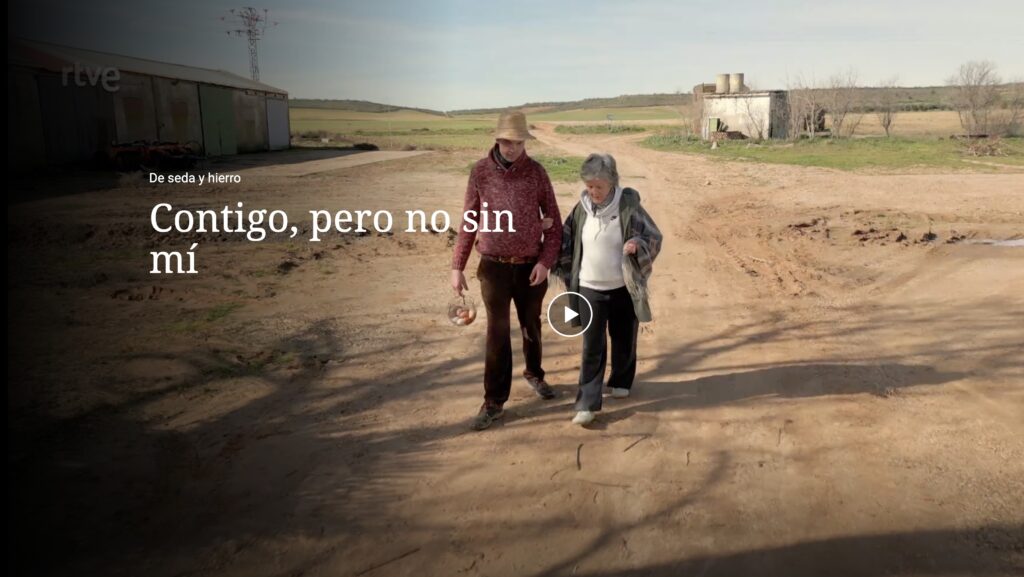
Contigo, pero no..., RTVE
(Music)
Audio description [AD]. Program intro De seda y Hierro , from RTVE.
Shot of Raúl Aguirre walking through a natural setting. He heads to a chicken coop where he collects eggs and carefully places them in a metal basket.
Raúl Aguirre - R.A.:— I fight for different rights, so that they listen to us, so that they can give us a voice, so that they respect us. For a dignified life.
(Addressing the chickens) Come on...
Audio description [AD]:— From inside a room, Myriam Arnáiz speaks on a balcony with her dog, Carrie. Myriam uses a reacher grabber to serve her food and then watches her.
M.A.:— (Addressing Carrie) Who is going to feed you? Mommy, right? Come. Come, Karim.
M.A. (v.o.):— If you had asked me two years ago if I had achieved my dream, I would have answered no. But today, currently, I would say yes. It has taken a lot of work, a lot of effort, and I am very proud of all the little steps I have been taking.
(Music)
Audio description [AD]:— Raúl feeds the chickens. His mother, Concha Casasnovas, enters the chicken coop.
Concha Casasnovas (C.C.):— (Addressing the hens) Girls, let's go inside.
(Addressing her son) Hi, Raúl, how are you?
R.A.:— Good morning, Mom.
C.C.:— How are you, son? You're here already, you've come quite early today, haven't you?
R.A.:— Yes, because I had to see how many eggs there are.
C.C.:— Very well, and what else? Do you have something on this afternoon too?
R.A.:— Yes. I am going to (Raúl signs the word 'work') work.
C.C.:— Oh, okay.
Audio description [AD]: Raúl and Concha continue talking inaudibly.
R.A. (v.o.):— I live in the countryside, in my house.
Audio description [AD]: Close-up of Raúl.
R.A.:— I have been leading an independent living project for four years.
Audio description [AD]: Concha Casasnovas and José Luis Aguirre, Raúl's parents, at their home.
C.C.:— Raúl is the second of our children. From the age of three and a half, he began having epileptic seizure problems that changed our entire family in an incredible way.
We went from neurologist to neurologist and, in the end, they sent us to Marseille to Dr. Gastaut's clinic, where they determined that his condition was Lennox-Gastaut syndrome.
The diagnosis was a huge blow, and at the same time, it was absolutely liberating to know what was happening.
(Sound of chickens)
Audio description [AD]: Raúl and his mother together, feeding and taking care of the chickens
V.O. (voice-over):— He came here during the pandemic, because we brought him with us.
Audio description [AD]: Close-up of Concha.
C. C.:— He was living in a supervised apartment at that time and saw an empty house and started saying that he wanted to live there, and we didn't believe him.
Audio description [AD]: Close-up of a village house with a white facade and a tiled roof. Next to the front door, a sign that says "La casa mía" (My house), next to an illustration, the work of Raúl.
Next, Raúl and Concha come out of the henhouse and walk arm in arm.
Close-up of José Luis.
José Luis Aguirre (JO.A):— The feeling it awakened in us, at least in me, is that the tremendous protection he had had for 18 or 20 years was beginning to unravel, and he would have to face problems in his own way.
Audio description [AD]: Raúl and Concha walk arm in arm.
C.C.:— Well, kiddo, I'm staying home now. Are you heading to yours?
R.A.— I'm leaving, yes, Mom.
C.C.:— Come on.
Audio description [AD]: Raúl and Concha say goodbye. Concha takes the basket of eggs and leaves for her home.
C.C.:— I'll take care of Ismael's eggs, right?
R.A.— Okay, yes.
C.C.:— Come on.
R.A.— Bye, Mom.
C.C.:— Bye, see you later, son.
R.A.— Goodbye.
(Music)
Audio description [AD]: Raúl walks away after saying goodbye to his mother. Concha turns to watch him before entering the house.
Next, a close-up of Concha and José Luis.
C.C.:— Personal assistance is something that has truly been essential in these steps that they have been taking and will continue to take.
Audio description [AD]: As the song 'A Mi Manera' plays, the camera follows Raúl walking until he reaches his home, where he enters. The song continues as Myriam Arnáiz, sitting in a wheelchair, looks at herself in the mirror and applies deep red lipstick. After putting on her makeup, Myriam smiles at her reflection (subjective appreciation).
🎵
'To live, always to live, I will face it serenely.' 'I have always been this way, I will tell you sincerely.' 'To live with intensity and I never found any borders,' 'and all of that was in my own way.'
🎵
Myriam Arnáiz - (M.A.):— I am from Seville, although I currently live in Madrid in a rented apartment, but I have just bought an apartment. I am really looking forward to being able to start my independent life project there and, above all, with my little dog, Carrie.
Audio description [AD]:— Myriam pets and kisses her dog, Carrie. Then, she opens one of her closets and, using a reacher grabber, picks up some shoes from the bottom drawers.
M.A.:— I call myself "the Madonna of disability," because I believe I am doing a good job in making independent living visible, making the rights of persons with disabilities visible.
Audio description [AD]: Close-up of Myriam.
M.A.:— I have a physical disability, diastrophic dysplasia, which is a musculoskeletal disability that, well, above all, affects the muscles and bones of the upper limbs and lower limbs. (Music) Audio description [AD]: Myriam is in a kitchen with just enough space for her wheelchair to turn. She adjusts the height of her chair to align with the countertop and, with some difficulty due to the limited space, picks up a cup and makes herself a coffee.
M.A. (v.o.):— Personal assistance is the human support that performs, or helps persons with disabilities to perform, those tasks that we cannot carry out by ourselves or that we find truly difficult to perform.
Audio description [AD]: Close-up of Myriam.
M.A.:— Currently, I do not have personal assistance because, unfortunately, regrettably, we are in a current situation where accessing that service through the law is a miracle.
Right now I have home help, which is one hour a day, and right now, with home help, I cannot enjoy that… well, enjoy… I cannot have that ease of developing my daily life outside of my usual environment, which is my home.
(Music)
Audio description [AD]: In the distance, surrounded by nature, Raúl and Sacha Novalbos walk through the countryside.
Sacha Novalbos - (S.N.):— How was your weekend, Raulete? We haven't seen each other.
R.A.:— Good, Sacha.
Audio description [AD]: Close-up of Sacha.
S.N.:— I am Sacha, and I am Raúl's personal assistant.
Audio description [AD]: Raúl and Sacha chat while walking through the countryside.
R.A.:— Well, cleaning up the poop...
S.N.:— … of the hens?
R.A.:— Yes.
Audio description [AD]: Close-up of Sacha.
S.N.:— I have been working with Raúl for six and a half, seven years. Where he needs the most support is in activities of daily living, but we also cover a lot of other areas. Social, family, when he has a conflict or wants to prepare dinner for them, he also counts on me.
Audio description [AD]: Raúl and Sacha are chatting in Raúl's kitchen. On a nearby wall, there is a whiteboard full of agendas, notes, and reminders.
S.N.:— Are you going to need any support today?
R.A.:— Yes, Sacha.
S.N.:— Tell me.
R.A.:— You have to help me prepare a Spanish potato omelet.
S.N.:— Of course! Shall we write it down?
R.A.:— Okay, yes. S.N.:— Do you have the ingredients? R.A.:— Yes, Sacha.
S.N.:— Well then, let's get to it.
Audio description [AD]: Close-up of Sacha.
S.N.:— Raúl and I spend twenty hours together a week, four hours a day, from Monday to Thursday. He is my boss, and in the end, things are done a bit according to what he demands. Or where he has the most needs is where he asks for support.
Audio description [AD]: General view of a livestock feeder or similar.
S.N. (original version):— They ask me, above all, for tools to be able to do activities more individually and more autonomously. Cooking plans, learning recipes, sign language…
Audio description [AD]: Raúl and Sacha walk through the empty feeding area.
S.N.:— Are there many nests this year?
R.A.:— Yes.
S.N.:— Yes? And the nest that is placed there, the bird that always lands there?
Audio description [AD]: Close-up of Sacha.
S.N.:— I really like working with Raúl because, in the end, the work is done in a very simple way. Because we have been together for so many years, because we have so much trust, and because we know each other so well, it makes the work, most of the time, very simple.
Audio description [AD]: Raúl and Sacha walk through the feeding area.
S.N.:— What was it called?
Audio description [AD]: Raúl responds to Sacha using sign language. Sacha nods.
S.N.:— I don't remember. And the name was?
Audio description [AD]: Raúl spells the name using the fingerspelling alphabet.
S.N.:— Huh? Cernica… Kestrel, that's right, I didn't remember.
Audio description [AD]: Raúl applauds by raising his hands.
S.N.:— Bravo!
Audio description [AD]: Close-up of Sacha.
S.N.:— We both get very happy when he achieves goals, when he cooks, when we learn sign language and see that we can finally have a conversation. That is when I feel that connection with Raúl.
Audio description [AD]: Raúl and Sacha walk through the feeding area.
S.N.:— Very cool. Let's go outside to see if there are more nests.
(Sounds Sad Lullaby , by Natalia Lacunza)
🎵
Little carnations in your hair, the tattoo on your skin.
🎵
Audio description [AD]: Close-up of Sacha.
S.N.:— It is poorly paid work. We do not have an accredited degree in personal assistance, we do not have specific training in personal assistance. And I also think it is very important that professionals are taken care of a little and that we are given tools or resources to be able to work on our emotional and psychological side as well.
Audio description [AD]: Raúl and Sacha chat while sitting at a wooden table.
R.A.:— I… give Sacha… a… ten.
Audio description [AD]: Sacha nods with a smile and strokes her hand.
(Music)
Audio description [AD]: Myriam crosses a park on a wooden path. The back view of her wheelchair is shown, which has a sticker with the inscription 'No llores, Juanita'. Next, Myriam enters some PREDIF offices and greets her colleagues.
M.A.:— Good morning.
Voices in unison: —Good morning!
Audio description [AD]: Myriam greets a classmate, who stands up to kiss her.
Colleague 1:— How are you, my girl? How was your weekend?
M.A.:— Good, good.
Audio description [AD]: As Myriam walks through the room, Gema Campos, head of the Economic Area at PREDIF, approaches her and greets her.
Gema Campos - (G.C.):— How are you? How are you, Carrie?
M.A.:— Very well, better now.
G.C.:— Shall I get your computer or tablet out?
M.A.:— Yes, please, the laptop, the tablet, and the charger, please.
G.C.:— Did you bring food?
M.A.:— Yes.
G.C.:— Should we lower it?
M.A.:— Yes.
Audio description [AD]: Close-up of Myriam.
M.A.:— Currently, I work at an NGO that advocates for the rights of persons with disabilities. And, specifically, my work is to promote and raise awareness about the right to independent living and the role of personal assistance. It is a right.
Audio description [AD]: Myriam is focused on working at her office computer.
M.A.:— It is a right that belongs to us as persons with disabilities, which is recognized in the UN Convention on the Rights of Persons with Disabilities.
And, furthermore, it is specifically stated in Article 19, which says that we, as persons with disabilities, have the right to live independently and to be included in the community on an equal basis with the rest of the citizenry.
Audio description [AD]: Myriam works and talks with her colleagues. Afterwards, they eat together during their work break.
(Music)
M.A.:— What did you bring?
Companion 3:— Rice with saffron milk cap mushrooms.
M.A.:— Oh, how lovely!
Peer 3:— It really is.
M.A.:— Did you do it yourself?
Colleague 3:— Yes, my mom taught me that.
Audio description [AD]: A classmate passes a plate of food to Myriam at the table.
G.C.:— Well, you've got money.
M.A.:— Thank you.
G.C.:— It looks very promising, doesn't it?
M.A.:— Yes, well, let's see, it's the same old thing. I would like to be able to see a bit what it contains, to be able to, you know... but I don't know... in the end, I order delivery. Because I don't have time, I'm stressed. I don't have time to shower, to get ready, to make food, all in one hour. It's frustrating, but well.
Audio description [AD]: Close-up of Sacha's hands as she rummages through papers inside a small metal box.
S.N.:— Let's see, Raúl, you still need to pay these little envelopes.
Audio description [AD]: Raúl and Sacha are chatting while sitting on a bed. Sacha is holding the metal box in her hands.
S.N.:— The electricity bill and the grocery bill, since we have to go shopping. Do you have pasta there?
R.A.:— Yes.
Audio description [AD]: Close-up of Raúl's hands, picking up the envelopes handed to him by Sacha.
S.N.:— How much is it for the electricity?
A.R.: — Twenty.
S.N.:— Let's see if you have the money for everything.
Audio description [AD]: Close-up of José Luis Aguirre.
JO.A.:— Sacha works from a place of equality, so to speak. Because the way she treats Raúl is one of total acceptance of Raúl as a person, as he is, not as you want to make him. She has taught me so much, because from that place, things can be achieved.
Audio description [AD]: Close-up of José Luis and Concha.
JO.A.:— Also, with affection, respect, and taking a pause, right?
Audio description [AD]: Close-up of Raúl's hands on a notebook, where the various combinations of coins that add up to one euro are drawn.
S.N.:— And for the lunch of…
R.A.:— Six euros.
Audio description [AD]: Close-up of the metal box where Raúl keeps the receipts and the money.
S.N.:— You can take this one to do the grocery shopping, right? And we'll leave this one here so you can pay the electricity bill.
R. A.:— Okay.
Audio description [AD]: Close-up of Concha.
C.C.:— Sometimes the overprotection that we parents tend to have causes him a lot of rejection. And in fact, he puts it in a very beautiful way. He says that he likes support, but he doesn't like help.
Audio description [AD]: Raúl and Sacha in the kitchen. Raúl is getting ready to make a potato omelet.
S.N.:— Well, what ingredients do you need for the omelet?
R.A.:— The potatoes.
S.N.:— Yes.
R.A.:— The eggs. The frying pan.
S.N.:— And a little bit of…
R.A.:— Exit.
(Music)
Audio description [AD]: Close-up shot of Raúl peeling potatoes. Next, Myrian assisting a person in her 'Impulsa Igualdad' office.
M.A.:— Good morning, David, how are you? How are things?
David:— Hello, good morning, very well. Here we are.
M.A.:— Tell me, how can I help you?
David:— Well, I just arrived in Madrid because I want to continue my studies. I am going to do a master's degree and, to be honest, I am going to need quite a lot of support.
M.A.:— Tell me, what kind of support do you need, David?
David:— Well, you see, at home, I need help getting dressed, with personal hygiene, and especially with household chores like ironing, cooking... It is very helpful for me to have support when handling banking matters or going grocery shopping.
M.A.:— I believe that, based on what you are telling me, what best fits what you are describing is the role of a personal assistant. Let me explain.
Through Impulsa Igualdad, you can hire personal assistance, either through the dependency law or privately.
David:— If I decide to hire the assistance myself, can I choose the person who will be in charge of it and so on?
M.A.:— That's it, David, the strong point of the personal assistance figure is that you choose everything, that is, you choose the personal assistant, you choose schedules, activities, even the gender of the personal assistant.
David:— Well, as for me, let's go for it!
M.A.:— Great.
David:— Perfect.
Audio description [AD]:— Close-up shot of Raúl cracking and whisking an egg in a bowl. Next, a close-up of Sacha.
S.N.:— Raúl is a very artistic person; he is very assertive, both regarding his own rights and the rights of others. He is very affectionate, very respectful, has a great deal of empathy, and is a lovely person.
Audio description [AD]: Raúl and Sacha in the kitchen. Raúl turns on the stove burner.
S.N.:— What number are you going to put it at?
R.A.:— At six.
S.N.:— Okay. Well, take a good look at it there. Perfect. If you need support, give me a call, okay?
R.A.:— Okay, Sacha.
Audio description [AD]: Close-up of José Luis.
JO.A.:— Raúl awakens an energy very different from what we are usually accustomed to seeing. As he says, he makes the hearts of everyone he interacts with smile. It is a phrase he has mentioned since he was little, even when he was quite ill.
C.C.:— His made-up phrase was: "I love you so much" [te amoro]. And when you asked him what happiness meant to him, he would say: "well, it's when your heart laughs." I had forgotten that, yes, very beautiful.
Audio description [AD]: Concha and José Luis get emotional when remembering these words (subjective appreciation).
Audio description [AD]: Raúl and Sacha in the kitchen. Raúl sings while stirring the omelet in the pan.
M.A.:— Come on, very good. Now slowly, because you might burn yourself, you know.
Audio description [AD]: Raúl flips the potato omelet from the pan onto a plate.
M.A.:— There it is! Shall we see it? A huge omelet, Raúl. Congratulations! Great.
Audio description [AD]: Raúl and Sachan high-five.
R.A.:— Thank you, Sacha.
Audio description [AD]: Myriam plays with Carrie, her dog. Next, family photos are shown.
(Music)
M.A. (original version):— I am 36 years old. I am the youngest of three siblings. The oldest is named Juanma. He also has a disability, the same one I have. And then my brother Frank, who is the middle one. He does not have a disability. And well, I am super close to them. The truth is that I am very lucky to have two brothers. We have always supported each other, we have respected each other.
Audio description [AD]: Close-up of Myriam.
M.A.:— My mother passed away recently, just a few months ago. María del Carmen, Maica to her friends. She never doubted everything I could achieve.
Audio description [AD]: Myriam gets out of bed and sits in her wheelchair, which is placed next to it. Carrie, her dog, is by her side.
M.A.:— It was easy to fall into overprotection. And my mother always gave me wings, she trusted in everything, despite the panic she must have felt as a mother. 'This girl is going to Madrid all by herself.' She never put an obstacle in my way, because she was a born fighter. And that brought us very close together.
(Playing 'Me dijeron de pequeño', by Manuel Carrasco)
Audio description [AD]: Close-up of Myriam.
M.A.:— I talk about Carrie and… I get emotional. Carrie has given me life.
Audio description [AD]: Carrie runs towards Myriam, who is getting ready to take him for a walk.
M.A.:— She has given me that companionship and affection that I, at the moment I decided to get Carrie, needed so much. There were many people who, because of my disability, told me: 'you are crazy'.
Audio description [AD]: Carrie gets into the elevator.
M.A.: (Addressing Carrie) Very good, you are so good!
It is going to be a challenge, and a beautiful challenge, because for me, taking care of Carrie and Carrie accompanying me as well, for me it is one of the most beautiful things I am currently experiencing.
(Addressing Carrie) Shall we go out to the street? Come on, let's go.
('Me dijeron de pequeño' by Manuel Carrasco plays)
Audio description [AD]: Close-up of Raúl painting. On a wooden table, pencils, markers, and notebooks.
R.A. (v.o.):— I love painting because… it brings me richness and, at the same time, it is something with which I can express my different emotions and how I feel. I usually paint portraits when I am asked, and maybe they pay me two 20-euro bills or a fifty-euro bill.
Audio description [AD]: José Luis takes a picture of his son, Raúl, while he shows his work to someone nearby. Concha watches by his side.
Peer:— I love this one by Lucía, it's super beautiful, with all the little animals.
Audio description [AD]: José Luis and Concha observe and photograph Raúl.
C.C.:— The truth is that it is beautiful.
JO.A.:— Look for one of a horse.
Audio description [AD]: Close-up of José Luis and Concha.
JO.A. (v.o.):— He wants to go horseback riding; he has a series of hobbies that need to be covered, and besides, we are working on him earning a little money because everything costs money and [we want him to understand] the value of money.
C.C.:— For him to be a little more autonomous.
Audio description [AD]: Close-up of Raúl and his companion during the photo session. Raúl pulls up his sweater sleeve to reveal a drawing and text on his shoulder. The background of the scene is a brown-toned fabric. His companion looks at the drawing, appearing surprised (subjective appreciation).
JO.A.:— Let's see? Wow, man! Let's see?
C.C.:— And the legend, what is the legend like? There, there, there.
Companion:— What does it say? Rights, equality, and freedom.
JO.A.: — Rights, equality, and freedom? That's quite a lot, indeed. Very well.
(Electronic music)
Audio description [AD]: Urban landscape of buildings in Madrid. Next, Myrian is at MDA, a physiotherapy center. She is lying on a mat while Manu, her physiotherapist, hands her a small ball to perform some exercises.
Manu:— You catch it with your hands. Up, up goes the ball. Release, catch, and down. If you don't squeeze, the ball gets away.
Audio description [AD]: Myrian changes her posture and sits up to switch exercises. Manu shows her an elastic band, which she puts on her leg.
Manu:— This exercise is the exact opposite, an antagonist to the one we did previously. It is a pulling exercise, so that in your day-to-day life you have the capacity to bring things toward yourself.
The grip with your hands, as you know.
Audio description [AD]: Close-up of Myriam.
M.A.:— Manu is my physical therapist, he is my trainer, because well, I think he is also part of my independent living project: mobilizing myself, working on my body and, above all, also working on posture levels. Because like it or not, I am always sitting in the chair. That little bit of release, of exercise, is good for me, both in terms of posture and also in terms of releasing that adrenaline and that stress that we often experience in a big city and that work can entail.
Audio description [AD]: Myrian sits up to perform a new exercise.
Manu:— Release and up, more, more, more, more. That's it, since you have quite severe scoliosis, we'll give it a little mobility. Come on, breathe in and release. Come on, let's go up, okay?
Let's do it. Come on, up, up, with the other one. Strong, you be strong. That's it, very good. Okay, you're done. You're done, okay?
You alone.
Audio description [AD]: Myriam, standing and holding onto Manu, laughs and shakes her head.
Manu:— You alone, you alone. Yes, come on. Hold on, hold on.
M.A.:— But give me a second!
Audio description [AD]: Myriam stands up, without holding onto Manu.
Manu:— If you're doing fine like that, come on, you're doing perfect. Come on, hold on for me, just five little seconds. I can see you're shaking. Come on, slowly and down, okay?
Audio description [AD]: With Manu's help, Myriam bends her legs to sit back down on the floor.
Manu:— The leg. That's it. Perfect. Okay, you're a star, right?
Audio description [AD]: Myriam smiles, claps, and high-fives Manu.
Manu:— Right, well, we have finished the class.
Audio description [AD]: Concha takes something cooked out of the oven. Next, a close-up of Concha.
C.C.:— Raúl was recently awarded the "Corazón Inclusivo" prize, an award given by a wonderful person who created it three or four years ago.
Audio description [AD]: Raúl and his family share a meal together. During the meal, Raúl shows the "Corazón Inclusivo" prize to the camera.
C.C.:— He is a person with ALS. And since he met Raúl, he found a special spark in Raúl that he considers him to be an essential person for him and for society.
Audio description [AD]: Raúl and his family share a meal, together.
JO.A.:— Well, I have some photos here from those days. Shall I show them to you?
R.A.:— Yes. Wow! What amazing photos!
Audio description [AD]: Close-up of a tablet showing photos of the award ceremony. Raúl appears dressed as a lion.
Family member:— It's just that when they gave it to him, they were dressed as lions. Why did you decide to choose the lions from Congress?
C.C.:— Because it is in Congress where laws must be changed.
Audio description [AD]: Close-up of a tablet showing a photograph of groups, in front of Congress, next to Dabiz Riaño. Almost everyone is dressed as lions.
C.C.:— Let's toast to the award.
Voices in unison:— First things first. For Raúl. For Raúl!
C.C.:— Congratulations, Raúl! What a guy!
(Music)
Audio description [AD]: Myrian leaves her building with Carrie.
M.A.:— Come on, Carrie! Yay!
Audio description [AD]: Close-up of Myrian
M.A.:— I have always noticed that to win people over, to win over society, I have had to work twice or three times as hard.
Audio description [AD]: Myrian walks Carrie through the park.
M.A.: I have always had to, I have felt that I have had to work very hard on my emotional management, my personality, my way of being.
Audio description [AD]: Close-up of Myrian.
M.A.:— That is why I also often try to compensate for it with fashion and the way I dress, because I believe there is more to see in me than just my height.
When I talk about my disability, I always talk about my double disability, because, of course, it is my wheelchair and then my physical appearance. Maybe I am out with a friend who uses a wheelchair, and all the stares always go a bit to me.
That impact that still generates in society for people with this condition.
Audio description [AD]: Myrian runs into Rubén, a friend, at the park.
Rubén:— Hello, Miriam. How are you?
M.A.:— Well, well!
Rubén:— Hello, Carrie!
M.A.:— What's up, handsome? What are you doing?
Rubén:— I brought my little guitar to sing a bit.
M.A.:— I love it!
Rubén:— Come on, let's go.
M.A.:— Carrie, shall we go? Let's sing, Carrie, let's go.
Audio description [AD]: Myrian and Rubén, at home. Rubén plays the guitar and Myrian sings.
M.A.:— (Singing) Now is the time and not tomorrow, let the show begin again now that… I’m getting lost…!
Rubén:— Come on, start, okay?
M.A.:— That's it, that's it. Rubén, don't laugh!
Audio description [AD]: Raúl and an equestrian guide lead a white horse out of the stables at the Doma Vaquera Aleada Riding Club. Then, while Raúl ties a knot, the guide shows him how to do it.
Guide:— Close to here, Raúl, remember. We pull from there and that's it. Very good. Come on, let's brush him a little.
Audio description [AD]: Raúl brushes the horse.
R.A.:— (Addressing the horse) I trust you, okay? Come on. Let's go. Let's go.
Audio description [AD]: Raúl unties the horse and walks it at sunset. Next, Rubén and Myriam play the guitar and sing 'Hay que vivir el momento' by Manuel Carrasco.
M.A.:— (singing) Now is the time and not tomorrow. Let the show begin again. Now that I no longer lose my cool in the face of so many occasional fools.
Audio description [AD]: Close-up of Myriam.
M.A.:— That desire to take on the world I got from my mother, and I believe it is the greatest pride my mother can have in me now. To say, "Mom, I'm still going, I'm still moving everything forward."
Audio description [AD]: José Luis and Concha watch Raúl, who is riding a horse.
R.A.:— Thank you, parents, for the love.
Audio description [AD]: Close-up of Myriam singing 'Hay que vivir el momento', by Manuel Carrasco.
M.A.:— (Singing) Look, you have to live in the moment. Look, you have to live in the moment. Tonight the clock hands will dance. Now I only want, now I only want. Look, you have to live in the moment. Look, look, you have to live in the moment. I feel like a hurricane inside my heart. Now I only want,
now I only want. You have to live in the moment.
Audio description [AD]: Final credits. Laia Oliver, director; María Galiacho, deputy director; Julia Fernández, scriptwriter; Beatriz Chicharro, director of photography; Carlos Serrano, executive producer; Lorena-Barrio, production; Amanda Padillo, production assistant. Diego Cerezo, editing; Carlos F. Arroyo, color grading; Marta Garabatos, post-production; Diego Arévalo, sound post-production.
Muy Films Team: Julio Cuspinera, sound technician; Jaime A. Rivero, director of photography; María José Mascarell, web and social media; Alejandro de la Llave, head of production; Irene Die, production assistant; Fernando Manjavacas, second camera operator.
Acknowledgements: David Fernández, Ana Gallardo, Rubén Mena, David Gómez, Patricia Pérez, Gema Campos, Jaime Aguirre, Diego Aguirre, Kaótica Libros, CEMIR Plena Inclusión, Impulsa Igualdad, Club de Hípica Doma Vaquera Aleada, MDA Fisioterapia.
Subtitled by Accesibilidad TVE.
I am Quim
Audio description [AD]: Close-up of Quim against a white background.
Quim:— Hello, my name is Quim and I am 18 years old. I live in Vilassar de Mar and this is my story. Since I was very little, I have gone to schools that were not special schools. I started daycare when I was less than a year old. Which... I don't remember very well, but I remember that they had treated me well. They had treated me well.
And then, I went from preschool to the Escola del Mar. I don't remember the beginning, but in the end, I remember it was a good school and a place where I felt comfortable.
After the Escola del Mar, I moved from the Escola del Mar to Santa Anna, where, apart from some problems I had at Santa Anna, I had a good time. Well, from the first year to the 4th, I had a good time. And then, in the fourth year, I had many problems continuing.
When I finished 4th year of ESO, they didn't give me the diploma. I wanted to do theater, to study theater, but I have no other options. We went to the Territorial Services and the EAP, and they were very stubborn about giving us the diploma.
No one in all these years has wanted to give me a hand. Currently, I am in an adapted PQPI program at Miquel Biada in Mataró. They won't give me the degree for this either, and we are back to the beginning again.
I want to be an actor, a professional actor to be in important series or movies and such. And also... Well, I want to be an actor... an actor. And that's it.
(Music)
Audio description [AD]: Extreme close-up of Quim.
Quim:— My name is Quim and this is my life.
Audio description [AD]: Quim talks and laughs with someone off-camera.
Quim:— He was too shy, right? On camera?
Voice 1 (off-camera):— But that's normal, right? The first few times always...
Quim:— Yes.
Voice 1 (off-screen):— Don't worry. I would be shy too, especially if I had to explain my life.
Audio description [AD]: Close-up of Quim after talking to the person off-camera. He seems to be thinking about something or waiting (subjective assessment).
Voice 1 (off-camera):— Well, that's it. We've got it!
Voice 2 (off-screen):— Are you ready?
Voice 1 (off-screen):— Yes.
Audio description [AD]: Quim gets up and leaves. Fade to black.
Audio description [AD]: Close-up of Quim against a white background.
Quim:— Hi, my name is Quim and I am 18 years old. I live in Vilassar de Mar and this is my story. Since I was little, I have attended schools that were not special schools. I started daycare when I was less than a year old. Which… I don't remember very well, but I remember that they had treated me well. They treated me well.
And then, I moved from daycare to Escola del Mar. I don't remember the beginning either, but in the end, I remember it was a good school and it was a place where I felt comfortable.
After Escola del Mar, I moved from Escola del Mar to Santa Anna, where, apart from some problems I had at Santa Anna, I had a good time. Well, from the first grade to the 4th grade, I had a good time. And then, in fourth grade, I had many problems continuing.
When I finished 4th year of ESO, they didn't give me my diploma. I wanted to do theater, to study theater, but I don't have any other options. We went to the Territorial Services and the EAP, and they were very stubborn about giving us the diploma.
No one in all these years has wanted to lend me a hand. Currently, I am in an adapted PQPI program at Miquel Biada in Mataró. They won't give me the diploma for that either, and we are back at the beginning again.
I want to be an actor, a professional actor to be in important series or movies and such. And also… Well, I want to be an actor… an actor. And that's it.
(Music)
Audio description [AD]: Extreme close-up of Quim.
Quim:— My name is Quim and this is my life.
Audio description [AD]: Quim talks and laughs with someone off-camera.
Quim:— He was too shy, right? On camera?
Voice 1 (off-screen):— But that's normal, right? The first few times always…
Quim:— Yes.
Voice 1 (off-screen):— Don't worry. I would be shy too, especially if I had to explain my life.
Audio description [AD]: Close-up of Quim after talking to the person off-camera. He seems to be thinking about something or waiting (subjective assessment).
Voice 1 (off-camera):— Well, that's it. We've got it!
Voice 2 (off-screen):— Are you ready?
Voice 1 (off-screen):— Yes.
Audio description [AD]: Quim gets up and leaves. Fade to black.
Supercapaces, Canal Málaga
Els demotions, IB3 TV
Di-versos +, Canal Málaga
The school of my dreams I
The school of my dreams II
Indira Martínez, EITB
Indira Martínez:— I am Indira, I am 17 years old, and I live in Vitoria-Gasteiz. I am a person who, when I see an injustice, moves forward to fight against that injustice.
In schools, there is a lack of love for some people.
It was a great honor to be given that award there for working to make schools inclusive for everyone. It is a group from all over Spain, which is very diverse. We used to meet, and as a result of that, we talked about what school should be, and we saw that there were still things to change. And a very interesting guide was created. So that children do not go through what I went through.
My school, the one I will build when I grow up, will not have specific classrooms or anything like that. Everyone will be with everyone, right there, learning. It is simply the best for everyone.
Noemí Preciado:— Our fight and our work have been for Indira to remain within the system. Indira has been removed from the system, because the options the system gave us were segregated options.
Indira Martínez:— If we are separated from a young age, coexistence among everyone is impossible.
I love studying, yes, I do. I am an activist, which I already am. And I also [want to be] a politician to ensure that laws and the United Nations Convention are upheld. It states that persons with disabilities have the right to an inclusive education. Yet, there are still laws that allow us to be separated.
At my old school, the teachers didn't explain anything to me. So, naturally, I was bored. They considered that I should be apart. Segregated in a special classroom. They said I had to be with 'my own kind'...
Noemí Preciado:— Indira in secondary school was in the mainstream classroom because it was 'my stubborn insistence.' It was never understood as her legitimate right. She was there, in class; it was physical inclusion.
Indira Martínez:— There were 30 of us minus 1. Who was the -1? Me. They were missing getting to know me, having a little more love.
And in the playgrounds, I wasn't with my classmates. And believe me, I tried, you know? But nothing, it was impossible. I was completely invisible.
Noemí Preciado:— It lacks humanity. And the conviction that, when people are segregated due to their condition, the rights of those individuals and the rights of others are being violated. Because they are being deprived of the right to live alongside diversity.
Indira Martínez:— I am studying at the Europa institute. I am taking training courses for the unemployed. There are no specific classrooms there, and that is where they really teach me. I am just one of the students, and I go there happy.
Campaign, Canal Málaga
[Provisional automatic transcription]
[Music]
I'm not going to lie to you, there are things I have to hear these days that make me indignant, but how can you say it's tiresome to be so clear about it and have to hear certain things, come on, seriously, but sometimes suddenly something happens [Music]
as if by magic, a message starts reaching you from everywhere that sounds like it is part of you, that breathes the same oxygen that drives you to continue on that path which is mandatory if we want to advance in justice
you quickly look for a source, an origin, but you cannot find it; a message with such strength that you cannot believe it, it is everywhere, everyone talks about it and knows it, but where does it come from, who is behind it? there is no answer; what we do know is that it manages to unleash a tsunami of partisans of inclusion, workers for equality, militants of diversity; with meticulous curiosity I isolate my targets; she is a lunatic, and not because she is obsessed with red riding hood, but because of her fascination with Luna, her nine-year-old daughter who has Angelman syndrome; Luna is enrolled in a public school in a mainstream classroom with supports; Ana, besides working and living in Malaga surrounded by books, is a staunch defender of inclusive education
Lucía is from Seville and is in her second year of high school. She is a strong-willed girl, a feminist, a campaigner, and an absolute militant for inclusion. She is a firecracker who needs role models and people to be inspired by. Her 13-year-old brother, Raúl, has Williams syndrome. Antonio Márquez is a teacher specializing in inclusive pedagogy and is currently the director of the project 'A una desigual de escuelas inclusivas SL'. His main work is training and advising on inclusion. He has 16 years of experience in schools, the last 12 of which were with the Granada team for the blind. His work is oriented toward transforming schools into a model that accepts, respects, and includes everyone. They are the ones chosen to create it, at least for these few minutes, simply because they believe in it and they want it, and 'Quererla es crearla'. Welcome to all three of you to 'Supercapaces'. It is a pleasure to be able to speak with people who speak our same language, the language of inclusion. The first mandatory question is: what happened when this video reached you? The mysterious video that we all received in some way and that remains a great mystery to this day. The video reached me via WhatsApp, well, through contacts I have, and so on. And well, I suppose what happened to everyone else happened to me too, starting to watch it with mystery, wondering what it was telling us, and suddenly seeing reflected so many things that I have been trying to convey for a long time, for example, to teachers, families, institutions, and everyone. And suddenly, everything is captured perfectly in a video that starts by leaving your heart a little still, with pure feeling on your skin, and well, a lot of it if you have seen it. It happened to me exactly the same as to my colleague. It reached me through several groups at the same time, and when I opened it, I was surprised. It was a breath of fresh air and a lot of emotion, a lot of joy, because I started to see important words that are important to me daily and that we are dealing with every day, so that they could be seen in such an effective and efficient way. When I read the word dignity, when I saw the word love, which is the most powerful of all, freedom, diversity, I said, this gesture, I am not alone. That is the only thing I thought, I am not alone. Throughout the history of our planet, there has often been the need to say, 'come on, enough is enough, we need everyone to be respected equally.' That is what we feel, a lot of joy. I totally understand you. Lucía, tell us, from your young and absolutely fresh perspective, when the video reached you and you saw it, what did you think? At first, it seemed strange to my mother, who had received it via WhatsApp, but then I saw it on social media, and I thought that it was truly making an impression on people and that people liked it. And I honestly feel very identified with the video because I have always been a person who strongly defends rights.
and honestly, I felt very identified and that I wasn't alone, as is generally talked about regarding inclusion, you know? What a word, right? And I don't know what you all think about whether the word is actually being used correctly in society in general; does inclusive education really exist today?
come on, I see you're eager, but for nothing, no, no, no, no, these are just small drops, we are like the Taifa kingdoms, each of us fighting a bit on our own in that sense because the administration, no, we are not going to support it because the regulations are being breached, because the rights of millions of children continue to be violated to this day. It makes me laugh when they tell me, 'You're very lucky, Ana Luisa, this daughter of yours who has a disability is in a mainstream school or classroom and uses support,' and I say, 'Lucky? The problem is that for the rest, those who are not in those conditions, those children's rights are being violated.' This is a problem. I am not lucky at all; I think what I have is a great misfortune because, precisely at my daughter's school, she continues to be different because she is a girl with diversity. They are not diverse children in a classroom, in a center, each with their own characteristics, and she will continue to be the 'different' girl because she has extraordinary support, because she doesn't speak, because she uses an augmentative voice communicator, because she wears it on her face, and she is still the 'weird' one. So no, inclusion is a path and a permanent struggle, but from the morning on, at all levels; I mean, it's not a dream yet. Does your daughter have significant curricular adaptations? Well, look, she had all the significant curricular adaptations, as you know, and if not, I'll tell you, there are problems when it comes to graduating if she has significant curricular adaptations. That's why I was telling a school council to explain this reason, which was unknown to the teaching staff; it is not studied what happens because of having significant curricular adaptations, and right now she has specific ones in two areas, the mathematics area and the language area, and the others are curricular adaptations, but they are not significant. We are gradually removing them, appealing to the issue of Universal Design for Learning, well, for everything, but even so, it is a path, I tell you, a drop in the ocean. The educational response from the school is favorable, so that's not it, that's important, but it is a problem, it continues to be a problem because she would need it, but on the other hand, we find ourselves with the other, with the other wall. So there we are listening. To begin with, as long as we keep talking about inclusion when we are referring to people with disabilities, learning difficulties, etc., it means at the base that the concept of inclusion has not been understood well, because it cannot be linked to that. Inclusion means the participation of everyone, all of them. And so, within trying to start understanding that, you start to realize that we cannot make a person's condition be transformed, or that word that is used a lot, 'normalization,' which we have in our principles of the education law and everything, I don't like it because it means trying to make someone normal who is not. And so these types of adjustments and support start to happen, which you are talking about: significant and non-significant curricular adaptations, specific programs, and all with the intention of making someone normal. Look, it is a condition, it cannot be changed, so we have to shift that gaze and realize that, indeed, what we can change is how the school addresses the entire diversity of its students. And so, when we shift that focus, we will start to realize that the barriers are not in the student themselves, but that it is us who put them there, those who insist on that. With the training, we start doing practices in Universal Design for Learning with multilevel design and other types of strategies, which in the end, when the training ends, it is very curious because we can even have eight hours of training in four or five sessions, we are working on open and flexible designs for everyone, everyone understands it, everyone applies it, and when I finish, I say, 'Have you noticed that we haven't mentioned the word 'significant adaptation'? It could be done, it could be done if we proposed and shifted the focus here. What happens is that the word 'inclusion' is being distorted a little bit, it's becoming 'integration' again, now everything is 'inclusive.' Just adding the adjective 'inclusive' already makes me laugh because you see the ad for an 'inclusive outing' from the association of, or the, I don't know what, of disability, and then all the children with that disability come out and they go there, and already in an 'inclusive outing' it means that that space, that place, has to be prepared to address and attend to anyone who goes. Lucia, I know you are listening, I am very interested in your opinion as a student, as a person who has very recent experience with what teaching is. I'm not talking to you, as Antonio says, from the position of teaching as it is today, which is not inclusive; it not only harms people with special educational needs or people with different social, economic, or ethnic realities, it affects everyone. It also affects you. Listening to Antonio speak in that way, do you notice that in your teaching, in your education, you have missed things? Have you missed them taking into account your interests, your reality, your talents in the education system? We are not people, we are a grade, and in my case, in my school, we only leave with a gold-plated table.
Regarding my brother's situation, he is in a mainstream school, but it is not truly an inclusive school; it is a school with integration. However, as Ana said before, they still see my brother as the different one, so I am very much in disagreement with the education system and everything because it seems like a lot for no one. You have had a step forward compared to what we experienced in our generation; that is, you have already had an integration system—not inclusion, but integration. In some cases, you have shared a classroom with someone who had these realities with functional diversity. You have experienced it, and do you think that you young people have learned a little more than us, that you are prepared to be a little more aware of what is truly fair? I think so, but we still have a long way to go because in my class there was a child with functional diversity, and it was always as if the other children left him aside, and he would make friends with whoever. What do you think is needed? Because that is one of the main arguments used to say that we cannot all be together at school, right? Bullying, rejection. What kind of environment, what kind of space do you think needs to be created? What kind of work needs to be done? Because there has to be prior work, or perhaps not creating, but maybe preparing specific personnel so they know how to articulate those social relationships that occur in schools. What can be done to avoid these types of situations, which today tend to be one of the things most present in the balance, that these children will not integrate one way or another, or will not be able to socialize adequately?
to change a value system that is deeply rooted in our society, so it is not just an action within a school, but something that surrounds the entire educational community. The entire community implies families, institutions, and the very model of each school. And I often use the term inclusive cultures, that culture which is the first and most difficult thing to change, because from there is where the models we are experiencing later arise. Look, for example, I always use the same case: when a child enters early childhood education and has a classmate who may have any kind of differences, they accept them naturally. They hold hands, they start talking, they don't care if one is blonde and the other is diverse; it doesn't worry them at all. But notice how, as they advance through school, they start assuming values that are imposed on them by others, by the adults who make up the communities surrounding them—the teachers, the families, the school staff. So, clearly, this should be a strategy of a school that, in harmony with its immediate environment, begins to mature a project in which education in values and respect for diversity are something assumed by that entire community. And to make proposals for this to be carried out, that is, holding meetings in schools, service-learning projects from the students themselves who go out into the community and raise awareness about this issue. But that also requires leadership in the school that is committed, indefinitely, strongly, and deeply to inclusion, because otherwise it is impossible. Otherwise, what we are doing is replicating. If I see a student enter first grade who has a disability, who is in early childhood education with their group, and mysteriously in two months, for no known reason, they can no longer be there, then that 5-year-old child who is their classmate, when they reach six and see that they are being taken elsewhere, understands that something is happening. And so they begin to assume that the other child was different and that is why they were taken away. And when they grow up, they see that practice repeated, not only in society, but how society is also included, because that situation of excluding in a normal way and without any kind of shame has been normalized. So it is us who are transmitting that culture and those values that are replicated, that are replicated in those little bubbles. I believe the change has to be a seed that comes from when they are very small, with children who always see that everyone is together, no matter what happens. I will tell you, obviously, an anecdote: when Luna arrived, we changed her school, and she arrived in the fifth year of early childhood education, and it was beautiful, in the third year of early childhood education.
I wanted to explain to those children, to her classmates, why she didn't speak. So, I made up a story—I love stories—and I invented that Luna's head was a Ferris wheel where all the words were spinning and spinning and spinning. And since Ferris wheels are so much fun, it was hard for them to come down, it was hard for them to get off, and that's why she didn't speak. And the children's response was amazing because they raised their hands, and one of them asked how much money I had given Luna to ride the Ferris wheel.
The most important thing, and the second thing, was: 'Teacher, I have an idea, let's turn off the fairground lights.' In other words, they were looking for solutions. But the problem wasn't that Luna didn't speak; it was that if we presented this as a problem, it could be solved. It's that wonderful, marvelous innocence of 'let's act, we have no time to lose.' I am also going to conspire with the children because it's very good for preparing the ground, preparing the mind. Talking about the 'Quererla es crearla' video is something that really has a great impact and is very necessary, but above all, we must be everywhere. It is a responsibility of the parents; we have to take our children anywhere. Visibility is what matters, showing the theory first and then the practice, because in the end, there is always someone who gets left behind. Children in mainstream schools don't have difficulties; it's the system that has them. And we parents have to be brave and say that if they don't have the resources that special education has, it doesn't matter. Let's fight, let's suffer. If this teacher isn't sufficiently prepared, they need to be trained in inclusion now. They don't need children with problems in class; they need children with difficulties, and we are going to solve it together, not just me.
I have always said 'I don't have time,' I say 'I'm sorry, I don't have time,' but I can't wait, my daughter is growing up. A daughter cannot have an idyllic framework in which to exist; my daughter cannot have a wonderful, inclusive culture where the museum's activity is not going to accommodate her being in this activity. So, what have I done? Well, I created it. I started creating it. So I began to organize activities for all the children in the museums of this city, and as you can see, little by little, we are looking at where the focal points are in non-formal education and early childhood education because we already have it. I'm not going back now; what is needed is for the children from the classes to come, a whole tribe of children and parents from the schools, saying 'my child is going to be here.' But the small proposals, Antonio, which I love, on the other hand, are wonderful. Well, all the work I am developing has that as its final goal: that all children... to begin with, when you have the problem at home, you have no choice but to find a solution. It is true, and sometimes there is no time to wait, but it is also true that I believe it shouldn't be done poorly, nor should it be done without planning, without assessing all aspects. Because it is true that, for example, we have to see how the connection between health and education would be implemented within a mainstream school; that would be fundamental for many students with disabilities in the mainstream school. When we have a minor behavioral problem in the classroom, we don't know how to address that child's behavior in mainstream classrooms today. So, a very important preparation would have to be done, and we should also look at the model that already exists. There is a model where that is being promoted; I myself was at the ONCE school, which had specific centers for the blind, and which is currently undergoing a complete transformation, transforming into resource centers that serve to provide guidance, but they continue to accommodate certain students who may have very specific needs, and it is for a time, always for a temporary space to provide coverage, and that coincides a lot with a provision that I think is out there.
Seeing that you are telling me, many times when I have shared this, people say: 'It's just that the children arrive, they don't have another disability, they have more difficulties than ours.' But first, referring to the model they have used, that model of wanting to transform, of doing it little by little, of gradually reducing their special centers, and that the staff who were in those special centers—who are wonderful, valuable people with incredible experience—go to the mainstream school to advise us and say, 'You are doing this like this, like this,' we would all be wishing for them to come because they are the ones who know these things. Not Universal Design for Learning, which has become fashionable and is now being included in regulations, and schools and teachers are told it's mandatory, but no one has told me how. So, don't you think we are at the beginning of something? Do you think enough is being done so that this discourse, which we all seem to agree on—but which is not the discourse that society is actually hearing these days—do you think it is starting to make headway in some way? What future do you see? I am super optimistic. I hope for so much. I am convinced that the campaign is working, and the moment could not be better. And of course, we are in the middle of a pandemic; we have readapted the education system in record time. We thought it would be an absolute disaster—how would children handle the issue of masks, the order of bubble classes? We said, 'Rosana, can you hear me?' The truth is, it is being proven that this is exactly where it works best. If we had foreseen a pandemic and put it on paper, writing down all the possibilities, everything we have to do to avoid contact between children, we wouldn't have enough time. But the model is there, and we have it. It's just that we are capable, we can do it. 'Quererla es crearla'—it just has to be done. And I am convinced of this magnificent path with programs like yours and professionals and wonderful people like Antonio, like Lucía. I really want to believe it. I think the video has had a lot of social impact. People are going to realize, they are realizing what is truly needed, and that 'Quererla es crearla'—I'm not going to make another reference—and I believe this video
I don't think the time it was released was chosen at random. I believe it is a very key moment, precisely because of what Anna says regarding the pandemic, and also just before a new educational reform is approved that could change the model we had a little bit. It seems, it seems it is heading in a direction very far from what we want, but it seems it is heading in that direction.
And well, I do think it is an appropriate moment. Look at what I was telling you before: now, more and more regulations in the different autonomous communities are also starting to implement mandatory things, starting with language. For example, in the Valencian Community, they no longer speak of 'therapeutic pedagogy' teachers, but of 'inclusive pedagogy.' And language is important; it may not seem like it, but it starts to sink in when you start hearing those 'therapeutic' things, as if we had to give therapy to a child.
It seems that steps are being taken, but then, as you rightly say, in politics, all these things get distorted. It's not just about whether Spanish is the vehicular language—no, it isn't—or other such stories that don't affect us as much. Instead, there is no discussion, for example, about the inclusion model, the model that is intended to be addressed, and all these things. It is sad on the part of our politicians. Well, but among the teaching staff, in the social class, I think we are starting to see a change, also with the help of the pandemic and so on. Just one little thing: regarding the pandemic, look, I say this a lot now in the teacher training I do, and that is that a very important change occurred in the concept of special educational needs. Because when we were confined at home, there were many students who might be brighter in the classroom, who might get better grades due to this very rote-learning model we have here, or for other reasons, because they are easily guided by the teachers' instructions. But when they were at home, and parents perhaps couldn't or didn't know how to assist them, they began to manifest special educational needs. And in many other cases, as reported by the parents themselves, those students who had special educational needs, who came from a lot of work at home, a lot of routine, and a lot of effort, coped much better with the teachers and other students. So this has to give us a hint to realize that needs are caused by the context; the student doesn't have them, rather it is the context that generates those needs. And we now have the possibility, having realized this, to reverse all contexts so that everyone... I think that is a magnificent reflection, Antonio, to conclude this conversation, which I keep saying is not concluded, but rather it is like, well, listening to another philosopher of inclusion, which is that there is no finish line in inclusion. Inclusion is the path that we must all travel together, just as there is no finish line in justice; one is never too just, one is never too inclusive. Thank you all three for sharing these minutes with me, and I hope that we really continue to do many things, continue talking, and continue reflecting as we have done during this time, because I believe that is where the foundations will emerge to be able to put into practice what we want.
there was a time when the rights or the lives of the working class did not matter but we wanted plaid
there was a time when childhood had no rights when to protect boys and girls from abuse one had to resort to animal protection laws but we wanted love there was a time when the color of some human beings made them the property of others a time when the law discriminated against and segregated them but we wanted freedom
there was a time when half the population was not considered people when our bodies our will and our decisions were not our own but we wanted equality [Music] there was a time when it was possible to abandon abuse and eliminate people with disabilities with impunity but we wanted humanity there was a time when for being loving and desiring freely you were locked in a closet in a psychiatric ward or in a prison but we wanted diversity
There was a time when schools segregated students based on their origin, ethnicity, social class, or abilities; a time when the UN accused Spain of gravely and systematically violating the right to education of children with disabilities, and that time is today. We have inclusive education. Quererla es crearla [Music]
Documentary, Canal Málaga
News, La Sexta
Audio description [AD]:- The presenter of La Sexta Noticias, together with a colleague, presents the news, standing behind a high table.
And today, a demonstration in Madrid to demand an inclusive school.
Audio description [AD]:- Next, with the presenter's voice-over, images of the demonstration in Callao, Madrid, are shown.
Presenter:- They are calling for an education system based on the inclusion and equity of children with different abilities. They are asking for them to have the same opportunities and to be taught just like the rest of the students, without discrimination.
Audio description [AD]:- The camera focuses on two people who are giving statements.
Ignacio Calderón:- It is not just that more is learned in inclusive schools, or that it is learned better in inclusive schools. It is that we learn to live together, and that is what we need.
Susana Fajardo:- Changing our perspective so that we do not see diversity as a problem or a difficulty, but as a new way of understanding life.
Media coverage
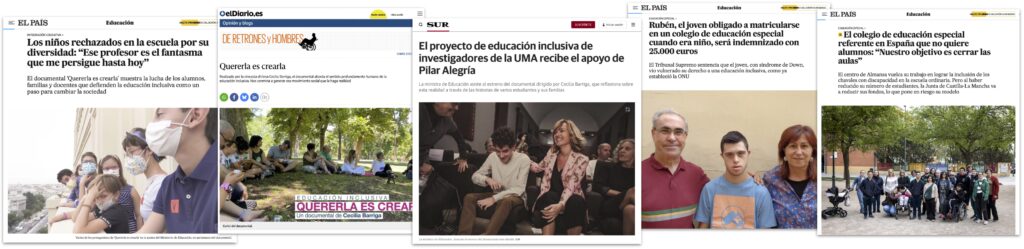
- Young people bring their vision for inclusive education to the European Parliament (European Agency for Special Needs and Inclusive Education, 19/10/2026). https://www.european-agency.org/news/young-people-european-parliamenthttps://www.european-agency.org/news/young-people-european-parliament
- Héctor will be able to study vocational training with an assistant and fulfill his dream of becoming a pastry chef (La Voz de Galicia, 16/10/2026). https://www.lavozdegalicia.es/amp/noticia/vigo/2026/10/14/hector-podra-estudiar-fp-asistente-cumplir-sueno-repostero/00031792000480609768591.htm
- From educational research with young people to international policy advocacy (University of Málaga, 14/10/2026). https://www.uma.es/departamento-de-teoria-e-historia-de-la-educacion/noticias/de-la-investigacion-educativa-con-jovenes-la-incidencia-politica-internacional/
- Héctor’s struggle to become a pastry chef and break a new educational barrier (La Voz de Galicia, 09/10/2026). https://www.lavozdegalicia.es/noticia/vigo/2026/10/07/lucha-hector-repostero-romper-nueva-barrera-educativa/00031791397889739624435.htm
- When political gain topples inclusive education (El Diario de la Educación, 06/10/2026). https://eldiariodelaeducacion.com/2026/10/06/educacion-inclusiva-familias-recursos/https://eldiariodelaeducacion.com/2026/10/06/educacion-inclusiva-familias-recursos/
- Young people shaping inclusive education policy at the European Parliament (European Agency for Special Needs and Inclusive Education, 23/09/2026). https://www.european-agency.org/news/european-parliament-event-2026
- The Government presents its strategy to include students with disabilities in mainstream schools (El País, 09/18/2026). https://elpais.com/educacion/2026-09-18/el-gobierno-propone-incorporar-progresivamente-a-45000-estudiantes-con-discapacidad-a-la-escuela-ordinaria.html
- “It is not a reconversion”: the Quererla es Crearla movement accuses the Regional Government of Andalusia of dismantling vocational training for students with disabilities by “disguising it as inclusion” (Tododisca, 09/08/2026). https://tododisca.es/discapacidad/no-es-reconversion-el-movimiento-quererla-es-crearla-acusa-a-la-junta-de-andalucia-de-desmantelar-la-fp-para-alumnado-con-discapacidad-disfrazandolo-de-inclusion/
- There are strikes that open up spaces (El Diario de la Educación, 07/16/2026). https://eldiariodelaeducacion.com/quererla-es-crearla/2026/07/16/hay-huelgas-que-abren-espacios/
- Inclusive Education Movement rejects amendments to the disability reform: “It is not whatever the PP feels like” (Europa Press, 09/16/2026). https://www.europapress.es/epsocial/igualdad/noticia-movimiento-educacion-inclusiva-rechazan-enmiendas-reforma-discapacidad-no-le-apetezca-pp-20260916141859.html
- The Inclusive Education Movement rejects the PP’s amendments to the disability reform (Demócrata, 09/16/2026). https://www.democrata.es/politica/congreso-y-senado/el-movimiento-por-la-educacion-inclusiva-rechaza-las-enmiendas-del-pp-a-la-reforma-de-la-discapacidad/
- The Inclusive Education Movement rejects the PP’s amendments to the disability reform (Demócrata, 09/16/2026). https://www.democrata.es/ca/politica/congres-i-senat/el-moviment-per-l-educacio-inclusiva-rebutja-les-esmenes-del-pp-a-la-reforma-de-la-discapacitat/
- The Movement for Inclusive Education rejects the PP’s amendments to the disability reform (Demócrata, 09/16/2026). https://www.democrata.es/pt/politica/congresso-e-senado/o-movimento-pela-educacao-inclusiva-rejeita-as-emendas-do-pp-a-reforma-da-deficiencia/amp/
- The Movement for Inclusive Education rejects the PP’s amendments to the disability reform (Demócrata, 09/16/2026). https://www.democrata.es/it/politica/congresso-e-senato/il-movimento-per-l-educazione-inclusiva-respinge-le-emendamenti-del-pp-alla-riforma-della-disabilita/
- Manifesto: yes to field trips and extracurricular activities (El Diario de la Educación, 06/23/2026). https://eldiariodelaeducacion.com/quererla-es-crearla/2026/06/23/manifiesto-salidas-actividades-extraescolares-educacion-publica/
- Weaving networks for transformation (La Nación, 06/11/2026). https://www.lanacion.com.py/columnistas/2026/06/11/tejiendo-redes-para-transformar-la-educacion/
- Students in Boborás gain a voice in the classroom (La Región, 06/02/2026). https://www.laregion.es/boboras/alumnado-boboras-gana-voz-aula_1_20260602-4299991.html
- «Quererla es Crearla» rejects the segregated classrooms proposed by the Regional Ministry: «Specific classrooms are not an inclusive measure» (Marina Alta, 05/21/2026). https://lamarinaalta.com/quererla-es-crearla-rechaza-las-aulas-segregadas-que-propone-conselleria-las-aulas-especificas-no-son-una-medida-inclusiva/
- Indefinite strike in Valencia: we defend inclusive education, not the creation of UECO classrooms (El Diario de la Educación, 05/18/2026). https://eldiariodelaeducacion.com/quererla-es-crearla/2026/05/18/huelga-educacion-publica-inclusion-ueco-comunidad-valenciana/
- The Secretary of State closes the participatory process held with the educational community to design the Inclusive Education plan
(Ministry of Education, Vocational Training and Sports, 05/05/2026). https://www.educacionfpydeportes.gob.es/prensa/actualidad/2026/05/20260505-jornadainclusiva.html - Indefinite strike in Valencia: we defend inclusive education, not the creation of UECO classrooms (El Diario de la Educación, 05/18/2026). https://eldiariodelaeducacion.com/quererla-es-crearla/2026/05/18/huelga-educacion-publica-inclusion-ueco-comunidad-valenciana/
- Open page. Quererla es crearla: Revisiting inclusion (Rosa Sensat, 05/01/2026). https://www.rosasensat.org/es/infancia-214/pagina-abierta-quererla-es-crearla-a-vueltas-con-la-inclusion
- Asunción Declaration for Inclusive Education as a Social Movement (University of Málaga, 04/15/2026). http://hdl.handle.net/10630/46502
- 1st Ibero-American Congress on Inclusive Education as a Social Movement (UNESCO, 04/09/2026). https://www.unesco.org/es/articles/1er-congreso-iberoamericano-sobre-educacion-inclusiva-como-movimiento-social
- Paraguay will host the 1st Ibero-American Congress on Inclusive Education as a Social Movement (El Nacional, 03/14/2026). https://elnacional.com.py/nacionales/paraguay-sera-sede-1er-congreso-iberoamericano-sobre-educacion-inclusiva-como-movimiento-social-n102480
- ION: our country will host the first Ibero-American Congress on Inclusive Education (La Nación, 03/09/2026). https://www.lanacion.com.py/pais/2026/03/09/ion-nuestro-pais-sera-sede-del-primer-congreso-iberoamericano-sobre-educacion-inclusiva/
- Inclusive Education: Asunción to host the 1st Ibero-American Congress (ABC, 03/28/2026). https://www.abc.com.py/nacionales/2026/03/28/educacion-inclusiva-asuncion-sera-sede-del-1er-congreso-iberoamericano/
- Collaborative workshop to strengthen inclusive schools in the Patagonia Region: “Quererla es Acción!” (UNPA, 03/03/2026). https://www.uaco.unpa.edu.ar/taller-colaborativo-para-fortalecer-la-escuela-inclusiva-en-la-region-patagonia-quererla-es-accion
- Asunción hosted the first Ibero-American Congress on Inclusive Education as a Social Movement (UNESCO, 06/19/2026). https://www.unesco.org/es/articles/asuncion-fue-sede-del-primer-congreso-iberoamericano-sobre-educacion-inclusiva-como-movimiento
- The 1st Ibero-American Congress on Inclusive Education as a Social Movement was held in Paraguay (University of Malaga, 04/21/2026). https://www.uma.es/departamento-de-teoria-e-historia-de-la-educacion/noticias/celebrado-en-paraguay-el-1er-congreso-iberoamericano-sobre-educacion-inclusiva-como-movimiento-social/
- Paraguay moves towards inclusive education with new evidence to strengthen public policies (United Nations, 04/14/2026). https://paraguay.un.org/es/313663-paraguay-avanza-hacia-una-educaci%C3%B3n-inclusiva-con-nuevas-evidencias-para-fortalecer
- Paraguay opens a regional space to rethink inclusive education as a social commitment (La Nación, 04/09/2026). https://www.lanacion.com.py/pais/2026/04/09/paraguay-abre-espacio-regional-para-repensar-educacion-inclusiva-como-compromiso-social/
- We participated in the 1st Ibero-American Congress on Inclusive Education as a Social Movement (RREI, 04/20/2026). https://rededucacioninclusiva.org/estrategias-de-incidencia/participamos-del-1er-congreso-iberoamericano-sobre-educacion-inclusiva-como-movimiento-social/
- Asunción hosted the first Ibero-American Congress on Inclusive Education as a Social Movement (Ecuador Universitario, 06/21/2026). https://ecuadoruniversitario.com/arte-y-cultura/asuncion-fue-sede-del-primer-congreso-iberoamericano-sobre-educacion-inclusiva-como-movimiento-social/
- As members of the RREI, we participated in the 1st Ibero-American Congress on Inclusive Education as a Social Movement (ACIJ, 04/14/2026). https://acij.org.ar/como-integrantes-de-la-rrei-participamos-del-1er-congreso-iberoamericano-sobre-educacion-inclusiva-como-movimiento-social/
- UNESCO provides evidence to improve the availability, comparability, and use of data on students with disabilities (UNESCO, 04/22/2026). https://www.unesco.org/es/articles/la-unesco-aporta-evidencia-para-mejorar-la-disponibilidad-comparabilidad-y-uso-de-datos-sobre-los
- Getting down to the nitty-gritty: proposals for inclusive education as a social movement (El Diario de la Educación, 05/12/2026). https://eldiariodelaeducacion.com/quererla-es-crearla/2026/05/12/educacion-inclusiva-movimiento-social-congreso-iberoamericano-asuncion/
- Weaving networks to transform education (La Nación, 06/11/2026). https://www.lanacion.com.py/columnistas/2026/06/11/tejiendo-redes-para-transformar-la-educacion/
- Special Education Pedagogy student participates in international congress in Paraguay (University of Chile, 04/20/2026). https://facso.uchile.cl/noticias/239157/estudiante-de-ed-especial-participa-en-congreso-en-paraguay
- MEC and UNICEF present recommendations to strengthen inclusive education in Paraguay (UNICEF, 04/10/2026). https://www.unicef.org/paraguay/comunicados-prensa/mec-y-unicef-presentan-recomendaciones-para-fortalecer-la-educaci%C3%B3n-inclusiva-en
- In April, Asunción will host the 1st Ibero-American Congress on Inclusive Education (Rosario 3, 02/24/2026). https://www.rosario3.com/educacion/en-abril-asuncion-sera-sede-del-1-congreso-iberoamericano-de-educacion-inclusiva-20260224-0057.html
- Thinking together about school guidance (El Diario de la Educación, 12/09/2025). https://eldiariodelaeducacion.com/quererla-es-crearla/2025/12/09/pensar-juntos-la-orientacion-escolar/
- Invitation to the Ibero-American Congress on Inclusive Education (Diario Norte, 02/24/2026). https://www.diarionorte.com/324049-inivitan-al-congreso-iberoamericano-de-educacion-inclusiva
- Revoloteo (El Diario de la Educación, 07/21/2025). https://eldiariodelaeducacion.com/quererla-es-crearla/2025/07/21/revoloteo/
- Rubén, the young man forced to enroll in a special education school as a child, will be compensated with 25,000 euros (El País, 06/18/2025). https://elpais.com/educacion/2025-06-18/ruben-el-joven-obligado-a-matricularse-en-un-colegio-de-educacion-especial-cuando-era-nino-sera-indemnizado-con-25000-euros.html
- The Power of students (El Diario de la Educación, 05/28/2025). https://eldiariodelaeducacion.com/quererla-es-crearla/2025/05/28/el-poder-del-alumnado/
- On both sides of the ocean, suffering hurts the same (El Diario de la Educación, 05/26/2025). https://eldiariodelaeducacion.com/quererla-es-crearla/2025/05/26/a-los-dos-lados-del-oceano-el-sufrimiento-duele-igual/
- The glasses that the school needs (El Diario de la Educación, 05/13/2025). https://eldiariodelaeducacion.com/quererla-es-crearla/2025/05/13/las-gafas-que-necesita-la-escuela/
- The benchmark special education school in Spain that does not want students: “Our goal is to close the classrooms” (El País, 04/15/2025). https://elpais.com/educacion/2025-04-15/el-colegio-de-educacion-especial-referente-en-espana-que-no-quiere-alumnos-nuestro-objetivo-es-cerrar-las-aulas.html
- It is not a midsummer night’s dream (El Diario de la Educación, 04/11/2025). https://eldiariodelaeducacion.com/quererla-es-crearla/2025/04/11/no-es-el-sueno-de-una-noche-de-verano/
- First mobility of the Network of Schools for inclusion and equity: one meeting, a thousand questions, and one answer (El Diario de la Educación, 02/12/2025). https://eldiariodelaeducacion.com/quererla-es-crearla/2025/02/12/primera-movilidad-de-la-red-de-escuelas-por-la-inclusion-y-la-equidad-un-encuentro-mil-preguntas-y-una-respuesta/
- The emotion of creating in community (El Diario de la Educación, 01/02/2025). https://eldiariodelaeducacion.com/quererla-es-crearla/2025/01/02/la-emocion-de-crear-en-comunidad/
- Times of change (El Diario de la Educación, 12/05/2024). https://eldiariodelaeducacion.com/quererla-es-crearla/2024/12/05/tiempos-de-cambios/
- “Educating based on labeling produces a harmful effect” (Diario de Almería, de Cádiz, de Jerez, de Sevilla, El Día de Córdoba, Europa Sur, Huelva Información, Granada Hoy and Málaga Hoy, 10/24/2024). https://www.ignaciocalderon.uma.es/projects/efecto-nocivo/
- The need to organize ourselves (El Diario de la Educación, 09/09/2024). https://eldiariodelaeducacion.com/quererla-es-crearla/2024/09/09/la-necesidad-de-articularnos/
- The owners of the story (El Diario de la Educación, 06/20/2024). https://eldiariodelaeducacion.com/quererla-es-crearla/2024/06/20/los-duenos-del-cuento/
- In search of alternatives to psycho-pedagogical assessment (El Diario de la Educación, 05/27/2024). https://eldiariodelaeducacion.com/quererla-es-crearla/2024/05/27/en-busca-de-alternativas-a-la-evaluacion-psicopedagogica/
- Scars (El Diario de la Educación, 05/02/2024). https://eldiariodelaeducacion.com/quererla-es-crearla/2024/05/02/cicatrices/
- “It is terrible that a child does not feel part of society” (Diario Vasco, 04/29/2024). https://www.ignaciocalderon.uma.es/projects/es-terrible/
- “Inclusive education in Spain is regressing. Segregation is increasing” (Down España, 04/09/2024). https://www.sindromedown.net/la-educacion-en-espana-va-en-retroceso-cada-vez-se-segrega-mas/
- How to achieve inclusion from within exclusion? (El Diario de la Educación, 03/05/2024). https://eldiariodelaeducacion.com/quererla-es-crearla/2024/03/05/como-hacer-inclusion-desde-la-exclusion/
- Starting… with memory (El Diario de la Educación, 01/23/2024). https://eldiariodelaeducacion.com/quererla-es-crearla/2024/01/23/comenzar-con-memoria/
- Cristóbal Ruiz: listening to Los Asperones, awarded by Cáritas (Diario Sur, 12/22/2023). https://www.diariosur.es/malaga/cristobal-ruiz-escucha-asperones-premiada-caritas-20231221005029-nt.html
- Awarded for lending their voice to achieve an inclusive school (La Opinión de Málaga, 12/11/2023). https://www.ignaciocalderon.uma.es/projects/prestar-su-voz/
- Everyone fits in the classroom: global award for an inclusive education project (Agencia EFE, 11/19/2023). https://www.ignaciocalderon.uma.es/projects/en-el-aula-caben-todos/
- “School teaches us deeply that there must always be someone below us, when collaboration should be the priority” (El Español, 07/05/2023). https://www.elespanol.com/malaga/cultura/educacion/20230507/escuela-ensena-alguien-debajo-deberia-primar-colaboracion/761174290_0.html
- The Spanish school system, as an institution, is exclusionary (Diario Sur, 05/11/2022). https://www.ignaciocalderon.uma.es/projects/escuela-excluyente/
- Quererla es Crearla, the fight for inclusive education (La Ventana, Cadena Ser, 31/10/2022). https://creemoseducacioninclusiva.uma.es/w/2Ug79yGkNxa6hsNyRUYnMx
- Alegría attends the premiere of the documentary ‘Inclusive Education. Quererla es crearla’ (Europa Press, 10/21/2022). https://www.europapress.tv/politica/709271/1/alegria-asiste-estreno-documental-educacion-inclusiva-quererla-crearla
- Ignacio Calderón: “In school, it’s like being in a supermarket checkout line; the diversity of rhythms is not respected” (El Diari de l’educació, 10/26/2022). https://diarieducacio.cat/ignacio-calderon-a-lescola-passa-com-a-la-cua-del-super-no-es-respecta-la-diversitat-de-ritmes/
- The documentary ‘Quererla es crearla’ advocates for inclusive education (Servimedia, 10/21/2022). https://www.servimedia.es/noticias/museo-reina-sofia-acoge-encuentro-sobre-educacion-inclusiva/3474173
- Pilar Alegría attends the premiere of the documentary ‘Inclusive education. Quererla es crearla’ (Ministry of Education and Vocational Training, 20/10/2022). https://www.educacionyfp.gob.es/prensa/fotonoticias/2022/10/20221021-educacioninclusiva.html
- Ignacio Calderón: “People say we must normalize disability, but no. It is normality that has created disability” (El Diario de la Educación, 21/10/2022) https://eldiariodelaeducacion.com/2022/10/21/ignacio-calderon-se-dice-que-hay-que-normalizar-la-discapacidad-y-no-ha-sido-la-normalidad-la-que-ha-hecho-la-discapacidad/
- Being part of everything (Museo Nacional Centro de Arte Reina Sofía, 21/10/2022). https://www.museoreinasofia.es/actividades/ser-parte-todo
- A documentary seeks to achieve an inclusive education that breaks down the “barriers” for persons with disabilities (Galicia Confidencial, 10/19/2022). http://www.galiciaconfidencial.com/noticia/211812-documental-busca-conseguir-educacion-inclusiva-rompa-coas-barreiras-persoas-discapacidade
- Children rejected at school due to their diversity: “That teacher is the ghost that haunts me to this day” (El País, 10/22/2022). https://elpais.com/educacion/2022-10-22/los-ninos-rechazados-en-la-escuela-por-su-diversidad-ese-profesor-es-el-fantasma-que-me-persigue-hasta-hoy.html
- Alegría attends the premiere of the documentary ‘Quererla es crearla’ and commits to leaving no student “behind” (La Vanguardia, 10/21/2022). https://www.lavanguardia.com/vida/20221021/8577119/alegria-asiste-estreno-documental-quererla-crearla-apuesta-dejar-ningun-alumno.amp.html
- The UMA promotes an inclusive education project with the documentary ‘Quererla es crearla’ (Teleprensa, 10/21/2022). https://www.teleprensa.com/articulo/malaga/uma-impulsa-proyecto-educacion-inclusiva-documental-quererla-es-crearla/202210211523041322049.html
- ‘Quererla es crearla’: educating in Equality (Tesis, Canal Sur TV, 12/10/2022). https://www.canalsur.es/television/programas/tesis/noticia/1880515.html
- The documentary ‘Quererla es crearla’ advocates for inclusive education (La Vanguardia, 10/21/2022). https://www.lavanguardia.com/vida/20221021/8575986/documental-quererla-crearla-revindica-educacion-inclusiva.html
- The UMA promotes an inclusive education project with the documentary ‘Quererla es crearla’ (Europa Press, 10/21/2022). https://www.europapress.es/andalucia/malaga-00356/noticia-uma-impulsa-proyecto-educacion-inclusiva-documental-quererla-crearla-20221021151653.html
- The UMA promotes an inclusive education project with the documentary ‘Quererla es crearla’ (La Opinión de Málaga, 10/21/2022). https://www.laopiniondemalaga.es/sociedad/2022/10/21/uma-impulsa-proyecto-educacion-inclusiva-77541987.html
- The inclusive education project by UMA researchers receives support from Pilar Alegría (Diario Sur, 10/24/2022). https://www.diariosur.es/malaga/uma-mministra-apoya-proyecto-educacion-inclusiva-20221024114617-nt.html
- Quererla es crearla (ElDiario.es, 11/07/2022). https://www.eldiario.es/retrones/quererla-crearla_132_9689216.html
- Quererla es crearla takes pride in inclusion (El Diario de la Educación, 10/19/2022). https://eldiariodelaeducacion.com/2022/10/19/quererla-es-crearla-saca-pecho-por-la-inclusion/
- An educational project from the UMA that makes the leap to the big screen (Novaciencia, 10/21/2022). https://novaciencia.es/un-proyecto-educativo-de-la-uma-que-da-el-salto-a-la-gran-pantalla
- The UMA promotes an inclusive education project with the documentary ‘Quererla es crearla’ (Gente en Málaga, 10/21/2022). http://www.gentedigital.es/malaga/noticia/3488056/la-uma-impulsa-un-proyecto-de-educacion-inclusiva-con-el-documental-quererla-es-crearla/
- Inclusive education: ‘Quererla es crearla’ (Artesfera, Radio Nacional de España, 12/05/2022) https://www.rtve.es/play/audios/artesfera/artesfera-educacion-inclusiva-quererla-crearla-05-12-22/6750812/
- ‘Quererla es crearla’, the UMA documentary that fights for inclusive education (Málaga Hoy, 11/28/2022). https://www.malagahoy.es/malaga/Querer-documental-UMA-educacion-inclusiva_0_1741627937.html
- Inclusive education will be the focus of a conference organized by Education and “Capaces” (Rota al Día, 11/28/2022). https://rotaaldia.com/art/37151/la-educacion-inclusiva-sera-el-centro-de-unas-jornadas-organizadas-por-educacion-y-capaces
- Documenting a movement: ‘Quererla es crearla’ (Radioactivas, Radio 5, 11/30/2022). https://www.rtve.es/play/audios/radioactivas-en-radio-5/radioactivas-radio-5-documentar-movimiento-quererla-crearla/6748040/
- Experts in inclusive education: “We must denaturalize normality” (Hora 14 Baleares, Cadena Ser, 02/03/2023). https://cadenaser.com/baleares/2023/02/03/expertos-en-educacion-inclusiva-hay-que-desnaturalizar-la-normalidad-radio-mallorca/
- The City Council collaborates with the “Changing the Perspective” project to implement more inclusive education (Mérida City Council, 01/27/2023). https://merida.es/el-ayuntamiento-colabora-con-el-proyecto-cambio-de-mirada-para-implantar-una-educacion-mas-inclusiva/
- Quererla es crearla (Els demotions, IB3 TV, 03/07/2023) https://youtu.be/4tHDQH-QkC0
- Launch of the “Quererla es crearla” campaign in defense of inclusive education (Regional Network for Inclusive Education – Latin America, 10/17/2020) https://rededucacioninclusiva.org/estrategias-de-incidencia/lanzan-la-campana-quererla-es-crearla-en-defensa-de-la-educacion-inclusiva/
- Quererla es crearla (Mi mirada te hace grande, 12/07/2020). http://objetivovisibilizandoelautismo.com/pv/index.php/historias/154-quererla-es-crearla
- Protesters demand “inclusive” schools (Europa Press, 10/23/2022). https://www.europapress.tv/sociedad/709545/1/manifestantes-reclaman-escuelas-inclusivas
- Protesters demand improvements in education regarding inclusion (Europa Press, 10/23/2022). https://www.europapress.tv/sociedad/709567/1/manifestantes-reclaman-mejoras-educacion-ambito-inclusion
- Hundreds of people demonstrate for inclusive education (Europa Press, 10/23/2022). https://www.europapress.tv/sociedad/709547/1/decenas-personas-manifiestan-educacion-inclusiva
- Rally for an inclusive school (La Sexta Noticias, 10/23/2022). https://creemoseducacioninclusiva.uma.es/w/hSk6T7JDhKjum31mx3f1BT
- The Minister of Education receives a delegation from the group ‘Estudiantes por la inclusión’ (University of Málaga, 09/14/2021). https://www.uma.es/sala-de-prensa/noticias/la-ministra-de-educacion-recibe-una-representacion-del-grupo-estudiantes-por-la-inclusion/
- Children rejected at school due to their diversity: “That teacher is the ghost that haunts me to this day” (Trama Red, 09/14/2021). https://tramared.com/tramanews/hallazgos/721-los-ninos-rechazados-en-la-escuela-por-su-diversidad-ese-profesor-es-el-fantasma-que-me-persigue-hasta-hoy
- Inclusive Education. Quererla es crearla (El Periódico de Extremadura, 03/23/2022). https://www.elperiodicoextremadura.com/ocio/agenda/educacion-inclusiva-quererla-crearla-85046157.html
- FEDER joins the “Quererla es crearla” campaign (Spanish Federation for Rare Diseases, 10/21/2022). https://www.enfermedades-raras.org/actualidad/noticias/feder-se-adhiere-la-campana-quererla-es-crearla
- ‘Quererla es crearla’, a campaign for inclusive education (Aula Intercultural, 11/11/2020). https://aulaintercultural.org/2020/11/11/quererla-es-crearla-una-campana-por-la-educacion-inclusiva/
- Foanpas, for inclusion in the classroom (Faro de Vigo, 03/18/2023). https://www.farodevigo.es/gran-vigo/2023/03/18/foanpas-inclusion-aulas-84847937.html
- Inclusive and included education: the necessary change of perspective (El Salto, 10/24/2022). https://www.elsaltodiario.com/educacion/educacion-inclusiva-e-incluida-el-cambio-de-mirada-necesario
- Suma y sigue (Gente Despierta, Radio Nacional de España, 10/13/2021). https://www.rtve.es/play/audios/gente-despierta/cuarta-hora-13-10-21/6135440/
- Pilar Alegría holds a meeting with a group of secondary school students who have developed a guide on inclusive education (Ministry of Education and Vocational Training, 09/13/2021). https://www.educacionyfp.gob.es/prensa/fotonoticias/2021/09/20210913-reunionestudiantesinclusiva.html
- A seven-step guide to making your school a more inclusive place (El Diario de la Educación, 10/27/2021). https://eldiariodelaeducacion.com/2021/10/27/una-guia-en-siete-pasos-para-hacer-de-tu-escuela-un-lugar-mas-inclusivo/
- Estudiantes por la inclusión (Cappaces, 09/14/2021). https://cappaces.com/2021/09/14/6720/
- The voice of students: an essential tool for building inclusive schools (The Conversation, 12/02/2021). https://theconversation.com/la-voz-del-alumnado-una-herramienta-esencial-para-construir-escuelas-inclusivas-171332
- Get to know ‘Estudiantes por la inclusión’ (Down España). https://creamosinclusion.com/educacion-inclusiva/blog/experiencia/conoce-estudiantes-por-la-inclusion/
- New Guide: How to make your school inclusive (Criando 24/7). https://criando247.com/guia-como-hacer-inclusiva-escuela-descarga-gratis/
- Webinar 2: How to make your school inclusive (ONCE Competition, 01/27/2022). https://youtu.be/LpH5nn6nNPA
- Cinema and Science: Quererla es crearla (Malota Interactive Museum, 03/24/2023). https://fb.watch/jt0GyOXj4X/
- No venim amb Manual (IB3, 01/29/2023). https://ib3.org/novenim?pl=1&cont=8775381b-9fa7-11ed-8e3e-c437725f29d4&t=894&fbclid=IwAR2iQpT9vkOkfu3pj5TjhLwmrHU5uJ-epF2eVGrCzjSEgTXyfYaKx293OVw
- Inclusive education (A Media Mañana, Radio Nacional de España, 11/24/2022). https://www.rtve.es/play/audios/a-media-manana/educacion-inclusiva-24-11-22/6743268/
- Como la luz de un sueño (La Axarquía, Film Festival, 02/04/2022). https://axarquiafestival.com/premios
- The school of my dreams – Part I (Supercapaces, Canal Málaga TV, 01/28/2022). https://vimeo.com/671394592
- The school of my dreams – Part II (Supercapaces, Canal Málaga TV, 02/04/2022). https://vimeo.com/674826378
- A research perspective on ‘Quererla es crearla’ (Supercapaces, Canal Málaga TV, 10/21/2022). https://creemoseducacioninclusiva.uma.es/w/gopfR6afSzqmPnvRL8Vcx7
- Interview with Ignacio Calderón Almendros (Meganoticias, Chile, 07/22/2022). https://youtu.be/v9oa1zrsm7M
- Every student matters in Chile (El Mostrador, Chile, 02/01/2022). https://www.elmostrador.cl/agenda-pais/2022/02/01/cada-estudiante-importa-en-chile/
- Leticia Barbadillo and Marta Casal from Quererla es Crearla (Hoy por Hoy A Coruña, Cadena Ser, 11/09/2022). https://cadenaser.com/audio/1667980971273/
- Interview with Ignacio Calderón Almendros (Supercapaces, Canal Málaga TV, 03/26/2021). https://youtu.be/4uHoUvYTw8w
- Interview with Ignacio Calderón Almendros (CNN Chile, 06/22/2021). https://youtu.be/uRtolKLj18E
- Reaction to the study stating that students without disabilities achieve the same results when they have classmates with disabilities (SMC Spain, 07/07/2022). https://sciencemediacentre.es/reaccion-al-estudio-que-dice-que-los-estudiantes-sin-discapacidad-obtienen-los-mismos-resultados
- Another step in the fight against the shortcomings of the education system (Diario Sur, 11/23/2021). https://www.diariosur.es/cronica-universitaria/educacion-inclusiva-uma-proyecto-20211123000141-ntvo.html
- More than 200 people participate in the virtual meetings ‘Conversations about the (inclusive) school’ (20 Minutos, 06/12/2021). https://www.20minutos.es/noticia/4290247/0/mas-de-200-personas-participan-en-los-encuentros-virtuales-conversaciones-sobre-la-escuela-inclusiva/
- More than 200 people participate in the virtual meetings “Conversations about the (inclusive) school” (University of Malaga, 06/12/2021). https://www.uma.es/sala-de-prensa/noticias/mas-de-200-personas-participan-en-los-encuentros-virtuales-conversaciones-sobre-la-escuela-inclusiva/
- Almáchar hosts the “Axarquía Inclusiva” meeting (Axarquía Plus, 12/01/2021). https://www.axarquiaplus.es/almachar-acoge-el-encuentro-axarquia-inclusiva/
- Almáchar hosts the “Axarquía Inclusiva” participatory conference (Axarquía 24 Horas, 12/03/2021). https://www.axarquia24horas.es/interior/almachar-acoge-la-jornada-participativa-ldquo-axarquia-inclusiva-rdquo-713
- Susana Fajardo presents the Mérida City Council’s inclusion model at the “Axarquía Inclusiva” conference (Mérida City Council, 12/02/2021). https://merida.es/susana-fajardo-expone-el-modelo-de-inclusion-del-ayuntamiento-en-la-jornada-axarquia-inclusiva/
- “The determined and ethically guided articulation of educational processes allows us to grow in our humanity” (Oritel, 07/30/2021). https://oritel.org/2021/07/30/la-articulacion-decidida-y-eticamente-guiada-de-procesos-educativos-nos-permiten-crecer-en-nuestra-humanidad/
- The LOMLOE and the right to inclusive education (El Diario de la Educación, 02/08/2021). https://eldiariodelaeducacion.com/porotrapoliticaeducativa/2021/02/08/la-lomloe-y-el-derecho-a-la-educacion-inclusiva-por-otra-politica-educativa-foro-de-sevilla/
- “Educational policy is developed every day at the national level, but also in schools and the classroom” (Fundación Educacional Seminarium, 09/19/2023). https://www.fundacionseminarium.com/la-politica-educativa-se-desarrolla-todos-los-dias-a-nivel-legislativo-pero-tambien-en-las-escuelas-y-el-aula/
- Rubén, an inclusive struggle on film (Diario de León, 10/17/2022). https://www.diariodeleon.es/articulo/sociedad/ruben-lucha-inclusiva-cine/202210172112312267877.html
- ‘Quererla es crearla’, a campaign for inclusive education (El Diario de la Educación, 10/14/2020). https://eldiariodelaeducacion.com/2020/10/14/quererla-es-crearla-una-campana-por-la-educacion-inclusiva/
- Imagine (El Diario de la Educación, 12/03/2020). https://eldiariodelaeducacion.com/2020/12/03/imagine/
- Ignacio Calderón Almendros (Supercapaces, Canal Málaga TV, 05/20/2020). https://youtu.be/Blx3DrNi7GM
- We continue to exclude (El Diario de la Educación, 12/03/2019). https://eldiariodelaeducacion.com/2019/12/03/seguimos-excluyendo/
- Neither by law nor by science (El Diario de la Educación, 06/20/2019). https://eldiariodelaeducacion.com/2019/06/20/no-de-ley-ni-de-ciencia/
- “Thinking that the mere presence of all students makes a school inclusive is a fallacy” (El Diario de la Educación, 01/10/2019). https://eldiariodelaeducacion.com/2019/01/10/pensar-que-la-mera-presencia-de-todo-el-alumnado-convierte-a-la-escuela-en-inclusiva-es-una-falacia/#comment-17968
- “What we lack (in inclusive education) is not scientific evidence, it is political will” (El Diario de la Educación, 02/26/2019). https://eldiariodelaeducacion.com/2019/02/26/lo-que-nos-falta-en-la-educacion-inclusiva-no-es-evidencia-cientifica-es-voluntad-politica/
- Segregating children by disability is a violation of human rights (Agencia SINC, 6/13/2018). https://www.agenciasinc.es/Opinion/Segregar-por-discapacidad-a-la-infancia-es-violar-los-derechos-humanos
- University research concludes that Spain is failing to uphold the right to inclusive education (Servimedia, 06/24/2018). https://www.servimedia.es/noticias/1049220
- Interview with Nacho Calderón Almendros: inclusive education (INED 21, 04/18/2018). https://ined21.com/entrevista-a-nacho-calderon-almendros/
- Rethinking the role (not only) of guidance to make inclusion possible (El Diario de la Educación, 02/28/2018). http://eldiariodelaeducacion.com/blog/2018/02/28/repensar-papel-no-solo-la-orientacion-posible-la-inclusion/