Consensus document. Minimum document for an Inclusive Sociopsychopedagogical Evaluation. Emerging narratives about the inclusive school from the social model of disability. Resistance, resilience, and social change.
RTI2018-099218-A-I00 | Ministry of Science, Innovation and Universities. University of Malaga.
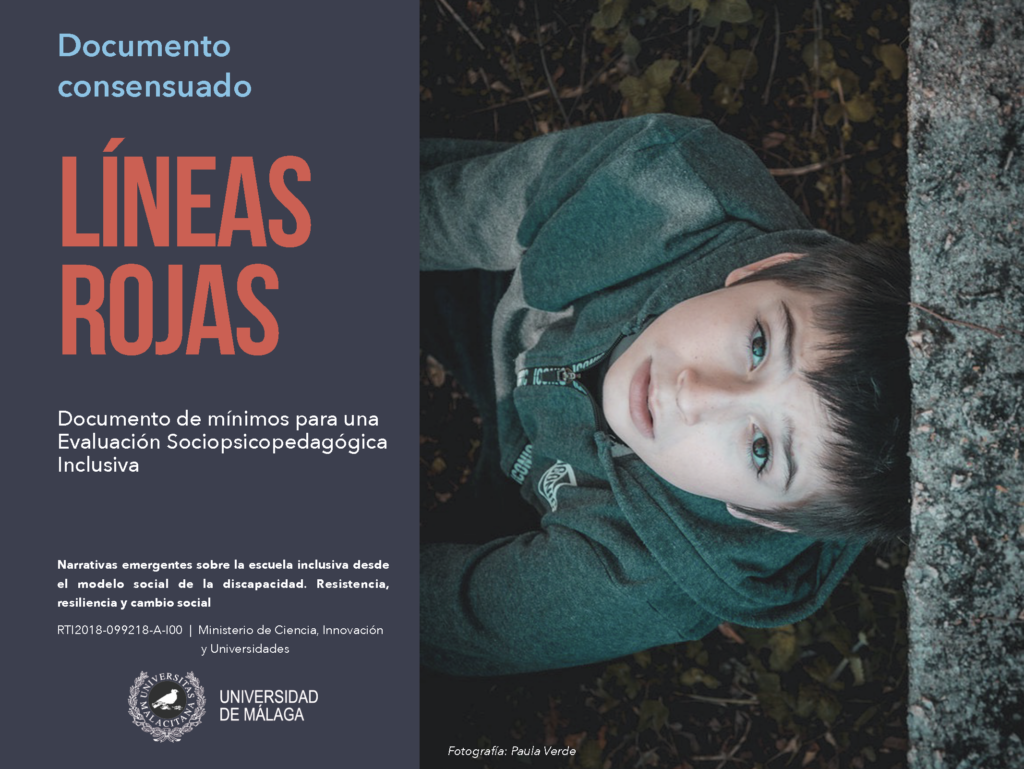
Red Lines
1. Evaluation cannot violate human rights, which implies that it must always protect, among others, the fundamental right to inclusive education: it can never be a reason for segregation from the classroom or the center.
2. Any socio-psychopedagogical evaluation proposal must clearly include the voices of the students and their families. It must be a collaborative construction with the teachers. Furthermore, families must be recognized as having the capacity to accept or reject the individualized aspects of the socio-psychopedagogical evaluation when it refers to their family member. The role of guidance is not to oppose the family, but to work alongside them, protecting human rights. These are the limits of such a relationship.
3. In the event that disability is addressed, the evaluation must be based on the social and rights-based model, moving away from the clinical model. It must therefore offer a systemic perspective.
4. As a consequence of the above, it is necessary to prevent diagnostic categories from being used as a form of socio-pedagogical assessment. When a category appears, the person is, in a way, nullified; and an educational assessment must necessarily place people at the center. In this regard, the need to pay attention also to those categories socially accepted as “mild” is highlighted.
5. Proposed interventions should be fundamentally oriented from the common, avoiding an initial specific focus.
6. The use of psychometric tests must be excluded from assessment practices, due to the demonstrated harmful effects they produce and the social injustice they conceal.
7. Psychopedagogical assessment must avoid standardized proposals, because it specifically needs to focus on the unique nature of the context, the educational situation of each classroom, school, and educational community. In this sense, recovering and constructing biographical and narrative accounts can be of great help.
8. The sociopsychopedagogical assessment of the class group must focus on respecting natural learning rhythms against standardized demands, the body, and potential, rather than on deficits.
9. The assessment must conclude in a report useful for the particular situation of that class, far from pretense and justification for requesting resources, because it is an educational tool. It must identify barriers (to access, learning, and participation) and constitute a practical proposal that offers tools and is accessible to the people affected by it (the entire educational community).
10. The inclusive measures that are proposed must be monitored and evaluated in order to adapt the proposal to the real conditions of the teaching-learning process.