
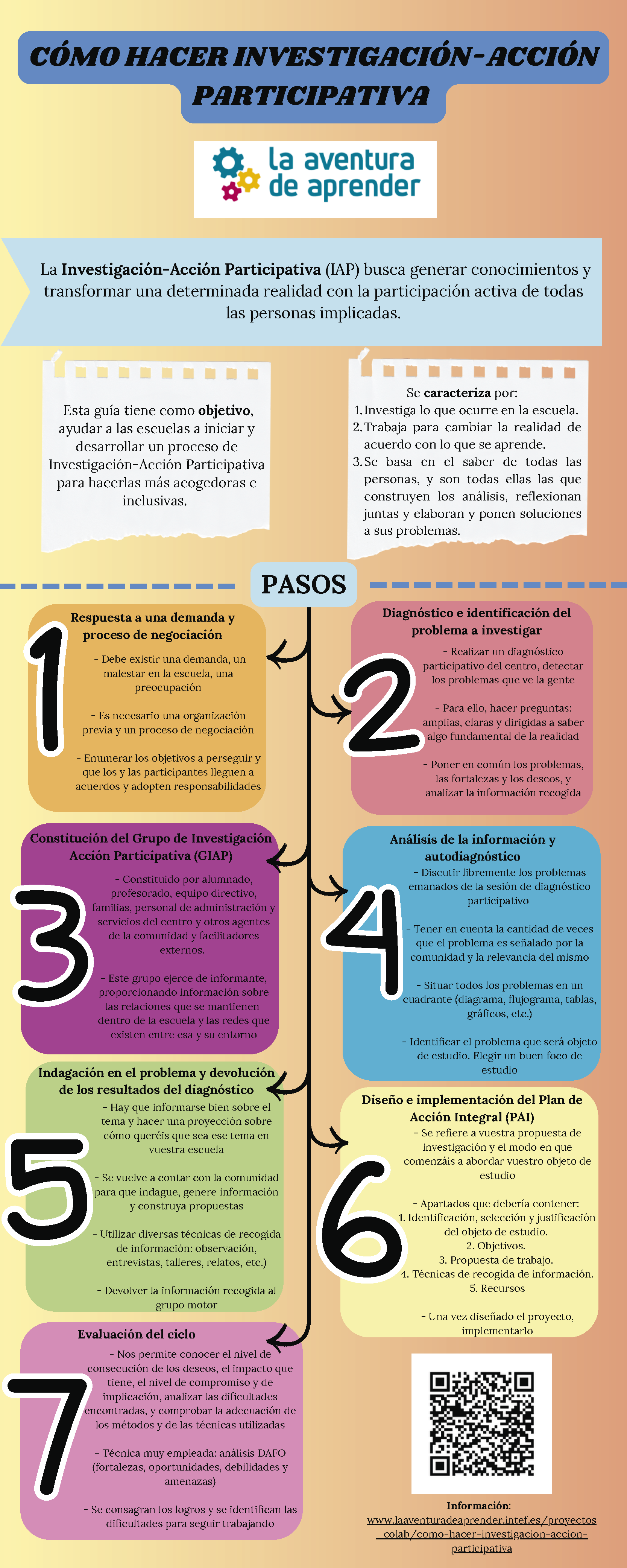
Infographic ‘How to do Participatory Action Research’
Participatory Action Research (PAR) seeks to generate knowledge and transform a specific reality with the active participation of all involved individuals.
This guide aims to help schools initiate and develop a Participatory Action Research process to make them more welcoming and inclusive.
- Investigate what happens in school.
- Work to change reality according to what is learned.
- It is based on the knowledge of all people, and it is all of them who construct the analyses, reflect together, and develop and implement solutions to their problems.
Steps
- Response to a demand and negotiation process.
- There must be a demand, a feeling of unease at school, a concern
- Prior organization and a negotiation process are necessary
- List the objectives to pursue and ensure that participants reach agreements and assume responsibilities
- Diagnosis and identification of the problem to investigate.
- Conduct a participatory diagnosis of the school, identify the problems people see.
- To do this, ask questions: broad, clear, and aimed at knowing something fundamental about reality.
- Share the problems, strengths, and desires, and analyze the information gathered.
- Constitution of the Participatory Action Research Group (GIAP).
- Composed of students, teachers, management team, families, administrative and service staff of the center, and other community agents and external facilitators.
- This group acts as an informant, providing information about the relationships maintained within the school and the networks that exist between it and its environment.
- Analysis of information and self-diagnosis.
- Freely discuss the problems arising from the participatory diagnosis session. Take into account the number of times the problem is pointed out by the community and its relevance.
- Place all problems in a quadrant (diagram, flowchart, tables, graphs, etc.).
- Identify the problem to be studied. Choose a good focus of study.
- Inquiry into the problem and feedback on the diagnostic results.
- You need to get well-informed about the topic and make a projection about how you want that topic to be in your school.
- The community is once again involved to investigate, generate information, and build proposals.
- Use diverse information gathering techniques: observation, interviews, workshops, narratives, etc.).
- Return the collected information to the steering group.
- Design and implementation of the Comprehensive Action Plan (CAP).
- It refers to your research proposal and how you begin to address your object of study.
- Sections it should contain:
- Identification, selection, and justification of the object of study.
- Objectives.
- Work proposal.
- Information gathering techniques.
- Resources
- Once the project is designed, implement it.
- Cycle evaluation.
- It allows us to know the level of achievement of desires, the impact it has, the level of commitment and involvement, analyze the difficulties encountered, and verify the adequacy of the methods and techniques used.
- Widely used technique: SWOT analysis (strengths, opportunities, weaknesses, and threats).
- Achievements are consolidated and difficulties are identified to continue working.
Information:
www.laaventuradeaprender.intef.es/proyectos_colab/como-hacer-investigacion-accion-participativa