
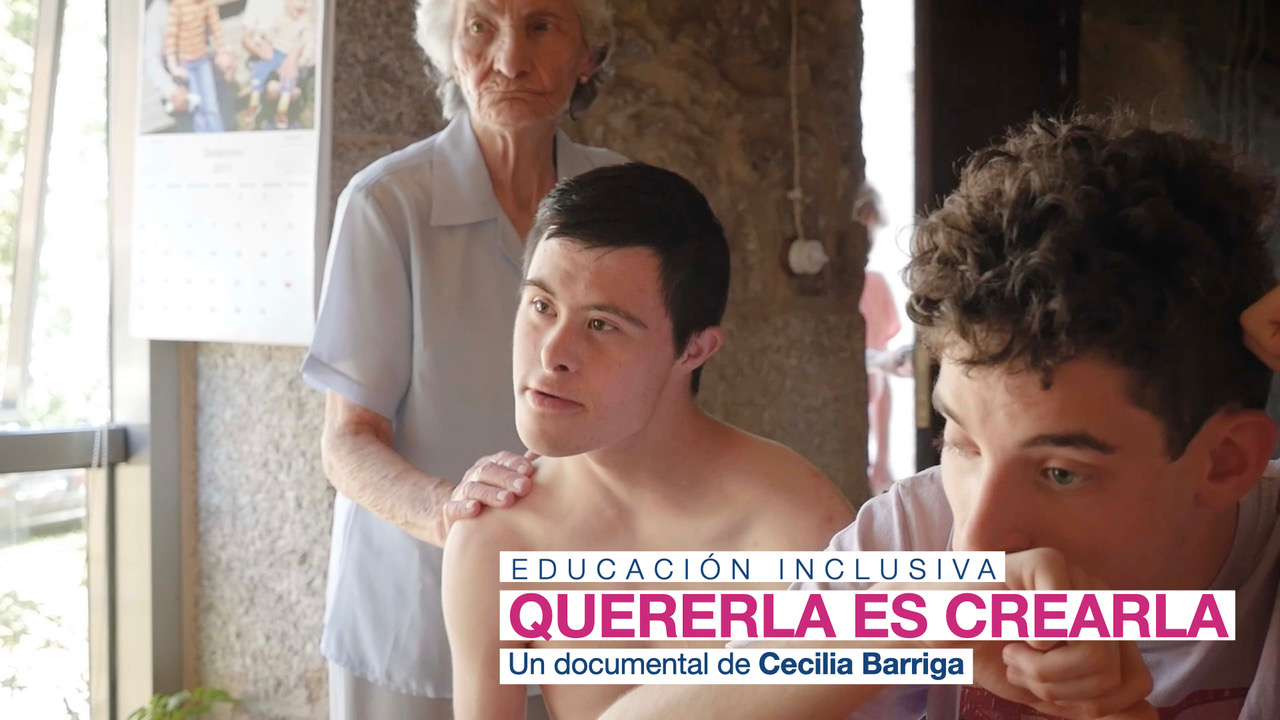
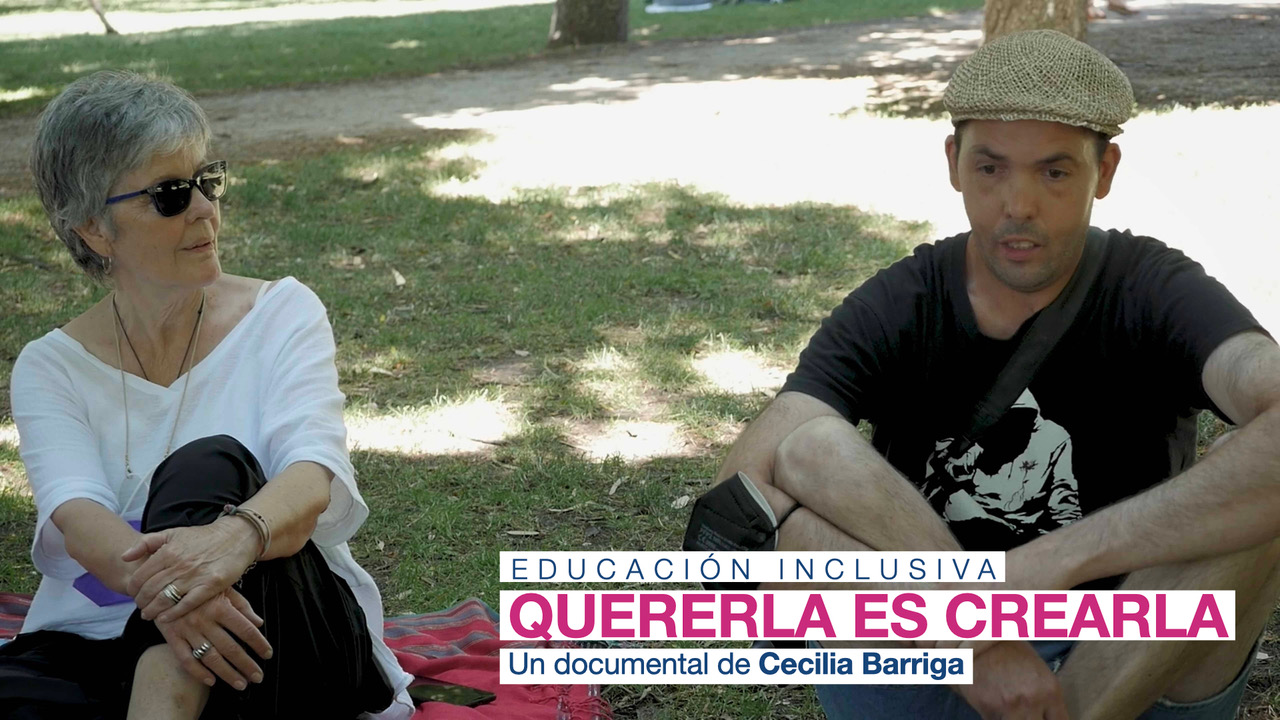
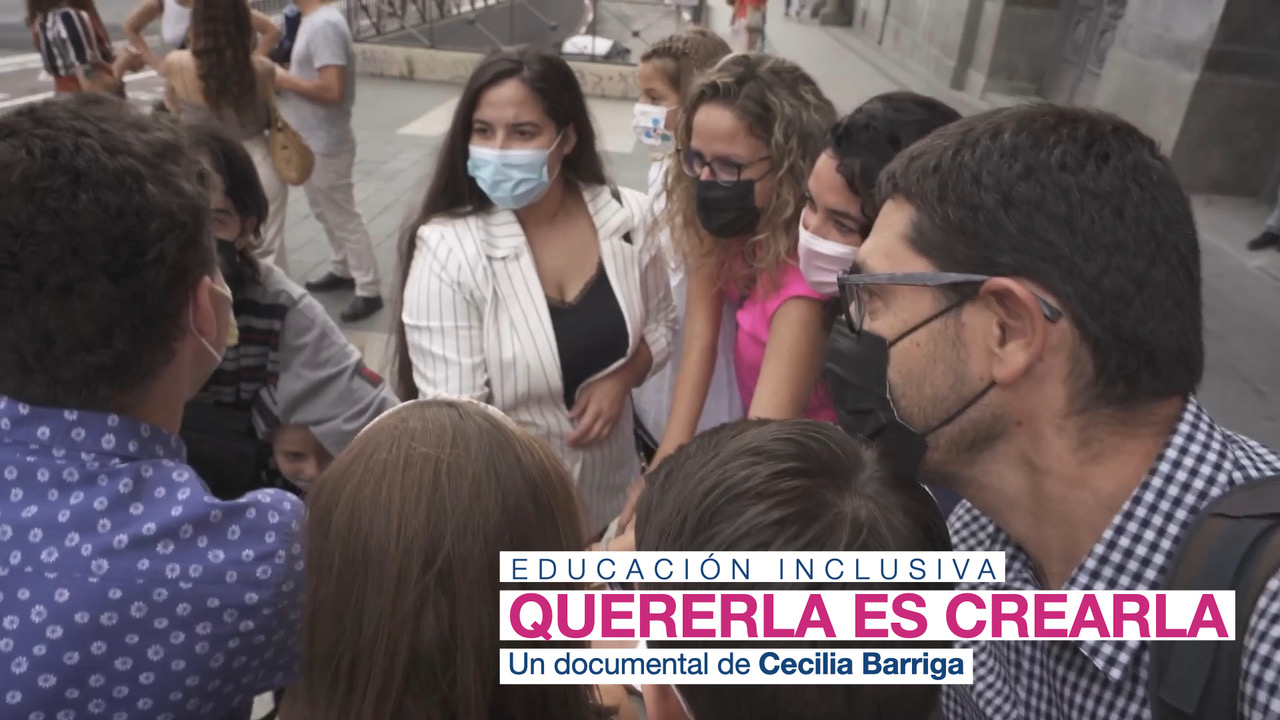
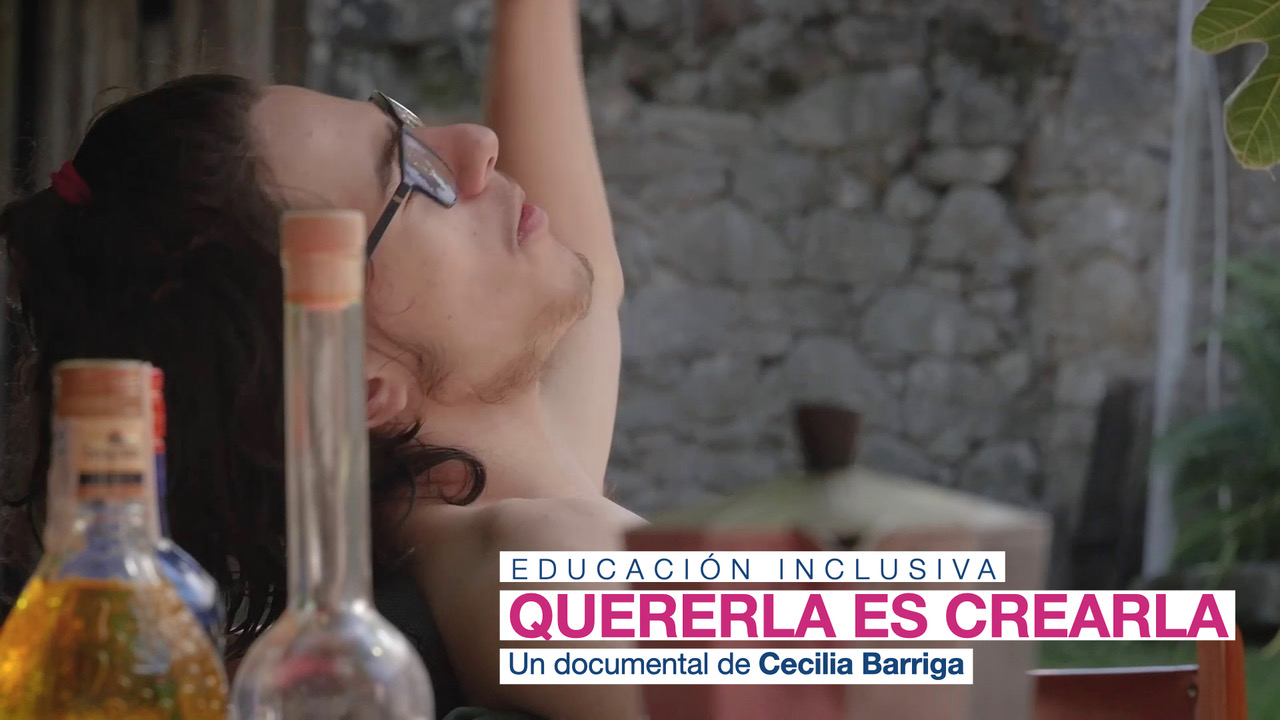
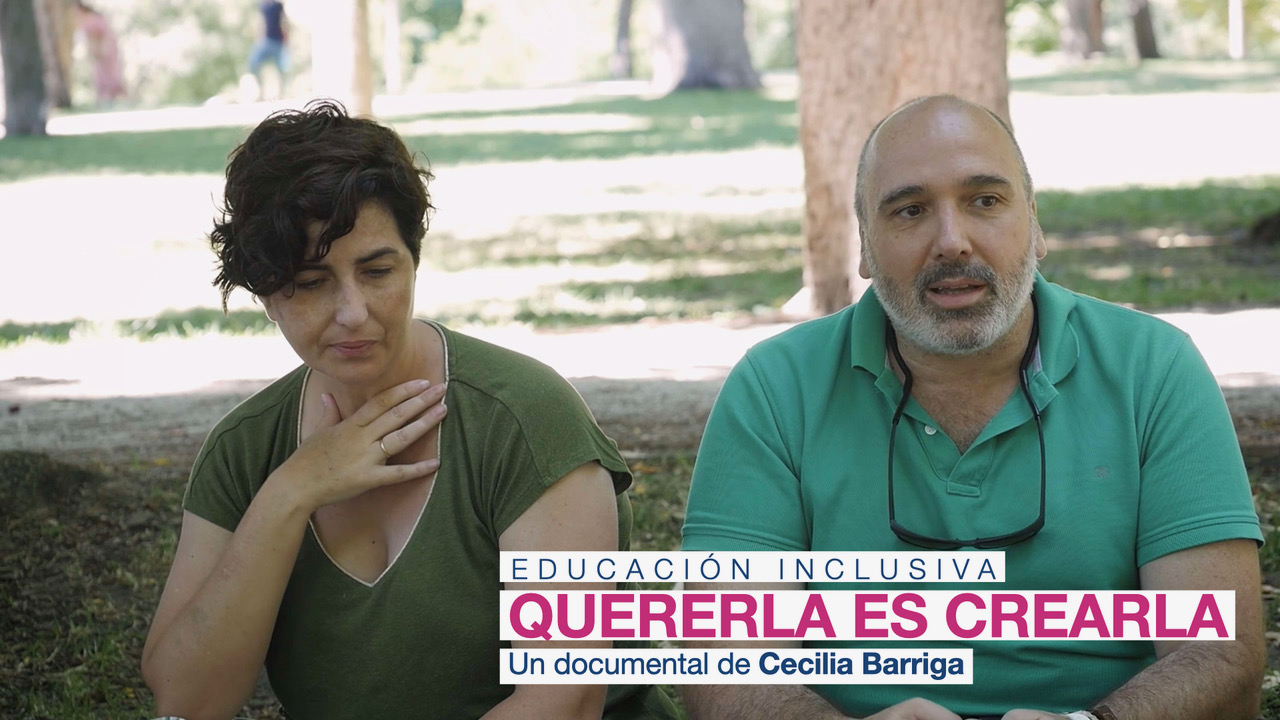
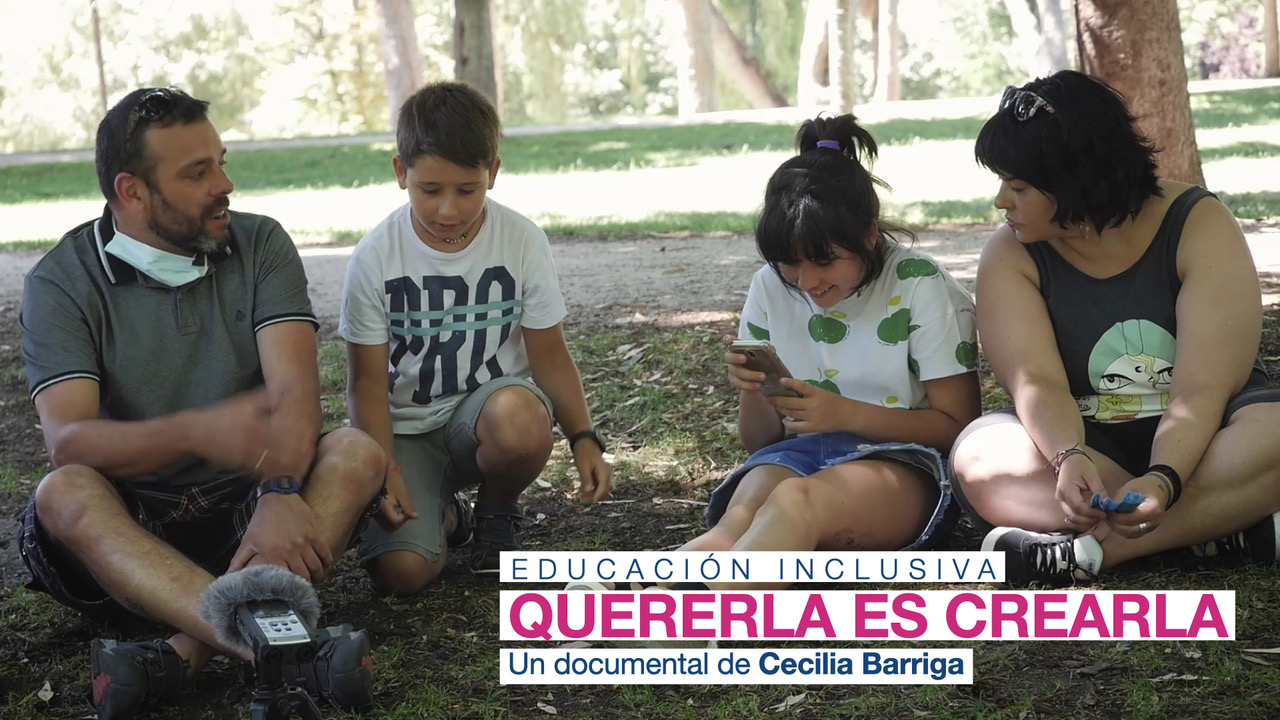
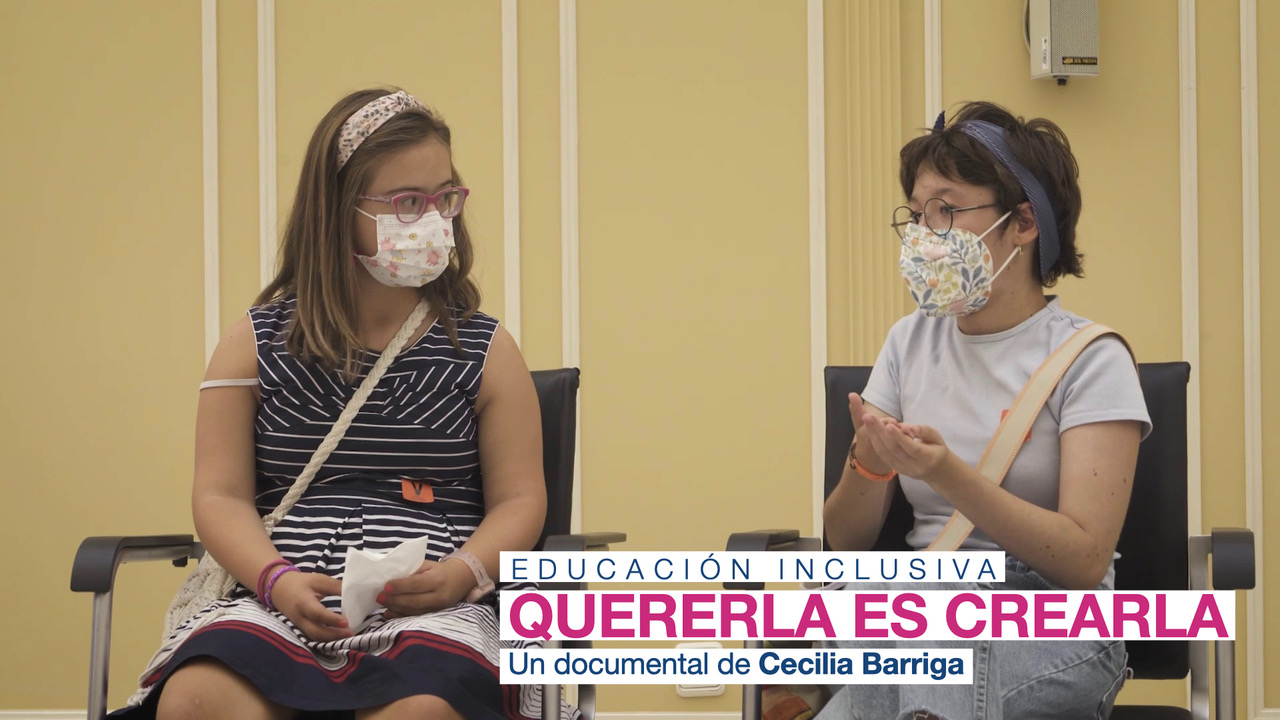





The film, open to the public
Audio description [AD]: On a black background, the text: "Faculty of Education Sciences. The University of Malaga presents the story of Rubén Calleja Loma, a family in struggle."
🎵 [Música introductoria de informativo]
Audio description [AD]: Close-up of a journalist during a TVE news broadcast.
Journalist 1:— A family from León has appealed to the Constitutional Court so that their son, who has Down syndrome, can attend a public school and not a specialized center.
Audio description [AD]: Rubén Calleja and his father, Alejandro Calleja, appear. Then, Rubén with another young man with Down syndrome. Next, Rubén swimming in a pool.
Journalist 2 (V.O.):—This video from change.org has already collected 130,000 signatures. It's the story of Rubén, a 14-year-old young man with Down syndrome. Close-up of Alejandro Calleja, talking to an interviewer on a park bench.
Alejandro Calleja - A.C.:—From the beginning, he has been stimulated, we have always been there for him to reach his maximum potential. Next, images of the school he was expelled from are shown.
Journalist 3 (V.O.):—The family's request is not far-fetched because the child attended early childhood education at the González de Lama Public School, with satisfactory progress. Problems arose in fourth grade when the child began to be subjected to mistreatment by a teacher.
Audio Description [AD]: Rubén Calleja, Lucía Loma, her mother, Alejandro Calleja and a journalist are at home talking. Rubén hugs his mother.
Journalist 4 (V.O.):—He had been at a public school in León for eight years until a new teacher arrived.
A.C.:—He rejected his presence in the classroom. He told us so from the beginning and later we found out about the abuse. He wanted to impose the law in the classroom by terrorizing.
Audio description [AD]:News report from La Sexta channel. After the journalist, a video of Rubén reading a book is shown on screen.
Journalist 5:—His family reports that the regional government of Castilla y León expelled him from the public school he had attended his entire life three years ago, claiming he should be in a special school.
Audio description [AD]: Rubén, Alejandro, and Lucía Loma, his mother, appear seated around a table.
Journalist 2 (V.O.):— And what Rubén and his parents want is for the boy to return to his lifelong school.
Rubén Calleja (R.C.):— I want to go to school.
Audio description [AD]: On screen, Lucía is teaching Rubén.
Journalist 2 (v.o.):—He has been receiving classes at home for three years, from his parents or from teachers.
Audio description [AD]:Close-up of a page with text and a pencil pointing to the words “anvil” and “hammer”.
R. C.:—Anvil… hammer.
Lucía Loma - L.L.:—It has a lack, and that lack is being with his friends.
Journalist 3 (v.o.):—After a long journey, the administration's only solution was to refer him to a special school.
L.L.:—And you say: 'no, I educate him at home'.
Audio description [AD]:Discussion on the program 'Vamos a ver', from Castilla-La Mancha, with five participants. In a caption, the text: 'He cannot be in a mainstream school. Daniel and his parents have lost the last battle fought in Spanish courts'.
Panelist 1:—I believe that those who should determine whether this child should go to a mainstream school or a special school are the technicians, the doctors, the psychologists, the psychiatrists.
A.C.:—(Intervenes by phone on the program). Inclusive education, a fundamental human right, is only achieved in mainstream schools, with other children. If we already know they won't reach the same level...
Panelist 2:—It's absurd.
A.C.:—It's not absurd. We already know they will reach the same level of knowledge, but they will socialize, they will be with their peers. They will learn from their peers and their peers will also learn from them.
Audio description [AD]:TVE's news report is revisited, showing Rubén's former school.
Periodista 3 (v.o.):— The Provincial Directorate decided to enroll him ex officio at the Sagrado Corazón school, but the parents insist that Rubén has the right to an inclusive education.
Audio description [AD]:On screen, images of Rubén playing board games. Then, Rubén and his mother play chess.
L.L.:— They put them there like in a miscellaneous drawer. For me, my son has to be in society.
Periodista 2 (v.o.):— The story gets complicated. The Prosecutor's Office reported the parents for not having their son enrolled in school.
A.C.:—That I, supposedly, could go to jail for defending my son's right to inclusive education? (gesture of displeasure).
L.L.:—Of course it hurts, a lot!
A.C.:—It's the world turned upside down. When we are defending our son's right to inclusive education.
Journalist 3 (v.o.):—A right that our country, as a member of the UN, is obliged to fulfill.
Agustín Matía, Down España - A.M.:—In Spain, the International Convention on Rights is in force, which states that educational inclusion is an obligation.
[Música introductoria de informativo]
Audio description [AD]:On a blue background, the text: "They denounced the Spanish State before the UN". Next, Rubén and his parents at home. Alejandro addresses the interviewer.
A.C.:—The dignity and rights of our son are priceless.
Audio description [AD]:Various press and media covers are shown on screen with headlines such as: "The UN forces Spain to compensate a student excluded for being Down", "The UN on the Down child: 'They did not take reasonable measures'", and "The UN condemns Spain to compensate Rubén for being discriminated against at school". On a blue background, the text appears: "The Calleja Loma family wins against the Spanish State". Next, in '8 Magazine', journalist Patricia Aláez addresses the camera. Alejandro Calleja attends the program.
Patricia Aláez - P.A.:—In León, we have good news: the UN Committee has ruled in favor of a family from León.
A.C.:—Apart from being right, it grants Rubén his right. A right that was denied to him throughout the judicial process we pursued, both here in the León Court and in the superior court of Castilla-León, in the Constitutional Court. Even in Strasbourg. We won the lawsuit, but at a very high personal, family, emotional, and psychological cost.
UNESCO, an international organization, also presented a World Education report this year and recognized the Calleja Loma family as defenders of inclusive education in Spain. What is taken from us internally is given to us externally.
Audio description [AD]:Fade to black. On two green lines, the text: "Inclusive education: Quererla es Crearla". Next, in front of the Ministry of Education doors, a group of adults and young people gather. One person is taking photographs of them with a mobile phone.
Carmen Saavedra, mother of Antón - C.S.: If you get together more, maybe the poster comes out. When no one passes by, I'll throw it. Now.
(Addressing Indira Martínez) How are you, Indira? Good. Ready? How are you? So pretty! We have a war cry: We do it and then we see! What do you think?
Audio description [AD]: Several members of the group 'Students for Inclusion', including Nacho Calderón, Teresa Rascón, and Luz Mojtar, form a circle and place their hands on top of each other, in a sign of unity.
Group (in unison):— Strength! The hand, let's gooooo!
Nacho Calderón - N.C.:— (Addressing her daughter, Malena Calderón, who is crying). Don't be nervous, Malena. We're going to have a great time. You don't have to be nervous.
Malena Calderón - M.C.:— (Nods) I don't know…
N.C.:— Why are you nervous? Don't be nervous. You're going to do super well. We're just going to talk about the same things we've been talking about during the conversations we've had. So, there's no need to be nervous. You should be happy so that everyone can be more at ease. (Addressing the whole group) You'll see, it's going to turn out very well. It's going to turn out very well. And we're going to have a great time. And in a little while, we're going to have a drink somewhere.
Luz Mojtar - L.M.:— Let's celebrate!
Audio description [AD]: On screen, Malena wipes away her tears. Next, her meeting with the Minister of Education and Vocational Training, Pilar Alegría, and the Secretary of State for Education, Alejandro Tiana, appears.
M.C.:—My uncle was almost expelled from school. And we have a friend, Rubén, who was actually kicked out of school and he felt very bad because he wanted to go to a regular school, but they wanted to send him to a special education school. Not anymore. And then, even the UN, later on, when they found out about this case, said it was discrimination and we would like you to call Rubén to fix this.
Pilar Alegría, Minister of Education - P.A.:—Where is Rubén?
M.C.:—In León. In León.
P.A.:—Yes. I'll look into the matter, I'll look into the case, okay? I'll try to call Rubén. Okay. Does that sound good to you?
M.C.:—Yes. Okay.
Audio description [AD]:Indira appears nervous. Beside her, Malena assists her, offering support.
P.A.:—(Addressing Indira) Do you want to get up and take a breath? Come on!
Audio description [AD]:The minister addresses Antón Fontao, seated to her right.
Antón Fontao - A.F.:—Because we form a very good team together. One of the things that makes us happy is knowing that we can vent here. We are united. And we are here because we are happy to know that each and every one of us can make schools more inclusive.
Audio description [AD]:The minister addresses Indira again.
Indira Martínez - I.M.:—Those were the worst. The one I liked was Aniceto, the others, no…
P.A.:—With others no…
I.M.:—No, because the others didn't put me with others. And on top of that, I already have one who is my tutor forever. On top of that. Who I can't stand. Oh, my God! Now let's see what I do with him. Now I'll turn it around. It's going to be very difficult. (LAUGHTER)
P.A.:—You wanted to do the same thing your classmates were doing, of course.
I.M.:—Look, I saw it with me and my friend. I freaked out! Until I gathered my courage and said: what teacher? You're not going to put me in the back again, are you? And I told him to his face.
P.A.:—Very well. A brave woman.
I.M.:—Yes, right? Of course. They go and tell me: 'No, she's there because you weren't there.' And I say: 'Are you sure? You're not tricking me?' Because I think they were tricking me.
Audio description [AD]:The camera stops on Juan Stefan.
Juan Stefan Marí-Mayans - J.S.M.-M.:—For me, my experience has been quite hard because it's very difficult to balance my medical appointments with school, as I have to miss classes and then I miss those classes. And then I get quite overwhelmed and everything becomes bigger and harder for me, because by missing classes, it's been very difficult, as the teachers have also barely helped me.
Audio description [AD]:Juan Stefan gets emotional and puts a hand to his forehead.
N.C.:—They have all lived through very, very painful experiences and are saying that school is not being attentive to them. He is saying that one does not have the right to be sick at school.
Audio description [AD]:The minister looks at the screen of a tablet she is holding. On the screen, Pablo, a young man in a room surrounded by sports equipment and a shelf with books and other objects, addresses the camera.
Pablo García - P.G.:—Hello, I'm Pablo and I'm part of the 'Students for Inclusion' group. This project helps teachers, students, and families so that we all have our place in that inclusive school.
Audio description [AD]:The minister then plays a video by Jorge Osa, a member of the 'Students for Inclusion' group.
Jorge Osa - J.O.:—I wanted to say, my part of the guide that Nacho's group gave you. It turns out that I am a child who, in my school, from primary school until sixth grade, was not accepted like the rest of the class. And I think it's a mistake by the teachers. And I would like you to take it into account, minister. Bye.
P.A.:—Goodbye (says goodbye to Jorge).
Audio description [AD]:Nacho Calderón addresses the minister, to whom he hands a paper guide.
N.C.:—The guide has a step-by-step process. It is a very short guide for students, by students. — Do you want to make your school inclusive? — Yes. — How can we do it? — The first step is to find a diverse group, make a diverse group. And, from there, the story begins.
Audio description [AD]: The minister addresses the group.
P.A.:— I can only thank you. And all ideas and contributions are welcome, if with them we manage to improve the school, which is what it is all about.
Audio description [AD]: The minister sits next to Zulaica to listen to her testimony.
Zulaika Hadmed - Z-H.:— Discrimination based on different ethnicities or cultures, and no longer just child to child, but also from teachers. As is my case. In third grade, I had to join late because my mother was undergoing life-or-death surgery and there was no one who could take me to school. So, I had a teacher. I will never forget that teacher, because he is the ghost that has haunted me until now, as I am about to finish second year of high school. He has marked not only my growth at that stage when I was only seven years old. Now, at 18, he still marks me a lot too. And it's because I was always in the spotlight and I didn't understand many things.
So, he would tell me: 'I can explain it to you many times, if I'm paid to explain it to you.' But by the third time he would say: 'If you're stupid, it's not my fault. Learn by yourself.' And you would be left like that, because of course, he didn't just say it privately, but he said it in front of many children. And I was so shy that I felt like a tiny, tiny ant. I told my mother: 'I don't want to go to school anymore,' even though I loved it and my grades were outstanding. But from third grade onwards, my grades went from failing to failing.
In fourth grade, my mother went to a parent-teacher conference and he told her: 'Of course, don't worry, I'll help her.' He was one of those people who dictated quickly, and if you couldn't keep up, you were left behind and failed. And then, the next day, in front of the class, he told me: 'Zulaica, tell your mother that if you're slow, it's not my fault, because I'm not going to put up four blackboards for you.' Out of the blue. And of course, children are so cruel that they started laughing at me because I was slow, because the teacher told you you were stupid, that you were a gypsy. And of course, if you're a gypsy and you're already eight years old, get out of school, you don't deserve to be here.
Of course, and you can take this in two ways: drop out of school and never go back, or get more involved, as I did. If I didn't know something, I would start discovering it on my own. I would start learning it myself. And although this has made me independent, it still affects me, because in first year of high school I'm not able to ask a question, as I don't want others to laugh at me anymore. I mean, they laughed at me for three consecutive years. I don't want them to laugh at me anymore, because according to them, I'm clumsy.
Audio description [AD]: The minister addresses the group.
P.A.:— The experiences you've shared with me are painful because, in the end, you are the young people of our country, you are the future of this country. It also makes one's heart ache, but I must tell you that never, never, never, never, never lose confidence in yourselves. Never. Never lose confidence in yourselves.
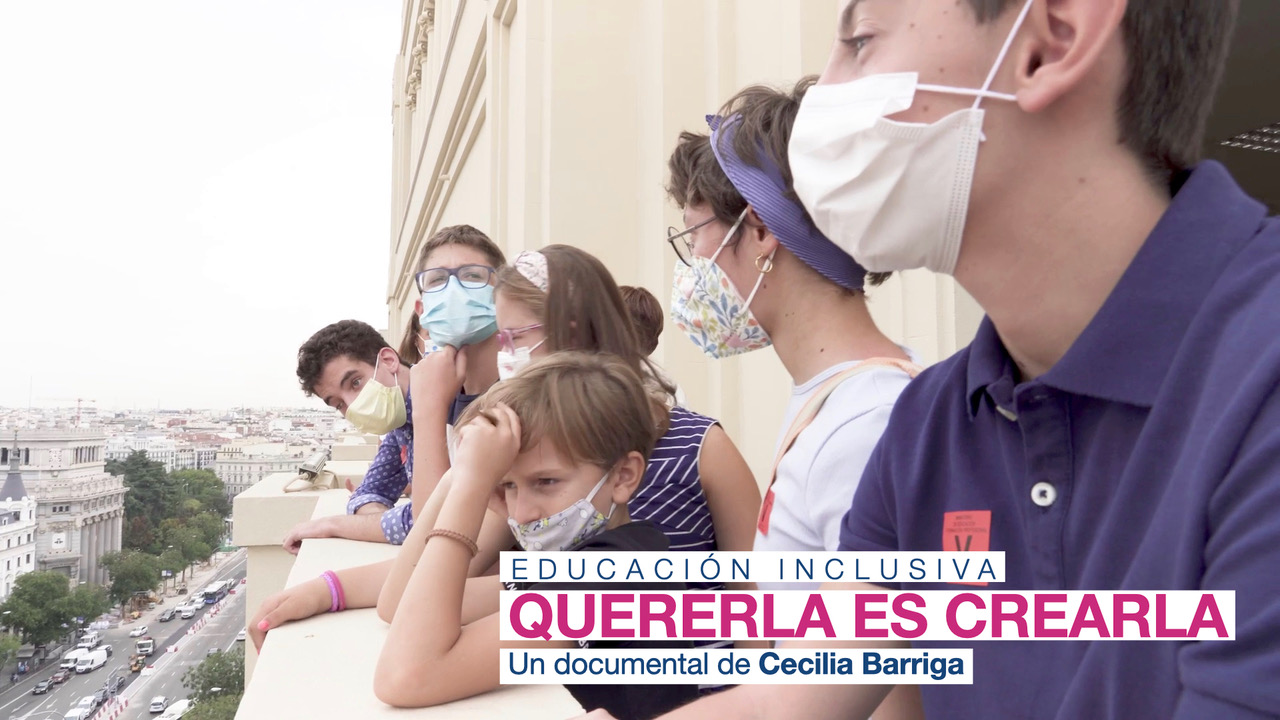
Audio description [AD]: Sitting on a platform, the ten students pose with the minister. They walk down a ministry hallway, enter an office, and exit onto a balcony. All are wearing surgical masks. Leaning out, they gaze at the rooftops of Madrid and the intersection of Calle Alcalá with Gran Vía.
Fade to black.
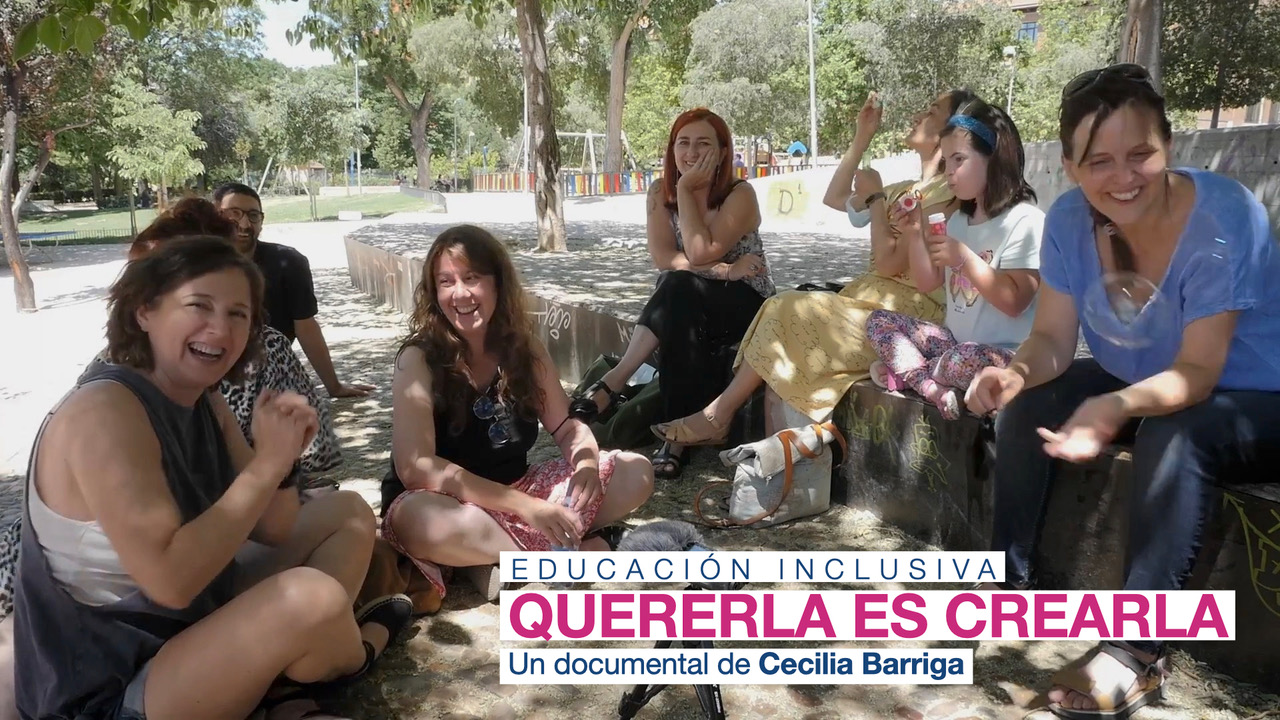
Several adults gather in a park and chat animatedly. Raúl Aguirre steps slightly away from the group and waves to the camera.
Next, the facade of a country house is shown. On it, a plaque with the name "La Casa Mía" and, next to it, a vibrant and intense illustration by Raúl. The image depicts a country house surrounded by nature, animals, and people, with a sun with a face at the top.
Raúl Aguirre - R.A.:— I am Raúl.
Audio description [AD]: Raúl leaves the house and heads to the garden, where he begins to work. He is wearing gray pants, a red and blue t-shirt that looks like a national team jersey, and a cap.
R.A.:—I am a person with diversity. And I have recently started living completely alone.
Audio description [AD]:Raúl flips through the bookThe rhinoceros's head, which combines texts and illustrations created by him as part of his artistic work.
R.A.:—(Holding a drawing of himself in his hands.) Well, this is a cousin of mine. I thought she could be at the sea and I drew her a kind of bikini. My friends, every time they see it, they think the bikini is headphones.
Audio description [AD]: Raúl reappears in the garden, outdoors, with Sacha Novalbos, his personal assistant. Together they collect plants and eggs.
R.A.:—A personal assistant comes three days a week. You've taught me a lot about birds, you've taught me to have patience.
Audio description [AD]: In a room, Raúl and Sacha are talking.
Sacha Novalbos - S.N.:—You have taught me a lot about birds, about having patience. You have taught me to reinvent myself many times, to push myself, to rack my brain.
R.A.:—You, well... to look at different prices, what costs more, what costs less. You have also taught me to cook. When you put the oil in, knowing whether to put it on high or low. Also, to be more sensitive.
S.N.:—Well, you are already very sensitive. You have taught me to be more sensitive.
R.A.:—And what else? To work on the value of money, to save, to take better care of parents.
Audio description [AD]:Raúl is in the orchard with his father, José Aguirre. He takes a photograph of him. Next, the image of the woman recording him appears, along with his mother, Concha Casasnovas, who watches the scene with a smile. Raúl adjusts the zoom and takes a snapshot of his mother.
Next, Raúl and his mother are sitting on the grass in a park, accompanied by a group of adult family members of 'Students for Inclusion'.
R.A.:—I am here today to meet new people. And I want to ask all these people how this moment came about. Thank you.
Concha Casasnovas - C.C.:—I have enormous hope for a future different from the one I have had to live and the one Raúl has had to live, especially. I am not at all sure that it is good to dream for our children. Raúl, certainly, has shown us that it is absurd for us to dream for them. They will also be initiators of this movement.
Teresa Rascón - T.R.:—I am currently overwhelmed with joy to be part of this group and this transformation that I believe you are generating. As I say, you are making history.
Susana Fajardo Bautista - S.F.C.:— That the process that says and that label that says my son has a certain percentage of disability does not mean that his life will be as someone looked at him and knew his life would unfold that way, but rather that he has all opportunities. And this stems from the right to inclusive education to subsequently transform society and be able to carry out those life projects.
Fidel Rozalem - F.R.:—And what I want is for my three children to have a different perspective, and what I would most like is for all of this to serve to change people's perspective on diversity.
Fernanda Valdés - F.V.:—(With her daughter, Zoe) Eight years ago, when she was born after a natural birth, they told me: “Here, you have a perfect, wonderful baby girl.” And I believed it. And even though someone came to tell me no, that she wasn't perfect, my thought was: “If she was perfect three days ago, why isn't she perfect now? So, I have continued with my perfect daughter these years, and I believe she should be whatever she wants to be.
A.C.:—First, we have undergone an internal transformation ourselves with our daily experiences, and now what matters is to transmit it and for this movement to be reflected and transparent to society. And we give it such an important push because we have the right, but the reality is very complicated for everyone. It is a path of hope, of struggle, of resistance, of pain too, but in the end, it is worth it. We are walking it, and we will continue walking it.
Marta Casal - M.C. :— It is a world where no one is told they cannot be anything, where each person is validated and recognized for who they are and what they are. And I believe that is possible. It seems like a utopia, something so basic, but I believe it is achieved in this group, and that brings enormous happiness. So, how can we amplify it, right?
C.S.:— I always say that the person who has taught me the most in the world has been my son, and he has taught me to respect everyone as they are, even myself, to respect myself and be who I am, with the good, the bad, and the mediocre. Because we are born and there is a mold we all have to fit into, and we suffer to fit into that damn mold. All inhabitants of this planet are suffering. So, let's see if we can break that mold and let everyone live life as they wish.
Audio description [AD]: Sandra Fernández, mother of Jorge and Leo Osa, sobs.
Sandra Fernández Carrera- S.F.C.:— (Sobbing) I want to have answers to the questions my son asks me about his future. And I don't have them. I needed to find people who understood me. Despite being very tearful, I am very optimistic. I am an optimist convinced that things can change. We are all in a process of construction and this group is so incredibly kind.
Sonia Hermida - S.H.:—I was also remembering another of my son's phrases, which always gets me: 'Mom, it's just that there are teachers who don't want to learn, and that way it's impossible.' And it's true, and he's absolutely right, because I think we are also here. I don't know if to teach, because I don't feel like a teacher to anyone either, but at least to try to open a little window of light and for us to become more and more until there is a global us.
Carmen Moreno - C.M.:—I dream that as a society we break down that wall that exists. It's very different how we see our children at home, and as soon as we cross that sidewalk, we realize how the rest of society doesn't share our same perspective. So, I want to break down that wall because I think it's very necessary.
N.C.:—A learning community like this, where every day you are open to what another person will tell you, provoke you, and move you, I haven't known anything else like it. The things we have been unlearning and the desire for other people to also be able to unlearn. The difficulty is how we make other people do it.
Belén Jurado - B.J.:—The loneliness of people with functional diversity or the loneliness of families. Having this group, sharing your experiences and things that seem unimportant to society in general, but are important to us. My brother actually taught me everything. He taught me to value people in a way and to see that there are other ways of life. At eight years old, he was already teaching me. And from then on, what I carry inside, I understand that not everyone who hasn't lived that situation can carry it, but I believe that by doing things, we can get closer to them living or understanding those situations.
Rubén Redondo - R.R.:— I am here today, above all, to meet you, for you to meet Lucía and Marcos (he points to two young people beside him, Marcos and Lucía, siblings). I only thought I would come, but look, now I am here, sitting, learning and very curious about what you are capable of contributing. And eager to learn, because… (His eyes well up). Well, because there is a lot to learn.
Marcos Redondo - M.R.:— (He addresses his father) Your foot is showing [en cámara].
Rubén Redondo - R.R.:— From within the world of disability and all of that, you realize how little you saw before, how little you knew before, and that people who are now outside and don't know, are not to blame, just as I wasn't before. And I think that's very difficult. I think it's the key point to achieve. That people who don't have an imperative need to be immersed in this topic have our perspective. And that seems to me to be the key, it seems very difficult, but here, in this group, I see many people who believe in it… it makes me nervous.
Audio description [AD]: Overview of the park. The group is sitting in the shade of a grove of trees. On a sign, the text: Text by Macarena García. Voice by María Luisa Fernández.
🎵 [Suena música de jazz al piano]
M.L.F. (v.o.):—Orientation is understood as a diagnostic tool. And that demands an Administration that does not offer the necessary means and resources. And in this whole maelstrom, I can't stop asking myself: 'Who am I to issue judgments and opinions? How can we foster more inclusive and humane spaces? How can we modify belief systems to bet on the idea that anyone can?'
Audio description [AD]:Rubén's father addresses the group sitting in the park.
A.C.:—Is Spain, as a guarantor of the Convention and the Constitution, truly a State of law? For persons with disabilities, for Rubén, at least, for our son, it has not been a State of law. The last great social revolution we have left, the empowerment of diversity, and for the reality of the law to be effective and real.
S.F.B.:—I believe we must start with a request for respect. We've discussed it many times, the "he'll be happy" or "he's well-loved here." I say, "Well, love him less, but treat him like a person." It's so obvious, you tell yourself, "My son is a person." It seems like you're stating the obvious, but in reality, you're not. It needs to be said often: he is a person.
B.J.:—Yes, as if we have to convince people to realize he is a person. When in reality, it's obvious that he's supposed to be a person, but in the eyes of society, my son isn't a person like my daughter. So, we have to keep repeating it; we have no other choice.
S.F.C.:—And I think another debate is emerging in society. More people feel that their diversity is not being understood. [A través de la conversación] from some migrant kids, who were talking about their process, I said: "If you change certain adjectives or certain names, they are talking about the same process as my trans son, my son with cerebral palsy." In the end, they are all demanding the same rights. There are many similarities in these movements, and I believe the energy and power we have as a group are mature enough to seek out those other allies.
C.C.:—I was thinking about how 40 years ago, a group of crazy women, who demonstrated on March 8th in Sol, were directly taken to jail. And look where the feminist movement is now. We've been in revolutionary political movements, and yet this issue has never had a place in them. Never. We've always experienced immense loneliness. The world is changing because the cashier has patience and waits for Raúl to say, "This is X euros," "How much does this cost me?" "Why is this more expensive? Well, I'm going to change it." And there's a line of 20 people waiting. And the cashier tells them, "Wait, here's Raúl, and he has his own pace." I heard him say the other day, "They didn't teach me this at school."
N.C.:— ¿Cómo conseguimos hacer espacios en los que haya la confianza de la que tú estabas hablando, Concha? La confianza en quien está atendiendo en un supermercado o que no te va a engañar, porque de eso se trata. Cuando hablamos de ciudad de educadora, se trata de eso, de que uno pueda tener la confianza de que tú vas a seguir aprendiendo en otros espacios, no solo en la escuela, y que el resto de la sociedad también va a seguir aprendiendo.
M.C.:— Yo decía el otro día con unos chicos en un aula, adolescentes: «Vale, yo no voy a ser negra ni gitana, nunca ni hombre, ya lo tengo claro, ni rica, a no ser que me toquen los Euromillones, pero mi diversidad funcional puede ir variando ahora en dos minutos, la de todos, por ser humanos. Y, sin embargo, vivimos completamente de espaldas a eso. Es algo que está ahí desde el momento en que nacemos, presente, y a lo que le damos la espalda. Pero, ¿por qué? ¿Qué pasa ahí? Y eso me hace pensar a la vez que tiene que ser muy fácil cambiarlo. No sé cómo decirlo. Es dificilísimo, nos parece un muro, pero pienso que tiene que haber una brecha que haga que esto caiga, porque somos todos y todas.
C.S.:— Y es que hay otros movimientos en los que, a lo mejor, recibían un maltrato por parte del mundo, clarísimo. ¿Y qué pasa con las personas con discapacidad? Que a veces hay un maltrato o una invisibilidad, pero a veces el buen trato es malo, porque tiene que haber otro buen trato distinto. Antón ahora está empezando a ir solo por el mundo, y le está costando un mundo. Los sábados salgo yo antes de casa y quedamos para desayunar en un lugar. Pues ya de tres veces, dos le ha pasado, que le ha parado a vecinos y le han dicho: «¿Dónde vas tú, solito, dónde está mamá?
F.V.:—My heart breaks because they are not allowed to be adults, nor are they allowed to have relationships, nor do they have the right to have a life like the rest of us. I don't understand that. And why does it continue to be perpetuated? I mean, what business is that?
B.J.:—I think we need to make them visible, for them to be seen and not hidden, and for daily life, as Carmen says, to become as natural as possible for them.
F.V.:—How do we change parents' fears that their children will be overprotected, that nothing will happen to them? How do we change that?
B.J.:—By making them visible.
F.V.:—Because isolating them from violence, treating them like children throughout their lives with violence, preventing them from making decisions, is violence. Let's also call it what it is. It is urgent to change this, because they are being mistreated.
A.C.:—And it is a violence that is, in fact, institutionalized.
F.V.:—And furthermore, totally protected by all of us.
A.C.:—Protected by public authorities. In other words, just as we say, hey, if you see your neighbor mistreating his wife, likewise, if you consider that this person is being deprived of their rights, say: 'Hey, we have to change this, and we all have to change it.' Is it a huge task? Yes, it's not overprotection. In other words, it is violence and it is a crime against the person.
T.R.:—I am very concerned, for example, to see that those who will be professionals tomorrow, will be teachers, will be counselors, when they go for practical training, and you ask them how it went and what the classroom is like, the students they have interacted with, what worries them most is not finding children with a label in that classroom.
S.F.B.:—And based on that, totally dehumanized, without adaptation, the same for everyone, they say: 'This one can stay and this one has to leave'.
Audio description [AD]:The group has stood up, except for two young people who continue playing on the floor.
N.C.:—How can we push the school to stop serving productivity?
M.C.:— I believe it's a review for everything, and this is like a little bomb. So, if we set it aside here, that tension doesn't reach the top. Because it's a miracle that Raúl is now in Camarma doing this and that Camarma says: “Wait, hold on, let's all learn.”
R.A.:— The support is at the moment you ask for it. And the help is, let's say, more for the moment you are in.
Audio description [AD]: Fade to black. Sonia Hermida, mother of Sabela and Iago, walks through a park with her children. Sabela lets go of her hand and takes small jumps. Next, the interview continues at her home.
S.H.:— I've been training for years in the field of children's literature, especially children's literature related to diversity. And of course, my testing ground is my children, at least for day-to-day.
Audio description [AD]: Sonia is sitting next to her children and her father, Diego. She and Diego are reading a story aloud, interpreting the characters' dialogues with different intonations.
S.H.:— (Reads the story) 'Exasperated, and with a swoop, he landed on one of Osvaldo's ears.'
Sabela Terrón - S.T.:— (Inaudible, aloud).
Iago Terrón - I.T.:— (Aloud) 'Where do you have your little trumpet?'
S.H.: — (Reads the story) "With all the strength of her lungs she said: 'Well, I should have shouted louder,' said the sea serpent complacently."
Diego Terrón - D.T.:— "Aha! That's what I thought, a donut."
Audio description [AD]: Close-up of Sabela, who is rocking in a rocking chair while playing a stringed instrument, possibly a zither, repetitively and singing.
I.T.:— (Addressing the camera) When she's happy or when she's having fun, not when she's nervous at all (smile). The easiest thing we had to do together, which we can't do now, because my father has a bad back, was that we would sit on top of him, and if I was there, Sabela didn't want to, but I would try to convince her. The difficult part was getting her to sit on top, but once she was on, she found it hard to get off. She didn't want to leave. But when she had to get off her dad, that was precisely when she didn't want to leave.
Audio description [AD]: Close-up of Sabela, rocking in a rocking chair, while humming the song of Papageno, from The Magic Flute by Mozart.
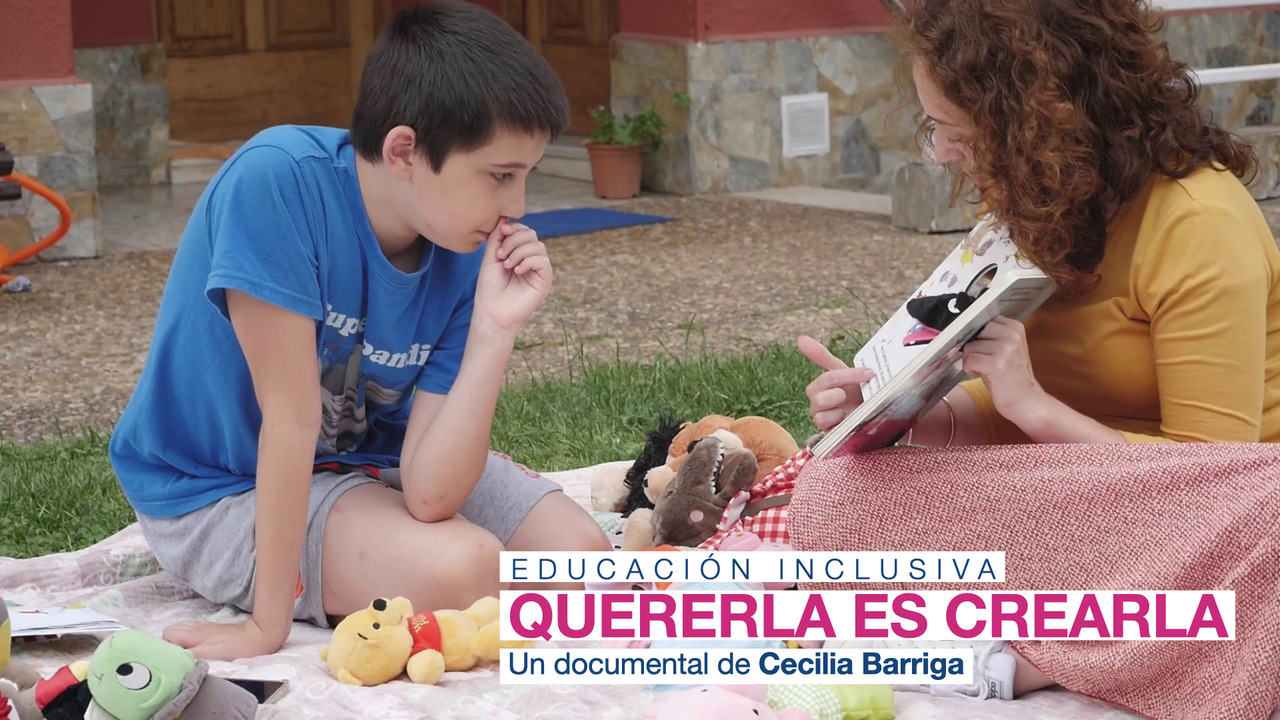
Next, a close-up of Paula Verde and her son Héctor, sitting on a sheet on the grass. Paula holds a storybook that she shows to Héctor, tracing the text with her finger. In front of them, his brothers, Lucas and Martín, play ball.
Paula Verde - P. V.:— (Narrating the story) I am learning with him how he encodes the world, what impresses me.
Audio description [AD]: While Paula speaks, photographs she has taken as a professional photographer of her son Héctor are shown.
P. V.:—I mean, his way of being in the world, of understanding and coding, dismantled me as a person, because to this day I still don't know what part of conversations he understands, how he understands them. So, deciphering all that and reinventing myself every day to be able to respond constantly. So, I need to decipher and, at the same time, try to convey that there is another type of reality, another type of mind, for which we are not prepared, but that, from the humility of not being prepared, we have to prepare ourselves to respond to other possibilities. So, I need the people around me to learn with me, to build with me so that this society were really more prepared to respond. I mean, half of all the schemes we have are useless, in his case.
Audio description [AD]:Finally, the whole family gathers on the sheet: Paula, the mother; Marcos, the father, and their three children, Héctor, Marcos, and Martín.
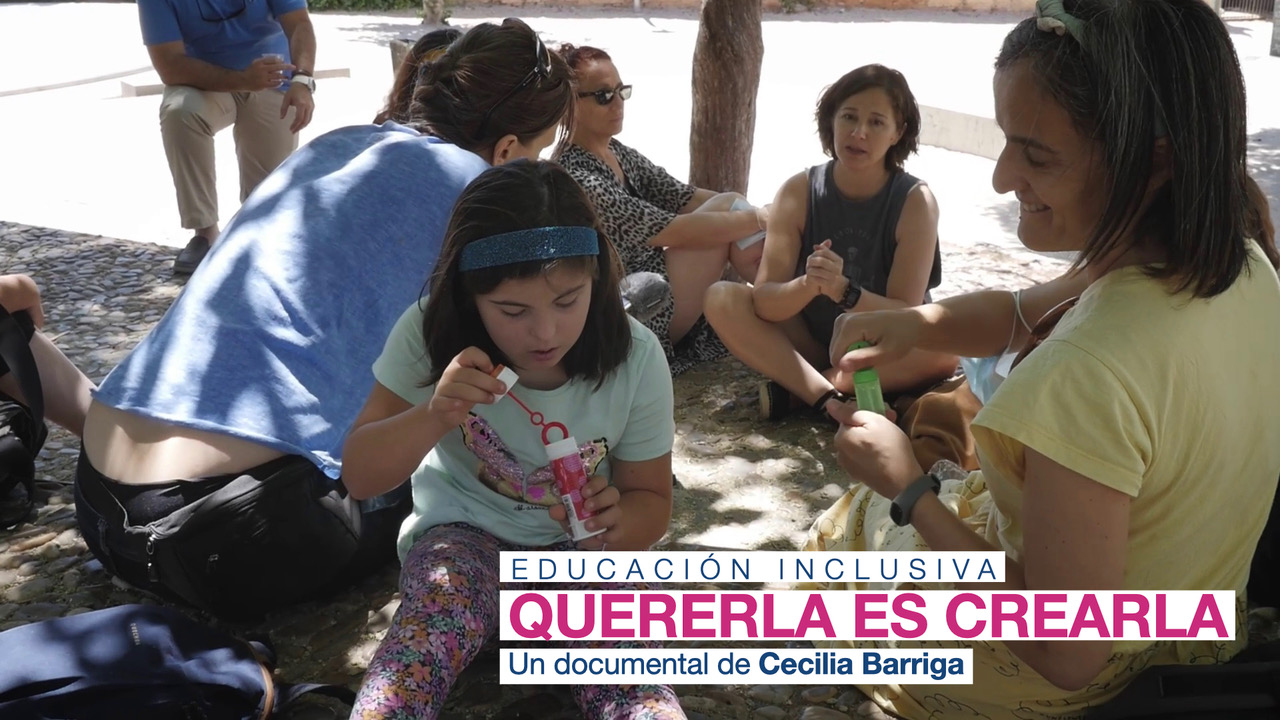
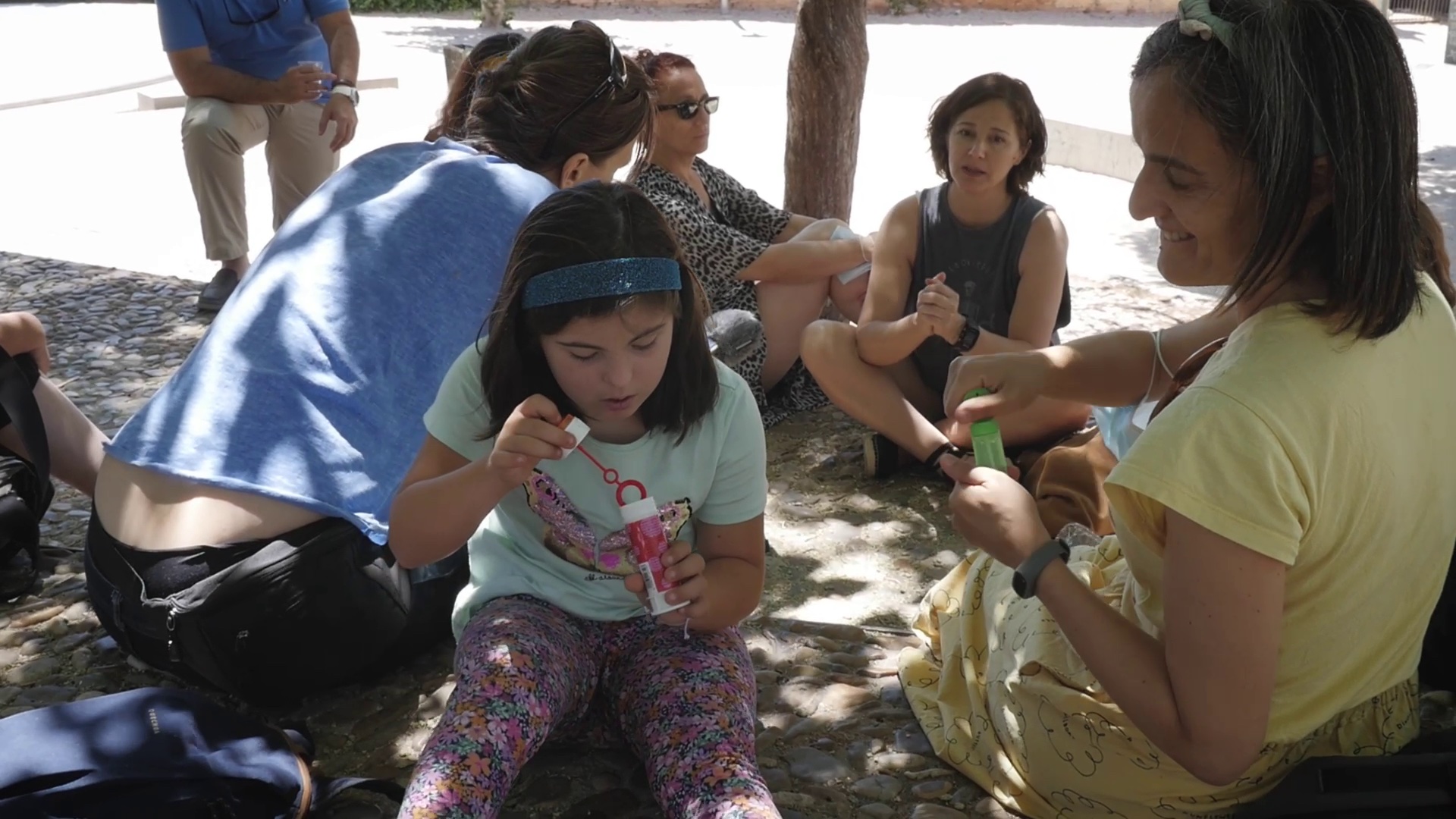
Audio description [AD]:The group of adults and young people gathered in a park. A caption reads: "Intertwining struggles and learning." One of the girls plays blowing soap bubbles, which float in the air while the adults continue to talk.
S.F.C.:—We had known each other since our children were very young and we met in the waiting room for rehabilitation at the Materno in Coruña.
M.C.:—We cried.
S.F.C.:—We cried too and we found each other. We all share a common view on diversity.
M.C.:—The diversity in my son's development began, and I found myself facing an abyss, thinking: 'And now what? And why do I have nothing to hold onto to face this violence?' I felt it was the greatest violence I had ever experienced in my life. It's a violence against the person you love most, every day, every day, every day.
Marta Malo - M.M.:—From your experiences, from what I understand to be our experiences, which resonate with mine, I clearly remember the meeting we had from Precarias with the Foro de Vida Independiente, which made us think a lot and also connected us with our own experiences. I have a brother who is missing a hand, I have an uncle with intellectual diversity, I had an aunt who is a bit like my mother, who passed away during COVID, with multiple sclerosis and who always fought hard for inclusion. I am in a school that is a learning community and the families are inside the classroom and you see the complexity of a classroom, putting that together, and you say: 'There has to be a commitment from above, the will of families and teachers is not enough, it's not enough because it's a level of diversity.' After all, I have a trans child, the school is a house with a door, and who can provide that personalized support that each child needs? So I think there are less violent educational frameworks.
C.S.:—And there are many vested economic interests, because they are 90% subsidized or private schools. And there is an employers' association for special education that is already showing how they are intimidating families, because the public school does not accommodate. So, you say: 'I prefer to have my child segregated than mistreated,' which is logical. And they are creating an internal conflict that we do not want.
S.F.C.:—We were given the name, among certain teachers, 'the nagging mothers.' Not 'the nagging fathers.'
S.F.B.:—In the other corner, when they like you and seem to want to do you a favor or praise you, they say: 'She's a "mother courage"', I don't know which is worse. 'You must be so lucky to have a mother like you.'
S.F.C.:—With functional diversity, how do we make ourselves not visible or visible, but how do we spread, or how do we use, not the resources, but the trajectory, not make the same mistakes, perhaps, or know the difficulties, the successes, so that this movement doesn't have to start from scratch like so many others?
C.S.:—Pride arrives, come on!, March 8th. And then our dates arrive and I don't see anyone who is super active in other struggles, saying: "Well, this doesn't concern me." There are times I even get angry and tell myself: "I feel like not going to this or that demonstration anymore, like if it's the Sahrawis, and so on." Because then I see all these very active people who are involved in everything, and I send them, for example, the manifesto for inclusive education for them to sign, and they don't bother. Unless they have a close relative.
S.F.C.:—Being a non-productive person, first in childhood, then because you have functional diversity, and then because you are old, it's still linked to illness, which means it's not really considered diversity. And there's a lot of struggle there. It's still considered a disability that prevents you from doing x things, whatever they may be, and therefore you need to see a doctor and therefore you need to look as much like "normal" as possible and fit within the norm.
F.V.:—Because when they are born... someone told me that my daughter could aspire to be a mail carrier, that these children already deliver mail. It's like: "Do you have a crystal ball to know what she will become at most or what the story is?", right?
M.C.:—Ableism within the community. That is, this year, little by little, we are managing to come together to ask for things. But that is a rigid, internal barrier. And don't think that you are 'like this one'.
C.S.:—The neurologist told me: — Go to Aspanaes speech therapists, they are very good. — Aspanaes: Do they have autism? — No, he has Joubert syndrome. — Oh, no! This is for those who have autism. I had an ex-neighbor who was there, who had a deaf son and who got me plugged in to take the sign language course. But like that, you know? The Life of Brian army, exactly like that.
(LAUGHTER)
C.S.:—What are we?
M.C.:—It's very ridiculous.
C.S.:—And how are we going to move forward? As we are, each one fighting in their own circle. 'And ours have Asperger's, which is not the same as other autistic people, because these ones are smart.' Look, you can't go and take the bus alone, but because you know how to make a square grid. But damn it, he has the same needs as mine!
M.C.:—The daily care of the boys, girls, and adults is in the hands of associations that live on subsidies. In other words, the Administration is not doing it, the State is not doing it.
S.F.B.:—When we were collecting signatures for the degree: 'How can a person who doesn't have the same results as my son have the right to a degree?' Do you know how hard my son has worked? Has he worked as hard or harder than your son? Doesn't that effort require recognition?
C.S.:—But then comes the moment to celebrate your son's birthday, and you don't invite mine. Do you understand? It's not necessary. More than coming to the demonstrations, I want those small gestures. Like, 'Well, it's because if it doesn't condition me, because maybe your son wants to go somewhere that isn't accessible for mine, then so he doesn't have a bad time.' And you're not going to sacrifice your son's desire to go to Chuchipandi because Antón is going. So, not even the minimum effort anymore.
S.F.C.:—We want to change the world for so many people, and you and I are not capable of changing the life of your brother who is right next to you. I don't want to burden you with that responsibility, but you say your friends have accepted that you are alone, yet you go out with your friends and don't take your brother with you. Caregiving should be a priority subject in schools. We all need each other. We live in Coruña, by the sea, in a small town by the sea. Sometimes the beaches become a physical education classroom. The City Council proposes a surfing activity, in winter, during the pandemic. Look, let's do the surfing activity. Of course, since Jorge won't be able to take his wheelchair onto the sand, it's better that he stays home.
M.M.:—With the Forum for Independent Living, we used to say that there should be a social change so that pushing that wheelchair would be everyone's responsibility. Then, the mother or caregiver wouldn't have to go, and their task wouldn't be to push that wheelchair, but rather there would be a mutual regulation where it's clear that the wheelchair needs to be pushed and that we take turns so that no one gets tired. And then they would say: 'No, because I don't want to depend on anyone's goodwill. If it's organized like this, it's like a favor people are doing for me.' So, tactically yes, because life is absolutely individualistic, and indeed, if you don't have that guaranteed support, you always end up owing your life to others, waiting for that favor, but at the same time, as a horizon, that idea of caregiving as a mandatory subject in schools, it's that we are, I am not, we are.
S.F.B.:—There are people who don't understand that we want to become independent from all our children, and I claim my right to become independent from my son and for him to have an independent life from me, a complete one, and for me to have a complete life, independent of him.
🎵 [Suena música de jazz al piano]
V.O.:—Because our life experience reaches other people, and then, that gives me a little warmth to try to keep doing things.
Audio description [AD]: Fade to black. The young people and their families are celebrating a barbecue in the courtyard of a house, surrounded by a natural environment. The sky is clear. Most of the group is sitting at the table, under the shade of a tree, while they chat animatedly.
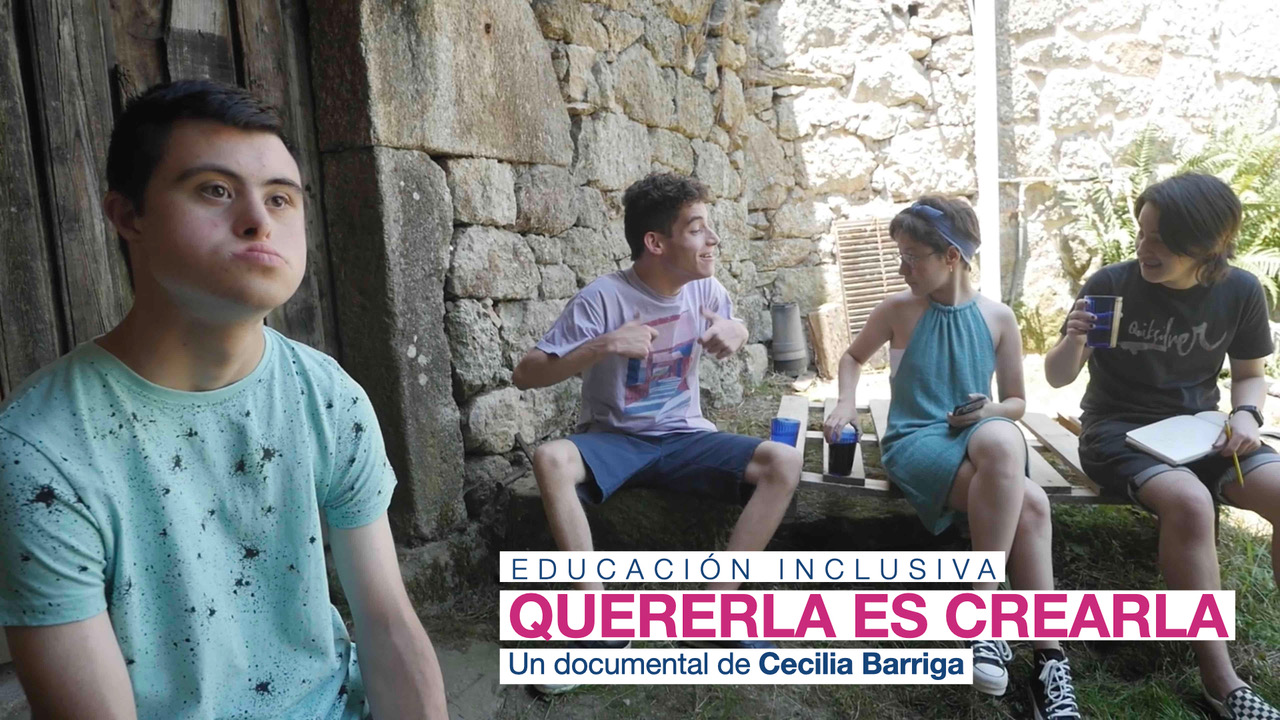
Next, the members of the group Students for Inclusion, Rubén, Antón, Malena, Jorge, and Leo are sitting on a wooden pallet, in front of a stone wall.
Jorge Osa - J.O.:— Malena, do you know what I'm going to do for the last two years that are coming?
M.C.:—What are you going to do?
J.O.:—Go to Adormideras, to a new high school.
A.F.:—Well, I'm going to study Image and Sound and then I'm going to Madrid, to the National Drama Center.
M.C.:—And then he's going to be an actor!
Leo Osa - L.O.:— How cool, man.
J.O.:— Dude, dude!
M.C.:— I'm going to be an actress.
L.O.:— I have to see you on Telecinco or something, huh!
(Antón laughs)
A.F.:—No, no, on Telecinco, no.
J.O.:—If I see you in a TV commercial, I'll kill you.
A.F.:—No, no. Not me.
L.O.:—Very good, Antón. Very good, Antón.
A.F.:—Because when I win a Goya, I'm going to dedicate it to you.
M.C.:—Ole, ole that.
J.O.:—Please, when you win an award, if you don't thank me...
M.C.:—And if I see you on TV, I'll record you.
A.F.:—Maybe we can make a movie together…
M.C.:—Yes, yes!
L.O.:—That's right, I'll do the sets for you. The actor, you (points to Antón).
M.C.:—The actress, too.
L.O.:—The actress too, of course.
M.C.:—Or the screenwriter. The screenwriter.
L.O.:—You are the editor of the film (addresses Rubén). And you do the soundtrack (addresses Jorge).
R.C.:—Shhh!
Audio description [AD]: Rear view of Rubén walking through a courtyard. Then, a close-up of his father, Alejandro, speaking to the camera in an indoor space.
A.C.:—Rubén is already 21 years old, and the truth is that we've had very difficult moments, but we've had many good moments. In his early years, he had a very good schooling. I mean, it wasn't inclusion, as we understand inclusion today, but he had very good integration within his environment, at school, with his classmates and the teachers who supported him. And us, with the families.
Audio description [AD]: Back on screen, the group of young people consisting of Rubén, Antón, Malena, Jorge, and Leo.
A.F.:—(Addressing Leo) I work in art. Do you know what time actors get up?
L.O.:—What time?
A.F.:—At five in the morning.
L.O.:—Wow! An hour before all Spaniards!
J.O.:—Look what the dog did to me.
L.O.:—What did the dog do to you?
J.O.:—He licked me.
(Malena laughs)
L.O.:—Yes, but where.
J.O.:—In hand.
L.O.:—(Addressing the dog while petting it) And what is this one, an actor too? They are extras.
M.C.:—They are our dogs in the film (addressing Antón).
A.F.:—And maybe we'll have a nominated film between the two of us, and we'll both get a Goya.
L.O.:—Wow!
M.C.:—Yes.
Audio Description [AD]:Sandra, mother of Jorge and Leo, approaches the group. She crouches down and leans on Jorge.
S.F.C.:—(Addressing the group) We have something to tell you. How would you like it if you could have a meeting and an interview where the screenwriters of 'Money Heist' could tell you things?
Audio description [AD]: Antón, Malena and Leo react with great surprise.
M.C.:—What are you saying?
A.F.:—(Jumps up and runs out into the garden.) Buuuut. Aaaaaa! Aaaaaa!
(LAUGHTER)
🎵 [Plays "The Moon and the Accordion(instrumental), by Ziv Moran]
Audio Description [AD]:Rubén goes out to meet Antón, who runs non-stop in the playground. Then, his mother, Lucía, speaks to the camera.
L.L.:—His classmates supported him, played with him. There was never any problem with the kids, and that made me proud. I loved seeing him.
Audio Description [AD]:Antón arrives at an outdoor shed, where part of the group is waiting for him and greets him with laughter and joy.
A.F.:—No, no, no. Today, with the heat and the news, I'm dying!
L.O.:—It's a dream.
A.F.:—The last thing I wanted now is for it to be a dream. Come on... I'll wake up.
C.S.:—You wake up and stay in bed. (Carmen hugs her son and kisses him.)
S.F.C.:—Look, I'll tell you. We have to organize now and see how to bring everything together. The fact is that the 'Quererla es Crearla' group told them everything you've been doing all winter, the guide you're creating and that will be submitted to the Ministry in September. And they told them what we're doing too. And then the Head of Communications found it very interesting. We don't know if she'll be able to come to Madrid and meet with you. We have to organize that. But they want to meet you, they want to meet you!
C.S.:—And bring us to Nairobi! Nairobi! Nairobi!
(all at once:—)(while jumping) Nairobi! Nairobi! Nairobi! Nairobi! Nairobi! Nairobi! Nairobi! Nairobi! Nairobi! Nairobi! Nairobi! Nairobi! I didn't give them, poor thing, to participate because I don't see the house of paper.
R.C.:—Valladolid!
J.O.:—I don't know if I'll be able to participate because I haven't seen 'Money Heist'.
L.O.:—Well, you're taking your time. Kid, get a move on.
M.C.:—I've watched the first and second seasons. I have the third and fourth left.
A.F.:—Me, all of them.
L.O.:—I'll kill you.
(Malena smiles.)
L.O.:—Get out!
M.C.:—It's just that...
J.O.:—Antón, I'm very sorry, but I see you in the role of 'The Professor'.
— L.O.:You would be capable, huh? I think if the actor dies or something, they'll replace you.
— A.F.:And I'm going to wear my 'Money Heist' t-shirt to that meeting. With a list of questions.
— M.C.:Yes, that's true.
— L.O.:You have to be prepared.
M.C.:—Important, important.
L.O.:—Extremely important. And with suggestions to finish..., no, they've already filmed everything.
Audio Description [AD]:Close-up of Rubén leaving a wooden space, similar to a barn. Next, the group reappears in the courtyard, talking.
L.O.:—I was going to suggest ways to end the series.
J.O.:—If I'm given a role in a series, I want to be the villain, because I like blood in series.
S.F.C.:—For me, a name with tremendous power is Ferrol. I love it. I'm going to be Ferrol.
L.O.:—Ferrol is depressing, Mom. I think 'Ferrol,' and I think how sad.
S.F.C.:—And you, Rubén, what city are you going to be? The name of a city you really like.
R.C.:—León (Nods and takes a sip of water from the glass).
S.F.C.:—Of course. It's just that... with León...
M.C.:—You can say another one.
S.F.C.:—It's just that with León he has a lot of grit, no pun intended.
Audio description [AD]: Rubén walks through a sunny square, surrounded by bars and restaurants. The camera follows his steps. Next, his father, Alejandro, speaks to the camera in an indoor space: a bright, glass-enclosed dining room.
🎵 [Plays La Luna e la Fisarmonica (instrumental), by Ziv Moran]
A.C. (V.O.):— The truth is that the gamble was very powerful and could have meant jail for us. It could have meant the worst of all for us, which was the loss of parental custody of Rubén. The easy thing would have been to back down and say, 'Well, okay, okay, so let him go to a special education center, get this charge dropped, and leave us alone, let us live. At least survive.' But no, we decided to take the risk, we would do it again, that much is also very clear to us, because it's an issue that... It was tremendous, a stab in the back (he gets emotional and his eyes well up), they didn't want us.
Audio description [AD]: Again, at the barbecue. The group is gathered around the table, enjoying themselves as they dance, eat, and sing.
In unison:—(Singing)"Vivir así, Antón, es morir de amor. Por amor, tengo el alma herida. Por amor, no tengo más vida que su vida, melancolía"(by Raphael).
"Explota, explótame, expló, explota, explota mi corazón…! ¡Explota, explótame, expló, explota mi corazón…!"(by Raffaella Carrà).
Audio description [AD]: Malena and Rubén start dancing, holding hands. In front of them, Leo smiles. The group applauds and sings.
M.C.:—We dance well, don't we, Rubén?
L.L.:—We have a dance session every Saturday. And this is Rubén's star song.
Audio description [AD]: Close-up of Lucía, Rubén's mother, smiling as she watches the scene. Next, she speaks to the camera in an indoor setting.
L.L.:—You start thinking from when he was born until now and you say: 'Wow, I wouldn't have dreamed of where we are.' Rubén is satisfaction right now.
Audio description [AD]:Malena and Rubén finish dancing as the group applauds and cheers. Next, they all gather around the table to share dessert. Leo's mother assists him.
A.F.:—Look at you, the prettiest in the whole neighborhood!
🎵 [Song playsChico Perfecto - The Answer]
S.F.C.:— Those who want to play board games, come inside. Do you want to play board games? (Addressing her son Leo) Everyone inside?
Audio description [AD]: Close-up of a pencil drawing by Leo Osa, showing some members of the group while they were eating. Leo holds the drawing up to the camera and smiles.
A.C.:— Well, well, Leo. I saw you there. I almost saw myself too (in the drawing).
L.O.:— Yes, it's you. Look at yourself (addresses and approaches Alejandro). I didn't try to make you look like yourself.
A.C.:—No, no, no… good, good. The environment and all. Very good, perfect.
L.O.:—I made you by accident.
Amara Fontao - A.F.:—How cool, I love it.
L.L.:—Look, there's Alejandro!
A.F.:—Can I take a picture?
L.O.:—Sure, auntie.
A.F.:—Yes?
A.C.:—Bring Leo, bring. I'll take him out too (in a photo).
L.O.:—Well, I'm going to play before they take my spot.
A.C.:—(Addresses an adult sitting next to him) Well, adolescence or pre-adolescence… Yes, it depends. If the older one sets a path, then in the end you follow it. That helps. For you, I always… Yes, it falls.
Audio description [AD]:Tristan bursts into the table where six adults are conversing.
S.F.C.:—What happened, Tristán?
Tristán Lens - T.L.:—I've come back (from the board games). They're playing.
S.F.:—Playing what?
T.L.:—Jorge is playing inside. Your son.
S.F.:—No way! And what does he play?
T.L.:—Al Catán: sailors. Al Catán.
S.F.:—I don't know how that game works. Explain it to me.
T.L.:—They play Catan…
Audio description [AD]: Inside the house, the group of young people plays Catan , a board game. In the foreground, Rubén. Milagros, Rubén's grandmother, accompanies the group and pets Rubén. Meanwhile, Carmen, Antón's mother, plays with them, standing up.
C.S.:— (Looking at the board with Antón) Straw… Where is the Straw Port? I don't see it.
R.C.:— (Looking at Milagros) Grandma. I knew grandma.
M.C.:— (Addressing Rubén) Her name is Milagros.
R.C.:— I met my grandmother.
🎵 [Suena música alegre]
Audio description [AD]: The group of young people goes out to the garden again. Leo pushes his brother Jorge's wheelchair.
L.O.:— Let's see, here we want a hose!
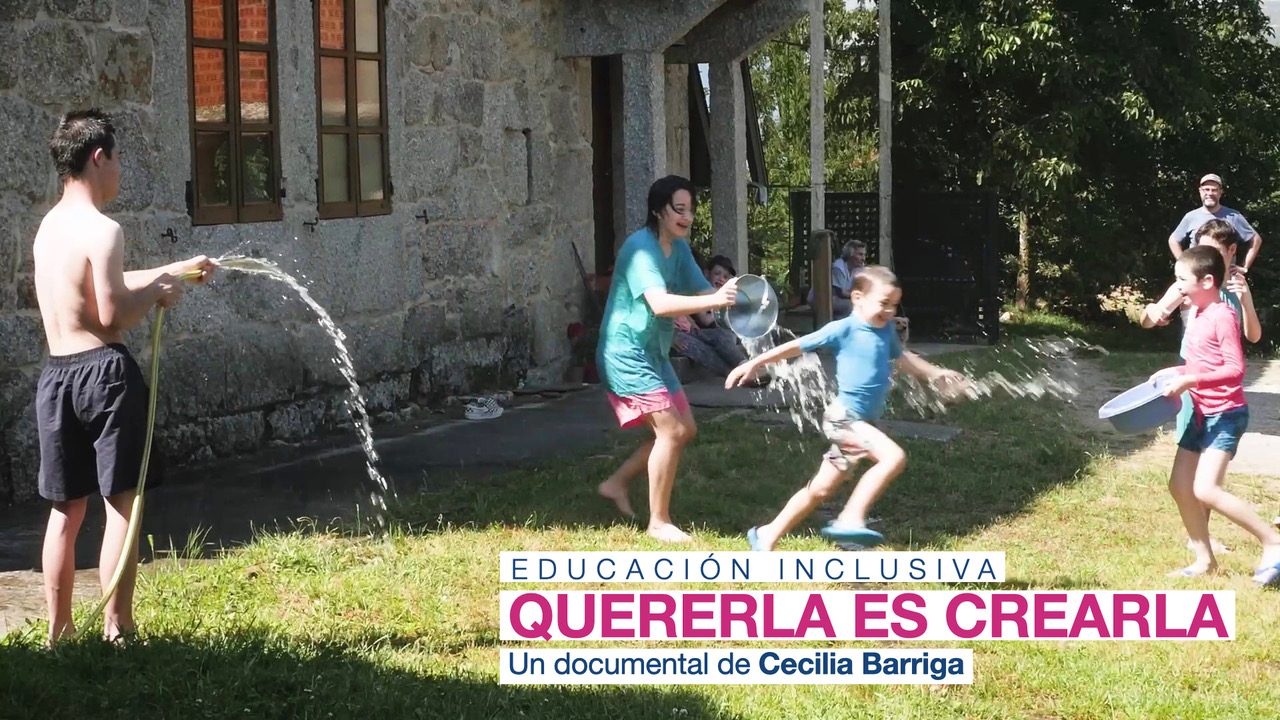
Audio description [AD]: The group of young people and adults has fun and laughs in the garden while getting wet with a hose and buckets of water. The day is clear. The rest of the adults, sitting on the stone porch and away from the water, watch the scene and share the fun.
L.L. (v.o.):— This child [Rubén] in a special school would not have developed the same way as in daily life, on the street, with everyone, as I say.
Audio description [AD]: Leo continues drawing the group in his notebook, sitting on a chair.
L.O.:— Did it turn out that badly?
M.C.:— They ruined it with everyone who left.
L.O.:— Yes.
M.C.:— They ruined it and on top of that...
L.O.:— But because the actors left.
M.C.:—Yes, yes.
Leticia Barbadillo, Tristán's mother - L.B.:—What were we talking about?
M.C.:—Elite.
L.B.:—Ah, okay, no, no.
L.O.:—For teenagers.
L.B.:—For teenagers like you.
L.O.:—Of course.
L.B.:—Not for old people like me, you mean?
L.O.:—No, I mean for the kids.
(Laughter)
L.B.:—Oh, okay. That was much less offensive. Thanks, Leo.
M.C.:—No, of course, it's just that sex comes up all the time.
L.B.:—Well, sex is much better than violence. Leave it.
L.O.:—No, I know. But there are deaths and things.
L.B.:—In that case (LAUGHS).
Audio description [AD]: Tristan and his mother hum. He holds an orange fan in his hands, which he moves and strokes with his fingers.
L.B.:—You changed the song on me again, son.
(SINGING) "Take a look to the rail track, from Miami to Canadá…"
Audio description [AD]: Tristán hums along to the rhythm of the song his mother is singing. Next to them, Rubén, Lucía, Milagros, and Nieves (Loma) pose for Leo, who is photographing them.
L.B.:—Lalala, lalala… lalala, lalala…
Audio description [AD]: Tristán follows the rhythm and hums along.
L.B.:—(SINGING) "Nananaaa with dezember..."
Audio description [AD]:Close-up of the pencil drawing Leo is making of the group.
L.B.:—The mastery of music here!
(Nieves smiles)
Audio description [AD]:Tristán gets up.
L.B.:—Hey, hey, hey, Leo is painting you! No, you can move.
L.O.:—(Addressing Tristán). I've already done you. You can move now.
L.B.:—You can move now, you have permission.
T.L.:—(Approaches Leo) I'm going to see. (Pointing to the drawing) It's this one.
L.O.:—And who is this?
T.L.:—Nieves.
L.O.:—And what am I going to do with this one?
T.L.:—Rubén. But my mother doesn't appear, didn't you draw her?
L.O.:—Who?
T.L.:—My mother.
L.O.:—No, but I'll do it later.
(Leticia laughs)
L.B.:—So I could have been moving around this whole time!
T.L.:—Mom, it'll do it later.
L.B.:—And here I was, keeping up appearances.
(laughter)
L.O.:—Now you can move.
Nieves Loma (N.L.):—With what you've sung, let's go...
L.B.:—It was more to keep the other one still than to keep myself still.
(LAUGHTER)
Audio description [AD]:Alejandro rests with his eyes closed, sitting on the floor, with his legs crossed and leaning against a wall. Sandra, Segundo, Antón's father, and Amara, his sister, are sitting at the table. Sandra looks at her phone, while Segundo and Amara talk. Next, a close-up of Jorge in profile.
🎵 [Music plays, A tender heart , by The David Roy Collective ]
Segundo Fontao García - F.G.:— Go to the sofa if you want. Or to bed.
S.F.C.:— Jorge, do you want to move back a little so the sun doesn't hit you?
F.G.:— Shall I bring you down some towels?
S.F.C.:— (Addressing Jorge) Shall we change now, or what? Your chair is still dripping.
J.O.:—No.
S.F.C.:—You don't want to change?
J.O.:—No, that's tiresome.
S.F.C.:—Okay, received, received.
L.B.:—(Addressing Jorge) Look, I heard something from you earlier. Treat your mother well. I have something saved up for you, and if you misbehave, I'll tell it.
F.G.:—Let's see, let's see.
J.O.:—No to mothers!
Audio description [AD]: Close-up of Lucía.
J.O.:— I'm telling you because she gets super annoying with me!
F.G. (v.o.):— Do you want some towels?
S.F.C. (v.o.):— No, he doesn't sleep. He's exhausted. He has his routines too. He rests with his video games, with his videos, he likes to escape for a while. And now, since he doesn't have his means, he's here observing, watching, and he's bored.
L.L.:—We're all in the same boat now.
S.F. (v.o.):—Yes, but we have other resources.
L.L.:— (v.o.):—The important thing is that he had a good time.
S.F.:—Let's go. So far, he's had a great time.
Audio description [AD]:Leo continues painting next to Tristán.
L.O.:—(Addressing Tristán) I can put something in [en el retrato]. Whatever you want.
T.L.:—To my father.
Carlos Lens - C.L. (v.o.):—My bond with Tristán, I think, is much stronger than with my other two children. He was my first son and my first experience with fatherhood.
Audio description [AD]: On screen, Leo, Malena, and Tristán's parents.
T.L.:—Look, Mom, she's taking pictures of you. Smile!
L.B.—Did you see the drawing, Tris?
C.L.:— Yes.
L.B.:— Yes? Did you see how well we came out?
T.L.:— Yes, yes.
Audio Description [AD]: Carlos addresses the camera in an indoor space.
C.L.:— And this has been over time, because his characteristics made him possibly more prone to my desire to be with him and understand him. But also, circumstantially, because immediately after he was born, Leticia, his mother, started a university master's degree that required a lot of her time.
So, from when he was very young, I started spending much more time with him than I later did with his siblings, probably.
Audio description [AD]: Leticia types on a tablet while Jorge and his mother move away from the table.
L.B.:— What I wanted was to write. That everyone goes into Audiovisual Communication wanting to be directors, and no, I wanted to be a screenwriter! I'm not interested in deciding shots at all, I just want to write. Yes, it was a strange profile, but...
Audio description [AD]: Antón and Leo are sitting in the garden. Antón types on his mobile phone, Leo draws in his sketchbook. Segundo, Antón's father, kisses him on the forehead.
L.B.:—Let's play, shall we? It's getting away.
T.L.:—Where is my father?
L.B.:—Wasn't he inside?
T.L.:—I'm going to see.
Audio description [AD]: Carlos addresses the camera in an indoor space.
C.L.:—Regarding the day-to-day with Tristán, it's true that he demands a lot from me and seeks me out a lot. He's the least masculine thing, from a traditional point of view, that you could find. Tristán is super affectionate, super expressive. He always tries to put a word to the emotion he's feeling, with his limitations, but he tries to say it, and I think that teaches me great lessons about what the relationship between people who love each other should be like. Basically, a different way of loving each other.
Audio description [AD]: Lucía addresses Jorge, who is accompanied by his mother.
L.L.:—How do we change your mind? Come on, explain it to us.
S.F.C.:—It's sold out.
L.L.:—He's sold out too. And he's stubborn, stubborn, stubborn. Isn't that right?
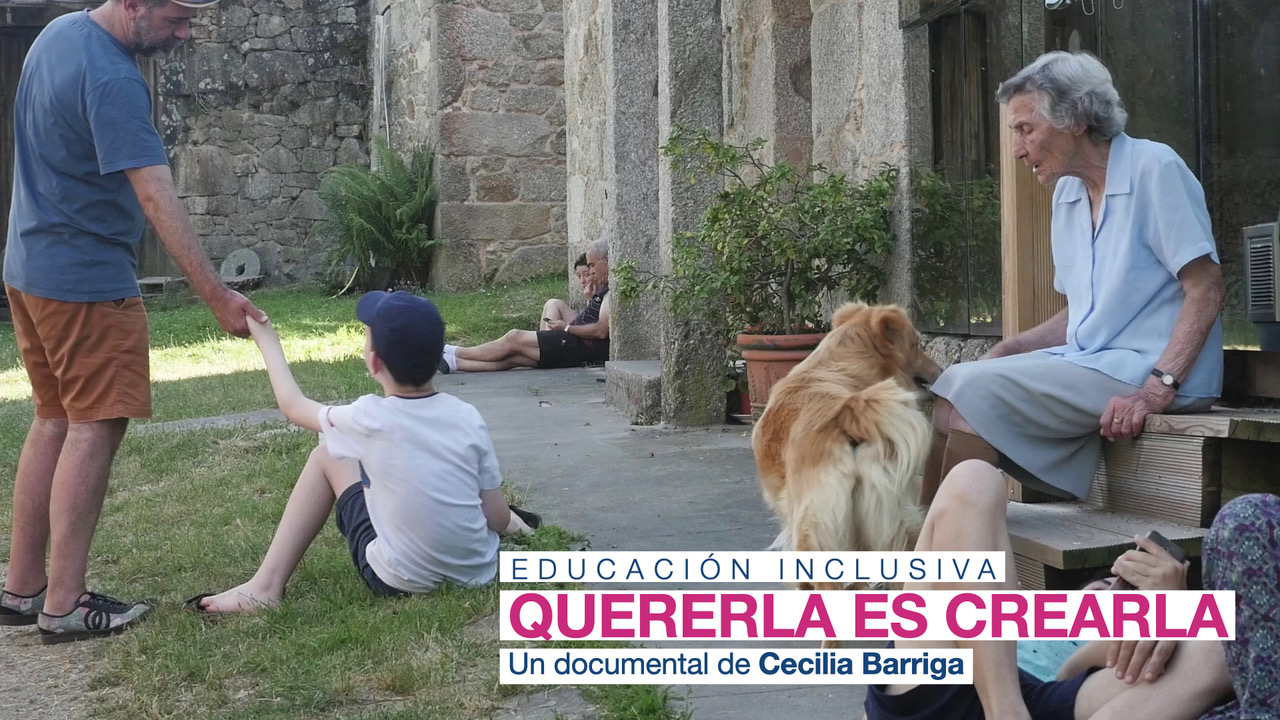
Audio description [AD]:Segundo is sitting on some wooden steps next to Milagros, Rubén's grandmother. Next to them, the dog holds a piece of wood in its mouth.
F.G.:—(Referring to the dog) He's a pain.
S.F.C.:—We are all exhausted, with this sun beating down.
Audio description [AD]:Sandra pushes her son's wheelchair away from the direct sun and moves away with him. Alejandro and Milagros appear in the foreground. The camera focuses on different members of the group.
L.B. (v.o.):—All the support and help from those around you is very important. And we have been very well supported. But also because we allow people to help us. Because if you withdraw into your shell and don't want to know anything, don't talk to anyone, or don't want a hand, people won't support you.
C.L. (v.o.):—I have found myself, fortunately, questioning the male role, the role of the man. I have come into contact with people eager to reinvent themselves, eager to analyze themselves, and eager to see what the role of men is right now, through readings, through support groups, even emotionally. It makes me angry because there is still a long way to go. Internally within our family, and obviously in society. The burden of caregiving mostly falls on mothers or even grandmothers, and we still have a long way to go.
And in our personal case, for me, above all, in expressing emotions, I prefer to end up punching a cushion or getting angry or shouting, rather than crying and talking about it and expressing it calmly.
Audio description [AD]: Leticia and Tristán are sitting next to each other on a stone staircase.
T.L.:—When Amara arrives, we'll say goodbye.
L.B.:—You've put it on the wrong shoe. Guaca.
T.L.:—Throw it out, throw it out.
F.G.:—It's just that she was supposed to say goodbye when she came.
L.B.:—Otherwise, we'll send her a message, okay?
F.G.:—When she left, she said, are you coming back? And she replied yes, that we would say goodbye when she left.
T.L.:—No, I want to wait.
L.B.:—Well, Max and Nemo are playing. When they finish playing, we'll leave. If Amara came, you say goodbye and, if not, we'll record a farewell message for her and send it to her, okay?
T.L.:—I don't want to.
F.G.:—But look, Amara, let's call her and she'll come.
L.B.:—Well, Amara has better things to do than come say goodbye to Tristan.
F.G.:—Amara has to say goodbye to Tristan, what do you mean?
T.L.:—No, I don't want to, I don't want to.
L.B.:—You're very tired, and you're getting sad.
T.L.:—Yes, I am sad.
L.B.:—I know. And how do we do it? What do you need?
L.B.:—Tristán, calm down, I think I think he's coming. No, it's just that he's not.
T.L.:—I'm just sad now.
L.B.:—Okay, and what do you need to not be sad?
L.B.:—Can you give me a hug?
L.B.:—Stronger?
T.L.:—Yes.
L.B.:— ¿Más fuerte?
T.L.:— Yo quiero ir a Limiñón, pero no puede ser.
L.B.:— Pero entonces te estás poniendo triste por cosas distintas. Estás hablando de Amara, pero te estás poniendo triste por Limiñón.
Tristán:— Sí, es por eso.
F.G.:— ¿Quieres ir a Limiñón?
L.B.:—Do you know that there is also a Limiñón near here that is not ours?
T.L.:—Which one?
L.B.:—The Limiñón of Chantada.
T.L.:—Yes. We should stop by when we return.
L.B.:— No, porque eso queda más lejos.
T.L.:— Yo quiero ir al Limiñón.
L.B.:— No vamos a hablar más…
T.L.:— Cállate, mamá.
L.B.:—Hey!
T.L.:—No, shut up.
L.B.:—No.
T.L.:—Shut up. When are we back?
L.B.:—You just hit me in the knee. Shall we remove the Limiñón topic and stomp on it, please? You have to get it out of your head (Tristán makes gestures of taking the thought out of his head and throwing it to the ground). Rip it out, to the ground!
Audio description [AD]:Alejandro smiles.
L.B.:—Yes, break it well on the ground and stomp on it. That's it, we won't talk about it anymore.
T.L.:—I want him to come. Done.
F.G.:—But don't worry, Amara will surely come.
L.B.:—Tristan.
T.L.:—But what if she doesn't come?
L.B.:—What do you prefer? Wait for Amara to arrive and stay here, even if we've left, or leave without saying goodbye?
T.L.:—I prefer, I prefer…
Audio description [AD]:Lucía watches the scene. Rubén hugs his mother, crying.
L.B.:—Ah, ah…!
T.L.:—I don't… I don't… I don't know.
L.B.:—You don't know, well. Well, it's good that you don't know. You can think about it.
T.L.:—I already have the solution.
L.B.:—What solution do you have?
T.L.:—I prefer to stay here while...
L.B.:— ¿Prefieres quedarte aquí aunque nosotros nos vayamos?
Tristán:— Sí.
L.B.:— Vienes a Coruña mañana con nosotros.
T.L.:— Prefiero a eso. Por favor, déjame, déjame. (Rubén acerca su rostro al de su madre. Su madre responde con un beso.)
(RISAS)
F.G.:—Amara is surely almost here, you'll see. But don't worry, Amara is surely coming, eh.
L.B.:—Tristán, you don't have the medicine.
T.L.:—Oops.
L.B.:—Oops, we don't have the medicine.
T.L.:— Well, we can go home and... come back.
L.B.:— Yes, of course! Go home and come back again so you can come with the medicine. As if I needed that!
F.G.:— Look, if you give him a choice, he chose.
Audio description [AD]: Antón leaves the interior of the house and joins the group.
L.B.:—Man, Antón!
T.L.:—And then, then? How?
L.B.:—We're done. Shall we make room for Antón to join us?
Audio Description [AD]:Antón sits behind Leticia and Tristán.
T.L.:— Mom, is Taboada near here?
L.B.:— Taboada is nearby, but it's in the other direction.
T.L.:— We're going the opposite way.
M.C. (v.o.):— We're already on round three!
L.B.:—How many rounds does that game have?
M.C. (v.o.):—I don't know. Until the cards run out.
Audio description:Leticia makes a gesture of displeasure.
(Sicilian music)
Audio description [AD]:Fade to black. The group waits. Amara arrives.
A.F.:—Oh!!! How sad.
F.G.:—But what are you doing? How can you leave without saying goodbye to Tristán? How can you not come back?
A.F.:—I thought you were staying for dinner. What?
Audio description [AD]:People tell Amara that Tristán is very sad because he thought he wouldn't be able to say goodbye to her. Amara laments. Then, the group says goodbye. On screen, Antón, Jorge, Sandra, Segundo, Lucía, and Nieves, who is pushing Jorge's chair.
S.F.C.:—Antón says the person he most wants to say goodbye to is you.
Audio description [AD]:Antón approaches Jorge, while the group smiles. Sandra says goodbye to Milagros.
S.F.:—Goodbye forever, Milagros.
Audio description [AD]:Malena says goodbye to Jorge with a hug and a kiss.
S.F.C.:—A big, strong, tight hug.
J.O.:—Goodbye, Rubén!
Audio description [AD]:Rubén approaches and Jorge kisses him.
Audio description [AD]:Carmen hugs Malena tightly as someone sings "Thank you for coming."
F.G.:—(Addressing Jorge) Goodbye, comrade!
Audio description [AD]:The group says goodbye with kisses and hugs. A caption reads: "The Calleja Lomas family continues to fight, but Spain has not yet complied with the UN ruling." Immediately after, they say goodbye to the camera. Fade to black.
A new caption reads: "A social movement for an inclusive society is emerging, beginning in a school that respects the diversity in which we learn to live."
Under a tent in Álmáchar (Málaga), the participatory workshop "Axarquía Inclusiva" is held: students and families gather at tables around camera operators, conversing. Fade to black.
The following caption reads: "These schools learn to rebuild themselves through dialogue, listening to the voices of students, families, and the community to develop fairer practices, and building networks of schools for inclusion."
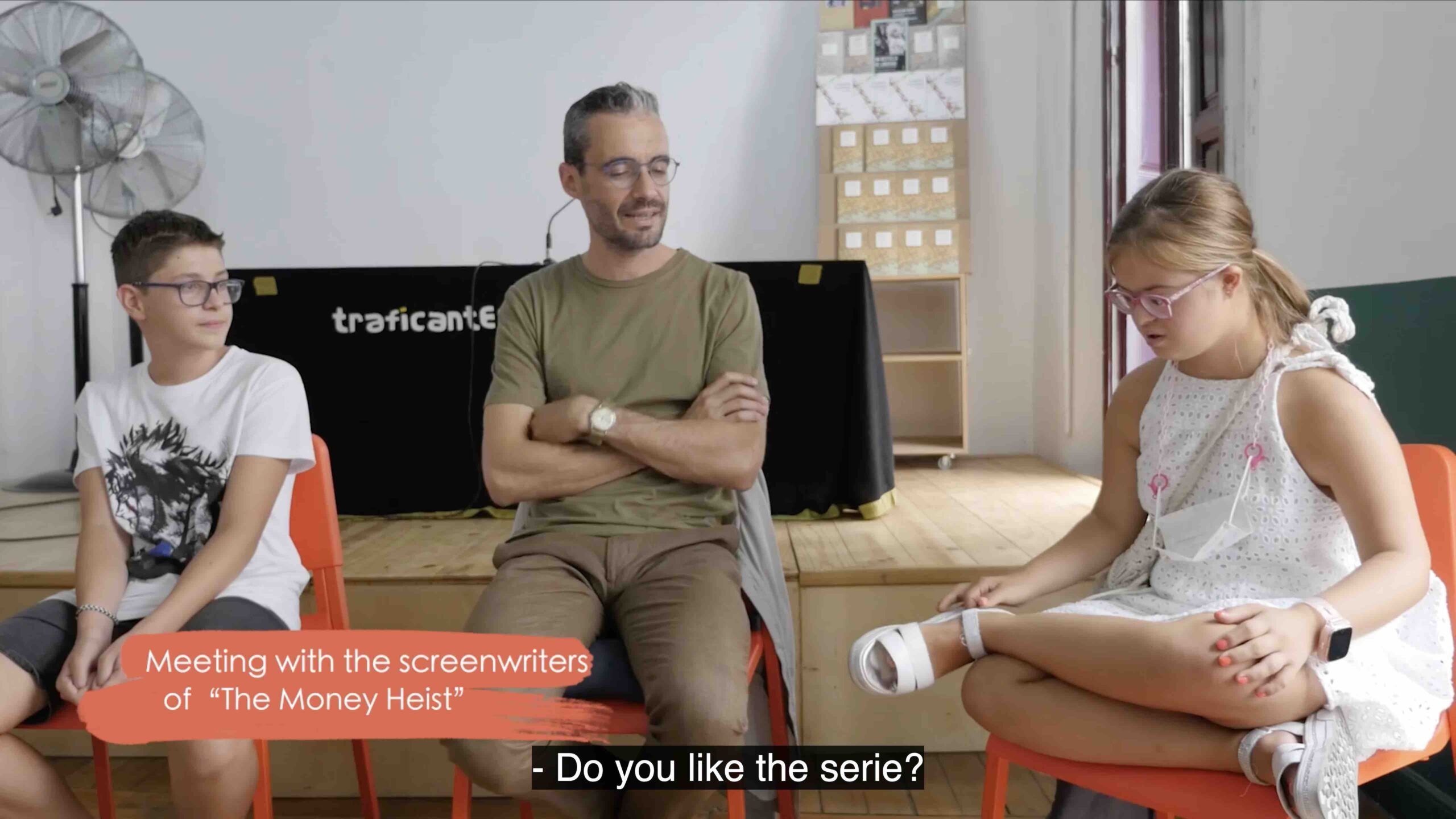
Below is the meeting with the screenwriters of "Money Heist" with Students for Inclusion. In a room, the group is sitting in a circle.
Screenwriter 1:—(Addressing Indira, sitting to his left). Do you like the series?
I.M.:—Yes.
Screenwriter 1:—Who is your favorite character?
I.M.:—Tokyo.
Screenwriter 1:—Tokyo, you didn't hesitate at all. Why?
I.M.:—Every time I see her, I say, Tokyo! Always.
Screenwriter 1:—Yeah?
I.M.:—Yes. And I always do it like this: Tokyo! (Repeats in the same euphoric tone)
(LAUGHTER)
Screenwriter 1:—You always do...? But how...
I.M.:—(Opens his arms wide) With open arms, I'm going to give him a hug.
Screenwriter 1:—Yes?
A.F.:—[Yo sería] the teacher.
Screenwriter 2:—Of course, go ahead. Look at him! The teacher.
Screenwriter 1:—In charge, huh?
A.F.:—It's amazing because he's very smart, because when there's nothing to do, you go to him and he does know what to do.
Screenwriter 1:—You are like the professor.
(LAUGHTER)
L.O.:—Because you created a balance of tension, emotion, and humor. I don't know how you do it, it's brilliant. Because you're never bored.
Screenwriter 1:—With a phone, you can write, you can shoot, you can edit, and you can distribute. In other words, you can go through all the processes of making a series. And we all have something to tell. The more we look inward, the more we resemble each other. So, look inward and tell us what worries you, what you feel, how you feel. Those on the outside will receive it as something of their own that concerns them, because it's true. Therefore, emotional truths make us all very similar. And that's why we tell fictional stories, because we all see ourselves reflected in some universal things, which are love, hate, ambition, envy, or disappointment. Not much else. And you have that at 15, at 12, at 80 years old. So you have stories, and if you want to write and be actors, you can do it all. You can make a series in selfie mode.
Screenwriter 2:—With the protagonist of 'Money Heist,' with Manila, who is a transgender character, we, for example, who are from another generation, are learning about what's happening at home, because there are things that are still a bit beyond us, even though it might seem like we know it all.
L.O.:—I don't know why, I haven't seen any action movie or series with as much tension as 'Money Heist' or 'Locked Up,' that features a character with a disability who is tense, strong, and, I don't know, important to the plot. And I think it's something...
Screenwriter 2:—Another pending issue.
L.O.:—Yes, in general.
Screenwriter 1:—But all the things that haven't been done are the best.
Screenwriter 2:—There just has to be someone who presents the idea and another who gives them the opportunity to develop it. You know.
Young person 1:—For example, the Netflix series "Atypical".
Screenwriter 1:—There you have good material. You see yourselves, you get together. You already have a new approach, which is the hardest part. You have actors, you have people who write. You have life experiences to fill that, for sure, you have so many things to tell.
Audio description [AD]:The young people meet after the encounter with the screenwriters and reflect on the experience.
L.O.:—Wow, what a moment! I've never felt so much adrenaline. I think I've spent it all now. And you, really, what was the question?
A.F.:—If the teacher were to storm the Ministry of Education, how would they do it?
In unison:—(Excited) What are you saying!? That offered a lot of possibilities, man!
J.O.:—(Speaks to the camera to explain Antón's idea.) If the teacher had to rob the Minister of Education, what would they do? What would the plan be?
Audio Description [AD]: Fade to black. On the title card, the text: “This film is dedicated to many people who do not appear in these images, but who have been fundamental in the creation of the Quererla es crearla movement. To all of them, thank you!”
(MUSIC)
Audio Description [AD]: Over a blue paint stroke, a window appears with images from the ILP Mobilization for Inclusive Schooling in Madrid. Next, images from the Participatory Action Research Project of the La Parra Early Childhood and Primary Education Center, Almáchar, Málaga. Also, Mobilization of the Independent and Diverse Life Forum. Images in an auditorium of the Workshop Orienta: Participatory Meeting for an inclusive school, Málaga.
To the right, in credits:
General Content Production: Florencio Cabello Fernández, Sandra Fernández Carrera, Ignacio Calderón Almendros, María Teresa Rascón Gómez, Fátima Solera Navarro, Luz Mojtar Mendieta.
Production assistant: Fátima Solera Navarro
Direction, camera, and editing: Cecilia Barriga.
Production assistant: Fátima Solera Navarro.
Camera 2nd recording unit: Nacho Balancín.
Direct sound: Ana Paula Bravo.
Image and sound post-production: Antu Ale Miranda
Editing: Cecilia Barriga
Editing assistant: Jaime Vidal
Production: Research Project “Emerging narratives about inclusive schools from the social model of disability. Resistance, resilience, and social change” (RTI2018-099218-A-I00), funded by the Ministry of Science, Innovation and Universities.
Collaborators: University of Málaga, Ministry of Science, Innovation and Universities, Traficantes de Sueños Associative Bookstore, Ministry of Education and Vocational Training, CEIP La Parra de Almáchar.
Participants, in order of appearance:
Cast (in order of appearance): Rubén Calleja Loma, Lucía Loma Luis, Alejandro Calleja Lucas, Antón Fontao Saavedra, Malena Calderón Cano, Darío Calderón Cano, Leo Osa Fernández, Jorge Osa Fernández, Indira Martínez de Ilarduya, Alberto Sánchez Montes, Zulaika Hadmed Cortés, Pilar Alegría Continente, Alejandro Tiana Ferrer, Ignacio Calderón Almendros, Luz del Valle Mojtar Mendieta, Raúl Aguirre Casasnovas, Sacha Novalbos Egea, Concha Casasnovas Lafón, José Luis Aguirre Roldán, Teresa Rascón Gómez, Marta Casal Cacharrón, Carmen Saavedra Torreiro, Fidel Rozalem Suárez, Susana Fajardo Bautista, Sonia Hermida Galán, Carmen Moreno Olivera, Florencio Cabello Fernández-Delgado, Fernanda Valdés Sánchez, Zoe Siendones Valdés, Sandra Fernández Carrera, Rubén Redondo Romero, Belén Jurado Herruzo, Lucía Redondo Jurado, Marcos Redondo Jurado, Macarena García Heredia, María Luisa Fernández, Fátima Solera Navarro, Diego Terrón del Valle, Sabela Terrón Hermida, Iago Terrón Hermida, Paula Verde Francisco, Marcos Zabaleta García, Martín Zabaleta Verde, Héctor Zabaleta Verde, Lucas Zabaleta Verde, Marta Malo de Molina, Amara Fontao Saavedra, Segundo Fontao García, Milagros García Pena, Nieves Loma Luis, Leticia Barbadillo Vázquez, Carlos Lens San Martín, Tristán Lens Barbadillo, Nemo Lens Barbadillo, Max Lens Barbadillo, Javier Gómez Santander, Sara Solomando.
Logos of Inclusive Education, Quererla es crearla and University of Málaga.www.creemoseducacioninclusiva.com. Audio description produced by the Spanish Centre for Subtitling and Audio Description, CESyA.
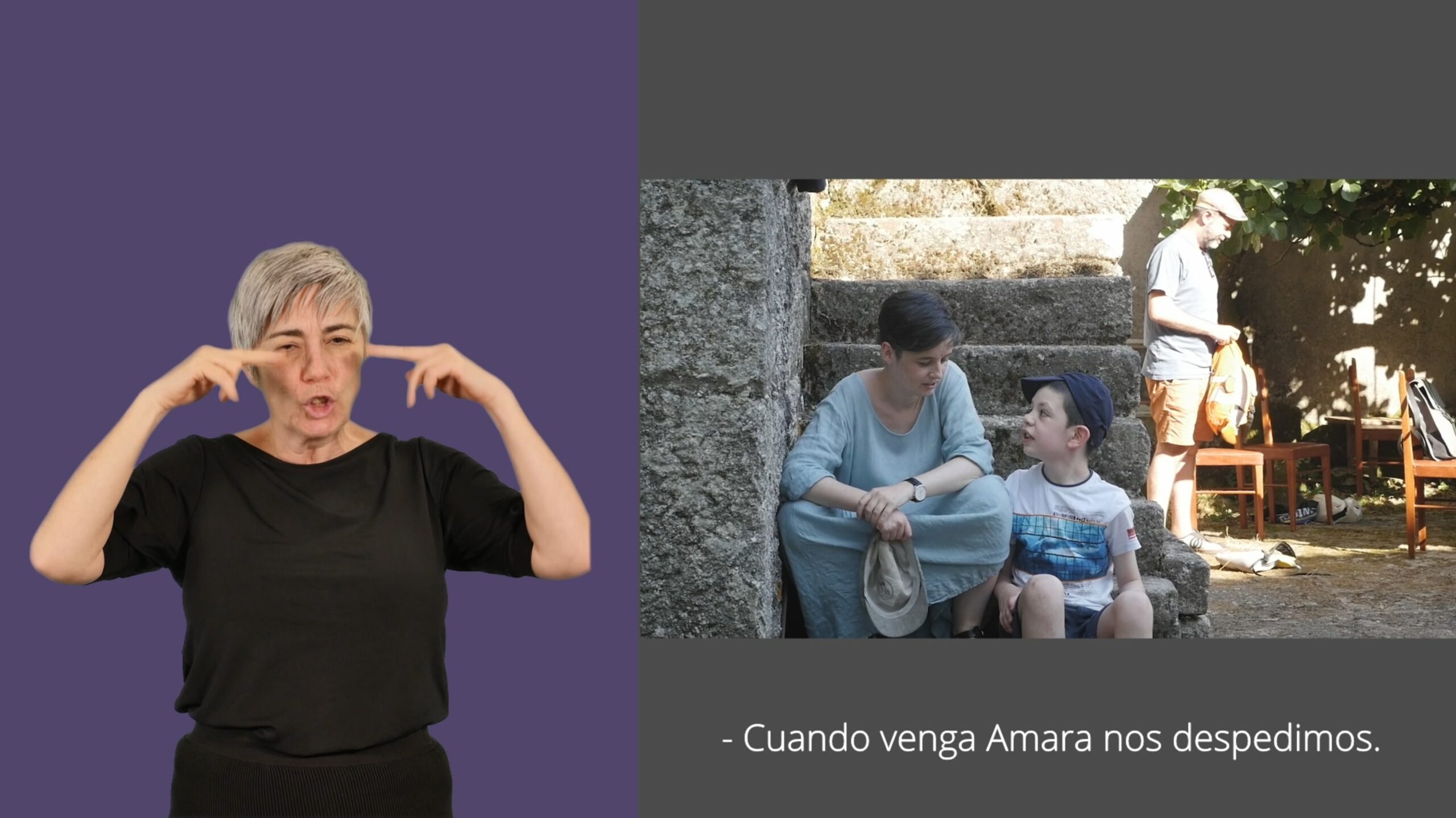
Documentary with embedded Spanish subtitles
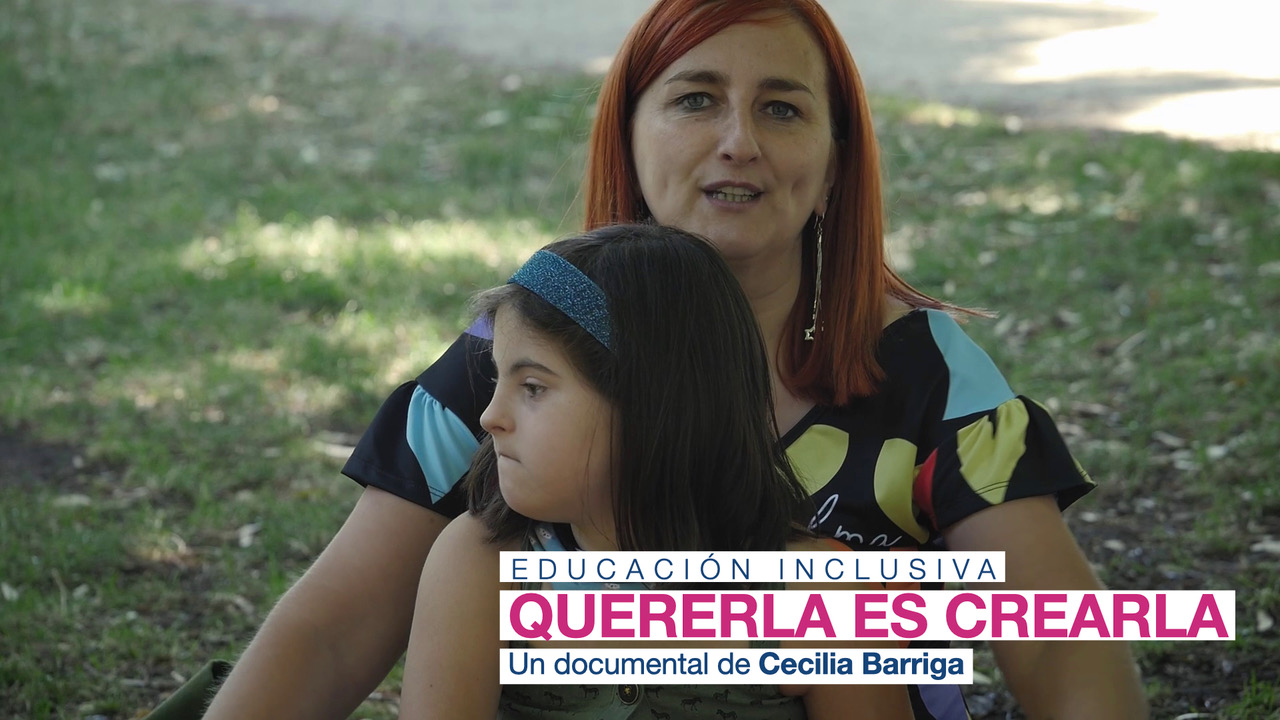
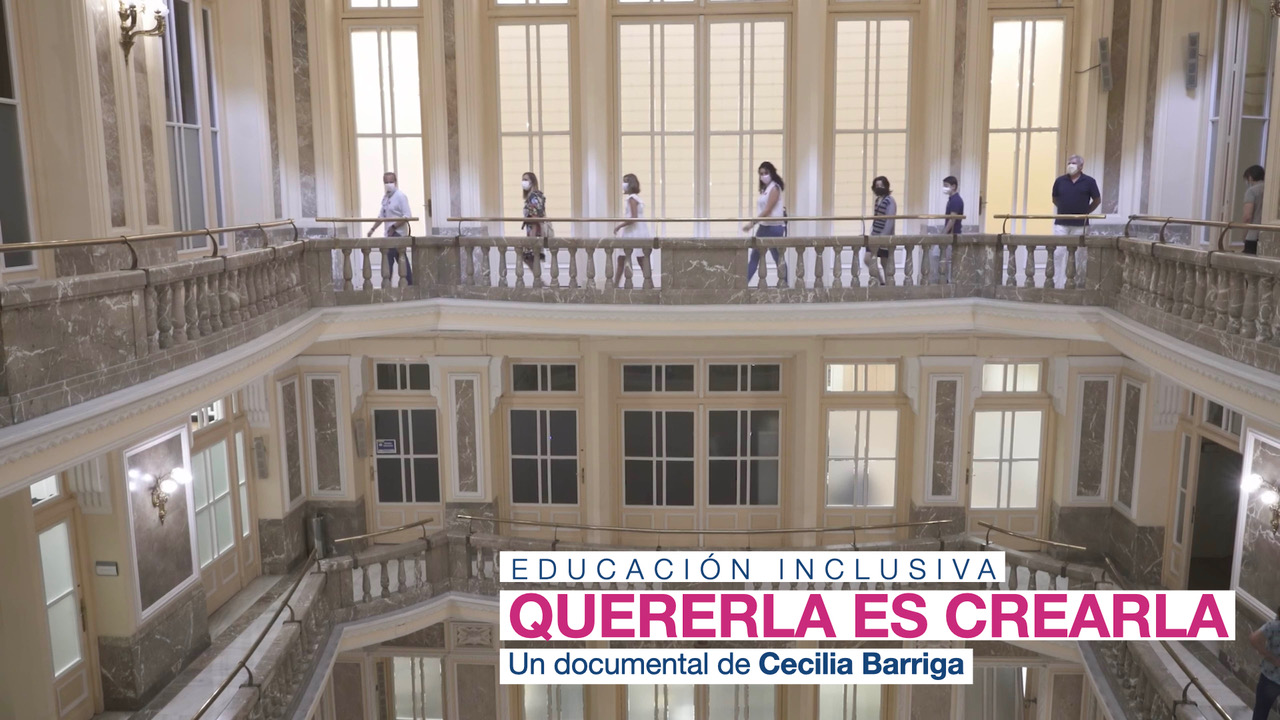
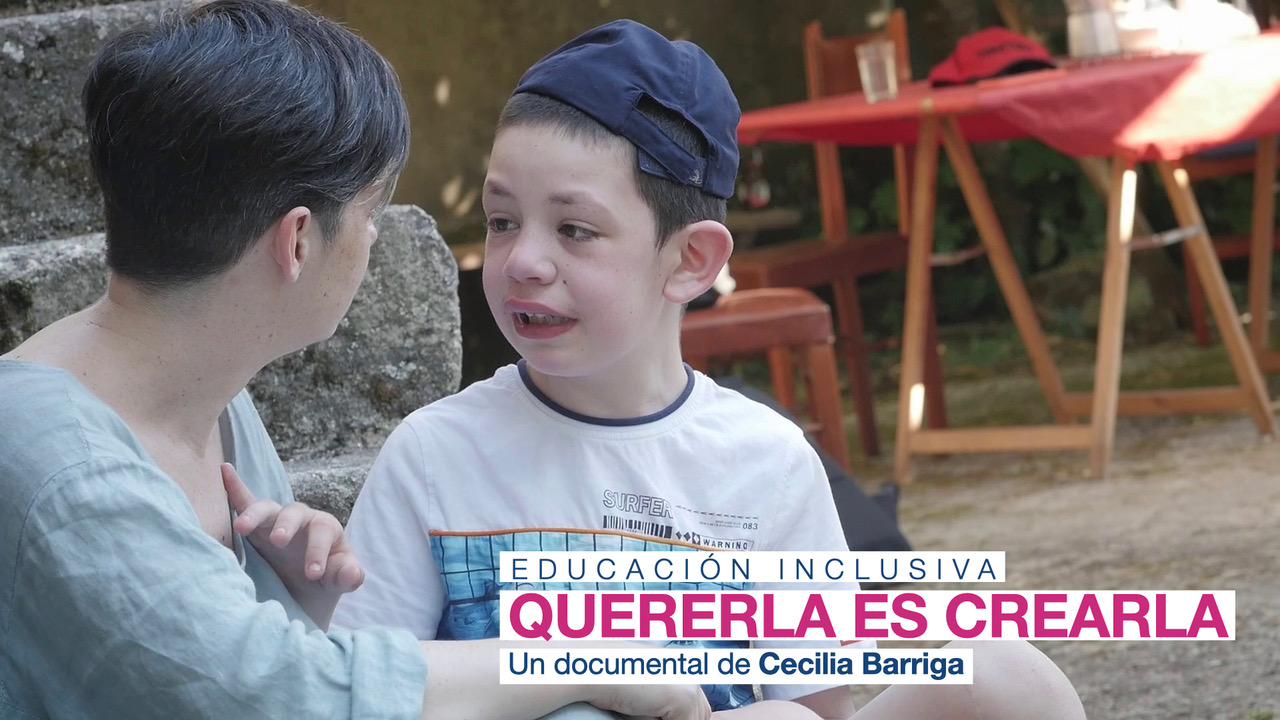
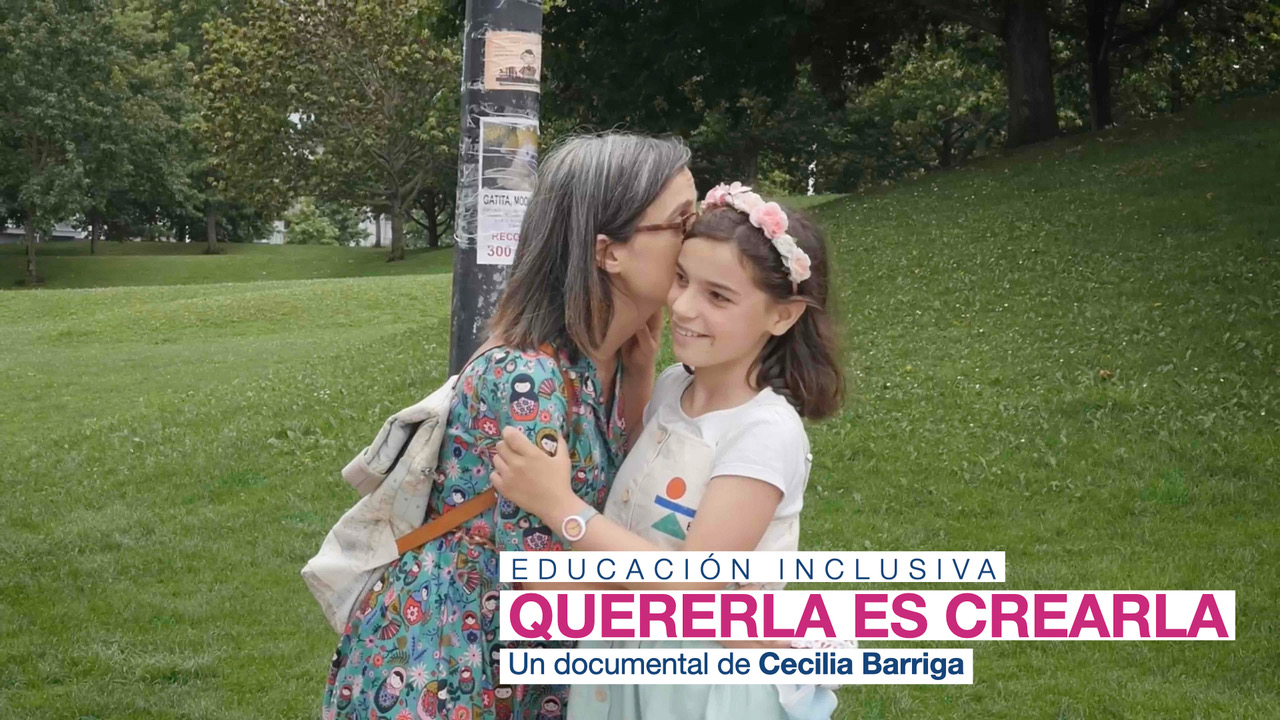
A documentary by Cecilia Barriga, which addresses the profoundly human meaning of inclusive education and the need to generate a social movement that makes it a reality.
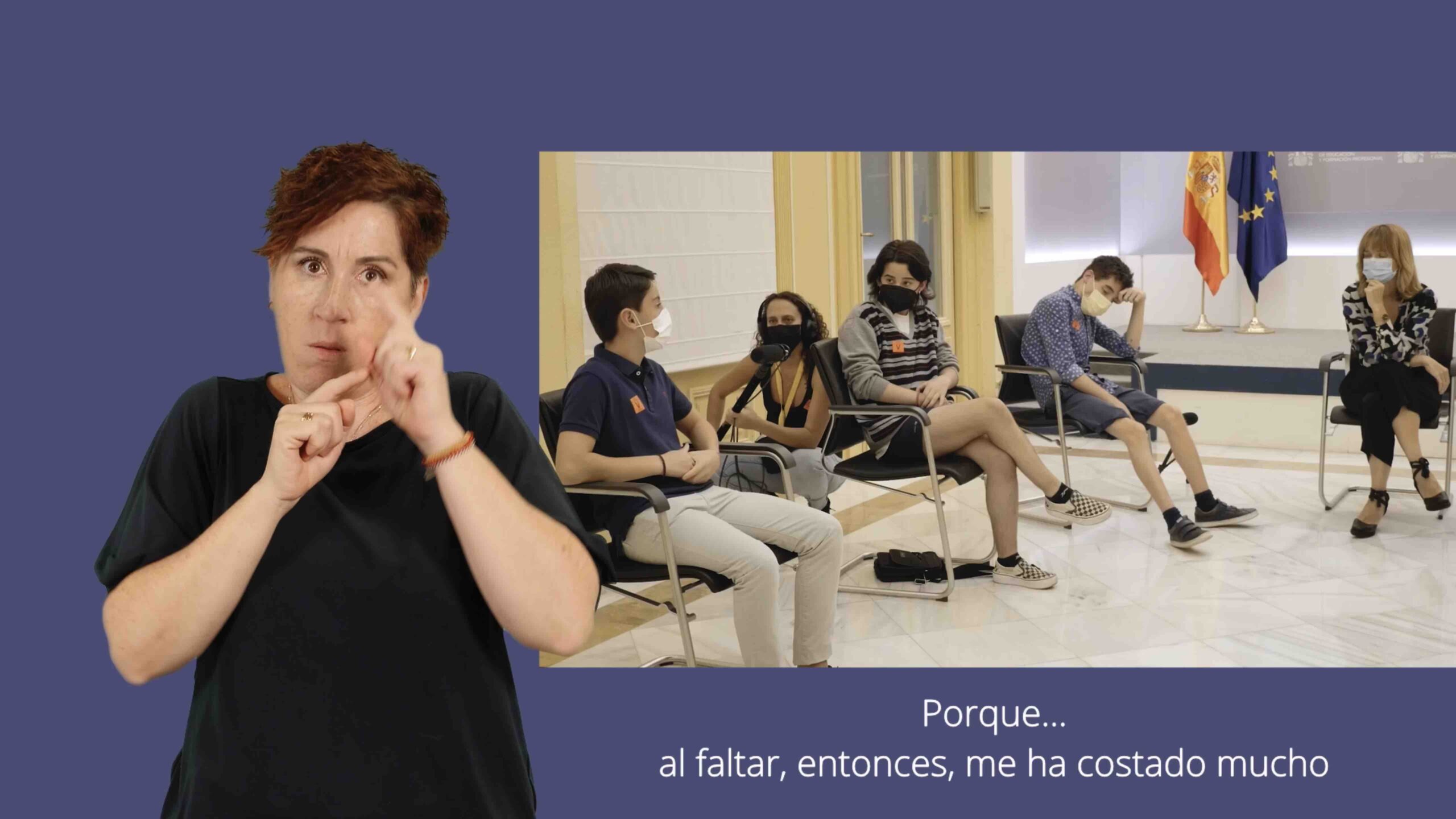
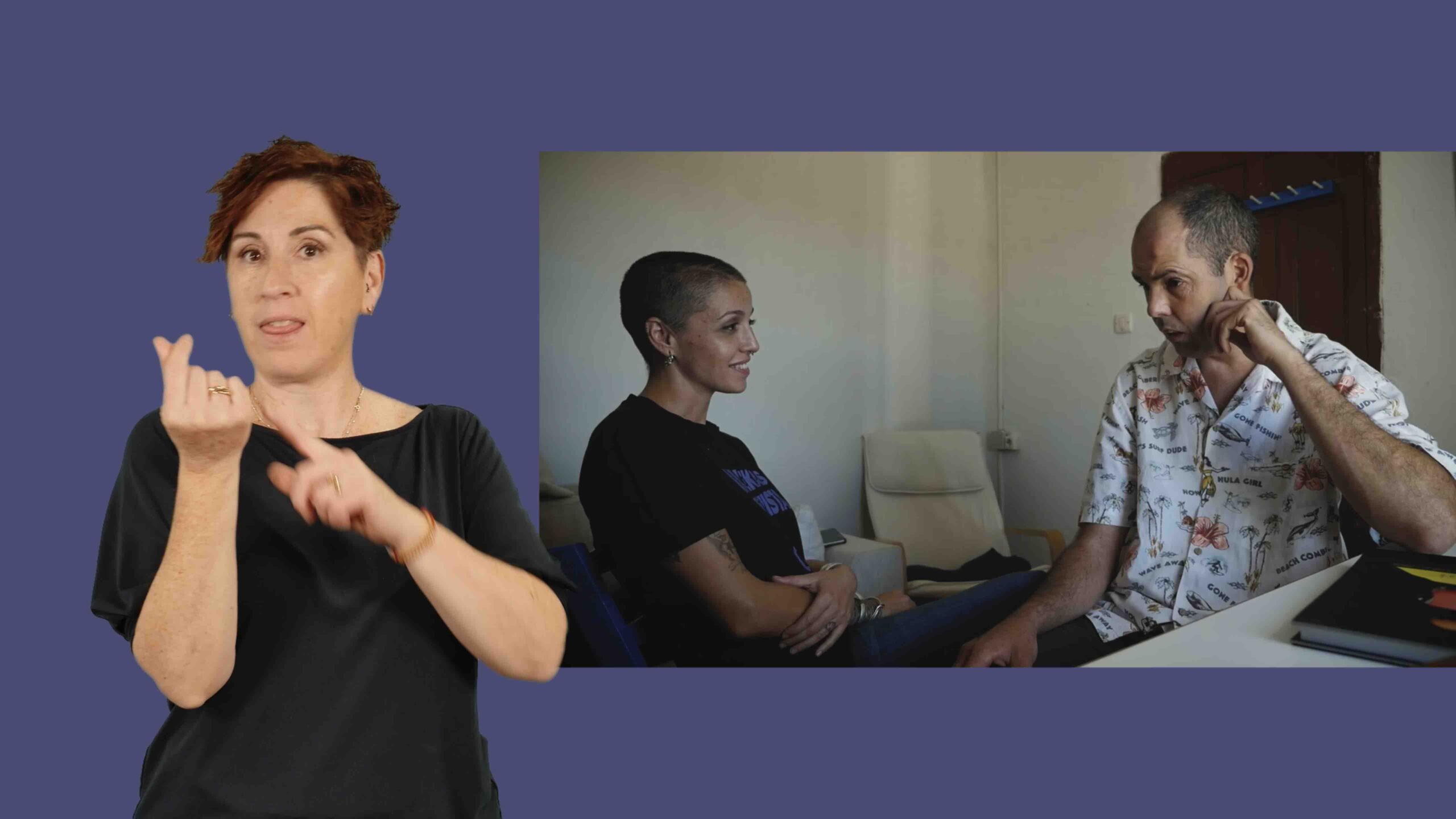
Choose your version of the documentary
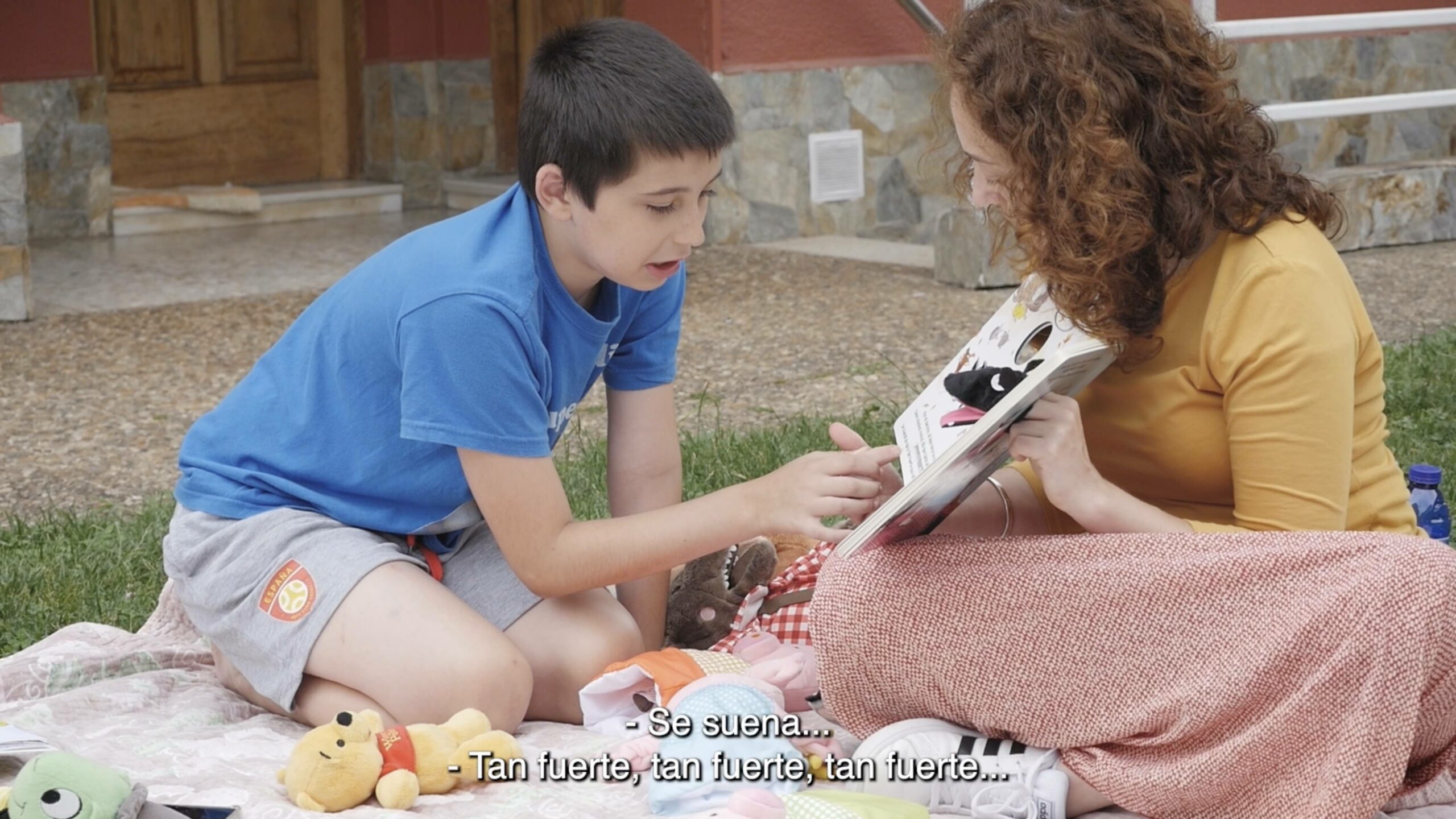
The documentary, better shared
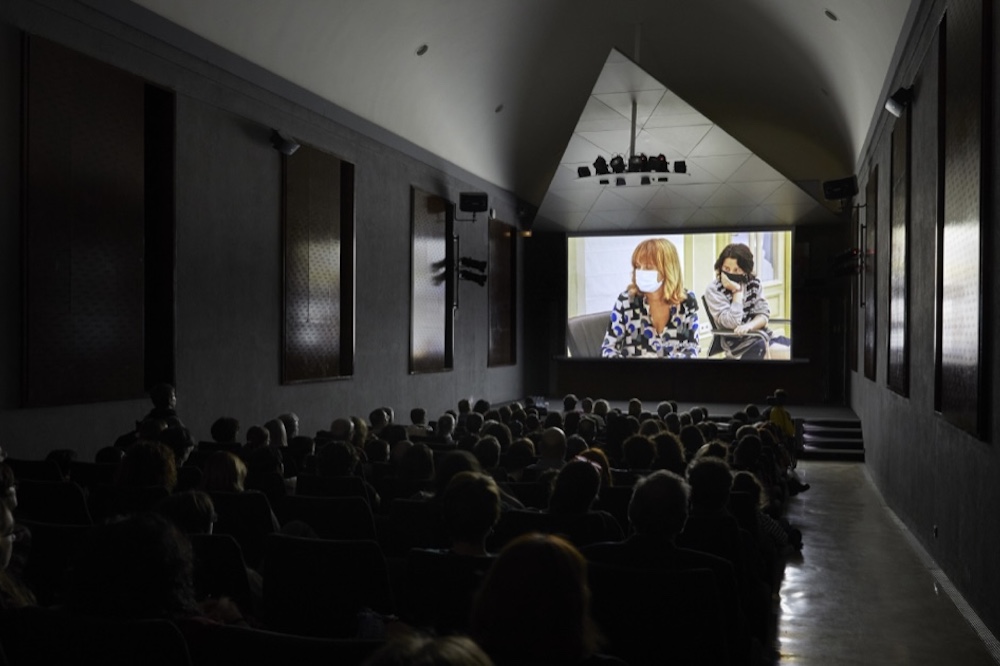
For months, viewing the documentary has been limited to collective screenings that generate public debate. You can find many of these screeningsHERE.
Although the documentary has now been released, we continue to encourage its use in collective screenings in Universities, Schools, Associations, Teacher Training Centers, City Councils, social organizations, etc. Making schools inclusive requires us to talk, to get to know each other better, and to begin questioning what has until now been “the norm.” That is what needs to be dismantled, and the documentary is a very useful tool to start the process.
All the material needed to promote a screening is availableHERE: poster, synopsis, technical sheet, photocall, film images to share with the media, possible questions to facilitate discussion, etc. Some of the documents are prepared to be downloaded with the aim of editing and contextualizing them to your specific situation.
More information about the film
A significant part of the work developed in ‘Quererla es Crearla’ has undergone a rigorous documentation process, for which the direction of filmmaker Cecilia Barriga was enlisted. Guided by participatory processes in which each member of the ‘Quererla es crearla’ steering group had a voice, she has narrated the process followed, while also showcasing the seed of a social movement. Thus, the experience of collective construction could transcend the scope of the promoters.
All information about the film, the technical sheet, the motivation behind it, how it was made, its impact, posters, the collaboration processes involved, its initial theatrical screenings, etc., is available at the following links:
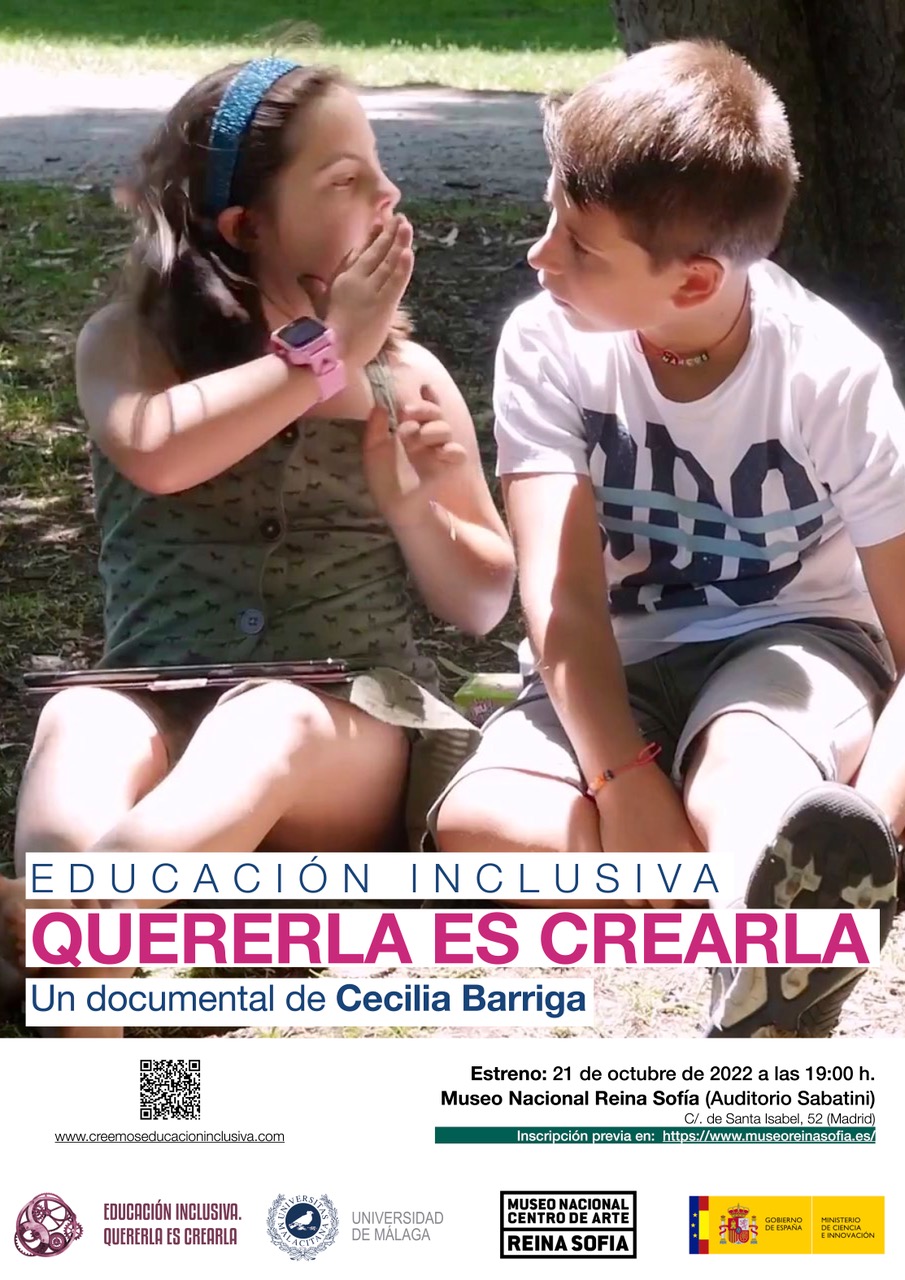
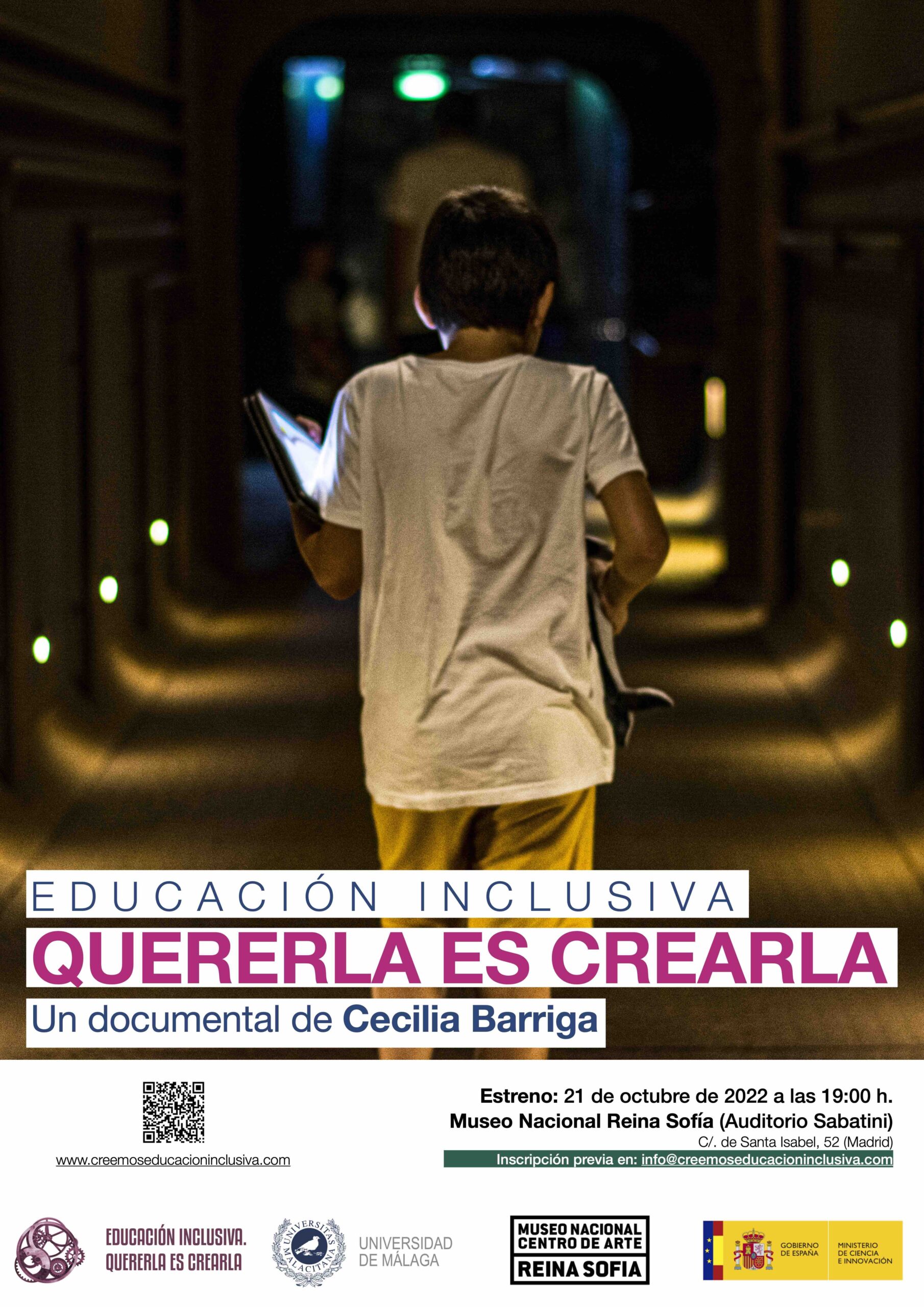
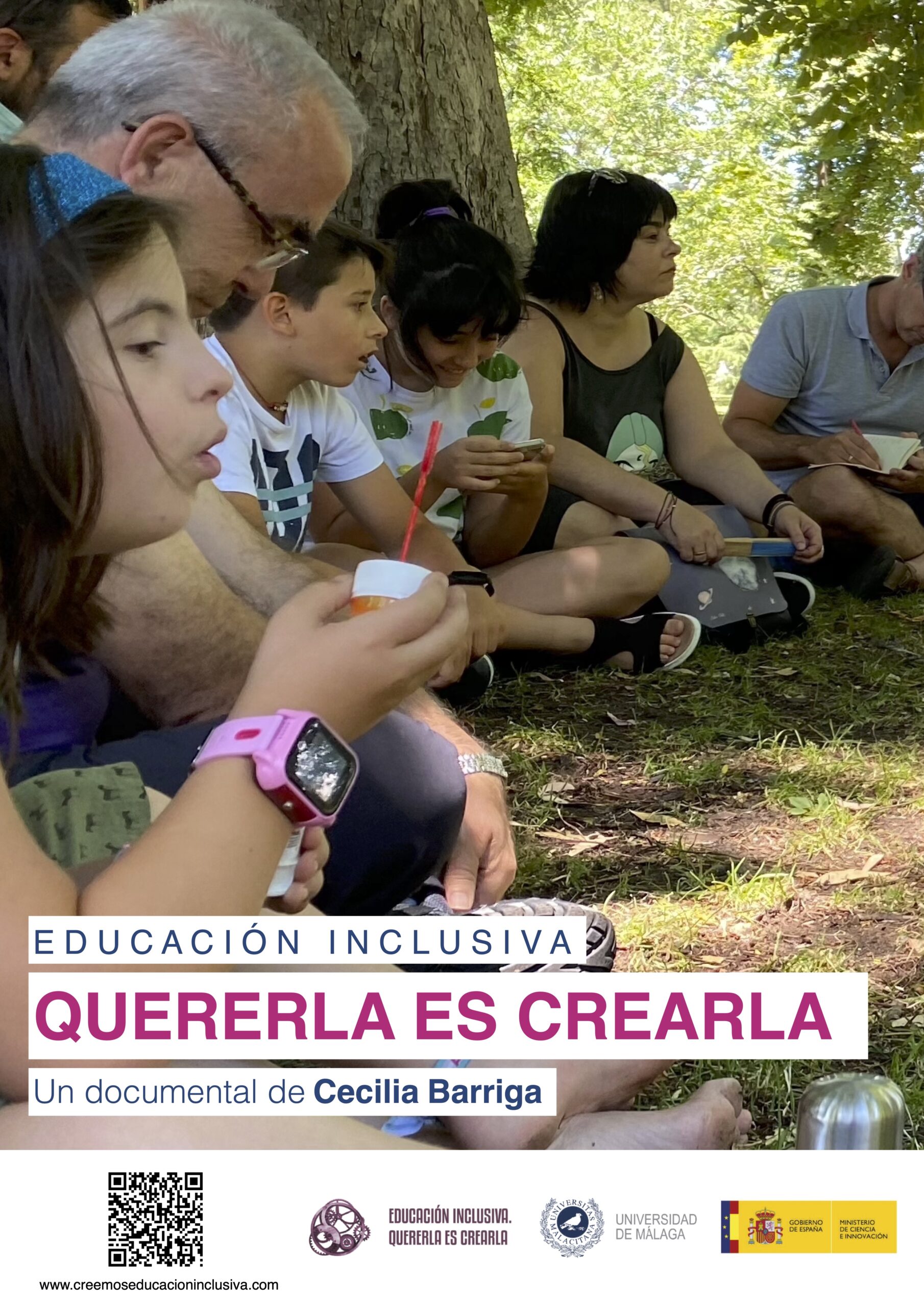
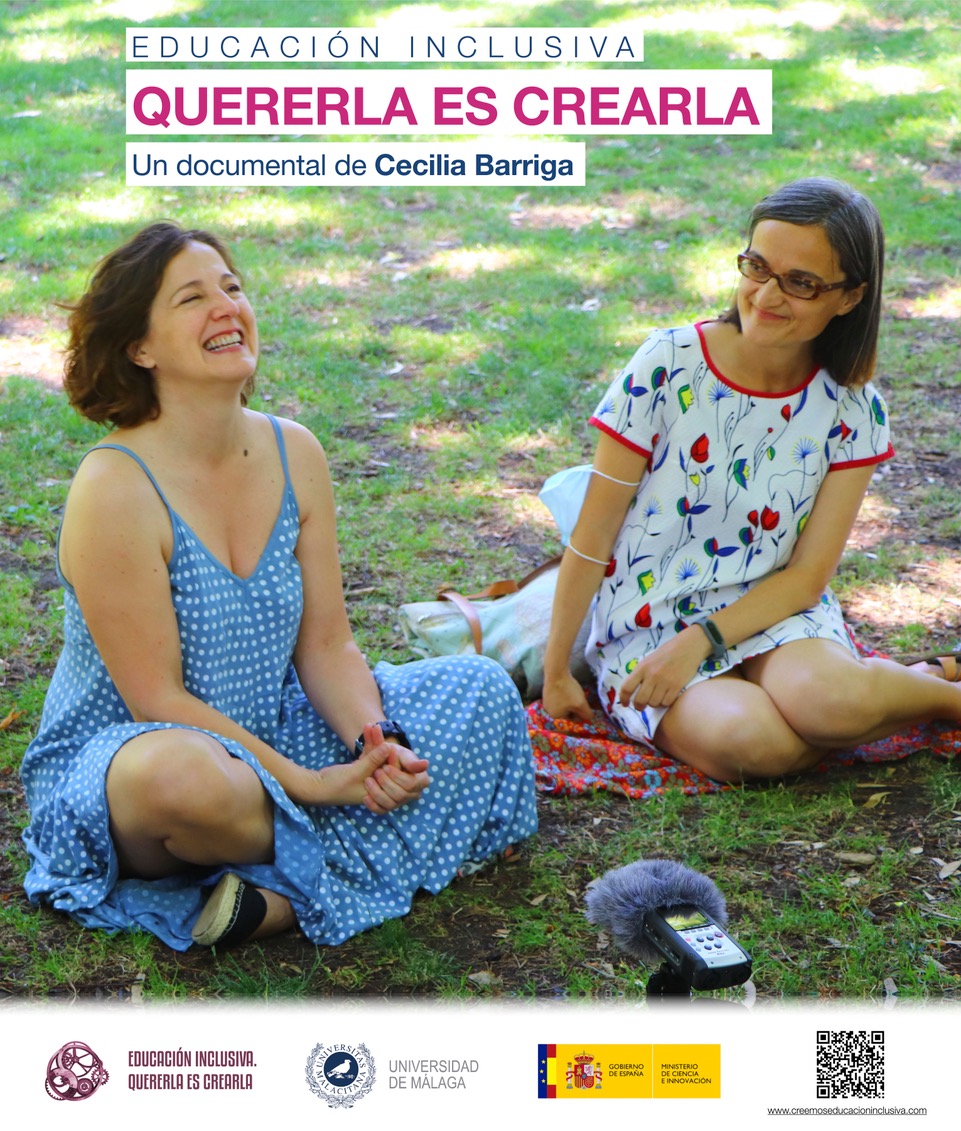
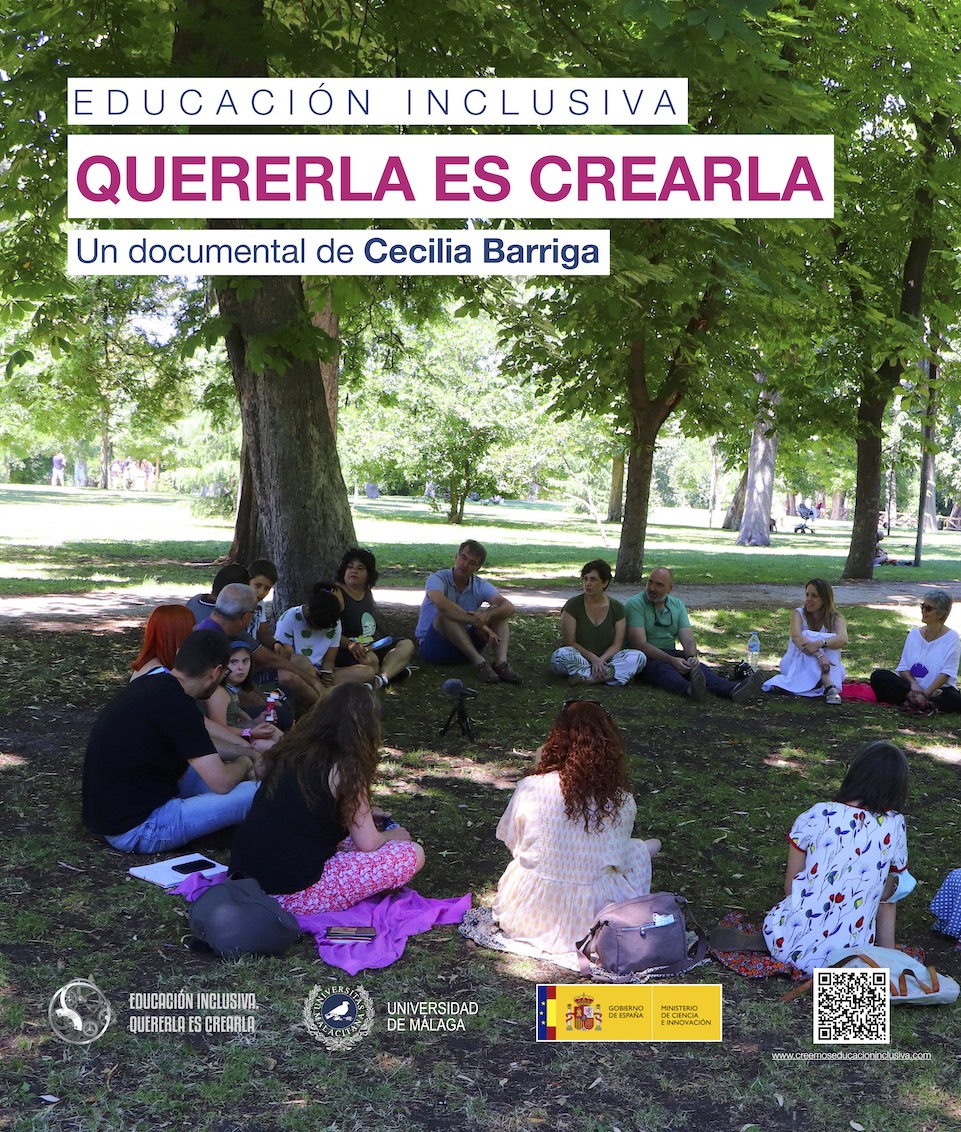
Some scientific productions
- SOLERA, F. & CABELLO-FERNÁNDEZ, F. (2024). How to film a movement: the creation process of the documentary “Inclusive Education: Quererla es crearla”. Paper presented at the5th International Congress on Social Movements and ICT Move.net. Seville, Spain. Available at PDF.
- RASCÓN-GÓMEZ, M.T. & CALDERÓN-ALMENDROS, I. (2024). Documenting a movement. Inclusive education as a protagonist. Paper presented at the British Educational Research Association (BERA) Conference 2024 and World Educational Research Association (WERA) Focal Meeting. Manchester, United Kingdom. Available at PDF and online.
- RASCÓN-GÓMEZ, M.T., CABELLO-FERNANDEZ, F. & CALDERÓN-ALMENDROS, I. (2023). How to make the participatory social documentary a tool for educational inclusion? Paper presented at the American Educational Research Association Annual Meeting 2023 (AERA), Chicago, USA. Available in PDF and online.
- CALDERÓN-ALMENDROS, I. & RASCÓN-GÓMEZ, M.T. (2022). Weaving struggles for the right to education: Collective and personal narratives for inclusion from the social model of disability.Pedagogía Social. Revista Interuniversitaria, 41, 43-54. Available in PDF and online.
- RASCÓN-GÓMEZ, M.T.; CABELLO FERNÁNDEZ-DELGADO, F. & CALDERÓN-ALMENDROS, I. (2022). Emerging and transformative narratives on inclusive education through documentary cinema. Paper presented at the American Educational Research Association Annual Meeting 2022 (AERA). San Diego, USA. Available in PDF and online.
- CABELLO, F. and RASCÓN, M. T. (2019). Audiovisual narratives about resilience and education. Journal of Educational Innovation, 19(80), 77-92.