
A network of schools to advance and drive progress
For decades, inclusive education has been on the international political agenda. Inclusive education is understood as a fundamental human right that cannot be taken away from any child or young person, as it means the loss of social, emotional, attitudinal, academic, and identity-related opportunities (Hehir et al., 2016; EADSNE, 2018), as well as an insurmountable obstacle to advancing in the construction of societies that are kind to all people. Despite this, inequalities based on disability, social class, nationality, or ethnicity, among others, continue to be produced and reproduced in our education systems, something that has been repeatedly evidenced in reports by international organizations such as UNESCO (2020). Schools can be repositories and legitimizers of these social injustices, but they can also challenge them. Therefore, the collective project of making schools inclusive holds a prominent place among desirable and necessary objectives in all corners of the world.
This is the reason that mobilizes the International Network of Schools for Inclusion and Equity: advancing in the challenge of developing more inclusive school institutions, offering learning opportunities and a social network that supports all students without exception. This implies the construction of more welcoming and creative school communities, which value differences and grow systematically from them. In this way, educational environments reduce segregation, and improve the quality of the learning they generate and the social relationships they foster, which means growing in democracy and social justice.
Cooperation among the different school communities in the network will allow for the piloting and improvement of a series of tools created under the umbrella of this project, the comparison of experiences, and the construction of practical proposals for the improvement of cultures, policies, and practices that could serve as an example for other schools in Spain and Latin America. The network includes schools with great diversity among them, which makes it especially valuable: rural and urban, from Early Childhood, Primary, and Secondary stages, with a wide diversity of students and different challenges. These can be united in participation as a key element for equity and inclusion, and are manifested in the eradication of segregation, the reduction of school failure, repetition, and dropout, the improvement of community participation and coexistence, as well as the optimization of the quality of learning.
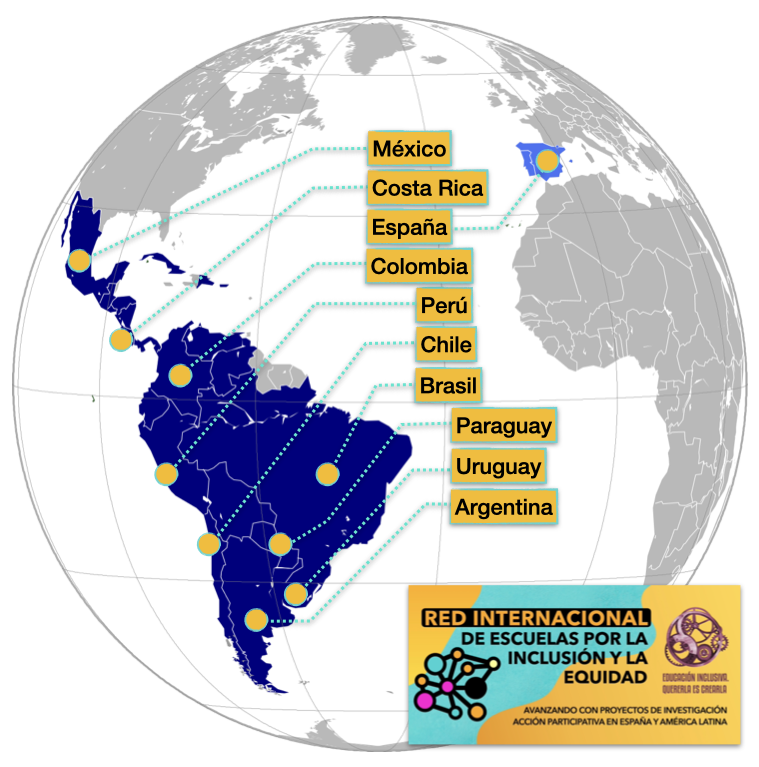
Quererla es Crearla thus convened this Network of School Centers in Spain and Latin America who wish to advance their practices to adequately serve all students without exception. The network will begin working in May 2024, holding online meetings facilitated by the team of the R&D+i Project “Emerging Narratives for the Construction of Inclusive Schools” (PID2022-140193OB-I00, from the Ministry of Science, Innovation and Universities of Spain) at the University of Malaga. The work builds upon the findings and constructions developed over the last 5 years in the preceding R&D+i project: “Emerging Narratives on Inclusive Schools from the Social Model of Disability” (RTI2018-099218-A-I00, from the Ministry of Science and Innovation of Spain).
Each of the Educational Centers that form part of the network will develop a Participatory Action Research, using the resources generated in Quererla es Crearla over the last few years, particularly the guide “How to do Participatory Action Research”. The process will be coordinated by researchers from the University of Malaga, with contributions from movement activists and the support of the other schools in the community.
Referencias:
- European Agency for Development in Special Needs Education (2018). Pruebas de la relación entre la educación inclusiva y la inclusión social. EADSNE.
- Hehir, T.; Pascucci, S. & Pascucci, Ch. (2016). Resumen de la evidencia sobre la educación inclusiva. Alana Institute.
- UNESCO (2020). Global Education Monitoring Report 2020: Inclusion and education: All, without exception. UNESCO.

Information about Network Meetings
Meeting Calendar
1st Season (2023-24 academic year):
- Meeting 1: Thursday, June 6, 2024
- Meeting 2: Wednesday, September 18, 2024
- Meeting 3: Wednesday, October 16, 2024
- Meeting 4: Friday, October 25 and Saturday, October 26, 2024 (Catalyze Workshop)
- Meeting 5: Wednesday, November 20, 2024
- Meeting 6: Wednesday, December 11, 2024
- Meeting 7: Thursday, January 16, 2025
- Meeting 8: Thursday, February 13, 2025
- Meeting 9: Thursday, March 6, 2025
- Meeting 10: Tuesday, April 1, 2025
- Meeting 11: Thursday, May 8, 2025
- Meeting 12: Thursday, June 5, 2025
2nd Season (2024-25 academic year):
- Meeting 13:Thursday, November 13, 2025
- Meeting 14: Thursday, December 11, 2025
- Meeting 15: Thursday, January 22, 2026
- Meeting 16: Thursday, February 19, 2026
- Meeting 17: Thursday, March 19, 2026
- Meeting 18: Thursday, April 16, 2026
- Meeting 19: Thursday, May 14, 2026
- Meeting 20: Thursday, June 11, 2026
Season 2 (2025-26 academic year)
[Transcripción automática provisional]
We have prepared an agenda for today, for rejoining, for starting again. Víctor was commenting earlier that his school couldn't be there until the end of last year's process and asked if they could join now. And of course, yes, the idea is for this to be like a wheel always turning and for us to be able to join the process, regardless of whether you were able to come more or less last year. Um. Well, welcome to another new cycle, another season. When I was preparing the agenda, I thought, maybe I should put episode 1, season 2, right? E1 S2, like on video platforms, right? Maybe I should have done it that way. Maybe I'll think about it and fix it. Well, it's very cinematic, don't you think? I don't know. This course must be, I mean, I'll say something. I have a daughter who is a playwright. Well, studying playwriting, so maybe that has something to do with it. Well, um, nothing, well, for this first, this first half hour of the session, we had thought of recovering a bit of the basis or the meaning of a network like this. Um, well, what a network like this means and what a movement like the one that sustains this network, which you know is Quererla es crearla. Quererla es crearla was born in 2018. Um, in 2018 we had a national meeting where, hello Vanessa, where we started thinking together based on people's experiences, and that first meeting where we shared many of our concerns, our desires too, our surprise when we started listening to each other, has led us to a moment like now, right? a second year in which we continue to work with a network of schools that aim to improve their practices and are working towards it. Well, when I started thinking a bit about where to go with this first start of the network, Mariana and I were talking the other day, Mariana and Tere, that we should rethink what we are talking about when we join to form a network for inclusive education. Um, a network of schools for inclusive education and equity, and the importance of becoming aware that um, in the same experience or under the same situation in the same family or in the same school, even in the same classroom, very different experiences occur. And since very different experiences occur, it is important that we look at those experiences, at what is happening, because certainly I would say that in this network there is no school that does not want to improve, right? And there is no school that does not do things that are very good, because in fact there is a concern for belonging and participating in a network like this, which is not a mandatory network, which is not a network that is simply a periodic meeting between a group of people who want precisely that, to improve their practices, right? But in this idea there is also a trap, and it is that many times we think that um, that we do well, and it is good to think that we do well, right? It is good to think that we do well because certainly, as I was saying, there are things we do well. I think that as a father, there are things I do well, but it is also important to be aware. Perhaps as a father it is easier to be aware of this, right? To be aware that even though I do some things well as a father, there are always things I don't do well, right? And so this idea of assuming that there are things we need to change comes to me from the experience, well, it comes from many places, right? But when I thought about how to start this, I thought about my personal experience in my school, which was wonderful for me and where my teachers were like continuous emotional support, who always, when I noticed they cared about me, when I noticed they wanted to teach me, they wanted me to learn, they wanted me to be well with my classmates, and to my surprise, a few years later, I realized that that experience was not the experience in that school, but rather my experience in that school. Because precisely those same teachers, a few years later, my brother had them, and precisely those same teachers wanted to expel my brother from school and send him to a special education center. Of course, the teachers don't explicitly say, we don't like this boy or this girl, but what was really happening there was that they liked me, and they didn't like my brother. No teacher would say that, but at the root of what was happening was that my brother was a more complex student than I was, and my brother was pushing a school that indeed does things well, with me it did them very well, but it also does things badly, and often we do them very badly. So, um, I wanted to start here, I wanted to start by thinking that in schools it's not about being very, very optimistic, or very pessimistic, or seeing the school as a marvel, or seeing it as, um, the opposite, because it's neither one nor the other, but rather that we are all the time in a back and forth between the things we do well and the things we do badly. And there are many things we could do better if we thought more carefully about what we are doing. Well, this is the first thing, the first thing I brought, and the second thing I brought was, elaborating on this idea of those two experiences, from those two experiences I just narrated, or from the different experiences that exist in any school, it doesn't matter if it's Víctor's school or Cristina's school. In any school, there are those two experiences or those many more experiences, right, that are different and that lead some people to not have a good time there. So, from those experiences, the positive one offers things, provides tools to think about how to do things well, but the negative one helps us think about what we don't do well and where we need to aim. And so, um, a few days ago at a congress that was held here at the University of Málaga and which I couldn't attend because we were away at a congress elsewhere, in a presentation by Amador Fernanda de Sabater, he made a quote when he spoke about the experience in school and made a quote, a quote from Simone Weil that said it could be a great start, a great start to think about school or to rethink what has now become in many cases something without much meaning. And the question was, what is your torment? What is your torment? That question leads us to delve into the experience of those who are suffering. But in reality, in all contexts, we always have a torment, right? It's not just something that happens at school; it happens in the family, in the neighborhood, in the group of friends, where not everything is happiness, not everything is torment, but it exists, it exists. And the school should ask itself about the torment of each person there. Um. What is causing them suffering? That which is causing them suffering may be something that comes from within the school or from outside the school, but which the school is called to take into account and work on.
Hm. Wanting them, creating them, which is the movement that sustains this network of schools, is a social movement that has arisen from sharing suffering. We might think that suffering leads to sinking into the abyss, right? Into the abyss of sorrow, but the experience we have in "Quererla es crearla" is just the opposite. It's that starting from that suffering or torment, we have been building something that makes sense because we don't just think about the suffering, but we think about that suffering to build something else, to assume that schools can be different, that our relationships can be different, and that our role in all of this can be different. And that's what we've been working on since 2018 when we met here at the University of Malaga, asking ourselves at that time about the role of school counseling in schools. And it began at that moment, in the first hour of that meeting, when a lot of experiences from people who were having a terrible time at school began to emerge. And these people were teachers, they were professionals, they were families, and they were students who all told about their torment, what their torment was at school, and from that, everything we've been doing up to now has been built. I don't know what awareness you have of what we've been doing. I think none of us are aware of what "Quererla es crearla" has been or, rather, what it is doing. We already know that anything we do is infinitesimal, a speck of dust, right? But there are specks of dust that are already having some impact. And yesterday, to my surprise, I discovered something that was published today on the social media of "Quererla es crearla": the "Quererla es crearla" website alone has had a million visits since last year. Well, a tiny speck of dust, built by many people, is having an influence on people who want to come to the website to get informed, to get trained, and to keep thinking about how to do things better. Well, and it says,
I'll say it, I can't think of the name right now, but I can't think of the name right now, but I'll find it quickly, I think, or not? Yes, I had to look up Bell Hooks. Uh, Bell Hooks says that it's really about how we work against the silencing mechanisms that schools have. How do we make those silencing mechanisms disappear that are causing those stories that show us suffering or torment to always be overshadowed, covered up, forgotten, or silenced? In other words, what could we do? Let's see, Bell Hooks, as she poses it, she poses it from feminism, but as Paulo Freire poses it, because she is also greatly influenced by him, what she poses is how to make schools spaces where people can be liberated, where all of us can be freer, because schools are spaces that particularly allow us to be liberated from many yokes we have in social contexts, right? And she argues that we must fight against those silencing mechanisms. And those silencing mechanisms, I was thinking for a little while before coming in, I was thinking about some of them. I was thinking, for example, about the silencing mechanism of expulsions, which are commonplace in schools and which are experiences that are surely happening in many of your schools, but which are anything but educational processes or silencing mechanisms. Academicism is also a silencing mechanism, uh, thinking that what's important is in the explicit curriculum, in what is particularly designed by publishers and comes in our textbooks, and sticking to that above the people we have in front of us. Or silencing is in meritocracy. No, thinking that children are getting what they deserve in our schools. That thought silences many problems that are social and not the children's, even though the children suffer them. Or bureaucracy. And I was talking a little while ago with several colleagues about how legal language was colonizing educational language in schools. How are we thinking about conflicts, needs, difficulties, relationships of children, and also of teachers with children, in legal terms? It's as if my faculty of education, where I work, were dedicated to doing or ceded its space to the Faculty of Law, right? As if law specialists were teaching in education, but educating is not that. And so we will have to think about what educating is, and largely educating has to do with fighting against all the 'isms' that exist in schools. There's a question that Broncano asks that I love, uh, he says, "Well, you, who are more sexist or more racist, right?" And the question is brilliant. The question is brilliant because the question itself contains the evidence that we are all both sexist and racist, right? And that we are not only sexist and racist, we are much more. We are in many affiliations that we are often not aware of and therefore not entirely responsible for, but which we need to unravel in order to change negative experiences in schools.
and discrimination is lodged then in the continuity, in continuing to do what we do. So, there needs to be a constant questioning of what we do. And what we do is what a friend of mine, Álvaro, calls normicide. Hm. Normicide, says Álvaro, which are the processes in which normality kills differences and, with them, kills certain people. So, the school should fight all the time against the normality that is causing all this harm to so many people. And how to do it? Because that is the question, the million-dollar question. Although first we should think, does what I am proposing, what Nacho is proposing now, reflect reality? And I was thinking a moment ago, I brought up a review I did recently of the figures for education in Spain. Forgive me, those of you who are from other countries, but the reality is that, for example, in the last five academic years, there has been an increase of 1395 special education units. That is, 19% more special education classrooms in Spain in the last 5 years. We often think, "In my school, it's necessary, but in those other schools where all those classrooms have been opened, they are also thinking the same thing, and they weren't there 5 years ago, right? And that has happened now. It is happening now.
Then, the question again is, how do we do this? And for that, a network like this makes sense. eh how to do something that is not simple, that is complex, that delves into that complexity and that requires many people. So, this network is based on one, sharing experiences, eh, on the importance of learning from other schools, because all schools are doing things well. So, we can learn from what we are doing well. Hm. But for that, we need to look at what we are not doing well. If we don't look at what we are not doing well, we will continue in the reproduction of those silencing mechanisms that I was talking about earlier, right? And to break the silencing mechanisms, what is needed is to get people talking. That's why the procedure that Mariana and Tere are going to explain now, or remind us of, is precisely intended for this: how to get people talking. Often we think, well, this procedure with which we want to do an evaluation, we can change it for this other procedure, perhaps through a questionnaire. That is problematic. What are we proposing? What is needed is face-to-face encounter, an encounter in which people start talking about that question. What is your torment? Eh, what is your torment? What is not working here? And what needs to change? And then people start talking. Well, and
I'm going to comment on two more ideas. One is that in that process of questioning that I've been trying to talk about in this little while, there's a part that was fundamental for me and that, thinking about how to start this session a little while ago, I brought it back again. When I did my doctoral thesis a few years ago, I did it on my own family. People told me not to do my doctoral thesis on that because it was my family. Hmm. And that I wouldn't be objective. Well, in reality, something similar happens to what you are going to do, right? What you are doing, which is investigating your school. You are investigating your school. And that's problematic, they told me. Well, I'm not saying it's not problematic; it's problematic because in a way you have to break out of the schemes you have, and that's problematic. And how do you break out of the schemes you have? That is, I live in my house and I live as I think I should live. Either I question those schemes that make me act that way or I'll keep doing the same thing. And how do I question it? The only way I had was to ask, to ask more people, of course, and by asking many people, but at the same time, I learned not to distrust what I thought. Hmm. not to distrust some ideas that I had been building in my own context, in my own reality. That is, you have very important knowledge from your schools, which you shouldn't distrust. However, there are parts of that knowledge that the school or the institution tends to push aside, and that which is pushed aside, which is genuinely knowledge from teachers, should be put at the center and in the foreground. Well, that's on one hand. When I took on the challenge of researching my own family, of researching myself in part, what happened to me was that I discovered, rediscovered my family and rediscovered myself. I remember that one of the most impressive things I experienced during that whole time was discovering the depth of my brother Rafa,
I have always had a very good relationship with whom I have always had a very good relationship, and I thought I knew them well, but what I realized is that I actually knew them very little, or rather, I knew their most superficial side, because there is such an enormous depth in each person that it is impossible to even imagine it. That is what I encountered when researching, for example, my brother. And that made me think that I didn't really know my daughter, nor my son, nor my partner, nor my mother, nor my father, that in reality we don't know each other, even if we live together for a long time. And the only way to know each other a little or a little more is by talking. And this is the task we have here in this network, to build by talking all the time, having a conversation, because I cannot access, I cannot enter inside you unless you open the door for me. Therefore, a boy, a girl, you will not be able to access a boy or a girl, you will not be able to access a teacher if that person does not open the door for you. That is why it is so important to count on other voices, to count on other voices and to create a context that allows those voices to speak. And of course, they should speak not what one wants to hear, but what those people have to say. And that leaves one quite exposed, quite naked, because what do I do if what they are going to propose is something I am incapable of doing, right? Because certainly we have many limitations, there are many things we don't know how to do, and the main fears, the main obstacles to continuity are fundamentally fear. Hm. everything that causes us fear. And for that, the procedure we have planned is very useful: building, as Mariana and Tere are going to explain now, a participatory action research (PAR) allows one to rest in collective construction. that not everything depends on you, but your participation is fundamental, and that people together can build not only analyses, not only will they tell you what is happening to them, not only will they explain why they think it is happening, but what they will do is build proposals together. And that is not something that you alone have to respond to, but something that is done in community. And that is the proposal we bring this year, which we brought last year, but this year we bring it with renewed strength. So, I've gone on a bit of a long rant here, and if you like, well, if you want to comment on anything, you can, and if not, Mariana and Terez have their set of proposals ready here.
Well, I don't know if there are any questions, if not, well, if you want, we can start and you can interrupt us at any time, if you have any doubts. Yes, I want to start. Well, above all, by saying good afternoon, as I saw that several colleagues have joined, and a welcome, right?, it's always a pleasure to see so many people here, especially involved, right?, in your work and in those children who, as Nacho says, must also find their place in school, because school is ultimately for them, right? It's not for us, it's for them. So we have to try to make it a friendly school. That's to start with. Well, a bit to pick up on this little idea that Nacho mentioned about learning together, that's what it's all about. Mariana and I will spend a few minutes, and what we'll do above all is to revisit some of the steps we explained last year regarding participatory action research, how to do it. You already know, that's why we'll do it briefly, but we did think it was important to remember it because, well, as Víctor, for example, said at the beginning, there are several centers, like his, that want to pick up where they left off because they couldn't continue. There are centers that are, let's say, starting, others are more advanced. So, if you agree, we'll do it very briefly, to help you get oriented and know where each of you stands and what the next steps are. There's something very important that I think has been the focus of everything Nacho was saying, and that's the idea, which would be the first step to carry out participatory action research: raising awareness. Raising awareness that in our schools, as he said, there are many things being done well, but there are also things that need to be improved. So, by thinking about those things that need to be improved, about that awareness-raising, that's where, let's say, it arises, because normally participatory action research arises from a demand, so that's the demand, the awareness-raising, but it's not enough for that awareness-raising to remain only among, well, a small group of teachers, of administrators, etc., but it's important that if we see a symptom of unease within our school, the most important thing is to make it known to the educational community and try to involve them in that attempt, in that transformation, right? That is to say, try to join forces. If we truly want a transformation, it's not enough for us to be, as I say, a few professionals; we need to involve families, and above all, students. And well, we'll elaborate on this idea later because I think this is the driving force of the whole process. Let's see how many forces we manage to gather on that path. This demand must also be linked to planning, that is, to an objective, to conditions, to commitments that we assume as a community, and from there we will start working. That is, the first thing is awareness-raising, but that awareness-raising must be followed, as I said, by planning and by adopting, above all, commitments, okay? A commitment by, as we said, the entire community. It's the first step. Mariana will tell you a bit about where we need to go once that happens, and we'll see.
Well, good afternoon. I also, uh, well, I greet all the, uh, well, all the people who are connected, it's a pleasure to meet again as always. Uh, and well, to continue a bit with the process that Nacho and Tere have started, uh, I think there's something, uh, as Tere said, right? That awareness-raising, uh, with which a participatory action research begins, and in this case, we would enter a second step that we have called diagnosis and identification of the problem we are going to investigate. That would be a bit of that second step to take. And he said something very, very interesting, very beautiful, right? Nacho started, uh, to share, uh, a bit of his research experience about his own family, right? Of course, this type of research is what we call participatory action research, because we are not researching a reality alien to us, we are researching our own reality, right? Nacho gave that beautiful example, right? I rediscovered or knew very little about my brother, but I discovered an enormous depth. So, perhaps starting by becoming aware that it is our reality that we are going to investigate. And, uh, that reality about which we are going to investigate, uh, also has an enormous depth.
And of course, one says, "And where do I start? Because if I want to improve, if I want to, uh, advance, I'll have to stop. Be careful in the reality we live in today, in the society we live in today, that we go at enormous speeds, right? Stop
and ask ourselves, what's happening in my school? What's my school like? How is teaching done in my school?
What are the relationships like in my school?
What would I dream of for a school? In my school, how would I dream of it being better?
I think that's an especially beautiful exercise. Uh, uh, it's a beginning, uh, to start a dialogue. It's a diagnostic process. To consider what situation, what situation we are starting from, what my reality is like, what I like, and what I think I need to improve. We start by looking at ourselves because we are fully involved in the reality we are investigating, because we are the true protagonists of that investigation. They are not people outside your center; you are the ones who truly live the day-to-day in your center. Therefore, I think this research has something especially relevant that makes the school more inclusive from the very first moment, and that is that the true protagonists, the community itself, takes the reins of that investigation to make their school more inclusive.
Inclusion will not arrive at the end. Inclusion is a path and a process that we are building together, hand in hand, committed.
It's the second step, asking ourselves questions, and we can ask them however we want, but in the end, it's about dialoguing, sitting down, looking at the situation. Carmen, are you there? I don't know if she's there or if she's in the car or has stopped somewhere. No, I'm here, Mariana. Ah, good, good. Uh, I don't know if you could remind us in a minute how that day went. I still remember arriving in your town, where we were going to park on the hill, because your school isn't right here, in Málaga, and no, no, no, it's not, you have to get there, you have to drive a few kilometers, and well, it's going to be longer for you, huh? No, but it's true that I remember with special affection that first day you organized, a full morning where we could participate. Could you remind us for a minute what it was like at your school? Yes. Uh, it's true that when we started, now that you look back, you see the magnitude of the movement, of what we did. Uh, for a school like ours, which is in a rural area, as Mariana said, uh, it's close because we're not that far, I mean, we're 18 km from Rincón de La Victoria and 16 from Vélez in Málaga, but it's true that it's an area that's very nestled up there, it has a strong village identity, and for you to arrive with a bus of 60 or 65 seats, uh, full, that came there packed, it was raining too, I think it was raining. and you disembarked there, uh, and took over the school to ensure, uh, the idea was to ensure that the children and families could speak freely and have that participation you mentioned and ask the questions you just asked, right? Like, what is the school we want, how is teaching done in my school, what is it really that I want for my school, if I could make it happen, and to ensure to some extent that they wouldn't feel, uh, inhibited or say what was politically correct because there were teachers present or someone from management present. It's true that now that we've moved forward and the years have passed, and this question has been asked many times, because it's been asked many times, it's true that there's already other participation, right? There are channels, it's seen with more naturalness, but that first time it was very important that they could have that freedom to be able to carry it out, right? And the truth is that the experience was very rich. Uh, the end of the experience that day, I'm left with that, with that moment. You laugh, and Nacho too, because at the end of the experience, after asking them, well, of course, as I always say, as it always happens everywhere, a conflict arose because the children spoke, the families spoke, and today I think that without that conflict that arose, the change wouldn't have been possible. I mean, that conflict was necessary, conflict is often necessary for change to occur. The biggest changes that have occurred at a societal level in any environment, many of them stem from conflict, so that conflict was needed, and that conflict came from the teaching staff, because there was part of the teaching staff who considered, uh, that we were getting into trouble and that really, what were we doing? We were opening the school doors to families so they could give their opinions, and of course, we were giving free rein, we were letting go, it was like the ship was drifting, and we couldn't, and the families, as Nacho just described, a conflict arose that we weren't prepared for. I had a bad time during that moment, I have to admit it, because of course, but it's necessary to have a bad time, it's necessary because in the end it makes you question yourself and you realize when time passes that it was necessary to carry it out because it created and generated many moments and spaces for dialogue after that conflict in different spaces, spaces with families, spaces with students, let's work together because in the end, that conflict arose because we were naming, or they were naming, uh, they talked about bullying, they talked about harassment, maybe it wasn't really like that because there wasn't any protocol for harassment, uh, uh, open, or the ones that were open were already open, but it was necessary to create that, to listen to the families, because they were speaking, perhaps not with the correct terminology, but it's true that it was necessary to talk with them and talk in different spaces and start building together because from the moment we started, we were going to build. They focused on coexistence, and it was necessary for all of us to build a better coexistence. So, the truth is that when you look at it now, with the passage of years, you realize the magnitude and the construction and the starting point of that moment. We were privileged because not everyone has the possibility of that help that we had with the UMA and with you and with that volunteer work. I mean, the volunteer work gave a lot of richness to it.
And within that volunteering, if you remember, talking also brought to mind the experience that within the volunteering itself, there were students who had lived their experience in educational centers in a way that perhaps wasn't what Nacho just described. Some had lived it well, and some hadn't lived it well and had those glasses on as if they saw everything badly, right? Or some saw it well and didn't realize that it could also be... So, it was very enriching for everyone. I believe that coming together to participate, talk, and ask questions is very enriching, and the more diverse voices there are, the better.
Thank you Carmen for sharing such a beautiful experience. The camera, no, don't worry, we see you in the little photo and well, since we know you well, it especially brings us great joy to hear you and as you were describing the process, I think those of us who had the enormous luck to accompany you have been remembering those moments, right? Those moments that I was thinking about from what you've told me, perhaps I would focus on an important part of the diagnosis, which is the conflict. I was thinking, I don't know if you've ever had blocked ears. I have. And when they unblock, everything seems to bother you, right? Because you've suddenly gone from one state to another. I had the sensation that in that center, suddenly, there was a commotion, right? What Carmen says, right? Suddenly it unblocked and there were so many people giving diverse opinions, talking, some with one idea, others with another, right? A bit overwhelming. On the other hand, I have that overwhelming memory that was uncomfortable, as Carmen said, right? Because there were realities that you say, "Wow, you don't expect that." Or, on the other hand, I found the process itself especially beautiful, with those flip charts and sticky notes, many people participating, very mixed groups, movement, right? a lot of movement and as Carmen says, perhaps what La Parra told, I am always very aware that what happened at La Parra is the seed of this network today, it is the origin of the creation of this network in that school, in that small town, which I don't know how many students it has. And there is something that Carmen said, which is what starts in the diagnosis and the problems begin to emerge, but above all, the ears start to unblock and those silenced voices begin to be heard, right? As Nacho said earlier. If you want, we can move on to the next step, Tere, with the constitution of that steering group to keep moving forward. Great. Thank you, Mariana. Well, I'll just pick up on that memory, as Mariana said, it was indeed overwhelming, it caused fear, as Nacho said over there, but what also struck me a lot was the courage, the courage of the families, of the students, the freedom with which they expressed certain opinions and especially certain feelings they were having at school, right? I think that often that freedom, that courage, awakens fear in those who hear it, because of course, we are not used to opening such a free dialogue in schools. Normally it's a mediated dialogue, mediated by adults, a lot by educators too. And I think there, well, it was a moment when the community felt free to speak, felt that the environment was truly preparing that breeding ground for everyone to say what they thought and what they felt at each moment. And for me, that was very beautiful and it picks up on this idea because that idea of free dialogue is a bit what we aim for to happen in this next step, which is the constitution of the GIAP, the participatory action research group. We often call this group the steering group. Can you hear us calling it the steering group? Why steering group? In a car, who is the mechanism that directs and drives, let's say, the most important part of the process? The engine, right? Well, the same happens here. This group, which must be made up of, as we said before, teachers, administrators, but also especially students and parents, is in a way the one that will manage the whole process. If this group is strong, surely the process, even if it has its ups and downs, will surely move forward. If we don't manage to create a solid group in that sense, it will be difficult because in participatory action research, what we are looking for is to involve all voices, the entire community. So, it's good that some of us have the will to transform, but if that will doesn't go hand in hand with the students and the families, meaning that we give them a place in that process, transformation is very difficult to achieve. You will already know this from your own schools. So, for me, this is the cornerstone, I would encourage those who have started the process and those who are still in it, to involve as many students and as many families as possible. I think Carmen, who is there, can say that when that GIAP started to work better, it was when the students took a voice, right? Carmen, what do you think? I don't know if she's there. Well, are you still there or not? Well, she'll get back to it. I think this is fundamental because you will notice it a lot, I mean, not just that they are present, but that there is a balance of voices. I would put a slogan on this GIAP thing, as I say. All voices are worth the same. Whether they come from a student, a parent, a mother, a teacher. We are all an educational community. All voices must be worth the same. And for that, it is necessary to give it time, to create mechanisms for participation within the group, mechanisms for open dialogue. That is, this normally, like any human group, right? It's something we have to keep working on. It's the same with friendships, it's the same with family, so it's exactly the same here. We have to keep working on the relationships that occur within the GIAP, so that we all feel free to express what we think at each moment, the proposals we consider, the diagnosis we make of each piece of information we receive. Of course, for this GIAP to make sense, it's not enough to express our opinions, which is super important, but it is necessary that we also adopt commitments, each from our part. And those commitments imply, above all, that we create a work dynamic, a schedule, for example, so that we can, as we have done here in the network, indicate the days or times we will meet throughout the year so that each person can plan and organize themselves, etc. And well, in the end, as I say, there should be a balance of voices and those voices should also be present in these meetings. That is, forgive me, my mouth is dry, it is very important that we also have the voices of those families and those students here, because as you will see, this will completely transform not only the dynamics of your center, but of the network itself, okay? Because right now we are listening to professionals, but we still need many students here and we need many families. Well, Mariana, I'll hand it over to you for the next step. Come on, we're moving forward. Tere, picking up on what Terez just commented, that steering group that we often call the steering group and that she recalled very graphically as being like the engine of a car, right? We could think of the engine as being the essential part, right? the part that really sets things in motion, that motivates, energizes, encourages, right? And Tere fundamentally highlighted that something we have learned, right? something we have learned by participating in these investigations, is that the engine must be represented, that all the parts that make it up must be represented by the different voices, but that undoubtedly one of the most important voices in the engine, from our experience, and I suppose you will think or have the same experience, is the students themselves, right? Of course, that's the point of that steering group. But now the next step would be to ask ourselves, where are we going, where do we start, what direction do we take, because we have done a diagnosis and many problems have emerged, and so, do we go left, right, up, down, what direction do we take, because the engine is formed, but then we have to stop again because otherwise, let's see where we're going to end up, right? And we have to ask ourselves, not about the direction we like most, but as Nacho said earlier, I think respectfully, not what we want to hear, but what they want to say in that diagnosis. So we take all those problems, all that. I remember, my goodness, because when you start doing a diagnosis, you don't think so many ideas and so many proposals and so many sticky notes full of information will come out. Sometimes we collect and without realizing it, you say, "But we have so much information to collect." Well, there are techniques that can help us analyze the collected information, but ultimately, in this phase, what matters is to be clear about the direction to take and to focus our effort on a specific point, in one direction. And in this case, I'll use the example of La Parra again. La Parra decided that its focus, its direction, was to improve coexistence in the center and its surroundings.
At the end, well, at the end during, but you always think that something new and beautiful about this type of research is that it's not only important to set that focus and direction, it's not only important where we want to go, but the process, the journey we are living is extremely important. We'll see now which phase we move to next. I'll leave you with all the part we do with that information. Now, how do we start? With the focus clear now, what do we do? What do we do now? Well, above all, the next step would be to investigate the problem and provide feedback on the results, okay? The investigation. We already know the focus, as Mariana says, we have detected the focus and now the most important thing is to start gathering all the community information about that focus. That is to say, we put the students, the families, ourselves to work, how are we going to gather information about them? Well, here, last year, very creative proposals emerged, in addition to the ones we gave, because some centers had already gone through this phase. We gave some advice, like, well, a very easy one, which is participant observation, that we all start observing the students from their perspective, that they observe relationships among their peers, between teachers and students. Teachers can also change their usual perspective a bit and try to go a little further, the details of what the relationship is like between our colleagues, between our colleagues and the family, and also the families, right?, with their own children, that they start gathering information, that they observe, what are the relationships like between these children and their peers, between them and other parents. And all of that, we note it down, right? All those little, especially the little details, we note all of that down and leave it there. Another technique, well, interviews, right? And they did this very well at La Parra, as we were saying, because the students had a lot of fun. Here they did the same, they went around during breaks and stuff as interviewers, right? And in classes, interviewing classmates, other techniques can be used, but above all, asking what is happening, right? asking classmates, they sent them in pairs and did a little bit, one was taking notes, the other was recording the information, a bit like trying to see or gather all possible information on this topic. Interviews, as you know, can be individual or group. We can do them in a classroom with a group of students. The important thing is to gather, let's say, that in that information all the boys and girls, the family, the teachers are represented, especially the voices of those more vulnerable students and families, those who suffer the most at school, okay? Let's not be afraid to open our ears, not to unblock them, as Mariana said, to listen to those voices, even if it creates conflict, because that will be the seed of our research. Well, in interviews, it's true that there are, well, you know this, that there are a series of criteria that must always be met, that try to guarantee anonymity to the person being interviewed, if they wish. when you are asking, don't give opinions, don't interrupt, but try to make it an open dialogue, even if the interview might have a script, which isn't necessarily required, even if it does, try to make it a dialogue and let the person speak, so that we are noting down some keywords of the issues that have been discussed and thus we don't have to ask about them because perhaps in the same conversation the person is already releasing ideas about one of the questions we were going to ask later. So, start with simple ideas, with simple questions and then perhaps more complex ones. Another technique, for example, workshops that have also been worked on in conferences with La Parra, right? A good way to gather information is through participation dynamics in those workshops, like, for example, brainstorming, right? that the collectives with whom we are working, the groups with whom we are working, announce ideas, they are collected, and then each of those ideas is reflected upon, analyzed, etc. Then there is another technique, like the Philips 66, which is dividing a large group into small groups, having them think about a specific topic, and once ideas are extracted from those small groups, we take them to the plenary assembly, right? And everything that has been worked on in the groups, the spokespersons take it to that plenary assembly and a dialogue opens. Another way, narratives, right? And I really like this way of narratives because it allows the person, the student, the parent, etc., in a relaxed environment to reflect while writing their own brief narrative, right? And this, well, while it can allow us to collect many brief narratives from the community, it also allows the person telling it to reconstruct their own experiences around what the school means to them, the relationships that occur within it, how they would like it, right? A bit of what Mariana said, what they would like to change in relation to that focus we are working on. Well, and all these techniques will help us gather a lot of information. What happens? That surely at first you will be a bit scared because you will say, what a quantity of information, what do we do now with all this information we have collected, okay? Well, don't be afraid, that's what the whole community is for, you don't have to do it alone. That is to say, above all, you can organize by group, group of students, of parents and summarize and try to synthesize that information so that it reaches the steering group already synthesized, making it more agile, okay? because otherwise it can be an enormous amount of information and you might feel a bit, as I say, with that fear, right?, which has happened many times. Okay, I have all the information, but now what do I do? So, try to ensure that this information reaches the steering group in a very concise way, and it will be within that steering group where all this information will be analyzed, okay? An analysis will be produced, and since all collectives are represented there, everyone will be represented, and once the information is analyzed, it will be returned to the community, okay? So that this analysis doesn't just stay within the steering group, but all members of the community have the opportunity to introduce new ideas, proposals, actions, okay? So I would emphasize this a lot, that it is important to take on responsibilities, but it is also important to delegate and don't be afraid to delegate to your students, to delegate to those families because you have wonderful allies there that we often overlook and don't even realize, right? Well, as I was saying before, this will be the most enriching part of the project. Well, I, as I think we're going to regulate, I was going to ask Carmen to talk a little about the experience of that feedback with the workshops they did with the students and all that, but I think that instead of doing that, we're going to move on, right Nacho, what do you think? because otherwise we'll go a bit slow. I'll just tell you that it was done at La Parra, well, they organized an event with the whole school and a series of workshops were held. The students participated very actively in these workshops, they produced videos that served as a sort of launchpad in each of the workshops, launching ideas about coexistence, and this served in the different workshops to work on different themes that were directly related to coexistence, such as the use of social media, loneliness in the playgrounds, methodologies, the need for more active methodologies, etc. And well, if you agree, I'll hand over to Mariana, who will continue with the next step, which is the design and implementation of the comprehensive action plan, the PAI. Yes, this would be, well, we've said that we have, no, as Tere said, we have the engine, we have the direction, the focus of study. And of course, Tere has been explaining a bit, well, how we can, the process itself, because of course, how will we achieve or how can we make our school more inclusive, how to improve that coexistence. She has described a series of techniques, but perhaps not only the quantity and variety of techniques, but something important is that, as she said, a lot of information is collected, but that information, that investigation into the problem itself, is already giving many clues about what we can do, what we can do. And this is the next step. Nacho, Tere, and Carmen have all said that in this process, fear arises, also a fundamental and necessary emotion in the process. Because one sometimes says, "And now what do I do? Or how do I respond to this situation?"
And something especially beautiful in participatory action research is that fear is transformed into motivation, into enthusiasm, into a project. Fear goes out the window and the door opens to an action plan, an action plan that is not built by one person, not by the management team, but by the entire core team and the whole community. And Nacho also mentioned it at the beginning, right? With this movement, it is capable of transforming suffering. Well, PAR transforms that fear of being alone in the face of an unknown, invisible, silenced reality. It brings it to light and allows us to unite and work together and make proposals for improvement. And not only make proposals for improvement, but implement them. And that is the phase we have just described. At La Parra, many ideas emerged that had already been discovered, had been gradually discovered in the phase that Tere described. Well, look, they created a new subject on technology and social networks, because, of course, they had seen how there were many issues of cyberbullying on social networks, right? They offered training to teachers on all these topics, informational workshops for families and students. They facilitated new resources to eradicate loneliness during recess, etc., etc., etc. And they didn't just stay within their school; on a December day in 2021, I think, they said, "Hey, let's invite the surrounding schools to share this experience we've carried out, right?" And so, the event we called Inclusive Gasargía Day was held. And finally, Tere, we have the last step after designing the comprehensive action plan, putting it into practice and
great. Thank you very much, Mariana. Well, the last step is like any educational process, right? Evaluation, that is, in each, let's say that each cycle that makes up the PAR should be followed by an evaluation process. Why is this process important? Well, because it's a moment when we stop to think about what has happened, uh, how what has happened during all this time. Hm. if what transformations have occurred in the school. Uh, that is, it's a moment above all for reflection, right? When we already have that information and it's time, uh, as I say, to make decisions, right? Based on the information we have, we start making decisions as a community, as we said before, and all the results that come out of that evaluation are discussed. In addition to making decisions, a very important part, I think, of the evaluation process is to assume commitments, right? That is, we continue, it's still a cycle, this is a process, as we said before, we are going to continue working. So, the evaluation allows us to take that little pause to see, uh, what has happened, what information we have about what has happened. And now, well, we're going to think about how we're going to transform this, right? How are we going to transform that which is creating that discomfort in the school? Well, based on that decision-making, as I say, commitments are made and from there we continue working. There are many techniques for evaluation. Well, you who are teachers will know many. We put in that guide we had the SWOT technique, which we have used several times, SWOT for strengths, opportunities, weaknesses, and threats, right? a bit, uh, to identify those difficulties, those successes, those mistakes, those dangers that what is happening at that moment can entail for the research and especially those proposals for improvement, right? In that SWOT, which as you know, is a double-entry table where those four, those four ideas are collected: strengths, weaknesses, threats, and opportunities, the community, the steering group above all, introduces, uh, discusses what would go into each of those boxes, what have been those threats, those opportunities, and so on. And those results are analyzed later and we think, as I said, about proposals for improvement. For me, this is a fundamental process, just as I said that the steering group is, let's say, the cornerstone of the process, because without that engine, the car doesn't move, right? As we say. Well, evaluation is also a very important process because, as I say, uh, well, sometimes we go, Mariana said, sometimes we go with the times we have, right? We don't stop to think, to reflect, well, evaluation allows precisely that, to stop and think, uh, well, what has happened? How have we done it, how can we do it better? and a bit to continue working and it will be the starting point of the next cycle. And well, these would be, in broad strokes, all the phases of participatory action research. We have tried to synthesize it a lot because we know that we have already gone through this process, but we believed it was important to revisit it because, as we said, we know that not all schools have had the same times, you are not all at the same point. And well, if we are going to start a new cycle, it is important to, let's say, revisit all of this. And now, well, the next thing, here we were going to open a dialogue a bit because what we wanted to ask you, now I'll give you the floor if you want, Nacho, is a bit to see about those commitments, right? that I was commenting on. We have to assume commitments, well, the network also has to assume commitments. This is, this is fundamental. That is, all that, as we said at the beginning, that you are doing well in your schools, that which also needs to improve, well, all of that and all these PAR processes, you have to document them. That is, all those small steps you are taking, you have to document them, you have to collect them. And I think this is fundamental because many times we do, as Nacho said, very good practices but we don't record them and then it remains a bit, and it is fundamental, everything must be seen, the whole process. Well, I don't know, my colleagues Nacho, well, if you agree, let's open the floor, right? Let's see how everything that has been discussed has resonated a bit and also the perspective you have now to focus on this new course.
We've talked so much that we've left everyone silent, huh? We haven't moved on, we haven't moved on. Marcelino, it's starting to liven up now. Come on, I'll break the ice and that way the others will get more animated. I'll be very brief. This year, unlike last year, I'm at a new school, which isn't a new school because I already knew it many years ago. I worked there for 3 years. I always requested my permanent position there because, for me, it's an ideal environment. And when I say ideal, as Nacho and Tere also said earlier, it doesn't mean perfect. Ideal means an environment to work in. That's the thing, because that doesn't always happen. I've had the bad experience of two schools that turned out to be duds, and finally, I've arrived at one I knew with my permanent position, and this also gives me the possibility to control the situation a bit myself. Look, when I say control the situation, I don't mean it in a negative way, I mean it in a positive way, in the sense that I'm the one in charge, but there's a group of teachers behind me who support me. There's a management team who told me, "Marce, go ahead, do whatever you want." And that was more than enough for me. To such an extent that, on the other hand, work is being done almost in parallel, almost without having discussed it beforehand, because they are people I already trusted before starting to work with them. For example, work is being done through the ProA project and the Proa project with the levers, and what it's giving us is that in the end there's a confluence between Proa and SIAP, because it so happens that from Proa, for example, I've already requested to create, to stimulate SIAP, and to include me in the lever that has to do with families. So, we're going to have mixed groups in the afternoons. Classes are in the morning, but we're going to have groups in the afternoons where families will also be involved. In a neighborhood that isn't a neighborhood with much social facilitation, let's put it that way. That is, there are big social problems, there are broken families, there are big conflicts, but on the other hand, it has a very collaborative, very involved teaching staff and management team. To such an extent that the head of studies herself is creating what we've started to call, we don't really know what we're calling it, but I've already started working with SIAP, I've started recording, I've started taking notes, and these things called the 'emotional patrols' have been created, and the emotional patrols are students from all years of ESO. For now, we're with ESO, later we'll move on to baccalaureate, but for now, we're with ESO. From all the years involved, to ensure that no one in the playground or in the hallways feels alone, sad, or cornered. That is, this is the first of the slogans, right? There was a lot of talk about avoiding bullying. Well, this is a way to avoid bullying, that everyone feels, you know, "I'll put a hand on your shoulder and say, 'Come on, what's wrong?'" There are currently 20 volunteer students from first to fourth year of ESO who are circulating around the school during all breaks and at all times so that not a single student, no matter who they are, is left alone in a corner. And I think that's incredible. And this is one idea. And then another idea and another piece of work we're doing, and here I'll interrupt myself because I don't want to hog the floor, is to start working with the students from the 'aula en clave' (key classroom) that are in the school, where it's not the 'aula en clave' that asks for charity, as has traditionally happened, to come to our so-called mainstream classrooms, but rather it's the mainstream classrooms that go looking for the students from 'aula en clave' so that they come and are involved in activities, even curricular ones. So, in my performing arts baccalaureate, where we're preparing a performance and a theatrical show for the Day of Solidarity with Palestine, which is on November 28th, November 29th, the students from 'aula en clave' will also come. They've been informed, you know, because there's also this old notion that students from 'aula en clave' don't understand anything. Well, they've also been informed about what's happening in Gaza, and it's incredible because these students, acting in the middle of the theater, they had to react emotionally, and they were told, "Well, you move around the theater and see what you feel when this performance happens, right?" And it was impressive what could be seen there, the micro-gestures, the gestures, right, of students apart in a corner who spontaneously covered their faces at what they were hearing, students from 'aula en clave', right? So much for them saying they didn't understand, right? And well, these are the experiences. I have a lot of hope for what will happen this year, because the movement has everyone's approval, at least the go-ahead to let me do it or let us do it, because it's not just me anymore. I started alone, but now we are a group of 10 teachers. Each one is doing their bit, in their own area, but to really let us do what we want to do. And then, sharing our work the other day, and with this I'll finish, was wonderful because at one point we distributed some words, and a girl from second year of ESO got the word 'tolerance', and she made a face, a bit skeptical, and said something like, "Well, tolerance is putting up with it." And I was laughing because it's true, tolerance is putting up with it. Who said you have to tolerate? You don't have to tolerate, you have to accept. And then she said, "Of course, but this is enduring, this is putting up with it." And then, of course, it was incredible how her own classmate, right? Said, "Well, but tolerance has a positive side." I stayed quiet because I said, no, it has nothing positive. Tolerance is putting up with it, right? Look how the student herself was able to understand something that probably the person, with all good intentions, who had put that card as a positive word, hadn't thought of, right? But the student herself revealed the hidden meaning of the word tolerance. This is to talk about the wonders of SIAP, right? What it creates, right? Well, I'll shut up now and pass the word to the others. Great. Congratulations, Marce. And how important that confluence is, of making connections between things that are happening in the school, in other projects you're developing in the school, and that connect with SIAP and are incorporated into the process.
Well, more ideas. What else has been going through your minds? Come on, let's hunt, let's hunt. Ah, good. How are you? Hi, Nacho. I'm Rosa. I had to change accounts. Uh, well, as you know, we started last year, we started by doing the participatory action research project. Uh, yes, there were several mistakes. For example, not all students were involved, only the older grades were involved, it wasn't done at the same time. Maybe this year it would be good to include everyone. The inauguration of the network was really great. There was a lot of participation this year. So, this course, we hope to do something similar, and especially so that more people come. We have invited, we are going to invite associations, we are going to invite other types of groups. So, well, we're excited. We already have a focus, but we do need to focus a bit more to see if, well, other problems have been seen or from last year, this year something in the context has changed, which is that the teaching staff is also a bit more tired, we are a bit more overexploited. The bureaucracy, what you said, the silences, the bureaucracy and all those things, seem to be taking a toll, and the lack of solidarity, the lack of vision of what a school is like, what its context is like, and what needs that school has. So, as long as things move forward, there's no problem here. And as long as people don't complain, but it's not, I don't know, I'm still the annoying one about resources, but it's mandatory, it's mandatory to provide minimum resources because inclusion is about including with the necessary support. Right now, we've been enrolling a child with level 3 autism and we've been enrolling him until 11 in the morning because we have an ATE for a lot. So if the ATE is going to change a diaper, that child cannot be attended to. And the orientation team has been rotating LPT, an advisor, my head of studies, and I have also taken on AT duties on occasion, but that's not our job at school. And we're not doing our job. So, I don't know, it's a bit like that, inclusion with support, and well, let's get back to it, and I'm really looking forward to it. On other occasions last year, here in the forum, there were many more of us from my school, we took it with great enthusiasm and excitement, and this year, well, it's a bit the same. We're going to see what we can do. We have very involved families. There's Alejandra, I don't know if you know her, probably yes, and there are other families too, but in the end, the core group started with many families from normalized families, and in the end, it's remained with families of students, especially students with ASD. But we're happy because they are very involved people and we can rely on them for celebrations, for assemblies, for gathering information, and for many things, and especially to get to know them and to know their opinion, to know what they think, to know, well, let's see how this experience works this year. Well, thank you very much, Rosa, for sharing it with us. And maybe I'm a bit negative, but no, I didn't see you as negative. I listened to you and thought, well, one of the things I wanted to mention is that I think there's a problem with, as Tere was saying earlier, that we don't record, that we don't turn the experience happening in your school into something that can be shared. What do I mean by this? I was listening to you or I was listening to Marce earlier, right, about things that are happening in your schools that you find fantastic, that we only know about because you've mentioned something, but it would be important for the things we do and that work, as has already happened, for example, with La Parra, La Parra, the experience of La Parra has become this, right? So, what could happen if each of the experiences in your schools could serve for other schools to advance in their own agendas? That's one thing. And on the other hand, another reflection I had, Rosa, following up on what was being said, well, beyond reflections that would need to be made, which is not the time to do today, I was thinking about one of the first investigations I did, which wasn't an action research. The first one was action research, but the second one wasn't action research, it was biographical research where I was going to ask, in this case, a child, I'm thinking of a child right now, I was going to ask a child to tell me his life story, right? And I would record it. And so I went because what I wanted to investigate was school failure, how school failure was experienced. And first I asked a girl from a working-class neighborhood, which was my neighborhood, and the second boy, that girl already told me that she was already getting into a bit of petty crime, that she was flirting with some crimes, and I thought, I'll go where she pointed me, right, to those who already commit crimes, okay, to hear them tell me. So, I went to a juvenile center and at the juvenile center we were selecting a boy for this, and when I went to negotiate with him, well, the story has a lot of twists and turns that I'm not going to tell right now, but there's a moment when, after I told him that what I wanted to do was democratic research, that I wanted to build his life story, and so on. Then I finish my speech and he says, "And what do I get out of this?"
And I have that question in my backpack since that happened in 2000 or 2001, and I've carried it in my backpack ever since because that question, "And what do I gain from this?" is a question we should be asking ourselves every time we do research or educate, all the time. And I, "What do I gain from this?" Even when I thought I was doing very democratic research, the young man told me, "But, but young man, you come here to ask me to tell you my story, and what do I gain from this, because you're going to take my story and now what do I do?" The question was very good, wasn't it? I think we should ask that question. What do people gain from this? Because the people who left GIAP, I mean in your case, but last year, for example, there were many experiences in schools where families did not get involved, right, in the process, okay? Why aren't they getting involved? Largely because when faced with the question, "What do I gain from this?" The answer is nothing, right? Or at least that's what they thought, because in reality, when that young man asked me that, I told him, "Well, look, I can't offer you anything. The only thing I can offer you is that we write your story together." And then he thought and told me, "Okay, so, in reality, the movie didn't change that much, what changed is that he saw the meaning it had for him." And I think that's something very important, Rosa, thank you for sharing that experience, because in reality, I think it's something very important, it's how we manage to convene people and for people to think, this is mine and it's not his or hers, but it's mine. This is not Marce's, this is mine. That's the great desire. Well, any other ideas?
Look, Vicky is here. Well, if you want us to stop this little part and continue, but just one more word, right? Come on, let's see who's up for it. How has what we were talking about today resonated, or how do we think about what happened last year and how we'd like this year to be? Come on, Mónica,
wait a second, I'm in the library and I'm going to change, I'm going to the classroom so I don't disturb. Okay, okay, I'm here. Look, wait, I'm turning on the light. Well,
you've walked into a cave. Mónica, in our case, the good news.
Yes, we are starting the research now. Ah, okay, okay, perfect. Well, the good news is that we are finally getting started. So, well, we have started, I mean, we are a very, very small school because right now we are, well, there are 23 students. And the teaching staff is about 10, including teachers and volunteers who are also assisting. And so last year what we started is, we are in a rural area, in a town, but it's really very dispersed, it's more like a commuter town, isn't it? So, we are finding it very difficult to engage the community, especially. And so last year was the attempt that didn't go very well, but well, through the creation of a neighborhood association, we have that part covered, we started to have it a bit covered. So, this year we intend to return to the community. We have gone from the big, let's say, to the small. We have been like that. So, we have met this course with the Councilor for Citizen Participation, and we are going to organize, together with the City Council, a meeting of all the citizen entities in the municipality. So, we will meet here in the school library, we will all be together, and then we will see what actions we can take among all the entities that are in this municipality, at least in our core area, more than anything else. And then the City Council told us that they would support us both in the meeting and in the possible outcomes. So, well, that part we have, we are starting to have it resolved, and then we have started with the students, well, a bit to do that research, to see a bit what their needs are with a series of questions. They are, they are, we started with those in the second cycle of primary education, second and third cycle of primary education we started with them, and we are going to transfer that to the first cycle. We work by cycle because we are very few, and then also to the early childhood education classroom, and so we have started from top to bottom and we will reach there, and then on the 24th of this month we have a pedagogical meeting with the families, and then that's where we will also start with the families. So, this has been our beginning. Okay. Well, that's great, isn't it? The good news is that we have finally started. Well, and you have started in a big way, so to speak. So, well. Mm. Not in numbers, but in trying to ensure everyone is represented, which was also important, because otherwise we would be missing something. So, we have opened it up so that everyone can start at the same time and then see how we make adjustments. Well, very good, very good. Well, then, congratulations, Mónica. And again, I think, either you document this or it will remain internal. Exactly. And I think something that we are doing well in 'Quererla es crearla' is documenting and sharing. Documenting and sharing implies that this multiplies because it multiplies from our own experiences. Yes. I have only one question. We will document it, okay? Probably in January we will be able to send you everything because before that, honestly, I see it as complicated, but between collecting, summarizing, and so on, and given that we are, as Rosa was saying, we are being swamped with bureaucracy from all sides, and I try to dodge a lot of it, but there are others that are unavoidable. So, I commit to sending it in January, and if, I don't know if you, the question is, if you provide feedback, okay, but it doesn't have to be for January, it doesn't have to be because you are imposing that on yourselves. Exactly. Yes, because otherwise time will run out. And also so that you have the first, the first steps, because I, the question is, if you provide feedback later, or do you just collect it, that's my question. Do you provide feedback? I don't know if Mariana wants to comment on anything, Tere, about what we had planned to propose today in the session on how to do this registration.
I don't know, Mariana, if you want to comment on anything. The idea, well, there's a step we're working on because the idea would be to be able to collect all those experiences you're documenting and have them on some medium, in this case Decidim, which as you know is the participatory platform we're using, but we're still working on how, Nacho, to include those graphic documents, videos, etc., that you're sending us. Uh, I would say that while this is being resolved, Nacho, I don't know, I'm doing this now, uh, yes, but we could perhaps provide, uh, our email or something so that those experiences could start coming in and we could store them. Of course, no. I would say that the space on the platform isn't as important as the platform itself, which we have, and it's a platform that, well, needs development, but it's a platform that is already yielding a lot of results, which is Decidim. But beyond the platform where to host all this, what we are going to propose is that at least each school commits this academic year to complete a full cycle of Participatory Action Research (PAR), meaning that the schools that are in this, certainly last year we were kind of landing, starting, and we had to see what all this was about, uh, but this year we do want all the schools in the network to commit to completing a cycle. This implies that you have to go through all those phases. However, the phases that Mariana and Terez have talked about, however, talking about the phases shouldn't be a straitjacket, but a tool to do better, okay? So, the proposal we make with PAR as a methodology is based on the idea that inclusive education is built in the procedure itself, which is what Mariana was suggesting earlier, right? It's not something we're going to do at the end, it's not something we're going to achieve when we finish the cycle, but rather that in the process, in the procedure we're following for research, it's already happening. Therefore, it's so important to include all voices, and here we're no longer talking about representation, but about direct participation of all members of the school. Including all those voices means letting everyone speak, and then, uh, having this idea, then the entire methodology needs to be, let's say, flexible, according to the demands you have in each school, okay? The methodology isn't a straitjacket, it's a tool that helps. And in the end, we are going to ask you to document that cycle in a video. That video doesn't have to be long. I imagine some schools will want to make a documentary-style video, others will want to make a shorter video, but the idea that we proposed, that we discussed the other day, correct me if I'm wrong, Mariana and Tere, the idea we proposed was how to ensure that during the process, you always take the precaution of setting up a phone to record something. No, it doesn't have to be the whole event. Imagine, I don't know, we have a meeting of the faculty, okay? And you're going to talk about a part of the PAR topic. Well, take the precaution of recording a little bit, okay? a little bit, so that you have an image as a resource, and then you can link images from different moments of the PAR and with a voice-over you can reconstruct the story. Do you understand? So, that's actually not complicated, you just need to be careful to always make some recordings with a phone, someone from the steering group or who is there, who has a phone that records reasonably well, put it horizontally, and keep it static. Or someone who carries it and makes smooth movements, okay? So that it can be used later for documentation. That has incredible power, because if, for example, we have the children thinking together, right? And they are doing, they are filling out flip charts and or they are in an assembly talking, all those images, while we are telling what happened, they are illustrating the process you have lived. So, this was what we were talking about, if I'm not mistaken, Mariana Terez, the other day. That was it, yes, yes, totally. Okay, that's one possibility. Another possibility that we've also considered and that can be very useful is that there's a day when you call someone to record on that day, but because you're going to show different aspects of what's working at the school. Imagine things happening in the classroom, things happening in the playground, things happening during activities we do with the whole community, I don't know, an assembly or something like that, and call someone to record all of that. And that person, I think this is a resource we haven't used, that is being used very little. We've used it in 'Quererla', in fact, at the meeting of La Parra's Sarquía, we used it, which is to invite a local TV station to do a report. So, if you tell them, "In this 3-hour slot, we're going to do this activity, this activity, this activity so that you and maybe you can interview this person, this mother, this child, and this teacher." Maybe in a 3-hour segment, they'll get footage that won't cost you money because it's from the local TV, meaning they'll do a report for themselves, and it would be great for you. Of course.
And if you are already working like you, Mónica, with the City Council or with it's much simpler. Hm.
Well, I don't know, Mariana, if there was anything. Well, let's see, besides what you've mentioned, the commitment, right?, that we are talking about carrying out the cycle of the participatory action research cycle and documenting the process, right? that we said that one way for that process that you carry out to also become an incentive, motivation for other centers, right? And this network can grow. We also talked about the importance, well, it's already been said today, of the steering groups, that is, I don't know if Nacho and Ter have passed on the dates for the next meetings, but I've uploaded them to the network's page, both on Decidim which is in the calendar and on the network's website on the Quererla website. So, the next meeting we have is on Thursday, December 11th, and we wanted to propose that the steering groups that will initiate the PAR in each of your centers come, that is, that each of your centers participate in these sessions, the steering groups, students, families, teachers, administrative and service staff, from the city council, from associations, management team, in short, that this steering group participate. Hm. Because the idea of this year's sessions is that they are work sessions, that is, we are not going to explain beyond what we have done today, how to do PAR, but rather we want the sessions to be the PAR. part of the work that would be done in your center and that these meetings are part of those meetings you would have with the steering group, even being able to have small groups at times, small groups where each steering group would work separately and then we would have joint meetings. Exactly. Very good. The idea is that in sessions like today's, we break with the logic that has existed so far and start work sessions in which the entire steering group must be present, families, students, professionals, and other staff from the community. And we will surely have common parts and parts where we will break out into rooms so that each steering group can start working on what they are working on, whatever it is. If it's in the diagnosis, then it's in the diagnosis. If it's designing the diagnosis, it's designing the diagnosis. If it's analyzing what happened in the diagnosis, then a part of that can be done here, because there won't be time for everything. If you are in the intervention part, then come on, then you are in the creating the intervention plan or you are in the development of the intervention plan, then we talk about that. That is, the sessions we have, which you can already see at the link I've put in the chat, will be, as Mariana said, work sessions that we believe will be much more productive. And on the other hand, the idea is that if right now we are a group of 21 people here, then in reality it should be a group of many more people, because if these 21 people belong to, let's say 15 centers, right? Then a steering group has how many, how many people are in your steering group, Cristina?
Last year there were representatives from sixth grade, I think there were two, from fifth grade there were another two. Then Mothers and fathers was, mm, how many was it, Juan? More or less. More or less four, but anyway, basically 12 or 15. 12 15. Well, then 15*15, okay? So, there should be a lot of people here at the next session, meaning we have a month to prepare so that the motor group from each school is at the meeting next month that we're going to have. Marce, I wanted to ask a question. Uh, in those people who will connect on the 11th, can students and parents be included? Of course, it's not that they can be, it's that they have to. The idea is that the sessions from here onwards you'll be working in the motor group, that motor group which is a group that feeds, energizes, and moves the rest of the community, okay? If you haven't done anything yet, it's okay, come here and think about what needs to be started. If you have things done, then we'll work on that. Okay, that's the idea. How does that sound? To me, it sounds very good. Okay, great. It sounds great to me, but I think we'll convene them here at the school, okay? Because otherwise Ah, well, good. That's fine. Of course, of course. In fact, something that would be interesting is with that calendar that's already posted, that Nacho has posted in several places, that the entire motor group reserves those dates that will be part of the cycle's work, meaning that we already have the task of forming the motor group, if we have it formed, then with the dates of the sessions. That way, we thought the other day that last year it was a bit more introductory. We had the opportunity to hear from families, students, management teams, counselors, we invited them to each session, right? and that well, this year we'll try to ensure that the work we do in these meetings actually facilitates the process that is being carried out. Uh, so I think it's going to be, I don't know, a very enriching experience. In the preparatory meeting we had, we planned this course with great enthusiasm because we think it's going to be very fruitful, okay? So, well, keep up the good work, because by December we need to bring a lot of people here, okay, this room holds a lot of people. I don't remember how many, but we have a limit of 1000, but hey, if necessary, it can be increased, okay? So, what we aim for is for the meetings to be massive, massive, motor groups from each school that start working in the session. Karina tells me, Karina says that in Argentina, the school year is closing, not only in Argentina, but in several Latin American countries, you are now closing the school year and won't be able to participate until March. Well, I would say two things. One, it's not necessary for the school year to be in session for you to be able to, look at the meetings I've put there, there aren't that many, okay? From now until March, there's one in the middle called the Mérida workshop. I'll tell you about it now, it's in-person, so for those of you from other countries, don't even consider it, and for those here, whoever can go will go and whoever can't, won't. But what's left are Thursday, December 11th, February 19th, March 19th in the So, there are two sessions. I would say, perhaps, Karina, you can set up the motor group and invite them so that these two sessions, of course, it will only be for the motor group, without having worked with the community, can be held and you can start thinking about things. That's one possibility. I would consider it, as there are only two days, I'm not going to tell people, hey, give up your vacations, right? It's two days, right? And another possibility, Karina, I'll finish with this and then you can comment, okay? Another possibility is that if it's not possible to set up, let's say, create the motor group and have them participate in those two sessions, I would say, perhaps, part of the school that is going to be part of the motor group, maybe yes. If not, I don't know, make the decision you have to make. Were you going to say something, Karina? No, no. Perfect. Thanks. Very good. Well, any more ideas about all this? Well, I
you are not heard.
Hello everyone. It's 12 noon here. It's already around, I don't know, 7 PM there, it's getting dark. I'm glad to greet you all. The last time we saw each other here was around June. Look, in our case, I connect because I'm retired in the morning, but I'm still active in the afternoon. My teachers don't work in a school or a 'cole', as you call it, a primary or secondary school. We are an inclusive education unit for special education. So, if I can connect, I'm connecting now. I was running and everything, but well, look, we are participating. I'm glad to greet you all. First of all, congratulations to Quererla es crearla because you have a million views or something like that, a million. That's good, right? That's good. I saw it this morning, I put a figure there for you. As an inclusive education unit, we are part of special education. In this school year, we have a population of 145 students from primary and secondary school, from four primary schools and three secondary schools. Among the students we serve, we have six students with low vision, one student with deafness, two with hearing loss, four with motor disabilities, and 28 with intellectual disabilities. Okay, okay, okay. Don't go on with that. A lot, a lot, a lot. Well, what I'm getting at is that we are currently working on reasonable adjustments, especially in secondary and primary school, so that teachers can use and implement them for all those students who require them to equalize learning and participation opportunities. At the secondary level, I have two secondary schools with about 90 students each, and they have over thirty students with some kind of disability. So I tell the director, no, teacher, the UD won't be able to solve all these issues. We need to create a joint work plan and ensure that teachers know what reasonable adjustments they need to make for each student depending on their condition. These will be the reasonable adjustments in the content and in the learning development processes according to the curriculum we have. It's a big challenge, and you need to include this in your school's socio-educational diagnosis for your continuous improvement program or your school's analytical program. You need to have it there, and we must establish the commitment to make these reasonable adjustments for all students who require them. Why? It's a mandate from the Convention on the Rights of Persons with Disabilities. It's a mandate from Article 3 of our Constitution, and it's a mandate from our General Education Law. Well, Apolonio, that's what we're working on. Well, thank you very much. I'm very happy to see you again, Apolonio. I was thinking while you were listening. The first thing is something that every time I hear about reasonable adjustments, and I work with the convention and defend the convention and all that, I think, what would be the unreasonable adjustments? Unreasonable. Well, that's the issue. I was telling someone precisely, I said, "Well, let's see. We're talking about a social model of disability, and we're talking about barriers to rethinking and participation. And it's wrong to say that students have barriers, right? Students face barriers, and from the social model, they also tell us that they are persons with disabilities, and if disability is social, it's in the contexts, why do we keep saying persons with disabilities and not persons who face disability? Right? Ah, let's see, let's see how you've got me there, Apolonio. Let's see. How? Let's see. UNESCO doesn't talk about human functioning in its domains. UNESCO doesn't talk about persons with disabilities. It talks about eight domains of human functioning and talks about possible barriers they experience, it talks about reasonable adjustments and individual supports. Well, what I was thinking while you were listening to me, to wrap up, because we're going to close in a moment, about the possibility of bringing together a group, your steering group, I would think, one, are you going to work with all the schools in participatory action research, or are you going to work with one, two, three schools? Well, you'll have to decide who you're going to work with, okay? Because maybe initially you don't have to be working with all the schools in participatory action research. Two, once you've decided if you're going to work, for example, this year we're going to work with two schools, right? Or with one school, okay? Well, what needs to be done is to convene the school, and by school, I mean the teaching staff of that school, the students, everyone, not just those, not that list you started enumerating earlier, but all the children in that school. Then, create a steering group for that school, and you as a unit
also, of course, it has to be there in that core group. Okay. Well, thank you very much, Polonio. Any other ideas before we close, as we're over time?
Okay, then, Mariana Teres, close the session.
Well, I just want to thank you, as always, for this time you dedicate to this. As Nacho says, to the question of what I'm taking away, I hope you're taking away a lot, and well, we'll keep seeing each other, and as we've said, we're going to stop talking and start working directly on each of the phases. So, I wish you a very good transition into the new term until we see each other again, and it's been a pleasure to have you here again. Likewise, I send you a big hug, it's been a pleasure to see you, and remember, December 11th, we have to fill the room, okay? Alright, lots of love. Thank you very much, everyone. Well, I did want to emphasize one thing: the dates, I've copied them for you in the chat, and you have them on the Quererla es crearla website, okay? The dates for the meetings so you can schedule them, so you can inform the core groups about all these meetings and they can have them in their calendars. And second, Quererla es crearla is generating other training sessions, okay? You can stay informed through Quererla's social media. They are starting a series of seminars on research that has emerged from the different collectives within Quererla. This is starting now and will be announced. There are training sessions being offered by the orientation group, the Alterevaluación orientation group, which are also starting, they have already begun, and you can also stay informed through social media. There are also training sessions, well, actually these are not training sessions, but rather support network meetings for Quererla es crearla, which are also very interesting. Spaces where people share their experiences. And then, for January, for the end of January, there's a workshop we're designing, actually it's a workshop for the Ministry of Education that we're going to do. Mark the date, it will be in Mérida, it will be in person, and the idea is that this space will be a diagnostic space for the state plan for inclusive education, the strategic plan. It's important that we are there, so whoever can, you are more than invited. Well, it's been a pleasure, see you. See you. Bye. Bye.
[Transcripción automática provisional]
[Transcripción automática provisional]
[Transcripción automática provisional]
Season 1 (2024-25 academic year)
R1 T1: Negotiation Phase
Nacho Calderón:— I'll introduce myself. I'm Nacho Calderón, from the University of Málaga. I'm here with Mariana Alonso and Teresa Rascón, colleagues from the University of Málaga, and also with Jesús Soldevila, from the University of Vic, and some colleagues with whom we've been working for some time now. Particularly Carmen Matés, Mary Herrera, and I don't know if Diana, who I haven't seen, Diana Fortanet, was around. It is a pleasure and an honor for us to be sharing today this first meeting of this international network for inclusion and equity. Mariana and Tere will explain later how we got here. But I did want to welcome you on behalf of all of us, and thank you for the wonderful response to the call from so many different places, from so many schools interested in improving the inclusion within their own institutions.
So, first of all, welcome, congratulations, and congratulations to us for being able to gather so many people interested in advancing the practices in our schools.
We hereby declare this network initiated. It's now our turn to explain a bit about what brings us together and where we come from. And, throughout the session, if you wish, we will explain that journey a little, and at the end, if you agree, we'll open the floor for any questions, interests, or needs you wish to raise.
Well, what do you think, Tere?
Teresa Rascón:— Great. I'll explain a bit... weren't you going to start the information about the subscription?
Nacho Calderón:— Yes, sorry. You will have seen that you have received information through an email distribution list, a news list. It is an email list to which you cannot reply, but you will receive information. The idea is that this list will be the channel for information from the coordination of the entire network to all the centers in the network. In the information that we will be sending, so that it can reach you and reach the maximum number of people possible, it is necessary that you subscribe. Those who have received the information, no. That means you are subscribed or we had subscribed you with the email you gave us. But, surely, there are more people from your school who are interested in being informed. So, what you would have to do is sign up for the distribution list. In the email I sent you, there is a link that will take you... let me see if I can show it. Yes, it will take you to this page, which I am currently projecting.
On this page, you can see that the email address is:redinternacionalescuelasinclusivas@uma.esWhen you are written to, you cannot actually reply: that is the address from which you will receive emails. If you look, on this page there is a space for you to enter the email addresses of anyone you want to be informed, along with the name of that colleague. I would also include, in addition to the name, the school they are from, but it is not necessary. Well, that's not important. All the people who want to can sign up there, and it's the fastest way to always be informed.
Yes, that was a logistical part I wanted to mention, which is important, because maybe right now there is only one email address per school, but if there is a group of teachers, as there will presumably be, who are part of the network, who are part of the work that will be done, you can register all the teachers there, even family members, students who are interested, etc. Well, over to you, Tere.
Teresa Rascón:—Good afternoon from Spain and good morning to the colleagues who are listening to us from Latin America. I am Tere, a colleague of Nacho and Mariana, who is also here. Before we begin, we thought it would be good for you to know a little about where the idea for this initiative and others that we will comment on later comes from.
This comes from a movement. Those of you who know the network will logically be part of it too. The movement is "Quererla es crearla" (To want it is to create it). This movement is a social movement that arises from the call of a professional, in this case a counselor who, dissatisfied with her work, made a call to meet with other professionals and see what could be done regarding counseling. Especially to move towards more inclusive education. Well, in response to that call, which we echoed from the University of Malaga and supported with a project that has been running ever since, since 2018, we decided to hold a meeting there, at the University of Malaga, in the south of Spain, to which professionals and families from all over the country were invited. Although I know that many people from abroad also followed us via streaming.
At this event, which in principle, as I said, was a call from a professional, professionals and families attended. What was heard there were voices of dissatisfaction with what was happening in the Spanish education system, which we know from international reports and from what many colleagues told us abroad. It is a reality that is happening internationally, not just here in Spain. So, we met. In that meeting, we made a series of commitments. Families and professionals began to work together, and from that, many resources and products began to emerge, which Mariana will present to you later. Our idea is to work on them with this network as well, and they are freely available on our website atCreemos Educación Inclusiva. And rather than presenting the movement as such, so you can see a bit of its objective and what it pursues, I thought it would be better for the video we use to introduce ourselves to society to do it. Nacho has it ready.
I hope you like it. It's a short video.
Narrator (voice-over):—There was a time when the rights or lives of the working class did not matter, but we wanted care. There was a time when children had no rights, when to protect boys and girls from mistreatment, one had to resort to animal protection laws, but we wanted love. There was a time when the color of some human beings made them the property of others, a time when the law discriminated and segregated them. But we wanted freedom. There was a time when half of the population was not considered people, when our bodies, our will, and our decisions were not our own. But we wanted equality. There was a time when people with disabilities could be abandoned, mistreated, and eliminated with impunity. But we wanted humanity. There was a time when, for wanting and desiring, people could not work freely. They would lock you up in a closet, a psychiatric hospital, or a prison. But we wanted diversity. There was a time when schools segregated students based on their origin, ethnicity, social class, or abilities. A time when the UN accused Spain of gravely and systematically violating the right to education of girls and boys with disabilities. And that time is now. What do we want? Inclusive education. To want it is to create it.
Teresa Rascón:—Well, this is the presentation, the presentation video we use when we launched ourselves into this presentation in society. As I said, what is captured, especially at the end of the video, is not a reality seen only in Spain, but an international reality. In fact, that's why we are here, because we want to move towards more inclusive education. One of the lines that opened up at that meeting in Malaga, which, as I said, was attended by many professionals. Among them were some members of the management team of a small rural school here in Axarquía, Malaga. That school is called CEIP La Parra, in fact, some colleagues are here. I see the director over there, Carmen, Mary, I don't know if Diana is there too. And we started working. They were like the pilot experience, they attended that meeting and asked us to provide them with training. They will tell you a bit now about the work we have developed together and that pilot experience, which is what we intend to extend to the network.
And well, from that training, which was only two days, a good connection was established, let's say, between us external facilitators and the center. And we continued working. And well, many things came out of it. But I prefer them to tell you, they are here, to tell you a bit about how the experience was and so on. Are you there, right?
Carmen Matés:—Yes, we are here. Well, my colleague Mary is here, who is the head of studies. I am Carmen Maté, the director. The truth is that I feel super happy and excited to see so many people from so many countries and all with the same desire to transform. To not go on too long, we met Nacho, Teresa, and Mariana. And well, our goal was that we wanted our school to be more inclusive. And within all that vision we had, we saw a little bit of light. We called them and told them that we thought there was a magic formula that, if implemented, would make schools more inclusive with a simple training. Obviously, there is no magic, because schools are inclusive day by day, we have to transform them day by day and in our own vision. They are our principles, our way of understanding how we are going to do it.
But it is true that we embarked on a project with them, in a participatory action research that transformed us from the very first minute, the entire community. We put into play the ability to work and to transform, involving everyone. We are a learning community. Here in Spain, a learning community is a type of project we carry out, where we consider that the family is a very important part of the process, both the family and the students, and the entire environment around the center. The center must be part of that society. So, we started thinking about what we could transform and change in our school, what were those points we wanted to modify, and what was the school we wanted to build, together. This is said very easily now, but it involved a series of... Imagine. The entire educational community. When I say the entire educational community, I mean students, I mean families, I mean people belonging to different associative networks, the City Council. To speak constructively, but to talk about what things we would like to change, how things are being done in the school and how we can change them, transform them, and what we would like to keep. What is the school we want to achieve.
So, after asking that question, after several conflicts arose, because the conflict was necessary for change to occur, for us to accept those moments when, at first, we said: My God, what is this? Everything that came after was analyzing information and including it in each of the decisions and information we had for the entire community to synthesize and see what intervention pathways we needed to take. I take away many moments, but above all, if I had to summarize now, in a short time, I take away, as I always say, the voices of the students, which are often not heard and which provide the solution to many situations. And from the moment we all start thinking and the entire educational community starts thinking about the same point and the same intervention, from that moment on, we are all working to achieve the same objective. Whether we achieve more or less, we are all building it through all avenues.
For us, it has been a transformation. For me, on a personal level and, of course, on a professional level and in my commitment to the educational community. As a pedagogical moment, Mary, we haven't divided it. Mary can tell you about one or two within the classroom and within the school. It is transformative. On a personal and constructive level, very much so. Mary, I give you the floor.
Mery Herrera:—Hello to all of you. I am Mary, head of studies, but above all, a street teacher. As Carmen said, that research we embarked on with Nacho, Mariana, and Teresa, to whom we are eternally grateful, transformed us, but I would say it continues to transform us to this day. In all conflicts, because there are conflicts in school, we always start with dialogue. I believe that dialogue and listening to all parts of the educational community is what makes us all grow: as schools, as people, as professionals. I'll keep that participatory action research that we developed. And that, as I say, we continue to develop and keep very much on the agenda.
Teresa Rascón:—Thank you both very much for sharing your experience. Well, I must say that the experience they have already shared, which was that pilot experience and on which they continue to work, led us to consider the idea of a national network of centers.
In fact, work has been underway on this since last year. The idea this year was to extend it and make it international, which is why we are all here today, right? Mariana, my colleague, wanted to explain a little about what this international network consists of and its objective. So I'm going to hand over to her, if that's okay with you. Mariana, are you there? I don't know if she's left. There she is.
Mariana Alonso:—Good afternoon. How are you? I am very happy to greet you all. Well, I share with my colleagues, Nacho, Tere, Carmen, and Mery, the same excitement of being here this afternoon, with all of you. I greet you from Malaga at 5:27 PM, with twenty-something degrees. Anyway, what more can I tell you? The truth is, it's a pleasure to be with so many people from all over the world. One feels, well, I don't know, like a small grain of sand in an immense network of which we feel very, very fortunate to be a part. After sharing this excitement, Tere then passed on to the pilot experience of CEIP La Parra. And Carmen and Mary, forgive me, I don't want to leave anyone out, it's important.
Well, Carmen said that there is nothing magical, that in the end it is our perspectives, our practices. I believe that La Parra has been that pilot experience that Tere mentioned and a pilot experience of a school that works for its dreams, for making the school more inclusive. It has been nice to hear Carmen say that, above all, she holds onto the voices of the students, that she prioritizes the boys and girls. It has also been especially nice to hear Mery say that the research they have carried out has transformed us and continues to transform us day by day, especially that listening to the community. I believe that something we have learned, Tere, Nacho, and I, is that an inclusive school is a daily conquest and that it is built day by day and that it must be built in a network and that it must keep growing. And that is our enthusiasm and that is the main reason why we are here. Tere already mentioned that last year we started a call in Spain, but this year, for 2024-2025, the idea is to extend it, not only in Spain, but also in Latin America. And the response has been wonderful.
It has been magnificent. There are already more than 170 centers that form part of this international network of schools for inclusion and equity. If Nacho can project the map, we see in a general overview all those centers that are here this afternoon; it is possible that some are missing. Look, from Mexico, 21 centers; Costa Rica, 2; Spain, 56; Colombia, 40; Peru, 4; Chile, 11; Brazil, 6; Paraguay, 1; Uruguay, 17, and Argentina, 15. As I say, more than 170 centers that are driven by the work for inclusion and equity. And looking at this map, that is the objective of the network: to guarantee inclusive, equitable, quality education. That is to say, to promote all possible learning opportunities for our students. A bit in line with that Sustainable Development Goal 4 of the UN's 2030 Agenda.
Y la pregunta podría ser: ¿cómo podemos hacerlo? En esta red, lo que se pretende es que cada centro educativo lleve a cabo una investigación-acción participativa, como la experiencia que ha contado el centro piloto CEIP La Parra. Y bueno, yo creo que es especialmente interesante que es una investigación-acción participativa, y que, además, tenemos la suerte ya de contar con una serie de materiales, de videotutoriales y, sobre todo, con una serie de guías que vamos a presentar muy brevemente.
Son seis guías las que nos van a ayudar a iniciar esta investigación-acción participativa. Ahora las vamos a proyectar para que veáis un poquito cada una de ellas. Son guías que han nacido de la experiencia, de la propia práctica de mucha gente trabajando por hacer su escuela más inclusiva, por cumplir con ese sueño de Quererla es crearla. Tenéis aquí estas seis guías.
La primera que aparece en la parte izquierda es «¿Cómo hacer investigación-acción participativa?» En esta guía, ¿qué se recoge? Se recoge la experiencia, paso a paso, que ha seguido el CEIP La Parra. Hemos tenido la suerte de escuchar aquí a Carmen, a Mary y también Diana, que está por ahí, y a otros compañeros y compañeras de este cole, de esta comunidad de aprendizaje de Almáchar, Málaga. Esta guía, muy sencilla y práctica, va describiendo paso a paso cómo ha realizado este CEIP su investigación-acción participativa.
A continuación, tenemos una caja de recursos magnífica de la Unesco, llegando a todos los estudiantes, que trae bastantes materiales muy prácticos, también para trabajar con los equipos docentes, familias, etcétera.
Luego tenemos una tercera guía, que se llama «¿Cómo hacer inclusiva tu escuela?». Es una guía especialmente relevante porque está creada por el grupo de Estudiantes por la inclusión». Estudiantes que crean una guía para que otros estudiantes puedan hacer realidad ese sueño de trabajar por la inclusión en su escuela, en sus institutos. Ya sabéis que el grupo «Estudiantes por la Inclusión» ha tenido y sigue teniendo muchos reconocimientos y premios a nivel nacional e internacional.
A continuación, tenemos la guía «¿Cómo disentir?». Qué curioso el nombre, ¿verdad? Bueno, pues esta guía invita a cuestionarse, a acompañar aquellos procesos en los que uno dice: «Oye, que no estoy de acuerdo con esta injusticia, que esto hay que cambiarlo, que esto hay que transformarlo». Así que está elaborada por familias radicales, por el colectivo Radicales desadaptadas.
And, next, we have a guide that is still in the press, but about to be released, developed by a group of educational advisors from all over Spain. This guide is called "Towards Inclusive Psychopedagogical Assessment" and proposes an alternative psychopedagogical assessment, in line with human rights. And, finally, another guide that places special emphasis on educational policies. It is called "Analysis and Proposals for a New Education Law." It is a wonderful guide because it arises from conversations among different groups from the entire educational community: students, teachers, management teams, researchers, advisors, who, during COVID-19, initiated conversations about the proposed law we had in Spain at that time. Therefore, it captures the feelings, thoughts, and all the experiences of many people.
I don't think I'm missing any other guides.
Nacho Calderón:— I'm sure there will be another one soon. Well, I did want to say that the guides are, as Mariana explained, the result of people's work. And I think that's important, because they are not the result of a university research group, but rather guides that have been produced by people who, from their position as a teacher, or from their position as a student, or from their position as a family member, have been building, have been working for a long time on an experience, their own experience, and then have narrated it or shared some of the learnings they have gained from that experience. So, all that accumulated knowledge is now brought to this network. And it is poured here with the idea that this network can generate new fruits from this work of so much time and so many people. Excuse me, Mariana.
Mariana Alonso:— Simply to present, as Nacho says, the importance of this guide, the result of the work of the entire educational community. And I think with this, Nacho, we can move on to what we understand and the procedure we understand by inclusion. The entire procedure we will follow in the work of this wonderful network.
Nacho Calderón:— I continue? Okay. Well, I was saying that we come from six years of intense work, by many people, especially here in Spain, but also outside of Spain. In addition to what has been shown in the guide, for example, the Unesco Resource Box, a box that is generated from the work we have been developing with Professor Mel Ainscow also in Latin America in recent years. We have also been working together with schools in Latin America since 2017 and learning from those experiences through collaborative action research processes in that case. What we propose is, as Mariana said, that in each school that is part of the network, research is carried out, but not research done by the university, but research done by the school itself. And we are talking about research with all the letters, with all the legitimacy and value of rigorous research. Participatory action research is based on processes called action research, which is, on the one hand, to analyze what is happening. And we analyze it, not, not just to know what is happening, but to transform what is happening.
So, action research aims to know what is happening in order to transform it. But, in addition, in this case, the proposal we bring is participatory action research. And that means that the voice of the teaching staff alone is not enough. It is a simple methodology that we will see over time. Action research has been done a lot through the practice of the teaching staff themselves. But participatory action research is not research by the teaching staff. I believe that both Mary and Carmen have made it clear that in their experience, in their school, the research they did was not research by the teaching staff, but by the community. Of course, the teaching staff played a fundamental role, but they also recognized that the role taken by, for example, the students, had overwhelmed them. The students are also researching, and the families are also researching. Underlying this methodological proposal is a logic that understands that people know; that ordinary people, citizens, are not foolish and know what is happening. They know how to transform what is happening, but on many occasions we are not asked, nor are the teaching staff asked, nor are the families asked, nor are the students asked, nor other people.
And what we propose is a systematic process in which we ask ourselves, as a community, what is happening and how we can modify it. And that is the proposal we bring. And for that, we have brought all these tools from people who have also been thinking, through participatory action research processes, about how to improve, for example, their ability to say no to injustice or how they can modify their school or how they can modify a law. And ordinary people have done this. So, I think the great value in this process is that we will be a huge network of people who are valuing that extraordinary knowledge that exists in any school, but which is unfortunately not being heard, not being worked on.
This is what we propose. For me, it offers a dimension to what we are going to do that seems extraordinary. Here we are a large group of people, with more than 100 people. We are from different schools. The vast majority of schools come with one or two people. What we have here are investigations in all those contexts and, then, the possibility for all those schools to learn from the experience of the rest.
And, of course, for those of us who are not in school in the same way, what an incredible opportunity to be able to learn from the experience of so many people who are experts in their realities!
Well, on the one hand, this adds great value to what we are going to do in each school and what we are going to do in the network, but it also positions this network, if we manage to make it shine, as I am sure it can, if we manage to make it shine, I believe this network can play an important role in promoting inclusive education on the global agenda, not just among ourselves, but I would like us to think…
I'm going back a bit. One of the guides that Mariana presented earlier is the students' guide. The students' guide was created by a group of 16 students. When this group of 16 students was convened, they were told: "Hey, we believe you know a lot and that you can advise the Ministry of Education on how to make schools better, how to make schools inclusive. You could create a guide." And since that beginning, which happened in 2020, something extraordinary has happened with that group of students.
The latest was that they presented the guide at the United Nations in New York a couple of months ago. I think there was something extraordinary in the methodology used, not because we did anything extraordinary, but because the children, from the beginning, felt that what they said mattered, because it wasn't something fake, but they were feeling that it was real, that what they were saying was important, and that in some way they were doing something for others, not just for themselves. Yes, they were learning to reconstruct their own experience, but they were building something for others.
So, I think that right now this network should position itself in this way, in the position that this group of students, who were so important, taught us. And there aren't many networks like this in the world. Networks, moreover, united by a culture. Of course, there are many different cultures here, but there is also a common culture. And there aren't many networks that have, for example, like this one, schools from ten countries, thinking together about how to improve their schools and sharing it with others. I wanted to mention this because I think it's important that we keep it in mind.
What we are doing is not just for us, but what we manage to do and manage to communicate can be the seed for other possibilities in other schools. For this, we have shown some guides, some of the tools we are going to use, but we also want to involve the people who have made all these works possible. So, here you can see Mariana, Teresa, and myself, for example, from the University of Malaga; Jesús, from the University of Vic; or Carmen and Mary, from La Parra School, here in Malaga. But there are people from many other contexts here who we also want to hear from and who will help us in the process. We will have, as facilitators, families who have been working on this for a long time.
The families who created that guide will come to tell us, or perhaps, to make us a little uneasy, to disturb us a little in our process. We will also have the group of students who generated that guide, but also another group of students that are already being generated in Latin America, with the movements that are being generated in Latin America, and with people like Silvana Corso, whom we have here, or Mercedes Viola, Mónica Cortés. There are many people from Latin America as well, from Colombia, Uruguay, Paraguay, Argentina, Argentina, Brazil, who will also come to help us in the task of facilitating the processes. And how are we going to do it? Not as a training session from the University of Malaga, for example, or a group of people telling you what you have to do. There is an agenda, which is a methodological agenda built fundamentally on the La Parra guide, the guide that Carmen and Mary presented with their process in their school, here in Malaga. That will be the fundamental guide.
The idea is to have monthly meetings where we present something, propose something, and agree to meet again in a month having completed that part of the process. Because the participatory action research process is cyclical. So, the idea is to initially carry out a first cycle of action research, and for that first cycle to be facilitated by us in these meetings. We meet in a month, and say: "The next meeting will be on such-and-such a date, and there is a task to be done until then".
To this end, we are going to implement a tool that is not yet enabled, but it is an online tool that will be called "Decidimos" (We Decide). We will host it on the website of Quererla es crearla. That platform is a platform for participatory work, for collaborative work among people. Each center will have its space, each school will have its space, and you will see how these spaces are for self-management. So, the idea is that schools can manage themselves using this tool and that this tool serves to share with other schools what we are doing. So that what each school does can be something that other schools can enjoy, can learn from.
This tool will be important, on the one hand, for the internal organization of each school, but also for establishing relationships between centers. And finally, and I think it is very important, for the systematization of what you are doing in each school. As important as the analyses you carry out, as the proposals you design or the actions you take, as important as that, is to record, to systematize, what has happened. We are not trying to overwhelm the schools. We know you have a lot of work and that one of the characteristics of teaching work is having many tasks. We aim to essentialize all the work to avoid overloading, to avoid overwhelming. But it is important to systematize the experience, because we are doing research in the deepest sense of what research is. To change things.
There are some ideas that we would like to share today. There are fundamentally three characteristics that we would like to share.
One is that each school has to carry out internal negotiation within its own institution. That is to say, before the next meeting, we should have our school's agreement to join the network and to get involved in it. What does this mean? It means that in the governing body you have in your school, here in Spain they are called Consejos Escolares (School Councils) and the community and the teaching staff are represented, it should be explained what this is about, what this network is about, what the project we are going to develop is about, and for the school to say: "We agree".
Does this mean that everyone will participate in the research in the same way? Well, there's a bit of a trick here. Not everyone will be equally committed, but the process ensures that everyone participates, albeit to different degrees. I think Carmen and Mery can show this very easily, because the process itself leads, for example, initially, to consulting the entire school. So, whether you get involved in the research or not, you are consulted. Your voice already matters. It is not a voice that doesn't matter. Well,t matter. Well, this is the first task we have pending now.
A second task would be for each school to establish contact with someone from a local university. That is, to establish a network with at least one university teacher or researcher from your locality and area. This way, someone from the university can lend you a hand, making the process you are going to follow a little easier. What key advice would we give you? Look for someone who is involved, of course, with education. Perhaps you are already thinking of someone who had authority over you when you were training or when you hear them speak at a conference or read one of their texts. And it would be important that they have conducted qualitative research, and even better, if they have done action research. But it is important that they have done qualitative research or that, at least, you know they are involved with inclusive education. Well, that would be the second task we have for today.
The third is not for today. It will be for later. We will ask you to systematize your experiences, that is, to ensure that what happens in your school is not forgotten or kept only for yourselves.
We are also going to ask you to make contact with a local television station. Why? Because we would like them to document audiovisually, perhaps with a report, at the end of the process, what you have done, what has happened in your school. So that it doesn't stay within the school walls, but becomes something that can be shared with your community. That is, it will be a tool to tell mothers and fathers, and the students. The students will be seen there, the value of the teachers' work will be recognized in that report, but it can also be told to other schools and communities who will see that what seems impossible is being done by schools in their own context with great results.
So, what we are talking about is, on the one hand, a commitment, the commitment of those who are here, which is already understood, the commitment of professionals who want to advance their practices and those of their school. And also the commitment to share it, so that it is not just something for us, but generates something beyond what we are doing.
And that's more or less all we came to tell you. I don't know if Mariana and Tere want to say something, or if Mary and Carmen want to say something.
Teresa Rascón:—Well, Nacho, I just remembered that we said earlier that we started all this in a first meeting here in Malaga, but we haven't mentioned that it has been repeated. In fact, we've had three. We met in Madrid, we met again in Menorca, and the next one is intended to be an international workshop where, I hope, we will all see each other on October 25th and 26th of this year. And it will be open to all of us who are part of this network, and to those who want to come. Many will be online, but they will still have the possibility to participate. I didn't want to forget.
Nacho Calderón:—Yes, and you have done well, because we said we would have monthly meetings, but one of the meetings, the one in October, will be this event that will take place in Barcelona. It will take place physically in Barcelona, but it will take place virtually online. That is, the event will be streamed, so we are considering that the international network will participate in this event. These events are participatory and are part of participatory action research processes. We had one, as Tere said, in 2018, another in 2020, another in 2022. And in a way, in each of these events, something similar to what we are going to do month by month is done. We will send you all the information so you have it, and whoever wants to and can participate in person in Barcelona. And whoever is going to do it online, that's great.
I think now is the time to open the floor. What do you think about what we have been discussing? I'm going to speak. Go ahead, Irene.
Irene Handerson:— Well, can you hear me? My name is Gabriela Rodríguez, Irene is my colleague. And Johanna Reguidor also accompanies us. I am the coordinator of the Spanish area at Amadita school, located in the Canton of Coronado, in the province of San José. We have been an inclusive school for many years. Our mistake has been not documenting everything we have done. We were founded in 1986 and since then we opened ourselves up to being an inclusive school, because more or less 10% of our student population has some disability, so we opened ourselves up to having at least 10% of our student population with some neurodivergent condition.
In Costa Rica. there is a law for persons with disabilities that was passed in '96, 10 years after what we set out as an institution. So, this project excites us very much, especially to start documenting or to be able to take it to other schools, because yes, without false modesty, we are sought after a lot nationally. We already have a certain reputation, so to speak, for working with children in different conditions within the classrooms. Therefore, we are very excited to be part of this international network. We are here to serve you all. I saw that there were two of us from Costa Rica and I would like to know who the other person or the other school is to make contact and start working together.
Nacho Calderón:— Thank you very much. In any case, I don't know if the other school is here, but the tool we are going to launch, called "Decidimos", is not a tool we invented ourselves, but rather we are adapting it to our movement. It is a tool that has been used in many places, for example, in the Barcelona City Council it is called "Decidim", and there they have used it to carry out participatory processes with participatory budgets, etc. This tool will allow us to get in touch with the different schools, so that all of that will be made very clear.
On the other hand, perhaps this network and the research that is being inaugurated now, will be a great opportunity for you to share as well, for you to systematize your experience. Because like you, there are surely many other schools that are moving forward and have done very valuable things that nobody knows about. Well, a fundamental part of this network lies in how to share all this knowledge that we have been generating. And, on the other hand, it is important to know that, when we are talking about inclusive education, we are not only referring to what we have called disability, but we are referring to the diversity of all students.
Irene Henderson:— Perfect, we are absolutely clear on that.
Nacho Calderón:— Thank you. Thank you very much. There were more speakers. Eliana, I'm not sure if I'm going in order; perhaps Mariana has a clearer idea. Eliana Bolaños, whenever you're ready.
Eliana Bolaños:— Good morning, from Colombia. I'm in the school, on some stairs, so I'm not sure if you can hear me well. Thank you very much for this opportunity you give us to share with all these people about what we have also been doing in schools, as you have said. I feel that participatory action research is very related to this proposal, because we, and what you were saying earlier, have started a project here at the school called "Path to Diversity."
We don't talk about disability, but rather about a proposal from some of your compatriots, from Romañach, who from the Independent Living Forum, started talking about functional diversity and cultural diversity. So, we focus on these two types of diversity, because the classroom is a heterogeneous and diverse space, where we believe multiple diversities converge. So, we have started to implement these proposals; they have been complex, but I think we have been ascending the stairs, celebrating diversity, as the diverse space that the classroom is. So, I am very willing to work. And to the people from Cali who are here, if we can have a meeting, I will leave my email there so we can exchange ideas, so we can work together, and hopefully, it will have an impact on public policies, especially Colombian ones, which tend a lot towards normativism and "what needs to be done."
Teachers always want to be told the A, B, C. So, I feel that this proposal has a lot of impact on what we want to do from school, also from the university, as you are promoting this meeting between advanced training and teachers in practice. So, I am very willing, thank you very much, and I will leave my email because perhaps someone can join forces with me. Thank you.
Nacho Calderón:— Thank you very much, Eliana.
Mariana Alonso:— Next, Edith Martínez, whenever you're ready.
Edith Martínez:— Good morning. I'm from Costa Rica, located in the border area between Costa Rica and Nicaragua. Our school is small, with 34 students, 3 teachers, and we have one student with Down syndrome. We are implementing in Costa Rica something called the "Lines of Action" in its new 2023 version. This includes that the person with a disability or in a situation of disability must attend the nearest educational center. So, the nearest school for this special education student is approximately 120 kilometers away, and his community school is 200 meters away. Therefore, the child was included in our school. We are doing all the awareness work with the population. The child is seven years old and is in the first grade; he has not been schooled before, and we have seen very good acceptance. We have great openness from the children and the teachers, and we will begin to systematize it, because for us, this marks the beginning of a very novel process for teachers. For those of us who are specialists in special education in Costa Rica, this is our area of action. I also have a master's degree in Psychopedagogy, and so we are putting all our effort into moving forward.
Nacho Calderón:— Edith. Thank you very much. Thank you very much. Well, I think what we are seeing is that we will meet each other in this network. I believe one of the most incredible strengths it will have is the diversity of countries, but also of cultures, experiences, and realities, which will be a great opportunity to learn from each other as we develop our own projects. Thank you for sharing your experience, Edith. Who's next, Mariano?
Mariana Alonso:— César Bunader. César, whenever you want.
César Bunader:— Yes, hello, good morning, how are you? I'm César, from the province of Mendoza, from the Uco Valley, too. I'm a parent at the school and also a parent of a child with a disability who attends the school. The principal is here, I think, too, Noelia. I think I saw her there.
The truth is that this invitation to the project of building inclusive networks seemed wonderful to us. It seemed spectacular when the invitation arrived. We come from a very nice experience. We did a kind of fashion show called "Diversos" (Diverse), where children with disabilities and neurotypical children, to call them that way, participated. I also liked this concept that when we talk about diversity, we don't just talk about disability, but about all children with other conditions and not necessarily those with a disability. We are working at the Jean Piaget school. Specifically, it is characterized by and for inclusion. We have, I don't know if in most grades or courses, but in a large number of them, some child with a disability, accompanied by their inclusive education teachers, in addition to the grade teacher. So we are working hard on this and we want to be active in this project as much as we can. Thank you very much.
Welcome, César, and thank you for sharing the experience. I insist: the focus must be and will be what we are going to develop. It is an approach that does not focus on what we have called disability, but rather on the need to listen and to make everyone, all voices, heard. Many times, for example, when we say we have a boy or a girl with a certain condition, whatever the condition, what we are largely saying is that they are people who have never been or were not usually in ordinary contexts like ours or common ones like ours, like our schools, but also that they were not heard. It's not just that they weren't there, but that when they were, they weren't heard. What we propose is that, particularly, those groups that are at a disadvantage, one of them is the one named by disability, but there are many others, you know them because you have them in your schools. They are groups that are at a disadvantage for many other reasons. All those people who have not been heard enough, and therefore are people who do not participate enough and do not have good results, for example, in schools, is because, to a large extent, schools have not been made to measure for them.
So, what we propose is work to understand who is being left out, why they are being left out, and how we can make sure everyone is included. Well, thank you very much, César.
Mariana Alonso:— María Gutiérrez, whenever you're ready.
María Gutiérrez:— Hello, how are you? How are you all? Well, first of all, thank you very much for this opportunity you're giving us. I find this idea of an international network extremely important, which will surely not only allow us to visualize our practices but also, I am fully convinced, will allow us to build something together, something new that we can in turn share with others.
I am the director of a therapeutic educational center called Credes. We are in the province of Chaco, Argentina, and at this moment we offer different services and provisions, including the educational inclusion service. We consider the proposal to be a participatory action research project. Our population, precisely, is characterized by having disabilities. Therefore, I thought it was very important that we conduct this research directly with some of the institutions with which we work in a network, through educational inclusion. At this moment, we have 15 institutions with which we work here in my town and also in neighboring towns. So, I thought it would be appropriate, let's say, to start this work directly with some of the institutions that are in networks, perhaps not all of them, but to start with some of them. So, I find the proposal relevant for us to make ourselves known and, above all, also to carry out the exercise of systematization.
We, in particular, have some experience with systematization, because since we work with social security providers, we are obliged to provide responses based on systematization. So, it will be another opportunity for improvement for us at the institutional level and I have no doubt that also for the rest of the institutions that relate to us.
Nacho Calderón:— Very good, thank you very much, María. Of course. In fact, in the process, you will be invited to form networks with other institutions, but you can already invite them from the beginning to be part of your process. Did I understand correctly that your school is a special education school?
María Gutiérrez:— Yes.
Nacho Calderón:— Good. There is also another school here, the CEE Joan Mesquida, Spain, which has also been developing work with other institutions, with mainstream schools, common ones there, where they carry out their work to rebuild this logic of special education for some and ordinary education for others. Surely something really useful can come out of all these experiences. Well, thank you very much. Without a doubt.
María Gutiérrez:— Thank you.
Mariana Alonso:— Juan de Dios, whenever you want.
Juan de Dios:— Thank you. Good morning, greetings to everyone from San Luis Potosí, Mexico. Thank you for the space you are providing us. I just wanted to mention, I think we had a difficulty with the schedule. It was marked as 10:00 AM here in Mexico, and I logged in 15 minutes before 10:00 AM, but I think you were already a bit ahead. Now, reviewing the messages, I think it was mentioned there.
Nacho Calderón:—If there was an error, my bad. If there was an error, it was my fault. (Irony) I relied on a website that told me everything... it translated it, and it seems it didn't do it well. Well, I'm sorry. In any case, the session has been recorded and we will share it.
Juan de Dios:—Great. Yes, so we can verify what the commitment entails for us and continue with this excellent project. I managed to get in touch with a researcher, someone from the university, and ask them.
I have the service in one of the towns in the interior of the state. In this town, there isn't a university nearby that conducts research. There is a university more focused on technical work, on the technical training of young people, and on their incorporation into companies. Can we approach an institution in the State that carries out this participatory action research process?
Nacho Calderón:—Of course, no problem. The point is that we have someone who can help us methodologically in the field and that this can be built upon. The idea is that we are doing work here in Spain. We are sharing the tools and methodological strategies we have used, but in each context, its own strategy, its own way of doing participatory action research must be developed. And that requires contact with the local community, with the entities around, with the universities, but also with public administrations and the education service. In San Luis Potosí, you told me, we have already been working with a series of quite large and very interesting schools, and there are already valuable experiences, which we can surely share here too. Thank you very much.
Juan de Dios:—Thank you.
Mariana Alonso:—Aura Emperatriz, whenever you want.
Nacho Calderón:—I would ask you to make the interventions very brief now, because we have to close. We don't want to take more time than we initially said, so please, keep them short.
Mariana Alonso:—Aura, can you activate your mic? We can't hear you. I think you're speaking. Yes, now. Thank you, now.
Aura Emperatriz:— Hello, good morning, Aura from Colombia, from the Cesar department. We are in the north of Colombia, in the Cesar department, which is coastal, but we don't identify much as coastal. Thank you for the wonderful experience. I feel very blessed to be part of this group, that we have been selected. As one of my predecessors from Colombia said, we have been working here in our institution for 20 years, in parallel with Colombian educational legislation. Since 2017, we have been implementing the guidelines that the ministry has given us, and currently, since 2022, we have carried out the Reasonable Adjustments Plan for each type of disability.
Thank you, that was it, thank you for this participation, and we remain very attentive to carrying out step by step, as Ignacio just illustrated for us, about this process that I find extraordinary. Because look, for 20 years we have been carrying out an inclusive education process, but we have made the mistake that many of you have perhaps mentioned, which is that we have not systematized the processes, and this is an opportunity. And at a good time, as the Spanish say, we are going to start systematizing now. Very grateful and at your service for anything you need.
Nacho Calderón:— Thank you very much, Aura. I was thinking, while listening to you, Aura, that just because it wasn't systematized, it didn't mean it didn't exist. My mother never systematized anything and did great things.
Aura Emperatriz:— (Laughter) No, no. Yes, yes, of course. What we have done is wonderful, beautiful.
Nacho Calderón:— Sure, the issue will be that what you have done has remained only for yourselves. And now, how can we make it so that it doesn't just remain for us, but that it remains for other people? Well, thank you very much. Thank you.
Mariana Alonso:—Marcelino Cotilla?
Marcelino Cotilla:—Yes, I'm going to be very brief, because we already talked the other day. As I listen to everyone, ideas come to me. Nacho already knows, because I brought it up the other day and I'm going to bring up another problem again. That is to say, I always come here to raise problems, but I see a threat in all of this and a generalized problem that the fight against superstructures: politically correct language. And politically correct language, where everyone, absolutely everyone here, of course, but also those outside, or even those who don't believe in it, talk about inclusive education. And it's an incredible thing, because, of course, the problem is that we call different things by the same name. Not different things, but things that go against each other.
And then, getting lost in that kind of language and, above all, having them lose us with threats: 'no, but well, we already do inclusive education, be careful.' The ministries, the autonomous communities, the regions… they all talk about inclusive language. The UN talks about inclusive language, everyone is inclusive. You ask any teacher in the world: Are you inclusive? And everyone will tell you: 'Of course, I'm super inclusive.'
Now, I want to say, if things aren't working and everyone is inclusive, then they are selling me a pig in a poke. And that's where I… That's where I would also like to ask for your advice, you who have more experience: how can we fight against this. This is a hot potato that I'm throwing out there, because it's complicated. When you say: 'Well, but I just had the experience, when I talked about this.' Some people tell me: 'Well, but we are already inclusive, why are we going to raise this?' Look, let's talk about real things, let's not get lost in language. And real things are what they are. That is to say, if a student is not in class or is with others who are not their peers, it is not inclusive. You can call it whatever you want, but it isn't. Period. That's it. I mean, two and two are four, not five.
So, that's where I'm going, because we're going to get lost in that. And it's a problem that I'm revealing.
Nacho Calderón:— You see it as a problem, Marcelino, but I see it as a great opportunity for this network, because what you are proposing is something that is real and that, of course, must be part of the network. It is not possible for it not to be in the network. There is such a huge variety of schools here that, of course, it has to be. And a variety of people. So, we will have to forge our own consensus and we will also have to embrace something that has always guided me in the logic of what it means to educate. I am no longer talking about inclusive education: to educate. And educating yourself has to do with being who you are not today; being who you are not today, or always being in the process of becoming who, in part, you still are, but in part, you leave behind.
When I look at my students, I always think about what they know, what they don't know, and what they don't know they can transform into something they do know. And that happens in the process of educating oneself. Educating oneself is nothing more than this: moving forward, becoming who you are not yet. And in this logic, Professor Mel Ainscow, who will also participate in some of these sessions, always says that all schools are inclusive, all schools are inclusive to some degree. I don't say it like him; I say that there isn't a single fully inclusive school. There isn't any school that is completely inclusive. But we are in the process, and in that process, there isn't a single school that is outside of it.
So, in that process, now what we will have to do is clarify, question, and problematize many of the things we think, and who better to problematize everything than Carmen Matés, from Escuela de la Parra in Malaga; Ana Murcia, from Asturias, or Juan de Dios, from San Luis Potosí.
It is no longer just that questioning, although that too, but the questioning that a student will make about what you are doing in your own school, or the questioning that a mother is making about what you are doing in your own school, which also has to do with your frame of reference: what opens up, what expands. The example we have here today, where we are hearing such different voices, with such different experiences, serves to think about what participatory action research is all about and what the power of participatory action research is for building inclusive education. Thank you very much, Marcelino.
Mariana Alonso:— Carlos Sandoval, whenever you're ready.
Carlos Sandoval:— Thank you. Look, my school is in Guadalajara, Jalisco, Mexico. And right now, Nacho, you just said that there are no inclusive schools, but I dare to say that my school is inclusive. I have more than 100 children with different disabilities, but I have listened to my colleagues. There are schools for deaf children with deaf children, children with intellectual disabilities, only with intellectual disabilities. In my school, we have 1000 children in the morning shift. It is a secondary school, but I have a hundred and so children with different disabilities distributed among the children who do not have disabilities. And that, Ignacio, is when inclusion happens, when they go out for recess and you don't see the child with a disability. You see the child who doesn't have hearing problems talking to the deaf child, because they even develop their own language.
So, that is inclusion. That is the beauty of what we do. So, you can't tell me that inclusion doesn't exist. When I have spent years working with children, it makes me angry when others say otherwise.
Nacho Calderón:—Carlos, don't take it so hard. I was speaking generally.
Carlos Sandoval:—But I say it because I am happy to hear you all. And to tell you: 'Well, my school, come and see that inclusion does exist.' Many of those children were not accepted in some schools, and they are with me. And we are preparing them for higher education. Thank you very much, and a hug. I am very happy to be with you.
Nacho Calderón:— Thank you very much, Carlos, and congratulations on the work you are doing. I also know schools that one would say are very inclusive. I have here in front of me, on the middle of the screen, Silvana Corso. I was at her school some years ago, and it seemed wonderful to me, in Buenos Aires. Of course, there are inclusive experiences. My mother was very inclusive, but I cannot say that that person is… (smile) well, let me see, yes I can say it… We can say that I am not sexist, or we can say that I am completely fair, or we can say that I am good. The same applies to inclusion. It is something that is never exhausted, because there is always a horizon of improvement. Even in schools as excellent as yours, Carlos, or Silvana's, there are things that can advance. The experience of Carmen and Mery, who provide us with their guide to work in other schools, is an example of a school that does not necessarily have to be perfect, because there is no perfect school.
Or yes, any school is perfect, but the question is not whether it is perfect or not, whether it is fully inclusive, but whether it is in the process. Thank you very much, Carlos.
Mariana Alonso:— Sandra Ribera, cuando quieras.
Sandra Ribera:— Hola, buenos días. Lo primero es que estas dos últimas intervenciones movilizan muchísimo. La de Marcelino es algo que vivo personalmente. Me rayó enormemente cada vez que hubo un término que se use, que no sea el que yo he construido con base en la experiencia.
Entonces, pues de acuerdo, pero también estoy de acuerdo un poco con Ignacio en términos de lo que significa este ejercicio, y es poder identificar en qué momento, hablando desde la institución, estamos con respecto a tres componentes fundamentales: cultura, política y práctica. Y ahí uno creo que explotaría muchísimo, como el señor Carlos, porque dentro del ejercicio que hemos hecho en nuestra institución, vivimos muy orgullosos por lo que somos. Pero nos damos cuenta de que pasan muchas cosas en lo cultural, pasan muchas cosas en la práctica y, en eso, tengo que ser muy realista y decir que somos muy incluyentes pero pasan cosas. Este ejercicio nos va a llevar a identificar en qué momento estamos. Yo hago parte de un colegio en Cali, donde tenemos 842 estudiantes, más o menos. Los 842 estudiantes hacen parte de una ruta de «Atención a la Diversidad», le llamamos.
Por supuesto, un grupo de ellos tiene una condición particular. Prefiero no mencionar la palabra discapacidad, porque nuestro interés es que ese grupo de estudiantes sea reconocido por su nombre y por otras habilidades que no son la condición particular. De hecho, parte del ejercicio cultural es dejar de nominar ese tipo de situaciones con estas palabras. Entonces, simplemente decirles gracias. Gracias por esas detonantes que nos dejan el día de hoy. Son muy interesantes y muy entusiasmada por hacer un ejercicio muy formal de lo que hacemos y que, con una compañerita que está por aquí también en esta reunión, hemos querido hacer desde hace cuatro años y no nos hemos animado a que esto se dé de una manera como tan formal y colectiva, y sobre todo a nivel internacional. Entonces, muchas gracias por la oportunidad.
Nacho Calderón:— Muchas gracias, Sandra. Yo pienso que esto apunta maneras. Esta red apunta maneras. Yo no sé qué es lo que estáis viendo, pero yo estoy viendo una gran cantidad de ideas diferentes, de experiencias diferentes que van a enriquecer el proceso porque ya lo están haciendo. Así que os felicito y también nos felicito, así en general. Quedan cuatro palabras, creo.
Mariana Alonso:— Yes, four words. Apolonio, whenever you're ready.
Apolonio Valdez:— Good morning. Here in Monterrey, Nuevo León, in northern Mexico, close to the border. It's a pleasure to participate in this network. I follow Ignacio Calderón Almendros, who was also at a meeting in Elche, Spain, invited by Isabel Peña Albert. We belong to the Teide Group, Mexico. We named it Teide after the volcano. Our constitution, or our General Education Law, now with the New Mexican School, requires us in Article 98 to participate in academic networks.
So, we are participating in different academic networks. I have a group called "Ibero-American Teacher," because the idea is to see what's happening in education worldwide, what's happening in Mexico, and what's happening in my context.
I am the director of a UDEEI 35, UDEEI 35, in Nuevo León. Coincidentally, the guide they asked us to review before this meeting outlines an "Integral Action Plan." The steps of the "Integral Action Plan" align closely with what we have in Nuevo León as a UDEEI, now with the government of Samuel García.
So, as a UDEEI, we have an intervention plan for each of the schools that our laws serve. As a UDEEI, we have a continuous improvement program, but this continuous improvement program is integrated into each of the intervention plans for every school we serve. We are currently supporting 143 students with some condition. I agree with my colleague who says the idea is no longer to focus heavily on the condition. The UNESCO glossary of supports and reasonable adjustments mentions eight domains and the possible barriers that a person experiences—it doesn't say faces, but experiences—what reasonable adjustments can be made, and what individual supports are required.
So, there is much to share. DUA 3.0 is coming. It's being released in July by UNESCO. There is a consultation in the Ibero-American sphere regarding the progress of Ibero-American schools in implementing universal design for learning. Results will be available in June. We are awaiting this, but the idea is to share what little or much we are doing. And our intervention plan, Ignacio, aligns with the action plan you have there.
Nacho Calderón:— I am clear that many schools that have joined the network, that are part of the network now, have valuable experiences. Well, let's see, I think any school has very valuable experiences, okay? Starting from here. But I am sure that the schools in this network already have very valuable experiences simply by having signed up, by having wanted to participate in a process like this. And I believe that the participatory action research experience we are going to develop and the tool we are going to make available will serve to systematize those experiences that you are already having, that you already have beforehand. So thank you very much, Apolonio.
Mariana Alonso:— Mónica Martínez, whenever you're ready.
Mónica Martínez:— Hello, Nacho, family, and especially Latin America. I'm Mónica, I'm at Escuela Saudade in Sa Cabaneta, Mallorca, Spain. And Nacho, I had two questions. The first is about the "Decidimos" platform. I assume you will send us a link to access it, to enter all the data, etc. The second is regarding establishing contact with someone from a local university, is it necessary for them to be someone who conducts this type of research? Research in the educational field, or can they be from any other field?
Nacho Calderón:— It could be from another field. For example, it could be a sociologist, an anthropologist, or a social worker. Let's see, for example, in Brazil there are participatory action research experiences, because there is a tradition of participatory action research and not necessarily educational. If someone can help you, let's say, methodologically, what we are talking about is making contact with someone who can help methodologically in the process. I think it's interesting if they are from education, but not necessarily. Do you know anyone who is very involved? Right now, here in Spain, I'm thinking of some professors who have tremendous experience in participatory action research and if I had to choose, I might look for one of those teachers who are sociologists, not educators.
Mónica Martínez:— Okay, thank you.
Nacho Calderón:— And of course, the "Decidimos" tool will be hosted on the 'Quererla es crearla' website, and we will send you the link when it's ready. But it's not ready yet, because they are setting it up, preparing it to adapt it to our specific context.
Mariana Alonso:— Xavi is next. If you want, Xavi.
Xavi Tology:— Hello, first of all, you have been the energy boost I need for this month. It's a pleasure, a gift to be here, Cruz, our head of studies, is also here. We are a small town, a small school in a small town, about 30 kilometers from Ourense, in Galicia. And I wanted to ask you something. For us, this year is being very difficult, we have a case of discrimination due to disability. Sandra, excuse me, but I have to say it: it's discrimination due to disability with aggressive responses, a PA. And the wear and tear on the teaching staff, especially the more traditional ones, is quite pronounced and has its consequences. Among them, the typical false corporatism that overemphasizes any mistake by the family or the child. And, on the other hand, measures in a faculty meeting, like recording a student with a mobile phone, which violates their rights, are taken as a completely ordinary measure.
From the Management, obviously, the work is arduous because we have to control the synergies of the teaching staff, but the question is related to that. We hesitated this year whether we could participate or not. If the question is asked this afternoon, surely many people will say: "No, I get paid the same, I have my textbook, the content is much more important than the students' content."
The answer is no. We have to persuade the majority, and what we are going to do is look for common ground. No one will openly say they want to exclude. And that's what we have to do this month. And faced with this situation, we are more eager than ever. It is precisely when we need to engage with this wonderful opportunity the most. So, the question for Nacho, Carmen, or Mariana is: do you have any expectations in terms of a percentage?
There are about 17-16 of us teachers. A large number will not be here next year, because they are changing, transferring, or on temporary contracts. So, we are currently looking for support from 5, 6, 7. Sonia López supports us, I think Nacho knows her, she's an educational psychologist at the University. I told her yesterday that I might send an email tonight; we have a rather tense agenda and end of the school year. So, the question would be, to avoid prolonging the situation: is it necessary to cover all grade levels, for example, or could we start with the first and third cycles?
What we want is to get in, somehow, to get in. That would be the question.
Nacho Calderón:—If what you want is to get in, you already are. I would tell you.
Xavi Tology:—No, no. But I'm imagining the percentage.
Nacho Calderón:—What I mean is that something external to that desire cannot prevent the development of that desire. And if you know that the network and participatory action research will mean support at a time that is particularly conflictive or complex in your school, then I would not hesitate any longer. Now, what do you have to achieve? What is it that I would tell you that you should achieve or that all schools in the network have to achieve? An approval from the center's decision-making body that says: "We agree." And now, how much involvement is there from all the teachers? That cannot be known right now, we cannot know it.
Xavi Tology:—Yes, good. Well.
Nacho Calderón:—So I'm not going to tell you anything. What I am going to tell you is that it is necessary, and it is one of the tasks we have requested, that for the next meeting, there be that written document in which the school, your school, commits to participating in the network. In fact, they had already asked us if there was any document to do that. We can prepare, if you wish, something simple to be passed directly through the school councils or by whatever name they have in each region.
Teresa Rascón:—Claudia.
Nacho Calderón:—The connection is not going to let you connect today. We'll look forward to hearing from you, Claudia. Next time, for sure.
I want to thank those of you who have participated in this session. I welcome you on behalf of the coordinating team, because I believe a wonderful horizon is opening up for us where we will learn. I always think that talking about inclusive education and change in schools is about opening up to learning; there's no other way. For schools to learn, for each of us to learn. I'm seeing some people here who haven't spoken, and I know the processes they've already gone through. I'm seeing, for example, Víctor García, who last year in San Luis Potosí also did beautiful work at his school. I'm also seeing Ana Murcia, with the work she's been developing. I'm seeing many faces of people who haven't spoken, but who already have beautiful experiences. And I think it's wonderful to join forces to evolve all of this in so many schools.
Thank you, the team thanks you. We'll stay in touch.
Remember to subscribe to the mailing list. Invite anyone from your communities you need to invite so they can stay informed. Well, see you soon. Regards.
In unison:Thank you very much. Thanks. Thanks to everyone. Goodbye. Goodbye. Goodbye. Bye. Don't forget, with the clock, Nacho.
R2 T1: Basic Concepts
Nacho Calderón:—We all greet each other. Welcome, we are very eager to get back to it, well, almost to start, because we had a first meeting and a lot of time has passed.
Shall we begin? The session is being recorded. I imagine that when you entered, the little message that this first part was being recorded already appeared. I will probably cut it a bit and upload it again later so that it is available as material for those who could not be here at this time and want to be. In a moment my colleague Mariana will arrive, who will accompany me for this time, along with two other colleagues, Floren and Indira, who will accompany us in a third part of the meeting. The meeting will have three parts. A first one, which will be a bit expository. I will bore you here for a while. You will have to forgive me, but we thought it was important to start by laying some groundwork, by presenting some fundamental ideas that could help us establish something in common. A minimum common ground to start building the network.
Well, if you agree, I'll start sharing. I have the screen here. Are you seeing it or not?
I was saying that we had planned in the team to start by talking a bit about what this inclusive education is. Surely for many of you it is already something you have seen a lot, that you have very clear, but we thought it was important to work on it.
I will start by saying that we are building a research network. In the first meeting, we talked about participatory action research. And I don't know how many of you currently see yourselves as educational researchers. And that's what it's all about, being educational researchers, starting to think that we are not just teachers, or that we are not just a mother or a student, but that the entire school community can see itself as a researcher, because it has knowledge, expertise, and that this knowledge, if we share it, can grow and advance.
I remember the first time I did research. It wasn't the first, actually it was the second, but the first time I did formal research. I was going to do research called biographical research. Biographical research is a type of research that delves into someone's life or the lives of some people, and by delving into people's lives, we can understand what culture is like, what a context is like, what a school is like, for example, because the person will tell us what that school is like, filtered through their own experience. The point is that I was doing research. That first research was biographical research on school failure. I wanted to research school failure, but not school failure as, for example, a statistic, but I wanted to think about school failure from people's experience: how people lived it, what that school failure meant to them. I started with a first case, a life story of a girl in a working-class neighborhood in Málaga, and she was from a working-class family, but even there some stories that interested me were pointed out, and I wanted to look for the second case in a center for minors and offenders, which is what reformatories used to be called, well, a jail for children.
And I remember that when I went to do the first interview with this young man named Medina on the first day, I was very interested in having the first meeting, the negotiation of the research. Negotiate, that is, to reach an agreement between me, who in that case wanted to research, and the person who was going to be researched, reaching some agreements. So, I arrived there and when I arrived, they told me: “Look, Nacho, today is not a good day because Medina tried to commit suicide last night.” And of course, when I heard that, I told myself that, evidently, it was not a day to be there. And I left. And as I was leaving, they called me: “Hey, wait, wait, the boy wants to see you.” So, I always think that, in that room, it was the boy, me, and the story that had happened the night before. And yet, despite that story that had happened the night before. Well, I started to tell him what I wanted to do, how that research would be, that for me it was very democratic, because in reality the interest, the desire was to learn from his story.
I told him how it would be, what I would try to do, how we could do it, that I would use his words, that he would always have control over the research, in short. And there comes a point where he stops me and says: “And what do I gain from this?” And that question, which had no other pretension than to express that he didn't know what he was going to gain from it, has stayed with me since that research, more than 20 years ago, throughout my work as a researcher, because although I thought I was doing democratic work, that my research defended Medina's voice, what he was telling me was that it was my research and not his research.
Well, I'm talking about research and, in reality, what I came to talk about was inclusive education, although of course we are going to research it, but when we are doing inclusive education, when we practice teaching, in reality what we are talking about is a very particular type of relationship. In the same way that the relationship I was beginning to establish with Medina was a very particular relationship.
Medina told me that there was a great asymmetry between what I proposed and what he proposed. That is, that there was an enormous power imbalance. And when he asked me that question, I hardly had to answer him, I told him that I could offer him almost nothing and, however, he wanted to do the research. So, that research did have something democratic about it, but also something undemocratic.
When we talk about inclusive education, we are talking about a particular way of relating, of understanding that the relationships that move us or the relationships between teachers and students and the rest of the educational community are power relationships. And it also happens that, in these power relationships, there are people, evidently. And I bring an expression from one of the best teachers my brother Rafa ever had. My brother Rafa is the youngest of a lot of brothers and sisters that we are. I remember that in an interview his music teacher gave after he finished high school, because Rafa had managed to complete the professional degree in music, 10 courses of musical studies beyond high school, the teacher said: “Well, in my class I have 25 students and Rafael.”
This expression, which again seems innocent, and is indeed innocent because it's not trying to say anything profound or strange, is saying that there's a category of students, and another category that Rafa belongs to. Rafa is not part of that category. I haven't said, and it's surely interesting to know in this case, that Rafa was differentiated by that teacher for a reason we'll discover now. The point is that I've taken that expression from that teacher, a great teacher, who, however, made that division between Rafa and the rest of his students. And that has to do with what we've understood as normal. What's normal in school is, and now, surely, many things are going through our minds: following a pace, having a certain type of body, learning in a particular way. That's what we've called normal, even though it's actually a fiction.
I'm showing you this image of Da Vinci because it represents the perfect body. But who has this perfect body? Or what is this perfect body? In schools, there are many body types, but they're not there when we're, for example, designing or when we're thinking about our students, we don't usually think about those other bodies, about those other people we've displaced from the category of, in this case, as that teacher said, students. The relationship between the body and power is something that has existed since we were human. Here I show an image that I find very graphic of how the body, or some bodies, have been dominated by power. And the relationships established between bodies have been and continue to be enormously asymmetrical. Those who look away, those who turn their backs, are one group facing another, in this case because of skin color. And this image is of Ruby Bridges. I imagine many of you know her. She is the first African American girl who studied in a school that until that moment was called 'schools for whites'.
This is the first day Ruby arrived at school, and the image is also very graphic because it's tremendous. Ruby had to be accompanied, escorted by the police, to access the school. It says a lot about what Ruby represented in that society, about the danger that a child of that age entering that school implied. Ruby and her teacher recount that the school emptied, it emptied of students and it emptied of teachers. A teacher had to come from another state to attend to Ruby, and that teacher who came from another state became one of Ruby's great friends, a great ally. What we're talking about is forms of oppression. I've brought some words from Maria Montessori, because we've already adopted a quite neutralized message from Maria Montessori, haven't we? We've made it normal. But Montessori's way of thinking wasn't normal, of course, in her time. Montessori says: 'Without a doubt, in the past we were the unconscious oppressors of this new seed that sprouts pure and full of energy'.
Thus, the child has been kept totally hidden or, for the most part, overshadowed by this unconscious selfishness of the adult. Frequently, the adult becomes more of an obstacle than a help for the child's development. Montessori, here, is talking about how adults exert oppression regarding childhood. And she's not referring to a specific childhood, but to childhood in general. The relationships we establish in school, the teacher-student relationships, are relationships between generations that are often laden with enormous asymmetry.
Well, and here I present my brother Rafa. Some of you, I'm sure, know him; others don't. And I'd like to tell a story in this little time I have left until the end of the first hour, when Mariana will take over. Let's see if I can do it. This you see on screen was an interview Rafa gave when he finished his professional music degree, several years ago. And he tells something that I find very interesting.
Rafa had managed to finish his professional music degree and was the first person in the world to achieve it. That's why they interviewed him. Previously, Rafa had already had serious problems at school, because they wanted to expel him to send him to a special education center. When he finished his professional music degree, they interviewed him on the radio and he says this:
Interviewer:—When did you decide to be a musician? Did you listen to them?
Rafa Calderón:—Well, when I was 9 or 10 years old. When the band members left with their instruments, they went to the band.
Interviewer:Ah, and you saw them pass by and felt envious. You said, I want to go with the band too, right?
Rafa Calderón:—No, no, no. My thought was this, it's what I'm going to tell, and it's that I, I, why not?
Nacho Calderón:—What have you thought while listening to this brief conversation?
María Isabel Megías:—That he spoke for him.
Nacho Calderón:—That he spoke for him. The announcer despairs at a moment when Rafa is getting stuck there, he gets stuck, he gets stuck and says: 'Come on, I'll finish the sentence for you.'
María Isabel Megías:—Very condescending too.
Nacho Calderón:—Very condescending too, yes. Eloy also emphasizes the condescension.
The interviewer says to him: 'And you thought, me too, right? You saw the people and the band and thought, me too.' And Rafa says: 'no, no, no.' The previous week, another interview had been done with him, on another radio channel, and it put me on the track of the importance of that word he had repeated. He said the same thing: 'no, no, no, no, that wasn't it.' The host insists and tells him: 'you thought, me too.' And he says: 'No, no, no, no, what I thought was, me, why not?' In reality, there is a big difference between 'me too' and 'me, why not?'.
'Me too' could have been said by those two white people sitting on the bench, those students or that teaching staff who left Ruby's center when he arrived. Or I could have thought it, for example, about the band, which was a band that was at our school, next to the house. But Rafa emphasizes that he had already seen a barrier he was facing, and that barrier was that people like him were not in a band like that.
The idea that there are barriers is a fundamental idea in what we have called inclusive education. Barriers are something external and usually difficult to see. Some we have gotten used to seeing. For example, architectural barriers are easier to see, but of course, you don't really see them until you get into a wheelchair and try to move through those spaces. This summer I was with my brother who uses a wheelchair traveling through Portugal, rolling through Portugal and it was a horror. Two years ago I was in Portugal and I didn't think about how inaccessible the streets were. I saw it when I went with my brother, who uses a wheelchair.
I'm bringing another video. I'm bringing several videos that I'd like to share. I'm going to see if we can get this one. It's from another radio interview, in this case, not from anyone close to me, but when I heard it, I thought: 'I'm saving this one.' I looked for it and saved it because I think it's very useful for many things. Well, let's play it.
Audio description [AD].Video Chimamanda Ngozi Adichie. Interview on Cadena Ser radio. 11/26/2017.
Interviewer:—You went to Philadelphia at only 19 years old to study Communication and Politics. I would like to know how being three things in the US: Black, a woman, and an immigrant, influences your work, but also your way of looking at the world.
Chimamanda Ngozi:— When I arrived in the US, at first I was 19 years old, and until I arrived in the US, I had never thought of myself as Black because I didn't have to think of myself as Black. In Nigeria, practically all of us are Black. This was because race is not a marker of identity for us either. We think of ourselves more in ethnic or religious terms, but not of race. So when I arrived in the US, I realized that, suddenly, I had become Black. And I immediately realized that this 'Black woman' I had become was marked by a lot of negative stereotypes, and I resisted accepting it. At first, it took me a while to accept this new identity as Black.
Nacho Calderón:—When I heard this, I said: 'This is a gem.' It's a gem because she wasn't Black before. Or rather, what color was she before? Had her skin color changed? It hadn't changed. What had changed was the context. And there was a context in which she hadn't had to think of herself as Black. A context in which, suddenly, she becomes Black. This story serves to think very carefully about what is happening, not only, for example, with skin color, but what bodies that are not normative mean, what is normal, what we expect in this case in our schools. What does it mean, suddenly, for someone to enter our school who we understand as an outsider, and for us to make them feel like an outsider? What Chimamanda is suggesting is that, suddenly, identity is transformed according to what people tell you. Well, I've gone off on a tangent with Chimamanda, but here's another story.
The next video I'm going to share is from another interview. In this case, it's an interview in French. I've subtitled it. The interview is with Alexander Jollien and Boris Cyrulnik. Boris Cyrulnik is one of the great pioneers of Psychiatry, creator of the theory of resilience. And Alexandre Jollien will introduce himself now. When the interview begins, the interviewer says to him: 'Hey, how interesting how you introduce yourself on your website, right?' I'm saying this because the interview starts a bit abruptly, and I don't want the detail at the beginning to be lost.
(Start of interview)
Interviewer:— Alexander Jollien, 'writer and philosopher', and it says so on your website, but first it says "man, writer and philosopher". An interesting precision…
Alexander Jollien:— Yes, why? It's a good basis to start from. It's to claim the right to be entirely a man, because of the danger of being reduced to a disabled person.
Interviewer:— You've already experienced that, being reduced to your birth disability, which led you to spend 17 years in an institution. They reduced you to that and denied your profile as a man.
Alexander Jollien:— Yes, exactly.
Interviewer:—(Addressing Boris Cyrulnik) Profile of a man who was also denied to you, Boris Cyrulnik. We will talk about your childhood. Both of you had childhoods different from most, very different from each other. You, Cyrulnik, a Jew during the war, were denied as a 6-year-old child the right to be a man afterwards.
Boris Cyrulnik:—Yes, absolutely. I consider that I was expelled from humanity without possibility... I had no right to be human, without possibility. I had to do like Alexander, earn my own place.
Nacho Calderón:—This other interview also seems paradigmatic to me for how these two people draw a parallel between their two childhoods, which are radically different. Alexander Jollien states that he has to present himself as 'man, writer, and philosopher,' putting 'man' first, because if he doesn't, it's understood that he isn't one, meaning he's been removed from the category. At the beginning of this presentation, I told you about that expression from my brother's teacher. We are talking about this very thing, about how certain people are removed from a category. In this case, from the category of man or humanity, as Boris Cyrulnik responds. 'In reality, we both had to earn our place,' which is very similar to what has happened to us, but what happened to Boris Cyrulnik is, surely, the most brutal expression humanity has ever experienced, expelling people from themselves.
At the beginning of this presentation, I told you about that expression from my brother's teacher. We are talking about this very thing, about how certain people are removed from a category. In this case, from the category of man or humanity, as Boris Cyrulnik responds. 'In reality, we both had to earn our place,' which is very similar to what has happened to us, but what happened to Boris Cyrulnik is, surely, the most brutal expression humanity has ever experienced, expelling people from themselves.
People in Nazi Germany were understood as pieces of meat to be killed, burned, and discarded. He says: 'I lost my humanity, I was expelled from humanity.' In reality, when we talk about oppression, we are talking about how people are expelled from humanity. And this expulsion from humanity, which we see here in a very brutal way, we do it in small doses.
The question we started with was: 'What is inclusive education?' And I bring here the silliest slide I could possibly bring. I say it's the silliest because everyone already knows it, we all know it; this wheel has been shared online continuously. But I bring it because it's simple and because it's like common ground. I say 'common ground' because we can find this same drawing from a researcher, or from large international and national organizations, that talk about what inclusive education is.
I've brought how the OECD, which is an international economic organization, defines it. I've brought it from the OECD because I thought it's not suspected of being particularly revolutionary, but rather the opposite. It expresses the issue of exclusion, segregation, and integration. Exclusion is when access is denied. In many countries, this exclusion still exists. Among the countries in the network, there is still a lot of exclusion. Segregation, says the OECD, is when certain groups are educated in separate environments. This exists in all countries in the network, where some students are segregated, separated to be schooled. Integration, says the OECD, is when students are in the same context, but must adapt to their environment, which seems unalterable.
So, exclusion is when people are outside and not in school. Segregation is when they are schooled separately. Integration is when they are inside, inside the classroom, but still don't adapt to the environment. That is, people have to adapt to that environment, because the environment is not modified. And inclusion is none of these things. So, we've started with what inclusion is not. Okay, what is inclusion? It's what I'd like to address with a testimony.
A couple of years ago, during the pandemic, we had some conversations in which some of the people here participated. In those conversations, we spoke with families, students, professionals, politicians, etc. With management teams. This is a fragment of a couple of minutes from a conversation I had with Marcos. Marcos is a child from an area of Madrid. I ask him, like the other children, what his schools were like, and this is what he says.
Nacho Calderón:—Hi, Nacho.
Marcos:—Hello.
Nacho Calderón:—How are you?
Marcos:—Fine.
Nacho Calderón:—What is your school like, Marcos?
Marcos:—Okay.
Nacho Calderón:—Yes?
Marcos:—It's good because it's good for me.
Nacho Calderón:—Is it good for you?
Marcos:—It is good.
Nacho Calderón:—Not so much for your sister?
Marcos:—Not so much.
Nacho Calderón:—Why?
Marcos:—Because she feels alone in the playground.
Nacho Calderón:—Does your sister feel alone in the playground?
Marcos:—She is alone.
Nacho Calderón:—She is alone. Always?
Marcos:—She is always alone, yes.
Nacho Calderón:—And how do you see that?
Marcos:—Bad.
Nacho Calderón:—And why do you think she is alone?
Marcos:—I don't know.
Nacho Calderón:—And how could that be fixed, Marco? What do you think could be done?
Marcos:—By talking to their classmates.
Nacho Calderón:—By talking to their classmates and talking to their classmates. And what could we say to their classmates?
Marcos:—Let them join her.
Nacho Calderón:—And why do you think they don't join her?
Marcos:—Because she has autism.
Nacho Calderón:—And you think that's why they don't join her? And you said before, Marcos, that school was good for you. Why is it good for you?
Marcos:—Because things are sent to me, I'm with my friends, they hang out with me.
Nacho Calderón:—So, they send you tasks, you hang out with your friends, and you see that doesn't happen with your sister.
Marcos:—Yes.
Nacho Calderón:—Thank you very much, Marcos, because you have helped us a lot to understand what your school is like. Thank you, Marcos.
Marcos:—You're welcome.
Nacho Calderón:—I've taken this little chat with Marcos around to many places. Because Marcos is a little boy who, in 2 minutes, explains two things. One, what is inclusion and what is not inclusion? Marcos' experience tells his story and his sister's experience. He says: 'It's good for me.' So, from this, we can understand what inclusion is about. 'It's not good for my sister.' What we can understand is how exclusion happens. And I always pause on the words he uses. He starts by saying, 'it's not good for my sister because she feels alone in the playground.' And what I do is repeat what he's saying. I give him back his own words: 'she feels alone in the playground?' And then that question helps him to review what he just said. Are you saying she's alone in the playground? And he replies: 'she's always alone.' So, what at first was 'she feels alone' becomes 'she's always alone.'
All that had to be done was to help him delve deeper into his words. Then, I ask him: and why is it good for you? If he tells me why it's good for him, it can help us understand how the inclusion process happens. He says: 'because I'm with my friends, they gather around me, and they send me tasks.' The first thing he says is 'they send me tasks.' It was during the pandemic. During the lockdown, his sister wasn't sent a single task. His sister ceased to exist during the lockdown. And yet, he was sent tasks every day. So he says: 'This is important, that they send me tasks'; that is, that they care about my learning. Second, 'I'm with my friends.' He says 'being,' being is presence. We've already talked about two things. One, learning, and another, presence, 'I'm with my friends.' And the last thing is that he says: 'it's not just that I'm with my friends, it's that they gather around me.'
So, Marcos is talking about three fundamental big ideas. What is inclusive education? It's being there, learning, and participating, being part of it. Well, what Marcos is proposing is, in reality, what UNESCO proposes. What is inclusive education? It's a process that helps overcome the obstacles that limit presence, being with your friends, participation, being part of them, them wanting to gather around me, and the achievements of all students, that is, learning, that my learning matters. It's an idea we must work on all the time. We're talking about education in the terms Marcos sets out, because what Marcos proposes interests me much more than what UNESCO proposes. Notice that what has happened here is that a child who experiences school is capable of making an analysis as powerful as the one made by international education organizations.
Then, here he's telling us two things. One is that we have an unexplored potential in schools, in our classrooms, that we have within reach. Many times, we think that to achieve inclusion, we need a lot of resources. That's something I encounter everywhere, in every country I've been to. That's a big issue, but particularly here, in Spain, it's a mantra: there aren't enough resources. If the resources that exist, for example, in schools in Spain, were available in schools in some parts of Latin America where I've been, what would happen? What do you think would happen? What Marcos has told us here is that, by listening to the voice of the students, we have the greatest resource we can have. They know how to analyze their own experiences, and we can work from those analyses they make.
Furthermore, UNESCO raises another issue: equity. Equity consists of ensuring that there is a concern for justice, so that the education of all students is considered of equal importance. And this was better explained to me by a boy in Santiago, Chile, after participatory work with a group of students. We were already holding the assembly, sharing what they had thought among themselves, and this boy said: 'We have realized that in our group there is a person, a boy, I don't remember his name, whom we have realized needs more attention, not because he is different, but precisely because he is the same as everyone else.' This incredible definition of what equity is, was told to me by a child like this, spontaneously, 'not because he is different, but precisely because he is the same as everyone else.' That is to say, he matters just as much as the rest.
Eliana says that often our resources are our minds, creativity, our voices. Of course, often, when we think about barriers, we are not thinking that the barriers are in our own experiences and in our own emotions and ways of thinking. And a large part of those barriers, the most complex to work with in schools that are hindering inclusion, have to do with this.
Well, these two concepts are key. One, inclusion, which has to do with obstacles to presence, participation, achievement, and equity, the concern for everyone's learning. That is, that every student is considered of equal importance, which means they do not have to be treated equally, in the same way.
Well, I'm going to add a couple more ideas, seeing that time is running out. We have just analyzed what inclusive education is. We have been thinking about what is normal, what we have understood as normal, and how that is one of the biggest barriers we have in schools. And now something is being raised that is very important for the work we will do from now on. Ordinary schooling, that is, the work we do in common schools, in mainstream schools, is actually a form of cultural genocide that denies the legitimacy of differences. Cultural genocide. What it is saying is that it is destroying certain differences, the people who carry certain differences, who are condemned by the school. The word genocide is not trivial; it emphasizes what Boris Cyrulnik was saying: 'You lose your humanity, you are cast out of humanity.' So, inclusive education is about how we confront this ordinary schooling and question this cultural genocide, this killing of differences that is happening again and again, insistently, in our ways of working, in our forms of organization, etc.
A second idea we wanted to convey is that, as Mel Ainscow says, inclusive education is technically simple. We will see that the procedures we will propose during this year of work ahead of us are not particularly complex, but they are socially complex. This is something to keep in mind. We know that the biggest problem with inclusive education is not the difficulty of doing it, but the difficulty of agreeing to do it. The complexity a school has in moving in the same direction to address the conflicts that occur inclusively.
Well, there is one last idea that is also important, from bell hooks, who says that it is about working against the silencing mechanisms that exist in schools so that these silenced voices can be an affirmation of the struggle. That is to say, to make those who have not been able to speak until now because they have been silenced, take the floor and help us think about a school that is not organized by what has been the norm until now. So, we have proposed: one, that mainstream schooling is, to a large extent, the problem; two, that there is a complexity that has to do with our social relationships. To get out of this vicious cycle, we need to dismantle those mechanisms that silence people, says hooks.
I asked Marco: 'Hey, Marco, how do we fix this?' And then Marco says: 'By talking to people in their class.' Talking to people in their class. Is that the solution, right? Talking to people in their class or with our school. The solution will then be, how do we establish dialogue mechanisms systematically so that those who have not spoken can be speaking, and that this influences how we act and what the school's activity is like.
I think I'll leave it at that, because I had promised my colleague Mariana that I would have finished by now, and I have been... well, because I left half of the presentation. (Addressing Mariana) Mariana, I left half of the presentation, you know I tend to ramble. I don't know if, before Mariana begins, anyone wants to take the floor to think aloud, a couple of voices from those of you here, what have you thought? What emotions might have surfaced?
Come on, Juan de Dios. Hello, how are you?
Juan de Dios:—Yes, I think at some point we will have to stop talking about inclusive education and just talk about education as a right. A right inherent to all human beings.
Nacho Calderón:—Very good. Juan said that talking about inclusive education is somewhat accepting that we have been kicked out, that we have been excluded from education and that we have to add a label to it. I strongly agree with you and with what you are proposing. Any other ideas, any other interventions? Let's see, Eliana.
Eliana Bolaños:— I, once again, thank you for this commitment that Ignacio is making to express all the realities that, in some way, the institution leads us to reflect upon as diverse human beings. And what struck me most about what you just said is that today we are in total visibility of inclusive processes at the educational, cultural, and social levels. But from that social perspective, yes, there are still many realities that are part of a complexity, as the last authors you mentioned said. So, this part of complexity, even though it is visible today, is still a complex part, isn't it? In the case, for example, of the child who said his little sister was alone, that she was always alone. And these are realities that we want in schools today; as teachers, we have a fundamental role there. But, sometimes, one swallow doesn't make a summer. Well, I don't know if it's a way of saying that a few of us don't change realities, but well, we do start movements.
Nacho Calderón:— Thank you very much. It was difficult to hear you, the audio wasn't very clear. Thank you for your intervention. This morning we were talking about that campaign we mentioned at the beginning, before the session started. A campaign that is being launched by Quererla es crearla, the movement that has been generated here in Spain to promote inclusive education and that is behind all this work in the network. It was said about the few people who show their faces to make a complaint. Has it been made visible, yes, but how much has been made invisible? How much fear is still there to defend a right, as Juan de Dios said, the right to education? Well, one more word, forgive me the rest, Lucy. Lucy Otero.
Lucy Otero:— Thank you, Ignacio. Well, Lucy Otero from Colombia, it's a great pleasure for me and I thank Ignacio and those who are leading these spaces, for allowing us to truly have a very universal consensus. I believe that in Latin America, in all the countries we cover, Latin America and Hispanic America, we are almost on the same page within the framework of inclusive education. And definitively, what you are proposing and what you have just presented, which has clear and precise foundations regarding what we all truly seek. To start from research and from case studies that truly allow us to visualize this and make us feel it, because unfortunately, this is met with incredible indifference. Barriers will always be there, but the beautiful thing is that we have elements that allow us to eliminate them. So, from my perspective and from my knowledge, I believe that the research part is fundamental to being able to start a whole process from scratch, because people are unaware of the concepts, the conceptualization is very mistaken, people are still talking about educational inclusion, people are still talking about disabled people, they are still using terminology 100% far removed from what we currently have.
Unesco continues to advance in inclusive policy, and countries are still with policies from 2006 and 2010. So, it is surprising how the indifference among all these processes denies us the possibility of moving forward and, really, stop talking about inclusive education to talk about equity, which is what international policy is practically demanding of us. So, I thank you very much for the spaces and I am 100% in favor of this network truly being a leader, but a true leader of those who are suffering in the processes we are seeing. Not only in educational contexts, where it is most evident, but also in the family context, in the social context, in the cultural context, even in sports. In all contexts. I consider the importance of starting with the research part. Thank you very much.
Nacho Calderón:— Thank you, Lucy. In reality, each of the schools in this network will work with action research. We are not going to talk about case studies, but in reality, each of these investigations will have its own entity, it will be like a case study. And of course, we have the enormous potential that we are many, from many different countries, building something together. I wanted to emphasize one more point before giving the floor to Mariana. I apologize to the rest of you who have raised your hands, but we have very little time.
I wanted to emphasize people's voices, because people's voices should help us build what inclusive education is. That is to say, we have some foundations, we know things, we know what science has said so far, but it is also important to understand that people are not foolish, that people know, and that by listening to people, we can deconstruct. Of course, we know some things and are ignorant of others, as Freire said. So, on the basis of what we know, we can build things, and we also have scientific knowledge that helps us to support each other, to learn together, to see a little further.
One of the things we should think about is that barriers are always something external to the person. Those barriers can always be moved. What perhaps cannot be moved, for example, is if a person is black or brown. The barrier is outside the color that person has. Do you understand? So, thinking of barriers as something external, as what Marco explained earlier, that they are not in the person, but outside, that can be moved. Are they concerned about my learning, are they giving me tasks? That can be moved. They are with their friends, that can be moved. If they are not with their friends, that can be moved. Do they get together with her or not? If that is not happening, can it be moved? And those barriers that are preventing that from happening, can be moved.
Well, thank you very much for the comments, thank you also for understanding that we have very little time and that we do not want to go over. And Mariana has the floor.
Mariana Alonso:—Hello, good afternoon. I am very happy to greet you from my homeland, Málaga. Excuse me, I joined a little later because I am substituting a colleague in class. The truth is that I was very eager to participate in this meeting and, above all, to meet all of you, which is always a pleasure. We are here, as Nacho said, because we want to hear everyone's voices, since by listening to those voices we can build and learn together. And we are going to do it through that participatory action research that each center will promote to carry out this participatory action research.
I will take advantage of a few minutes to remind you of the tasks we had planned for today's meeting, September 18th. We had the first one in June and we set three tasks that we are going to try to remember, clarify, in case there are any doubts, and re-share the documents that allow them to be completed. Then, a little later, we will see where they will be posted, etc. I think most of you already know, because Nacho, Tere, and I sent them via email, from that newsletter mailing list that we will discuss later.
So, what I'm about to say will serve as a reminder. The first step. To begin this participatory action research, we all believe it's essential for the entire center and community to participate. Therefore, logically, to carry out this PAR, you need to obtain the center's agreement, which can be done through one of your participation bodies, such as the school council or equivalent. The idea is that the school accepts that it will conduct this participatory action research, that there is a commitment, that it's not just one or two people, but that the school commits to it by approving this agreement in the school council. You have a document that I will show you as a reminder, I'm sharing it right now. It's the document you are seeing. It's a certificate from the school secretary confirming the school council's agreement to participate in the international network. You just need to fill in the secretary's first and last name, the school's name and number, and identification.
And then, in the minutes, the day, month, and year it was held, stating that it is aware of, participates in, and commits to this research project. And finally, the signature. This would be the agreement, the document that formalizes this agreement. I don't know if there are any questions. Nacho, I'll continue if there are no questions about this.
Nacho Calderón:—I received an email from a school sending me this document. You don't need to send it to me. At the end of the session, Floren and Indira will explain how to submit it. This first submission will be via email, but they will tell you about a platform that we will use throughout the rest of the sessions.
Mariana Alonso:—That's what Nacho is saying; we've also set aside some time for you to see where to upload and place all these materials. It's a platform that has been prepared and is very interesting.
The second task we had planned consists of establishing contact with a researcher from a nearby university, a local university. Now, the idea of this contact is not for these researchers to carry out the process, but, as Nacho has already mentioned, it is the community, the school with its educational community, that will lead the initiative, will lead the action research process. Therefore, these researchers would be external facilitators, a helping hand, a critical external perspective. So, for this, we have also prepared a project presentation letter, which I will share now. You have it in your email, and it's very complete.
So, in this letter you are seeing now, you have what is the first page. It is a letter inviting participation in this project, providing the research project's data, and then, on the following pages, there is an introduction, as you are seeing, to the research project with its objectives, and the background is also explained. This project has had some background that Nacho has mentioned, some of it from conversations and working groups. So, all the information is here so that the person can know that we are not starting from scratch, that there was a previous project of another 4 years that has been worked on to make schools more inclusive. The methodology, participatory action research, is defined and described. Finally, there is a section specifying what is requested of that researcher, which, in essence, you have explained in the final summary as well. In reality, basically two tasks are requested. On the one hand, support as an external facilitator and to be part of what is the driving group of the participatory action research. That is, to attend those meetings with the driving group of the action research to provide that external perspective that helps us to rethink, reflect, etc.
The second task would be to develop a service-learning project, in such a way that it helps the center to carry out what would be its first participatory diagnosis. Here, the researcher can help with a learning process. For example, in Malaga, we have done this with CEIP La Parra, a school located in Malaga. There is teaching staff from there present; I take this opportunity to greet them. Students from our faculty, specifically from Nacho's class, went to that school for a morning, a day, to facilitate an initial diagnosis, organizing the information gathering processes, the assembly, etc. It is a project we call service-learning because the students from our faculty are learning and, at the same time, are providing a service to the community and the school. What do you think? Any doubts, questions, or comments? The coordinator has raised her hand. Proa Coordinator. Whenever you're ready.
Proa Coordinator:—From Menorca. I read the letter you sent us and forwarded it to the person we contacted at UIB. And now, when you explained it, I have two questions. The first is that you mentioned attending meetings with the driving group; I understand these are meetings with us, with our school, and then we will relay information to the rest of the meetings. (Mariana nods) Okay, I understood that correctly. And then I understood that the service-learning project was a proposal made to that person, in our case a researcher, and if they could bring it to their classroom and do something with their students, fine, but that it was not a requirement. I'm not sure if I understood that correctly.
Nacho Calderón:—That's right, that's right.
Proa Coordinator:—Okay.
Nacho Calderón:— Do you want to answer Maika, Mariana, or should I? Let's see, what would we want? This is a huge network, there are schools from many different places, what is it we want to do? What we want is for participatory action research to be established in the territory. So, we are offering the general logic, but what is desirable? What is desirable is that next year, for example, you might no longer need the work of, say, the University of Malaga, but rather that each school, if it wishes, can continue and already has contact with a university in its territory. We are talking about Santiago, Chile, just as much as about Menorca or any other place. So, we understand that universities are overloaded with work, just as we understand that schools are overloaded with work. Therefore, everything we do is always with flexibility. We have set some dates for carrying out some tasks. Not everyone has completed the tasks yet. For example, not everyone has done the negotiation.
Perhaps there are some schools that have not yet done the negotiation. What is desirable is that it be done by today so we are all on the same page. But we understand that not all schools will be in the same situation. The same applies to the university. Let's imagine that Inma, who is here thinking with another school in the network, or Jesús, this year, can do a service-learning project, which is one day. They can schedule a day with their students to go to the school and help with the diagnosis. But, perhaps, there is another university that is not in a position to do so. Well, that's okay, we proceed with flexibility, establishing the relationship so that there is, let's say, a landing in the territory.
Mariana Alonso:— If there are any other questions about this contact, as Nacho said, with all the flexibility that is understood. We have the possibility to establish contacts, create networks, never better said.
Nacho Calderón:— María Cruz, you've raised your hand, Mariana.
Mariana Alonso:— Come on, María Cruz, whenever you're ready.
María Cruz:—Hello, good afternoon. A quick question. We have the certificate from the school secretary, but it's from June. The faculty has changed quite a bit. More than half of the faculty are new people, the entire management team has changed. Do we need to make a new commitment from the council? At our school, the school council currently consists of one teacher, the principal, the secretary, and three parents. We are short on teaching staff because the team has changed. So, we are currently below the minimum.
Nacho Calderón:—Maricruz, what I would tell you is to be smart. That agreement was approved by the school council. If you want to use it, then I imagine you have the full right to use it, because it was approved by the school council. Of course, it was for this year, it was approved in June, but it was for this year, for this school year. You have the requirement. This new faculty has arrived at the school with that agreement approved by the School Council, by the school's governing body, which means that faculty knows or should know about it. Perhaps what you need to do is inform them that this project is underway. The School Council approved it, and the new faculty arrives to work on this project.
María Cruz:—Okay, thank you.
Mariana Alonso:—Lucy Otero, who also has a question.
Lucy Otero:—Yes, my question is regarding the role that some of us here play. My role is 100% researcher at the university, in master's programs. We are addressing a macro-project related to communication skills, strengthening communication skills through augmented reality based on universal design for learning. How valid can it be for us to address results or products from these research projects, which we have tutored, directed, evaluated, and moderated?
Mariana Alonso:—Nacho, if you want, go ahead.
Nacho Calderón:—Well, Lucy, I think this has to do with what the session started with today. One thing is what I wanted, and another thing is what the student was actually wanting to do. These projects are projects of a community. What's good about this is that, being from the community, they have extraordinary potential, but what's complex is that they are not dominated by someone. They are not dominated, for example, by my interest, but rather by the community. So, when you join a participatory action research project in a school, your job will be to support the school in what it does, and that's where you will be. We will be setting the guidelines, and, taking that into account, each school has its strengths. For example, there is a school that has been working on coexistence for a long time, and that has to do with inclusion. There are schools that have been working on very active learning. We talk about inclusion. So, those strengths are incorporated into the project, but they are incorporated as part of the participatory action research project that is directed by the community.
Lucy Otero:—In that vein, then, we do need to look for an educational institution to achieve those parameters. Right?
Nacho Calderón:—Yes.
Mariana Alonso:—Very well, let's quickly move on to the third task, which we've already mentioned and are using: adding to the mailing list the newsletter created by the University of Málaga for everyone who wants to stay informed about the network, which can include education professionals, families, students, and anyone involved in the process. Additionally, we will try to send just the right amount of precise information to avoid overwhelming contacts. How to do it? Very simple. You have the link in the email we sent you, and I'll share it on screen. Let's see. In the link we sent you, you need to enter your email address and name here. Then, subscribe to the International Network of Inclusive Schools newsletter list. And, from here, we will send you all the most important information regarding the network. That would be the third task, so that other members of the educational community can sign up.
And very quickly, because we'll soon hand over to Floren and Indira. In addition to these three tasks, remember a particularly important event for exchange, an international event: the Cataliza Workshop. I'm going to post the address right now so you can see it too. It's not a conference, it's not a course, but rather a meeting for us to share a diagnosis, for families, students, professionals, and different agents of the community, and above all, to advance the inclusive education agenda. The Cataliza Workshop aims to foster inclusive networks and actions across cultures, school communities, and individuals. Here you have all the information. It will be held in Barcelona on October 25 and 26, 2024. It's two days, Friday and Saturday, full days. All information about the meeting is in the dossier. You have the space to register, and even the poster to see what it's about, etc.
Something also very important to keep in mind is that, at this workshop, we invite all members of the Network to participate, because as you will see now, the School Network, this network we are part of, plays a very prominent role during these two days. On Friday, both in the morning and in the afternoon, this meeting is organized so that you can participate in person, but also, above all, remotely. The issue of schedules has also been taken into account, both in Spain and outside of Spain. Therefore, you will see that we will dedicate Friday fundamentally to the school network, and Saturday will be more dedicated to the social movement of inclusive education, with a particular focus on families and students. Specifically, on Friday morning, the school network from Spain will participate, and in the afternoon, the international network.
We have a very prominent role here. That's why we encourage you to register as soon as possible and save these dates, which are very important. Of course, you can also participate on Saturday the 26th. Again, it is organized fundamentally for the social movement in Spain in the morning and internationally, on Saturday afternoon. And well, let us tell you that you have the schedule detailed here. You will see that it is very participatory, because it is about all voices being heard. There are plenary assemblies, panels, and workshops around the emerging topics and, of course, a final assembly to reach concrete commitments. You can see this information in detail, the program. You have it all perfectly detailed. There is also a link so you can sign up. Any questions you may have, you can comment on them and we will keep you informed about this great event. We are especially excited for all of you to come, so please, save the date, October 25th and 26th, Barcelona. We look forward to seeing you with great enthusiasm.
Nacho, whenever you want. And I'll shut up now, the others are coming up behind me.
Nacho Calderón:—They're coming. I just want to say that the Barcelona Workshop is an event that is the continuation of other great meetings held in previous years. We had one in 2018, which was the seed of the whole process that has brought us here; another in 2020; another in 2022, and now this one, in Barcelona. This is the first one that will be international. And what we would like is for the network to have a massive presence, not only from those of you who are here, who are, let's say, the ones leading the process in your schools, but also for teachers, families, and students whom you believe might be interested to participate. Opening in-person registrations is indeed problematic because we don't have space for everyone, but online, all the people who want to can participate. Okay?
Now Floren and Indira have the floor. They will explain something about this platform that Mariana just showed, where the workshop is. The workshop, I repeat as Mariana said, is a fundamental event for the network, so we should all be there working.
Floren, Indira, you have the floor.
Florencio Cabello:—Indira needs to activate her mic. She is with us, Indira Martínez, from the Students for Inclusion Group, from Vitoria-Gasteiz, Basque Country. One of the key figures of the 'Quererla es crearla' movement along with Noemí, her mom. Indira is the one who, from the youth group, has pushed the most on 'Decidim'. And I wanted to, at Nacho's request…
Nacho Calderón:—Nobody knows what «Decidim» is, Floren.
Florencio Cabello:—Ah, okay. It's the virtual platform we are experimenting with to try to enhance cooperation. Above all, to work remotely with everyone in Latin America. We already have the «Decidim» platform installed on a server at UMA, a public university server, and we are starting to work with it. It's a democratic participation platform that originated in the Barcelona City Council and from democratic movements in Barcelona.
Nacho asked us to show you the graphical interface today, the welcome page, the home page, and also to briefly guide you through the registration process with some keys and with the idea that, once all of you who can are registered, we can start grouping, archiving, and documenting the process little by little.
The idea is that we can make this process more systematic, having a place where we can easily find it, and even that for the next meeting we can convene and launch it from that same platform so that the entire agenda, minutes, or this video you are recording are kept there.
I also want to introduce you to Marina Gómez, who is also a colleague working in the group. Marina, if you want, say hello.
Nacho Calderón:— Hello, Marina.
Marina Gómez:— Indira helped me set up the account a second ago. I don't know why her microphone isn't working, but she's going to explain it. Let's see if she can get it to work.
Florencio Cabello:— Look, I'll call Indira for a moment and you can tell her what you've been doing, because you've just done it, what we're going to try to present to her. So, while I give her a quick call, let's see if we can get this sorted. Okay? If you want, Marina, you can send them what we've done, the first step, which is for everyone to go to the website. Copy the link into the chat, alright?
Marina Gómez:— Okay, the link I'm sharing is the one that goes to the website. Do you have it?
Nacho Calderón:— Yes, it's already there in the video conference chat, we have the link and you can enter the shared screen.
Marina Gómez:—So, once you click... Let's see, Indira was going to do this, I said I wasn't going to talk...
Florencio Cabello:—If you want, Marina, let's have everyone stay there and, when they say in the chat that everyone is on the website, we'll start. I'm going to talk to Indira for a moment.
Nacho Calderón:—This space is new, it's a tool that Floren and Marina, Fátima, the communication team of Quererla es crearlas, have been setting up through the University of Malaga, with the idea that everything we do will be registered on this platform. It will be a process and different spaces will be opened so that, for example, we can upload that document we now have on negotiating the schools.
Florencio Cabello:—Hey, Nacho, as the administrator of this meeting, can you look for Indira to enable her mic, as a last resort?
Nacho Calderón:—But is she in right now? I don't see her. I think she's not in right now.
Florencio Cabello:— She's joining. So, if that works for you, building on what Nacho was saying, the objective we had set for today, because the meeting is ending, was for everyone to confirm they are already on the link.
Very good. A lot of people are already joining. So, Nacho raised the issue of the documents. Good heavens, they are already registering! Don't do anything yet, because there was a preliminary matter. You are delegates, I understand, from your schools. You are somehow linked to the schools.
What we had proposed is that, in this matter of registration, we clearly differentiate between your personal email, which is what you will register with, and the school's institutional email that you have given to Nacho. The one you have registered with, in a way, is the one you should keep for a first step. So, for example, I have my UMA email, but then I have a Quererla es crearla email. We propose making this kind of double registration. First, a registration with a personal email and, then, Nacho actually has a kind of document with all the official emails you have contacted.
So that, for example, Nacho Calderón is there, and also the study group, the research project from UMA. So that we have that dual aspect. Why? Because we are in a process here that is opening up to the school, but surely many of you have another facet, other dimensions, and you want to get involved in other processes as individuals, or you want to open assemblies as individuals. So, I think it's good, from the beginning, to have a kind of reference institutional email, so that when a document needs to be uploaded, it's not uploaded one day by Pepe, another day by Floren, another day by Indira, but always by the same account, identifiable as the school's account.
Nacho Calderón:—When Floren is talking about processes, she is talking about the process we will follow during the next year, which will have its phases and a calendar. So, this calendar with its respective phases is what we will be registering on this platform. Floren suggests that each person have their own personal user, but that from the first email you provided to join the network, institutional accounts be created from an account for each school.
Florencio Cabello:—It is not a double registration. It's just that you can only create one institutional account, a group, which invites a lot of individual people. You can only create a group once you are an individual user. So, I think it's more interesting to have that kind of institutional interface or email. Some people might tell me, 'No, I registered in the participatory process, but I registered with a personal email.' Well, if it's not possible to do it with an official one, then we'll keep that for the institutional part and you'll use another. But I think it's interesting, as far as possible, to build the process in a way that we recognize each other.
I am Floren, UMA, University of Malaga or UMA Research Project. And when we propose something, it's not Floren who proposes it, but those from the UMA group. Then, Floren, Lucía, or Eli will have their own individual proposals. But when a school reaches a consensus and communicates it to us, we can be sure that it is from the school, not from the members of the school who may have their own separate proposals.
Nacho Calderón:—Let's see if Indira can speak now. Let's see if we can hear her. Great. I'll be quiet.
Indira:—Hello, can you hear me well now?
Nacho Calderón:— We can hear you perfectly, Indira. We've managed it. Welcome. Welcome, at last. Thank you. Well, the floor is yours. Indira, Floren.
Florencio Cabello:— Marina, you put up the presentation and Indira explains it.
Marina Gómez:— There it is. Can you see it?
Florencio Cabello:—Yes, we can see it.
Marina Gómez:— Perfect.
Florencio Cabello:— Indira, you narrate and Marina will share her screen.
Nacho Calderón:— Indira, I don't know if it's your connection, you're not speaking, we can't hear you well.
Indira:— (Garbled sound) Now yes, now yes. Okay, well, first of all, hello everyone. Thank you very much for being here. And now I'm going to explain how the platform works. The first thing you need to do is go to Google and type https://decidimoseducacioninclusiva.uma.es/ If you haven't registered yet, you need to register, of course, with your email and password. You must accept the terms of use.
Florencio Cabello:—Indira, can you hear me? It's Floren. Indira, they're saying in the chat that it's cutting out a bit. My suggestion, when it cuts out, is to turn off the camera. Indira, can you hear me? Well, they're saying here that it's understandable. Indira, can you hear me? It's just that Indira is having connection problems. Okay, they're saying here that it's coming through. Let's see, Marina, one moment. Indira, are you there? Nacho, Indira has left. Can you find her?
Nacho Calderón:—Yes, she's left, she's left.
Florencio Cabello:—She's having connection problems, she's our expert. But anyway, I'll repeat what she said. This would be the basic registration. This is where I recommend, I insist, using an institutional email. Maybe someone will tell me: 'No, look, we're going to open two personal ones, we don't have an institutional one because, I don't know, we don't have one.' And what I say is that the first email used here should be an email for the person, an email where you are the only one who accesses it, unlike the other institutional email, where you can even share the password. One day one person comes, another day another, but we always receive the information, the documentation, the opinions, the minutes from an institutional account. That's the suggestion.
So, as you can see, you need to fill in your name, alias, email address, password, and accept the terms. For the option 'I want to receive the newsletter,' you don't need to click it for now. You finish by clicking 'Register.'
I would like to know if you can tell me in the chat if you are already registering, because if you register, we will move on to looking at the account a bit.
(The chat confirms their registration)
We need to get Indira a more powerful computer because she's a whiz. We've been meeting since five, and we've been working on several things. The idea is that we will have an email with an institutional reference, just as you will see. If you want to wait until tomorrow or the day after to create the group, that's fine, because we're going to show you how it's done now, and it's just one more thing.
Nacho Calderón:—Florencio, let's imagine that in a school, 50 people want to register on "Decidim." Well, 50 people can register without any problem, and there will only be one institutional account. Did I get that wrong, or did I say it correctly?
Florencio Cabello:—That's the idea. Since there are so many of you, it's so that there's a possibility of recognition. (Florencio reads from the chat) "Can you tell me until what time the meeting lasts?"
Nacho Calderón:—The idea is to close it at the point.
Florencio Cabello:— So, since we are already here, Marina, many of you who are registered will see what Marina sees. In the upper right corner, it says "Account." If I click on account, a drop-down menu appears. Click on "My account." Here you have the usual options, as you can see, adding an image. I, in fact, don't think I have one, it's a disaster. You can put a personal URL. In languages, we have English, Catalan, the co-official languages of Spain. I suppose if we go to Latin America, this will multiply with co-official languages, French, and Portuguese.
Let's go to my public profile and here, in the menu on the left, you have a small drop-down of your activity, the comments you've made, the drafts, the discussions. Since we're not there yet, there's no need to dwell on it, but if you look up, besides editing the profile, you have "Create a group." Here, what we are creating is the profile of my school, the profile of my research project, the profile with which we will eventually have the institutional relationship with the Network of Schools for Inclusive Education. That is, with which we will participate in the process, uploading minutes, uploading reports, diagnoses, apart from the personal activity of each individual. So, here it will ask us again for a name, an alias. We will always recommend that you try to be very recognizable. For example, the name of the school or institute. The alias can be a bit shorter.
In the avatar, you can also differentiate it from your personal profile by adding a nice image of the school, or the cover of the talk. Rafaela mentioned in the chat that when registering, it told her that her email was already in use. Probably, Rafaela used the same personal registration email for the group. That's where I say that, if you don't have one, although you don't need to do it today, ask the school if you can have an email. Then, you have an email, and that email, if it's for the group, also has the advantage that if the password is shared, you can have 10 people, five or four, whoever is responsible for the process. One day one, another day another.
What comes below the document number and phone number, in principle, is to verify that the group is not made up or a troll. But, as I know from Nacho, that you have already been sending documents where your Center's Secretariat certifies that you are officially in the process, we will do that. With those certifications, when we have them, we will verify them. Therefore, it is not necessary.
Finally, you can create a group with the button. We invite you to do so in the coming days. If it can't be today, then in the coming days.
Lastly, to be a bit punctual, we won't tell you to do anything other than bring the documents you have to bring today. If you wish, starting from this meeting, we will generate a meeting on "Decidim" for today with the data that Indira and Marina give me. I will upload minutes, the video, the agenda we had, and the documents. On the platform, we will have all the documents associated with the meeting. But separately, with those documents you send, since it's the first time, what we propose is to open a parallel virtual participatory process to the one you are carrying out, and for us to be the ones who take all the documents and upload them.
From the next meeting onwards, we will invite you to join that process, which is very simple. And, from there, when the meeting ends, we will say: "Hey, you will upload the next document in this section, each with your institutional email." This way, we can know that there are not five minutes documents from the School of Brazil, but only one from the institutional email.
From the next meeting, if you wish, we will take the next step, so that you can upload the documents without our mediation. So, Marina, can you put them in the chat and we'll finish up, the two of us?
Marina Gómez:—Yes, Indira's email is there...
Florencio Cabello:—...and put Marina in copy, who will give it to you now, right?
Marina Gómez:—Yes, it's in the chat now.
Florencio Cabello:—Okay, so that's it from our side, Nacho.
Nacho Calderón:—Yes, I understand then that this first process, uploading the requested documentation, will be done by sending the document to Indira and Marina. And that from the next step onwards, each center will manage its own uploading of materials and all that.
Florencio Cabello:—Yes, if you reserve a small space for us at the end of the next meeting, we will try to tell you about the process we have opened, the phase we are in, and where each of you can upload the documentation from your institutional email. And apart from that, you can all explore the platform, create assemblies when needed. I also tell you that, if there are people who like this and want to get more involved, we can give them more administrative capabilities for their assembly, for the overall process of the network. For now, let's say, we'll take care of it, but basically to facilitate the work. Hopefully, you will soon be many administrators.
Nacho Calderón:—Thank you very much, Indira, Floren, and Marina, for your help with all of this, which is a bit confusing at first. And well, there was still one pending issue. After each session, we will send you an email. That email will contain the summary of the session, the ideas or agreements reached, and also the full video of the session. Additionally, in this case, we will send you the calendar of meetings we will have throughout the course, so you can schedule yourselves. It is important that all centers are present at the meetings. Perhaps the person leading the project will not be able to attend all meetings, but all centers must be represented in all meetings, okay? We also understand that it takes time to plan. We will send you the calendar so you have everything.
And well, it has been a pleasure, thank you very much for being here stoically enduring these two hours, and we will see you soon at the next meeting. It will be, I'll anticipate it now, on October 16th. Well, a pleasure. Thank you very much.
In unison:—Thank you, goodbye.
R3 T1: Diagnosis Phase
Nacho Calderón:—
Welcome and welcome to the third virtual session of this network. Again, it is a pleasure for us to be with all of you, and to think a little about what we are going to continue doing, particularly about what we have called ‘inclusive education’ and how we can promote it in our schools.
Today's session has many procedural aspects. Mariana, Tere, Floren, Indira, Marina, and I have prepared this session. We were thinking about showing some things that we needed to teach and that are necessary to work through the network. First, I will start, then Indira, Marina, and Floren will continue speaking for a little while, telling us something about the platform. After that, Tere will speak for a little while about the meeting we have ahead, the Cataliza workshop, which will take place next week. Later, I will work on the task we are going to do: an introduction to participatory action research.
Afterwards, Tere and Mariana will continue talking about the diagnosis, which is the phase we are currently in. And, finally, a quick review of ideas to finish, as always. In two hours, we expect to have finished with all this load of things and we hope it will be useful.
Well, I will start by projecting the «Decidimos» platform. The other day, something about this platform was being explained. There you have it. «Decidimos» is a participatory work platform where we are currently developing all the work of the Quererla es crearla network. Both the school network and the social movement that has been working on ‘Quererla es crearla’, here in Spain, but also in Latin America. Floren, Indira, and Marina will now show you how to register on the platform, upload tasks, and how to register schools.
I will show you something simpler. The platform has three main processes. Actually, they are not processes, they are three main volumes of the platform. One, the assemblies. Two, the conferences. Three, the processes. Well, I will explain a little about the process that the network is following.
(Performs steps on screen) If we go here, to «Processes», you will find our network. As you will have seen, I have logged in, meaning I have already entered. I registered on the network at the time, and that's why I'm seeing everything I'm seeing. If we enter the school network process, we will see the process information, what this network is about. And then, here, on the right, we will find «Meetings», «School Diagnostic Sheet», which we will tell you about later.
If you look, here, on the left, the date appears, which is to see what we want to visualize, for example, the upcoming events, the upcoming meetings, the past meetings, which are those other two meetings. We have had two meetings so far in the network, I mark them all so that they are all visible now, and they are all there. We are currently in the third one and the next two are already set. If we now enter any of these meetings, for example, the second one, which is the last one we had, there is all the information about that meeting. From the video of the session, which is recorded, like the current session, the minutes of the session, which you can also see here. The automatic transcription that is made of the session. Right now, a transcription of the session is also being made, and even the chat of that session. And a closing appears here, the minutes of the meeting. That closing details the agreements we have made with the school. «Establish some contact with the university», we will comment on this later, or «register on the mailing list» to receive invitations, etc. In the end, everything is recorded.
Si nos vamos para atrás, al inicio del proceso de la red, y pulsamos aquí, vais a encontrar, la fase en la que ahora mismo estamos en el encuentro. Después vamos a hablar sobre las diferentes fases que tiene un proceso de investigación acción-participativa.
Y entre esas fases, la segunda, que es la fase actual, la fase de diagnóstico e identificación del problema a investigar. Si pulso aquí, sale un desplegable en el que me aparecen todas las fases por las que vamos a ir trabajando en esta red. Ahora mismo estamos en la fase dos: «diagnóstico e identificación del problema a investigar», que dura hasta el día 19 de noviembre y, después, iremos a la siguiente fase.
Esto es lo que ahora mismo queríamos contar sobre el proceso de la red internacional de escuelas por la inclusión y la equidad que tenemos en la plataforma. ¿Hay alguna duda, algo que queráis resolver sobre esto?
Coordinador/a Proa (Maika):—
Hola, Maika, del CAP. A mí solo me salen cuatro encuentros, estoy siguiendo lo que tú nos dices y el segundo no me sale. Por ejemplo, allí donde tú nos has explicado me sale.
Nacho Calderón:—
Sí, te salen primero, tercero, cuarto y quinto. ¿A todas os pasa?
Voz 1:—
Yes, me too.
Nacho Calderón:—
Oh, don't tell me. Well, that's something I haven't configured, okay, forgive me. I don't know what it could be.
Nicéforo Pascual:—
Excuse me. Regarding that, I'll introduce myself, I'm Nicéforo Pascual, from Alcázar de San Juan. I'm seeing that, even if you're not registered, you can see those four meetings; I don't know if perhaps by being registered the second one will appear. Perhaps you were logged in, Maika, when you entered.
Nacho Calderón:—
Well, let me figure that out with the people who know, who are the platform administrators. Now it can be seen, okay. There's something I hadn't done right, but I'll take into account what has been said, that you can enter without being logged in. I'll see how the administrators fix that so that you can only enter if you have logged into the platform.
Nicéforo Pascual:—
Upon logging in, I did see the second meeting.
Nacho Calderón:—
Okay, but it's because of something I did, meaning it's something I haven't configured correctly. So, no worries, please forgive me. We are also learning with the platform. If you find it complicated, it's even more so for those of us who have to be inside its guts, but it offers many possibilities for networking, so that it's not just us sharing information, but that you can also work on the platform, making it a very dynamic space.
If you agree, Floren can join now and continue with the topic of registering on the platform, or if Mariana or Tere, you think there's something I've missed...
Teresa Rascón:—
From my perspective, you've covered everything very accurately.
Nacho Calderón:— Perfect.
We'll hand it over to you, Floren. More people are joining. So, the information you saw today about the meeting, which I sent you by email, you hadn't been able to see it, meaning that link for the second meeting wasn't working.
Coordinator (Maika):—
I saw the agenda and all that. You sent it in two emails. In one, I clicked on a link, and from there, I downloaded the meeting agenda.
Floren Cabello:—
Hello, good afternoon. Well, thank you very much, Nacho. I think you already met Indira the other day, who was explaining to some of you here about registering on the "Decidim" platform. And they wanted us to go over this again. Indira isn't here today, which is a shame; she's much more fun. I'll do my best.
The first thing I wanted to do is, although I'm sure many of you have it, I'm going to put the URL in the chat for the video that Fátima Solera prepared with Indira and Fátima, from here at the University of Malaga, about registering for the Barcelona Workshop. It's not today's topic, but you also have it step-by-step in 1 minute and a half through the registration entry for the Barcelona Workshop. Also, on how to register on "Decidim," which is a requirement. Without being registered on "Decidim," on our "Decidim" for Quererla es crearla, there's already a lot of activity that can be seen, and I think it's good that it's that way.
It's a platform that, from the outset, has a very public vocation, so it needs to be regulated because it can't always be pertinent. But it's true that in "Meetings," for example, a few appear right now, because those are the ones coming up, but if you click on "Past Meetings," you can see some of them, and if you want, we can review them later. We need to see what our preferences are. I think, by default, and if we take care, for example, of some cases, especially if there are children, like names, I think it's good that there's activity, that it's visible publicly, and then we can regulate it.
A meeting can be made public, for example, the minutes that collect a series of more internal agreements, and then you change the meeting to private, so that everyone knows we are meeting, as someone commented. Everyone sees the agenda, but only registered people can see the minutes, for example.
So, what we want is that, by default, when a process, an assembly, or a conference is opened, it is public. This allows the use of a wide variety of tools. Now, regarding the registration issue you mentioned, I'm going to share my screen so you can see how it's done. You should already be seeing my screen.
If we enter the website "decidimoseducacioninclusiva.uma.es", as Nacho mentioned, we find this main page. Nacho, can you confirm if my screen is being displayed correctly? As you were saying, if I click on "Encounters" (Meetings), as long as these encounters are marked as public, they can be viewed. It is true that there are some, as in the case of administrators, when we are adjusting details, where even if I want to know more, I will have to join the encounter. By doing so, if I am not registered, I will not be inside.
When I say "join", it will ask me for my username and password. That is to say, there is like a first step that might be visible. So, the agenda is even available, what we are going to talk about, but not yet. To join, to participate, I can see what is happening, I can even see what we are going to talk about, but to participate, I must be part of the platform.
I say "join", okay, but who are you? Oh, you are not registered. Well, this will be one of the ways it will ask me to register. So, I think it's good that, from the outset, we try to show the world a bit that this movement is alive and give a lot of thought to what we do so that most of it can be shared and can even be seen by people who might not like us, but who see that we don't stop moving. I insist, within a movement, there can be, and it is necessary that there be, moments of greater trust where not so many details are given away about surprises we are preparing, and then we either don't do it until later or we collect it in a much more private way.
We are thinking about this because, don't forget, this platform originates from a project by the Barcelona City Council, in which they want to open up the city council. So, of course, from the start, everything a public authority does, they will want it to be open so that there can be no mistrust that there is an asymmetry of knowledge and power. We, perhaps, are among equals; there is no need for so much transparency in everything. But I think it is good that, either through that route or, I insist, returning to the main page, if I click on "enter here" on the right, if I have a username and password, fine, and if not, I can create an account. When creating an account, what we asked you the other day and I would like to insist on is that you think very carefully. If we do things by giving them some thought from the start, I think everything will go much more smoothly and much more easily afterwards. So, the first thing I would like to emphasize here, as I said the other day, is that the initial registration is personal.
So, I would ask that when you register, those of you who are not yet registered, think very carefully that the email address you put here is for personal and exclusive use, where you feel that at any time on this platform you can express yourself, you can put forward a very personal proposal, regardless of whether you are integrated into institutions, schools, or collectives. From the outset, what we asked was that you put a name here that we also ask you to make as recognizable as possible. In a movement where many people are suffering, we believe it is very important that we recognize each other more or less.
So, if there are many Nachos, put "Nacho Calderón". I am Floren, I don't have that problem because I don't know how many Florencio's there are. I have the problem that my father gave me a rather unique name. So I don't think there will be many confusions. But if there are many "Cármenes" or many "Nachos" and, suddenly, Nacho says something, and I don't agree, it might be that I am talking to another Nacho. So we ask you, if you can, to put a very recognizable name. It doesn't have to be a name, if you don't feel comfortable. For example, our colleagues from Galicia often call themselves "meigas", like witches.
So, for example, "María Meiga," you know she's from the Galicia group. I don't know, I'm from Málaga; people from Málaga are called "boquerones." So, if you say "Nacho Boquerón," I don't think there's any other Nacho from Málaga. If you don't feel comfortable putting your first and last name strictly, then a nickname, a type of nickname that everyone knows, so that everyone knows who is speaking. I think it's important, in this sense, to know that many people will see you.
So, you might play with a pseudonym, but it should be a pseudonym that everyone recognizes, like "María Meiga," "Nacho Boquerón." Or else, your email address, which everyone knows you are "F. Cabello," for example. My address is "F. Cabello," and it can be a way for people to more or less locate me because they see my email address and notice that it always says "F. Cabello." A name that is as recognizable as possible, I insist, and a strictly personal email address. From there, you set up your password, accept the terms and conditions, and, well, here you click to register.
Nacho Calderón:—
Just one thing, Floren. This registration that anyone who wants can do, it has no restrictions. If there are people in your school, 10 teachers who want to sign up, then great; 20 mothers and fathers, then great too. Okay? As individuals, anyone who wants can sign up. Sorry, Floren.
Floren Cabello:—
Yes, that's right. Also, we encourage you to register with the aim that you are personally recognizable, beyond being part of a movement, a school, or participating in a network. So, once you're inside, you'll see something like this. I, as an administrator, and I'm also encouraging people to become administrators, so I see an administration dashboard that takes me, as Nacho said, into the inner workings of everything. But, initially, this is what you would see, and this would be the key button. Now, once I'm inside, I have my account in the upper right corner; there I have the possibility to have private conversations with someone. For example, I'm looking for Maika, who spoke earlier. Maika, what would your username be?
Proa Coordinator (Maika):—
Maika Pons.
Florencio Cabello:—
Okay, then I'll say "Maika, Menorca." Anyone else from Menorca, for example?
Proa Coordinator (Maika):—
Well, I also have the other account, as you had said we would need an account.
Florencio Cabello:—
What would the other account be, Maika? The institutional one.
Proa Coordinator (Maika):—
The institutional one. Wait, I can't remember the name I gave it now: "Cap de Llevant".
Florencio Cabello:—
Okay, so I tell her: ‘Hello, Maika, welcome.’ It’s a simple way to have private messaging within the platform. But what interests us most is that we have notifications that keep us updated, within our activity, on what we want to follow. If you also want to be more recognizable, we have a host of languages, which I hope we’ll have to expand soon. For example, Portuguese for colleagues who may come from Brazil or Portugal; French, Basque, Galician, Catalan, English… You can have the platform, by default, in the language that is most comfortable for you. Forgive us if it’s not well translated; help us even if it is.
But the most interesting thing we wanted to tell you and that we highlighted the other day would be the public profile. If you go to ‘My public profile,’ and you’ve followed the advice of using a personal email account and identifying yourself with a recognizable name, like ‘Maika Menorca,’ here we are going to do some work and are seeking to do institutional advocacy work. So it would be highly recommended, and I think it will be best for the work in processes like the Network of Schools for Inclusion and Equity, that along with your strictly personal profile, where you can present all your ideas, disagreements, and support proposals, we clearly separate, clearly identify a group, which would be that collective, in this case, that school with which I have registered in a process, for example, the Network of Schools for Inclusion.
So I would ask you that for this group, for this creation of a group that represents, that allows participation as an entity, collective, association, school, an imagined government at a given moment, I don’t know, that could be good to intervene, you give it a name, well, I think Maika has already done it, and it’s ‘Cap de Llevant’.
So, this is for all the schools that will be involved. You can put an alias here, how you are called, or repeat the same one. And here it is key that you have reserved for the Institutional Corporate Group email, an email that could well be official, or created ad hoc specifically to share the password. So, in a collective, we can have an email, at a given moment, we could even share the password among the three or four of us involved in the process. And to that email address, we ask you to send us information about the process in which we, as a school, are involved. And from that email address, I will log into Decidim to contribute collective agreements, upload official documentation, and for everyone to recognize you. This is the school’s position, not just Maika’s, who may perfectly agree, but that of IES, Cap de Llevant.
That’s why I told you to think carefully about registration to reserve the strictly personal email address that only you access for your personal registration, and a corporate, official email address, or simply one shared with a shared password, so that if Maika can’t come to the meeting one day, a colleague can come and you can rotate. Let’s always have that reference for sending information. And above all, this reference is very important for identifying yourself as a collective when taking steps, completing phases of the processes. For example, Nacho wanted us to explain today how the incorporation would be, how we are doing it now, but how it ideally should be the incorporation of documents that the school will be asking you for within the process of the schools for inclusion and equity.
So, do you think we should move on to that? Come on, right now, as we have it set up with Indira, Marina is collaborating, Fátima and I, if we go to the process of the school network, which has a series of phases and so on, it has a series of meetings, I still need to upload the minutes of the meetings properly and have them all there so that, at one go, whoever arrives late or joins later can see how we are progressing.
I think if we do it well, it can be really cool and, at the same time, it's like you can download it, you can export the process to a file, so you can have everything very well categorized. So, right now, for anyone entering the process, they find this 'Related Documents' section and see a first folder which contains acceptance documents. I haven't really been able to review them, and I was doing it during the meeting, but I haven't had time to see if we have any new ones, but if you click here, you can see that, thanks to Indira and Marina who have been compiling them for you, we have a series of acceptance documents. We understand these are public commitment documents; therefore, they can be available here. You can even download them, so that a school from Venezuela or Bogotá can see where the school from La Vila is, who are the ones here, when those from Valladolid have joined. I think seeing that a lot of people are joining and committing also encourages the work.
And also, let's not kid ourselves, I think it's good to say it: if there's a new family arriving at the school, or a teacher arriving and asking, 'What's this about inclusion? What's this about? Why is this, where has it been said that we are involved?' Well, they can see that there is an official agreement that supports the colleagues who are here putting themselves out there, attending a lot of meetings, doing a lot of work, and writing on platforms like this to improve your school. There is an official agreement, you are backed up. Unfortunately, many times we have to remind people in certain forums that there is official support, while others perhaps make it easy. For now, we are doing this manually.
Ideally, you, with your corporate emails, with your official emails, with your collective emails, would say: 'Look, this is the email for Cap de Llevant, as Maika explained to me, this is the correct email, with this we will work, we will log into Cap de Llevant, collective password' and there we will upload documents.
So, it would be good that, individually, at some point, we, if we can't do it collectively, even individually, for example, to the same email of Indira and Marina that you told us about, you could send us: 'Hey, how are you? Greetings from Menorca, this is the email address we will work with and that we want you to authorize, that it be authorized to upload and download documents, to modify things, so that it's not Maika who uploads things from her institute, but an institute account.' That could be a first phase, so we don't have to go looking for them, but rather you send us an email and say: 'These are the official emails, please add us to the authorized list.' Yes, sorry, I'll stop here.
Proa Coordinator (Maika):—
I think I did it wrong. What I did was create two accounts. I didn't do what you said, Floren, about creating a group, but I created two accounts. One is C Proa, which is the one we will use officially, from which I have to send the documentation, and then one is M Pons, which is the one I use. But now, when you said all this about the group, I got a bit lost.
Nacho Calderón:—
(Laughter) Welcome to the club, Maika. Welcome to the club. You have to get lost for a while, and then you start to find your way.
Proa Coordinator (Maika):—
It's just that I don't know if that's correct, because I thought that by having one that was supposedly official, then that was it. And now I have to do this thing about creating a group…
Floren Cabello:—
But the official account you created is "Cap de Llevant," do I understand that you created it as another individual user?
Proa Coordinator (Maika):—
Yes, I created two accounts. Mine, with my email, and one with a Proa Coordination email, in this case, which I named "IES Cap de Llevant, Menorca."
Floren Cabello:—
I don't know, if you all have that agreement, it can be good, but we believe that the dynamic of creating groups, of having users not strictly tied to a personal, private password, who can carry out other activities besides individual ones, is beneficial. So, I don't know how you prefer. You can have a group there and add people. You can subscribe to that group. You can have your meetings, group messaging, followers. I don't know, I think what you're saying could work. Maybe in your dynamic, that's enough, but I think the dynamic of creating groups as collective users is better.
Proa Coordinator (Maika):—
Of course, I'm doing something wrong because it's not shared. It's a password that I, as the coordinator of this, use. So, I'll do the group thing, it could be better.
Floren Cabello:—
It could be better, if the reality of your institute is that, in the end, you'll be the one pulling the cart. But I think creating a group is better.
Proa Coordinator (Maika):—
No, it's no trouble for me to do it, I just wanted to know if I was doing it right. That's all.
Nacho Calderón:—
Yo lo había entendido como tú antes, Maika, o sea que yo estoy aprendiendo a la vez que tú.
Floren Cabello:—
Maika, mientras yo hablo, ¿podrías crear ese grupo? Te voy a utilizar un poco de prueba. Voy a compartir la pantalla y mostraros cómo se subirían los documentos. A ver, ya estoy entrando en el panel de administración. Lo ideal sería que ese grupo o esa usuaria fuera nombrada como administradora. Como administradora, se accede a las tripas, la interfaz.
Aquí tengo una serie de posibilidades, pero los tres espacios básicos en los que trabajamos en «Decidim» son los que ha explicado Nacho. Me voy a «Procesos» y en «Procesos», Maika y su instituto están en la Red Internacional de Escuelas por la Inclusión. Puedo buscar un nuevo administrador de proceso: pongo el nombre y el rol que le doy. Una vez que vosotras seáis administradoras del proceso, o tengáis autorización para subir documentos en alguna de las fases, lo que os encontraríais sería lo siguiente. Insisto, estamos en el proceso de la Red de Escuelas y hay una pestaña que pone «Adjuntos». Pincho en «Adjuntos», que sería lo que vosotros haríais en fase sucesiva, y tengo la posibilidad de subir archivos individuales o de crear carpetas.
Nosotros lo primero que hicimos fue crear una carpeta: «Primera fase, documentos de aceptación». No sé si Nacho, por ejemplo, me puede decir el nombre del siguiente documento que van a necesitar, por si queréis que lo hagamos en directo.
Nacho Calderón:—
El siguiente documento es el que van a presentar en un ratito Mariana y Tere: «Fecha de diagnóstico».
Florencio Cabello:—
(While creating the folder). Okay, let's put it under "Order of position." In "Description," I'll put: "Diagnostic file for educational centers." I already have another little folder. Let's make a few folders for each phase. And within that folder, there will be many more documents, because there are many more schools. Rather than making a folder per school, let's make a folder per phase. Then, I access "Archive," and here we have the different headings by acceptance. I would put "File CEIP Manuel Llano," "File CEE Asprona," etc. for the others. If you notice, it says here which folder these documents are in. In the "Acceptance documents" folder. So, when we move on to the next phase, where you have to upload the diagnostic file, if you are already administrators and feel comfortable, what you would do is click "New attachment." For example, in the name, I would put "File Cap Llevant" and the chosen language. Then, as a description, "File Cap de Llevant." Then, I would indicate which folder it will go into. Finally, select "Add file." Search for it in my folder and attach it.
Once I create it, what we will have is, in this process, a second folder with documents inside. Then, you will be able to have different folders here, and everyone will be able to see each other's documents to learn from other recognizable schools, because their name is on it, also in the documents, such as "file of" or "acceptance documents," for example.
If you have any questions, I'm still here; otherwise, I'll leave.
Nacho Calderón:—
Is there anything you'd like to tell Floren?
Florencio Cabello:—
I have a few questions here in the chat.
Nacho Calderón:—
Katia says: "My school sent the documentation, but I haven't received confirmation of receipt." Katia, which school is yours?
(Catia replies via chat)
Florencio Cabello:—
While you are gathered, I'm going to check it and, if I can, I'll upload it. Some people tell me there's an error when creating the group. Sorry it's not uploaded, I'll check it now. Some people are asking me how to send us the documentation, because they were able to create a group. For now, you can send it to Indira and Marina's account, the one you sent the acceptance documents to. We will handle the authorizations and register you as administrators. Do you want me to post Indira and Marina's emails in the chat again?
Nacho Calderón:—
In any case, you have them in your email and in the minutes of the last session, both on the platform and on the network's website. Thank you very much, Floren, for clarifying all these things. We will surely continue to have doubts; if there's a problem, let us know and we'll try to answer them. Now Tere will continue talking about the latest on procedures; we already said that this meeting would have a lot to do with procedures.
Teresa Rascón:—
First, good afternoon to all of you, good morning to some. I'm going to take advantage and make a small slip here to remind you of the event we have next week, on Friday and Saturday. You know that on the 25th and 26th, the Cataliza Workshop is being organized, which we are organizing at the Bofill Foundation, in Barcelona. I know many of you would like to go, but you won't be able to be there in person, although you know you can attend virtually. In fact, two sessions have been held; one in the morning and one in the afternoon, so that people across the pond can attend during morning hours.
I know that, perhaps, some of you haven't been able to register yet for whatever reason, so I wanted to explain and encourage you to do so, through the different registration modalities. This is very important. You can register both virtually and in person. And how do we do it?
Well, the most important thing, as Floren mentioned, is to register on "Decidim". Anyway, Indira explains this better than I do in a video, but I'm going to explain it very briefly to remind you. As I said, the first step is to register on "Decidim". Click on the "Register for the event" button. And there, there are several registration modalities. You select the ones you wish. For example, if you can only attend Friday afternoon, you tick Friday afternoon. Once you make your selection, it takes you directly to the page of the option you have chosen. Then, you select a button that says "Join the event". That's why I said that if you are not on "Decidim", you won't be able to join. It is necessary that you are previously registered on "Decidim". Once you click the "Join the event" button, the session starts and a survey will appear.
In that survey, only some of your data is requested. Finally, you will be asked to accept the terms and conditions of use. You tick there and, as it says in the fifth step: "Done, you are now registered for that workshop. Cataliza".
Nacho Calderón:—
One thing, Tere, for people who will not be in Barcelona but will participate. The event lasts two days, but the first day is dedicated to the network of schools. So, at a minimum, each school should register online and "Join the event". Next Friday will be the day dedicated to schools. So, it would be desirable for all schools in the network to participate in this event, online or in person. We know that the vast majority will not be able to attend in person, but we will dedicate the morning to the school network here in Spain. As Tere said, the dream will be on the other side of the pond. And in the afternoon, we will dedicate it to the International Network, the network with schools in Latin America.
So, if there is no one from your school who can or wants to be in the entire workshop, I would still tell you to make the effort to register virtually. You register for all sessions, but you only attend Friday morning or Friday afternoon, okay? But it is important that at least several people per center are in the workshop, because it is part of all the training we are doing. It is a participatory event in which we will be able to hear voices from more people. Sorry, Tere.
Tere Rascón:—
No, nothing. What I was going to continue saying is that it is very important that you participate. Obviously, the more members from the center can be, the better, because this is actually a participatory and work event, not a usual conference. So we are interested in hearing different voices from different territories and realities of very diverse educational communities. So, the more of us there are, the richer the event will be. Therefore, we would appreciate it if you would make that small effort, as far as possible, to accompany us on the 25th and 26th in the Cataliza workshop. Well, I don't know if there are any questions. Oh, look, Víctor has raised his hand, right?
Víctor García:—
Good morning, from Mexico. I'm registering for the workshop, but I have a few questions. It asks for my DNI or passport, which is mandatory. Do I need to add anything there?
Nacho Calderón:—
Your passport number. That's required for the activity's certification. So, if you want a certificate of participation in that activity, we can send it with your identification number or passport.
Teresa Rascón:—
Of course, there's no DNI there, that's Spanish. But you'll have a passport number, won't you, Víctor?
Víctor García:—
Yes.
Teresa Rascón:—
It is only for the certificate, to issue the certificate, it is not for anything else.
Víctor García:—
And in the option of linking with the theme?
Nacho Calderón:—
Well, the Network of Schools for Inclusion and Equity is part of the School Network.
Víctor García:—
Well, here, um, it marks that «student, compulsory education, post-compulsory education student, university student…».
Teresa Rascón:—
It's your area.
Víctor García:—
My case, in whatever way I can contribute.
Teresa Rascón:—
Yes, exactly.
Víctor García:—
That's the question. Thank you.
Teresa Rascón:—
I don't know if there are any more questions. Look, over there they put "I put my Ruth Chilean," and it can't be changed anymore. It's okay, it's fine. Okay, María?
Well then, if you like, Nacho, you were going to give a brief introduction to what this participatory action research we're involved in is all about.
Nacho Calderón:—
Well, we're going to dedicate time to the content. We've been talking a lot about the procedure, and now, yes, I'd like to talk a bit about the content, what participatory action research is about, and how we're going to approach the work in the coming months.
Participatory action research is, basically, the methodology we'll be using. It's a form of research, of inquiry into reality, but also of understanding reality to be able to act upon it. It's a cyclical process that, in reality, never ends, in which a community, no matter which one, in our case, it will be school communities, comes together to think about what's happening in that reality and how it can transform it. So, the analysis that arises from participatory action research, and from action research in general, is an analysis that has a commitment to transforming what's happening. That's the key. For me, what makes this methodology the most interesting of all is that it doesn't just research for the sake of knowing.
For the love of knowledge, yes, but also because we know that we can transform reality, that the reality we currently have in a school isn't something unchangeable, but rather something that can be changed if we organize ourselves intelligently. Fals Borda, one of the great thinkers and creators of this methodology, says that participatory action research could be considered not just a methodology, but a research methodology, a philosophy of life, because the participants are "sentipensantes" (feeling-thinkers) and would be ready to fight for change. This idea that those of us who participate in a school community, for example, are not just brains or just emotion, but a combination of emotion and knowledge, is one of the great strengths of participatory action research.
I was saying that participatory action research is a cycle in which we begin with inquiry. The first step is that a problem emerges or a problem is selected. That's normally how it happens. On other occasions, what happens is that there's a demand. In this case, what there is is a demand that is materializing in those documents you're sending. It's school centers, yours, that say: "We want to be part of the network." That is to say, there's already a demand in your school that says: "We want to do something to improve inclusion and equity." The next step would be the participatory diagnosis of reality. That is, getting the entire community of our school to think about what's happening, what problems we have, what the fundamental problem is that we're going to address. And for that, we're going to design an action plan.
This action plan responds to a problem that we have detected, that our community has detected. Then, the development is put into motion. That is to say, the community puts it into motion. And, finally, it evaluates whether what has been done works or not. Some things will have worked and some things will not have worked. We will have solved something, and something will surely re-emerge as a new problem or a problem that was not resolved, and then the cycle begins again. This is the logic of action research, in general, and of participatory action research, in particular, because it involves the work of more people. We have been working in various places with different materials. For example, we have been working with some of the schools in the network, and with other schools that are not currently part of it, using this tool: a resource box that we created for UNESCO and that we have worked with in different places through Action Research. I'll show two photos from two schools. The one below is a school in Almería, here in Spain. The one above is Víctor's school, a school in San Luis Potosí. Does the photo look familiar, Víctor?
Víctor García:—
Yes, it looks familiar.
Nacho Calderón:—
Does it look familiar?
Víctor García:—
Well, you got that one from the Internet, didn't you, Nacho? (ironically)
Nacho Calderón:—
From the internet..., from the internet, yes, yes, because I haven't been there yet, but I hope that...
Víctor García:—
Because we already changed it, right? Do you remember when we did the exhibition of the projects here in the Diploma in Inclusion? We already improved the facade and the interiors and everything.
Nacho Calderón:—
(Laughter) Very good, very good.
Víctor García:—
(Laughter) It's nothing like it anymore.
Nacho Calderón:—
Well, the point is that these are two examples of schools with which we have been working, using this set of resources, but also implementing action research processes in those schools. I bring some reflections from the school in Almería. A short video of the work they were doing, trying to advance in how to achieve inclusion. In this case, they carried out an action research project using a methodology called "Lesson studies." Teachers learn from each other because they support each other in their classes, they observe each other's classes, they learn from what their colleague is doing, and that colleague provides feedback.
So, this is a very simple form of action research in which some of those cycles, or phases of cycles, that I mentioned earlier are completed, and in which communities move forward. This particular story from Almería began with two people from this school who took a training course with a colleague and myself, like the one Víctor took last year with some colleagues from his school. After the process, they commented on this. I hope it can be heard.
Clara Campoamor Public School, Almería.
Teacher 1:—
In my case, it has led to self-questioning about our teaching work. I believe that observing each other fosters creativity. It has become clear that teachers have doubts and uncertainties, that not everything is so easy, that you feel identified when things don't go well; you're not alone.
Teacher 2:—
How does this translate? How do I learn to ask my students intelligent questions, questions that are appropriate for them to move forward? I think we have important and difficult work to do there.
Teacher 3:—
I would like colleagues who have extensive experience in this educational line to mentor us and contribute that experience to our classroom.
Teacher 1:—
I want you, who have more experience, as Laura said, to come to my class and see how I perform. I'm going with what Laura said: what for? So that I feel supported, I who have less experience or want to improve my teaching practice, so that I feel supported, to learn how to manage myself in my own classroom with the characteristics of my students, and so that there is support. The moment I fall pedagogically, it's okay that I go through that, it's okay because you have to go through that to achieve those results.
Teacher 4:—
It would be interesting, I don't know, to contact other centers in other places that are also following this same pedagogical line, that can contribute things to us. Another perspective, another vision that perhaps we haven't thought of.
Nacho Calderón:—
Well, this is just a glimpse of some of the reflections made by this faculty of teachers, after a process, and I think it's very useful to bring it up here because it shows us, on the one hand, the depth of analysis that is being developed within a school community, in this case a group of teachers, by developing a collaborative strategy. Because this was a collaborative action research in which some help others to grow. I've been to your class, I've seen how you do it, yes, but now I'd be interested in you coming to mine, because, of course, my children aren't yours, and I'm not you, so I'd like you to see how I do it to see how I can improve it. It's about teachers moving away from the logic of 'my work alone in the classroom' and the presence of other colleagues, signifying a process of improvement in what for me is something complex, difficult, because teaching is a very complex, very difficult, very beautiful task, but also one that presents many challenges.
That brief video I sent you ends with a teacher saying: 'I would like us to get in touch with other schools.' And this is one of the great values of a network like this, that there are many schools that are going to start a process, that are already starting a process in which to advance their practices. And this means that we have the opportunity to learn from many other schools.
I mentioned earlier that there were two schools here. The other school was the school of the Belisario Domínguez School in San Luis Potosí, Mexico. When that first cycle of work ended, I had the good fortune to conduct some interviews with some of the people who participated there, and that process began with a diagnosis of the school. That diagnosis was made at the beginning of the school year, using a diagnosis they usually conduct. Víctor knows it, of course, much better than I do. I'll give a brief summary, a very superficial one. A diagnosis of the school at the beginning of the school year, which they usually conduct on students' academic performance, behaviors, prior learning levels, assessments by support staff, etc.
And they decided that, apart from working with 'Lesson studies,' they wanted to think about how they could make certain students, labeled as having special educational needs, feel more a part of the school. Among the findings they uncovered, the students reported feeling strange, segregated, as if they weren't part of the group. They even said they felt ignored at times. A teacher told me, in her exact words: 'The students told me they didn't feel like they were part of their group.' The teaching staff cried when talking about their experiences at the school. This was a moment of great pain for the school's teachers, as they told me. It was a great pain because, when the students spoke during the interviews, what they said was not what was expected; they didn't find what they expected to happen. However, while it was a great pain, it meant that this process led to a change in practice, because they recognized errors in the way certain students were treated. As they continued to tell me, they said that all of this also had significant repercussions on the learning process. And they told a story that they told me with fascination, but that I also received with fascination.
The teaching staff showed fascination with the rapid progress in literacy of one of the third-grade boys, after having felt heard and that the teaching staff was trying to transform. The feelings of undervaluation showed that certain changes in the teaching staff's attitudes could lead to changes in academic development and inclusion with the rest of their peers. Víctor, who is here, told me: 'Personally, it has been a slap in the face.' Did you say that to me?
Víctor García:—
(Laughter) Yes, yes, a white glove.
Nacho Calderón:—
(Laughter) A white glove. 'It has been a white glove, because we thought,' and I took this sentence verbatim and loved it, 'that we were an inclusive school, and I've learned that it's a process, and that you have to stay in it.' And this was a great lesson for me from Víctor. We thought one thing, we thought that inclusion was one thing. We thought that what we were doing was that, and we've realized that it's something else. And the children themselves have warned us when we've asked them. And I've realized that it's not a state, it's a process, a process.
Therefore, action research keeps the institution in the improvement process all the time. Well, I think I'm running out of time, I think I have three minutes left. In the end, it's about finding what we haven't been able to find before. And that's a process that never ends. Learning is something that never ends. A teacher at this school used to say: 'We realized that we are a barrier and we thought that the barriers were something else, that they were in other places. We commonly said that they have cognitive problems, they have, they have. And not us.' These are verbatim words from the teacher, showing a great understanding of what inclusive education is about. We often think we know what it's about, but it's a continuous discovery. There hasn't been a single school I've collaborated with where the teaching staff hasn't said: 'the great advance has been listening to the students'.
A participatory action research process focuses on what the students say, what the families say, and, of course, what the teaching staff say. It focuses on people's concerns, how they analyze what's happening, and how our practices as professionals can be modified, can be improved, thanks to what students and families are telling us. How can we, as a whole community, reconstruct what is happening right now in the school?
Well, yes, as I am a disciplined guy, I'll stop here and give the floor to Tere and Mariana.
Teresa Rascón:—
Mariana, you start, come on.
Mariana Alonso:—
Perfect. Well, thank you very much. Good afternoon, good morning to all of you. It's a pleasure to greet you. At this point on the agenda, we're going to talk a little bit, as Nacho was saying earlier, about the procedure for that second phase of participatory action research work that the whole network is doing together. Precisely, this second step has a lot to do with what Nacho was just talking about; with carrying out that participatory diagnosis of the entire center, where the focus is really placed on listening to the concerns of the entire community. When we talk about the entire community, in this phase, it's about inviting the entire community. Students, teaching staff, families, administrative and service personnel, and agents from all communities, social, political, etc. The more people who can attend that meeting, the better. We'll see later that, in the end, it's something very concrete; it can be a morning. My colleague Tere will explain how we can organize it and give an example of how it has been done. The most important thing, as Nacho said, is to try to listen to all voices because the objective is to build a school where all these needs and interests have a place. To put a little focus on listening to the entire community.
We are now going to share a guide that will help you see a bit of that entire phase and those steps involved in participatory action research. It's a guide published by the Ministry of Education and Vocational Training, and it's part of the collection 'The Adventure of Learning'. It's a very simple guide, with an introduction; the materials needed for participatory action research; how to do participatory action research, and the steps. The first step, which we've already taken in a first phase, is to respond to a demand and a negotiation process.
This second phase is described in two or three pages very simply. You even have an example video that we will now watch together. Whenever you want, Tere, you can take over to comment a little on the procedure and how it has been carried out, specifically, in a school where we have worked, present here in the session, CEIP La Parra, in Malaga. I take this opportunity to send them a big hug because, honestly, it has been a beautiful process and we continue to have a close relationship with this school.
Teresa Rascón:—
Thank you very much, Mariana. We have put the links to the guide in the chat. The guide is also among the resources on the ‘Quererla es Crearla' page, but you have the links in the chat, in case you want to access it. The guide contains all the steps we will be working on throughout this process. Right now, we are going to focus on step number two, which will be the next task to complete for our next meeting, in a month's time. It does not involve an excessive burden. That is to say, I want to insist a lot on this idea because I know that schools are often involved in thousands of projects and we do not want this to be an additional burden, but rather to leverage the potential that these schools already have to give them visibility and manage them in a different way. So, the idea is that in a month's time we can organize a session. I am going to give you an example of a session that was organized one morning, on a school day, okay?
As each school has its own context or case, you will adapt it a bit to your context, okay? It is important. The school, CEIP La Parra, which is the example I am going to give you and whose principal is here, will tell us later about her experience so you can see that it is not as complicated as we might think. Initially, they took advantage of some workshops they wanted to hold about the school of their dreams and organized themselves to create the procedure for that workshop on diagnosis, within their participatory action research. They took advantage of that moment. You, perhaps, have another upcoming event that you can take advantage of if you wish, and if not, we can organize it focused on this diagnosis. But if you have something, a workshop or an event, where you think many families or students will come, take advantage of it. If not, we will organize it. The idea is that the more people who can come, families, students, teachers, the better, because we are interested in knowing and understanding what families and students think; what is happening in the school; what strengths that school has; what weaknesses, and what desires exist within the school.
The more people we are, the more that general overview of the educational community will be captured. I am going to explain how this school did it, an example that you can adapt. It was carried out during one morning, on a school day, which they had previously communicated to families, students, teachers, and so on. All those who could attend participated. I must say that participation was massive, as you will see later, because we are going to show you a short video of how the experience was. It is also true that it is a rural school; it has fewer students than other, perhaps larger, schools, so it was not so difficult to organize. However, as I will explain in this example, you will see how it can be done in any school, regardless of its size. Well, as I say, they invited families and students, and the dynamic that was carried out was to divide it first into groups. That is to say, one group consisting of families and several groups consisting of students, but heterogeneous students, meaning students belonging to different grade levels.
Students from early childhood education were mixed with primary school students, and with students from the first cycle of secondary education, as this school goes up to the second year of ESO (around 14 years old), here in Spain. In your country, it's called differently, but anyway, up to 14 years old, to give you an idea. Several spaces were set up, it will always depend on how many families attend. In one space, families worked; in another, small groups of diverse students worked. In these different spaces, we set up four continuous papers, four flip charts. Inside each classroom, there were four flip charts, and on each flip chart, we posed a question. The four questions were as follows.
The first was: What is the school we have like? This question aims to establish a general diagnosis, a general overview of what is happening in the center. The second question was: How do we teach and how do we learn in our school? With this question, we wanted to identify what barriers there were to learning. Perhaps you don't need to ask these questions; you can ask others that are clear and concise, but adapted to your context. The idea is that, when we are looking to identify these barriers to learning, what we are looking to identify are the barriers to inclusion within the center. The third question was: What is your relationship with your classmates and teachers like? Notice what we are doing here. What we are doing here is identifying barriers to participation. And the fourth question was: What is the school of your dreams like? Here, what are we doing? Well, again, we are projecting the school of our dreams, our desires, which was somewhat the objective of these workshops in the beginning.
As I told you, in the different spaces, they worked on these four flip charts, but then, within the same space, they rotated from one flip chart to another. That is, first, each classroom was divided into four groups that responded to these four questions, and then, these groups rotated.
The first group went to the second flip chart, the second to the third, the third to the fourth, and so on, because the idea was that the entire group could work on the different questions. This same dynamic was done with the students, with the families, and subsequently, with the teaching staff. What we asked for in each of the spaces was for there to be a spokesperson, one or two spokespersons. This will depend on the size of your center. If it's a small center, then perhaps one spokesperson is enough.
After working with these flip charts, the spokespersons collected the fundamental ideas from the flip charts. I mentioned that on each flip chart, each participant would write their answer to the question on a post-it. For example, What is the school we have like? A student would put their answer on a post-it and place it there. After placing it, they would explain the answer to the whole group so that what was being recorded there would be understood. Then, once this entire process was finished and the rotation had occurred, the spokesperson would present everything that had happened in this final assembly. The aim was to bring the entire educational community together there. A large space could be a courtyard or an auditorium; a quite large space where all the groups of students, teachers, and families could be present.
In that final assembly, what we were looking for was a dialogue among the different people and groups. If the center is very large, perhaps there can be a short 10-minute meeting before the final assembly for spokespersons to gather. Perhaps not everyone needs to go, but rather three or four can take all the fundamental ideas and bring them there. You adapt it according to the number of people you have. Once we are in that assembly and each spokesperson has briefly explained what happened in their space, the goal is for everything that has emerged in the different spaces, that is, all those problems, strengths, and desires, to allow us to get a global picture of everything that has happened in the different spaces and for a dialogue to begin there.
It often happens that conflicts arise within the school, but for various reasons, they haven't been allowed to surface. It's like an iceberg; often, you see the tip, but not what's underneath, and until we dig, until we dive in, we don't see the base. It can happen, and it's good that it happens, because those conflicts are part of being human. We always say in inclusive education that what we cannot do is turn away when we see a situation of exclusion or discrimination; instead, we must confront it. The same applies to conflicts, so don't be afraid if things emerge that you didn't expect. It's not a conflict; we have to see it as an opportunity to start working from there. Something is happening in the school; there were symptoms, but that's giving us clues as to what the problem might be.
And what will perhaps be our focus of study, that would be what we want to seek in that assembly: a dialogue, for all those issues to emerge, and for us to be able to start working from there. What will we ask of you? What we ask is that, after this morning, at least a record must be kept of what happened in the assembly. We have prepared a brief form, which Mariana will explain to you later, so that once this meeting has been held, you can collect the fundamental details of the meeting. In any case, don't worry, because now Mariana will explain it to you in detail.
I think, in principle, I've explained everything. In any case, if you have any questions, please ask them without hesitation. I'm going to hand over to someone who, surely, remembers the process even better, the director of CEIP La Parra, Carmen. She can tell you a bit about how the experience went. Thank you. Carmen, are you there?
Carmen Matés:—
Yes, I'm here, Teresa, thank you very much. Well, for us, it was quite an experience to live through it, and when we considered that we wanted to be an inclusive school, that first question and that transformation, we were at the very beginning of what the school is, of what lay ahead, of all the work that lay ahead, of the whole concept that lay behind it. Starting to work through participatory research made us see the need to involve all parties so that the inclusive school we wanted to achieve could be realized. Nacho mentioned earlier that it's a way to find where the barriers were. Indeed, because often we teachers try to find the barriers, and it's not just teachers, although they can be, who find certain barriers. Listening to all members of the educational community puts the focus and spotlight on everything else, on everything that can give us an idea for us to work on. In other words, we didn't ask the two questions Teresa mentioned: What is the school we have? And what is the school we want to achieve?
It's brutal. We are telling the entire educational community to reflect on what we have, the objective, and the desire we want to achieve. We are a learning community and we take advantage of that phase of the dream for the learning community: the phase of dreaming again and, from that dream, which we are already doing for the second time, use it to carry out this experience.
Evidently, the students, the families, and the teaching staff are many people, and each person has their own way of understanding everything. So, as Teresa has said, conflict is so natural that, among us, it had to emerge, but that conflict, today, the more time that passes, the more I realize that it is necessary. Without that conflict, we would not have built much of what came later; it is necessary for it to exist. Let's be aware that each person has a vision. The school, from each of its vertices, understanding vertices as the different sectors of the educational community, has a vision, and for each of those sectors, there is a problem that concerns them. Giving them a space to talk and to be heard without opining or sanctioning, simply listening to the difficulties they present, the schools they believe we have, and the schools they want to achieve, is the starting point, because from that moment on, we are all building together for that school that we will all propose and that we all want to dream of.
The conflict that took place in the assembly at first, well, imagine, it was big, but today it is one of the most enriching experiences I have had and the most learning I have been able to gain. My conflict, for example, mainly came from a part of the faculty who felt that bringing families into the school and giving them a voice to express their opinions was taking away their authority. 'Carmen, we are 'screwed,' lost, what are we doing, how are we going to let families in here to give their opinions on what we are doing? We are the professionals.'
That happened to me. The school is a school, to be inclusive, it has to be an open school, a school where everyone can have an opinion, where voices are heard. And in my case, for example, in a rural environment, it is super important to link it so that we can all pull together, because we are all going to achieve it, everyone will feel involved, and we will all pull for the same objective. We are all working towards the same objective. Our relationship with the center, now that a few years have passed, is much better, and we always understand that any point of view, even if it is different, is very constructive for us. We have opened a channel to be able to talk and to transform together, because from the moment we start thinking, we are all doing it, participating.
And I don't know if I had notes, I think I have answered all the questions I asked myself as I listened. I love listening to it. And I don't know if I'm answering you or not. Teresa, I don't know if you want me to clarify anything else.
Teresa Rascón:—
I think you have explained yourself perfectly, Carmen. I don't know if the colleagues here have any questions. If not, we will proceed to the video so you can see in images what this experience was like at CEIP La Parra.
Mariana Alonso:—
It is a video to watch, a little bit, all that Tere and Carmen were commenting on. Every time I hear it, I say to myself: 'you have to see how much we learned in that diagnostic phase'. It is a pleasure to hear Carmen as the school principal, how many times she has said the word 'listen' and, above all, how they took advantage of that day to link it to something that was already part of the school, which is that they are learning communities. It did not involve extra work, but rather was truly linked to that phase they called 'Dreaming Again'. It is an important point that Tere and Carmen have emphasized, that we link it to some day, to some moment of coexistence, of meeting with students, families, community, in short, take advantage of it.
Let's watch it.
Audio description [AD]:
Presentation of "Building the school of our dreams. Improving coexistence in our school and its surroundings. CEIP La Parra, Almáchar, Málaga".
Narrator (voice-over):—
Is it possible to build the school of our dreams? Close your eyes and imagine for a moment what that school would be like. Perhaps it would have a garden at the entrance with a large sign that says: 'Here we celebrate diversity, come in without knocking'. It would be a place where children learn, but also where teachers and families learn, and we do it as a community. A place where no one would feel inferior because the voice of a girl matters as much as the mayor's. The students would help her in her complicated task. Perhaps we could say what we like and what we don't, decide how we can learn and teach better, and continue to feel that we are heard and respected.
Of course, we would create that school together. The whole town is invited. And what if, besides dreaming it, we start creating it? This is what we have begun to build at CEIP La Parra in Almáchar, Málaga. We want to take responsibility for our dreams, analyze, reflect, share, and make the changes we desire. And to do so through a rigorous process that prioritizes the participation of students, teachers, school staff, families, neighbors, and public officials, in addition to a team from the University of Málaga whom we have invited. Together as a community, we have analyzed our reality and want to turn problems into challenges.
We have concluded that improving our relationships allows us to face them with joy and hope. Therefore, now, the entire school will focus on researching and transforming our coexistence, because we want our school to always be welcoming and because with every step we take in our research, we are creating the school we desire to improve coexistence in our school and its surroundings. Little by little, we are building our school with effort and involvement, where emotions and feelings prevail and education becomes inclusive, learning and teaching from the heart.
Mariana Alonso:—
We have just seen a little bit of the La Parra center and that initial diagnosis. We have even put a face to the process that Tere described so orderly and organized. We have seen the flip charts, the post-its, the students, the families. We have also seen the final assembly. You can watch this video as many times as you want, it's in the guide, with a photo where the link to that video is. The truth is that it brings back very good memories, what can we say!
To conclude this phase, we are going to specify a task: this workshop. A workshop that you can do in a morning, or however each center wants to organize it. I am going to share that form that is already on the "Decidimos" platform. Are you seeing my screen?
Within the "Decidimos" platform, under processes, we have chosen "International Network of Schools for Inclusion and Equity". Here, in addition to the meetings we have held, we have the Center Diagnosis Form, for which, additionally, Floren has created a folder where you can upload this task. We are going to mention the fields in this form, which we invite you to share, to leave a record of the wonderful work you are going to do at the center with the entire community.
We invite you to specify the title you will give to the workshop. Carmen said: "We timed it to coincide with 'Dreaming Again'". She has spoken, as a learning community, about that very important moment. Therefore, we can give a title to that workshop, the date on which you will hold it, day, month and year, the location. We want to know where it was held because each center is unique and where that center is located. Then, the name, the municipality, the city, the country, and the schedule you have chosen to organize it.
And we ask you, if possible, and approximately, to specify which students, families, and teachers participated. For example: 100 students, 200. This gives us a little information about all the centers in the process we are developing. Then, the last two sections are a bit more open. In the description of the process, we ask you to explain a little about how you organized it. For example: "We mixed the groups in this way, we sent out the invitation or we planned to invite all these people", how we obtained that information as well. We have provided an example with the flip charts, the post-its, but perhaps there are other ways to do it. So, briefly describe how that process went, with a brief evaluation of the process at the end. For example, comments, feelings, even emotions; a general evaluation that you can make to conclude the description of the process. Something brief that you can fill out once you have held the workshop. As Tere said, the idea would be to have this form for the next meeting, November 20th. On November 20th, at 5:00 p.m., we will work with the information we have collected from the diagnosis.
I don't think there's anything else. Do you want to ask any questions or make any comments? If not, Nacho, it would be time to review the final task, right? Come on, Rafaela, whenever you want.
Rafaela Guardiola:—
Hello, good afternoon. The centers that are part of the Proa+ program, last year and previous years, did something similar through a series of questionnaires to the entire educational community and also with other centers with which we formed a tandem in education. Then, in that SWOT analysis, we saw the strengths, weaknesses, and where we were going to move towards this inclusion. We have carried out, as I told you, two, and last year was the last one. Would this be something like that, or do we need to do something more specific?
Nacho Calderón:—
Well, let's see, with the same logic that Tere and Mariana have been presenting about taking advantage of what is being done in the center, I think that's evident. The work you have done is work that should be leveraged. That, on the one hand. On the other hand, you will have to see if what you have done meets the requirements we have been setting out. For example, how is teaching and learning done in the school? Have the possible barriers to participation in the school been analyzed? Has a participatory analysis of what happens in the school been carried out? Sometimes, the questionnaire is designed by us, as teachers, and we limit the reflections that people, that the community, make. If you see that what you have done is sufficient, then great, you have work done that will need to be recovered.
If you see that it is not, what Mariana and Teresa have been proposing has been to provoke a starting point, a turning point where a morning of school activity is broken. Carmen mentioned it earlier; it was a day, a morning of commotion, because suddenly, all the activity at CEIP La Parra transformed into how we mix everyone, all the students, and then an assembly. That turning point is interesting, I'm not going to say it's essential, but it's interesting because it's not just a collection of information by the teaching staff; it's that the community begins to realize that their voices, those of families, boys and girls, matter, to the point that they first discuss and then hold an assembly to think about what they have discussed and the next steps.
One very beautiful thing is that people talk, and it gets recorded. For example, Tere said that on the flip chart of the session dedicated to the teaching staff, the teachers were doing participatory evaluation. Putting their ideas on post-its, which remain on that flip chart and are discussed. What we are going to do in next week's workshop can help you see how to implement a participatory process where people's ideas are not just ideas written on paper for the teaching staff to receive, but ideas that people defend. Carmen said: 'There was conflict, and I realized it was very important because what we want is to hear people in their element, to create an environment of deep and sincere dialogue.' And that, let's say, doesn't seem easy to resolve with a questionnaire, although the information a questionnaire provides is very important, just as the information that the initial evaluations by the teaching staff in this school in Mexico were based on is also important.
All of that is information you have, but now it's not just about that, but about generating dialogue; a conversation begins among the entire community. That is the great milestone, for me, of that diagnostic day.
Mariana Alonso:—
I also wanted to add a few more things I saw in the chat. On the one hand, as Tere already mentioned, at CEIP La Parra, they had facilitators from the University of Malaga, groups of students who are in training. Therefore, it could be a good opportunity to involve our students. And then, to Eloy, who asked in the chat if both processes could be combined, because they are going to carry out a service-learning experience in the neighborhood, which we think is fantastic. That's what it's all about, taking advantage of the fact that you are going to bring the community together. Even as you mention, extending to the neighborhood this analysis of barriers to learning and participation. That's what it's about, taking advantage of moments and junctures to reflect together. Eloy, whenever you want.
Eloy Andújar:—
It was simply about that, because we are involved in this process right now. For us, it's a bit like for the other colleagues; we are also in Proa+ and we are a learning community, so these processes sound quite familiar to us. And, moreover, I find them very important. I think they go far beyond the information that is collected. It's really a bit of what is conveyed with the issue of opening doors to participation and allowing people to have the opportunity to say things. But of course, since we were in this process, we wanted to carry out an intervention in the neighborhood because we also think it's important that the school is not limited to those four walls that define our school. Since we are there, I say, 'Well, let's not have two separate events, but let's overlap them all into one, and we can see what school we dream of and what neighborhood we dream of.' I think they can go hand in hand.
Nacho Calderón:—
Totally, just like what Rafaela was suggesting earlier, they are not different things. Let's see, Rafaela was asking: 'Is this enough?' It might be. If you see that there's no way to hold the event at this time or you think it doesn't make sense, it might be enough. Now, perhaps, what one is doing is supporting the other. For example, Carmen, who has been giving her presentation on CEIP La Parra, is a very involved person in the Proa+ program. That is to say, they don't have to be different things. We can capture all the work you are doing. I think it's something very valuable.
Eloy Andújar:—
I think the source of information we have from those questionnaires, which we conducted at a certain time, is important, but I perfectly understand that we are in different processes and that what we want is to promote this dialogue, and all of that helps. It's not about not doing it, it's simply about also taking advantage of the moment of meeting and giving it some meaning. Because otherwise, you know what happens? That in the end, in the faculty meetings, they also have the feeling that there are so many things, that they can't get to everything. So, if we already have a plan for a project and we are capable, within that project, of adding, for example: 'Hey, what do you think about the neighborhood, what do you think about the school?', then it's just expanding the question.
Nacho Calderón:—
Sure, absolutely. All right.
Eloy Andújar:—
Okay, well, nothing. Thank you.
Mariana Alonso:—
Are there any more words requested?
Nacho Calderón:—
Yes, there are a couple more.
Mariana Alonso:—
When you want, Marta Advisory Service.
Advisory Service (Marta):—
Hello everyone. Yes, I was going to discuss it with Rafaela. My center is the one that partnered with her on this Proa+ project, and I was thinking, just like her, that it was a process that began last year and I think it can be a way to continue and expand. Last year, Rafaela's work focused on inclusive playgrounds. So, I think we already generated a dynamic that, now, perhaps, what we need, the next challenge, will be how to expand it, to have more participation. I don't know, maybe by looking for more creative minds to see what we can come up with. But I think it can be a good start based on what was done last year.
Nacho Calderón:—
Great, great.
Mariana Alonso:—
José Manuel has also asked to speak.
José Manuel Améstica:—
Yes, thank you very much. A pleasure. First, thank you for opening these spaces to share. I have a double-beta question, because we are from Chile. I am the researcher collaborating with one of the schools that are registered, and we are halfway through the second semester. We close the school year in December. And why did it seem important to establish it as a point? Because I think the expectation that the diagnostic process can generate in the teaching staff is also at stake. That's why I wanted to ask about it.
So, when you propose these spaces and these consultations, is it a diagnostic milestone or the beginning of a diagnostic process? It seems important to me.
Nacho Calderón:—
Actually, it's just the beginning. It's a participatory beginning in which everything is swept, and from there, the problems to be addressed in the next process are detected. And then, each of those problems needs to be investigated. For example, Marta mentioned earlier that the problem was in the playgrounds, right? Well, that can be a problem, a focus that we decide to address. So, now we need to investigate it, and we need to get people thinking and acting on that issue. It's like a general sweep of the school's situation.
José Manuel Améstica:—
Okay, okay. And, to complement the question, is it possible for me to be in direct contact with the school team, so we can share with them the idea of what is planned or what is intended to be taken as initial input? Because I think something interesting about the exercise is that in each center, the consequences of what participation means are put into play. That can also have many interpretations.
Nacho Calderón:—
Yes, totally. I see this as a great learning opportunity for everyone, because we will see very different realities in each of the schools, the conceptions that exist there, the structural realities of each country, of each school, in short, a great opportunity to learn.
Well, if there are no more words, we invite you to sign up next week. That each center signs up, it's important. We would like to know if there are people from centers who are currently in the room and involved in the school network, who are registered for next week's workshop, because we would like to count on some of them. If it were possible for you to put the name of the center and how many people or who will be attending in the chat, so we can contact you, it would be fantastic. At least to be aware that you will be there and that we can ask you about the problems you have in your school, what worries you, what you expect, in short, for you to tell us about the reality of your schools.
Well, that's on one hand. On the other hand, invite all the people from your school who might be interested in participating, not just teachers. If you have any families or people from outside the school who might be interested, invite them. You know that the online school is open, it's free, and it will be a pleasure to have everyone.
And, finally, let's remember what we talked about today: the diagnostic day. An important task has been assigned, which is to carry out this diagnostic day in each of your schools. If you have doubts, you have a guide. And if you have more doubts, you have our contact information to send us your questions.
Again, remember that it is always an effort to undertake any activity like this, because it involves questioning how we organize that day. Think that our intention is not to create more noise in the school, but to create an opportunity for deep dialogue, for profound conversation among the entire community. And that is what is initiated with that diagnostic day. I don't think I missed anything, we've gone over by 2 minutes.
Well, one thing we haven't said enough, Mariana mentioned it, is that the diagnostic day can be a good time to involve that university you've contacted, if you've managed to contact one. If you haven't managed to contact one, that's okay, but if you have contacted a university, perhaps this is the time to say, 'Hey, could a class of yours of teaching students come? It doesn't matter if they are from teaching, early childhood, primary, pedagogy, or social education, but let them help us run this day.'
And perhaps what is called service-learning can be done. The university students will learn much more than in any university session we give them there as teachers. They will learn much more because they will be in your school, learning how to facilitate a participatory process that helps the school improve. And, on the other hand, it will help you because they are more hands to solve problems and to facilitate everything.
And that's all, it has been a pleasure to share this little while with you. We'll see you next week at the workshop. The next meeting will be on November 20th. Thank you very much, Mariana, who is always there to help. Well, hugs to all of you. Goodbye.
— In unison:
A hug. See you soon.
R4 T1: The Catalyze Workshop
On October 25 and 26, 2024, the WorkshopCataliza: Fostering inclusive networks and actions across cultures, school communities, and individuals, a hybrid event(In-person and Virtual), took place in Barcelona. Its first day was dedicated to the School Network, with the morning in Spain for the national network, and the afternoon for the international network.
Audiodescripción [AD]: Asamblea del workshop «Cataliza» en el Hub Social de Barcelona. Ignacio Calderón toma el micro y se dirige a las personas asistentes.
NACHO CALDERÓN - N.C.:— La primera asamblea es una asamblea dedicada a lo que voy a leer. Se titula: «Red de Escuelas por la Inclusión y la Equidad de España». En el centro, nuestra idea para este día es acompañar a la Red de Escuelas que se ha iniciado en ‘Quererla es crearla’ hace muy poquito. Llevamos muy poquitas reuniones, con lo cual la red de escuela está básicamente empezando. No nos hemos puesto todavía a trabajar, de hecho. Este mes es el primer mes de trabajo dentro de cada una de esas escuelas; algunas de ellas están aquí, otras están online, conectadas.
Pero sabemos que aquí hay representación de escuelas de la red de diferentes lugares del Estado, y también hay escuelas de otras redes que pueden participar contando parte de su experiencia. La finalidad de esta asamblea es hacer una primera valoración sobre el estado de la educación inclusiva, aquí, en España, a la luz de las experiencias que volquéis, así como conocer el sentir de las personas participantes al respecto. Es decir, se trata de pensar qué está ocurriendo dentro de las escuelas. Cuáles son los problemas y las preocupaciones que vivimos en ellas. Cuáles son las fortalezas, los logros y vuestra experiencia.
Comenzamos la asamblea y ¡ánimo! ¿Quién rompe el hielo?
PARTICIPANTE 1 - INMA:— Hola, yo soy Inma. Mi experiencia en la enseñanza obligatoria con mi hijo ha sido muy lorquiana y medieval. Nadie se ha hecho cargo de atenderlo ni protegerlo. Es un niño que tiene dos enfermedades raras, congénitas, crónicas, graves y discapacitantes. Esto me llevó a plantearme muchas cuestiones. Por ejemplo, ¿para qué sirve la acción tutorial?, ¿para qué sirve el proyecto del centro?, ¿para qué sirve el equipo directivo o la inspección educativa?
I have come to the conclusion that they are useless because the system protects neither the minor nor their family environment. Therefore, a system that does not accept any opinion from outside itself and listens to no one is undermining interpersonal relationships and, at the same time, weakening itself in its intrapersonal capacity. I have come to the conclusion that, for me, the educational system in the school of life is suspended.
N.C.:—Thank you, Inma. More words.
PARTICIPANT 2 - BELÉN:—Hello, good morning. I'm Belén. Our experience in the education system has been that Lucía has been confined to a TEA classroom for 13 years. Lucía is 16 years old and will finish next year. It was supposed to be the best for her, but she hasn't left it. She hasn't gone on excursions. Many times, she didn't even leave the school to go to the cafeteria. It has been a total disaster. I would also like to address the issue of TEA classrooms, specific classrooms in Madrid. TEA classrooms are very common, and I believe they are totally discriminatory.
I'll share more later.
N.C.:—Very well, thank you very much, Belén. More ideas. We would like participation to begin from all sectors of the school community. Professionals and students. This space is a space that should prioritize speaking, especially from professionals, so you can tell us what is happening in schools. How you are experiencing it. What your experiences are.
PARTICIPANT 3 - ABRAHAM:—Hello, good morning. I am Abraham and I am a primary school teacher in Catalonia. The first two testimonies scare me. Gratitude for hearing them, and fear. It reminds me of how we started in our school, separating children. Taking them out of their natural space, their group of classmates. We started to wonder how this reality could be changed and the problem that changing realities entails. It is very difficult in the sense that, before changing any reality, you have to change the person's thinking about what you want to change. That involved us.
We have been trying to do it for 20 years. Now, in our school, no one considers removing a child from the group, but it is true that along the way there have been, to put it clearly, victims and those who have been harmed. It is also true that when we started, there was no rule or legislation to support us. At least, here in Catalonia, yes. This does not mean that it is respected, as Inma said, especially if those who have to apply the rule do not believe in it or do not bring it to fruition. Obviously, this is more complex. However, just by considering it, we are already starting.
I was very eager to meet Belén because of her #YNoPasaNada initiative. The fact of considering this, and that you, as a teacher, have a mother with that initiative, makes you consider many things. Surely, they are not the answers we are looking for. But we consider them. Unfortunately, these answers are very, very slow.
N.C.:—Thank you very much, Abraham. For those who don't know what [la iniciativa] #YNoPasaNada is, it is one of the campaigns launched by Belén Jurado. (Addressing Belén) Belén, how did you start the initiative?
PARTICIPANT 2 (B.J.):—People denounced discriminatory educational practices that were not seen or were hidden in the education system. So, I started with some of my own, and many people followed me with the hashtag #Nothing Happens. Many were collected, which can be seen on Instagram and on the blog of 'Quererla sí es crearla'.
N.C.:— The hashtag #Nothing Happens implies all those discriminatory practices that 'happen, but nothing happens'. Very good, thank you very much. More ideas. What disciplined people with timekeeping, I'm very impressed!
(Laughter)
PARTICIPANT 4 - ADRIANA:—Hello, based on my experience at my son's school and what I see when talking to other schools, I simply want to comment that my perception is that we start, perhaps, from a mistaken idea of inclusive education in schools. At least, my experience is that 'inclusion' seems to mean accessing a mainstream school. But of course, from there, then what?
Linking a bit with what you are discussing, it's not simply about entering a center that has a sign saying 'mainstream', but what happens from there? What practices do we put on the table or how do we evaluate? This is where I see we start to get lost. At least, in my experience. That is, we have presence clear, but from there, then what? How do they participate or how do we evaluate? How do we make them progress? It's the mistaken concept of 'inclusive education'. It's clear that no one says they want to exclude, but what concept do we have of inclusive education?
N.C.:—Very good, thank you very much, Adriana.
PARTICIPANT 5 - EMPAR:—Hello, I'm Empar, a mother and a teacher. (Addressing Nacho) As you are also asking for a teacher's perspective, and in relation to what Adriana just said, I would like to say that there is also the mistaken concept of what disability is. Along with what Adriana just said about the concept of inclusive education, I also believe that, sometimes, within the system and even society, the problem is 'what is disability'. People with disabilities are people with full rights, they should achieve the same as people without disabilities. I believe this error is deeply ingrained in professionals, which leads to the establishment and continuation of dynamics that are not inclusive, that do not attend to the rights of all people.
N.C.:—Very good, thank you very much. (Addressing Empar) Listening to you, I would ask you: what are those dynamics?
PARTICIPANT 5 - EMPAR:— The dynamics involve having a person with disabilities performing below their actual capabilities. The perspective from which we work with students with disabilities is not the same as with students without disabilities. We set the ceiling lower than it should be. From there, everything that it encompasses and functions poorly. Everything related to planning, assessment, and the daily work in the classroom itself. All of that is no longer working as it should.
N.C.:— Very good, thank you very much. Any other ideas.
PARTICIPANT 6 - PAULA:— Hello, I'm Paula. Following our recent experience in compulsory secondary education, at the institute, I wanted to share a reflection for us all to consider. And I would like it to be discussed at some point. It has a lot to do with this t-shirt I'm wearing: resources.
I start from the premise that resources are necessary. It's the way for us all to understand each other and be united: teaching teams, management, and families. But to what extent are resources a way or a tool for inclusion, or are they an excuse for exclusion? Because I am sadly encountering the latter. Sometimes we don't want resources because we prefer students not to be in our center. So, after the experience of having advocated, actively and passively, for resources for the center, I am experiencing enormous disappointment.
That's all.
N.C.:—Okay. Please, when we talk about something that we know, but others perhaps don't, let's explain it for everyone.
PARTICIPANT 7 - CARMEN:—Hello, I'm Carmen and family. I would like to point out that the educational practice carried out in schools affects both students and families. We feel that we are not part of that educational community, as it is not planned taking our children into account. So, that is a pain that I think should also be considered.
N.C.:—Very good, thank you very much, any other ideas? Come on, professionals, share your concerns or wishes.
PARTICIPANT 8 - JUANI:—Hello, I'm Juani and I'm from Valdepeñas. I'm a colleague of your brother, Nacho, a counselor and a mother. (SOBS) I'm very emotional, I'm sorry.
(Applause)
PARTICIPANT 8 - JUANI:—As a counselor, I question many things. As a mother, I get very frustrated. The Administration requires us to follow a series of content criteria. They tell us: “put this child in the [programa] Delfos,” but children are not a program. If a child with special and specific educational needs is associated with a need for early childhood curricular competence while in high school, we cannot spend 13 years tracing lines and maintaining an early childhood curriculum just because the program says so. Or because the program prevents us from setting a curricular competence level adapted to their real needs.
That is a handicap we have in schools and high schools. So, as a counselor, I feel frustrated when my colleagues and I have to create those programs, and I face the same problem with my daughter. The Administration needs to understand that inclusive education means adapting all materials and the Administration itself to the students' needs, not to a program or a set of criteria.
Regarding resources, it's the same as what Paula was saying: “I don't have resources.” Yes, but what good are resources for a series of covered needs if those resources are not developed in a curricular way, according to the student's needs? Then we have nothing. Furthermore, we unfortunately see a change between primary and secondary school. It seems that in Primary, regular things can be done, but in secondary, they cannot. Why? Why can't we work with children in secondary school the way we do in primary? “This child is no longer in Special Education Secondary.” No, excuse me. By providing special education, you don't want them. And what cannot happen is that parents are afraid, as if they are being harassed in high school, and that you use that fear to send children to special education.
No, excuse me, like everyone else. Everyone has different interests and equal needs. Therefore, we cannot use fear. Professionals have it too. And we have to admit it: we are afraid. As a professional, even though I am a mother, I often don't know the appropriate educational response. And I ask, I move around, because those fears must be managed in some way.
Thank you very much.
N.C.:—Thank you very much. More ideas.
PARTICIPANT 9 - KARIM:Hello, I am a mother and also an educator. My daughter has already gone through the education system; she is working. And what worries me is that I keep hearing the same things I heard 30 years ago. I feel like we are getting stuck in a culture that doesn't know how to ask for help, that shouldn't be afraid because... let's not talk about fear..., that moves very fast and doesn't focus on processes. A culture that doesn't know how to listen and sees difference as a problem. I believe we need to start discussing these issues.
N.C.:Very good, Karim.
(Applause)
PARTICIPANT 10:Hello, I am (unintelligible) and I also have a son who has gone through the entire education system. Up to university. He was successful until he got there. At university, he faced many difficulties, so he did not continue. There is no university inclusion.
I want to talk about that loneliness that mothers and students with disabilities feel from within educational centers, from the education system itself. That loneliness that no one understands, [y por la que nos acusan], making us mothers seem crazy, hysterical, misunderstood, and that no one makes evident. Until you find a person who sees that humanity in you. And promotes that humanity in you. I want to leave that mark too, so that it is visible.
N.C.:—Thank you very much.
(Applause)
N.C.:—David is there taking a look at the chat in case there is any intervention that wants to be included. (Nacho looks at a laptop) There are people from Centers Dancing for Inclusion, from Catalonia. From our network, there are people from CEIP Cavite-Isla del Hierro, from CEIP Manuel Llano, from Colegio Maristas CCV (Centro Cultural Vallisoletano), from IES José Conde García, from CEIP Luis Vives, from Escola de la Vila, from CEIP Alcázar y Serrano, from CEIP Andrés de Ribera, from CEIP Príncipe de Asturias…
Come on, these professionals have to come out… I don't know if I haven't said it already…
(Laughter)
PARTICIPANT 11 - PAU:—Hello, I'm Pau and I'm a technician in the Department of Education, in the Directorate General for Inclusive Education. We coordinate the "Centros en Danza por la Inclusión" (Dance Centers for Inclusion) project. For those who don't know it, it's a project that was launched thanks to the material provided by Nacho.
I was listening to you, and one of the things that is clear is the necessary collaboration between the Administration, families, and educational centers. In this regard, I would like Bea, an Inclusive Education facilitator, Segundo and Montse, from the management team of Institut d'Escola, and Miguel Martí, from Lliçà, to join me in this presentation. One of the things that makes us most proud is being able to triangulate educational intervention.
We hear a lot about the negative vision, obviously based on experience, but there's also a call for optimism, I think. For example, in the work Bea is doing as a facilitator in creating synergies with city councils and institutions, especially to change this vision of disability. The educational center, on its own, will have a very difficult time on a social level. A lot is being asked of educational centers and the Administration, but it has to be an involvement that pulls everyone along. And in that sense, I appreciate the work of Bea and Segundo.
That's what "Centros en Danza por Inclusión" is all about. We are 207 centers that are now starting to talk about inclusion within the center. Each one from their starting point. Obviously, not all centers are at the same level, but they are centers that have already jumped into the pool and have very cool experiences, like the work with families on November 8th. Thanks to the intervention of one of the families, colleagues from Institut Escola are premiering a short film.
That's why I truly call for optimism because it's worth it. Now Bea will speak to you, it couldn't be any other way…
N.C.:—(IRONIC) You're not forcing anyone either, are you, Pau? I notice you're not forcing anyone.
PARTICIPANT 11 - PAU:—We talk almost every day, we are almost family.
PARTICIPANT 12 - BEA:—Hello, good morning everyone. I'll explain a little about where our project comes from. I'm Bea Alonso. I've been a teacher since 2003. I have the privilege of being part of the team of inclusive education facilitators, a new role in the Department of Education of Catalonia. There are 37 of us professionals across Catalonia, distributed among different territorial services. I'm here with my colleagues Sergi and Joana, who do the same job as me, and Olga Vilamala.
We have the privilege of developing the Centers in Dance for Inclusion project. Pau is the coordinator of Central Services. And we have the privilege of visiting different centers in the territory to present the project to them and encourage them to join. L'Institut Escola Miquel Martí i Pol, from a town called Lliçà d'Amunt, also participates. They are top-notch professionals, 100% committed. They are doing incredible work.
I was listening to these interventions, and the truth is that there's a sense of negativity in the air. I'm very sorry that we are like this at the moment. Therefore, we would like to contribute our small part, to bring a bit of optimism, because it can be done. We are starting little by little. As my colleague Sergi always says, there's no magic wand. Little by little, step by step; it's a very long road ahead of us, but we are on it. The important thing is that we are here.
In the Centers in Dance project, professionals, families, students, and the Administration work as a team. I think this is fundamental because the voice of the students must be heard, what they feel and think. To count on them as flag-bearers for transforming centers into inclusive educational centers.
As I was telling my colleagues in the car: we are starting now, little by little. It's about creating an educational environment where there is trust and cooperation. Where each student is valued and we can bring out their excellence. And from here, little by little, little by little.
Come on, lots of encouragement, we're on it and it's not easy, but it's a matter of effort and teamwork. I'll hand it over to my colleagues.
PARTICIPANT 13 - SEGUNDO:—Hello, I'm the director of the Institute School. When I took on the project of directing, one of the things I considered to improve the center was social cohesion. Within social cohesion, inclusion. Beyond educational results, I wanted to improve our center in terms of inclusion, and we joined the 'Centros en Danza por la Inclusión' initiative. We are very happy; everyone from early childhood education to 4th year of ESO has been involved. We are carrying out activities to improve this area. We hear many interventions from families, and our hearts are touched. Right now, we have a student with a tracheotomy due to a rare disease. She is at our educational center, and we are very happy to have her. We are professionals, we don't have a magic wand, as Bea said… I get emotional too… Let's go!
(Applause)
PARTICIPANT 14 - MONTSE:—Hello, I'm Montse, head of studies at this institute school. An institute school that has students from I3 to ESO. Four teachers from this center have come, but any of us could have come because it's a project that involves everyone from early childhood education, as the director mentioned, to 4th year of ESO. Furthermore, we recognize that we can't do anything without families, and this project extends to the entire educational community so we can move forward together. Activities? We have dynamics, because for us, inclusion means all students, and everyone must participate in group dynamics, cohesion dynamics.
And well, what Segundo was saying. For example, the student we have in I3. We are a pilot school here in Catalonia, and we have put in all the resources. Among colleagues, we have made every effort to ensure she can be at school with us. Her dad is in the classroom with us every hour, and of course, we are also moved to be able to facilitate this situation and collaborate with this family. Jessica is here. She is one of the teachers who initiated this project and can share some experiences. We have Eli, who is the Special Education teacher, from Therapeutic Pedagogy, and she can also explain a bit.
PARTICIPANT 15 - JESSICA:—Good morning, I'm Jessica and I'm a 6th-grade tutor. Last year we made a beautiful short film, which we will present on Friday at our educational center. What really matters to us is reflecting on this topic. At our center, we take the whole issue of inclusion very seriously. It's a center where, I believe, we do it very well. We are one big family and, together, we fight for our students.
We have the student they were talking about, and we have other children with other types of difficulties, both social, physical, or psychological, and they have a place in our center. I am a mom of the I3 class and I am truly excited that my daughter can live and share her school environment with girls like Tanit.
PARTICIPANT 16:—(Addressing Montse) Haven't they provided you with the resource of a nurse? I think the appropriate solution would be a nurse because for the family to be… we also have lives. I don't think it's the solution. The solution is a school nurse.
PARTICIPANT 17 (off-camera):—(Responding to participant 16.) For now, it's an option.
PARTICIPANT 16:—Yes, yes. I'm not saying otherwise. I think they are looking for options and it's a very valid option, but I think the appropriate one would be to have a school nurse. For the Administration to provide that resource.
N.C.:—We will finish with the interventions and then continue with the debate because the whole time will be debate.
PARTICIPANT 14 - MONTSE:—Well, we are just starting. We are indeed requesting all resources and we recognize that we are developing an action plan with families, which we are beginning to implement.
N.C.:—Very good. Thank you very much for sharing your experience. We continue, there were several people who wanted to speak.
PARTICIPANT 18:—Well, since Nacho has thrown down the gauntlet… I am a mother. I have a son with a disability. I also work in education, and that’s where the difference lies. I come from Mallorca, from the Saudade School, a recent school, although the project has been running for 10 years. Well, 10 years since we started thinking that we had to open a school, yes or yes; 17 years working in a more therapeutic field. We were also involved in the school environment, but we saw the number of difficulties and diagnoses that were arriving. I, who was in secondary school, and my sister, in early childhood education, would say to each other: “what has happened in all these years?”. Because I would read reports from early childhood education and observe that the children were exactly as they had been described in early childhood education. Many things were stirred up within us.
As a result of all the work, including therapeutic work, we decided what Olga Casanova, I don't know if you know her. Olga says in one of her books something like we should close all schools, spend a year thinking, and then reopen them all. And, really, luckily, we had the family and economic means to cope with many aspects. We stopped, we left the school where we were because we didn't fit in at all, and we decided to create the project that is now up and running. It's the second official year, as we've been going for five, the first three in other places. Now, we are officially accredited. It is an inclusive school and the order from the Ministry is that we are 'an atypical center (inclusion)'.
(Nacho approaches the participant.)
PARTICIPANT 18:—(COMEDIC) You scare me, Nacho…
(Laughter)
N.C.:—(COMEDIC) It's to bother you a bit and interrupt you…
PARTICIPANT 18:—Okay, I'm going. [… somos un centro atípico (inclusión)], that gives us freedom. We are based on five pillars. The working methodology is completely different from a mainstream school. We go on excursions on Fridays, as Belén mentioned. If not all students can be accommodated on the excursion, it doesn't happen. Of course, it has to be adapted to all circumstances. We have people with different needs: severe emotional issues, disabilities, difficulties.
What are we observing? That the training of teachers is fundamental, the personal work of each one, because of everything that affects us. Support is fundamental to be able to cover all those needs; small classrooms with few resources. I agree with what Paula says, it's not a matter of resources. For us, the team that works horizontally is fundamental and inclusive communities open to the town. We are in a town. Thank you very much.
N.C.:— Thank you. Come on, more words, please. Let's try to stick to two minutes. We have 10 minutes left for the assembly. It would be interesting for everything that needs to come out in these 10 minutes to come out.
PARTICIPANT 19 - CARMEN:— Hello, my name is Carmen and I wanted to thank the testimony of Centros en Danza por la Inclusión. I wish it weren't the exception, but the norm. I also want to apologize in advance. In these meetings, I always have the feeling that the teachers who come are precisely the ones who don't need to be here. You have to endure and hear all our pain and all our experiences. So, just so you know: we know. But well, it's your turn.
Believe it or not, we are not negative, it's just that our life experience would have made us jump off a bridge years ago. We have enough energy to be here and continue this activism to end these situations we have lived through. And about 'step by step, little by little,' I understand that too. The suffragettes were where they were a long time ago, but our children have a life. For ours, it has already passed. They are no longer on time. We need to speed up so that, at least, the children who started school this year, get it. I would be satisfied with that, with all the pain and all our terrible life experiences, discrimination, violation of rights, loneliness, isolation, and all the negative things a human being can have in their life.
So, step by step, little by little, yes, but not so much, please.
(Applause)
DAVID GONZÁLEZ GÁNDARA - D.G.:—Hello, I'm David and I'm recording the comments from the people connecting online. After some technical difficulties, we've finally managed to collect them.
We have María Panadero, from CEIP Alcázar y Serrano, Caudete (Albacete). María says: 'Just today, we presented a song coinciding with the center's 50th anniversary, following the Schools for Inclusion project, and we would like to share it with the other participating centers.' Well, you'll have to play it later to hear the song created by a children's choir of 6th-grade students, from the 24-25 school year. A version by Mario Milán, who says: 'In this world, at times so disoriented, they are essential.' Let's raise our hands to accompany them. Let's raise our hands so that everyone has a place, without exception. It's the only thing that will ensure us a kind future.'
(Applause)
N.C.:—Very good. Perhaps you could send us the video if it's already produced, and we could share it on social media.
PARTICIPANT 20 - MARISOL:—Hello, I'm Marisol Moreno, I come from Bogotá, Colombia, Latin America. Thank you, Nacho. Thank you all. I want to share with you that this is a universal feeling and that the time has come for this to stop. As they said before, we have been talking about the same thing for 30 years, about similar stories. The train has left the station for some, you can't change things little by little. The time is now. And you can count on Latin America. I believe that united, we can move and transform this reality for a better education system, not just for students with disabilities. They are the ones who will lead the transformation of a better education system.
The time is now, Nacho. That's why we came, to see how we can unite to generate a tide and a universal movement.
(Applause)
N.C.:—Thank you very much.
PARTICIPANT 21 - VANESSA:—Hello, good morning. I'm Vanessa, a mother and a teacher here in Barcelona. I don't share the enthusiasm of the representatives of inclusiva, I'm sorry, nor of the Escolas en Danza project, which we haven't wanted to join, but we do support the Escuelas en Red project that you have shared.
I feel frustration. As a teacher, I haven't felt supported by the Consorci d'Educació or by the Administration at any time. In the end, I feel much more supported by the families, who are the ones with whom I share day by day. I also share what Carmen said about loneliness, frustration, and that when you talk to the Consorci, the response is terrible. This is totally personal.
When I learned about the project, for me it was something, as Marisol said, totally international. I mean, beyond the Administration that accompanies us. It's everyone's business.
N.C.:—My question would be: what is it that you miss when you say "I feel alone?" I think that answer could help us continue thinking as teachers.
PARTICIPANT 21 - MARISOL:—Because in the end, when you have doubts or don't understand... we have a Decree of Law that accompanies us... it stays between the family and the teacher. I think there should be a network of teachers to ask and who would listen to us. For example, now, in our school, a specific classroom was set up for us, which is called SIEI here, and we were never asked. Of course, I understand where all this comes from, but I miss encounters like this (referring to the workshop), organized by the Consorci, where you can say what you think. Fear has also been discussed here...
I don't have that feeling, no. The Director of Inclusion herself came to our center and the experience was not pleasant. That is to say, we left that meeting even more frustrated. I, at least, have the feeling that not everything can be said as a teacher. Then, you go as a family member and, sometimes, the response is different too. Not always, mine doesn't do that. So, what I would need more is the feeling that it's everyone's business, that encounters like these could also be organized by the Consorci or whatever.
N.C.:—Well, I think here a possibility is raised to continue advancing on how we can support each other and not feel alone. Well, very good, thank you very much. Any more ideas.
PARTICIPANT 22 - CRISTINA:—Hello, good morning to all. My name is Cristina and I am a counselor at a secondary school in the Balearic Islands, specifically in Menorca. I am here with three colleagues: a head of studies and two teachers, who have also been heads of studies and project promoters at the educational center where I work. It is a complex and very large center, with vocational training, baccalaureate, and secondary education.
It is very difficult for me to decide in two minutes whether to talk about projects, needs, barriers, or concerns. I wouldn't know where to start. What I am clear about is that there has been an evolution in the Balearic Islands over the last 30 years. That, on the one hand.
On the other hand, I also believe that we have evolved as an educational center. In the center, we have a School Educational Project (PEC) that clearly reflects the idea of inclusion, and we have been working for four years through initiatives like yours, and others, with the aim of detecting and eliminating barriers to inclusion in the center. We have sought the participation of the entire educational community to achieve this. Now, we are focusing more on the students. At other times, we have focused more on families and teachers, even on the non-teaching staff of the center.
What I can say is that, perhaps, one of the fundamental barriers we encounter is communication. I believe that the difficulty in understanding each other and in finding adequate communication strategies among the different members of the educational community is one of the keys for everything that is being done to be valued. And for the school, at the same time, to be able to realize, in a way, what the families have conveyed here, up to now.
N.C.:—Very good, thank you very much.
(Applause)
PARTICIPANT 22 - SHEILA:—Hello, my name is Sheila, I come from Vigo. I have the good fortune to participate in a Federation of AMPAS (Parents' Associations) where we have a Special Educational Needs Support (SEN) Commission. Also, I have the fortune of having great professionals who live and fight for this and help me. I realize that, every week, cases appear. Every week. I understand you perfectly, because I am also a SEN mother. I listen to the cases of the families we try to help, often we try to help them as best we can, letting them know they are not alone; sometimes, what you feel is a sense of loneliness within. You notice it and try to help, but it's difficult.
I understand the teachers, for example, because at a certain point they are not given the resources and they try to fight. There comes a point when you give up. You let it go, and that's when phrases like "better for special education" and things like that appear. This is what we try to do, to make them understand that this is not the case. We are in a phase right now of fighting so that politicians understand that resources are needed, that these children have to be where they belong. That their place is to belong to a mainstream classroom. That they are children like everyone else and that they have to participate.
It's hard for us, like everyone else, to get resources, but we are not going to stop. However, I am fortunate to have a wonderful Special Educational Needs Support (SEN) Commission. The parents who are here, like me, will never be alone, never.
(Applause)
N.C.:—No more words will be admitted. You know we'll be talking until tomorrow night. Don't try to take it all in now.
PARTICIPANT 23 - ALICIA:—Hello, good morning. My name is Alicia, I am a primary school counselor and I come with my colleagues Esther and Blanca. We are from Maristas School.
The subsidized private school also opts for inclusion. At the core of our ideology is supporting vulnerable children. 200 years ago, this group had certain characteristics, and now, I don't know if you agree, all our children and adolescents are vulnerable for some reason. We believe in a school for everyone, not just for persons with disabilities, although we understand they are the most excluded. For them, we must focus and look beyond.
Being here is a tribute to those children and families who made us reflect and change. It is a tribute to Miguel and Sergio, from our school, and to their families. We share a context of success. The journey to this point is due to the support and construction of this school by everyone. Management and counseling teams must take on that leadership role in schools. We believe in it, but we also believe that we need to identify those catalysts for change in our schools.
We have taken personal and professional risks to get here. I take the risk. I don't like to speak without knowing: at least, the Administration of Castilla y León is exclusionary. And if you want arguments, I will be happy to be called if they are listening.
And I share a concern, which I'm sure is a general concern: how to sustain this inclusive culture? How to sustain these inclusive practices in our schools? Joining the comment made earlier by a mother, I am in a hurry because the children are in a hurry. We haven't been doing this for many years. Yes, little by little, it is built more solidly, but many children have already been left behind along the way.
N.C.:—Thank you very much, Alicia. María, and José Ramón will close.
PARTICIPANT 24 - MARÍA:—Hello. I am going to explain a bit about the negative aspects I see in the evolution. I do see plans, programs, and cultures that are changing and are very inclusive, but I don't see them in the real practice of the classrooms. Due to my work, I enter many classrooms in different centers and I still see the same practices from many years ago. Practices in which students with disabilities have no place and in which many other children, without apparent difficulties, also do not.
Many times I ask myself for whom this class is designed, what children are learning in it. Yes, there may be two or three, but the vast majority survive an education system in which children with disabilities do not fit, and many others do not either. We have a very poor quality education with very nice and inclusive plans and programs. However, the reality is not that. I, at least, and I enter many classrooms, do not see it. Or I see it in a specific activity, on a specific day, but in the day-to-day I still see the education I received 40 years ago.
PARTICIPANT 25:—(Takes the microphone from María, who is sitting next to her): Well, I'll take the floor.
N.C.:—(IRONY) She's a word thief, a second thief…
(Laughter)
PARTICIPANT 25:—I completely agree with Vanessa. Policies are changing, apparently, but in reality the lowest-ranking rules being applied are in all the regional education departments, they are not contravening organic and higher-ranking laws. In the end, I think only the names of the general directorates, projects, and programs are changing. I completely agree with Vanessa: we are not supported at all. And that's it.
N.C.:—Very good, thank you.
(Applause)
PARTICIPANT 26 - JOSÉ RAMÓN:—Hello, I'm José Ramón Lago, I work as a professor at the University of Vic, I'm not a professor: I do. Following up on what the colleague raised, I would suggest that this meeting, in the end, try to provide two key answers. Two clear answers to two questions that were raised six or seven years ago in Catalonia and which have received many different answers over the years.
The first was posed to me by a professional from the United Kingdom when he visited and told me, 6 years ago: "You have a very clear and good inclusion law. I'm very happy about that." And I said: "I doubt it." About 6 months ago, those of us who followed the figures already knew what would happen: how could it be that we had an inclusion law and in the last five years the number of children in special education centers had increased? Both in the regions of Catalonia and in Spain.
The second is something that came up about a month and a half ago. I was with 70 centers that have Intensive Support for Inclusive Schooling (SIEI). I asked them what SIEI was. I believe that of the 70, about 50 told me that SIEI was the USEE (Units for Support to Special Education).
The questions are two. First, do we agree that special education centers must be closed NOW!?
(Some attendees respond yes)
PARTICIPANT 26 - JOSÉ RAMÓN:Let's not answer them now.
N.C.:(Addressing the attendees.) Don't answer it yet.
PARTICIPANT 26 - JOSÉ RAMÓN:The second is linked to the first. I would ask that we start talking about processes to be able to close special education centers. I know it can't be done in all of Catalonia or all of Spain, but let's try to make certain regions and environments able to do it. There is a region in Catalonia called Solsona. For a long time, fortunately, it did not have a Special Education Center (CEE) and some children were able to stay there.
The last question is: how do we ensure that within classrooms and centers that have SIEI classrooms, it is not a SIEI classroom?
N.C.:—That question links to the one Belén started with at the beginning. We only have the word of one person who commented in the chat left. With her, we'll close.
D.G.:—Well, first, apologies to the people who commented online because they had indeed posted the link to the video of the song; I just saw it. We have another comment from Carmen Matés, from CEIP La Parra..., who just wanted to say hello.
(Laughter)
D.G.:—And, then, we have another from Diana Farzaneh, from CEIP La Parra, who says: “It is necessary for the teaching staff's perspective to change. We cannot keep focusing on the students. Inclusion only exists in the present if it is given and the students feel connected. Teaching staff with very traditional, exclusionary practices continue to arrive at the centers.”
And another colleague from the same school says: "We need Special Education centers to be reconverted into the resource centers they should have been for a long time by decree. At least, in the Valencian Community."
N.C.:—Alright, thank you all very much for this fantastic opening assembly. We've kicked off. Now we have a panel discussion. Let's continue.
(Applause)
Audio description [AD]:Raúl Aguirre approaches Nacho. Nacho asks him if he wants him to comment on his book, "The Rhinoceros's Head". Raúl nods.
N.C.:—(Addressing the participants.) While the panel members are arriving, I'd like to mention two things regarding the organization. The first is that I haven't had the chance to thank the work being done by the Spanish Sign Language interpreters. Thank you very much. Second, I want to announce that Raúl has copies of "The Rhinoceros's Head" here that he is selling. I want him to present them, as they are his work.
Raúl Aguirre - R.A.:—It is… The Head of the… Rhinoceros. It is an art book. And it is av… available for all… of you who want to… buy… it. And if not… you can ask me for it, as it can be shipp… shipped by ma… mail.
(Applause)
N.C.:—Great. Contact Raúl. Thank you.
(Music)
[Música]
Audio description [AD]:Round table from the "Catalyze" workshop at the Barcelona Social Hub. At a round table, several people are seated in front of an audience. Among them are Marta Casal, Jesús Soldevila, Marisensi Muñoz, Raúl R. López, David G. Gándara, María José Gómez, and Vicky Burriel. Marta takes the microphone.
MARTA CASAL - M.C.:—We now move on to the first round table. We are the Alterevaluación Collective. We belong to 'Quererla es crearla'. We are very excited and nervous because we have a lot of responsibility, and we hope to do well. I have been given the role of moderator. We will introduce ourselves as we speak. I am going to hand over to the first colleague.
MARÍA JOSÉ GÓMEZ - MJ.G.:—Good morning, my name is María José, and it is a pleasure to be here with all of you, sharing these days that we hope will be fruitful. I have been entrusted with the difficult task of opening the panel, and the truth is, listening to your interventions makes me want to change a good part of what I have prepared, although it's not too far off. I'm going to start by reading a small part, because if I read it, I'll be more concise than if I tell it.
"Look at this child." As guidance counselors, this is a typical phrase we repeat many times and that we have been told thousands of times. I am going to tell you a story about this phrase. Let's say the child's name was Abel and he was 8 years old.
When I met him, the child was the target of all the problems at his educational center. His family suffered immensely. A great deal of mistreatment. And my intervention was of absolutely no use. They didn't want to count on me. My intervention and my approach didn't interest them. They dismissed me, devalued me, and any attempt to bring reason was futile: it was inhumane.
What happened in the end? Well, the child, his family, and I left the school. I told the mother that they had to leave, that they couldn't continue. The child was given a place in the same school where I had been placed. The old school was the only school in that town, and we moved to where I had been given a place, in another town.
The child arrived in September with school phobia. He didn't even want to enter the school. I understood him perfectly: I felt the same way. What happened at the new school? Nothing special, the teachers were coordinating. His tutor was respectful of children, and eager to improve as a teacher and as a person. I would venture to say that what happened at that new school is that everything is done collectively, no one says 'let's get rid of this child'.
The issue of resources has come up here. The school where he was was a classroom with 10 students and 14 support staff per week. The tutor was never alone. What I mean by this is that it's not a matter of resources. Yes, they are needed, no one will deny it, but resources are not the solution to what we are discussing.
In a couple of months, the child told his mother: 'Mom, I'm happy at this school. They love me.' He was 8 years old. The two schools are barely 5 km apart. How can it be that a child doesn't fit in one school and does in another? A school with more complexity, a larger number of students, and fewer personal resources.
Sometimes, when I've told this or another story, something that has come up here catches attention: what's wrong with that child? What does he have, what diagnosis? The diagnosis doesn't matter. The child's characteristics don't matter. We have to stop focusing on the child to see what's wrong or what's not. We have to change the environment. It was also mentioned, I think Diana said it in the chat, that we needed to change our perspective. Yes, we need to change our perspective. We often hear that 'the child has barriers.' The child doesn't have barriers, the girl doesn't have barriers. The barriers are in the environment and in the relationship created between a person with certain characteristics and an environment that is not designed or thought out for them. I'm not even talking about adapted anymore.
Therefore, it cannot be that we continue with the same question about deficit or disability: it doesn't exist. Special educational needs is the terminology used in educational legislation, but we should discard the idea that anyone has educational needs or is a NEAE. That type of terminology is the convention.
I've gone off track now...
In short, it's about moving from the individual model we're used to, to the social model. In our work as counselors, that was a point we wanted to address. And it was very difficult to break away from that individual perspective. Later, my colleagues will explain the model we propose and how we created it.
It has also come up here that you don't need to have a recognized disability to be suffering in school. We have seen many students and families in thousands of situations of institutional mistreatment that school inflicts on a large part of the student body because it doesn't look at children's needs. We cannot keep doing the same thing. We cannot avoid considering how to change. The easiest thing is to get rid of the child; it's easier to have the family against you, without considering: "What am I doing?" "What can I change to make this better?"
Some voices from guidance counselors have emerged. We bear a large part of the responsibility because, traditionally, what we have done is segregate students. We have been instrumentalized for this and have accepted it by sending students out of the classroom to a TEA classroom, as it has been called, or to a special education center. The UN already told us guidance counselors in a 2017 report that enough is enough with the reports we are producing. Therefore, we must move to the social model, a model that is, I believe, misunderstood.
The entire educational community must unite, families, students, and professionals, to make this change which, as has been said before, is too slow because we have been hearing "little by little" for many years. Enough is enough with more students continuing to suffer in school.
Well, I'll hand over to another of the topics that has come up and that José Ramón Lago was asking about: How to close Special Education Centers? My colleague Marta will tell you a bit about how they are doing it.
MARTA SÁNCHEZ - M.S.:—Hello, my name is Marta and I serve as the director of a Special Education Center in Almansa, in the province of Albacete, Castilla-La Mancha. For those of you across the pond, I'll tell you that the center belongs to the Asprona association, a provincial association that has three Special Education Centers in three different towns. We are state-subsidized centers with the Ministry of Education and we began, 10 years ago, a transformation process as a necessary exercise in internal coherence.
We are an entity that works for the inclusion of persons with disabilities and supports families in those processes, so the issue of Special Education Centers was a natural fit. In this transformation process, we acknowledge and identify ourselves as segregating centers, a step that I consider essential and that all centers should take. The change in perspective and viewpoint primarily involves realizing what one is. What one is doing: segregating.
From there, we began to work with many difficulties that I will not go into, but also with a lot of support. There are other centers that we have discovered nationwide, and I want to name the Joan Mesquida Center in Manacor, Balearic Islands. This center is doing excellent work despite having everything against it. It is working along the same lines as us, trying to build that transformation, which involves the transfer of resources. Something as simple as the resources that are now in the Special Education School being transferred to mainstream schools. I see it as simple, and I believe we are doing it in a simple way.
When you tell this in other forums or with colleagues who are in Special Education Centers, with your permission I add the addendum 'public', I'm sorry because it's my experience, it seems like a huge task to them. "What you are doing is impossible, we can't do it." Everything is a barrier to carrying out this work. Well, we are doing it. We don't know if well or badly. Our indicators are what families tell us and what the bodies of our students tell us, who are the ones who tell us where they want to be. We perceive the difference from when they are within the four walls of our center. We can generate a safe space where the student is recognized and feels good. A space where they don't find what they might sometimes find in mainstream school: aggression, violence, and rejection. Their bodies and their gaze are not the same when they are in mainstream classrooms.
We are supporting students with great support needs. Colleagues from Catalonia have mentioned that, in their center, they have a student. We also support these types of students. We do not have preschool or primary school students enrolled in the center. The students who remain in the secondary stage are all in combined schooling. That is, they spend a few days in the mainstream center and others with us. Then, the rest who remain are in the post-compulsory stage.
Yes, inclusive education can be done. It's not easy, but we are an example that a way can be found. It is essential that the family, the school, and the students go together. It is a transformation of educational communities; it cannot be done with only one leg of the table. All are needed. It is a collaborative process, in which we build together starting from realizing who we are and what we are doing. I think that is the essential question we all have to ask ourselves in school.
SUSANA PÉREZ - S.P.:— Good morning. I'm a little nervous, to be honest. I'm Susana and I come from the social movement, from a very small association in Ferrol that was founded 30 years ago, around 1994, coinciding with the Salamanca Statement. At that time, I was still in high school. 10 years later, I was a teacher and psychopedagogue.
Back then, this association Quererla es crearla hired me to defend the right to inclusive education. My role in the association is to accompany inclusion processes, or at least that's what I like to think, because in reality, what I do is stumble upon a lot of barriers. The barriers that families, students, teachers, and other education professionals encounter. Barriers that end up expelling students, who experience a segregated system firsthand. We have a system that allows one to be apart from society.
For me, the most impactful part of my work has to do with listening to those voices firsthand. I've been working here for 20 years, and I believe that what has kept me tied to this association is precisely those firsthand accounts. Hearing them tell you how they are insulted or how they have been thrown down the stairs. That every day they are given coloring pages and no one bothers to teach them. That they are yelled at and treated as if they were little children. That they are bullied and are always watched in case anything happens to them. That no one would miss them if they left their school.
Estos relatos se llegan a interiorizar y a legitimar, considerando que sus derechos no cuentan. Entendiendo que el mundo para ellos funciona de otra manera, que no es lo mismo del otro lado. También escuchamos a los profes cuando nos dicen: «¿Cómo voy a enseñarle matemática si no sabe hablar», «Para aprender a escribir, primero tendrá que aprender a hablar», «No sabe relacionarse con los compañeros, tiene que ir al aula de educación especial» o «La adaptación curricular la tiene que trabajar en la clase de apoyo, yo no soy especialista en pedagogía terapéutica, tendrá que ir al Centro de Educación Especial, donde están los especialistas.» Podría seguir enumerando cientos de relatos como estos.
De alguna manera, mi trabajo consiste en escucharlos y remover esas barreras que están impidiendo que puedan permanecer en el sistema ordinario y no tengan que ser expulsados. En tratar de desmontar verdades que parecen incuestionables. Y fortalecer a la familia, abrazarla, escucharla y recordarle que sus hijos tienen unos derechos. Escuchar las voces de esos estudiantes que, de alguna manera, consideran que no importan. Hay que recordarles que sí importan y que, además, tienen que ser ellos mismos también los que reivindiquen sus derechos. Tenemos que aprender a escuchar y no morir en el intento por todas esas situaciones que se viven en la escuela. Escuchar a los profes y saber cómo remover y hacer que las escuelas dejen de ser lugares de sufrimiento, porque al final lo son. Y lo son para todos.
Se me acaba el tiempo. Quería aprovechar para reivindicar, desde aquí, el papel de las asociaciones, porque muchas de ellas nacieron para dar respuesta a ese modelo rehabilitador. Antes, las personas con discapacidad no tenían recursos, no podían estar. Simplemente, no estaban, y de alguna manera muchas asociaciones nacen para dar respuesta a esto. Creo que también hay que evolucionar y, efectivamente, tal como decía María José, tenemos que dar ese salto al modelo social y entender que el papel de las entidades puede ser importante en ese cambio de mirada.
Como profesional de una entidad, siento también ese rechazo que sienten las personas etiquetadas. Al final, yo también vengo de una asociación donde, en realidad, mi categoría profesional no es considerada igual que la de cualquier otro profesional. Yo también estoy etiquetada. Y en esta búsqueda y en esta sensación de sentirme etiquetada, me encontré con todas estas personas con las que, poco a poco, se fue creando una red. A día de hoy, a veces, cuando tengo una reunión en un cole, puedo llamar a Paula, que es una mamá, y le digo: «Me voy a enfrentar a una situación y no sé qué es lo que va a pasar, quiero que me cuentes. Quiero escucharte.» O, de repente, puedo llamar a María José porque creo que ella me puede ayudar. O necesito escuchar a Raúl o a Carmen porque me está pasando algo y creo que sus voces pueden ser importantes. Para mí, es muy importante la red que se está creando, este grupo.
Gracias. Juntos somos más fuertes, gracias.
MARISENSI MUÑOZ: - M.M.:— Yo voy a leer un poquito porque así sé lo que voy a tardar. Soy Marisensi y empezaré hablando un poquito de mi trayectoria en este colectivo. Participé en el primer workshop de Málaga con muchas y
muchos de vosotros. Asistí como familia y, por aquel entonces, me encontraba en un proceso de búsqueda de otra escuela para mi hijo y mi hija. Unos años antes, había conocido a Marta y a otras familias en Almansa, de donde yo soy; andaban buscando lo mismo. En Málaga, fuimos conscientes del sufrimiento de muchas familias que habían vivido procesos de exclusión y de segregación de sus hijos e hijas. Poco después, como orientadora, me encontré formando parte del grupo Alterevaluación, que hoy está aquí.
First, I had to commit to those red lines we started with, born within this group. Then, I had to recover my spirit as an educational activist. Although I knew it was too late for my son and me, as you have mentioned, I had to be consistent with everything I had learned in that search process.
My journey as a substitute teacher has allowed me to get to know different schools. At first, it was very hard and difficult for me to see, from within the school, that what I suspected from the outside could sometimes be even worse than I imagined. Although I needed my time to complain, I had to get out of there, I had to be proactive and align what I felt with what I thought and did.
In that process, I also realized that this mistreatment of children and adolescents by schools is almost always systematic and unconscious; we don't realize it. That's why I think what we discussed here this morning is important. It is necessary to review usual practices. We have to initiate research processes to question many of the perpetuated and accepted actions. Without these review processes, schools are condemned to maintain them without even being aware that they are exclusionary, segregating, or harmful.
For example, we can talk about adaptation periods in early childhood education, which, if you think about it, is outrageous. We try to adapt 3-year-old children to a space that is totally hostile to them, without reflection. If we reflected, we should talk about welcome periods, for example, in which the school adapts to the children. The school should be the students. The spaces and practices are what should adapt to the children. The school should always be respectful and welcoming towards everyone. This is just one example that occurred to me suddenly, but we should continue reviewing lists, as was mentioned this morning. And, for this, the attitude of listening within our collective is fundamental. We have to listen to the entire educational community.
I will tell you, from my experience as a counselor, a specific situation very similar to those already told. But on this occasion, I am talking about a secondary school where a colleague approaches me in the hallway to talk to me about a student. I listen to him and sense that, behind that request for help, lies the belief that this student should not be in the school. That 'this' is not his place. However, I welcome that request for help from the teacher's need, because it is the teacher who cannot or does not know how to act. The child or adolescent is as they are. Therefore, it is the school that does not know how to do it. So, I have to listen and empathize with the teacher.
I initiate a process of participatory listening to build a response from a collaborative model, not as an expert. I am not an expert. I listen to that teacher, I understand where his distress comes from. However, I make it very clear to him from the outset that 'this' is the boy's place, in his classroom, with his peers. I do not allow for the possibility that he might think there is another place for him. Next, I gather information about the boy's context. I need to listen to the family, to know their reality. I realize that there is a lot of suffering behind the family, accustomed to being told about the problems their son has. The relief I sense is immense when we change accountability for listening and interest, for getting to know the boy. The family's eyes change in the listening process; the listening is extended to the boy himself, to the teaching staff. Together, we discover and understand many situations and how they can be changed. We take opinions into account, and many close-by ideas and measures emerge from here.
Learning for all is powerful. In the process, there are moments of disagreement, of course, but since it's a collaborative model, loneliness isn't as prevalent. Not for the teacher, the counselor, the family, or the students. And most importantly: for the child.
In the process, there are also magical moments. For example, shortly after, I meet the teacher again. In the same hallway. I ask him the same question, but his answer is completely different. A while ago, the answer would have been: "Very bad. Look, the child did a handstand in class today..." However, his answer was: "Very good, actually, great. The child did a handstand in class." That is to say, the child is still the same, still doing a handstand in class. What has changed is the teacher's attitude.
That is the beginning and the end: orienting the school towards inclusion, ceasing to look in the wrong direction. Thank you.
(Applause)
VICKY BURRIEL - V.B.:—Hello, I'm Vicky Burriel, and I'm also a counselor in this collective where we've concluded that we must transform all those psycho-pedagogical evaluations they ask us for on children to create reports that, in reality, serve no purpose other than labeling. We should try to transform these procedures into participatory action research processes. A national network of schools has been created to try to advance inclusion and equity, carrying out participatory action research in each center.
A collective of students has created a guide for conducting participatory action research in schools. This guide has been published by the Ministry of Education. Additionally, there is another guide published on how to conduct this type of research in a school. Something that was carried out at CEIP La Parra, in Malaga. They are not present, but they are participating online. (Addressing the CEIP) Please, we invite you to comment; we want to hear from you.
That's why we are on this path. Participatory action research involves opening processes where mechanisms are put in place that facilitate dialogue and active listening. Through these mechanisms, people investigate what is happening in their environment, in this case, the school. Everyone investigates. It's not the counselor's task. We start from that conviction: when people look, they understand, and the unjust situations that occur in school and society emerge. We are in a very unjust, violent, and competitive society. When we listen, empathy appears, and together we seek solutions. Something that hadn't happened before because the situation hadn't been created.
Quiero poneros un ejemplo, rápido, porque queda poquito tiempo. Es sobre un niño cualquiera de 9 años, con discapacidad, de un centro cualquiera. Los servicios sociales llevan un seguimiento de su familia porque parece que hay un poquito de desprotección.
Su tutora me dice: «Uf, este niño, muy mal, muy mal. No está haciendo nada y, además, se pasa el 60 % fuera del aula. Claro, como yo al principio le decía que cuando molestara se saliera un poquito y, luego, entrara, ahora es él el que me dice que quiere estar fuera casi todo el tiempo. Además, sus compañeros no le quieren tampoco, es muy punxa (molesto). Huele mal y viene muy sucio. Es muy disruptivo, se está pasando. Ya le he puesto dos partes. Si ponemos el tercero, habrá que ir aplicando el reglamento de régimen interno…», entre paréntesis, porque no lo dijo, «… y eso es la expulsión. Su madre ha tirado ya la toalla, no puede con él.»
Le respondo que voy a llamar a la madre. Llamo a la madre y le digo que la tutora está muy preocupada, ¿que qué pasa? «Me ha dicho que no puedes con tu hijo. Cuéntame qué pasa.» Todo esto por teléfono, eh. Y por teléfono, la madre me dice: «La verdad es que no puedo con él. Antes de ayer, a las 9 de la mañana, nos estábamos viniendo para clase y el niño me dice que mire lo que lleva en el bolsillo. Llevaba unas tijeras porque, si se metían con él, eso es lo que se encontrarían. Yo no supe qué decirle, me quedé helada. No sé qué hacer. Lleva todo el curso pasado y lo que llevamos de este que no le han invitado a ningún cumpleaños. Bueno, un niño le invitó a uno y, al día siguiente, vino y me dijo que lo había desinvitado porque le caía mal a su madre. ¿Cómo puede caerle mal un niño de 9 años?» Después me contó que el niño venía triste, que le llamaban gordo, asqueroso. Le decían que olía mal y le preguntaban si iba a celebrar su cumpleaños en un contenedor. Eso y más cosas. Pongo esto encima de la mesa.
Mel Ainscow dice que «avanzar en inclusión es técnicamente muy sencillo». Es decir, todo aquello que tenemos que hacer. La inclusión no es ‘las personas con discapacidad’. No, la inclusión es que la escuela sea más respetuosa, acogedora y flexible. Que tenga más calidad para todo el mundo. Para mí, eso es la inclusión. Entonces, ¿qué pasa cuando nos enfrentamos a este tema? En esa escuela hay docentes que están a tope para transformar las cosas, por la inclusión. Esta docente, en particular, no, pero los hay. Podemos abordar esta situación, por ejemplo, diciéndole a la docente: «No, la solución con este niño no es que lo expulses. Venga, va.» Tras eso, la tutora u otra persona empática puede decirle al grupito de alumnos: «No lo podéis decir eso a ese niño. Muy mal. No hagáis eso, jolines, que os estáis pasando un montón. Eso ya roza el acoso escolar. ¿Cómo te lo tomarías tú si te lo dijeran a ti?» ¿Sabéis lo que va a pasar si hacemos eso? Seguramente, esos alumnos no vuelvan a decir nada. Pero, seguramente, tampoco le vuelvan a dirigir la palabra y, desde luego, no le invitarán a ningún cumpleaños. No lo van a invitar ni a él ni a otros niños, a lo que no invitan a los cumpleaños en esas aulas. Y lo sé porque ha llegado a mis oídos.
En los «procesos de investigación-acción participativa» se rompe esa dinámica y se pone a la comunidad a buscar qué problemas hay, para que salgan en una asamblea como esta, por ejemplo, o en otras formas de participación. Y que la gente los pueda escuchar. Y que, entonces, pueda haber procesos de empatía, donde una madre pueda participar y decir: «Jolín, cómo me he pasado yo al desinvitar a un niño» o «Jolín, cómo nos hemos pasado por no pensar en este niño». En estos procesos de escucha, de mirada colectividad, se puede dar esa transformación más rápida y mejor.
Por eso, nosotros estamos tirando por ahí.
(Applause)
RAÚL R. LÓPEZ - RR.L.:— In these participatory action research processes, there is also the 'diagnosis' phase, but it is not based on asking if the child is 'capable of', in their abilities or their body. From there, we can move from 'learning difficulties' to 'teaching difficulties', to whether that teacher is 'capable of'. But we are also focusing on capabilities, from the social model, by asking ourselves: Do you consider the design of this environment to be adequate for this child? And for this teacher? Is it necessary to make transformations in that environment?
Malaguzzi spoke of the "third teacher". The third teacher, involved in teaching-learning processes, is the relationship with the adult, with the students, and with the environment. I want to show you a part of that design phase in what is 'environmental assessment'. Environmental assessment means changing the gaze, even stopping looking with your eyes and looking with your chest. That is to say, when we enter to observe a classroom where we have been given space to observe it, environmental assessment means: What do I feel? What impact does it have on me? Because that is what is there. The rest is intellectualization and we get lost. Do I feel overwhelmed? Is it the overwhelm the teacher feels? Is it the overwhelm the students feel? Students, no. A digression. This morning Jesús and I were talking, and he tells me: "We can't talk about that [de alumnado] because in Colombia it is very clear that 'alumnado' comes from the Latin and means 'lack of light'." As if they had no light and needed to be illuminated. They do have light, and very bright light. They are the ones to listen to so they can illuminate us. Ask them: What are you feeling in this classroom? How would you like your classroom to be?
In our observation, in what we perceive, is where we can see unhealthy spaces, spaces that make one sick. How can we transform them into healthy spaces, spaces that heal? From there, we could talk about spatial disorders, right? That is to say, disorders with a deficit of nature or incompatible with life, like dead classrooms. There are classrooms where there is no life and where there is no space for life. Life is movement. And in those classrooms, there is no space for movement. Life is joy, and there is also no space for joy or for emotions. There is no space for many children. Some teachers say: "It's the classroom I found..." or "It's the school I found..."
Participatory action research processes involve changes. It's not what you found, it's the classroom you want to create or the one you accept. They used to say that asylums are not a space, but a criterion of who is crazy and who is not. Classrooms are also not just a space; they are also a criterion. When we design a classroom, we already know who will have a place in it, which children will not be able to develop in that classroom. Therefore, focusing on that design is important, because with it, before the school year begins, we are saying who will fail and who will succeed.
There are other forms of education. For example, farm schools are successful. Kids fail in educational centers, in certain very traditional and closed classrooms. We have a role, also as counselors, and that is to open up those traditional classrooms and transform them into open spaces that adapt to the needs of each course. To avoid exceeding my time, we can talk about classrooms and playgrounds. There is a whole open debate: is the playground for free use or for directed activities? Perhaps, it is also not the solution to assign activities. Once again, directing activities and more activities. Another debate, also regarding playgrounds, is: playgrounds and breaks with a fixed schedule or should their use depend on rest, on what the teacher perceives? There are schools that do not have a playground schedule; it is the teachers who decide when to rest and when to return.
That is to say, many things are being done differently, opening up new spaces for all types of students.
DAVID G. GÁNDARA - D.G.:—Hello, I'm David and for the past few years, I've been working as a counselor in a small school in the middle of the mountains, literally. The place is called Terra de Montes, which I recommend you visit, and the town is called Forcarei. (Addressing the members of the Alterevaluación group) I started collaborating with these people by developing a proposal. A proposal for one of the biggest hurdles in inclusive education, which is psycho-educational assessment.
I'm going to tell you an example of how I went from feeling, at first, that what I was doing day-to-day was a long way from the group, and that I saw it as a bit unrealistic. And you might ask me: 'So, what were you doing there?' Well, here you go...
(Laughter)
Just the other day, we were asked to explain our proposal at a meeting of the Colectivo Dime, of which a couple of people are here. Colectivo Dime is a group of teachers who, among other goals, also advocate for educational inclusion. While preparing the explanation, I started thinking about examples from my past that could fit well here. So, I've brought you one...
This example starts as always: 'You have to look at [un alumno, alumna]'. However, this time there was a difference. Sometimes, the teacher tells you, but this time I found out that the family had already started pulling strings to get something done that I'll mention later. This could be a real or fictional example, but I'm not going to say which to protect the data.
(Laughter)
Okay, I'll continue. [En Alterevaluación] we have an integrated process to turn around those demands that don't come in the form of a diagnosis; to start looking at the context, as my colleagues have already said. This new point of view isn't easy for teachers, families, or us. It's very difficult for us to change our mindset. In our case, even when talking about it. The brain keeps defaulting to the usual. The idea was to do a joint analysis as Alterevaluación proposes, but in this situation, I spoke with people separately. Asynchronously, which is all the rage now. I'll explain later why I did it that way, as these were the things that made me think I didn't fit the model. We must include the voices of the students. And the students loved the proposals that were being put on the table.
In this last aspect, I want to pause for a second because something we've talked about a lot is that our proposal is like painting a picture within a frame that we define, where you can paint in many different ways. And this is very important. We don't propose a step-by-step recipe, but a framework within which to paint.
So, I said to myself: 'This time, I couldn't form the group, but before riding a bike, you need training wheels.' With some people, at first, you might make mistakes, or not, but I prefer to go like this, little by little. So I started negotiating… (LAUGHING) My, how time flies…!
(Laughter)
I managed to shift the conversation from talking about ADHD, protocols, guidelines, consequences, conflict, and difficulties in problem-solving, to thinking about what we can do. And what we could do was very simple. As you can see, all this vocabulary, like 'ADHD,' 'behavioral problems,' and so on, was reframed. We decided to create cooperative groups where we would do unplugged computational thinking problems, which is trendy. That is, we used chess pieces and small cards to solve some problems, but it sounds better if you say 'computational thinking,' (SARCASTICALLY) especially when the inspector asks you.
(Laughter)
This is where we had to fit everything in well. We presented them with: 'Now you can be the boss for 5 minutes,' 'No, now she's the boss,' 'You continue,' and that's how the classroom was being rebuilt to be a welcoming place for everyone, learning that there are rules to respect. I'm almost finished now. It worked very well. The students were delighted with that activity, of course. You take away their book and they're playing with chess pieces, but it was important. The first intervention had been a disaster, but I took notes. In the second one, I was pleased.
Another very important aspect of participatory action research is the cycles. The bad thing was that, although everyone agreed it had gone well, it wasn't continued. I think it's because it's not in the book, in the summary.
I don't know how you see the example I've told you about, before talking about the guide, because it hasn't been published yet. When you see the guide, you'll be able to judge whether this example fits well or not. I cheated a bit…, but my message was to tell you my personal anecdote and show how I feel I applied the model we're talking about. Then my colleagues tell me if it's true or not…
These examples are more akin to what can actually happen in classrooms than if we were only talking about theory. Thank you for listening.
(Applause)
M.C.:—(Addressing Nacho) Is there time for questions or interventions?
ORGANIZER 1:—(Addressing Marta) First of all, one of the interventions was for you, precisely, in gratitude. It's from colleague María Panadero, whose school is one of your reference centers. María wanted to thank you for the work you do and how you help, support, and manage to reinforce all the work they are developing in favor of inclusion.
Next, we have another intervention from Charu, who shares her experience with changing schools for her son's enrollment. After changing several times, she managed to feel part of the school. She explains that one of the possible reasons is that, upon arriving at the new school, she prepared a talk with her therapist from the association to introduce herself to her new classmates. And with that talk and preparation, she was well-received, also by her classmates. She has managed to feel part of the school.
Charu also tells us that they didn't know how to make her feel like one of them in the previous school, and now, they have achieved it by openly sharing her abilities and difficulties with the rest of her classmates. Thus, she has managed to feel like one of them in the educational community where she is now.
These are the interventions for now.
M.C.:—Thank you.
N.C.:—Thank you. There are several hands raised here.
PARTICIPANT 1 - MARTA:—Hello, I'm Marta. Thank you for letting me participate. I want to congratulate the colleague who spoke about the playgrounds. I thought it was a great idea. After all the interventions, I'm trying to put my thoughts in order. I'm a trainer. I train people in inclusive education. I'm also a Special Education teacher, although I don't practice.
I think that, lately, we complain in all areas of life. And I think enough is enough, because the trains are running late. We complain, but we don't look for a solution. The teachers I meet in training sessions consider filing a complaint and ask me for a solution. They give me an example: they have a student with ASD who starts screaming, that they can't do anything, that they don't have support, etc. Always complaints, but they don't try to find a solution, but rather for someone to give them a tool to solve the problem. I think that, with a little reading about inclusive education, they could also find tools. We complain, but we don't look for a solution.
I will participate more later. I've forgotten everything I wanted to say. Thank you.
(Applause)
N.C.:— In addition to the readings, I would say that some ideas that go further have been raised today. I don't remember if it was Vicky who commented: "I have a network of people who help me solve the problem. I don't feel alone." It's not that you read a book, which is supposedly what you have to do, but that there are other people you can tell your story to and they will give youfeedback.
JESÚS SOLDEVILA - J.S.:— Can I say something? I think that, precisely, methodologies, tools, and resources are requested, which is what matters least. In reality, it's a matter of conscience, culture, political commitment, and relationships. We always go towards the tools, and they matter the least. It can be done in many different ways, being respectful of human rights and sensitive to others, understanding that there is a human being in front of you. We forget this and think that everything is methodology, when, in reality, it matters the least.
PARTICIPANT 2 - JUANI:—Marta, you really caught my attention. You defined yourselves as a 'segregating center.' In my town, the teachers from the Special Education Center wear t-shirts that say: 'We are an inclusive school.' And in the debates we have in orientation sessions, the counselor tells us they are an inclusive school. To which I reply that they are not an inclusive school. (Addressing Marta) As counselors, your work has been phenomenal. But what do we do, for example, when the Special Education Center doesn't want to advise the institute or doesn't want an inclusive opinion, pressuring and threatening families so that the children don't go to the institute? What can we do? What does the Administration do? Inspection?
I am a counselor like you, so I ask you: what do we do as counselors when a Special Education Center says the child shouldn't go to the institute, but to a Special Education Center, and the institute's counselor asks for advice on how to work at the institute? And they don't want to advise them, among other things, because they won't send professionals from the Special Education Center to the institute. They refuse, they don't believe it. They understand that their positions will be eliminated and they prioritize their personal interest in securing a position at the institute over the student's interest. It's the difference between public and subsidized.
Someone has to stop this! Either we parents, as associations, stop it by exerting pressure, because they pay more attention to us when we are parents. As a colleague said, it seems that a teacher cannot say certain things clearly because, if you say certain things, they tell you: 'Hey, shhh, you are part of the Administration.' Okay, but I'm speaking as a mother now. When I go to a meeting with Inspection, it's very funny because I say: 'No, I'm not Juani, the counselor, now I'm the mother.' But it shouldn't be like that. Criticism has to be constructive. I should be able to speak as an equal. I shouldn't be afraid of an inspector calling me out or opening a file on me. Besides, if they can't open one on me, because I'm a civil servant, then we should use that to tell them: 'You are not going to open a file on me. I am going to report what you do. You have an obligation, and I have another.'
N.C.:— Of course, what cannot happen is that we think that, for example, Marta has more freedom than a public official. A public official has more freedom of action. It's true that the public official is subject to a very complex and heavy machinery. But I have more freedom as a public official. I teach classes as I want, and I also have an obligation. What cannot happen is to think that being public is the problem.
Just as Marta has mentioned the benefits that working at Asprona has brought her, I also mention the benefits that working at a public university has for me. In the panel discussion, there are several people working in public institutions. The public sector has the vast majority of human diversity in schools. The biggest problem or obstacle is the fear we've talked about. Fear among families, students, teachers, and counselors.
RR.L.:— Hello, I already introduced myself. I'm Raúl, and I live in the Ebro Delta. I'm a counselor with the Alterevaluación collective. After a counselor finished telling me about her daughter's experiences, crying, she said to me: 'I'm afraid to report all this at the school because my daughter might pay for it later.' To which I replied: 'I understand. As a father, I've also experienced that fear. Of course, you're not obligated to risk it as a mother. However, you are a counselor and a civil servant. Don't tell me you're afraid, because you're not risking anything more than your conscience. That's where you should speak as that mother who cannot speak at the school where your daughter is.'
We have to lose our fears, and fears can only be lost when you don't feel alone and when you have someone to share them with. This group has power because we talk about our fears, our falls, and our emotions. And we give each other emotional support, more than intellectual. I believe that professional networks of personal support, heart to heart, are necessary, because that is where the strength to change is found.
MJ.G.:—It's important that we know that nothing will happen to us, that most of us have faced pressure. When you see the suffering of the most vulnerable link, you stand your ground because your conscience won't let you do otherwise. You can't do anything else. You go through a hard time, but in the end, we signed the ruling. Networks are fundamental. Raúl and I met in 2016. He was working as a counselor in Huelva and told me via social media: 'You are not alone.' You are not alone. I've repeated those three words to myself since 2016 because, for me, they were incredibly important. I was alone. In my orientation team, there were 30 professionals, and I was alone. I suffered workplace harassment, and the Inspectorate pressured me to change. But I said, 'No, I'm not changing.' I bothered Alejandro and Nacho. I asked them what I could do and how, but you resist and disobey the orders you're being given because they are unjust. And the only thing you can do is disobey them. Listen to your conscience. Otherwise, you are disrespecting yourself too.
So, I encourage you to disobey what you consider unjust. To stand firm and defend what is justice and right.
PARTICIPANT 4 - MÓNICA:—Hi, I'm Mónica, and I'm from the Balearic Islands. It's been mentioned that we're doing things well in the Balearic Islands, but it's been a bit due to immense loneliness. We are trying to overcome fear by uniting families and teachers. I'm very proud because I have half the faculty from my children's high school here, and I believe this is very important.
I'd like to ask Marta a question, who spoke about a center in the Balearic Islands, specifically Mallorca. It started as a resource center for training, but it suffered a setback with the new administration of the Conselleria d'Educació in the Balearic Islands. They want to prevent the 14 centers it serves from having that resource and want their students to return to their schools. Here, I want to make a point: it's crucial that the Federation of Families supports these centers. To this day, the center has overcome the setback. The federations of the Balearic Islands have supported it. All the AMPAS from the schools where these centers go have taken to the streets, and the town councils have requested the resource for their towns. We have the strength, which I find very important and worth noting. We have the strength. We need to unite; fear can be overcome.
That said, Marta, I want to ask you a question. Following their success in legally approving, through a decree, that they can continue to go to schools to support them, we now have the case where it's contemplated that any Special Education Center in the Balearic Islands has the possibility of being a resource center. They've opened that door, but I'll tell you how that opening is being used, although I assume you already know. These centers are not acting as resource centers.
So, please, can you explain what a resource center is and what it is not? Forgive me for the length. I just came for one question.
M.C.:—I think the essential thing is not that the Administration gives you the title or the label of 'Resource Center'. If there is no internal transformation in that center nor the previous process that we have lived through, for example, the center can become a space for recruiting new students. What you are experiencing in the Balearic Islands with this decree that has just been issued, we also experienced in Castilla-La Mancha with the Schooling Support Services (SAE). The same thing happens to us, right, Juani?
In other words, Special Education Centers that have this service, supposedly to advise mainstream schools and prevent students from ending up segregated, can become spaces for recruiting new students. In the Special Education Centers of Castilla-La Mancha, we have a process called 'tutoring process' to prevent precisely this. In practice, if no attention is paid to it, it ends up becoming the opposite. That is why the indices of segregated students from Special Education Schools are increasing. Catalonia has CEEPSIR and objective data are showing an increase in segregated students. In other words, CEEPSIR are also not working, generally speaking, of course. (Addressing several attendees) I know that some centers are fighting and working to ensure this is not the case, but, in general, we run that risk.
N.C.:—Let's take a break, have some coffee, and then we'll continue working. The idea is to continue with the workshops. In the workshops, we will all contribute to analysis and proposals. I know time is short, but we have two days to keep talking. Thank you very much to the panel and to those who have participated.
(Applause)
(Music)
Audio description [AD]:International Assembly "Where we come from, where we are going", part of the "Catalyze" workshop at the Barcelona Social Hub. Nacho Calderón acts as moderator.
NACHO CALDERÓN - N.C.:—We are going to start the afternoon and morning session in Latin America. Welcome to those connecting now from Latin America. We apologize for the accumulated delay from this morning; we will try to organize ourselves better tomorrow. The start was a bit chaotic, but we hope to do a little better tomorrow.
We welcome all the people from Latin America who are joining us online. For us, it is a pleasure and an honor to have your presence and participation. The "Quererla es crearla" movement begins its journey in Latin America, although it has been underway in Spain for some time. We believe that, without being burdensome, sharing what we have been doing in Spain in recent years to promote inclusive education would be a good way to take this first step towards its internalization, thinking about schools in Latin America.
To do this, we thought of involving a group of people with experience and participation in "Quererla es crearla" to help us illustrate what we have been doing. One of the people from the organization that drives things, Fátima Herrera, told me: "You're crazy, it's impossible for all those people to speak in this time." But, indeed, I am a little crazy and I believe that, with very brief interventions, we can tell what "Quererla es crearla" is about. So I am going to pass the microphone to many people so they can help us tell this story.
Welcome. We hope you find the entire session interesting. We will begin by briefly introducing this movement: what we have done so far, what we have felt, and what we have learned in the process.
Marta, if you agree, please stand up, and we will pass the microphone around. Marta, you start.
PARTICIPANT 1 - MARTA:—For me, “Quererla es Crearla” was a balm in the midst of a sea of loneliness. It meant finding people who not only thought, like me, that inclusive education was the only possible way, but who also based their ideas on scientific evidence. It’s not just what someone feels, but a scientific background that is demonstrating that inclusive education is the only possible education.
For me, it meant realizing that I was an activist. Now I am one with full awareness and I feel very proud. It served to strengthen my commitment to the work I was doing and has helped me to continue with it. I have found wonderful people and I still believe that the effort is worthwhile, despite all the difficulties and barriers you encounter along the way.
N.C.:— Alejandro, are you here? I’m looking for people all over the room. Alejandro…
PARTICIPANT 2 - ALEJANDRO:—Hello, good afternoon. I am Alejandro Calleja, Rubén Calleja’s father. For me, “Quererla es crearla” is the accumulation of many experiences, people, friends, and feelings. It’s knowing that you are accompanied on this arduous and difficult path. It’s becoming aware, together, that inclusive education is a fundamental human right. It is not a right of the Administration or of parents; it is a right of our children.
Furthermore, we know that we have legal backing, in addition to reason. We have the Convention on the Rights of Persons with Disabilities, the Convention on the Rights of the Child, and then the Spanish Constitution. What happens is that our own countries do not even comply with their own Constitution, violating and infringing upon our children’s right to inclusive education.
In this battle we are, we continue, and we will continue. It is a long and hard battle, but it is worth it. I encourage you to keep pushing in that direction.
N.C.:—Thank you very much. (IRONY) You can applaud if you want, it's not forbidden.
(Applause)
PARTICIPANT 3 - Mª JOSÉ:—Good afternoon, good morning. My name is María José, I am a counselor and I am also part of "Quererla es crearla".
I believe this movement arises from suffering. We have seen a lot of suffering in students and families, but that suffering has served as a lever to try to change what is happening.
There was a moment when I thought that my own suffering, seeing that of the people I worked with, lacked legitimacy. But I understood that yes, we have to recognize that suffering exists in school. Many people suffer. And far from being a pessimistic or defeatist message, the enthusiasm and hope of seeing that more and more people are working here, shows that we are not here out of pessimism or to complain, but to reflect a reality in order to try to change it. Thank you.
(Applause)
PARTICIPANT 4 - MARISENSI:— Good afternoon, my name is Marisensi. I am a school counselor and I participated for the first time in the big meeting in Malaga as a mother, looking for another school for my daughter and my son.
Although it was a space where the suffering of many families was evident, for me it was a place where I felt I was not alone and that I was not crazy. As my t-shirt says, "We know what we want". In Malaga, I felt it was possible to generate common spaces with the entire educational community.
In the following big meetings, in Madrid, Menorca, and now in Barcelona, I have participated as a counselor. Each time, the need to listen to families and students is reaffirmed, generating participatory and collaborative listening because, as we say, "Quererla es crearla" (To want it is to create it). Thank you.
(Applause)
N.C.:— Furthermore, there are more and more meetings. Marisensi has spoken of four big meetings, but there have been others. Cesa, your turn.
PARTICIPANT 5 - CESA:—For me, going to Madrid meant a more personal contact with "Quererla es crearla," continuing to weave a network and build bridges. It also meant the creation of a space from above, from the Administration, which is sometimes greatly needed, not just from below, the TaPSEI, participation table for an inclusive school in Catalonia (Table for Participation for an Inclusive Education System).
In May, a major meeting was held where Nacho Calderón attended and, through the documentary "Quererla es crearla," an impressive effort began to be woven that, little by little, will become visible. It is the change that evolves, and with it, my feelings have also changed. Finally, I can speak of a positive emotional afterglow, and I wouldn't trade that for anything.
(Applause)
PARTICIPANT 6 - PATRI:—Hello, my name is Patri and I come from Mallorca. We also left Madrid with such a positive emotional afterglow that we couldn't wait two years to see each other again, so we decided to move it up. We presented the documentary in Mallorca and, as if that weren't enough, we said, "Let's also see each other in Menorca!" and in February we met there.
For me, it's about reconnecting with that family that isn't given to you, but that you choose. It's seeing faces again with whom you know you share something so strong and filling yourself with energy. So, thank you all.
(Applause)
PARTICIPANT 7 - MERCEDES:—Hello, good afternoon. I'm Mercedes. For me, one of the most revealing encounters was the one we had in Cadiz. For the first time, at a conference on education, there was a panel full of students. We know that in education, the student should be the center, the protagonist, but that is not always the case. Especially when we talk about children with disabilities, who are often ignored and silenced, and about whom decisions are made.
It was impactful to hear those firsthand testimonies and understand how school and our education system had made them feel. And who better than them to teach us another path, another way of understanding education? An education in which all of us have to be, not just present, but participating. And to participate, the important thing is that each person's essence is respected and they are allowed to be.
It was a very impactful moment for me, and I'm grateful it was thanks to 'Quererla es crearla'. As I say, I think it was the first time there was a student panel, when it should be the norm in education to include them because they are the protagonists.
(Applause)
PARTICIPANT 8 - MARTÍN:—Hello, I'm Martín, one of the members of 'Students for Inclusion'. I want to talk about the meeting we had in Grado, Asturias, about one or two years ago, where I was accompanied by Indira, another member of 'Students for Inclusion'. My mother and the rest of my family also came.
At that meeting, I expressed my perspective on the education system, defending my brother's values. I felt loved, respected, and heard by the teachers and specialists present. From here, I thank you all for coming that day.
(Applause)
PARTICIPANT 9 - SUSANA:—Hello, I'm Susana and I come from Teima in Ferrol, a very small association that was founded to defend the rights of persons with disabilities. For me, "Quererla es Crearla" was encountering a language that was like mine, where I didn't have to justify myself, argue, or explain. It was finding other voices and situations similar to what I was experiencing, which weren't so strange.
I went to Malaga, and later to Menorca, where we talked about policies and the importance of integrating into them to make politics from the inside out. Then, we met in San Sebastian. Now, I have the meeting of families, students, and professionals.
This year, our organization turns 30 years old, and we are celebrating participatory workshops, a workshop where the idea is to talk about the past, present, and future of the rights of persons with disabilities, and about the steps we need to take from now on.
(Applause)
N.C.:— The meetings have been increasing organically; people were asking for them, they wanted them. One meeting would end, and then people elsewhere would say: "We'll organize the next one."
PARTICIPANT 10 - MALENA:—Hello, I'm Malena and I'm here to talk about the meeting we had in Paraguay. I was there with Antón and my father to explain our work on "Quererla es Crearla", the guide we developed and the many meetings we had.
For me, it meant finding a new family, because not only were we invited to Paraguay to share our experiences, but we also made very good friends and had a great time.
(Applause)
PARTICIPANT 11 - ANTÓN:—Hello, I'm going to talk about the trip we took to Chicago last year. We went basically to present and share our project, which we've been working on all this time. In Chicago, we presented and showed our work to other groups of students and other people.
It was very interesting and great; that's how I experienced it. People who, without knowing me, suddenly became interested in our project. Until now, I wonder why there are people in this world who don't know me, but they value me and I feel like I can contribute something to them. It's something that doesn't happen to me with other people. I love that!
(Applause)
PARTICIPANT 12 - CONCHA:—Hello, I'm Concha Casasnovas. As you can see from my hair and my appearance, I am older than many here, but my feelings, my needs, and above all, the need for support I've had throughout my life are the same as those of most of the mothers present. The difference is that I lived this in solitude for many years. That's why, for me, "Quererla es crearla" was a whole universe.
I want to tell you that Raúl, whom you will probably see later, has suffered from a serious illness since birth, or rather, a few years after he was born. For a long time, doctors told us he had to go to an institution because, in their opinion, he would ruin family life.
Forgive me, I'm very nervous. (Referring to her companions) I had a beer (WITH AFFECTION) with these witches to calm myself down, and this is how I am...
(Laughter)
PARTICIPANT 12 - CONCHA:—Neither his father nor I ever believed the doctors. We fought against medicine, school, and all possible social spaces so that he could fulfill his life's desire: to be the person he wanted to be. And, in fact, he achieved it.
It took many years, because he didn't control his illness until he was 20, and for a long time, he has carried the consequences of that illness, but that has only made him an increasingly wonderful person. (SOBBING) I want to tell you that this solitude I've felt throughout my life has only been overcome with "Quererla es crearla".
Audio description [AD]:Antón approaches Concha. They hug.
PARTICIPANT 12 - CONCHA:—Thank you, Antón! Well, I've told you everything. Thank you very much and keep up the good work. I truly believe we are changing the future with the support of 'Quererla es crearla', also in Latin America. Thank you.
(Applause)
PARTICIPANT 13 - BELÉN:—Hello, I'm Belén Jurado and I'm from Madrid. I'm a mother of two and I started to notice the discrimination towards Lucía in first grade, when she was only 6 years old. I began to realize everything that was happening. As I've said on several occasions before, they would leave her in the ASD classroom for days, years, and entire school terms until now, when she is 16 years old.
At first, it was a shock because I didn't know exactly what was happening. I have to say I didn't understand. But I started reading a lot from other mothers, like Carmen Saavedra, and Nacho. And that helped me a lot to do what I had to do: claim Lucía's rights.
Then they tell us that mothers are crazy, and perhaps many think we like to publish our life stories on social media. No, we would like to be doing other things, like enjoying Lucía, who is wonderful, or enjoying my son, who is wonderful. But we have no other choice, because it's the only way to achieve anything.
In “Quererla es crearla” there are many life stories in a section called “Weaving Lives”. It contains our story, Lucía’s story, Concha’s story, and the stories of many other people. I recommend you take a look. And that’s all, because I get nervous.
(Applause)
N.C.:—It’s your turn, Indira.
(Applause)
N.C.:—(Addressing Indira) Here are the applause, come on.
PARTICIPANT 14 - INDIRA:— (Addressing Malena, sitting next to her) Okay, but I need your hand, I get nervous.
Audio description [AD]:Indira and Malena stand up, holding hands.
(Applause)
PARTICIPANT 14 - INDIRA:— (BREATHING HEAVILY) I don't know what's wrong with me, I'm super nervous.
N.C.:— (Addressing Indira) (IN A LOW VOICE) You know how to do it so well. Take your time. You've been talking about some places you've been, right?
Audiodescripción [AD]: Raúl se acerca a Indira y la anima.
(Aplausos)
N.C.:— (Dirigiéndose a Indira) (EN VOZ BAJA) Tómate tu tiempo. Habéis estado hablando de algunos sitios en los que habéis estado vosotras, ¿verdad?
PARTICIPANTE 13 - INDIRA:— Con la ministra.
N.C.:— (Speaking to Indira) (WHISPERING) What happened with the minister?
PARTICIPANT 13 - INDIRA:—It was super exciting. That said, with quite a bit of nervousness, but with energy and hand in hand with my little sister, Malena.
Audio description [AD]:Indira hugs Malena. The attending group gets emotional.
(Applause)
PARTICIPANT 14 - INDIRA:—Malena, and I say this from the heart, is lovely and supported me a lot. Well, actually, everyone supported me. The whole group, which is wonderful, supported me.
N.C.:—(Addressing Indira) And you, where have you been? Tell me. Where have you had political influence?
Audio description [AD]:Malena leans in and whispers something in Indira's ear.
PARTICIPANT 14 - INDIRA:—When I was at the UN. That was exciting too.
N.C.:—(Addressing Indira) And what did you do at the UN?
PARTICIPANT 14 - INDIRA:—Malena and I had to talk.
N.C.:— (Addressing Indira) And how did you feel?
PARTICIPANT 14 - INDIRA:—Well, a little nervous at first. That said, once again with Malena's magic touch.
(Laughter)
N.C.:—(Addressing Indira) You told me before that there were good feelings and bad feelings.
PARTICIPANT 14 - INDIRA:— Yes.
N.C.:— (Addressing Indira) Explain it. First, the bad part.
PARTICIPANT 14 - INDIRA:— Yes, yes. For example, when I was with my mom talking to some politicians, the bad part was that they told me: “Very good, very good, how brave” and I don’t know what, but they didn’t stop for a minute to tell me that I’m doing a good job and that, because of that, they are going to listen to my voice, something I doubt. But well, I don’t know if everything I told them really sank into their hearts. That discussion was so tense…!
N.C.:— (Addressing Indira) And what was the positive emotion?
PARTICIPANTE 14 - INDIRA:— Que, por lo menos, me han permitido estar allí. Es la única parte buena que tengo yo. Vi desde el primer momento, porque soy muy selectiva, que era gente maja, claro, pero la verdad es que no fueron muy majos conmigo.
(Risas)
N.C.:— (Dirigiéndose a Indira) (SONRÍE CON COMPLICIDAD) ¡Pero tú eres la mejor, Indira…!
Audiodescripción [AD]: Indira y Malena se abrazan.
(Aplausos y vítores)
PARTICIPANT 15 - DARÍO:—Hello, I'm Darío Calderón and I'm part of the 'Students for Inclusion' group. I want to talk about my experience receiving the Málaga City Award for Education.
(Applause)
PARTICIPANT 15 - DARÍO:—This award was given to my sister and me. At the time, we were quite excited to receive it, but it wasn't until I got home that I truly realized the magnitude of what we had achieved: promoting our ideas about the education everyone deserves and about an inclusive learning model.
I felt very grateful to have been chosen to receive that award. I realized that what we are doing is not trivial, but something that is truly generating changes within the education system of our country.
N.C.:—And, furthermore, today is Darío and Alejandro's birthday!
Audio description [AD]:The group applauds and begins to sing in unison.
🎶 Happy birthday to you, happy birthday to you,
happy birthday dear all, happy birthday to you! 🎶
Audio description [AD]: Alejandro and Darío hug each other.
PARTICIPANT 16 - CARMEN:Hello, my name is Carmen, and I wish I could have the same feeling every day of my life that I get every time we have gatherings like this. Sometimes, life makes you wonder if all of this is worth it... and maybe it is, I don't know.
What I have learned, fundamentally, from this movement and from the people I have met in "Quererla es crearla" is that, every time we have achieved a small advance, or even when we haven't, it has at least served to make us feel a little better about ourselves, knowing that we are contributing something.
It is what Concha just said, what Indira does every day with her life, what Antón and Raúl do: dissent. Because that is what Concha did. They told her that her son was going to ruin her family's life, but she dissented and said: "I do not agree."
From the collective, we have developed a guide that collects all those experiences and dissents that can serve other families. I don't know if it will be enough to move forward immediately, although I am sure it will be, at least in the long term. But, above all, it is to feel that we are defending the dignity of our sons and daughters, of our students.
N.C.:— Mónica, it's your turn.
PARTICIPANT 17 - MÓNICA:— I think it has become clear that families have a lot to contribute. It is important that we complain, yes, but also that we build.
In my case, I was very clear that I had to focus all my effort and the potential I could contribute, both as a person and as a family, in the school. But how to do it? The path I found was to get involved with the AMPA (Parents' Association).
It is important to open a door from which to act, using the mechanisms that the Administration has to focus our proposals. What we are doing here, this meeting, we have to channel it through a channel that really compensates us.
Following my experience in the AMPA, I discovered that there was a very large open door here and that we could do many things. If we unite, we can achieve much more. The AMPA is not just for organizing parties or supporting school projects; it can also be used to support those people whom the school is not supporting or who feel very alone. I believe the AMPA can also take on that role.
Based on this idea, I thought about the need for a guide. Just as the 'Students for Inclusion' group has theirs, and the counselors have theirs, families also need one. I spoke with Nacho, we discussed the idea, and it seemed like a good proposal, so now we are working on it.
It is important that you understand that you can join an AMPA and then a federation, because there are channels to channel our proposals and the potential we have as families.
This guide will talk about that: about how to build the school we want from the AMPA. It will be practical so that we can build together, but the essential thing is that, first, we have to join an AMPA and a federation of families to go further.
Basically, that's what I wanted to share.
(Applause)
N.C.:—Thank you very much.
PARTICIPANT 18 - PALOMA:—Hello, I'm Paloma and I've been following the "Quererla es crearla" movement for a while. You have been my guide, and the students have taught me to leave behind the fear that paralyzed me.
The board of directors of the Federation of AMPA of Cádiz, the association of mothers and fathers of the students, was undergoing a change. Talking with Nacho and other people, I told myself: "I'm going to go for it." I decided to take the step and get involved with a clear purpose: that no family feels alone, because loneliness is the most terrifying thing.
My idea is that in all educational centers there should be a group of 'Families for Inclusion', so that this is not left solely in the hands of the mothers or fathers of children who are singled out for their disability within schools. We want this to spread and drive the necessary political change, because "education is political," even if some say it isn't.
That's why we have to unite so that no family feels alone. That this becomes almost an obligation. That we are not always "the crazy mothers," but that we manage to make all mothers and fathers become "crazy mothers and crazy fathers" for inclusive education.
(Applause)
N.C.:—Thank you.
PARTICIPANT 19 - ALBERTO:—Hello, good afternoon. I'm Alberto, one of the students from the ‘Students for Inclusion’ group, and today I want to talk a bit about how students can lead change in education.
(Applause)
For me, accepting that students lead change has been an inside-out process. The first vital step to being able to do so was having a good quality of life, and I achieved that thanks to my doctors, who diagnosed my illnesses, did what needed to be done, and gave me the appropriate treatments. Thanks to them, I can be here today and participate in all of this. Because if I weren't healthy, I couldn't be where I am now.
The world is already calling for change. To evolve and not remain stagnant. As Pau Donés says in a quote I really like because, from my point of view, he's very right: «Living is urgent». That's why I value the school I'm in today so much, because it respects me, listens to me, values me, allows me to develop socially, and be who I am.
That's why I think being here today, at this workshop, is very important for everyone. Because together we are building the future. A future that we want, in which we can all be well and participate.
(Applause)
N.C.:— Thank you.
PARTICIPANT 20 - LUZ:— Hello, I am Luz, one of the fortunate ones to accompany this group of students. It is very difficult for me to speak after Alberto and everyone else, because I am very emotional. And this is how I live my day-to-day life with these people: emotional.
Mónica was addressing the families and telling them that they have the possibility to join the AMPAs, to be together, to create networks. I want to address the professionals: teachers, counselors… You have the possibility to accompany your students.
And don't be afraid. Before, my colleagues were talking about fear, but in the end, they themselves make everything much easier. Because all they need is for us to be by their side, as Nacho and I have been, and to put them at the center. It's not about giving them a voice or giving them anything, because they already have it. It's simply about providing them with support and accompanying them.
Thank you very much.
(Applause)
PARTICIPANT 21 - VICKY:—Hi, I'm Vicky, I'm a school counselor. In Latin America, I suppose the equivalent would be a school psychologist or something similar. I came to counseling at the age of 30, after dedicating the first part of my life to political and social activism.
Ever since I started in counseling, I had something very clear that I had integrated into my life: that the place we are in as humanity is the result of the struggle of those who came before us. I have always believed in the capacity and strength of people when they organize to achieve something, in trusting people.
So I came to counseling with that mindset, with an approach that was quite against the grain, outside of everything. I highly valued democracy within the school, respect for people, for children, not classifying or labeling, questioning injustices in the school environment.
But I remember that when I joined the "Quererla es crearla" counselors' group, I suggested that listening is fundamental for a counselor. Listening. And then, in a meeting, someone questioned me: "And why do only you listen in school?" And I was shocked. They told me: "Why doesn't the tutor listen with you? Why don't you teach listening? Why don't we work on listening?" And, at that moment, I understood that I was mistaken.
The change in the counseling model we propose seeks to transform counseling into processes of social change. That is what is truly complicated when we talk about advancing inclusion, getting people to say: "Come on, let's have the will to change."
From my point of view, that is the change in the counseling model.
(Applause)
PARTICIPANT 22 - RAÚL R.:—Hello, I'm Raúl and I'm a counselor… Wait, I'll start again. Hello, I'm Raúl. I'm a student and, when I was little, I went with my father to Germany. I didn't know the language, and when I returned to Spain, I was two years behind in school.
Okay, I'll start again. I'm Raúl, father of a daughter and a son who, for me, are very powerful, both personally and for school. I'll continue. I'm a counselor and, after all I've experienced and felt needed to change, now I have the opportunity to transform it.
In ‘AlterEvaluación’ I have found a group of professionals who work from collective creation and emotional listening. I believe that was exactly what I needed and what we need.
And now I see that I increasingly feel part of a much broader family than I thought.
(Applause)
N.C.:—Carmen Matés and Diana, are you online? If you are, get ready to comment on something. And also, Juliana, from Mexico, and Víctor Salinas.
PARTICIPANT 23 - MARIANA:—Hello, I'm Mariana and I'm also part of the magnificent team at the University of Málaga (UMA), with whom I learn every day. The truth is I'm quite moved after hearing so many testimonials.
Now I suppose Carmen and Diana will comment on the experience of La Parra, a very small school in a rural area of Málaga, in Almáchar. I believe that great things always start small, and at La Parra, something small began that has been growing.
We started working by supporting this center. Professionally, I've spent over twenty years supporting different educational centers, and for me, it was a huge opportunity because I had never worked with the entire educational community nor had I had the experience of listening, first and foremost, to the students. Being in a center where the children were the first and the most important. It wasn't like that at first. It took us time to invite them; it seemed difficult, but then they became the most important voices. And then, the families. I believe that's the right order in a center, breaking the hierarchy.
Today, I feel enormously fortunate because Nacho and Tere, the principal researchers, have counted on me to collaborate in the coordination of this network we are creating. From something small, a network of centers and schools that want to work for inclusion and equity has emerged.
In April of this year, a call was made through a Google Forms survey; you know, we're very modern with technology, and more than 150 schools from Spain and Latin America responded, interested in working to make inclusive education a reality.
Some, due to lack of time, won't be able to continue this year, but perhaps later on. The important thing is that we are already advancing in this work to bring participatory action research to these communities and work with the entire educational community.
We haven't been doing this for long, but we keep moving forward, and that's what's important. So, thank you very much, it's a pleasure, as always.
(Applause)
N.C.:—Mariana has already spoken about the La Parra school and other schools in Latin America. I have had the good fortune to work with Professor Mel Ainscow and with teams from different schools that, through action research, try to improve their practices. Many of them are in Latin America and some are part of this network.
I would have liked Víctor Salinas to comment a little on his experience in his school. In particular, in San Luis Potosí, Mexico, there is a group of schools that is advancing in their own practices, and I believe that is another of the great achievements we have accomplished. These are changes that start little by little, as Mariana said, but that, over time, take root.
Belén, whenever you want.
(Applause)
PARTICIPANT 12 - BELÉN:—Here I am again, determined to make visible the educational practices that no one wants to talk about. Yes, I'm a little crazy, as they say. Many things happen in schools, and yet, nothing ever happens. I'm sure you know many stories where nothing ever happened.
That's why I've dedicated myself to running campaigns. The first was the "Excuses" campaign, hence the t-shirts you see around here. Always with the participation of others, never alone. I like to make visible, above all, the testimonies of mothers, although also of professionals. On YouTube, there are talks where many mothers share their experiences. Also, professional mothers, like Ana Murcia and others.
The last campaign I launched was "And nothing happens," because in our experience, really, nothing has ever happened. Next year, Lucía will leave with nothing to show for it, just as she entered: without a diploma and without anything. And when she leaves, she will go out into the world without anything happening.
I tried to run the campaign on social media with the hashtag #YNoPasaNada (AndNothingHappens), making visible all those discriminatory educational practices that nobody talks about. I was fortunate that many people followed me, and we have managed to gather many experiences that you can see with that hashtag. Also on the "Quererla es crearla" website, there is a text we wrote where we compiled some of them.
I think something has to happen now. We can't go on like this, with nothing happening.
(Applause)
PARTICIPANT 24 - RAÚL:—Well, I am... Raúl. I am a person with a disability and... and I have come here to try to cha-change the rules of schools. I-I-I am also here because we have to defend each u-one's ri-ights. A-a-and we ca-ca-cannot allow them to take them away from us.
That they have to listen to us. That they give us a voice... Th-th-that they don't take away our d-d-dreams. E-e-enough of so ma-ma-ma-many pro-pro-promises! Let there be... actions. And that they don't... clip our wings.
(Applause)
Audio description [AD]:Raúl and Malena hug.
PARTICIPANT 25 - PAULA:—Hi, I'm Paula Verde. In addition to my activism with the rest of the colleagues here, with families and professionals I've met over time, I'm deeply committed to ensuring that not only people's rights are respected, but also their dignity, their capabilities, and all that they have to contribute are recognized.
I'm talking about my son, in particular, and all people who function differently from the statistical majority. That's why, through photography and art, we are trying, just like Raúl, to promote initiatives such as photographic exhibitions and collaborations with Nacho, for example, through the book "Reconocer la diversidad" (Recognizing Diversity).
There's also the photography you see on the poster. Nacho has always been a person with an incredible ability to infect us with his vision that everyone can contribute.
My small contribution has been to share my most personal side, open my heart, and with my photographs, try to change the perspective towards a more dignified one for people labeled by their disability.
(Applause)
N.C.:—Raúl hasn't mentioned it, but he also collaborates with his art. His drawings are part of the "Quererla es crearla" publications.
PARTICIPANT 26 - FÁTIMA:—Good afternoon, everyone. I'm here to talk about something that perhaps some of you already know, others have collaborated on, appear in, have already watched, or want to watch. I'm referring to the documentary "Quererla es crearla," which premiered two years ago at the Reina Sofía Museum.
This documentary did two things: on the one hand, it documented something that was already being done, and on the other, it facilitated new encounters. We were coming from a lot of work through screens, and it served as an excuse to see each other in person. It was like a process in progress that, as many of you may already know, later motivated screenings worldwide.
(Addressing Nacho) May I say it? (Nacho nods) The documentary is open to everyone. You no longer need to ask our permission to organize screenings. You can organize them whenever you want.
(Applause)
PARTICIPANT 6 - PATRI:— (Patri, Indira, and Malena are standing together) Not content with organizing events, we also make time to appear in the media. As Chelo mentioned while we were eating, we need to evangelize, spread the word, and educate.
Personally, I take advantage of any opportunity that comes my way, whether on the radio or television. I don't even know how I did it, but I ended up on a TV show live. Ultimately, it's about talking about what isn't being talked about. Because if people don't know about it, they don't understand.
So, that's what it's all about: communicating, explaining, talking, and making this reality known, which isn't always pretty.
(Applause)
PARTICIPANT 6 - PATRI:— (Addressing Indira and Malena) Do you two want to say anything?
(Applause)
N.C.:— Indira, for example, has been one of the people who has appeared most in the media for "Quererla es crearla." Over the past year, Indira was in the press almost every day. How was that, Indira? What has that experience been like? Don't you want to say anything?
PARTICIPANT 10 - MALENA:— (Encouraging Indira) Yes, come on!
N.C.:— How did you feel when you saw yourself, for example, in the interviews?
PARTICIPANT 14 - INDIRA:— Good, yes, quite confident with what I was doing.
Audio description [AD]: Nacho smiles.
(Applause and cheers)
PARTICIPANT 27 - MARINA:—I'm Marina, for those who don't know me. I manage the social media for "Quererla es crearla" and, following up on what Patri said, if you don't communicate and aren't present externally, people won't know about you.
That's what we try to do through social media. You can send all the suggestions you want, because the idea is to reach a little further than what the university, which is a lot, normally reaches. That's all from me.
(Applause)
N.C.:— Marina has done an amazing job!
PARTICIPANT 28 - DANI:—Hello, good day. My name is Daniel García, Dani. I'm a pedagogue and currently a teacher at the Faculty of Education in Zaragoza.
As a pedagogue, the educational issue has always interested me. "Quererla es crearla" was the answer to a search I had been developing for a long time within the field of education. This search has to do with how to move beyond the educational models we had been trained in, about which we had a lot of criticism, but we lacked the initiative to put them into action.
Furthermore, it was important that this action not only originated from academia but was also rooted in practice and took into account the feelings, emotions, and experiences of the true protagonists of educational processes. In this regard, it has provided me with the opportunity to connect with wonderful people who, to this day, are collaborators of immense value in the training of future teachers.
Thank you very much.
(Applause)
PARTICIPANT 29 - DAVID:Hello, I'm David and I'm a counselor. I'm going to talk a bit more about what my colleague Daniel started and explain what we've been doing within the "Quererla es crearla" framework.
We call this "committed science" because, unlike traditional science in inclusion and diversity, which focuses on measuring intelligence or educational outcomes with numbers, committed science is directed towards change processes. Primarily, through action research and storytelling, which have already been discussed.
What does this mean for those of us who work in counseling? For us, it's a total change, it's something completely different. We go from working alone, as mentioned before, to discovering what people like Nacho, Gerardo Echeita, Mel Ainscow, among others, have written. Now, in addition, we have everything that "Quererla es crearla" has generated.
We already have some doctoral theses, like Jesús's, and many articles, like those about the experience at La Parra. When a counselor needs to speak with the Inspectorate or whoever, and can present these scientific works and published theses, it makes a difference.
(Applause)
N.C.:—We'll close with you.
PARTICIPANT 30 - PALOMA:—Hello, my name is Paloma and here with me is Sonia. Nacho asked us to tell you about the ION movement. We come from Paraguay, and this movement was born within the framework of a congress that we have been organizing from the federation "Juntos por la Inclusión" (Together for Inclusion) for three years now.
The first congress was very focused on what the experts say and on the educational community attending to listen. From the beginning, we knew we wanted teachers and professionals not to feel so alone, so the idea was to showcase what was being done in inclusion in Paraguay. However, we were still working with the model of "there are people who know, there are people who listen".
In the second congress, thanks to Nacho and Fabio, who is also connected from Paraguay with a group, we adopted a more community-based approach. We started giving a voice to the educational community, to the different stakeholders. We held discussions, which we called "circles of trust", where each sector met and expressed their concerns, pains, and joys.
The second congress concluded with a manifesto that brought together all those concerns, which led to more people joining to work and make the change we had been seeing as necessary in the country a reality. This is the ION movement.
We meet once a month. It's a totally diverse group, with parents, professionals, teachers, students with and without disabilities, grandparents… It's very varied. And, above all, it's generating projects that we put into action through the federation.
Now, Sonia will answer the second question: what does this movement mean?
PARTICIPANT 31 - SONIA:First, we are deeply grateful to Nacho, because he was the one who planted the seed in Paraguay, the seed of listening to the voices of different sectors. And not just listening, but acting through the federation as an action platform. We understand that this is a "little by little" process, but we still jump in. We set very big challenges for ourselves, trying to do something ambitious.
Nacho knows our challenges, but we believe that inclusive education cannot wait another day. There are people who are already in processes, others who are just starting, and some who are finishing their studies. From the federation and, above all, from the ION platform, we try to be a family, as Malena said. As Patri said, it's the family we choose.
And, well, we are deeply grateful to Nacho, Malena, and Antón, who came to Paraguay this year. Thanks to the inspiration of the "Quererla es crearla" group and 'Students for Inclusion', many students joined.
What the ION movement and the federation mean is enormous. It's a commitment that goes beyond being a mom. I have a daughter with Williams syndrome, Eva, and three other children. But ION goes beyond my commitment as a mom, my concern, and my desire for my daughter to grow up in a healthy and safe environment. There are many more people with us.
ION means a safe space, a family, a place where everyone feels free from prejudice and strange looks, where everyone feels supported and can express themselves. And this creation of networks challenges us, because we believe that networks are what give us strength and inspire us. We don't feel alone.
The other key point is advocacy. We are a bridge between society and government. We are a non-profit organization, but we are reaching the Ministries of Education, Health, and Culture effectively.
One of our challenges is to reach society, to reach all those people who do not have a direct relationship with a person with disabilities. We want to reach others through awareness and, above all, through commitment.
As was said this morning, inclusive education is for everyone and by everyone. It must reach everyone. Thanks to Nacho, Malena, and Antón for this invitation.
(Applause)
N.C.:—We've done a great round with everyone. I believe what has been demonstrated here is the learning process of a group that has grown over time and in which all of us have advanced. In reality, talking about inclusive education is talking about how communities can learn, and I think this is a great example of that.
We have finished this session… and now another one is coming. We'll give you three minutes to rest. Thank you very much.
R5 T1: The Steering Group
[Transcripción automática provisional]
Well, then, welcome, welcome to all and to all today we have a session
that we want to be a little quieter, that doesn't have so much, so much, well, it will have
content because it will be the content that we can bring from the different places of
the schools in the network, so, well, we have prepared an agenda with
three points that Mariana has prepared very well, who is the, the systematic part of all this, of
this team, Mariana is always, well, facilitating all that
work of organizing ourselves, getting started, and, and I don't know,
a disaster sometimes we are, well, that agenda has three points, the first
punto que del que yo me voy a hacer cargo de facilitar es el el que Trata de
no sé si todos y todas estáis Al Día de que hace unas semanas estuvimos en en un
workshop de de la red pero no solo de la red de quererlas crearlas y en ese workshop
pues estuvo parte de la red Estuvo trabajando Entonces ese va a ser el
primer orden del día vamos a tratar de hablar un poquito sobre este tema el segundo punto del orden del día
es el Vamos a abordar el diagnóstico que era la tarea que traíamos para hoy el
diagnóstico de de los centros pero en este caso e lo que vamos a hacer ya lo planteará
después Tere que es quien va a organizar ese ese espacio lo que vamos a hacer es
to count on the work that you have been developing in the schools some
schools have designed some schools have indeed managed to design
the activity they have managed to implement it Well we will address a little bit how that experience has gone How
has that experience been and what we hope above all is that you tell us
and the third point on the agenda which Mariana will lead which she
facilitates Mariana is about the next step which is a next
step that is much simpler than the last one we had proposed which is the the constitution of
a steering group Well we will address that later but if you agree then let's go
a comenzar con ese primer punto que es la experiencia en el workshop cataliza Bueno yo quiero poner un poquito Al Día
de de qué era aquel encuentro ese encuentro fueron dos días
de trabajo presencial y también online pero presencial en en Barcelona en la
sede de la [Música] fundación lo
diré la fundación bofil bofil eso Gracias de la fundación bfil que nos
dejaron el espacio bueno fueron dos sesiones que dedicamos la primera un
viernes la dedicamos entera a pensar sobre la red de escuelas eh o partir
Mejor dicho de la red de escuelas y ahí pues estuvieron diferentes personas de de esta red tanto por la mañana aquí en
Spain and of the national network, that is, of the centers that are from here in Spain
and in the afternoon we were in relation to the schools that are part of the network
that are on the other side of the ocean, and the second day we dedicated to
the social movement, uh, that creates it in the morning also to the social movement here
in Spain, and in the afternoon in Spain, which is morning in Latin America, we dedicated it to
the work of a social movement beyond Spanish borders
So the first day was dedicated to the network of schools
and I think both days were two particularly valuable days
was a great effort of systematization of organization of systematization, of course we made a thousand
mistakes for which we apologize both to those who were there in person and to those who were
particularly to those who were online because there is always a mistake when you are there, it is not so problematic because
Well, if for example there is a delay, then there is no problem because we are seeing the people who are delaying
activity, well, there is no problem, but whoever was online did notice that there was a delay and then the
next session, when would it be, well, so we apologize to those of you who were online because we know that
there were mistakes that, well, were not as desirable as they could have been, but there were also
brilliant things, I think there were brilliant debates, there were brilliant proposals
also brilliant and what we were proposing when we thought
Mariana Tere and I, when we were going to organize this session, it was good that we had already
a long time talking, us sharing proposals to implement in the
first days to organize a bit how to proceed with the network, and now what we were thinking is that it was a good
time to give back, so that you all could speak and share a bit about what
the workshop has meant in this case for those who were there and
tell those who couldn't be there what happened there, what it meant, in short, a bit
to bring us up to date. So, nothing, the floor is yours. I don't know who would like to start.
eh to start give the go-ahead come on Who is
encouraged the first one is the hardest eh come on here a brave one come on
Ana Good afternoon everyone first of all e it was two intense days intense
really eh But well we learned a lot we worked a lot we listened a lot
we passed some minutes like that we did everything eh honestly congratulations to the
organization because it was an impressive job and as a little summary that I take away eh
from from those intense hours eh first I could say eh that there eh
we were people related to functional diversity in one way or another no or family members of children and
chicas con diversidad funcional o chicos y chicos chicos y chicas excluidos por
el sistema por por esta razón entre otras eh profesionales también pero
relacionados con también no con la con la diversidad funcional pues eh
orientación PT al se echo de menos madres de eh todo tipo de niños y niñas
eh profesorado de todo tipo de materias Y es que bueno pues se sigue asociando
la inclusión a a desde desde esa perspectiva que nos determina la
administración no unos son normotos y otros diversos y diversas no los que
categorizamos etiquetamos diagnosticamos dictaminando eh contra y digo contra a
purpose, not against them, is what the topic seems to be about, and of course, this opens up and
and all of us become aware that this concerns everyone. Because
we need a more just society, or it will be very difficult to move forward, right?
That, that was one of the, well, one of the arguments that was valued there.
And then, well, many others, like, like listening to the
mothers. It always, well, gives me goosebumps, especially because of what
it concerns me as a counselor, and with all that they say, with all those experiences that are tremendous, and
that, well, I certainly hope not to contribute to that, to that harm.
ese dolor pero sé que lo he hecho desde el 98 he hecho cosas muy mal y Y bueno
pues eh creo que tenemos que que hacer autocrítica No e hablaron mucho y muy
bien y contaron cosas como Bueno pues Paula decía que parece que que todo depende de los
recursos pero que cuando se organizan campañas para para seguir dotando los
centros o o dotar eh de esos recursos que parece que faltan no es suficiente porque el tema no son los recursos no es
la cantidad de recursos sino Cómo se utilizan para excluir al alumnado no como excusa barata para excluir al
alumnado de eso también se habló también se habló del capacitismo dentro del capacitismo y como Eh muchas voces no
estaban ahí no había voces que que seguíamos sin incluir Y bueno pues se
also made a proposal for improvement for other meetings and and other
Uh well other alternative and augmentative communication systems that that
could also be present Although well there were interpreters uh communication mediators and it was
great too in that sense uh listening to the group of students
for inclusion also always gives us goosebumps uh we end up
crying with a lump in our throat Nacho even cried Hey
I'm I'm easily moved No believe me Uh well well I yes yes there we were
all uh very very emotional because of course they tell terrible stories and
but it is also true that we know that all of them are true, no, no, we certainly don't think they are going to lie, but
But we know that those narratives are like that and and of course, uh
in the end, we all contribute to this unjust system, no, and and well, uh, it is
it is important to reflect on it, the fact that the
kids had achieved many more things than adults and how we should learn from them and and one of the, uh,
well, one of the examples we could take is that they
they undertake an individual and collective struggle at the same time, no, at the same time and and and simultaneously, always when they represent
the platform individually, they are always thinking about their collective and and well, they also say it in the first person
person and that makes it much more valuable not for mobilization it is important that their voices are heard
and something that that Luz not for I don't know if this Luz not I haven't seen it but I haven't
seen it I don't think so but something that Luz kept saying is the voice of the students the students already have a voice the
students come with a voice we just have to give them the tools and the spaces and the times for
for them to be heard No but they already of course come standard like all of them with a voice I'm I'm
finishing up now uh uh well and then something that that I also really liked is the
topic of how they can how the access route for families in an
organized way no because it was said individually the system excludes them
families we have to enter as a collective We will have to enter as a family association not as AMPAS
as as AFAS in order to modify from within and to be able to as I said
at the beginning, to address ourselves to all of us, not to all of us as mothers of
any child, any girl, and finally, I also keep with
vision of the colleagues from the alter-evaluation group, some of whom are here, how they have given a
wonderful and brilliant turn to the issue of psycho-pedagogical evaluation
implementing participatory action research processes applied to psycho-pedagogical evaluation, I think
an impressive twist and well, from there, I certainly have
Claro que que ese es el camino no yo esto es un poco sería un poco mi mi
resumen Aunque podría hablar de muchísimas más cosas pero creo que estos serían los puntos más importantes para
mí Bueno pues genial Ana Mil gracias por por todo el reporte que nos acabas de
hacer que nos ha hecho un recorrido ahí por por todo aquel encuentro yo solo
añadiría lo que tú ibas comentando que a lo mejor aquí en este grupo Hay personas
que no saben qué es quererlas crearla o no saben qu es e
estudiantes por la inclusión o no saben qué es el grupo de madres bueno quererlas crearla nace igual que igual
que esta red nace de un proyecto de investigación eh que iniciamos en la
universidad de Málaga y que ese proyecto de investigación lo que quería era recoger las narrativas de la gente es
decir lo que pensaba la gente sobre educación inclusiva lo que pensaba la gente inicialmente sobre eh eso que se
ha llamado discapacidad eh sobre la diversidad en la escuela etcétera y eh A
partir de esa de esa primera de ese inicio de investigación Eh pues va
surgiendo algo que toma vida porque es la gente la que comienza a hacerse la la
dueña de esa investigación entonces Eh pues van surgiendo grupos de trabajo eh
un grupo de familias un grupo de estudiantes ese grupo de estudiantes lo que Ana ha llamado estudiantes por la
inclusión un grupo de pequeñito de estudiantes que se ponen a reflexionar sobre su experiencia y a partir de ahí
they create a tool that is a guide, uh, a school. Here are representatives
from that school, CEIP La Parra from Almachar, which begins its proposal for
work through participatory action research and creates a guide. And that guide is the seed of this
network that we are now enjoying, or a group of mothers called radical misfits because they
found that they were always told they were too radical and that they were misfits, and so they
not only did they not deny it, but they said, 'Well, then, we'll stick with this, with this name,' and
they also made their proposals. That is to say, the initial research project is becoming what the people themselves
families, students, professionals, etc., are building.
en una suerte de ciencia ciudadana esto Solo por aclarar un poquito por por
ubicar algunas de las cosas que ha mencionado Ana bueno muchas gracias Ana quién más quién continúa contando algo
del workshop lo que significó lo que
aprendió venga Quién se anima venga
Vicky Hola se oye bien Sí vale pues nada
que que lo que plantea Ana ya es muy completo pero para mí pues la
participación en el workshop fue encontrarme para lo que para mí ahora
mismo es pues la gente más avanzada en investigación en España vale en
research related to education in the sense that at this
moment there are families, some families who were present and some students
who were present who from my point of view have approaches to
how to improve the educational system, how to improve the school, which for me are
well, cutting-edge, and it was super interesting to share again with
them, to meet all the people together. There was a, a, a
assembly that was brutal, in which people, I suppose the video will be somewhere,
it's all being edited, we are editing all the encounters, there
the video is available and the minutes are available, the minutes are indeed published, the videos
not yet, no, in reality they are done but we are still finishing
editing them, well, well, that's what happened, there was an
assembly where people presented what they were doing and so on, and of course,
that put us in the dimension of what we were doing, okay, in the dimension of the quantity of because Nacho
has made a brief, I don't know, like a summary of what Quererla es crearla is and
Estudiantes por la Inclusión and La Parra and so on, but of course, there, there was really an
expression, I don't know, express, but listen
mí me dijeron que eso era una locura Que cómo se me ocurría hacer eso en una hora creo que fue
es que hubo no recuerdo Cuántas intervenciones hubo pero fueron aproximadamente no sé si 40 una cosa así
40 intervenciones una detrás de otra sí sí sí sí Y entonces ahí se iba viendo la dimensión de de la cantidad de
gente que había allí que que estaba que estaba peleando por esto y en la
cantidad de de proyectos que que se estaba No eso junto con todo lo que se
estuvo explicando de que se está haciendo Al otro lado del Charco que le llamamos nosotros de lo que se está
haciendo en en América Pues claro le le dio una dimensión a a a esto en lo que
estamos que que fue impresionante para mí también fue fue bueno porque digo los
most important people for me in research and on one hand there are the
families some families some students and then of course there are also
Well, people from the University of Vic who were there, people from I know online
there was Gerardo Citia, I know, I don't know, from the most cutting-edge people
there are in research in this, well, in this educational topic in Spain right now, they were in that
workshop, and for me it was, well, for me, I think that these people, what happens to us,
people who have been working on this for a long time and who have often felt like saying, ugh,
this seems like something that is difficult to move, right? My impression was that it is difficult to move. In the
sense that many times I don't know if it's happened to you, you find yourself working in a school, trying to move forward, and you see that
you're not moving forward, and you keep going and going, and you see that things are stalled, and for
me, this workshop was like a source of energy and
joy, and I think not just for me, but for many of these people
it was also a way of saying, well, we can move forward on this path we're on.
One of the things that was said is that we couldn't go so slowly. I don't
remember the exact phrase, but it was... I don't remember. Yes, well, Carmen said
something like, we know this is a process and that
social changes are slow but not but but not so much but not so much no and I
I know that in the eyes of some researchers who were there, uh, there were
sparks, sparks in the sense that they thought, wow, this thing we're doing of listening to the community
listening to each other, participating and being, uh, and and having active participation
this seems to be the way, and this way seems like it will be able to, uh, be a path to move forward
so well, uh, well, that's it, to say that I believe that
that spark that this workshop left us with, well, for me it's super hopeful, and I hope that in my
center we can, we can move forward with this. My center is there, it was also a
meeting with other schools that are part of the school network and that for me was a joy and a boost of energy
Great Thank you Vicky Well more ideas come on more people who were there
there and who convey to us what happened
happened Rafaela Well you've already turned on the microphone you can't back out now Oh
I didn't realize it's just that with what Ana and Vicky have already said there's really very little I can say the truth is that uh
the first part was well that a bombardment of everyone wanting to speak or wanting to speak families students and
professionals and the truth is that it gave you goosebumps really from so many uh well injustices and so many situations
well pitiful But then we moved forward and saw that yes that that
están haciendo cosas vale Pero siempre desde el punto de vista de de que tenamos que tener en cuenta y se hizo
mucho hincapié el derecho fundamental a la educación inclusiva que siempre tenemos que tener por delante vale Y con
una educación inclusiva y y de calidad eh Por eso muchas veces el tema como ha
dicho bien Ana de los recursos no es tan necesario sino es más bien la organización del centro El querer es
poder Vale y Y eso implica pues pues si el centro quiere moverse en esa línea No
necesitamos más recursos hay que generarlos y lo que sí que resonó un poquito era lo de la maestra sombra eh
eso de ahí que muchas veces pensamos que Cuanto más recursos era el lado contradictorio de la maestra sombra ahí
que muchas veces perjudica si no se genera bien esa ese recurso vale Y luego
well also add the legal part because our law seems to be a law that that does allow us, okay, with
the issue of of inclusion, the issue of parking, the issue of the ACIs on the other
hand, and the issue of inspection, which often seems like we don't have the support
support from from inspection a bit in that accompaniment so that the law would be smoother and we wouldn't have so much, well, the
bureaucracy of the ACIs that should disappear and that problem is there
that we have, okay? I don't know very well. Thank you very much, Rafaela. They are asking
over here, Maria, if you can explain what the shadow teacher is. Okay, well,
the shadow teacher in this case is usually that teacher, the PT or or the or the
El ayudante el cómo se llama auxiliar técnico que está con este alumnado tea
vale que que lo acompaña lo lleva y está a su lado continuamente en toda el día
en la jornada escolar Vale entonces es un recurso que en algunos momentos sí que es necesario pero no tenerlo eh de
una manera sentado a tu lado sino que debería de estar visible en algún espacio de la clase pero que se viera
que es la inclusión como bien hemos dicho para todos no para un niño solo hace algún tiempo eh mantuve yo una
conversación sobre esto que está por ahí grabada si si queréis la voy a compartir yo en mis redes sociales por si alguien
le interesa profundizar un poquito en las contradicciones que tiene esta figura a pesar de que ha sido tan
extendida internacionalmente en América Latina está también muy de moda tan de
moda como aquí y Según lo entiendo ha sido un coladero
un coladero de de cualquier cosa menos de inclusión en la mayoría de los casos
Bueno más ideas Muchas gracias Rafaela más ideas que que queráis destacar de del encuentro en
Barcelona venga Quién se anima eh
Marta venga yo me oís bien Sí más que
que ideas voy a hablar de sensaciones emociones Para mí fue muy emocionante me
sumo a lo que han dicho eh las compañeras hasta ahora yo destacaría al menos lo que yo me llevo del workshop de
Barcelona es el el establecer vínculos y afianzar esas redes no personales el
poder desvirtualizar a la gente que hemos conocido la mayoría nos hemos conocido a través de las redes el poder
afianzar esa relación más personal conocer mejor a esas personas a las que seguimos y con las que compartimos ideas
y pensamientos poder compartir esos momentos no los tiempos de descanso que
en donde nos íbamos a reponer fuerzas Pues creo que han sido también decisivos y creo que esta parte también es muy
importante en el workshop creo que es algo que hay que Resaltar yo al menos es lo que lo que me llevo y y que y que es
muy importante los encuentros presenciales no porque Bueno pues a veces sí que es verdad que es complejo es difícil todos aquellos que estáis al
otro lado de del del del océano es más complejo en América pero sí que es importante para para estrechar no eh
esos vínculos para sentir realmente que hay una red de personas trabajando por lo mismo con un objetivo común que te
helps those people know the lives of those people what you share with them that enriches so much
also your point of view your way of seeing things those experiences you share and I I keep that and I
would like to highlight it very well thank you very much Marta I also have been learning
as we advanced in the movement the importance of each of the encounters, that is, the
meeting people, giving them a hug, sharing a relaxed conversation time that is not
always, even though we left very little time for enjoyment there, it was all
hammer, go, come on Ana, in our free moments we gave them time to see what
they did until well, come on, more ideas
more more experiences in the workshop So that we leave with some clear ideas
of what it was for, let's see, I see quite a few people here who were
there, so come on
cheer up, come on Eli, hello, good morning, my name is Elia
Nava from Mexico, I coordinate an inclusion space, a team of 10 teachers in a
private school, and for us, we were able to meet a little on Friday
morning because you can imagine, there are still many activities that had to be
planned, and being so far away, our perception of the meeting
It was quite a surprise to see the students, and what we were discussing was that
[Música]
it means a lot to see our students with that public voice, with that political voice. We have
students from preschool to high school. We guide the high school students more towards this approach,
but we thought that perhaps something that questioned us
[Música] finished listening, so for
us, the truth is, what we liked the most was hearing the students, both male and female, and the families, and
of course, we share many concerns with the teachers, both male and female, and perhaps also the
urgency that the formal education system always has very strong administrative hurdles. How to be able to
making all of this harmonize, well, that's the challenge. The desire, I believe, is there, and the
enthusiasm that Dr. Nacho always projects. Many of you, whom we're beginning to recognize, are
inspirational for us. In broad terms, that's what
we were able to share. Well, thank you very much, Eli. I love what you say.
Honestly, as Ana said earlier, I got emotional listening to the
students. And I think the moments that moved me the most weren't the moments
of sadness when they shared something, some difficult experience they had lived through, which has moved me
many times before. But on this occasion, I think what moved me was the progress they had made in everything
in that time in a way that they had managed to interpret beyond what, for example, school teaches them and how
they had learned to learn from others and what you propose, I think it is
something not only relevant but necessary to establish bridges between what
some students do and others, what some teachers do and others, and find spaces where we can
intertwine our own narratives and I also really liked this idea
that you propose of getting them to have a public voice because the voice of Anton, of the boys and girls who
participated in the sessions are no longer just private voices
they are not just them, he always spoke in collective terms and in personal terms, of course, in terms
personally, but they are also speaking as a collective, as in
in the second person, in the first person plural, we are a 'we'. So creating that dimension
that is, creating an identity among us is fundamental. Well, thank you very much
Eli, any other ideas? We have a few minutes left, not many,
to continue with this. What do we take away from all
that? What can be useful to us from everything we've been working on
there, during those two intense days of work, because it was work. I loved seeing
so many people who are citizens, because we are the ones who are here, we are the ones who
majority professionals but there were H students and families who are not
professionals and who were researching or rather were researching and and they were there for two full days
doing in-depth research what is happening and how we can change it Well what what idea did we get come on
someone raise your hand Rosa come on I I the the main thing
I took away from the meeting was that many people are doing uh many small people are doing many things uh
to change them to change the situations and sorry to change the
dynamics that are happening in the centers to lead to change the dynamics of society and that really
this is a meeting point for for all those initiatives and all those
proposals and also a bit the the lever to to be able to start no
And the truth is that it was very good and when that why did you like it so much
let's see Rosa well I liked it because because
experiences similar to mine, similar to ours were seen in other places
throughout well that, throughout Spain and other parts of other parts of other countries. So we are all a bit in
the same the same boat, right? And with respect to other countries and
other cultures, we are a bit behind. Let's develop that a bit. Yes
for example, the European Union, the UN asks us to be more inclusive
that we remove the laws that we remove the laws uh about schooling
combined uh that we eliminate the centers of well they don't say we eliminate the centers of Special Education uh but yes
they point out that the LOE has that regulation then uh I get the feeling that we are always a bit behind
very good thank you very much Rosa then the convention says it the
convention says that we cannot continue with two parallel systems one special education and one mainstream education That
is stated Well more ideas Thank you very much for your comments Rosa
in the workshops always let's see explain that a bit Jesús
that it's a place where everyone feels good and comfortable I think that's it
sí que se habla de inclusión pero es un sitio inclusivo de verdad Donde toda la gente puede decir sin sin miedo y se
siente protegida y se siente a gusto y se siente con que su voz vale con todo lo
siempre de que debe ser un espacio inclusivo No pues es ese es un espacio inclusivo que sí
que vale porque hay que mejorar cositas lógicamente no el tema de la comunicación es una de las cosas que sí
que bueno que ya iremos trabajando pero que creo que es un
espacio donde la inclusión se respira realmente Muchas gracias Jesús yo De
hecho cuando estaba hablando Ana tenía por aquí apuntado no un taller los
talleres emergieron de las asambleas es decir que cuando había un tema de un taller era algo que había salido de una
previous assembly and one was raised by Ana the ableism within
from anti-ableist but we still are it's like the
sexism within feminism no we continue we continue we continue no and I think something here is interesting
to understand that inclusion is never a state but it is always a process
This is something problematic because many times we think of inclusion as as
a goal to reach no and when we say we talk about process many times what we do is shield ourselves by saying that the
thing is going slowly Carmen also raised this but it is impossible not to think that it is a
process meaning to say it's not something where you settle in but it's something where you
pretendes ir siempre mejorando entonces hablar de esto de de de por ejemplo las
carencias que tuvimos nosotros en en el workshop muestra que siempre se puede
aprender y estar en esta disposición de que siempre podemos aprender Eso es lo más cercano a la educación inclusiva
entonces una escuela que quiere ser inclusiva nunca será del todo inclusiva como no será nunca del todo justa como
no será nunca del todo igualitaria pero eh esta esta tensión o este deseo
continuo por seguir mejorando sabiendo que nos podemos evaluar y que podemos mejorar de eso va la la educación
inclusiva yo creo que Jesús también estaba Rescatando esta idea
Paloma Pues a mí me pasa un poco como como lo que está diciendo Jesús y lo que decía antes Marta Yo voy a hablar un
a little bit of what I felt most of what it was was a working conference
hard but for me it was like a festival of joy to feel accompanied not
judged it's like it reinforces my discourse on inclusion it's like I keep
thinking that we have to keep reviewing ourselves permanently because I remember when I went to meet Nacho
alone and after having met him I wrote to him I commented
on Twitter that I don't usually interact like that because I get a bit shy and I made the comment I thought about it a lot
to make sure it was accurate and I made the most ableist comment
in the world because what I told him was Thank you for giving a voice to the students and and and when I wrote it
I just thought, Oh my God, if it's like amplifying it, and he answered me, very well, very, but it's like
I felt, I felt very good about everything that was generated on a personal level
because I could hear from people who had similar or different experiences, but
that the feelings that move us are the same, and I strongly reinforce the idea
that we have to work at the local level for changes to happen. We have to
work in schools, we have to work in city councils, we have to work, we have to focus a lot on the local
and then I felt very, very fortunate to be, I think, one of the few people who
was accompanied by a mom who is not a mom, but is the mom of
school and and I think that for her it was also a transformation this
I returned home with a feeling of a hangover, meaning something happened
physical it went beyond the mental I think I think many of the people
well there several people verbalized it is that this experience is affecting us and and and and I felt it very much like that
I learned a lot a lot well what a joy Paloma well I think it is
shared by many people of course by me first eh that it was an experience in
which I was discussing before I think Ana also did a sweep of
beginning and and that had to do with later also
Rafaela has raised the point that H is probably something very powerful or
perhaps uh one of the mistakes we've often made when we think about social and educational changes is that
we only think from rationality and don't think from emotion. In other words, we don't
take emotion into account, right? So, in a meeting like this,
emotion is always at the forefront: the emotion of what happened to me at school, the emotion
of the desire to change, the emotion of being with other people who experience similar things. So that emotion ultimately
becomes the engine that, of course, then drives all that rational mechanism that we are
building together, but emotion is the engine, and talking about inclusive education should be
siempre unido a la emoción de de que estamos construyendo algo
mejor algo un mundo mejor y no es solo mi escuela no es algo que solo ocurra en
mi escuela sino que es algo que estamos construyendo en muchos lugares dice paloma y yo creo que hay que rescatar la
importancia de lo local y efectivamente estamos nos reunimos gente de Uruguay de
México de Argentina y de España de diferentes lugares de España y nos reunimos para después trabajar en lo
local para mí eh Y ya con esto cierro porque le toca ahora a Tere e seguir
avanzando en la agenda del día H para mí el encuentro sirvió
para ubicar eh todos esos debates que son tan globales en todas esas
experiencias que son también tan globales decía Eli cómo cómo encontraba Cómo veía a los chicos y chicas de de
allí de de México reflejados en las historias de de los chicos y chicas de
aquí de España no entonces eh todo ese debate global al final cobra sentido en
lo local y no hay una un mejor espacio para que cobre sentido que la red de
escuelas que tenemos aquí es decir que son escuelas que están trabajando por avanzar en lo que ocurre dentro de su
institución Y que además lo están haciendo acompañados Por las experiencias de otra gente de otras
escuelas en en este texto est que acabamos de publicar e varias varios colegas de diferentes
universidades de Manchester Uruguay chile y
España hay una idea que es que el profesorado inclusivo No solo está
preocupado por su alumnado sino que está preocupado por el alumnado por toda la
infancia es una preocupación por toda la infancia eso va mucho más allá de mi propia escuela de mi familia de mi va va
más allá Es un deseo de cambio que está e desparramado por toda la sociedad Y
ahora yo localmente trabajo para en pro de eso bueno ha sido un placer
escucharos creo que Quienes no pudieron estar se llevan eh un breve resumen de
lo que allí pasó eh Por supuesto habrá tiempo para seguir eh hablando de
aquello que pasó compartiremos todos los vídeos los podréis ver qui quien le apetezca verlos Hay alguno que merece la
pain, as Vicky said, and well, I want to thank all the effort that it meant for many people
to be there and also for other people to be online, which means that
being online is much more difficult than being in person, and there was a lot of effort and many people
who, well, spent their money, spent their time, dedicated a lot of
time to thinking together with other people, and that was the fuel for what
happened there. So, thank you very much. I think important ideas for this network emerged from there, and we hope
we hope they can emerge little by little. So, Tere, you have
the floor now with the second item on the agenda. I have a few minutes.
pues muchas gracias Nacho Bueno yo aprovecho para saludaros a todas que como decía veo muchas caras conocidas
por aquí sea que que nada daros la bienvenida también a los que venís de la
otra del otro lado del Charco como decíamos por aquí en el ámbito nacional
español Bueno yo voy a continuar un poco con una
cosa que no que espero que no pare sino que sirva de palanca como decía hay por aquí rosa para arrancar no
eh Y que pretende ir en esta línea de que no de que no perdamos esa emoción
como motor eh que debe estar yo creo presente en todo lo que lo que vamos a
ir haciendo eh sabíais que traíamos una tarea para hoy somos conscientes y ya
Nacho said at the beginning that it wouldn't be possible for all the schools, well, for you all to have it
ready on time because it's an accelerated pace, and each of us knows that
we have our own time, there are various activities, so
Well, the task for today was to carry out a participatory diagnosis in your
Educational Center, to see, above all, we proposed several
questions that we said were a guide because each center will apply it a little bit, the diagnosis will be
contextualized according to where it is located, the type of population it has,
etc. We proposed four guiding questions that could be useful: one was, What is the school like?
tenemos no para describir un poquito para alcanzar esa panorámica digamos
general de de la escuela Cómo se enseña y cómo se aprende nuestra escuela que
sería un poco el objetivo ahí sería detectar pues Cuáles son las barreras de
aprendizaje Cómo es la relación con tus compañeros compañeras y y profesores y
profesoras no para ver pues qué barreras pueden estar existiendo a la
participación y ya por último como es la escuela de tu sueño no para hacer esa proyección de de escuela me costa por
algunos mensajes que han ido llegando y tal que que hay escuelas que si bien no
tienen terminado todavía el diagnóstico lo están trabajando Eh sí me gustaría aclarar
Because maybe there is some I don't know if there is any confusion in that sense, I say it because of these messages I receive about
that this this sheet is aimed at carrying out a diagnosis. This means that we do have to
keep in mind the projection of the school we want. But it is important that we carry out a
thorough diagnosis of the school we have. And from there, we can move towards that
projection of the school we want, okay? I say this so that those of you who have not yet
carried out the diagnosis keep those two perspectives in mind, that is, an analysis, a diagnosis of what we have at this
moment to detect what those obstacles and barriers to inclusion are, and on the other hand, that projection
of the school that we want. I am not going to, if I see it necessary,
based on the participations we have, I will do it at the end because I know there are some centers that have already done
their diagnosis and have to leave soon, so I was going to do
a brief, very brief summary of what Nacho sent you all and
that we already discussed in the previous session about how we can organize the center to do that
diagnosis, but instead of doing it like that, I will start by that synthesis. I will start
uh well, by giving, not giving voice, because they have the voice, as we are saying, but inviting
those centers that have already carried out that diagnosis, and there are several, in fact, we have already received their their form, to
tell us how the process was, how they organized the groups, what difficulties they encountered
encontrado sobre todo Para orientar también aquellos coles que todavía no se han iniciado en este proceso por el
tiempo o aquellos que sí se han iniciado pero que todavía no no lo han finalizado porque algunos lo están haciendo por
sesiones eh Bueno pues que nos den alguna idea de de cómo cómo ha ido el
proceso Cómo lo han vivido los distintos colectivos no que conforma la escuela Y
bueno pues Ahí os lanzo esa invitación como dice Nacho sé que el primero a lo
mejor cuesta pero os invito a que nos comentéis un poco sé que hay algunos centros de hecho ahora mismo aquí
venga aquí pone coordinadora proa no sé soy yo Maica Ah maik que no te veía
venga Maica coment bueno como lo hemos enviado empezamos nosotros y así ya ya
está eh nosotros no hemos hecho exactamente
el formato que nos explicaste el otro día porque lo hemos adaptado como muy bien nos dijisteis a a nuestra realidad
no lo que hemos hecho es aprovechar algunas cositas que ya el centro venía
trabajando en especial eh algunas actividades que habíamos hecho con el programa proa no
me acuerdo quién lo comentó en la última sesión que preguntó si podíamos aprovechar algunas cosas hechas en proa
y contestaste que sí si se adaptaban no Bueno pues es lo que hemos hecho nosotros hace unos años hicimos un
cuando empezamos con el programa proa Así que pasamos un cuestionario de índice por la
inclusión con los resultados de aquel cuestionario a familias alumnado personal no docente profesorado pues eh
recogimos todos esos resultados y después preparamos un claustro pedagógico porque una algunos algunas
personas del centro habían hecho una formación en evaluación de Barreras juntamos esas dos cosas e hicimos un
claustro pedagógico para hablar de culturas inclusivas del centro Entonces el profesorado dio su opinión en
relación a siete ámbitos en los que nosotros agrupamos respeto participación colaboración bueno tampoco me quiero
extender mucho en eso eh Y el profesorado analizó eh el estado del
centro y Y a partir de ahí al año siguiente en una formación hicimos algunas propuestas Como por ejemplo pues
una herramienta para hacer la presentación del alumnado que nos permitiera no centrarnos en un
diagnóstico sino en una en Cómo es un grupo para luego poder abordar las
needs that an entire group might have, not individuals, but if a group presented them,
we needed to intervene more in one way or another, and all of that came from that pedagogical council and from
subsequent training. So, being a very large center, we
couldn't afford to hold a meeting with all the families and students. We have over a thousand students, so it seemed
unfeasible. What we did was choose one grade level, and in the third year of primary school, we did an activity with all the students as well
regarding the assessment of inclusive culture. We asked them some questions, and they had to rate how
they consider the center to be, from one to five, and justify their answer in several aspects, three aspects for
each of the areas. Then we gathered all the students' responses, and now we are at the point of
analyze that and a few days later we told the students to explain to their
families at home what they had done and we convened the families we did
an activity called the inclusion traffic light that we also focused on
through the questions that appear in the index for inclusion, we had
families place on a red, yellow, green traffic light where they think the center is
and now the moment we are in is collecting all this information, putting it together and then doing
a session bringing together families and students, a bit more now that we have gathered this vision
to come up with proposals, to draw conclusions from this analysis
part that we liked that we put in the file well the students got involved 100% not 200% it was a
thing some discussions in class and I think it's wonderful. The truth is that the activity with the students was very beautiful
and then reading everything they had written made us see things that perhaps we are not seeing and that we will have
to sit down and analyze in much more detail
but the session with the families was disappointing, it was frustrating because we had
prepared it, we thought about it a lot, consciously, we asked for help from the PTA to
get their opinion on whether they thought we were on the right track, in short, we had prepared it within our
possibilities, I think consciously, and very few people came, but very few, it even makes us a little bit
it is shameful to say the number of participants was low, but what we have gathered from that meeting
well, it is not significant, because there were so few, and so we are happy on one hand, and a bit
frustrated on the other, and we have decided that well, maybe we will repeat the meeting, we will do more promotion on
the center's networks, and if people see that this was done and families attended and it had a result,
then let's see if we can gradually get more people to come. Therefore, we believe that
our weak point is participation, which is the basis for us to be able to do
everything else. Well, I don't know if I explained it very well so you can get a bit of an idea. I don't know if Cristina
wants to add anything. Thank you very much, Mik, you've explained it well.
perfectamente lo habéis contado perfectamente y como como decíamos pues está bien está muy bien que vosotros
despertéis esa creatividad para crear instrumentos nuevos en esa recogida de información u otros que ya habéis usado
le deis esa forma porque que bueno de eso se trata no de incrementar el trabajo sino de aprovechar el trabajo
que que ya estamos haciendo no me preguntaban antes de dar paso a Nacho
que quería deciros algo creo me preguntaban por el chat el nombre de
vuestro centro Maica Ah disculpa es elc de Levante de menorca Muchas gracias Nacho
cuéntanos yo solo iba a decir una frase que decía mi madre vergüenza de robar
[Risas] vergüenza de robar lo que quiero decir que bueno lo
that we have not achieved now is something that lies ahead to do But shame how will it be shameful
that has happened you have opened up to participation you yourselves are detecting that that is a focus that
you have to work on that shame nothing is something that must be advanced on well perhaps it is that
we are a little frustrated too and this was last week and then we had to manage it
it is also true that the next day one of the participating mothers sent us a very beautiful email very beautiful about how
gratitude that a center opens up in this way willing to receive I believe that participation processes are
something that happens that trust is also gained little by
little well as Nacho says what you have to take away is the words of that
mother and that more words from another family arrive here
María Panadero also raised her hand, María
Come on, we can't hear you. Can you hear me? Yes.
Nothing, I wanted to offer some comfort to my colleagues by telling them that
we were also left with the feeling that 15 parents seemed very few
for what we expected in a school of 350 students, but
we held a participatory assembly and we didn't use the
marked questions either because we didn't do it with the students this time, only with the teaching staff and families.
Entonces le dimos una vuelta también hemos rellenado la ficha Pero muy contentos con la actividad
porque se se vio una bueno se dio una visión diferente no entre en los padres poder
escuchar a los profes desde la misma altura no no siempre desde el centro hacia fuera sino que fue recíproco y la
verdad que fue muy divertido y muy positivo pero nos quedamos también con la sensación de decir que hemos hecho
mal para que el resto de familias sobre todo al contrario de lo que pasó en el
workshop en este caso nosotros tuvimos familias de alumnado general y sin
embargo echamos en falta a a los nuestros No a lo que a los que necesitábamos que que sacaran allí su
voz así que nos quedamos con esa reflexión muy positivo todo y y no sé Esperando poder utilizar las
redes de otra forma para la próxima y que y que puedan participar más familias s puede
ser Muchas gracias María desde luego yo creo que esto es una
es algo generalizado no es algo que vaya pasar en vuestro centro sabemos que muchas veces bueno no no hemos sido
formados para participar y de repente Pues introducirnos en una cultura participativa pues no es fácil ni para
la familia ni para otros colectivos Yo sí que voy a seguir están levantando
mucho la mano ahora voy a ir dando paso sí que animar a María que esto mismo que
habéis hecho con familia y con los profesores que lo estendis al alumnado que os vais a llevar una grata sorpresa
porque bueno muchas tenemos la experiencia y las compañeras también de
de la Parra que están por aquí os Pueden decir que muchos de de los momentos en
los que el el proceso de diagnóstico Incluso el proceso de investigación se veía más atascado pues han sido los
alumnos los que han incentivado esa participación de la familia de los profesores entonces a que sigáis
trabajando en esa en esa línea y que invité también al alumnado a a que lo
haga Bueno sigo por ahí se abierto un micrófono a ver
ahora bueno la siguiente que haba levantado la mano es Isabel
mejías ya si no te importa Teresa voy a hablar yo porque soy compañera de María
lo primero que tengo que decir estoy orgullosa del cole en el que estamos y estoy super orgullosa de María eh Porque
and also she is an extraordinary person, more than that. So, well, I also wanted to mention, honestly,
it was a very emotional process and the entire faculty participated,
and 15, 15, 15 parents of students
and two, two girls who do re-education, who are also, who are also families.
So we rethought it. First, the intention was to gather preliminary information to know what
topics to address and also to see what team we could have.
But well, in the end, we've done it a bit in reverse. First, we presented, and then
we will gather information regarding the children. We will have a workshop divided into hours.
día 3 de el día 3 de diciembre el día de la discapacidad por ser un un día así un
poco más un poco más señalado Porque además nuestro centro se mueve mucho y tiene muchas eh tiene muchas actividades
y Y bueno pues nada muy emocionante y la verdad es que eh con un poquito de dolor
de corazón de que participaran pocas familias sí que nos han dicho que eso se avisa de otra manera eh que a lo mejor
la antelación No fue mucha Y bueno pues eh para el siguiente encuentro Porque estos son rondas eh la primera ronda
Pues a lo mejor eh contentos pero con ganas con ganas de más en la siguiente ronda pues ya a lo mejor incluso nos
metemos en política eh invitamos a a invitamos a a los partidos eh En este
caso que que forman parte del del entorno es una localidad de 10,000 habitantes entonces eh yo creo que eso
también puede ser un un una palanca para mover ciertas cosas no que nos pueden que nos pueden beneficiar Y bueno ya
está yo super orgullosa de mi Cole y super orgullosa de María
Muchísimas gracias nosotros super orgullosos de teneros en en esta red
bueno Isabel que me habías dado antes la palabra eso Isabel sí decir una cosa que
me están comentando por aquí por el chat si podéis decir vuestro centro para que no lo situemos gracias Bueno pues yo soy
del del ce príncipe de Asturias de almansa albacete y yo lo tengo muy
fresquito porque hice ayer la la actividad eh Nosotros sí que implicamos a toda la
comunidad educativa eh lo hicimos con todo el alumnado nos atrevimos ahí con
with our school has 315 students so we made 18 groups, uh
with all the children mixed and the truth is that very enriching and very beautiful situations arose
I must also say that the families, well, what the feeling of all of them was, that
for so many families there are, well, nine attended in my case
and and, well, I had to go there begging at the door after sending all the
information, well, what worked best for me was then doing the, the, the, the
emotional blackmail, come on, because there was no way. Well, everyone has their life organized and as
it was in the morning and such, well, we had also done the
experiencia previamente con el profesorado que también salió muy chula en una fcp Y bueno pues ayer
eh el el combinar que los Porque algunos decían buen qu van a decir niños de 3
años Bueno pues con los mayores que los emparejándose
lo que no sé si a lo mejor tendríamos que haberle dado una vueltecilla es a las preguntas porque nosotros sí que
usamos las mismas preguntas que proponía y claro e No salieron tantos temas de la
inclusión en sí o pues propuestas que hicieron a nivel de mejoras de de sus
sueños era a nivel de recursos colegio con más color colegio con dijeron hasta
con piscina claro se ponen a soñar eh pero sí luego salieron otras cosas pues
more time on technology less on the chair Well things came out that will surely enrich us
And and well also another factor that I
was concerned about and I am not happy with how it finally turned out was the final assembly
because of course later with all the students an assembly with the conclusions the panel of experts Yes
it went well it was agile and enriching but then the general assembly
I didn't know how to do it so that the children would get the message although
I think they already got it from the previous session and there it was a bit of a chaos it was a bit of a chaos But well
we learn from everything and for the next time we do something like this then
we will look for improvements in any case I am happy and I have taken a weight off my shoulders because I was very nervous about
the situation I also have to say that I was going to have the help of students
from the Faculty of Education of the University of Valencia but due to the DANA they have
canceled all activities and at the last minute they canceled it too
we were a bit overwhelmed to manage so many children with the teaching staff we have and the mothers
that the mothers ended up being the other adult in each classroom well
And I also had the help of Marta, Marta Sánchez from Almansa, from the SAE, who also
helped me and I thanked her and I thank her infinitely. Well,
nada Muchas gracias Isabel como tú di te has quitado este
peso encima no queremos que sea un peso pero entiendo lo entiendo entiendo
perfectamente eración muy grande y no sabía cómo iba a salir y
entiendo perfectamente además que valoramos muchísimo el esfuerzo que que estáis haciendo porque movilizar sobre
todo los centros con con tantos alumnos movilizar a tantos alumnado tantos
profesorados familia eh Y y que eso de alguna manera articularlo bien para que
no se forme ese caos es muy complicado Isabel si la idea es ir creando poco a
poco esos espacios para que se vayan acostumbrando esos a esa cultura de participación no y
lo que al principio puede parecer un caos es una oportunidad para ir generando esos nuevos espacios de de
participación y yo creo que seguro lo lo agradecen bueno Noelia había levantado
la mano Perdona María Teresa que me permitís que me cuele un minuto Solamente porque como me ha nombrado
Isabel yo solamente quería agradecerle a ella la oportunidad que me dio de poder participar fue muy emocionante estuve en
una aula de infantil me pareció eh la manera de organizarlo maravillosa Isabel
de verdad las profes al menos con la profe con la que yo estuve infantil entendió perfectamente la dinámica y
bueno ver a los grupos de chicos trabajando en cada uno en sus mesas no ver esa interacción entre los mayores y
los pequeños Cómo se ayudaban unos a otros y bueno las ideas que luego surgieron cuando los propios alumnos más
were the ones who were categorizing No generating categories from each of the positions
that the children had placed was very interesting perhaps there
at that moment, at least as I experienced it in that classroom, it was important to interact with the children to see
how they interpreted everything that their classmates had collected. And it was very
interesting because I remember that in that classroom there were several children who said we want video games in the
classes there are video games. And then analyzing it with them, one of the older ones said, my goodness, what nonsense
they've just put here, right? In the classroom, at school, we're going to be playing video games. And then, talking with
them, I told them, well, maybe the video game thing can be broader, it can be, we can play all kinds of games.
games no And then I told them Well look there is a teaching method called gamification and of course they looked at me
with a surprised face as if to say And what is that I said Learning through games and they said And can that be done
no I mean it was very interesting the the no the conversation with them and from those
ideas that they came up with that at first seemed out of place no ideas emerged that they
themselves said wow maybe that could be the school of our dreams it was very interesting
very very much so thank you very much Isabel for allowing me to be there like that
like that Thank you both very much for sharing that experience and well we are going to continue sharing experiences
because I see that there are many of you here who have done your homework
No, I'm not here, I don't know if it's good because I was in the street, also acting as a
mother in the park, and the first thing, Isabel, from us, we also launched ourselves
we did something very similar to what you set up, that party for coexistence. We are from
Hispanidad in Zaragoza, and we also decided to take the plunge with the whole
school, all the families, and the non-teaching staff. We also invited the staff from the
Inclusion team, Autism, that we have here in Aragon. Uh,
there was a lot of participation. In the case of families, it's true that the representation was also from about 15 people, 15 families, but we launched
simultaneously for all those families who couldn't come due to work issues, a questionnaire.
Google forms with these questions to receive them at the same time, so it was also a way to bring them closer to the School
and make them participate, participate, I don't know if you had considered it because it's an idea now with technology we
all get together a little more. We also saw it in a very beautiful way because we also did inter-grade groups
in the classes. It was done at the same time. The teaching staff did it the previous day,
which served as preparation to see what was coming, and the children did it at the same time as the
families. We had a whole school day from 9 am to 2 pm, from
the presentation, organization of older and younger students in the classrooms so they knew where they had to go and what was
going to happen, to getting to know a little about the situation in the school regarding the coexistence plan.
doing the assembly together and the and the last big assembly that we also had problems being able to do an
assembly with 344 students We are a school center with a preference for students with ASD and our students are in
the classrooms like the reor the students and so many changes meant
a lot of stress also for for some of our students and
we decided to make video calls in the classrooms that were connected to that big assembly so that they could
follow it and participate it was a very beautiful experience
I felt very very happy too because on the classroom screens
we projected a specific communicator I don't know if it's there I don't remember well
the name of a mother I met at the workshop who spoke about her daughter's communication devices
Paloma's already spoken about Paloma Paloma The communication devices
our students were the communication devices in the classroom and they helped everyone to have
ideas about what they could talk about at school, what they liked and didn't like. And it was our way of ensuring that
everyone could express themselves. We also used drawing, not only did they write on a colorful post-it
everything was very structured, like a methodology for everyone, everything was very accessible and and they
could draw their ideas, they could speak through the communication device, they could express them orally, and it was
amazing to see 3-year-olds making drawings, drawings that didn't need any words
and I believe that what I suppose is because we live a lot of tension to
put it together a lot of stress so this is perhaps the group that in the end pulls a bit of everything, uh I think what most
shocked me about my school, we always do these things, we had already done a diagnosis 4 years ago when we started this whole process, was that
there was a part of the teaching staff who thought that this was useless and that it generated more problems for them
than benefit, you know, everyone's opinion, and yet I contrasted it with what the children said or what
the families said. The families were delighted, they only received good words and gratitude for
letting them participate in the school, and the non-teaching staff felt super included, early risers, janitors,
administrative staff, lunch monitors. I think it was a very important turning point to understand that
inclusión no estaba dirigida a ese alumnado que pensamos que excluimos sino a todos los participantes de la comunidad
educativa y yo creo que e Bueno no sé si tengo más compañeras por ahí que quieren hablar
pero un poco nerviosa por estar aquí en el parque hablando esto yo soy Marina soy la directora del
centro y y tristemente yo no pude estar en la sesión presidencialmente porque estoy de baja nada grave pero no no
podía estar Y sí que estuve tuve la oportunidad de poder estar en la asamblea final online entonces a mí lo
que me llegó por parte de mis compañeras que son las que al final pues tiramos siempre del carro las mismas personas eh
sí que me gustaría volver a decir que lo digo Siempre que yo no soy ni PT ni a ni psicopedagoga ni nada de nada Soy maestra de primaria y Lucho por la
inclusión y no tengo alrededor a nadie con diversidad funcional Entonces quiero decir que sí estamos y hay gente vale
hay gente y necesitamos estos momentos quería volverlo a decir para poder tener ese chute de energía y poder seguir
adelante porque somos poquitos pero estamos Bueno entonces lo que quería decir simplemente era que desde fuera a
mí me estaban llegando estas cosas que siempre las vivo desde dentro con ese estrés que ha dicho Noelia de para dar
las cosas y tal y yo las vivía desde fuera pero a mí me está llegando lo feo lo feo de primero hacemos lo de la
tensión que tienen todos estos profesores y profesoras que algunos sí que creen en ello y otros no creen en
ello y te está llegando esto y dices el lo de antes es muy feo y ver ese contraste de El no llego o é Es que esto
no puede ser Es que esto es mentira y de repente escuchar a los niños decir mi escuela es maravillosa mi escuela me escucha mi escuela me atiende los
profesores son maravillosos esos mismos que se estaban quejando el día de antes estaban escuchando de parte del alumnado
that their teachers are wonderful and what I liked most about all the children in every class was how
we learn and they said with patience and affection and they were saying that to the teachers who the day before
were saying it's not possible And that for me was, well, brutal and that's it, sorry because I interrupted. Nothing.
Marina, thank you very much to both of you and I'm left with that generosity from the students
that we mentioned at the beginning, that's why it's so important to take their voice into account
because because well, they are those levers we talked about earlier, they are levers
fundamental. So, congratulations on the work you have done
and well, we continue with the other hands that are raised.
hay aquí más experiencia y nos vamos quedando con poquito tiempo Bueno antes de pasar a a Víctor comentar por aquí
por el chat que para que os hagáis una idea de esa de esa imaginación que está
viendo en los centros no para contextualizar esta dinámica que planteábamos comentaban por aquí por
ejemplo de l Sagrado Corazón de Málaga que ellos estaban haciendo el diagnóstico desde el grupo de alumnado
de Tercer y cuarto de la eso y decían Esto está permitiendo que haya más familias que estén participando y la lo
que han hecho es que la fase de los sueños lo han hecho como una lluvia de ideas y cuando exponen las ideas lo hacen a través de barcos de
eh que cuando quieren hacer las jornadas con todos los miembros de la comunidad
vale hemos visto que vosotras habéis echado mano ahí de los dibujos de Bueno pues vemos que que la imaginativa aquí
it is immeasurable So well Victor tell us about your
experience how are you Good morning good afternoon there with you I think This I can
share my screen to show you
of course
let's see I think I think you already
see it you see it Yes Victor yes Oh it's just that I couldn't
hear you Sorry this look there they are We actually
did our diagnosis on the first day of the workshop
we overlap with the dates so that's why we couldn't be there beforehand, my apologies. Nacho, I saw that I saw that
there was even a participation from a small project that I was supposed to do, but I
the dates overlapped and I didn't realize, and that day also coincided with us here in Mexico
having what are called technical councils; they used to be every last day of the month, but now
sometimes, for example, last month we had it, this month we have it on the last Friday of the month, so that day
the three activities overlapped, and we decided to do our diagnosis.
In fact, we hadn't reviewed, I hadn't reviewed the material you sent us until later, but we did see
that it turned out very, very similar. The only thing we took as
the reference was the presentation you gave us in the previous session, so my colleagues from USAER, well, in front
There, we all took screenshots of the questions you raised, and we modified them a bit here.
the first image up here, well, we are framing the activity for parents of
families and students. We presented and invited
mainly the students from USAER, who are around 44 students. Well,
now my colleagues will help me with parents and we asked for the
participation of 17 groups from my school. We asked for the participation of two or three members with, well, three
students with their parents. We had around 160 participants in this event.
between students and and parents, so they were given the framework for the activity and
afterwards we went, let me see, right now, well, here it is, these are, let's say, like
the work tables. There they are, and do you consider your school inclusive? Before moving on to this, we
divided the parents into one team and the students into another. The parents went with
part of the USAER staff to the audiovisual room, and they showed them some
videos to raise awareness. Uh, and, and another, and another part of the USAER team took
the students to the building that is currently the school's cafeteria. After we, after we did that
awareness-raising, we considered it important to first highlight
poquito Qué es la inclusión por eso los los los mandamos así en dos equipos para
que los maestros de usaer me hicieran el favor de de darles Pues un panorama más a los padres de familia y y se enfocaran
más en la se centraran más en la actividad miren aquí están las imágenes Aquí están los padres de familia en la
sala audiovisual este recibiéndola por parte de la directora de usaer y sus
compañeros la maestra sochil que ahorita también va a participar este aquí están
pues ellos les digo recibiendo este encuadre también aquí están también mis maestros ahí es que se ven ahí son
algunos de mis maestros acá están los los alumnos este también realizando una actividad ahí
sobre sobre el tema también este este les digo ellos estaban acá en otro espacio en el desayunador aquí lo
sacaron a la cancha un ratito ahí para para poder este practicar y aquí Bueno pues ya son las mesas de trabajo después
de esta sensibilización que se hizo así en dos equipos se se Se juntaron el
maestro de Educación Física puso una dinámica para formar equipos de ciertas personas para que acudieran a las mesas
donde teníamos las preguntas ahorita no sé ahorita si mis compañeras me pueden apoyar a a a rescatar las preguntas que
no les tengo aquí a la mano Este pero cada uno de los maestros se encargó de
una pregunta y lo dividimos para que contestaran alumnos maestros y padres de
familia y entonces los los docentes que estaban ahí eh Como moderadores pues ya
encaminaban la pregunta A bueno para que la contestara cada uno de los participantes lo hicimos este Algo
similar to how they presented it to us, we did it with little papers and they were sticking them there with tape,
space right now, look, there they are, where they lent them the markers to the kids so they could put
their answer to the parents, we gave them about 5 minutes and then we changed so that we changed
the the table, the teams would rotate, they rotated at the tables to
be able to participate in all the questions. Here's another, another
table. That's me. And to finish, uh,
we close with this one: what would be the school of your dreams? That
was the final question. They participated, uh,
Sorry, sorry, I'm not going to anymore
Oh, I've already read here. Well, while I read, here it is, here it is
are participating in the working groups. We also have some videos. Look, here it is: Do you consider your school to be
inclusive? And this is the final activity.
You've stopped sharing. But in any case, yes, briefly, because there are other words that need to be included.
And, and to finish, we also gave the colleagues there
Well, to the parents, we shared a little lunch with them to be able to finish the
activity. And well, right now we are in the, in the
este en la parte final de de revisar las las preguntas estamos en la parte final
de de de revisar estas esta los resultados Pues de las respuestas para
poder este concentrar la información y pues bueno haía grandes rasgos en la actividad y si quisiera que me
asesoraran un poquito ando perdido en esta ficha que dicen que hay que llenar
gracias gracias a ti Víctor como nos vamos quedando sin tiempo porque Mariana
tiene que que explicar un poquito Cuál sería la la tarea para la siguiente sesión pero todavía hay varias manos
levantadas si os parece vamos a intentar hacer intervenciones cortitas de 2s
minutitos yo lo siento muchísimo porque sois muchísimo centro y y seguro que lo
that you have to share is invaluable but you already know that the files will be available anyway
also so that other reference centers can use them and if I don't want to leave
without at least giving you the floor even for a couple of minutes, would you allow me to? No
Nacho Of course, of course, yes, come on because because well it's a task that
as they say here has required a great effort. I think at least a couple of minutes we have to
leave well here I had Cristina Cristina Rivera Yes hello good
Hello Cristina, tell us, well my school is one of those that
has already done the first diagnosis and well, on the contrary to
you have been counting We did have quite a bit of family participation compared to other types of
activities It's true that my school is very small and there are very few families
who participate but those who do participate a lot but we wanted more to participate so we helped
ourselves with social media on the one hand and on the other hand the way of approaching the activity yes there was an activity that was
analysis and and really of of research but we also wanted to build community we
wanted to have a breakfast where we were all together where we had a different kind of context where we could
interact outside of the usual places it's just that families interact with
teachers in a relaxed setting that would lead to conversations outside of that then
eh vinieron más familias y y la verdad que la actividad gustó muchísimo
Eh mi centro de hecho había momentos en los que decíamos no puede ser que todo el mundo esté de acuerdo no hay otra
cosa que no tenga que decir que que que realmente queréis que cambiemos Entonces
era a que estaba Genial porque Bueno nos indicaban que íbamos bien por este camino pero nosotros queríamos sacarle
ahí un poco de venga que qué qué cambiamos qué hacemos y y nada realmente
demandaban las familias y el alumnado muchas más actividades de convivencia los niños edes decían señor
es el mejor colegio del mundo me encanta porque claro ellos habían podido estar ech ahí toda la mañana explicando
diciendo conviviendo los pequeños con los mayores ayudándose entre ello entonces fue fue una experiencia muy
beautiful and they demand more, we will focus on another type of coexistence, but for me
That was the key to participation, being able to be together at a
relaxed moment and although the excuse was really research, but
we were able to spend some time socializing, which often we go so
fast that we don't have time. Thank you very much, Cristina. I think
they have told you the key, haven't they? Organizing more coexistence activities. Well, we will have to listen to them. Thank you very much for
your experience. Vicky, you were also going to share your school's experience.
they don't locate it, not in the school, etc. Vicky: Yes, my school is a school in Valencia, okay?
que es un bueno son 360 alumnos e es un Cole pues muy diverso no como
todos un poco más Y entonces lo que pasa es que que que
nos pasó la Dana íbamos a hacer el el tema este de otra manera pero pasó la
Dana en mi centro no en mi la zona de valencia donde estamos no afectado afectado 5 km más para allá entonces
claro eh lo que pensamos así rápidamente de un día para otro fue Bueno pues vamos
a hacerlo sobre este tema y antes una compañera decía es que yo no sé si esto
si lo que hemos sacado tiene algo que ver con la inclusión no con la inclusión y la equidad que es de lo que va esto y
y yo me hacía la misma pregunta esto que estamos haciendo tiene algo que ver con con la inclusión y con la equidad y yo
creo que sí nosotros lo hicimos en torno a a una en torno a un tema que era eh
primero qué nos había pasado con con este tema y luego qué podemos hacer el el cole no como Cole para para ayudar en
esta situación qué podíamos hacer Y por qué eso tiene que ver con la inclusión y con la equidad pues porque lo que tiene
que ver es en aprender como Cole y enseñar a los niños a y a las familias y
a nosotros mismos a hacernos responsables de lo que sucede de la dimensión social no que que tenemos las
personas y que eh Y que en eso pues tenemos tenemos algo que hacer tenemos
algo que decir tenemos tenemos capacidad y podemos pensar como pensarnos como
agentes activos no y participativos en esta sociedad que que claro decimos cómo
yo como có voy a enseñarles a los alumnos de mi Cole que que si en su
clase hay un niño que no puede hablar eh Pues es responsabilidad de ellos el el
el no dejarlo de lado y el y el hacerlo participe y estar con él para que sea
uno más cómo voy a hacerles yo eh con o sea cómo voy a trabajar yo eso Si
resulta que pasa 5 km de de tu casa un una desgracia y no te vas a y no y aquí
no ha pasado nada no es como si no hubiera pasado nada Entonces nada y decir también comparto con con las
compañeras de Zaragoza que es un proceso muy contradictorio porque Además nosotros lo preparamos en una semana Así
vale venga vamos a hacerlo lo hacemos No porque fue como decir pero a ver
we're back to school because we had three or four days without school, well, a disaster
so we come back and we were saying, but how can it be that this week ends without having done it? Let's do it and we
launched and so on and we had, well, all those resistances but of course that contrasted with the amount of
beauties that were coming out in the classrooms that the children were saying and and
nothing has been very contradictory in a week it can be organized But well, everything very, very fast, very
contradictory but but it has been wonderful and today we have just had the meeting of the steering group and and and
the truth is that beautiful things are coming out that we adults could not have imagined even
jokingly, well, but that's it. Thank you very much.
on this occasion, due to my center's logistical issues, I had to move to another school. So I am
supporting as an external consultant. My experience, and truly, it's like an
anecdote and a saying that is often heard here. I'm like a peacock, you know, with
my full plumage spread, because I've encountered several situations and comments
from several parents from other schools where I am currently working, where I am
carrying out the project remotely. They have told me, they have commented to me that there are even two children who
have withdrawn from the school where I am currently working and went to Belizario Dominguez because they say that
the approach towards the children, the teachers, the facilities are superb.
it's better not than better than a school, they said, it's satisfying to see that the
work we've done over a school year has borne fruit in an unexpected, abrupt way because no one
suddenly said, "Wow, it's a big responsibility after all,
because inclusion does hurt and it moves many ethical, emotional,
personal things, but the responsibility that comes with it after we had an
intervention, after a certain change was achieved, not 100% but the change is
happening to the extent that it's being projected throughout the community. Belizario school is at the beginning
of the municipality, and I am the last school in the municipality, so
projection that is being given there It is important but it is also of great responsibility and well I am delighted to
continue participating in this project because truly everything I learned in Belizario and with my colleagues is
there carrying the project I am carrying it out on the other side of the other
school so Thank you very much for your attention and that was what I wanted to say my participation that being
cooperative responsible and empathetic should should help us in the end
indeed inclusion is far below what we would like everyone to understand or
know at least what reference they have But it is not like that we still have a lot of work to do but we are already
moving forward little by little until participation Thank you very much thank you for joining and for
participar y nada seguir disfrutando de esa fiesta y vamos con con Cruz que le
hemos dejado con la palabra en la boca Lo siento Cruz nada sig nos contando
síguenos contando nada bueno que os decía que nosotros lo hicimos el viernes el viernes 15 y lo hicimos coincidir
bueno por otras actividades que hacemos en el centro y vimos que la familia no no participan mucho A veces lo hicimos
coincidir con el magosto del cole que se abrió a las familias para que bueno que pudieran venir más Y claro no fue una no
fue una actividad en concreto solamente para hacer esta este diagnóstico porque lo lo
hicimos coincidir con con actividades para ese día concreto Entonces a los al
alumnado sí que lo lo hicimos en la las aulas eh las preguntas sí que utilizamos
las preguntas que nos eh mandaste un modelo y después con las familias
utilizamos la balar que es una herramienta que tenemos aquí en la junta de Galicia para comunicarnos con las familias y se la mandamos previamente
para que ellos al llegar ese día las familias que se que vinieron pudieran ya tener bueno estar un poquito saber un
poquito de qué iba el tema y que pudieran tener ya una ayuda previa para poder contestar eh las familias nos
apuntaron sobre 70 familias Pero bueno por las que yo estu así bastante por
fuera mirando lo que iban cubriendo no no la participación o sea escrito
presencial sí que vino gente pero escribiendo No No fue mucha Eh no se no
se a ver cómo os diría no s es que me sale la palabra como que no
if we don't elaborate, they didn't want to express their opinions, and the people
who did, well, they are people who might have children with needs and
it was their particular vision, not the general vision of the school, and we lack
a bit of the sharing session, we ran out of time and yes
we talked about having another day, that is, needing the families to be able to
carry out that sharing session, so we have all the answers from the posters. We divided the posters by
colors. We had the different banners in each of the two courtyards, and
we categorized the different answers by color, but now we lack the sharing session to analyze all of them.
responses AND especially with families and well I don't know if Javi wants my
I'll eat that's around if he wants to add anything else, uh, nothing, well, first of all, thank you, Cruz
Cruz did the work of half the faculty, and for us this is very special
we haven't reached the starting point yet, uh, what I see and it's normal, we come from that, for example, as a
comment in that situation, a moment of, of pinchos, tapas, snacks, and the parents
were, uh, in the dining room, the teachers with the door closed in the
teachers, that fact in itself is not for those of us who have already experienced, uh, a multitude of situations like this, that situation is not
bad, it's indicative of where we come from, from a classic traditional education where and why do I have, uh
Necesito desconectar me decía una profesora eh nosotros no trabajamos 8 horas al día ni 40 a la semana
justamente la participación es comprender esta situación desde otro punto de vista es un placer tomar un
café con una señora con una madre abuela padre que no puede venir mucho o con
alguien que viene más pero no siempre tienes ese momento eh eh acabo ya ya sé
que hay más gente pero lo que me preocupa a mí es la lectura que hacemos de esa situación Yo creo que es bueno
que estemos eh entenderme obviamente no es lo ideal No pues los los padres en el
comedor y el profesorado no es lo ideal pero si ocurre es bueno verlo lo que me
lo que me preocupa a mí y es algo que llevo eh mucho tiempo viendo es esa actitud de de
occurs in other fields if you have worked in or experienced situations of xenophobia or racism are
those classic excuse structures of Oh it was unintentional, time will
demonstrate it. We lack a lot of evaluation. Evaluation, sorry, evaluation is in Galician, and we
see it as something personal, and for example, the mere fact of talking about this elicits responses from some of the
teaching staff, like, but I am inclusive. Of course, everyone is good, everyone is great. We are talking
about where we want to go. And for that, the driving force is us. Adding to
what you were saying about emotion, no education inspector is going to fix this. They will help us, they will
remind us of the legislative framework, but it is us, and it is difficult for us. A month ago and
we just had a vote to uh open an activity for teachers uh from 15 16
in the first vote we voted I think it was four or five correct me Cruz in the second only Cruz and I and everyone
it has its because it's a lot of work It's just that I've worked in other contexts
in other communities and and it's something that we need to improve I repeat not
it's bad to be there what we need is to look in the mirror recognize that it's not talking bad about me if
I say Jo then I can improve this How about next time we talk about it I'm Cruc How about next time we dedicate
a little more time to mixing How can we have coffee in one room for parents and in another That's the idea
I repeat evaluation is not lacking otherwise I thought it was a great idea I had to do it with second grade it's a real
regalo comentarios de algunas madres otro y de algun algunos profes y creo que alguna compañera lo dijo e
eh nos falta por lo menos en en nuestra zona en nuestro centro abrir irnos al
profesorado entender que es es riqueza que que que no que no es que da igual es que es super enriquecedor eh
nos falta esa Barrera aún y Bueno en eso estamos o sea mi lectura es positiva eh pero Uf Así que yo también tono me da
culpa porque no he podido ayudar a cruz en materias de en el ámbito organizativo
y estuvo muy bien nos falta ese punto de debate posterior y como referencia eso
evaluarnos y y ver hacia donde si esto todo es un paripé permitidme la palabra
para cumplir con un programa que estamos haciendo con otros coles de una red tal red de exclusión algo que me di no vale
para nada tenemos que empezar por lo más importante por por los valores éticos que están relacionados con con los
principios de la escuela y luego viene tecnología gamificación y ahí estamos
Perdón por explayarme también pero la lectura es positiva eh pero que este es el camino muchísimas Gracias Xavi y Cruz
por transmitir esa positividad no Y la importancia de ir pensando Cómo construir esos espacios de convivencia
que también decía Cristina no solo entre alumnado sino entre profesorados
familias y tal porque bueno es a partir de ahí donde se va construyendo no son
fundamentales no sé si ya para terminar estaba la compañera que se había vuelto
a conectar tú la ves por ahí Nacho no no la veo No sí Ah sí s sí la
estoy viendo Araceli venga Araceli pues cuéntanos tu experiencia y ya pasamos y
dejamos a Mariana que estará por ahí cuéntanos tu experiencia Sí sí se te escucha eh Araceli Acércate al
micrófono vale Bueno pues nada rápidamente eh nuestro Cole es un Cole
de Santander el Manuel lano entonces eh lo hicimos la la investigación la hemos
hecho por parte separadas por un lado con el alumnado en la hora de tutoría que tenemos los viernes por otro lado
con las familias con una encuesta y una urna que pusimos en el cole para que pusieran sus ideas y con el profesorado
En las reuniones de ciclo que hemos tenido ayer entonces Bueno un poco
recogiendo todo eh lo que hemos visto es por un lado que que se valora muy positivamente todo lo
que se hace de participación de las familias de mezcla de alumnado
internivel de bueno todo esto que hacemos tutorías compartidas apin un
lector recreos activos todo esto y en lo que vemos que podemos seguir caminando y
mejorando y que ha surgido sobre todo de parte de del alumnado es el
acompañamiento al alumnado vulnerable por la razón que sea entonces vemos que
igual podemos seguir trabajando en esa línea en algo que tenga que ver con
establecer alguna estructura que que ayude que que que los alumnos y las
alumnas se cuiden unos a otros en los diferentes espacios entonces bueno Esta
es nuestra idea nada más así breve Muchísimas gracias Araceli Nacho
había levantado la mano no sé si querías comentar algo Antes de dar paso a Mari Sí yo solo quería hacer un comentario
muy breve eh lo primero felicitar por esta maravilla que acabamos de de
presenciar aquí de todas las experiencias que habéis estado desarrollando que muchos de vosotros y vosotras sois
muy críticos Pero qué maravilla Escuchar lo que está pasando eso es lo primero
felicito y lo segundo que quería comentar
es que el diagnóstico no es más que una oportunidad para
conversar es el el primer paso para comenzar una conversación que no acaba
it is a conversation among the entire community so of course we have divided
right now by sectors, Chavi said, okay, we are separated, the desirable thing is to come together, well,
that's what the following steps are for, okay? The idea is, it's important that the children and
girls can speak without other people's voices over them. In fact, someone was talking earlier about
linking or mixing with politicians, families, for example. It's dangerous initially, not later, but
initially, yes, it's dangerous. Why? Because politicians know how to monopolize the discourse, and families don't have that
capacity developed. So it's important that, just as we professionals
tend to monopolize the discourse because we are trained in that, it is
it is important that there are spaces where people can develop their own voice and again this is just a conversation
that has been initiated among the entire community and that the participatory action research process will
continue to encourage in the following steps well Congratulations I join Nacho's
Congratulations and continue encouraging us to keep maintaining that
conversation we have started now what needs to continue is maintaining it well thank you very much everyone
for sharing your very very valuable experience you will be reading the comments there in the
chat that are coming in congratulating all the colleagues and I think it has also served as an incentive for the
centers that have not yet developed it to encourage them to carry it out well and now
The next item on our agenda, as Nacho was saying, is the task
that we have for a more relaxed one, okay? You can relax for the next session, which
Mariana will explain, and it has to do with the formation of that participatory action research group
within your center. Thank you very much, Mariana. She must be around, right, Mariana?
Excuse me, quite the opposite. Well, I'm very happy, very happy to greet you all.
It's a real pleasure, as Nacho and Tere said, to hear the
experiences you've shared from the very beginning, from when we first talked about the workshop to this moment
when you've started sharing the diagnosis you've carried out in your centers.
y Y bueno pues como habéis dicho muchos compañeros e el
proceso que se inicia de de la investigación acción participativa eh es un proceso que que está causando
mucha emoción y muchas sensaciones no que nos ayudan a sentirnos participe y a
y a promover en este grupo tan maravilloso esa inclusión educativa no por la que estamos todos
aquí el siguiente paso ya ha iniciado Nacho el sentido que
tiene cuando ha dicho que que hemos empezado a conversar en los centros pero
que es un inicio que est esto continúa no eh Por eso la el siguiente paso es un
paso especialmente bonito Eh muy muy bonito porque eh Vais a constituir en vuestros centros
what we call the participatory action research steering group and that
group needs to be constituted with delicacy with
care with because it will include representatives from the entire
educational community students teaching staff management team
families administrative and service staff different
agents from the community with whom we have been working who wish to join
member associations of not from the city council from different instances also political cultural centers
sports also university professors if possible or a professional who is
familiar with participatory methodologies and it is a group
especially diverse as we have seen those of us who have had the
opportunity to participate in a steering group we have learned the importance
of all sectors being represented
and as Nacho and Tere say a lot no each voice is worth the same as another
regardless of age position in the school level of
studies you say today is World Children's Day no November 20th
and I think if I had to say something I have learned by being part of a
the steering group would say that the voices of the students, for me,
have helped me a lot to learn and understand what that process means
to build a more inclusive school. It is a stable group that will work
throughout the entire cycle of participatory action research (PAR) and will meet periodically.
and that will work collaboratively, as we are doing here. It has been a process to see
how you congratulate each other, how we learn from the different
experiences, you make us participants, the images... all of that will be experienced in
that group. It is a real experience.
especialmente relevante no como decía lo decía antes Jesús y lo habéis dicho
muchos de vosotros no el mismo proceso en sí tiene que ser inclusivo poro tanto el grupo motor es
un espacio que tiene que construirse poco a poco eh siempre en proceso de ser
cada día más inclusivo no problemas surgirán mucho eh falta de participación también lo
puede contar el ceil Parra pero ahora no tenemos el tiempo pero sí ahí claro lo lógico es que
cueste mucho trabajo que el alumnado empiece que la familia por supuesto decir que no que es fácil no No es fácil
pero merece la pena y como los que estamos aquí
trabajamos por lo que verdaderamente merece la pena pues vamos a poneros mano a la obra no lo vamos a intentar bueno
Therefore it is a group that requires commitment and must participate
throughout the entire cycle it may be interesting to create
a kind of timeline of the different sessions because whoever participates in this group will need to know
Hey, you ask, right? Hey, how much time will this take me?
once a month, every 15 days. That is, it is necessary to know what
we are committing to, which is why we recommend that you do a bit of planning and scheduling. And above
all, when you start working, make sure the dynamics are as participatory and active as this session has been.
For the next December 11th
es la próxima sesión que tenemos esa sería la tarea a realizar y
vamos a compartir una ficha para facilitaros esa tarea la Constitución la tarea es la
constitución del grupo motor de investigación acción participativa eh la tenéis la comparto en un segundo y la
tenéis ya en la plataforma decidimos tenemos un equipazo que
prepara la plataforma continuamente y veis que debajo de la
ficha de diagnóstico está la ficha del grupo de investigación acción participativa muy muy sencilla la
comento de forma muy breve nombre de vuestro centro siempre fundamental lugar
eh eh municipio ciudad país y os pedimos que anoté simplemente el nombre no neces
no apellido ni nada No simplemente el nombre del alumnado que va a participar las familias también los datos de la
familia profesorado equipo directivo otro personal del centro y agentes del entorno esa sería la tarea que os
proponemos para realizar eh de Cara a la próxima antes de la próxima sesión que
será el 11 de diciembre Así que si tenéis alguna cuestión que plantearnos y
si no pues animaros a a crear ese grupo motor porque va a ser un grupo
espectacular y bueno viendo el panorama de estos centros sabemos que el 11 de diciembre encontramos unos grupos
espectaculares seguro alguna cuestión algunas eh
rafela yo esta mañana a Isabel bueno no pasa nada que
this morning I got carried away I saw the form and I edited it I know it's bad because I didn't put
names I put numbers thinking that the group was the one from yesterday the people who participated yesterday so and it's that
yes it gave me a warning when I sent it that it couldn't be edited afterwards so now what do I do
because I have it wrong Well we'll look at that and and
we try to delete it whenever the platform allows it we always leave a trace because what it aims for is to be
very transparent but it will surely be possible to delete it even if the record remains
but I think it can be deleted no problem okay Yes no problem Isabel Thank you very much Rafaela whenever you want Yes
I was only related to the number of students participating whether it is representative or one per level
or I don't know, the same as the teaching staff, let's see the steering group
uh it's a group that goes, uh, a bit to coordinate, right? and to facilitate, uh, they are
facilitators of participatory action research, but really, the ones who research and carry out the entire process are
the entire community, okay? The only thing is that to guarantee that there is a bit, right? Well,
that facilitation of, of the analysis of, of all the phases that we are going to
carry out later, we have a small representation from each sector
that, uh, I wouldn't put a specific number, but it should be as balanced as
as heterogeneous as possible and, and above all, that it has an adequate number to
that there can be dialogue and participation because Of course, if not, if there are 50 or 100
people, then it's impossible. So I think you will do that better than anyone else, knowing who
you can count on, which students, and how you can work best within that group. The only thing
is, sorry, the issue is that even if it's small, the issue is
it's about finding spaces and times because all the schedules are already set, and finding moments for teachers to coincide with
the students and the families. That will be a bit of a handicap, but well, it can be done, it can be
attempted. Yes, I'm sure you'll manage to align
the schedules a bit. It's true that in the end, it's about aligning schedules and so on, but but
seguro que buscáis algún hueco y bueno que reuniones que sean concretas Que
tengan un poco su organización y no saturar no yo creo que eso es una
recomendación también muy importante no no saturar las agendas y que fluya de la
manera más eh más fácil No yo decirte Rafaela que que una vez que empieza a participar
en el hiad no se pierde una reunión o sea es es un grupo humano tan importante
que que no nos perdemos las reuniones siempre hay hueco para ello y
Nacho a ver yo en relación con lo que está planteando Vicky en el en el chat y
creo que es una preocupación cómo se conforma ese grupo motor yo creo que lo principal es entender para qué es ese no
it is the steering group, it is not the leader, it is just a group of people who will
as Mariana was saying, to mobilize the rest of the people. So,
keeping this in mind, as Mariana said, it's not that this is the group that participates and the rest don't, but rather that this is
the group that facilitates, it's a motor, not the car, the motor moves the car, but
it's the car that moves. So, that's what it's about. It's like a small group of
people who have people from all sectors of the community
helping the whole community get moving. So, for example, if we think about what task will
be ahead of us, the first will be to analyze what was said at that conference on
diagnosis So if there are students there are families there are professionals there are
management teams there are external agents who start thinking about what the community has said, then
the analysis will be more powerful than if only a group of three does it
teachers, so it has to be, as Mariana said, an operational group, it cannot be
a huge group. Vicky says, we have a lot of demand from students who want to do, well,
great, so that demand from young people, let's make it
for example, into commissions, but not the steering group, because the steering group has to be something operational that can
meet quickly, that can, uh, make some quick decisions to move the rest forward
for example that steering group can perhaps delegate tasks to some of those
commissions invented commissions there is no single way of of commission you can think of many commissions
there can be in schools you already have many commissions in fact now think of some some that have
to be about how do we make sure everyone feels comfortable for example within that commission on coexistence is a
very important commission commissions is that you will have much more creativity than
us because you are on the ground and you know what possibilities there are but what I mean is that it has to be
something very operational for example a group of 20
people well a steering group is already quite strong V uh If in in those 20 people
particularmente hay estudiantes más fuerte va a ser porque los estudiantes tienen una voz que nos
ayuda a sobre todo a Los profesionales de la familia a pensar más allá de nuestros Marcos Entonces yo lo dejaría
por ahí Creo que libertad como decía Mariana para diseñar vuestros propios
grupos motor pero pensad que ese grupo motor va a organizar ahora la información que ha dado la comunidad y
después se la va a devolver de nuevo a la comunidad O sea que de nuevo será la comunidad quien tome
decisiones hay alguna otra palabra bueno en el chat yo creo que se ha ido también
haciendo comentarios no al respecto y y bueno Vicky también eso el análisis no
lo hace en efecto no grupo motor la función fundamental es esa no facilitar animar motivar y y y
sigue haciendo la investigación acción pues toda la comunidad no que eso esa es la investigación acción participativa
Bueno animaros a que para el 11 de diciembre tengamos esos grupos constituidos no sería un regalillo de
Navidad fantástico Mira Marcel levantar la mano Marcelino cuéntanos sí Hola Mira a
ver yo os cuento porque Yo realmente estoy en el en el grupo del instituto
como padre es mu es muy paradójico todo esto porque yo soy docente pero en el grupo del instituto que no es mi
instituto como padre eh Y yo me doy cuenta de que con todo esto que estáis diciendo
eh Hay una un problema que ha surgido justo en mi instituto esta mañana donde yo llevo la inclusión de unos chicos que
están siempre olvidados que son los chicos que ahora en Canarias tenemos este gran problema no somos el único el
only the only region But there are other regions that will also have it more and more, which is the the issue of the
so-called, which I don't like the name for due to the negative connotations given to them, of the "MENA" children (minors without family in Spain)
so of course, right now we have about twenty-something students in a school, uh, and there are, I know there are
schools that have up to 50% of these children, so of course, this is a challenge for inclusion, it's another challenge for
inclusion. Uh, when I, I have a, it's just that I have two struggles because I've had
struggles as a parent and now I have struggles as a teacher on two different fronts, and it's an impressive thing
how to say, well, since they don't know, since they don't understand, we give them worksheets and they can just stay there, and so, uh,
well, today I achieved my first victory as a teacher with these children because I managed to gather in the
biblioteca a los docentes que realmente estaban interesados en que esos chicos en sus aulas ordinarias y no solo en
apoyo idiomático o yo que sé en biología en matemática eh pudieran integrarse en
el aula y yo pensé que iba a estar solo y después de todas las batallas y de
todas las peleas y de mostado con 20 compañeros en la en la biblioteca esta
mañana que yo había convocado no y ha sido maravilloso porque de pronto a mí se me ha ocurrido la palabra democrático
Y entonces esto que vosotros estáis diciendo del grupo dinamizador es que yo lo comentaba Ah en el chat pero me
parecía interesante tomar la palabra no eh tenemos la mala cultura no sé si en
este país en otros también probablemente pero en este país particularmente de que quien dinamiza quien dirige es el que
manda y eso no es así es decir el que dirige es el que como decías tú Nacho es
el motor pero el motor dirige no manda porque Que Manda manda todo el mundo al
mismo tiempo es decir mandan las ruedas Porque si la rueda se pincha da igual el motor es decir No importa eh Y entonces
esa es la cultura que nosotros Yo aquí estoy viendo hoy que yo creo que es lo que vosotros transmitís pero es que
somos Duros de pelar o sea es que hay algo como que dentro de nosotros dice no Pero quién va a llevar la voz cantante
es que no hay nadie que lleve la voz cantante es que hay como una orientación hacia ahí no Y esto es lo más bonito y lo más
interesante lo he tenido esta mañana por fin después de de dos meses de lucha en mi centro y y bueno lo vamos a tener
también en el batán como padre y como estoy ahí hablando con la directora y es muy bonito escucharos a vosotros decir
esto no no cuidado el grupo dinamizador no es el que manda esta es la idea la
democracia interna no y yo creo que es por ahí por donde vamos Muchas gracias Marcelino por
compartir la experiencia Gina Paula y yo creo que ya cerramos las palabras para
ir finalizando parece por cumplir un poco el horario aunque no hemos un poco pero bueno Paula
cuando quieras Gracias Mariana qué placer qué
privilegio poder estar en esta hermosa experiencia he estado super receptiva a
la palabra de cada uno de los ponentes de las personas que han compartido su
experiencia soy colombiana soy orientadora escolar de profesión psicóloga y acompaño mi comunidad
educational, also with this perspective, embracing functional diversity and working very committedly for it
I want and I allow myself to respectfully request to be part of this
research because until today I know that you have advanced in a
diagnosis but if it is okay with you I could do it in the recent time and add the other
task so that by December 11th we are up to date with the group
if there is a possibility to participate and learn with you. Thank you for listening to me
of course Gina, we will be looking forward to hearing from you next
December 11th. We expect your contribution to that diagnosis. Thank you very much to you, Nacho. Whenever you want.
tomar Gracias mar Bueno pues nada cierro tú
Mariana con la alegría con la alegría del día
vaya Es que aquí los malagueños tenemos mucho arte lo sabéis o no Bueno cuando vengáis por fin ya os llevaremos por ahí
que nada que encantada eh Nacho téo Pues siempre es un
placer preparar junto con vosotros todas estas sesiones y nada lo dicho mucho
ánimo eh con el diagnóstico que tenéis por delante y sobre todo con la constitución del grupo de ese
maravilloso grupo que Vais a disfrutar muchísimo que vamos a disfrutar juntos y desearos pues eso que prontito nos vemos
el 11 de diciembre está aquí dentro de nada
R6 T1: Information analysis
[Transcripción automática provisional]
R7 T1: Learning from families
[Transcripción automática provisional]
We did too, so yes, I signed, we signed the letter, but it took me ages to upload it. I just did it now that I'm caught up. It's okay, it's okay, don't worry about it, and we haven't
done, well, the thing is, we're not here to make a diagnosis. Don't worry, each
school has its own circumstances and is at a certain point, and we are very aware that
each school, well, it has its own needs, its own rhythms, its own moments. So, we
are creating a guideline, but the guideline wouldn't make sense if we were talking about
inclusive education and thinking of a rigid guideline. We know that
Of course, what are we doing? We're saying, come on, each month, it's like we're accompanying a proposal, an
action for each month, but we know that, in fact, today's session, uh, no, no
we still know how many people, how many centers have been able to implement
the proposal we made in the last session because there wasn't enough time to do it, so it's okay, it's okay
nothing, no, don't worry because you haven't started, or maybe it's not the right time
no, surely when you have gone through that grieving process, that grieving process is part of a
diagnosis that you have also made, so maybe what you need to do is take advantage of the information that, and the
relationships that have been generated in that process, and from there, create an action proposal for the
next cycle, and it's super interesting because from adapting facilities to the limited budget, it's
everything has been, and moreover, collectively, the children themselves say to each other, we have to be patient, it's not the first year
and we are doing it together but this per But I see on the platform it says
when one chooses the network in processes it has an expiration date it says that
it has 5 months left that it has left like this but this will continue No but it will continue
continue so what you think is that what we are doing is a cycle but a research action works in
a spiral another cycle another cycle and the methodological proposal continues to be the
same as the first cycle as the second cycle So don't worry that it's not following a
homogeneous rhythm it's not a problem okay what we are proposing is to try to help
each school to develop the participatory process at its own pace with
their needs by responding to what is happening in that school, of course, and we could adapt all the experience we have
because we are in a new community because we have had to connect with neighbors, neighborhoods to solve problems
on the street Start a a
iap continuing with all the work you are doing and adapt the instruments that are being requested
experience we could try it in some way, of course, but has it sounded to you, everything that you have been
listening in the previous meetings, has it sounded to you, how does it resonate with your own experience, yes, because
because you are telling me, yes, and also in Mexico, the new proposal of the Mexican school
this new government policy has also been pushing us a bit
en esta cuestión o sea tuvimos que elaborar un diagnóstico inicial muy parecido al material que nos
compartieron este pues de alguna forma sí podemos pero lo más importante es
estar aquí eso eso muchas veces eh lo hemos planteado cuando mandábamos
correos Incluso en en los encuentros eh lo decíamos Pero es verdad que es que nunca nunca es suficiente decirlo las
veces que haya que decirlo esto es una herramienta para
para vuestras escuelas no es eh Ni una imposición ni es algo que tiene que
servir a la escuela si no está sirviendo Algo está fallando si
si el ritmo que se está planteando no es el de tu escuela no pasa nada tu escuela
Va desarrollando la investigación acción a su manera Bueno pues muchas gracias ya
hemos iniciado la sesión con con tu experiencia y además una experiencia muy bonita así que muchas gracias por por
haberla iniciado así bueno bienvenidos y bienvenidas a a todos y todas a la
séptima reunión de de la red estamos muy contentos de un año
nuevo volver a encontrarnos Nosotros hemos estado preparando la sesión de de
hoy con una variación respecto de lo que hemos estado haciendo hasta ahora era
algo que teníamos planteado desde el inicio cuando eh Mariana t y yo iniciá vamos el diseño
de de la propuesta para la red y era que no
away from how we have been doing it until now, which has been to
little by little, to share a guideline and propose an activity from
one month to the next. But from the beginning, we proposed that we would like everything that
has been generated within the "Quererla es crearla" movement, which is where this network originates, to be
channeled into this network of schools. The movement has had a strong
presence, a strong push, from
families, and we proposed, we thought it would be
interesting to bring in some more families, even taking into account some of the
difficulties encountered in the diagnostic phase of the workshop
participatory and bring in someone from those families who has been fighting for for
inclusion and working with schools so that that inclusion
becomes a reality. We invited her to tell us about her experience and for that experience to
serve us to continue thinking, we, based on our own experiences and with this idea
we invited Paula Verde, who is a great friend and a teacher to all
of us. She told us about her experience, so here is Paula. I don't know if I imagine
there are people who know her and others who don't. Paula is an activist
eh Por los derechos por el derecho a la educación inclusiva y por los derechos
humanos de de eso de todos los seres humanos y yo he tenido el placer de estar
aprendiendo con ella eh Pues ya desde hace unos cuantos años eh hemos
trabajado juntos Yo me acuerdo cuando la invité a clase por primera vez hace ya
pues unos cuantos años Paula cuánto aproximadamente buf no
sé Bueno ya ya un montón de años sabes que lo sabe lo sabe muy bien Facebook
eso seguro es es gente saca alguna foto hace tantos años sabes exactamente Bueno pues por
eso ya vale la pena pues la propuesta que que de la que he venido Disfrutando en
class with my students for many years now, this is the proposal we bring here. Here we are learning to
research and to make our schools more inclusive, to research to make schools more inclusive, and with my
students, what I propose is, well, Paula is coming. Paula tells us something about her experience.
and she has some time to tell us something about her experience, and then the idea is that
all the participants, all the people here in this room, establish a conversation
with Paula about how what she says resonates with our own
experiences. This is the proposal we bring to start today's session,
although the session is already underway, but the idea is that Paula starts by telling us something.
poco de su experiencia y después se inicia la conversación sí se cuenta con
para eso hace falta con contar con la participación de todo el grupo vale Así
que nada eh Paula como yo sé que este grupo va a ser muy participativo nada tiene tienes
la palabra Muchas gracias por estar aquí por Prestarte que yo sé que está siempre en
100000 líos y ahora en 101000 líos Así que muchas gracias Paula Bueno buenas
tardes y y encantada de que me invites siempre y bueno de estar con este equipo
de investigadores más porque los los admiro y los quiero un montón
eh Como dice Nacho Bueno pues uno va va
walking not because of what they have to live and learning at every step
because the truth is I don't have any manual and I see that many professionals
neither. So if there's anything that the school experience has given me is
the willingness of the professionals to learn alongside us from the point of view that the
I mean from the perspective that the professional steps down a bit from that
step of of knowing it all, which also exists, and from the humility of
thinking that we can learn together is how we've done best throughout my
school career. Well, due to the circumstances we have, I have
relacionando con muchas familias además como dice Nacho Bueno pues eh uno con su
vida puede eh elegir no cómo cómo ASUME los retos
que se le presentan y entre esos retos pues decidí utilizar mi experiencia para
intentar cambiar el el paso bueno que nuestro paso por el mundo deje deje un
panorama mucho más inclusivo entonces bueno yo formo parte de formé par del
ampa de la escuela de la Federación de ampas y la federación de ampas aquí concretamente donde yo vivo en vigo
Galicia es bastante activa numerosa y con y con y con un grupo de gente bastante
potente dando voz a muchas familias entonces eh qué quiero decir con esto que conocí
and we met many other families who were going through situations that I saw as distant, meaning I was
going through a, a, a school experience that was ideal, let's say. It's never entirely ideal,
but it's true that Nacho really liked me to share my experience, to talk about some things here
because it's not the usual thing. The usual thing is the other way around: that students are
unhappy, that students are excluded, that their rights are not respected, that there are always
excuses for them not to participate.
So, we didn't encounter this circumstance at first, and there was
a moment in our schooling when we did encounter that circumstance, and Nacho told me, "Mom, you have to
arrived or it's not that it has to arrive ever but it is true that what
I was telling Nacho, it didn't sound familiar to Nacho and and and to other families who are
close by, it didn't sound strange because they said, look, these are the arguments that many families have been telling us and
it hadn't happened to you until now, wait Paula, uh, to continue putting in
context for all the people who are here in the room now, uh, you mean
that the trajectory you have lived through in your son's schooling when you
say, uh, [Música], your experience has been very positive, is
that what you are saying, no, your experience has been very positive until there is a moment when it is not, okay? And that
that is highlighting is that it seems that the norm is not an experience like yours where in the
that Kel No what happened let's see well look uh I have three children my middle son
Well has a diagnosis of autism Héctor has it and has a profile that is say well
I see that there are many diagnoses of autism many profiles well Héctor has a profile that deviates
quite a bit from the standard at all levels that is within that norm that
at school he doesn't fit in anywhere So it's a very big challenge but it's
true that we live in a rural area I mean by that that it's an area uh where there aren't many options it's
to say you practically have to go to the center closest to you when you live A
lo mejor en el centro de la ciudad por circunstancias o porque hay un colegio preferente o lo que sea la propia
inspección ya te va derivando aquellos que tienen grupos de trabajo aas
específicas Aquí no aquí sus hermanos van a un centro bueno empezó yendo el
mayor entró el segundo que es sector y luego entró el tercero que es Lucas
y y es un es un centro que aunque sí que tenía pues decían no que tenía cierta
referencia que trabajaba muy bien la diversidad yo creo que perfiles como el como el de mi hijo no habían tenido me
consta Eh me consta por después por cómo se daban las circunstancias la extrañeza
ante ciertas cosas las propuestas que nos hacían Pero también es verdad que no
hubo nunca una oposición a que Héctor no pudiera estar allí partimos de la base
que es un alumno más y también teníamos la ventaja de que no había un aula especial que no había O sea que digamos
que Héctor tenía que participar eh De todo como los demás
Y bueno pues los maestros estaban más menos preparados
Eh sí que es verdad que se utiliza mucho lo del lo de lo de es que nos falta
preparación hay poca formación Bueno yo no creo mucho en esto y cada vez menos
porque yo como madre tampoco me enseñaron nada y y desde Bueno pues
desde mi
digamos mi compromiso como madre no es un compromiso no desde el amor Esto es desde el amor pero
realmente cada uno en su trabajo tendría que asumir que tiene que ser un
profesional y cumplir con su trabajo tenga el alumnado que tenga y no eh Pues
digamos empezar a poner pegas que atiendo a determinado alumno alumno no y demás
eh hubo un montón de circunstancias que se fueron dando
y y me las iba planteando yo en todo momento tuve una comunicación muy buena
con el centro eh quise desde el principio de hecho se dieron circunstancias Yo siempre fui muy de
visibilizar me gustaba a contar la la a través de fotografías y pues
em digamos la la las cosas que a mí las
particularidades que tenía mi hijo como como destacando la belleza transformar todo lo que era el dolor en algo pues
creativo y entonces yo cuando entré en el centro de de hecho le dije a una de las profesoras que no me importaba
hablarle a los otros padres y contarle Pero bueno ella en su momento Tuvo una visión muy positiva que me pareció muy
interesante que es que no que quería ponerle etiqueta a ningún niño y que quiso que todos los alumnos aprendieran
eh o sea que al final todos los niños en infantil son diversos y no tenemos por
qué ponerles etiquetas hubo diferentes opiniones por por por situaciones que se
dieron hubo niños que empezaron a a imitar a mi hijo en casa a dejar de hablar porque mi hijo pues tardó
muchísimo en decir su primera palabra a día de hoy sigue sin hablar de una manera eh funcional no Utiliza el
lenguaje de una manera funcional aprendió pues tiene una serie de códigos y palabras que las emplea en en
contextos que él cree que se deben aplicar aprendió a respuestas digamos
entonces Bueno pues hubo niños que imitaban se dedicaban a señalar eh decían que tenía un niño en clase que
utilizaba eh dibujitos bueno eh esta profesora no
quiso hacer ninguna charla donde se informase que era el autismo y demás Entonces yo
también lo
respetémonos
us and what caught his attention they spoke of the story of Elmer, I don't know if you know it, but it's used a lot, it's a
colorful elephant, it's used a lot, well
I think it's used in all educational stages because it always has a good learning, uh, anyway, Hector
nobody saw him as different, the only difference he saw was that he communicated with drawings or
pictograms, he didn't use words, so, well, the truth is that
I found that teacher's point of view very interesting, who did it from her own ignorance too, but
she started from the idea that she believed it wasn't good to label, and for me it was also a learning experience
because I was very much in favor of visibility, and that's good, but well, I
te voy a escuchar a ti si eso me reporta a mí una enseñanza que me reportó de la misma manera que ella siempre me pedía
consejos Pues para todo tipo de cosas a ver eh las salidas por ejemplo había salidas ella me decía no me planteaban
Qué te parece lo llevamos o no no era vamos a hacer esta salida tú cómo crees que puede salir Mejor no entonces
Entonces esta pregunta era muy interesante porque yo le decía Pues a lo mejor tengo esta idea a él le funciona
muy bien Esto aquello todo esto en infantil eh De hecho eh Bueno pues
ella tenía la asamblea que es la parte más verbal y ella se se buscó mucho
muchísimas ideas y
intercambiándose había como un protagonista y cuando llegó el día de ser el protagonista Héctor como ella
had miniaturized the entire dynamic in large in small so that he could follow it
daily the dynamic of we take attendance we see the weather with
him supported by us Because we sent him in an agenda with
drawings made by us What had he done on the weekend then he could also tell and participate and be a protagonist and
everyone was uh moved you know his classmates transmitted it at home so that person
not only involved the child and not only counted my son as one more
but at the same time was creating an atmosphere of of
enthusiasm I I know and And I have experienced this with many teachers that to the extent that
they enthusiastically embrace the challenge, they will also transmit it to the
rest of the students. Because many times we say, well, it's, uh, the other
students don't have to, uh, hear shouting or don't have to be disadvantaged, uh, or or how we have to
repeat many times that they are slower. Well, excuses, using the delay of others as an excuse, or that
they bother others, but not in this case. I have always seen that the enthusiasm with which some teachers,
mind you, not all, did things, made Héctor's class the most attractive, and
this happened to me especially, well, later some teachers relied more on the PT and
the L to take care of Héctor. Yes, that happened to me some year, that he seemed more like a student of the specialist than of the
propia tutora yo iba a una reunión con alguna tutora y me decía no es que mira
es Es que estas materias yo no las llevo las lleva la PT entonces bueno
eh No el alumno es el alumno de la tutora Y aunque la PT en un momento dado refuerce esa materia debería de ella
estar lo suficientemente informada para cuando tiene una reunión conmigo poder transmití transmití como si ella
estuviese realmente informada de todo no es de esto no te voy a hablar porque
entonces bueno hubo circunstancias que se pidieron regular pero
que pero que siempre hubo muy buena comunicación en tercero y cuarto de
primaria tuvo la la Bueno una de las H docentes que a mí más más me ha marcado
and and that and that also tutored my three children because it's a small school
as I said and with a track and this teacher, well, she broke the traditional structure of teaching. There was a
moment when she had 25 students, they became 27, and the class was split.
from the inspectorate, as a measure of attention to diversity, they allowed her to split the group
to the point that the students who were in the other group received messages from parents
saying how sorry they were to separate the group, that their children would miss being with Héctor in class, and
this is not usual, really. When I told these stories, who would think that it's not
well, the most common thing is that this student, Héctor, shouted a lot. Héctor, uh
Porque bueno se frustraba un montón había cosas que le molestaban tenía que salir a Y qué niño o sea De qué manera
estamos enseñando a ese grupo para que sus familias piensen desde sus No desde
sus experiencias que cuando separamos este grupo en dos el perjudicado es el que no tiene al niño con con
autismo eso para mí era muy llamativo me llegasen mensajes de las familias que dejaban de estar con mi hijo o sea son
recuerdos que guardo porque es son dignos de contar la verdad y y el grupo que estaba con Héctor pues
por ejemplo esta esta docente cómo hacía a mí me gusta mucho contarlo porque puede dar muchas pistas de cómo hacer
bien las cosas no con con el alumnado Pues esta docente cada trimestre en sus
asignaturas por ejemplo ciencias naturales y sociales me decía Qué temas íbamos a trabajar y dentro de los temas
me decía Qué personajes de esos que tú dices que tu hijo ve de Disney o de
cuentos clásicos crees que se podrían adaptar por ejemplo a este tema de la prehistoria o este tema de de la Edad
Media o este no entonces Bueno ella me pasaba un cuadro yo me lo llevaba para
mi casa y cubría en el cuadro personajes cuentos juegos que yo tenía en casa y
que le podían pistas Y entonces de repente decidió un ejemplo es decidió
enseñar la Prehistoria con la película de los crots que es de Disney bueno es de Disney de Pixar Pero y creó todo un
material donde todos los alumnos trabajaban con los con los muñecos de los crots que son
prehistóricos no entonces hombre la clase deor era una pasada veían
películas de repente aprendían matemáticas haciendo una tarta de chocolate donde luego él tenía que
repartir los trozos pero todos habían aplicado las matemáticas para hacer esa tarta Yo sé que son cosas que hoy en día
hay en muchos centros que ya se hacen pero hasta donde habíamos vivido ese
centro daba todo por el libro trabajaba de una manera más tradicional y el que
Héctor estuviera ahí suponía que ese sistema no servía pero que lo vamos a aprender todos de
otra manera En algunos momentos que le beneficiaban a él el niño salía trabaja
yo nunca o sea yo sé yo soy de las que piensan que es mejor que los apoyos estén dentro del aula pero eh conozco a
mi hijo y sabía que había cosas que le beneficiaban en momento dado salir y trabajar en la huerta a ver momentos
occasionally for their own oxygenation, not that they wouldn't happen, but I also sometimes thought the same thing, would everyone want that, huh?
No, no, Héctor would just like to leave the classroom and go to the garden to
plant, which they all did sometimes, but with him, they did it more often. The playgrounds, for example, were also something
that always concerned me, and I expressed it. And it was
thanks to something that Héctor, an obsession of Héctor's. Héctor was obsessed with
the kindergarten playground. And we can all think, 'Gosh, what a
nightmare, the child. Now, now he's in primary school, he has to be in the primary school playground.' The kindergarten playground had
swings. It had a sandbox. Héctor is still passionate about it to this day. He's 14 years old, and if we go to a playground,
there is sand and so on so I have to be careful because it's
big and when there are small children I get a little scared because it's like
a giant, and that happened to me with the child who is already very big, the others are
afraid, he's not rough, he's not aggressive, he couldn't be, and that would also have to be managed with that, but he
wasn't. Instead, of course, he wanted to go down the slide, there was someone in front and sometimes he pushed, come on, so he could go down, then
I go. So yes, I always had to manage it with cunning, so to speak.
Maybe I went down first, because I'm small and it worked, but
I mean, how did they handle that situation where the child was obsessed
with the small playground to get the child to stop going to the small children's playground and to
get involved with his classmates. So one day I sat down with the teacher and told her, the only way I see is
you have to make the big kids' playground attractive enough for him to lose interest in the
little ones'. So then they tried different strategies. One day they thought of bringing a basketball
because, well, there were basketball courts, but the children suddenly had free play, and with
free play, things sometimes happen, like children being alone. And I'm not saying you always have to have directed play,
but sometimes you have to be smart, observe, and introduce things to generate
momentum that they can then continue on their own. So it happened with the basketball, and suddenly, well
es verdad que Héctor tenía un una cuidadora que luego fue un cuidador Y entonces este chico se ponía a tirar
canastas a Héctor le hacía gracia que no le había gustado el baloncesto hasta ese momento y tiraba canastas también y
bueno entonces unos de repente el propio cuidador hacía Wow No no se hacía mucha
mucha fiesta Cuando el niño montaba Entonces ya empezó a generar un todos querían hacer como Héctor y Héctor se
sentía pues pues importante pero a la vez los otros Bueno pues empezaron a tener el mismo protagonismo que él con
el tema de la pelota de baloncesto y y después había Pues eso hasta gente
que quería eh ser ellos los protagonistas de ese momento de tal manera que generaron un ambiente como
atractivo de juegos y tal en el otro lado en el patio de los mayores para que Héctor perdiera el interés aunque a
veces no se le olvidaba intentaba intentaba pero ya luego también sus propios compañeros buscaban la
estrategia para tirar de él y ir a los recursos que habían aprendido en otro momento nos pasó en la
pandemia que a la vuelta de la pandemia marcaron los patios como por cuadrados
para que los grupos burbuja no se mezclas y cómo hacemos que Héctor No se mueva de ese cuadrado pues inventaron
también jugar con los cuentos clásicos que a él tanto le gustan los los tres
las tres casas de Los tres cerditos y pintaban con tiza en el suelo las tres
casas y entonces Bueno pues los de su grupo hacían unos eran el cerdito peño mediano y tal otros eran lobo y por la
dinámica de pintar en el suelo con tiza de repente al día siguiente a otro le apetecía pintar otro cuento como era el
of the three, so they generated a very interesting dynamic such that the child was never alone, but the
others found the proposals super interesting, so of course it was a very good situation during the
pandemic. I missed not having class, but what was being lost was contact with
others in those playgrounds, and they even organized pandemic playgrounds, as I used to say, because they even did a reading of
a story where they all took out a kind of puppet that they had
created for him so they could do it in one of these connections, because the connections they made to teach
him, he would get lost. But when we suddenly did an
activity where then all these experiences
qué quiero decir decir que que que esa tutora generó de tal manera
eh un entusiasmo en esa clase que se notaba ella estaba fascinada con lo que hacía y yo cantidad de veces que le di
las gracias pero es que ella me decía es que no me tienes que dar las gracias porque es que este es mi trabajo jamás
pensó que estuviera haciendo nada más Pero sí que había otras docentes del
centro que anda que vea a menudo trabajo que lleva con tu hijo eso no lo hacía yo
eh pero yo claro cuando alguien me decía esto yo realmente le iba a dar las gracias a ella en la que podía y ella me
volvía a repetir es que no me tienes que dar las gracias porque es mi trabajo y además yo estoy aprendiendo mucho con
todo [Música] esto es verdad que que ese entusiasmo Y
that way of transmitting to me as a family made me collaborate more
you imagine, I would bring a lot of things that she had squeezed her head with ideas to give them a turn
to change And well, that's how it went. All of primary school went that way. Then
things changed. There came a point where people told me, well, it's better that
the tutor continues with fifth and sixth grade, right? And some mothers told me, it's better
that she stays with fifth and sixth grade, and I told her, no
no, I don't think this is good. I think others have to learn
from this girl and do her job. She can't be, because she does it well, she can't be forced to have to pass
her cycle is third and fourth her cycle has to be third and fourth she has already completed it now it's someone else's turn
to continue what she started and I refuse to let it be because I would give anything
she would continue fifth and sixth but it didn't seem fair to me not because there are others who
have to do their work too and I have lived with I have lived through experiences with
tutors who have been wonderful but who have taken on the role of tutor from first to sixth because as they
did it well and in the end that well Paula
and I think you've made an important point here and if you like now if you
like if you want to say anything else before we start the conversation then
you have the floor if not then we move on, yes we can move on
it's just that, of course, uh, a bit, I know I get very confused and besides, it's
something that also excites me because I love to remember
uh, let's say all the good experiences we've had thanks to Héctor and that
and well, a bit to say what we are experiencing now or
what we have experienced, uh, the professionals are important to us, but the
management teams, having harmony in the center and a clear objective
for the center is very important. It cannot be that one teacher wants a child to be there and in reality, uh, a team
secondary school has a different vision, that's what happened to us in Secondary school. In
Secondary school H, we are experiencing a different reality. It started well, it seems like everything
was promising, but last year in the second year of ESO it wasn't so good either.
Even with resources. Yes, hello. I remember that the session is being recorded
and that this will be public. Okay, okay, okay. I say, no, no, no, but I say it so that
you keep it in mind. From then on, you do whatever you want. Yes, I mean, having the same resources.
It's true. Yes, because sometimes one gets excited and then says, well, no, I'd rather not.
But I'm at a point now where I don't mind being open and sincere, so
firstly, very good, and secondly, there is a proposal where, uh, it is said, well,
that when it had never been raised to me until now, it is said, well, that the child
would be better off in another center and that it is the thought of the entire center, and I say,
if it had never been raised to me until now, never, because suddenly now, and moreover,
at a time when the resources were the same as in first grade, not
the same as in primary education, because obviously he changed centers, but yes, the same as in first grade,
so sometimes it's not a matter of resources if there's a clear idea that
the child has to be, they will do it because the child is there, if there is a project or
a guideline in which there is
certain students who are less deserving of being there, then the excuses will begin and the problems will start to
arise. Well, very good, thank you very much
Paula, so now the floor is open. Let's raise our hands and
start talking. I would say that it's not a matter of asking Paula questions, although questions can be asked to
Paula, but rather of trying to start a conversation about how what she has been explaining
makes me reflect on my own experience
at my school, or on possible actions for the future.
H venga
Eli Muchas gracias muchas gracias Paula por esta eh esta narración tan tan
espectacular de todo lo que Has vivido con tu hijo A mí me surge un
cuestionamiento una reflexión al entorno al equipo de trabajo docente a las
familias que es la la que yo quisiera que se viera reflejada en nuestra investigación que es la siguiente Cómo
podemos hacer para que nuestros chicos nuestros alumnos y nuestras alumnas
participen como muchas de las de los ejemplos que tú dabas era de
participación activa y sobre todo justa Entonces yo quisiera que esa pregunta
pudiera ayudarnos a nosotras a ver cómo la podemos responder Cómo podemos hacer
que esa participación de ese alumno o esa alumna sea una participación justa
que evitemos esa parte de exclusión que a veces como docentes podemos caer muy
fácilmente en ella y como bien lo decías tú No únicamente este en en niños o
niñas con alguna condición pueden estar muchos otros niños o niñas estar
viviendo experiencias de exclusión por x motivo no este pero bueno esa es una de
las preguntas reflexiones que me hace escucharte y pensar en lo que nosotros
estamos haciendo el otro punto es que los admiramos mucho siempre sentimos Yo
I am from Mexico and I work in a Mexican school. When I hear you, Paula, when I hear Dr. Ignacio, I say, oh,
well, that's where we want to go, a lot towards where you are. Many
thanks. Well, for me, the question, Nacho, I mean,
Man, man, I think you threw it to you, Paula, I think you
dropped it in your garden, I don't know how to tell you. Now, it's true that
any question that is thrown out here, well, what we have here is a
community of people, so you've stimulated that question to arise,
but maybe Paula doesn't necessarily have to be the one to answer, but rather anyone from the room can ask.
alguna alguna respuesta Bueno
pues claro tú me preguntas como centro Cómo podéis hacer para que la participación sea justa no a ver hoy se
daba constancia en entre Bueno pues unas profesionales
con las que trabajo y y por ejemplo
decía va a haber una salida una excursión no lo que me pasaba a mí eh había una
excursión yo nunca le plantearía a una madre si soy docente y desde mi propia experiencia y y desde el aprender todos
eh en un grupo no no no plantearía nunca una salida una excursión donde de algún
niño no pudiera ir por las circunstancias que fuera Cómo sabemos si ese niño puede o lo va a disfrutar o no
well look an example was that Hector has a lot of difficulty with with
oral, the whole oral part, he gets lost. So if they were going to a
museum, even though the museum is also visual, there was a lot of
explanation, there wasn't all that part of the guide. And what happens?
uh the tutor, this very special tutor I told you about, called the
museum, asked what the outing would be like, which parts they were going to
visit, and she created a small itinerary, and it occurred to her that while
it's an example, it's an example, but while they were doing that outing, which ideally
siempre es que pensemos que todos van a disfrutar no a asistir a disfrutar
Entonces ella se le ocurrió vamos a intentar hacer en ese museo una búsqueda
del tesoro con pictos para él y ella claro hizo vamos a hacer la excursión
ella fue como de alguna manera se sincronizo con la persona que estaba en el Museo le dejaron un tiempo para
esconder Las pistas y la propia profesora que no lo haría todo el mundo le compró un pequeño regalo que lo
tenían al final que digamos A ver es un extra si yo como madre no supe de eso
hasta que me lo contó luego pero yo le decía a la profesora eso lo compraba yo Sabes quiero decir que ya salía de ella
y es verdad que fueron a la excursión tenían el y al niño lo engancharon y lo
engancharon sabiendo que tenía las pistas que hacía la ruta que hay veces que hubo salidas que salieron mal sí
hubo hubo veces que pero de esas también aprendimos entonces hay salidas que pensamos que van a salir bien pero no
planteemos una salida por ejemplo no vamos a ir a
una granja de de si hay un niño por ejemplo que es
alérgico a un determinado No pues no vayamos a ese sitio si si si vamos a si
tenemos un celíaco Pues a lo mejor ir a un sitio donde fabrican pan igual no es la mejor idea no por mucho que sea
maravilloso y estupendo pues en este caso hay hay determinadas salidas que igual eh No son beneficiosas para todos
planteemos nosotras pero después Además como no sabemos cómo va a suceder Hagamos una anticipación e intentemos si
podemos hablar con la familia no le planteemos Nunca es que estoy pensando que a mí me pasó en alguna ocasión eh es
que estoy pensando si llevarlo no que opinas la madre qué va a
decir si os da mucho trabajo ha ha madres que no eh dice qué opinas yo no a
mí siempre me cuesta he ido ganando he ido ganando en en determinación Pero qué
va a decir una madre al final el planteamiento es tu hijo viene cómo va a ser la mejor manera para que disfrute y
lo que he vivido en cuanto a participación fuera del centro y que luego hizo que en el centro también me
llegaran mensaje como el que os conté Es que desde muy pequeños es el grupo de mi hijo
hacían cumpleaños y se invitaban todos y esto bueno Esto se hace mucho y no hacía
it's just that it was someone's birthday in a park, for example, let's do it, but no one should be missing. I've been to many and I've
had a terrible time because my son, but I, as a mother, would go home
crying in my car and saying, 'The next one will be better, and the next one will be better.' And so, many families
who lived with me would say, 'How can we not stand with you? I don't like to talk about it to
say I'm wonderful, I'm not, really. I have, I'm a person with millions of flaws. But it's true that
it's hard to get me down. So, she
would tell me, 'It was disastrous, but let's organize something again and you'll be there.'
And that's what we have to learn from: that you never give up and that you try, and it's by trying that... And of course,
generó un grupo cuando fueron más mayores ya los niños nos invitaban siempre pero lo que han convivido en el
núcleo de pequeñitos es que a nadie se le excluía Y es que si no podemos hacer
una fiesta más grande la hacemos más pequeña pero estamos todos y entonces este tipo de cosas generaron muy buen
ambiente entre las familias y yo por ejemplo hacía exposiciones de fotografías Nacho lo sabe porque tengo
Pues el libro con él y demás y se venían todos a la exposición padres e hijos y
por qué haces exposiciones y contesta la profesora porque no todos los niños tienen la suerte de tener un compañero
que aprenda con pictogramas y su mamá le gusta que lo cuente no estaban diciendo porque tiene autismo no sé muy
importante la mirada que nosotros tengamos hacia ese niño y en la medida
en la que nosotros veamos justicia y hagamos justicia van a prender justicia por algo por algo Paula tiene
un blog que se llama mi mirada te hace grande no es no es no son unas palabras
que se le ocurrieron y ya está no en gran medida todo el tiempo ella va arrastrando una no va arrastrando va va
creando una mirada que no es solo la de ella sino en realidad la que se va
generando en esa comunidad que se que se va creando en en la escuela bueno Muchas gracias a ver de la comunidad chinly se
dice verdad sly
sly di tu nombre y y adelante Sí yo soy
Claudia Herrera el correo de la escuela Este bueno Yo escuchando a Paula a Eli
quisiera comentar en dos líneas una desde mi participación en el proyecto en el que estoy y otra Como mamá en cuanto
a la parte del proyecto Nosotros somos y por eso es queando sucede lo que sucede
la propia comunidad de papás nos impulsa tanto a a recuperar el espacio y que no
se perdiera no somos una escuela que desde hace 35 años desde el 89 cuando no
se hablaba tantísimo en México de inclusión como ahora era más bien educación especial y era una cosa muy
distinta Este es un proyecto que aparece con la idea de esta idea de los
zapatistas también de un mundo donde quepan todos los mundos no siempre nos hemos movido así es una escuela donde
puede haber de todo no puede haber nada o sea y adultos y niños Tenemos el mismo
derecho hacer y estar y esto que decían ahora Paula Paula y Nacho sobre la
mirada no es esencial y por ejemplo de lo más complicado es cuando una maestra
se va y hay que conseguir otro maestro maestra para la escuela porque no nos importan los estudios en lo pedagógico
sino su posición en la vida y y su cuestiones más que van
desde lo ético lo sensible para poder estar en este proyecto no y vivir de
esta manera en la escuela es muy complejo porque implica cuestionarse muchas cosas como adulto este implica un
proceso de de confrontación y y desarrollo humano constante no podemos
ser siempre los mismos nuestros alumnos nos van confrontando con cosas fuertes de cada uno no pero es un espacio muy
lovely indeed, a place where one can exist as they are, children and adults, and I was listening
to Paula and this teacher talking about the things she does, well, it's like, he didn't ask, and
how do you get the children involved in this too? Well, I think it's simply when
everyone is in on it, the children are too, right? When you don't
see a child and identify them as autistic, with Down syndrome, with cerebral palsy, but by their name, and
in the collective, the children are too, but also when it's necessary, we talk about
why Mengano always leaves, why Sutano always gets a chance, why the other one gets it, ah, well, because it seems
that they are exactly the same as the majority, right? No. What differences do they have? Ah, well, their name is this, and they function like this, for example, with
el síndrome de down Sí hay mucho que explicar de pronto de Por qué hay más dificultad para desarrollarlo lenguaje
oral o escrito no pero hay una parte madurativa que va al nivel de la edad o se es y los chicos también
este el conocimiento dignifica entonces no
estamos nosotros no vamos con las etiquetas cuando llegan con un niño y con un folder así enorme de todos los
estudios que ya le hicieron les decimos danos chance de conocer a tu hijo y luego nos cuentas todos los diagnósticos
que traes no pero tampoco hacemos de lado Cuando si hay algo que explicar al colectivo
este y tampoco Trabajamos para que les tengan lástima o compasión eso está esa
no es la mirada correcta No no es hay Pobrecita que chance no eso no dignifica
nadie y esto en la parte como de escuela no este y siempre es un gusto pues
compartir esta forma de trabajar ya son 35 años ya tenemos este hijos de alumnos
con nosotros no Y en la parte de mamá Pues qué te puedo decir Paula Yo tengo
un hijo Ahora tiene 17 años está en el espectro nunca lo diagnostiqué
este de pequeño no no no no quería yo como vivir a partir de un diagnóstico mi
vínculo con él pero sí leí muchísimo sobre autismo este sobre tdh y todas estas formas
diferentes de existir cuando a los 2 años era más que Vidente y él estaba en
otra línea y tengo una historia muy parecida a la tuya porque mi hijo se crió en mi escuela entonces Pues
imagine it was all yes there were difficulties because in the group there were
children who mistreated him and this Nano didn't speak then he started to speak and then he decided to be best friends with those children and
and well then the mothers started to sideline him then, I mean
but the school team and the way they always treated him the same as everyone else, they were with him or we were
I had an experience, I mean, I could suffer what I had to suffer, let's say, as a mother in other
places, but not at school, I don't know, and even so, my anxieties would creep in, what will
happen when he goes to primary school, what will happen at recess, will they start mistreating him, now this will happen, now that
and in the end he is not, he has a very big part
funcional de hecho una vez un papá dijo Pues es que no se le nota no y yo decía Bueno pues qué tiene que hacer para que
se le Note de qué hablan Bueno tuve la suerte de encontrarle una secundaria de financiamiento público en
Cuernavaca donde nunca hubo el mínimo problema tampoco jamás me mandaron a
traer este los maestros se vincularon con él es un chico lindísimo odia
escribir pero dice dice que tiene trastorno por déficit de la
escritura pero es es muy chido y y la logró o sea con los maestros todo no
hubo nunca nada y ahora nos fuimos a la prepa al bachillerato ya a los 16 y
desde el primer semestre que empezó con dificultades porque de pronto estaba en un salón con 60 chicos y y y y ya con un
montón de maestros que lo último que les importa es conocerlo a él no este y me pasó esto que decía Paula Es
la primera vez que escuché es que deberían de llevárselo una escuela especial Si es que tiene problemas no es
fuertísimo cuando el sistema te escupe así las cosas es durísimo Además este la
verdad es que mi chavo le echa un chorro de ganas a su forma pero se le olvida
todo en la vida y ya está más enfocado Tuvo una crisis horrible el año pasado
ahora s acabado diagnosticado un rato me dedicado porque se estaba deprimiendo muy fuerte y él me pidió saber qué
estaba pasando y fuimos al especialista y la ha levantado muy bien y este
semestre me pidió que ya él se hace responsable que ya lo deje que ya y pues
mañana lo dan de baja No porque se esforzó pero no alcanzó lo que tenía que
alcanzar y mañana lo dan de baja y y hay que empezar a ver qué lo lo reciben otra
vez en agosto en otro turno en la mañana ya no puede estar tendrá que estar en la
tarde él quiere seguir en su escuela porque él es así pero yo estoy en la disyuntiva de
empezar a ver si mejor hay un espacio donde lo lo aprecien más porque es un buen
chico no Entonces es muy fuerte tú tener como profesional este camino este
espacio este encuentro este sacar adelante acompañar familias no
este ayudar a llegan muy lastimadas las familias con hijos diferentes cuando ya han andado en
un sistema que no los entiende y ayudar a sanar acompañar a desetiquetar y que y que como mamá me
toque el otro no es así como Ay no Bueno pero a ver yo
creo que en tu caso Claudia pasa algo muy parecido a lo que le ha pasado a Paula de hecho como habéis desplazado
los tiempos eh en ese proceso en el que la escuela
comienza a decir no te quiero e como que se ha movido mucho
en en relación con lo que le pasa a otras experiencias así que bueno Muchas
gracias por compartir tu experiencia yo estaba pensando en algo Pero bueno si me
da tiempo al final que veo que vamos mal de tiempo lo comento Eh Muchas gracias
Claudia a ver tenía la mano levantada María que se ha tenido que marchar Pero
tenía una pregunta que ha dejado aquí por escrito y dice es una pregunta para ti Paula dice Me gustaría saber si es
tan determinante la falta de recursos que siempre se
menciona Bueno pues por mi experiencia especialmente última
experiencia puedo decir que hay unos recursos mínimos que yo no
voy a echar contra los recursos eh que yo creo que son necesarios Héctor siempre ha tenido porque entró
esto es una cosa que no dije pero cada vez más veo la idea de que tienen que
entrar sin pañal a la etapa de infantil y todo eso
and he entered Well he didn't control it, he was never a problem. He had a
caregiver and it's true that because of his profile, he's a child who would run away and had
a certain level of danger because he wasn't aware of the risks and
so on, so a minimum of resources, I think they are necessary, but it's
that sometimes we have all the resources but we don't want to, and sometimes we use the lack
of resources to justify that they can't be there.
sometimes the resources, we talked about it in the workshop when we went, that there are more resources
than we count on our fingers. There are more resources because colleagues are
resources for families. There are resources, there are also invisible resources, there aren't
many things that are resources. It's not the resource, the PT or the L that is always
mentioned, or the caregiver, the will of other teachers, the the the
that you, uh, I mean, we had a meal recently where we were with
primary school classmates, and I realized it was the first time my husband and I had sat down to talk with the other
parents, and my son was outside playing in the park because all his classmates
who were with him in Primary know him perfectly and give me the
peace of mind knowing that he won't run away or get hurt, or get more hurt than any child would.
got hurt fell off the swing or fell off I don't know what but well like any other not that I have to worry
more for being him right and and I felt for the first time that everything was achieved in
school and and two years passed he's no longer with those classmates he went to
another center without any classmates then there are many resources there are
that exist I mean if we have to demand resources from the administration let's demand them
them but let's not demand the resource for the child ever I mean let's not think that this
is something that sometimes I also say and Nacho then brings me back to my place resources are for the center and to the
extent that the center uses those resources well everyone will be better attended if in the end we are all
el tiempo diciendo de que el niño necesita el recurso se convierte en lo
contrario Es que este niño gasta mucho es que es un niño claro tener ese niño nos cuesta mucho No si hay recursos si
vienen recursos a mí me hablan de una figura que se llama PT preferente Héctor
nunca ha tenido una apt preferente ojo eh que puedo decir cosas Si sienten mal nunca ha tenido una apt preferente Yo la
he propuesto muchas veces pero a día de hoy digo una apt preferente para los que sepan o no sepan porque aquí hay
diferentes eh personas de diferentes países entonces las figuras se llamarán de
manera distinta aquí te asignan una Pt exclusiva para tu hijo durante unos años
si te la aceptan que son las menos todas las horas al día incluso tiene alguna
an hour a week to talk with me with the family, never. I proposed it at
the institute so that if they had that resource, they could use it as best they could among everyone. I think having a
resource like that for my son would be excessive. I really think that
having some hours with, I mean, uh, recently they assigned him some hours after a
big push for resources. And shortly after, the teacher tells me, look, we're going to have to reduce the hours for
your son because in the end, we didn't get this other resource we were hoping for. And I said, well, the only thing that will happen is that
the others will have to put in more effort on your part because it's also true that when we started the course and there were few
resources, I saw a greater involvement from the rest of the teachers. This is what reaches me. This is what I
it reaches me now without any resources. Not obviously.
now in situations with sufficient resources, exclusion continues.
resources are often used to exclude, they are misused. Because if
we have a single resource, for example the caregiver I was telling you about before who did those playgrounds
dynamics in the school, I think that was an important element for us.
On the other hand, I know many experiences of caregivers, well, educational technical assistants, who are
a burden for the child, because the child goes with the caregiver, the
child is always with someone, cannot do things because they are with them, and and and reaches
being counterproductive so I don't know if I said I'll clarify for you
I think you said a lot of things to keep thinking about uh uh Thank you very much Paula let's see there are several
hands raised time is short we're already taking a lot of time from Paula who
I had promised her it would be about 40 minutes or so and and terrible uh
come on Francisco Gaspar if we can make the comments or questions brief
it would be appreciated you can't hear me
it's still not
heard Maybe you'll have to leave and re-enter because it doesn't appear
the microphone icon if you think I'll pass the word to someone else while trying to leave and re-enter and and and and
let's see if that works yes because we can't hear you if not
write it well the next person efigenia
blanco Good afternoon to everyone and many blessings can you hear me
Yes well thank you my name is Efigenia Blanco Gado, principal of the
Afro Pajonal San Onofre Sucre Educational Institution
Colombia the issue of inclusion worries me a lot here in our territory
because some teachers feel stuck
decir que ellos no pueden dedicarle tanto tiempo a un niño que tenga
discapacidad porque si por decir algo en el aula hay 20 estudiantes Entonces qué
hace él con Los 19 restantes cuando los niños están en el
nivel en el ciclo preescolar y en primaria los docentes se le dedican al
niño pero cuando pasan al bachillerato ya hay dificultad porque la gran mayoría
de los docentes dicen eso y no es solamente en mi institución eso es a nivel yo no puedo decir que a nivel de
Colombia pero sí lo digo a nivel de mi municipio en San Onofre se da eso en casi todas
las instituciones por lo menos en mi institución por primera vez el año
we graduated two young people with disabilities in the past, but I was left with
the concern, the unease, and a kind of pain
because I say, what did they learn?
will those young people be able to
cope now that they are no longer in school? Because I don't
feel that those young people have left
prepared to face society or perhaps
to get a job, depending on what.
depending on what they can do with their development then
truly that is something that worries me at a general level here in my territory
because I feel that children with disabilities are not being given
that treatment because the teachers say is that they are for them to be with a teacher of education who
dedicates herself to them who knows how to treat them imagine if how we do
for what Paula said and I see that that that there in the school
where your children are I feel that I feel that they focus the learning of the rest of the
students on what interests your child who has that
discapacidad y y y acá No acá acá tratan es de ponerle cualquier cosita para que
el niño se distraiga entonces Ojalá que que que en esta
familia en que estamos pueda surgir como como especie
de un de una programación o o yo no sé que nos
orienten a cómo tratar esta problemática que estamos viviendo nosotros acá en el
municipio de sanre sucre Colombia gracias gracias efigenia Yo diría que si
os parece vamos a pasar por la por las tres preguntas que hay Bueno efigenia ya es una de ellas las otras dos personas
que quedan por participar y devolveremos la palabra a Paula y ya en cualquier
the case of Efigenia, what you describe is not so strange, it's something that happens here, I mean,
these are commonplaces that unfortunately still persist in in
Colombia, but also in Spain, in the United Kingdom, or in, or in Chile. That's right. Well,
and we'll try again, Francisco, to see if we can get you to be
heard. It doesn't seem like it. Well, write it down if you like. Write it in the
chat, your question, and we'll pass it on, or your comment, and we'll pass it on here in the room, but Ah, now the
microphone is on. Yes, but I think I was trying to turn it off and I couldn't.
Xavi. Well, hello everyone. Uh, nothing, I arrived a little bit, a little bit late.
disculpad ya ya puse Paula verde en en Google ya me salió mi mirada grande y
pude conectar un poco la charla magnífica a mí me dais energía nosotros simplemente voy a intentar ser brev eh
yo me encuentro en una situación absolutamente desalentadora sabéis que hay un niño con
autismo que está en segundo yo presenté mi dimisión en la dirección para dar más clases en segundo estamos cruz y yo ahí
de resilientes cruz de la directora eh la cantidad de obstáculos de de eh
zancadillas que está recibiendo este niño esta familia es increíble este niño no no obtuvo calificación en dos
materias en navidad porque no va a clase nuestro marco legislativo habla de de
adaptación de procedimientos de evaluación y adopción de de los instrumentos todos recordáis eh los
mirror schedules during confinement where we accepted technology already allows it videos or any type of
connection with families Cruz and I do it for example in these two subjects no And the question was to the
inspector the inspector we have had a change of inspector so well he decided to bargain the play then
well certainly you know that the first and second trimester is informative but one thing is that you don't put a
grade and another is that the mother, the family, does not have the right to an evaluation that is a universal
right no information was obtained in any of the subjects
and when you think everything is going wrong, the only, the last notification is that the mother who went up to the second floor we have
the corner the the corner of sorry The corner in Galician of calm before class it helped a lot
because he doesn't have the support this child would need, we are there, Cruz and
I, but ah, he's a kid, if, in our opinion, he's a great gift, no, Pina, yes
a sufficient number of teachers who see him, he has aggressive responses, and there is a collective that continues to deny
his his autism. He doesn't have a direct report, but there is an autism report from Horense that recognizes it,
Sergas, the health system, and it is classified as F84, but
uh, well, that's no excuse. The latest decision from the Inspector that has
just come out is that the mother cannot be, this has a name, exclusion, uh, Crill
Cruz, as director, commented her disagreement and, and obviously, well, now
tenemos que acatar eh Pero bueno escuchando a Paula de todos vosotros seguimos seguimos siendo
resilientes y y nada es es increíble es increíble siempre miramos para atrás y hay que ha el lado bueno de las cosas
esto también lo digo que no sirva como algo negativo sino Eh me consta que pa ver tiene una experiencia mucho más
larga eh En lo positivo Perdón en lo negativo y en lo positivo eh Lo último
es que es es peldaño tras peldaño acabamos de empezar un un plan de formación sobre prácticas restaurativas
Pues yo recuerdo los movimientos de renovación pedagógica con Julio rogero en Madrid bueno hablaban como
sustituimos el castigo en por trabajos de cohesión grupal y en tal caso sanciones el castigo tiene que ver con
la violencia no con la educación para la paz Bueno pues la ponente que que que llega el martes tirra de populismo Eh
well all parents all families are bad Of course you see people feeling I know this school
I studied here I've been here for 14 years 95 percent of families uh all have the right
but they are fantastic and then there's a small uh uh a small percentage of
families who either don't have the tools or have economic difficulties and that there might be some type
of conflict and rude mothers or fathers we are we are teachers it is
our obligation to attend to them and not exclude them uh I was left completely stunned and and
well the thing about punishments Of course because we shouldn't punish I in these years of directorship I can
honestly be happy because we reduced punishments we opened uh we connected classes cycles working uh in a way No
as collaborative, which has always been done at least in recent years, but cooperative, eh. And well, eh
I'm sorry to say that I'm glad Héctor isn't at our school right now. We continue to fight
eh, but it's hard to see how different people take advantage of their positions as tutors
even as inspectors, using subterfuges to do something that the legal framework
does not contemplate, which is pure exclusion. Nothing more. I'll pass the floor, and as always, it's a pleasure
to listen to you. Thank you very much, Chavi. Strength in difficult times.
which, well, well, Francisco, I think it can. What
happens is, I'm going to say something, Francisco, if it's not something directed at Paula, we'll dismiss her now. If it's something directed at her
okay come on Well excuse me I think I was
problems there with issues look the truth is I really identify with Paula's comment
Uh Well I feel that more than anything I think it's about breaking down all barriers
from the school because often as teachers we don't dare to break through, perhaps we are too
pressured or we are always with the fear of wanting to cover what the authorities are often asking us
to deliver, whether it's for a grade or a certain point of, well,
evaluations, right? I think, as Paula commented, or something that really stuck with me
that Paula commented about the teacher, the response she gave where, where she said that she, well, she
is learning from Héctor and I believe that if we all embrace that ideology
that I don't do it for work or I don't do it to just get it done for a boss
to get it done, uh, for a system, I think the change is noticeable, uh
And the change is noticeable because many times, out of fear, we don't do things well. Uh, we don't break those, uh,
perhaps sometimes we have good strategies that I'm going to implement, but at some point, the
obstacle comes, perhaps from the system, that it can't be done, it shouldn't
be done. So I feel it's a very pleasant experience that Paula shares because, well, as a father
of a family, I also have my child, and he also has a situation related to communication. He doesn't communicate.
verbalmente él ahorita está en preescolar entonces apenas voy
comenzando con esa parte y pues bueno más que nada siento que es agradecerle a Paula por es que nos Comenta como Padre
de Familia me llevó mucho como docente más eh Y yo creo que pues agradecer
verdad Y pues bueno para finar Bueno yo soy de San Luis Potosí
estoy en representación también del director Víctor no sé si lo recuerda ahorita por
una si no pudo estar en la reunión por situaciones de de reuniones pero estamos
aquí muy bien ya sabéis que todo queda grabado y y que se os pasa toda la información bueno Muchas gracias
Francisco Paula eh Te he mantenido aquí más tiempo del que debería te pido
disculpas porque me haar se ha alargado mucho esto entiendo que había mucho
interés por lo que tú habías estado comentando así que por una parte te pido disculpas y por otra parte te doy las
gracias Bueno nada nada gracias a vosotros de verdad que
si que si lo que cuento que al final tengo la sensación de que cuento todo de una manera muy que se dice aquí en
galici atrapallada porque es como que tuviera mucho que contar y es imposible hacer una síntesis
de algo que sirva y a veces me voy a cosas muy concretas ejemplos muy concretos pero que para mí son los
pequeños detalles no que tú Nacho siempre me dices los pequeños detalles Gracias si sirve de algo si realmente
Ojalá ojalá que en vuestras escuelas y que las escuelas
that capacity to make us families proud of doing a
group and team work that enhances the value of every human being
Hopefully Thank you very much Paula a big hug a hug
AB Well we'll stay here after listening to Paula and now we continue
after listening to Paula since it is said no there is not much to say well there was a a word a hand
raised from orientation Alcázar Yes look eh I am Rosa I have been
listening in a way in the car and here because well because yes
eh And the truth is that I have been a counselor in Castilla la Mancha in in different places teachers well there are in
todos sitios eh Y y situaciones como la que contabas eh también eh se trata un
poco de de que como personas Pues eso intentemos cambiar eh con con diferentes
movimientos como este y y cambiar las prácticas y en el momento en que la gran
mayoría de un centro tiene ese tipo de prácticas eh modificadas esa mentalidad de de inclusión de eh Para todos de de
eh el resto de los de los profesores el resto del profesorado que es más
reticente a ese tipo de prácticas lo ve ya como algo normalizado entonces Bueno
pues con ánimo y con ganas No ya solamente quería decir eso Muchas
gracias muchas gracias Bueno yo diría que a ver de la experiencia de Paula que
is a very particular experience of a mother who is actually a mother who
greatly energizes a classroom, and whose
strength is contagious to an entire
school. Now, the idea is to draw learnings for our own
experiences, to see what we can extract from it, or or or how we see ourselves reflected in that
experience. And now we had thought, we had actually thought for much longer
than we ultimately have left, right? But we had thought about how we could
try to extract some ideas that we think are fundamental from the
that we have been listening to today or how it has resonated with us, so nothing
we have we have the floor open again, brief turns of
words to try to ensure that several of us comment
Marina Hello, can you hear me? Yes, hello. Well, I'm from Hispan of Zaragoza. Paula, I've
heard her many times, so I've followed her, and what she has said
I think it has resonated with many of us here
from one point of view or another, like Claudia from both
Madrid and as a teacher. But there have been several things that I have
brought because I have projected with what I am doing and we are doing in my Educational Center my Educational Center
is preferential from somewhere on the spectrum But well my center is a preferential center for boys and girls that
is what we always say so one of the things that I have loved Well I have loved everything you have said
but one of the things that I have loved has been uh the part about we are all community this is based on research
participatory and that we must take advantage of all members of the community so one of the things that is very
good is to include families and not just because what happens in my center in my
center and like in many other centers uh that we are preferential or that thanks to
as we always say thanks to to the special no we have learned in in the no
especial no O sea en lo especial al Servicio del ordinario y Y ese es el punto de partida no entonces una de las
cosas que siempre hemos trabajado desde que de que desde que estaba ya la mal llamada aula porque los niños están
dentro de su clase no en la platea que eso no existe físicamente en mi centro
entonces eh lo que hemos ha sido siempre hacer un café para familias no un café
para familias que hacía era un café para familias del aula pero lo que ocurre es que ese café
para familias del aula esa esas familias han movido a otras familias o sea y esas
familias bueno lo de Paula es impresionante no pero bueno hay familias que mueven a las demás y que hacen que
se creen porque yo puedo mover a familia es como docente Pero no es lo mismo No no tiene nada que ver o sea la porque la
the motivation is not the same because the point of view is not the same so I think one of the fundamental things is to generate these spaces, foster them and
open them up not only But also only families I mean because if we are all involved there is no veil
there is a lack of I'm going to say this and the director is here or they are here no that there is that space
where they can get together, talk and talk about their needs, their desire to contribute to the
educational center and their desire to build, so that will be my
small note. Thank you very much, Marina. Very interesting. Any more ideas? Let's see.
and guidance reaches, repeat your name for me, Rosa, was I
mistaken? Ah, you left your hand up, but you had already put it down. Okay.
eh Claudia nada más una punte ahí de lo que han
estado comentando y escuchando a Javi que se me hacen muy fuertes esas situaciones no este hace tiempo leí no
me puedo acordar En dónde en un texto sobre inclusión decía y creo que H el
título la inclusión si no incomoda no es inclusión Y adopté esa frase como para
definir el trabajo que hacemos muchas veces y en México pasa mucho se se
reciben niños diferentes o con sus situaciones más para como Mostrar que se
es inclusivo pero no no se sabe qué hacer con lo que implica porque decía
hace rato Paula que el Hector grita y Héctor hace y Héctor quita y y pone y
exists and is a presence and alters everything and is and living in it without
wanting to normalize Héctor is very complex as a teacher not because Héctor doesn't have to be like everyone else
to say Oh it's already a happy inclusive school and And if we could work
with him because we normalized him that seems very strong to me so inclusion
implies accepting and receiving as one is and building a community that can
receive difference no And that is it is It is very complex especially with the current line that
is being seen that combines tddh to put it in some way with behaviors
that are categorized as violent because that becomes very strong in the community and it comes to you
above all, even if you are capable of interpreting and translating this child's supposed violence and his
language like this because it is also a language when there are these aggressions. So it's very complex. Now just
to close. Look, at video time, I could tell
you, Nacho, that from my perspective, the most inclusive thing I saw in the entire
workshop experience, for example, look, the moment when
they are finishing a session in the workshop and there is a person, I don't remember the name, speaking into the microphone
wanting to speak for all the students with some different form who were in their session, in their workshop
but time is running out, and then you tell the moderator that that
that she tells him that it's done and the moderator says I don't have the microphone and you tell her
take it away and the other one like Well I'll go and take it away it seemed to me because you know
inclusion is confused with many things but there are also limits respect
no and this and that stuck with me a lot of course well Thank you very much
Claudia that I'm annoying I when I listened to Xavi before
I thought how is it possible where has the school gotten to to justify
that a person can have the assistance of their
mother at the moment they need it has to be cataloged as
con autismo porque si no cualquier conducta que no sea la la que se espera
de un niño o de una niña es incorrecta y chavi después se pone a hablar de de
julio rogero de los movimientos de renovación pedagógica aquí en España que lo que hacían era entender a
los niños y a las niñas una preocupación por entender a los niños y a las niñas independientemente de cuáles eran sus
condiciones da igual que tú te portes de la manera que sea eh por la razón que sea que que por qu
por qué tiene que ser por qué tiene que haber un diagnóstico para justificar Bueno no es justificar es para
comprender una conducta de un niño o de una niña el niño o la niña está actuando
como cree que debe hacerlo o como mejor se le ocurre hacerlo y y y ahí estamos
nosotros como profesionales para intentar entender Por qué ocurre eso y cómo se puede buscar una otras
soluciones bueno Rafaela
muy breve yo me me quedo con con los recursos que siempre nos olvidamos y lo
tenemos ahí muy importante que es la familia y la verdad que a nosotros nos está ayudando mucho la familia de David
y también me quedo con la de los alumnos que nos está costando bastante que los
profes lo entiendan que el trabajar en equipos entre ellos viene muy bien porque se benefician todos pero bueno es
una lucha diaria y Bueno estamos estamos dando pas que eso es lo importante pero sí que me
quedo con que es un recurso muy importante el que aprendamos de los alumnos vale muchas gracias muchas
thank you Rafaela, uh Maria
Victoria Hello How are you Good afternoon I am from here in Malaga from Antequera, the Reina Sofía school, we are fortunate to
have a whole floor dedicated to special education and petal. We have motor skills classrooms, in short, it is a
quite powerful center, and we also have many students with special educational needs. But well, regarding me,
I am also the mother of a child with autism who is now 19 years old, and what I have liked most about all the people
I have had the opportunity to interact with throughout my son's life has
been the phrase his first kindergarten teacher told me: "I've never had a child like this, but I'm here to learn everything I need to." We don't
lack resources, we don't lack enthusiasm today, people because I also already
I am an Early Childhood Education teacher with 33 years of experience. The students who come from university to do their internships
most of them come with very
little enthusiasm, thinking only about what I'm going to earn and what I'm going to work, which is necessary, of course, but here
there is a hidden curriculum and a... an interest that makes you take the child to bed, you
take them out on the street, it's 'run run run run run run' - how do I do it with this child? At least that's what's happened to me.
And I have in my class today two children with autism, one is considered Asperger's
and the other is considered more of the Kanner type. But I have also had children
whose fathers died of cancer, children whose parents have separated due to mistreatment, which is not
it is only the child with autism that we are here for, I am a believer and I really like to remember the phrase that said
Jesus Christ says those who are well do not need a doctor. At what point were you told at university that you would
have a school, a class with 15, 20 perfect, studious, very good children,
very handsome, very educated. I don't remember being told that in school, and the
success of your work, at least I see it that way, also depends on the enthusiasm you put into it, on the desire you put
into your daily work, right? So you can have a PT or a counselor, but I
believe that the engine that drives it is you. For me, yes, what we achieve
with the raw material of each child who has a difficulty is important, but I almost stay on the other side of the scale.
la balanza con lo que aprenden los demás niños de esa situación una muestra un ejemplo a mí me gusta jugar con los
niños a las sillas musicales pero no pongo Por ejemplo si hay 15 niños no pongo 14 sillas yo pongo tres sillas y
voy Llamando a cuatro el que se queda sin silla se sienta y sale otro se sienta y sale otro pues yo recuerdo que
tenía un niño con un retraso mental importante pero que era el pobrecito muy
alegre muy Dinámico y dije Miguel te toca a ti pues sin yo tener que decir nada de la otra punta de la clase
Salieron dos niños le cogieron cada uno de una mano y se pusieron a jugar con él a la Silla musical y Miguel estuvo tres
rondas sin perder para mí ese día yo dije este curso ya lo puedo dar por
aprobado en valores y en empatía de todos los compañeros hacia todos los
classmates and and for example the other day another student told me sir because I have
as I've mentioned a girl who has pea and draws terribly well, I mean scandalously well, she says sir, the
cafeteria I was observing Nicole who didn't know how to eat before and now she eats with a spoon and sitting down and I ask myself
at 5 years old, you know, and I ask myself, is Nicole only going to know how to do
this, which is draw pretty pictures? We have to try to get Nicole to learn to do everything and to be
independent because Nicole is very special. If a child told me that,
I'd say, oh, I'd be satisfied. I, I
would put, on the one hand, yes. On the one hand, I'd say we would feel satisfied in
alguno en algunas cosas y en otr pensaría que hay todavía mucho mucho
camino por correr pero bueno en esa experiencia como en cualquier otra efectivamente como tú estás planteando
Mara Bueno e no sé si tz Mariana queréis comentar
algo si habéis rescatado algo de lo que de lo que ha salido hasta ahora Bueno yo
he rescatado muchas ideas Nacho muchas han comentado porque a mí me ha parecido
especialmente interesante el tema de los recursos que Comenta Paula porque es algo que sale constantemente como excusa
los recursos e yo creo la que la que más sale No es una excusa para Bueno pues
para muchas veces digo yo para no ejercer mi profesionalidad pongo como excusa eso no lo que decía
eh Por ahí también las compañeras es decir a mí pues no me han cuando yo me
formaba en ningún momento decía la compañera me han dicho que iba a tener niños perfectos Pues así es Y bueno pues
muchas veces yo creo que que eso lo tenemos que recordar También nosotros en la formación inicial de profesores que
que que bueno que esta creencia que esto no sale de los recursos solamente los profesores que están en activo sino
entre nuestro propio alumnado pues sale continuamente no el tema de los recursos yo creo que que es una cosa sobre la que
tenemos que que reflexionar muy bien muchas gracias T
Bueno yo H he aprendido mucho de de la charla de
de Paula no y he anotado muchísimas ideas y Pero además de lo que ha contado ha
there has been a moment when I zoomed in not because sometimes right now I see everyone
tiny No but I have enlarged the image of of Paula to see her and and after
listening to her I was thinking no And also asking myself uh How can there be a mother and a son
who are capable of transforming a whole school
with imagination with listening with that gaze with that love and what I
felt like telling Paula was Look you and your son are the best resource for any
school
Well and and even she herself was also stating it no in the first person but
estaba planteando muchos de los recursos que no vemos son esos que tenemos ahí
delante en muchas ocasiones trabajando con escuelas e me han planteado
eh se han sorprendido cuando escuchan al alumnado entonces una escuela que
todavía no ha aprendido a escuchar al alumnado ni a la familia pues una escuela que se está perdiendo la
posibilidad de aprender de de las familias y del alumnado que por supuesto
no todas las familias son como la de Paula eh Ni falta que hace tampoco
e lo interesante es Cómo podemos hacer y de eso de eso va el tema eh de de esta
red Cómo podemos hacer una metodología que facilite que eso que esa escucha
happens and that it is continuous that it is systematic well I listening to Paula
I was thinking some ideas that I rescue the importance of desire that later
Claudia herself has also highlighted when in her in her testimony
not the desire that Xavi be there, I was saying the opposite, it's not that there isn't a
desire for them to be there, they don't want them to be there, Paula said, there has been, there is a moment
when in reality they don't want them to be there, no. So that's where the key lies.
we can call that, uh, resources, we can call it training, we can call it whatever we want, but
that in reality what's underneath is a lack of desire, no. They don't want, a, a
mother another mother of the kind we have learned so much from in recent years Belén Jurado
she says if she doesn't want my daughter if she doesn't want my daughter Then what solution is there
this if if if a teacher doesn't want my daughter how can she be educated without
wanting how can she be educated without wanting I remember being in in Paraguay a few
years ago a law was passed well a very interesting law in
which there was a non-exclusion clause that non-exclusion clause is a
clause so that no one uh can any school can say uh
I don't want this child okay And I was there When when from the
Ministry was telling this, which is a legislative advance, uh, I was next to, to someone who
afterwards it would be good, we are very good friends, he is Álvaro, and Álvaro is a
person with cerebral palsy, and I remember that standing next to me, he told me
now they have to want you for
well, uh, and here is a brutal dilemma, no?
The brutal dilemma that, uh, by law you should not be able to be rejected, but the, the
complexity that education is a, a profoundly human activity and that
it is not a technical activity. Claudia has been talking a lot about this, Xavi has
talking about this and Marina has been talking about this Paula has been
talking about this that even if we think that it is important Well nobody
doubts that it is important to learn to educate
but the basis of educating is in love in the love for the person in the love for
knowledge in the love for the world says Carlos clar
no well he said the desire but also the desire that they learn the desire that
they stay what a wonder when he says Well I was obsessed with the
nursery school playground And so I told him the only solution he has is
que le hagáis más deseable el patio de primaria No pero que que en
realidad lo podemos eso adornar con lo que queramos podemos decir la técnica de no sé cuánto o lo que sea pero que en
realidad lo que estamos hablando es del deseo no de que educar tiene que ver con
el deseo también lo ha dicho cuando ha hablado de la importancia de de que en
la escuela haya un equipo directivo que quiera de nuevo es el deseo que quiera
porque si no quiere pues entonces ya es todo a la contra no chavi también estaba hablando todo a la contra todo es cuesta
arriba todo es muy difícil no Claro aquí estamos en una gran en uno de los
grandes escollos no cómo hacemos que una institución en la que hay gente de todos
los colores eh se ponga de acuerdo para avanzar hacia hacia en una
dirección otra cosa importante que yo creo que que ha tocado Paula ha
sido las condiciones de el lugar donde ella estaba dice esto ha ocurrido no lo
ha dicho así pero ahora lo digo yo así esto ha ocurrido porque su hijo no podía
estar en un aula específica porque no había ni en un centro de Educación esp porque no había Entonces esto no está
diciendo algo Si en tu escuela hay aula específica Entonces has creado has
creado tú no se ha creado el espacio para que haya esa exclusión si no está
Se buscan las herramientas de hecho cuando alguien le pregunta después y los recursos son importantes dice yo me he
realizing that when there were fewer resources the teacher got more involved
meaning when there is the resource that I can say this child is from the
specialist Then the the classroom tutor disengages but when it's not
that resource it allows for the possibility that the tutor thinks that this boy or girl
is part of their classroom and their responsibility Paula just told me no I'm not making it up
she said I'm rambling a bit
but I think there are some important ideas the rapport How to create rapport Well she said it's important that
there is a management team and rapport within the team she said it team she said
Paula la investigación acción participativa lo que trata es de generar una sintonía todo el tiempo todo el
trabajo conjunto en el que están trabajando para investigar lo que pasa
para para tratar de seleccionar un un problema que para para desarrollar una
acción digamos está todo el mundo haciendo algo ahí da igual que seas tú más afín o menos digamos como es un un
proyecto de la escuela eh todo el mundo está trabajando sobre una misma cosa lo
que cuentan muchos docentes cuando están trabajando en en procesos de investigación acción participativa es
que se sorprenden de poder contactar y de poder entablar una relación con
personas con profesionales con los que no tienen afinidad y Pueden seguir no
teniendo afinidad pedagógica por ejemplo o ideológica vale o esta persona a mí no
me cae bien pero se ponen a hacer algo juntos y encuentran cuestiones en común digamos que este este en realidad es el
gran el gran reto de cualquier investigación ciudadana o participativa es Cómo podemos Cómo podemos trabajar
con las diferencias no con lo que hay de común Claro porque si es con que hay de
común Pues nada seguir con la escuela homogénea
e y dice Y dice Paula dice voy a contar
una cosa y entonces cuenta una historia dice perdonadme pero es que esto me ha
quedado en el recuerdo entonces la escuela es un espacio donde se crean se
memory is being built, so the memory can be that
of of a school that is hurting your child, or a memory can be created that is radically different, like the one
that Paula's school has created, but for that, we need to keep
working with all those, with all those elements that Paula has also been mentioning, right? The desire, the
attunement, the leadership, the participation,
cohesion, the creation of a group, the creation of a group. And of course, with
an experience like Paula's, one might think, "That's it, it's because with that
family, well, anyone could do it." But the challenge is how we do it without
que haya una familia como la de Paula Aunque puede haber una familia muchas familias como la de Paula en en cada
escuela e pero sin que la haya porque es que no tiene que haber una familia así Cómo podemos generar toda esa dinámica
de seguridad de fortaleza de la institución de empatía que se va
generando y todo eso Cómo podemos y la propuesta que hay aquí es la
de la participación a través de la investigación y en eso es lo que estamos
trabajando que a lo mejor en el proceso no estamos terminando de verlo o Porque
todavía hemos comenzado muy hemos hecho muy poco unos pasos pequeños pero estamos andando en ese
camino bueno Marina tú querías comentar algo eh Sí pero creo que estaban antes
had their hand up before orientation
Come on, hello, sorry again. We have started this project of
action research because we want to generate groups, we want to generate practices that are as
inclusive as possible, and regarding resources, yes, it's true that the entire educational community
we are resources. I am super proud of my school because it manages
resources in the best possible way. They do split classes with physical education in the math areas to be able
to do split classes with the students. So that's in the first cycle, and regarding the
specialists, well, yes, with a lot, a lot, a lot
and are working on therapeutic work and we are also working on preventive work, the thing is that
between preventive work and therapeutic work is, uh, uh, a lot to handle
we are, well, trying to change practices, trying to, uh, but often we also get bogged down because
we consider that there might be a lack of, a lack of resources. Right now, being a preferred center
for ASD, uh, for example, having an ASD team, uh, would help us to, uh, be able to
to tutor the tutors, the teaching staff in general, uh, to be able to have much more
much more inclusive practices. So, right now, it's a training, uh, in
imitation, it's a training, uh, well, yes, in imitation and in, in
to represent practices and and to facilitate practices and and well and example also
So we do consider that that in a way we are a bit overwhelmed eh we are overwhelmed you want
to say with the with with the dynamic of the i
not talking about what of what is happening there Talking Talking Talking about resources eh in that in that
aspect they are managed they are managed they are managed great so because because s
also the College I am super proud because it is a very involved school the teaching staff very involved what happens is
that also eh every year new teaching staff comes so Eh well
we have to generate eh other other dynamics for many years cooperative learning has been taught all the
personas de aprendizaje cooperativo que aprendieron aprendizaje cooperativo en nuestro Cole están en otra localidad de
al lado y todos están haciendo trabajo cooperativo Entonces nosotros siempre es volver a empezar y Volver a empezar lo
de la iap es una experiencia eh que creo que puede ser muy enriquecedora nosotros
pues eh me ha causado una sensación de de alivio que dijeras que cada uno lleva
su lleva sus pasos y su intervención diferente ha sido algo que ha sido
liberador bueno no te quiero liberar tanto o sea un poco sí pero siempre que
haya un poquito de tensión siempre tú buscas un poco de tensión pero sin que ese esa tensión de la cuerda ya esté ya
esté tirando demasiado bueno Muchas gracias tambén También recordarte no un momentito
remind you that you also said that each of the interventions and actions of each of the centers would be
totally different and it really is like that, yes we did
an initial assembly to get to know each other, we gathered a lot of information, we gathered
information through questionnaires from both teachers and
families, and we are waiting, the group has a meeting
on Monday to analyze the problems and see what solutions we implement
I have a lot, I have a lot of desire and also a lot of uncertainty
because I don't know how many people will participate. It seems that the parents did take the step, and then I don't know, but
good with enthusiasm I think it would be important now that you are forming the groups the motor groups
of each participatory action research in each school it would be important that in the next meetings
begin to come uh that the complete motor group begins to participate here
that they create their own entry in decidimos and that
and that they join the session to participate like like the professionals Okay now
Mariana continue with this and there was one more word Marina Thank you very much uh
Yes thank you Look just now that you said that Nacho I just sent an email saying sign up for
decidimos little by little but well well it's complicated look
con esto que ha dicho la compañera política educativa de Centro da igual quién entre Y quién salga todo lo que
esté todo registrado en documentos se tiene que cumplir y aún así vuelves a empezar todos los años y todos los años
ya está esto yo creo Bueno pero un poco nos pasa a todos no ación es así no
sobre todo en los sistemas formales es así O sea a mí me viene yo tengo este año una corte y el año que viene tengo
otra corte y y el que viene viene otra y y ahora por ejemplo alguien No recuerdo
quién había sido s de antequera han dicho vienen fatal formados y yo asumo
digo mira estos son los míos los que los que yo he estado formando que yo he hecho mal y y me acaba de venir la
crítica no Y entonces la asumo y ahora y pienso el
año que viene lo haré mejor lo haremos mejor porque no es una cuestión solo de una clase lo haremos mejor como equipo
Pues habrá que seguir y la educación Siempre es así siempre no hay no hay otra es un es un Renacer constantemente
esente también eso por eso también dicen Aunque algunas veces algunas veces
envejecemos eh También dicen que la educación siempre rejuvenece porque siempre volvemos a a a la edad yo yo
tengo yo lo tengo jovencito y a mí no me salen ni arrugas ni nada porque como tengo a mi alumnado jovencito Yo pienso
que yo soy como ellos yo quería comentar una cosa que has dicho antes Nacho con respecto a y
que se ha nombrado mucho y en el workshop también se dijo mucho y creo que estamos bastante de acuerdo con respecto a lo de los recursos que sí que
es cierto que muchas veces son pocos pero que depende de la como ha dicho la compañera antes los los utilizo de la
mejor manera que puedo eso está claro y los que estamos aquí entiendo que que que somos muy conscientes y lo
intentamos hacer de la mejor manera posible no pero sí que hay hay una historia que a mí me toca mucho y ha
habido por ahí más gente que ha dicho que es un son centros preferentes tea centros preferentes no sé qué que si
centros con ese intento a a medias de hacer que los centros ordinarios acojan
a todo el mundo pero no del todo vamos a hacer que haya un aula que haya esos nombres o sea el propio consejero
anterior de Aragón dijo esas aulas que llamamos mal que dijimos aul latea
Nosotros llamamos programa porque viene asociado a un recurso no y y y es
tremendo que la propia política educativa de las administraciones intente mejorar eso
pero pero se quede como a medias y sé que está siendo grabado y se puede escuchar No tengo n eso lo que tú estás
diciendo Yo lo suscribo igual que tú o sea sin sentido es un sin sentido todo
el proceso de categorización institucional eh que que que hac las
administraciones además aquí estamos hablando de muchas administraciones no estamos hablando solo de la Administración central sino de muchas
administraciones que están HM formateando la escuela de acuerdo con
una categorización obsesiva de los niños y las niñas y de eh unir recursos
a categorización al final es un chantaje es un chantaje que sabemos que es dañino
para los niños y las niñas pero que la administración está funcionando así eh nuestra idea sería
que eh vengan gente también orientadores y orientadoras a ayudarnos a pensar uno
algunas cosas que ya han salido hoy que sería interesante A deslindar educación inclusiva y educación especial son dos
cosas diferentes son dos paradigmas radicalmente diferentes vale eh a a
pensar en evaluación eh sin estar pensando en lo que hemos
históricamente mamado de la evaluación psicopedagógica etcétera a pensar
en en el alumnado e sin pensar en categorías y a pensar en
Las evaluaciones y las propuestas de acción como algo participativo y no como algo
individual bueno Muchas gracias a todos y todas Mariana va a cerrar todo esto
Okay, wait, there's a word there, if you want to retrieve it, Mariana. I'm looking at it from, uh, Alfonso Bello.
from Escola Dàvila. Ah, of course, because no.
Let's see, no, no, it doesn't seem to have left the meeting in the chat. It just did.
leave the meeting. Yes, that's right, and I wanted to mention this, that we read it.
Okay, it's working on the center's diagnosis to enter the dynamic of
the IAP, the exclusive one. Okay, they have conducted the survey
students, families, faculty, and it's in the process of extracting the information that has
been a lot. Fantastic. Well, thank you for sharing it, even if you're not here right now, Alfonso. Well, we already know something.
poco dónde está tu cole en el proceso de la iap y nos alegra mucho eh Nuria ha
levantado la mano no sé si alguna cosita breve para ir ferrando estoy viendo aquí
Victoria que ha hecho un comentario y yo digo no María Victoria la crítica que has hecho ha estado genial la sumo de p
a p del principio al final y no es solo la formación no es solo que se aprenda
en un temario sino que que es por ejemplo cuando no dan el dos de pecho es
que lo que hemos hecho en la facultad no ha sido lo que deberíamos haber hecho
así que nada no tienes nada que pedir ningún ningún Perdón vamos en absoluto
vale Nuria cuando Perdona Cuando quiera Hola Qué tal Buenas tardes no muy breve
porque estamos fuera de tiempo Solamente comentar que este apunte que ha hecho Ignacio Que supongo que lo vamos a
retomar cuando ha comentado que quizá hablando desde orientación podríamos conseguir hacer una evaluación
psicopedagógica más inclusiva Eh bueno nosotros en el Centro Educativo tenemos
una pequeña experiencia en relación a este tema Y quizá cuando llegue el momento podríamos comentarlo Claro claro
por supuesto por supuesto Sería estupendo bueno para cerrar eh la sesión
simplemente repasar un poquito eh el trabajo que estamos haciendo en la iap
eh el trabajo que lleváis avanzado y por el cual os felicitamos Enhorabuena eh
Como decía las compañeras la iap ese proceso participativo no que nos va a permitir escuchar las distintas voces
like Paula like uh anyone of you who has spoken and like those who will come in
the different sessions so very very briefly we have uh on the platform decidimos there are three fact sheets uh we remind
the first one uh is a diagnosis fact sheet for the school that many of
you have already carried out that participatory day in your school and and well right now I was
commenting in the chat that colleague No that they had done surveys with students families etc. the second one is
fundamental also as you have seen today that Nacho said come on for the next session let's see if we can see here
families students part of that working group the constitution of your working
group in the school that is represented in that working group that
all sectors of the community are represented, including students, families, staff, administration and services, management team, teachers, etc. and the last task, which we will revisit next session, which we remind you will be on Thursday, starting this month, the sessions move from Wednesday to Thursday. As you can see, the next one will be on Thursday, February 13th at 5 p.m. Uh, well, the schedules, forgive me, depend on each country. That distortion there. Okay. The last one is the information analysis and self-diagnosis form, which consists of uploading the flowchart there, where the problems you have selected are analyzed, to finally choose a main focus on which you will center the first cycle of the participatory action research.
all sectors of the community are represented, including students, families, staff, administration and services, management team, teachers, etc. and the last task, which we will revisit next session, which we remind you will be on Thursday, starting this month, the sessions move from Wednesday to Thursday. As you can see, the next one will be on Thursday, February 13th at 5 p.m. Uh, well, the schedules, forgive me, depend on each country. That distortion there. Okay. The last one is the information analysis and self-diagnosis form, which consists of uploading the flowchart there, where the problems you have selected are analyzed, to finally choose a main focus on which you will center the first cycle of the participatory action research.
all sectors of the community are represented, including students, families, staff, administration and services, management team, teachers, etc. and the last task, which we will revisit next session, which we remind you will be on Thursday, starting this month, the sessions move from Wednesday to Thursday. As you can see, the next one will be on Thursday, February 13th at 5 p.m. Uh, well, the schedules, forgive me, depend on each country. That distortion there. Okay. The last one is the information analysis and self-diagnosis form, which consists of uploading the flowchart there, where the problems you have selected are analyzed, to finally choose a main focus on which you will center the first cycle of the participatory action research.
all sectors of the community are represented, including students, families, staff, administration and services, management team, teachers, etc. and the last task, which we will revisit next session, which we remind you will be on Thursday, starting this month, the sessions move from Wednesday to Thursday. As you can see, the next one will be on Thursday, February 13th at 5 p.m. Uh, well, the schedules, forgive me, depend on each country. That distortion there. Okay. The last one is the information analysis and self-diagnosis form, which consists of uploading the flowchart there, where the problems you have selected are analyzed, to finally choose a main focus on which you will center the first cycle of the participatory action research.
all sectors of the community are represented, including students, families, staff, administration and services, management team, teachers, etc. and the last task, which we will revisit next session, which we remind you will be on Thursday, starting this month, the sessions move from Wednesday to Thursday. As you can see, the next one will be on Thursday, February 13th at 5 p.m. Uh, well, the schedules, forgive me, depend on each country. That distortion there. Okay. The last one is the information analysis and self-diagnosis form, which consists of uploading the flowchart there, where the problems you have selected are analyzed, to finally choose a main focus on which you will center the first cycle of the participatory action research.
all sectors of the community are represented, including students, families, staff, administration and services, management team, teachers, etc. and the last task, which we will revisit next session, which we remind you will be on Thursday, starting this month, the sessions move from Wednesday to Thursday. As you can see, the next one will be on Thursday, February 13th at 5 p.m. Uh, well, the schedules, forgive me, depend on each country. That distortion there. Okay. The last one is the information analysis and self-diagnosis form, which consists of uploading the flowchart there, where the problems you have selected are analyzed, to finally choose a main focus on which you will center the first cycle of the participatory action research.
all sectors of the community are represented, including students, families, staff, administration and services, management team, teachers, etc. and the last task, which we will revisit next session, which we remind you will be on Thursday, starting this month, the sessions move from Wednesday to Thursday. As you can see, the next one will be on Thursday, February 13th at 5 p.m. Uh, well, the schedules, forgive me, depend on each country. That distortion there. Okay. The last one is the information analysis and self-diagnosis form, which consists of uploading the flowchart there, where the problems you have selected are analyzed, to finally choose a main focus on which you will center the first cycle of the participatory action research.
all sectors of the community are represented, including students, families, staff, administration and services, management team, teachers, etc. and the last task, which we will revisit next session, which we remind you will be on Thursday, starting this month, the sessions move from Wednesday to Thursday. As you can see, the next one will be on Thursday, February 13th at 5 p.m. Uh, well, the schedules, forgive me, depend on each country. That distortion there. Okay. The last one is the information analysis and self-diagnosis form, which consists of uploading the flowchart there, where the problems you have selected are analyzed, to finally choose a main focus on which you will center the first cycle of the participatory action research.
third tab that Nacho is currently projecting on the platform
So next time we will share our findings, those centers that have been able to put it into practice and we will review that phase again
we will dedicate a little more time to it again, nothing more, I encourage you to continue with this process
what better way to start 2025 than by doing a yap, let's make
our school more inclusive, there can be no better way to start 2025
So I encourage you to keep at it, a big hug, family
Inclusive Orientation
[Transcripción automática provisional]
Student Voice
[Transcripción automática provisional]
Inclusive Leadership
[Transcripción automática provisional]
R11 T1: From Special to Inclusive
[Transcripción automática provisional]
Well, welcome everyone to another session. This is the 11th. In the last few sessions, as you may recall, we dedicated the first hour of our meeting to thinking together with some people about an aspect of the school, to think about it in order to focus it towards inclusion. If I remember correctly, in the last few days we talked about the role of students, and another session was about the role of guidance. Last month, we dedicated some time to thinking a bit about the process we had followed in the group, based on the perspectives of four center directors from here, well, from this network, I mean. And for today, we planned to dedicate some reflection to what emerged in the Lloe, which is the Organic Law of Education currently in effect in Spain, which governs the entire educational system. It's one of the principles that exists every time we talk about making educational systems more inclusive: thinking, or rather rethinking, the role of special education centers in the development of these inclusive schools. Well, and after talking with Mariana and Tere, while preparing this session, we thought it would be very interesting to hear about a couple of experiences we have here in Spain that we believe are paradigmatic because they help us think about possibilities for how to achieve this evolution. And the role, the new role that these two schools, these two special education centers, have been developing, because in a way they were forging paths that weren't pre-established, but rather paths they were inventing as they went along, not from scratch, but by building upon the scientific knowledge that is being generated. But professionally, it's a big challenge to start paving the way in areas that are not yet well-traveled, right? So, well, here we have, I'm not sure if everyone is here, I think so, but we will have the experience of two schools. One is Joan Mesquida from the Balearic Islands, and the special education center of Almansa, from Asprona in Almansa. And we have two representatives from each of those schools. For Joan Mesquida, we have Javier and Marga. Hello, Javier and Marga. Hello, welcome, welcome. You haven't been to previous sessions of the network, but welcome to this session, which we are sure we will learn a lot from your experience. And Marta and Andrea are also here. Andrea, if she's here or not. Yes, Andrea is also here. Hello, Andrea. Hello, Marta. who will talk to us about the experience in Almansa, in Castilla la Mancha, also here in Spain. Hello, Javier, good. Hello, Andrea and Marta. As you can see, they know each other here, there's a connection, there's a connection. Well,
Well, particularly with the case of Asprona in Almanza. In recent weeks, if you've followed the Quererla es crearla social media, there's been a big movement, uh, demanding that the educational administration not withdraw funding for the center. Surely they'll tell us something about this. I think that has also been one of the main motivations for holding this session today. Uh, but it's not something new. Joan Mesquida also experienced something very similar not long ago, so surely you'll tell us something about all of this, and I don't know, I'd say, why don't you give a presentation of your experience, and then, if you agree, we can have a dialogue among yourselves as schools, among all the schools in the network, and let things flow. Does that sound perfect? Perfect. Well, uh, who wants to go first? Who wants to start? As you wish. As you wish. Come on, then, let's start with La Isla. Okay, then, fine. Well, our movement is practically led by the foundation, by Aproscom, which is decisively committed to inclusive schools. And we think this is the key point, to be very clear about it, because from here, when we decide to embark on this path, it's a challenging path with many, many complicated moments, and when you're feeling a bit weak, it's very easy to give up. So, the fact that the foundation itself already marked this itinerary, not only with the school but with all the services it has. So, from there, we started working. First, from where? From being clear that we were committed to inclusive education, but we also had to first analyze how we were working in the special education center, because, of course, we were coming from, well, a clinical and therapeutic model, and all of that had to be worked on internally as well to, well, prepare the professionals, because it's not easy from one day to the next. So, we started internally with training and follow-up for, well, 3 years, with a person who could accompany us in all this assessment of how we worked internally in all aspects and how we could progressively change the model. This then affected our organization, the grouping of students, the methodology, the care model, which, of course, we were still based on the therapeutic model. Uh, well, how to change this progressively. We were clear that we couldn't do it in a year, but that each small step should be well-consolidated. Because, of course, with a team of over 40 professionals from different generations with many, you know, cultures and different backgrounds, it was very risky to say, well, in two years we're moving towards ordinary schools, right? So, we started making changes internally progressively. We moved away from, we addressed certain aspects like grouping, to start with, because students were still grouped according to their disability. So, from there, we created heterogeneous groupings, taking into account students' ages and interests. Also, all the part about specialists' intervention, moving away from the therapeutic model, we stopped doing individual sessions to start, well, in the context and the environment. Opening the school outwards as well. Reviewing all the spaces in the school, open spaces. Any corner of the center was a place for learning. From here, we also created micro-teams to work and start working on the model, because, of course, we came from a faculty of over 40 people, and we understood that it was very difficult for everyone to agree, to all think the same. So, we created micro-teams within the faculty of teachers so that these micro-teams could organize themselves with what we called cycles or communities, small communities, right? To start working on co-tutoring, to remove the vision of 'the student is my student,' but rather that the students belong to everyone. To break this somewhat more individualistic idea, right, when working, and from there to move towards organizing these micro-teams in a strategic way so that the professionals were not homogeneous either, right, but rather starting from the same heterogeneity that we applied to the students, also with them, in order to, in a way, draw out each person's strengths and learn to work from difficulties as well, which was an important challenge for us because we came from very ingrained and difficult-to-break dynamics, and that's why we were clear that we had to do it progressively, and each school year we proposed two or three changes. Until, practically, with this person who guided us, the training with which she accompanied us was about inclusive methodologies in classroom routines, but of course, this affected everything, our culture, our practices. So, from there, this person guided us for three school years, during which we progressively changed the entire care model, methodology, and groupings. Parallel to this internal process, of course, we then opened all the channels and lines of communication with the administration, both at the municipal level, because, of course, this was having an impact outwards, so what we changed internally was going to change what was outside. In the special education center, we previously also had, well, summer leisure activities also focused on special education students. So, all of that had to be progressively dismantled because, of course, families also went from being very protected and well-cared for, and with this change, we had to ensure that as we were not attending to them in the special education center, we had to guarantee that they could have resources and support during the vacation months in their own environments. So, of course, from there, there was a network of communication with the different town councils of the students affected, because we are a regional center, so we serve students from our entire area, from many towns, many towns near Manacor, right? And well, that was also very important, explaining what we were doing, this change, so that the administration could first listen, understand it, and also accompany us in projecting resources in their municipality to be able to serve these young people and their families. All this change, of course, always paying close attention to the families, explaining every detail of every change we were going to make, what it implied to move away from the clinical model, because, of course, families were very accustomed to so many physiotherapy sessions, so many speech therapy sessions, because otherwise my son can't progress. So, there we also dedicated a lot of time to them understanding what we were doing, even participating in the center itself in this change, right? I wonder, I wonder, Marga, because often it's thought that when we think about the role of special education centers in building inclusive education systems, it's almost like a transfer of what's done in special education centers, continuing to do it in ordinary schools, as if it were automatic, but you are talking about a whole process of transformation of your way of thinking and acting. And I imagine that wouldn't be without conflict.
to the extent of what you mean at the team level. Well, but I imagine that conflict also outside the team, right? With families, I imagine we've already pointed it out, right? But within the team itself, in our thinking that we have to transform practices, for us it was key, that is to say, throughout this whole process, the management and technical team was in what I call on the field, that is, we weren't in the office directing, we were inside, showing it, showing it, because it's clear, it's very difficult that, well, you already know, right? everything that is imposed, if it's not demonstrated in some way. So, we are in the day-to-day, we are in the classrooms, in the dining hall, on the bus, on outings, that is, everything that was the office part was left for the night or the afternoon, because you have to be there. You have a clear model, you have some foundations, there is training, but the people who are working need to understand it, experience it, and for the experience to allow them to wire their brains to see things they weren't seeing. So, this couldn't be, for us, it wasn't viable to do it from 'we've done the document, here's how', but rather there was and is direct involvement in the day-to-day, because those small opportunities, that day-to-day in the classroom is when you can show the team, and the conflicts for us were opportunities to say, 'Come on, what's worrying you here? How are you seeing it? What can we do?' But always keeping the line of the model very, very clear. The line very clear, that is to say, there are things that are no longer allowed, that is to say, not even certain types of comments, and there are things that are not permitted. So, from there, then there are other things that together we will be able to address, work on, reflect on, model, but there is a line that marks a very key point. So, from there, there are things that can no longer be considered. Yes, also during this journey, since we started working with this training, we did form an alliance with a mainstream school that already worked, well, through learning environments methodology, with a super-inclusive approach, it's a mainstream school that has never referred students to special education centers. They are in the network of Son Carrió. Yes. So, we have them nearby and somehow, well, we created a project called Project Magrana, which was to be able to go and have an experience with students from a special education center for a few days a week in their mainstream school, but not with our professionals, but not for our professionals to be with our students, but to start this idea of working together, and there we really skipped, well, we didn't even ask for permission from educational inspection, that is, everything we've done or what we did at the beginning was that we didn't ask for anything, we just went there directly because we also learned that there's a part where you can't be, you have to bend the rules a bit because otherwise it's never going to happen, you know? Well, this is very, this is very illegal. How can this be? How can this be? Yes, we were friends and we did it together, but yes, in this way, and the idea in this experience was very contrary to what you were saying, Ignacio. We didn't want what had historically been done in a special education center to be done in a mainstream school. It was different. It was understanding that each person is unique and that it's about working together to give them the space each one needs. And from there, well, what can we contribute? Experiences, having worked with some support needs for years, and they contributed the mainstream environment, which for us was like the great treasure, to say, wow, there are a lot of opportunities here, there's a lot of richness here, but it was also a totally unknown territory for us that made us rethink many things, but the idea wasn't 'here we'll have the teach corner and we'll do it there', no. Let's see what this school is like and this is the child's school. Let's see how he'll be here. Well, what you're saying is very interesting, and I'm thinking all the time that, of course, we're learning from your experience, but here there are many schools that are not special education centers, but rather mainstream schools that are transferring or, I imagine, reconstructing or revising their own ways of thinking about this integration from their own realities, right? If you agree, let's move on to Andrea and Marta, so they can tell us a bit about their experience and we can link the two experiences. Okay? Very well. So, come on, Andrea, Marta, come on, I'll start, I'll start. And Andrea, jump in when you can. Okay, Andrea, don't let yourself be cut off, because Marta is on fire. Yes, yes, yes. Well, as I always listen to Javier Amarga, I find many points of connection, situations and processes that also occurred in our context, even though they are so different because, well, I think we have little in common. To give you some context, we are a very small center in a very small town. To give you an idea, they mentioned a team of 44 people. We are a multidisciplinary team of 12 people. Most of them aren't even full-time, okay? We work part-time, especially the specialists. It's true that our association, which is provincial, has two other centers, one in the town of Villar Roledo and another in La Roda, which are our twin siblings. They are also small centers. All of Villarrobledo is very similar to us. La Roda is a bit larger, it has double the classrooms. We have four subsidized classrooms, okay? And we've had a maximum of 22 students enrolled, okay? Today we have 12. So, if we, as an entity, lived through a process. Our association also went through an internal process of reviewing practices that covered all the centers and services of the entity itself, not just the special education centers. We, as a special education center, also started working more closely, more collaboratively, even generating annual action plans that were shared with lines of action that we set for ourselves in the three centers, always starting from an analysis of reality, what difficulties, what problems we had, right? All of this was accompanied by very, very powerful, very varied training. I think the entity also made a big commitment there. We didn't have the luck, perhaps, like you did with your foundation, of that accompaniment during these 3 years. We, well, we went here and there, picking up wherever we could. For example, Coral Elizondo was a trainer with us for a year, helping us to review our educational project for the three centers, and we carried out a review from an inclusive perspective, right? So, well, all of this, historically, as I tell you, is, I would say, at the special education center level, about 10 years, right? We started this review process, and from there, well, internally changes started to happen, but it's true that those changes, from my perspective, weren't perhaps as strong and with as powerful a structure as what you're describing that you had in Manacor. Our strategy was different, it was distinct, and I think our learning here, Andrea, will be able to comment much more, was perhaps to focus on the outside. We launched ourselves with a project, in 2016 we presented a very innovative project for the SAE service, for specialized advice and support, since in our region from that date onwards, a regulation is issued in Castilla la Mancha that allows all special education centers in the region to dedicate 12 and a half hours with a professional, which in this case was Andrea who took on the coordination, to carry out advisory work for mainstream schools. This regulation outlined a series of areas in which you had to provide advice, right? Very specialized areas, such as autism, motor disabilities, intellectual disabilities, right? There are several, Andrea knows it better than I do. And from these areas, the focus was on advice. As experts, our center received a request, and we went to those centers to provide external advice as experts on specific topics, right? That's how we started with a very ambitious project. We started from seeing ourselves at the precipice, saying, 'The administration is telling us to dedicate time to go to schools to provide advice, right? on very specific topics, completely unaware, we were like them, like Marga and Javier, unaware of mainstream schools. Our context had nothing to do with it, and that was very daunting. How are we going to come here, right? to tell, to say what others have to do if we don't even know the context in which all these experiences are taking place. So, at first, if you allow me to say it, we messed up continuously, okay? It was all mistakes and falling into errors and a lot of frustration from dedicating a lot of time, many hours, a lot of effort, right? in reaching the centers, in trying to do an analysis, in sharing our way of seeing things, our way of doing things, and realizing that it was falling on deaf ears. That is, there was no impact there, neither at the center level nor even at the well-being of those students for whom we were called, right? So, well, based on all those frustrations, we started to rethink what our role really was and what we could do as a special education center for mainstream schools, what we could contribute. And well, there we started to refine a bit more, and what we did above all was listen with the utmost humility, from not knowing. I don't know what you have here as a tutor, as a tutor in this classroom. I'm unaware of your entire reality, that you have twenty-something students here and that you have great diversity in the classroom, I don't know what resources you have, and from there, from listening, we started to realize what we could contribute, okay? And well, in what we did know, in ways of doing things, in practices, in types of support that could be provided, in technologies, right? how we could collaborate with these teachers in the school. In parallel, a very powerful job was done, I think it was one of the keys, with the guidance counselors in our area. We are a regional center. We serve the entire Almansa region. Well, it's about 10 municipalities with a population of about 47,000 inhabitants. Almansa has about 25,000, so with the rest of the population, we serve about 47,000 inhabitants with 22 infant, primary, and secondary schools. So, the guidance counselors, the guidance teams in the area, and especially social educators or PTSC, as they are called here, community service technical teachers, by regulation, have to meet once a month or every two months more or less in full coordination meetings. And in these meetings, well, different topics were usually discussed throughout the year, right? When it came to school placements, right? In February, January, February, the topic of school placements was discussed, right? And different topics that arose from these meetings. We took advantage of that to start doing a lot of groundwork, a lot of groundwork, a lot of groundwork, a lot of groundwork to raise awareness, to educate, and to convey the vision of inclusion. I remember that in one of the first sessions we worked on an article that Gerardo and Nacho published about guidance, and that article was very powerful because it helped all these professionals to reflect, right? So, from there, different paths emerged, right? that provided some answers to many of the concerns that these guidance counselors expressed year after year, year after year, right? The problems we all got stuck on every school year. This allowed the proposals for changing modalities in schools to start decreasing, right? So, we always told them, before making a modality change, call us as an advisory and support service. Let's collaborate with you and see what can be done, right? Before you even consider a modality change. And excuse me, Marta, yes. Beyond telling Andrea, Andrea, don't let yourself be overwhelmed, okay? Beyond that, I was thinking about one thing: one thing is that you start as experts, the next step is to recognize that you don't know, that is, here you have to listen, and how do you go from that step to the groundwork you were talking about, how do you get there? I'm going to ask Andrea. Andrea, how do you get from one to the other? Well, I don't know if you agree, Marta, with this. We already went through the process Marta described, but I think there was a turning point in the first tutoring process we did. A tutoring process is a new regulation issued by the Junta de Castilla la Mancha, the Ministry of Education, with Decree 85 on inclusion that we have here in our region. So, it tells us that for there to be a modality change, we have to follow a tutoring process with the mainstream school for at least two school years. Okay? So, we had the first tutoring of our journey there, and we went as expert models, as we said before. We went there, we evaluated, we observed how they worked, what measures they had implemented, and we evaluated the context of the school and the classroom, and we started making proposals. Well, you don't have this done, you have to do it, or there's a lack of cognitive accessibility. Well, we evaluated a series of measures that are in Decree 85 of Castilla la Mancha. We were suggesting things, but helping little, perhaps helping little, or at least we didn't have much collaboration from the school, and there came the frustration because the school shut us out and told us, 'No, we won't collaborate like this.' If you don't listen to and address our real needs, we can't, well, they wouldn't let us in. Even so, we snuck into the school classrooms and continued the tutoring process in person. My colleague Eva went as a speech and language therapist to work on communication in the classroom, and I went to, well, advise a bit on active methodologies, co-teaching, and some methodologies that promote inclusion. So, there we realized that what schools really needed was accompaniment, dialogue, collaboration, and not for an external service to come and tell them what to do. For me, that was the starting point of this whole process, because as a result of that first tutoring process, all the others that have followed, we have tried to involve all the professionals, listen, as Marta always says, take small steps, collaborate, not get ahead of their pace, because in the end, each school has its own context, its own reality, and we all have to, well, we as a service have to adjust to those realities and walk hand in hand, not ahead as we were before with our inclusive theories. So, I think that has been the key, listening a lot, reflecting a lot, accompanying, and I don't know, I think we are now at that point where we continue with Marta's groundwork, but I think a lot has been achieved at the guidance level, many teachers now believe in this model, and especially at the level of our center and service. More, excuse me, excuse me. No, no, no, no. Finish, finish, then I wanted to make a contribution, but also, we haven't, we haven't, we ourselves as colleagues, as a team, have gone out more and more professionals because it's true that we have fewer and fewer students, which frees up hours for our team professionals. So, until our teams haven't gone out, our professionals haven't gone out, perhaps they haven't made that transformation. So, as a team, we are in a very good moment, the truth is, because all, almost all, the majority, 90% have already had the experience and we've realized that yes, that's the model we have to follow because it's working, it's working for us so far. For us, it's been a process that's perhaps the opposite of Manacor's in this regard. Yes, we needed our colleagues to go out and experience inclusive education for them to believe in it, because most of them believed in special education, right? And they were the ones who would say, 'No, these children have to be with us. They are best off in the special education center, right?' When they were able to experience that, to be part of it, and to create that inclusive school with those mainstream teachers, that's when they made their own internal transformation. Yes, I wanted to comment a bit, Ignacio, if you allow me, that we did it, we talked with Marga, we did it the other way around. The other way around. Yes, we did it the other way around, I mean, we had it very clear and we took advantage of a fortuitous opportunity that arose, which was during COVID, when enrollments combining mainstream and special education centers couldn't be done, and the ministry told us, 'Would you dare, between quotes, to go there and work?' But like this, it was during Holy Week, and upon returning from Holy Week, we had to reconfigure our team differently so that we would be attended to internally and free up two teachers to go and attend to a critical situation outside, because they were complicated situations. So, from practice, okay? A bit, not from theory, but from practice. What we saw was this, which we now have recorded as two premises in our project. It has to be an accompaniment that is present. You have to know the reality, the context, because you are not focused on the person, but on how this person is functioning in their environment. So, if you are not in that environment, you don't have an impact. It has to be present, and the focus wasn't on what I do with the student, but how I accompany this center. And it's the center itself that marks for you where it is, what it needs now, what worries it most. And all of this accompanied by moving away from that way of thinking about what is right and what is wrong. You sometimes, Ignacio, talk about this not being a technical issue, well, it's also not a matter of who is doing it right and who is doing it wrong, but how we are seeing the person and finding solutions together to this. So, from there we proceeded, and especially also the premise when we started the experience, because it was a pilot experience that was led by the diversity support service, and in a first meeting, well, they already presented us as experts. So, we stopped there and said, 'No, this word, not at all. We are people, we have experience, we have preparation, training, but we come to share because experts, no, we don't know the mainstream environment.' So, from there, we have always taken care of this in projects, in talks, in staff meetings, in presentations with management teams. We are not a team of experts because, moreover, the ministry itself has specialized services that do not, that do not, that do go in this direction. So, of course, the schools were already resistant, like, 'another one, huh? Now these guys are coming to tell us things too.' So, that was the first thing we said, and right there we noticed a different predisposition. And the evaluation, in fact, because it was only one semester. Ah, it was good. To be able to verify that it was something else. You are there, you respect us, you understand us, you help us find strategies, you don't impose on us, right? So, this has to be taken care of a lot too. It was, this is something else in terms of how an external team comes to work with us, and this is something else in terms of how the person is being seen, because here we saw the child who hits, who runs away, but here we are not seeing the person who is functioning in an environment that is hostile to them. So, it was about doing things differently from two points of view. And of course, there the challenge, what was it? At the end of these two teams that had met, to make one. In the end, where this worked well, and was later expanded over the years, in the end, in these management and guidance teams and ours, the line was clear, we knew who each one was, we are paid by different entities, and we have different roles, but when it came to working, we seemed like one. Yes, just like with our own team, there's a very clear premise, and it's that any complicated, difficult situation, because, of course, being in the day-to-day, in the mainstream environment, there's everything, right? Well, people who become defensive, others who question, there are, sometimes there are very tense meetings, with comments, well, you have to learn too. Our premise is we listen, we calm down, and anything that hurts me, that hurts me at that moment, I keep it and transfer it to our internal team. So, we share it, we reflect on it, and then we think about how we're going to address it. We take great care of this because otherwise it's very easy in a day. Ah, well, yes, and in the end, I think it's No, but I think sometimes it's a justification, that is, it can be used to justify the fact that they don't want you there. Yes, of course, you mess it up, because, of course, the ministry proposed the centers to us. Then another premise that we established with them was, in order to continue, don't impose on us, don't impose on the mainstream school that Joan Mesquida is going to come, but rather, I don't know, do a search for which centers are interested in starting to change, get to know us, and from there, the starting point is very different because, well, from those who are a bit more aligned, right? or at least are not initially opposed to your presence and your work, right? Yes, to go together because it's not a forced path, given that the regulation is not yet in our favor for this, because if we had another framework, and also at that time, we also vetoed what were, I don't know if you do, open house days for special education, right? In our center, there are no open house days anymore, but there are sessions for, well, being able to share with a family, with a guidance team, with a management team, explaining how our center works, and there we have the opportunity to explain everything that, well, what you've heard so far, which is a bit what Marta was saying, that they worked with the guidance counselors. We have also given a lot of value to this, both with advice on schooling modalities when they came to gather information, it was an opportunity, and there was also a very significant impact on referrals. In fact, enrollment was reduced by half, and then we agreed because I don't know if in your regions we have what are called AC classrooms and 'hueco' classrooms, do you know them? These specific classrooms and for everyone? Well, we, with the mainstream school with which we had our ASET classroom, we had two, we progressively involved them in the change we were making to progressively close these units, which are in fact already closed, but we were on the way with the management team, who also had to work with their staff. So, of course, along the way, we left behind experiences that at a certain point can be a part of like a bridge of transformation, but then they burn out and you have to be clear that it was a bridge that you have to cross now. Yes. And we explain this now because we no longer have any of this, we don't have combined enrollment, there's no... So, this is also another point, another line that will not go back, and we explain this to families, to management teams, this will not go back. It's very interesting. Well, many of the things you've been saying are very interesting, right? But particularly one that is, in order to do something much more flexible, to be able to transition from one model to another, you have to be inflexible in some things, right? Because I was listening, and I've heard Marta on other occasions talking about that, about being inflexible in some things, right? When we've talked at other times, not in the school network, but in some previous conversations we've had in Quererla es Crearala, inclusive leadership requires this, having clear that there are limits that are not crossed. The group of guidance counselors also stated that they had created some red lines that were not crossed, and it seems that all of this is very important. I don't know, Andrea, Marta, if you would like to reflect a bit on this, on the limits. And another issue I would like you to reflect on is that, for me, such strong transformations as you have been developing, and so challenging for many people, imply movements in power relations, in how others work, so it's not just how you work, but how others work. And so, as I said before, I think there is a complexity which is conflict, and how to manage conflict. And earlier, Marga said that well, you had assumed, right? Javier told you that you had assumed conflict as something positive, but conflict is emotionally very demanding, right? Particularly when you are talking face-to-face with power, with the administration, now in Almansa, they have been experiencing it just like you did, I don't know if it was last year, right? a couple of years ago, and we are still experiencing it, right? That is, you are there dragging educational, for example, totally contrary to what we are doing. Our inspector is the main problem. That is to say, we have that in our day-to-day. The thing is, well, there is a director general who is wonderful too. Yes, well, of course, you already know part of it, you know what's going on. Well, let's see, Andrea, I left you there.
A ver, ya me he perdido, la verdad. Tantas cosas, Nacho. Demasiadas cosas. Pues llévatelo a donde te dé la gana y ya está. Bueno, el conflicto con la administración eh eso lo ha llevado principalmente Marta porque ha sido ella la que se ha comido todos los marrones de del mundo con la administración, pero sí que nos frustra bastante como equipo, pues, por ejemplo, que se manipule la información, eh, que que también tenemos que no hemos hablado de ellas, pero que es la una de las partes más importantes de de nuestro proyecto, que son las familias y las familias están muy implicadas en este en este proceso que hemos vivido, son parte activa en todo momento y ahora con la administración también están negociando y están manifestándose, están reuniéndose con la administración y claro, nos llega información de las familias, de lo que les cuenta la administración y sobre todo en la manipulación que hacen un poco eh como eh maquillan los datos que tienen para convencer a las familias de que nuestro servicio no no está haciendo lo que realmente ellos conocen. Nosotros, Marta, perdona, la directora general que nombra Ignacio en una reunión el 29 de enero del año pasado, nos dice, pues el problema se arregla es muy fácil. El otro día no se escucha. Andrea, ¿puedes cerrar? Gracias. Dice Andrea, "El problema se arregla muy fácil. Tú tienes aulas vacías porque te has dedicado a hacer esta locura. Entonces, bueno, llena las aulas y ya está." Y tu problema queda resuelto como el que hace matemáticas. Claro. Entonces ahí le decimos en su casa, en la consejería dijimos, "Ya, pero estos no somos nosotros." Y ella nos dijo justo esto. Es fácil. Tú te sientas con las familias y las convences de que lo mejor es y nosotros le dijimos, "Nosotros no lo vamos a hacer." En todo caso, tú toma las decisiones que eres la política que debas tomar sabiendo esto, que yo no lo voy a hacer. Entonces, yo creo que aquí, Ignacio, este conflicto es abordarlo, no se marga desde bueno, también ordenadamente, es decir, no tenemos diferentes estadios, ¿no? El de la administración, con qué personas vamos a a trabajar con la administración. Normalmente somos nuestro gerente pues ha sido parte activa y valiente en todo el proceso. Javi como coordinador y yo como directoras hemos sido los tres que siempre hemos ido a trabajar con la administración sabiendo que la primera reunión, porque claro, a nosotros esto nos pilló en cambio político, ¿vale? iniciamos la propuesta, la la experiencia con un equipo de gobierno, evolucionaba favorablemente y hubo el cambio y entonces a partir de ahí nosotros deducimos que ellos asociaron, que nosotros éramos parte de del equipo antiguo que gobernaba de en ideología, lo que fuese, no s no sabemos por qué. Entonces, a partir de ahí empezó la lucha. Claro, nosotros estamos en un punto clave porque con el antiguo equipo de gobierno ellos nos hacían una resolución ah por curso escolar para que hiciésemos ah atención a centros ordinarios porque habíamos bajado mucho la matrícula y nos estaban manteniendo el mismo concierto educativo, o sea, de que alguna manera eh teníamos que justificar que lo que no teníamos dentro la tendíamos fuera, pero era una resolución asíal, pero bueno, estamos amparados por ellos. Entonces, cuando esto cambió, la primera reunión que tuvimos en la que también estaba nuestro inspector, la directora general y el director general de de concertada fue, "¿Qué chapuza es esta que estáis haciendo?" Esto fue la la frase presentación. Entonces ahí era ya nos íbamos de vamos a respirar porque fue más de 2 horas de chapuza de que no, ilegal, de que es ilegal, de que la inclusión no sé qué. Entonces, lo que decíamos antes, para abordar estas situaciones de tan tensas y tan complicadas, pues tenemos estructura, una estructura de somos los tres que vamos a ir con la misma idea desde la calma, desde escuchar y desde que si sentimos aquella aquel dolor, porque a veces sientes una rabia que te come, pues respirar también, o sea, que que no que no que os conteníéis también ahí. O sea, yo yo pensaba que a lo mejor os conteníais con el con el profesorado o pero pensaba que aquí a lo mejor no os conteníais tanto. Sí, sí, os conteníais igual. Nos conteníamos en plan de no tenemos por qué dar respuesta hoy mismo, ¿ya? Vale, lo pensamos y os decimos cosa. Entonces, luego lo pensábamos, nos han, yo que sé, ah, nos han amenazado, nos han tal. Bueno, ¿cómo lo podemos movilizar? Entonces, a partir de ahí pensáamos si las familias, si a través de un centro ordinario. Hm. Entonces, a partir de ahí, como ya teníamos un movimiento detrás, que es del que hemos tirado siempre, que son las familias y los centros ordinarios, pues entonces no nos daba tanto miedo de decir, "Bueno, pues nos tenemos que plantar y no lo quitáis, pues no lo quitáis." Porque de atrás teníamos una estructura que sabíamos que se iba a mover, una fapa que ya nos había propuesto, bueno, nos había venido a conocer, apoyaba el modelo y están muy preparados también para para hacer, bueno, los también con la administración lucharon hasta el final. Entonces, a nivel de lo que es entidad con con administración, pues esta organización. Luego nosotros como equipo técnico pues también tenemos esos días duros de cosas que te chirrian en las en los oídos y que no puedes soportar más. Entonces hacemos como una terapia de de no de grupo para con volver a resituarnos porque luego a nuestro equipo diario tenemos que transmitir lo mismo. Entonces ahí está bien. Hay hay una una separación clara también de responsabilidades, ¿no? Eh, Andrea lo ha planteado en su en su intervención última. planteaba, bueno, esto es una cosa de Marta. Yo sí que creo que esa separación es verdad que que la planteáis en los dos centros, pero a la vez sí que pienso, hombre, la zozobra de Andrea, seguro, digo de Andrea y del resto de compañeros y compañeras en el centro, igual que en el vuestro, esa zozobra la tendrían, no no van a ser inmunes a eso, pero sí que digamos la pelea a cara de perro la tienen algunas personas, ¿no? Marta, ¿cómo cómo lo ves tú? Y tengo por aquí a Tere queriendo también preguntaros cosas. Pues brevemente y le dejamos espacio a Tere que nos que nos pregunte. Eh, yo hm yo estoy, bueno, estoy aprendiendo muchísimo sobre la administración y sobre cómo funciona. Se me están cayendo, pues, muchas ideas preconcebidas erróneas que yo tenía de cómo funciona esto, ¿no? Y y algo que tengo muy claro es que la administración es la institución que más vulnera los derechos esenciales de de las personas, ¿no? Eh, pues yendo en contra de las propias leyes que ellos promulgan y que aprueban, ¿no? Eh, eh, es así, ¿no? pensaba eh idílicamente que no era una romántica y pensaba que no, que la administración pues defendía, ¿no? La realidad es esta y lo estamos viendo con experiencias como las nuestras, ¿no? Que te tienes que enfrentar a la administración. Cuando comentabas de Nacho lo de los límites, en nuestro caso tuvimos una línea roja muy clara y es que en cuanto la normativa ya no lo permitió con el decreto 85 que ha nombrado antes Andrea los procesos de tutorización y que a partir de entonces cualquier cambio de modalidad de escolarización debería contar con el acuerdo del orientador del centro específico. Pues esa fue un una de las herramientas de los instrumentos a los que nos agarramos y marcamos ahí una línea roja muy clara. De hecho, incluso yo diría que incluso desmarcándonos de nuestros compañeros de Villar Robledo y la Roda, porque ellos sí que han sido más light en este tema, han tenido más miedos a la hora de hm de enfrentar la situación. De hecho, yo creo que también nos vemos en la situación extrema en la que estamos, precisamente porque fue un compromiso muy firme con esta línea roja. En lo que nuestra mano estuviera, en lo que mi mano como orientadora estuviera, ningún niño ni niña en la etapa eh de sobre todo infantil porque no tenemos concierto educativo, pero en la etapa de primaria y secundaria siempre que fuera posible evitaríamos un cambio de modalidad porque no íbamos a estar nunca de acuerdo en firmar ese dictamen. Y así anda quiere decir algo. Marta, perdóname, Marta, que te corté, ¿ves? Es que si no te corto no me dejas hablar. Eso es que a Marta hay que hacerle eso ahí. Además está últimamente a tope, o sea, que hay que
cutting it. I wanted to say something too about what Marta is commenting on regarding the tutoring processes, which is the administration itself. And, as I said before, eh there are two school years for us to go through that process, the minimum period to go through that tutoring process. And in the administration, they are the ones who talk to us, who talk to us about express tutoring processes. That is, in exceptional cases, it is not necessary to comply with that two-school-year period, it can be done at any time, so they themselves go against their own rule, which is eh respecting those deadlines. Another barrier, another red flag we talked about, we do not change modalities without having completed those two years of tutoring. It is something that we know happens in other centers, yes, because of the urgency, the emergency, because of the importance of making that change, but not us, because we understand that they must have the opportunity to stay in the center and for the center to attend to them, complying with all the measures of the decree. Therefore, decree 85 has not opened the door, and the administration also goes against the development of that decree sometimes. In fact, the decree allows us, those two school years, to convince, in quotation marks, the mainstream center that the best response is the mainstream one and not the change of modality. And so far, we have achieved it. I have a school enrollment unit after the two school years of tutoring. So, I think that period must be fulfilled because it is when the school is capable of having time to make those necessary changes. Terén. Well, good afternoon to all of you. Eh, first of all, congratulations to Marta, Andrea, Javier, and Mar, well, for having held your ground, right, in defense of that red line and for having defended what you believed in. I'm going to pick up a bit on this idea you've discussed about conflict because, well, it's a topic that concerns me and, above all, well, congratulations on that composure that Javier and Marga mentioned, right, when some of those red lines are being trampled on, right? And they're touching a raw nerve, right? It's not always easy to act as you do because, well, the first thing that comes to our minds is precisely not to hold back. Eh, of course, I think here you've said, perhaps without realizing it, a key to managing conflict in this way, and that is that you've said, we always go together, and we are clear about our position, you don't go alone. You don't go alone. And for me, this is a key, but in all these places where those red lines are crossed, when a parent goes to confront a management team or a teacher with the counselor, the teacher, and you don't expect it when they go. That is, I think we sometimes don't take this into account, and for me, not going alone and going accompanied and with people you know will support you at a given moment, right? When you falter and are unable to maintain that position, there's someone else there saying, "Calm down, we'll talk about this later, and this won't be left at that. We're going to work on this here, and it won't end here." For me, that's a very, very positive point, and you've given a key without realizing it that I think is fundamental for managing conflict like this. For me, that and then, excuse me, and now I'll leave you with another doubt I had, you mentioned the support of families, which I find fundamental, but families can also be a barrier many times. So, were the families who supported you those families who were already at the center, eh, before it became, let's say, an advisory center or mainstream centers, or were they also families from mainstream centers? Have you encountered resistance among families, and also, apart from families, among the management teams, which I think are fundamental? Have you told us that they requested it? Eh, do you think that the management team needs to have certain characteristics? Have you seen anything in common in all those centers regarding the management team? And also, well, this question is also a bit directed at Marta and Andrea because it's in the same vein. Yes. Well, regarding the families, Teresa, the support came from families in mainstream centers, not from ours. We stopped doing this years ago, where through these advisory services, going to these schools without it being legislated as such, as you have it with your authorization, yes, when they called us, we said, "Let me come first and understand what you're going through, and then we'll arrange for them not to come." So there were some years when children from special education did return to mainstream, but then that was it. So it was the support of families who were in mainstream. But it's curious because for some of these families, the starting point is that the management team, where there had already been some prior work to understand what we were doing together, okay? They would say, "Listen, this family is telling me they're not happy, that their child is missing out on something, and they want special education. Would it be good for you to come for a day and have a reflection session with them, with us, with the family, and address this?" So, families like these, who later supported us, were there. Why are they there? Okay, this is everyone's responsibility. They are there because this is the image that has been conveyed about their children. So, when you start conveying a different image, these families say, "I always remember one who was one of the leaders of Felich, who said, I've gone through this process of seeing my child in a different way many times, but in the end, boom, they knock me down, boom, and I'm back down. So, from time to time, I'm there, but I'm very clear about it. So, in this case, it was just a matter of putting into green things that she already had buried a bit, but it has been possible to support mainstream centers with their own families in seeing their children from another perspective. So they are the ones who say, "This is not something I want to fight for. This is how it has to be." They no longer have another point of view. Then, yes, it's true that, well, for us, the point of what was the direct change and this opportunity to start being in mainstream centers came about as a result of COVID. That is, with all the difficulties the pandemic situation caused for everyone, it had this positive aspect that, well, it was the way we had, right? Because, well, what we explained before, that is, we started accompanying mainstream centers precisely because, as a result of the measures, one of the measures they had post-COVID was that there couldn't be traceability of children between different centers, so that's when they gave us the opportunity to attend, right? From then on, of course, we had the opportunity to participate in many online meetings, and from there, now I'm talking about families from the special education center, a shift occurred where, of course, with measures that had to be addressed due to the pandemic, one of them was that we, at the special education center, had transportation that was covered by the foundation. So, the foundation organized transportation routes for all services; on the bus, there were children from school to the day center, to the residence. So, of course, one of the measures was traceability, and then the foundation drew a line and said, "Well, the children from the school bus with the users of the services of because they are different administrations, one is the Ministry of Education and the other was from Limas, right? So, the foundation drew a line there. This caused a movement. Of course, the time came when we would start the school year, and how would the children go to school when Pruscom was saying they wouldn't share the bus? So, here, our own families from our center began to mobilize, thinking, "Damn, if they hadn't taken them out of the mainstream system, they would go to school in my town walking without any problem. And now, on top of that, I have the difficulty created by the Ministry itself with a transportation service that it doesn't cover," and that's when a rebellion began, and our own families demanded to have mainstream school transportation like everyone else. And well, from here, the whole movement began because they started from the premise that you took them out of the system, you forced us to use complementary services that we had to pay for because they were from the foundation. So, what we are claiming is to go back to where we came from, from where you took us out. And from here, of course, our president of PIMA at the time led a lot because she experienced it very directly with her son, and she participated in meetings of the Federation of Parents' Associations of the Balearic Islands, and from there, she started talking about our model. So, we not only had families who are already in mainstream, but also a very attentive FAPA to what we were doing, inviting us to participation days to explain the model. So, for us, talking about families means talking, I don't know, in very, very broad terms, because the federation is involved with very powerful people that Ignacio knows, well, there's Mónica Allera, there are people like Michelangel, people who are very prepared, they know how to move very well, and at the administration level too. So, knowing our crisis situation where we could stop advising and supporting mainstream centers, they created the movement behind the scenes. So, and I think here there's also a key, I mean, if our work has this focus on validating the person for this family, this is the most powerful thing we can do, eh? Because that's where the strength lies. We've really seen it in recent years, they have no room for maneuver there. Eh, well, I think you highlight something that is always present in any inclusive proposal, which is the need to start from the participation of people, the participation of families, and the participation of students today, which has been one of the great strengths, right? Mariana. Eh, well, Javier, Marga, and Marta, and Andrea, thank you, well, for this, this special moment in which you are sharing with all of us your experience, right? And I, well, several questions arise for me, and there are elements that I have really liked, that have caught my attention. For example, when you talked about the team that leads by example, right? The team, how you, you didn't stay put, but you entered the field, right? You said, and demonstrating how that leadership emerged, because I imagine, I don't know, thinking about any school, that of course, at the beginning, it wouldn't be 100%. I don't know if you could talk about that leadership. And then, it also seemed especially relevant to me the role of accompaniment in your centers. You said that both centers have been accompanied, and then at a certain point, your role, eh, currently is to accompany mainstream centers, right? So, I would also like you to comment on that accompaniment you have experienced and that accompaniment you are offering. Thank you very much to all four.
Marta, si queréis. Sí, sí, sí. No, nosotros eh antes de contestar a Mariana quería contestar a a Tere en relación a las familias porque justamente esta mañana André y yo reflexionábamos sobre este tema, ¿no? Y le voy a dar la palabra a Andrea porque ya lo ha dicho muy bien esta mañana, así que cuenta tú lo del tema de la familia. No me acuerdo. ¿Qué dicho? ¿Qué te has hecho así, Andrea? ¿O qué? Venga, lo cuento yo. A ver, yo quería decir con el tema de las familias, sí que es verdad que que nosotros no hemos tenido resistencias con las familias, sobre con nuestras familias, desde luego que no, porque tampoco han estado tan informadas sobre el proceso que estamos llevando fuera de nuestro centro, con los centros ordinarios, pero con las familias de los centros ordinarios ha sido justamente lo contrario. siempre han estado eh de acuerdo con nuestra labor, porque, por ejemplo, uno de los renunciables era que las familias estuvieran presentes en la en todas las reuniones, en la de inicio de curso o la de inicio del proceso de de asesoramiento estaba. Entonces ahí aprovechábamos para explicar nuestro sensibilizar al claustro y a las familias. Entonces, en momento las familias no han puesto resistencia. ¿Y qué he dicho esta mañana? Cuéntalo. Sí, no hablábamos del caso del primer proceso deización. nos hemos encontrado carnet cuando íbamos al centro ordinario. Perdona Marta, ¿podéis apagar el resto los micrófonos mientras habla Marta? Es que es que no se escucha. Es el Vale, entonces e si nos encontramos nos hemos encontrado con algún caso de que las familias e si eran reticentes porque tú lo has comentado esta mañana, Andrea, que decías que son eran muy manipulables y por parte de los centros ordinarios, ¿vale?, pues se les transmitía la información de manera capciosa, eh se las manipulaba, ¿no?, y se las intentaba llevar al terreno. Eh, y entonces nuestra labor principalmente en estos casos es la de desde el acompañamiento, Mariana, pues eh informarlas, formarlas, ¿no? ¿Cuáles son sus derechos? ¿Cuáles son los derechos de su hijo? ¿Dónde es el espacio donde su hijo mejor va a estar? Porque no es que lo diga André Marta, sino que lo dice el la ciencia, ¿no? Y además lo refrendan las leyes. Entonces, toda esa información las familias pocas veces las tienen y las que las tiene la escuela es tan perversa que acaba haciéndoles dudar, ¿no?, de que el mejor espacio para ellos es la escuela ordinaria. Entonces, desde la duda les, bueno, pues es muy fácil desmontar a una a una persona y llevarla hacia donde tú quieres. Entonces, nosotras, nuestro trabajo principalmente ha sido apoyar a esa familia, acompañar a esa familia e darle fuerza en aquellos que ellas ya sienten, no hace falta que lo piensen, sino que lo sienten. Y entonces desde ese sentir ir apoyándoles ese camino que les les va dando asideros para seguir enfrentando con la escuela esos conflictos que van a ir surgiendo, ¿no? Hablamos antes del conflicto, el conflicto se va a dar. Y ya contestando a Mariana en cuanto al al acompañamiento, pues e eh ha sido el el cambio principalmente de ese concepto, ¿no? De pasar del concepto asesoramiento al de acompañamiento. Ahora, para nosotros la primera A del servicio de asesoramiento es servicio de acompañamiento. Somos acompañantes. Entonces es desde ahí, desde una posición de igualdad donde nos miramos a los ojos y colaboramos juntos y yo te enseño lo que yo sé y tú me enseñas lo que tú sabes y aprendemos juntos y construimos juntos sin sentirnos juzgados, sin sentirnos amenazados, sin Vale, ese ha sido eh las piezas claves que nosotras hemos ido construyendo en los últimos años, ¿no? Desde ahí, desde el acompañar principalmente. Fíjate, yo muchas veces hago esta comparación. Si eh esa es la manera en la que yo trabajo con cualquier alumno, ¿no? Yo alumno no lo estoy juzgando si sabe o no sabe, si puede o no puede, yo lo estoy acompañando en su proceso de desarrollo, ¿no? De de aprendizaje. Pues esto es exactamente igual, tanto con las familias como con los profesores, con el trabajo, con los docentes, ¿no? Entonces eso te ayuda mucho. Eso no quita para que salgas de muchas eh situaciones que has vivido en el aula y de y de muchas reuniones muy cabreada, ¿no? Como decían Javier y Marga, que te tienes que llevar, te tienes que tragar un montón de cosas que recibes, luego llegas a tu casa, las vomitas cuando puedes o con el equipo, lo compartes con el equipo, que nosotros en el equipo también hemos hecho muchas sesiones, muchos viernes que nos reuníamos para vomitar cosas que que hemos tenido que escuchar y luego pues las reconduces e intentas ver cómo abordas esto en la siguiente sesión o en la siguiente reunión. Pero sí es cierto que el codo a codo, el convivir convivir un maestro con otro maestro, ¿no? Esos equipos que Javier y Marga están generando muy bien, que hemos tenido André y yo la oportunidad de conocerlos en primera persona, ¿no? Y de ver cómo lo hacen, de construir eso, de generar un vínculo entre esos dos docentes, eso es maravilloso, es magia pura. Ya no necesitas a partir de ahí, de esa convivencia, de ese construir juntos, ya no necesitas hacer nada más, nada más que ir generando, ir generando y y la y te sorprende enormemente porque claro, son dos mentes, dos corazones compartiendo cosas y generando cosas de manera creativa junto a esos otros veintitantos corazones y mentes que hay en el aula, que muchas veces los olvidamos y son los mayores eh creadores de oportunidades, ¿no? para ir generando otra realidad diferente y aprender los unos de los otros no es otra cosa. Y luego que eso que loamos es que no es lineal, primero que es para toda la vida. Eso es otra cosa que también ah remarcamos mucho con los equipos. Esto no acaba igual que con la administración porque la administración es hasta cuándo estaréis aquí, cuándo habréis acabado de transformar el cole, porque luego tenéis que ir a No, vamos a ver. Ayer, ayer me pasó una anécdota con esto, yendo en el coche, recogiendo a mi hijo con un amigo, discutiendo de qué optativas iban a [ __ ] a segundo de eso y dijeron, "Igualdad de género no la voy a coger." Y le digo yo al amigo, "¿Por qué?" Dice, "Porque eso ya está arreglado." Eh, digo, "Bueno, espera un poco. Hay temas que no se arreglan, o sea, que tenemos trabajo siempre. Cógelo la asignatura, lo que tú veas, pero este tema es igual, esto no se acaba. Y luego en también, no sé en qué momento salió, no sé si era Teresa o Mariana, que eh en estas reuniones que hemos podido hacer, sea con administración, sea con equipos directivos, con equipos de que ahora tengo recuerdo hace cuando empezábamos con los asesoramientos, si estás atento, siempre hay alguien de aquel grupo que puedes decir, "De aquí es donde puedo tirar porque siempre hay alguien que se siente incómodo, ¿ya?" Y entonces esto también lo teníamos como muy como un termómetro, ¿no? Y ya nos mirábamos decir ahí. Entonces ya empezábamos a preguntar, "Oye, ¿y tú cómo lo ves? Oye, tú. Y claro, aquella persona empezaba como no a sacar y ya empezarlo y y a veces ocasionábamos porque lo sabíamos de compañeros que trabajaban en este centro de decir, "Oye, ahí se ha armado una revolución que hay gente que no ha dormido bien durante la noche." Y decíamos, "Pues ya va bien." Estamos contentos porque es verdad, hay que remover, pero a veces en lugar de confrontarte pues a estar atento porque es que siempre hay alguien de que no sé que ya sabes que hay una sensibilidad o algo de de lo que tirar. Entonces, de ahí empezamos a a decir lo que comentaba Marta, lo que decíamos antes, Marta, que estamos muy lejos, pero yo que esta mañana lo está trabajando con una maestra nuestra, porque estamos en un instituto, una muy complicada y yo le le hacía esta comparativa, digo, es que antes trabajábamos así, es que ese alumno total se escapa, el otro total muerde, aquel no sé qué, ya, pero ¿qué hacemos? Vamos a ver la persona y vamos a ver de dónde nos cogemos, que es un poco lo que decía Marga. En este instituto ya sabemos que hay muchas cosas que no van bien. Entonces ahí no nos podemos quedar porque de ahí no vamos a construir nada y hay que ser coherente. Digo, yo me gira tampoco se trabaja así porque entonces estamos en total total. Hay que salir de aquí. Esto es complicado y esto se hace con una estructura de equipo porque esa persona también es es lícito que tenga un mal día o que le hayan llovido 1000 cosas o 1000 miradas y y no es fácil. Entonces, ahí donde hay que tener una buena estructura para darnos apoyo unos a otros y poder organizar bien cómo vamos a seguir y tomar decisiones también más acertadas, ¿vale? No desde el calor o desde el conflicto, aprender a a trabajar desde ahí, porque es que situaciones de conflicto bercher va a haber siempre. Yo creo que hay es el trabajo. Sí, está muy va de eso. Es que va de eso. Claro. Si no te has equivocado de sitio. Bueno, a ver, eh, creo que Andrea quería decir algo y Sandra lleva un rato con la mano de levantada. Yo quería decir del acompañamiento de las familias también, que me quedo ahí con el tema de las familias, el acompañamiento de familias de centros ordinarios que ya han pasado por ese proceso y ahora están acompañando a familias que han iniciado ese proceso. la importancia que tienen, porque además nosotros, mi compañera Eva, que no sé si se ha conectado, creo que si está haciendo una escuela de familias donde se reúnen las familias de los centros ordinarios con la excusa de aprenderle tu escritura, que sí que la aprenden y la aprenden muy bien, para trabajarla con sus hijos, pero también para compartir esas inquietudes y esa esos miedos que tienen con las otras familias que ya han pasado por eso y ya tienen claro dónde quieren que estén sus hijos. Entonces, eh aprovechamos esas reuniones para que las familias asesoras del SAE acompañen a las otras y en ese proceso pues pues pasan cosas muy bonicas. Y hoy, por ejemplo, hablándolo con ellas, que he estado compartiendo cosas, por eso te decía Marta, que he dicho muchas cosas esta mañana, lo necesarias que son esas madres, porque casi siempre son madres, lo siento, pero necesarias que son esas madres para las familias que están empezando. Entonces, quería quería comentar un poco el acompañamiento también de esas familias. Qué bonito. Bien, muchas gracias, Andrea. Sandra, nada, yo primero os felicito por el trabajo que hicisteis en ambos coles y nada, yo voy a hablar como familia y sí que yo, por ejemplo, me he visto en esa tesitura de en dónde matricular a mi hija sin un centro ordinario un centro especial. Entonces estamos un poco así, no sé, no sé cómo explicarlo, pero bueno, desacompañamiento aquí no lo hemos tenido, entonces estamos un poco así buscándonos un poco la vida en ese sentido. No sé si me he explicado. Sí, te ha explicado perfectamente. Yo creo que aquí te ha entendido muy bien todo el mundo. Sí, sí. Eh, hay hay una gran sobra de ver hm que no está recibiendo es tu hijo o hija. Eh, Sandra, ¿me estás preguntando? Sí, dime. Perdona, disculpa. Tú estabas estabas hablando de tu hijo, de tu hija. Yo, mi hija este año pasa para la ESO, entonces yo me he estado planteando si meterla en un centro específico o en un centro ordinario. Ya, ahora está matriculada en un centro ordinario, ¿ya? Pero bueno, me he visto en esa tesitura de decidir por ella cuál sería mejor. Pues incluso me he planteado la acción de combinada que hablaba y los otros. Bueno, e yo lo que te diría es que al cole que al instituto, al que vaya, dile que se meta en la red. Nosotros, de hecho, Sandra, cuando recibimos familias y las escuchamos, bueno, tanto Javi como yo, yo no puedo decir nunca que el mejor lugar para un chico sea un centro de educación especial. No, yo tampoco lo creo. Yo de hecho por el ordinario siempre. Dime, dime. Lo explico, no explico el motivo y es que para nosotros estar apartados del mundo no es la mejor opción. Hay opciones y siempre proponemos la de poder trabajar con el centro educativo. Entonces, a partir de ahí, cuando intentamos construir, oye, pero mira, pues mira, estamos trabajando desde modelo, ah, podíamos acompañar el centro educativo si se lo plantease. Entonces, a partir de ahí, pero nosotros esto ya, pero dejar claro esta parte es importante porque si no cuando confundir no confundes. Y también nos ocurre a nivel profesional cuando vamos a una reunión, Sandra, y tenemos que decir que para nosotros esta nunca va a ser la mejor opción para una persona. Claro, a mí me han llegado a decir, me llegan, me han llegado, no me dice muchas veces, entonces, ¿qué pasa? Que trabajáis fatal y tu equipo no vale para nada. digo, "Bueno, me gusta cuando llegamos aquí porque entonces, ¿cuándo te lo puedo explicar?" Y explico todo lo que comentaba Marga. No se trata de de lo que hace la gente aquí, sino de que aquí no está el mundo, ¿vale? De que esto es excluir, de que esto es dejar aparte, esto es dejar de tener oportunidades, pero bueno, es un procesos complejos, ¿sí? muy complejos y te entendemos perfectamente. Bueno, muchas gracias, Sandra, por compartir tu preocupación que que conocemos, que escuchamos y que comprendemos a eh porque mucha gente está en tu misma situación. Eh, bueno, pero, Nacho, porque hablabas de secundaria, ¿verdad? Sí, paso secundaria. Para nosotros también eh en lo que tenemos mucha atención es que cuando estamos en un centro ordinario acompañando como centro de referencia, sí que estamos muy atentos a poder dar continuidad al centro de secundaria que esté adscrito. Es decir, para dar esta continuidad al proyecto, pues ya priorizamos siempre que fuesen o dar la posibilidad a a centros de secundaria adscritos al de primaria porque es la manera estos tránsitos son momentos clave. Por ejemplo, niños, niñas de infantil con grandes necesidades de apoyo que se ha hecho un trabajo y han tenido su sitio y están evolucionando allí. Cuando pasa primaria tienes que poner mucho trabajo para que este tesoro que se tiene de quién es él y cómo está con nosotros se ponga allí y le permita hacer la primaria, ¿vale? Y luego ocurre igual cuando pasa secundaria es lo mismo. Si tenemos esto, vamos a ponerlo allí porque ahí está la clave. La clave no es que qué le pasa a él ni qué le hacemos a él, sino cómo se le ha entendido. Entonces, estos momentos de transición, como te va a recibir un equipo nuevo y nos ocurrió en uno de los que uno de los alumnos con los que empezamos eh a principios de un curso, fue el curso pasado, cambiaba de pueblo, entonces cambiaba de colegio, entonces no estábamos nosotros, ¿vale? Y este chico había hecho una evolución muy positiva, pero era en plan, bueno, ¿y ahora qué va a pasar? Bueno, pues lo que hicimos es nuestra maestra y yo también nos fuimos tres o cuatro días, dimos material, le explicamos quién era. Esto gratis por que nos entendamos aquí, o sea, esto no nadie nos lo pedía, esto para que entendieran quién era él. Ahí sigue dos cursos y se va a secundar el año que viene. Estos procesos son muy importantes de cambio. Yo creo que todos los que estamos aquí, Marta, Andrea, es decir, lo que estamos haciendo lo haces desde la pasión, desde la ilusión, desde la lucha, porque no desde los horarios, ni desde el sueldo, ni es una cosa que tiene que estar ya no lo tienes que llevar en mena porque es que a veces solucionan más cosas fuera del horario de trabajo, ¿no? Que es para siempre esto. Bueno, no lo digas tan fuerte, hombre. Eso de que es para siempre, desligándolo todo de del horario y del sueldo. Bueno, oye, ha sido un placer. Es que bueno, nosotros e siempre estamos pensando, siempre estamos activados, siempre estamos creando ideas y eso me suena a mí de de Tere, de Mariana, de Marta, no, Marta Marta sí va con su tiempo estricto y ya está. Pero y luego para para perdón, para nuestro equipo y para nosotros también fue clave aliarnos con la con la universidad y desde ahí también tiramos mucho, nos hicieron bueno eh informes y acompañar a nuestro equipo. Juan Jordi Montaner dijo una frase muy muy acertada a nuestro equipo porque lo que decimos, bueno, pues profesionales que salen de la zona de confort, entonces ahí salen dudas, miedo, reticencias y inseguridades. Y Joan Jordi lo dijo, sois desestabilizadores, es decir, ahí donde vais aliáis, vais a provocar esto. O sea, que y esto te bueno, ayudó la idea, ¿no? Decir, bueno, pues es es normal. Bueno, pues muchas gracias a a Javier y a y a Marga, Andrea, Marta por compartir todo este rato de reflexiones, todas estas experiencias vuestras que son extraordinarias, que son desestabilizadoras, que por eso también tienen tantas resistencias enfente, porque desestabilizáis un sistema en realidad y tienen un gran poder. experiencias así como las vuestras tienen un gran poder. Así que nada, enhorabuena. Eh, yo diría que como nos hemos pasado mucho, mucho de tiempo, hemos abusado de vuestra de vuestra generosidad, eh vamos a dejar aquí e el tema vuestro que no se acaba, por supuesto. Yo rescato dos ideas de todo lo que habéis comentado. Una es la cercanía de las emociones que han podido vivir, que habéis podido vivir vosotras cuando estabais en conflicto con las administraciones con las emociones que vive una madre o un padre cuando está está encontrando resistencias en la escuela. Eh, y como como el miedo que ahora mismo nos ha planteado Sandra, pues yo creo que no hay tantas diferencias y esa cercanía en la emoción del miedo, las obras, las dificultades que está encontrando delante, eh yo creo que deberían servirnos. Y y otra idea que rescato también, que creo que es tan importante que abunda en el tema que planteaba antes de de no estar solos, la importancia de no estar solos, eh, es e esta idea de familias asesoras, de familias que ya eh han pasado. ¿Cómo hacer una cadena de formación? Esta mañana lo hablábamos T y yo, cómo hacer una cadena de formación para que lo que han aprendido uno vaya sirviendo para otros y otros y otros, ¿no? Y y no es algo solo de profesionales, sino de toda la comunidad que va enseñando a otras comunidades a ir a ir desarrollándose. Bueno, mil gracias por vuestras experiencias que que valen oro. Y Mariana Tere, seguí vosotras. Claro. Eh, bueno, una cosilla. Gracias. Y más de nosotros tenemos que dejar. Gracias. Muchas gracias. Muchas gracias. Gracias. H, bueno, pues si os parece entre ellos vamos a tocar un apartado eh bueno, una fase del proceso de la investigación acción participativa eh que bueno, como venimos desarrollando, se inició con y ya repasa un poquito el proceso y las tareas, se inició con el diagnóstico en el centro educativo, continuamos constituyendo el grupo de investigación acción participativa Y después eh bueno, pues se analizó a partir de ese diagnóstico y el eh pues el digamos que se analizó la información, los problemas para a través de ese flujograma para elegir, digamos, eh el problema fundamental, ¿no? Y a continuación pues el la comunidad educativa pues empieza a indagar en el problema seleccionado. Y ahora entraríamos en una nueva fase que es cómo devolver esa información que se ha recogido, ¿vale? toda la información que se ha recogido eh que ha recogido la comunidad, pues el alumnado, el profesorado, la familia, eh pues todos los miembros de la comunidad, del pueblo, eh cómo eh hacerla llegar de manera resumida, ¿no? Para que el grupo motor de la investigación acción pueda organizarla y pueda devolverla de nuevo a la comunidad para que esa comunidad haga propuestas de acción, eh para mejorar ese problema o ese foco, ese centro de integrez. elegido, ¿no? Entonces, bueno, muy brevemente pues vamos a compartir, sobre todo porque queremos dejar un poquito de espacio para que contéis algo de lo que de cómo va vuestro proceso de la investigación acción participativa y también dejarle un pequeño espacio a que estaba deseando contarnos también sobre esa movilidad eh que que y que Alfonso pronto pronto va a llevarla a cabo. Entonces, Tere ahora nos va a introducir un poquito pues cómo lo hizo el C la Parra, ¿no, Teres? ¿Te parece? Sí. Bueno, eh ahora los centros que estén ahora en esta fase, que entendemos o siempre lo decimos, que no todos habéis llegado hasta aquí porque cada uno tenéis vuestro ritmo, vuestro contexto. Los que estáis aquí, deciros que estáis en una fase muy bonita y sobre todo muy creativa. Yo voy a contar un poco de todas maneras también Carmen Maté, visto que está por aquí, la directora del centro del Se la Parra, pero por si me quiere corregir algo Carmen de lo que vaya contando, yo lo que voy a hacer es contar un poco que hicieron allí por si os puede servir eh un poco de guía para este proceso de devolución de la información. Esto no quiere decir que haya que hacer esto, como siempre decimos, únicamente por daros alguna algunas pistas, ¿no?, de por donde podéis ir, pero cada uno que que lo adapte un poquito a su contexto. Bueno, ahí en el en el centro en el C La Parra lo que se hizo es una devolución creativa con toda la comunidad educativa. Entonces, ¿cómo lo hicimos? Pues lo primero que se hizo fue h elaborar un vídeo en el que participaron diferentes eh miembros de la comunidad, participaron familia, alumnados, profesorados y también eh bueno, pues también investigadores externos de de la universidad. Y en ese vídeo pues contábamos un poco cómo había sido esa investigación, acción participativa en el centro y qué había supuesto para cada uno de nosotros la participación en esa IAP. Entonces, a partir de ahí, pues eso dio lugar, digamos, a una serie de talleres simultáneos que se realizaron. En total, en este centro fueron tres. Eh, las temáticas que salieron fueron redes sociales, relaciones y cultura. fue la primera temática, otra fue metodologías como forma de relación y la tercera y última temática que salió fue el recreo como espacio educativo. Entonces, estuvo muy muy bien, fue muy creativo en el sentido de que para cada uno de de estos talleres el alumnado del centro preparó un vídeo hecho por ellos y guionizado por ellos, en el que problematizaba eh una situación, digamos, esto problematizaba situaciones que se daban y que afectaban a estas a estos tres temas, ¿no?, de de estos tres talleres que decíamos. Eh, bueno, recordar un poco, si os acordáis, que aquí el principal foco de estudio que salió fue la convivencia. Entonces, en estos talleres y en estos vídeos que correspondían a cada uno de los talleres, pues además de la convivencia, sobre todo se trataban temas que afectaban a la convivencia, que se que se vieron que afectaban, pues no sé, temas como, por ejemplo, en esos vídeos que ellos representaban, pues vimos temas como como el acoso escolar, como la soledad que sentían muchos niños y niñas, ¿no?, eh de la que hemos hablado aquí algunas veces en el patio, el abuso que muchas veces se hace o que hacemos los los profesores, los docentes de la memorización y de metodologías que a veces son pues poco motivadoras para el alumno. Y una vez que en cada uno de estos talleres se visualizaban estos vídeos, estos vídeos iban dando lugar, digamos que eran el punto de partida para que se iniciara un debate cuyo objetivo era fundamentalmente el diseño de propuestas de mejora en ese sentido, ¿no? Entonces, bueno, pues tras los vídeos se dejaba un rato para que la comunidad en cada uno de esos talleres dialogara y al final lo que lo que se hizo es una asamblea final. En esa ya sí si sí estábamos todos y todas. Y y esa en esa asamblea final también se comenzó con otro vídeo, pero este fue muy bonito porque el vídeo recogía los deseos del alumnado eh para el centro, ¿no?, en torno a la convivencia. Entonces, este vídeo también dio pie a muchas de la de las propuestas que ya habían salido en los distintos talleres, ¿no? ¿Cómo podemos hacer para construir esa escuela de los sueños de nuestro alumnado? ¿Cómo lo hacemos? Entonces, muchas cosas eh bueno, pues fueron saliendo, ¿no? Propuestas sobre cómo eh hacer un uso responsable de de las nuevas tecnologías, en este caso sobre todo de los móviles, que sabemos que muchas veces eh bueno, pues fue un asunto problemático, sobre todo a determinadas edades cuando no se gestiona bien. Y y bueno y y fue a partir de esta asamblea, como digo, final, pues donde empezó a construirse, a forjarse pues un nuevo ciclo, ¿no? Bueno, este este era el foco. Hemos lanzado problemas que afectan a ese foco, hemos recogido información y ahora lo que se trataba, que un poco era el objetivo de esa devolución también era de ir pensando, ir diseñando propuestas de mejora y en ese punto en el que estáis muchos de vosotros y vosotras ahora. Entonces, bueno, pues Mariana os explicará, pero sí, como siempre decimos, nos gustaría, yo creo que esto es importante que se documente todo, es decir, todo lo que vamos haciendo en el colecando. Lo hemos estado haciendo ahora por medio de ficha, en este caso será igual. Vamos a rellenar una ficha que ella va a explicar. Eh, nuestra idea es ir morando o derivando hacia otro modelo más participativo, no solo fichas, ¿no?, que digamos que nos llegan a nosotros. Esto ya lo explicaremos, ¿verdad, Nacho? Estamos trabajando sobre cómo hacerlo y cómo introducirlo en el decidim, pero la idea es que estos sean espacios donde os podáis meter, ver lo que están haciendo otros centros, participar, etcétera. Bueno, pero ahora mismo estamos ahí y sí que nos interesa que esa esas experiencias que vais teniendo se documenten porque esto es lo que va a ayudar a otros centros a saber por dónde transitar, ¿no? igual que os voy contando un poco la experiencia que tuvo la Parra y que seguramente pues a muchos está ayudando en este proceso. Y Mariana, tú iba a comentar un poquito cómo va, cómo se podía recoger esa esa información. Sí. Eh, un poco como dice Tere, ¿no?, la importancia de documentar el proceso de la devolución creativa, ¿no?, de ese proceso tan bonito que ha descrito Tere, que bueno está ahí Carmen y si y si ella quiere ahora completar alguna cosilla, pues por supuesto estaríamos encantados porque lo lo organizaron, ¿no? Entre todos. La verdad es que fue un proceso precioso. Yo todavía recuerdo compartiendo en el Google Drive y que porque claro, había tanta información, ¿no? Y a ver cómo cómo nos quedamos con lo fundamental, el alumnado, cómo se movilizó para preparar los vídeos. Bueno, espectacular, ¿no? Entonces, en la ficha de evolución eh de la información que aparece ya en la plataforma Decidimos, pues eh muy brevemente la idea es contar de qué temas habéis informado a la comunidad. Es decir, al final, como ha comentado Tere, en el caso de la Parra se centró en tres temas: las redes sociales, la metodología y el recreo. Pues, ¿qué temas son los que de qué temas habéis informado y también cómo lo habéis realizado? Porque mirad, esta, bueno, esta jornada de evolución creativa nos pilló en en pandemia, con lo cual nosotros lo hicimos de forma online. Eh, h, no sé qué formato, qué vías de comunicación, qué personas se han implicado la preparación, pues todo eso lo podéis concretar, ¿no? incluso documentar pues la fecha, el lugar de la realización de esa jornada y también es bonito recoger eh algunas impresiones y testimonios en primera persona, ¿no? Pues no sé, alguna cita textual como pues que el alumnado que ha dicho el alumnado, que ha dicho la familia, que eh eso eh cala mucho, ¿no? Cuando tenemos los testimonios, las vivencias, pues también es una documentación mucho más completa, ¿no? es casi como que nos hace partícipes a los que no hemos estado allí, ¿no? Tratamos de documentar de esa forma, eh, que la emoción llegue, ¿no? Que que podamos transmitir algo de lo vivido. Eh eh para eso sirve la ficha, simplemente para dejar constancia de y testimonio de ese proceso tan tan bonito que que se vive, ¿no? Eh, no sé, Carmen, ¿quieres añadir alguna cosilla más? Hola, Mariana, hola. Hola a todos, que veo muchas cara conocida. Eh, tengo que decir una cosilla, Marta, me encanta escucharte, decir el testimonio tuyo, me quedo con la boca abierta por todo lo que vas rompiendo, ¿no? Y y lo que vas haciendo. Eh, con respecto a lo que comentabais de la devolución, es verdad que nos pilló en pandemia y y en ese momento decíamos en una zona rural como estábamos, porque ahora hemos avanzado mucho, pero en aquella época eh teníamos muchas dudas de que la gente se fuese a conectar. Eh, no había ese avance que hay ahora mismo tecnológico de conectarse fácilmente y conseguimos llegar a un pico de, quiero recordar, unos 140, 150 o 180 personas y para nosotros fue un subidón. Eh, ahí salió eh, no te imaginas eh la respuesta que puedas tener, pero ahí sale como como solución a una de las intervenciones que mantenemos, pues una materia de diseño propio, es decir, la familia proponen, un padre que propone que hay que formar a a la familia sobre el uso correcto de las tecnologías. Eh, vuelvo vuelvo a situarme otra vez en la zona en la que estamos. una zona rural donde muchas familias no tienen la posibilidad de acompañar a su hijo y a su hija porque no saben hacerlo. Y creo que el sistema educativo debemos de dar respuesta a todas a todas esas desigualdades que al final van calando al alumnado, ¿no? Entonces, ese padre propone que debemos de darle una formación al alumnado y a partir de ahí pues buscamos la forma que sale nuestra labor, buscar la forma que nos permite la consejería de Andalucía ese año hace un diseño propio, que ahora ya es un diseño interdisciplinar, pero bueno, e un proyecto interdisciplinar. Entonces nos permite crear una una materia de diseño propio que es educando en red, ¿no? Entonces, el que se puedan sentir escuchados y que ellos mismos, la comunidad te la solución es tremendo. Eh, no sé, yo ese día para mí fue uno de los días que más me bueno, las intervenciones de los alumnos es mi top, ¿no? Pero eh ese día fue uno de los días que más me llenaron y más me sorprendieron porque eh fue muy grato el la respuesta que hubo de la comunidad educativa y es que sentirse escuchado es importantísimo h para poder construir y independientemente de la comunidad educativa que tengamos, ¿no? El sentirse que tienen voz, que tienen capacidad para transformar es bastante importante. Eh, no sé
If you want me to comment on anything else. If, uh, no, but, uh, Carmen, wonderful. We thank you enormously for sharing. Adapted. I always say, adapt to what you have at that moment. That is, we had to adapt to a pandemic in which we were not used to it and in which we thought it was going to be a mess, because I've said it again, uh, it was difficult with what we had. So adapt what you have to your environment, to the possibilities you have at that moment, but move forward because in the end it will surprise you. If you are eager and want to do it, it will surprise you what it leads to, and it's true that many times we think, wow, how do I liven this up? How do I do it? But in the end, things happen. That is, it just takes a little push, a lever, and then it gains momentum and picks up speed and moves forward. Thank you very much, Carmen. Thank you very much, Carmen. Uh, let's see, Nacho, Tere, uh, what do you think, and Araceli, would you like to share a few minutes of that mobility experience you mentioned? You seemed very enthusiastic.
Sure, of course, what do I want to share? I'd be delighted. Well, let me tell you that we organized a series of activities to show our colleagues who came from La Rioja. Three wonderful colleagues came, one male colleague and two female colleagues. And, well, we showed them some things we do at school, uh, related to inclusion, and then, well, for example, today some families came to participate in a storytelling session, we did a 'reading godparent' event where the whole school gets involved, and the children pick up younger children who are assigned to them and occupy the school spaces, and they read them a story and take care of them. We showed them how we do active recess, uh, demonstrations of co-teaching, learning stations, etc. But, well, the fundamental thing has been to connect with these colleagues who we've seen are on the same path, who have many similarities, and to recognize each other, uh, to talk with passion about what we are doing and with enthusiasm. And I think it has also been a boost for our school, because the fact that they were there and that they entered all the classrooms, and that we went to eat with them and they were at recess, has made people, well, be more engaged in a different way. Uh, some people are going to travel to their school at the end of the month, and, well, everyone is very eager. Uh, I also notified our school's inspector and told her that they were coming to visit us, and she said, "Well, I'll make time because I think it's very important to go and greet them," and it was wonderful because she came to greet them, because, well, she's also a woman who believes in inclusion, so, mm, it was passionate, truly, I'm very, very happy. That's all I can tell you. What a joy to hear you, eh? We'll take away your experience, won't we? Those words, connecting, recognizing each other, talking with passion and enthusiasm. How beautiful. Congratulations, Alfonso, do you want to share something too, about, well, even though you're 10, 15 days away, as you said, from the mobility, but with what emotion is that mobility being approached, or with what?
Yes. Well, I personally am not going to Almansa. Two colleagues will go who are not here at the moment at the meeting, but it is our first mobility. We are also going to bring six children and two teachers. So, we are looking forward to seeing how, well, everything we will encounter in Almansa, because at the meeting we had in January, all the teachers in Barcelona, we already saw that they have many interesting things to show us. On our part, in January of next year, several schools will also come to visit us, and our center, as far as inclusion is concerned, is a center that has always supported inclusion above all else, and we are a reference center in the area of Valles Occidental. Here in one of the regions near Barcelona. So, we are also very happy that you will all come to visit us, and we are moving forward. Specifically, we had six children who are also representatives of the student council. We are bringing three children from fourth grade and three delegates from the student council from sixth grade, and for the next school year, we will do exactly the same, we will bring the delegate children from the student council.
Nothing, we are finishing closing everything. Abraham, who is also here, Sonia, is finishing managing the whole trip and the trip to Almansa, but we are looking forward to it. Well, next time, Alfonso, tell us something, in the next meeting in June, which I take this opportunity to remind you of, we will start here. And well, in principle, he was one of the candidates to go, but I have a course with which we will have an outing on those days, and I have to stay with my course, so when I can, I will also travel wherever I have to go, maybe to La Parra or Murcia or we don't know where, but [Música] next time for sure, right, Alfonso? Next time for sure. I hope, I hope. Congratulations, congratulations on that initiative of those six students, six female students who are going and the two teachers, and well, the network is being woven there, more and more powerful and more united with these mobilities. I don't know if Nacho, in short, remember, I'm taking advantage because I mentioned the tasks a bit earlier, remembering the phase, reminding you that the next session, remember that it is Thursday, June 5th, we will meet again on Thursday, June 5th, at 5 in the afternoon or at times that suit you, sorry, in the morning. Nacho, yes. Well, thank you very much for all the work. There's a Come on, Marta,
Let's see, I don't know if you wanted to say, I just wanted to take advantage of the opportunity you're giving me in today's meeting, because as a center in the network, forgive me, but I'm a bit disconnected from all the movement that's been happening here, and I want to take advantage of the fact that there are wonderful people in this forum today. Carmen, I'll return the words you said to me because for me you are a super inspiring person, and I greatly admire the work you've done in your center and your activism, and well, I want to acknowledge people who are here, Mariana, Tere, Nacho, Paloma, whom I also saw, right? So, I give you all my gratitude for your support, because you've mentioned several times the importance of the network, of feeling accompanied. For us, our center, personally, if this network hadn't existed, it would have been very difficult to live through all this that we are experiencing, this fight, this struggle with the administration. It would have been very easy to fall into discouragement, into doubts, into fears, right? To say, what are we doing, because, well, they've come at us like a steamroller, you can't imagine how. And thanks to this wonderful network, to all of you, we are here stronger than ever. More activist than ever. I mean, the administration doesn't know what they've done to us because right now, right now, they have it very difficult, okay? We don't know what will come out of this, right? But it's clear that all of this is achieving the opposite effect. If the administration thought that their actions would silence us, would minimize us, well, they should know that it's the complete opposite, and a large part of this result is thanks to the network and thanks to you. So, nothing, my deepest gratitude. Thank you very much. Thank you very much, Marta. Well, we're going to finish in a moment. Apolonio had asked to speak. Briefly, please. Apolonio. Yes, thank you very much. Greetings to everyone from Monterrey, Nuevo León, in northern Mexico. I'm following what you've published on Quererla es crearla. I don't know what happened to that special education center because those children, those children who are in mainstream school, who were put there with barriers, well, that's precisely what we are working on in Mexico as an inclusive education unit. We are providing support in mainstream schools. We follow the same steps that were requested there for this action research work. So, we have initial, intermediate, and final assessments for each of the students along with the teachers. We have a program, a school intervention plan. We are an inclusive education unit. I have eight teachers. I am the director. Each teacher has an intervention plan for their school. We serve hm four primary schools and three secondary schools, and each teacher has an intervention plan for their school. We, as an educational center, as a unit, have an improvement plan as a center, but each teacher in each mainstream school has an intervention plan with objectives, goals, transformative actions, and yes, we have still faced many situations because, well, inclusive education is not an end, it's a process, and it needs to be worked on. There's a lot of teacher and parent mobility, and everything. We currently have a secondary school that was yesterday. The directors are threatened by the CO, organized crime. The directors were given until May 19th to leave that secondary school. So, many things complicate things for us, but what we can do as a special education center, as a special education service, is to work in mainstream classrooms with teachers, following the four steps that Mescov outlined at that international inclusion forum in Cali, Colombia, September 17, 18, and 19, 2019 or 2018: access, participation, permanence, and evaluation of their achievements. Necessarily, these four steps must be met by inclusive schools because in many schools they are promoted just to be promoted, and we are trying to stop this. I say, no, wait, we have the curriculum, we have formative fields, we have content by grade, by phase, we have learning development processes, how can you just pass them along? No, we need to see what they are achieving from each of the continuums that the teacher has in their didactic planning. Here we are trying to put a new educational reform, the "new Mexican school," into practice, and from January 2nd to 6th, 2023, to date, it hasn't landed in the classrooms, teachers, it hasn't landed in the classrooms. It seems like we are planting bushes in swamps. There is a lot of resistance. There is a lot of resistance. So, they criticize me because I mention it, I said, "No, but it's a reality. How is it possible that we are currently discussing the topic of formative assessment when it was the topic of the Technical Council in June 2023? How is it possible that we are currently working on interdisciplinary projects? If it was the topic of the program in January 2023, look, we are revisiting topics from almost 2 and a half years ago, and it's not possible. So, is the school for us, or are we not for the school? So, we have that issue. And what happened? Well, what happened there with that center in Astorga? What happened? Well, what happened? What happened? Well, hey, what's still happening because that didn't end. Well, I made a video and shared it, hey Ignacio, I made a video and shared it on Twitter, in my group, on my Facebook wall. "El Maestro Iberoamericano" is my group, I shared it, many people liked it on Twitter, many followed me. So, this is because, in a way, to support the colleagues in this network, this network. Thank you very much. Thank you very much, Apolonio. Well, throughout today's session, you joined later, but we've been talking about the experience of that and another special education school that has been making its transition towards inclusion, towards supporting inclusion in mainstream schools. If you like, as we will publish it soon on the Decidimos platform, there will be some information there, but it's not finished yet, the battle continues. Well, thank you very much, Apolonio, for your intervention. I was thinking that, of course, when you were talking, for example, about the situation that some directors of this school were experiencing due to organized crime, I thought that the realities of different places are different, and that it's important because if there's one thing we must keep in mind when we talk about inclusive education, it's that contexts matter, and that's why we repeat so often, we know that we are not all going at the same pace, that each school has its own pace, that it's in a different phase. As Marta said, we haven't been able to follow the participatory action research process, we know that because each school is going through its own process. However, we do know that there is a spiral way of working that is getting the whole community to think together about what's happening, to design action proposals together, and to develop them. And well, in that process, we decided today that Marta and the people from Joan Mesquida would come to share their experiences, and Andrea, who shared her experience in those schools, but this week we've also had the opportunity to be in another mainstream school. When I say "we," I'm referring to Mariana, Teresa, and myself, who have been at the CI Reina Sofía in Antequera, which has undergone a process because Joan Mesquida said, "Our process hasn't been the same as Almansa's, right?" And in Almansa, they said the same thing, "Our process has been the inverse, right?" Well, the process at Reina Sofía, which was a special education center, has also been radically different. It is now a public mainstream education center that is in the process of becoming completely mainstream. And in that process, for us, it has been a richness and a great opportunity to be able to be there. I'm going to share a couple of images with you. One from the other day, there's Mariana singing. She was singing a malagueña called "I sing it whenever you want," and I dance malagueña. Well, this school is already advanced in its process. They have already chosen the focus, and they have been working on two focuses. One is student empowerment, and the other is the improvement of recess as an educational space. And they called us, and we proposed, well, what do we do? How can we fit into the proposal of what they have already developed, which are these focuses? And in the short time we had, let's try to work with a group of students, and we tried to work with that group of students, not exactly following the proposal in the guide, which is what Mariana and Terez were saying earlier. These are tools we are offering so you can see what one can choose to develop. That is important, each of the phases. The focus has already been chosen, they had already chosen the focus, and now what we did was participatory workshops as if they were doing the initial diagnosis, participatory workshops so they could advance in those focuses they had chosen. Here's another photograph. In which you can see the boys and girls, where they are communicating what their... it was the school's gym, there was a good group of students, there were five groups of students there, five or six, I think it was six, and they had previously been working on their ideas. On that flip chart, it said, "What would we like to happen?" So, they had been working on what they would like to happen. On all those sticky notes, each boy, each girl is saying what they would like to happen. And if you see that on the flip charts there are groupings, you see there are drawn circles, they have been grouping the different ideas so that they were doing what is called information categorization. Well, that image shows a way of what Terez was explaining earlier, which was very important, I don't know if Terez or Mariana or both, which is documenting processes. The photograph itself is a way of documenting the process, but the flip chart itself, once finished. We don't bother afterwards to put all the sticky notes on, because that glue is very fragile, but tape does stick and holds it, and then it can be folded and stored and archived. Why? Because there are the ideas of the boys and girls, and also the ideas categorized by them. Well, what I wanted to show was simply that there are many ways to reach common ground, that those ways of participatory action research should be adapted to the moments we are in and the needs we have in each of the centers, and that, above all, the most important thing is to enjoy the process. We had a great time at that school, learning a lot from what that teaching staff has been doing in that school and continues to do in that school. We learned that they had developed... see you later, Abraham, thanks for being here. We learned that they had created a culture among the boys and girls of respect, of appreciation, which was extraordinary, and for us, well, we take our hats off when we see practices like that. So, nothing, it's a pleasure to hear the practices here. It's a pleasure to also hear that there are people moving here and there. It's also a pleasure to know that there are people working, each in their own reality, in their school, and it's a pleasure that we have each other and that there is a network like this of impressive people in different parts of the world doing extraordinary things. So, nothing, thank you very much for everything. Hugs. Thank you. A hug. Thank you very much. A hug. Goodbye. A hug.
R12 T1: Network Experiences
[Transcripción automática provisional]
Well, welcome everyone to session 12 of this network. Well, it's been a few months now, about a year since we started all this, because if I remember correctly, I'd have to check, but if I remember correctly, the first one was in June of last year, maybe it was in May, maybe I'm mistaken, but around here. And well, we've already done what we initially set out to do, which was to have a first course with a series of meetings, one per month, where we could see each other, share a bit about our work, share a bit of a working dynamic through action research, and for that to serve as a way to launch projects in the different schools. Well, the network has fluctuated, the network meetings have fluctuated during all this time, but I think everything we've done little by little has exceeded many expectations. From the very beginning, we never thought we could create a network like the one we've been creating, and there it is. It was launched, and then a group of schools was launched, that group of schools from Spain has also been doing intense work, and now there's the proposal underway, right, Cristina? to see if the second group of schools within the network, which Cristina is coordinating from Jerez, can also be formed. So, well, many things have happened this year, and surely many things have happened in each of your schools, and today's session, which is the last of this course here in Spain, will be dedicated to sharing some of those experiences that have occurred in the schools. I don't know if Mariana and Tere want to say something before handing over to those who will share some of their experiences. Hello, Juan Luis, welcome.
Nothing, Nacho, don't comment on anything, simply that, well, this will be a very nice closing to the course because we're going to share experiences that many haven't come out. We've been listening in the different meetings, but it's good that there's a final moment, especially for national experiences, for you to tell us a bit about how each of you reached that research process towards your school and we are very eager to listen to you and learn from what you are doing in each of the schools and to see how we can continue to improve, right? Also, one of the objectives of today's session is for us to see what the strengths of the network have been, of the processes that have been developed, and what we still have to cover and how we can move forward on that point. So thank you for being with us this afternoon to share those experiences, which I'm sure we'll learn a lot from. Yes, I totally agree with what Tere says, looking forward to hearing from the different centers. It's true that during the sessions you've been contributing and well, uh, as Tele and Nacho say, the end should be your contributions, right, what you've been developing throughout this cycle and especially for possible improvements and proposals for the next course. Uh, well, whenever you want. Very good. Well, the idea is that we share, that we share and that, as Tere and Mariana said, this is a turning point, since we're going to take that break for the summer in Spain, let it be a turning point to share some of the things that have been done and to think about what we've done and let it be a comma, meaning that when we return from vacation, we'll be back and we'll continue here because this is a process that never ends. Well, and for this first part of the session, what we had planned was that, it was to share the session, to share your experiences a bit, for you to tell us all how you've carried out those action research processes in your schools, where you are, what phase you are in that process, what complexities or complications you've had, what things have surprised you. In short, tell us a bit about your experience and from there, start a conversation. So, if you agree, who was first, Mariana? It was Abraham's school. That's right. Yes, Escola de la Vila de Barcelona. That's right. Well, hello, good afternoon, first of all. Very good. We've prepared a very short presentation, eh? Don't be alarmed. Come on, let's get to it. Wait, they've changed my computer now and I don't know how this works. The department always does these things when it's most interesting. Okay, well, look, here in Barcelona, in Polinyà, which is the town we're in, which is next to, it's very close to Sabadell, I don't know if you know it, it's a small town of 8,000 inhabitants and we have one school, two schools in the town right now. We used to have three, eh, and the truth is that when we saw the opportunity to enter participatory action research, we saw it not as a problem, but not as a problem, but as a challenge. And you'll understand why now. Uh, look, first of all, I'll explain to you why our idea that it's a challenge, is that our center is new. I say new and I put it in many quotation marks, because it's a new center, because it's the fusion, the union of two previous centers, okay? With all that this entails and what it implies at the level of participatory research, which allows us to know what people think about the two centers within the conflict that has been generated by this union, okay? So, what we were clear about, both one center and the other, was that inclusion was not up for discussion, that was clear and there was no difficulty whatsoever in this regard. And we did have the need to create and explain the educational project to the community, okay? So it fell into our laps last year, it didn't happen, but well, it didn't happen two years ago and last year it finally bore fruit and things went well. Uh, but we, well, we don't all know each other, but you'll get to know us, we're a bit of the type who stick to the important idea, right? You sent us the documents on how to do research, but I stuck with the idea that each center does it its own way, and that's what I did. I took it and we did it our way. Very good, very good. So, you did it your way, Abraham. Basically, this topic, the first thing we did, we listened to you, I read it all, the guide, me and everyone involved, and what we did was present it to the faculty meeting, the faculty meeting, we did the sales pitch in reverse, we said, "We're going to travel and we have to do this." And to the families we said, "We're going to ask you what you want, how you want your school," based on the premise that inclusion is not up for discussion, that it has never been discussed in the center. And for the students, we have what we call the "consel de infans," which would be a student council or I don't know what, with a representative from each group. So we explained it there, and these children went to explain it to their classmates because if they wanted to participate or not, and we took advantage of the parents' visit to create the steering group. I should also tell you that once a term we do something called "café pedagógico" (pedagogical coffee), where families come once a term, we explain things, and we took advantage of one of these coffees to explain this, and obviously, I don't know what happens in other schools, but in ours, 10, 15 people come at most. When 15 come, it's a resounding success, and it's not like that. Well, they are the 15 who are in the steering group. We closed the door and said, "No one leaves until they sign, eh?" And this, so you can see, this here is the meeting, one of the steering group meetings. And what did we do? Well, here in Catalonia, I don't know if you do it, but there's a typical dish called "Escudella," which has everything in it. It would be like a stew, it wouldn't be escudella season now because you'd die of the heat, but the idea is that you can put many things in it, many ingredients, pasta, meat, vegetables, anything you want. And so I said, we made the analogy, right? That is, the school is like a big recipe and we have a pot with some ingredients, but we're missing others. Therefore, what we have that we like, we'll put in the pot, and what we're missing, we'll put in the cart, which is what we'll have to go and get. That's why in this infographic, we have a pot here and a cart here. And so we made this infographic and shared it with everyone so they could participate and we organized the participation activities. In terms of what we thought was that in these activities, this action to collect information, we would do it differently depending on the people, we couldn't do it together because here in our town people work from 9 in the morning to 6 in the evening. Well, it was very difficult for many people. So, what we did was, on the one hand, parents and teachers had the pot and the cart available for a week in the playground and at the school entrance, and they participated whenever they could. And for the children, we organized a whole day where the older ones helped the younger ones to write, we explained it to them, and then they participated. Uh, and here you see the participation day, right? Alfonso, my colleague, is here with the cart, handing out, passing with the cart to collect. Here are the children, here are the older ones. You see the older ones, but not the younger ones. This is the older one and behind him is the younger one, and they are writing, they are helping. And then we went to the cook, I went to the cook and said, "Do you have a pot you don't use?" He lent it to me. A pot that had a child inside, and here it is, this pot here. And then each person had their ingredient, oil, garlic, botifarra, everything. There was a lot, and with the question, what do you like about the school and what do you miss? Uh, and then for the families, what we did, I'll show you a video for a second, let's see if you can see it. No, no. Here, we did this to make it easier for people to get involved. So, the families from the steering group made these posters. "Fenuliroya" is translated as "boil the broth." Okay, so that would be the translation. Here was the pot, the broth, everything was here. What we did was separate the papers by color for families, for the educational team, and for students to do a differentiated count later, which doesn't mean we haven't combined them. So, well, I'll show it to you quickly, eh?
[Música]
[Música] No, it's not visible, or it's not, uh, it's getting a little stuck, but it was visible, right? Yes, yes, it's visible. What we did was involve the families from the steering group itself. This mother from the steering group, and the one you'll see now, so they understood how things were going, and we gathered. Well, although I see the pot down here, I smell it. [Música] [Aplausos] Well, more than anything so you can see a bit, uh, I'm not going to play it because you told me 5 minutes and I'll do 10. Uh, and the idea was this, that people would participate. Then, what happened? After this, we categorized the information, and these are the three groups, that's why we used the colors, and here the possibility to participate. And then, this is the part about the families, I think, we did a more detailed categorization. What happened here? Well, the students answered very concrete and very specific things, from putting nets on the goalposts at school to wanting a fountain in the playground, or wanting more exams, or more time for environments, or more time for spaces, or more things like that, but very concrete. And the families, just like the teachers, wrote us things. This is short, uh, this writing here is short, I mean, there are many others if you want, I can show them to you later, okay? But I won't go on any longer. And with this, we've been collecting, and so we've ended up with a map that is this one, which is incomprehensible because I wasn't capable of doing this with computers and I had to [ __ ]... a three, but it's great, I have it here. It's this one, okay? And I tried to organize all this a bit by doing the same thing, uh, the double entry, because there are some little numbers here that you can see. It's about organizing the information, categorizing it, and then choosing the problem. And the problem that emerged is communication linked to the educational level of the center, where we have some who say that we are a union of two schools, so we have two responses, from 'you talk too much, you explain too many things to us' to 'you don't explain anything to us' or 'the children learn a lot, uh, it's too much if they're learning, learning, learning all day and they don't play or anything.' Well, two visions emerged, for us to understand each other. And so the issue is this, and this issue here, when we did this, what happens is that the students, uh, this, well, it doesn't come out so clearly, it comes out, and we've decided to combine this [ __ ], these two, communication and educational level, because the students also had students who asked for more exams or more time for environments or I don't know what. Therefore, in the end, it's a bit about explaining our learning model, and we are here, we have reached this point because not well because here no, no, no. And so now, with the steering group that we meet on Monday, we talked about whether we should continue, force the issue now to ask people what they understand by communication, but of course, we wouldn't have time to reach anything concrete. So we've decided to postpone it until September, even with explaining all this to the families. That is, you've said all this, and next year, in September, October, to give an example, we'll start by talking about this. Very good. And from here, oh, sorry, comes the first commotion. I'll shut up now. Now Ana speaks. Hello. Uh, well, we had the opportunity to go to Príncipe de Asturias in Almansa, Albacete, with a group, well, a colleague and I went with six six students, uh, three from fourth grade and three from sixth grade, who are the representatives of the student council for these grades. And so, well, the experience has actually been very positive, uh, and traveling with them has really, well, they've enjoyed it a lot, they've been able to see, other classmates doing other things, they've integrated perfectly, uh, with them doing the activities that they presented to us, which you have some of here, and really you didn't see them as so integrated that it's hard, you know, to differentiate who is from one school and who is from another. And for them too, it's been very positive to see how another community, you know, how they work, and well, now we're also discussing what things we see as more positive, what we like more, what less, but now, well, that's it, we've been talking about what they saw. Well, and here you can see, you know, that excursions and outings were organized, because they treated us superbly, they welcomed us very well, they had very enriching activities prepared, and, well, the children loved it, you know? Starting from, besides, we also took almost a day to get to Almansa because we took three trains for them. That was, well, the big novelty, you know? And the train left them stranded. One of them stopped, and then, okay, when the next day they explained it to the parents, which also happened, you know, with the steering group, that before finishing the meeting, they had presented this powerpoint, well, a more elaborate one and so on, and explained their experience. This is what really came out, you know, from, well, that it had left us there for 10 minutes, you know, that we thought we wouldn't make it and so on, and then, well, the meal times, everything, really, it's an experience to live again. And here, well, here are all the children from there, the ones from here, and really, I personally believe that going with the students has been very enriching, and not only for them, but for us too, okay? Because this experience, when you have get-togethers and things like that, but it's different because you go to see what it is, you know, what they are doing here, how they do it elsewhere, and really, the experience is worth it, honestly. Well, how wonderful, huh? That's it. It's the last one. Go, go, go, go. Well, it's that, you know? That's it. Yes. Well, about the trip, well, what I told you, you know, that it has helped us to get to know other realities, and the experience of the students, who are now explaining it to their classmates, and they will have the opportunity when they do the last student council meeting, to explain it, you know? So that the others can also know, well, not what they have experienced, and because next year it's the other way around, you know? They also come here, and having the doors open for others and schools to come and get to know the reality. And really, well, I think this process is being very positive because sometimes you don't know, you know, what the other person thinks. You think that maybe yes, that in action, it seems like it's missing, you know? But for you, it is. So, when everything is finished and you know what they understand by communication and what's happening, I think it will be very enriching, and it already is, and to see how they participate, you know? Because here, for example, you have this photo of the child putting the ingredient in the pot, which I think says it all. Well, how wonderful. So, have you finished, right, Abraham? Yes, yes, now we have. Well, Ana and Abraham, thank you very much for sharing the experience, which is wonderful, that it's in process, you know? You've stopped, you've taken a break now for the end of the school year, but how wonderful. Several questions come to mind, but I don't know if I should ask them. It's almost better to open the floor for a moment because you have to leave later. No, no, no. Oh, so you're staying then. I'm staying, I'm staying. They called to say there's no need to rush. Oh, well, then, if you agree, let's go a bit faster so that more experiences can come up, and then we can all take notes on what interests us or what we'd like to ask our colleagues, or even what we'd like to contribute from our own experience based on what we've heard, you know? So, who's next, e vencos. Subos. Come on, let's upload them.
Hola. Hola. ¿Qué tal? ¿Qué tal? Muy bien. Bueno, eh nada, eh si os parece os empezamos hablando aquí un poquito. Bueno, hoy no están eh los profes que en realidad fueron a las movilidades. Sí que tengo una de las mamás. No, no se no está activada la cámara. No, no. Ah, vale, vale, vale, vale. Ahora sí, ahora sí, ahora sí. Y bueno, nada, os comento primero que, bueno, estamos eh nos centramos en el foco de participación de las familias en la fase de indagación y bueno, lo que estamos ahora mismo eh estamos e hicimos una encuesta a través de Google, de los formularios de Google a la comunidad educativa. Hicimos unas preguntas al profesorado, al alumnado y a las familias y bueno, nos hallamos ahora mismo en el proceso de de recaudación de de datos para analizarlos y a ver qué con qué nos encontramos, qué resultados. Un poco las preguntas iban encaminadas a al alumnado, ¿cómo se siente? Si cuando, ¿cómo los hace sentir que sus familias participen en el centro? En realidad sonun pocas preguntas a cada sector porque bueno, para eh analizar los datos los datos nos parecía eh mejor empezar con algo menos ambicioso y y bueno, eh ahí estamos. Y después tengo aquí una de las mamás que fue a a una de las movilidades que nuestro centro ahora mismo fue a dos. Estuvimos en estuvieron yo no pude participar en ninguna. Pero en Valencia y en Asturias. Entonces, eh tengo aquí una os eh uno de los profes, perdonadnos, estamos aquí en representación porque uno los dos profeson que bueno, una de la que fue a Valencia y el otro que fue a Esturia está en excursión con el alumnado. Está está historia de viaje está excursión. Entonces, pues eh nada, estamos aquí de representantes. Nos dejaron todo el material. Sí, sí. Eh, para que os lo hagamos digamos. Hola, que te veo por ahí. Bueno, ella sí, ella sí que participó activamente, entonces ella os puede contar de primera mano, pero yo estoy aquí de portavoz. Muy bien, muy bien. Eh, ¿qué queréis que os contemos antes de la visita a Cavit? Nosotros fuimos a Cruz y yo fuimos al Cap Cavit en Valencia. Sí. Y lo pasasteis mal. Dime. Y lo pasasteis mal, ¿no? Lo pasamos genial. nos atendieron muy bien. Bueno, como hicimos una avaluación muy positiva de de lo que vimos allí, la manera que tienen de trabajar, eh también un poco los distintos enfoques que le dan a la educación, eh los resultados que se consiguen con el esfuerzo que tienen día a día, tanto alumnado como profesorado, eh el esfuerzo del equipo docente y la aplicación de las familias, que nos gustó mucho también que hay mucha participación de las familias. Eh, después una cosa que nos llama mucho la atención, que lo dijimos en la valoración que hicimos, es el escaso nivel de ruido que hay en las aulas. Nos llama muchísimo la atención las puertas abiertas que tienen en las aulas, o sea, tú vas por el pasillo y están todas las aulas abiertas, también nos llamó muchísimo la atención. Eh, el buen comportamiento de los alumnos, que también lo reflejamos cuando hicimos la valoración. Eh, algo que nos encantó fue el recibimiento que tuvimos y sobre todo la entrada amable que tienen con el alumnado, que es a lo largo de todo el recorrido que hacen hasta las aulas. Nos gustó mucho eso. Y luego los distintos proyectos que trabajan, pues también, bueno, nos gustaron, hacen Teatro Forum y luego llevan dos proyectos más que son el Singa y el Ova, que nos encantó la el enfoque que le han dado y cómo lo trabajan con los alumnos. La verdad es que yo creo que los alumnos también lo disfrutan y el profesorado también. Entonces, eh, todo positivo. Oye, tú eres madre. Yo soy madre, sí. Y pero es que me encanta escucharte hablar de de la excursión pues como una investigadora que ha ido a una escuela a conocer, bueno, como a lo mejor lo haría yo si voy a una escuela para aprender qué es lo que está ocurriendo allí, ¿no? Tú la descripción que has estado haciendo es la de una investigadora viendo qué es lo que se puede descubrir en esa escuela para llevarte tú a la tuya. Sí, es que bueno, yo cuando hicimos la valoración eh es que nos encantó todo, como la forma de trabajar, sobre todo la clase de música la clase de música también es verdad esa nos encantó sobre todo con tanto alumnado, creo que eran 50 alumnos dando clases de música. Eso aquí fue inviable, una pasada. Nos dieron un hasta un concierto, bueno, nos aprendieron a bailar tango. Bueno, superb. La verdad es que es que no tenemos ningún punto así decir negativo de lo que nos hemos traído para aquí para Galicia. Qué maravilla. Así que nada, enhorabuena, chicas. Pues ahora les vamos a preguntar a ver que nos cuenten. Ahora ellas dirán, "No, nosotros no hemos hecho nada, apenas no sé cuánto." Bueno, y ¿quiénes fuisteis? ¿Quiénes fuisteis? Eh, fuimos eh Cruz, que es la directora de nuestro centro, y mi hija y yo. Muy bien, muy bien. Bueno, pues y bueno, una pregunta más y ya me callo. Pregunta ya y ya me callo. Eh, ¿qué habéis hecho con esa información? Eh, pues mira, las hemos traído aquí, hemos hecho una presentación en Canva y la hemos presentado primero al bueno, al equipo, ¿no? Bueno, al grupo motor, al grupo motor y después al Sí. después al claustro en dos sesiones distintas y hemos expuesto lo que hemos visto. Eh, hemos traído diapositivas y algunos vídeos de, bueno, la manera que tienen de trabajar y hemos dado nuestra opinión y la de Iria, por supuesto, que también es importante y en el claustro igual. Bueno, qué interesante, ¿no? Pues mil gracias a las dos por ponernos un poquito al día de vuestra experiencia que que también ha sido maravillosa. Eh, no sé si queríais decir algo más. Queremos decir la otra visita de Asturias o mirar si queréis antes hablar con las chicas, por ejemplo, con Vicky, preguntarle como estuvimos en Cavit y después nos pasamos a la otra que ya no hay nadie en representación. ¿Queréis mejor? Pues a ver, yo terminaría con vuestra experiencia y que después vayamos a la otra. Sí, vale. Pues nada, ahora te hablamos de la de Asturias, que no está ninguno de los participantes que fueron a la de Asturias están aquí, pero bueno, va Carmela, sí, pero nos pasaron así la información y lo tenemos aquí anotadito. Bueno, Asturias fue otro profe del centro y fue con una madre y un hijo también. Los dos están diagnosticados de autismo, madre e hijo. Y bueno, lo que comentaban sobre todo es que eh la su opinión fue que les gustó mucho la anticipación que había en el centro, que fue muy fácil para ellos organizar todas las actividades dadas las circunstancias en las que iban. Eh, también les llamó la atención el silencio que reinaba en el centro, eh la autonomía del alumnado en las actividades, eh las puertas abiertas del centro, eh tanto del centro como de las aulas, que al parecer las tenían siempre abiertas, eh que el centro se abría mucho a las familias, que las familias entraban por allí, bueno, pues como un un miembro más, el respeto hacia todos, que no notaron en ningún momento el trato autoritario del profesorado alumnado. o profesorado a familias o viceversa, eh las estaciones de trabajo eh e que les daban varias opciones de trabajo al alumnado, libre o solo, según a petición del alumnado como en ese momento quisiera trabajar, eh que usaban muchos juegos manipulativos, la tranquilidad del alumnado y del profesorado en las distintas actividades, que se respetaba la autonomía del alumnado, que el cole se adapta al alumnado y no al revés Y algo más tengo por aquí. Sí, que los alumnos tea están en el aula con los apoyos específicos que nunca salen fuera, a no ser que lo necesitasen y entonces sí que se respetaban. Eh, ausencia de libros de texto, trabajo en equipo del profesorado, mucha vocación en el profesorado y que había una educación inclusiva real o por lo menos ellos así lo percibieron. Bueno, esto era un poco la valoración tanto de la madre como del profesor. Perdona, pero has dicho ausencia de libro de texto. Sí, que trabajaban sin libros de texto. Es que eso lo ha pasado así como entre un mogollón de cosas una cosilla más. Una cosa más. Y nada, el niño que la opinión del niño fue que le gustó todo, que no sabría decir qué más. Y bueno, nada, Javi, que es el profesor, que fue un placer compartir la experiencia tanto con el CE Príncipe de Asturias, que fue a donde fueron de Oviedo, como el CE Santa Rosa de Lima de Murcía, que era el otro colegio que participaba también en la visita. Bueno, ya y ya. Sí, sí, ahora sí. Bueno, pues oye, enhorabuena por ese trabajo. Eh, parte de vuestra investigación es evidente que no ha estado solo dentro de la escuela, de vuestra escuela, sino en esas visitas que habéis hecho a otras escuelas. Enhorabuena por ese trabajo. Eh, gracias por compartirlo y es un placer escucharlo. Gracias. Gracias a vosotros. Bueno, ¿con quién vamos ahora? Eh, yo creo que Vicky no, por alusiones porque con Gabit. Venga a ver. Estoy yo y está también Susana. A ver que no veo Susana también. Susana, pues venga, a la carga. Vale. Pues bueno, iba a venir también Ana, la directora, pero le ha surgido un problema. Igual se conecta después. Vale, vale. Entonces, a ver, eh nosotros somos un colegio de de la ciudad de Valencia, ¿vale? Un colegio pues pues grandecito y que tiene tiene algunas particularidades y es que pues hay mucha diversidad. Nosotros escolarizamos a un alto porcentaje de alumnado e sobre todo con autismo, ¿vale? Y y bueno, también tenemos un aula específica, un aula CIL que le llamamos aquí, que es el aula hueco, que se llama en otras partes de España, ¿vale? y eh y bueno y y eso. Entonces eh nosotros recibimos a a dos centros que el centro de Shuvencos de Galicia y el Príncipe de Asturias de Almansa. Y cuando los recibimos, lo que intentamos hacer fue pues mostrarles un poco lo que lo que pues no sé, cosas que pensábamos que sí que les podían que les podían interesar, ¿no? y algunas las han nombrado, ¿no?, cuando habéis hablado y y bueno, también mostramos las dificultades que tenemos, que son muchas, y las cosas que tenemos que ir transformando, que son muchas. Quiero decir que no, no. Yo siempre hablo de que nuestro cole es un cole normal y corriente y y que en esa en ese en ese pues cole normal y corriente con profes normales y corrientes, con una orientadora normal y corriente y con y con familias para mí es importante verlo desde ahí y que en ese contexto es donde donde tenemos que que trabajar. ¿Lo veis como como lo que yo decía era lo que iba a pasar?
I won't say more. Yes, yes. Let's see, so the thing is that there are indeed things that we liked to show, right? Uh, they mentioned the Forum Theatre because we are very fond of it, because it is a tool for student participation through which we are working on coexistence and it is proving very valuable. That is to say, we are realizing the enormous strength it has and that, moreover, the group of people involved in carrying out participatory action research have come together and united somewhat around the Forum Theatre, and it has been one of the tools we have used in participatory action research. And then we also show some ways of working for support staff in inclusion, which we think were quite valuable in early childhood classrooms, in primary classrooms. we were showing something we are training in, which is cooperative learning and how it is a work that is providing us with ways of collaboration, of student participation that we think are valuable. Then, yes, there is something we also tried to show, which was the low arousal approach, something that has helped us a lot, it has helped us a lot in situations of student dysregulation and which, well, for us, we learned about this last year and it has helped us quite a bit, really, and we were discussing it with the schools, well, little things like that, okay? So, but well, that's it. So, I'm going to talk now, Susana will talk about the trip to Mansa, okay? But I'm going to talk about the participatory action research process in our school, okay? And so, to say that we have actually completed two incomplete cycles this year, okay? Which, well, we started experimenting with this, uh, last year, right? The one before. Can you hear me? Yes, yes, yes, yes. last year, right? The one before, and then we focused it on the playground, right? We focused it there, because it was already something that the educational community had shown interest in. So we went there and last year we persisted there, and this year, well, I already explained, the Dana event happened, we were starting, the Dana event happened and we said, "Well, let's put aside what we were doing, let's focus on that." So we did a kind of cycle with that theme. From that, we extracted some things that the community wanted to do. We did some of that, but we left it incomplete. We left it without evaluation and we didn't finish because we were crossed by the opportunity to do another cycle around the playgrounds again, okay? which was what we had pending, and the opportunity came to us because there was a project that the City Council granted us, uh, a company that specifically deals with participatory action research, an architecture firm, which is amazing, they made it available to us to help us with the process. The beauty of the matter is that they do it in one class. Of course, when they explained it to us and that it had to be express because of city council issues, it had to be super fast and it had to be, I don't know what. But these are from uh architects without borders. Uh, I don't remember their name. I'll put it later. But it's a company, right? It's Let's see, Susana, is it a company? Susana, do you remember their name? No, the company name. No, but they are not architects without borders. What I'm saying is an NGO, but it functions very similarly to what you are commenting on. Well, it was amazing and we said, "Hey, let's go for it." So, we went for it, and the thing is that the beauty of the matter was that they said, "No, we do this with one class." They did it with six schools, the other five did it with one class, and we said, "No, we're all going." And they were crossing themselves, saying, "What do you mean, the whole school is going?" The whole school is going. The whole school, and they were amazed, they loved it, I mean, they loved it, and we loved working with them because it was very, for example, the difference between the two cycles, in the second, the second participatory meeting, of course, it was visual, I mean, they are used to working with a plan and you can tell they know how to do IAP because they master, right?, doing it participatively, synthesizing so that the ideas are captured. So, uh, well, it was great and it was great to have it visually laid out, right? Which is something we need to learn for next time, right? They, for example, would show you the plan, right? And they would also give you, uh, images, right?, of options, right?, that the children could choose from, the children and the families, because we invited children and families. And the teaching staff were also there facilitating and so on. Well, the point is that, from there, uh, that, along with our student assemblies, along with the meetings with the teaching staff, things have come out, okay? So, a project has come out about what we want to do in the playground in relation to the naturalization of the playground and climate change and so on. And at the same time, from the work we have done on the playgrounds, proposals have emerged for new areas for organizing the playground, okay? Uh, measures that we, the teaching staff, had to take in the playground, right? Because some criticisms emerged, right?, regarding the teaching staff, regarding how we acted in the playgrounds, and that was also interesting. And then, uh, well, the playground has emerged, a video has also emerged, we did an exhibition to the six schools that had done this, and all the students participated. So, what moment of the cycle are we in now? We are in the, what's it called? Oh, I had it written down, in the design and implementation. Well, whatever that phase is, phase six, right? Phase six. I didn't write down the name here, look. Design and implementation of the action plan. We are there, okay? Uh, things that, reflections, right? We still need to do the evaluation. I think, I mean, that we will have time in July to do the evaluation, okay? And I think it's important because our two processes have had very beautiful things, but they have also had weak points and significant disorganization that has led us to not have the impact or the strength that this process could have. And among those things is that the steering group has not been maintained; instead, we have convened some meetings, then the children on one side, adults on the other, there hasn't been a union there, there hasn't been systematic work. So, I think that's one of the weaknesses. Then the two assemblies we've had have both gone terribly wrong, and so we need to work a bit on how to make those assemblies go better. Well, terribly and not so terribly, because in one of them I think the next focus emerged, which is the issue of football, because there was a kind of football rebellion in the middle of the assembly. The teaching staff got a bit anxious, saying, "Wow, things are kicking off here." I experienced it as saying, "Look how interesting this is coming out here." I don't know if Susana experienced it the same way because it was a bit chaotic, but it really went terribly, but interesting things came out of it. And then, uh, uh, family participation has decreased compared to the first one, I mean, now they are participating much less, and we also need to rethink that. Here I'm handing over to Susana.']}
¿vale? Pues a ver, eh, yo os iba a contar un poco la experiencia de Almansa, pero Ana la ha contado también que que bueno, a lo mejor me repito un poquito, pero pero bueno, porque sí que hemos vivido junto con ellos y con el centro de Las Palmas, con dos profes del Instituto de Las Palmas, hemos hemos vivido la experiencia de de Almansa de estos tres días. A ver, eh, lo que sobre todo, bueno, nosotras viajamos Vicky y yo, yo soy la profe de de audición y lenguaje del cole y llevamos a cuatro alumnos, cuatro alumnos de sexto, eh, pues dos de ellos con dificultades de aprendizaje, eh, pero sobre todo pues de un contexto de contextos familiares bastante sociofamiliares bastante desfavorecidos. Entonces, bueno, son niños que yo he tenido, se van ahora al instituto y los he tenido desde los 3 años. Entonces, realmente pues ha sido una experiencia muy muy bonita haber vivido estos tres días con ellos. Eh, a ver, sobre todo h destacar la la [ __ ] en el centro, o sea, cuando nosotros llegamos al Mansa, eh, lo primero que nos llamó la atención es como el centro había preparado al claustro y había preparado al alumnado. Como vais a recibir a tres centros, van a venir alumnos, van a venir profesores y nosotros tenemos que mostrar lo que tenemos a a estos centros. Entonces se notó muchísimo que esa acogida estaba super preparada y ya no es preparada porque al final pues eh hay cosas que no se pueden preparar, ¿no? Eh la manera de acogernos de los profesores, de los niños, eh saludándonos por el pasillo, bueno, eh invitándonos a las diferentes actividades. Eso fue una cosa muy bonita tanto a nosotros como a nuestros alumnos. Además, allí tuvimos también la suerte de encontrarnos con algunos niños que habían venido de visitantes a nuestro cole. Entonces, también fue un reencuentro. Algunos niños nuestros se reencontraron con niños de Almansa que que ya habían venido y también fue pues un uno de esos momentazos, ¿no? Eh, a ver, nos encantó nada más llegar, nos dieron un planning y dentro del planning de los tres días teníamos e dentro de cada franja horaria teníamos como tres opciones diferentes eh para poder ver. Entonces, h y todo eran experiencias un poco que los profes habían preparado para para nosotras. Entonces, todo eran cosas un poco pues eh metodologías pues bueno, pues muy interesantes de ver, ¿no? Pero entonces a lo mejor a primera hora del martes pues podíamos ir a ver una asamblea en infantil interactiva con niños con uso de comunicadores dinámicos o podíamos ir a ver una sesión de inglés gamificado con niños de 4 años o irnos a sexto a ver una actividad cooperativa, ¿no? Entonces, bueno, la pena ahí era que a veces no sabías muy bien que elegir porque todo era tan superinesante que decías, "Buah, voy a una, pero me pierdo las otras dos, ¿no?" Eh, a ver, como cosas muy chulas que hemos visto e han sido pues eh ello sí que es verdad que nos ha llamado la atención. Nosotros somos un centro, como ha dicho Vicky muchas veces, que tenemos un un alto volumen de niños con necesidades y entonces dentro de las aulas estamos muy acostumbrados pues a tener tres o cuatro niños eh a lo mejor pues con necesidades a lo mejor distintas, ¿no? Y h donde hay que hacer más adaptaciones, donde hay más profesorado de apoyo. Ellos sí que es verdad que tienen un alumnado más como más homogéneo, pero bueno, con los niños que tienen con necesidades, la verdad que hemos visto que se trabaja muy bien. Cosas que nos han llamado la atención, pues nosotros estamos eh empezando en la formación en en cooperativo y allí nos hemos dado cuenta que ellos llevan un rodaje ya bastante importante del tema cooperativo, ¿no? Entonces, eso sí que cuando entrábamos a las aulas a ver, pues, por ejemplo, e un repaso de un tema de la Edad Media, de conocimiento del medio, o una unidad de matemáticas trabajada con estructuras cooperativas, pues los niños se notaba que tenían un rodaje importante. Yo se lo preguntaba directamente a ellos, digo, "¿Lleváis mucho tiempo haciendo esto?" dice, "Buf, mucho tiempo." Entonces, eso se nota en la tranquilidad de los del maestro y en la tranquilidad de los niños, porque era como que fluía todo muchísimo, ¿no?, en las en las clases, como que había un ambiente de tranquilidad y un ambiente de pues eso de el maestro lo tiene todo bajo control, ¿no? y y los alumnos saben lo que tienen entre manos y además unas actividades cooperativas en las que realmente cada uno está cumpliendo su cargo, cada uno sabe lo que tiene que hacer. Bueno, cosas muy bonitas. El aprendizaje servicio, que fue, bueno, una actividad que ellos hacen con los niños mayores en la residencia de ancianos que tienen al lado del cole. E bueno, muy una actividad muy bonita. Eh, nos llamó mucho la atención también el aula que ellos tienen de robótica, porque nosotros de eso todavía estamos como en la prehistoria, no tenemos tanta tecnología y bueno, nos nos parece muy interesante y bueno, también estaban haciendo una pintura, un mural colaborativo en el patio, donde participaban, donde fue un mural también con un lema decidido por todos y donde iban bajando las aulas con la pintora e a cada uno pues a a poner su granito de arena y a y a y hacerlo, ¿no? Eh, ellos también asistimos al comité de alumnos. Una cosa muy interesante que ellos tienen es el en la la agenda 2030. Ellos participan en un programa eh desde la Diputación de Albacete que se llama la agenda 2030 y a partir de ahí también llevan a cabo muchísimos proyectos en este año en concreto en se dedican más a los espacios exteriores y bueno y también un comité de alumnado donde ahí pues toman muchísimas decisiones, ¿no? A ver, aparte de todo esto, de todo lo que es la experiencia pedagógica, de todo lo que es todo lo que hemos visto dentro del centro, hemos tenido también un acompañamiento por parte de alumnos, por parte de profesores, pues tanto en comidas juntos, excursiones al castillo de Almansa, excursiones al pantano, que han sido también nos ha llamado la atención la implicación de los prof de los profes, no solamente en el momento y en la jornada escolar, sino pues vamos a hacer unas excursión. Bueno, pues allí había profesores que estaban por la tarde haciendo la excursión con nosotros y acompañándonos y de repente niños que también se nos unían, niños de allí del cole y venían a acompañarnos, ¿no?, en la visita al pueblo. O sea, bueno, pues eso, nos ha llamado eso mucho la atención. Y bueno, y para acabar ya, para mí lo más bonito ha sido eh la los la experiencia de de los niños que nos hemos llevado. A ver, para ellos ha sido eh pues h toda una experiencia, pero no solamente el cole, la acogida, sino pues el entrar en un apartamento, dormir en un en un fuera de su casa, eh llegar a la estación de trenes de Valencia. Bueno, un superdescubrimiento que era igual que en los videojuegos, o sea, eso hemos descubierto con 12 años y fue superbonito para ellos. Eh, bueno, hm, tal he puesto, bueno, os he puesto aquí una frasecita que tal como ellos han dicho que han sido uno de los mejores días de su vida, o sea, imaginaros hasta qué punto ha podido llegar la experiencia y que nunca lo iban a olvidar. Entonces, bueno, pues muchísimas gracias al cole de Almansa, la verdad, por darnos esta oportunidad tan tan bonita y y darnos tantas ideas inspiradoras para nuestro cole. Muchas gracias, bueno, qué maravilla, qué maravilla, por Dios. y está ahí Vicky ya que no que no se aguanta, vaya, que no se sostiene. Bueno, enhorabuena por el trabajo, también por eh enhorabuena los otros cole en las tres experiencias que habéis estado contando no han sido experiencias de un solo cole, sino del cole con otras escuelas y eso es una maravilla. Os felicito, pero también por la sensibilidad de saber primero de saber acoger, después de de saber apreciar ese esa acogida tan cariñosa, ¿no? Y que al final esto de lo que se trata es de relaciones y y bueno, lo que habéis estado haciendo pues es una maravilla. Enhorabuena. Bueno, ¿con quién seguimos?
Mariana, with Capelevan. We continue. Very good,
Cristina is here.
Now, now, now, now, excuse me. Well, I apologize for joining late and because I had problems with Meet, and I also want to tell you that honestly, I have to leave early too because these have been very, very intense days at the institute, and I won't be able to stay for the whole session. Don't worry. Let's see, uh, well, we had thought of discussing our participatory action research process with you, but considering that in the specific process we are in since we started participating in the network of inclusive schools, the international one, as you already know, but in reality, some things had already been done or had been happening previously at the center, motivated by other types of work we carry out. So, well, in 2020 we started with DUA training with Coral Elizondo at the center, in which many teachers from our institute participated, which, as you know, is a secondary, baccalaureate, vocational training, and compulsory secondary education center with 100 students and over 140 teachers in the center. So, well, the participation was quite significant, but not complete by any means. Then, in 2021-22, we continued with a questionnaire to analyze inclusion at the center, following our participation in the Proa Plus program of the Ministry of Education and Science. And with that information, we had a first diagnosis of the center, although it's true that we weren't very capable of using that diagnosis to do things, yes, to communicate it, yes, to take it into account, but we didn't act accordingly, so to speak. Ah, then in 2022-23, we have a moment when we do training again on barrier assessment. In this course, few people from the center participated, but it's true that as a result of that training, we directly promoted an analysis with the teaching staff in which we tried to detect the teachers' vision regarding inclusive culture, because we have, well, more or less the concept of an inclusive school from three areas: inclusive culture, practice, and policy of the center. So, we focused on culture, we did diagnostic work with the teaching staff, and we came up with many ideas and many improvement proposals. In the 2023-24 academic year, we try to concretize these proposals, schedule them, prioritize some, and we presented to the management team which ones we believe we should carry out. And that's where one of, among many others, one of many is the development of a, I don't know how to say it in Spanish, a kind of table, a table of barriers with which we want to identify each of our students in the different class groups and present them to the teaching teams of the student groups based on this table, with the intention that they realize the reality of each of the groups they will have to work with during the course. And that was planned and scheduled for last year at the beginning of the course, which is when we have these meetings. But, among many other things, the guidance department, of which I am a part, we are 16 people, we are many, it was practically all new, except for a few people, and it was very difficult to incorporate them with this idea and this way of working at the beginning of the course when they had just arrived at the institute, and therefore we adopted our more traditional way of introducing students and groups and set aside this tool. But now this year we are preparing it so that it can be applied in the 2025-26 academic year at the beginning of September. Last year we also developed another DUA training, in which, well, a part of the teaching staff participated, so we believe that little by little we are incorporating ourselves into the way of doing things that DUA would dictate, so to speak. This year, well, last year we also joined the network of inclusive schools, but the international one, and we requested access to the ministry's one, it was denied, and then we requested it again at the end of last year, and it was this year that we were accepted, and for this reason we are participating in the grouping. What have we done this year? Well, apart from the first mobility in Almac, which I won't dwell on the presentation of the meeting, but it was very nice. We are very happy. A bit in the same vein as what the colleagues have said, we were very well received and the experience was very enriching, that's the truth. But continuing with participatory action research, what we have done this year has been an analysis or diagnosis with the families of third-year ESO students, of the inclusive culture of the center, and the same with the students. We have the material that I don't have prepared to present to you, but we have the material that was used. The truth is that we developed some worksheets, all the work was captured on very large posters where you could see the good, the not-so-good of each of the groups that had given their opinion, both from families and students. And in a way, well, a lot of information was gathered, focused on third-year ESO. The same was done with the delegates, only with the second-year ESO delegates. And finally, another of the activities we have carried out this year has been the formation of the steering committee, with which we have had a first meeting. We have managed to involve a group of about 15 students, six teachers, one family, representation from the city council, and representation from the management team. So, we have had a first meeting in which we have tried to explain the objectives of the steering committee's work and we have convened a second meeting for June 19th, in which we want to review the information collected from the students and families of third-year ESO, which in reality the center's inclusion team already has this, already has the information. We have already reviewed it, but well, we are going to do it a bit, we are going to do it with the students and we are going to do it with this steering committee so that people start to realize what people have said. But anyway, communication and participation would be the two topics or the two indicators of inclusive culture that we need to improve. But well, let's see what the steering committee says too. Let's see how they value it and we'll tell you how we continue. Very good. Well, thank you very much, Cristina, for telling us about your process. Thank you. Uh, hm, very interesting. I have many ideas still swirling around. Well, later, let's see if we can discuss. Thank you very much, Cristina. Thank you. Who do we have next? Mariana with Príncipe de Asturias from Almansa. Let's go.
Hello, good afternoon. I'm not Isabel, who couldn't be here, I'm Nuria, the head of studies. Oh, okay. But I logged in with Isabel's computer, so... I said earlier, "Isabel, hello Isabel." And you didn't answer me. And I thought, "No, it must be Isabel."
Well, nothing, uh, I wanted to talk to you a bit about the process we are following before going with with
and well, I'm going to try to share a presentation that Marta Sánchez made for us. I'm going to try to see if I can.
Oof! No, I don't know.
Well, Marta, if you're listening to me, if you can share it, because I don't know how to share it. Uh, you have there like, Isabel always does this.
Uh, look, you have there below among the buttons there's one that says share screen. I don't know if Yes, yes, yes, I clicked it, but I don't know. And when you click it, what do you see? You should see Chrome tab, window, or entire screen at the top, right? That's it. Okay. And do you have the PowerPoint open or what you're going to do? Do you have it open, right? Then click on window. Come on, okay. Oh, okay. Got it.
Let's see. There it is, it's showing now. There, okay. Let's see, and now, how do you have to go to the slide, to the PowerPoint? Darn. And move from there, to the one I have open, right? Yes, exactly. To the PowerPoint program.
That's it. There you are moving it now. Yes, it's moving. It's moving. Yes, yes, it's moving. Yes. Oh, come on, okay. Well, thank you very much, Marta, for giving us this presentation. Uh, well, this is our first year, and so, uh, we took a leap of faith, and in November, we decided to undertake the research process. It has been participatory. We tried, well, we proposed it to the entire school community, and since few families responded that they would come to do the activity, we contacted some families to ensure there would be families. We also grouped students of different ages, uh, grouped them into, well, into different groups to be able to carry it out. And well, as it says here, the entire educational community reflects together to improve the school. So, the younger ones helped the older ones answer the questions. What were the questions that, well, that you provided us with? What is the school we have like? How do we teach and learn in our school? What is your relationship with your classmates like? What is the school of your dreams like? I have a fly here, and, well, the truth is, it went very well. The children participated a lot, and the families who came also did. Uh, and then, some time later, after collecting all the opinions, all the opinions from the students, families, and teachers, we formed the steering group. And then we saw, well, before that, in each group, there were two children who were in charge of making a kind of summary of, well, yes, of all the responses that had been given. And then, in the second session, the steering group was formed, and there we started looking at, well, especially the problems that concerned them the most, which were the deteriorated outdoor spaces, they were outdated, there was poor vegetation, very difficult exams, too much homework, the need for active and playful methodologies, difficulties in understanding the teacher, they still noticed a lack of accessibility in learning, a lot of noise in class, relationships were sometimes very unfair, are very unfair, the teacher's lack of patience with the students. And so, in the third session, based on all these problems, a series of improvements were proposed in these groups. The teachers in the group always meet, the families in the group, of whom usually two or three mothers attend, and the children who are also in the group. And so, this will be our starting point for next year, to improve coexistence and the classroom climate, to try to establish active learning methodologies, and to improve the emotional competence of the teaching staff. What we wanted was to provide a realistic response to those problems that had arisen. And well, that's more or less what... Well, thank you very much, and congratulations, Nuria, for that work. Let me see, I'll stop sharing. No, I would like to thank the schools that participated. The truth is that it was three very intense days, but the truth is that it has been an excellent experience. Just like we went on the visit we made to Cavite, it was an excellent experience. We went, Isabel and I went, and a teacher also went, two children, and one mother of one of the children who came along. And I'm telling you, it was a very good experience. The children were delighted, especially the one who went without his mom. Well, that child was overjoyed. He even said it was the best, the best three days of his life, because he also belongs to a family where, well, he hadn't gone out before. So, when he saw himself at the Valencia station, where we had to take buses to get to places. Well, it was an impressive thing for him. And then the welcome we received. They immediately mixed with the other children to, well, when they saw themselves here, it was an explosion of joy. So, it's very good because you establish relationships with other people, you learn a lot because there, in all the methodologies, what they taught us at the Valencia school was, well, we brought back a lot of things to propose to our colleagues. The Forum Theatre was one of the things that caught our attention. Besides, it's a wonderful idea, really, we loved it, and the low arousal approach was also a very good idea, and I came back, and I'm from early childhood education, I came back with a lot of ideas from their methodology, the methodology used in early childhood education, so, we are very happy to have participated in these experiences. Well, how wonderful, for goodness sake. Today is nothing but joy and joy, eh? Well, congratulations on that wonderful work you are doing, eh, thank you for sharing it with us, and if you agree, let's move on to the next group. I think Marta wants to join, Nacho. Yes, no, I just want to thank Nuria. Forgive me, I couldn't connect when you were asking for help. I'm very sorry. I'm working right now, and I just want to congratulate you on the great work you're doing, and well, I'm loving hearing everything you're saying. You make me incredibly envious, although I feel very fortunate to be able to participate with the Prince of Asturias and to have accompanied you in part of the IAP process. So, well, just a greeting. A hug. A hug, Marta. Go ahead, thank you too, and congratulations to you too for the work, as you were also seen in some photos. Well, who are we going with now, Mariana? With the C and the station of La Rioja. Let's go.
Hello, good afternoon everyone. Hello. In principle, Aurora, the director, was going to be here too, telling you about the participatory action research process, but something unexpected came up with the school, and she had to leave, so I'll tell you, okay? I'll try to be brief because I see that otherwise, we'll run out of time. We had prepared it to take about 5 minutes, but I see they're a bit longer. I'll tell you a bit about how we approach participatory action research and where we are. Wait, wait, Juan Luis. They're longer because people are very undisciplined. You know? No, these people haven't been given any rules and they say, "These are for you, not for us." So, well, I'm saying it, I'll elaborate later, but anyway, I'll try to be as concise as possible. Hm. Regarding something that caught my attention, I saw that some centers mention the difficulty in bringing families in or in capturing their participation. In various meetings when we've discussed these topics, this is indeed something that sometimes challenges us, and it's a part that interests us quite a bit because, in the end, if you do it only at the faculty level or only partially, then the students in the third cycle end up with more biased information. We put it this way. Taking advantage of Constitution Day, which is one of the special days we celebrate at the center and is usually organized by the sixth-grade students, we announced to the families that, well, it wasn't a surprise, we announced to them that on that day we would ask them, at the school entrance, which we do in a staggered way, to enter the hall to participate, right? That it was going to be a special day. And the sixth-grade students themselves went out to the patio and invited them to come in. And that's where we started to gather that information. There were four points of questions they had to answer, and as I also heard Poliña say, they had differentiated them by colors. We also did that because later, to know who contributed what information, it was interesting. And these four questions, we collect the information in three moments. Families at the school entrance could also do it upon leaving. At the entrance, it was more effective in terms of bringing the children; that's when we achieved the most. Partly because they were notified and partly because, as I said, the sixth-grade students went out to the patio, said, "Can you come for a moment?" And they took them, guided them, and explained what it was for and why. Then, throughout the day, everyone passed through this was done in the hall, all the students from different classrooms, from early childhood to sixth grade of primary, accompanied by their tutors, specialists, whoever was scheduled at that time, and everyone answered, each according to their abilities, right? And also during the school day, representatives from the City Council passed by and also participated at that moment. And at two o'clock, when the students went home or to the cafeteria, that was the time for the faculty and non-teaching staff to participate. So, in this way, we were able to achieve a massive recovery of quite extensive data, and it yielded quite good results. The next step was for the third-cycle students to take all that information that had been shared person by person and group it by themes because they thought, "Well, look, this is repeated or here it's quite similar." This task was done with the director, with one of the counselors, and the sixth-grade tutors, PT and L. So, a group of five people was formed, and they divided the children into four groups, and each group worked on one question, they divided it up like that, and they were grouping. Now, on June 20th, we have to create the flowchart with the sixth-grade students. So, we are at that point. For now, we are quite happy with how it's turning out, with what we've seen, the responses, you get a sense of the feeling, and I'm sure that the flowchart will provide us with even more visual, clearer information. It's a bit like, if we were to say, separating the wheat from the chaff, right? And from there, you can refine the lines of action more. And that's regarding participatory action research, that's where we are. And regarding exchanges or visits, well, I won't go into too much detail. We went to the Alc Manuel Lellano school in Santander. They have come to ours, which I'll mention, they received us wonderfully, and I think they also left very happy from Arnedo. It couldn't have been any other way. Almost surprised me. Yes, I can say that in the end, Santander and La Rioja, we are not very far apart, nor are we so different. They have a spectacular sea, others don't. But well, apart from that small detail, right? Otherwise, I'm sure that if we went to Madrid, we might see more differences, or Andalusia, right? Due to geographical differences or perhaps ways of being. Regarding what I find most positive, the first thing I would highlight would be the feeling of creating community. It's the same as in these meetings, today it's one person, tomorrow it's another. When we were in Barcelona, now you see people and you say, "Oh, look, you put a face to people who, well, we see each other here too, but it's not the same, it's not the same, right?" Well, you say, you've been with them, you've shared more. So, that, in these visits, you create that bond, you can export it, you've taken a step further in that bond, and now on this topic that I saw, I had a doubt, you have another communication, right? More spontaneous? To say, I call this person and ask them, or they call me and you answer, you have more confidence to take that step. So, that first step. Then, of course, you find ideas that are exportable, you find things that you say, "Wow, this is great how they do it," and we can do it too. So, you bring back that list of exportable ideas. And then the third, and I think it's also very important, is that you go to another school, you see how they work for inclusion, you like it, and you realize and say, "Hey, we do this too." That phrase, "we do this too," or "we do it very similarly," which, whether you like it or not, reinforces you in the idea that you're on a path that might be a firm path, right? And well, that also, whether you like it or not, makes you keep working with that. And I'll leave it there so as not to go on too long. Well, you are much more disciplined than the rest of the people who have been... No, but it's good to hear from everyone, eh? No, we don't scold them, right? Come on, let's not scold them. Okay, okay. Well, thank you very much, Juan Luis. I also love your experience, what you've told us, where you pause, and well, if you don't mind, we'll discuss it in a little while. Many thanks. Congratulations to you. Well, and someone says, "Exportable task list. We're sharing it." Someone says, "I didn't quite catch who it was." Who's next? Mariana, the last center. No, I think we're done. Juan and Aurora said it was from your center, right? Yes. Well, then, yes, the floor is open, and now it's about discussing, well, what have you thought while listening to each other's experiences, what reflections do we make, what do we take away from all of it, what do we learn from all of it?
a little silence at the beginning. Come on, Juan Luis. But Jolí, of course, you cut off there to not exceed the time and now you take the floor and so you don't have to say a word before silence. But well. I, for example, from what we've heard this afternoon, there's one thing, Susana mentioned it earlier, I think it was Susana, if it wasn't Susana, forgive me, that when they were received, let's see if I say it right, in Almansa they had offered them a variety of options and she said, "Gosh, going to one makes me miss another, doesn't it?" That feeling of when you hear things here, there are many very interesting things." Of course, being able to see some makes you miss others and then, of course, I think, it would be very good to have a summary of, gosh, of this school you can't miss any of them, this one for example, boom, right? And then, and then maybe they could share that or in some way so that it reaches all of us, right? those things that sometimes you can say, this from my school is interesting, but maybe someone else comes and says, "No, look, what's interesting is this other thing, this is the most powerful thing or whatever." So maybe that would be a way to gather everything we're seeing, right? One and others. Very good, thank you very much, Juan Luillo. Well, in fact, in our internal chat we were talking about the need to share experiences and one of my questions had to do with this, with how do we make sure that this doesn't just stay in your center and with the person, the center that visits you, or let's say the little bit that we can share in such a short time as, for example, the time we've had today, right? We would have to look for ways for us to share all these experiences and among the things I was asking myself were whether this was being sufficiently systematized, that is, whether these experiences you've been sharing are being recorded in some way, either in writing, on video, in photographs, in audio, or in moments when we meet and talk thematically about a topic so that it is recorded, meaning, a group of people meets and makes sure it is recorded so that it is not lost, because it is your experience, but particular experiences are not exportable, right? As you said, right, José Luis? So, how much of all that you've been sharing has been recorded? And secondly, we would also have to think about those records, to the extent that they are of one type or another, they allow, for example, to be reused. Imagine that at the end of next year, doing this process, we decide to make a report, a documentary based on the experiences, on all the experiences we have in the network. For that, we need image recordings. For that, we need, let's say, that there has been a prior work by each of the schools systematizing the task they are doing. And of course, if all this is, imagine this condensing. I don't know if you know that in Catalonia there has been this year, this week, sorry, well, surely Abraham and Ana know about it. Yes. Abraham and Ana surely know that this week there has been a report that has caused a big stir because what it was was
correct me if I'm wrong, I was criticizing inclusive education as if it were not desirable, but rather that the desirable thing is the entire form of segregation. Imagine a documentary or a report made with all these experiences. This is an absolutely brilliant response to a proposal like that one. So, it creates a whole counter-discourse. Well, I'll shut up. Let's see, there are some words. Yes, Santa Rosa de Lima had raised her hand. Hello, good afternoon. I'm Mari Fedes, from Santa Rosa de Lima. Nacho, that also worries me a lot, and perhaps that's how I conveyed it to the group, and with Ana from Asturias, I was talking about it. I know that from La Paz, from Carmen, I also spoke with her, and I don't know if she's around, I haven't seen her this afternoon. She's not, right? No, Carmen is on a study trip, and Mary too. Well, some folders were created in Drive, which I think we are all aware of, that are in those folders, but it's true that when I spoke with Ana from Asturias, she wasn't aware of those folders. Perhaps I was aware because I had one of the visits to Carmen, well, not there at La Parra, and so I was aware of how we were carrying out that exchange. So, it also worries me that the evidence is not being left in the same way in all educational centers, right? That it's not being systematized. So I proposed a meeting, but it's true that we're all going crazy and it hasn't happened, and well, I am waiting, for example, for there to be minutes from the center we visited so that I can then counter-balance the information about how we felt, right? So, if you are not aware of that Drive folder, the rest of you, I'm telling you because I see that you are not aware, and I think it's very important. I have created another folder, La Parra's is created, Santa Rosa de Lima's is created, but I've seen that no one has continued creating folders. And if you go into the unit that Carmen shared in her day, the last one she shared, I don't know if you know which one it is. The thing is, that's only for people who are in the schools in the group. People who are not in the schools in the group don't have access to those, to that, they don't have access. But anyway, regardless of that, the case does worry me. Later, if I have to talk to the network, we'll talk about it separately, but the case worries me that in the end, with our willingness, each of us does it in our own way, right? And so, we miss things that other colleagues might not be missing. Well, I think perhaps what could be done is to dedicate some time to sharing ideas on how to do it and some milestones, yes? That are registered in some way, more or less homogeneously, right? In the content, but yes, in how we are going to register it. The form. The form. Yes. Thank you very much.
More ideas.
Come on, don't be shy.
Look at your notes to see what you want to ask or comment on.
There are also people here, Nacho, who perhaps in other centers outside of the national group have carried out participatory action research. I see Eli Apollonio over there, and if they want to share something, I can, you know, this is your space too. Thank you very much. Thank you very much, Dr. Ignacio. Well, it is very surprising for me to hear you, the efforts that exist, the progress that has been made, and how well-structured the objective of active participation of the entire community is. It is a very, very important objective that we are transitioning to in Mexico to be able to visualize this type of dynamism in schools. As you know, or I don't know if the news reaches you yet. In Mexico, we currently have chaos in many respects, as perhaps you do in your country in others, right? But there is a lot of, like, a kind of prioritization in some respects. And inclusion, although it is represented as an articulating axis, sometimes fades away in schools. One of the challenges we have had this school year, for example, in the school where I am, which has quite a few economic resources, but sometimes the lack of knowledge, the attitudes are that barrier to work. So, for me, hearing the different perspectives on approaching these proposals helps me to convey to our steering group how we can transition to real and joint participation of an entire community. It is a very large school and the objective of this school in particular is very academic, not that it's bad. Each school will have its own little stamp. So, in the results we work on, the issue of respect and the use of language, that is, coexistence, is one of the objectives. We haven't been able to go further because the needs of our working community have overwhelmed us. But there is a commitment to continue learning from these experiences and there is a commitment to, from our country, also look towards where we can move forward. Perhaps not at the same pace and alongside you, because from our perspective, you are moving forward. But I do want to tell you that I thank you very much, and I thank you on behalf of many students, many teachers, and many families here in Mexico.
Bueno, yo si me si puedo e a ver lo que tú dices, Eli, lo comparto, pero solo en parte porque da la impresión este es un grupo de escuelas muy extraordinario, igual que la tuya es muy extraordinaria. Eh, el esfuerzo y el trabajo que está haciendo que están haciendo estas escuelas no es eh no quiero decir que las otras escuelas no hagan esfuerzos. eh pero que este estos esfuerzos que están haciendo estas escuelas están como muy orientados, ¿no? Saben hacia dónde van estas escuelas y pero eso no es el común de la escuela aquí en España, de modo que no sientas que lo que está ocurriendo allí en México es algo tan diferente a lo que está ocurriendo aquí en España, porque no es tanto. Y justamente yo quería comentar un par de ideas eh en relación a esto. La primera es que el otro día en la en una asamblea de quererlas crearla lo planteé eh había estado mirando cómo cómo habían ido los números de la escuela española e en los últimos años. Me fijé en los dos últimos años, en los dos últimos cursos y en los dos últimos cursos en España se han abierto, se han creado más de 1000 aulas de educación especial nuevas. 1000 aulas de educación especial nuevas. E el reportaje del que hablaba yo hace un ratito de de Cataluña refleja de nuevo esto, refleja que se está generando todo un caldo de cultivo que es internacional, Eli, que no es solo de aquí, sino que es internacional, que es ahora mismo una cruzada contra todo lo que tiene que ver la con la diversidad y la inclusión, eh, y que eso está calando. Vaya. Incluso eh hoy ha habido hoy me llegaban noticias feas también de esa movilización que hay en Asturias que ha derivado hacia lugares que no debería haber derivado, es decir, una reclamación por más recursos que al final se convierten en más recursos para la exclusión. Quiero decir que estamos ante eso, ante esa situación y sin embargo tenemos aquí a un grupo de escuelas construyendo una comunidad de aprendizaje y construyendo prácticas que son radicalmente que van en la dirección radicalmente opuesta de esa de ese de ese río de sentido que hay ahora mismo, lamentablemente, en la escuela, ¿no? Y para mí la respuesta está la pregunta y la respuesta está en qué es lo que puede hacer este grupo para contrarrestar. A lo mejor parece algo un poco bobo o demasiado ilusorio, ¿no? Pero, ¿qué es lo que puede hacer este grupo para contrarrestar ese ese esa corriente que ahora mismo está llevando a muchas escuelas hacia una deriva que es que va contra los derechos de los niños y de las niñas? Y yo cuando escucho todas las experiencias que ha habido, que se han estado comenzando a contar y comenzando a a desarrollar, porque llevamos un añito que que hemos estado haciendo un poquito sobre sobre ese trabajo, pero si nosotros sabemos articularlo bien y ponemos en común todo este aprendizaje que se ha ido generando y toda esta experiencia para decir, "Oigan, que esto no es una utopía, que esto no No es algo que que se haga de un día para otro, ni es algo que de repente es maravilloso. Incluso una escuela a la que a la que le han estado echando flores varias escuelas, la propia escuela dice, "Tenemos muchos errores." O sea, no es no es que de repente ya la escuela esté maravillosa y ya está, sino que es una escuela que todo el tiempo sabe que tiene errores y que necesariamente tiene que seguir avanzando y que eso nunca va a parar. Quiero decir que nunca va a dejar de tener errores. No hay un sistema que no tenga errores. Pero hm que esto a mí me llena de esperanza pensar qué es lo que esto puede significar para el resto de no solo para las escuelas de la red, sino para el resto de escuelas de aquí de España y de América Latina.
Bueno, ¿más ideas? ¿Qué más pensáis por ahí?
que estáis muy callados.
It's the end of the academic year, Nacho, which has us all... Well, if you want to wrap up, I have no problem, I'll go on a little longer and that's it. I would like us to think a bit because we've been talking about your action research projects, but Mariana, Tere, and I had also talked about wanting to leave some time to think about how we've organized ourselves, meaning, how these seminars have gone, how they've been projected, so that if we think a bit about what we've done well and what we haven't done well, that could help us do better next year. And I think now would be a good time to address that a bit. What have you thought about during this whole process? What complexities have you encountered? Because I know there have been great complexities. Um, what feedback do you give us about the process? How could it be improved?
Come on, you can open your microphones and everyone can speak at once, it's okay.
Apolonio, whenever you're ready.
Hello, how are you? Good morning. Listen, I'm just arriving at the fourth, I was on the road and didn't want to connect with my phone, and I'm glad Ignacio gave me time with that. I've been listening since a little after 9 when I dropped my son off at work and came back, and with the traffic and everything, I couldn't comment or do anything from my phone in the car. I was just listening. I said, "Let's see if I can make it to connect to the Mac," and I've arrived and just connected here. My phone is really hot because it was in the car, it's so hot." Listen, we just agree on many things. For example, as a special education service, yesterday I visited four schools, three primary and one secondary, and we are reviewing, almost at the end of the school year, you will also be going on recess. We are reviewing how we did during the school year for all the students we serve in terms of access, permanence, participation, and the evaluation of their academic achievements, because the evaluation of their academic achievements is very important. It's not enough that they passed and passed and passed, not from everything that was planned from the curriculum in the groups, in the grades, in the context of the new Mexican school, of the new 2022 curriculum, of the learning development processes that the students achieved, because if there isn't a fair evaluation for the students, there isn't inclusive education. If there isn't a fair evaluation, there isn't inclusive education. It's not enough to promote them from one grade to another just to promote them. Oh, pass him because he has this condition. Oh, pass him because, poor thing. No, no, that's over. We have to be very aware of and very responsible for what we are doing as special education services. Yesterday, I encountered a case of a student whose schedule was restricted because he has x condition. He comes half the afternoon. I told him, no, the student cannot come half the afternoon. The student must have permanence, he must have his complete schedule for the entire school year, the entire week, every day. You cannot restrict it because that infringes on his rights as a student, as a person, as a student. It is in the legislation that you cannot commit discriminatory acts. So, the student is here, what are we going to do with him or what are we doing with him? Another case of a student that the parents hadn't taken him to the neurologist for a diagnosis, but it doesn't matter the diagnosis. If we have already identified his needs, regardless of the diagnosis on paper, we have to do something with him. So there are many things we have to change because, independently, yes, the diagnosis gives us an idea, but in the classroom, at school, in the community, what is the student doing? What are we identifying? What does the student need? And that must be addressed, regardless of whether the father and mother took him or didn't take him to the doctor, to the neurologist, no, he's here now and what are we doing with him. It strikes me that we coincide because I see that we, as special education, apply Mel and Tony B's Index, the green tree. You, Nacho, look, since 2017, 2000, no? Yes, since 2017, before our authorities asked us to, we were already applying it because we were given that Index by Mel and Tony Bot in special education in Nuevo León in December 2016. We were ahead of the new Mexican school, we were ahead of the national education for inclusive education, because we already had that text in Nuevo León, in northern Mexico. We already have it in Nuevo León and we started. Some colleagues from the educational sector, from education, kept it, they weren't interested because it was work. So in our UDI 35 of the state, it took us about 3 years to develop a project for a multi-year work plan. It took us almost 3 years to put together the work, but we reviewed the cultures, the policies, the practices, the three dimensions, we reviewed the two sections of each dimension, we reviewed the indicators from 11 to 13 indicators for each of the sections, and then we applied the self-assessment descriptors, which are between 3 and 11 for each indicator, and from there we got a diagnosis for each of the schools. We serve four primary and three secondary schools. We made a diagnosis for each of the schools and we have an intervention plan for each of the schools with very clear, very concrete objectives and very achievable goals. Very achievable. So, in this time of accountability, we are very prone to saying, for example, 80% of the teachers followed the suggestions. Okay. Not all of them have names and surnames. Which ones? Which ones did? Which ones didn't? Well, with those who didn't, we have to work with them, right? That 70% of the students achieved the content. Which students? Because they all have names and surnames. It's not that 70 is too little. Put more. Well, 75. 75. No, no, no, no. So, they all have names and surnames. If we have the goals very clear, very precise, smart goals, achievable goals, we can provide good accountability. Very fair, very fair. So, we are in that process. We are still evaluating this month of June the intervention plan for each of the schools. We are evaluating what we have advanced in cultures, policies, and practices. We are advancing what we have achieved with the implementation of the new Mexican school and the 2022 curriculum in the schools we serve in the classroom, at school, and in the community. And I think those texts by Apollonio, Apollonio is one of the most undisciplined people I know, from this group, he's the most undisciplined. Well, hey, Nacho, I saw you shared this text. I'm going to, I'm going to... I've already looked for it. There's no international shipping. There's a 39-page sample, but this text has over 300 pages. Yes. Well, that one, I think that one comes from a congress that was held here last year. Yes. No, I don't have it. I don't have it, but I have seen that it wasn't accessible online, not even in PDF. No, no. Well, I got a 39-page PDF. This one, look, I have yours. This one, yes, that one, they brought it to me from Spain. They sent it to me from there via International Shipping. I have this one on inclusive education by Clean Le Clean Engineé. Yes, the original is probably pink. I have this one by Philip Renault. Okay, okay, okay, okay, okay. Don't show us your whole library. Besides, you have it next to you, it's dangerous because the one I'm going for is behind her, and all this says Henry Shero, Valdivieso from the Network of Teachers of Latin America and the Caribbean, with humility to learn. We all learn from each other, right? I mean, and besides, it's a quote from Pablo Freire. So, I just wanted to ask you about this text, but well, if it's not available, then too bad. I'll wait to see when it comes out. But well, that's more or less how we're doing, more or less. Thanks. Thank you very much, Polonio. I have to say that this weekend I saw, I mention it because it was a movie from your land, a Mexican movie, an incredible movie. I didn't like everything, but almost everything, because it's a story, it comes from a real story and it's called Radical. I don't know if you know it. Yes, Eli knows it. Eli, yes, she knows it. And I loved it. I loved it. So much so that I thought, maybe we could do, well, I thought I'm definitely going to use it in my class, but maybe we could do some film forum on the network. Well, Vicky,
nothing, right? I wanted to say that if thinking about next year and about what we have to do, I've taken away some ideas from the participatory action research (IAPs) that you centers have presented here. Yes, the part about how to get families more involved, we're definitely taking that, the one you explained from there, for sure. And then, looking ahead to next year, I think that for my center, one of the things we'll need is to ask you questions, to be involved in the process itself, you know? Because each of us has been going through the process as best we could, but I really think we'll do more work on specifying things to ask. I mean to you, but it could be to the whole network, but to you because I think there, well, the issue with participatory processes is that they should be processes of personal connection, of building relationships, and from those relationships, making the center more democratic, more, well, more flexible, more welcoming, right? That's the path, and often in the processes, you kind of go off in other directions, right? You go towards, for example, making it very quantitative, when what you really want is for there to be joint reflection, or you get lost in too much data and then you don't collect, you don't give back well to the community, you don't do a because when you have the guide, you place a lot of importance on the feedback being artistic, bringing people together, giving a sense of a community in motion, right? And sometimes, when you're in the process, you get sidetracked, right? You focus more on what you're doing than on that, which is what gives it meaning. So, for me, for next year, I would like at least in our center to specify that, and I think it will be beneficial for all centers, to have gone from a babbling stage to now deepening it, in the next course. I don't know if Mariana, you want to comment on anything, right? Only that I don't know if I understood Vicky correctly, to also take it into account, because I'm noting down the evaluations and all that for improvements for next year. When you refer to synthesizing information, do you mean that we should provide some tools for returning it in a synthesized way too, right? Not just, let's say, through presentations, but in artistic ways, or is that what you meant, that we provide tools on how to synthesize it? Or that could also be, but what I meant is that I suppose we will need at times direct contact with you to say, look, I'm in the middle of this mess, how do I handle it? So, less of a standard, collective session, right? And more facilitation, like a tutorial, right? Like a facilitator who is close to you, who you can call and ask questions, right? Yes. I also have the feeling, right, Vicky? of continuous back-and-forth, continuous feedback with the centers, and as Nacho is commenting, well, the issue of tools and more personalized facilitation, which could somehow be, I don't know, we'd see how it could be planned, but anyway, the video call tool itself also allows us to meet in small groups, etc., right? I think it's a very good idea, a very interesting idea, the suggestion you're proposing. Yes, I was also thinking about the importance of what Abraham and Ana said at the beginning when they said, "We've done it our own way." And I love that, right? The idea of, of course, and on top of that, the metaphor you used is that of the recipe and cooking, right? That in reality, the guide is also like a recipe book, right? A recipe book that can't be followed to the letter because it doesn't make sense to follow it to the letter, or rather, in reality, you did find out which step you were on, but you did it your own way, right? There are steps that have to be followed because those steps are helping us to systematize what would otherwise just remain an experience, right? And I think it can partly improve the process in the sense that we do what Vicky says, it's not so much about telling the recipe, but about starting from your experience to continue with your recipe, right? So, let's see, that could be done, it could even be done in collective sessions like these, but it needs a big counterpart, meaning, because you can't arrive at a session without knowing what the school has done, because otherwise, we'll just be stuck here. So, if there's a commitment from the other side that says, "We're going to do, for example, this and this for the next meeting, okay?" And now we'll find, for example, when I heard Vicky's experience with, I liked everything, but with, what is it that I find most educationally valuable? We had a failure in the working group, that's valuable. We had a failure in the assembly, that's valuable. We had a failure in participation, that's valuable. Why? Because we bring it up, we problematize it, and we look for a solution. And then, but for that, it's necessary that it's done, that we do this very much, that the work is there, and when we come to the sessions, we don't come for us, the university, to tell you something, but for the centers to come to tell your experience and say, this failure, this error, or this problem I have, how do we move forward with it? And then we can do that among those of us facilitating from the university, but also from the experiences of each center. Hmm. Well, and to work a bit from the problems that arise fundamentally, meaning, it's the centers that pivot, let's say, the sessions based on the process they are carrying out. Exactly. Okay. Another question that I, that I was thinking about, listening to the experiences of the group, okay?, which are the ones you've been telling today. And how you've highlighted the mobilities, the mobilities, not just that there have been, okay?, that they have been research mobilities, what we don't know is how much you have systematized that, and if you haven't done it, don't finish the course without doing it. I mean, imagine you've done two mobilities, right? You've visited two centers and you haven't written anything. Okay? I'm putting myself in that case, you haven't written anything, you've just gone and it was super productive, as you said, and nothing has been written, okay? Well, you can't go into the summer without systematizing it. So, before the holidays, find a way. You can systematize it by recording yourselves. You hold a meeting of people who were on the mobilities and they talk about the mobilities, and you record it, for example. That's a simple way to systematize it because it might last an hour, 2 hours, and you have it saved. You know that it won't be lost. But you can do it in writing, of course, you can do reflections. I heard some reflections here today that I thought, this is a blog post that we could publish on the education newspaper's blog, and we're already feeding the school, not just here in Spain, but abroad, we're feeding it with experiences. Well, and one more thing. Hmm. What you've highlighted about leaving, about visiting other schools, is the experience of going out with the children on a field trip. I mean, I'm not mistaken, am I? Because I've been listening. It's going out on a field trip. Of course, it was a field trip that also had another purpose, right? But it's a field trip. And the importance of the shared experience, of going out, of taking the train, of finding yourself in that scenario where you wouldn't normally be, right? The experience that means for the professionals and the children and the families, right? That togetherness. Well, for that, you don't need to be in a group. Maybe it's something we could think about as part of the participatory action research itself, as actions that are developed, that in the focus areas you have in the different centers, many of them, one way to work on that focus is this, right? Generating experiences that are so brilliant. Well, I'll shut up, I have more, but there's someone else who wants to speak. Go ahead, Abraham. No, just to add that it's not Ana's or my idea, but the idea of the six children we took to Mansa. On their own initiative, some of them decided to keep a travel diary, and that's where everything is, right? All of it, but some even got up at 4 in the morning because they had to write it down. No, no, you sleep now, man. How wonderful. And of course, we were just discussing it with Ara, that what we did very well, I think, is that we took the children, of course, a few days before we left, right? We told them, "You are responsible and the image of the school on the visit." And therefore, you have to [ __ ] a lot of information, a lot, you have to, because you have to explain it to us, you have to explain it to your parents, and also to your classmates. Of course, there, I don't know, some would say, well, I'll write it down or I'll get lost. And now, this Monday, well, this Monday, the 2nd, they gave the feedback to the parents. We went last week, and on Monday they gave the feedback to the parents. Well, we invited all the parents to the steering group, and it was spectacular. Well, they let slip, they said one of the good things, they said, "There's always a healthy breakfast." The teachers said that. And a girl said, "Well, except in the staff room [Risas]" Well, that's it, and that came from them, doing the diary, and now we were saying that we're going to ask for it to photograph or scan, I don't know, we won't, but because it really is, and it came from them, we never told them to write it down or anything, so as a way of systematizing it, it would be good. Of course, it's a wonderful way, but also, it's the boys and girls who are acting as researchers, which is what participatory action research is all about. It's not something that will happen in the future, it's something that is happening. So, often we think, "We have to collect good information." Yes, but the act of collecting information is already something happening. When that boy, that girl is writing their diary, something is already happening. So, that's where the key is, which is what is happening in the process. Go ahead, Rosa. Oh, uh, good afternoon. The doubt that arises for me when I think about mobilities with children is how to make the selection to be inclusive. If you take fifth and sixth grade, sixth graders leave the next year. We've only had one meeting with students. So, this year we've taken fifth and sixth graders for the assemblies and for the, for collecting information. And those students leave next year. So, I also want to involve those students who are leaving and have a means of communication with them. But for the mobilities, for example, how do you make the selection for those mobilities? In such a way that we are inclusive. I don't know, the doubt arises for me. Well, the ones in the steering group, the ones I mean, the doubt is very good, the concern is very good. Here, there will surely have been different experiences. Go ahead, Abraham. Go ahead, give it a try. Well, we had the same doubt, in fact, we had, I won't say conflict, but often discussions about how we chose and why, because of course, it's a trip with everything paid for, I mean, it's not a summer camp, because at summer camps, parents pay a part. So, of course, the teachers said, "Well, how do I choose the children?" And in the end, we said, well, we have the CELI fans, this, the School Council for children. We said, "These were chosen by themselves, right? They are their representatives, and they ran election campaigns and everything." Don't think that at the time when the council was formed and renewed each year, with a 2-year mandate, when they finish a cycle, they change. So, we said, well, these ones, but of course, the doubt also arose about at what ages. And so, we did talk to the steering group because if you ask the, we asked the Saling Fans, and a child from I3 or I4 or I5, I don't know, said, "I'm going." And I said, "Yes, of course." And a child of 3, four, or five, I don't know how old they were, came up. And said, "I want to go too." I said, "Well, wait, how do I tell your parents that you've been stuck on a stopped train for 10 minutes?" I mean, so, we did it like this. And they themselves chose their representatives. It's also true that at the time we chose the children's representatives, they didn't know, well, I didn't even know we were going to do the mobilities. Of course, it has happened that, of course, when the fourth graders went, well, for next year when they have to be renewed, you can imagine the mess we're going to have, the election campaign we're going to have. Well, one already told me, "Next year I'm signing up, yes or yes." Very good. I also really liked, I don't know if it was Nuria who had told the experience of those boys and girls who had never left, right? And that due to the conditions their families were living in, they had never had that experience. Well, that brings richness, of course, to the child, but to the whole experience, which I also think is a form of selection, well, that will always be unfair because it will be very few children from a large school.
Well, uh, we've gone over time, so I think that's enough. Of course, any thoughts you'd like to share with Mariana, Tere, and me to help us do better next year, in the coming academic year, when we start again, probably in September, we'll send you an email with the dates we schedule, uh, everything you send us will be very welcome. If during this time, when you relax a bit from the course and have time to take notes or to systematize the experiences you've been having, not only from those who have left, but from all the work you've been doing in your school with your participatory action research. Um, if you want to send us something, a post to publish, something to simply share, well, you know our emails, so it will be very welcome, and we're really looking forward to reading from you. And that's it, for us it has been a real pleasure and an honor to accompany this group of impressive professionals. I don't think last year we expected to have had such a great opportunity, and I am sincerely immensely grateful. I imagine Mariana and Tere feel the same. Of course, thank you very much, truly. We have, well, I echo Nacho's words. We have thoroughly enjoyed these little moments with you. We have learned a lot because all this experience that you are also forging in your centers, we take it to the classroom so that these teachers, these counselors who are training, also learn, right, from you and from what you are doing in your schools, and for us it is a source of continuous learning. So, thank you very much, and I wish you a wonderful summer and rest, above all, because I think we all need it. I also join in Nacho and Tere's thanks and congratulations. And well, we're doing like Abraham's school children, whom he mentioned earlier, who started writing immediately because of the enormous responsibility of telling the community what they had experienced. So, we encourage you, just as Nacho and Tere have done, to write, as the children always set an example for us, to write so that we can continue to build the network, right? Because I believe it's the best antidote to segregation, to separation, to that current that Nacho mentioned earlier, right? Our strength lies in our network, and we continue next year with great enthusiasm. Happy summer. Thank you very much. Before we go, I just wanted to highlight one thing, and that is that in a moment like this, a network of professionals with this commitment is enormously hopeful for me. I congratulate you and thank you very much. Well, have a happy summer, rest a lot too, because we need a lot of rest, uh, deeply, and we'll see each other in a few months. A hug. Have a good summer, everyone. Have a good summer. Hug.
Team publications related
Some scientific publications
- AINSCOW, M.; CALDERÓN-ALMENDROS, I.; DUK, C. & VIOLA, M. (2024). Using professional development to promote inclusive education in Latin America: possibilities and challenges. Professional Development in Education, 1–18.
- CALDERÓN-ALMENDROS, I.; AINSCOW, M.; BERSANELLI, S. & MOLINA, P. (2020). Educational inclusion and equity in Latin America: an analysis of the challenges . Prospects: Comparative Journal of Curriculum, Learning, and Assessment, 49(3), 169-186.
- HERRERA FERNÁNDEZ, M.M., MATÉS LLAMAS, C., FARZANEH PEÑA, D. & BARRADO FERNÁNDEZ, S. (2021). Walking towards inclusion through participatory action research in an educational community . Latin American Journal of Inclusive Education, 15(2), 135-153.
- CALDERÓN ALMENDROS, I.; RASCÓN GÓMEZ, M.T. & ALONSO BRIALES, M. (2020).Researching to build inclusive education. In Vila, E. and Grana, I. (Coords.),Educational Research and Social Change(pp. 189-209). Octaedro.
- CALDERÓN-ALMENDROS, I. & RASCÓN-GÓMEZ, M.T. (2022).Weaving struggles for the right to education: Collective and personal narratives for inclusion from the social model of disability . Social Pedagogy. Interuniversity Journal , 41, 43-54.
- CALDERÓN-ALMENDROS, I. (2023).Researching with communities to promote inclusive education . Lead the Change Series , 140, 2-4.
- CALDERÓN-ALMENDROS, I. & ECHEITA-SARRIONANDIA, G. (2022).Inclusive Education as a Human Right. The Oxford Research Encyclopedia of Education .
- CALDERÓN-ALMENDROS, I.; MORENO-PARRA, J. & VILA-MERINO, E. (2022). Education, power, and segregation. The psychoeducational report as an obstacle to inclusive education . International Journal of Inclusive education.
- CALDERÓN ALMENDROS, I. & RASCÓN GÓMEZ, M.T. (Coords.) (2024). The role of the university in building inclusive education systems. Difficulties, proposals, and challenges . Octaedro.
- MOJTAR-MENDIETA, L. & CALDERÓN-ALMENDROS, I. (2021). Silenced voices leading school changes. Enabling Education Review 10, 28-29.
Conferences at scientific congresses
- CALDERÓN-ALMENDROS, I. (2022). Involving communities in the promotion of inclusive school cultures. 1st International Conference on Education and Training – Thinking education in transition timesLisbon, Portugal.
- CALDERÓN-ALMENDROS, I.; RASCÓN-GÓMEZ, M.T. & MOJTAR-MENDIETA, L. (2022). Intersectionality, emerging narratives, and inclusive education in Spain. Paper presented at theAmerican Educational Research Association Annual Meeting 2022 (AERA). San Diego, USA.
- CALDERÓN-ALMENDROS, I.; RASCÓN-GÓMEZ, M.T. & MOJTAR-MENDIETA, L. (2022).New Discourses for a Necessary Transformation: Intersectionality, emerging narratives, and inclusive education in Spain.Paper presented at theAmerican Educational Research Association Research Meeting 2022 (AERA), San Diego, USA.
- RASCÓN-GÓMEZ, M.T.; CABELLO FERNÁNDEZ-DELGADO, F. & CALDERÓN-ALMENDROS, I. (2022).Emerging and transformative narratives on inclusive education through documentary cinema. Paper presented at theAmerican Educational Research Association Annual Meeting 2022 (AERA),San Diego, USA.
- RASCÓN-GÓMEZ, M.T., CABELLO-FERNANDEZ, F. & CALDERÓN-ALMENDROS, I. (2023).How to make the participatory social documentary a tool for educational inclusion?Paper presented at theAmerican Educational Research Association Annual Meeting 2023 (AERA) ), Chicago, USA.
- ALONSO-BRIALES, M., DE OÑA-COTS, J.M. & VEGA-DÍAZ, C. (2021). Lifelong learning for inclusive education. Paper presented at World Educational Research Association 2021 Focal Meeting, Santiago de Compostela, Spain.
- CALDERÓN-ALMENDROS, I. & AINSCOW, M. (2024). Narratives of communities on the challenges of inclusive education and equity in Latin America. Paper presented at the British Educational Research Association (BERA) Conference 2024 and World Educational Research Association (WERA) Focal Meeting . Manchester, United Kingdom.