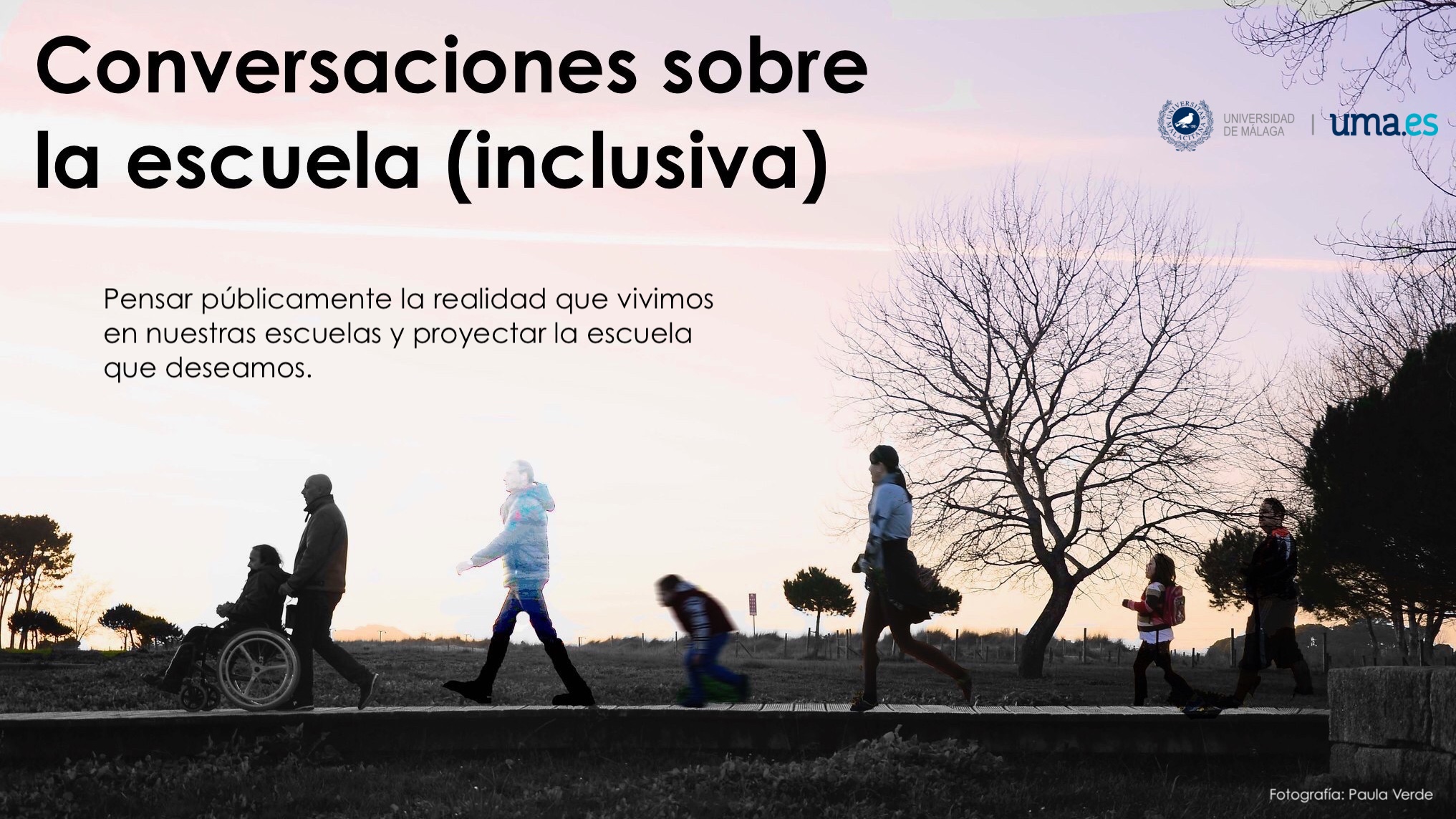
Poster for 'Conversations about (Inclusive) School' to reflect and dialogue about the reality and desirable futures of education. In the background, a group of people walk along a wooden walkway in an open, rural space. It is sunset and the sunlight is dim. Above the image, the logo of the University of Malaga. Photography by Paula Verde.

Conversations between students, families, professionals, management teams, researchers, and policymakers about the schools we have and how to make them for everyone

During the Tuesdays of May and June 2020, a series of Conversations about the (inclusive) school were held, shared on social media through the Education, Diversity and Inequality page on Facebook or in the Conversations about the (inclusive) school playlist on YouTube profile of Ignacio Calderón Almendros.

. These conversations aimed to be a space to publicly reflect on the reality we experience in our schools and to envision the school we desire. The sessions were recorded and disseminated on social media, and also used for pedagogical research purposes. More than 200 people registered for the conversations; therefore, the meetings were operationally divided by groups. First, families; then, students, education professionals, researchers, management teams, and representatives of the main political parties in Parliament. Although meetings were organized by groups, the idea was for all registered participants to attend the other debates, and citizens were invited to follow and comment on them on social media. The act of listening was essential for the entire process.

As a result of all this, the recorded sessions remain for reflection and analysis, and are already being used for teacher training processes, with tens of thousands of views. Furthermore, from these meetings, a document was born that aims to be useful for the parliamentary debate on the 2020 Education Law Project in Spain. The text, available for free download, is Análisis y propuestas para una nueva Ley Educativa. Conversaciones de la ciudadanía sobre la escuela inclusiva (Octaedro, 2020).
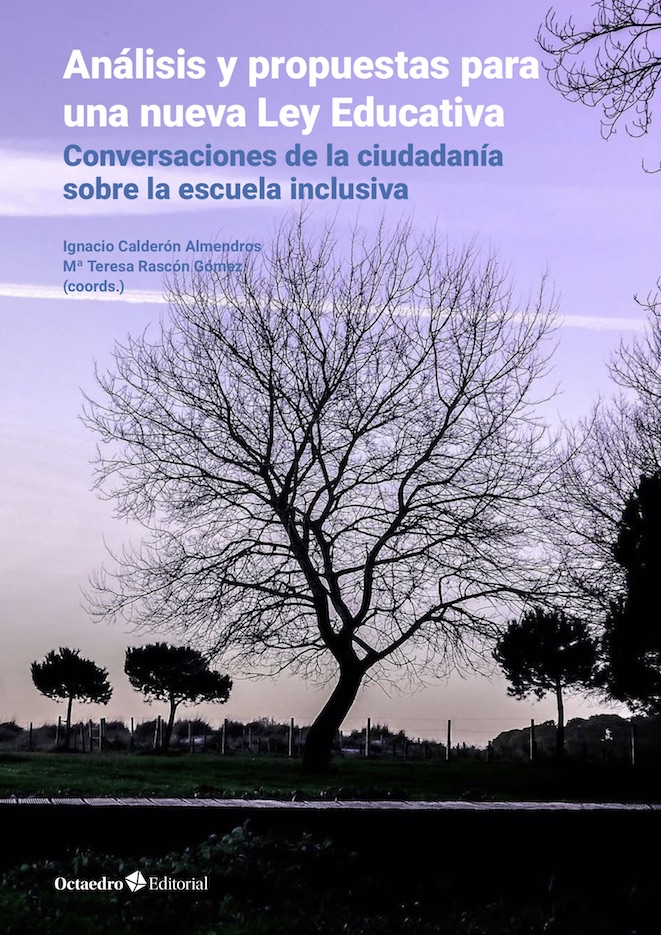
  • Access the Guide , available in PDF and online .
  • Videos of the conversations

    Families' experiences in schools. Between wanting and being able to

    N.C.:—Well, thank you all for sharing your experiences and reflections. I would like to start by focusing on how we can improve the school experience for our families and our children. It is important to remember that we are here to seek solutions and learn from each other. Everyone's participation is crucial to better understand our realities and how we can support each other in this process. "Between wanting and being able." I don't know if this title sparks anything for you, if it can serve as a starting point for today's session. The floor is yours. Well, who wants to go first? Who wants to start? Carmen.Carmen:—Let's see, I've been reflecting this morning on the function of school and I've come to the conclusion that it has two: to educate and to socialize, for children to live together. But there are many girls and boys who don't achieve either of these two objectives. They don't get educated, they don't socialize, they don't live together because they don't have friends. So, my question is: why do they go to school? I ask myself this question every single day, especially in the last three years.Rebeca:—I'm Rebeca, from São Paulo, Brazil, a teacher of 4 and 5-year-old children and mother of a 2-year-old girl who started school in February. She had one month of classes before the coronavirus and was very well received. She is a child with a disability. I have ten years of experience as a teacher and this is my first experience as a mother. When I arrived, they wanted to know my story and everything about her. They talked a lot about respecting differences, which revolved around respect. I remember asking the teacher about this step that concerned me, perhaps a little more, and it makes me think about how we go beyond respect. But we are together, each in our own world. I want her to be loved, of course, she has friends, and I also want her to learn and live together with all the possibilities of that coexistence to achieve respect.N.C.:—Thank you very much, Rebeca. Mari Carmen. Mari Carmen:— Buenas tardes. Después de escuchar a Carmen, tengo que decir que coincido mucho con ella, quizás porque también estoy viviendo la escolarización de un niño “especial” en secundaria. Creo que el mayor problema que tenemos las familias, y soy profesora, es la administración. La administración tapa y protege lo que, por ejemplo, Carmen ha mencionado. A esa falta de ratio, a ese currículum y a esa selección de personal. Desde mi experiencia, puedo decir que las ratios son enormes y que es imposible atender, por ejemplo, en Secundaria, a 25 alumnos y tener diferentes grupos dentro de esos alumnos. El profesorado se ampara en que tienen que cumplir objetivos y, si el niño no cumple, se le suspende y punto. No se paran a pensar en cómo se puede ayudar. Y la única ayuda que tenemos serían los equipos de orientación con los recursos disponibles, que en lugar de echarte un capote, lo único que te dicen día a día son las dificultades que tiene, en lugar de ayudar. Entonces, lo que he escuchado a Carmen, me he sentido totalmente identificada, porque cuando decides que tu hijo permanezca en ordinaria es eso. Chocas e intentan demostrar que no tienes razón. Que tu hijo no tiene por qué estar ahí, que no te estás dando cuenta. Y cuando subes e intentas demostrarlo, porque realmente llevas tus justificaciones, vas a las reuniones, tomas nota y te das cuenta de que, a lo mejor, cuando se dice que un grupo va mal, no solamente es tu hijo, es el grupo en general. Entonces, coincido con Carmen en que está fallando, sobre todo, el sistema. Pero también se debe tener en cuenta que la administración, en cierta manera, ampara a su profesorado y lo defiende. Entiendo que quizás no van a decir: “Oye, no tenemos ese personal. No está preparado”, pero día a día te das cuenta de que en primaria a un niño lo puedes mantener. Un niño que presenta una forma diferente de aprendizaje se puede mantener, incluso le puedes intentar que la socialización, que es otra de las cosas que Carmen ha mencionado, se lleve a cabo. Sin embargo, cuando llegas a Secundaria, dejas a tu hijo ahí prácticamente solo. Y es la lucha, y es el sentimiento que, como madre, sientes todos los días que realmente merece la pena. Yo creo que sí, que merece la pena, que nosotros como familia sigamos luchando para los que vienen detrás. N:C:— Muchas gracias, Mari Carmen. Rocío Rocío:— Well, I'm Rocío and I have a son who is in early childhood education this year, he's 3 years old. He has a rare disease and has started school. We, even before the child started school, have already encountered barriers, because due to his diagnosis, even before the counselor saw him and they issued his schooling report, the teacher who was supposed to have him told me that she wasn't prepared, that she didn't feel capable of having my son in her class and that the best thing I could do was to take him to another school where there's a specific classroom and put him in that specific classroom. So, as a mother, I'm surprised that they didn't even get to know my son and they already had a path set out for him. I think it's outrageous that, without knowing if the child has abilities or not, they directly refer him elsewhere and that's it. Of course, I didn't accept it, I fought for it, and the child is in his brother's school where he belongs and in the mainstream classroom. A mainstream classroom that, according to the report, should have been provided with support, which we fought for him to have, and he has it. But, even so, they continue to have his path marked in the sense that, yes, he's in a mainstream class, but they don't give him all the content, they don't adapt the content, and he's three years old. So, I think the system is designed in such a way that, because you have a report, because you have a disability, you already have a predetermined path and you're not going to deviate from it. And, as a mother, the fact that they don't want to understand or bet on your child is something I find outrageous. The system is definitely not right, and schooling isn't right, and this needs to change because the fact that teachers can hide behind the excuse of not having resources, not having training... well, in my job I've had to update myself, and during the quarantine they've had to organize their work and do it differently to cope with what we're experiencing, and yet, with our children, they don't even consider it. They directly have this marked out, which I understand might be what they're told to do, but even so, it's not fair to the individual. To what Carmen was saying about why it has to be in a mainstream classroom, I don't even consider it any other way, because what I think is that if children don't interact with other children, both mine to learn and for the others to learn about diversity, then if we are always segregating and leaving people aside, society will never be inclusive and never... the problem of segregation will only get worse. So, where does exclusion stop? From school, from a young age. What I don't think is right is that from the age of 3 they are putting up the obstacles they are putting up. That a 3-year-old (neurotypical) child doesn't know how to do things, and it's okay, but with mine they are always justifying themselves, 'it's because he doesn't know how to do things,' 'because he won't learn it,' 'because he won't do it'... and how do you know he won't do it, how do you know he won't learn it. That seems totally unfair to me. That's why I say, the system isn't right, and indeed, we have to fight for it, and it's true that the support, those who should be there to help us, are not doing so, and we are alone in this fight. And the most important thing of all is that if we don't do something to change it, those who come after will have the same problem. And it can't be that we're not moving forward, that we're not changing, that we're not doing something that really works for everyone, not just for some. Because then the children who are doing well, of course, they progress and everything is fine and there's no problem, but those who have some difficulty, they get left behind, and that cannot be, it's not fair. N.C.:— Estas reflexiones y experiencias compartidas durante la reunión resaltan las dificultades sistémicas y administrativas que enfrentan tanto padres como maestros en el ámbito de la educación inclusiva, revelando una necesidad crítica de reforma y apoyo. Estela:— Buenas tardes. Soy Estela. Para quien no me conozca, soy madre de un chaval que ya tiene 21 años cumplidos este año. Luego, tengo la situación de que mi hijo ya acaba con el sistema educativo, y, bueno, pues tengo, por un lado, que decir que, tristemente, me alegro de haber acabado con la etapa educativa porque me han hecho sudar sangre y llorar sangre. Y hace tiempo que dejé el sistema educativo como algo perdido. Hace tiempo que nos dejamos llevar cuesta abajo por el sistema porque sabíamos que no había forma de que le aportara nada la educación a Víctor. Que Víctor iba a aprender fuera del sistema educativo. Que, como todo el mundo, pues, se aprende con la actividad, con la experiencia, pero en él, pues, todavía más. Y como él todavía no ha conseguido ni aprender ni a leer ni a escribir, pues el sistema corriente de fichas para él no supone nada. Además, es que han seguido, como en Primaria, con los colores, las caritas tristes y alegres. Toda la vida, toda la vida. Cosas que ha visto que ya le aburren. Ya no sabe cómo decir que sabe distinguir entre el rojo y el verde. [Risas] Que por qué tienen que estar constantemente con esa prueba si sabe lo que es el color. Y, que, además, todos reconocen que Víctor sabe más de lo que aparente, solo que no lo puede expresar en una ficha ni hablarlo. Y, bueno, pues ahora empezaremos a navegar por otro desierto que es el del empleo, que para él no existe, y del que tendremos que buscar otras formas. El sistema educativo para él, para formarlo, para el empleo, no existe. Para los demás sí, para los nuestros no. No nos podemos quedar solo en la escuela. Porque una vida independiente, una vida adulta e independiente, sin meternos por la vía de la segregación que lleva a la residencia, algo que estamos viendo con el coronavirus, a los centros ocupacionales, centros de día y a esa segunda vía muerta. Si queremos que vivan y que sean adultos con una vida independiente, con un proyecto de vida, tendremos que mirar no solo el tema curricular, académico, y que lo superen. Porque el sistema educativo es como una cordillera de montaña. Unos pueden ir de montaña a montaña, pero otros terminan cruzándola y punto. Y lo que te encuentras detrás de esa cordillera de montaña es un desierto que te toca pelear por la accesibilidad, por muchas otras cosas y muchos apoyos que le den una vida independiente. N.C.:— Muchas gracias, Estela. Eduardo. Eduardo:— Hola, ¿qué tal? Somos Janet, mi esposa, y Eduardo, de México. Yo quiero partir diciendo que, en México, por lo que escucho puede ser así también en España y en otros países, la educación está fundada en ser competitivo académicamente. Que seas bueno en matemáticas, que seas bueno en física, que seas bueno en inglés, que seas bilingüe es superimportante. En los colegios compiten por eso. Tratan de ser los mejores colegios para eso. Los padres buscamos un colegio que tenga eso para nuestros hijos. Entonces, pensando que los colegios no piensan en educar en más habilidades para la vida más social. A ser mejores, socialmente, cívicamente, etc. No es tan relevante una educación inclusiva, no, nada más al colegio. Aunque quisieran, los papás no buscan específicamente eso. Pues partiendo de eso, es muy difícil que un colegio les dé los recursos y se enfoque en las necesidades de todos los niños.   Por ahí, mencionaron que cuando no eres tan bueno en matemáticas, es probable que salgas. No estás hablando de un niño con discapacidad. Estás hablando de un niño al que le cuesta más las matemáticas o que le cuesta más la historia y que, probablemente, salga del colegio porque no es lo suficientemente bueno para el colegio. Ahora, imagínense qué puede pasar en una escuela donde hay un problema de inclusión o de integración, en donde hay niños con discapacidad. Pues los papás de otros niños podrían quejarse, y de hecho a nosotros nos pasó. Podrían quejarse porque la maestra le ponga más atención a un niño que necesita más apoyo que cualquiera que sea su situación, y no al grupo general para hacerlo competitivo. Para que sea totalmente bilingüe. Entonces, para mí, la base es la que está del principio mal. Creo que tendríamos que hacer la tarea más en el sentido de cómo cambiamos la percepción y cómo cambiamos la realidad, también de lo que es una inclusión en la sociedad, en las familias, en la vida de todos los días de todos los niños, incluido los colegios. Para mí tendría que ser desde ahí. Eso daría más puerta a que no hubiera tanta resistencia a ese cambio. Nosotros ya con esa base hemos tenido a nuestra hija, Constanza, que tiene 13 años y ahora pasa a Secundaria, en dos colegios diferentes. Uno con tal intención y cariño de tenerla, pero con pocos recursos y disponibilidad para realmente responder a sus necesidades. Entre querer y poder, justamente. Entre querer hacer las cosas con mucha voluntad y decir: “sí, queremos tener con nosotros a Constanza, tráigala, la estamos esperando hace 20 años en el colegio, etc.” y, por otro lado, decirnos: “no puede trabajar sin sombra. Ella va a tener que tener sombra en este colegio siempre que ella esté, porque nosotros no tenemos el recurso. No estamos preparados y no podemos, no podemos dedicarle el tiempo”. En alguna ocasión, la terapeuta que nosotros hemos proporcionado le decía «Bueno, podría ser que la mis le dedicara 5 min o 10 min (la titular) a Constanza para poderle explicar y poder dedicar un tiempo de más para que ella se sintiera mucho más integrada, mucho más incluida en el grupo». Ya. No lo podemos, porque las mamás se van a quejar porque estamos descuidando a sus hijas. Entonces, al final, la cambiamos y encontramos un colegio que, desde mi punto de vista, para mí es la mejor opción de un colegio de integración. No encontramos un colegio realmente inclusivo, pero es la mejor propuesta, en México, de un colegio de integración, donde hay grupos técnicos, que es el grupo para niños que tienen alguna necesidad adicional, y también hay grupo regular. Dependiendo de las capacidades de cada niño, él está en su grupo regular un alto porcentaje del día, o no. Dependiendo de cómo vaya integrándose, cómo sea su comportamiento, su aprendizaje…, un montón de cosas. Digamos que el complemento es muy bueno. Las mises del grupo técnico o las maestras del grupo técnico son buenísimas. Están muy capacitadas. Hacen una adaptación en la currícula impresionante. Realmente aprenden. Avanzan al nivel de cada uno. Es muy personalizado. Son excelentes. Las mises del grupo regular están familiarizadas, que es totalmente distinto. Eso no quiero decir que estén necesariamente lo más capacitadas, pero están muy familiarizadas con los niños, con el sistema, y cuando detectan una necesidad, lo hablan con la mis del grupo técnico. Luego, nosotros estamos bien, pero sí creo que la base para mí es mucho más abajo. Es más de educación y de formación. I.C.:—Thank you very much, thank you both.Patricia:— Me presento. Soy Patricia, de Buenos Aires, Argentina, y tengo 3 hijos. La mayor tiene 37 años y tiene síndrome de Down. Yo puedo hablar de mi experiencia, no voy a hablar de la experiencia de mi hija, porque entre querer y poder, hace 30 años, no tiene sentido ya.   Claro que tiene sentido, sigue teniendo sentido. Sigue teniendo… De hecho, yo creo que, en buena medida, las familias jóvenes necesitan de conocer nuestro recorrido y de saber cuáles han sido las luchas. Claro. Yo soy miembro fundador de la Asociación Síndrome de Down de la República Argentina (ASDRA), y cuando le comencé con la integración en ese momento no se hablaba de la inclusión de Sabrina. Entre el querer y el poder, yo era una militante de la causa sin saberlo y, entonces, me doy cuenta de que entre ese querer del momento y lo que podía, se puede menos ahora. Estoy hablando de capital y provincia de Buenos Aires, porque Argentina es muy grande y la experiencia de cada uno es de cada uno. En ese momento, Sabrina iba a un jardín y nadie me pidió nunca nada. O sea, lo de la maestra sombra, o como acá le dicen, maestra integradora, nunca me lo pidieron en una sala. Sabrina empezó en una sala después de operarla de corazón con 3 años. Nunca me lo pidieron. Solo le puse en preescolar lo que en ese momento llamaban los americanos, hasta que después leí a López Melero, lo que se llamaba un Peer Tutoring pedagógico. Pues fue la primera en hacer preescolar con un par pedagógico, pero porque se la puse yo, porque lo leí y se lo puse. Conclusión, que termino ayudando a otros niños en Preescolar que lo necesitaban como Sabrina. Sin embargo, cuando empezó Primaria fue un poco lo que cuenta el señor de México [Eduardo]: era una escuela que tenía un proyecto con un grupo donde iban a aprender especialmente bien y dónde a veces se lo ponía en primer grado. O sea, era la Educación Especial dentro de una escuela convencional, y encima funcionaba mal. Entonces, Sabrina, como tenía una patología asociada visual, que en ese momento no sabíamos cómo manejarla, porque nos enteramos de lo que tenía a los 15 años, creo que a nosotros nos sacan. Tiene mucha razón, Carmen Saavedra, la mamá que he escuchado. Lamento lo de Estela, yo también lo viví. A mi hija la sacaron del colegio, pero en realidad me sacaron a mí. Nos expulsan a nosotras las madres, que somos las locas, porque el sistema no tolera que nosotras marquemos, que no estemos mandando un diagnóstico al colegio. Estamos mandando a nuestros hijos. No queremos que los diagnostiquen ni que los evalúen, queremos que los enseñen y que no nos digan que no están preparados, porque para eso son docentes, y el docente tiene que estar preparado para todo, y si no le gusta que estudie otra cosa. El problema que tenemos en Argentina, en general, es que la carrera docente no es universitaria. Tú acá terminas el bachiller, te anotas en magisterio, haces 2 años, el 3.º haces pasantías, y ahí aparece el recibido de maestro. O sea, maestros hombres casi no hay, la mayoría son maestras. Nunca se va a lograr porque no hay una política pública que sea parte de la Universidad de Buenos Aires, de la UBA. Una carrera, así como la tecnicatura en paisajismo, es una carrera universitaria de 3 años, en magisterio no. Yo no digo que con eso funcionaría mejor, digo que funcionaría mucho mejor porque se tendría que cambiar el currículum y los maestros saldrían docentes para todos los alumnos, sabiendo qué es un diseño universal de aprendizaje, y no estarían usando la siempre y tan aumentada muletilla de “yo no estoy preparada para esto”. Nosotras, las madres, tampoco estamos preparadas para esto. Yo me convertí en una técnica de esto y tendría que haberme dedicado a ser madre, nada más. Entonces, no, no me parece que las maestras digan que no están preparadas para esto. La escuela es el microcosmos de lo que se ve en la sociedad. O sea, se replica en la escuela. Por eso existe el bullying y todo lo que apareció. Se replica en la escuela lo mismo que va a pasar afuera. Si no logramos que la escuela sea una mini sociedad donde se sepa que la diversidad nos enriquece a todos y aprendamos todos juntos, dejemos de usar como coto de poder la Escuela Especial, que es negocio para muchos. Porque acá, el que va incluido en una escuela, Nacho, no sé los demás qué opinarán, no va a escuelas públicas, va a escuelas privadas. Se pagan ellos el gabinete o la prepago, la obra social, la psicopedagoga, la maestra integradora… No hay escuela pública que le diga que sí. Yo lo que veo es que en España, por lo que comentan, se quejan por el mal funcionamiento del hijo en la escuela. Acá no te toman, te dicen que no en 20 millones de escuelas antes de que encuentres una que te diga que sí. Encima, los padres que no están preparados, no le plantean lo que quieren de la inclusión de su hijo. Entonces, la escuela intenta hacer entrar a redonditos en cuadraditos y, cuando el redondito no entra en el cuadradito, en nombre de la inclusión y del diagnóstico de esa persona, le muestran la puerta de salida. Generalmente, están en sala de 3, ya le pide una maestra integradora o maestra sombra. Cuatro, preescolar, en primer grado y en segundo. Cuando la currícula hace, se va, se aleja del aprendizaje de la persona con inclusión, la sacan o la invitan a que se vaya y le dicen que se tiene que ir a una Escuela Especial. Por otro lado, convencen a los padres, en contra de la Convención y el Artículo 24, de que la mejor opción para sus hijos es la Escuela Especial. Y quienes los convencen son los que trabajan y dueños de la Educación Especial privada, porque viven de eso. Es un negocio redondito. Porque la educación pública tendría que pasar a la educación pública especial. Tendría que trabajar dentro de la pública común y trabajar juntas. Nadie dice que desaparezcan, y no habría problema. Eso pasaría en políticas públicas, pero cuando se trata de un negocio de muchos, de Educación Privada, entonces no, no quieren. Bueno, ese es el problema que veo aquí. Y después están también en nosotros los padres… I.C.:—María Patricia [risas], already…Patricia:—Yes, well.N.C.:—Yes, yes, because, among other things, I think they're going to laud you. You're not seeing the chat, but it's… burning up. 'María Patricia for president,' wow. [Risas] For president of the UN, at least.Patricia:—I didn't read anything [risas]. I didn't read anything, but I thought they were going to lynch me. I wasn't reading anything, but people, don't complain, because here they tell us no all the time. And if you ask me, we're worse off now than before. [Risas] In other words, society has regressed. It's true what Carmen said, with the quarantine I think many children are learning and experiencing things at home that they didn't learn at school. I was happy at school, but not because of the school. I.C.:— Muchas gracias, María Patricia. Tiene la palabra la familia Esteima. Merce:— Hola, soy Merce. Dar la felicitación a todas las que ya habéis hablado, pero, Patricia, la verdad es que nos ha hecho el subidón de la tarde. Felicitaciones, mucho, ya está, sí. Bueno, yo solo quería hacer un pequeño comentario con respecto a lo que decía Eduardo antes y, con todos mis respetos. Si es cierto y estoy de acuerdo en que hay que pensar un poco desde la base, aunque con términos sencillitos. Perdóname, Nacho, porque voy a coger un poco tus palabras y rescatar los discursos de las familias, de las mamás. A lo mejor no tanta formación, a lo mejor no es tan importante la ratio, a lo mejor es más importante, pues, no sé, la confianza, el cariño, el amor, el querer a tus alumnos, a todos y cada uno de ellos y de ellas. El querer enseñarles, el querer que aprendan. Entonces, simplemente decir que veo que la integración no forma mucho parte de la solución, desde mi punto de vista, porque no deja de ser también tipificar o categorizar o segregar, aunque sea en el mismo espacio, a las personas. Con etiquetas. Entonces, yo creo que el cambio poco a poco va a estar, y Carmen lo decía muy bien, porque los chavales avanzan estando en casa, a pesar de que los papás y las mamás no son especialistas, ¿verdad? Pero avanzan porque los quieren, porque creen en ellos, porque confían en ellos, porque tienen ilusión… Bueno, pienso que las cosillas tienen que ir por ahí, ¿sí? I.C.:— Gracias. Abrazos a Isa. Tiene la palabra María Emilia. María Emilia:— Hola a todos. La verdad es un gusto escucharlos a todos. Me genera un montón de emociones encontradas escuchar a estas mamás con experiencias tan dispares. Nosotros somos de Argentina, de la provincia de Buenos Aires, de un pueblito muy pequeño de 12,000 habitantes, General Madrid. Tenemos tres hijos. Nuestra hija Clara, de 9 años, tiene síndrome de Down. Luego, tenemos a Martín de 6, y a Manuel de 2. Nuestra experiencia como familia, como papás de Clara y siendo nuestra primera hija, con todo lo que implica, ha sido absolutamente favorable con la escuela y, en general, también nuestra situación, y por eso remarco que somos de una comunidad pequeña. Clara siempre ha sido Clara, con todo lo que eso implica, más allá del diagnóstico. Siempre se han esperado a conocerla para hacerle una propuesta. Es lo que hablan muchas de las mamás: lo más importante en una trayectoria educativa en la vida tiene que ver con el respeto, con el amor, con entender la diversidad de todas sus facetas, y en valorarlas para que nuestros hijos estén en los lugares que tienen que estar, que son los mismos lugares que el resto, con los apoyos que necesitan, como cualquier otro chico. Claramente, la educación funciona a través del currículum y a través de objetivos y estándares, pero la realidad es que cada uno de los niños que ocupan un aula son distintos, y si queremos pensar en que su trayectoria sea lo más enriquecida posible, tenemos que olvidarnos de un diagnóstico. Nuestra experiencia es que Clara, desde sus 2 años, ha transitado por escuela común, jardín de infantes, escuela Primaria, siempre con proyectos de inclusión de la escuela de Educación Especial de nuestra comunidad. De hecho, hemos sufrido mudanzas también, pero siempre hemos apostado por la escuela común. Como familia, confiamos en la escuela pública y en la escuela de nivel. Creemos que ahí es donde tiene que estar Clara, porque, como otras mamás decían, la diversidad solamente se aprende si todos estamos en la escuela, ¿sí? Y la verdad es que nuestra experiencia es muy favorable porque siempre han conocido a Clara, la han respetado, han planteado los proyectos y los acompañamientos conociéndonos como familia. Creo que algo para destacar es que el rol de las familias es absolutamente fundamental en la trayectoria de nuestros hijos, el compromiso es que seamos escuchados, que seamos parte de la planificación, tanto como nuestros terapeutas externos. Creo que la familia, y coincido que ahora estamos todos en casa, nuestros niños están avanzando y aprendiendo mucho, porque la familia somos los que más los conocemos y quienes desde el amor confiamos y creemos en que no tienen techo, que nadie tiene un techo. Entonces, creo que ese acompañamiento en la escuela tiene que ser fundamental. El de las familias. Y la escuela tiene que poder escuchar a las familias y a los niños como principales protagonistas. I.C.:— Muchas gracias, María Emilia. Tiene la palabra ahora Inma. Inma:— Hello, how are you? I'm going to introduce myself a little, because the truth is it's the first time I've found myself in this situation and I don't know anyone. From what I see, there's a lot of talk about disabilities, let's call it that, but always with learning problems or difficulty reaching objectives. I have a son. He was born with a congenital malformation. And I identified a lot with Rocío when she said that, from the beginning, there are already barriers. The same thing happened to me. As soon as I went to enroll him in school, the school secretary rejected me with the medical report. She didn't want to know anything about medical reports. Well, one presents their child, because, moreover, my son has a congenital malformation that is a bit particular from a social point of view. My son has three rectal openings, has an anal reconstruction, has spina bifida occulta. He walks. Apparently, he's a normal, everyday child, but no, he's not. He has functional problems with his sphincter control, with what that entails at school. He has no cognitive problems. It's true that he's a child who, intellectually, has abilities, but, of course, having intellectual abilities doesn't mean you can easily reach objectives when you have other added difficulties. What happens? That my son was given a schooling assessment that was... well, I won't go into details. But well, for me. I have prepared all this [risas] so as not to waste time and to be clear, and so that I can be heard well, because I think it's important to give visibility and empower ourselves. I think it's super important that we use this word a lot, okay? Because school doesn't empower. I think we have to start a little bit there, apart from inclusion, because inclusion entails the empowerment of these children. And of their families, of course. Therefore, my child's schooling begins with rejection, exclusion, and total disorientation, because when you tell them that my son has renal issues, nobody knows what you're talking about. And because nobody knows, instead of informing themselves, all the guidance professionals, management teams, heads of studies... nobody informs themselves and nobody listens to you. The first thing they do is tell you, 'Oh, what's that? We have no idea. Get out of here, because it's going to create a problem for us, an extra workload and everything.' I think the first year, my son, like all children, has to go through sphincter control, but my son has a delay in sphincter control, because, even though he didn't have colostomy bags or use diapers, he started using his sphincter at 10 months old. Therefore, he was 10 months behind compared to the other children, if we look at it from a numerical or time perspective. What happens is that the effort we've made at home, even the healthcare professionals, the doctors, for the child to reach that point, as I said, doesn't fit with 'little circles in squares.' We had made a huge effort; the child, first and foremost. We had achieved many milestones, but when he gets to 3-year-old preschool, my son requires materials, like clothes and attention. What happens? That they interpret, the school interprets, that the mother just doesn't want to attend to the child when he poops or pees. Because that's how it is, because a child, when they start school at 3 years old, can't poop or pee on themselves. They have to be super autonomous and independent in the bathroom. Communal bathrooms that are not supervised, that are outside the classrooms and to which no one accompanies them. What happens? That, within the schooling assessment, the support person treats my son like a diaper change. My son shouldn't have been treated like a diaper change. They should have provided reinforcement for toilet use and toilet learning, but not changed his diaper. They took him to a separate room, where there was no toilet, took him all the way up there, and changed a diaper that he didn't have. Then, that created misinformation in a learning process for which it is extremely important to do it correctly. I was seeing it in my son. My son would leave school angry, he didn't want to see the support aide. Even though I spoke with her, she wasn't going to change her approach because, moreover, there was a girl with a developmental delay and they lumped my son in with her. I was seeing it, and as everyone knows, mothers perceive it and suffer closely. I saw that things weren't going well for my son, and automatically, I resigned from the support monitor. They tell me to resign from the support monitor, an assessment that is useless. Well, that's what they say. The tutor that year—obviously, my son every day left and arrived with his backpack, clothes, and necessary items for changing—had to take him and bring him daily, because in her class there was no space for 'that.' She placed him at a table right next to the door. She held him with two fingers. She told me things about the child. That is total exclusion. The following year, and for the remaining two years of preschool, another tutor came, who reframed everything, normalized everything, accepted that the child had a different way of using the toilet and controlling his sphincter, and that if you respect how he does it, it normalizes, which is the objective. They do it differently, but if you accept it, don't change it, don't modify it, the behavior normalizes. We were very good for two years, where everything was understood very well. She called the family, listened to the family, asked about what she didn't understand, and respected, which is the most important thing, all the guidelines. Everything went very well, I relaxed, the child relaxed, the experience was very positive. Since the child was achieving curricular objectives very well, even at a quite high level, the assessment was removed, zero. At the change of stage, the assessment was gone. What happens? That I considered changing schools because things weren't going well, but at the same time, it coincided with my daughter also starting school. It wouldn't be worth it to have each child in a different center, a mess. The family is very important, to have a bit of order and an ordered quality of life, because he is a disordered child in himself, the reality. So, what happens? That we preferred to stay at the same center, thinking that, since he had adapted and everything was going well, the stage change would be better, staying at the same center. But, of course, our surprise was that it was not at all. The primary school stage was an absolute failure. It's the school that made my son sick. He had his own health crisis because of how badly things were handled there, and in his own health crisis, as it is now global, I'm going to talk about my son's as his own. I was only asking for the same thing that was being done up to that point. I wanted a school like the one they are now supposed to want to implement. If they had listened to me, they would have been ahead of the curve, but since mothers are crazy, of course, I wasn't listened to. Now I'm glad this is happening because I asked for this for myself. My son always said from the EOE that, from the moment the child had moments where he didn't control his feces, I shouldn't even think about sending him to school, forbidden to go to school. For my son, 1st and 2nd grade of Primary school, it was quite hard, because his tutor, by not listening to us, by not reading the child's academic record, by not talking to his preschool classmate, decided that she held the key to my son making adequate use of the bathroom. [Le obligaba a] hold it in. A child who doesn't have the capacity to hold it or control his sphincter. With which, it caused my son to have to soil himself and remain dirty at school. No one can learn like that, no one reaches objectives like that. N.C.:— Inma, no tienes que seguir porque… yo creo que tienes… Inma:— No, quiero seguir, voy a cortar esto, voy a dar el salto. N.C.:— En cualquier caso, Inma, quienes te estamos escuchando, no sabemos de tu sufrimiento, pero sí sabemos del sufrimiento de la tremenda incomprensión que hay en las escuelas. Entonces, no hace falta que sigas profundizando ahí porque… Inma:— En mi caso, mi hijo pasó más tiempo en casa que en la escuela. Se presentaron dificultades de salud, evidentemente por todas las actuaciones llevadas a cabo por la escuela. Por lo tanto, el niño estaba más tiempo en casa, abandonaba la jornada escolar antes de tiempo o, bien, simplemente, no asistía. Llegó un momento en el que mi hijo me pidió no ir, y yo no lo forcé, sinceramente. Llegó un momento en el que vi la prioridad y en casa el niño es donde ha aprendido. He tenido que ser su maestra, y he tenido que adaptarlo todo. Desde el colegio, como estoy diciendo, nada. Voy a ir siguiendo mi esquema… N.C.:— Yo creo, Inma, que como tú estás diciendo, en gran medida también has anticipado lo que está ocurriendo ahora. Es lo que a mí me ha ocurrido. Ahora se está pidiendo a la escuela lo que yo le pedía. Inma:— Es que yo pedí una escuela en casa. Yo pedí que la escuela tenía que salir del espacio físico y tenía que llegar a mi casa. Y que estamos en la era de la tecnología. Que era una pena que haya un programa que no sé si es bueno o malo, lo desconozco. Pero existe y se ha invertido en él. Solicité al centro que lo usara. Que diera de alta a mi hijo, particularmente, y que, por favor, lo pusiera en marcha. Porque yo vivía ajena a una escuela. Pienso que la escuela… tengo 44 años y no ha cambiado, sigue siendo la misma. Entonces, le decía a mi hijo «esto va por aquí» y mi hijo me decía «no, mamá, cuando yo llegue mañana no va a ser», «porque tú lo digas, si no lo ven, no lo saben, por aquí». Y mi hijo salía del cole todos los días y me decía, «mamá, tenías razón, ha sido todo como tú has dicho». Esto no ha cambiado. Voy a la idea principal a la que queremos llegar. N.C.:— Cierra ya Inma, hay mucha gente todavía esperando para participar. Inma:— Vale. Yo quiero decir, con respecto al currículo, que no es ni bueno ni malo, simplemente es la programación que hay para los maestros, porque son programaciones teóricas y no reales. Quiero hacer también un llamamiento al principio de autonomía de los centros. El principio de autonomía de un centro no es que el director del centro tenga autoridad sobre todo, ni tampoco es que haga lo que él quiera. Quiero hablar del proyecto del centro. El proyecto de centro debe reflejar explícitamente la diversidad de sus alumnos. Es decir, si tiene alumnos con x perfil, tiene que aparecer, específicamente, no hablar de diversidad de manera teórica, porque ese derecho o principio de autonomía de los centros es para que tú le des identidad a tu centro. Por lo tanto, tienes que hacer constar en tu proyecto de centro que tienes un niño con esto y cómo lo trabajas, cómo lo quieres trabajar o cómo actúas. La familia es muy importante. La familia no se puede reducir a consejo escolar ni AMPA. Por supuesto que no. Otra cosa que no entiendo es cómo la administración… N.C.:—Inma, closing now.Inma:—Excuse me, the Administration has to recognize whether disability is the same as need, a student with specific support needs or not, because there is a big debate. My son passed the disability filter because they said he was not a student with needs. But when he has the disability, they tell me that doesn't work for me either. So the Administration has to create a legal framework where it truly clarifies what these children are, or what these children are like, or how they are going to be assessed, because that is what it has to accept and recognize. It does not recognize them.N.C.:—Thank you very much, Inma, for your testimony.Inma:—Thank you very much to you, to you always. N.C.:— Gado. Gado:— Buenas tardes a todos y… N.C.:— Os pido brevedad porque tenemos poco tiempo. Vamos a intentar que todos podamos hablar y, después, si somos capaces de generar un poco de debate. Gado:— Yo creo que, recogiendo un poco de notas de todos los participantes, me identifico con todos. Mi hijo tiene 14 años y no puedo hacer una valoración de secundaria porque este año ha empezado 1° de la ESO. A ver, elegimos el camino de la integración. No sé si llamarlo integración o inclusión. Pensamos que no se podía comprender la diversidad, si no se convivía con ella desde la infancia. A partir de ahí, también me identifico con esa militancia que ha surgido de la voz de Carmen Saavedra: el sistema ha fallado. El sistema educativo necesita, desde mi punto de vista, una reforma de raíz para atender las necesidades de nuestros niños. Tanto de nuestros niños con y sin diversidad. A partir de ahí, yo no creo que esto sea un camino de hoy para mañana. No quiero alargarme más, pero sí que deciros que el sistema está muy encorsetado. Gente con preparación, gente no preparada, gente con miedo. Y la gente no preparada sí está motivada, bien, pero es lo que hay y no podemos hacer nada, nos lo hemos encontrado muchas veces. Al final, nosotros decidimos que lo importante era la parte emocional más que la curricular y que sería nuestro hijo quien eligiese su espacio. Con esto, sí. N.C.:—I can't ask you a question now because there are other people who want to speak. But, I'm left with a question… How do you connect with one thing and distance yourself from another? How do you connect with the emotional and not the curricular?Gado:—I think it's all connected, Nacho, because motivation for my son has been the most important thing for him to keep learning. And this motivation, many times, we parents had to provide to the professionals. I think it's all connected.N.C.:—Very good, thank you very much.María:—Hello, I am María, Vicens is my husband. I have a 13-year-old son with an ultra-rare disease. It's an A1 gene. This disease was identified in 2013, it's very new. We went many years without a diagnosis, but anyway… My experience with school for my son, who is 13 years old, has been a bit, well…, I really identify with Patricia, even though we are in Spain. I live in Donosti, Gipuzkoa. Here, 'special' schools are private, subsidized, and when you want a mainstream school, it can be public, although also subsidized. So, my journey with my child was that he was in a special school. In this special school, one of the professionals, who saw that the child was progressing, recommended that, seeing how I was, a woman who was proactive, I should transfer him to a mainstream school. She even told me: “You will have a lot of difficulty, because the orientation team will deny it to you, but you have a lot of character and, surely, because of that character and the fight you have, you will surely achieve it”. That's how it was, they denied it. They didn't even want to do a face-to-face assessment, but I threatened the orientation team that I would file a complaint if they didn't admit him, which, well, made them give in. The director agreed to do a face-to-face assessment for my son. That's when he told me yes, this child can be in a mainstream school. So, we decided to do a shared arrangement. This shared arrangement lasted for three years due to the child's social skills and abilities; a lot of work was done. Yes, I have to say that I was the driving force. That I constantly encourage the professionals. —I'm the one who gives the guidelines. I'm a mother, not a professional. With all this, I always find myself in the situation of constantly looking for things so that Markel can evolve. I find myself again in the lockdown we had. I had to do therapy in Madrid. I returned home. I waited for the school to contact me, as just another student, for the online classes that all students were having. No one contacted me. I fell into a horrible sadness. It was I who, after Easter, contacted them. I told them that Markel was just another student, and that these children could also be worked with from home. Which, well, at first the director sent me an email, which I found super funny: “Based on the preferences you indicate for Markel, give us guidelines to develop online classes”. I told them that I was still a mother, that they were the professionals, that they should call the orientation team, that Markel could work online, especially with attention. Markel is non-verbal. And, that's when, well, they then backed down. And then they said, "Wow, wow!" We are constantly in his curriculum, working on communication through a tablet, on concentration. The fact is, I have managed to get us to online classes. Markel is having very good responses, but I always wanted to focus a bit on the fact that I am always in the situation of having to constantly give guidelines, the one who is constantly looking for things, the one who has to tell the professionals who are working with him 'let's do it this way'. I am a mother who works a lot at home because I see that every time we work, Markel evolves more. With all that it entails, the Administration puts millions of obstacles in my way, millions of obstacles. Now I have a lawsuit because Markel is finishing Primary school and we have to move to Secondary. What happens? That in Primary they already gave him few resources. Through sheer stubbornness, they gave him all the resources. They always put up many obstacles, the hours, the hours… But all the hours won't be given. Well, we've managed them so far. Now, they are again putting up all those barriers of 'if we give your son these hours, we have to take them away from another child'. I always find myself in the conflict, feeling bad about all this that is happening. You feel bad for telling yourself, 'On top of that, I'm going to take from another family.' How is that possible? The Administration is about economics. They have always talked a lot about economics to me in the Administration. I have had meetings with deputies and others, and always, always, they have talked about economics. They have even told me that perhaps we should ask pedestrians to pay more taxes, right? So that Education collects more taxes, and then there would be more specialists and more resources. But in the end, you feel like you're begging, right? N.C.:— Thank you very much. Sandra, will you achieve it or not? Sandra:— Well, first of all, let me introduce myself. I am the mother of three boys, one of them is named Jorge, he is 15 years old and has cerebral palsy. Jorge's journey through Primary school has been, perhaps, similar to all the struggles you who have spoken have gone through. But I want to launch, open a window of hope. Jorge had to repeat 4th grade of Primary. Jorge has a twin, his older brother is two years older than them, and Jorge repeated 4th grade, so his brothers went to high school. I was able to get to know the life of the high school, the atmosphere that was breathed there. I was part of the AMPA. I was on the School Council in Galicia. I live in A Coruña. And… a year before Jorge arrived at high school, I went to talk to the counselor and explained what I believed should be my son's education and inclusion in high school. I had the world's luck to meet this woman. The last year of Jorge's Primary school, the Specific Orientation Team called me. They called me to a meeting. I hadn't been to the school for a year due to so many fights I had, like all of you, and they asked me: what do you expect for your son when he gets to high school? I was… I said, I expect everything. My son can do everything. The problem is that here they believed he couldn't. I'll leave that aside. The fact is that Jorge arrived at high school, and girls, I've been living for two years, finally enjoying life. I mean, I've met people who have given their all for Jorge. Starting with his counselor, the PT, many teachers, and, do you know what Jorge's assessment was in the first evaluation? They were surprised. They asked me for a little patience, but they saw that Jorge had incredible abilities. I mean, after all I had to hear in Primary school, it's about people. In the end, it's about people. About that love you were talking about. That love must also be in the teaching staff and that capacity to want it to be possible. Well, halfway through the first year, the counselor called me again, the orientation team, along with the PT, and they managed to get the figure of the preferred PT for Jorge. This year, that PT is with him in almost all subjects. Jorge is always in the classroom. The abysmal difference I noticed between Primary and Secondary was the relationship between the teaching staff and us. At high school, they are super open to all kinds of proposals. It's an extraordinary environment. Jorge has class every day of the lockdown at 8:30 in the morning via videoconference with his teacher, and he's happy. The luck we've had is to see how they relate, I mean, it's wonderful. In fact, I sent Nacho, well, and a few others, a video of Jorge when he received his 2nd-term grades and he said: “Hey, I think the 5 you gave me in math is too low.” And the teacher told him: “It's a number, Jorge, what matters is that you have learned”. But he wants more, and that's wonderful, that my son wants more and is allowed to. In addition to this inclusion we talk about regarding disability, I also have to tell you, and I want to tell you all, that Jorge's twin, last year, communicated to my whole family that he was born a girl and that he is a boy. We went through the whole transition with him, and the high school was wonderful. I mean, the Orientation Department was wonderful. It was so beautiful. It's such a wonderful experience that it shows how they are and that it's possible when people allow it. So, well, I know that the pain I have gone through and that you have also gone through, has a light at the end of the tunnel. I thought it would never come. Nacho knew me at the worst moment of my life, but it's possible, and we all have to keep fighting, me first. I've relaxed, I'm sorry. I've allowed myself the right to relax, and for a while, I might be less involved. I've needed to rest, really. N.C.:— You've even allowed yourself to have fun and rest, and that's it. Sandra:— What? Happy as can be. I practiced [risas] throughout the lockdown, but I'm back, and if it helps you in any way, think that there are people who are. I thought there weren't, and sometimes I put all the teaching staff in the same bag, because it's true that Primary school itself has been very corporatist. It's one of the problems they have. Look, I'm hooked on Grey's Anatomy. In the US, when a professional makes a mistake, the other one goes and reports it. I wish they would do that here in Education, right? Because some teachers who abandoned the school, I even had to find out that my son was in 1st grade of Primary, separated from the rest for 6 months, looking at the wall with a computer. His caregiver told me. Sorry, his AT. This cannot be. We are helpless. We don't know what happens inside the classroom. I think there should also be another type of educational inspection, and that teachers, among themselves, should not allow this. It's all corrupt, I think. I think they have to put the child before labor rights many times. But anyway. I send you a ray of hope, of light, of much affection, of much love. I take this opportunity to send a kiss to all our radicals who might be watching us now, and, Nacho, thank you for everything. N.C.:— Thank you very much for opening windows. How wonderful! Well, Blanca had the floor now. Blanca:— Hello, for those who don't know me, I'm Blanca, Félix's mom, a 10-year-old child with diversity, enrolled in a Special Education school, in the province of Pontevedra, Spain. And I'm also Martín's mom, a 12-year-old boy who started 1st year of ESO this year. He's in the public high school corresponding to our zone. It was only possible for them to go to the same public school corresponding to our zone for one year. Félix was segregated in the first year of kindergarten. First, they imposed a combined education modality with a Special Education school. Well, with a lot of fighting, a lot of complaints… [risas], with that aggressiveness and that horrible hostility that we have all experienced, we managed to get him 3 days in mainstream, not like the initial 2, and 2 in Special Education. Well, the experience in the public school was cruel. Directly, very cruel. I had to recover, like Sandra, so as not to get emotional and break down in tears every time I spoke in a forum like this. That takes years off you. We didn't like the special school either. It was a bit like a prison, in the sense that it fostered a lot of distance between the family and the school. The strong ideas I would like to share in this minute “golden minute” [risas] and that I've written down a bit so as not to forget them, as Eduardo Figueroa said, which I loved, is that the current educational system, I believe, today, in Spain, with this educational reform already in parliamentary process and in these strange circumstances, must be eradicated, uprooted. That is to say, removed from there, because it is based on standards, on purely academic competencies based on deeply individualistic age groups, it is not a basis for inclusion. So, it would be a mistake for me, and I think that's where they are dividing us, the whole community, who are in the same ocean, in the same sea. It's the anguish that this system generates for families, that it cannot serve as a basis for inclusion. I believe that the moment we all start from that idea, that 'divide and conquer' strategy they are playing with platforms and such will disappear. Because that anguish you live will disappear. The fact that everyone is together will not guarantee inclusion. That's very clear. The strong idea of double inclusion is that they all go to the same schools, and I couldn't agree more. So, [risas], I am a diverse mom. It's in my very core. My fear is that the educational commitment will be lost along the way. Let me explain. My son is in a good school. It's special education, but my son has a personalized educational program. It's radically different from an adapted educational program. It has nothing to do with it. And to top it off, it has an evaluation system that evaluates the program. Whether the program is working or not, and if design adjustments need to be made. It doesn't evaluate the child. Which is a basic concept, it seems to me, common sense, but here we place the failure or success on the children's shoulders. But the failure or success of that program that the professionals have designed for a child. The education system with Félix is very basic, but perhaps, it's another idea, I don't mean it has to be imported. The fact is that he is evaluated with his program in all the different areas, whether he does it with help, whether he does it without help, or if he doesn't do it. If he manages to do it without help, then other contexts are generalized, such as his play space outside of school or, of course, his home. And similarly, at home, we continuously communicate to the school what things he does and doesn't do at school. And that's very funny. Besides, in the end, you reach a relationship with your child's teacher, in my case, almost, of co-motherhood. I mean it. [risas]. We share the hopes, the joys, the love for the child. It's very easy. It's that, above all, love, it's missed in this horrible lockdown, and… you become a confidant in everything related to the child. I want to end with a personal experience I had last year. It was in an Erasmus program in Italy. We were actually looking for experience and sharing experiences in independent living projects, it wasn't focused on school. Besides being Félix's mom, I am a director in an association that manages the school, the day center, everything, everything as a mom. I mean, these are the battles you get involved in because, professionally, I am something else entirely unrelated to this. But we are always looking for ideas, over there, to bother the administration. To launch independent living projects, which is what it's all about, and school too, the one we want, must be focused on that. On ensuring that everyone has a guaranteed independent living project. Well, the fact is that Special Education has not existed there since 1978, if I recall correctly, and all the professionals we interviewed told us that they did not perceive a positive experience, because, let's say, they were put there with an educational system like the one we have in Spain, and then, basically, they called it a system of coexistence in the water, of co-presence in the classroom. It was horrible. Co-presence, they said. And that, outside of the educational law, almost all schools have managed to have support classrooms, there they call them support classrooms, where they separate students with diversity without resources. I mean, without specific resources for their educational attention or personalized programming, nothing. To get them out of the way. So, well, I wanted to say that the debate… of dismantling this educational system and starting it anew, resetting it. Because if we all get caught up in it, I mean, if we do what they did in Italy, we won't achieve anything, because in Italy, people with diversity are not more included than in Spanish society. That is to say, their presence in school has not guaranteed more social inclusion in adult life. N.C.: — Muchas gracias, Blanca. ¿Andas por ahí, Virginia? Virginia: — Sí, sí, sí. Es que me he ido apuntando cosas. Bueno, dar las gracias a todos. Me ha parecido que todo lo que ha contado Patricia, de Argentina, aunque ha pasado décadas, parece que es lo que vivimos aquí día a día. Luego, me he apuntado aquí, cuando ella te ha dicho que si lo contaba, no era importante porque ya había pasado mucho tiempo, yo creo que es muy importante que los que estamos en una etapa ayudemos a los que están en otra etapa. Por ejemplo, mi hijo está en Secundaria. A los que están en Primaria o Infantil, les ayudará a no tener que sufrir tanto. En el caso particular de mi hijo, Mario, que está en la Secundaria, hoy mismo, como resumen, he tenido una conversación de casi una hora con su directora, y la he solicitado, por favor, que tuvieran en cuenta una experiencia más global y que, incluso, nos vamos a plantear irnos a la FP Básica. Porque, aunque ellos traten de poner de su parte, la frase es siempre la misma. Tiene que hacer lo que los demás, como los demás, y tampoco llegamos a ningún sitio. Y da lo mismo que sepas, como apuntaba Estela, si tu hijo no ha llegado, por ejemplo, a escribir. Mario lee, escribe, hace programas de cubo, entiende, no sé qué. La traba está siempre. Cuando llegas a un camino, la traba es que, si te gusta todo manuscrito, hazlo todo manuscrito, y eso que es con buenas intenciones. Lo último, porque no quiero enrollarme más, que tengo aquí un montón de cosas, lo que ha dicho Carmen de la militancia que le plantea un hermano, a mí también me ha sucedido. Y por eso, me planteo a veces que, si solamente miramos por la parte académica, quedándonos en la ordinaria, será casi imposible si perdemos la parte relacional. Y esa no sería más posible, aunque sé que tampoco que no, porque tengo “madres” con niños en Educación Especial y ¿cómo se consigue esa parte relacional? Bueno, muchas gracias a todos. N.C.: — Bueno, muchas gracias, Virginia. Virginia lo ha hecho ejemplarmente, solo te digo eso [risas]. No se te escucha, mira a ver si está bien conectado… Persona 17: — Bueno, decir que muchas gracias. Es la primera vez que puedo conectarme a algo así y me encanta. Muchas gracias a todas las que habéis estado hablando. Decir que estoy totalmente de acuerdo con que el problema es el sistema educativo. Que es muy impersonal. Decir que, afortunadamente, somos unas madres locas. Gracias a eso hemos conseguido muchas cosas. Yo soy mamá de 2 niños con necesidades educativas especiales. Están escolarizados en ordinaria con apoyo. El mayor tiene 16 y la pequeña tiene 10. Cada uno con las suyas. Son totalmente diferentes. Han estado escolarizados en 3 colegios diferentes y el motivo fue porque tenía la sensación de estar hablando con la pared. De que no se escuchaba y que no estábamos consiguiendo nada. Y mientras eso, mis hijos se iban haciendo grandes, iban creciendo, y tenía la sensación de perder el tiempo. Lo que más me ha marcado en todo este paso por estos 3 centros, en uno hemos estado mejor, en otros hemos estado peor, ha sido sobre todo la diferencia. No la diferencia que supone que tienen mis hijos con el resto de los compañeros, sino la diferencia entre tener un diagnóstico o no tenerlo. La diferencia entre tener una comunicación con el profesorado de calidad o no tenerla. La diferencia entre encontrarnos nosotros emocionalmente bien o no. La diferencia de tener un integrador social o no tenerlo en el centro. La diferencia de que mis hijos tengan unos compañeros o que no los tengan, y buenos padres de esos compañeros o que no lo sean. Y la diferencia entre que te tengan en cuenta, que tengan en cuenta nuestra realidad familiar. Lo que nos pasa, lo que pasa en nuestra casa. Y nada más, muchas gracias. N.C.: — Muchas gracias. Uy, lo estáis haciendo superbién. Deberíais haberlo iniciado vosotras y así las demás os habrían seguido y habrían sido obedientes [risas]. Mónica Villarán. ¿Andas por ahí, Mónica? Bueno, pues pasamos a María Fuensanta. María: — Buenas tardes a todos y a todas, y muchas gracias por esta iniciativa. Me presento un poco. Mi nombre es María Fuensanta, soy de Coín, Málaga. Estoy aquí como madre de un joven de 22 años con diversidad funcional, trastorno del espectro autista, diagnosticado a los 18 años con síndrome de Asperger, y… bueno, su paso por el sistema educativo ha sido, la verdad, un caos. Sin un diagnóstico en ningún momento y, simplemente, es catalogado como un niño raro. Entonces, pues, claro, buscando apoyos, pero sin entender ni cómo ni qué pasaba, pero viendo su diferencia. Le buscaba apoyo en función de eso. Solicité dentro de la Primaria. Estoy hablando de que él tiene ahora 22 años. Lo solicité porque, como mi hijo era diferente y me daba cuenta de que a lo mejor es que no apuntaba directamente los deberes, y no es que no los hiciera, sino que no los apuntaba por el tema de las funciones ejecutivas y todo el rollo este, él no sabía que para el otro día tenía que hacer eso. Entonces, yo solicité un poco de atención simplemente a la hora de anotarle los deberes a él y… nada, pues no. Eso era mucho trabajo, parece ser, para el profesorado. Una cosa que yo quisiera apuntar también es que estoy escuchando en casi todos los testimonios que es, en función de la suerte, el que tu hijo o hija funcione o no funcione. Es cuestión de la profesionalidad y el buen hacer de la persona, y aparte de que, claro, estamos en un sistema que no está adaptado para nada. Ratio muy grande, muchos alumnos en la misma clase. No hay apoyos y, entonces, se complica, pero depende todo de eso, del buen hacer. Luego, como pudimos, pasamos la Primaria, y en Secundaria decidieron adaptarle inglés. Entonces, la adaptación del inglés, cuando yo me di cuenta, era bajar el nivel de inglés. Él no tenía problemas de aprendizaje, su problema es de comunicación. Entonces, había exámenes que los hacía muy bien y exámenes que los dejaba en blanco. Yo ahora ya lo entiendo. Hay exámenes en que no entendía básicamente las preguntas, vamos, que no sabía lo que le estaban preguntando, pero no en inglés, sino en general. Y, claro, la adaptación para mí suponía, y lo dije, preguntarle de otra manera. Él era muy visual. Tuvo la suerte de tener en Historia un profesor que todo lo hacía muy visual, que la hacía de documental, y, claro, historia le iba muy bien. Entonces, él se ha ido adaptando de una manera catastrófica, vaya. Ahora también pertenezco a una asociación de familias con diversidad funcional, aquí en Coín, y me encuentro que la situación sigue prácticamente igual. Nos dicen que el tema de la inclusión, de los recursos, incluso directores de colegio, que denun…, que lo denunciamos, porque cuando pedimos un apoyo para los niños, nos dicen que los niños tienen que ir al recurso y no el recurso a los niños. O sea, seguimos viendo el mismo caos que yo, que nosotros sufrimos. Luego, también quería puntualizar que estamos intentando, nosotros por lo menos desde la asociación, que ellos tengan una vida laboral y, de hecho, tenemos programas de inclusión laboral, pero nos damos cuenta de que no va a haber una inclusión real mientras, desde pequeñitos, el tema de la educación tampoco se viva de una manera inclusiva. Entonces, claro, un poco mi dilema es este: ¿Cómo vamos a… estamos creando una red buena, porque me estoy encontrando con grupos muy buenos, haciendo apoyos para la inclusión laboral, si ni ellos se han formado bien? Porque mi hijo salió de Bachillerato, y no hizo más porque ya no podía con el sistema, porque, además, es que no le acompañaban porque no lo entendían y nosotros tampoco sabíamos lo que estaba pasando. Y, bueno, no sé, que me he liado, pero, bueno, en general eso, que veo que no hay inclusión. N.C.: — Muchas gracias por todas tus palabras. Mónica. Mónica: — Buenas tardes a todos, como el tiempo es oro y creo que ya se han debatido o se han comentado bastantes cosas que yo tenía en la retaguardia, no me voy a extender más porque me siento superidentificada tanto con Estela como con Carmen como con Inma de Sevilla… con todas. Estoy de acuerdo con Blanca, en fin. N.C.: — Mónica, está por ahí la chica, lo digo porque se está grabando y como lo voy a emitir, para que tú lo sepas. Mónica: — Vale, ok, gracias. Voy a hacer una presentación. Quiero ser tan breve que, al final, ni me vais a entender. Yo soy Mónica Villarán, mamá de una niña con una enfermedad. Empezamos en ordinaria. Hemos seguido en ordinaria hasta secundaria, donde no he tenido más remedio que acudir a la especial. Entonces, no solo me siento muy identificada, sino que comparto al 100 % vuestra opinión. Me gustaría darle las gracias especialmente a Estela porque creo que, a partir de los 21 años, después del recorrido que tenemos durante toda nuestra vida, que nuestros hijos están en otra etapa, que las madres sigamos involucradas luchando por una educación de calidad para todos, creo que es para tocar las palmas. Porque cuando es un niño pequeño, tú luchas, tú estás ahí… bueno, no es fácil para nadie esto, pero estás ahí. Cuando tú terminas y sigues aquí, para mí, enhorabuena. Pero lo que estaba diciendo de Estela. Estela en su discurso decía: «yo bajé las manos ya en la educación», y yo pensaba, «bueno, pues para haberlas bajado, aquí estás». Ya está, solo te interrumpía para decir eso. Entonces, solamente voy a contestar, no voy a repetir lo que habéis dicho todas. Me siento superidentificada, y todos lo sabemos. Sí me gustaría destacar de esta pandemia, que me ha encantado, personalmente, como mamá, porque me ha permitido ver el trabajo que también se desarrolla en Especial. Creo que es importante para debatir un tema tan complejo como este. Conocer cómo funcionan desde dentro, y, la Educación Especial, aparte de que ya había ido a algunos congresos donde se hablaba de que el PTVAL no nos va a servir, no nos va a servir para una posible inserción laboral, yo quiero decir, como mamá, que lo he comprobado en mis carnes durante esta pandemia. El aburrimiento y la cárcel a la que le llaman ellos, como dice Carmen Saavedra, son normales. ¿Veis esto? Audiodescripción [AD] Mónica muestra algo en pantalla. Mónica: — ¿Veis los deberes que está haciendo mi hija con 19 años? Una niña que hace absolutamente todo, que además es scout. Mirad las sumas que le manda su profesor. A ver si se ven estas. N.C.: — Sí, sí, se ven. Mónica: — Pues estas son las que hace conmigo, ¿vale? Bueno, tengo todo esto lleno de fichas porque me es más… Me mandan una actividad para que designe cuáles son las partes del colegio, y resulta que viene una piscina y su colegio no tiene piscina, fuerte, ¿eh? Y ahora esto. Yo cuando le pongo estos deberes a mi hija. El primer día o las primeras dos semanas de la pandemia, mi hija me hacía esto. Bueno, rayones, rayones, normal, aburrida la chiquilla, aburría. Yo, de hecho, la pongo hasta a colorear los rectángulos porque digo, «bueno, le voy a sacar partido un poquito a esto porque lo ha hecho mi hija en 2 segundos». Y aquí, escribe el nombre del objeto. Mira, un lápiz. Mi hija escribe, lee, resta… con 19 años, mi hija sigue haciendo estas fichas. Ni cole especial, ni ordinario, ni recursos, ni administración, ni denuncias, ni nada. Los profesores tienen que reciclarse, eso está clarísimo. Pero, vamos, digo yo que esto es como yo en mi puesto de trabajo, ¿no? En fin, ahí lo dejo. Dejo el contenido y el material que está trabajando con 19 años en un PTVAL, a ver si esto es normal. Ya está. N.C.: — Muchas gracias, Mónica, muchas gracias. María Rodríguez, ¿andas por ahí? María R: — Hola. Voy a ser muy breve y obediente. Antes que nada, hola a todos y, bueno, yo quería empezar diciendo que creo que, entre el querer y el poder, hay un problema muy grande, que es el tema del diagnóstico. Creo que el diagnóstico es una sentencia, un ladrillo o losa. Muchos padres luchamos por tener el diagnóstico porque nos da respuesta, pero, ahora, ese mismo diagnóstico en otras etapas de la vida de nuestros hijos, lo que hace es poner paredes. Y es curioso, porque las familias que tenemos un recorrido de hospitales. Mi hija ha ido al cole del hospital, y en el cole del hospital yo no he visto ni tantas palabras raras, ni tantos procedimientos, ni tantas historias. Eso también es una reflexión, ¿no? En el cole del hospital, donde hay niños que pasan mucho tiempo, no hay tantos protocolos. Luego, también, están las barreras que muchas veces el sistema y los profesionales ponen a los padres. Yo soy madre primeriza y, de repente, empiezas el proceso de escolarización y tienes que hacer un máster porque entre Pt, AL, currículo, orientadora… Empiezas a conocer palabras extrañas y luego, aparte, los contenidos, muchas veces, de esos informes tienes que interpretarlo, hacerlo, y es una carrera universitaria que tienes que hacer en un tiempo exprés. Y todo el esfuerzo siempre cae sobre la familia. No veo que haya una conversación de igual a igual. Es siempre la familia la que tiene que demostrar y la que tiene que hacer para que ellos lo hagan. Luego, estoy totalmente de acuerdo con Gado con que el problema educativo no es un problema sobre los niños con necesidades educativas especiales, es un problema social. Me da igual si es la ordinaria o cómo lo queráis llamar. Creo que todos los padres, cuando nuestros hijos pasan de Primaria, que puede haber ahí un poco de supervivencia, a Secundaria, todos tenemos miedo. Es decir, hay un problema que es social y que es global. Inma hablaba de una cosa muy dura. Hablaba de que su hijo no era normal por el hecho del control fisiológico, ¿no? Era diferente. Que te digan eso es muy duro. El tema de que tu hijo, porque haga las cosas de una forma diferente, ya lo aparten, ¿no? Ese es el mayor problema, ¿no? Que te aparten como persona y que, a partir de ese momento, ya solo sea un diagnóstico, un informe médico y cientos de protocolos. No entiendo el sistema hacia dónde va o hacia quién mira o piensa, porque no hace a las personas, no mira a las personas. Está mirando palabras, conceptos y cosas absurdas. Y ya, por último, creo que es imprescindible esta lucha en la que ahora mismo estamos hablando las madres, y otro día hablarán los profesionales y los niños. Creo que es importante que los profesionales deis un paso hacia delante con nosotras, porque lo que estamos diciendo no es de locas. Ya está. M.C.: — Muy bien, muchas gracias. Paula. Paula: — Hello, me? Are there more Paulas or is it just me? Okay, I'll also try to be very brief. Well, the school's decision wasn't something I even considered. I want to insist on this utopian idea that all schools must be prepared for absolutely all students. I'm a mother of three children. Héctor has a diagnosis of autism spectrum disorder with significant communication difficulties, especially in understanding. He attends the same school as his brothers, and I also want to open a window, like Sandra, on a positive note. But this window always comes with the help of professionals who are willing to take on my son's case. What do I mean by this? That not all professionals want to teach my son. I mean, within this school, those who have taken on this risk or who have embraced my son's right, assuming it's a challenge for them, have done so in an extraordinary way. We've found a wonderful way to grow as a group there. My son as a student, as one more in the class, but not everyone is willing to take on that group among the school's own professionals. It's not a school that has a center project prepared for all students. So, I want to highlight that a bit. That yes, we still depend on luck, and luck sometimes accompanies us, but it won't be eternal either. And on the other hand, referring a bit to what Blanca mentioned about Italy. Yes, in Portugal, something similar happened to us. We went on an excursion to see an educational center, and what they told us was about the elimination of special education. And then they didn't have any resources... I mean, in companies, there wasn't an offering for students who stayed in primary school for a very long time. Perhaps even until they were 21 years old. Many specific classrooms, let's say, with those students, partly separated, and very few resources provided to the centers. So, things must be done, but they must be done well. They can't be done haphazardly. That's all. N.C.:— Thank you very much, Paula. Ali, are you there? Ali:— Oh! Yes, Nacho. Something very brief. I think one of the situations in schools is the issue of adultocentrism. It's a collection of oppressions. Not just because of disability. I think children are always seen as not fully persons, right? They are seen as someone who will be like the future, the future lawyer, the future engineer; they are always someone who is going to be. They are in a limbo of humanity, and well, with persons with disabilities, this seeing them as children is permanent. That's why their opinions are not taken into account, what they want... It's always what the professional says, what the family says, but what do the children say? They are people. I have a brother with intellectual functional diversity, so I say I am his voice, right? My brother Lucas has his voice. My brother is the defender of his rights. I might be a spokesperson, but not his voice, right? I recently saw something he wrote to Carlos Skilar, I'm not sure how to pronounce it, but he said that it's not that people don't have a voice; it's that we need to be quiet to hear them. And that's it, right? We need to be quiet, and we also need to want to listen, because the truth is that often there is no interest, no interest in really knowing what children want. That would be all. N.C.:— Thank you very much, Ali, for your brevity as well. Susana. Susana: — I just wanted to share a few sentences that summarize what we've already said and that, at the time, caused me pain and fear. One is what Mari and Santi said, because we're from the same association: 'the child for the resource, not the resource for the child.' When they insisted that my daughter go to a special education classroom… which, by the way, a psychologist, a psychiatrist, once told me that my daughter and I would depend on the luck we had in finding a teacher who saw my daughter as just another child, because all children, all of them, have special educational needs… if I found someone who understood that reality, my daughter would progress in school; if I didn't, then I'd just have to deal with it. Excuse the expression. And when I brought this up with a politician who came to the association to talk with us, I mentioned how that could be possible. How could we, as mothers, have to settle for whichever teacher we happened to get? Whether they wanted to teach friends or not. And he said something that bothered me the most in the world. 'Well, there's nothing we can do about that because we've hit a wall with the civil service.' That phrase, spoken by an important politician representing Málaga in congress, hurt me deeply. Because if he thinks that way, he's the one who can change things, so what are we going to face? What solution do they offer us? I've been lucky. It was a bit different in early childhood education, but I've been lucky. In early childhood, the teachers were very dedicated to my daughter, and in primary school, well, not so much. I differentiate between her classroom teacher and the PT (Therapeutic Pedagogy) and AL (Support Learning) specialists. In general, all the PT and AL specialists I've encountered have been people who, because they are trained and prepared to work with children with special educational needs, know how to do it. However, her classroom teacher… I've encountered the phrase 'I just don't know how to work with Paula.' Paula is my daughter. And I wanted to say that we should consider whether, in the end, education depends on a teacher's willingness. It's complicated, isn't it? That's all, thank you very much. N.C.: — Thank you very much, Susana, Jorge. Are you there? Jorge: Hello. I just want to say that, as a result of all this confinement, one realizes that nobody cares about our children because, at least, it's our experience. They don't always care about him. It shows that when he's at school, if they care, it's because he's disruptive. Because he's disruptive, he shouts, he leaves, he runs, and blah-blah… 'Oh, the child is interfering!' Our children are disruptive. Now that we are all in our homes, we are all confined, etcetera, we realize that they don't exist. None of the team, and it's not necessary, okay?… but none of the guidance team has deigned to ask: 'Hey, how is your child, how is it affecting him, what's wrong with him, is he okay or not?', 'Hey, do you need anything?' Nothing. About two weeks ago, the tutor asked us to give her our email address to send it to them, as they are requesting it. I said: 'Well, and what for?' And we are waiting for them to, surely, when the course ends, ask us for information to evaluate him, like the transition to high school, to evaluate him, send us this, that and the other. All of them. So, we feel like saying, 'Well, have you all been concerned all these days about knowing how he is?' They haven't cared at all. So, this confinement, the issue with the virus, has served for that. So that, in the end, our children… and I'm not just speaking for myself. I've asked people at the school and it's the same. They haven't asked anything. They don't know anything, they don't know anything. So, that's what happens, it's been talked about a lot, we have to depend on people. I've been commenting here that they are a kind of islands in our shipwreck. We are all shipwrecked and, suddenly, we find an island, which are the teachers who help our children, and where we cling. And unfortunately, because of the system, the mirage ends up disappearing due to temporary staff, because of this and that. No, we have to be here always, every year, depending on one, on another… Let's see if next year's, this year's, works or not. We are always like this, and not much more. And, also, my opinion on all this, is that even the university student who wants to dedicate themselves to teaching, from the first minute they enter the school, they have to be told which students they are going to encounter, okay? From their degree program, they should dedicate themselves to teaching what they are going to encounter. All the diversity of children that exists. It cannot be that Special Education is some kind of specialty or an elective, or I don't know what the current curriculum is, okay? I don't know. But it has to be like this, mandatory, because they are realizing that we are all here, and it cannot be that now someone comes and says 'no… I don't know, I don't know how to deal with it, I don't know.' So, I think from the beginning they have to dedicate themselves to all these types of issues and that the education system must change radically. On the one hand, inclusion is a radical change and let's stop with knowledge and let's stop with history, because in the end it's always the same. And I say this a bit emotionally, right? Because if not… we are in the same situation and, let's see if this changes, because in the end schools seem like a cartoon by Frato, which Nacho showed me once. They are factories, the children go through, little geniuses come out, and those who don't, they discard them. Well, there it is. There is a cartoon by Frato that, if you look it up, you clearly see how children with needs or difficulties, not just special needs, disabled, or whatever you want to call them. No. Those who don't comply go elsewhere and only the little geniuses come out. I don't want to ramble on that… if not Jesús will throw me out, burn my clothes [risas].N.C.:Thank you very much, Jorge. Silvia, I think I left you for a long time and I didn't see that you had asked to speak for so long. Go ahead, Silvia.Silvia:— I'm going to be very brief. I want to tell you that the greatest pain I have felt in my life has not been due to my son's diagnosis, nor his hospital admissions, nor his illness, nor a series of other quite serious things we've experienced in our lives. The greatest pain our family has felt, and I think my son too, has been because of school. And I also want to tell you that my son, at 3 years old, already had a psycho-pedagogical evaluation and a schooling report that sentenced him to death. And now, at 8 years old, he remains sentenced to not being able to leave that specific classroom, a classroom that extinguishes him, that has taken a lot from him, that makes him feel bad, and that, above all, is costing him many opportunities in life. Despite having given him the necessary tools, despite my son having shown the world his capabilities, we continue to fight and have to fight and prove, with a guidance team, that my son must have an adequate IQ to be in a mainstream classroom. That's all. N.C.: — Thank you very much. I think in many or almost all, if not all, of the testimonies, I always say thank you and a hug. Alejandro Pérez. Alejandro: — Hello, um… Alejandro, from here, from Uruguay, I send you greetings. I'm going to try to be brief, Nacho. Um… I was listening attentively to the testimonies of most of the mothers and fathers who shared them, and well, I identify with many of them. There is a clear violation of human rights by institutions, since the UN's millennium development goals in point 2 speak of quality education and integration for all, and that is not being fulfilled. And on a personal level, we as a family have had different educational experiences with Manuel, our son, who has cerebral palsy and is 21 years old today. He has managed to attend school, including periods of hospitalization for surgeries, and the same has happened in high school. In general, we have had a good disposition from the educational centers, but we have always been on top of teachers to ensure that the accommodations Manuel has needed were made. What I tell the parents listening out there, some with much more experience than me and others, well, just starting on this path, is that you always have to be there, don't delegate. Manuel is 21 years old today, and we continue to be present and accompany him in his development as a person and in all aspects. That's why I also wanted to open, like many of you, a window to say that, perhaps, the key is the family's support, however the family is composed. Don't expect institutions to fully commit, because that won't happen. So you have to be there, and you have to be present always. And thank you very much for this space, Nacho. N.C.: — Thank you very much, Alejandro, for your testimony. Verónica, are you there? Verónica: — Good morning, I’m from Bolivia. Um… well, I have my 6-year-old son with Down syndrome. I’m a very active mom in human rights and my son’s inclusion. I want to share that, since my son was born, in these 6 years I’ve never had a problem opening up opportunities for him, because I always start from the premise that inclusion begins at home. And it depends on how we see our children for all the other people in your environment to be able to see our children. He has been a child who has been included since he was 6 months old in a daycare. The more opportunities we give to normalization, the more we will be normalizing his environment. I am a mom very involved in each of the stages my son has gone through, in which, as they say, we are the crazy ones who are not afraid to speak, to teach, to educate, and I believe that if we have such a proactive and positive attitude, we can infect other people in the same way. We cannot say it cannot be done if we, as parents, do not commit to it and work as a team. When we have that predisposition and understand that this inclusion process will never be easy and will never be perfect, but it is worth it for our children, we have to do it. And everything we do in our environment will be contagious. I have a very positive environment that works with my son, and that’s why we have these results. So, here, I send a reflection to families: don’t give up. Believe in your children, and the work begins at home. We have to prepare our children to be independent. It cannot be that we delegate the work to the schools or that the school has to be in charge of changing my son’s diaper or that… We have to give them the tools at home. Take advantage of this pandemic when we are locked up and teach them basic life skills. In this way, their inclusion in society will be much easier. Thank you for the opportunity, Nacho. N.C.: — Thank you very much, Verónica. Fernanda, we’ll close with your words. Fernanda: — Zoe is here with me. I just wanted to send a greeting to everyone, because I’ve loved it. I love hearing everyone. I would like to encourage people who I’ve seen are a little bit down, because we all have those moments at some point with so many difficult things. I would also like to open another little window, like some people have opened, right? Zoe is 7 years old, and we are in a mainstream school. When she was 3, I insisted that she should repeat the year because she still didn’t speak much. Nacho and all the radicals know that I thought about it a lot, and it was a very difficult decision, but she was going from being in a group of 25 to being in a group of 15 children, and it was also one more year for her to get more language support and to be able to acquire, as she has now, reading and writing. So, I’m very happy about that, although you never know if any decision you make will turn out well or badly, right? But, in the end, I know Zoe and I try to see who she is and for everyone to see who she is. It’s not her diagnosis. Many see her face and think they know everything about Zoe. That’s not everything; she is much more than her face, than her diagnosis, and than what they expect from her. She has a lot to say. So, that’s it. Although she’s angry now because she can’t open something. Well, I send you all a big hug and thank you very much for these moments, which are, which are life and heaven [risas]. N.C.: — Muchas gracias, Fernanda. No nos ha dado tiempo a cruzarnos. Nos ha dado tiempo a exponer. Yo creo que todos tenemos muchas ganas de hablar. Todos tenemos esa necesidad de poder contar qué es lo que vivimos, lo que nos pasa y a mí me encantan espacios como este, en los que tanta gente pone en común cosas que, en realidad, son realmente comunes. Son experiencias tan comunes, a pesar de que muchas son tan duras, que son travesía en el desierto. Han aparecido por ahí varias metáforas. Una de ellas es como que somos un náufrago, decía Jorge. Bueno, ese sentimiento de desazón, de que no tienes dónde asirte y que, de repente, hay personas. Jorge hacía relación a personas, a profesionales, pero también hay otras personas que son familias, en las que nos podemos agarrar porque tienen experiencias similares. Porque, además, las soluciones a una escuela que todavía es muy excluyente, como hoy hemos evidenciado, no pueden venir por soluciones personales. Porque uno diga: «aquí estoy yo y voy a cambiar la realidad». Cambiamos, cambiaremos la realidad en la medida en que seamos capaces de armonizar, de organizarnos y de pensar cómo podemos incidir en esta realidad que hace tanto daño a tantas personas. Y coincido con lo que planteaba Alejandro, también. Que es una cuestión de derechos humanos, que hoy, cuando… los testimonios más duros, más sangrantes, eran evidentes… No sabría cómo decirlo, pero es una escuela, un espacio, en el que debería acogerse a la infancia con toda su vulnerabilidad. Esas escuelas deberían ser espacios que defienden a la infancia y que preservan sus derechos. Y yo creo que, a pesar de toda la complejidad que hemos visto, también hemos visto muchas luces o algunas luces que nos han dicho, «bueno, pues, quizás por aquí». Yo creo que hay mucho por desarrollar en esa línea. Planteabais que había que cambiar, había que… desraizar la escuela, ¿no? Cambiarla por completo. Bien, pero, ¿qué es eso…? ¿Qué es fundamental? ¿Qué hay que cambiar para que la escuela pueda hacer un espacio en el que esté tu hijo o tu hija? Y ese hijo o hija, puede ser quien no habla o quien se comporta como la escuela, ahora mismo, no tolera o quien no controla esfínter o quien piensa de manera diferente o quien no aprende… Porque muchas veces, en nuestros propios discursos, hacemos como un círculo alrededor, como una zanja alrededor, de la experiencia que nos pasa a nosotros al completo, pero lo que hace falta es ensanchar esa franja y que quepamos todos. Bueno, yo me voy de la sesión de hoy con mucha… tristeza, pero también con mucha alegría, porque me parece que el foro ha sido fantástico. Yo os felicito a todas y a todos. Os agradezco enormemente vuestros aportes, todos y cada uno de ellos, y os querría invitar a algo. Creo que si algo tienen bueno estos encuentros es que son justamente esos, encuentros, donde se dialoga y se puede pensar más allá de lo que yo pienso en mi parcelita o en mí, en mi casa, en mi familia o en mi contexto particular. Y si eso conseguimos llevarlo más allá de nosotros como familias, para mí creo que sería algo fantástico. La semana que viene está convocado un encuentro de estudiantes. Quizá algunos o algunas de vosotros pensáis, podéis pensar, que vuestro hijo o hija, que los compañeros o compañeras de vuestro hijo o hija, pueden formar parte de ese encuentro. Y a ver qué es lo que dicen ellos. Me encantaría poder escuchar qué es lo que dicen ellos y ellas y eso dárselo a los profesionales, a ver qué es lo que pueden pensar los profesionales también con vuestros testimonios y con los testimonios de niños y niñas que están viviendo, en primera persona, cómo es la escuela. Bueno, yo dejo eso por ahí lanzado. Mi correo electrónico es ica@uma.es. In that email, if someone wants to enroll a son or daughter, a friend, a boy or girl for the next meeting, well, you already know that you can send me an email and it will be a pleasure to hear from you. And that's all, we've gone on for a long time, but I wanted to hear from all of you and it has been an honor to listen. Thank you and we continue. Well, hugs to all.

    The school we have and the one we want. Students speak

    Nacho Calderón - N.C.:— Ya, pero ¿tú es que conoces a alguien que necesite hablar en lengua de señas o que hable en lengua de señas? — Sí. N.C.:— ¿Y en el cole qué pasa? — Y, no el mismo colegio que yo, pero un amigo mío sí, y no se saben comunicar y, a veces, los profesores tampoco saben cómo tratarla bien, porque en los colegios de acá muchos no saben tratar con chicos con discapacidad o sordera y cosas así, porque directamente los mandan a la Escuela Especial y no tratan de incluirlos bien en estas escuelas. Ahora está cambiando un poco… N.C.:— Ya, porque tú eres de Argentina. — Sí. N.C.:— Muchas gracias. Alguna idea más. ¿Cómo son vuestras escuelas? — Yo sí… N.C.:— Hola, ¿cómo te llamas? — Constanza. N.C.:— Constanza, cuéntanos, ¿cómo es tu escuela? — Mi escuela es muy grande. N.C.:— Muy grande, ¿qué más? — Me gusta. N.C.:— Te gusta. ¿Por qué te gusta? — Me divierto. N.C.:—You have fun, mmm… And how do you have fun? — I have fun by retouching the "assignments" they send.N.C.:—By doing the homework, you say? — Yes.N.C.:—You have fun with that? Are they fun assignments? — Yes.N.C.:—And do all your classmates have fun? — My classmates are a lot of fun for me because they work.N.C.:—But do they have fun too, or is it just you who has fun at your school? — We have a lot of fun, well, I do too.N.C.:—Ah, good. Very good, Constanza. Is there anything else you want to tell us about your school? — My school is very big because it works with the library. There are many books I like to read. "Aroa and I" are math wizards, we like to do addition and subtraction.N.C.:—You love it. So, you love reading, you love math. Constanza, you like everything. — I like circles. Making circles with a compass.N.C.:—So, for you, your school is… you like it a lot. — Yes, I like it.N.C.:—Well, I think we're going to have to learn from your school, let's see how we can make other schools fun like this too. — Very, very smart.N.C.:—All right, Constanza, thank you very much. More ideas. What else can you tell us about your schools? — Mine doesn't have an elevator and there's a girl who is lame and she never changes classes, because her classes are held downstairs.N.C.:—Mmm, so, your school doesn't have an elevator and she can't climb the stairs, and so, they've put her class always downstairs. — No, they put her…N.C.:—Sorry, the class always downstairs. — Yes. N.C.:— Y a ti, ¿qué te parece eso, Alejandra? — Mal. N.C.:— ¿Por qué te parece mal? — Pues porque ella, si pasa de curso, tendría que ir a arriba, pero… N.C.:— Pero no iría. — No va. N.C.:— Muy bien, ¿más ideas que quieres contar de tu escuela, Alejandra? — No… — Bueno, pues más, más ideas por ahí. ¿Quién más quiere comentar algo sobre su escuela? ¿Cómo es tu escuela? Venga más ideas. N.C.:—I can… I'm going to tell you something about the high school we are in now. I arrived four years before my brother, Jorge. And in the high school, I think there had never been a student in a wheelchair, so it wasn't adapted. And the truth is, when my brother submitted his enrollment to enter the high school, they reacted quite quickly and started to put in, to set up ramps on all the level changes in the courtyards and adapted the bathroom and enlarged it. The elevator, there's an elevator now, I don't know if it was there before. I doubt it a little, but I don't think so. And in general, I thought they did a pretty good job with that, because, I mean, before my brother arrived, it wasn't set up so that someone could get around the entire high school in a wheelchair.N.C.:—Yeah. — And well, yes. One problem I do see is that our high school, compared to many of the ones around here, doesn't have many students. It has about 300 or a little more, and we are 60 students per grade level. At first, they divided us into classes of 20 people, but now, more and more, they are dividing them into two classes of almost 30 students, and I think that can be detrimental, because it's much harder for a teacher if there are students who aren't keeping up with the class pace, to focus on them, because maybe there are 25 people who are perfectly keeping up with the pace and 5 who are falling behind. And I think with 20 people it would be much easier for the teacher.N.C.:—So, the smaller the groups, the better you think it is. — I think so, both for the teacher and for the student, because in a class with 30 people, the noise there is, all the distractions there are... It's not the same as having 20 in a class. Or, I don't know, directly, in the electives, there are times when there are 14 of us and the class pace difference between a class of 30 people and one of 14 is very noticeable.N.C.:—So, in a class of 14, the pace is more like… — Yes, can I add something? N.C.:— Venga. — Yo soy Lucía [risas] N.C.:— Hola, Lucía. — Que ya no solo por lo que tú has dicho, sino también por el aprendizaje, porque estamos acostumbrados a que un profesor nos eduque de una manera y no todos tenemos el mismo aprendizaje. Tenemos que aprender también de otras maneras. No solamente el que nos inculcan una persona con 30 alumnos allí, que tampoco sabe muy bien lo que hacer. N.C.:— Ya. Y cómo, pero cómo se hace eso que tú estás diciendo. — Pues haciendo grupos más reducidos, porque nuestro aprendizaje no es muy bueno actualmente, por lo menos en mi opinión. N.C.:— ¿No? ¿Vuestro aprendizaje no es muy bueno? Ahora pregunto así en general, no solo a Lucía, sino en general. El aprendizaje. Lo que aprendéis en la escuela, ¿creéis que es importante, que es regular, que no es importante? ¿Qué pensáis? A ver, a mí me gusta, a mí me gustaría escuchar, por ejemplo, a Marcos. Venga, Marcos. — Hola, Nacho. N.C.:— Hola, ¿qué tal? — Bien. N.C.:— ¿Cómo es tu escuela, Marcos? — Está bien. N.C.:— Sí… Está bien, ¿por qué está bien? — Para mí es buena, pero para mi hermana no tanto. N.C.:— Para tu hermana no tanto, ¿por qué? — Porque se siente sola en el patio. N.C.:— Tu hermana se siente sola en el patio. — Está sola. N.C.:— ¿Está sola? — Siempre. N.C.:— ¿Siempre está sola? — Sí. N.C.:— ¿Y cómo lo ves tú eso? — Mal N.C.:—And why do you think she is alone? — I don't know.N.C.:—And how could that be fixed, Marcos? What do you think? — By talking to her classmates.N.C.:—Talking to her classmates… What could we tell her classmates? — That they should hang out with her.N.C.:—Mmm… And why do you think she doesn't hang out with her? — Because she has autism. N.C.:— ¿Y por eso crees que no se juntan con ella? — Sí. N.C.:— Tú antes decías, Marcos, que para ti sí era buena la escuela. ¿Por qué es buena para ti? — Porque a mí me mandan cosas, estoy con mis amigos, se juntan conmigo… - N.C.:— Sí. O sea, que a ti te mandan tarea, tú te juntas con tus amigos y eso tú ves que no pasa con tu hermana. — Sí. N.C.:— Bueno, pues muchas gracias, Marcos, porque nos ha ayudado mucho a entender cómo es tu escuela — Gracias. N.C.:— Gracias, Marcos — De nada. N.C.:— Bueno, más ideas. Más, más personas que nos cuenten cómo es su escuela. — A ver, Nacho, ¿me escucha? N.C.:— Venga. Sí. — Hola, ¿qué tal? Mi nombre es Alejandro, soy de Venezuela, y bueno, como decía Nacho, soy uno de los mayores, aunque no tanto, solo 24 años [risas]. Soy estudiante universitario, estudio Filosofía en la Universidad Central de Venezuela y, bueno, y estoy a punto de terminar. Estoy en el proceso de la tesis. Espero, a lo mejor, de terminar este año. Y bueno, un poco compartiendo. Mi experiencia es bastante particular en la escuela, sí, porque yo estudié en tres colegios. Dos colegios que no eran accesibles, que no… hablo de que no había rampas, ascensores, nada de esto. Se suponía que los profesores no estaban preparados, nada, y un colegio que sí estaba preparado, tenía infraestructura, ascensores, rampas, todo. Una 'tacita de plata'. Los profesores eran grupos reducidos de unos 15 alumnos. Era un colegio bastante interesante, pero haciendo la retrospectiva y viendo hacia atrás, mi experiencia menos favorable fue justamente en esta escuela. En la que era inclusiva, en la que tenía todas las facilidades para, para mí. N.C.:— ¿Esa fue la menos favorable? — Sí, por eso que digo que es bastante particular. Yo hablo, lo he comentado. Yo nací con una discapacidad. Tengo… nací con espina bífida. Por lo tanto, soy usuario de silla de ruedas. Utilizo la silla de ruedas para moverme y, por lo tanto, mi discapacidad es como ustedes digan que son altos, bajos, con la piel de un color u otro… una característica más. Este… y bueno, en este sentido, lo digo porque en los otros dos colegios, si bien no había esa infraestructura o esa reparación, había la voluntad. Creo que se cumple muy bien eso que dices tú, Nacho, de… rescatando, creo, que un chico en Uruguay, una de mis experiencias que se me quedó para que la inclusión se un poco “haga”, ¿no? N.C.:—Yes, yes, Tomás said it, yes. — So, yes, because even in this school where I was for five years, it was accessible and had all the facilities, sharing with classmates was a bit of a torment. It was tormenting, annoying for me, I could even say without any problem now. I was even bullied in a certain, in a certain way. And in other schools, not so much, because, first, the first, the first school I attended didn't have the facilities. I studied there because I have two brothers and at the school where they studied, my parents wanted to enroll me because, well, they already knew the school. It had stairs, the teachers adapted the classrooms to the ground floor. There was the willingness, everything. Just another student. They made all the adaptations, everything that was required for me to be well there. In the third school, where I graduated from high school, it was the same, even my parents had to talk to the principals — my brothers also graduated there — to make the accommodations of lowering the classrooms. I had to study on the ground floor. They did it, no problem at all, and it was like, the teachers, I only had an issue with one teacher, but it was an isolated incident. But the rest, socially, in those schools I felt good. However, in this school that was supposed to have all the guarantees, then, that's a bit something to consider, isn't it? But the good thing is that I've had a family, my family, that has supported me a lot, has listened to me, because, to my surprise, later, I got in touch with other classmates in this inclusive school and they also had similar experiences to mine. Only they went all the way to high school. My parents, because of this bad experience, preferred to put me in another school where I would be comfortable, even if it wasn't accessible or adapted for me as a person who uses a wheelchair. N.C.:—So, Alejandro, you're suggesting that, on the one hand, there are the physical difficulties or the inaccessibility of some centers, which is something that several people have already mentioned, but that it's not all about that, but rather… — ... Yes, yes, totally. N.C.:—... but that the barrier, the architectural barrier, the difficulty in getting in, the stairs, for example, that Alejandra or Marcos mentioned, are not the fundamental issue, perhaps. They are a fundamental part, but they are not the only issue that becomes a barrier in school. Very well, thank you very much. — Exactly. N.C.:—Thank you very much, and any more ideas out there, more… — Hello! N.C.:— Hola, ¿quién eres? — Soy Daría. N.C.:— Hola, Daría, ¿nos cuentas un poco cómo es tu escuela? — Sí, mi escuela es diferente a las demás porque, bueno, no nos mandan tantas tareas para irnos a casa y yo creo que me divierto más allí, que como si estuviera en una escuela diferente. N.C.:— Ajá. — Los miércoles, después de inglés, nos dejan ir, o sea, cogemos un amigo, una pareja de nuestra clase, para ir a otro campo más grande que tenemos, donde jugamos, hasta que nos dicen que volvamos a clase. N.C.:— O sea, que tu colegio, Daría, es… A ti te encanta. — Sí. N.C.:—Yeah, and you love it because of that, because first you said they didn't give you many homework assignments, right? — No, only sometimes, when we didn't finish some things they had told us to do. N.C.:—Yeah. — And we took them home to finish. N.C.:—Yeah, what Daría is talking about now is something that interests me. When there are assignments that aren't finished… Does anyone find it difficult to finish assignments? — Something happens to me, Nacho. If they assign homework at my school, I do it at home. I like to work. N.C.:—You like it, so if you don't have time to do it at school, Constanza also loves doing it at home? — Yes, working. N.C.:—Constanza loves everything about her school [risas] — Well, and the rest... N.C.:—Me too… — Yes, go on, Daría. N.C.:—Also, every Friday at my school we go on an excursion, unless there's a storm or it rains a lot, but sometimes it rains a little and we go with raincoats. N.C.:—Right, and every Friday you go on an excursion. — Every Friday, except, for example, on some days. In the summer, at the end of the school year, we put on a play, which almost always falls on a Friday. We usually do it on Fridays, so that Friday we don't go on an excursion. For example, if there's a holiday on a Friday that we celebrate, then we don't go on an excursion. N.C.:— Ya, o sea, a ver si yo lo entiendo, Daría, y se lo cuento a todos los demás que hay aquí. Todos los viernes en tu escuela, una de dos, o estáis de excursión, o estáis de teatro. — Sí. N.C.:— Y, además, en tu escuela no mandan tareas para la casa. — No, solo si no terminamos alguna cosa. N.C.:— ¿Qué pensáis el resto de eso? — Qué quiero estar en su colegio, por favor [Risas] N.C.:— Lucía, tú quieres estar en su colegio, ¿no? — Sí, y más ahora en cuarentena, vamos. N.C.:—Let's see, more ideas. Leo had activated the microphone. — I think it's a, a fantasy. Imagine, to start with, that teachers don't assign homework, but rather you do it in class, and if you don't finish, you do it at home. And that every week we have a field trip, I mean, it's a great plan, I think [risas]. I want to go there too. N.C.:—María, your school is the envy of many people, I think, right? [Risas] and — I think I wouldn't be stressed in class like this. N.C.:—What were you saying, Leo? — I think that way nobody, nobody would go to class stressed, as usually happens. N.C.:—Does it usually happen that you go to class stressed? — Let's see, in general, yes. N.C.:— Sí, — Sí, sí. N.C.:— ¿Por qué? — Porque estamos a tope con todo. Que es normal, ¿no? Vamos ahí a trabajar, pero no sé, es bastante caótico. N.C.:— Mmm, es bastante caótico, ¿por qué está desorganizado…? — Porque, para empezar, yo me organizo mal, pero, en general, es trabajo, examen, deberes, trabajo… O sea, es así todo el rato. Cuando hay una excursión, claro. N.C.:— Sí, no, es que no se tiene en cuenta la emoción de las personas y la situación de cada persona. Es que no se tiene nada en cuenta. — Claro. N.C.:—Sure. Well, now we're going to try to talk about each person's situation. Let's see, I've been seeing Estefan for a while now with his microphone on. Do you want to say something, Estefan? Go ahead. — Yes, my name is Juan “Estefan” and I think the books could also be available digitally.N.C.:—What, what? Sorry, I didn't hear you. — School books, all the books, instead of being on paper, which uses a lot of paper.N.C.:—Yes. — Well, that they be digital, on phones, laptops, computers…N.C.:—Okay, that seems important to you. — For the planet in general, yes.N.C.:—Yes, very good. More ideas, Juan. — That teachers also learn to listen to the student and that it's not just the student who has to listen.N.C.:—Ahhh — Because there are some teachers who think they are the center of the universe, basically.N.C.:—Yes? Do you all share this, or not? — Let's see, who will… come on. Speak, speak.N.C.:—Manuel, speak. — What he says is right. I think school, in my case, is a little outdated, because, I mean, students also know things, because now they have many resources to learn, and teachers can also learn from their students. For example, I don't know if you remember the old saying: the student is the one who is silent, the teacher is the one who knows, and it doesn't have to be that way always. It generates, it generates such great frustration. For example, I remember that at school they told me I had to work more, but hey, I'm a child. At that time, I used to ask myself, 'I'm a child, I have the right to play, to have fun, I'm not a miniature adult.' N.C.:—Yes, yes. — But be careful, be careful, if a child wasn't told anything by the teacher and on top of that it was assumed that he also had to do physical therapy and go to the pool, and I didn't have time to play. That's why, that's why I made an excuse, I continued on this path, I made an excuse. Besides…N.C.:—I didn't hear correctly, Manuel, the excuse you made. — I made an excuse to Mom that I didn't have homework to avoid…N.C.:—Yes, of course, besides, what you're saying, Manuel, seems to me that, at least when I was studying, and I'm a bit old now, hiding the homework they assigned you from your father or mother was also something shared. Does that happen around there, or does it only happen to Manuel? — It happens to me, it happens to me a little too.N.C.:—It happens to you too, Juan? — Yes, quite a bit. N.C.:— Ya, y ¿por qué ocurre eso, por qué pensáis que ocurre eso? — Porque cada profesor piensa que los deberes son solamente de una asignatura por día, son 5. N.C.:— Ya, ya. — Te encuentras con un atasco de deberes. N.C.:— Un atasco, eso es como, como en el tráfico, ¿no? A ver, estaba por ahí Antón, que quería comentar algo. Venga, Antón, estamos escuchando. Quizás no tienes activado el micro. Ah, sí lo tienes, pero no te estamos viendo, creo. Ah, sí, te vemos, Antón. ¿Cómo es tu escuela? ¿Qué quieres contar de tu escuela? No se te escucha, Antón. No se te escucha, algo está pasando ahí que no funciona. ¿El resto lo escucháis? — No, no. N.C.:— No se te está escuchando, Antón. Es que ha tenido que abandonar. Eso tiene que reiniciar el ordenador. — Quizás tenga que mirar la configuración. N.C.:—Yes, more words around, more ideas. — Hello. N.C.:—Let's see. — My brother. N.C.:—Come on. — I'm Carlos. N.C.:—Hello, Carlos, what do you want to share. — For me, school is quite good. N.C.:— Te gusta. — Ah, sí. N.C.:— ¿Y por qué te gusta? ¿Por qué crees que te gusta tanto? — Bueno, depende. N.C.:— Ah, depende. Rápido, que hay más niños. — Pues porque paso mucho tiempo con mis amigos. N.C.:— Ya. — Estamos jugando en el patio muchísimo. Y los deberes son cortitos. N.C.:— O sea, que los deberes tienen que ser poco o ninguno, eso es lo importante para ti, Carlos. Es muy importante el estar con los compañeros. — Hay veces que nos ponen una montaña de deberes. N.C.:— Una montaña de deberes. Entre la montaña de deberes que te ponen a ti y los atascos de tu hermano [risas] esto es imposible. — A veces, a veces. N.C.:— Es verdad, a veces, a veces. Llevas razón. Bueno, entonces, tú destacas de tu escuela que a ti te gusta porque te puedes reunir con tus compañeros, os divertís juntos y también porque no hay muchos deberes. Muy bien. Antón, he visto que tu micrófono ya estaba funcionando. Venga, a la carga. — Una vez, mi instituto y yo fuimos al Palacio de la Ópera y no había barandilla, me lo habían dicho, pero como yo soy muy tímido, no le pedí ayuda a nadie y las… N.C.:— Estoy escuchando, se entrecorta un poco Antón, que fuiste con el instituto al Palacio de la Ópera y que no había barandilla, y que tú, como eres muy tímido, no le pediste ayuda a nadie. — Sí. N.C.:— And you had a rough time. — Yes. N.C.:— And why do you highlight that about your school, Antón? — It's my fault, it's my fault, but also the school's fault, because they saw me before. It's my fault too. N.C.:— You say it's also your fault, but it's also everyone else's fault, is that what you mean? Or that it's only your fault. — The school's. N.C.:— I didn't understand you, Antón. — It's also the fault, it's also the fault of those who saw me. N.C.:— Ya, de quien te vio. Mi pregunta, Antón, es: ¿por qué cuando yo te he preguntado sobre la escuela, por qué has elegido eso que nos estás contando? — Porque en mi instituto, yo también vi que… N.C.:— No he…, es que se ha ido entrecortando y no he entendido bien, pero, a ver, dices que no ayudan en el instituto y eso, eso es lo que tú quieres, lo que tú querías destacar, que no estás teniendo ayuda en el instituto. — Y también como la mayoría somos gente con discapacidad, pues no 'ayudan'… N.C.:— Dices que, lo que yo entendí, no ayudan a las personas que tenéis discapacidad en el instituto y que para la mayoría sois solo gente con discapacidad. ¿Es eso lo que tú has dicho, no? — Y que cuando hay que compartir, estamos solos. N.C.:— Estáis solos. — Y… no. N.C.:—Yes, so, Antón, what you want to highlight is the same thing that Marcos highlighted earlier, which happened to his sister. — Yes. N.C.:—Very good, thank you very much, Antón, for your contribution. What do the rest of you think about this, about people being left alone in the playground or not finding people to support them at school? What do the rest of you think? — I think others should put themselves in the person's shoes and find a way to include them and do things with them. I had a friend in primary school who had Down syndrome, and since no one wanted to play with her, I tried to find a way to play with her and tried to communicate with her and see what she liked and do what she liked. But I think others should put themselves in the person's shoes and find a way to include them. N.C.:—I see. — Yes. N.C.:—And is that something that depends on... on classmates or on teachers, what do you think? — It depends on everyone. — On both sides. — Everyone, everyone. N.C.:—Lara thinks for everyone, for both sides. — Get out.N.C.:—Who said for everyone? — Me. — The teachers, sometimes, don't tell us, they don't tell us that..., for example, more things like this come up and, sometimes, it's like they don't care, and the kids sometimes do it out of their own will or for things. So, I think teachers should motivate them to do things.N.C.:—Okay. Very good, more ideas, who else is speaking? — Hello.N.C.:—Hello, what's your name? — Look, Nacho is asking you, Abril. — Abril. N.C.:—April is the youngest of all of us here. April, what is your school like? — It has rooms where we can, there, there are modules and we can play.N.C.:—Oh, great. So, you go to school to play. — Yes.N.C.:—And is that all you do, play? Are you playing the whole time? — Well, when it's been an hour, we go for a snack, then to the park, and finally, there's a surprise. But it's like, like a farewell party.N.C.:—Wow, look, what you're describing, I like it. I don't know if you like it too, April. — I like it. N.C.:— Te gusta. O sea, que tú todos los días quieres ir a la escuela. — Además, no me mandan cosas. N.C.:— Ah, no te mandan deberes. — Ya no me mandan. N.C.:— ¡Qué bien! ¿Y eso te parece bien o no? — Sí N.C.:— Ah, muy bien. Bueno, muchas gracias, Abril. Más ideas por ahí. ¿Quién más cuenta? — En… N.C.:—Come on, Leo. — Regarding what you were saying earlier about integrating people into the class, I think it depends as much on the students as on the teacher. The teacher, first, when doing group work in class, should ensure they participate too. So they aren't in a corner or simply, well, I don't know, that everyone participates. And then, when going out to the playground, I think students, well, they don't usually put themselves in the position of these students, so they say: 'Well, since I'm comfortable with the group of friends I have now, I'm not going to meet anyone else. Why bother, if I have my group?' So they don't, they don't pay attention to them. N.C.:—Right, and what's the solution for that, then? — Well, I think it's good for teachers to give them a little push, but I don't think that will change their minds much. I think this, this should be taught more when we are very young, like Abril's age or so, because that's when everything sticks in our heads. But, I think if… I don't know, maybe… Well, I don't know. Yes, I think that if we were educated from a young age, well, I don't know, everything would be more fluid and there wouldn't be these kinds of problems. N.C.:—Right, but… imagine… Okay, I'll make a note of this idea, alright? That it's something that needs to be worked on, especially when we are younger. But, once we're not so young anymore, what do we do? For example, what could teachers do so that someone isn't alone in the playground? — Look, I don't think teachers can do much, because when it's recess time, it's free time. It depends on the students, what they want to do with their free time. So, of course, they prefer to spend their free time with their friends rather than including others. So, I don't know. N.C.:—What do you all think? — I think it's wrong that they are left alone, because, because… - N.C.:— A ti te parece mal. — Sí, me parece mal que los dejen solos, porque pobrecillos. N.C.:— Y… — Que pasen todo el rato solos y luego que haya grupos de 30 personas, pues, no sé. N.C.:— ¿Y qué solución ves tú a eso, Juan? — Pues que algunas personas que recapaciten y que vayan a preguntarle «¿quieres jugar al fútbol o quieres jugar al basket?», lo que les guste jugar. N.C.:— Ya, muy bien. Más ideas. — Yo creo, yo creo que también los profesores, por supuesto, si, también, es de todos y siquiera de nosotros mismos como una discapacidad, pero, hablando de los profes, creo que, porque muchas veces, eso puede suceder porque, bueno, nos tiene a los compañeros, nos ven con miedo. No saben cómo abordarlo. Tienen miedo porque somos “diferentes” a lo que están acostumbrados. Por lo que sí creo que el profesor puede ayudar un poco a romper ese miedo, esa barrera que tienen nuestros compañeros con nosotros, ¿no? Igual nosotros mismos podemos tomar la iniciativa. A veces, dependiendo del contexto, también buscar a esos compañeros y amigos. También, depende de las situaciones, pero creo que el profesor puede ayudar a facilitar ese vínculo. Esa vinculación entre nosotros, de estar juntos los estudiantes, todos los estudiantes. N.C.:—Okay, thank you very much. Yes, Marcos. Come on. What have you thought of, Marcos? Let's see. You've thought of something. — No.N.C.:—No, well, when you think of something, ask to speak. Come on, more ideas. — Me.N.C.:—Come on, go ahead, what's your name? — Hi, my name is Mario.N.C.:—Mario, go ahead. — I'm in the second year of ESO and the bell bothered me because it was too loud, but now they've put on some music.N.C.:—And that, and the music doesn't bother you? — No.N.C.:—Do you like that change, then? — Yes.N.C.:—Okay, and what else do you want to tell me about your school? — About the sapulli. — You say it. Come on, help him, you [risas]N.C.:—Mario, what do you like, your classmates, the PT? — Ah, that... N.C.:— A ver, cuéntalo, cuéntalo. Que no te dé vergüenza, si estamos todos contando cosas. — Que a mí, que me, que me, que mi compañero me gusta. N.C.:— Te gusta, que… ¿qué? — Que me, que me ayuden. N.C.:— Te gusta más que te ayuden más ellos que la PT. — Sí. N.C.:— O sea, que te gusta más que te ayuden tus compañeros que la PT. — Sí. N.C.:—Well, why do you like it more? Why do you think you like it more? — Come on, Mario, don't be shy. — Don't feel ashamed. — Come on. N.C.:—Well, you answer if you want. — Ah, because... because it's cooler. N.C.:—Because it's cooler. Very good, very good. Thank you very much. More ideas. Come on, tell us. What were you going to say? Oh! You were Mar, right? — Yes, I'm Mar. N.C.:—Come on, Mar, tell us. — I'm very clear about it, really. N.C.:—Yes, yes, I know — What I would like is to have classmates.N.C.:—That's what you would like, and at your school, did you have classmates, or not? — Actually, I had classmates, more like one, I didn't have classmates.N.C.:—You didn't have classmates? — No. I had teachers.N.C.:—You had professions. I like that they trusted and believed in me. — You like that they trusted you and believed in you, and did that happen, or not? N.C.:— No. — ¿No creían en ti? N.C.:— No. N.C.:— ¿Y en qué notabas tú eso? — Salí del colegio, ya el colegio lo dejé, y no… no confiaban nada en mí, lo que hacen es vigilarme a todas horas. N.C.:— Vigilarte a todas horas, dices tú. A ver, Mar, a ver si yo lo estoy entendiendo, ¿vale? Tú dices que no confiaban en ti, que lo que hacían era vigilar que a todas horas y, entonces, tú dejaste el colegio. ¿Lo he entendido bien, o no? ¿Cómo crees que habría sido la escuela para que tú no lo hubieras dejado? — Pues que me apoyaran y que me enseñen. N.C.:—That they support you and teach you, but, did they teach you, or not? — Actually, they didn't teach me. N.C.:—They didn't teach you, actually. And why do you think they didn't actually teach you? — They didn't teach me because I didn't do everything necessary to... teach me. N.C.:—In other words, you think they weren't doing enough for you to be able to learn it, to learn things. — Exactly. N.C.:—Okay, very good. Mar, do you want to say something, do you want to say anything else, or...? — What I like most is freedom and moving around places, like everyone else, and being like everyone else, too. N.C.:— Y ser como los demás, pero tú eres como los demás, ¿o no? — Yo soy distinta a los demás. N.C.:— Tú eres distinta a los demás. — Más bien… - N.C.:— Eso te decían, ¿no? Pero tú no eres distinta. — No, solo que tengo síndrome de Down. N.C.:— Y por eso te decían que eres distinta. — No, es que yo no soy como los demás, yo soy diferente a los demás. N.C.:— Ya, pero dices que lo que te gustaba era poder moverte con libertad, como los demás, ¿y no podías hacer eso? — No. N.C.:— ¿No? Muchas gracias, Mar, por contar tu experiencia. Gracias. — Yo quiero decir algo. Para nada creo que esté bien lo que ella dice… N.C.:— Sí. ¿Quién eres? — Lara. No creo lo que ella dice porque no es distinta a los demás, yo creo que vos sos igual a todos, sos una persona como todos, nada más que, a veces, tenemos capacidades diferentes. Pero todos somos iguales y tenemos derecho a hacer las mismas cosas y a que nos incluyan. Todos somos iguales y somos únicos y somos perfectos como somos. N.C.:— Muy bien, Lara, muchas gracias. ¿Alguien más quiere hablar? — Yo. N.C.:—Who are you? — Me, Marcos N.C.:—Come on, Marcos, you speak then. — I think teachers have to help children who are alone and teach them, because they don't take care of children who are alone with problems. N.C.:—I see… — They don't teach them much. N.C.:—Marcos, now that you've written down your idea well [risas]. Since you've written it down and said it well. Now I'm going to ask you, Marcos, how can they do it? How do you think it can be done at school so that no child is left alone? Your proposal. Now we're going to make Marcos the school principal. — By being with them. N.C.:— Yendo con ellos, ¿cómo? ¿Quiénes? — Los profes. N.C.:— Aaaah, O sea, que los profes deberían ir con quienes están solos en el recreo. — Sí. N.C.:— Ya, ¿y así se ha solucionado ya todo? — Y decirles a los compañeros que le ayuden. N.C.:— Ya, bueno, muy bien. Entonces, ¿tú, de director, lo que harías es eso? Bien. Bueno, más ideas, más cosas que queráis expresar. Quedaba por ahí Manuel. Manuel quería comentar algo, que había pedido la palabra hace un rato. — Nacho. N.C.:—Who are you? Because I'm a bit confused right now about who I'm speaking with, forgive me. Okay, let's see. Manuel wanted to speak; he had asked for the floor. — Yes. N.C.:—Go ahead. — Yes, mine will be brief; I'll try not to take too long. What I see, from my point of view, is that not all teachers are sufficiently prepared to teach. Let me explain. In my opinion, teachers are given superficial training. Not entirely, because, you know, a school's accessibility isn't just architectural access. It also needs to be in other areas, such as learning modalities. Because, as a girl said, I don't remember her name just now: 'Not all of us learn in the same way; values are also involved.' One has to make the student feel comfortable at school, because it will also be part of their development. In my opinion, teachers have superficial training, not what it should be. N.C.:—Very good, thank you very much, Manuel. I think Antón was around wanting to say something. — Another thing, whenever it's time to go to the cafeteria, we always have to wait for the primary school students to leave, and well, some of them point at me and laugh at me, and I tell them that their parents have to educate them. N.C.:—Right. So, you go to the cafeteria, the primary school students come out, they pick on you, and you say that their... — They point at me, laughing at me. N.C.:— Te señala. — Sí, y se ríen. Ellos saben que les estoy mirando igual que ellos. N.C.:— Ya. — Les deberían de enseñar sus padres. N.C.:— Ya. ¿Piensas que es solo una cuestión que deberían enseñarle los padres? ¿Qué soluciones podríamos encontrar? Tú has dicho una, que es que los padres deberían enseñarles. ¿Hay alguna otra solución a eso o no, Antón? — Los profesores también podrían enseñar algo. N.C.:— Ya, los profesores también podrían enseñar algo. — Sí. Bien. Yo voy a romper un poco con lo que hemos estado hablando hasta ahora para ver si me contáis algo sobre esto. ¿Qué me contáis sobre la evaluación? ¿Qué os parece? ¿Qué os parecen las calificaciones en la escuela? — Pues, me parece muy bien. N.C.:—You think they are very good [risas]. Hello, Jorge. — Look, there you are. There he is, it's Nacho. — Hello. N.C.:—Hello, how are you? — Fine. N.C.:—Well, what did you want to tell us, Jorge? — Tell about unequal things. N.C.:—Go ahead. — Look, when I started school I had some really difficult teachers to understand because I was in a class that is supposed to be a mixed class. I had a class and everyone together. Okay, very good, but I was separate. N.C.:—Yes. — And, and it's like they've always, APP has always supported me, but I didn't want their help. So, I asked Pepe for a day off and I told him, I told him with such sadness that I ended up crying.N.C.:—When you told the assistants no, that you wanted a day off. — Yes, that's it, that's it. My mother had to come defend me. Imagine what I'm telling you.N.C.:—Imagine. And when you say you were set aside… what's that like? Can you explain it a bit, Jorge? — Damn, the whole class was there and I… The whole class was paying attention to the teacher except me. I mean, the whole class except me.N.C.:—Right, I understand, and you… and, so, it was like you had… Let me see if I'm understanding this correctly, okay? You were with your assistant and, so, it was like the whole class was looking at the teacher and you with your assistant. — Correct.N.C.:—Yeah, that's why you told the assistant you wanted to give him a day off, but you said it with anger or with sadness. — No, I said it with so much sadness that I ended up crying.N.C.:—Yeah, yeah. And when your mother went to defend you at school, what did you achieve, Jorge? — Well, the teachers were calling my mother crazy. That she didn't want, she didn't want my mother to help them, and the English teacher told my mother about me, of course. Look, the English teacher's name is Marga, okay?N.C.:—Yes. — And then Marga told mom, assuming about me: “Look, I make, I make the rules as I have to make them, and if not, then you figure it out.” — And what is your high school like now? Tell us. — Wonderful.N.C.:—Your high school is wonderful now. — They support me with everything I want and the truth is I have some really great teachers. N.C.:— Sí, ¿y por qué dices que son unos profesores tan majísimos? A ver, explícanoslo para que entendamos la diferencia entre aquellos que no y los de ahora sí. — Porque ellos querían que, los del cole, creían que yo necesitaba ayuda porque sí, porque les daba la gana. N.C.:— Ya, y tú no necesitas ayuda. — Y ahora, sí ven que puedo. N.C.:— A ver, explícate. — Estoy haciendo todo, todo lo que quiero a mi manera y todo cambió. N.C.:— Mmmm, ¿qué significa hacer todo a tu manera, Jorge? — Pues participando yo en la clase, ocupando yo, ocupándome yo mismo de mis deberes, N.C.:— Ya. — Poniéndonos, poniéndome las alarmas para llegar a clase. Todo bien, todo genial. Y a, y a partir de ahí mi vida cambió. N.C.:— Fíjate, a ver, Jorge, entonces yo estoy entendiendo que para ti lo fundamental ha sido que algo que antes estaba comentando Mar, que creyeran en ti, ¿o no es eso? — ¿Que creyeran en mí? N.C.:— Que crean en ti, ¿o no te referías a eso? Que creyeran que tú podías hacer las cosas, ¿o no se estaba refiriendo a eso? — No, todísimo lo contrario. N.C.:— A ver, explícamelo. — Queríamos, querían ofrecerme ayuda en todo. Que lo entiendo, pero en vez de ayudarme, me estaban molestando todas y todas las ayudas. Imagínate lo que tuve que aguantar. N.C.:—Yes. I'm understanding you perfectly. Well, I'm very happy about what you finally experienced, I'm not happy about what I had to go through before, Jorge. Well, do you want to comment on anything else? — No. N.C.:—Thank you very much, Jorge. Any more ideas, anything else you'd like to share about school? — Nacho, I'd like to talk about my classroom. N.C.:—Go ahead, tell us, Constanza. — I wish... My classroom, I wish. N.C.:—What, what? — I, to be alone in my classroom, I wish to be alone, to work. N.C.:— ¿Te puedo preguntar algo, Constanza? — Sí. N.C.:— ¿Lo que tú aprendes en la escuela es importante? ¿Cómo aprendes tú en la escuela? — Yo aprendo cosas con mis amis, en la escuela. N.C.:— ¿Qué es lo que aprendes? — Matemáticas. N.C.:— ¿Y esas matemáticas son importantes o no? — Sí, son importantes, ¿por qué? Nosotros hacemos restas, sumas, y ya está. N.C.:—And do they work for you? — Yes, they work for me. N.C.:— Okay, and do they help you learn it at school? — I'm already learning.N.C.:—Oh, very good, very good. Any more ideas? Who wants to speak? Who wants to comment on how we learn, for example? Yes, Antón, did you want to comment on something? — I don't like the teacher I already mentioned. I get angry because my teacher calls me "subnormal" and it makes me angry. It makes me angry that a person insults me directly and that [no] should be fired. Why would a person say that?N.C.:—Okay, so, let me see if I understood. Antón, you're saying that your music teacher uses words like "subnormal" or "retarded" and what do you think of a person… Yes. I think you were saying that it makes you angry and that you think a person who says those things shouldn't be there. — No.N.C.:—Okay, when you get angry about that, when you hear, for example, someone say "subnormal," what do you feel or what do you think? — I get angry. N.C.:— Te enfadas. — Me enfado. N.C.:— Ya, y ese enfado… Perdón. — Me enfado mucho, especialmente porque estamos en un colegio. Es todo, la niñez de despedir eso. N.C.:— Ya, y cuando te enfadas, ¿te enfadas por dentro o por fuera? — Por dentro. N.C.:— Porque… para afuera enfadarse. — No sé, pero también debería enfadarme e irme y no llorar. Debería irme del colegio cuando están diciendo una cosa muy destructiva sobre mi discapacidad. N.C.:— Muy bien, muchas gracias, Antón. ¿Algo más que quieras comentar? — No. N.C.:— Bueno, más ideas. ¿Quién quiere comentar algo más? — Yo. Bueno, que lo que estaba diciendo Antón, que insultar a un alumno, pues, sería sancionable de despedir al profesor o de denunciar porque, bueno, me parece muy fuerte. N.C.:— Bueno, muy bien, muchas gracias, Juan. Vamos a ver, antes había preguntado… me interesa que, que comentemos algo sobre dos cuestiones. Una, sobre cómo se aprende en la escuela. Si se aprende bien, cómo se aprende, qué es lo que se aprende. Si os parece correcto. Y, también, quiero saber qué pensáis sobre la evaluación, algo que se ha preguntado antes. Me gustaría que profundizaseis en las dos cuestiones. En lo que se aprende y en la evaluación. — ¿En lo que se aprende? N.C.:— A ver, ¿quién se anima primero? — Que se anime otro, no pasa nada. N.C.:— Venga, Juan, venga. Alto. — ¿Yo? N.C.:— Sí, Juan, Juan. — Bueno, yo pienso que el temario nos lo enseñan bien. El temario se enseña bien, lo que no se enseña es a respetar, a tratar bien a las personas y todo eso. N.C.:— Vale, entonces, cuando tú piensas que el temario que se enseña, no está mal en la escuela. Eso está bien y está bien para todo el mundo. — Y las matemáticas y todo también. N.C.:— Todo esto está bien. — Lo que no está bien es que no te enseñan, por ejemplo, a tratar con personas, por así, decirlo con dificultades. N.C.:— Ya, bien, muy bien. Muchas gracias, Juan. Alejandro. — A ver, sí, yo creo que estoy totalmente de acuerdo con Juan, también me sentí identificado con lo que dijo Mar, Manuel, Antón. Este, yo creo que, bueno, un poco respondió a tu pregunta, Nacho, no es que de por sí sea mala la evaluación. Yo creo que, más bien, podríamos hablar de la rigidez con que algunos profesores aplican la evaluación, ¿no? Son muy rígidos. Tiene como una forma de hacer las cosas y listo. Poniendo como un ejemplo, es como una puerta, ¿no? Vemos la educación como una puerta por la que todo el mundo tiene que entrar, en esta puerta y de la misma manera. Cuando no debería ser así, no tiene que ser así, porque al verlo así… que creo que es lo que me ha pasado. Bueno, a mí no tanto, pero porque mi discapacidad lo que me ha tenido son limitaciones del tipo físico, como he dicho antes, pero otros compañeros, sí. Es que, bueno, el que no entra por esta puerta y de la misma forma, es su problema. Y creo que aquí ninguno de los que estamos tenemos un problema. En realidad, discapacidad. Entonces, en esa puerta entramos todos, solo que entramos rodando en nuestra silla de ruedas, entramos con nuestras muletas, entramos con braille, con lenguaje de señas… y se trata de eso, de descubrir que esa puerta es algo que no es fijo. Y creo que, por allí, bueno, es un poco por donde puedan ir las cosas. N.C.:— Muy bien. Entonces entiendo, Alejandro, que la idea es que no todo el mundo aprende de la misma manera y no todo el mundo debería tener que, que demostrar lo mismo. — Exactamente. N.C.:— Ya, muchas gracias. — Y también, bueno… N.C.:— Sí, sí. Comenta. Comenta. — Sí, claro, disculpa. Me gustó mucho lo que dijo Mar del 'sueño de la libertad'. Yo me sentí identificado porque eso era lo que me pasó a mí. En este colegio que les comentaba antes, que era inclusivo. Sentía, más bien, como una, una presión, más o menos parecido, porque si bien entre los compañeros no era mala la interacción, la forma como me trataba desde que llegaba a la puerta... entraba por la puerta de atrás, por la emergencia. Empezando por allí, los estudiantes con discapacidad entramos por la puerta de emergencia, ¿no? Entonces me parece que es importante, que nos podamos sentir libre en la escuela. Eso es todo. N.C.:— Muy bien, muchas gracias. Está por ahí Lucía. — Nacho, quiero… N.C.:— A ver, Lucía, espera un momentito a que hable Marcos. — Sí. N.C.:— Gracias. Marcos, venga. — A mí me mandan deberes, pero a mi hermana no y todo y todo se lo han enseñado mis padres. N.C.:— Bueno, vamos a ver. Entonces, tú lo que estás diciendo es que no todo el mundo aprende igual en la escuela. —Sí. N.C.:— Ya, y no a todo el mundo le mandan tareas en la escuela, porque tú lo ves con tu hermana. Ya, ¿y qué te parece eso? — Mal, muy mal. N.C.:— ¿Y crees que tiene alguna solución, Marcos? — Sí. N.C.:— A ver, ¿nos puedes contar alguna solución tú, como director de tu cole? Si tú fueras director de tu cole, ¿qué harías? — Que el profe le ayude y le mande tareas. N.C.:— Ya, bueno, muy bien. — Como a los demás. N.C.:— Ya, como los demás. Muy bien, bueno, pues muchas gracias, Marcos. Lucía. — Vale, lo primero es que estoy totalmente de acuerdo con lo que ha dicho Alejandro, era lo que yo iba a decir. Y lo segundo, lo de las evaluaciones, que, por ejemplo, en mi instituto los exámenes cuentan un 90 % de la nota en la evaluación. Entonces, hay una que tiene alguna discapacidad, entonces, a ella comprender el temario, pues, le resulta más difícil y los profesores no le explican, no le ayudan en nada. Lo único que hace es que a la hora de hacer el examen le dan media hora más para hacerlo, pero eso no le ayuda en nada. - Eso no ayuda. N.C.:— No ayuda, que se dé más tiempo, no ayuda. — No. N.C.:— No, ¿por qué no ayuda? A ver… — Pues, porque si no le enseñas bien los contenidos, ¿qué le va a servir media hora más en el examen? N.C.:— Ya. O sea, por lo que veo, hay diferencias en cómo se enseña. Eso es lo que ha dicho Marcos, que no a todo el mundo se enseña igual. Y también hay diferencias en cómo se aprende. Y, claro, al final eso no se arregla en un examen, solo ampliando el tiempo de respuesta al examen. — Sí. N.C.:—Okay. Very good. Come on, let's see, Leo is eager to talk… — That, that with the exam, I mean, if 90% of the grades are from exams and what you do to help a student, in this case with a disability, is to extend the exam deadline, I mean, the time, it doesn't prove anything because, look, for what we're supposed to study and for what we take the exam, it's to demonstrate what we've learned, and if you don't adapt the topics so that person learns and understands, no matter how much you extend the exam, it won't change anything. N.C.:—Of course, because they have to have understood it, otherwise… — Exactly, the grade is just a measure of how you've managed to explain what you've understood. N.C.:—Right. — But if you, if… N.C.:—If they haven't understood it… — What's the point? For nothing. N.C.:—Very good, very good. — Besides, I think that basically exams teach us to memorize because I, for example, take a philosophy exam and two days later, I don't remember the topic, to be honest. I memorize it and that's it. — Oh, me neither.N.C.:—I see. — It doesn't teach us to learn, it teaches us to memorize.N.C.:—I see, I see. So, you learn... But does that happen a lot? The memorizing to learn thing. — Yes. In all subjects, basically.N.C.:—In all... but, Juan, earlier you said that everything was fine with the content. — Well, some things are. N.C.:— Ya, pero ahora estás viendo algunos problemillas… — Sí. N.C.:— Muy bien. Manuel. — Yo también estoy totalmente de acuerdo con lo que se ha dicho. Creo que el modelo de enseñanza está demasiado establecido. En mi opinión, creo que es un modelo anticuado. Se deberían tomar consideraciones, pues, por ejemplo, en la adecuación del contenido a un lenguaje más explícito. O si, por ejemplo, el alumno tiene la habilidad de expresarlo en equipo como debate, por ejemplo, que se le dé esa posibilidad, porque eso frustra. N.C.:— Ya. — Para ponerte un ejemplo, yo, en la universidad, tuve adecuaciones, sí, pero cuáles eran. Era lo que decían ellos. Era el tiempo, la modalidad, la oralidad… Pero no adecuar el contenido que, en la educación, es necesario. Y no lo digo solo por mí, puede haber otros alumnos que también lo necesiten. N.C.:— Ya. — Entonces, digo, dónde están los derechos. O sea, en lo teórico muy bien, pero en la práctica hay un gran problema. N.C.:— Muy bien, muchas gracias, Manuel, por el comentario tan interesante. — ¡Hola! N.C.:— Hola, Daría. — Hola, hola. N.C.:— ¿Qué quieres contar, Daría? — Que yo en la escuela aprendo también de muchas maneras. Aprendo leyendo, divirtiéndome, jugando y haciendo muchas cosas. N.C.:— Daría, es que lo tengo que decir. La escuela de Daría es el sueño de todos los que estamos aquí, eh, Daría. — Sí… [risas] N.C.:— Menuda suerte tienes, Daría. Bueno, más ideas. — ¡Hola! N.C.:— Hola, ¿quién eres? — Mmm, Abril. N.C.:— Abril, venga, Abril, ¿qué quieres contarnos de tu escuela? — Aprendo jugando, aprendo corriendo, tirándome en los… N.C.:— Tirándote… — En los muros N.C.:— Sí… — Y también me divierto mucho en mi escuela. N.C.:— A ver, yo te voy a preguntar una cosa, Abril. En tu escuela, ¿todos los niños y todas las niñas se lo pasan bien? — Sí. N.C.:— ¿Sí? Daría, ¿en la tuya también? — Sí. Muy bien. N.C.:— Bueno, muchas gracias a las dos. A ver, Antón quería comentar algo. — En los coles en día que había examen, tengo que ir al médico, por lo que lo hago otro día y, pues, no hay silencio. Y yo, cuando faltan otras personas un día, y otro día hacen el examen, piden silencio, porque hay compañeros haciendo el examen. Y, para mí, no. Entonces, nunca me puedo concentrar y me faltan cosas. Entonces, en mi instituto tenían un trato un poco distinto con los que tenemos discapacidad y los que no. N.C.:— ¿Es algo distinto, entonces, con quienes tenéis discapacidad, Antón? — Sí. N.C.:— ¿Solo con las personas que tienen discapacidad o es distinto con más gente, además de las personas que tienen discapacidad? ¿Creéis que hay discriminación en la escuela con más gente o solo con las personas con discapacidad? — Con más gente. N.C.:— Con más gente, ¿qué gente? ¿Qué gente veis que está en desventaja también en la escuela? — Los que, no sé, los que no están con sus padres, que no les ayudan. — Ya. N.C.:— Como suspenden, ¡ala! Pues no, no es así. — Entiendo, o sea, que, que tú dices que quienes suspenden son, son también discriminados. N.C.:—Yes. —That, since they have already failed, it's like one less.N.C.:—Yes. Right, is there anyone else who...? Well, Antón, did you want to comment on anything else? — No. — I do. N.C.:—Go ahead, Mar. — I learn, for example, if you explain it to me, I learn by measuring things, like in cooking.N.C.:—Yes. — And by doing it, too.N.C.:—Yes, that's your way of learning, you say. — Yes.N.C.:—Right, and school… have you ever learned that way at school, Mar? — Well, in the kitchen, yes.N.C.:—Right. — No, I didn't learn that at school, I only learned it at home.N.C.:—Right. In the kitchen, what happened? — About making pizzas. N.C.:— Ah, ¿haciendo pizza? ¿Así aprendías?, dices tú. — Sí. N.C.:— ¡Ah! — A mi manera, ir haciendo yo los postres. N.C.:— Ya, ¿y así es como a ti te gustaría haber aprendido también en la escuela? — Sí. N.C.:— Ya, ¿y en tu escuela, en algún momento aprendías de esa manera, o no? — No me dejaron hacer esas cosas. N.C.:— ¿No os dejaban hacer esas cosas? — No. N.C.:— No, pero, ¿y cuándo eras más pequeña, tampoco? — No, no me dejan tampoco. N.C.:— Tampoco. Bueno, muy bien. Muchas gracias, Mar. ¿Quieres comentar algo más? — No. N.C.:— Bueno, después, si quieres, levantas la mano. Muy bien, más ideas. Estábamos tratando de hablar sobre el aprendizaje. Mario, tienes la mano levantada, venga. — Yo. N.C.:— Adelante. — Nos mandan muchas tareas, muchas tareas… N.C.:— ¿Muchas tareas? ¿Quién está diciendo lo de muchas tareas? ¿Mario? Mario, ¿quieres contarnos algo? A ver… que no se ve mucho. Yo, por lo menos, no veo mucho, no sé si es por… — Biología, geología, eso es. N.C.:— Lo que pasa es que, Mario, yo no veo lo que pone en el papel porque no se ve bien la imagen. Explícanoslo tú. — Díselo. — Lengua, mates… N.C.:— Sí… ¿Son las calificaciones? —Plástica, tecnología, inglés, música. N.C.:— Mario, esas asignaturas que tú tienes, ¿te gustan o no te gustan? — Bueno… todas menos matemáticas. N.C.:— Todas menos matemáticas. Matemáticas no, pero el resto sí. ¿Es así o no, Mario? ¿Te gustan o no? Tómate tu tiempo… — Sí, me gusta N.C.:— ¿Y por qué te gustan, Mario? — Los deberes que hacen, libros no tenemos. N.C.:— ¿Cómo dices? No te he entendido. — ¿Qué libros tenemos? Aquí tengo uno. N.C.:— Habla más alto. — Aquí tengo. N.C.:— ¿Qué nos quieres enseñar? — Aquí tengo un libro que es de… N.C.:— ¿De qué es? — De inglés. N.C.:— Sí, ¿ese te interesa? Ese libro, ¿te gusta o no, Mario? — Sí. N.C.:—And at your school, at the institute, do you have books like that or not? — Yes, I also have another one that… — Tell them about it.N.C.:—At your school, do you have books like that, Mario, or not? — No.N.C.:—No. Well, do you want to comment on anything else, Mario? — That’s enough.N.C.:—Do you want to tell us anything else about your school or is that it, Mario? — Later. N.C.:— Vale, más tarde. Bueno, tú pides el turno cuando quieras, Mario. Bueno, más ideas del resto. — Yo. N.C.:— ¿Quién eres? — ¿Puedo decir algo? N.C.:— Sí — Es, como decía antes, sobre la gente que está discriminada. N.C.:— ¿Quién eres? Perdona que no te localizo ahora mismo. — Marcos, el hermano de Jorge. N.C.:—Hello, Marcos, yes, go ahead. — I think there's a prejudice on everyone's part, a bit on the part of teachers too, because I've seen many teachers who, if a student repeats a grade, if they have a doubt or raise their hand, they pay little attention because they think they're not interested in the subject and maybe they had, God knows, some difficulty in a previous year and repeated. N.C.:—Yes. — And then, also, it has happened that I've entered a new class and seen a student, and when I found out they had repeated the year, I also… Not anymore, but before, I would shy away a bit. Like I was scared, I don't know. It's prejudice, you say, 'ooh, be careful, they repeated.' And then, knowing people who have repeated and are now my friends, I've learned that it's okay. I mean, in the end, we are all students, each person might have a bigger difficulty than others, but… I don't think anyone should ever be judged for anything. And this also happens even with parents when you mention someone's name they don't know, and suddenly, they ask you who it is, and you say, 'they repeated,' and they give you a bad look, as if saying, 'don't get close to them.' N.C.:—Yeah, yes, yes. — And they don't know them. N.C.:—Hey, but this you're raising now, Marcos, is very interesting, that… it's not something that only, for example, the teaching staff says, but that it happens to you too, that we have prejudices… — Yes. N.C.:— … con los demás. — Yo creo que nadie debe mirar a alguien mal por… N.C.:— Muy bien. —… por estar en un curso por segundo año consecutivo, es simplemente otra oportunidad para volver a retomar el ritmo que llevaba. N.C.:— Ya, oye, y ya que estás tú en este tema, Marcos. ¿Qué te parece la repetición? ¿Qué te parece que la gente repita en la escuela, que repita el curso? — Hombre, pues, yo creo que, vale, sé que hay gente que le molesta mucho repetir, pero obviamente es una oportunidad. Si tú no puedes pasar de curso, teniendo algunos conceptos, por así decirlo, que serían del curso en el que estás, porque luego sí que se te iría complicando y sería una bola más grande de materia pérdida, que luego vas a tener que ir recuperando, y recuperando y recuperando. Aunque también veo que, hay veces, que… los criterios para repetir un alumno deberían ser un poco más flexibles. N.C.:— Ya. — Porque… yo qué sé, a lo mejor tuviste un problema personal en un curso y también está para eso septiembre, ¿no? Puedes recuperar algunas asignaturas que dejaste en la evaluación. Que esa es otra, la evaluación. Entonces, pues eso, yo creo que le da la oportunidad a muchos, pero también le quita como la motivación a otros. N.C.:— Ya, muy bien. ¿Alguien más que quiera comentar algo sobre este tema o sobre otros temas? Me llega, me llega una pregunta por aquí que voy a trasladar, ¿vale? Es una pregunta que hace una madre del grupo. Dice: ¿Qué opináis de un alumno que apenas habla, y lo poco que habla, lo hace en inglés con todo el esfuerzo que eso supone, y que le pongan un suficiente en esa asignatura? — Me parece muy mal. N.C.:— Te parece muy mal, ¿por qué, Juan? — Porque ya que le cuesta hablar, y habla en una lengua extranjera, entre comillas, que ahora mismo es la que más se habla, pues me parece mal que, además de que hable, que intente hablar bien, y le pongan insuficiente por no querer hablar español, por ejemplo. N.C.:— Ya, muy bien. Más ideas. Alguien más que quiero responder a esta pregunta. — A ver, Nacho, yo. Me hiciste recordar con esa pregunta, la que hablaba la mamá en el chat. Un caso en mi universidad central. Este caso es como bandera en nuestra universidad, justamente para los que estamos luchando en esto de que nos dejen estar, ¿no? Porque no es otra cosa que nos dejen estar en la universidad o en la escuela. Entonces, este compañero sufrió un accidente. Él no tenía discapacidad. Sufrió un accidente esquiando en Alemania, volvió acá a Venezuela, no, perdón, en Alemania, en la operación pasó algo y tuvo el problema con el oxígeno y adquirió una discapacidad. Entonces, tiene unos superiores comprometidos y no puede hablar, por la discapacidad. Él entró para estudiar en la universidad. Cuando entró, los profesores se fueron al prejuicio, ¿no? ¿Cómo él va a estudiar idiomas modernos si él no puede comunicarse? Entonces, como una resistencia total, y al final del día, se demostró la forma en la que él podía comunicarse, que era a través de una computadora con un sistema. Podía hacerlo perfectamente en tres idiomas y, hoy en día, ya está a punto de graduarse, e incluso ha ganado premios al mérito estudiantil en la universidad. O sea, que poder, podía. N.C.:— Muy bien. Muchas gracias, Alejandro. ¿Alguna otra idea? Bueno, ya vamos como cuesta abajo buscando el cierre. Queda poquito aquí. Me interesaría saber cómo sería la escuela ideal. El sitio ideal en el que todas las personas podrían caber. Donde no habría nadie que estuviera discriminado. ¿Cómo sería esa escuela? ¿Qué es lo que habría que hacer para que esa escuela existiera? — ¿En qué sentido? N.C.:—In every sense. — That is, in terms of respect or curriculum. N.C.:—In everything, in everything. We are talking about a school, Leo. So, a school is a place where you go, on the one hand, to learn and, also, to live. So, I would like to know how you would invent a school where all people are respected. — Let's see, something feasible, something possible, not something unattainable, like a school where classes were smaller, as my brother said, where, you know, like, three classes per grade with 15 students so the teacher can attend to those who have more difficulties and the class can be more productive. Then, improving the education system, it's normal that we're stuck because there are many things to improve, right? But, I also see that it's quite complicated to change, because I see the current system as quite logical, because, look, when you go to school, you go to learn. Nobody likes everything or most things. Maybe you don't like anything, but, of course, we have to go to get basic knowledge, even if we don't want to, because otherwise humanity wouldn't function. And I don't know, if you have an accident, you want a person who already has the best medical knowledge to operate on you and save your life, right? And so it is in all areas. That's why a foundation is required for everyone, to avoid future problems. So, I don't know, that's what grades and exams are for, and that's why there are assignments that are perhaps a bit excessive and all that. N.C.:—And this, Leo, excuse me. Isn't that at odds with what was said earlier about not everyone having to go through the same door? Do you understand? One of the arguments made when we were talking about grading was that not everyone could be graded the same way, they said. That not everyone could go through the same door, was the metaphor used. — Yes, but… How, how? I don't understand how it could be changed either, because we have to find a way to see what each person is best at, you know? After all, in a job, they won't look at your middle school grades, you know? N.C.:—I see. — So, it's more to, well, to see where you're going to go, then high school… I don't know. N.C.:— Well, great. Thank you very much, Leo. Any more ideas, what would that school be like? Come on, Antón, you were going to tell us something. — Me! N.C.:— First Antón, and then you all can speak. Come on, Antón. — I would like all, all of them... like my support teacher. N.C.:— Something cut out at the beginning, Antón. I heard something that gave me the impression you wanted the teaching staff to be like your support teacher, did I understand that correctly? — Yes. N.C.:— And what is your support teacher like? — She is very good to me, she helps me with everything, and now during quarantine she writes me emails to see if I need help with math homework and things like that. N.C.:— ¿Qué te escribe o no te escribe? — Me escribe. N.C.:— ¿Que sí…? Ya, ya. — Sí. N.C.:— Bueno, entonces. La escuela que a ti te gustaría tener es ¿cómo? — Pues con todos los profesores como ella. N.C.:— Ya. — Teniendo confianza. Me da confianza y no como la… la de apoyo que me venía con los… N.C.:— Ya, entendido. ¿Terminaste, Antón? — Sí. N.C.:— Bien. Rescato, de lo que tú planteas, que para ti es fundamental que el profesorado te dé confianza, ¿sí? — Sí. N.C.:— ¿Sí, Antón? — Sí. N.C.:— Ok. Bueno, muy bien, muchas gracias. ¿Algo más que quieras comentarnos? — No. N.C.:— Vale. Bueno, alguien más que hable cómo, cómo sería esa escuela extraordinaria. Esa escuela que, que a todos nos gustaría. A ver si están por aquí Marcos y Lucía. — Yo. N.C.:— Venga. — Yo pienso en una escuela en la que todos aprenden y que todos fueran y que todos tengan amigos. N.C.:— Que todos aprendan y que todos tengan amigos. — Hola, lucía. — Dile, «hola, Nacho». — Enséñale la flor, qué chula. N.C.:— Me encantan tus flores, Lucía. Bueno, entonces, una escuela en la que todos, todos los niños y todas las niñas aprendan y que tengan amigos. Muy bien, Marcos. — Porque… N.C.:—Say it, say it, say it. — Because it's important.N.C.:—Which is more important? One, the other, or both? — Both.N.C.:—Both, and if I told you now, Marcos, of those two things, learning or having friends, which is more important? — Having friends.N.C.:—Well, thank you very much, Marcos. Goodbye, Lucía. — Goodbye. N.C.:— Adiós. Muy bien, más ideas. ¿Quién quiere comentar cómo sería la escuela de sus sueños? — Aquí. N.C.:— Venga, Manuel. — Sí, para mí la escuela ideal sería una escuela sin límites. Donde no te pongan, donde no te pongan un 'pero' y sin prejuicios. Donde se…, donde se siente cada uno como es y donde me dé gusto ir y que los estudiantes puedan ser protagonistas y no máquinas. N.C.:— Ya. — Que, porque parece que nos educan para trabajar? Que sí, es importante, pero también la impresión para la vida es importante. La escuela también forma parte de eso. N.C.:— Completamente de acuerdo. Muy bien, muchas gracias. — Nos educan para trabajar, pero… N.C.:— Di, di. — Pero no para la vida. N.C.:— Nos educan para trabajar y no para la vida, ¿verdad, Manuel? — Sí. N.C.:— Muy bien, muchas gracias. — De nada. N.C.:— Lucía, ibas a decir algo. — Que estoy completamente de acuerdo con él, en todo. Que nos ven, actualmente, los sistemas educativos nos ven como máquinas cuando verdaderamente somos personas con sentimientos y con emociones. Que, a lo que no nos educan, no tenemos en el colegio alguna asignatura que nos haga expresarnos cómo somos nosotros mismos, sino que todo tiene que ser mecanizado y regido por un orden, y no. En mi opinión, no nos dejan expresarnos, ni nos enseñan cómo gestionar nuestros sentimientos y a nosotros mismos. N.C.:— Muy bien, Lucía, me pregunto y te pregunto, Lucía, ¿cómo sería una escuela que no discrimina? — Pues, primero, los educadores deberían de tener mentalizado cada situación de cada persona y saber cómo decir la cosa porque, en mi experiencia, muchos profesores, al hacer algo a algún niño, alguna burla o algo, a lo mejor ha dicho, no haga eso que son cosas de retrasado o de subnormales. Entonces, primero, que se eduquen ellos a saber enseñar y después… porque los alumnos toman como referencia a los profesores. Entonces, si el profesor no los educa bien, los alumnos, pues, tampoco van a saber cómo reaccionar. Y, también, a enseñar con más, con más dinamismo. No siempre con la misma ley de yo pongo en la pizarra tal cosa y esto lo tenéis que memorizar para mañana y, no sé, con empatía y más respeto entre los alumnos, también. N.C.:— Muy bien, ¿algo más querías comentar, Lucía? — No, no, no. N.C.:— Bueno, muchas gracias. ¿Alguna otra idea sobre, sobre esa escuela que desearíamos todos y todas? Venga, Mar. — Yo no soy visible, por eso quiero una escuela que… N.C.:— Se escucha muy flojo, Mar, tienes que hablar fuerte porque, si no, no se te escucha bien. — Ah, sí. N.C.:—Come on. — Okay. I am invisible, and I like to be seen. N.C.:—That they understand you. — Yes, that too. N.C.:—Thank you very much, Mar. Is there anything else you want to say? — Also, well, that I get tired sometimes. N.C.:—You get tired, sometimes? — No, that they used to tell her sometimes that she was slow. — Yes. N.C.:— Ah, que te lo decían. Ya, y la escuela, para que una escuela sea una buena escuela, eso no puede ocurrir ¿o sí? — No. N.C.:— Muy bien, muchas gracias, Mar. Gracias por contarnos todo lo que nos has contado hoy. Gracias. — De nada. N.C.:— Bueno, alguna otra palabra que nos cuente cómo debe ser esa escuela. — A ver, Nacho, yo rápidamente. N.C.:— Venga. — Yo creo que esa escuela, esa universidad, esa educación que necesitamos o que desearíamos es una escuela que no nos ve como un favor, ¿no? Es decir, que te estamos haciendo un favor, ¿no? Tú estás aquí porque 'te lo permitimos, te hacemos el favor de que estés aquí y, bueno, a nuestra manera'. Sin adaptaciones, encerrado, solo, en un aula separada. Entonces, que no nos hagan sentir como que nos están haciendo un favor. Simplemente, es nuestro derecho estar allí. No es ningún favor que nos hacen. Entonces, creo que por ahí puede ir eso. Que se nos reconozca como otro individuo más del aula, de clase o del sistema. N.C.:— Muy bien, muchas gracias. Estoy leyendo aquí algunos comentarios que ha hecho Isa, Itxa, que tiene 6 años y que dice que los exámenes son muy aburridos, y que… que, aprenden. Dicen que aprenden en la escuela a no hablar y a no beber agua en clase de Educación Física. Entiendo que es algo que a Itxa no le gusta y que esa escuela que a todos nos gustaría, no debería ser así. Muy bien, muchas gracias. Más ideas que queráis comentar sobre esa escuela extraordinaria. Venga, Antón. — A los profesores no les importa que nosotras aprendamos. No saben las cosas. No les importa, solo les importa la clase. Y a mí eso no me parece bien. N.C.:— Vale, dices que al profesorado no le importa lo que aprendéis, ¿sí? Que solo les importa, ¿el qué, Antón?, ¿la clase? — Sí. Que, que, sí. N.C.:— Explícalo bien para que lo termine de entender, Antón. — Que no les importa si… Lo que les importa es lo que escribes en el examen y quien se examina les da igual. N.C.:— Ya, muy bien, que lo que importa es lo que escribe en un examen y quién se examina, en realidad, no importa tanto, ¿verdad, Antón? — Sí. N.C.:— Muy bien, muchas gracias. ¿Alguien más que quiera…? Vamos cerrando ya. ¿Alguien más que quiera terminar diciendo algo de esa escuela que les gustaría tener o que nos gustaría tener? — Yo. N.C.:— Venga. — Para empezar, una escuela que te acepte tal y como eres. N.C.:— Muy bien. — Que si, por ejemplo, vas con silla de ruedas, pues que dé igual. N.C.:— Ya, que dé igual. — Que no hay que apartar a la persona que vaya en silla de ruedas o que no habla o que no sabe escribir bien. N.C.:— Muy bien, muchas gracias, Juan. ¿Alguien más quiere comentar algo? Bueno, pues yo creo que es el momento de terminar con esta sesión que para mí ha sido —creo que hablo en nombre de todos los que han estado asistiendo a ella— ha sido una sesión fantástica. Os felicito a todos y a todas. Os doy las gracias enormemente por todo lo que hoy nos habéis enseñado y me gustaría que mañana compartiéramos este vídeo muchas veces y que mucha gente lo escuche, porque es un vídeo que merece la pena. Gracias por todo lo que habéis dicho y seguimos trabajando por esa escuela para todos y todas.

    Working in a school that must be for all citizens. The professionals' perspective

    Nacho Calderón - N.C.:— The idea, again, is to continue with these conversations. That they are not just those of the mothers and fathers, on the one hand, or the students or the professionals. The idea is that, together, we can build something and move something in other people. Well, I'll be quiet now and the floor is yours. Who wants to jump into the ring? Come on, Ximena just asked to speak, so go ahead. Ximena:— Hello, good morning to everyone. Greetings to Ignacio and everyone here, from Colombia. I want to highlight, above all, this experience and this presentation, from the two other conversations we've been able to see: the one with the students and the one with the parents, which have been very interesting. I would like to highlight 5 points exactly. The first is the word we use for this conversation, which is perspective, perspective. I feel it has put us at an advantage and allowed us to see practices from afar, and that allows us to see ourselves as professionals. Sometimes, in our immediacy and in our classrooms, we don't allow ourselves to explore and self-evaluate our practices. The second is that flexibility is indeed possible. We have transformed everything in this pandemic, we have taken into account learning paces, we have taken into account the support and adjustments that children with or without disabilities need at home, there with their families. I feel that this is a demonstration and an example for our professionals, parents, and guardians who are by our side. It is indeed possible to think about these individualities and the diversity that exists in our classroom. The third is that the voices of families are heard so much in these meetings, these conversations, as well as on those screens through which we teachers can see the reality that is there, in their homes. I have boys and girls of four years old and I have seen poverty, I have seen inequality, I have seen what their beds are like, what their homes are like, and that allows me to understand the dynamics and sometimes understand the difficulties that exist in the classroom itself. The fourth is a word that the students used in their conversation, and it was that teachers should be facilitators, but sometimes we are the ones who put the most obstacles in the way. We should be friends, we should listen, we should be that ally of the families, because really, sometimes, we are in a very "imposing" way, pointing out the father who doesn't give, who doesn't contribute. And referring back a bit to the parents' conversation, well, the fathers are simply fighting for a guarantee of rights that we, in my case, as a public employee, a government employee, have the obligation, yes or yes, to promote those rights. Finally, I close with a phrase that was also in the student conversation, and it was "inclusion is done in a low voice." Right now, there's a boom of conversations, of webinars, people are applying, professionals are doing a lot, showing their experiences, but these are experiences isolated from reality. Simply, I wanted to bring this up because many of us do things, but we don't show them. So, the idea is to share with our communities, parents, students, and teachers. Finally, to have that window of hope, to say that it can be done. We can cater to diversity. I hope I have been concise, thank you very much for letting me participate, Nacho. N.C.:— Thank you very much, Ximena. It has been a pleasure to listen to you. Begoña. Begoña:— Hello, good afternoon, I'm Begoña, I'm a speech therapist… N.C.:—Hello, Begoña.Begoña:—Hello, how are you? I'm really looking forward to participating here. Thank you so much, Nacho. Well, I think fundamentally what happens to many professionals is that we don't have, perhaps, enough vocation, not just to work with children with complex needs, but to work in education. And what I'm saying might sound very, very harsh, right? But it's the reality I'm encountering. I provide training to professionals, as well as workshops for families, and I'm realizing that, on many occasions, we encounter excuses like 'the system is just like that.' And I think, 'Okay, but you are part of the system and you have the ability to change it, to rebel against it.' Then, on the other hand, that lack of vocation also means you don't try to keep training. 'They don't train us adequately.' No, you have to go and seek out training. We've all done crazy things and balanced family and work life, so what? Aren't families already balancing as best they can, even acting as teachers during this lockdown period? So, if it's not vocational, honestly, it's okay. Step back or to the side and think if this is really your place. And... well, and I think, with that, for me, it was. I focus on vocation because I believe it's the key; the key so that, as we heard someone say the other day, our students don't say they have to work, that they go to class stressed. Those who know me know that I avoid saying, 'you have to work on this with your child' as much as possible. It might slip out sometimes, because I've been doing this for many years. But I avoid saying it. And, of course, the child in the classroom doesn't work; the child in the classroom is there to learn, to enjoy, to socialize, etc. So, I think we really need to shift our perspective significantly. And I'll stop here, because I want to give the floor to the others, because if you let me... [risas]. Okay, thank you. N.C.:—Thank you very much, Begoña. I wanted to make a note for those who are not part of the professional group today; you can comment whatever you want through the chat, and if you want to ask any questions. There's someone, Luz, who is taking notes to try to gather some of these questions. Well, Guadalupe has the floor now. Guadalupe:— Hola. Este, pues, yo primero agradezco esta oportunidad porque, la verdad, escuchar a las madres de familia, los niños y ahora a nosotros, es una de las cosas que necesitamos. Escucharnos e irnos construyendo desde estas diferentes narrativas. Hubo un momento en el que yo… tal vez, sentí como indignación. Sí, esta es la palabra, o realmente no sé qué palabra logre describir el sentimiento cuando escuchábamos a diversas madres de familia peleando por un derecho a una educación que no debe de ser, ni siquiera, peleado. Las escuelas estamos allí justo para vivir esta diversidad. Escuchar a niños que, de pronto, decían que se aburrían en las escuelas. ¿Qué pasa con esta cuestión de la evaluación y de todo lo que hablamos? Incluso, también como madre de familia, escuchar y vivir lo que luego pasa en la casa de ustedes, con mis dos hijas, es complicado. Y eso creo que a mí me ha llevado a… justo a lo mejor. Ahorita, lo que quiero exponer. Espero ser lo más breve y clara posible. Creo que nosotros hemos normalizado mucho la violencia y la violencia entre sus diferentes aristas. O sea, alguna madre de familia igual hablaba de esta cuestión de edad, del adultocentrismo. Y creo que lo que las escuelas necesitamos, justo, es como ver de qué manera nosotros hemos analizado esta violencia. Pero también de qué manera nosotros invisibilizamos justo las prácticas discriminatorias que sí, siguen existiendo en las escuelas y que también estén de alguna manera. No nos atrevemos a hablar, decir o mirar. Creo que una de las cosas que primero deberíamos de hacer es justo eso. O sea, atrevernos a darnos cuenta de que todos hemos estado en esa postura o de que nos han discriminado en los diferentes roles que tengamos. Que nosotros luego no nos atrevemos a mirar qué discriminamos. Y ver esto y visibilizar esto en nuestra cotidianidad. Yo trabajo como directora de un jardín de niños público en la ciudad de México y, de verdad, sí estoy convencida de que hay esperanza. La participación de nuestra compañera hace un momento hablaba de esto. O sea, de vocación. Pero creo que, como de pronto decir, a los papás, a los maestros, al director. Entonces es como señalar, señalar, señalar, acusar, acusar, acusar el sistema y, la verdad, es que no nos hemos posicionado en entender que, desde el lugar donde estamos, podremos generar con nuestras rupturas esos cambios. Yo sí creo que es posible, les digo. De pronto, me he encontrado en la posición de que, incluso como tío o mamá, discriminan a veces a los niños, a los familiares o vecinos que tú tienes cerca. Pero también he vivido la otra parte. Existimos todavía muchos maestros y maestras como de verdad, así. Con esta camiseta bien puesta y de entender. Y no hay otra manera de entender y dividir las diferencias si tú misma no te miras, ¿no? Si desde este espacio, tú no te atreves a mirar cómo es tu práctica, ya sea como docente, como director, como mamá, porque si no nos unimos y no empezamos a crear esos espacios de diálogo y, sobre todo, escucha entre nosotros, pues difícilmente vamos a generar un desequilibrio que nos lleve a movernos. Por ejemplo, en la escuela donde yo estoy, esta cuestión es constante: tratar de vivir las diferencias, de aceptarnos, pero, incluso, de aceptarnos entre nosotros como colegiado. Y creo que no vamos a poder dar algo si entre nosotros no aprendemos a hacer un colegio de una comunidad, digamos, como de docentes e ir abriendo esos espacios para también escuchar y hacer comunidad con las madres de familia. La verdad es que papás o maestros estamos para que nuestros niños vivan una infancia feliz en estas escuelas. Entonces, yo sí creo de verdad que todavía tenemos la esperanza, que sí podemos hacer algo y empezar mirándonos nosotros. Y justo ir buscando diferentes espacios. Cada cual es bien diferente, pero justo tenemos que empezar a mirar a uno, bueno, pues a lo mejor yo aquí miro a mi colegiado, esta situación y de ahí empiezo a abordar. Cosas chiquitas, pero que, entre cada pasito, cada pasito, creo que podemos empezar a tejer una red como mucho más grande. A lo mejor, es una visión como muy soñadora o esperanzadora, pero, sí, creo que es posible, y justo tenemos que empezar a hacer esa cuestión de mirarnos, de sensibilizarnos, de concientizarnos para ir como avanzando. La verdad es que la educación es un derecho y ninguno de los que estamos aquí podemos permitir que ese derecho se convierta en negocio. Y, finalmente, para terminar, creo que tenemos que empezar a mirar que hemos puesto muchas etiquetas. A lo mejor, yo lo miro y digo: «ah, bueno». Y lo he vivido, de verdad, en serio, he visto a compañeras mías maestras peleando un lugar para sus hijos y es una situación dolorosa. Pero no nos podemos quedar como clavadas en ese dolor o en esta… Hay que seguir levantando nuestra voz, pero sí tenemos que empezar a darnos cuenta, también, que a veces nosotras mismas, en nuestros espacios, vamos generando todavía más etiquetas. Porque se la ponemos al niño que obtiene discapacidad o al niño que presenta x condición, situación, enfermedad, autismo, trastorno de déficit y atención, y al final es otra etiqueta. Y necesitamos darnos cuenta de que somos más, mucho que esa etiqueta, mucho más que ese diagnóstico, ese pronóstico de vida. Y lo digo de verdad, en serio, porque es complicado vivirlo teniendo este rol, incluso de mamá, maestra, compañera o directora. Al final, tenemos que empezar a mirarnos, lo que es de verdad. Entender que todos somos bien diferentes y que, a veces, seguimos generando etiquetas, más etiquetas y más etiquetas. N.C.:—Thank you very much.Guadalupe:—I think I would stop here, at this moment. And the idea is that we have to learn to live with differences. Thank you very much for listening to me.N.C.:—Thank you very much, Guadalupe, for your contribution. Gabriela.Gabriela:—Well, first of all, thank you. I believe that to build a school for everyone together, we must start like this, with conversations among everyone. I find this idea of bringing together different actors in this construction extremely interesting. I believe it's a collective effort and involves reciprocity, both in rights and obligations, in demands and interventions, and in the construction of those interventions, rights and obligations, desires and needs. The truth is, I expressed this to you via email. I was deeply moved by the voices from the discussion with the kids, with everyone. I believe they brought the voice of the classroom. I am a psychopedagogue and I work as a psychopedagogue in an early childhood school. I am also a professor in the early childhood teaching program at the Suma Institute. And I am also in the Ministry of Education, in two areas, as an advisor and I am part of technical teams, always from an inclusion perspective. I believe that in the previous conversations with families and students, the problems that, at least, I identified and which are fully shared here, were clearly identified. In Argentina, we share these problems related to achieved learning, curriculum, methodology, class size, teacher training, administration, and the education system. Now, I just heard my previous colleagues say, "we all make up the education system," and that's true. Each one, from the place they can and in the construction, based on clear and well-defined concepts. Regarding students, the students manage to identify the same. That they teach us, because what is recognized is that they want to learn, but what are the difficulties in the way of teaching, right? In being able to think about how to teach them all, everyone and each one, because... although the universal design for learning exists, which is extremely interesting in its principles, that wouldn't be enough either. I believe there is always also an individual intervention that one must undertake. Students who said, "I learn by doing," and that's one way too. And, also, another thing that the students highlighted was coexistence. The right to coexist and play with others. I remember when I asked the kids how they would solve those problems they identified. And many said with immense simplicity and clarity that, in reality, it's about going and talking to the teacher and telling them to start observing how they learn and to talk to their classmates so that others also help in this learning process. One knows, from the greatest theoretical references, pedagogues or psychologists, among them, Vygotsky, that classmates are natural supports within a class group. And that's what the kids were saying. Something else I identified was that they don't see Special Education as something that is up for discussion, which I know is also the case in Spain. Here, in our education law, Special Education is a modality that responds to specific needs. A response, a modality of the education system. Then I identified what is intolerable and what truly moved me: listening to families in quite harsh accounts. And what is intolerable and what we must work with is mistreatment, harassment, bullying, disrespect, discrimination, violation of rights... Even the children named the right to play, and I believe that if Tonucci hears us, it puts us in a well-deserved challenge, doesn't it? No, no, one cannot think about that. And then I believe that's what it's all about. That is, one must continue thinking about one's own intervention and what has been achieved in moving from integration to an inclusive perspective, and that, too, was heard from a mother. Well, I don't know how to name it: integration, inclusion. Because I think there is still confusion. N.C.:—We're wrapping up, Gabriela.Gabriela:—Yes, to wrap up is… what was moving to hear the students and one of the phrases I'm going to take from the students: 'teachers also have to listen to students because students also have something to teach.' So, well, thank you very much.N.C.:—That was fantastic, truly [risas].Gabriela:—Yes.N.C.:—Well, thank you very much, Gabriela. Alejandro Pérez has the floor.Alejandro:—Hello, good morning or good afternoon, from Uruguay. Well, I work in teacher training and what I see is that, in the curriculum, from the moment a teacher or professor is trained, there isn't a curricular content yet that addresses diversity. Recently, there are optional workshops. So, in these optional workshops, depending on the group, if they decide to do an inclusion workshop or not. There is a lack of professional preparation, as my colleagues have already said. If there is a vocation, one researches the topic and seeks specialization, but if the vocation is not there, that attention to diversity that we talk so much about, does not exist. Therefore, there must be a great deal of empathy on the part of the teacher to attend to the diverse student body that we increasingly have in our classrooms. On the other hand, everyone has to learn. It's not just about socializing at school, and we already saw that in the very rich testimonials that these young people gave us last Tuesday. It's about finding the particular way for each case, so that the student leaves my class richer than when they entered. Again, how do we achieve that in each case? Each case, without a doubt, will require an element of research to ensure that student learns and also to support the family, which will undoubtedly smooth the path a lot. I don't want to go on much longer because, what I've been hearing so far, is in the same vein as what I've been thinking, but undoubtedly we need happy students in the classrooms who can also contribute from their diversity and enrich this society further. That student will undoubtedly be an asset to another who struggles a little less; it's not just that they benefit him. They have a lot to give. Thank you, Nacho.N.C.:—Thank you very much, Alejandro, for your comment. I'm going to bring some words to the debate. Juan raises several ideas, which I will pass on. He says: 'I believe we need to work on several lines. The first, professional awareness, is to take families and students seriously, who have shown us the daily struggle they face in some schools with different professionals. So I think we need to be self-critical and raise awareness and train ourselves. Secondly, Juan says, the educational model should provide more autonomy to adjust to all students. Autonomy for both the center and the teaching staff, and a flexibilization of the curriculum. Few mandatory objectives and increased according to the needs of the context by the teaching staff. Third, an improvement in human resources. And fourth, Universal Design for Learning, including the existence of technicians dedicated to creating a design for all within educational centers, and that allow us to adapt to any need.' Well, these are the ideas that Juan had shared through the chat. All very interesting, and I also take the liberty of bringing a question that Thelma's families launch in the chat, in case it can be useful to you. The question is: What small steps, that are within our reach, can we take to make education understood as a right for everyone? I'll leave the question there in case you want to revisit it as more words emerge. Eli had the floor now.Eli:—Good morning, Dr. Ignacio, I don't know if you heard me.N.C.:—Yes, I hear you, I hear you.Eli:—Perfect. Good morning from Mexico, I am enormously pleased to be able to participate in this dialogue table that invites us so much. I have had some questions arise. The first is a self-criticism of the work I promote. I work in a school in Mexico that promotes inclusive education. It is a private school, but it represents a civil association called Programa Educación para la Vida, which has many years of experience. Several things, and a bit by rescuing what Begoña, Guadalupe, and Gabriela had said previously, a methodology must be proposed to promote a school for all. Perhaps, I don't know, these terms of integration and inclusion are becoming outdated. They are becoming like this same way of accepting another group, but to what extent do we want to promote a school for all, to what extent do we do it based on the presence, learning, and participation of the students? To what extent do we do it based on school justice, to what extent do we do it based on curricular justice, to what extent do we truly personalize the students? And regarding the teaching staff, one of the strategies that could be a path would be the strengthening of the foundations that teachers have. They always follow the same line: we do not have a specialization to be able to face the challenges that arise. But, I believe that teachers have a very important characteristic. They are strong, they are critical, they are creative, they have a diversity of students in their classrooms, they have a diversity of experiences. I believe that strengthening teachers' vocation can favor these educational contexts becoming richer and full of opportunities for all. I hope that through these dialogues, we can take up more ideas and, above all, not stop questioning ourselves and being very reflective about what we propose in this journey of inclusion or in this journey of a school for all. Thank you very much, Doctor. N.C.:—Thank you very much, Eli. A pleasure to hear you. Eli:—Thank you, Doctor. N.C.:—María del Mar has the floor. María del Mar:— Hola, buenas tardes. Encantada de estar en la tercera fase de encuentros [risas]. Voy a intentar ser muy breve. Yo creo que este covid-19 ha puesto a la escuela, lo que entendemos por escuela, patas arriba totalmente, y si no la ha puesto patas arriba, por lo menos sí ha puesto al descubierto todos los déficits sobre los que hemos venido trabajando mucha gente. Podemos hablar de todo, de innovación pedagógica, de ratio, de infinidad de cosas… pero, por no alargarme y por responder a la pregunta a la cuestión que planteaba Nacho, yo creo que para trabajar para que esta escuela sea para toda la ciudadanía, es imposible construirla sin toda la ciudadanía. Y ese es el primer paso, el primer bloque que tenemos que romper de nuestra cabeza. Al hilo de lo que están comentando todos mis compañeros y compañeras, que estamos en consonancia, aludo también a lo que decía un alumno el otro día: «es que los maestros se creen que lo saben todo y no nos escuchan». Pues no, no lo sabemos todo. Es más, sabemos muchas cosas, pero otras no y, además, esas no se aprenden en la universidad. Esta es otra cuestión, ¿no? Pero luego había una mamá de Argentina que nos encantó a todo el mundo, que se quejaba de que la maestra de su hijo decía: «es que yo no estoy preparada». Pues sí, efectivamente, no estamos preparadas, pero es que las familias que han tenido que hacer frente ahora a esta situación, tampoco estaban preparadas. Ni antes, ni mucho menos ahora. Yo creo que tenemos que pensar, quitarnos el chip de que las personas docentes somos las que lo sabemos todo porque hemos estudiado 3-4 años, o hemos hecho los cursos que sean. Tenemos que romper con ese «a mí no me va a decir esta madre cómo tengo que organizar mi clase», «a mí no me va a decir este niño cómo tengo que evaluar». Eso hay que romperlo porque, si estamos implicando a las familias en un proceso complejo, sí nos tienen que decir cómo lo tenemos que hacer o, por lo menos, tienen que opinar. Termino con uno de los pasitos que proponía la familia Thelma. Creo que quedan muchísimos y muy grandes, pero uno de ellos es ser antipática, cada uno en su centro, porque aquí estamos todos de acuerdo, pero llegamos al claustro y somos los 'bichos raros', en muchas ocasiones. Entonces, tenemos que acostumbrarnos a ser antipáticas y poner encima de la mesa esta realidad. Muchas gracias. N.C:— Muchas gracias, me… María del Mar:— Perdona si no me he… N.C.:— No, ha estado ajustado. Me ha gustado mucho esta última parte porque me provoca mucho. Me provoca que, por una parte, tenemos la necesidad de poder encontrar la empatía en otra gente, pero, a la vez, tú pones el dedo en la llaga en la necesidad de ser antipático en un sistema que realmente está siendo de verdad antipático, tal y como nos enseñaron los niños y las niñas, los jóvenes y la familia. N.C.:— Bueno, Rebeca tiene la palabra. Rebeca:— Buenas tardes, bueno, yo soy de Venezuela, soy profesora de Educación Especial y trabajo en la Universidad Nacional Abierta de Venezuela, donde se forman profesionales de Educación Especial. Por favor, Norla, llévate al niño para allá, por favor. Este…, mira, Nacho, yo recogí, para ser breve, los 3-4 elementos principales. El primero de lo que decían los padres y los niños. La formación de los docentes que manifestaban que no estaban totalmente preparados, por decirlo así. En este sentido, creo que debería generarse una formación de los docentes, donde se incluya, como eje transversal, la diversidad. Y dentro de esta diversidad, por supuesto, la discapacidad. Y que esa formación no solo debe quedar en la formación de pregrado, sino en la formación continua que debe tener ese docente. El segundo punto tiene que ver con que las familias se ven muy agobiadas con la situación, con las circunstancias en las que viven cada una de las personas con discapacidad. Entonces, en ese sentido, yo creo que nuestra formación continua debe ser un trabajo de cooperación conjunta: docente, familia, comunidad. O sea, no podemos trabajar aislados y con esto ratifico todo lo que han dicho nuestros compañeros desde que iniciamos. El otro punto es esa cooperación, que lo rescato también de lo que decía uno de los padres la semana pasada. Decía que los docentes de aula regular, lo llamamos así nosotros, estaban familiarizados, pero no tan sensibilizados, algo así, y que los de especial, los docentes de educación especial, estamos más sensibilizados. Entonces, debe haber todo lo que es esa cooperación docente, de aula regular y docente, aula especialista, no desde el punto de vista de que el docente de especial es el que más sabe o no, sino de manera conjunta. Y para mí es fundamental trabajar desde esa relación con los padres y la comunidad, desde el punto de vista de la formación. Nosotros nos apuntamos ahorita a todo lo que es el diseño curricular en la carrera, y cuesta, porque muchos de los docentes de aula regular dicen: «yo no tengo por qué saber de especial». Entonces, es importante llegar a esa concepción. Y algo muy importante, que lo aplico para nuestro país, es de lo que hablaban los compañeros, la vocación. Muchos tenemos vocación al máximo, pero, por ejemplo, en nuestro país, Venezuela, debido a las condiciones en las que se encuentran actualmente los docentes, a veces, por mucha vocación que tengas, te desanimas. Bueno, con esto cierro. Muchas felicidades por esta actividad, de verdad, gracias. N.C.:— Muchas gracias, Rebeca. Margarita. Margarita:— Good afternoon, Nacho, and to everyone listening. I'll be brief. I want to share my experience in the educational field as Head of the Guidance Department, that is, as an educational counselor in the networks of Early Childhood and Primary Education centers. I have personally witnessed the lack of respect, of treatment, towards diversity. Well, I say this because... after touring all the Early Childhood and Primary Education centers, I have seen what happens in our current education system. On the one hand, I dare to humbly state that the education system itself responds to the majority group, but leaves certain students, certain groups at risk of exclusion, on the margins of the system itself. And this is a point that should concern us, because we are talking about a school for everyone, about inclusive education, and we, as professionals and researchers, must also, in this case, recap and understand what it means, what we understand by inclusive schools. When I am asked what I understand by inclusive schools, I obviously speak of a school for everyone. An open school that strengthens bonds and, in this case, where all students can be and belong. All of them. What does this mean? Where all students can express themselves with complete freedom. Inclusive, democratic schools. So, we find ourselves in a moment of collective inertia, which is what I have observed from the Guidance Department. Because I saw that what I was doing with my colleagues was not enough for it to reach all students. I sought to provide that educational response to all students, and one of the guides I looked for was in other educational models to make it a school that responded to diversity. That responded to abilities, to motivations. Because I saw that the current model was not responding, it was leaving certain groups relegated to the margins of the system itself. And when I speak of groups at risk of exclusion, I mean students with disabilities, with impairments, but in this group, Nacho, students with high abilities would also be included, as you well know. Students with an IQ above the average, and yet, the education system fails to provide them with the necessary resources. Sometimes they are used as an excuse to leave them out. So, I believe we are at a very good moment, at a turning point, where difference is still seen, obviously, as a barrier and not as a value. And we all need a real commitment. I want to say this because we talk about inclusion and inclusion is discussed in different areas of society. Specifically, in the educational field, I have heard very ornate speeches, with very beautiful words, but I don't see professionals taking responsibility, nor thinking and reflecting. We need to create spaces for dialogue, for participation, listening, of course, to the voice of the students, as they are the main protagonists of our educational centers and they are the main protagonists of the center, who in the end, are also relegated. They are not heard, we don't listen to them, we don't give them the attention they need. In fact, I'll take this opportunity to tell you a small thing. In my doctoral thesis, which is in progress, I give voice to these groups at risk of exclusion. I conduct the sample through a qualitative methodology of biographical interviews. I interviewed students, and one of the main barriers I have analyzed, apart from those that have just been mentioned by families, is that lack of training, updating, and commitment from professionals. But I don't want it to fall solely on professionals, because this is a commitment for everyone: families, teachers, the students themselves. As we have seen in previous talks, students are aware of everything that happens in school: of those silenced voices, of those heard voices, of those popular students or those students who remain on the margins of the system itself. So, to conclude, we have to rethink our education: what direction should our centers take; what socio-educational policies are in place that leave certain students out; what educational practices are we carrying out, yes, are our practices inclusive values? We need to reflect and introspect to think about the type of values, whether they are exclusionary or inclusive, because I believe we are in an education system where inclusion is discussed, and students with special educational needs, with educational support needs, are enrolled, but I still see, from certain professionals, educational practices with exclusionary values. And it's not the same, as Tony Booth said in his guide "Index for Inclusion." "Talking about appearance is talking about beauty in a harmonious sense." An inclusive value, beauty, in the sense of harmony, coherence. That coherence of the structure within the organization of the centers, which serves as a metaphor for me. So, we need to design and plan, for the future, what kind of school we want for our sons and daughters. We want a school where all children can be or belong, creating spaces for dialogue and reflection. It reminds me of what I've read by Selwyn about schools: creating spaces, learning communities with cooperative methodologies. That supports are not an excuse to, in this case, determine which students enter and which students are left out of school. So, well. To conclude, Nacho, we have to rethink, all together, the entire community, and create a more cohesive model of society. These inequalities, which are increasingly growing, are a bit of a reflection of our education, of what is happening entirely in our society. N.C.:—Thank you very much, Margarita.Margarita:—You're welcome, thank you, Nacho, and thank you all.N.C.:—Ana Roble has the floor. Ana, are you there?Ana:—Yes, hello, how are you? Excuse me. Well, I missed the previous one, but I heard it, and I will watch it later. I saw the children and honestly, it moved me very much. I wanted to tell you that, for me, it is very difficult to separate my part as a mother from my professional part. No, I can't. So...N.C.:—You don't have to.Ana:—I don't have to [risas]. Don't put me in that position. The fact is that when I think about everything I do on one level and another, I don't know, I don't know how to separate it. A mother, a pedagogue, who was a bit fed up with confinement, like many of us, asked me the other day how I would do it with her daughter. She said: 'My daughter is assigned a lot of homework from school and at home, it makes me very nervous because she just wants to work with beads. Making little bead things.' And I laughed and asked her what the problem was. Then she told me she had to do her homework and I told her that homework is not punishment and beads are not the reward. 'What does your daughter like to do most? This, and why don't you work from there? I'm sure that, working from there, with the beads on the table, you can work on other things.' What I mean by this is that, in my professional capacity, I try to make things this way, that is, I have never, ever, ever taught anyone, any student, anything if not from their concerns and interests. A student who gets bored simply stops learning. And I think I have applied this at all levels. That is, I work in a museum and I run an inclusive workshop program. I don't like to call them that, I like to work for coexistence. In reality, they are workshops where everyone has a place and is for everyone. That is, I think school has been a bit on the sidelines of its environment, its proximity, its community, and here, within the environment, culture comes in. Separate from everything that is the cultural environment. And it can't be, it can't continue to be that way. There is much to learn in non-formal education. I rescue from there... I was taking some notes earlier... I rescue the theme of the right to play, to have fun. Learning by doing, the right to coexist. I also rescue the theme of curriculum flexibility, of few mandatory objectives. All of this is already in non-formal education, in one way or another. When students come to the museum to do the workshops, they come to enjoy themselves, to have fun and to learn, and they don't come for me to demand that they demonstrate everything they have learned and how they have learned it. For me, it is enough that the kids ask questions and are curious. A student asks when they are motivated. They won't ask you anything, nor will they question you about anything, when they are ignoring what you are telling them. So, I think we should learn to work from there. I think school cannot be on the sidelines of the community, on the sidelines of culture, and culture, either, on the sidelines of school. That is, any public institution owes itself to its students, owes itself to its citizens, and cannot discriminate. It cannot open the doors of its institution with projects that are not inclusive, that are not for everyone. And, well, I just wanted to contribute this small but significant grain of sand. N.C.:—Very good, very interesting, Ana. I was thinking that, of course, the difficulty arises here of how to fit that way of working and that clearly educational work that we have called non-formal education. How can we fit that with the pedagogical proposals that currently exist in schools and with the curricular design that exists in schools? That's where the work lies, and probably, there's something we'll have to develop there, that we could promote: how to make it fit? Ana:—Without a doubt. N.C.:—Well, very, very interesting.Ana:—Thank you very much.N.C.:—María José has the floor.María José:— Hola. Buenas tardes. Yo soy María José y trabajo y trabajo como orientadora. Bueno, pues quisiera retomar algunas ideas que ya han salido de la escucha. Igual que decía Guadalupe, para mí eso sería fundamental en la escuela si queremos que sea para toda la ciudadanía: hay que escuchar. Hay que dar unos espacios para que puedan hablar, para que puedan opinar, tanto el alumnado como las familias. Y, bueno, pensando qué haría falta para que eso pudiera darse, y no se den esas prácticas discriminatorias, que también se han dicho, y no tengamos el dolor que nos ha causado el escuchar a las familias o al alumnado por esas discriminaciones tan brutales. Una de las palabras que a mí me venía es la de respeto. Respeto respecto a cómo vemos a la persona. También se ha dicho, no sé quién, la autocrítica y mirarnos. El mirarnos. Yo, por lo menos, cada día me doy cuenta de mis propias prácticas y de mi propia mirada, que no es la adecuada. O me doy cuenta de que estoy cayendo en algo, que… Por ejemplo, ayer hablaba con un tutor para un informe que estoy haciendo de un niño que se va al instituto. ¿Y qué objetivo tiene ese informe? Que lo conozcan en el instituto. Y, claro, al hablar con él, me hago consciente de eso. ¿Qué sentido tiene? O sea, ¿qué sentido tiene si yo no estoy haciendo eso con el resto del alumnado, por qué sí lo tengo que hacer con esta persona? Aunque yo intente hacerlo de la manera más… no sé, de la mirada más positiva que pueda poner, llega un informe y eso dice algo en el colegio. Entonces, no sé, por ejemplo, lo que decía Lara el otro día, ver a la persona perfecta como es. Yo creo que, cuando hacemos una evaluación psicopedagógica, estamos esperando a un alumno o alumna que no es la que tenemos delante y, por tanto, le estamos faltando al respeto a esa persona. O, todavía peor, estamos buscando a ese niño fallido porque para eso estamos pasando la evaluación. Un niño fallido, que dice Carmen Saavedra, ¿no? O sea, ¿cómo podemos ver a una persona fallida, en vez de ver a esa persona? En vez de respetar cómo es su aprendizaje, cómo es su forma de andar, su forma de ser, su forma de hablar o… o cualquier otra característica que el alumno o la alumna tenga. Entonces, yo, lo que veo es que hay una serie de palabras que han caído en, no sé si en una desvirtuación: la diversidad, el cambio de mirada, incluso la inclusión. A mí me resulta muy cansino, lo siento, estar hablando en esos términos porque creo que no dicen nada, O sea, que yo, cuando otra persona lo está diciendo, y yo creía que estamos en una misma sintonía, me doy cuenta de que no, que yo no sé qué significa la inclusión para ti. Sí, lo único que significa igual para todo el mundo es exclusión, porque no hablaríamos de incluir si previamente no hemos excluido, ¿no? Entonces, la formación yo veo que va muy encaminada a una formación técnica como profesionales, o a una formación de conocer otra metodología tal. Que yo creo que está muy bien eso, pero, para mí, falta… Por ejemplo, Claudio Naranjo también lo decía. Que falta esa parte de mirarnos, de darnos cuenta de qué estamos haciendo. O sea, cómo nos estamos tratando. Que en una profesión donde trabajamos con personas, y trabajamos con personas que se están formando, que están creciendo como personas, hay muchas cosas que debemos mirarnos y que debemos ser autocríticos. Entonces, no sé, creo que el limpiar la mirada o el profundo respeto del que tú has hablado en ocasiones. El profundo respeto al ser humano, creo que nos llevaría a…, no sé, a ver a la persona y no ver otra cosa que nos hemos inventado. Otro término que yo creo que deberíamos descartar en la escuela, y a lo mejor parece muy radical, es el término de necesidades educativas especiales, igual que la evaluación psicopedagógica, aunque es una parte de lo que nosotros estamos haciendo. Y ver esa formación, no sé, personal, como personas humanas o como le queramos llamar. Y para tener una escuela, digamos, limpia, en la que no haya caminos trazados de antemano para nadie que venga ya con un informe, con dictamen… Y, de hecho, si escuchamos, las familias lo dicen. A mí me ha dicho una madre: «no están hablando de mi hijo, no, no me están hablando de mi hijo» o "ese informe no me dice nada de mi hijo", porque no escuchamos lo que tengan que aportar las familias o lo que tengan que aportar las madres, y las tachamos un poco de locas. No sé, no me enrollo más. Yo creo que haría falta esa parte de humanizar la escuela. N.C.:—Very well, thank you very much, María José. I was wondering that every time, or rather, I was thinking that every time we eliminate a term, another one emerges. Every time one emerges, every time we want to eliminate a context because it's horrifying, we invent another one to replace it, which practically means the same thing.María José:—No, I'm not saying I wouldn't replace it with another one.N.C.:—Yes, yes. I understood you.María José:—In other words, just eliminate it and that's it. [risas] María José:— Thank you very much, María José. Raúl has the floor. Raúl:— Well, very, very interesting about changing our perspective to look at ourselves, as María José recalled. I believe we are also accustomed, without thinking, to where we direct our gaze, and automatically, naturally, we look at what is different, we look at what moves, and we fall into what I call hiding in plain sight: "look at this child," so that while you focus on them, you stop seeing what I don't want to show you because I'm afraid, because I think I don't know, that I can't. What I don't want to show are the difficulties in making my classroom inclusive, in making my classroom joyful, alive, and not a dead classroom. So, if we change that perspective, and I don't look at what is expected of me, then I enter into disruption. And within guidance, you have to be able to withstand not complying with what you are usually expected to comply with, because otherwise nothing changes. If we all do what is expected so far, nothing changes. Therefore, that disruption, which at first can be painful for oneself. You discover, in the end, that in reality all teachers want to be disruptive, because in a school that is not alive, it's not true that people are well. Neither are the students well, where the boys and girls are not well, and the teachers are not well either. There is fear of change, but it's not good. So, within that, of what is not expected, it seems to me, at least in public school, that I say, if it's called public, it's because it's of the people, why doesn't the people participate? That is, community participation is what can change the school as it is. We cannot include from a segregated school, isolated from its own community. I'm talking about communities, about how we work in learning communities. If we let students, volunteers, families… into the classroom, our possibilities for action multiply, and the quality of family-teacher relationships increases, where they are no longer antagonistic; but where they add up. They add up because people participate actively in all aspects, not theoretically from the School Council, but truly and democratically. And that totally changes the quality of participation. Then, of course, on a personal level, when I spoke of disruption, sooner or later, a dilemma arises. What do I do, do I adapt to what is expected of me, or do I uphold human rights? I'm almost talking about conscientious objection, because, of course, it's very hard to say, if you are aware of it: "well, okay, I'll do, I'll collaborate a little, as long as there's a little bit of human rights here…". That is, if we get serious, we get serious, and it seems to me that when we open a serious debate, everyone listens and says: "Wow, this is serious, something else might emerge here." And then, and finally, I'll finish, regarding "the situation is not right, it's not yet favorable for me to introduce changes, they still force me to segregate students." That's not true, in reality we are much freer than we think and we can do many more things from guidance. There can be many schooling modalities, but they always tell you: "if the general one is not possible, then switch to something else." Let's see, if I see that the general one is possible in many centers, of course it's possible in this classroom too. Therefore, I am not going to recommend anything else, but I am going to help work towards making it possible in that specific classroom. To work, not only on methodological changes; but also, on what happens on a personal level that makes it difficult for us to make that change. We think we don't know when, in reality, those who are doing it are no better or worse, nor do they know more or less. Well, I'll leave it here, thank you very much. N.C.:— Well, it's very interesting, Raúl, as always. I have a couple of questions. One is from Sandra in the chat, who asks: 'Why do you think these demands don't transcend into political and social debate?' And Carmen Moreno, another mother, asks: 'What is the purpose of our work?' Well, I've said another mother, but she's also a professional. What is the purpose of our work? Well, those questions remain there. The floor is now open to someone whose profile is 'Chair of Pedagogy'.Patricia:—Sorry, I didn't change the name. I'm Patricia. How are you? Fine, I took some notes, but I want to say that, regarding the students, it was very moving. Because of my work, I always listened to the mothers. I'm a retired early childhood teacher and I always heard the same words from the mothers, but hearing the students was very moving and I think, by putting together all the ideas they proposed, it would be more or less like a curriculum for didactics. I believe there are many things they raise, to which didactics would provide many answers, intertwined with the idea of diversity. I think if I had to teach didactics, I would start there. From the group of mothers, what I take away is when they spoke about the teaching staff, and here I want to go a little further and it's, more or less, the question of why these issues don't translate into social policies. I think there's a very medicalized view, from a very medical paradigm in society. I think it's a normalizing society, like here in Argentina. It's a normalizing society regarding disability. It's very rarely visible in the workplaces you go to an office, it's very rare that someone with a disability attends to you, it's very rare that someone with a disability appears on a TV show, outside of that role. I think there's a social issue regarding disability, regarding that normality, which isn't presented to us as such. I was a kindergarten principal, as the colleague from Mexico was saying. The teachers told me that, really, they didn't feel prepared, neither professionally nor personally, to attend to a student there. I particularly remember a student who came in a wheelchair. I think there's something personal and attitudinal, related to disabilities and the view towards what is not normal about disability. That's how I think we see it. Regarding teaching staff, at least here in Argentina, the teaching staff that goes into general education is separate from those who study Special Education. I think these two things should be together or, at least, connected in some way at some point in the career, because I believe that's where the break happens. In many teaching careers, there's nothing that addresses diversity. There might be a workshop, a voluntary meeting for the teaching staff. That is, here we call 'profesorado' the place where they study to become teachers. There's something that isn't together, it goes on parallel paths. I think there should be much more articulation, in that sense, because it has to do with this matter of will. Sometimes teachers, due to mobility, take charge of actions related to inclusion. I have many excellent experiences, and many not-so-good experiences, where a teacher, despite not feeling prepared, prepares in some way to attend to that student. I consider that schools need to have much more connection with what accompanies that student, both with their parents, who are the ones who truly know them, and with all the professionals who sometimes attend to that student. Sometimes there are therapists, psychologists, and psychopedagogues who can provide a lot of help in this regard for most situations and in the best way. And I'm left with a question that Marcos, I think, asked in the students' group: "What can be done to ensure there are no lonely children?" And Jorge asks now, it's assumed that in a class people are together and not separated, when they were talking about being separated in groups. Marcos said to see them like everyone else. I think everything the children said is for deep analysis, from many disciplines. From art, pedagogy, inclusion, learning theory, but we need a more comprehensive view and less, as one of the colleagues said, "labeling." I think labels mark a path very strongly, they determine it, they predefine it, and that's where they go, there's no other path that label can move on. I think seeing them as just another student, a student within the group, discovering little by little their ways of learning, their likes... I think that would be one of the necessary and essential things. N.C.:—Very well, thank you very much. Yes.Patricia:—And one last thing. I think that teachers should also make room for the reflective teacher. For that teacher who, even if they don't know what to do at a given moment, can reflect on their own practice and, from there, face these issues like others, but particularly the one we are discussing. Nothing else, thank you.N.C.:—Very well, thank you very much. Caterina has the floor.Caterina:—Hello, I greet you from Peru. I wanted to bring three ideas here based on a conversation with a father who made me rethink a lot. I share them with you here. A father mentioned that we depend on the luck or will to have a good professional who teaches our children, and from there, many new ideas came to mind. One of them is that, as we have discussed during this dialogue, education is not a favor, no, it is a right. But it is necessary to create spaces for reflection to question how the school has been functioning. Then, I also thought that many professionals may have little experience in relating to persons with disabilities. Perhaps their training has also been very poor, right? A single course on Inclusive Education in the curriculum is not enough to be a teacher who truly believes in inclusion. But I also think it is important, and I mention this because I remember a mother at a conference who told us that she believed inclusive education is a mirror that no one wants to look into, because ultimately no one wants to recognize themselves as different, but it is also very similar to the other because we can have the same feelings, right? I believe that many of us, perhaps, and many people who work in schools, may have many fears, prejudices, frustrations, and beliefs associated with pity. If we profess to be empathetic, we must validate that this can happen, right? That can be true, and ultimately, inclusion is a process from which one learns by doing, and it is completely valid to have fears and frustrations. However, there is a third idea, which seems to me one of the most important: we must take responsibility. We are not the ones who have to provide the tips, the magic formulas for this to happen. It is the teacher who must commit to inclusion for all students. Something I took away from the students' dialogue is what they want or what they seek. I think they want us to trust them, that they have all the potential to learn, and that these are lifelong learnings. Not only in the social part; but also, in terms of what they are looking for, what their goals are, what their dreams are. Second, I think they want to be known too. Students do not want to be ignored, left alone in the playground, or be the last in the back of the classroom. And, ultimately, we agree that a psycho-pedagogical report cannot stigmatize you or categorize you. It is the families and the students who can say what they are looking for, what they want, who they are, how we can help them. And not by helping out of pity, but by helping from the potential that they are autonomous, they can achieve their dreams. And, well, the last thing… Actually, I would like to say many things, but I also like listening to you [risas], is that I think we all have to ask ourselves: why and for what purpose do our students go to school, how much are we doing to contribute to making all their dreams and goals possible and that they truly feel capable of achieving them. Thank you very much.N.C.:—Very well, thank you very much, Caterina. Mónica has the floor.Mónica:—Responding to the question they asked about why we believe politicians are not addressing the needs, I think it's because they are actually much worse off than we are in our profession. They have many more needs, and I believe they have fallen quite far behind in many areas. There are no public policies, there is no long-term vision, and, especially at the educational level, very long-term visions are needed. So, of course, asking… it's like asking the impossible, because they are not really focused on what is needed. I understand that a person who is dedicated to politics and is truly dedicated, and it is their job, is because they provide a service to others, and that is not integrated into them. So, it is very difficult for them to truly be up to par. And then, one only needs to look, for example, I think Marc mentioned it, that the entire pandemic and the entire lockdown reveal many difficulties, which were already known, that make things difficult. Because we know there are very vulnerable groups, we know there are persons with disabilities who have gone out on the streets and had problems, we know how the elderly are in residences, it's not new to anyone. So, who have been the greatly abandoned? Children. Everything has been done with children in mind. Children couldn't go out on the streets, children couldn't go to the park, go to green areas. So, of course, legislation is really being made without considering children. And then, to continue a bit, for me, the figure of the teacher, the professor, is fundamentally an assistant, and an assistant who, above all, must be unconditionally at the service of others, through their gaze, their voice, their body, their connection, their relationship, and, above all, with a lot of presence. Presence is what the child truly perceives, and that is what makes everything flow in a different way. Of course, all of this implies accepting, for example, that children have different ways, different listening times, etc., etc. Different ways of learning, different interests. From this, we get that each child is a world. So, it's like telling the other person that I care about who they really are, who that person is. All of that creates a bond, creates a relationship. The children said it very clearly the other day: it creates trust. For me, it's fundamental. If there is no trust, there is no relationship, there is no bond, there is no… there is no energy between us, with which, everything lacks meaning. So, the classroom lacks meaning. I think two things are fundamental. Our work has two very important points. The personal one, which is personal work, Raúl explained it very well. We understand that we must be agents of change. People who are truly agents of change are so because they have worked on themselves thoroughly; these are not 20-hour courses at a teacher training center. We are talking about much longer training, about personal knowledge and about knowing how to be with others, because I have been able to work on my presence with respect to others and how I feel when I see a confrontation in the classroom or in the playground, for example, which is where the vast majority of problems are occurring. The second aspect is the community. Ana said it, I wish we all had the opportunity to be in the museum for much longer and to do activities with people with whom we are living in our community. All that community work with the artisans where you are living. And if you live in a rural area, for me, it's wonderful. Teamwork is fundamental. Teams are not just one teacher; there are many of us who can be in the classroom, who must attend to these children. Because I can connect with one child, or two, or three, but there will always be someone with whom, for whatever reason, because we are all human, I cannot connect more and cannot reach further. To answer specific questions, what are the needs? The children said it very well the other day, in small schools. Size matters a lot, for me, it matters a great deal. Small schools. There is a beautiful book that says that small is beautiful, I think that's right, and we should try to move towards that, small schools. The how, we have to find it. We cannot, as I said, Raúl, I think, stand still. Then, if there is also a multi-grade classroom where they can share at other levels, even better. I'm not talking about inclusion, because I take for granted that they must be schools for everyone. I mean, this seems like something from another galaxy, and that's what's happening. Contact with nature, very important. Now the great need has been seen. Well, it's seen now; it's been talked about for many years, but now it's been seen due to the lockdown. In direct relation with families and the neighborhood community, and then, it has also been discussed a lot, play and exploration. Play is exploration, it is learning, it is emotion. So, please, those in Secondary school also need to be allowed to play. It is very important that they play. Play is what will give us the bond with others, the relationship with others. And then, of course, movement, bodily movement, movement at all levels, because we are very accustomed to being in the classroom for 7 hours, many children sitting down, and that is… well, I have no words, I have no words. N.C.:—Thank you very much, Mónica.Mónica:—Nacho, can I add just one thing? We are two, but, of course, we are together…N.C.:—Ah, of course, of course. State your name, please.Cristina:—We are both teachers. I believe that these spaces where we come together, because we reflect this way, are fundamental. And I think that, currently, the situation we have just experienced has absolutely unmasked the school. The reality is that we are light-years away from understanding what a child is and from understanding ourselves as people. So, I think society continues to think, as was said before, about adults and not about children. And look, when we were stopped, the first thing that was proposed was to continue from the video camera, giving, giving, giving. Offering the teacher, offering what needs to be done and what should be done, from a place of control, with the need to control what is being done or not being done. So, what I think is fundamental is that being a teacher is not a matter of will; it is a matter of being. Of deep personal listening to understand the child and know how to observe them. And that change of perspective, which has already been discussed at times, lies in learning to be able to observe my child to be able to understand the children in the classroom. To train them, and I believe that currently it is a social issue, as critical beings, beings with autonomy and independence. It is fundamental that we work on this. How? I would add everything Mónica has said. Like what we are doing, in spaces where we meet with the children, and they can openly tell us everything they think and everything they feel, but without that 'restraint', because the teacher always wants to conclude and say that their opinion is the most valuable. No. All of us, all of us, and I don't want to exclude anyone, all of us are part of a society from which we have to learn to be. All of us. That's it, thank you.N.C.:—Very well, thank you very much, Cristina. Carmen, let's see if we can get it to work. We can't hear you. You need to configure it in the three dots on the right, at the bottom. I imagine you know how. Go to 'Settings' and check which microphone you have selected. No. Keep… keep trying without fear, even if your voice suddenly comes through when you manage it. Another possibility that I think you should try is to restart the application if you can't get it to work, and if not, restart the computer. Come on, I'll bring you back now. David has the floor. Oh my goodness! Time is really running out.David:—Okay, here I am. Let me introduce myself, I'm David. I work as a teacher of what, in Spain, is known as PT, Therapeutic Pedagogy, a support teacher so that people from other countries can understand. I'm Jorge's teacher, Sandra's son, whom you'll already know if you've seen the first video. The truth is that, before commenting on all the actions I had in Prat, I first wanted to talk about what led me to join this forum, because really, at first, I wasn't thinking of participating. I saw it as something that, well, I'm not one for participating in forums, for speaking out loud, let's say, but I think the trigger was seeing the first video, the video from the families. And seeing how all those families, all those mothers, spoke with such tension about education, about the education system. I had noted down certain phrases that struck me as quite remarkable, such as Inma's, who said that we have to empower ourselves, that the school isn't going to empower us. That kind of statements that show that we are doing something wrong, obviously, and we are doing very, very wrong in education, to the point that we are leaving students so much to one side. That's why I decided to participate, to say that they are not alone. That there are really people in education who still think we should help these people, that we should stand up for them, and that we have to make a change from within. You were talking about uprooting the education system and changing it again. I totally agree in that sense, because attention to diversity will not be responded to in this way. Let's talk about Jorge's case, which as a specific case can help us illustrate my way of understanding education. When I met Jorge, at the beginning of the school year, we had a first meeting for evaluation and so on, and, of course, we ended up talking about what he wanted for his education, for his education, for the school year. If you know the story, he came from a school where, well, inclusion really shone by its absence, and, of course, he ended up telling me, basically, that what he wanted was freedom and autonomy. In the end, that's what all children want. Autonomy, to feel that, even though they are children, they can make decisions. And I think that's the key, understanding that they can make their future decisions even as young children. In that sense, I think it's an act of bravery for teachers to make those kinds of decisions for their students' education. I think the motto of this forum was "Between wanting and being able to". Well, I think it's there, you must be able to, the bravery of the teacher is what will determine whether the education system really changes. The bravery of teachers, of all of us really. We all have to collaborate to change this system and move it towards something that truly helps everyone else. Then, I had a couple of things to tell you, but about the coronavirus situation, from the educational perspective or from what I'm seeing in terms of what it caused in educational methodology. I, for example, was already quite a follower of technologies, I was quite a technocrat in that sense, and now they are being discovered as a method of inclusion, as they are allowing students who had no way of interacting in class to do so. In Jorge's case, for example, having a computer or a tablet greatly facilitates his class methodology, the ability to complete activities, the ability to set alarms for activities. I think it's one of the keys to the new education. That's why I wanted to highlight it at this time. Then, the capacity of teachers to adapt, which is something that I think has already been discussed in this forum on several occasions, forgive me if I go on too long and I will try to be brief. The capacity to adapt to specific situations and what you have in the classroom, which, in the end, are not 24 children that you can swap for another 24 children, and the class will be exactly the same, no. You have to see that each one of them is different, regardless of whether they have special needs or a situation, that. Each teacher has to see and value that and know how to respond. That is one of the keys to a good teacher. Then, regarding the change in the education system, the key is that, to make it more democratic and more transparent, because there was a lot of talk about the evaluation that needs to be in the education system. Evaluation isn't just about the student, obviously, getting a 5 or a 10, no; it's also the evaluation of teachers, we teachers also have to get 10s, and the educational administration, in general. That's why I wanted to focus on that as the engine of change for this new education. And, well, that's all I wanted to comment on. It's a pleasure to share this space with such good professionals, with such good ideas, and a huge greeting to everyone. Let's hope that what we all want to achieve, we end up achieving. I trust that we will. N.C.:—Thank you very much, David. It is also a pleasure to hear from you. Let's go with Inma.Inma:—Good afternoon. Well, I'm taking advantage of speaking after David to thank him because he mentioned me and I really enjoyed his intervention and what he said. I want to start by naming Marcos who, as the director of his school, the other day, to solve his sister's problem, said that the teacher had to do it. And then Leo, who said it had to be taught from a young age. I am a childcare educator for the first cycle. We are the first step in the system, or rather, the last, because we are the ones who are least considered, and I think that's where we start, with the seed. There are children in the education system from 16 weeks old. That is, we have a generation of children who enter the education system very early and, however, the last thing they want is to be in it. I will continue with Marcos and Leo. So, in early childhood education, our methodology is play. Through play, children learn many things and needs are also met. Children in early childhood education are in different stages of development, therefore, there are many different needs to attend to. There are children who communicate and others who do not. Verbally, I mean, because they all communicate. So, as an early childhood educator, I develop a methodology in the classroom where all children are included and all needs are met. I think Leo hit the nail on the head, it's taught from a young age, but what happens? That at some point in the education system, this is abandoned. It's for young children and it can't be done, but that's not true. I think I agree with Mónica that we have to play, because we have to make proposals with experiences. I, for example, read a book that marked me a lot, "The Adult Facing the Child." It's a book of experiences that I think is super important. Experiences that, well, are still a game, but not a game as it's basically understood. There's also something else I'd like to say, and that is that in early childhood education we have a circle time, which is very important, a way to welcome the students. The students express themselves, as Manuel said. The student has to speak; Manuel was very right. And we, with very young children, give them a voice. Many, as I say, do not speak verbally, but in the circle time, everything is arranged with images that allow them to express themselves. Why, when they reach other stages, is this a total nullity? I don't understand, when that could be continued. Losing half an hour a day to welcome or say goodbye to every student doesn't take away time. I think that in primary school classrooms, corners disappear, they disappear. I'm not saying play corners, but we can create corners with concepts or class rules or coexistence, corners where children reinforce certain things. So, I agree with Marcos and I agree with Leo, it's just that I don't know why this is abandoned. And I think the first cycle, I'm going to advocate for it from here, of Early Childhood Education, is very important and I think it should be more included and not so excluded. I agree with Guadalupe and, I think she was a director, and with the two kindergarten teachers. They talk about how they relate a lot with families, yes. Because, in the first cycle, if we're not with the family... But it's not just in the first cycle of early childhood education, but in the second, in primary, in secondary. In everything. The family has to be involved in everything because, in order to develop what I want in the classroom, I need to know about these children. I need to know if they slept well, I need to know if they are eating poorly, because all of that will prevent me from developing my practice, my methodology. So, if I am capable with 20 children aged 2-3, why can't it be done in primary school? In secondary school, where there are adolescents who say they are reprogrammed. Adolescence is somewhat reprogrammed to re-establish the pillars of childhood, things that have been left unresolved, because secondary school treats the adolescent... [risas] I don't know, it's blocked. So, things that were not resolved well, become entrenched and are not resolved at all, zero. I also want to highlight that I really like the poem about the green ear, the one about the mature man with a green ear. I want, please, all teachers to have a green ear. In the end, they are all saying it: we have to listen, we have to listen. I watched the film about Maria Montessori during this lockdown, her autobiographical life. I'm a big fan of hers and I liked it even more. She was a doctor, she studied medicine. However, she developed a very important educational pedagogy. So, I think that education professionals can apply common sense, we can apply our will to train or to read, which reading is very important. That helps us to open our minds and the field of what we've been talking about. And I want to recommend, to finish, the book "The Color Monster," which is worked with very young children. For all those teachers who, as Caterina said, have fear, frustration, prejudice... It's for young children, but it's useful for everyone. Thank you very much. N.C:—Very well, thank you very much, Inma. Education Teima has the floor.Teima:— Al final pensé que me quedaba sin turno. Qué difícil sintetizar todo esto que estamos escuchando. Repaso todo lo que dijeron las familias, todo lo que dijeron los alumnos y todo lo que llevo recopilando yo durante todos estos años de experiencia. Trabajo en una entidad de personas con diversidad funcional, en Teima, que está en Ferrol. Y trabajo en la etapa de educación, acompaño a chicos que estén en etapa educativa obligatoria y postobligatoria, pero, también acompaño a los contextos donde ellos se desarrollan, y uno de esos contextos, lógicamente, es, es la escuela. La escuela y la familia. Y decía que me resulta muy difícil quedarme con ideas porque creo que las claves se han dado todas. Creo que, si recogemos toda la información que salió el otro día con las familias, recogemos lo que salió con los alumnos, las claves están ahí. Creo que una de las cosas que están pasando es que no nos escuchamos unos a otros. Creo que este foro está sirviendo para eso y creo que es muy necesaria esa parte, porque, al final, parece que cada uno ve el problema en el otro y nunca llegamos a soluciones que realmente sean efectivas y eficaces. Yo, por mi experiencia, veo que hay una gran insatisfacción por parte de todas las partes implicadas, por parte de las familias, por parte de los alumnos, por parte de los profes, pero, lo cierto es que, dentro de toda esta insatisfacción, al final, las personas que salen peor paradas siempre son los niños. Veo que las realidades se repiten en todas las partes del mundo y creo que, bueno, mi conclusión es que la escuela debe ser una. Le quitaría todas las etiquetas. Ni tiene que ser ordinaria, ni tiene que ser especial, ni tiene que ser pública, ni privada, sino que una escuela debería de servir para cualquier niño, sea cual sea sus características. Me quedo con un comentario de Marcos, que decía el otro día que la escuela para él era muy buena; sin embargo, para su hermana no lo era tanto. Me quedo con la frase de Carmen Saavedra que dice que, si separas en la escuela, separas para la vida entera. Me quedo con tantas frases. Como la que decía el otro día Patricia Viron, que los expulsan a ellos y nos expulsan a nosotros. Es decir, la escuela expulsa cuando tienes un hijo que no encaja en la norma, expulsa hijos, expulsa familias, evalúa, diagnóstica, clasifica… ¿Para qué? Si después no enseña. Me quedo con la frase que dijo Mar. Dijo que tenía profesores, pero que en realidad los profesores no le enseñaban. Que no tenía compañeros. ¿Para qué voy a la escuela si no tengo compañeros? ¿Dónde está esa parte social? Y me quedo con la frase de «renunciar a los monitores de apoyo», porque no se estaban usando como apoyo, sino como exclusión. Si yo voy a una escuela y necesito un apoyo, y la escuela no me está proporcionando ese apoyo; sin embargo, me proporciona otro que no estoy necesitando, no está funcionando. La escuela no puede ser sufrimiento, como salía el otro día también, porque no atiende a necesidades básicas. ¿Por qué una escuela no puede atender necesidades básicas? Es que no somos humanos. Entonces, creo que está también tremendamente deshumanizada. Está completamente descontextualizada, salía el otro día también. Los proyectos educativos de centros son de corta y pega, las programaciones de aulas son todos los años las mismas, no tienen en cuenta la realidad que tienen, no consideran al alumnado que tienen. No sé, falta de transparencia también. Muchísima falta de transparencia. No se cuenta la verdad a las familias. Todo está sesgado. Eso hace que tomes decisiones condicionadas porque no tienes toda la información. Falta de expectativas. Utilizan materiales de Infantil para niños que, a lo mejor, tienen 18 años. Por favor, que sigan creciendo, que no son niños para siempre. Sin embargo, los materiales están año tras año, tras año, haciendo siempre lo mismo. Eso acaba generando una imagen distorsionada para ellos, porque se acaban viendo como que no son capaces, y, al final, el mensaje que están dando a sus compañeros también es distorsionado, porque los están viendo toda la vida como si fueran pequeños. La escuela, generalmente, mira al diagnóstico. Al final, buscamos soluciones para un diagnóstico, sin tener en cuenta a esa persona, ¿no? No sé, seguimos dependiendo de la suerte, decía Paula el otro día, «de profesionales que asumen el reto de coger la clase de mi hijo», pero, ¿por qué podemos tener esa decisión? Es decir, ¿cómo, cómo alguien puede tener la posibilidad de elegir si quiere o no quiere? En cualquier otra profesión, ¿uno puede elegir? Me pregunto yo. No lo sé. Uno puede elegir asumir la responsabilidad de su profesión, o no asumirla. Creo que estamos hablando de una profesión suficientemente importante. No sé, creo que somos náufragos, decía también un padre el otro día. Somos náufragos que, cuando encontramos una isla, nos agarramos. Es decir, al final resulta que las cosas, cuando funcionan, son la excepción, no son la regla. La regla es que, generalmente, no funcionan. Y me quedo con comentarios de los chicos donde hablaban de que, generalmente, los grupos son demasiado grandes, aun sabiendo que eso condiciona la enseñanza. Es decir, ni el profesor está cómodo con grupos grandes, ni los niños están cómodos, porque tampoco pueden aprender. Que está muy centrada en los contenidos, que olvidan los aspectos humanos, que está centrada en el rendimiento académico. ¿Cómo puede alguien ir a la escuela para aprender con un nivel de estrés tan enorme? Profesores que no escuchan y aprenden. Lo siento, Jorge, hay pocos casos. Los que hay, que, por favor, se multipliquen. La falta de vocación, que también salía hoy. Y, después, esa sensación de culpa. ¿Cómo puede ser que Antón se vaya de excursión y se sienta culpable porque no fue capaz de pedir ayuda, porque tenía miedo o es muy tímido, cuando sabe que hay una profe que lo está viendo, además? Creo que, si vamos a una escuela que no está proporcionando los apoyos que necesita, mal va, ¿no? Creo que tenemos una escuela que se ha ido construyendo a base de parches y que está dando lugar a un montón de faltas y que no cubre lo que tiene que cubrir. Esta es mi visión, así rápido y corriendo [risas]. N.C.:—Well, quickly and on the run, you've given us many, many key insights, Susana, so thank you very much, and we'll continue. I'm asking those who remain to please keep your interventions very brief. Lucía. We're running over time. Lucía:— ¿Hola? En principio, tenía pensado decir algunas cosas que ya he ido diciendo en el chat, pero bueno. Ahora ya, pues, como queda poco tiempo, resumiré bastante. Yo pienso que los que estamos aquí, en principio, somos una muestra sesgada de lo que nos podemos encontrar en las escuelas habitualmente. Es decir, no es esto lo que habitualmente nos encontramos en las escuelas. Afortunadamente, también lo hay, pero, pero no es lo habitual. Entonces, claro, hablamos de informes, de si hacer o no hacer informes. A los niños los delimita o los marca, incluso, el apellido, y eso a ver cómo lo eliminamos. O sea, yo he tenido niños en los que ya solo el apellido indica cómo los tienen, quieren situar o colocar, etcétera. Entonces, claro, es difícil si vamos con estas mentalidades, ¿no? Luego, por otra parte, hablamos de la formación y demás. O sea, yo he tenido alumnos en prácticas del Máster de Inclusión Educativa y también de Magisterio y, curiosamente, les dices «vamos a trabajar con un niño ciego de 3 años en una escuela en tal sitio" y, sorpresa. Recién salidos de la escuela, ¿vale?, y en un máster de inclusión educativa, se sorprenden de que esto todavía se dé. Entonces, creo que la formación debería cambiar y debería evolucionar hacia lo que se encontrarán en las aulas de verdad. Que pueden encontrarse un alumno ciego, un alumno sordo, un alumno que camina con un andador, un alumno con diversidad en general, ¿no? Incluso diversidad cultural, de un sitio, de otro, etc. Después, otra cosa, el tema de los centros. O sea, me sorprende cómo a nadie le llama la atención, cómo grupos que un año funcionan con un estilo de tutoría, al año siguiente dejan de funcionar y empiezan a hacer aguas. Y nadie se pregunta por qué y a nadie le extraña. O sea, yo esto lo he vivido en más de un centro, centro que dices: «uh, ¡qué bien!, estos niños van fenomenal, que no sé qué, que no sé cuánto», y al año siguiente dices, "pero qué está pasando, qué está pasando?" Pues algo está pasando. Eso, por un lado, y, después, otro tipo en la organización de los centros, el año, la semana. Decía uno de los chicos que se había encontrado más incluido o mejor en un centro donde no estaba prevista la inclusión, y que no en un centro donde era todo adaptado y todo sin barreras y tal. Pues esto también nos debe llevar a la reflexión. Pero, sobre todo, a mí lo que sí que me gustaría incorporar es que no entiendo cómo hay determinadas actitudes o determinadas cosas que se pueden permitir. Es decir, no entiendo cómo se puede permitir, y ya el otro día lo comentaba Facebook porque yo lo he visto también, que haya profesorado que diga: «yo a este chaval en clase no lo quiero», pero, ¿cómo puede ser? O sea, nosotros nos imaginamos ir al centro de salud y que diga al médico, «no, yo a esta persona no la atiendo». No sé, puede haber médicos que también tengan sus reticencias hacia algunas cosas, yo qué sé. Puede haber un médico que diga: «yo no quiero atender a esta persona, porque es fumador y el mal que tiene se lo ha buscado». Nadie lo entendería, no lo aceptaríamos. Sin embargo, podemos aceptar que alguien no quiera un alumno en su clase, ¿no? Entonces, yo pienso que todo esto nos debe llevar a la reflexión y me encanta que se den estos espacios, porque se oyen reflexiones muy interesantes, pero también están las otras. Y, de verdad, tiene que haber sistemas que esto lo evalúen, lo piensen y no lo permitan. No se pueden permitir actitudes como que, por ejemplo, un dictamen es superválido para excluir a un niño de un centro y que tiene que ir a un centro de Educación Especial. Vamos, esto es un dictamen de profesionales, pero en los dictámenes de los profesionales también ponen otras cosas. Adaptaciones que los alumnos necesitan o cosas que se tienen que hacer metodológicamente para que un tipo de alumnado pueda funcionar, y eso, pues, si se hace, se hace, y si no se hace, pues tiene menos importancia. Entonces, bien, yo dejo esas reflexiones rápidas y, de verdad, que me encantan estos espacios, pero pienso que la realidad es otra[risas]. N.C.:—Well, Lucía, those who were interested in discussing this have gathered here, but we also have to consider that you don't know who will be listening to this, because who would have told us that last week's session would be listened to by more than 20,000 people in a week? It was a group of children and young people who wanted nothing more than to talk, and many people listened to it.Lucía:—No, no, I love it and I'm glad that people are reflecting and talking, but, I believe that, truly, there must be other mechanisms so that those who don't listen to us and don't think this way or who are the same. I mean, they just have to comply, period, [risas].N.C.:—Completely. Well, thank you very much, Lucía.Lucía:—Thank you.N.C.:—Rebeca has the floor. Rebeca:—Hello, I'm Rebeca. I'm from São Paulo. I don't speak Spanish. I'm going to speak Portuguese slowly. N.C.:—Very well. Rebeca:—Inma spoke about what Leo said last week. Last week, Leo said that young children play with friends with all their differences, and, of course, I am a teacher of young children in early childhood education. I agree that, from a young age, we have to teach more. Leo brought up an idea that is very present among the sufferings, and that is that when we are young, we must be taught to coexist with diversity. If not from a young age, it will not be learned. I think this is an idea that we must break among teachers, that coexistence should continue without being mentioned to be successful with children and that they have the opportunity to think about this more plural coexistence in education from early childhood; that they can have the right to feel that they also have this right, not only for people with disabilities or other differences, but that we are all different. That this plural coexistence continues to be promoted and discussed throughout schooling. If we teachers believe that people can still learn, that they can still reflect and can change throughout their lives, even after becoming adults. I also think in terms of coexistence and social relationships, in terms of teaching. I also believe that we can think that early childhood education can teach a lot, because, when we talk about people who learn in different ways, if school is full-time, we think of simultaneous teaching where everyone is sitting at the same time, how do we access differences, different ways of learning, different times, different times in the classroom. Not just for children with disabilities, but for all children. I think early childhood education can teach us to try different activities in work corners and purposes that are happening simultaneously for all children and young people. They are doing things at their own pace with different learning methods, and the teacher, even if there's only one, can organize the class by leading groups. Anyway, I think it's a way of thinking that we feel we can contribute to the thoughts of others in the teaching stages. Thank you all for being here. N.C.:— Muchas gracias, Rebeca. Tiene la palabra Juanita. Juanita:— Hola, un gusto estar en esta reunión con ustedes. Un saludo, Nacho. Los saludos desde Montes, en la Nueva México. Yo soy supervisora de Educación Especial y quisiera comentarles un poquito acerca del recorrido que hemos tenido hacia la inclusión educativa de los alumnos que atendemos. N.C:— Muy breve, Juanita, porque estamos yo sobre el tiempo. Juanita:— Ok, sí. El camino hacia la inclusión en nosotros ha sido un poco difícil, pero hemos estado logrando avances, ¿no? Yo pienso que cada escuela es diferente. Estamos trabajando ahorita en los colectivos escolares, en consejos técnicos, donde la mirada la hemos estado poniendo a las barreras, no en los alumnos. Estamos viendo que las necesidades, ahorita, tienen que ser en las escuelas, en los maestros, en materiales. Lo han estado comentando. La escuela tiene que estar preparada para recibir a los alumnos. Todos tienen derecho de estar. Se ha estado trabajando en las normas de inscripción, acreditación y promoción, desde la legislación. En el estado de Sinaloa, tenemos nosotros el derecho prioritario de que los alumnos deben estar en las escuelas inclusivas. Se ha hecho un trabajo enorme con los padres de familia y empoderándoles, diciendo que sus hijos son sujetos de derecho, que pueden estar en una escuela, como los demás alumnos, cerca de su casa, que tienen el derecho de convivir, de aprender y nos queda claro que los alumnos aprenden de sus compañeros mucho más que de los maestros. El convivir con ellos, participar en los recreos, en las actividades lúdicas, es de mucho beneficio para ellos. Nosotros tenemos como zona, ahorita, por ejemplo, con esta pandemia, un reto de contactar a todos los alumnos que atendemos. Tenemos alrededor de 580 alumnos inscritos en nuestra estadística y los maestros tenemos ese reto. Contactar a las familias para saber cómo están. Que platiquen los alumnos con sus maestros, que se sientan acompañados, que se sientan importantes. Y soy de la creencia, como dice Carlos, que sin presencia no hay inclusión. Hay que empoderar a las familias. Nosotros, también, tenemos trabajos en centros de Educación Especial. Yo atiendo un centro particular y otro nuevo público. Los dos son diferentes, pero en los dos se está haciendo el trabajo de sensibilizar a las familias de que sus hijos pueden ir a la escuela regular. En algunas ocasiones, hasta los mismos padres los llevan. Esto nos ha gustado mucho, porque se ha ampliado mucho la cobertura de maestros de apoyo, que les llamamos aquí en México. Maestros de apoyo psicopedagógico que están en las escuelas, apoyando a los maestros, en la elaboración de materiales, en el diseño de sus planeaciones, con las adecuaciones que, ahorita, pudiéramos decir que son los ajustes curriculares. Y hay que hacer ese cambio desde cómo nos comunicamos. Yo les digo mucho a los maestros, desde cómo utilizas el lenguaje, es como tú actúas. Les decíamos, ahorita, una etiqueta tras otra, algunos dicen alumnos con bat. Entonces, ahí hay que estar nosotros siempre muy listos. Es decir, no es el alumno el que presenta barreras, es el sistema, es la escuela, es el maestro, somos, incluso, las autoridades educativas quienes tenemos alguna barrera. Aquí, lo importante, para cerrar, Nacho, es que la comunidad se construye desde lo real, las micropolíticas de cada escuela. Nosotros, como autoridades educativas, desde cada zona estamos construyendo inclusión. Nosotros, en cada escuela, con cada director, se hace la diferencia. Desde los que están dirigiendo la educación, hacemos la diferencia. Este es un camino que apenas empezamos. Me da mucho gusto compartir con todos ustedes, quizás, somos pocos los que seamos de México, pero todo casi nuestro modelo, viene de España. Entonces, yo los sigo muy de cerca y es un gusto estar con ustedes, escucharlos, y mucho que aprender. Ojalá nos volvamos a ver. N.C:—Thank you very much, Juanita. Likewise, Mercedes has the floor, although Mercedes, would you allow me a moment to introduce Carmen's words? She was here earlier and couldn't join because her microphone wasn't working. Mercedes:—Yes, yes. N.C:—Carmen says, “I would have liked to say that school is a reflection of society and that qualitative leap happens in Secondary education, pedagogical leadership, and a lot of democracy.” That is what she recommends. She says, “Education is not individual; it is social." We speak from the heart, but from secondary school onwards, school looks for workers. That's why, when adaptations are made in secondary education, after they are completed, students do not graduate. That is the reality. The reality is that we need to change, to train people, not workers for the market. To row together, we must demand the right to education from all those responsible: leadership, guidance, and educational teams, not individual teachers acting in isolation. As long as this is the case, it will be voluntarism.” I think this connects with what Mar was saying earlier about being unfriendly. Mercedes, you have the floor. Mercedes:— Muchas gracias. Hola a todos y a todas. En primer lugar, quería darte las gracias a ti, Nacho, por realizar estas sesiones, estas conversaciones, que a mí me están sirviendo mucho y estoy aprendiendo mucho. Bueno, yo soy doctora por la Universidad de Jaén, además de profesora en la Universidad de Jaén del grado de Trabajo Social y Educación Social. Entonces, mi caso, digamos, es especial. Un poco descompensado, porque tengo 50 años de experiencia en universidad funcional y un añito de experiencia como profesora. Por eso digo que está un poco descompensado. Pero bueno, ya tengo los dos puntos de vista. Ahora no voy a entrar en cómo fue mi formación y todo, porque voy a tardar mucho. Pero, bueno, el poquito tiempo que llevo como profesora, es verdad que no se puede trasladar la educación de la universidad a la escuela infantil y primaria, las características son diferentes. Pero, bueno, yo he tomado aquí unos apuntes y a ver si soy capaz de resumirlo. Estoy de acuerdo con casi todo lo que se ha dicho, pero alguien dijo una cosa de la puntilla, que es que el profesor debe ser facilitador. Si el profesor o la profesora no cumplen este objetivo, pues, malamente vamos. Es verdad que hay profesores y profesoras que, en vez de facilitar, perjudican. Otra cosa que también me llamó la atención de la sección de la semana pasada y de la otra, de los padres, es que muchos hablaban que la educación de su hijo dependía del profesor o la profesora que le tocaba. Entonces, a mí eso me parece muy fuerte. Que la formación de tu hijo o de tu hija dependa de quién te toque. ¿Eso cómo se soluciona? Pues, me viene a la cabeza una palabra: compromiso. Lo que pasa es que, lamentablemente, no hay pastillita para tomarse y aumentar los niveles de compromiso; depende mucho del compromiso de los profesionales, que se implican en la formación del alumnado. Antes de esta mañana, preparé un poco esto y miré la página web de la Universidad de Jaén para ver exactamente los grados de Educación Infantil y Primaria, a ver si había alguna asignatura específica sobre diversidad funcional, discapacidad… He mirado las tres que hay en la Universidad de Jaén, que son la Infantil, la Primaria y la Educación Social, y las tres reúnen cuatro asignaturas, pero son muy, muy amplias, sobre la diversidad. Una precisamente era sobre la escuela inclusiva, pero miré el temario y era… Luego, otra era sobre las TIC, sobre recursos pedagógicos, pero muy amplio. Realmente, como profesora de universidad también, me preocupa sobre todo el origen de los profesionales, de la formación de esos profesionales, que luego, a lo largo de su vida profesional, por supuesto, sigue la formación siempre. Pero en la universidad, ¿qué se hace? De esta, no hay una, no sé si llamarla especialización. A mí no me gusta llamarla así, creo que la formación tiene que ser amplia en muchos aspectos. Pero, bueno, no hay una formación específica en niños o niñas con diversidad funcional o con necesidades especiales. No hay una formación creada y luego siempre está el recurso de que algunos profesionales te dicen: «yo no estoy formado en eso». Pero, bueno, es como lo que decía antes, compromiso. Depende del compromiso que tú tengas de ver las cosas, aunque no lo hayas visto en la universidad. En resumen, que me parece también muy importante la formación universitaria y, a raíz de ahí, pues, tengo que hablar contigo, Nacho, en privado, porque me ha venido una idea de un estudio también muy interesante. N.C.:— Muy bien. Mercedes:— Un estudio muy interesante sería la reacción de los alumnos ante un profesor con diversidad funcional, también, pero eso es ya otro tema que lo veremos otro día. Pero bueno, era eso [risas]. N.C.:— Thank you very much, Mercedes, for your intervention. Well, we have finished all the interventions. I would have liked us to have had a little interaction among ourselves, but we have already gone quite over time and it should not be prolonged any further. I want to thank all of you for each of the interventions, which I find have been very rich. It is now our job to extract some of the fundamental ideas that we have been working on in each of the conversations. The conversation with the researchers is still to come, let's see next week what they tell us, what they offer to this whole debate. And I have the feeling that it never ends, it never ends here, as if it were always too little, always insufficient, always needing more. One of the issues that I personally have left on the back burner was something that, for me, was fundamental last week, and that is the concern, the interest, the fundamental thing for the boys and girls, for the young people, was not what is for the teaching staff for the most part, which is the academic, but rather that they poured everything into it. I think Marcos gave us a lesson the other day, being so young, a fantastic lesson on what school is, what meaning school should have, how school is right now. He said, he said that, for him, school was better than for his sister, because they gave him homework and because he was with his friends. At that moment I asked him: "Marcos, and between those two things, being sent homework, that is to say, all that has to do with the structure of academic tasks, learning and teaching, and the other, which is being with friends, what matters most to you?" "Social participation at school?" He didn't hesitate. He said that the most important thing was friends. And, probably, if we want to build a different school, a school that does not fall into the same mistakes as the current school, we should surely shift the weight of our interest and concern to that second part, which is participation, being together. Probably, you have already noticed in some of our fantastic interventions. That being together and supporting each other is the way to make learning valuable, meaningful, and contribute to our happiness and the happiness of the students. Well, we'll leave it here and I greatly appreciate the session. Hopefully, many people will listen to it and we will continue with these conversations, not only here, but that each one of us continues them in our own space and in our own places. Well, a hug. Goodbye.

    Educational research and inclusive education. From what we know to what we do

    Nacho Calderón:— Buenas tardes a todos y todas. Comenzamos a otra sesión más. La última de las que teníamos programadas hasta el momento. En esta ocasión vamos a hablar sobre investigación y educación inclusiva. Hay algunas personas nuevas, a las que yo me permití el lujo de invitar porque pensé que sus voces podían alimentar bien el debate de hoy. Y hay otras personas que están ahí, a la sombra, que pueden, que están interesadas en todos estos debates y que pueden participar a través del chat si quieren traer alguna idea. Yo creo que hoy vamos a ser menos personas que de costumbre. Quizás, podemos interactuar más. La idea del debate es dedicar una primera parte a plantear ideas iniciales de todas las personas que estén interesadas en participar y, después, comenzar a hacer algo más de diálogo entre nosotros. El disparador que se había planteado inicialmente era ese título: «investigación educativa y educación inclusiva, de lo que sabemos a lo que hacemos». Esa es la idea fundamental que hay detrás del encuentro. Yo lo desgloso en dos grandes ideas o dos grandes inquietudes para mí que, quizás, no coincidan con las apuestas, pero, las quiero manifestar. Una de ellas es la distancia que hay entre la investigación y lo que ocurre en las escuelas. Esa distancia entre lo que nosotros conseguimos, muchas veces desde la academia, pero que no está en las escuelas. La otra, también relacionada con esta primera, es: ¿cuál es el papel de la investigación en la transformación de lo que ocurre en las escuelas? Esas son, para mí, dos ideas fundamentales que, quizá, para vosotros no lo son, pero yo las quería plantear. La idea fundamental es la investigación educativa en relación con la educación inclusiva, de lo que sabemos a lo que hacemos y comenzamos ya. ¿Quién, quién se anima a comenzar? Primero, intervenciones breves. Eli. Eli:— Buenos días a todos desde México. Respondiendo un poco al título de lo que hoy nos lleva a estar aquí en esta comunicación entre todos y todas «¿Qué es lo que sabemos?», yo creo que los que tenemos la fortuna de dedicarnos a la educación, tenemos un bagaje de cómo aprendemos las personas y de todos los contextos que influyen en este aprendizaje. ¿Qué es lo que sabemos que se necesita en el ámbito de la inclusión? Sabemos que se necesitan espacios donde se escuche, donde se hable, donde existan los principios para crear nuevas comunidades, donde todos participen. Pero, ¿cómo fomentar una comunidad basada en estos principios de diversidad e inclusión, donde todos cuenten? Es aquí donde nosotros, desde hace 3-4 años, tenemos la oportunidad de ir registrando una herramienta a la que titulamos relatos biográficos digitales, que consiste en darle voz a las personas con alguna necesidad de apoyo, para que, desde esta herramienta, las personas puedan comentar cuáles son sus intereses, cuáles son sus expectativas dentro de la comunidad escolar y, de esta manera, los profesores puedan acercarse, porque, también sabemos que una de las características del profesorado es que siempre nos comenta: «es que no conocemos a nuestro alumno, es que no sabemos qué herramientas tiene, es que no…». Desconocemos ese potencial, pero no nos gusta dar voz a las personas, nos gusta que las personas tengan voz propia. Y hacemos este apoyo de relatos biográficos digitales para que las personas puedan compartir desde su vida, desde sus experiencias, cómo les gustaría que fuera la escuela. Entonces, esta herramienta, relatos biográficos digitales, la hemos propuesto dos veces en el Congreso de Investigación, en el COMIE, que es el Congreso de Investigación de Educación en México. En la primera, pudimos reportar cómo es su elaboración y, en la segunda, qué impacto puede llegar a tener en la cultura escolar para favorecer la inclusión, los derechos y la participación de todas las personas. Muchas gracias, doctor. — N.C.:— Muy bien, muchas gracias, Eli. Gracias, también, por la síntesis. Samu tiene la palabra. Samu Servín.   Samu:— Hello. Well, first of all, it's a pleasure. Actually, I participated in the presentation, in the previous talks. And the experience of now also hearing the voice from other spaces is very enriching. My name is Samuel Servín, I am 23 years old, I am from Paraguay, and I finished my Psychology degree last year with an emphasis on education. I am addressing the topic of inclusive education in Paraguay as my undergraduate thesis topic, and well, from this path of construction that I have been following to delve deeper into the subject, the previous experience seems very enriching. I wanted to mention that I am also collaborating with research on educational topics from here. And I am ready to listen, to learn as well, and whatever I can share from my small experience, I will. I hope I haven't taken up too many minutes of your time in this dynamic. Thank you and I'm paying attention. N.C.:— Very good, thank you very much, Samu. Liliana has the floor. Liliana:— Okay, good morning, here in Ecuador. Thank you very much for the space. I am Liliana Siniegas. Greetings to all from Ecuador. I am a teacher and researcher in the field of Inclusive Education. I agree with many of you that this has been a very enriching space due to everything that has been shared. First, from the perspective of families. Then, from the position of students, their experiences, from professionals, and now, from the projections that can be generated through research. In relation to the title of this session and the need to consider the role of research in making schools inclusive, I would like to propose three central ideas, which I believe are based on, or rather, I am convinced that they are based on the previous conversations and the different contributions made during this week. The first is based on the reality we experience in our schools. Those who have spoken have left us with many questions that require, I believe, before answers, a problematization of the function, the objective, and mainly, of what we understand by an educational institution. In the first session, Carmen, for example, as a mother, told us that her daughter was grateful for the lockdown because it kept her from going to school. Other families said that it is necessary to reset the education system because the fact that everyone goes to school does not guarantee inclusion. Students are aware that there are different paces and different learning needs. They point out, for example, that school is chaotic because individuals are not taken into account. We have been told that teachers think they are the center of the universe, that exams teach memorization and not learning, and that outdated teaching models are still being used so rigidly that they have only generated frustration. Therefore, this first idea of rethinking what we are doing in schools from the perspective of what we do in research, I consider it to be key. For the second idea, I begin by agreeing with Marga's question about "what is understood by an inclusive school." It is striking that, despite so much theory, we have remained in rhetorical discourse that continues to generate exclusionary practices. Last week it was pointed out that we would not be talking about inclusion if exclusion had not occurred previously. Therefore, I do believe that it is also urgent to redefine what we understand by inclusive education. Generating, as some of the contributions stated, ruptures from a change in perspective that allows us to understand, as María José said, that in school we can no longer continue looking for the failed child or proposing intervention processes for what they lack, especially when there is a disability. Which, by the way, is from the Special Education model that we have focused on so much.   Some say that we have focused so much on specializing teachers, spaces, resources, and techniques that now, as Carlos Skliar rightly points out, it is impossible for us to make everyone learn in the same space. The experiences from different countries, because I also believe that is the richness of what we have been able to do, reflect quite similar dynamics in educational contexts that are centered on diagnoses. In a normalizing medical model, which, as one of the mothers, Patricia, said, has caused the child to be lost from view. Or as Antón and Mar pointed out, that those with disabilities are singled out, using terms like subnormal, retarded, which only reveal the prejudices and labels that prevail over the expectations and trust we should have in our students. Manuel, on the other hand, told us that teacher training is superficial because it leads them to think that a school is inclusive solely because it has architectural access, and not because the student feels comfortable in their school. Or as Marcos said, that teachers are the first ones called to break the fear, in quotes, of the different. Therefore, as some professionals have stated, I believe it is important to propose a methodology that promotes a school for all, such as, for example, as some professionals suggested, Universal Design for Learning, or to make the curriculum more flexible with few mandatory contents that allow it to be adapted to all students. But, I do believe that first and foremost, from research, it is necessary to insist on the need not to reduce inclusion to the presence of students with disabilities, or of those who, compared to the rest, will continue to be the different ones. Only with different names: functional diversity, special educational needs, etc. The third and final idea I propose, based on what María del Mar said, when she stated that COVID has turned schools upside down, or Guadalupe, who pointed out that violence has been normalized and discriminatory practices have been made invisible. Undoubtedly, this pandemic has worsened a long-standing crisis. There are structural problems that keep minority groups excluded, now, through disconnection, because we are facing a new dynamic. Under the premise, as Juan Bello Domínguez suggests, that from a utilitarian strategy, it is thought that school can be brought home. So, in conclusion, regarding this space that you, Nacho, have opened, and which I greatly appreciate, our role as researchers should be directed towards profoundly reflecting on the school and its function. On teacher training from an epistemological position different from the one we currently have in many countries, and on the current global situation that has increased inequality, injustice, and exclusion. I believe that for those of us who try to bet on a different education, the challenge ahead is great. The content, the syllabus, we have been told, is not the most important thing. What is important is the possibility of being together and coexisting while respecting the differences that are present in all of us. So, there are many things to research, and hopefully, we can join forces for all the challenges that lie ahead. N.C.:— Very well, thank you very much, Liliana. Stephanie. Stephanie:— Hello, how are you? I'm here from Peru, it's still morning, but hello everyone. I am also a researcher. I am a psychologist by profession. I work at the society for Down syndrome. I've had the opportunity to participate in projects on inclusive education and I share, just like in past meetings, many testimonies that we have found in our reality in Peruvian schools. We had the opportunity to carry out a project that involved entering and analyzing the conceptions, practices, policies, and cultures of 12 public schools, and precisely from them, we proposed an intervention. And what we can find from this research and this initiated project is that a first step will always be to listen to the voices of all those participating in the educational community, because this idea that inclusion is not understood as we researchers or as professionals guiding families understand it, is also observed in that space. But beyond that, to initiate an intervention or give them new concepts about what inclusion is, we also need to know where they are coming from. It is thought that they don't really know what inclusion is, however, they do have it within their conceptions, even if they have never heard it. Because it is in the fact that they know they have to share with others, they know they have to live with others, but precisely, from that, we can then build for them to reconstruct that concept and participate with other people to realize that diversity is part of them and their context. So, that is something we found and it was very important. That before training on adaptations or training on universal design, it is necessary to reconstruct the concept of inclusion with all educational agents so that, from that, they themselves act and create a long-term project. That has been very important in this study we conducted. The second was also to collect indicators, information on how practices are being carried out, what is being thought about violence, what situations students are experiencing in relation to, for example, participating in class, participating with other students, and also how families are doing. This that we had heard in past meetings, initiated from these video conferences, these talks, where we have also found families who have had doors closed on them or who even don't have many opportunities. So, starting from that urgency, it is necessary to listen to them and also understand their context and, when we work with them, use examples based on their own reality. So, it is something very important that we have been finding. Building activities together, but, more than telling them how to do it or what their parenting styles should be, starting from the threads they have so that they realize that they can build better. And in relation to teachers, we have found that there is a great need for initial training based on diversity, for better support to respond to students, but we can no longer go back. So, what we need with teachers who are training or who are already teaching is to strengthen in-service training, right? And we have done that from, also, building practice or their practical knowledge. Not giving them these recipes and guidelines yet, but, with what they know, reconstructing their conceptions and analyzing their educational practice. It is not allowed that the practical knowledge they had outside, they were not going to have the strategies, but rather to realize what questions perhaps will help me to reorient my educational practice so that I can truly address diversity. Well, those are some of the things we have found. In relation, for example, to decision-makers, who are the principals, we have realized that they actually have a very important role in inclusion, because they are the ones who really make the decisions for the schools and need to understand that leadership must be shared. Because often it happens that the teacher is waiting for the principal to tell them what to do and does not act on it. So, it is important that we work a lot with principals on this concept of shared leadership and, from that, make them understand that inclusion is not something different, but rather part of their job. And when they truly learn to work together and collaboratively, they have managed to respond to inclusion, and that is precisely thinking about an inclusive educational project. Well, actually, I also wanted to thank you for this opportunity. There are several things we have been finding, which, perhaps, we will be able to share later, but it is a very important concept. And the most important point of everything we have been seeing is to work a lot on the concept of inclusion, because language builds realities and the same will directly impact the practices that professionals in each school may have. And that will open opportunities in Higher Education or in any environment where we want students to continue. Thank you. N.C.:— Okay. Thank you very much, Stephanie. Federico, you have the floor. Federico:— Hello everyone, I'm Federico Vector, I'm a professor at the University of Illinois in Chicago. I wanted to touch on topics that are, I believe, linked to the advancement, and that is the issue of intentionality. I see little in all that is research, and mostly international research, about inclusion and intentionality. I mean that, generally, research tries to cover the topic of disability in very limited ways, in the sense that 'children with disabilities only have the identity of children with disabilities.' That we cannot learn or research how the experiences of these children are also at the intersections of disability with race, language, gender, immigration… These children or their families experience or live forms of oppression and privilege that interact and intersect. And I believe we are having a very limited vision in research with this. We have to think more about how these forms of oppression and privilege interact, intersect, in very specific contexts. Because the specific context was to interact in different ways. Deliberately, I propose this in two areas, in two arenas. One, the legal, the political. How is inclusion being implemented in contexts of education marketization? My work is mostly in the city of Chicago. In Chicago, since 2000, more than 100 schools have been closed for academic score reasons or for austerity reasons. And that has also affected children with disabilities, but very differently depending on whether they are white, African American, or Latino in the cities of Chicago. We need to understand the geographies of the cities a little to understand how inclusion interacts with these different forms of oppression. And the other aspect is the pedagogical. We depend, it seems to me, sometimes, a lot on UDL. Everyone, at the level of inclusive education, who publishes and gives recommendations for practices, always supports UDL, UDL, UDL, but UDL is also a very limited tool and I think we have to be a little more aggressive in criticizing it. Limited in the sense that it touches very little on issues of intentionality. It talks a lot about abilities, about expanding the spectrum of participation, but it doesn't talk much about how this also represents racial or ethnic or linguistic identities, which come and play a big part in classrooms. And it also doesn't talk much, even within disability. It seems to me that UDL is very limited, because it also doesn't talk about disability as culture and as a common tool or a cultural tool for learning. It only treats it at the level of ability, but it doesn't talk about the culture and history of people with disabilities, which is also very important for incorporating into a more emancipatory education, it seems to me. And I'll stop there. N.C.:— Thank you very much, Federico. Wow, you open several interesting can of worms. Well, we'll have an opportunity to talk. Let's move on to the next person. Odet. Odet :— Good afternoon. Thank you for letting me peek through this window. I've been able to follow some of the conversations. I think it's a very interesting context for exchanging ideas and for us to pose the interesting questions that you always ask us, Nacho. I'd like to go back to the initial question and the title you've proposed, on which we can comment. The subtitle says: “From what we know, to what we do.” I wanted to focus a little on 'from what we know, to what we do,' because I think it initially starts from a rather transmissive idea, as it assumes that what we know is valid and will guide practice. When, in reality, I believe that what we know, we know together, meaning that what we know is a collective construction, because knowledge is always constructed. That's why I think that what we know, the little that we know. In this case, I speak as a teacher at the Jaume I University and also as a researcher in inclusive education. I believe that what we know, we know thanks to what professionals tell us, thanks to what families tell us, thanks to what students contribute, who contribute so much. But it is true that, of course, in recent years, some researchers also say that inclusive education is not advancing, or at least, not advancing at the pace it should, at the pace that would be desirable. In that sense, yes, it seems to present itself as a gap between theory and practice. I remember, many years ago, I had the opportunity to visit intensive schools in Canada. I recall that Gordon Porter, who is highly recognized in this field, said precisely that: we have an excess of theory and, possibly, a lack of effective practices. Therefore, I think we might need to invert the question. Possibly, we should also think about what we do, about whether what we do, we do well, and about what we can learn from what we are already doing in schools. And I believe that, in these meetings, we have already had many answers to this question. I had taken notes on some interventions. For example, from the families, I loved the session with the mothers. The empowered mothers. They said: “the school fails academically, the school fails in methodology, it fails in the training of the professionals who educate our children.” The children and young people also insisted on this, and I think it's very interesting that they have brought up the barriers. Barriers of all kinds, systemic barriers. Here, the lack of resources and the issue of radios, schooling modalities… have been discussed, and that's why Blanca said: “we need to uproot the system.” We will have to build a new system, but not on top of the one we already have. I think the issue of attitudinal barriers is very relevant here, and specifically, as Paula said: “things can't be done haphazardly” [risas]. That phrase made me laugh. And I say, can't things really be done haphazardly? Sometimes you have to go in with a machete, because often… [risas]… this inclusion thing is a radical way of thinking about education. There was a teacher who also argued that the teaching profession is a matter of vocation. Yes, it's a matter of vocation, and Gador also put her words to it. She said: “people who aren't prepared, if they're motivated, that's good” [risas]. That's a phrase I also noted down, because it's true: “it's an attitudinal issue.” That is, if they're motivated, that's good. The issue of training has come up repeatedly. More accurately, the issue of the lack of preparation of education professionals. I think that we university professors, for our part, have to be very self-critical. So, the training of teachers has been debated a lot, and on the one hand, there's the debate on the table and specialization is demanded. And on the other hand, the training of generalist teachers. I think in the end, this is a matter of distribution and a matter of models. Liliana pointed out the issue of models a moment ago. That is, just as the school, in practice, is becoming the Special Education system, the therapeutic system, which comes from the medical model. This is a system that coexists with the ordinary system, with the system more based on the rights approach, with a very humanistic vision of the school and human relationships. In short, with a social model. In the same way, in the curricula, those two models are also proposed and coexist. Students, on the one hand, have subjects related to all possible disorders, with the consequent pathological and stereotyped view of human diversity. And, on the other hand, they have more pedagogical subjects, more focused on diversification, on personalization strategies in teaching. There are many debates about whether inclusive education should be a cross-cutting theme in all subjects, but, today, I think it would be similar to previous cross-cutting themes. And with the debate on education for citizenship. I believe that this has shown us that, often, as they say in my village, the house remains unswept. So students also end up learning by creating lesson plans, and in the end, what I always tell them: “this isn't a separate section.” The issue of inclusion is not a separate section. Often we teach them to create didactic lesson plans, and in the end, to put a section on attention to diversity. So, wouldn't it be better to learn to plan, from the very beginning, with multilevel lesson plans, with UDL lesson plans? Despite Federico's critique of UDL lesson plans, which I found very, very interesting. I wanted to return to attitudinal barriers, and here, two words come to mind. Two words that have already been mentioned. One is the word trust. The trust that we must all have that families can and should contribute, and we have the obligation to support them. Trust that all children have to learn, trust that professionals, like in that session that discussed the desire versus the ability, want to and can transform their practices. Then I've retrieved some phrases, like what Jimena pointed out, who said: “in the end, we professionals are used to doing, we are doing, doing, and we don't show what we do.” I totally agree, and I also believe that our commitment as researchers lies there. It involves rescuing those practices, it involves analyzing them. As Stephanie said a moment ago, it involves reflecting on them, rethinking them, and disseminating them, and I think that has a lot to do with the type of research we do. So, another topic I want to raise, without going on too long, is in relation to research. And here, rather than topics, I would pose questions. That is, it's important for us researchers to ask ourselves why we research, to ask ourselves for what purpose, and to whom inclusive education research is in service of. And also to consider what research we do and how we do it, that is, what research strategies allow us to rethink the research we do. And to be consistent with what we say, how can that research also become more inclusive. These are questions that I believe we should ask ourselves in this space. N.C.:— Muchas gracias, Odet. Muchas ideas también interesantes. Guadalupe tiene la palabra. Guadalupe:— Este, yo la verdad es que quiero ser muy breve, pero me preguntaba si era prudente pedir la palabra porque ya no soy investigadora. Yo trabajo en esta parte de las escuelas, y todo esto me ha llevado como a reflexionar muchas cosas e, incluso, a darnos cuenta de que nosotros, como maestros, también, de alguna manera, hacemos investigación. Hice como unas notas para no extenderme, ¿no? Este rol de investigación y de lo que nosotros estamos viviendo en las escuelas, pues, así como ahorita, se hacen estos foros, y también deben de ser escuchados. Creo que cuando nosotros repensamos nuestra práctica cotidiana, es algo que debe de hablarse y debe, también, darse a conocer. En las prácticas que nosotros hacemos que, al mirarnos a veces, sí nos hemos dado cuenta de que hay prácticas que no son válidas y, por supuesto, también hay otras prácticas que creo que son esos esfuerzos o intentos de, nos planteamos una serie de preguntas y más preguntas, se suele comenzar a hacer desequilibrios y, a lo mejor, desde estas tensiones que se generan, se comienzan a pisar escalones. Donde yo ahorita estoy estudiando, se llama Pedagogía de la Diferencia y la Interculturalidad, y mi maestro, Juan, siempre nos dice que justo estas preguntas nos tienen que llevar a posicionarnos en una manera de repensar esta escuela, de manera, pues, de manera… no sé siquiera si la palabra sea válida: 'diferente'. Con este discurso de los diferentes y las desigualdades. Pero creo que sí estos saberes colectivos nos van a permitir justo construirlos y reconstruirnos. Es momento de que también nosotros, como maestros, nos posicionemos en este papel, ¿no? Es decir, a veces creo que los maestros nos demandan mucho, ¿no? Mucho, muchas exigencias y, a veces, como decía ya en la sesión pasada, seguimos perpetuando ciertas cosas que normalizamos. Desde las violencias sutiles en el día a día, en las escuelas, incluso ahorita, en esta pandemia. O sea, creo que tenemos que posicionarnos en qué estamos generando y qué escuelas queremos y cómo queremos construir como una comunidad que aprenda y que siga avanzando. Entonces, al final, lo único que yo quería decir es que creo que es importante, también, que abramos canales, porque, a veces, creo que aquí, en nuestro país, los maestros nos atrevemos poco, poco a hablar y romper estos silencios, ¿no? Y a veces, también, en nuestro país creo que también se generan pocos espacios para que los maestros hablemos de estos intentos que tenemos a la hora, que estamos ya pensando nuestras prácticas, y creo que eso es algo muy importante y agradezco mucho este espacio. Y al final se trata de construir una memoria colectiva. La verdad es que me hizo mucho eco Federico cuando hablaba. A veces no solo es esta cuestión de que a veces nosotros lo hablamos como discapacidad, sino un montón de cosas que, a veces, seguimos como etiquetando, nombrando, especializando y subespecializando. Y, al final, se trata de que aprendamos a darnos cuenta de que todos somos bien diferentes y que, de esta diferencia, podemos enriquecernos. Y en las escuelas se trata de eso. Decía una compañera: «Los directores tenemos un papel muy importante». Y eso, híjole, se pega mucho porque, pues, yo, desde ese rol de dirección de un preescolar, sí, es cierto, se trata de que nos escuchemos todos y de que generemos, de algún modo, estos vínculos de liderazgo horizontal. Y, a veces, incluso de que nuestros compañeros maestros nos quiten como esa etiqueta que te colocan, esa etiqueta de director, con la que a veces, dejan de verte como compañero, colega o docente que también está junto contigo, pues, en esta lucha de seguir construyéndonos, la educación inclusiva comienza desde ahí. Esos pequeños escalones para generar esos diálogos. Agradezco mucho eso y era el único quería decir, que este espacio justo nos permite romper los silencios. Gracias. N.C.:— Thank you very much, Guadalupe. Alicia. Alicia:— Hello again. I want to start by saying that when you classified the sessions so that families would speak in one, teachers in another, researchers in another… I signed up for all of them, Nacho, because I feel I have a connection to each one. That is, I believe I can share my testimony as a neurodivergent person, as a family member of a young person with an intellectual disability, as a professor at the University of Guadalajara, as the mother of two neurotypical children, and as a researcher at the Study on Gender Violence laboratory. So, from my perspective, based on everything I've experienced and the testimonies we've heard over these past weeks, it's very clear that there seem to be factions in all of this. There are factions of mothers who say in their testimonies, "The teachers don't understand me"; students who say, "Well, they're not listening to me either"; and I think research is the same. For example, when I did a research stay at the University of Granada, someone there, a recognized researcher, told me that I wasn't objective because I was speaking or viewing everything from the perspective of a sister of someone with an intellectual disability. She said I couldn't be objective and that I wasn't fit to be a researcher because I was bringing in personal matters. Being objective? I think that's also something about research. This same bias is seen: "I am the great researcher, and I have to stay on the sidelines and not include feelings, and not include…". It's like, "I present the evidence, but I don't get involved." This is also what has been said: the need to listen to all voices. Perhaps my situation is extraordinary. I know that not everyone can be involved in all the areas I've had to be, but we must consider, as Stephanie said, everyone who participates in inclusion. And research cannot just be about interviewing people so they can tell their stories of discrimination; it must also listen to their proposals. Regarding the practical aspect, what is said about the principal's role, I think it's essential. One of the interviews I conducted for my master's thesis research was precisely with a secondary school principal who has 1400 students and is like an oasis of inclusion. He told me: "I have never turned away a single student." He has students with all types of disabilities. They have an adapted school, and what they don't have, they manage with what they can and the resources they have. He is constantly seeking resources, and for example, even in evaluations, he told me that when the Secretariat of Public Education asked him for 'tabula rasa' evaluations, he would send photos of the students and their work. Of how this boy arrived and how he was now. He was truly confronting the entire system. This vertical system that dictates how things should be. He is completely confronting it all because he "adequately" believes in his students, that no one should be excluded or segregated. These, the non-normalized ones, are also something we cannot overlook. There is a situation, both in Mexico and Spain, where, even though we are talking about inclusion, it's always there, alongside Special Schools. Due to my family situation, my brother went three years without attending school because the indication was that he had to be in a Special School, which he didn't want, and for me, I believe that as long as these schools exist, they will be an obstacle to inclusion, because they are the prime place where they want to send all the different ones. Special education is a legitimization for segregation, and it's evident that in the lawsuits that have taken place in Mexico, Spain, Colombia, and other countries, they don't send students from Special Education to regular schools; it's always the other way around. They always refer you to segregation. Here's another point: in the role of inclusion, the state's role is very important, and here there's another separation between what's in the legislation and what's in reality. The convention is already there, there's international, national, and local legislation, and yet, in practice, what we continue to see are discriminatory and exclusionary processes. Here, for example, the program that, at the federal and national level, is allocated for inclusion, assigns 30 euro cents per student per year. So, that's the importance the Mexican state gives to inclusion. In Mexico, what's happening is that the entire burden of the inclusive process is being placed on teachers. And, of course, we families already know that when there's willingness, we've already covered almost half the journey, but that's not all. That is, inclusion isn't all about reasonable adjustments, it's not all about whether the teacher wants to. There are also supports; legally, supports are something very different, right? Materials, what should be provided for inclusion, the teacher really cannot cover it. So, what's happening here is that there's a process, on the part of the Mexican state, of simulation, not inclusion. I pretend to comply with international legislation, as if I choose, but I'm not allocating any resources. And the Education Law in Mexico has a section that outlines how education should be in Mexico, and it states that it must promote equity and equal opportunities. And I believe, and with this I'll conclude, that it's a matter of equality, because I've been told, for example, that it wasn't violent to want to segregate my brother; but what was violent was that my family wanted to normalize my brother or not accept the reality that my brother has a disability. So, he should have been in a special school, and perhaps, then, I should have too. For being neurodivergent, I should also have been in a Special School, or even a mental institution… because that's how everything different is viewed. There are always segregated spaces for us. So, I think in this matter of equality, we must be clear that we are not seeking de facto equality; we are all different, no two people are the same. We are not seeking equality or normalization; rather, we should be treated as if we were equal. That's the point. It's not that we are equal; it's that we should be treated as if we were, and what we seek is equality in rights. That would be all. N.C.:— Thank you very much, Ali. Jesús has the floor. Jesús:— Hello. Well, thank you for the opportunity to be here, friends and colleagues. It's a shame I couldn't hear Susana, because she's a role model for me. Well, a few things that came to mind from the title and from what I've been hearing. When we talk about educational research or education and inclusive education, from what we know to what we do, we need to properly consider what we do, because I think academics rarely consider it. Or we should consider it a bit more, in this sense, because, in reality, we live a bit under the pressures of Academia and, sometimes, I think this makes us lose our way. Being a bit radical on certain issues can lead you a bit astray from the path of Academia. And, to me, this seems like something worth considering. In the sense that it's important to consider whether we conduct research *on* inclusion or *inclusive* research, in this sense, for example. That is, whether we are really only concerned with analyses, analyses of inclusion processes to write our articles, or if we truly involve the people with whom we conduct research to transform their reality. It's important for participants to be involved and for the research, as has already been said, to be as emancipatory as possible and to generate benefits for these people with whom we research. In this same direction, another element that resonated a bit and caught my attention is the framework from which we conduct this research. It's not the same to start from the social model, which has a lot to contribute regarding research or how we understand inclusion, or from concepts like barriers, whether they are included or not in the frameworks of thought from which we build research. As I said, to consider from an ethical perspective what the purpose of our research is. That is, whether the way we research will promote the elimination of barriers or not. Burton already raised this in 2009, but I think it's worth remembering. It's a bit like that mantra that researchers should recover to consider if we are losing direction or our north. Or, as researchers, to consider what responsibilities we have from the privileges of being able to conduct research, right? From the position we hold to conduct research, and to consider what responsibilities derive from this. Speaking with you, Nacho, the question arose about how we can ensure that educational research contributes to the transformation of the school. From our experience in the research group I'm part of, here at the University of Vic, Central University of Catalonia, we've found that what works for us is being in the schools. That is, being in the schools, walking their path, listening a lot, listening a lot, listening a lot, and collaborating with everyone who is part of it. That is, from the children, the families, the janitor, the caretaker... whoever is part of the school. And, sometimes, also, training. Sometimes, we enjoy certain knowledge that is worth sharing with the people with whom we research. Burton put it at the time: 'how can I use my knowledge and my skills to challenge forms of oppression'. I think it would be good if our role and our knowledge could accompany everyone in the schools for this challenge. I was fortunate to be in Italy from '78, over forty years ago. And it's a country that, at least by law, is inclusive and where Special Education centers were eliminated. I was lucky to work with Nicola Komo. He was very involved in this type of research. He called it research-training-action research, and we could, if you like, rephrase it as research for training in collaboration with schools. Through listening and attempting to analyze and transform their reality, and action, because the important thing is that our research also leads to action, so that it has an impact in the end. I remember that when I arrived, Komo asked me what I researched, and I said, 'Yes, well, attitudes,' but I was researching from the perspective of knowing them, not changing them. And he told me directly: 'But what impact does that have?' And, well, that was one of the many reality checks I've had in my life, where you say, 'And how have I spent so much time without considering this?' That is, 'what impact,' and he told me this back in 2006. Since then, that reality check has been good because it has transformed my reality and my way of researching a bit. I listened to the videos of the children, and I'm a big fan, because it's one of my research lines, also the whole topic of children's voices. I heard two comments that really struck me. One girl stated that teachers don't know and send them to Special Education centers. Sadly, this is a common reality, and that's why I proposed this way of approaching research, so that we can reach a point where we establish these collaborative processes to create new situations in schools with teachers, with children, with families, with all agents. Families are inclusive and are a model. And I think, from there, research plays an important role in this transformation process. And the other one that impacted me greatly was hearing a boy, whose name I can't recall now, who said that, for him, school was good, but for his sister, not so much. Marcos. Yes. And my voice trembles because it's emotional to see that these things are still happening and that the school isn't changing. You could see how Marcos experienced it firsthand and doesn't perceive around him at school that it can change. That is, the feeling I think he might have, and it's sad that this is his feeling and not one of 'this can change.' And not one of 'when I can go to school, if I mention it to my teachers or to whoever, they will open the doors for me, they will listen to me, and this will change.' In reality, in the voices of the students, we have a great resource. Now, I don't want to be misunderstood. That is, the change is not their responsibility, logically; the responsibility lies more with the adults who work in this field, but it's important that we consider the voices of children so that the school can change, and they are this resource. This is the resource that makes them accomplices. It's so important for children to be accomplices because, ultimately, when a child needs to be included, they need to be included among their peers. That is, a teacher, in the end, cannot include anyone; they can create the situations for others to include them, but a teacher will hardly end up including because, when a birthday is celebrated, it won't be her who invites them, it will be their peers. And this is what made me think a lot about Marcos's expression, right? To fight so that these children don't have this feeling; but rather the opposite. That they say: 'school can be a place where we are all accomplices, a place where inclusion, well-being, and happiness are always sought.' Ultimately, happiness should be the final objective. That's it. N.C.:— Thank you very much, Jesús. I believe that, to a large extent, these conversations are driven by this idea you are presenting: the unbearable reality of years passing by, and still, we are researching, schools continue with the same dynamics, and our faculties, as Odet mentioned, also continue in the same dynamic, training the same type of teachers. Faced with this situation, which I find unbearable, I thought: 'What can we, as researchers, do that would be useful for teachers, for students, for those families who felt empowered but were denouncing the absolute exclusion experienced by many of their family members?' And, well, that's where we are. N.C.:— Thank you very much, Jesús. Julián has the floor. Julián:— The truth is, as you know, Nacho, I am not a researcher, nor a teacher; I am a father who enjoys listening. I participate, whenever I can, in any project, in any issue that affects not only my son who has a disability but all my children. I believe that education is always fundamental, as is how we educate. How we educate for the future, to make better people. So, what I have observed is that there is a great barrier between what education is, that is, the school, and society. That is, the professionals, those within the school, and society. There is a distance that we really don't know how to bridge or make them meet. So, when mothers or fathers talk about professionals, about teachers, we talk about what they do, but I think it would be important for us to have a common ground where we all are a shared part, and let me explain. Earlier, we spoke about families' trust in contributing, about all the children who can or the professionals who can. Last year, here in Castilla-La Mancha, we carried out a pilot project called inclusive classrooms, based on learning communities. What I learned there is that inclusion is not about including people with disabilities. It's really about creating spaces where everyone can be part of it, and even where parents can come to understand how their children are taught. So, I can say that in some cases, a family who thought things were being done poorly in the classroom because their child wouldn't be able to keep up, when they participated in this pilot project, they changed radically. They didn't see the teachers as enemies; instead, they saw them as great allies for their child to learn. So, basically, my reflection is that, perhaps, what we need to look at is how to introduce society into the school. That is, that the school is not something separate from society. Basically, I think the social model of education consists precisely in this: that we become allies in building that education. I don't know if I'm rambling or not being very clear... N.C.:— I think you have been very clear. Basically, I believe that what is really important is to break down those walls about what happens in school, what happens in the classroom. That often cannot get out, which leads to resentment from families, from society. What is being done? What is not being done? And, in the end, these are barriers that, in one way or another, can be broken, precisely, as Jesús was saying earlier, by fostering spaces for inclusion. Julián:— I can simply say that when the professional fosters these spaces, both for students and for families, inclusion is very easy. I think it's very easy, but not only for people with disabilities, but also for those who are gifted or for those with any type of… We shouldn't focus on the inclusion, in my opinion, of people with disabilities; but on everyone in general. And basically, that's a bit of my reflection on which I think you can research or contribute, those of you who really dedicate yourselves to analyzing these types of situations. N.C.:— Very good, thank you very much, Julián. Susana, come on, we're going to achieve it. [risas] Susana:— Good afternoon, everyone. Third time's the charm. Well, thank you very much, Nacho, for giving us the opportunity to be here today. I will briefly address a few issues. At this point, I believe many of the people who have preceded me have already pointed them out, and I wanted to connect two closely intertwined topics, on which Odet has also focused her attention. The first, I think it has already been raised throughout all previous meetings and is being repeated today. Families, students, and professionals have referred to the initial and ongoing training of teachers in different ways and have alluded to it by referencing a lack of vocation among teachers, poor preparation, or the difficulties that seem to exist in listening to students. It is certainly tremendously unfair, that is the word, that the education of some children depends on them getting a teacher who is willing and trained, as a professional said. I believe that is inadmissible, and we all here agree. And, well, thinking a bit about the school we want and the question you raised, what kind of initial training or how to change that training, I believe there are a number of aspects that can help us think. Some have been mentioned. I believe that reflection on how to make school a good place for everyone cannot be reduced to a specific subject, and sometimes, a very short subject. And that is what is happening in our faculties. It is, unfortunately, the reality in the study plans. I also believe it cannot be the result of a choice. That is, it is again inadmissible, and it is what is happening, that students decide whether or not to choose the subject of attention to diversity or inclusive schools. It makes no sense in the school we have today. Furthermore, I believe that training should help teachers, future teachers, and this was said, I believe, by a mother and also by professionals. To recognize and think about where these future teachers stand in relation to some differences and some situations of inequality they are seeing in schools, and it should help them to act. And somewhat in relation to what Julián was commenting on precisely in the previous intervention, also reducing that gap that seems to exist between what is taught and what happens later in schools. A bit of what you raised at the beginning, how to bridge the gap between what we teach and what happens in classrooms. I believe that training should help our students to leave behind that incessant search for certainties about who others are. And it is something we encounter every day in class, I want to know who and what a person with such and such a diagnosis is like. We should manage to get them to understand that it takes time to get to know people, to build enabling relationships with others, and that arises from gestures, from attent… As some mothers said, 'how my son expresses certain things, how he shows himself in certain activities, what interests him.' And all of this, which has already been said, although in other ways, requires time and different ways of doing things in the faculties. I believe it requires time and different ways of doing things that allow students to reflect on their lived experiences as students as well. That is, when they went through school. That gives them the opportunity to reflect on what they are experiencing as future teachers in practice. That it gives them time to manipulate the constructs we work with so that they do not end up becoming empty words, which they often learn by rote, and from which we can teach them what it means to listen to different voices. That is, so that we can, together, with all that mix, tune in to meanings. Know what we are really talking about and who is involved. And I believe that all of this is not easy. It is evident, in all the meetings that have been held, that the complexity of the issue at hand is highlighted, and perhaps we cannot delve into all the elements that explain that complexity, but what I do believe is that we have to resist [risas] to continue showing that another, another type of training is possible. Jesús said earlier that we had to be radical, and yes. We have to stand firm, and we know that there are other ways to make that possible. We have to stay there, even though there are many surrounding issues that do not accompany us, that do not help us. And the second element has to do with the research we do. I believe we also have to value the research that is being done from some places, like the one you are initiating or have been developing, and which brings many people together here today, because it is not the type of research that predominates, it is not the dominant research. We must value this type of research, which is done with other people and in which knowledge is co-produced, and therefore, what results is possible due to the type of relationships that are built and the way we relate to each other. I would say that research must be done with people and not about them. It cannot be research that talks about people with disabilities or their families without talking with them, without involving them. And the same in school, it cannot be research about school without getting involved in the school. Therefore, what is proposed cannot be alien to the interests, concerns, or needs of those who participate; it must be relevant to those people, to the students, to the families, and to the professionals. Likewise, it must recognize and value the experience, the knowledge gained from experience, in the construction of knowledge. That it goes from the bottom up, that is fundamental. And then it must lead us to think about the type of resources, strategies, or languages we use to work together, because, of course, if we only move with the languages we have traditionally used in research, we always leave other people out, including teachers in schools, let alone families or students. The further we move away from the other's strategies, the harder it is for the other to feel part of something. And to conclude, I believe that what we are talking about is socially committed research, which requires resisting the pressures of Academia, as Jesús also pointed out. It is important that we take into account that how we make history matters. So, well [risas], we have to make history with other people, build it with other people, stay with the school and with the professionals of the school, because we will make a different history possible than the one we often face, right? And, well, I'll leave it there, thank you very much [risas] N.C.:— Thank you very much, Susana, the wait was worth it [Risas]. Joana had the floor. Joana:— Hola, muy buenas tardes a todos. Yo soy Joana Marina, soy fisioterapeuta y trabajo en centros educativos tratando e intentando ser un apoyo educativo. No sé si lo consigo, es mi esperanza y mi ilusión, no sé si lo conseguiré. Y es una pasión que compagino con la gran ilusión que es la investigación. Tuve la oportunidad desde el programa de doctorado en educación inclusiva de investigar, en este caso, la figura del fisioterapeuta en un contexto educativo. No por creerla más relevante ni protagonista, simplemente por ser una figura que estaba presente en los centros educativos y, bueno, era desconocida a nivel científico. Relativamente desconocida en este momento y, por ello, la investigamos, pero no porque consideramos que tenga que ser una figura aislada o protagonista. De hecho, entre nuestras conclusiones, se ensalza el trabajo en equipo, en colaboración, de una forma, quizás, interdisciplinar en estos y diversos términos, pero lo más importante es que se dirija la mirada a favorecer el aprendizaje del alumnado. En el caso de la fisioterapia, sí que es un perfil de alumnado, pero yo creo que tampoco debemos de dejar de observar a todo el alumnado. En la educación inclusiva, todos sabemos que es para todos los alumnos y valora la diversidad de acceder y enriquece la educación. Era un poco lo que quería contextualizar. Bueno, habiendo escuchado a todos los compañeros, ha sido un placer, coincido con Odet en que se convive con el modelo rehabilitador. Pues sí, convive con el modelo rehabilitador y yo creo que mi figura y yo podemos dar bastante fe de ello. De hecho, algunas de las conclusiones que sacamos en investigación eran que la consideración de salud adoptada, en este caso, por el fisioterapeuta, que fue quien exploramos a través de herramientas de recogida de datos y dos perspectivas. La del fisioterapeuta y del tutor. Entonces, localizamos que la perspectiva de salud que es adoptada es lo que determina el tipo de actuación que este profesional realiza en el centro. Y sí que es verdad que, en el momento en que estudiamos y en el contexto que elegimos, sí que era más preferente, la atención rehabilitadora. Una atención que todos conocemos que pasa en los centros educativos, que es aislada, que es individual y no se dirige, quizá, a objetivos directos que están pasando o las actividades propias del centro educativo. Pero, al mismo tiempo, sí que, bueno, descubrimos o, o se desveló un pequeño borrador de cómo este profesional, en colaboración con otros profesionales, sí que podía favorecer los aprendizajes que suceden de forma natural en el centro educativo.   Y un poco aquí hablábamos del reto de la investigación. Y como han señalado otros compañeros, se trata de escuchar, escuchar, comprender y llegar a empatizar con lo que está sucediendo. Es muy importante, está en el contexto. Yo creo que lo hemos señalado varios y también lo señalaba Jesús: «¿Por qué no hacen investigación-acción?», que finalmente sí que se traduce en una modificación. Al fin y al cabo, yo creo que se tendrán que establecer las sinergias que tiene este espacio. Nacho, has conseguido establecer sinergias con todos los actores y todos los actores son todos los actores. Alumnos, profesionales, responsables administrativos, que también son muy importantes y no siempre participan o quieren participar… De hecho, los responsables administrativos han sido, digamos, la mesa del encuentro que no ha salido adelante. Todos los demás han salido. Los responsables administrativos, no. La barrera actual. Bueno, probablemente yo también tengo poco poder de convocatoria en ese entorno [risas]. Entonces, un poco lo que yo creo que muchos hemos estado comentando. ¿Hacia dónde debería ir la investigación? Hacia establecer sinergias entre todos los actores, porque desde la investigación aislada no lo vamos a conseguir. Intentando ser breve, creo que he tocado algunos puntos que me gustaban, y quería, pretendía informar. N.C.:— Thank you very much, Joana, for your intervention. Let's go with Nacho. Nacho:— Hello, good afternoon to all of you. Thank you, Nacho, my namesake, for this invitation. I am enjoying it immensely, and it is a pleasure to hear colleagues speak about topics that unite us. It is true that many of the things I wanted to share have already been mentioned, and I don't want to repeat them, but returning to the question that has been on my mind since 5 o'clock, what is it that we know? And, here, I agree with something Odet said. What we know is nothing more than a construction, and perhaps, therein lies the first great task of educational research: to deconstruct all that we know, or at least, to question the way in which we have all constructed that knowledge about school, pedagogical knowledge. It seems to me that this is one of the most pressing functions or challenges for research: to start questioning the established order in schools and also to question many of the practices that, regardless of whether we can label them as more or less inclusive, or whatever label we want to put on them, are being done simply because they have always been done that way. And it seems that they have left a residue in schools about what is permissible to do and what, moreover, appears to be validated by a kind of scientific halo that continues to be reproduced. And questioning this would also lead us to review some of the issues we teach in our classrooms, in Education or Pedagogy faculties. On the other hand, when we talk about educational research, I believe, and I echo Susana's expression, that it is necessary for us to align meanings also on what educational research is. Even in the sub-question, we think: what is the role of research in transforming what happens in schools? There is also a kind of trap, isn't there? It seems that research is something that happens, an entity, generally external, sometimes also occurring in the school setting, which has the capacity to impact, affect, or shake up what happens within it. And I don't know if this view of research is too widespread, but sometimes it holds us back from asking big questions about research, like those Odet pointed out, regarding ethics. Or the degree of belligerence it should have, as Jesús said. And I truly believe that research makes no sense, at least in schools, if we don't go there knowing that research is already happening there, regardless of whether academia arrives or not. And perhaps, I begin to imagine roles that are closer to accompaniment, to being together, to rethinking together. Without a doubt, research, the kind we can do from academia, cannot ignore at any moment, as has already been said, who the protagonists in school are and, above all, the lives that the school organization affects. It is also time to give greater prominence to all the movements of voice and participation within educational research itself. I also wanted to pose a question that I believe can help us understand why there is sometimes that distance, which concerns me, and I don't know if the people in the room would like to talk about it, with those who live research, who coexist with inclusive research. We coexist with the commodification of education, with the requirements and demands of academia, with emerging issues, which, in quotes, resonate, offering immediate solutions, certainties in the educational field. For example, there are many issues related to the rise of neuroscience in education, when inclusive educational research problematizes the very idea of research on school, the world, life, history. And other types of research, or other research topics, seem to offer certainties, assurance, and almost indisputable matters more quickly. There, we have nothing to do. So we need to pay a little attention to other elements with which inclusive education coexists and start focusing on issues that are uncomfortable for schools, for the administration, for the systems, and abandon, a little, the overly psychobiological views on what happens in schools. That is why I believe we should face the challenge, so uncomfortable for some, of starting to talk more seriously or making more noise about exclusionary pressures in the school's grammar. And to finish, simply, let's think about the role of educational research as a loudspeaker, a platform, a space for rethinking. Sometimes we forget, because academics are subjected to different constraints: the value of denunciation through research. And I think it is very necessary to place ourselves back in that position, the possibilities of educational research or inclusive research to denounce and start talking about what has often, and for a long time, been silenced in the school's grammar, such as the construction of inequality and exclusion. Well, thank you very much. N.C.:— Muchas gracias, Nacho, por tu intervención. Márquel, es la última palabra que tengo anotada, a no ser que alguien se me haya escapado. Cuando Márquel hable, comenzamos la interacción. Márquel:— Hola, yo soy María, madre de un niño con discapacidad y sí que me gustaría aportar un granito de arena. Yo tengo un niño con discapacidad, como decía, y tengo una niña, vamos a decir, dentro de la normalidad. Como madre, con la niña ha fluido todo, ha sido muy liviano, nunca me han puesto un pretexto. Ella ha seguido sus cursos, está en 4° de la ESO, tiene 16 años y todo ha sido normal. Sin embargo, con el niño, que tiene 13, ha sido un largo camino de obstáculos. Me gustaría que, si es posible, que se me metiese en esta olla que estamos entre todos elaborando: un guiso, lo quiero llamar así, de aportaciones de todos. Me gustaría que esta aportación fuese el porqué a las familias nos cuesta tanto que los niños con una discapacidad tengan una educación inclusiva, velar por esos derechos que les corresponden. Solo quería, bueno, aportar esto. N.C.:— Muy bien, muchas gracias, Márquel. Alejandra. Alejandra:— Hello, good morning to everyone. Good afternoon, here in Argentina. The truth is that, with what Julián has said, everything I was planning to say has been disorganized, because what this father raised has deeply impacted me, because I actually share it. I pose this question and I thank Nacho for this invitation, which is a conversation. As you say, raising a child is not known when it begins or when it ends. And when I considered participating, I really had my doubts, because my line of research is related to the voice of the students, but not of persons with disabilities, and I thought that there was something within what I was able to research in relation to students who are not categorized as persons with disabilities, that perhaps could add to the conversation. I say that what Julián raised as a father deeply impacted me, because he says he is concerned about the education of his child with a disability, but actually about that of all his children. And I believe that is a bit of the research perspective. That is, at first, I wondered how all of us academics do it: if I am going to intervene, I have to establish some points, which we actually establish because we have little time, as Nacho keeps us on track [risas]. But, in reality, I thought about education, what is it for. Not in utilitarian terms; but in terms of meaning. And, in reality, let's say, research serves, at least qualitative research, to recover the voice of the subjects. And there, I agree with Jesús, that the researcher's way is to be in the research settings, that is, in the field. He said to be in the school. That is the way to bring what is being researched, let's say, to the place where all of that really has to help improve educational practices. And, moreover, not only to seek the voices of those being researched; but also to involve them in some way, which is a bit of the dynamic you have opened, Nacho, with these conversations, in which I have participated in all of them and in which the voice of the students and the voice of the families has deeply impacted me. Recovering Julián's discourse a bit, he says that the issue of inclusion is not about persons with disabilities, and I believe that is the point, it is the paradigm from which inclusion is researched. I believe that, although in methodological terms, we have to open up the game a bit and be a bit cautious and a bit academic in questioning ourselves about persons with disabilities, I also believe that the issue is that research, in the field of inclusion, should be towards the entire collective and in all conditions, even in those that we consider normal, in quotation marks. Why? Because from what I have been able to see through research, at the center of the education system, disability is marked not only by differences of origin, but by a crucial point within the system, which is evaluation. When, at the time, I was able to conduct reflection groups, research with students entering the University of Málaga, they told me that, at the moment a teacher evaluates a student, they are saying whether that student is fit or not fit, and there comes into play what all colleagues have been raising, which is the issue of the label. An issue that you also raise, Nacho, in your research. The label, this element of great prejudice that disqualifies or qualifies subjects to be within the system. I believe that all people have a disability for the education system. All of them. These students, with whom a research project is being seen, stated that in schools there are furniture students, there are the clumsy ones, those who will never be able to speak, and that it is very difficult to move, to overcome that obstacle of the gaze of the other. And in systemic terms, I believe that the teacher, the educator in the classroom, is the representative of the system and is the one who, in a way, works for inclusion or exclusion. So, working alongside the one who trains, the one who researches alongside the trainer who is in the classroom, is also a way out, it is a possible way out. The approach. What Julián raised deeply impacted me. He says: "when the school approaches society, when the school approaches parents, "if there is an approach, I don't see the teacher as an enemy." It cannot be that in the 21st century we can still think, including as parents and mothers have stated, that the school builds walls, erects ramparts, that students with disabilities themselves state that no one trusted them, that they are monitored. That is, in these terms, I believe that researchers should unite the paradigm and think that exclusion, as Julián said very well, is not about persons with disabilities. Well, Nacho, I won't take up any more [risas] minutes of the conversation. It's a pleasure to be listening to all of you, truly very enriching. N.C.:— Igualmente, muchas gracias, Alejandra. Sergio, y ya sí es la última palabra. Luego, abrimos la vela. Sergio. Pues no… Margarita, venga, habla tú. Margarita:— Buenas tardes, Nacho, y a todas las personas. Gracias por darme la voz, porque el otro día interviene contándoos un poco mi experiencia como Departamento de Orientación, como orientadora en los centros de infantil y primaria. Y hoy, antes de dar mi visión como investigadora en formación, ya que estoy realizando el doctorado en equidad e innovación educativa y la línea de investigación, procesos de inclusión y exclusión en la universidad de Vigo, dirigido por la catedrática María Ángeles Parrilla Latas, quiero dar gracias a todas las personas, investigadores porque he podido leer un poco toda la trayectoria sobre lo que han escrito acerca del tema de la inclusión. En el marco teórico de mi tesis doctoral en curso, cuyo título es «Barreras y Ayudas en el Camino de la Inclusión: Un Estudio desde la Voz Alumnado», le doy la voz, en este caso, al alumnado. La importancia de dar la voz, el movimiento de dar la voz del alumnado, también en relación con la educación inclusiva. ¿Por qué? ¿Por qué una investigación de este tipo, con estas características, donde realizo y se conforma el marco teórico de mi tesis doctoral? Por la importancia, como decía Ignacio Haya en la Universidad de Cantabria, de dar la voz a determinados alumnos. En este caso, estoy hablando de colectivos en riesgo de exclusión educativa por diferentes razones: discapacidad, deficiencia, altas capacidades, que han estado silenciados a los márgenes del propio sistema sin que nadie les diera la palabra. Por eso creo que es importante, a través de estas voces, desde una perspectiva inside, desde dentro, intento que el objetivo principal o propósito de mi estudio de investigación sea analizar e identificar las principales barreras al aprendizaje, en este caso a la participación y, por ende, la inclusión que estos alumnos han sufrido en los centros educativos. Hablábamos de barreras de aprendizaje y las definimos, para que no entiendan las personas que no son del campo de la investigación, como los obstáculos, impedimentos que encontraron los alumnos a lo largo de sus trayectorias y, en este caso, a través de una metodología cualitativa de la entrevista biográfica, rescato todas estas voces. Y desde este estudio, como digo, inside, desde dentro, para que ellos me narren, me cuenten sus testimonios personales, sus trayectorias educativas, las barreras didácticas que, como bien hemos escuchado a las familias, en el proceso de enseñanza-aprendizaje… N.C.:— Margarita, breve, que si no, no nos queda tiempo para entablar conversación. Margarita:— Perdona, Nacho. Para finalizar, el tema un poco de las barreras y de los apoyos que hemos hablado y que todos sabemos y hemos analizado. Y planteándonos el título de esta conversación, las dos grandes inquietudes de las que tú hablabas, la distancia entre la investigación y lo que pasa en la escuela. Y también ahí, la brecha que hay entre la legislación, las personas que legislan las leyes y esas necesidades de nuestra realidad educativa. Hay una brecha existente entre lo que se hace en los centros y lo que los legisladores escriben en la propia ley. Hay una normativa contradictoria, que hay que revisar. Y el papel de la investigación, a través de estos encuentros, de estos escenarios, de estos contextos educativos, utilizando este tipo de plataformas. En este caso, es otro tipo de investigación, como decía por ahí uno de los compañeros. Son otras formas de hacer nuevas investigaciones en nuevos contextos formativos, ecología de aprendizaje, que es donde se crean lazos, donde se crean lazos, donde todas las opiniones que he ido escuchando, las fui apuntando en un cuaderno, porque es una forma de transferir conocimiento, de compartirlo, de crear nuevas formas y nuevas miradas de ver la investigación desde una perspectiva totalmente inclusiva, equitativa y fiscal. N.C.:— Muchas gracias, Margarita. Bueno, decía yo que iba a ser malo como lo era mi madre conmigo [risas]. Yo le contaba la historia de lo que yo estaba investigando y, entonces, me decía: «muy bien, eso está muy bien, ¿pero y hermano, qué?». Entonces, esa es la pregunta que yo hago. Muy bien, todo lo que hemos estado trabajando, pero yo pienso que la legislación sigue igual y recuerdo, por ejemplo, cuando comenzaron a llegarme un montón de familias para que les ayudara a hacer informes para resistir a la escuela. Y yo decía: "lo que no puede ser es que la solución sea [ayudar] a uno por uno, tratando de argumentar que tiene derecho a estar con el resto del alumnado, porque eso era lo que pedían las familias". Me mandaban los diagnósticos de los niños y las niñas para ver qué podía hacer yo, para argumentar que ese niño no fuera expulsado de la escuela, por ejemplo. Y yo pensaba, "bueno, y entonces nosotros, como investigadores, ¿qué papel tenemos ante esto?" O nosotros, como investigadores, ¿qué papel tenemos ante nuevas normativas y nuevos decretos que van saliendo, que van en contra de lo que sabemos ya?" Porque hay muchas cosas que no sabemos, pero también hay algunas cosas que sí sabemos.   A mí me ha gustado mucho el tono en el que hemos estado trabajando, en el que hoy se ha mantenido la conversación, que es que en la ciencia, en realidad, no hay tantas certidumbres; sino que no hay tantas certezas como dudas, cuestionamientos, aunque también tenemos alguna certeza. Sabemos, por ejemplo, que la repetición de cursos no es una solución y en nuestra escuela campa a sus anchas, por ejemplo. O sabemos que es bueno cuando las diferencias habitan las escuelas, lo sabemos, en muchas escuelas. El ejemplo está en las voces de las familias y el alumnado, especialmente, que hemos escuchado durante esta semana, que nos muestran que las escuelas muchas veces lo que hacen es castigar las diferencias y separar las diferencias. Y, entonces, yo no puedo parar de hacerme la pregunta que me hacía mi madre: «Muy bien, tú sabes cómo investigar, todo lo que tú estás haciendo son elaboraciones que son muy interesantes, pero ¿en qué están siendo de utilidad para que la escuela se transforme?» Ya, no digo más. Se abre la veda. Ahora no se pide, aquí no se pide ya la palabra. Se abre el micrófono y adelante… (Silencio) N.C.:— A couple of years ago, we held a similar meeting, but we did it in person at the University of Malaga. When the meeting ended, and after all the elaborations and some conclusions were made, we had arrived at a ten-point plan of the fundamental ideas we had drawn from a day-long working session. And a mother stood up and said: "Very well, all of that is fine, but what are you going to do tomorrow?" That question, which was a bit blunt, honestly, personally affected me, because, very well, tomorrow how will I contribute to those changes, for example, that had been proposed in that ten-point plan. How can my work influence that to happen, in part? And I ask myself: we, as a collective of researchers too, what is our possibility as actors in a scenario that we know is still very exclusionary? Samuel:— Permission, Nacho. N.C.:— Go ahead, Samuel. Samuel:— That's it. The answer that comes to me to the question, to the questioning you pose, is that we can always do research work from an opportunity for learning. Perhaps, the research experience. I think it was you who mentioned the individual, the person who works with us, the person we research with, that we are helping them so much to participate satisfactorily. In other words, I think yes, our research can allow us to rescue learning for this person who participates. It's something with which we can already feel useful. Yes, where we collaborate, you see. It's the answer that, at least, occurs to me based on the question you ask me, that you ask us: how research contributes to the door. Thank you. N.C.:— Thank you very much, Samuel. I was thinking. Here in Spain, there has recently been a movement that has suddenly erupted, and what it says is the staunch defense of Special Education. It sets the political agenda with four videos made by a magician, a showman. This spreads like wildfire through social media and sets the political agenda. So, I think, it's true that we, as researchers, do not have certainties and cannot speak with the certainty that those videos do, but I wonder if we could also exert some kind of influence to prevent that agenda from going down the paths set by a power group. I say this to give an example, to ground the topic.Julián:—Nacho, one thing that I think, for the example you just gave, is that the ignorant person always believes they possess the truth. However, the researcher, their own knowledge, always questions it. So, obviously, there is a tremendous difference from the start. That is to say, the difference of the ignorant person or the one who knows exactly what they want, like the magician you referred to, who is very clear and doesn't mind performing magic to achieve what they intend. However, the researcher, obviously, is always questioning their own knowledge, which makes it complicated to fight with such, such, such different weapons. You've disappeared…N.C.:—I did like the magician [risas]. I disappeared for a moment because my battery was running low. My apologies, and in particular, my apologies, Julián, because I couldn't hear your intervention. Well, let's continue.Joana María:—A small contribution to what you were discussing, in the end. This certainty thing, I think it's something that all researchers, even if we have some knowledge that we can more or less understand as certain, is something we all do, and of course, we can't always ask the same of families. In my opinion and in my professional experience, sometimes you have to let time put things in their place. Also, people need time to mature. Not everyone is in the optimal moment to accept that not everything is known, that we are not masters of our future. Look what has happened to us all now. We are all semi-confined at home, and I used to have other gigantic worries. You don't quite know where things are going to head, you can't have… It's what I pointed out earlier. "Something to accept".N.C.:—I just read in the chat that one of Nacho Haya's ideas and values, the value of research in advocacy, is something I believe is one of the great values that should be exploited, or rather, that we should delve deeply into, on how we can exercise it. Guadalupe:— I think the question you posed us, from the very first moment, led us into silence, didn't it? It caused this great silence, and that is nothing more than a manifestation that we are still rethinking and building. But I think, for example, if you say: "Well, what do we do today, what do we do tomorrow?" Well, the first thing, rightly so, is this attitude, and if we transform this attitude, I think it's a good start in a way. And the other thing is that I believe, and I don't know if this is possible, that we should take these voices, these discussions and reflections to the senates, as you rightly say. That is, legislation is still there, and legislation is often what continues to perpetuate the generation of these systems of oppression. And I don't know if there's a way for us to take these voices precisely to these spheres. I know that, in the end, what eventually comes out in this matter of public educational policy, little rescues our voices, but I think that's the struggle, to keep taking it to those spheres. I believe, and in the end, silence falls again, because you really leave us thinking, don't you? As your mom says: "Well, uh-huh, and your brother?" In this case, I say, "Ah, yes, and my children, and my students?" And it generates more questions. But I truly believe that we need to break the silences and take this to other spheres, right? Not just in this "eternal" trap of educational research. I think we'll have to find the way or the means to get this to where it transforms into laws, right? N.C.:— Very good. Yes, Sandra, a mother, in the chat, is saying that it will be a matter of communication, of how the results of research reach outside the academic circle, which is something that has also been pointed out, due to how poisoned the academic system is, as well. Well, any more ideas. Empar:— Hello, Nacho. I'm Empar, and I'm super grateful for these conversations you've organized. I've participated in all of them, and as Alicia was saying earlier, I'm a bit of everything. Part teacher, part family member, and well, I've loved participating. I think, as a summary, even though I'm not a researcher, they've also contributed that, sometimes, teachers do a bit of research, not very rigorous, but we should get more involved in more rigorous research and help with faculty research. I think, I don't know, even if I don't speak from a research perspective, I don't know what we can do, as you say, on Monday; what we should do. But I want to highlight the idea of a participant from last week who said that, in the end, you end up being the unpleasant one in the faculty. Well, in the end, I think we should continue defending these ideas, defending them from being unpleasant, because in the end, it's the only way, isn't it? To say, "Okay, we've talked about it, everyone knows it now, we've proven it, the laws say so, and everything remains the same." Well, in the end, maybe we'll have to be a little more unpleasant, so that we're heard a bit more and to defend the right of all students to be included. N.C.:— Thank you very much, thank you very much. More ideas. Susana:— Hello, Nacho. I would like to point out something that I think is important. I believe that things have changed, and this meeting and previous meetings and many things happening in schools are a reflection of that. So, I don't think we are in the same place as we were; I refuse to accept it. I believe that, fortunately, in recent years, the path we have traveled is important and interesting, right? And that's why I said we had to resist there, to prevent those easy arguments, like the movement in favor of Special Education, considering how difficult it was to rethink the role of specific centers. That easy argument, the one Julián also spoke about, doesn't penetrate with such agility, and I would say it's like that, not because the argument is powerful and not because the argument is well-founded. Not at all; it's simply because it allows you to stay in your place, in certainty, in what you already know, in tradition, in what has always been. We need things to hold onto, so what better than some things not moving. Having said that, I believe yes, things have changed. I believe these meetings are fundamental because they serve to bring many people from different places into contact, to share what concerns us, why we want to keep working. And to generate this visible or invisible network, which gives you back the idea that you are not alone in doing certain things. I think that is very powerful. I believe that, in all of us, from home, from our own families, at university, in research, from school… we can do many things and, therefore, have the opportunity to show how, from different places, we are doing them. It strengthens us. So, I wanted to leave that other message because I have the feeling that things are indeed happening, and important things. So thank you all. N.C.:— Thank you very much, Susana. More ideas. Jesús:— I would echo what Susana says. In the sense that I believe things have changed and that we are adding up. As I said before, metaphorically speaking, you get a slap that opens your eyes. When I was little, I was even more immersed in a rehabilitative model. I grew up in that model, and my thinking was shaped in school and practically in all the environments I participated in based on that model. And now, a few years later, having met people throughout my life who have given me those slaps, who have opened my eyes, I have changed. And then, it makes me think that on Monday I will celebrate my birthday, and when I blow out the candles, I will strongly wish that there are more and more of us, and there are. We have to thank people like you, Nacho, who organize these things and bring people together from different places, and we are adding more and more. And when those videos come out, people see them and discuss them at the tables where they are eating, when we can sit down to eat together again, that people replicate and have arguments to counter. I think it's important that the desire becomes greater and more shared, and the arguments become more and more shared. And, there, I want to thank the mothers too, for giving those reality slaps [Risas], in this regard. So... N.C.:— Okay. Thank you very much, Jesús. Federico:— Much of what you said touches on one of the themes you all identified: the idea of prioritizing epistemology and the voices of mothers, schools… which I think is great. But I'm going to make a cautionary note based on what I've been hearing. It seems to me that we can't be naive enough to think that all these voices will be emancipatory. Voices can push for the inclusion of disability, but they may not be comprehensive on a racist or immigration level. Therefore, one must enter these research spaces with significant reflexivity, capable of helping those contexts to have a somewhat critical version of their own ideologies that are currently at play. Just because they come from the grassroots, from schools, or from parents, doesn't mean we should assume they will be viable. N.C.:— Okay, thank you very much, Federico. Odet:— I'd just like to point out two things: What can we do? Well, I think when the professionals spoke yesterday, they already emphasized that we cannot work alone, and I would say that we researchers cannot research alone either. So, here we are talking about a demand for collaborative work, and this is a way of researching. Earlier, Nacho pointed out that there is already research happening in schools. Things are already being done in schools. Teachers do research, it's just that they don't transmit it as much as they should. Empar also referred to this a moment ago. So, to pick up on Julián's point that the issue of inclusion isn't about people with disabilities, I would also say: the issue of inclusion isn't just about specialists. But it is true that when we propose certain research and training initiatives, specialists are the first to show interest in the topic of inclusive education. I think we have an advantage here, through collaborative work, by creating alliances between the work of teachers and specialists. I believe this is a strategy we use when we provide training: requesting that specialists attend the training sessions accompanied by the teachers from the mainstream classroom. That's a requirement, because otherwise it seems like it's not their concern. Therefore, it's a very simple strategy to implement teams and support for inclusion that can truly implement more inclusive practices in their schools, analyze them, rethink them, reformulate them, and research them. I believe this is the research we should be pursuing, and furthermore, I think it has a great social impact, which is the other point. As these dissemination strategies also have a great social impact, such as this one we are participating in, virtual encounters that are shared on social media, they have a much greater power and social impact than all the publications, you know, that nobody reads. [risas], that nobody reads. [Risas] N.C.:— Absolutely. Well, more ideas. Inma:— I wanted to say a few things, very briefly. From my experience as a mother, with my son, I want to highlight what Odet and many others have said, but today it has been simplified to "attitude barrier." I think that from university training, I would like to know how that would be resolved, because, in my case, the inspector even told me that he could not change people and that this person was not going to do anything to accept my son, nor to integrate him, nor to do anything. And I am left with the idea that there is nothing to be done, and that doesn't seem right to me. So, I want to connect with what Susana said, which I think is vital and extremely important: the subjects in university that are about inclusion or disabilities, whatever they are called, it is important that they be mandatory and not optional, because, if they are optional, we are already telling future professionals that this can be chosen, and then, if it can be chosen, I can exclude or reject it. And I think what has been said here today is very important. I, as a mother and as a professional, cannot separate them, but above all, as a mother because of my experience. And then, I also want to highlight what Alicia said, because the issue of inclusion and accepting disability in the system we have is very bureaucratized. The legal framework, as you also said, Nacho, is changing; legislation is being updated. Neither teachers nor directors are aware that this is happening. I have read all the possible legal framework there is to defend my son. To claim what is rightfully his, which I don't know why they weren't giving him. And one day, I go to the Delegation, and nobody knew about this legal framework. Nobody knew what I was talking about, and I am just a mother. So, I think it is very important that accepting tools or resources, whether human or physical, for students with needs is not so bureaucratized, because I believe they should already be accepted if they have a disability recognized by a department. It should already be recognized. I don't know why the system is a society, a micro-society, within society. I think it's nothing but barriers, barriers, and bureaucratic barriers. And then, I would also like to say that yes, to access teaching positions in the system, it would be necessary to implement psychotechnical or psychological profile tests, because if the attitudinal barrier is what it is, how do we solve it. There is an excess of theory and a scarcity of practice, and we know how many people have experience outside the formal, personal, and lived experience in their environment. I don't know, I think there is something to be done. N.C.:— Inma touches on some very sensitive issues, which show the complexity of what we are discussing. That is why, here, among researchers, among very good researchers, they are working in uncertainty. Inma:— And to finish, they said that at the university they wonder what these children will be like, what profiles they have. My experience with my son is not very common, what my son has is not very usual, nor is his profile, but I can say that here I have heard students, children, and families with medical diagnoses different from my son's, and in the end, we are all the same. We have all gone through the same thing. Each with their own needs, but all with the same thing. So, about them wondering what students are like, I'd tell them that, in the end, they are all the same. I don't know if I'm explaining myself. [risas] Each with their pathology or their need. And then, I want to conclude by saying that, please, the education system cannot ignore 'the medical.' Please, I had to bite my tongue sitting at the table with a man at the Delegation who told me that a doctor wasn't going to tell him what he had to do with a child. But I go to the doctor and say, "The lady told me he doesn't see well," and the doctor refers him to an ophthalmologist. So, education cannot close its eyes to medicine. And we are seeing it with the coronavirus. N.C.:— Thank you very much, Inma. Well, we've already gone over the hour. I think we'll close here. We could keep talking for longer, because I'm delighted. I think many things of great, great value have come out. I also think we've highlighted, in a large part of those who have spoken today, the need for collaborative work. Not just in schools. Also among ourselves, right? How important it would be to continue with forums that not only lead to our particular research, with our local team; but that we talk to each other, that we create strategies among ourselves to try to move things forward? In short. Well, I want to enormously thank all the participants. In particular, the people I roped in at the last minute [risas]. Odet, Susana, Nacho, Jesús… In short. Thank you very much to all the people who have participated, it has been a fantastic session. And, well, let's hope that tomorrow it also has a great reach on social media. A hug.

    Leading teams to build inclusive schools. Difficulties, achievements, and challenges

    Nacho Calderón - N.C.: — Well, the meeting is now recording. Welcome, everyone. First of all, I want to thank you for being here today, for joining us in these conversations, and for continuing this extensive discussion among all of us who are part of the educational community.

    A couple of procedural matters: first, the session is being recorded, as has already been announced, and it will be shared on social media and used later in the research project within which it is framed.

    That, on the one hand.

    On the other, the purpose of this meeting is to try to discuss the need to talk about the school we have, what we would like it to be, and how we can make the project of creating inclusive schools a reality.

    Today's session follows many others, all of them very interesting, with students, families, teachers, and other professionals, and researchers. Today it's the turn of a group I'm very eager to talk to and from whom I expect to learn a lot: school principals who are driving inclusion. Today's topic is leading teams to build inclusive schools, the difficulties and challenges in achieving this.

    I recall some of the sessions where, mainly families, but also teachers, spoke about the importance of management teams in building these inclusive school projects. Today we have a fantastic opportunity, not so much to present each of our school projects, because there isn't time for that, but to try to start a conversation among ourselves, to see what you have learned from your experience.

    I think it's clear to everyone that a school is never entirely inclusive and always has a path ahead. The goal is for you, who have the experience and track record in all of this, to help the rest of us understand the difficulties, achievements, and challenges you have faced over the years.

    So, the first thing to say is that there will be someone monitoring the chat, it's Luz, a colleague from the team. She will be attentive in case someone who is not part of the teaching group, who are school principals, wants to ask a question, and to the best of our ability, we will try to bring them into the discussion.

    We will start with very brief interventions. I indicated in the emails that we should try to keep them to three minutes. It's not about presenting the project, but about what we have learned. They have already selected some of those things they have learned, and we are all ears right now, so I will take my turn, I will take the floor, and we will begin.

    Whoever feels like it can start, so go ahead. We are all ears. I see we are all very disciplined.

    Norma Albeira:—Hello, good morning to some, good afternoon to others. Good morning for me. Well, I'm Norma, I'm from Entre Ríos, Argentina, principal of the Madre de Calcuta school, and for 19 years we have been building our educational project on the foundation of inclusive education. It has been a very winding road, and we started it with a lot of uncertainty, but today we continue to think about the idea of what kind of school we want, where we start, and well, I think the first thing we did was let go of certainties because in each child's process there was so much uniqueness that looking at them from only one perspective made it difficult to dispel prejudices. We realized that they limited the possibilities that the children and young people had and, on the other hand, prevented us from seeing opportunities. Something we do every day is celebrate that presence in our schools, value that presence, and make that life visible because in the past it was not seen.

    Where did we have to start? In the first place, by shifting our focus away from diagnostic criteria. Most of the time, they categorize students and could address their educational needs through the academic proposals we offered. We had to learn to work as a team. This idea of 'each teacher with their own little book' didn't work for us; we had to be looking at a common goal and allow other perspectives into the classroom through interdisciplinary teams, families, our own teachers, and well.

    And to train ourselves in new ways of learning and conceiving education and classroom work. What we didn't know, we had to go out and find it and identify it, and then, once identified, minimize the learning barriers our children had. To make that curriculum possible, an interactive social life within the school also had to start within the classrooms. Among other things, through the work of the teacher with those children. Well, all of this leads us to question that we have to transform our practice, that it wouldn't be easy, and that it is difficult even today, when we know that processes of denaturalization are not simple and are deeply ingrained.

    Another thing we learned and continue to learn is what values the school conceived from this perspective brought us: acceptance, being more respectful of life, of others' ways of life, a sense of belonging. If this student is mine and they come to my school so that I can bring them closer to that culture, so they can have greater participation in the curriculum, which is sometimes so cumbersome.

    We learned that we were part of a constant school metamorphosis and that, well, when we thought we had learned something, it was already unlearned. We learned rhythms, particularities, to look at realities without judging. And, well, that we will continue to navigate many tensions because there are those who consider that this is not the right proposal. We learned that this is possible if we want the project and if we have the will, if we have commitment, a lot of responsibility to be able to have a good attitude and concrete actions to be able to intervene in the lives of these children. That is more or less what I have been doing in our school for 19 years.

    N.C.Thank you very much, Norma. How many years have you been working on this project?

    Norma Albeira:—In our school, 19 years.

    N.C.:—19 years. Although it is not the time to discuss school projects, it would be fantastic if you would like to share them with the research team. If so, you can send them to my email address, so that we can also learn from all your experience.

    Thank you very much, Norma. Listening to you, I remembered the words of a mother who, a bit desperately, told me recently that she doesn't want any more theory. She doesn't want the theory of inclusion anymore; what she wants are facts. So I would like us to try to focus all the interventions a bit. You are taking them where you think you should take them, but trying to respond to things that family members, students, professionals, and researchers have told us before. May it serve to think about an inclusive school.

    Thank you very much, Norma, for your intervention.

    Rosa Llorente García.:—If you wish, I will continue. Good afternoon and thank you very much. It is a pleasure to be able to participate in this forum, which will surely be very enriching.

    I will share with you a bit about the learnings and challenges of our transformation process.

    N.C.:—What is your school?

    Rosa Llorente García.:—It is a public infant and primary school in Zaragoza, located in a neighborhood that enrolls a population of Roma ethnicity, second-generation immigrants, and a significant population facing vulnerability. A public school that, at one point, welcomed the population from the working-class neighborhood and, due to the massive enrollment of the Roma population, became a 100% Roma school, which later welcomed the arriving immigrant population.

    Our story begins in 2002-2003, facing a severe general crisis due to a 95% school failure rate among students, high conflict, opposing views and paths between families and schools, and significant tension.

    The first lesson we teachers who wanted to change learned was to transform the culture of complaint into a growth mindset and raise our own expectations. That was the turning point to believe that it was possible to transform such a critical reality we were facing: raising our expectations, based on training within a learning community. We are not their learning community per se, but the philosophy of learning communities has inspired us to achieve the participation of the educational community. From there, we began a very complex journey.

    The lesson we have learned in our center is, first, to be clear about where we want to go, and what was very clear to us was that we wanted to become an inclusive center where all children learned and where families valued the importance of school. To utilize the skills and knowledge of the entire teaching staff.

    A very important lesson we have learned in our center is to transform the capacities, potential, and skills of each person, each teacher, each family, each member of the educational community for the common good, a very important exercise in collective intelligence as well. We have developed a collective language, and that shared language is based on very powerful training, because for there to be innovation and inclusion, there must be training for the entire teaching staff, but training that translates into concrete courses of action, because often training remains just that, nothing, and does not manage to transform realities.

    The leadership model is also very important. In our center, we have opted for appreciative leadership, which is based on people's potential and on problems that become learning opportunities. And very importantly, also, building a school culture shared by the entire educational community. In our case, we initiated a social transformation project, because school is a very powerful element of social transformation, and we have managed to have the school transform the neighborhood we are involved in and transform families. It is a very important capacity that school has. We have achieved this through fundamental identifying characteristics, which are the commitment and involvement of all agents in the educational community.

    Learning is very important in the active participation of all agents in the educational community. We are an open school where multiple activities are organized in which everyone participates at the same level. The voice of families carries more weight, perhaps, than that of teachers, and much emphasis has been placed on that participation.

    Innovation, evidently, has been fundamental, as has creativity. So, with all this, something very important we have learned is that together we can grow. The teaching team has acted as a driving force for change.

    We in the center access through a service commission, for which you go through a selection process; you know which center you are coming to, but when you arrive, the center is still much more complex than you imagined. Then, there are a series of characteristics and identifying traits in teachers that work and that are passion, ethics, humanism, positive psychology, commitment, perseverance, never giving up, even though the difficulties are sometimes insurmountable, although in the end they are. High expectations, the capacity for self-criticism, the capacity for work, individual work and collaborative work, innovation, and creativity. And yes, we have learned that nothing is more limiting than low expectations.

    Broadly speaking, I have created a broad overview of what we have learned and faced in our process of transformation towards a more inclusive school.

    N.C.:—Thank you very much for your contribution, Rosa. We move on to Marta, I have it noted down. If you see that I am mistaken in the order because I have skipped someone, please tell me.

    Marta Cebrián:—I will try to define our trajectory as quickly and clearly as possible. We are a center that was created from a perspective already focused, from the outset, on the inclusion of students, although paradoxically, looking back, we are part of a totally exclusionary schooling model when what we want is the inclusion of our students. Due to the current situation and the social uproar surrounding special education, we recognize that we are in a very difficult struggle that puts us in the position of how a special education center can fight for its own disappearance, but we firmly believe in this idea because the foundation of our project is that we talk about people and their rights and that no system should limit or restrict them in any way.

    The basis of the entire inclusive project we are undertaking is to focus on people, on each of our students, on their families, and, as a mother rightly said in the conversation with families, to talk about individualized plans and not adapted plans, with which we completely agree.

    In our transformation process, we are working on developing a series of plans that allow for this individualization in the teaching-learning processes of each of our students. Among the center's achievements, and I think it's very important, as Rosa said, is that it is a solid project. In this regard, even though professionals may change due to interim positions and staff mobility, the same consolidated idea is transmitted: that we want the best for our students, and we know that the best is in a totally inclusive context.

    Every year we try to reinforce all our ideas by participating in training, in different experiences, in national forums, and with other pioneering centers in this regard. There is a great team behind us that leads this practice and also allows us to bring out the best in each of the professionals. We also consider this a very important achievement in this entire process.

    Regarding difficulties, well, all of them and more, because nobody said it would be easy, but for us, we also need them to keep improving, to confirm what we want and what we don't want. To fight for the rights of our students, not because they are our students, but because Sustainable Development Goal 4 recognizes it, the constitution recognizes it, the Convention on the Rights of the Child recognizes it. Therefore, I think it's important to focus on the person as a unique being, from their capacity and their strengths, which are many. Limitations have already been imposed on them for many years, and we must move away from that way of working.

    Our project is based on the dimensions of quality of life. They have opened up a world for us when it comes to developing these individualized plans because they allow those with greater needs, who will not be able to excel in curricular content, to excel in other fundamental areas of life, even more fundamental than academic ones. Families are a significant part of our project. Families trust the center completely. We also work on this, so that they feel that affection, that trust. In the end, a very close and beautiful relationship is created to build this entire system.

    Challenges it poses, many open up beneath our feet. The main one, the community. We believe that the school and its practices are nothing if they are not contextualized within the community framework. Our role must be to provide strategies and tools to all students for their better development in the community, because they are part of it and they need to know it and use it. All our practices revolve around this. We are a center with completely open doors, day after day, for students, teachers, families, neighbors, acquaintances, strangers to enter, but also to go out, to go out into the community, to its resources, to experience and use them as part of that community that we are.

    Finally, as a center, we would like to highlight the great challenge of educational policies. We feel the need to also fight for policies that align with this discourse and that do not just remain as what families express: a theory that then becomes blurred with practices that do not materialize. We believe that we must promote a restructuring of the current education system and opt for a system that is the same for everyone, with the immense variety of resources that each person will need, regardless of their needs or disability. Yes, a single base center could be the mainstream school, to give it a name, but the school, in general, not the only school that should exist. Therefore, as professionals, we must go beyond our functions, also incorporating that responsibility with the Administration, as a mother said. That mother has impacted me, honestly, because she said very interesting things, like uprooting the education system to be able to recreate it. I find it very interesting and it has caught my attention. Thank you very much.

    N.C.:—Thank you very much, Marta. Marina Sampietro has the floor.

    Marina Sampietro Gómez:—First, we thank Amalia, from Plena Inclusión, for proposing us for this conversation, which we find fantastic, for giving us this opportunity.

    The first thing I want to say is that our management team is new. This long journey that we hear about from others, we will begin in July, but it is true that the center has a long history in inclusion, or at least in trying to move in that direction.

    So I will try to be brief and go point by point. Regarding the difficulties that, in this regard, we as a management team are encountering and have encountered, it is demonstrating the need for change to people who do not see it as necessary; that is very difficult. Changing that perspective is not in our hands, but, at least, it gives us strength to motivate. In a way, that is what we try to do. Beliefs are very difficult to change. The fear of the different, the unknown, the routine when one becomes comfortable. Regarding the mobility of people in public schools that you mentioned earlier, in our center, half of the people change every year. That is also a quite complicated handicap.

    The perspective present in people from all educational sectors, from those who think that if there is a problem, it is always someone else's fault. This very Spanish culture of blame, of complaining, of not moving forward, which often makes it so difficult for us to propose solutions. We have also encountered this.

    Economic decisions are often educational. That struggle that Marta also points to. And then, not moving forward, wanting to disguise fear as prudence, because I prefer to be imprudent, honestly, than to be afraid. I'll fix it later, but sometimes there are certain things you don't do out of fear. These are the handicaps in a very general way.

    As for the achievements we have made, since the center has been on this journey, with shared leadership, it is that there are motivated people. Small actions have been working, little by little. We focus on that, on that positivity that Rosa was pointing to earlier. Inclusion is breathed within. There are joint entities. A school for everyone is sought, which we must all build together.

    This morning, all the conversations have been brutal, they have brought out a lot of incredible things, but I remember Estefani, from Peru, in the research conversation, who said that all stakeholders should be listened to in order to build the concept of inclusion, together, to act upon it. That it was a long-term project. This is an innovation plan, which is what we need now. We have an inclusive innovation plan and we use it to make this last, regardless of the people who pass through the center. So, you are leaving a mark. It is an experience of shared responsibility, of joint construction, as we are doing. Promoting horizontal participation processes to make decisions. Commissions in which there are spokespersons from all sectors: students, families, teachers, non-teaching staff, management team, and in all these processes we encourage the participation of students with disabilities, changing the deficit-based model for one based on coexistence.

    We have learned these models from Plena Inclusión. We have had pilot programs for inclusive parents, with Jean Piaget, which is with Marta, and now we are working with the Universal Design for Learning (UDL), training ourselves in it. Alliances with other centers and entities that have opened up perspectives for us in our progress make great things possible, as I have already said. With Plena Inclusión, the neighborhood association which is very involved in the center, the surrounding public educational centers. Those alliances. With the public early childhood education center, the secondary school, and then, the Vocational Training Center. We have invented the educational space and we will gradually coordinate and do joint activities that include not only the children within the school.

    Another achievement is to go beyond our school, to think more about the whole, as I said before, and for the common good. It is crucial to detect strengths in all sectors, including those that often go unnoticed. It is complicated, but everyone has strengths; obviously, we have to start from that. Otherwise, we don't move forward. Inviting people to put those strengths at the service of the school and increasing the frequency of children's council meetings is fundamental. Before, we had one meeting per term, and this year we had one every month due to COVID. Afterwards, we skipped two and just had the closing one, which we've already posted.

    Providing transparency in all processes, I think, is also very important because it builds trust. If people know what's going on, they are not afraid. This is one of the things we try to do as a leadership team. Then, regarding challenges, it's about offering a vision, detecting barriers, and how to overcome them. The COVID situation itself, suddenly, an internet radio station emerged, which already had a seed and has now blossomed. Everyone who wanted and could participate has done so, and an art festival also emerged, with participation not only from our community. We have started to undertake competency-based tasks that were not done before.

    It is an opportunity, personal transformation for teachers and non-teaching staff, and this is also a challenge we face now. Change requires personal transformation of perspective, attitude, and reflection, and this, without a doubt, is the biggest challenge of all. We know it's slow, but we are working on it.

    Another thing, and this last point I just made, is the biggest challenge for you. Yes, I think so. This is a mainstream school, designated as a preferred school for autism. I don't like to say we have a 'trampoline classroom,' and we believe this is the biggest challenge. Changing that shift in perspective is what I mentioned before. Given the experiences we've acquired, it's very difficult to approach. You can't change how a person thinks, but you can add a grain, another grain, and with small actions, positively influence.

    So, some people will never change, but if you are in this system, well, this systemic boom, if you are in this system, you know you have to go along with it, so to speak. A farm won't be there where we won't reach because there have to be actors, all kinds of thoughts in the world, and it's enriching.

    Then, another thing is to listen to everyone, coordinated, following a democratic spirit. We try to do this, as we've said before, with all sectors involved, making everyone a participant in everything and ensuring that, at least, their opinions and ideas are heard.

    Then, another great challenge is to change the way of teaching. Almost everything at the classroom level: presenting as challenges what others see as insurmountable difficulties. 'This is impossible' has been said many times; we lack training, this obligation is that we have to train ourselves, and it's no longer about quantity, but quality.

    Our millions of resources, the universal learning document, the multilevel curriculum, competency-based tasks, there are millions of things and you don't need to be many in the center to contribute, help us, and coordinate. So, instead of seeing it as 'oh no, they didn't arrive, I'll jump on the bandwagon and together we'll achieve this,' no, on the other hand, something that seems very important to us is that we must continue the fight because we are one, even though there is a fantastic law that in theory is wonderful for inclusion, we must continue to insist day by day and be clear that it is a fight and that it is daily and must be so because it is our responsibility and our ethical commitment, our professional ethics, we should talk about and appeal to professional ethics.

    And then, as a final challenge, continue establishing ties with entities, with the neighborhood, with the environment, to learn with and in the environment, but also with the university so that there is research in the school. We are with the Hipatia program to be able to experiment with it, to be able to advance. The excuse of not having training, 'I can't do it for them,' I've already said it, it's no use. It's not that we have a lot of people around who are willing to help us with these things through pilots and collaborations, so we don't want this discourse to be a bit obsolete. So, it's not comfortable to say 'so many people,' as someone recently said, 'everything,' but rather to have a good teacher, a good mentor, and when they are, let's see, and it's not a matter of luck, then not being in a good school shouldn't be a matter of luck, and we all have to take responsibility for that.

    N.C.:— Thank you very much, Marina. All the interventions are very interesting. María, you have the floor.

    María Adela Camacho:— Thank you very much for this space. I speak from my daughter, from a town in Málaga, and also from an institute. I think it's a somewhat different reality to talk about inclusion from an institute, because it's strange. I don't know why, when we all have students with different abilities, and we all have to respond to them.

    We started by reflecting on the right to learn, the right to learn, which I believe is the foundation. Then we saw that learning could happen through spaces, through methodology, through resources, through attention to all students, through the very organization of the center. We started little by little, but we wanted a center where, from the beginning, everyone felt part of it.

    We pay a lot, a lot of attention to any detail. What matters most to us is that our students become happy young people in themselves tomorrow. That's why we treat all of them with empathy, based on neuroeducation principles, with a lot of patience to be able to understand each other, both them with us and with each other, with a lot of active listening and full attention. We try to work on mindfulness with the different boys and girls, and especially through competency-based tasks, which is very important for us because we see that inclusion within a secondary school is also due to competency-based work. We already work on teamwork, collaborative work, cooperative work, everything. All our documents, from the management project to the latest center document, are all in line with this inclusive work.

    Our own leadership proposal is based on inclusive models. In trying, well, in this case I based myself, and it's a personal matter, being the director, I based myself on Coral Elizondo who had already worked on shared leadership and inclusion in school documents. Through what I learned from reading her work, I created a project, a school project that is shared by everyone, obviously, by the entire educational community. For us it is very important, therefore, starting from the very organization of the school, the departments, the technical team, we have equality officers. It is a department of coexistence and coeducation, in order to address even the slightest symptom, you know, that we might overlook a student who cannot be attended to according to their capacity.

    We are also working, we are saying from, from the school itself, we wanted to create identifying characteristics, and these are identifying characteristics for us. We want when a person enters the school, to see that school as part of them, from the very smells to what they see, through their senses. So, well, we pay a lot of attention to spaces that are differential, flexible, and open spaces, and we strive to project a friendly, clean, warm, and very welcoming image. The entire school is involved in the decoration, in the day-to-day, and in the organization of the school, with these identifying characteristics based on respect for all students.

    That is why we are also working on personalized attention. Everything that is done within a classroom goes outside the classroom, what is shared with the entire educational community, like a kind of showcase of what is being done. I don't know, it's like trying to involve everyone, every visitor, in what is ours. For this, light, color, and sensations are important; we all try to ensure that it's not the only thing. In fact, we try to create spaces, for example, for common knowledge, which is one of the many things that has already been discussed here by previous colleagues, where each group of teachers gets involved in sharing their own experiences. All the best in transversal knowledge we have discussed from the POA, from paths of emotions, coexistence, equity, even teacher training which is very important and must be managed by the technical team itself in promoting new technologies, new communication, all of this to create dynamic, emotional, and creative spaces for the students. Which for us, we are saying, is perhaps the most important thing.

    To this end, we rely on methodologies that, of course, must be based on collaborative work and very active techniques. These include project-based learning, learning problems, services, flipped classrooms, and gamification, which is visual. We believe it is essential for all students to acquire what, in our opinion, will be useful to them later. The most important thing for us, for example, is to start from what they can learn to do, rather than what they already know from the beginning. We try, as you have also mentioned before, to incorporate universal design for learning, UDL.

    Regarding the phrase, "if you are not capable, I will remove you from the classroom," we ensure that all learning happens within the classroom. Teachers remain in the classroom, and when the need arises to support someone who may not be following the teaching-learning process in a standard way, we bring in two support teachers. They work alongside the specialist teacher within the classroom. To achieve this, it is crucial to pay attention to these students. For example, we try to have peer mentors, who are students who can assist other classmates for various reasons. Here, inclusion goes beyond simply considering a student with different abilities. We are talking about inclusion in a broad sense, encompassing students who feel lonely, who come from other countries, or who do not master the language. We face a wide variety of cases for which we want to offer solutions through the use of student helpers. These can emotionally support others who are feeling alone or withdrawn, which could prevent them from continuing with their teaching-learning process.

    In summary, what we do is try to maintain an open school. We do not want to be isolated teachers; we aspire to be archipelago teachers, all united in learning. To achieve this, we always begin with a welcome for both the teaching staff and the students to the new center, and with an initial assessment that is truly inclusive, which I believe is where we should all start, from a well-structured initial assessment.

    — N.C.—Cristóbal has the floor.

    Cristóbal Calero:—Good afternoon, and thank you very much for the opportunity to be here learning and sharing. I belong to the Spanish Foundation. I worked in the management of the Cardenal Espinola school in Madrid and am currently with the foundation, which manages 15 schools in different cities with very diverse situations.

    From my experience as a manager, I can offer my perspective without repeating the wonderful ideas we have already heard, which make one want to move to Zaragoza or Mijas. My school is located in the Chamartín neighborhood, one of the most privileged in Madrid and, therefore, in all of Spain. It might seem that we do not face difficulties. However, we encountered the first dilemma: determining if we were truly a successful school and what defined that success.

    We faced many dilemmas about when a student truly succeeds or if our school was achieving good results academically. We are a school that goes from two to eighteen years old. We realized that we did not have a values problem. Our staff has extraordinary dedication and great sensitivity towards the disadvantaged, with a strong desire to contribute to the social function of education.

    Despite this, we continually fell into the same dilemmas. We thought we were doing well because we obtained good results in the university entrance exams and our students chose engineering degrees. However, we faced the dilemma of what to do with students who learn differently or who face behavioral difficulties.

    We came to the conclusion that we were failing in our self-assessment. Our approach did not allow many of our students with difficulties to fully participate in the educational experience. Often, these students ended up transferring to smaller schools or those with more resources.

    We also realized that we did not have a problem with effort or work capacity. Our team was competent and worked excellently, but our paradigm was wrong. We did not have enough impact on people's lives, not even on students who fit a more traditional model.

    We set out to break that dynamic related to our beliefs. Responding to the dilemma of self-examination, we decided to look at things from another perspective. We asked ourselves what people who came to apply for a place thought of us, especially those parents of children with difficulties such as dyslexia, who were afraid to tell us their problems for fear of the consequences.

    We began to see ourselves in a different way, evaluating ourselves through the comments of mothers and fathers. We realized that we were better prepared to change paradigms and move our focus towards our stated values, with more depth and rigor. When we made that decision, we discovered that the educational community was willing to accompany us, despite some departures.

    This change was not about whether families agreed or whether students accepted diversity. It was about whether we were willing to take that step and assume that leadership. When families saw that we were leading this movement, they placed their trust in us, even in times of difficulty.

    One of the biggest challenges has been dealing with the education system itself, which is also self-absorbed in its own evaluations and ways of operating. This includes managing relationships with the EOEP (Educational and Psychopedagogical Guidance Teams) and adapting to a system and curriculum that do not always align with our beliefs.

    We realized that we were responsible for the educational experience of our students and their families. This was not just about students studying because their families demanded it or about solving individual student problems, but about recognizing our responsibility for their well-being.

    This process led us to a deeper understanding of how we operated and how we could change aspects where we were not effective. We began to question how we educate and how we learn, based on evidence and continuous reflection.

    Finally, we realized that we didn't need to change our values, but rather to reclaim them and put them back at the center of our educational culture. This has allowed us to be more human, more approachable, kinder, and more effective in our transition towards an authenticity and humanism that we want at the heart of our educational experience.

    N.C.:—Thank you very much. Guadalupe has the floor.

    Guadalupe Saldaña:—Hello, can you hear me? Hello, hello everyone. I live in Mexico City and I want to share the following. I will try to express it in relation to the difficulties, achievements, and challenges. At the beginning of the session, Nacho asked a question: what have we learned? From there, I want to make my contribution.

    In the first person, I have learned to know myself and also to know ourselves as a group. I have been a principal at this school for about five years, and during this time, we have learned to play with the dimensions of truth. This involves motivating ourselves, sometimes demotivating ourselves, and then motivating ourselves again, entering a constant cycle. I mention this because, at first, I started from the idea that, even though we are in Mexico City, there are boroughs with very different school cultures, even within the same borough.

    When I arrived at this school, I understood that we must always start by knowing the community you are joining and giving them back their voice and perspective. This is crucial because we are situated between the authorities and regulations. Furthermore, sometimes, due to the hierarchical system, it seems that only teachers have a voice, but it is also crucial to build and flexibilize regulations.

    I believe the most important thing is to observe what the team is like and build from there. This can be a challenge because we are all different. However, what allows us to move forward is to bring school council spaces to life. I mean giving a voice to all participants, not just teachers, but also parents and children. It is crucial to listen to them first and, from there, start mobilizing. There are no fixed recipes; it's about finding the small steps in each school culture that guide you to build a common project.

    Here in Mexico City, it is often the principals who carry out the continuous school improvement program. Previously, the principal built the project alone, but now we recognize that the project is built together. We have given a voice to everyone and recognized existing realities.

    Once you learn, along with your fellow teachers and your team, to give voice to this project and recognize that it comes from what you experience in the classrooms and the support you provide, that becomes fundamental. Another subtle issue is that we must be cautious. Sometimes, as mentioned in previous sessions, we start blaming each other, but we must support the processes. Sometimes, the teacher becomes the focus of all complaints: from parents, from the principal, from the supervisor.

    I started from the idea that it is vital to provide support and break many of these beliefs and labels. As a principal, you are often positioned as someone who supervises and judges. However, it is important to provide empathetic support where you recognize the voice of others. Furthermore, it is fundamental that the council is not disconnected from what we have here, meaning finding synergies and learning from mistakes.

    Regarding achievements, if we look at the council space that is activated from these perspectives, I think we can give meaning to inclusive education and inclusive coexistence. As challenges, we need to continue making visible what we normalize because, when you are immersed, you stop seeing important things in this project or team vision. Above all, it is crucial to consolidate teamwork in schools to form true learning communities.

    Finally, we must continue fighting to create projects with the team vision you have mentioned, but also to create alliances. Sometimes, we realize that, even though we have achieved great things, we find out from new families or from the siblings of our students that, when they move on to primary school, these children are made invisible. That leaves you with pain, a challenge. Therefore, I think it is important to generate alliances with nearby schools or with those where you know your children go, because it seems that the work done is undone.

    Another challenge we have, and with this I will close, is that sometimes we stop looking at the fact that, in addition to the teams of teachers, principals, and supervisors, the educational support staff also has a valuable perspective on this project. We have integrated them, but we are in this stage of also building that team, looking at what they have to tell us, and the relationships that are being formed with the children, with us, and with the rest of the team. With these mistakes and learnings, this is what I wanted to share with you today: the importance of forming teams, active listening, and shared leadership.

    N.C.:— Thank you very much, Guadalupe. Denise has the floor.

    Denise Mosscheti:—Hello, how are you? Good afternoon. Here in Argentina, I am from the province of Buenos Aires, specifically from a relatively small city called Bahía Blanca, in the south of the province. First, it is a pleasure to share this moment with so many colleagues from so many places, and especially, from Spain.

    Let me tell you a bit about myself: I am the principal of Secondary School 24, a public school in the province, and I have been in this management role for 9 years. It is a very small school that started with about 80 students and today we have 300. We have progressed very gradually, leading, as part of today's topic, the role and leadership of management teams. I have the firm conviction that inclusive education is possible.

    It has been a gradual process of team building. I believe the key is to incorporate year after year not only teaching staff, but also external professionals and different teams that support this vision. Our main goal is inclusive education.

    In the nine years we have been working, one of the strengths we have built is the creation of a broad outlook and acceptance towards others. Here, in different parts of Argentina, and in my experience in the city, this perspective is quite stagnant. At first, the first thing we heard from the teaching staff was 'I don't know how to do it.' We transformed it into 'how can I do it?' This change in perspective has been a guiding principle throughout all the years.

    Teacher training has been fundamental. It has allowed us to open new perspectives and bring theory into practice within the classroom. Being present and connecting allows teachers, convinced that everyone can learn, to take risks. We ask ourselves what the condition is for taking these risks, and the answer is daring to deconstruct oneself, to think about practice from a flexible and open place.

    Some colleagues mention that teachers tend to stick to their traditional methods. Our challenge has been to show them that there are many more ways to teach, ensuring that attention reaches everyone. We come from a homogeneous education, but paradigms are changing. Today, for example, a teacher entering the school faces the challenge of how they can reinvent themselves to attend to all students. This implies guaranteeing not only their presence, but also their active participation and learning.

    This effort has been supported by families. Throughout the years, we have seen and heard how families navigate different educational centers without managing to enroll their children due to their learning difficulties. Our task has been to break down these barriers and show that learning is possible for everyone.

    When students leave school happy, the success of our approach is evident. Continuous training has allowed us to grow from knowledge and understand how to teach in many ways. Silvana, who is with us today, has been a great participant in these training sessions. She has helped convey that there are many ways to teach a class.

    Regarding weaknesses and challenges, we have begun to transform the belief that one can learn in multiple ways and that access to education must be diversified. This allows everyone the possibility for their learning to be tangible and effective, ensuring that our actions are not just talk, but are lived in the daily practice of the school.

    Today we can say that, in our Secondary School 24 in Bahía Blanca, we face continuous challenges, but we transform them into real possibilities to make inclusive education not just a discourse, but a lived and effective practice.

    I believe the most important thing is to learn from mistakes, because there is no learning without error. It is in those moments of error where we truly learn and can modify, change, adapt, and continue building.

    Regarding the challenges, they are the same for everyone: to continue consolidating these teams, these visions, these practices, and to continue challenging the status quo. It is necessary to take risks and continue growing and learning from each mistake and each success. This is what I believe I can contribute from my experience and vision at Secondary School 24 in Bahía Blanca.

    N.C.:—Thank you very much, Denise. You are taking notes, right? I think there is quite a bit of material here. Let's move on to Marta.

    Ana María Mitoire:— Hello, good afternoon. From Argentina too, specifically from the interior of the province of Chaco, in the north of the country, I speak to you as the director of a special education school. I am very pleased to participate in these conversations that reflect much of what we are doing in different places. It is often believed that institutions in better locations provide a better education, but it is also thought that in more remote areas, educational quality decreases. I want to share an experience we are having in very vulnerable environments in the interior of our country, where we are promoting the inclusion of persons with disabilities.

    Our school coordinates with four municipalities, each with fewer than 7,000 to 8,000 inhabitants. In these municipalities, we have seen very interesting changes thanks to the inclusive culture that has begun to be worked on not only in early childhood, primary, and secondary schools, but also in the community. This has allowed our students from all over the education system to share spaces, which was initially a challenge and today we consider it a strength.

    We have managed to open up the regulations, which in Argentina, despite having many interesting laws, are rarely put into practice. We have built spaces to discuss these regulations because, although it is proclaimed that the education system is inclusive and that education is a right for all, we often find contradictory regulations from the Ministry of Education itself.

    A concrete action I want to share is a showcase of inclusive practices that we started three years ago. We set up spaces where each teacher, from early childhood, primary, or secondary education, can explain how they tackled seemingly insurmountable difficulties. These experiences are presented in documents of no more than two pages, where each teacher recounts their experience. This has allowed other teachers, who perhaps were not convinced or had not made the necessary attitudinal change, to see that it is possible. It is a way of documenting practices, not as scientific evidence, but as proof that it is possible to change and adapt.

    We organize these showcases in one of the four municipalities within a radius of 20 to 30 kilometers. In these meetings, teachers and some students share their experiences, and the rest of the community participates like at a fair. The first year it was half a day, then we had to extend it to a full day, and this year we were thinking of making it two days because more and more people want to share how they solve everyday problems.

    Now we are trying to publish these experiences. This circulates through all the schools and is built with the support teacher for integration, whether it's one or two teachers who get together to tell a concrete experience. This is what has opened the way the most, beyond any other pedagogical or scientific intervention we have attempted.

    The biggest challenge we have now is to be able to clearly document these processes to truly live shared leadership. It should be known that attention to diversity and inclusion are not solely within the realm of special education. Although here, that is still the primary focus, we believe this is our greatest challenge and something that all of us who work in special education must embrace. So, thank you very much for this space.

    N.C.:— Thank you very much. Carmen has the floor.

    Carmen Matés:—

    Hello, Nacho, I imagine you're referring to me. I'm Carmen Matés, director of an educational center in the Axarquía region. I have very poor reception, so I'm moving around the house because I'm in an area with very little coverage.

    I am the director of an educational center that is a learning community. When we talk about inclusion, we realize that we still have a lot to do. It's true that we are based on the idea that we all build the school together, not just the teaching staff. However, one of the biggest difficulties we face is the change of teaching staff and the change in the conception of how many teachers view students. I don't think it's done with malice or intentionally, but out of ignorance. Listening to the interventions of students and families makes us empathize with the suffering behind it.

    I question whether we must be doing something wrong, something we need to change and modify in the centers. We need a change in perspective towards the students, because when there is suffering behind these children, boys, girls, fathers, and mothers, we must be doing something wrong.

    From the leadership teams, it's true that we have to consider that the key lies in attention to diversity, because we need to respond to them, but we can't do it alone. There isn't a team of teachers who believe in this, and it's sad to hear from families and children who say they depend on the luck of the teacher they get. In part, I share that perception, because we as a leadership team often have teaching staff who, although we can maintain a trained group, every year a new group arrives and we start from scratch again.

    We look at the students and they are categorized, sent for guidance, and it seems like the student isn't yours, you don't believe in the student's capabilities. This transformation, I insist, is not about confronting the teaching staff, but about trying as a challenge to get them to change their perspective and recognize the possibilities of each family. There is a family behind them, there is suffering behind them.

    I think that disseminating all these interventions from parents, mothers, students, and pupils is essential so that they are heard and so that, together, we can build a school that responds to all children, and that doesn't depend on the luck of the teacher you get. I have also heard as a principal that I am not capable with three years of experience to support a student who has just joined. It is sad to have to hear that as a mother, father, and as a principal of an educational center.

    I won't go on any longer.

    N.C.:—Thank you for your intervention, Marta. Now it's Leti's turn.

    Leti López:—

    I am totally moved and happy to be sharing with so many experts on the subject and with so many groups. I love everything I have learned from previous meetings and from these. Thank you very much and congratulations also to the university for this important research. A hug to everyone. I am Betty from Guatemala, I am the founder of an association and executive director. We have been working on inclusive education for 15 years because I started with this when I couldn't find a suitable school for myself in my country, and then a school that I wanted for him; a school where acceptance reigned, where differences were respected and that built his self-esteem instead of destroying it, a school that adapted to his way of learning. Based on that, I started with "Frío del Sol".

    I will start, perhaps, with the challenges because I believe that we inclusive schools have a double challenge, but we have to pave the way. That is also very conditioned, and the challenge of giving ourselves the opportunity to enter that wonderful experience of diversity is a challenge to adapt, to promote diversity, and then until the moment comes when it is something normal. This implies seeing the student as an individual being, starting from the fact that they are a human being, which is the most important thing. By seeing them as a human being to whom we have the opportunity to help them learn many things, then we see them as individual and unique, with their own challenges and their own goals, starting from different points, each of them, and respecting that I think is wonderful.

    In addition to this challenge from the university, we have another one: we are also a school like any other. So, the challenge of adapting and appearing in education, and wanting to do it well, is why many of us here are now talking about the place and we like to learn about neuroeducation and other things because we want our school to also be at the forefront, like many, in developing human beings with critical thinking, with values, and who are happy, which is one of the most important things that I believe we all came into this world for.

    What has worked for us and what we have learned is that, as many have done here, instead of pointing out differences, we celebrate them; celebrating individuality can be a beautiful thing. As we tell our children on the first day of class, we know that here there is every color, size, and flavor, and that is the first message. Children are very intelligent and adapt so quickly. Then, they learn sign language, or if he doesn't know how his little friend who can't see will manage, but we have it in our hands to make that as natural as possible. They are so intelligent that they just ask you if he can hear or not, it doesn't matter, and they invent their own signs and there is communication, and that is something precious.

    Then, perhaps, as they also said, acceptance and empathy. I believe that putting yourself in someone else's shoes and working on empathy is so important, not only in the way of teaching but also with their emotions, how they are feeling and how their families are feeling. No one should be left out, and if possible, we should only focus on their health. Beyond that, sometimes it seems that with so much information we also complicate things a lot and we no longer know how to face some of the situations, but when we clear all that up, we can see the simpler things that yield results, practical answers. For example, so-and-so can't see, but he can hear, he can touch, and so we adapt to that and go to his learning days, and his classmates know that they are going to this. You can just tell him to offer him everything, but and then he will go with you wherever and explain what you are seeing in the video.

    One of the achievements we didn't know inclusive education would bring us is that we are a school free from the famous bullying and mockery because one of the few rules we explain to students on their first day of class is that we celebrate diversity. Celebrating diversity, as you rightly said, I believe is accepting the many differences we each have and celebrating that there is no one else like you. So, when you do that, it becomes very natural for everyone, and no one is interested in mocking or pointing out "you are different," but rather is interested in helping. A culture of help has been created, and for me, it is precious to see that in the classrooms when children work at different paces, they have three options in our classrooms: you finish, but your classmates need help, you can choose to learn something interesting, go to the library, go to the game corner, or help someone else. The thing I love most is that most of them choose to help a classmate, and thus you are creating a new type of human being where everyone enriches each other, everyone learns, and within this diversity, we will have children with advanced intelligence.

    Well, I want to finish then with the achievements. We are now open, as another colleague also said, to be multipliers of our experiences because to keep that to ourselves in a country where there are no inclusive schools and we are paving the way would be very selfish. We have to share and be agents of multiplication that it is possible. In the end, I believe that taking the time to rebuild children's self-esteem will allow them to learn much better. And in the end, as has been said in other conferences, we want to talk only about schools, not inclusive schools, just schools for everyone, happy schools, where students want to return the next day wondering what surprise their teacher will have for them this time.

    N.C.:—Thank you very much for your intervention, Leti. Silvana has the floor.

    Silvana Corso:—Hello, good afternoon. Thank you, Nacho, for giving me the opportunity again to contribute something to this discussion in relation to all the presentations. I don't want to be repetitive and I prefer to get straight to the point. In this call, I will focus on the role of the director because I find it fundamental. Beyond all that can be contributed, there is a matter of positioning in the role, and it is crucial to have the objective clear. When you have a leader, a director who is clear that rights are guaranteed in this school and there is no room for debate, even if it seems authoritarian, I am not going to allow a debate about whether a student can or cannot be here; it is a fact that everyone can be here. This makes matters clearer.

    For me, the positioning and belief in the leadership role are fundamental and represent the big problem to face. Also, when one assumes management, fears come and the attempt to be liked while you are getting to know the terrain. Therefore, your discourse must be clear, leaving no room for debate. Teamwork is obviously fundamental, but with a clear objective, and that is unmovable.

    The other challenge is knowing how to work as a team. The interpretation of regulations is crucial, as many have spoken about certain conditions and regulations that, although guaranteed, my colleagues from Argentina have commented that here progress has been made in regulations but not in concrete facts. The regulations contradict some resolutions. In that sense, I always state that I have to take into account the legal pyramid and the root. The law says that everyone goes to school, even if there are contradictory resolutions. I stick to the law and learn to read the regulations in favor of the children, not to protect my position. For me, this is fundamental.

    Another issue I address as problems are the established discourses within schools. This also has to do with knowing the history of each school, the way of naming the other, the historical view of the school that says that in this town we have always done things a certain way. The fact that schools have historically worked more in isolation than in a network was the problem I had to face when trying to change the perspective towards the other. The first challenge I took on to be able to work on the established discourses, and with my goal clear, was to work with the teachers' school biographies. I want a change of perspective, I need to question why I say what I say, because surely my entire school history and my history with the other emerge there. That's why I worked in networks, I involved psychologists and psychopedagogues from the hospital with which we collaborate to help me carry out this work with the teachers.

    Once we were able to enable dialogue, we began to construct discourses. You've already mentioned it, so I won't repeat it, but it's about permanent teacher training in context. In the school, we generate that space for permanent training and flexible school trajectories, based on Flavia Terigi's ideas in Argentina about thinking about personalized paths for each of our students. The issue of discourse returns; for example, these ways of naming have to do with illnesses that only appear in school. Being a man in school, being overage is a disease specific to school, they say. Outside of school, they don't exist. From that point of view, we started to work, insisting on this thread of breaking down ingrained discourses, opening space for everything.

    Another great challenge is the social imaginary when one works in inclusion, because the fact that families and the school environment point to the inclusive school as a place that does not offer quality learning was also mentioned here. Breaking with that social imaginary so that the school is chosen by the community, and not the place where all those who have been rejected by other schools go, was fundamental for us. We made ourselves known, we articulated with the community, and after having worked historically with students who have faced repetition, failure, or have been rejected by other schools, today our school is the first choice in our seventh grade. That is our great achievement: breaking with that imaginary and making the community understand that there is no other option than the inclusive school, that this is truly enriching for the trajectory of each of your children. We believe it should be the opportunity, but for that we did a lot of work externally, a lot of noise to make known all that we were doing and the possibilities.

    And if you allow me, I'll close with that. Other points are repeated based on what was said. It is fair to raise the problem of how to sustain inclusion now. That question was not raised, but it is also a constant restart. Building a school that works on inclusion lines is a school that is under permanent construction because there is no recipe. The experience in Chaco was very good, not in terms of recipes, but in thinking that with logic and common sense we can all find answers. The reality is that it starts over. I find myself at this point of having had beautiful experiences to share in a period when I am rebuilding a school.

    This is my reality: the school that previously included students, today leaves them out due to lack of connectivity, lack of equipment, and hunger. I theorize: parents who are unemployed, going hungry, and coming to hand in assignments. The priority is the situation that is conditioning us. A child cannot learn today, as has been said in another sense: happiness is not within the school, and the context generates the conditions for others to learn. It is a context that highlights a student who learns in this environment, where the wind blows on their neck, and it affects some sectors more than others, because the pandemic does not recognize social classes and always particularly affects the most vulnerable.

    So, I see a great opportunity in this moment of pandemic. Allow me to explain: analyzing the discourses or understanding who the problematic students are in the traditional school, I generally see it in my school, where sometimes it is the disruptive behavior of a student, the way they move or interrupt in the classroom, that requires them to be specially attended to. In virtuality, this behavior is not present, so that student stops being a problem and can also show all their learning possibilities. Thus, labeling someone as a "problem student" becomes a problem in itself. Dismantling that discourse based on the virtuality experience seems to me to be a unique opportunity.

    On the other hand, today these "problem students" also help us dismantle the discourse and understand that yesterday's problems are today's problems, and that if we don't change our perspectives, they will continue to be problems in the future. This pandemic moment is critical, and if we think we will emerge from this better, that remains to be seen.

    So, we must pause and analyze everything as we are discussing in this period to be able to consider the positive and the dramatic, to be able to truly create an inclusive school afterwards. The debate on evaluation is crucial because this is the moment to make a significant change. Today, the question is how to evaluate beyond a simple numerical grade that dictates whether a student can or cannot. This moment cannot just be a tool to get by and count progress, but it must generate a deep internal debate about how we can guarantee our students' learning. This is the question we usually ask ourselves in the classroom: do we believe that the tools we have allow us to ensure learning? This is a moment when, in Argentina, we are debating this because we think we have the whole year ahead of us, even though you are closing the cycle. We will be in confinement for a large part of the children's school journey.

    N.C.:— I believe Silvana brings important issues to the table. For example, this last one she quickly mentions and which places us all in an interesting position. We could take advantage of a situation like the one we have, a radical situation that is putting us in a very difficult position, but which, on the other hand, is favoring some possibilities that did not exist two months ago.

    The questioning of evaluation is probably a moment we should seize to truly fight for that school we are talking about, the inclusive school. Surely, a good action that could arise from this is, I don't know, a manifesto or a network effort, advocating for that school that is not so conditioned by grades and continuous evaluations.

    Well, thank you very much. Carlos Sandoval has the floor, and with that, we will begin to close.

    Carlos Sandoval:— Hello, good morning. Thank you very much for the opportunity to participate and tell you about my school. I have heard everything you are saying, and some interesting things you are discussing here have moved me, especially what is related to evaluation. I am against evaluations, especially in an inclusive school. If we talk about individuality, we must respect that individuality. I continue to fight in my country against the issue of evaluation as a blank slate. We are not externally evaluated every year, and I share this experience of my students because Fulanito's name comes up, and he cannot be evaluated like someone else. I am talking about a general secondary school, and these students we have often come from special education schools, but, for example, there is a school for deaf children where all their classmates are deaf. When they come to me at the secondary level, they have to interact with people who are not deaf. Okay, there are some students who are deaf and have not learned sign language, and that is a problem, and it is also a problem for transmitting knowledge.

    In another situation, students arrive with low vision, blind, with intellectual disabilities, autistic, and it is wonderful to see what happens when they connect with each other and can live, can dialogue, and can learn from them, which mainstream schools shy away from. We generate the philosophy of understanding the other from the perspective of the other's world. That is to say, if I learn braille, I am understanding the world of the blind person, but if I do not learn braille or if I do not learn sign language, it will be difficult for me to understand that student's world. Then, what about the parents too? Because I heard complaints from parents. Parents are also afraid of leaving their students in mainstream schools. There is also overprotection from parents, and I know this because I live it, but they also suffer. The parent suffers, and along with the student, the rejection from the school administration of other schools, the rejection from teachers because they believe they cannot work with them because they are not trained.

    Then, what do you do as an administrator? As an administrator, you must generate strategies and spaces for these students to develop and work on their competencies. That is what my school offers now. For example, I was just listening to the teacher who is worried that there might be hunger in her space. Our school has a project called "full-time school." My students come in at 7 in the morning and leave at 5 in the afternoon. They know what it is like to interact with more than 300 children in a dining hall, everything that happens there, everything they transmit, everything they can experience. That is learning. The school learns, and that is a mistake we sometimes make: in special education schools, learning doesn't only happen in school; it happens at home, it happens on the street. So, we continue to live, and that is what happens in my school. As an administrator, if I were to leave, I would be content because I have left concrete spaces where students can live.

    Lately, what the system has given me is a symphony orchestra, so where students with disabilities can join that orchestra and work remotely has also transformed their way of living, their way of thinking, and allows them to develop in other areas. What I have done as an administrator: manage spaces so they can develop freely. For example, here we have a system called CODE, which is for sports, so they can go to compete, to prepare, and to experience education in a more integral way, not just putting them in a classroom, not just listening, no, but also generating education in other areas. Very well, not with this.

    N.C.:—Thank you very much, Carlos, for your intervention. There are no more interventions scheduled right now. We will open a very brief turn, between 5 and 10 minutes, in which we will try to make very concise interventions, after having heard everything that the other colleagues have said. I would be interested to know what has resonated with each of you, and in particular, I would like to know what we can offer that is of value to someone who is currently thinking about whether inclusive school is possible or not, what would need to be done, how I, as a teacher, principal, or administrator, could undertake that project.

    For now, I leave the idea open for discussion. Open your microphones and begin, but very briefly.

    Cristóbal Calero:—Well, I simply want to paraphrase my colleague Mercedes, who at one point, in one of those crazy moments we got into, told me a phrase that I will never forget and that has resonated with me during this time, especially in relation to changes in beliefs and the systemic imposition that this is a utopia. She told me: 'We did it because we didn't know it was impossible.' I think this is a key point for managers, for leaders, whatever we call them, for those who will guide teachers to another place. We have to break the idea that this is an ideological utopia; it is a real and not impossible issue.

    José Luis Aguilar:—An important reflection that some have mentioned, but I believe this challenge we are posing to ourselves must be extended to all of society. There is no possibility of having an inclusive school if there isn't a society that considers itself inclusive. We can have a response where it is architecturally modified; I mean that the powers of defeat, the collectives, the carts, the streets are a disaster. An accessibility issue is being raised, but the appeal must be to society.

    With regard to the school itself, training was mentioned, but I think it is important, regarding teacher training, to go beyond the content.

    The training must be developed and provide content for the tools so that each situation is new and catches the eye, because the only way to build is disabling and the only way for all children in situations of disability to be considered differently. As I have connectivity problems, what is the approach to repeating human rights? That is, attention to diversity is marked in the conquest of groups of people with disabilities. It is not a duty that the government simply says it includes, but rather that inclusion is a situation of collective acquisition of rights and we must advocate for those rights.

    As labeled before, objectivities end up being swept away. We are faced with the issue of medical diagnoses as educational determinants. It doesn't serve us, but it is necessary, because sometimes the financiers and the schools... well.

    N.C.:—Thank you very much, José Luis. I know that all of you have a lot to say, because you have fantastic work and experience, but we have very little time. Therefore, we must prioritize having more words, more people who want to comment.

    Rosa Llorente:—To build an inclusive school that involves working from an appreciative inquiry approach, which allows us to maximize the positive potential of all members of the educational community, making cooperation the fundamental element. As an agent of change. It's about inquiring from a perspective that evaluates and respects others, always using dialogue as a communication tool.

    I recently read the book 'Appreciative Inquiry' by Míriam Subirana, and I think it gave me a very interesting perspective for leading schools. It's an inclusive perspective.

    Denise Moschetti:—I wanted to add to what we were just discussing about this moment of the pandemic. We always say that we are working on inclusion. I believe that today we are working as educators in the midst of this situation, and it's about other ways of making decisions. We are returning to making decisions that perhaps we already had, human ones, from another context. Amidst this complex simultaneity that involves displacement, as principals, we have to support teachers, families, and the students themselves.

    Today we are with the students and families, and I think it's central because it will allow us to see that we can continue and restructure what's coming, which is in-person learning. Here in Argentina, we still have a long way to go before returning to classrooms. I believe we must build new information and try out new ways of connecting and transmitting, and I think that's key: to start thinking in these conversations. This time we can have with the children, families, and teachers is crucial at this moment.

    N.C.:—Thank you very much. I was wondering how many of the leadership projects you've expressed here, over this time, are based on a rebellious person challenging a school system.

    Miriam Adriana:— Good afternoon, everyone. I'm Miriam, from Bahía Blanca, Argentina. I wanted to say that, at this moment, there's an issue that I think is important to consider in the process of building the inclusive school, which is not only reinforcing issues related to academic accessibility or pedagogy, but also the need that many children and families have for their children to be integrated. And young people who, also from a social perspective, are not being taken into account, according to some family testimonies, during this confinement, they are isolated.

    Yes, we are isolated due to the pandemic, but, on the other hand, they are even more isolated than they are in schools. It's useless to reinforce pedagogical aspects if, socially, children and young people are not even considered by their peers or by other families. Therefore, I think collaborative work with families with disabilities is necessary, but also with other families. That is, for the inclusive school to work collaboratively with other families to understand the situation of these young people or children, because otherwise, we are constantly reinforcing the pedagogical and forgetting that a person's life or life journey is not only about learning content, but also about encountering others.

    I think this is also key to consider in the inclusive school. That's all.

    N.C.:— Thank you very much, Miriam. With your words, we will close. We have also been addressing the isolation within isolation, as you said.

    In some cases, the effort to remain in school for children, young people, and families is such that, in some cases, this isolation has relaxed them. It's terrible what I'm saying, but I want to say that they have relaxed because they are resting from the effort they have to make to sustain themselves in a mainstream school. I don't always mean mainstream school when I speak of school, of course.

    Go ahead, Silvana.

    Silvana Corso:—In relation to this moment of the pandemic and the family, and returning to the topic of discourse, today we are asking families for a lot of support to sustain the children's schooling. Listening to families we didn't listen to before. And, in relation to students with learning difficulties, even more so. So, it seems to me that it is also an opportunity for schools to register the role of the family and how much they have supported this return process. That they continue to have that role.

    Families contribute in relation to issues that have to do with the care of their children, but we never give them a voice to express how their children learn. We don't let them be participants in a real school project, where they can be heard for what they contribute to their children's learning. It is something that must be rescued upon return, so that families continue to have that role and we don't close the doors to them again and only call them to see when there are problems or they are referred for treatment. Thank you very much.

    N.C.:—Thank you very much. I have to thank each of the words of the people who have spoken today. Also to those who have been listening and participating through the chat. There is much we would like to know about your experience. We have had this little time. I already told you that for us it would be great, if you feel like it, to share your school projects with us, so that we can learn more about your own experiences, beyond what these two hours have given us.

    Topics have already come up that seem very important to me and that I believe many people will value. I would also say that the leadership that your schools are demonstrating should come from the school itself. There have been many interventions talking about the importance of leaving the school, of going beyond the school's borders. I believe that telling stories like your experiences builds another imaginary of school reality that allows many teachers and families to think about something they don't allow themselves to think about: living together, learning together. That by living and learning together, we are better.

    I want to congratulate you and thank you for this time of conversation. We continue with everything. A hug.

    In unison:— Thank you very much, it's a pleasure.

    Challenging inequalities in school. Inclusive education on the political agenda

    Nacho Calderón - N.C.:— We begin the session. Today, I want to welcome Maribel García López, Joan Mena Arca, Georgina Trías Gil, and Óscar Clavell López.

    All of them are representatives, members of the Commission on Education and Vocational Training of the Congress of Deputies, and they have voluntarily and generously agreed to participate in this time of conversation, of talking among ourselves about the topic 'Challenging inequalities in school. Inclusive education on the political agenda.'

    That has been the topic with which I invited them, and they represent different political forces, parliamentary groups. Maribel comes from the Socialist Parliamentary Group; Joan Mena comes from the confederal parliamentary group of Unidas Podemos-En Comú Podem-Galicia; Georgina Trías comes from the Vox Parliamentary Group, and Óscar Clavell from the Popular Parliamentary Group.

    For me, and I believe I speak on behalf of all the people who have participated during these weeks in the conversations we have been having about inclusive education, it is an honor that you are here today, that you have made time in your schedules for us, and that we can think together, once again, about what school we have and what school we want.

    It was difficult for me to think about how to start the session. I won't waste time, but I do think it's important to situate you in something I already mentioned in the email I sent you, which is that these are not journalistic encounters, nor are they, probably, the encounters you are accustomed to having in Congress, but rather, they are a space for citizen construction with a group of people concerned that schools respond to the needs of their families, their students, and those people who are seeing that they are not sufficiently well-cared for in schools today. The tone and climate that has prevailed during all these sessions, as you may have seen when you reviewed those videos, has been a climate of dialogue that, to me, seems exemplary. And with that climate that has been generated each week, I would like us to continue and for this to be a space for construction. A space where we know there is uncertainty, a terrain that is not all clear, that is not black or white, and where we have the need to build. And in which you, forgive me for using the informal 'tú', have a very prominent role.

    I also wanted to emphasize something initial. The people who have participated so far are part of all those represented, both those who are here today and some who are not. I mean that the people who have spoken, the children, the families, the professionals, the administrators, the researchers, all of them are part of the ideological spectrum that you represent and who come together in these conversations to try to build something better, and in that context, I would like us to begin the debate.

    I would start it with a couple of videos that could serve, fragments that could serve to initiate the debates. The first video, if you agree, is by Carmen Saavedra.

    Carmen Saavedra:— I've been reflecting this morning on the function of school, and I've come to the conclusion that it has two: that children are educated and that they socialize, that they live together, right? However, there are many girls and many boys who don't achieve either of these two objectives. They neither get educated nor socialize. They don't live together because they don't have friends.

    So, my question is: why do they go to school? Because I ask myself this question day in, day out. […]

    I knew, I felt why I was sending him, but I didn't have the words to express it. Then, a few months ago, Luz López Díaz, who I don't know if she's around here, gave them to me. In one sentence, she encapsulated why I send Antón to mainstream school. She said: I have chosen for my son the same school that his siblings went to and that his neighbors go to. I think that if you separate in school, you separate for your whole life. And, there, is the reason, although I didn't know how to put it that way, why Antón goes to school.

    N.C.:— Óscar, you've seen it. We can't hear you. Your mic isn't on right now.

    Óscar Clavell - O.C.:— Yes, yes, I've seen it, I've seen it.

    N.C.:—Okay. And, Maribel, you too? And Joan?

    Joan Mena - J.M.:—Yes. Also.

    N.C.:—Okay. Another one, the second video I want to show you before starting the discussion. I'll play it here.

    Mar:—What I would like is to have classmates. Rather no, I didn't have classmates.

    Audio description [AD]: Text: “Mar decided to leave school 3 years ago.”

    Mar:— I had teachers. I like that they trusted me and believed in me. Rather, when I left school, I had already left school and no, they didn't trust me at all and what they do is watch me all the time. That they support me and teach me… Actually, they didn't teach me. They didn't teach me because I didn't do everything necessary for them to teach me. And what I like most is the freedom and moving around the schools like everyone else, and being like everyone else, too.

    I am not different from others, I am different.

    Lara Elizalde:— I want to say something. I think what she says is right, that she is different from others. I think you are the same as everyone, you are a person like everyone else, it's just that sometimes we have different abilities. But we are all the same and we have the right to do the same things and to be included, but we are all the same and we are unique and we are perfect as we are.

    N.C.:— With this scenario, I would like to open a first round of interventions of 3 minutes. I am not going to keep track of time. We are going to have a conversation. I find what Carmen, Mar, and Lara are proposing interesting. Carmen places the debate in the school. What is separated in school, remains separated for the rest of life. And Mar raises the debate that school has not done what it should have for her to learn.

    The floor is yours. Who wants to start?

    O.C.:—Come on, I'll jump in. First, good afternoon everyone and thank you very much for inviting me to be part of these very interesting conferences. I will contribute all I can and more to avoid heating up the atmosphere, eh [risas]. That is the first premise you have given us. I have taken it, I have taken up the challenge.

    I find the second video very interesting, but although I have seen it, I have heard it very, very poorly. I heard the first one better. But from the summary you have given, Nacho, I think it summarizes everything, it defines everything. We are facing a golden opportunity, and I'll tell you why. We have on the table, and everyone knows it, a draft of a new education law that is in the process of presenting partial amendments in the Congress of Deputies. From it, a law may emerge, or rather, a law should emerge, agreed upon, negotiated by broad groups, if not all groups, of politicians with representation in Congress. A law that is not dependent on the change of government, the change of political color, or the government in power.

    It cannot be that in 40 years of democracy, we have changed education laws so many times and there are always pending issues. We need to open a period, a timeframe to listen. Earlier I read a message that someone wrote, [decía] that politicians should talk less and listen more. Well, indeed. It is time for politicians to listen. It is time for politicians to heed the suggestions, the demands that different sectors, platforms, organizations... that are linked to education of all kinds. They can contribute to us, and I am sure that very pleasant, very good, and very productive and fruitful things would be seen for a law, for an education law.

    Therefore, now more than ever, a state pact for education is essential. And within education, there is a sector as important as the one we are talking about here regarding special needs, students who require some special attention. That is where that debate should take place. That is where it should be addressed. That is where it should be negotiated and agreed upon. And that is where politicians, I insist, should heed your suggestions and your requirements.

    If we miss this opportunity that we have now, open today, we will lose many years to be able to pass an education law in proper condition. To please everyone, in this life, it is impossible to please everyone, but yes, a broad majority of the population, because if we talk about a specific part of education, we are losing that whole of education.

    I like to talk about education, and in education, all the aspects, all the areas we suggest are included. And, for that reason, I repeat, the 4 majority parties in the chamber at this moment are represented here. The 4 parties that have been voted for by the Spanish people. If we lose this occasion, this opportunity, I think it will be very difficult for us to provide the appropriate explanations to the citizens.

    N.C.:—Thank you very much. Who continues? Maribel, Georgina, Joan?

    Maribel García - M.G.:—Go ahead, I'll jump in. First, I wanted to say thank you. The truth is that I find everything that has been generated very interesting. I said it before we connected. It is truly interesting from the university sphere to open this window to the world, because, moreover, I have been able to follow the different videos in which you have worked with families, children, professionals, researchers, and management teams, and the truth is that it is tremendously important and enriching.

    Secondly, I wanted to say that this exercise of collective intelligence that is leading us, a colleague from the management team said the other day, who was presenting learning communities in her educational center, to which I will refer later, seems really important and necessary in the society we are living in. And, above all, following this pandemic that has revealed so many things to us, from people's homes to how we think we feel and how we work many hours a day.

    And I also wanted to say that, well, my vision is multidisciplinary. I have been in active politics, professionally dedicated, if we can say so, since April 2019. I have been a physical education teacher for 20 years. I am a psychopedagogue. I worked for 8 years in diversity support as an advisor. I am a mother. We all know that I have someone close to me with cerebral palsy. As a professional said the other day. I cannot divide myself. I am a politician, right now, but it is circumstantial. I come from the world of diversity support, and that is how I want to be understood. I completely agree with Óscar. I believe that, indeed, this bill, which has not yet begun to be debated, because it is currently in the stage of presenting amendments to the articles. It is allowing, and I am convinced that Óscar, Joan, or Georgina, that we are meeting with hundreds of groups these two months, working hard on those articles and amendments, the entire educational community is being heard. We are having meetings with the entire educational community, with all the organizations, associations, and groups. Let's not forget that this law was already presented a year ago in Congress and had a very broad debate in the Education Commission at that time, but the elections came and, obviously, we could not continue advancing in all that the parliamentary work of approval or debate entails, but, it is clear that it is a law that is a great opportunity, and I agree with Óscar that we must seize it by all means to pass the best possible law, right now, for Spanish society.

    And then, I wanted to make a more technical point.

    N.C.:—Very briefly, Maribel, so we can move on.

    M.G.:—Yes. So, I'll leave it, I don't mind. I'll leave it for a little later. I would like to make a slightly more technical proposal regarding what I believe or consider should be the attention to diversity, because, moreover, I am convinced that many of the attendees will want to hear what we, in this case, policymakers and politicians, think about attention to diversity.

    N.C.:—Thank you. Very good. Thank you very much. Joan, Georgina? Who's next?

    Georgina Trías - G.T.:—I can go next if you like. Well, good afternoon. Thank you very much for your invitation. Above all, for your commitment to education, to all of you who have participated these past weeks. What I want to do in this first intervention is to present some core ideas that I believe can broaden horizons regarding the topic of inclusion and that I hope will enrich the debate.

    Firstly, I wanted to highlight that inclusive education should not be exclusive, nor should it be presented as the only or the best option. It should be an open choice, yes?, available to anyone who desires it, but it should not be imposed, because in this way, we respect the framework of educational freedom in which we firmly believe education should operate.

    On the other hand, it has not been proven that the inclusive education model is the best, nor that all families want it, nor that all education professionals subscribe to it, who believe that Special Education centers are high-performance centers. That they are centers, and I would like to emphasize this, where students are attended to based on their needs and not where they are segregated based on their disability. And in reality, from my point of view, what we should fight for is universal accessibility to Special Education. And, even within Special Education itself, there is specialization, and specializing is not segregating; specializing contributes to a better response.

    I am aware that some centers do it. It is evident that it is not the same to try to stimulate the development of children with autism, with Down syndrome, with cerebral palsy, because Special Education is a galaxy, as you all know very well, full of different strata. Specializing is not isolating either, because attending a Special Education center does not isolate a person from society, but rather, on the contrary, equips them with more tools and resources to better function in society later on. They are high-level centers that cater to children from an early age, and sometimes, a few years in Special Education centers are enough to then transition into mainstream education. In my view, standardization always detracts from the quality of education, and all of you here know this.

    The different pedagogical orientations and theories are very diverse and must be respected in the name of freedom and within the framework of legality. And in this sense, I also want to highlight a very important issue. What should prevail is the best interest of the minor. And this, the best interest of the minor, is never isolated. Many vectors converge in the best interest of the minor: their parents, their family, the sociocultural environment, the school they attend… And, therefore, if we equate the best interest of the minor with inclusion, we fall into reductionism. In my view, everything we are building is misguided. And this interest is closely related to giving each person what they need at each moment. The question is who decides.

    N.C.:—We are wrapping up now, Georgina.

    G.T.:—Yes. Here, again, we face a recurring problem, which is: how each autonomous community acts differently, right? And then, also, two more little things. If we think about the emotional well-being of the minor, it is evident that inclusion is not the recipe for achieving it. It may work sometimes, but not always. Here, the words 'never' and 'always' do not work, and it's logical, because each person is a world and what works for one does not work for another. Even with the same type of disability.

    On the other hand…

    N.C.:— Mmmm, let's wrap up.

    G.T.:— Yes. On a more political level, there seems to be an intention to lower the percentages of students in Special Education because they haven't decreased in the last 20 years. So, here I would like to make a point, right? That this intention does not take into account the dignity of the person. We are talking about people, not numbers. The types of disabilities, moreover, are different, and those of you who know the subject, they are different now than they were 20 years ago.

    And finally, I conclude. I believe that all of you who are involved in the issue of Special Education must be clear that no one should appropriate disability. No platform, no association, nor any government. And avoid any biased view of this reality. We must be respectful of the different approaches and allow each orientation to develop within the framework of educational freedom, without imposing one approach over others that are equally legitimate. Thank you very much.

    N.C.:— Thank you very much, Georgina. Joan.

    Joan Mena:— Well, thank you very much, and good afternoon to all of you. First, I'd also like to thank you for the invitation from the Unidas Podemos-En Comú Podem group, and congratulate you on the work you are doing with these activities.

    I'm like Maribel: I'm a secondary school teacher, and now, in addition, I'm serving as a political representative. That's why, many times, it's hard for me to take off one hat and put on another, because, above all else, I stand up for education. I believe that the videos you've shared with us, what they talk about and what they are fundamentally based on, is the right to education. What we should be reflecting on is, basically, the right to education and whether all children in this country, regardless of their social, economic, physical, or psychological circumstances, have the same right to education. We believe that, unfortunately, they do not. We have not achieved a law that guarantees the right to education for all children.

    The main problem Spain has, and this isn't just said by Unidas Podemos-En Comú Podem, but by all the reports from our European surroundings and OECD countries. Spain's main educational problem is precisely segregation, which is motivated by different causes, right? Socioeconomic segregation, but also the segregation of students with specific circumstances. That's why I also believe that the model of school we aim to build says a lot about the model of society we want to build in Spain. Therefore, an inclusive society, where 'everyone is equal because they are different,' as the video said, is the model of education that we defend, because it is also the model of country that we defend from Unidas Podemos.

    What do we aspire to in the educational model? What kind of school do we want from Unidas Podemos? We want, and we're not deceiving anyone or hiding anything, an education that is public. We want an education that is free, and we want an education that is inclusive, because these are the 3 fundamental pillars for guaranteeing a society free from inequalities. I believe that if freedom is to serve any purpose, it must be precisely to ensure that there are no inequalities and that these inequalities are not established or institutionalized, especially not from an educational system like ours. To do this, to be able to achieve this, and I believe we also need to talk about this and be serious, we basically need two things. The first, more resources. I believe that either we allocate more resources to education, or, if not, in the end, we will have a lie built on a foundation that is not the true one, right?

    I, who have also had contact with many families, have the feeling that most families… I am convinced that most families want the best for their sons and daughters. The problem often lies with us, from the school, wrongly called, mainstream. If there are no mechanisms. If there are no resources to support all students, regardless of the circumstances they present with, many families look for alternatives, right? That's why I believe that public authorities are responsible for ensuring that school must serve all children.

    We also need training. We need teachers to have a lot of training. The cuts in education over the last 10 years have dismantled public education in our country a lot, but they have practically weakened teacher training, which needs to be, well, a teaching staff that is updated on a daily basis. That law that we believe in, we want it to be a law that shields public education, free education, and also, inclusive education. It must guarantee that no boy, no girl, is left behind for the reasons I mentioned earlier, and I'm finishing up. I believe that the LOMLOE must include this.

    Earlier, my colleague Óscar mentioned that in Spain, during Democracy, we have had up to 7 educational laws. That's true. But I don't see it as a bad thing, in the sense that laws are meant to be updated. The problem we've had is that almost none of those laws have had the input or approval of the entire educational community, which means that if we don't create a law that is endorsed by the educational community, we will fail again, right? I think that's one of the elements, one of the needs we have on the table. And I'll finish with something I don't want to leave unsaid.

    I believe that most of the political forces represented in the Congress of Deputies today agree more on these aspects than what often reaches society. Surely we insist more on highlighting our differences and making public a dispute between one and another, and we don't realize that we are our own worst enemies when we do that. And I am convinced that what I would ask all political forces is to take education out of our political and partisan battle, which is very legitimate, because ideology is for that, but I believe that the common good, education, must be above the partisan interests of one political force or another.

    Thank you very much.

    N.C.:—Many comments are coming in. Several of them relate to Spain's ratification of the Convention on the Rights of Persons with Disabilities in 2008, which is then evaluated by the committee itself, and which, for example, could, could lead to a question like this.

    In addition to meeting with the different sectors linked to education, are you drafting this new law with the Universal Declaration of Human Rights and the Convention on the Rights of Persons with Disabilities in your hands?

    Another person, for example, asks: Do you think it can be argued that it is widely supported by numerous national and international investigations, and there is also a superior argument, which is that we are talking about human rights and an international treaty ratified by Spain?

    Well… If you agree, we could continue this way. Who’s next?

    M.G.:—May I? Regarding the Convention on Human Rights and the Rights of Persons with Disabilities. The report issued by the UN in 2018 speaks of an investigation into alleged grave or systematic violations of Article 24 of the right to education in the Convention by Spain, concerning the structural exclusion and segregation of persons with disabilities in the general education system. This was a tremendous blow to the Spanish education system when it was published because, by studying the Convention’s basis, we can see that, indeed, we want to take it into account in the new law, it couldn’t be any other way. For me, that Convention on the Rights of Persons with Disabilities, approved by the UN in 2006 and ratified by Spain in 2008, is showing us a path.

    A very clear path regarding the necessary achievement in all cases of what is referred to as personal adjustments. We must guarantee persons with disabilities, all types of persons with special educational needs and with SEN, that is, diversity, because we are all diverse, the enjoyment, the exercise, on equal terms with others, of all human and fundamental rights, including education and inclusive education. And this does not mean that, at a given moment, we have to give up some form of schooling or that we have to consider that everything is black or white. I think you mentioned it at the beginning, didn’t you? I believe we have the opportunity at three levels. At the macro level, we have an opportunity, which is the draft education laws, and this draft education law will not stand alone; it will be accompanied by future Royal Decrees, where the digital divide and the learning gap, which have become crystal clear with COVID-19, must be addressed, yes or yes.

    We must work on adapted vocational training for persons with disabilities because, as a young woman said in a video, it cannot be that I stay at home and my maximum is to be in a Day Center or a residence after the age of 21. We must work to bring about an absolute change in teacher training, in initial training, as you have seen and discussed on other occasions, in continuous professional development, and in access to public service.

    It is clear that this is an opportunity. I see it as a challenge. And that is at a macro level, but at a meso level we move to the transfer of educational competencies, the autonomous communities and their Decrees for attention to diversity. The Decrees for attention to diversity need to be rethought and re-examined very carefully. We need to rethink what a psycho-pedagogical evaluation is for, what a schooling report is for, what the use of the human resources we have in classrooms is, whether we take children out, whether we segregate them, whether we bring them into the classroom, because it is clear that, in learning communities, one of the things that has taught us the most is that when not one teacher enters a classroom, but more than one person enters, the educational community enters, what surrounds the school enters, it is much more enriching, it is an enriched learning space and, therefore, much more inclusive. And at a micro level, all the work we have to do as educational centers and as classrooms: good practices, greater autonomy, UDLS, the sensitivity of educational centers. We have to remember and resume that work because we have to personalize teaching. We are all equal, we are all different, but it is not a matter of adapting teaching. For me, the word adaptation has become outdated and has been reduced. Teaching must be personalized. We have to reach every boy and every girl, because no one can be left behind and that, that idea that any boy or girl can achieve their highest potential in the Spanish education system; that must be our work. That must be our point of view. And I believe that this Convention does not tell us if centers…

    N.C.:— Let's wrap up.

    M.G.:— I'm finishing. I'm finishing, yes. Special Education Centers, yes or no. It does not tell us if specialized classrooms or not. What we have to seek and rethink is that our education system is inclusive in all its areas, in all its modalities and that it responds to Spanish society, which is diverse, which is unique and, therefore, that all of us can fulfill ourselves within it.

    N.C.:— Thank you very much, Maribel. I thought that, precisely in these conversations, that debate has barely been present. The debate that has been present all the time is how to ensure that no one leaves school feeling dismissed, how to ensure that no one feels excluded in schools, and that debate has been worked on all the time. Two things.

    One, Maribel, when I said before, not everything is black and white. Probably, the comment was not accurate, because in law, it is indeed black or white. I meant that, in the construction of our ideas and our practices and our cultures, things are not black or white. And, on the other hand, I wanted to comment that, something that had already come up, is that, yes, there is a lot of scientific research and, in fact, in one of the conversations, the conversation of researchers, it became very clear. Therefore, I would like us to have debates based on data.

    Alright, who wants to go next?

    O.C.:—Okay, shall I continue?

    N.C.:—Thank you very much.

    O.C.:—Okay. Some very interesting points have been made so far, and many more will be made. Among my colleagues, two have mentioned they are teachers and know what teaching is like from the inside. I haven't said it, but I am too. I also teach at the secondary level. I also know what teaching is like from the inside, and the other day I said it in another meeting. I said that if we were to draft and create an education law, four active teachers, inside a classroom, would come up with a perfect law in a month, because legislating from Madrid is very difficult or very far removed from the reality, to put it another way, of how it can be done from within a classroom. We are talking about an education law. Only teachers know what a class is, they know their students, they know how they have to work with their students and what they have to do. Unfortunately, then, those who dayby day day are working or belong to platforms dedicated to education.

    That said, indeed, the teaching staff is magnificent teaching staff in all aspects. In Spain, from the People's Party, we are advocating for an educational MIR, just as doctors have when they finish their medical degree, so should teachers. That training be permanent because, like it or not, society is changing; reality is not the same. Today's reality, the education system is not the same now as it was 15 years ago, nor will it be the same in 20 years. Therefore, this changing reality, we also have to adapt and mold it to the training system for teachers. Of course, as I said at the beginning, all parties must be heard. All groups must be considered, all of them. Of course, the convention on human rights must be taken into account. Of course, Article 27 of the Spanish Constitution must be taken into account. Of course, all judicial rulings, from the Supreme Court, from the Constitutional Court, must be taken into account. Whether they point in one direction or another. Of course, everything must be taken into account, because if we left out any party, however small, without considering them, that law would already be flawed, it would not come out as complete as it should.

    We talk about teachers, we talk about students, but, many times, we forget about families. And families, parents, know perfectly well what they want for their children. Sometimes they need advice or some external support to decide, because they are not education experts, just like me. If I need legal advice, I go to a lawyer. If I need health advice, I go to a doctor. It is normal for parents to have to seek professional advice to be able to choose the type of education they want for their children at some point. But I don't know any father or mother who doesn't want the best for their children and, therefore, the freedom of choice enshrined in the Spanish Constitution. Enshrined in a democratic state like ours, the Spanish one. It must be present, and it is parents who must choose the education for their children. And it is the public administrations that must guarantee this right of choice for parents. Whether it is the State, or the autonomous communities, because, let's say, the vast majority of educational competencies are transferred to the autonomous communities, to the education departments. And, therefore, if we reach that point, there should be no problem.

    Are human and economic resources needed? Of course. Human and economic resources are needed, but, with all the cards on the table, I am sure, I am sure, that we could pass that law or reach very important and lasting agreements.

    N.C.:— Thank you very much, Óscar. I was just reading a comment. It says, "Could you tell the EOE teams?" Because, in reality, families don't decide that today. Those who decide the school where children are enrolled are not the families, but the orientation teams. More words. Joan.

    J.M.:— Yes, I. May I?

    N.C.:— Go ahead.

    J.M.:— Well, I have several points. I'm not as optimistic as Óscar. I don't think that teachers alone would have created the best educational law in this country. We would have to incorporate, for example, families, who are also a fundamental part of the educational community, and that's something that hasn't been done in the different educational laws we've had during this period of democracy, right? That's why I said: the bad thing about this period, about these 40 years, hasn't been that there have been many educational laws, because laws are meant to be updated, to be modernized, and Spain in the 80s didn't need the same education as in the 90s, nor as in the 2000s, nor as we need now. We have to adapt Spanish society and its public schools to the challenges of Spanish society at each moment, but it's true that we haven't been able to incorporate opinions or involvement.

    Often due to a lack of political will, most of the time in the different educational laws. The day we do that, we will surely have a law that will last longer, because those who have to apply it in the classrooms, precisely, will believe in it. I think, honestly, we shouldn't take steps backward. Spain already has an inclusive education model that has been ratified since 2008, as Maribel said. Therefore, from that point on, the obligation we all have, those of us in the Congress of Deputies, is how to adapt the educational legislation and regulations to what Spain has already ratified. That is to say, we already have the mandate. From there, we have to see how we make it possible for schools in Spain to be inclusive schools, where all boys and all girls can fit.

    And I believe there are 4 fundamental elements to achieve this. The first, as I said before, is training, which is basic. We need to expand teacher training. Not only initial training, which is very important, but also ongoing professional development, which has been cut in all the autonomous communities, and we are a fundamental piece. We have to be trained every day.

    Second, resources. Without resources, without investment in education, we will not be able to aspire to the structural changes that the Spanish educational model needs.

    Third, which I think is fundamental and we should also take advantage of a situation arising from COVID-19. We have the obligation to try to reduce class sizes in our classrooms, because that also favors inclusive education and favors the individualized attention that I believe all political parties of any ideology defend. Therefore, let's also agree on how to reduce these class sizes in our classrooms to guarantee that all students are being attended to according to their needs.

    And the fourth, which for me is a fundamental element. Many times we forget, and the first ones to forget are us teachers. Allow me to speak as a teacher now. We need to incorporate new professional profiles into education. We need more than just teachers. We need counselors, pedagogues, aides, psychopedagogues… We need social educators. In other words, there must be a very diverse profile of professionals in education in our country to ensure that the school is precisely an inclusive school.

    And I'll finish with something. Many times, when we talk about families' choice, it still seems like a bit of a trick we all play on ourselves, because if the school I have next to my house had all the tools to offer an education that I believe my son or daughter should have, I wouldn't consider alternatives to the school right in front of my house. Therefore, what we need to achieve is that the school in front of our houses, no matter which neighborhood we live in, which city we live in, which town we live in, in the rural towns, of which there are many in Spain, is the best. And that's why I said it must be public, free, and inclusive, because the school we all have next to our homes must be the best so we don't have to look for alternatives elsewhere. Many times, we present families' freedom of choice as a trap to, in a way, not provide the necessary tools that the school in our neighborhood should have, and therefore, to present as an alternative what is an obligation on the part of families.

    N.C.:—Very good, thank you very much. Recalling what you were saying, something that a mother sent me. She told me about a conversation she had with one of her sons; she has 3 sons. The mother asks her son what would happen if, one day, the center told one of his siblings that he couldn't stay because of his behavior or whatever. And then, this boy, Martín, replies: well, we'll have to help him. And then she asks about the other brother, who has autism, and when he replies, he responds with a question: what's the difference to think that Lucas can go to my school and Héctor can't go to my school? Who decides who goes to one school or another? Because it seems like a decision, but in reality, it's a decision that is, at best, very conditional.

    Here, in the group of families here, there is someone in particular who has been litigating for the right to stay, to remain, of her son in the center where he was enrolled. And regarding the issue of training, there was also a comment out there, which I read, that said: 'if it's been more than 25 years since the Salamanca statement, what does it take for teachers to be trained properly? Since then, we've supposedly been training for inclusive education, what's the problem with training?'

    More words. Georgina. The mic. Now.

    G.T.:—Yes, well, I wanted to make some observations. We approach education within the framework of freedom. And freedom implies respect for rights. Of course, fundamental rights contemplated through the bodies you have cited. Fundamental rights contemplated in the Spanish Constitution. Therefore, what we cannot do is suddenly say that freedom of choice is a trap or that an article of the Constitution is a false right. I believe that parents' freedom to choose their children's education is a fundamental right. And I would simply like to point out something I haven't said before. I think objective criteria are needed so that this doesn't happen, so that all those rulings you are mentioning don't occur. Many families have wanted to send their children to mainstream education. And, precisely, the platforms that bring together all families of children with disabilities should be the ones, in my opinion, to agree on objective criteria. So that a student goes to one center or another with the help of families. In short, to have a bit more consensus there.

    And then, I think it is very important to make a life plan. Even beyond objective criteria regarding disability. We all know, from family experiences, what coexistence with beauty and richness brings. These people are undoubtedly special because they open us to another perspective on existence and enrich it, but all that, which coexistence entails, has nothing to do with the freedom we may have to decide the education we want for our brother, for our son, for our nephew. Therefore, I think we must avoid exclusivism. Inclusive education, great, but not exclusively, because then freedom comes into play.

    And then, of course, man, to say that the ideal is to have the school in front of your house, hopefully, hopefully. But, well, there is a mosaic of pedagogical proposals from different schools, and anyone who knows about pedagogy knows that pedagogy does not propose a single model of education, but rather pedagogical proposals. And when one decides which school to send their child to, they must be able to choose. And, hopefully, public schools would offer these different pedagogical proposals and not be a uniform school. Hopefully. Thank you very much.

    N.C.:—Of course, when you talked about objective criteria, a text, a comment appears that says: "so, what do we agree on, official criteria or family choice." In reality, well, it's something complex. I don't want to get into it.

    G.T.:—There are many vectors, right? It's a complex issue. I think...

    N.C.:—Sure, Georgina, what happens is that it might seem that families are choosing, and that's not the problem, the problem is. You just have to watch some of the videos, especially those from families and young people... I'm going to play a video here so we can watch it and discuss it.

    G.T.:—Because, excuse me, excuse me. Regarding the videos. For example, the first one you showed says: 'if you segregate in school, you segregate for life.' Well, that's a deterministic view. Not everyone thinks that way. I know many families who don't think that way, but many. You can't generalize that. It's a reductionist view.

    J.M.:—But Georgina, then answer me one thing: why does your son or daughter, who plays with the neighbor across the street, have to go to a school 50 km away? I think that's an exclusionary functioning on the part of society. And forgive us for asking questions, maybe it's not the...

    N.C.:—Well, I think it's good that you're entering this debate. I think it's good. I'm going to play this video to see what it provokes.

    Marcos:— Hello, Nacho.

    N.C.:— Hello, how are you? Fine. What is your school like, Marcos?

    Marcos:— It's fine.

    N.C.:— Yes… it's fine? Why is it fine?

    Marcos:— It's good for me.

    N.C.:—It's good for you.

    Marcos:—Not so much for my sister.

    N.C.:—Not so much for your sister, why?

    Marcos:—Because she feels alone in the playground.

    N.C.:—Your sister feels alone in the playground.

    Marcos:—She is alone.

    N.C.:—She is alone? Always. Is she always alone?

    Marcos:— Yes.

    N.C.:— And how do you see that?

    Marcos:— Bad.

    N.C.:— And why do you think she is alone?

    Marcos:— I don't know.

    N.C.:—And how could that be fixed, Marcos, what do you suggest?

    Marcos:—By talking to their classmates.

    N.C.:—By talking to their classmates... and what could we say to their classmates?

    Marcos:—Let them join her.

    N.C.:—Mmm, and why do you think they don't join her?

    Marcos:—Because she has autism.

    N.C.:—And because of that, you think they don't join her?

    Marcos:— Yes.

    N.C.:— You said before, Marcos, that school was good for you, why is it good for you?

    Marcos:— Because they give me things to do, I'm with my friends, they hang out with me…

    N.C.:— Yes. So, they give you homework, you hang out with your friends, and you see that doesn't happen with your sister.

    Marcos:— Yes.

    N.C.:— Well, thank you very much, Marcos, because you have helped us a lot to understand what your school is like. Thank you, Marcos.

    Marcos:— You're welcome.

    M.G.:— Well, what that child says about his reality and his sister's reality is absolutely clear and crystal clear. They are in the same educational center and are having a completely different educational experience. I think, honestly, that with this video we have to ask ourselves several things: what kind of education do we want. Diversity exists and has existed from birth to death. All people are different and all people are equal, and if we educate in a segregated and differentiated way, we will not know how to live and coexist in the society we are in. Therefore, I think we must decisively work for a more cohesive society, and that comes from addressing diversity in its broadest sense.

    Regarding one of the videos, there was talk of social justice and school justice and curricular justice. I really liked it, because this child is actually demanding or requesting curricular justice and educational justice for his sister. I think that attention to diversity cannot depend on the will of a family, it cannot depend on the will of an administration or the will of a teacher, as you have said on many occasions: the teacher tells you they are not prepared, the teacher doesn't want them in their classroom, or the family wants this or only this. I have indeed read the ruling and am aware of the enrollment ruling that is happening on both sides. Families asking for their child to go to a Special Education center, and families asking for their son or daughter to go to a mainstream school.

    The current system we have obliges us and, in a way, requires all of us professionals dedicated to education to work collectively. Guidance teams cannot be one side, educational centers another, teachers another, families another. We cannot be at war. We have a child who has needs, and we have to sit down, discuss it, and ensure that the assessment is not a final judgment, or that the administration ultimately has to be sued because the family or the child wants to... no, we cannot continue down this path, and I believe this educational bill must also compel us to sit down and reflect, for policymakers and politicians on this issue, so that later, in the Decrees on attention to diversity...

    N.C.:—We are closing now. …

    M.G.:—of the different autonomous communities becomes a reality. And we have to, we have to rethink, we have to sit down and think.

    N.C.:—Thank you very much, Maribel. I'm receiving a comment that relates to what you are discussing. Schooling assessments are not optional; they are schooling assessments. In fact, those rulings question the legal validity of those schooling assessments. No one chooses that, and it cannot be framed as something chosen when the mechanism for a person to go to a Special Education center or a specific classroom is something decided by, for example, a professional.

    More words.

    M.G.:—Just one thing. The specific Educational and Psychopedagogical Guidance teams and the other guidance departments, I am convinced that they do their job as best as possible, just like education professionals, and that when they issue a schooling report, they make a proposal. The family signs for or against that proposal. Remember that. It's not exactly…

    N.C.:—But the family cannot refuse, I mean, when the schooling report is presented, it is, in the end, absolute. The family can refuse, but that can be taken as far as the professional wants, as far as the administration wants, really.

    I'm going to send another video that relates to this. Very short.

    Raúl R. López:—Sooner or later, we face a dilemma. What do I do, adapt to what is expected of me or enforce human rights?

    N.C.:—He is a professional, he is a counselor; in fact, there are many counselors in this situation.

    J.M.:—Of course, that's why I said that, surely, we get bogged down in this whole issue of what families choose and what families don't choose when the debate is about whether schools have the necessary tools to deal with students who present any kind of need. Because, surely, when we achieve that, there will be no professionals who have to consider excluding a student so that they can be attended to according to the educational requirements imposed by public administrations. And, probably, there won't be too many families who consider taking their children to certain schools. Because, as I said, I think the debate we still have is what are the tools, what are the resources that schools need to guarantee that any student, regardless of their personal, social, or economic circumstances of the family, is best attended to. And I think, honestly, that's the debate we should be having from a political perspective, and I have a feeling I won't be very wrong. I believe that in this debate we will find common ground, regardless of our individual ideologies, which are, of course, legitimate, because the well-being of the minor, the well-being of my child, who votes left, being well-cared for in a school, and my neighbor's child, who votes right, also being well-cared for in school, is in our interest as a society in general. It is where we will find those common points that I know or believe are what we need to move forward on, which is why I think we should stop debating.

    I said a trick, call it what you want, but debates that lead us nowhere, that only seek confrontation between families and others, and seek the best interest, which is the good for education, which must be how we guarantee that the school provides the attention that any boy or girl needs, regardless of their personal circumstances. For that, we need resources, we need teacher training, and we clearly need different professional profiles beyond the historical teacher we've always had in our classrooms.

    N.C.:—Thank you very much.

    O.C.:—It's not about, if you allow me, Nacho, confrontations, or winning battles, or anything of the sort. Sometimes, human beings, people, are experts at making the easy difficult and complicating our lives in such a way that what seems like such an obvious reality, which we can almost touch with our fingertips, we turn into a universe, and indeed, there are many important things.

    One is that, at times, labeling something is very painful. Always adding some adjective like inclusive, exclusive, special, ordinary… Behind that, at times, there is a lot of pain, a lot of pain and a lot of cruelty. Which, in many cases, is indeed the reality, but we add that touch that, at times, dehumanizes it, to put it in a way, in the matter we are dealing with. They say that children never lie, and when we see realities like that of this child, Marcos, from the previous video, who denounced what his sister is suffering because she is autistic, the truth is that it is a drama and that is the reality. And, indeed, it is showing us that something is not working well, that something is failing in the education system. Call it resources, which can be economic resources, professional ones, whatever. When parents cannot freely choose the school, whether it's the one in front of their house, or the one on the other side of the city, or the one in the next town. But when they cannot freely choose that school, something is also failing, something is not working, and that is what should concern us.

    Everything would work well, and I have said this before, when public administrations, and I speak in plural, are the guarantors that we, as citizens, have our rights and can access them. And those public administrations, if I, as a father, or anyone listening to us as a father or mother who wants to take their child to any school, without adjectives, I insist, without adjectives, I am not going to objectify the nouns now, to take their child to any school, whether they have a disability or not, through the education system that is taught in that school… Whatever it is, I don't care. I insist that I don't want to go into details. If they cannot do it, it is because the system is failing us. And that must be corrected. That sometimes, one way to correct it, indeed, I agree with my colleagues, is economic resources. Of course. I wouldn't doubt it. Far from it. But it's not just economic resources. There are also other aspects to consider, and I insist, parents are the ones who should have the first and last word, always accompanied, at some point, by external support to best school their children.

    M.G.:—I just have one point. That perhaps, Óscar, is possible in a city like Madrid. In Extremadura, an absolutely rural area, we have the centers we have, and any boy or girl can choose the center they want, simply because there is one, perhaps, in their town and no other. Therefore, when I said that attention to diversity must be the best possible also in that center, because it is the one they have. We are not going to take that child on a bus every day when they can be in their center. That is what I was referring to, taking into account that, of course, I understand you, Óscar, we have to differentiate between rural and urban schools… It's just that everything is so broad [risas] that this is the casuistry. We cannot set a rule or a regulation because it is not possible.

    O.C.:—Totally agree.

    N.C.:—I am being asked a question here: 'Do you think that creating a bill from a pact will make what Marcos says change?'

    J.M.:—I'll give you my opinion, if you like. If we do it from an exclusively political pact within the four walls of the Congress of Deputies, it will be very difficult. If we do it from a pact between political forces and the educational community, then we would be starting to structurally change what has been done in education in the last 40 years.

    O.C.:—Let this not set a precedent, but I agree with him.

    J.M.:—(Laughter) Good.

    M.G.:—Very good, very good, come on, come on. (Laughter) Dangerous precedent, dangerous precedent [risas].

    O.C.:— But delete this from the video, okay, delete it.

    N.C.:— (Laughter) I'll delete it, I'll delete it [risas]. Well, more ideas. I have another video here. The truth is, I've always had a soft spot for families, as they are who I work with the most and who I research the most, especially mothers. I think the knowledge that mothers generate is of incalculable value for schools, and it's not being taken into account right now. If we want schools to be inclusive, this knowledge must necessarily be brought to the forefront, as a great tool for building pedagogical knowledge.

    That's already been said, but I have to say that the session with young people we had here, with children and young people… Georgina, did you want to comment on something?

    G.T.:— Yes, you've touched a nerve. Regarding mothers' knowledge, just a small note. I've also been in training for many years. Before and always, I've spoken about knowledge by connaturality, which is the knowledge a mother naturally has about what's happening with her child, and which she knows, by connaturality, by love. Through that knowledge that love gives. Because she loves him, she knows how to best care for her child. I just wanted to make this point, because I found it very beautiful and because I subscribe to it.

    N.C.:— Pues, fíjate, por ahí andan parte de mis investigaciones. En el conocimiento que generan las madres, particularmente, también los padres, evidentemente, pero, particularmente, yo he trabajado con las madres y es un conocimiento de su hijo. Tú dices desde el amor. También lo planteo así en mis trabajos, desde el amor. Y es un conocimiento directo con la persona, más allá de todo el proceso de etiquetado que ocurre, en diferentes instituciones. Ocurre en la sanidad desde que comienza el nacimiento de tu hijo o tu hija y, después, la institución escolar también trabaja a partir de ahí.

    Y las familias lo que hacen, y en particular las madres, es conocer a la persona sin el estigma, tienen esa capacidad…

    G.T.:— Exacto.

    N.C.:— … esa capacidad de mostrar a la institución quién es esa persona sin el estigma.

    G.T.:— Y no solo a la institución, sino al propio niño, porque, si tú eres capaz, cada día que amanece, mirar a tu hijo con una mirada nueva, sin etiquetas, porque ya no es ante la institución, es que tú realmente no digas: «este es un vago, este es un pesado, con este no se puede, este es un inútil…». Todo esto limita de forma radical a los hijos. Hay que formar a los padres también, y yo a eso me he dedicado muchísimo.

    N.C.:—Yes. It also happens, I'm going into more than I should here…

    G.T.:—I know, me too (laughs), sorry, uh.

    N.C.:—… but we are working on the school, also on the family aspect. The educational aspect, there are no separate areas.

    G.T.:—It transcends.

    N.C.:— But, I was saying, that knowledge, you said ‘natural’, I wouldn’t call it natural…

    G.T.:— Connatural.

    N.C.:— Connatural. I wouldn’t call it that, but I think we’re talking about the same thing. That genuine knowledge that is generated within families… Not in all families, it must be said. In some families or in many families, in those I’ve known, certainly. That is a great tool for the school. And one of the things you’ve raised here, but which has also been raised in previous sessions, is the importance of participation in schools, that the community goes to schools, that they can enter them, that it can transform the culture… That is one of the great tools we have.

    Well, I’ll play another video. I have a soft spot for young people too. I’ll play you a short video to continue, and we’ll wrap up shortly.

    Antón Fontao:— What measures will you take to ensure no child feels alone at school?

    M.G.:—Yes, I was saying that at the micro level we have a series of good practices that we could and should recover, and not just leave it to the good will of some educational centers or some teachers who are more trained or more involved in inclusive education.

    We have inclusive playgrounds, we have very interesting work with learning communities by Ramón Flecha throughout the country, scientifically shown and worked on, we have families and associations, collectives, entities, that work hand in hand with educational centers so that no child feels this way. It is a tremendous cruelty to still have boys and girls in educational centers alone. And the teachers, we work with the best of each home, with the treasure of each home. My children, I have two children, and they are the treasure of my home, and I am convinced that all mothers and all fathers and all families listening to us, their children are the most important thing and their daughters for them. So, we have to go back to working at all these levels, because within our legislative scope, we have the capacity to legislate, but we also have the capacity to work, as Joan said, as Óscar said, to work with the entire educational community so that we can learn in an action research, which in the end is an action research that is bearing fruit and reaping its fruits in many parts of Spain.

    G.T.:—Well, in this vein, and to respond to the video, I would like to say that, despite the fact that our parliamentary group has flatly rejected this new law that is being processed because it is eminently ideological, we have supported the amendment that deals with integrating emotional education. Emotional education, which implies a comprehensive education of the person: forming people. I don't know what that is that you mentioned about inclusive playgrounds. So, let that be a natural reality, but not only with regard to persons with disabilities, but with anyone who is not like you, who does not think like you, who thinks differently. And in this, we politicians must set an example, in how we relate to those who think differently. There, respect for the person comes in, seeing people, seeing that the person is above all a good and that therefore must be respected, even if they have differences with me.

    It is a great, great training effort, as you have already said here, a pending issue, which is the training of teachers, families, children, and it is constant, in my opinion, through dialogue, interaction, that capacity to be aware of what is happening everywhere, of that empathy. 'Empathy', this word has been overused. I hardly dare to use it anymore, because it is very misused, frankly. So, I, who am an expert in emotional education, when I hear it, I say, 'Damn, this is not empathy, for God's sake'. But it is true that, if we manage that the person, human beings, our students, our children, ourselves, because that also grows as we get older, then we can grow in this. Without a doubt, we would improve coexistence and we will not see these situations that all hurt us.

    N.C.:—Of course, in reality, in those conversations, despite the fact that they were held very calmly, there is a great deal of pain deposited in those sessions. I think, if that is, as Georgina said, one of the great gaps in our school: how we are dealing with students' emotions. For example, how motivation falls, especially in secondary school. This has to do with the satisfaction and desire that students have to be there. What are we doing?

    But, of course, some groups get the lion's share. The example, I think, we have it in these videos, because there are brothers and sisters who tell the story of their time at school and the school's time, but the school of their brother or sister. And that big difference there is not diversity, it is inequality. We must understand it as the inequality we have to remove, and that you, as politicians, have a great task ahead of you.

    O.C.:— And often, Nacho, if you allow me, more than inequality, it becomes cruelty. And it's very hard, very hard. It's that what, going back to the video of this last boy, Antón, his name is, right? I'm already in the second chapter of the book. We've talked about the first chapter, which would be that each student can be in the center they want, but once inside the center, they shouldn't feel isolated, they shouldn't feel marginalized. Not only for people with some type of disability, social isolation, for many reasons, not only for having a physical, psychological disability, of any kind. And teachers, we have a daily struggle. And that's why someone asked before: 'Wasn't what happened in Salamanca 25 years ago enough?' Society is changing at such a rapid, voracious pace. We are in the digitalization of society and this changes so quickly that the ways of teaching or the ways of facing a group of students are not the same now as they were 25 years ago, nor will they be in 7 years. That's why we teachers have to be in continuous training, practically daily. Not to get comfortable until we retire.

    One gets their position and gets comfortable, right? Quite the opposite. We must be permanently training ourselves in issues as sensitive as these. And I repeat, the Spanish team is exceptional, exceptional. I can't say anything negative, in general, about the teaching staff, but, I insist, sometimes we encounter realities within a classroom that become cruel.

    N.C.:— Well, I wanted to say that, in reality, when we talk about inclusive school, we are talking about the whole school, about school for all citizens. And when Georgina spoke earlier about emotions, they are something for all citizens. And when you comment, Óscar, on this intervention, you are also referring to all citizens. It's not about anything else, it's just that there are populations that are outside, or that being inside are still outside, and that's the great work we have. One of the researchers who participated in these sessions, Nacho Haya is his name, said that we had to move from this very biologistic idea, which understands disability as a biological problem, to understanding that our work is in seeing the exclusionary pressures in the system, which is what Antón was talking about. He wasn't talking about anything else. Or what Marcos was talking about earlier, when he said that school wasn't good for his sister.

    Those pressures that the system is currently exerting so that his sister is not there. Those are what we have to work on. And Óscar commented, 'a lot of time has passed and time changes since Salamanca.' But we haven't even done that. That is to say, the purposes of the Salamanca Declaration, years have passed since that UNESCO declaration, we haven't achieved them.

    Joan wanted to comment and we're going to wrap up in a moment.

    J.M.:—Yes, I don't agree with what Óscar said, (irony), nor without setting a precedent. I believe that, precisely, the question Antón asked us is the main question that we, as public administrations and political representatives, have the obligation to answer.

    First, because it can be done in two ways. Either we implement measures, let's say, specific, patches, to put it that way, to correct the deficits in the system. Or we consider structural changes, which are what our education system needs to guarantee that all boys and girls receive attention in our schools. I said it. The structural changes that we from Unidas Podemos propose are those that seek an education that is public, that is free, that is inclusive, because we believe it is the school for all boys and girls, regardless of their needs. I'll use myself as an example. I don't need to say it. I've been a chubby kid my whole life, tending towards being overweight, and when I had physical education, I needed special attention, different from what the rest of my classmates needed. Well, that's what we have to guarantee: that, within that school, regardless of the needs we each have due to our physical, psychological, or socioeconomic conditions, we are attended to within the educational centers. Because that is, and I return to what I said at the beginning and with that I finish, what will also guarantee us an inclusive society. Not a society where some of us see ourselves as different from others, but where we all see ourselves as equal, precisely because we are different.

    O.C.:—As far as the Popular Party is concerned, I would be willing, as the education spokesperson for my party, in the Congress of Deputies. I'm not closing myself off to anyone. I am willing to sit down and talk about everything. I said it before. To reach a negotiation, all, all the cards must be put, face up, on the table. All of them. Mine and everyone else's.

    And I agree that not all my cards will be accepted, but the other party must also agree that I cannot accept all of their cards either. It's a negotiation, ultimately. There must be concessions from both sides, from all sides. I insist: sitting down at a table with political parties, to achieve... well, with political parties, I insist, and with the entire educational community, because that's what Joan Mena and I agreed on earlier, the educational community must be an active player, not a passive one, not a guest of honor, but a totally active player in this negotiation. And, of course, negotiate to reach an education law that lasts over time and that is well-received, especially by the educational community. I'm willing to do that without any problem.

    G.T.:—On my part, indeed, and as you said at the beginning. Something very important. It's about listening first, and then listening. If you listen well, you can always reach an agreement. So, that's it. I'll take this opportunity to thank you, Ignacio, for the invitation, and that's it. From our team, we will continue fighting for education, for this commitment, for providing it with the resources it needs, for attending to all the needs of families with children with disabilities, and also for freedom. Thank you very much.

    N.C.:— Thank you very much, Georgina. We are going to close now. Maribel. Go ahead.

    M.G.:— First, I want to thank the people who have attended. I am totally available to any family, mother, or person who has participated to answer questions and for whatever else is needed. I am very happy to hear Óscar and Georgina and, of course, Joan, because from here we can achieve what is expected of us as policymakers and politicians: to agree on the best possible education law. I want to believe that, and I am convinced of it, we all want a quality and equitable education system, because if there is no equity, there is no quality. And therefore, I am convinced that we will be able to move forward, and I am available for any questions or suggestions from the entire educational community that I know is following us. Thank you very much.

    N.C.:— Thank you very much. Georgina, Joan…

    O.C.:— Nacho, I also take this opportunity to say goodbye. Thanks for inviting me. The truth is that I have been very comfortable. This hour and a half has passed very pleasantly and quickly. I could have stayed much longer. You have me here for whatever you need, for other similar events or on a personal or political level in Madrid. So I am willing to collaborate with you, with the educational community in general, because the educational community and especially our children deserve it.

    N.C.:— Thank you very much, Óscar.

    J.M.:— I would also like to thank you, not only for inviting us this afternoon, but for the work you are doing. I believe it is crucial for the educational community to also become active and, therefore, to often show us the way. I always say that no one knows the needs within the classroom better than the educational community. Therefore, I wish you continued success in your fight for this education that we defend, the best education for everyone. And because I am convinced that we will achieve it together.

    N.C.:— Well, thank you all very much for being here today, especially to the four of you for agreeing to participate. Because we are also aware of the immense work you currently have on your hands, and you surely have many other very interesting things to do, but I don't know if more interesting than this (laughter). I really appreciate your participation.

    I also believe that when we dialogue, we manage to transcend many boundaries that are, in reality, movable, and that you now have a very important task of moving boundaries to continue working together, because what all these families, teachers, administrators, researchers, and above all, children have been demanding is that school be worthwhile for them.

    So thank you very much for all your interventions, and we are also here.

    In unison:— Thank you, goodbye.

    More information

    Scientific productions from the Conversations

    Publications

    Conference presentations at scientific congresses

    • CALDERÓN ALMENDROS, I. (2021). Subverting research relationships: thinking, doing, and promoting inclusive schools through dialogue. Presentation at the 1st International Research Seminar: Building a network of networks around inclusion and interculturality. Cádiz, Spain.
    • CALDERÓN-ALMENDROS, I.; RASCÓN-GÓMEZ, M.T. & CABELLO-FERNÁNDEZ-DELGADO, F. (2021). How to make our schools more inclusive? The case of Spain. Paper presented at Comparative Education Society of Asia (CESA) 12th Biennial Conference. Kathmandu, Nepal.
    • CALDERÓN-ALMENDROS, I.; RASCÓN-GÓMEZ, M.T. & MOJTAR-MENDIETA, L. (2022). Intersectionality, emerging narratives, and inclusive education in Spain.Paper presented at the American Educational Research Association Annual Meeting 2022 (AERA). San Diego, USA.https://hdl.handle.net/10630/24019
    • CALDERÓN-ALMENDROS, I. (2022). Involving communities in the promotion of inclusive school cultures.1st International Conference on Education and Training – Thinking education in transition times.Lisbon, Portugal.https://hdl.handle.net/10630/24019